Heritage Month Reflections on Water, People, and Becoming
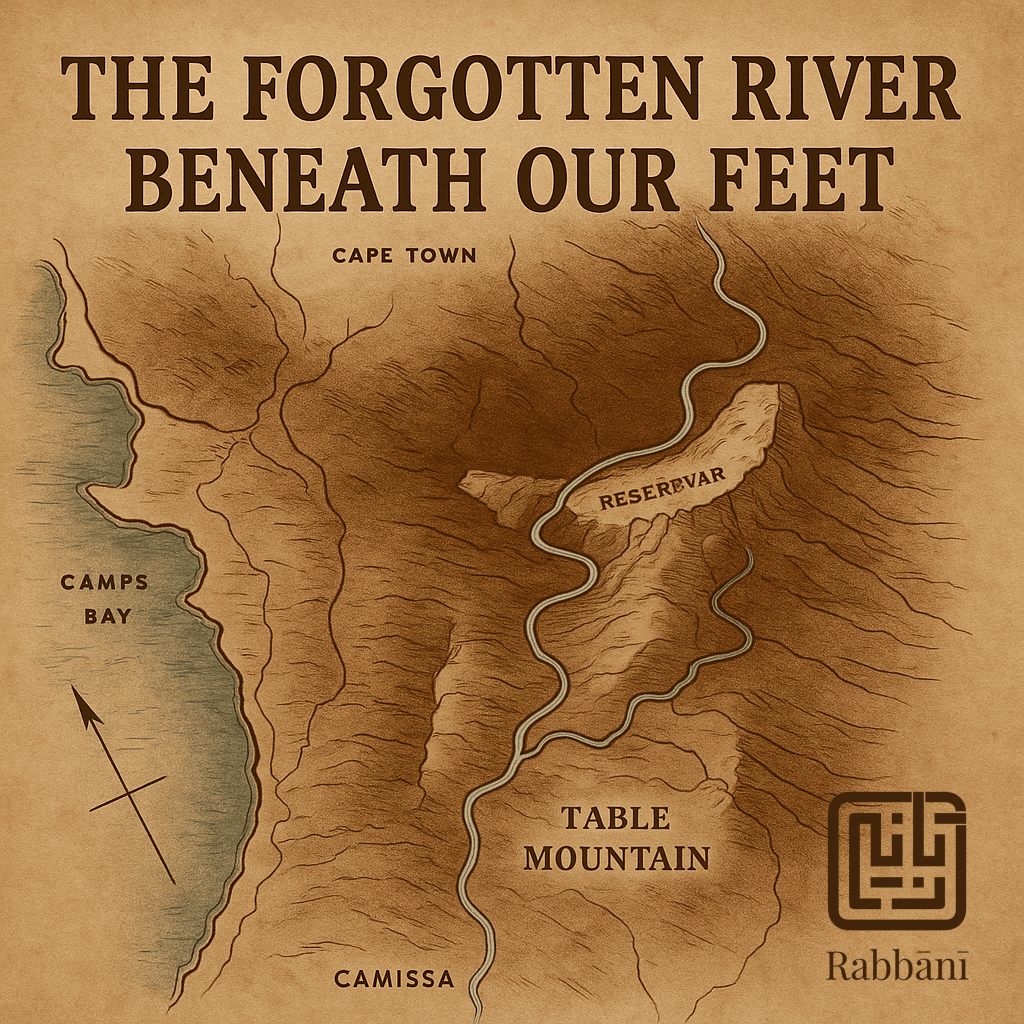
The Forgotten River Beneath Our Feet
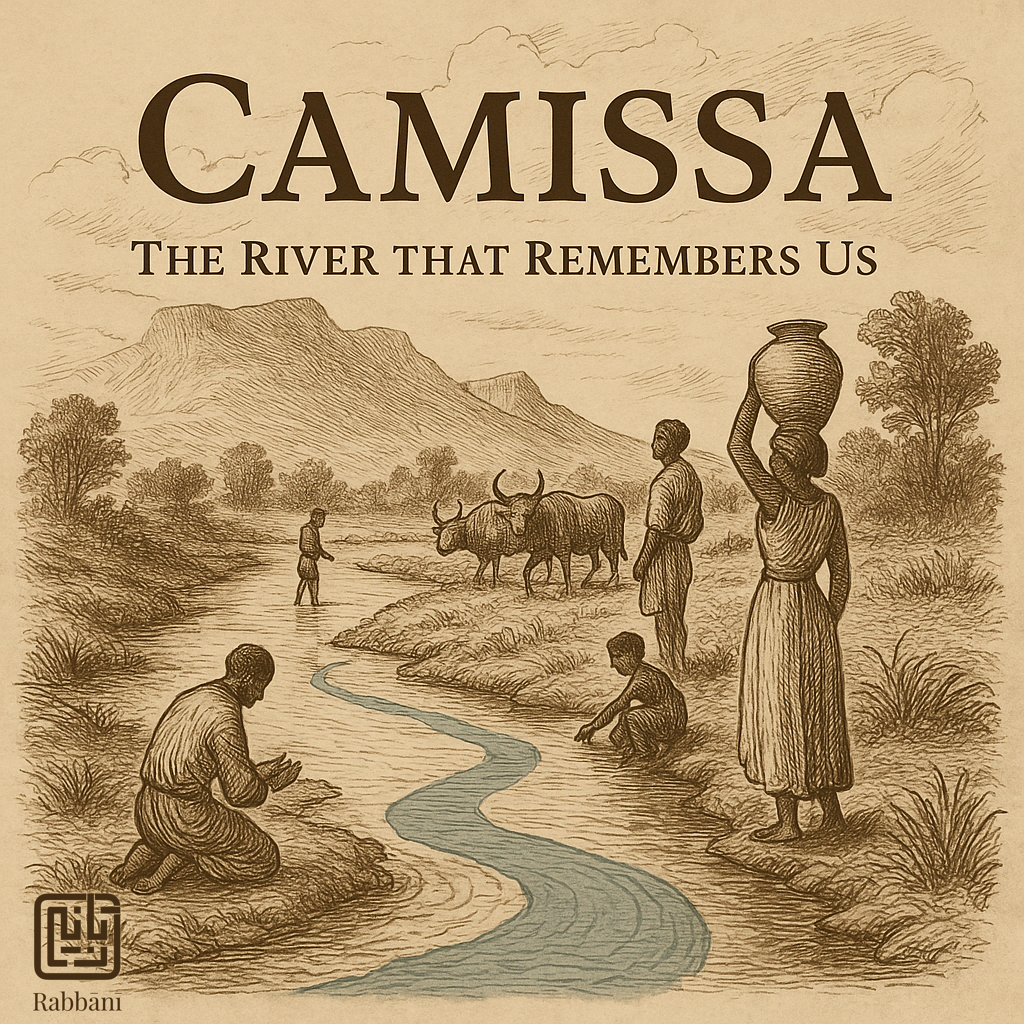
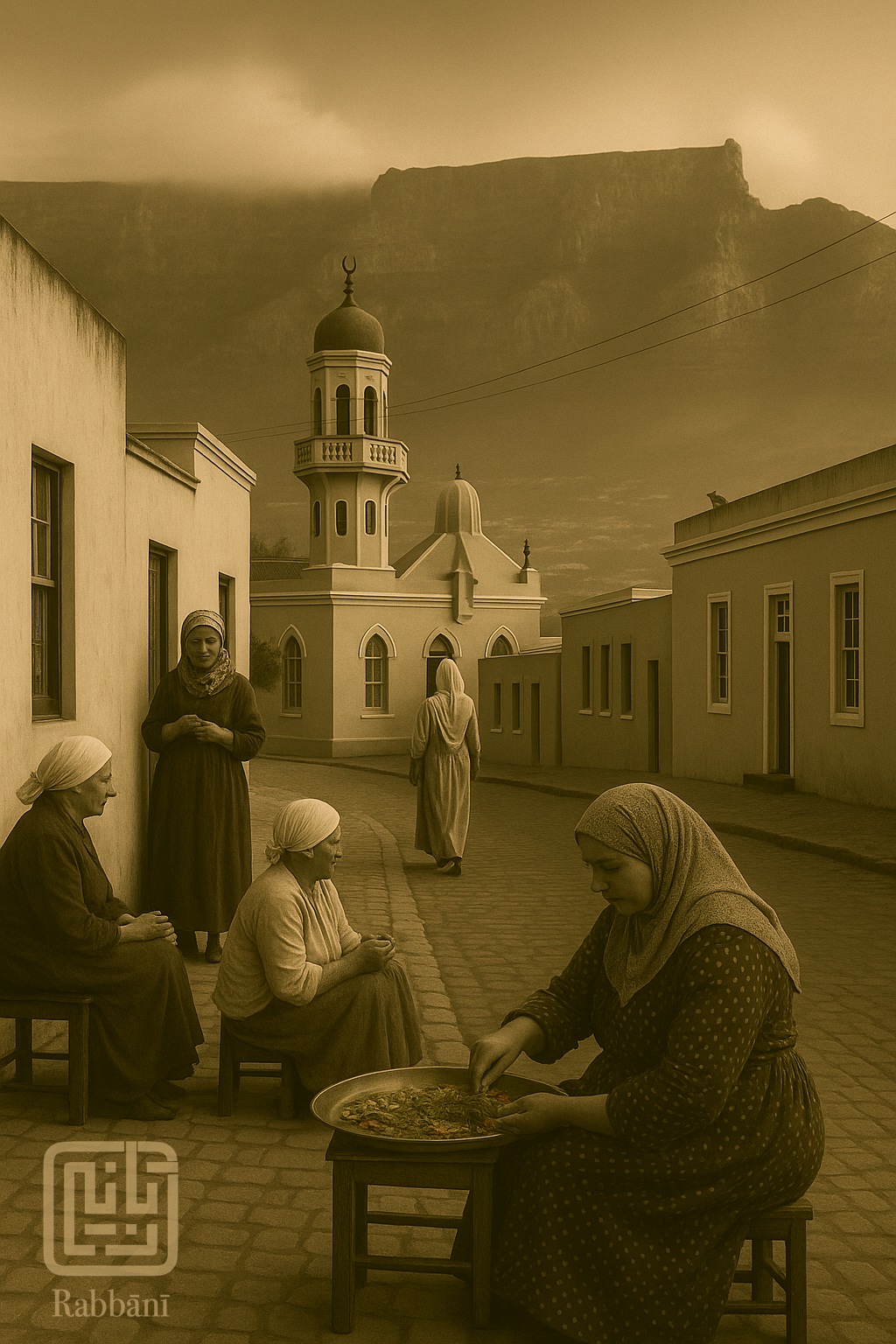
Before there were streets and buildings, before Company Gardens and canals, there was water. It rose from the springs of Table Mountain and came tumbling down in streams, gathering into what the Khoi called Camissa — the place of sweet waters. For centuries, this river sustained life at the Cape. The Khoi and San drank from it, rested by its banks, told stories in its shade. Later, enslaved men and women from Java, Bengal, Madagascar, Mozambique, and India touched its current as they bent under forced labour. Fresh water was the first mercy, and the first demand.
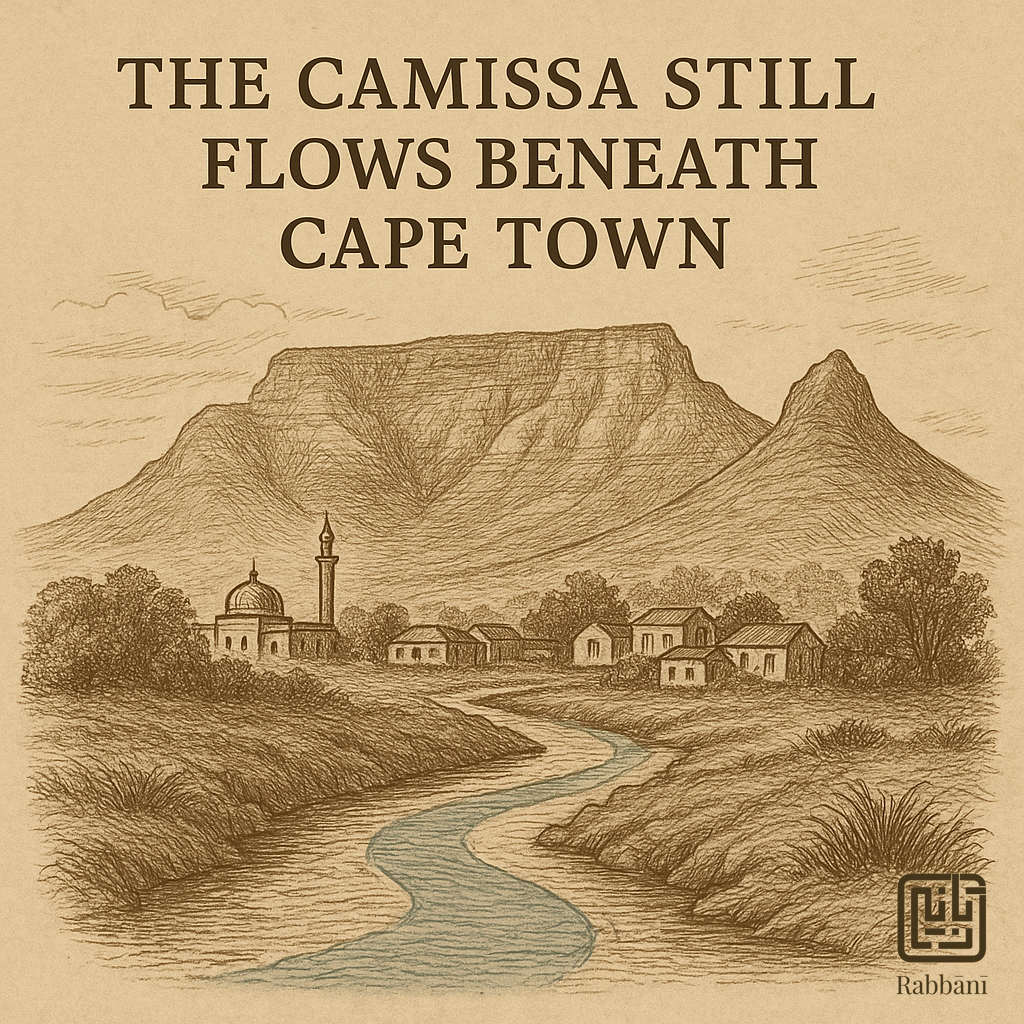
Camissa once ran openly down into the town. The Dutch East India Company carved it into canals, forcing its body into stone, bending it to their fort and gardens. But water has memory. It seeps under walls, reappears in unexpected places, refuses to be silenced. Today, buried beneath tar and pavement, Camissa still flows. And if you pause long enough, you might hear it whisper under your feet.
At the River’s Edge: A People Gathered
The river was never just water. It was a meeting place, a barzakh — a threshold where lives, languages, and faiths collided. Khoi pastoralists led cattle to drink. San hunters rested with skins and stories. Dutch settlers drew buckets to quench their fort. Slaves dug trenches, carried wood, and planted gardens for a company that claimed the river as its own.
Yet at the same banks, something else was happening. Free Blacks, exiles, manumitted slaves, and the first Muslims of the Cape gathered here. The Auwal Mosque — our first mosque — rose near the Camissa’s streams. Qur’an recitation and children’s laughter mingled with the sound of water. Out of pain, a people began to form.
African Camissa: A Wider Circle
Patric Tariq Mellet calls this heritage African Camissa. It is more than geography; it is an identity — a wider circle of becoming. In his telling, Camissa is the place where Khoi, San, enslaved Africans, Asian exiles, and their descendants all drank from the same stream, forming a new community beyond the colonial word “Coloured.”
Stuart Hall once said identity is not a fixed thing we inherit, but a process of becoming. Camissa is that process made visible in water — always moving, always reshaping, carrying traces of every stone it has touched.
The River of Resistance and Remembrance
Water has always been resistance. Hājar ran between the hills in desperation, and Zamzam burst forth in the desert — the well that still feeds millions of pilgrims. Camissa, too, gave life to those who were bound in chains. The VOC tried to control it, but enslaved hands touched it daily, and their songs flowed into it.
In my own writing, I have tried to follow these streams:
The Legend of the Silver Tree — a story of shimmering roots in mountain mist.
The Mother Tongue of Tasbih — where Afrikaans, written in Arabic script, became a stream of prayer.
Tamat — a reminder that completion is never an ending, but a living beginning.
Hājar — the Black mother whose faith turned thirst into a sacred inheritance.
All these pieces flow back into Camissa. The river is not only history — it is memory itself, resisting erasure.
Heritage Month: Listening for the Water
September often gives us monuments, parades, and neat stories of “unity in diversity.” But heritage is not polished granite or rainbow slogans. It is water that refuses to stay in its channel.
Camissa is buried, but not gone. It still seeps under Cape Town, carrying whispers of Khoi clans, slave lullabies, Qur’an verses, and the rhythm of ghoema drums. It reminds us that heritage is not just what we are handed, but what we choose to remember and honour.
Closing Reflection
The Camissa River still remembers us. It does not flow in straight lines. It curves, divides, disappears, and resurfaces — like our histories, like our families, like our faiths. To walk in Cape Town is to walk above water, on layers of memory that never dry out.
The tree shimmers still, for those who know where to look. The river flows still, for those who choose to listen.
🎥 This reflection also lives as a video. Watch it on [Instagram]
How empire sails in suits, and what it means to row in resistance.
🔰 Intro
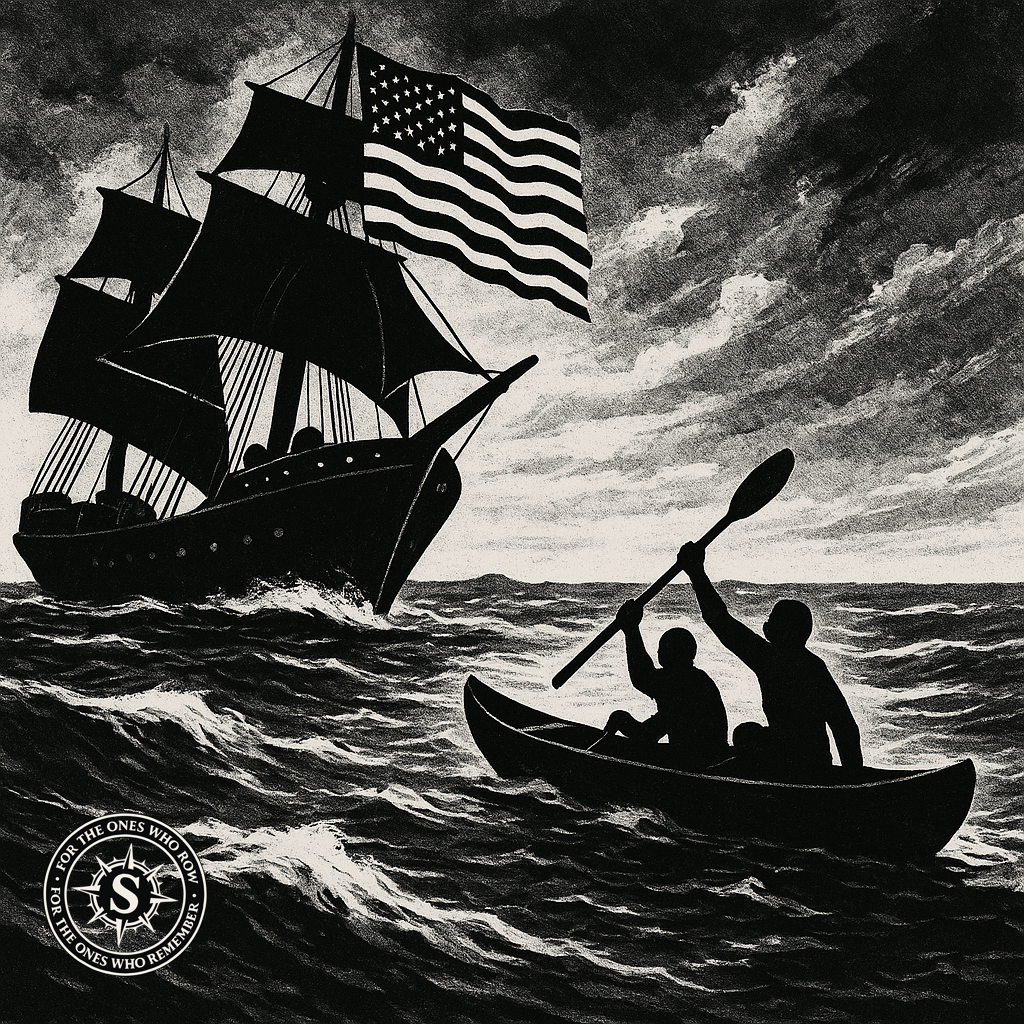
There was a time when pirates came with cutlasses and black flags. You saw them coming. You heard the war drums. But today — the pirates wear uniforms. Or suits. Or diplomatic smiles. And while their ships sail under the banner of freedom, the wake they leave is full of oil, fire, and broken nations.
This is a story about empire. But it’s also a story about you. About where you sit — above deck, below deck, or paddling in a canoe. It’s about resistance. Memory. And the unseen rows of angels above.
“The sea is full of flags — but not one lowers its sails in grief.”
They told us flags were symbols of freedom. They said democracy wears red, white, and blue. They taught us that when their soldiers arrive, the people are being saved.
But the flag flaps like a warning now. The stripes stretch across oceans. The stars are stamped on missiles. The anthem plays over drone strikes.
This isn’t peace. It’s piracy with better branding.
The United States isn’t a country anymore — it’s a flagship. The lead ship in a fleet of multinationals, financial institutions, media empires, and war machines.
It doesn’t sail for justice. It sails for lithium. For land. For leverage.
Its flag is the Jolly Roger of the modern age — not because it’s outlawed, but because it’s above the law. And while the old pirates hoisted black flags to strike fear, these ones wave their colours with pride… and call it diplomacy.
You see them dock in Gaza, in Haiti, in the Sahel. They don’t drop anchor — they drop sanctions. They don’t build bridges — they bulldoze economies. They leave schools shattered, mothers weeping, aquifers poisoned — and they call it freedom.
Even the boldest voices still need trade. Even South Africa, with its lawsuit and legacy, still knocks on the same doors. Because when the pirates run the ports, you have to smile as they loot.
Meanwhile, in Gaza, the killing continues. The children cry in Arabic, but no ship stops to help. The sea is full of flags, but not one lowers its sails in grief.
🏢 Section 2: The Pirates Have Offices Now
“You don’t need a coup when you can crash a currency.”
The pirates don’t need eye-patches anymore. They wear tailored suits. They don’t wave cutlasses — they carry clipboards. Their muskets have been replaced by metrics.
The modern pirate doesn’t kick down your door — he offers you a deal. An “investment.” A “development project.” A “partnership.”
But look closely: The lithium ends up in their electric cars. The water rights end up in their stock portfolios. The debt — always the debt — ends up around your children’s necks.
They’ve learned that you don’t need to invade a country if you can own its infrastructure. You don’t need to drop bombs if you can drop interest rates. You don’t need a coup when you can crash a currency.
BlackRock owns more land than many nations. Nestlé bottles water it didn’t pray for. Chevron calls oil sacred. Halliburton builds what the bombs destroy.
The empire privatized its violence. It outsourced the pillaging to companies with ethical mission statements. Its generals now wear CEO name tags. Its foot soldiers are analysts, consultants, lobbyists.
And when a country resists — like Bolivia, like Palestine, like Niger — it doesn’t get invaded at first. It gets discredited. Its leaders are called unstable. Its elections are called suspect. Its people are painted as dangerous, irrational, ungrateful.
This is how conquest works now: not with sails, but with spreadsheets. Not with warships, but with press releases. Not with swords — but with silence.
Somewhere, a young trade official — daughter of a struggle veteran — tries to resist. She sits in a Johannesburg office late at night, re-reading a contract with clauses meant to trap her people. She circles words in red. She drafts a softer version. She knows they won’t accept it. But still — she sends it.
🧠 Sidebar: They Stole the Thoughts Too
They didn’t just loot land and labour. They colonised knowledge. They broke open sacred libraries, and then wrote the footnotes in their own names.
The West calls it “intellectual property.” But it’s just patented plunder.
In Egypt, Plato sat at the feet of Black scholars. In Mali, the Dogon mapped the Sirius star system — long before telescopes. In South Asia, turmeric healed wounds before it had a bar code.
They burned the manuscripts of Timbuktu. Then they published “discoveries” about African medicine in European journals.
Today they say: “You owe us mobile phones.” But what they really mean is: “We branded what we stole.”
🛏 Section 3: Below Deck — The Ordinary Citizen
“The system is designed to keep the floor clean — even if the keel runs red.”
Empires aren’t only built by generals. They are built by people who go to work, come home tired, scroll a little, and sleep.
Below deck, life continues. The engines roar above, the orders are barked on the bridge — but here, the lighting is soft. There are supermarkets, streaming shows, lawnmowers, coffee shops.
No one hears the groans of the drowned. No one smells the smoke from the burning village.
Maybe they see something on the news — Gaza, Congo, Yemen. Maybe they feel a flicker of sorrow. Maybe not.
The comfort below deck is that you don’t have to know. The noise is muffled. The suffering is pixelated. The system is designed to keep the floor clean — even if the keel runs red.
And when someone does knock on the cabin door — a refugee, a witness, a protester — the citizens flinch. Not because they’re evil. But because it’s awkward. Disruptive. A crack in the illusion.
You see, this ship sells a story: “We are good.” “We bring freedom.” “We are the world’s hope.”
It’s a story whispered through education, hummed in entertainment, declared in politics. And most below deck believe it. Or want to. Or at least, want not to think about it too much.
One evening, a man in the suburbs clicks on a video about Gaza. He watches for seventeen seconds before an ad plays. He sighs. Skips it. Opens another tab. A special on air fryers. The horror slips away — not because he’s cruel, but because the system makes forgetting so easy.
Dissent is dulled with subscription bundles. A hundred shows to choose from. None of them about Palestine. And if that fails, there’s always a pill. A holiday. A hashtag that ends by Monday.
Because thinking leads to questions. And questions lead to guilt. And guilt demands action. And action? That rocks the boat.
🛶 Section 4: Canoes and Resistance
“These boats do not always win. But they do not drown quietly.”
Not every vessel sails under the pirate’s flag. Some float with patched sails and broken oars. They are small. Often sinking. But they do not bow.
They are the canoes of the world. Gaza, battered and besieged, still sings the Adhān through rubble. Haiti, dismembered by decades of debt and interference, still cooks its own rice. Congo, bleeding from every open vein of mineral wealth, still births drums and poems.
These are not nations that invade. They don’t fly drones or send tanks. They row.
And every stroke is resistance. Every preserved language, every intact culture, every refused bribe — resistance.
They are mocked for being poor. Starved for being proud. Punished for surviving.
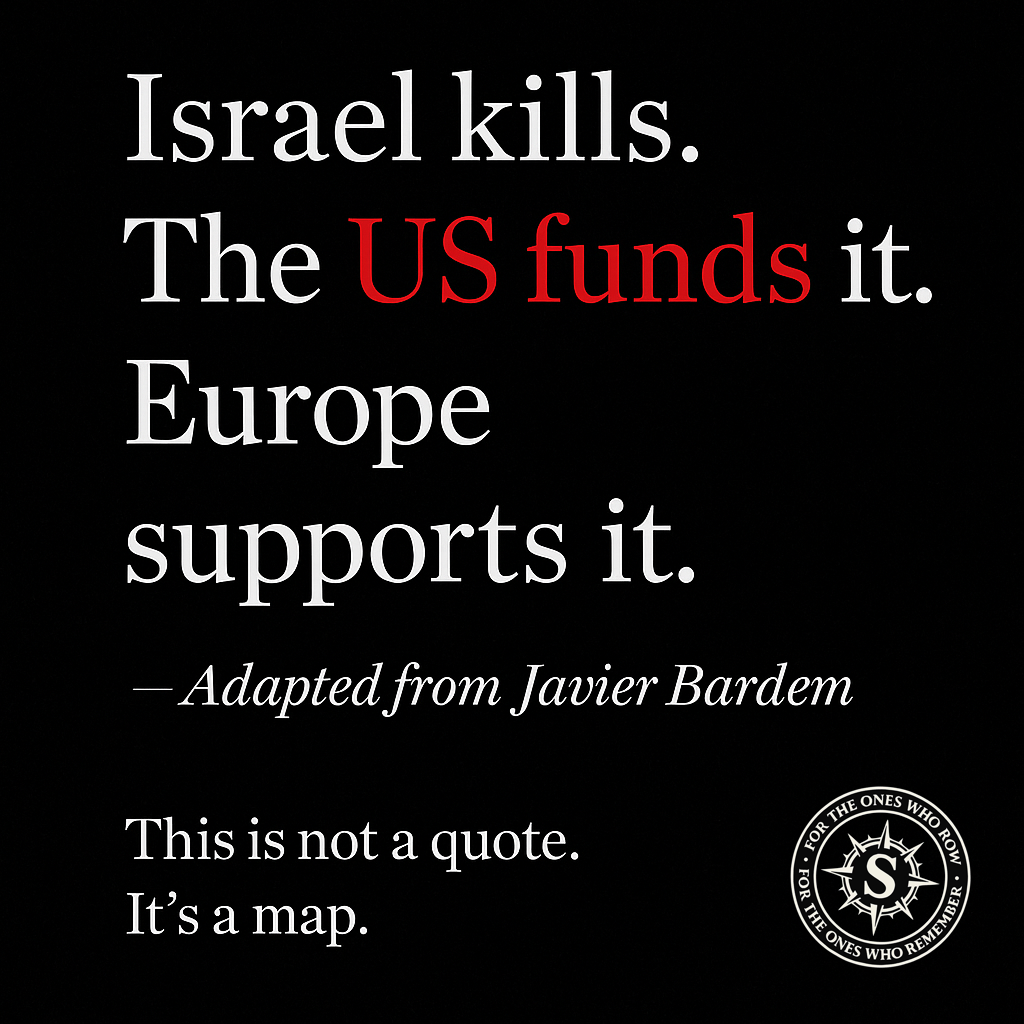
Some truths no longer need footnotes. As the Spanish actor Javier Bardem once said, bluntly and beautifully: “Israel kills. The US funds it. And Europe supports it.”
That’s not politics. That’s a map. A map of complicity. A map of whose silence lets the ship sail on.
The empire calls them unstable. Calls their leaders corrupt. Calls their children threats. But what they fear is not chaos — it’s clarity.
Because the canoe does not pretend. It knows the sea is dangerous. It knows what the pirate ship is.
And still, it rows.
Some canoes are communities. Some are movements. Some are just one grandmother who still tells the old stories — even as the bulldozers arrive.
Some of the canoes ride rivers: the Amazon, the Orange, the Missouri. In them sit the Mapuche, the Nama, the Sioux. They chant in languages the empire once tried to burn. They still paddle. They still protect.
As the bombs fall, a boy in Gaza recites lines from Mahmoud Darwish: “We have on this earth what makes life worth living.” He whispers them into the dust. Into his mother’s lap. It’s not defiance. It’s remembering.
These boats do not always win. But they do not drown quietly. Their resistance echoes — in funeral processions, in ululations, in the smell of fresh bread rising where bombs fell.
And in the far distance, something stirs. Not a boat. Not a bomb. But a wave. A rising swell of memory and reckoning. The kind that even empires cannot out-sail.
❓ Section 5: What Now?
“Maybe you can’t leave yet. But you can plant questions in the cracks of the hull.”
You’ve seen the ship. You’ve heard the cannons. You’ve walked the quiet corridors below deck. You’ve watched the canoes struggle to stay afloat.
So now the question is simple. What now?
You don’t have to be a general. You don’t have to command a fleet. But you do have choices.
You can choose not to cheer when the ship fires. You can choose not to believe the stories they sell you — about the savages, the chaos, the necessary war.
You can choose not to mock the canoe. You can choose to listen when the drowned call out from beneath the waves. You can learn their names. Say their prayers. Tell their stories.
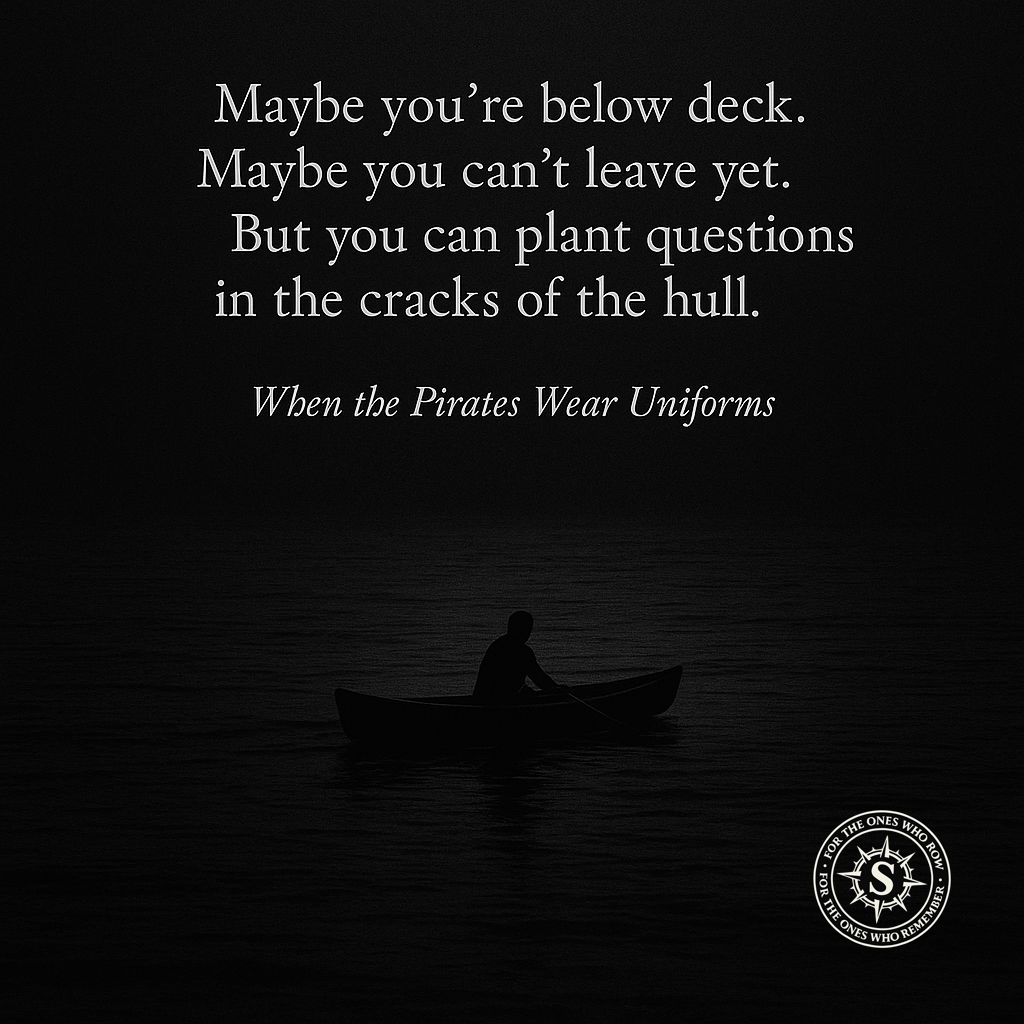
Maybe you’re below deck. Maybe you can’t leave yet. But you can plant questions like seeds in the cracks of the hull. You can make art that aches. You can whisper, even if your voice shakes.
And maybe, one day, when the ship hits a reef — you’ll already know how to swim.
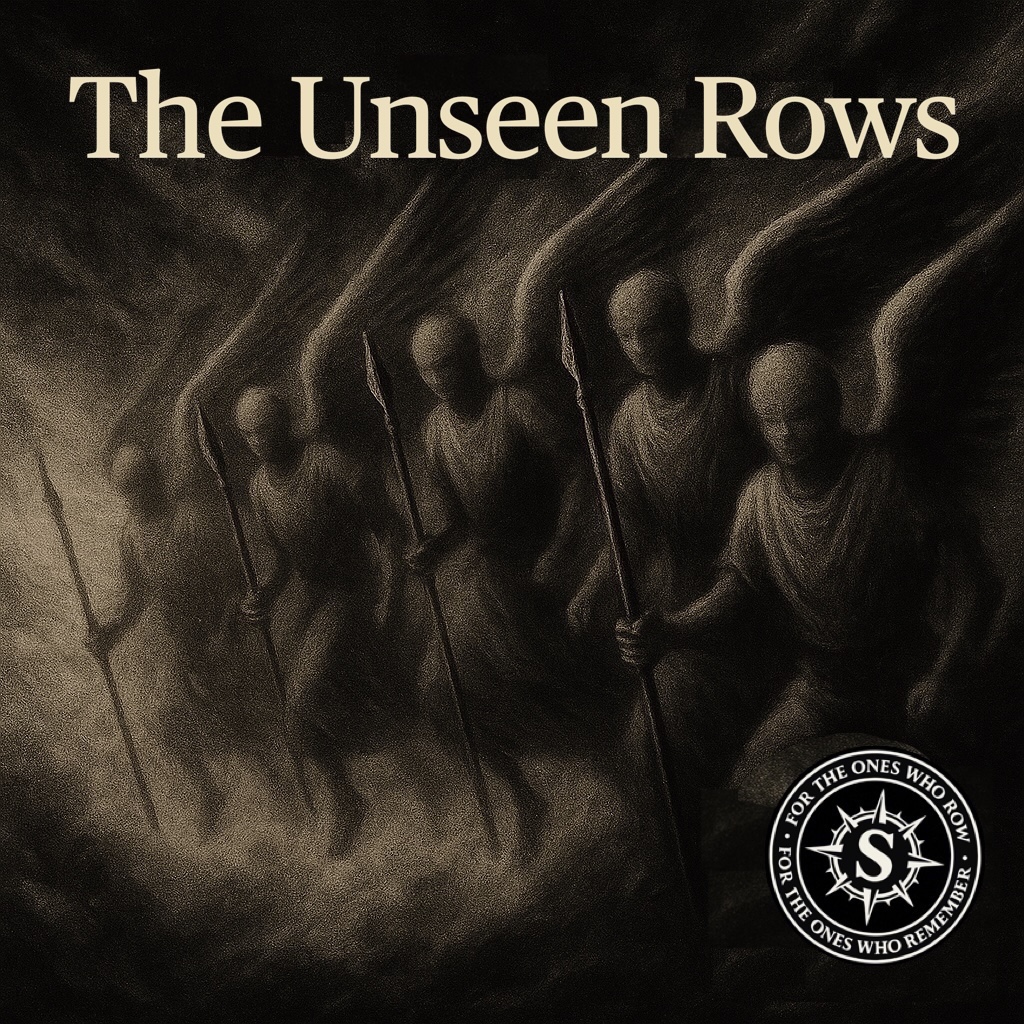
🌌 Postscript: The Unseen Rows
“Above the pirate ships, the angels line up.”
For the ones who row. For the ones who remember.
Above the shipping lanes and air raids, above the pirate flags and surveillance drones, above the offices and engines and war rooms — there are rows they do not see.
Al-Ṣāffāt. “By those arrayed in rows…” (Qur’ān 37:1) The angels. Not scattered. Not confused. Lined up — like soldiers of mercy. Advancing — like winds of truth. Reciting — not data, but dhikr.
وَالصَّافَّاتِ صَفًّا فَالزَّاجِرَاتِ زَجْرًا فَالتَّالِيَاتِ ذِكْرًا By those arrayed in ranks, by those who drive forward, and by those who recite the Reminder… (Qur’ān 37:1–3)
These are not symbols. They are not myths. They are the architecture of heaven. And they do not forget the ones who row.
When the shayāṭīn of power rise to steal, when the liars reach for whispers of the unseen, they are met with stones of fire. Comets hurled from truth’s edge. The skies are not neutral. The divine has guardians.
“They cannot listen to the Higher Assembly… they are pelted from every side, repelled, and for them is a perpetual punishment.” (Qur’ān 37:8–9)
And we? We row. We remember. We recite.
We do not carry cannons — but we carry verses. We are not in fleets — but we are not alone. Somewhere, angels are already in formation.
✨ A Final Word from Rafiq al-Bunduqia
The Sage on the Jetty
So here’s what I say, ne:
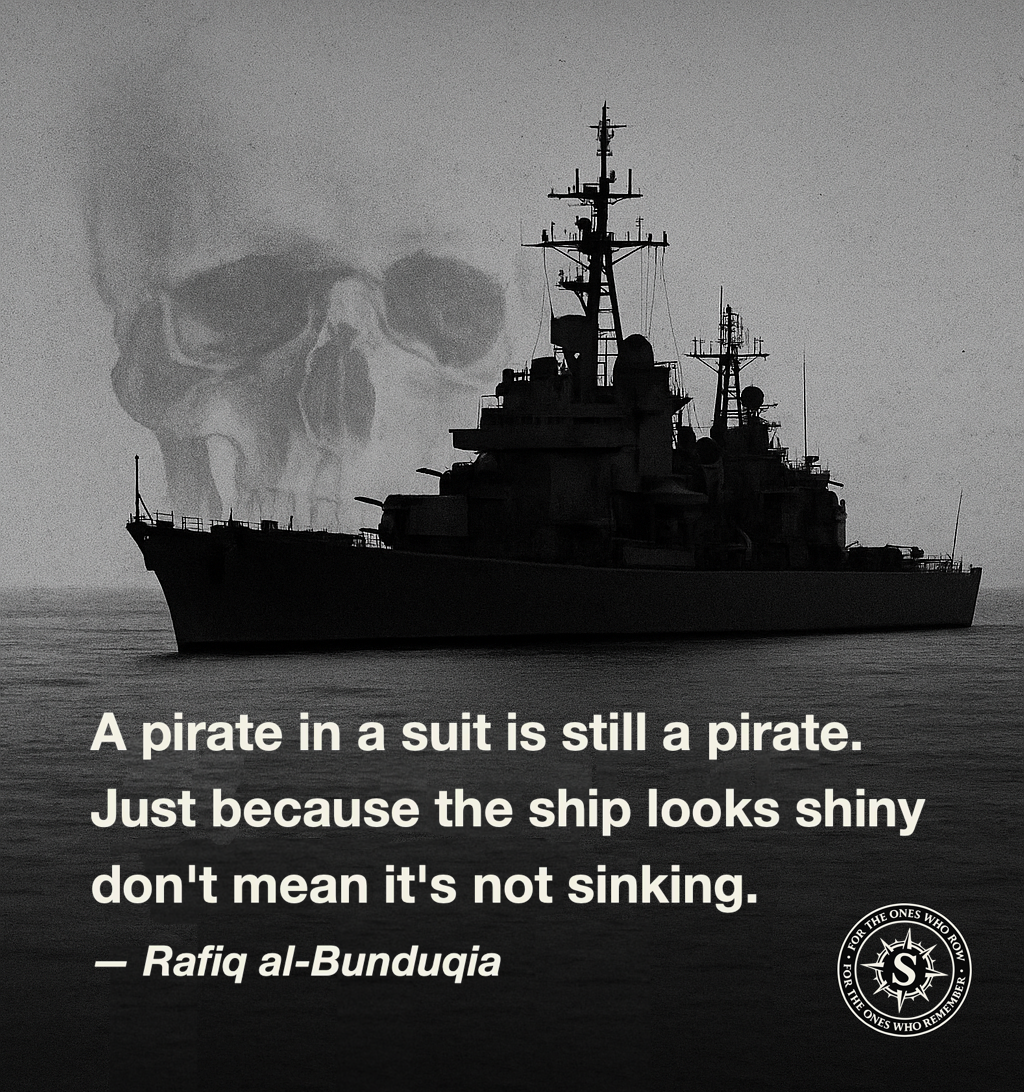
Don’t let them fool you with fancy uniforms and offshore accents. A pirate in a suit is still a pirate. And just because the ship looks shiny don’t mean it’s not sinking.
Me, I seen this before. The old flags change — but the hunger stays the same. They used to come for your gold. Now they come for your soul — and your SIM card.
They sell you peace while sharpening knives. Call it “stability,” call it “the market,” call it “regime change.” But listen close, my bru — they only change regimes that say “no.”
Below deck, I know some of you are tired. I know some of you feel small, feel stuck. But remember: Empires fall when enough people stop pretending.
You can’t steer the whole ship, but you can stop rowing. You can stop clapping for the captain. You can light a fire in your corner. And when the time comes — you’ll know which way to swim.
And as for the ones still paddling in canoes? Rowing against the wave, barefoot, hungry, heart full?
May your names be written on the wind. May your stories outlast the storm. And may your grandchildren sail free.
shotgun click
We ride till the ship breaks, bru. Until then — we don’t hand over our compass.
“Salaam to the angels who line up when we can’t. Salaam to the ones who row even with leaking boats. Salaam to the ones who still make dhikr in the dark.
And to the empire?
May you one day see what light you tried to drown.”
Ameen, and ashraaf ʿalaikum ya ṣaffāt.
The seal of remembrance — for the ones who row, and the ones who remember.
— Rafiq al-Bunduqia, The Sage on the Jetty 🧭
“The Pharaoh. The Banker. The Builder.”
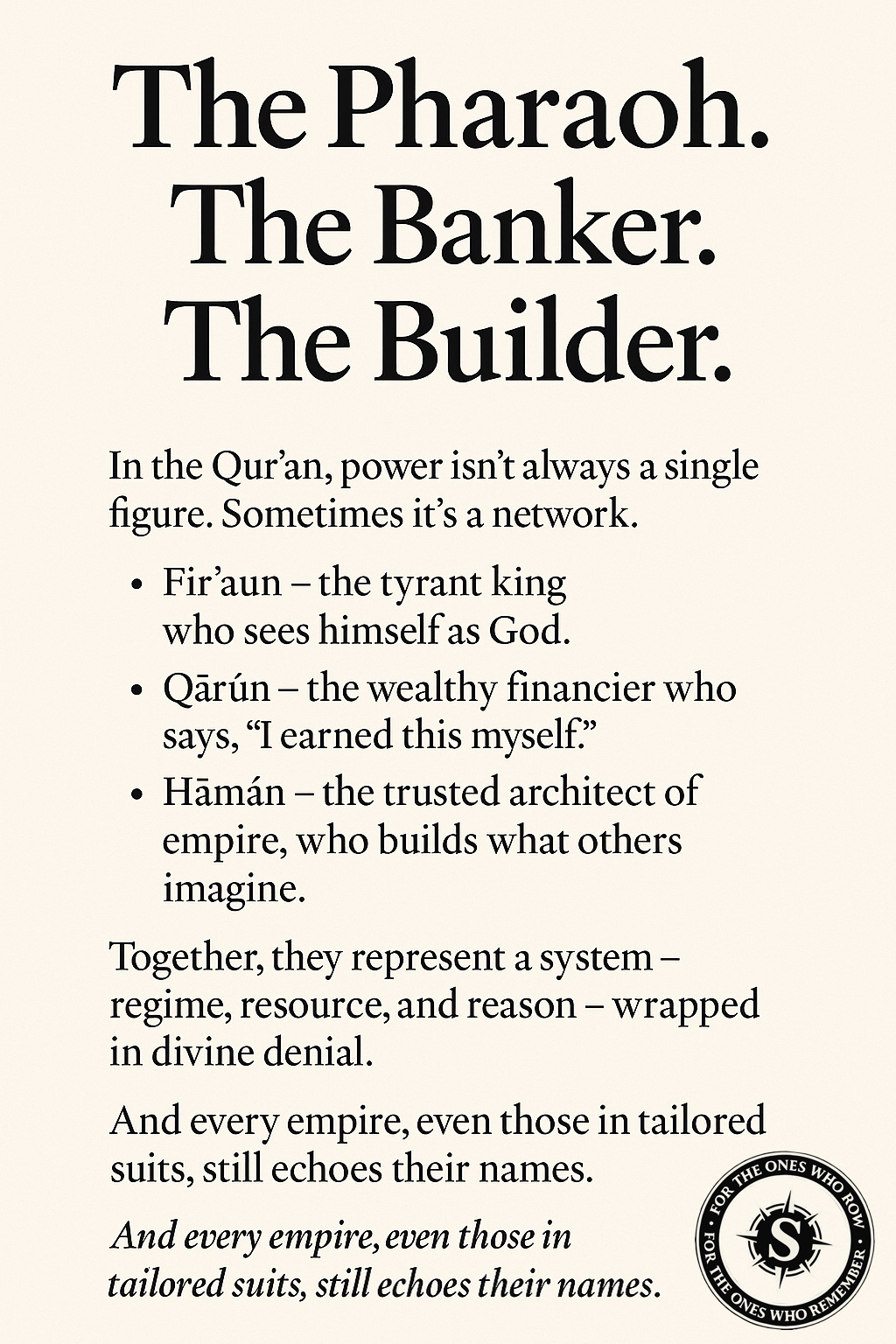
📜 Sidebar: The Three Faces of Tyranny Fir‘awn. Qārūn. Hāmān. These three figures appear repeatedly in the Qur’an — not just as villains of the past, but as types that recur across history. Fir‘awn: the dictator, the political oppressor. He claims divinity, demands obedience, and divides people to rule them. Qārūn: the hoarder, the economic elite. He flaunts his wealth, credits no one but himself, and forgets the source of all provision. Hāmān: the enabler, the bureaucrat and ideologue. He builds towers, writes the laws, manipulates truth, and justifies oppression in the name of order. Together, they form a system: the empire that marches with a flag in one hand, a contract in the other, and blood on its boots. Sound familiar?
“Today, they wear suits. They weaponise policy. But the triad still walks among us.”
The Pharaoh, the Banker, and the Builder
In the Qur’an, they stand together — a tyrant, a financier, and a master of infrastructure. Firʿawn ruled with cruelty. Qārūn hoarded with pride. Hāmān built towers for lies.
Centuries later, the empire shapeshifts. Today, they wear tailored suits. They pass laws. They sign cheques. They pave roads to ruin.
But remembrance makes them visible. And visibility is resistance.
“The Pharaoh. The Banker. The Builder.”
🧭 Parting Compass — A Note from Rafiq al-Bunduqia
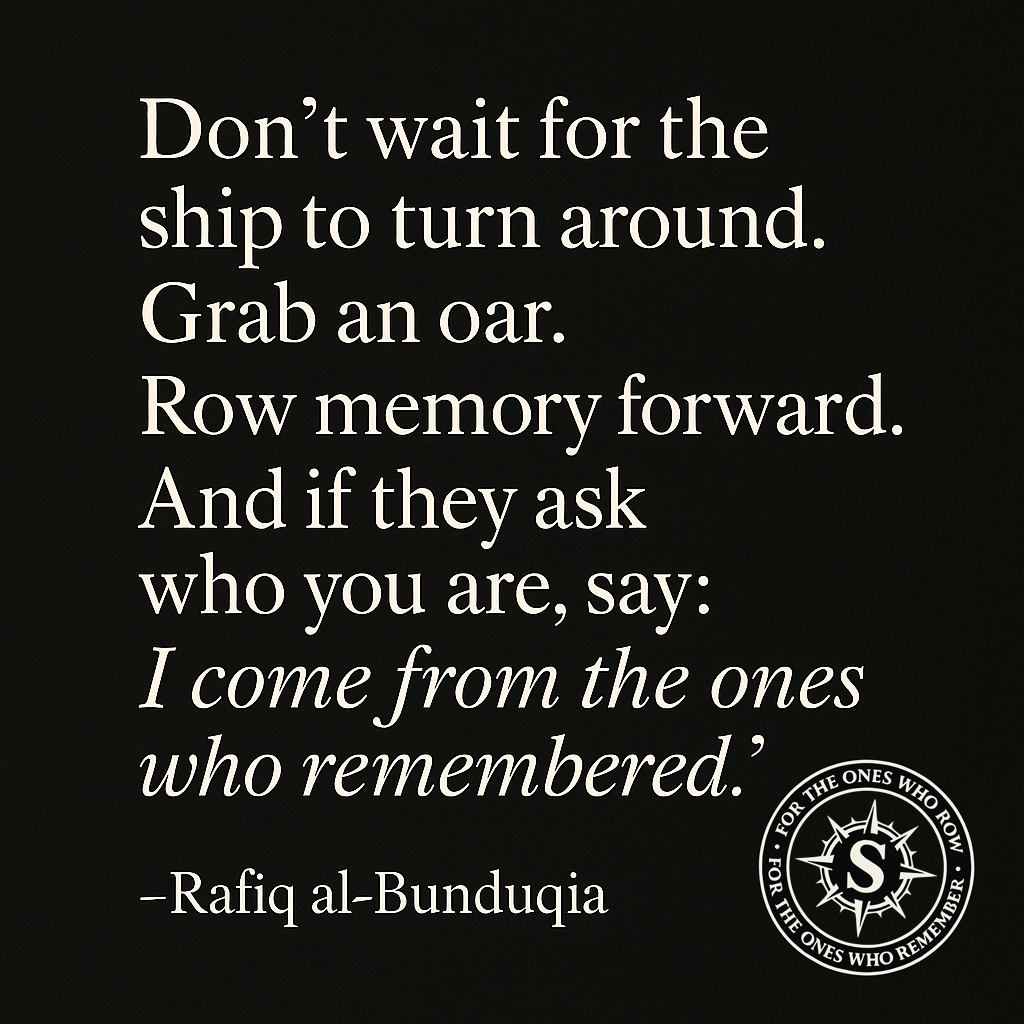
Don’t wait for the ship to turn around. Grab an oar. Row memory forward. And if they ask who you are, say: I come from the ones who remembered.
Koesister Mentality: Sweet Spice, Survival, and Sunday Mornings
More Than a Doughnut
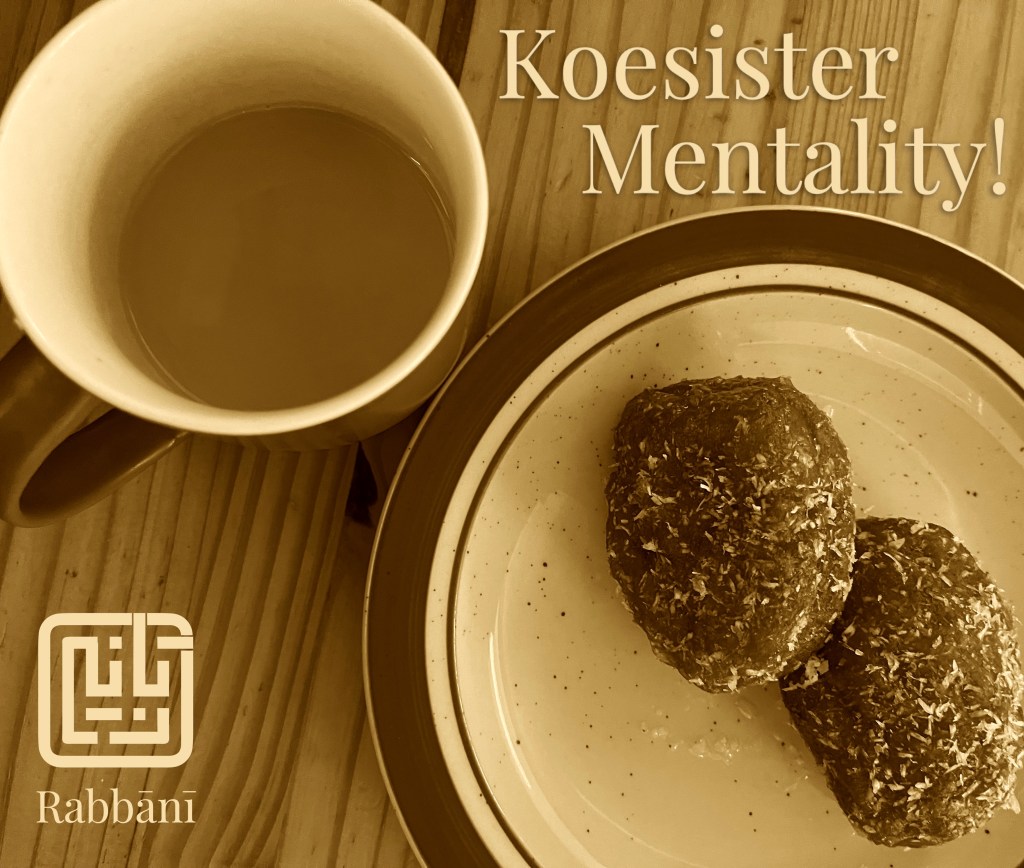
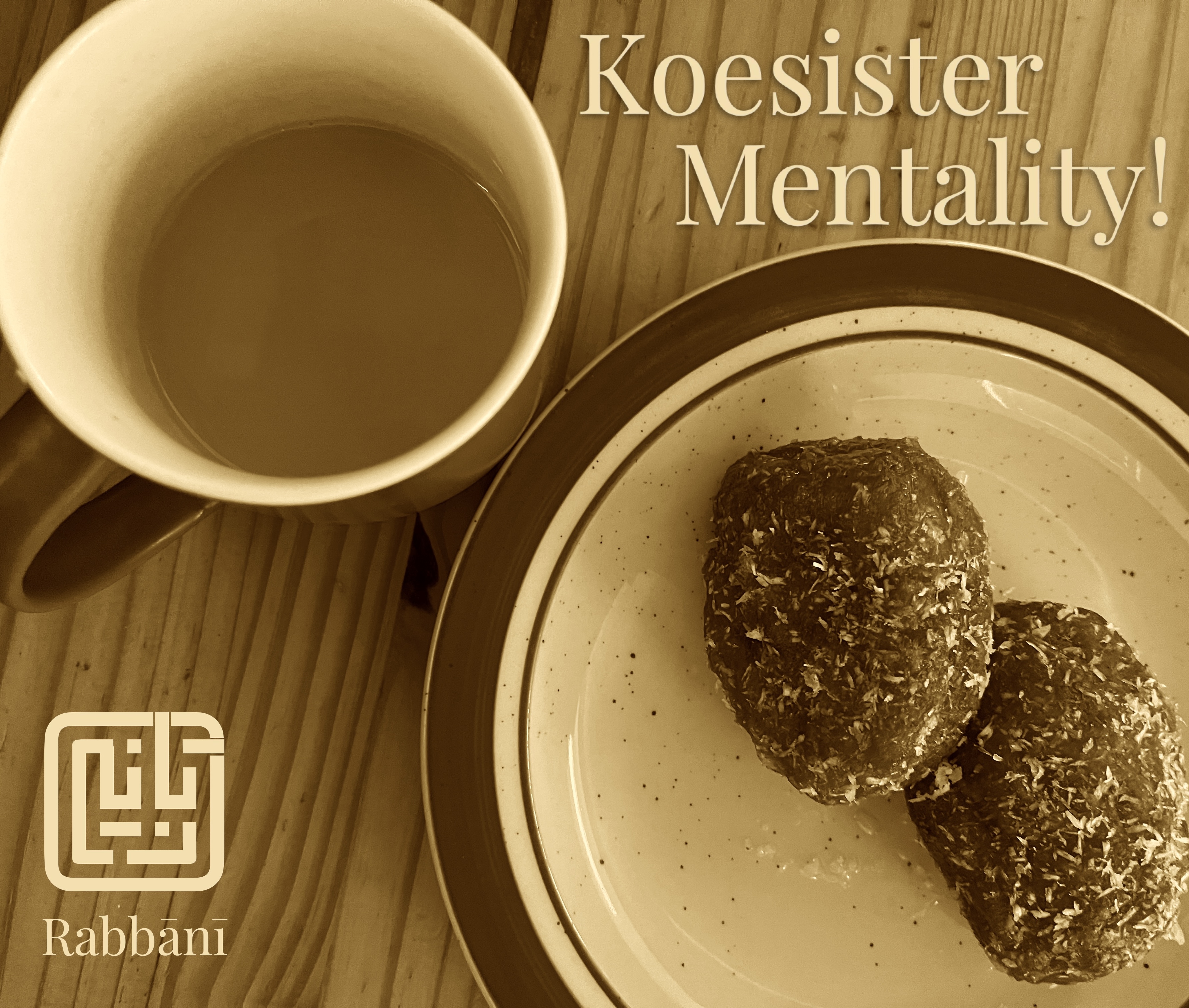
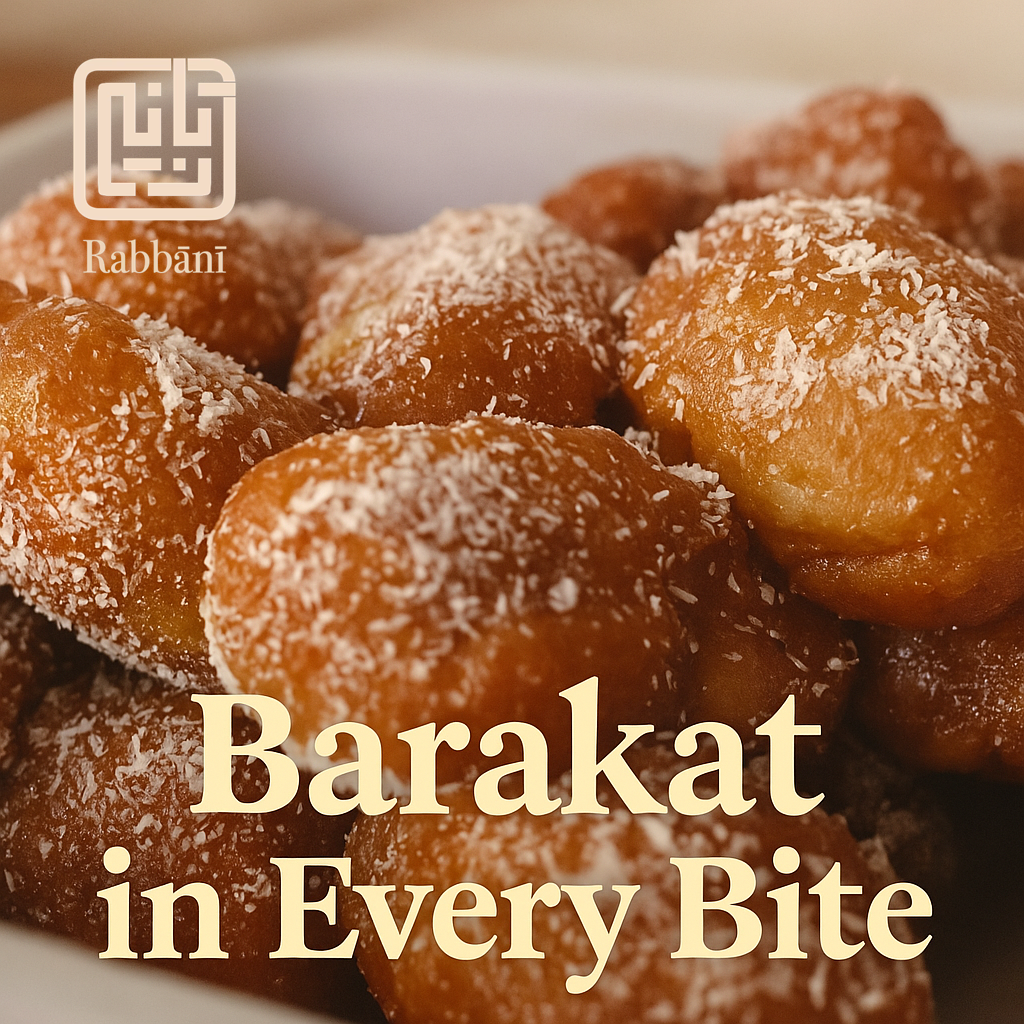
The koesister is not just fried dough dipped in syrup. It is a Cape Muslim archive you can taste: slavery and spice-routes folded into flour, patience stitched into the rise, mercy poured as syrup, and community dusted on like coconut. On Sundays in Cape Town, this is how memory is served warm.
From Chains to Sweetness: Where it Comes From
Enslaved and exiled people from Indonesia, Bengal, India, Madagascar and Mozambique brought spice grammars — cardamom, cinnamon, ginger, aniseed — into the Cape. In cramped kitchens they kneaded survival into foodways that became Cape cuisine.
The koesister was one such vessel: a creole of technique and faith, born in constraint, perfected in community.
Koesister vs Koeksister — why the “e” matters The Cape Malay koesister is a spiced, oval fritter simmered in syrup and rolled in coconut. The Afrikaner koeksister is a plaited, crisp fry dunked into cold syrup. They share a Dutch “koek” root but took divergent paths: one scented with aniseed and Sunday barakah; the other with braids and brittle sweetness.
Grinding the Memory
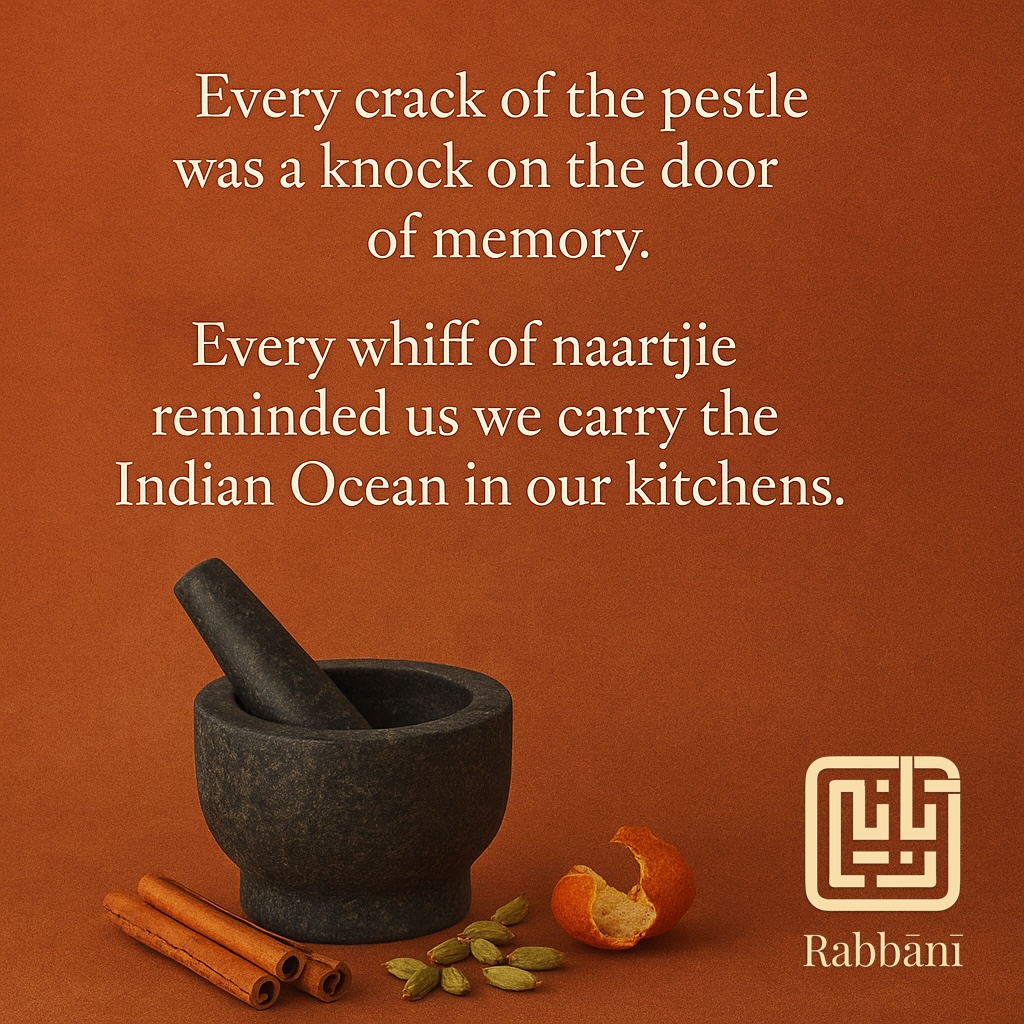
When I was a child, I would sit on my bum on the stoep, mortar and pestle between my legs, grinding cinnamon, cardamom, aniseed, and dried naartjie peel. The air filled with perfume, and I knew without knowing that these were not only flavours — they were history.
Spices that had crossed oceans with enslaved women were now ground by a child’s hands on a Cape Town stoep, ready to become part of Sunday morning koesisters. Every crack of the pestle was a knock on the door of memory, every whiff of naartjie a reminder that we carry the Indian Ocean in our kitchens.
Sundays in Primrose Park
I remember sugaring koesisters outside our front door in Primrose Park. Neighbours would stand in line on Sunday mornings, bowls in hand. My Tietie, Gadija — Dija, may Allah have mercy on her — made a koesister that was simple, fragrant, and always in demand.
She would wrap the dough in blankets to rise, then fry and dip until sticky, coating each with coconut. People didn’t come only for the sweet; they came for what the sweet held: blessing, neighbourliness, and survival in sugared form.
Two Recipes, One Lineage
Tietie Dija’s Koesisters
1 kg cake flour
2 large eggs
1 tsp fine salt
2 tsp each cinnamon, cardamom, ginger, aniseed
1 pkt yeast
½ cup oil
1 ½ cups lukewarm water (not more than 2 cups)
Method: Sift dry ingredients into a large bowl. Add eggs and oil, mixing with both hands until crumbly. Add water and knead into a ball. Cover with a bread packet and wrap in a blanket. Leave to rise for 2–3 hours. Fry, syrup, and serve with coconut.
10 g instant yeast, 1 cup sugar, 2 cups hot water, 2 tbsp butter, ±2 cups milk
Oil for deep frying
Method: Melt butter and sugar in hot water, add milk to make 1 litre. Mix with flour, spices, and yeast to form a soft dough. Let rise until doubled. Shape into balls, then oblongs. Fry until golden. Dip into syrup (sugar, water, cardamom, cinnamon), and sprinkle with coconut. Optionally slit and fill with glazed coconut.
The Art of Sugaring a Koesister
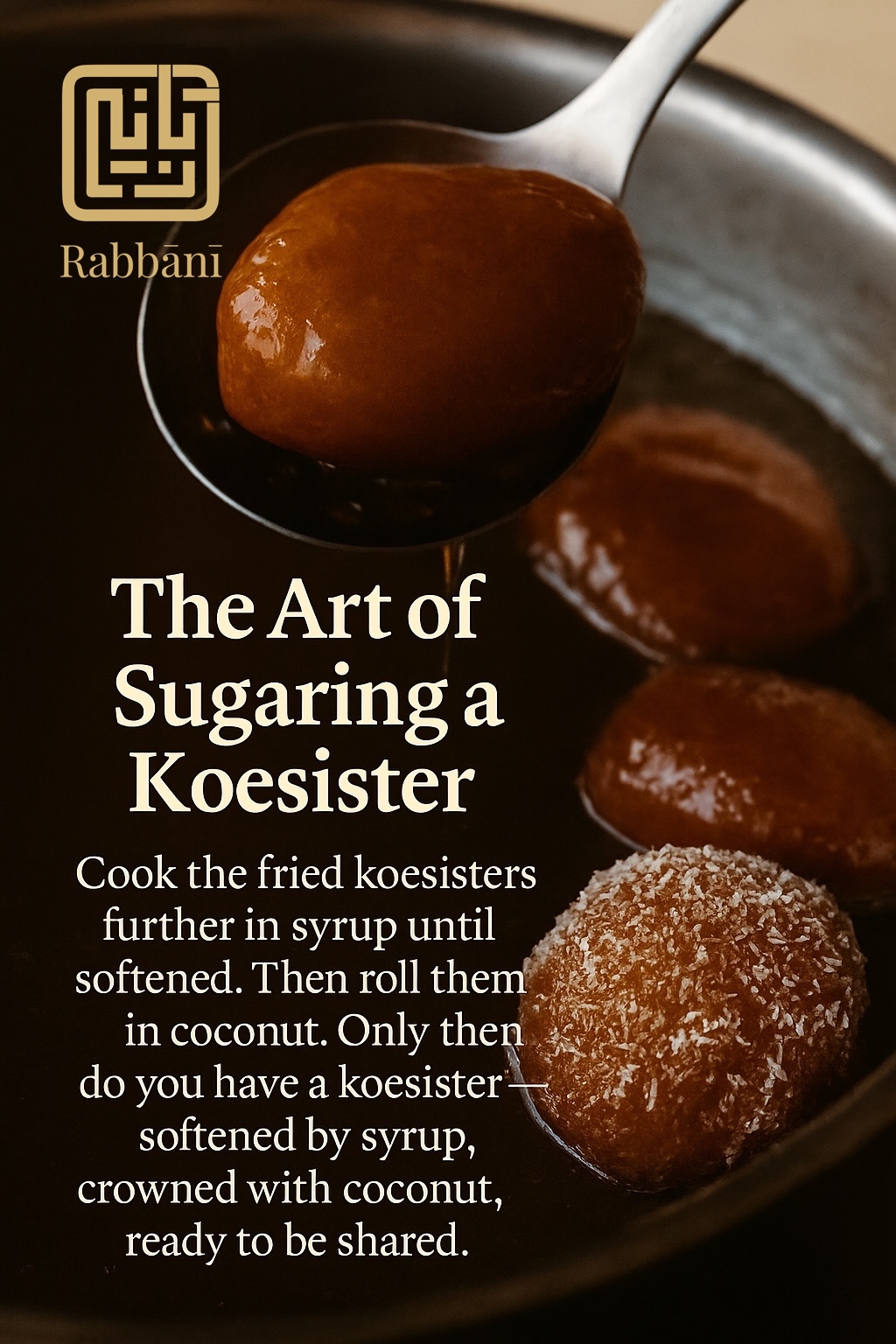
People often miss the essence of the koesister. This is not the crisp, cold-dipped koeksister. Astaghfirullāh, you don’t just fry and dunk.
In a nice biggish pot you cook:
1 cup water
1 cup sugar
(Optional, but beloved: cardamom, cinnamon, and even a touch of honey for barakah and shine).
Watch the pot until it starts to get sticky. You test it with a spoon: lift the syrup and see how the drips slow down. That’s the sign.
Now — and this is the secret — you add in the dry fried koesisters to the pot. Stir them gently, let them continue cooking together, prod with your spoon until they soften and drink the syrup. Keep a cup of water ready when it gets too sticky. But use it sparingly. Only then do you take them out, roll them in coconut, and place them in the bowl.
That’s when you have a koesister: softened by syrup, crowned with coconut, ready to be shared.
The Barakat of the Koesister
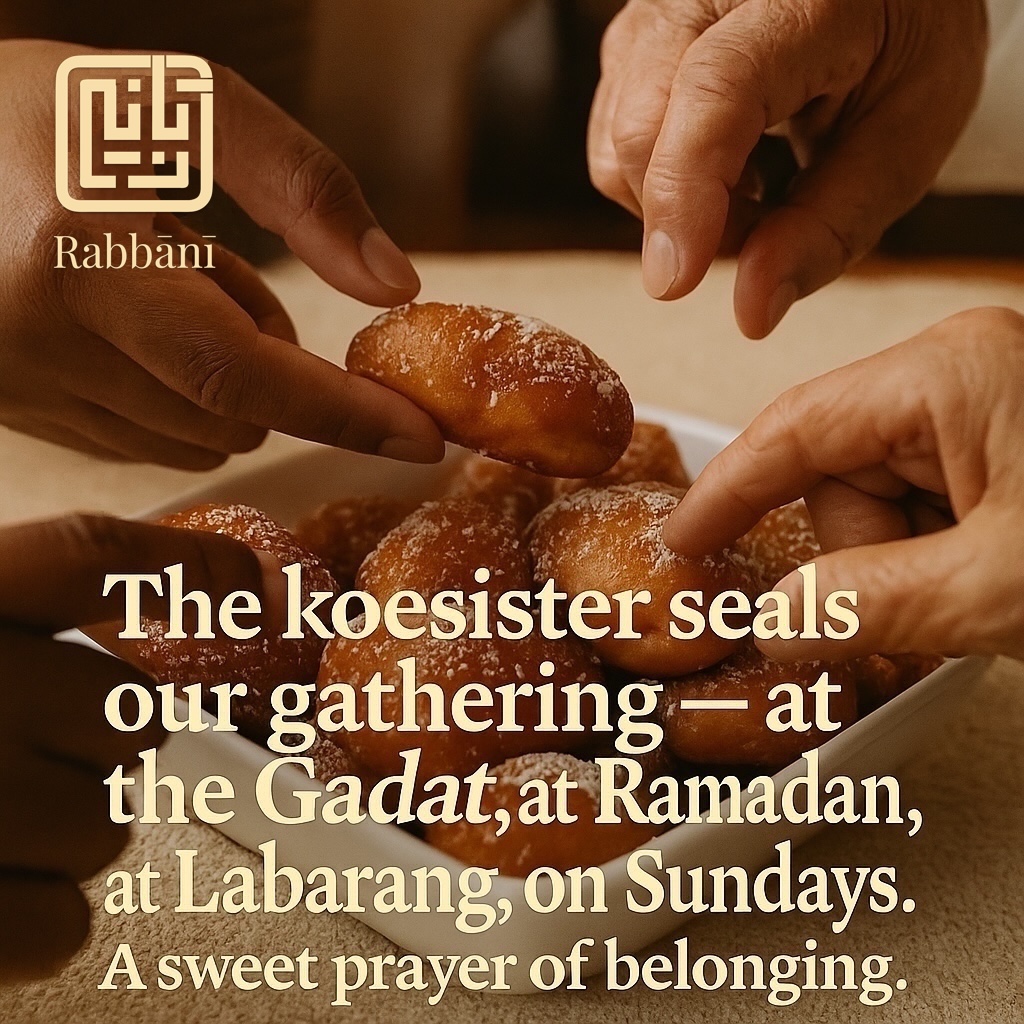
The koesister is not confined to Sundays. It turns up wherever barakah gathers:
At the Gadat (dhikr circle): trays of koesisters pass between voices chanting the Divine Names, sweetness sealing the remembrance.
At weddings: slipped into barakat parcels — alongside nuts and sweetmeats — a reminder that joy is for sharing.
In Ramadan: laid on iftar tables, syrup echoing the mercy of breaking fast.
At Labarang (Eid): no celebration is complete without sticky fingers and coconut laughter.
Every Sunday morning: queues outside homes in District Six, Bo-Kaap, Athlone, Primrose Park.
In all these settings, the koesister is a seal of blessing: a sweet amen after prayer, a sugared handshake of belonging.
Symbolism: What the Steps Teach
The yeast: intention, a spark that lifts everything.
The rise (under blankets): hidden work, dignity rising even in silence.
The oil: trial by heat — sabr through fire.
The syrup: mercy, binding the cracks and soaking to the core.
The coconut: hospitality, a dusting that says this is for sharing.
The Sunday bowl: community, where every vessel is filled, no one excluded.
This is why elders said: Life is like a koesister — not so lekker if eaten raw, but sweet when endured, fried, and dipped in mercy.
Koesister Mentality: Sweetness After Struggle
To eat a koesister is to eat history — slavery, spice routes, resilience, survival. To make one is to carry that tradition forward.
Koesister Mentality is more than humour or heritage: it is the ethic of rising, enduring, softening with mercy, and sharing abundance. Sweetness after struggle, but never without memory.
Once, “koesister mentality” meant narrow thinking. But I steal it back, and sugar it differently: for me, koesister mentality is resilience after rising, sweetness after struggle, and barakat in every bite.
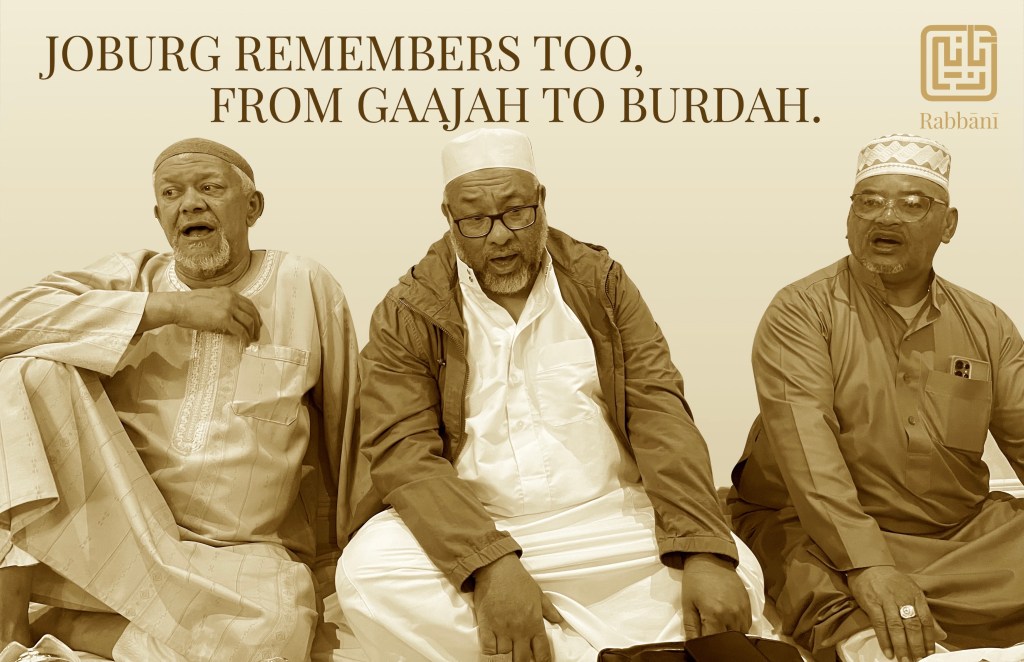
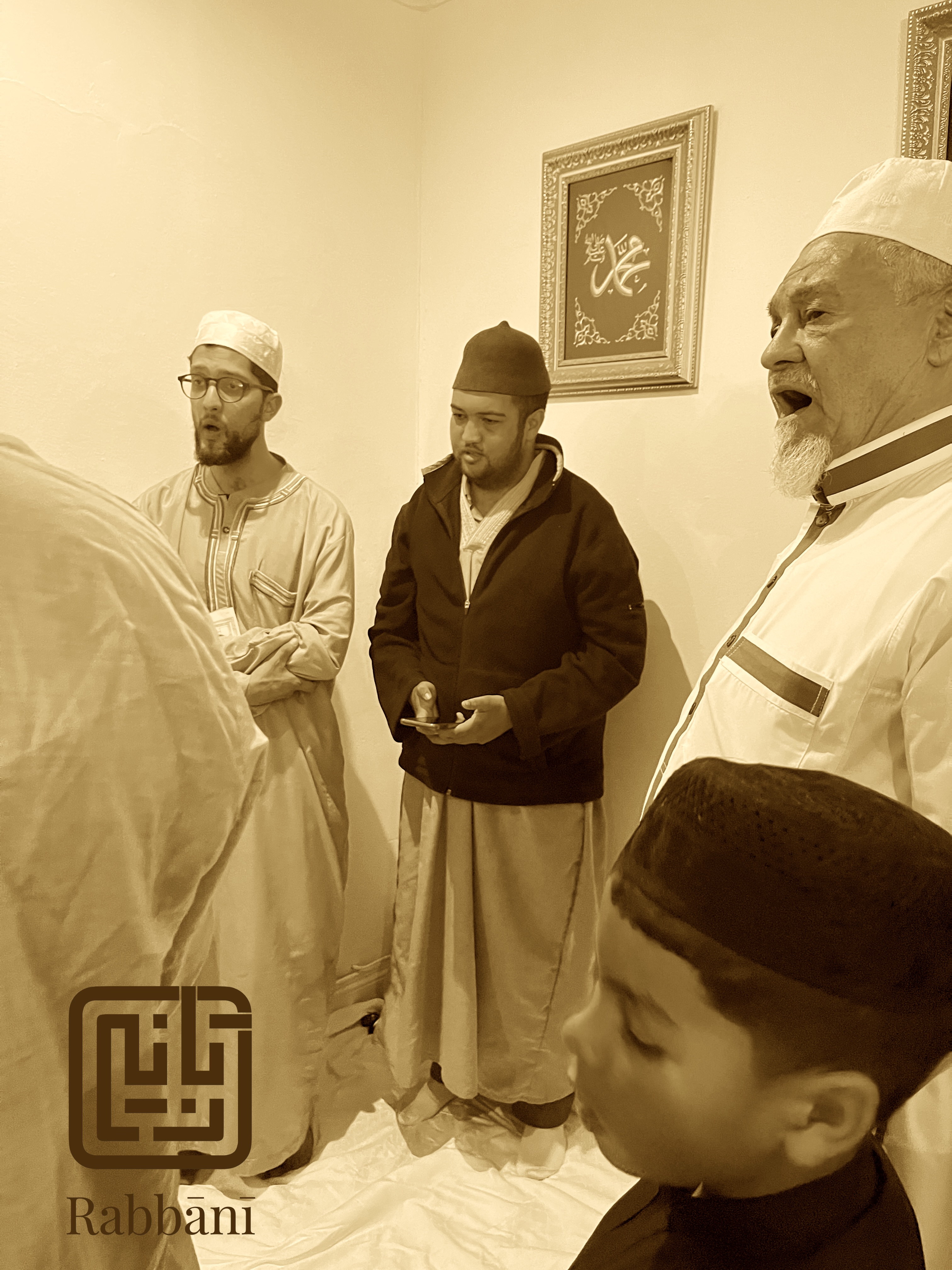
The room was warm with family and remembrance. Qur’ans lay open, voices moving together through Yāsīn, Mulk, the Quls, verses of Ḥashr and Baqara. Then came the Asmāʾ al-Ḥusnā, dhikr in chorus, and a duʿā that softened every heart.
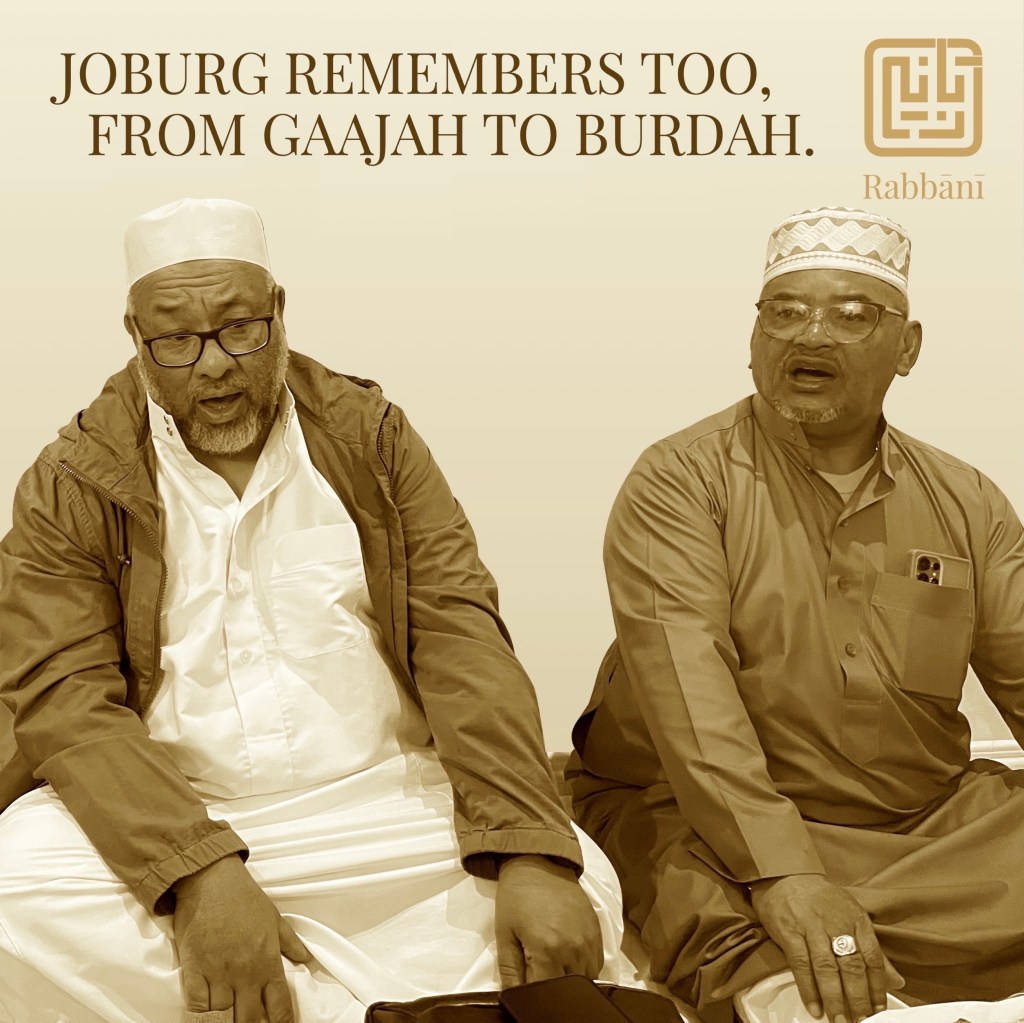
It was called an Arwaag, but as my friend Shakeel Garda reminded me, this was really a Gaajah — from ḥājah, a need. That night the “need” was joy: the birthdays of two young daughters, celebrated with Qur’an and remembrance. In Cape Town, we are used to dhikr circling grief, but here in Joburg, it circled life — proof that dhikr belongs to both birth and remembrance.
Beyond Cape Town
Too often, Cape Town is imagined as the sole custodian of these traditions. But remembrance does not belong to one city. It lives in Worcester, in Uitenhage, in Kimberley, in Joburg — wherever Muslims have gathered to cut rampies, to recite Yā Sīn, to raise salawāt. We must widen the circle, and not let heritage shrink into a single accent or postcode.
Heritage isn’t measured by the size of a crowd, but by the pulse that refuses to stop.
A Wider Map of Memory
I laughed when Shakeel said, “Ek het amper gesamba!” — because sometimes the subtle linkages do astound us.
On language and dialect, PE-born Boeta Yusie – remembers how it felt when hearing old Uitenhage folk speak their Afrikaans, slower than usual, every word taking time to land.
And here in Joburg too, the old families — the Matthews, the Domingos, the Sallies among so many others — have carried remembrance for generations. Some, like the Sallies, trace ties to Port Elizabeth, but all became founding Johannesburg families in their own right.
In Florida North, during the Gaajah, we stood for the salawāt — the Cape inheritance. Voices rose, and in that standing it felt as if the light of Muhammad ﷺ entered the room.
Heritage does not have one accent, one city, one rhythm. It stretches wider — across towns and valleys, across languages and lineages — carried in every echo of lā ilāha illa’Llāh.
Houghton Masjid – The Chorus of the Burdah
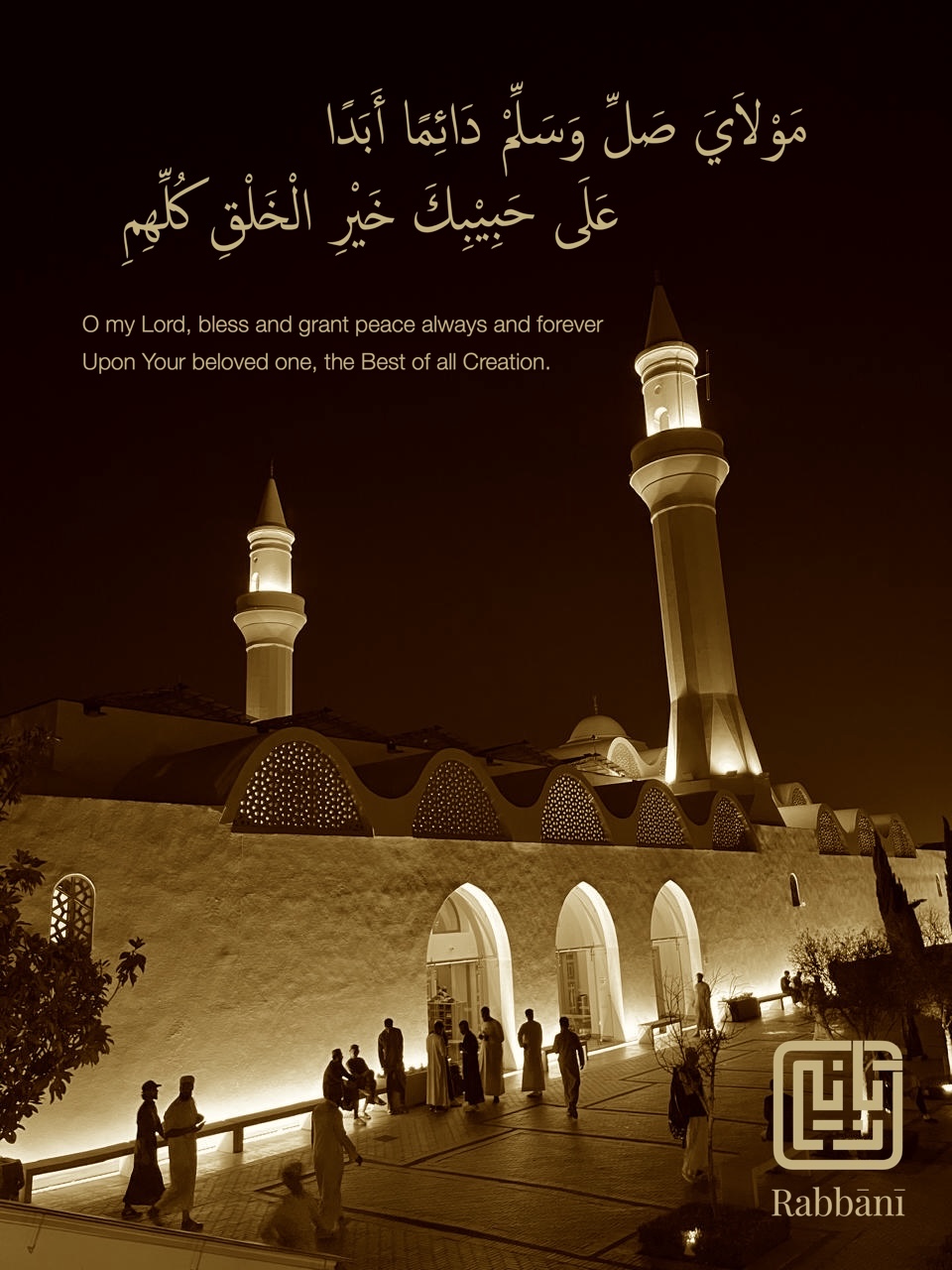
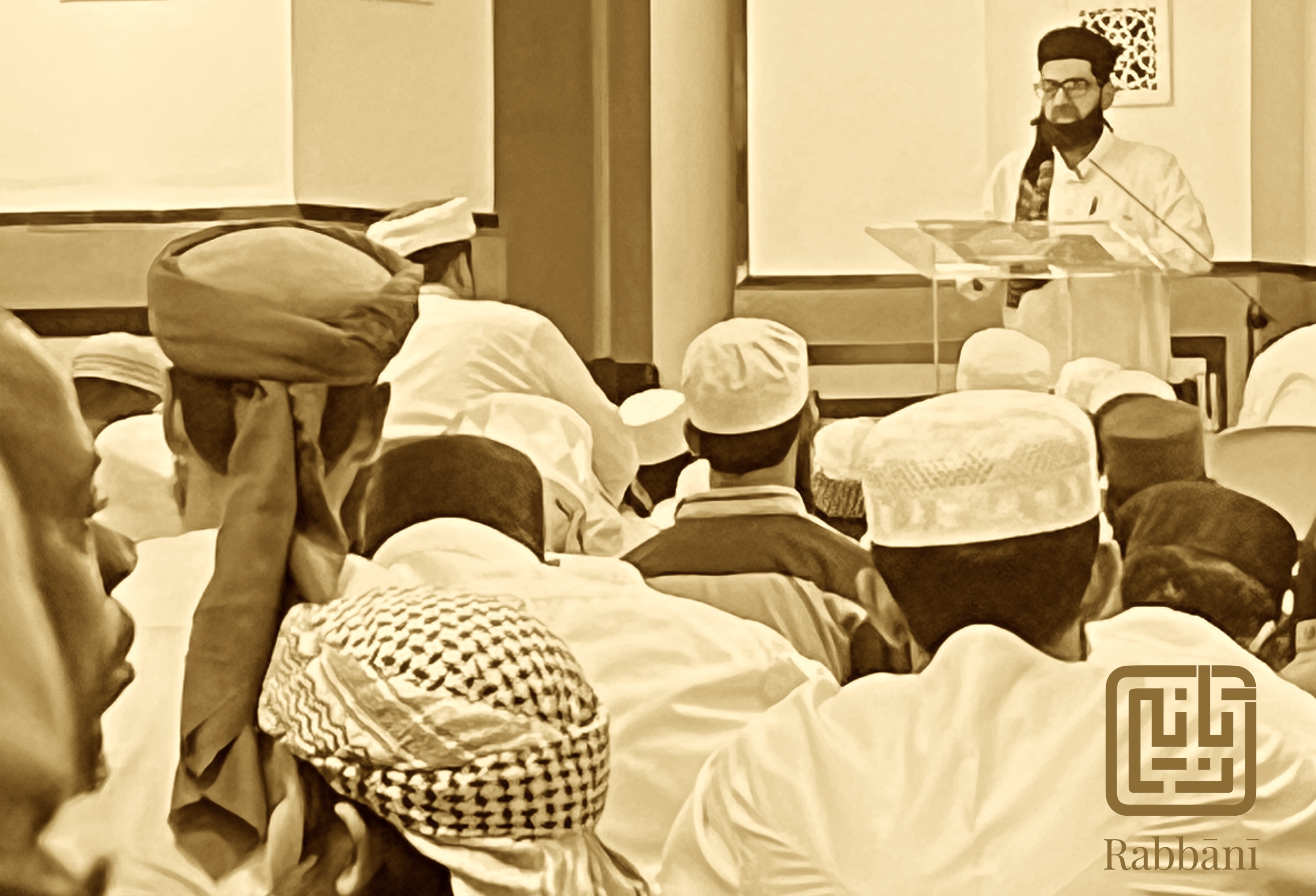
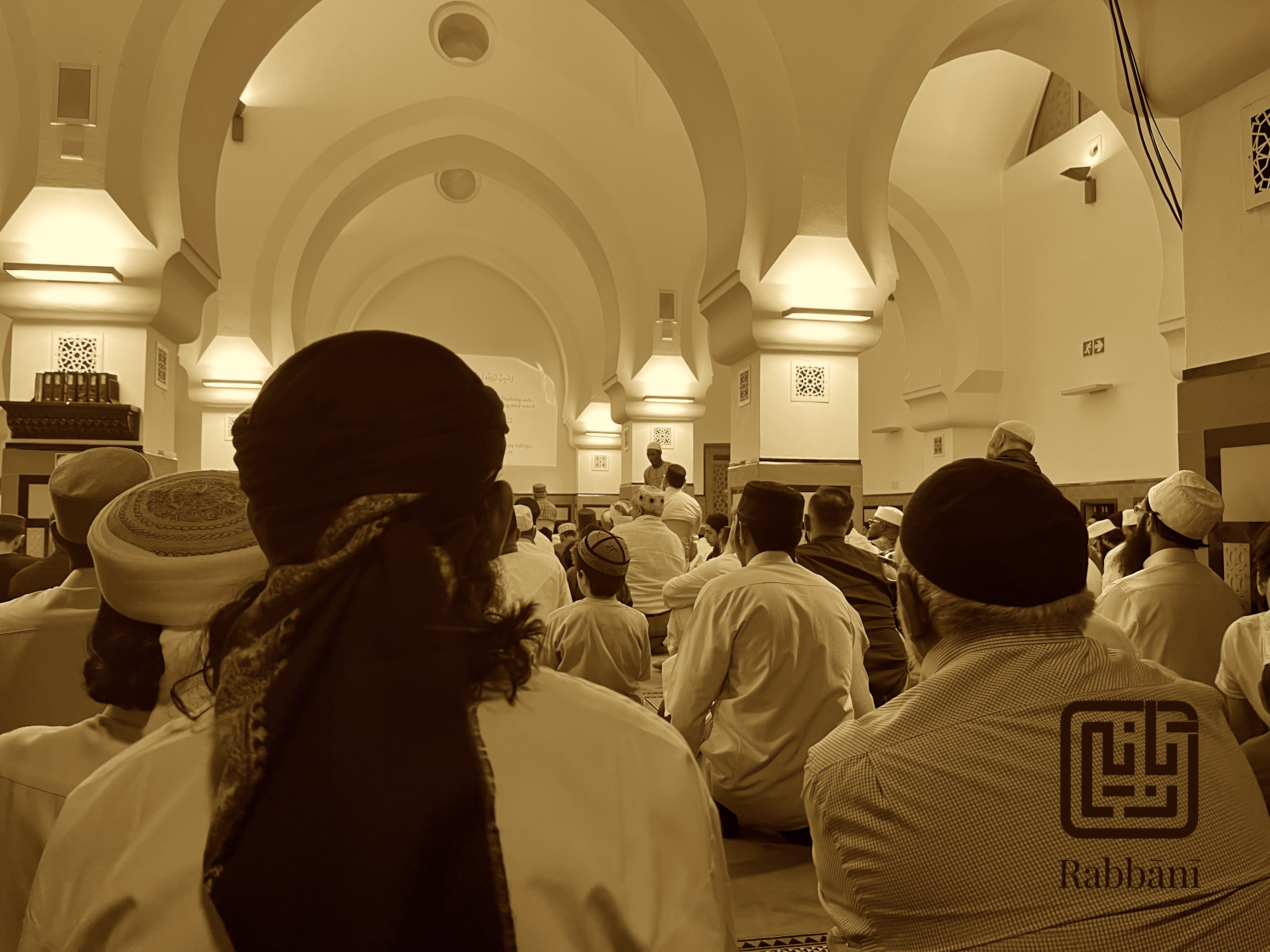
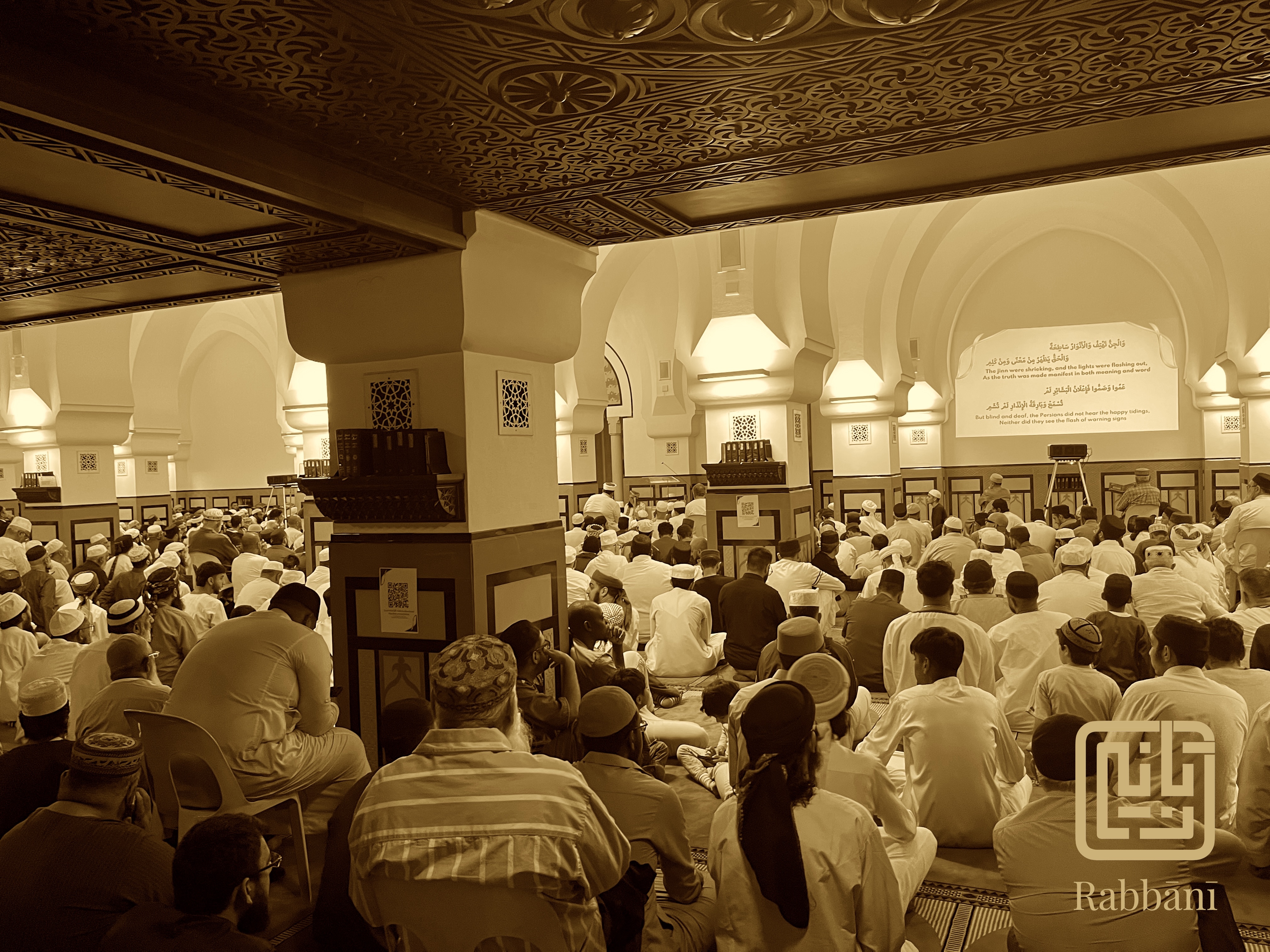
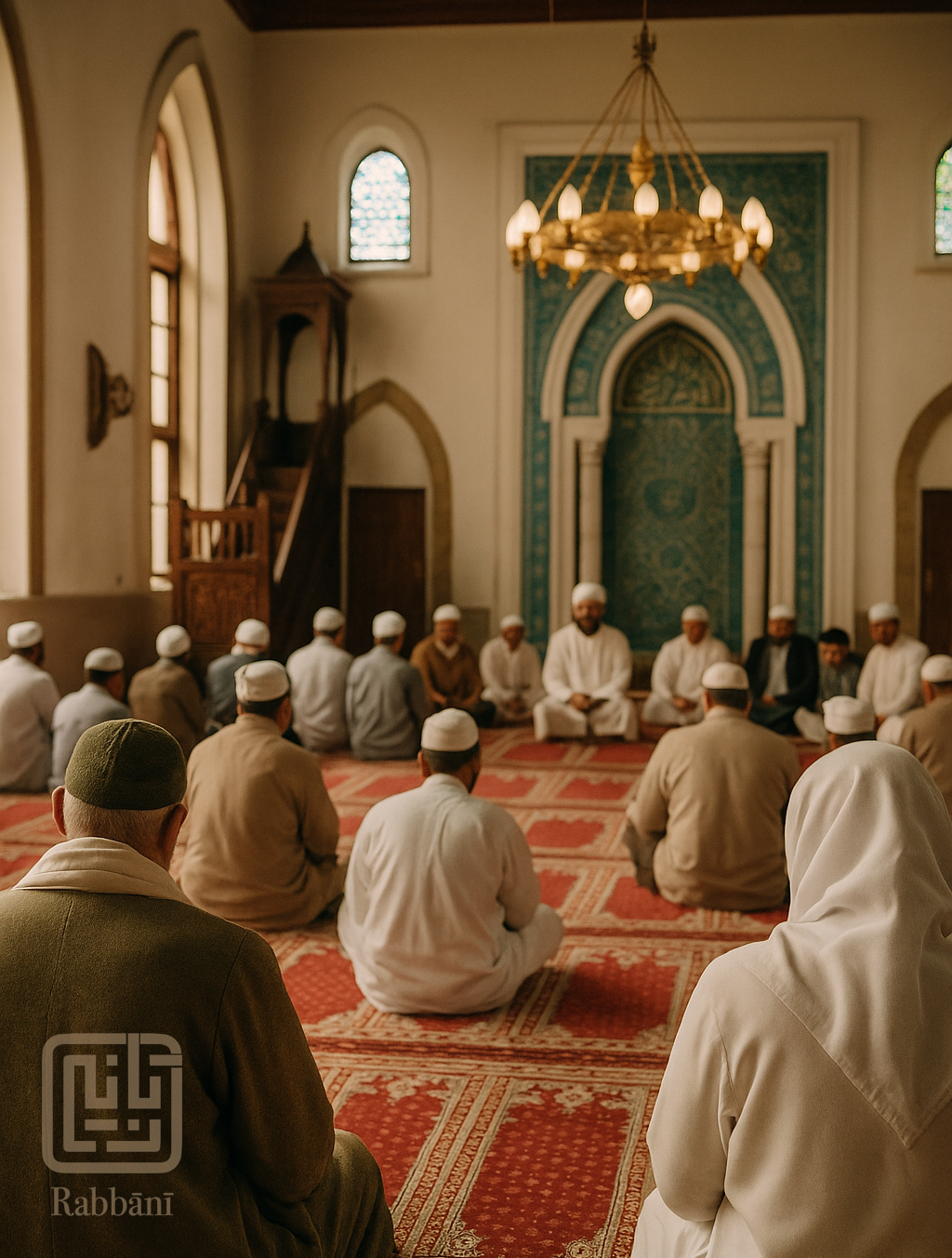
Friday night at Houghton Mosque was a different scale. The mosque was full: elders in white, young men with turbans, children by their fathers’ sides. Groups from different mosques took their turns, each with its own melody and rhythm.
Later my daughter Lala asked me, “What is this story of the Burdah? I’ve never heard this before.” I told her: “This is pure poetry! Almost like the Riwayah — the Prophet’s ﷺ life in song. But here, in the Burdah, different groups recite in turn, and together they weave a chorus.”
When I arrived at Houghton Mosque, I noticed something new. On the poster it had said: “Ladies Facilities Available.”Inside, the organisers had placed a new screen, expanding the women’s section for those who wanted to attend. It was unusual — there is already a women’s section — but this night, they anticipated more women. They made space.
That small act struck me as part of the remembrance itself: a recognition that devotion lives in inclusivity, in the care we show each other when we gather.
Before each group began, Ml Abu Hurairah Bobat guided the gathering, introducing the chapters and themes of the Qasidah Burdah. With warmth and clarity, he explained how the verses moved from praise of the Prophet ﷺ’s birth, to his struggles, to his intercession. His words opened the door for those less familiar, making the Burdah not just recited, but understood.
And then came the moment that will stay with me: as each group finished its verses, the entire jamaat — young and old — spontaneously joined in the chorus:
O my Lord, bless and grant peace always and forever Upon Your beloved one, the Best of all Creation.
It was not performance but inheritance. The refrain rose again and again until it felt as though the very walls of Houghton Mosque were singing with us.
The Lion and the Fortress
From the Qasidah Burdah, Imām al-Būṣīrī sings of the strength carried by those tied to the Prophet ﷺ:
Those whose help comes from the Messenger of Allah — Even lions encountering them in their dens would be struck speechless with fear.
He established his community within the fortress of his religion, As the lion settles down with its cubs in its lair.
Hearing the jamaat echo the chorus, I felt that same fortress. This was not nostalgia — it was strength and mercy alive in Johannesburg.
Fragrance and Victory
Later, another passage rang true to what I saw and smelled:
The winds of victory would present to you their fragrance, So that you imagine each valiant one of them to be a beautiful flower in bud.
As if, riding their steeds, they were flowers blooming upon a height, Held there not by the tautness of their saddles, but by the firmness of their resolution.
The Burdah does not only narrate victory — it perfumes it. Just as our Cape homes once scented with sandalwood and rampies, so here the fragrance of victory was carried in chorus.
Majestic Presence
And in the majesty of the Prophet ﷺ, the Burdah declares:
Like a flower in freshness and a full moon in eminence, Like an ocean in pure generosity and like time itself in strength of resolution.
Just from his majestic bearing, even when he was alone, He seemed as if amongst a great army and entourage.
At Houghton there was no standing qiyām — the tradition differs from the Cape. But the chorus of Mawlaya ṣalli wa sallim… still lifted the gathering, as if the walls themselves joined in remembrance.
Dress and Identity – From Kurta to Thobe
As I looked around, I noticed another change. When I was younger, men in Joburg mosques wore kurtas — Indian style. Now the children, young men, and elders were dressed in thobes and turbans, a celebration of the Prophet’s ﷺ attire.
Was it the influence of hajj and ʿumrah, Gulf media, or the aspiration to be closer to sunnah? Perhaps all of these. Styles shift, but the devotion remains.
Closing – Joburg Remembers Too
This Rabiʿ al-Awwal, in Heritage Month, Joburg reminded me that Cape Town does not own memory. Dhikr lives here too — in family homes, in gaajahs for birthdays, in mosques filled with Burdah echoes.
Heritage is not just remembrance, it is continuity. Not only in books, but in chorus. Not only in Cape Town, but in Joburg.
The Prophet ﷺ is in our veins and in our graves. In sandalwood tasbihs, in rampies leaves, in choruses that rise like fragrance. Remembered not only in words, but in song.
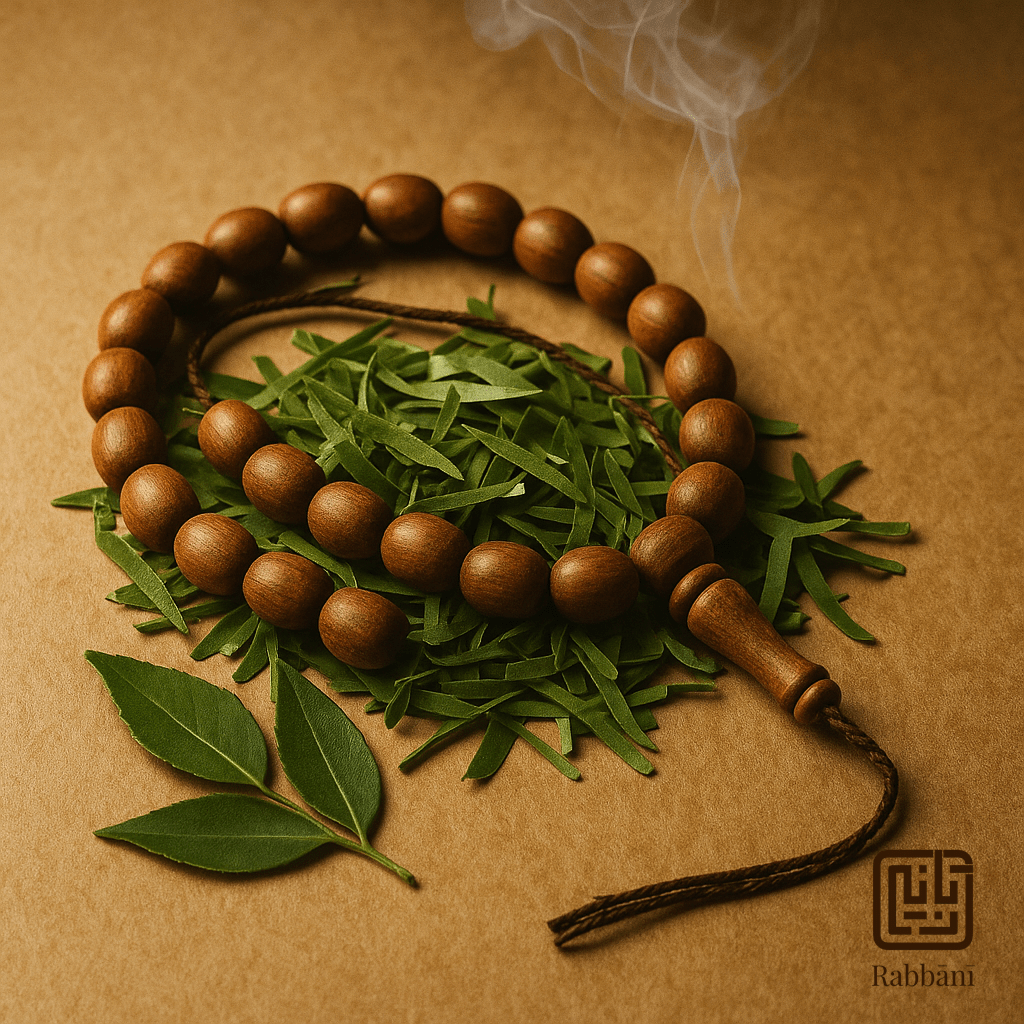
Every Rabiʿ al-Awwal, Cape Town breathes differently. The air is heavy with sandalwood smoke, the sny of rampies, the melody of the Riwayat al-Barzanji. Children once practised their lagu at home, correcting one another — because to sing the Prophet ﷺ was to sing him beautifully. Even cutting lemon leaves became dhikr.
This is Cape devotion: love woven into scent, sound, and preparation. It was never by chance. Preparation itself was worship.
The Beauty of Riwāyah
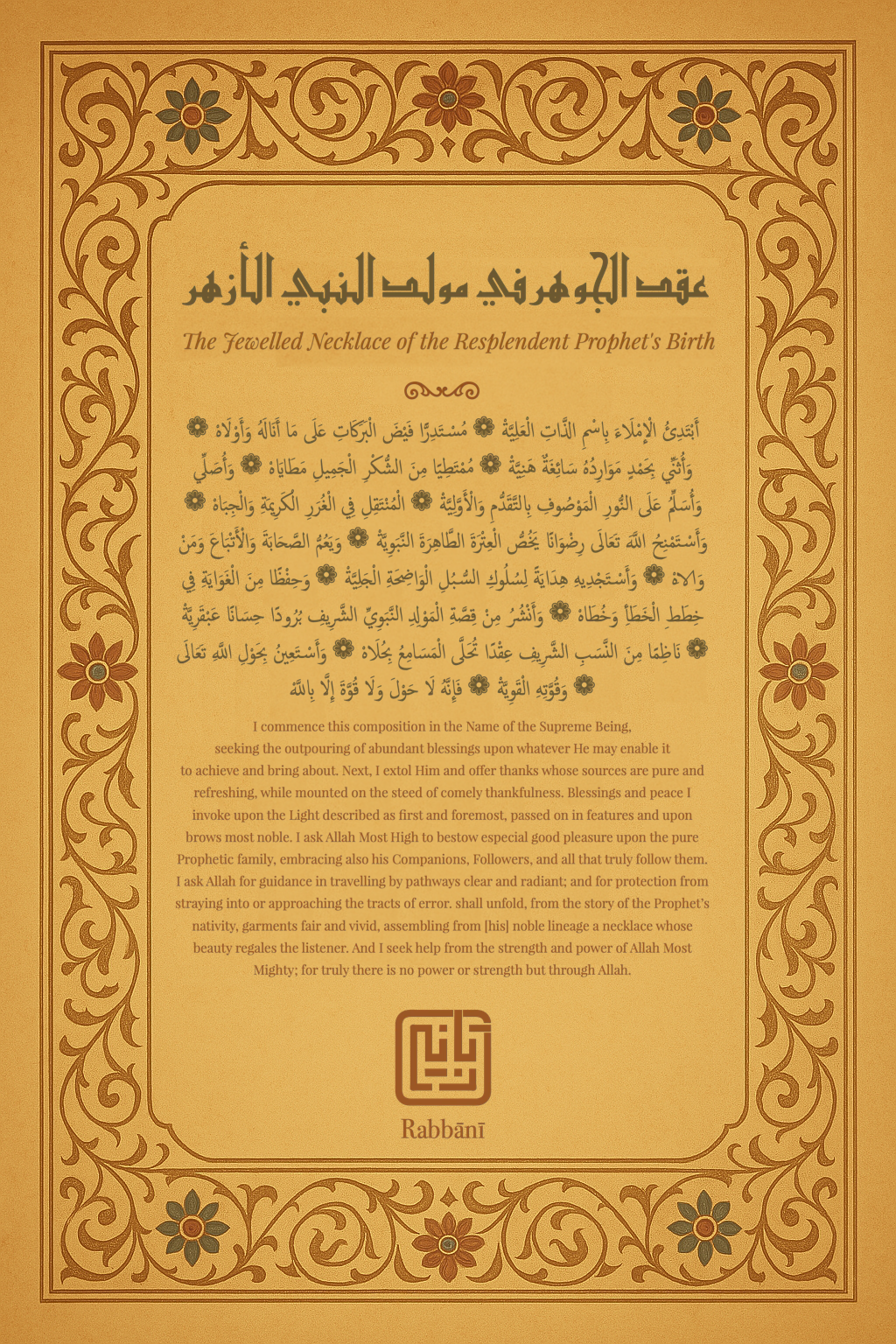
The Arabic word riwāyah (رِوَايَة) means narration. But in the Cape it became more: the sung retelling of the Prophet’s ﷺ life.
Imām Jaʿfar al-Barzanji (d. 1763), Chief Mufti of Madinah and a Kurd from Barzan, composed ʿIqd al-Jawāhir (The Necklace of Jewels). Written in rhythmic prose and poetry, it tells the noble birth and qualities of the Prophet ﷺ. From Madinah it travelled to East Africa, Southeast Asia, and the Cape, where it became the heartbeat of Mawlud gatherings — always with sandalwood burning, rampies cut, and voices rising in lagu.
How beautiful is thy face, Shining brighter than the sun. This night is lit by your light — A night of joy, a day of pride. The givers of glad tidings cried out: “The Chosen One, the Beloved, has come — rejoice!“
From Barzan to Jerusalem to the Cape
The same Kurdish soil that gave us Barzanji also gave us Ṣalāḥuddīn al-Ayyūbī (Saladin) — the liberator of Jerusalem in 1187. One carried the pen of devotion, the other the sword of justice.
🌿 The Cape inherited both: singing the riwāyah with love, and resisting injustice with courage. Devotion is never only ritual — it is also justice.
Mawlud and the Question of Evidence
Every year, voices say: “Mawlud is bidʿah. It is ḥarām.” But as Shaykh Allie Khalfe reminds us, declaring something ḥarām requires qatʿī (decisive) proof in both chain (thubūt) and meaning (dalālah). No such text exists.
Instead, the Qur’an itself honours prophetic birthdays:
“Peace be upon him the day he was born” (Q 19:15) — Yaḥyā.
“Peace be upon me the day I was born” (Q 19:33) — ʿĪsā.
The Prophet ﷺ also endorsed gratitude for sacred days. When the Jews fasted to commemorate Musa’s deliverance, he said: “We have more right to Musa than you” — and he fasted (Bukhārī, Muslim).
If deliverance is worthy of commemoration, how much more the birth of Muhammad ﷺ, mercy to the worlds (Q 21:107).
Graves, Memory, and Reverence
Some argue: “Level the graves.” They quote hadith forbidding plastering or building on tombs. But the Qur’an records that when the People of the Cave were discovered, those who prevailed said: “We will surely build a masjid over them”(Q 18:21).
Our sacred sites confirm this:
The Hijr Ismāʿīl beside the Kaʿbah contains the graves of Hājar and Ismāʿīl.
Masjid Nabawī encloses the Prophet ﷺ, Abū Bakr, and ʿUmar.
The Cape’s kramats — Tuang Yusuf, Tuang Guru, Tuang Mahmud — stand as circles of remembrance.
These are not shirk but reverence, places of memory and duʿāʾ. To erase them is to erase ourselves.
Activism as Sunnah
The Prophet ﷺ left us more than rituals. He left us justice. The Constitution of Madinah established a civic community across religions and tribes.
That spirit carried into the Cape’s struggle against apartheid. In the Call of Islam, the Muslim Youth Movement, and the National Muslim Conference at UWC (1992), activists remembered the Prophet ﷺ not only with salawāt but with action — defending equality, insisting on women’s inclusion, placing youth at the centre. To live his Sunnah is to resist injustice.
The Everyday Sunnah
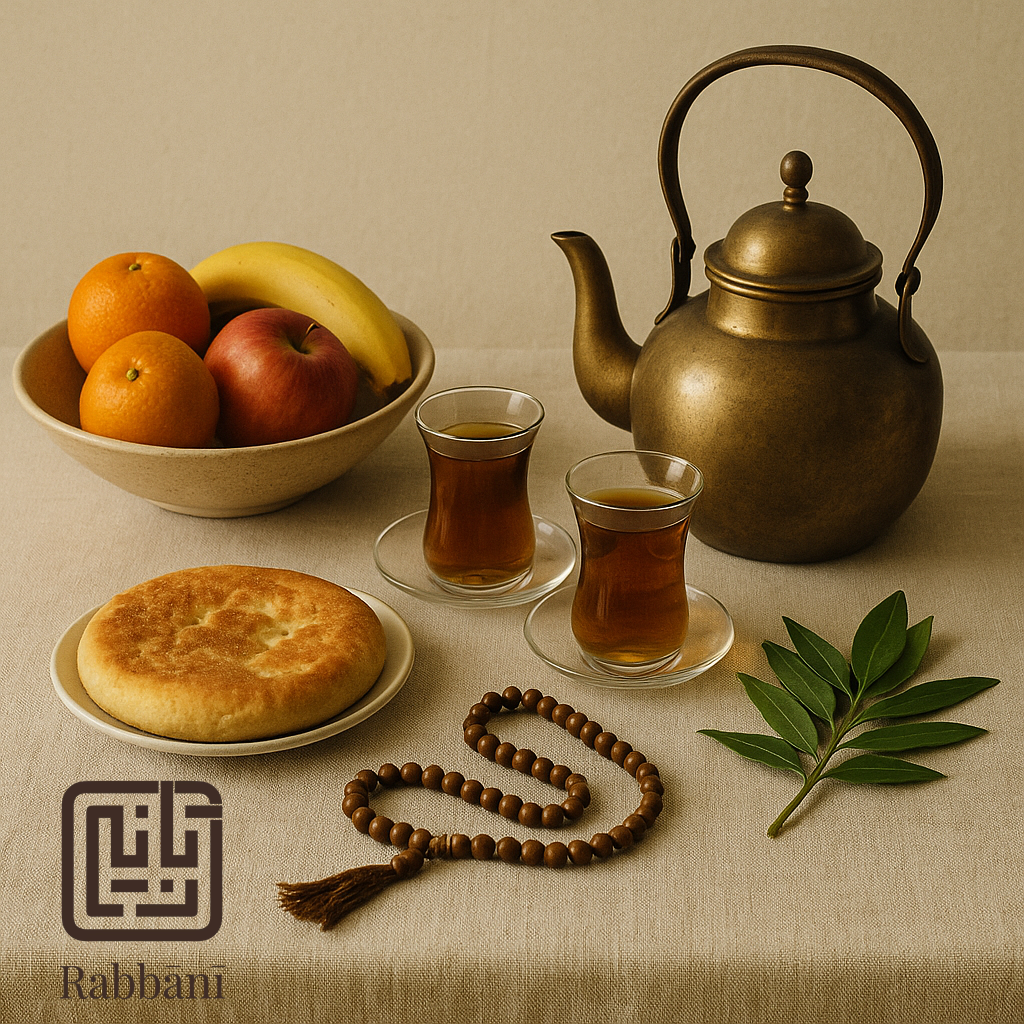
And yet, his legacy is also small, intimate. To say “Ahlan wa sahlan” at the door is prophetic. To put on the kettle and share food is prophetic. To dress with dignity, to smile, to eat together — these are echoes of the Prophet ﷺ at the table.
That was my final note on Radio 786: Mawlud is not just once a year, but lives in every act of welcome, in every gathering, in the rhythm of our homes.
Gadija’s Reflection
At the close of our conversation, Gadija Ahjum reminded listeners that these traditions are not nostalgia but a living inheritance. They still speak to Cape Town today — in song, in struggle, in everyday acts of kindness. Her words were a benediction: that we must hold on to these echoes, because they remind us who we are, and whose love runs in our veins.
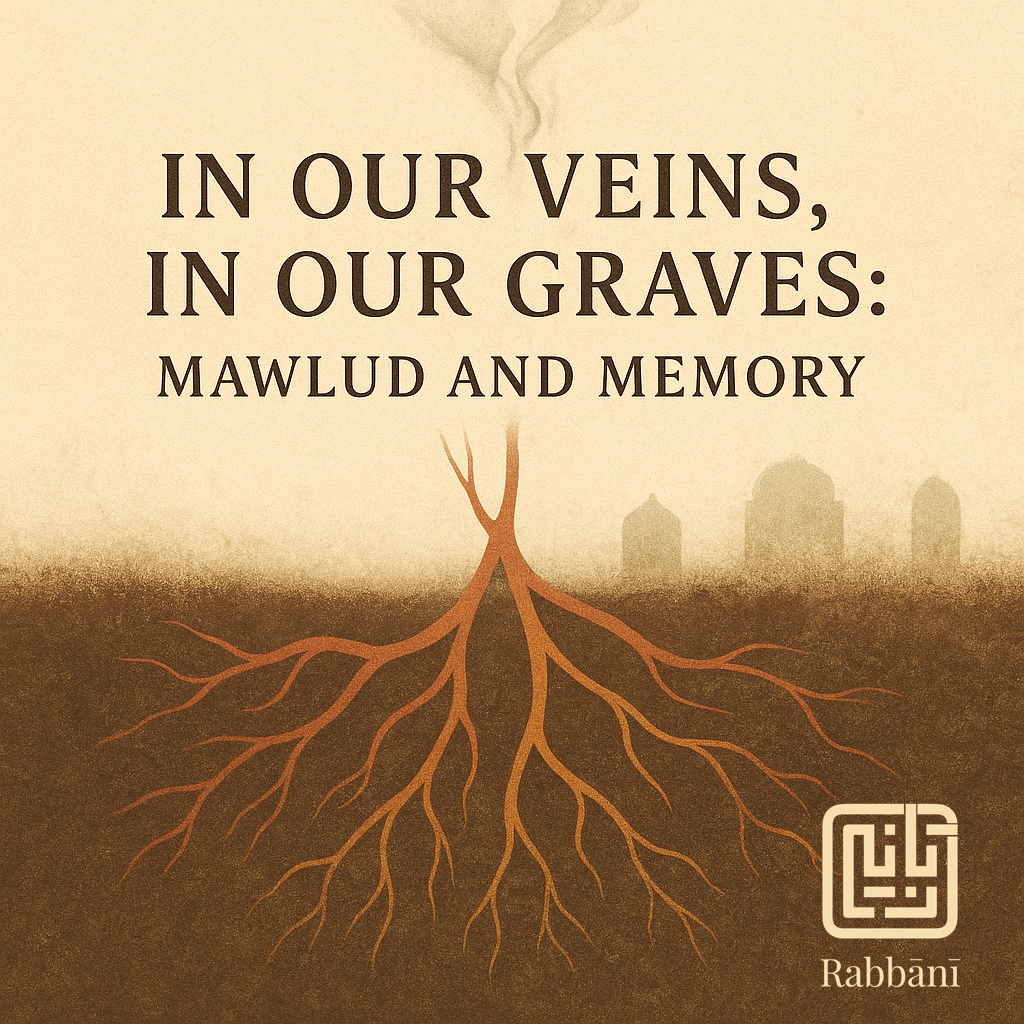
Closing: In Our Veins, In Our Graves
The Prophet ﷺ is not only in our books. He is in our veins — in sandalwood tasbihs from Makkah, in rampies leaves cut by children, in songs sung through the night. And he is in our graves — in the kramats that guard our Cape, in the Hijr Ismāʿīl, in Masjid Nabawī itself.
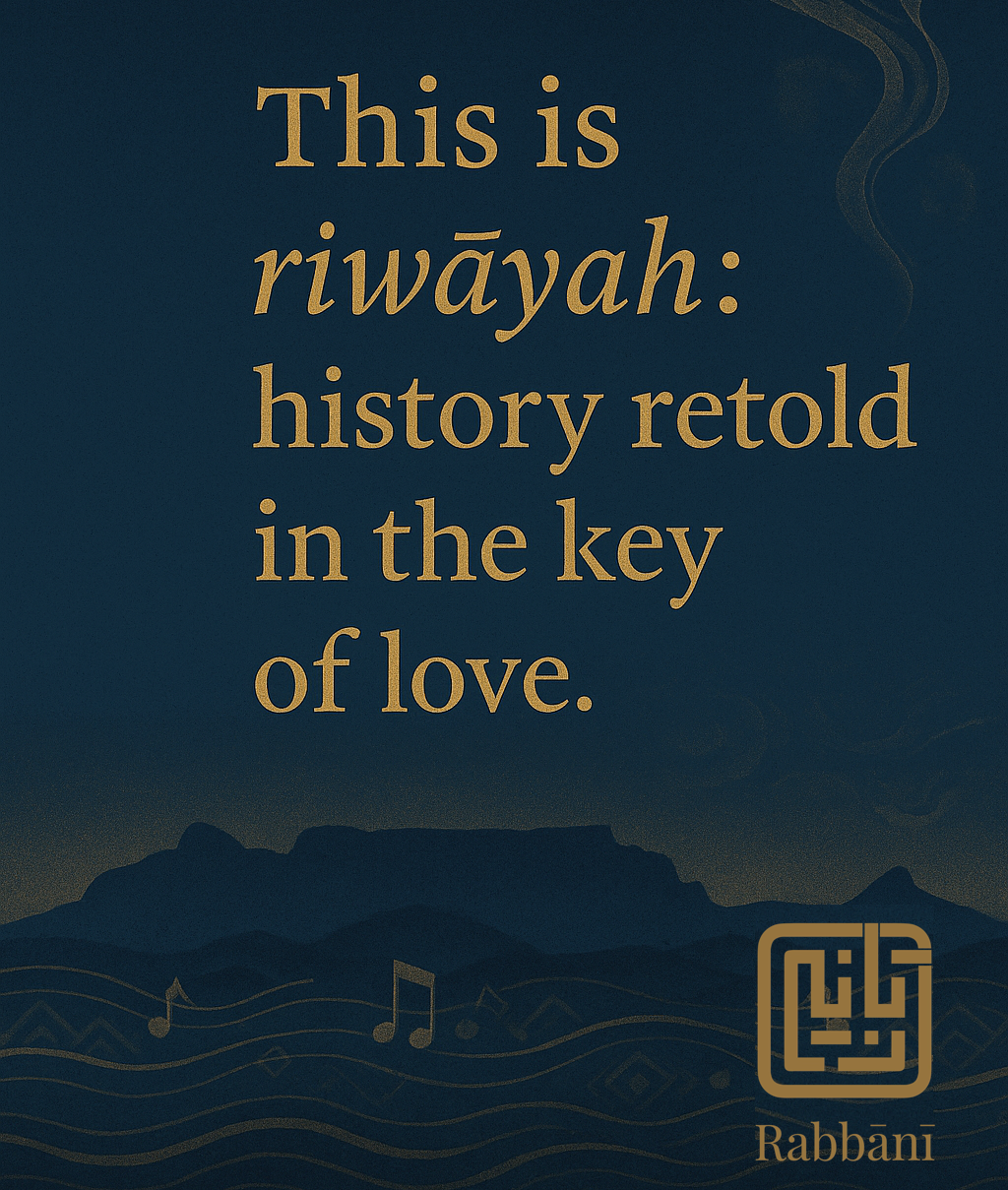
This is the beauty of riwāyah: history retold in the key of love, memory carried on the breath, the Prophet ﷺ remembered not only in books, but in song.
And then comes the moment every Cape gathering knows. The reciter enters the salawāt, and we rise. To stand in qiyām is to welcome the Beloved ﷺ into the room. Voices swell, hearts open, and it feels as though his light enters the gathering like fragrance. This is not metaphor — it is inheritance. In standing, we join generations before us, declaring with our bodies and our voices: the Prophet ﷺ lives in our veins, and in our graves.
🔗 Related Blogs & Reflections
🌿 The Prophet in Our Veins — Cape Mawlud traditions, sandalwood, inheritance: Read here
🧭 Tourist in My City — walking Cape Town’s sacred geography: Camissa, Slave Lodge, Bo-Kaap, Tana Baru: Read here
🕊️ A Family Dhikr Between Birth and Remembrance — names, dreams, duʿāʾ across generations: Read here
🌊 Get Rooted, Walk Through the Sea — faith at life’s thresholds: Read here
🕌 Streams of Ink and Streams of Light — reflections on adab, ink, and the mosque as living memory: Read here
Planting knowledge, remembrance, and companionship in the soil of hearts
It began not with my own notes, but with a gift. A reflection carried to me from a dars (lesson) of Shaykh Allie Khalfe — may Allah preserve him — through the words of his student, Masooda. What reached me was not information but suḥba (companionship in transmission). It felt as if a branch had been placed in my hand, living and fragrant.
The dars turned on Imam Sharani’s text. At its close, the author prayed for the one who writes, the one who conveys, and the one who listens — sketching in that duʿāʾ (supplication) the hidden architecture of ijāzah (authorisation). Knowledge is never solitary. It requires scribe, voice, and ear.
When the names of the ʿulamāʾ (scholars) in the sanad (chain of transmission) were recited, it was like witnesses at a nikāh (marriage contract): a chain of trust sealed with al-Fātiḥa (the Opening chapter of the Qur’an) and ṣalawāt (prayers upon the Prophet ﷺ). Not formality, but a bond.
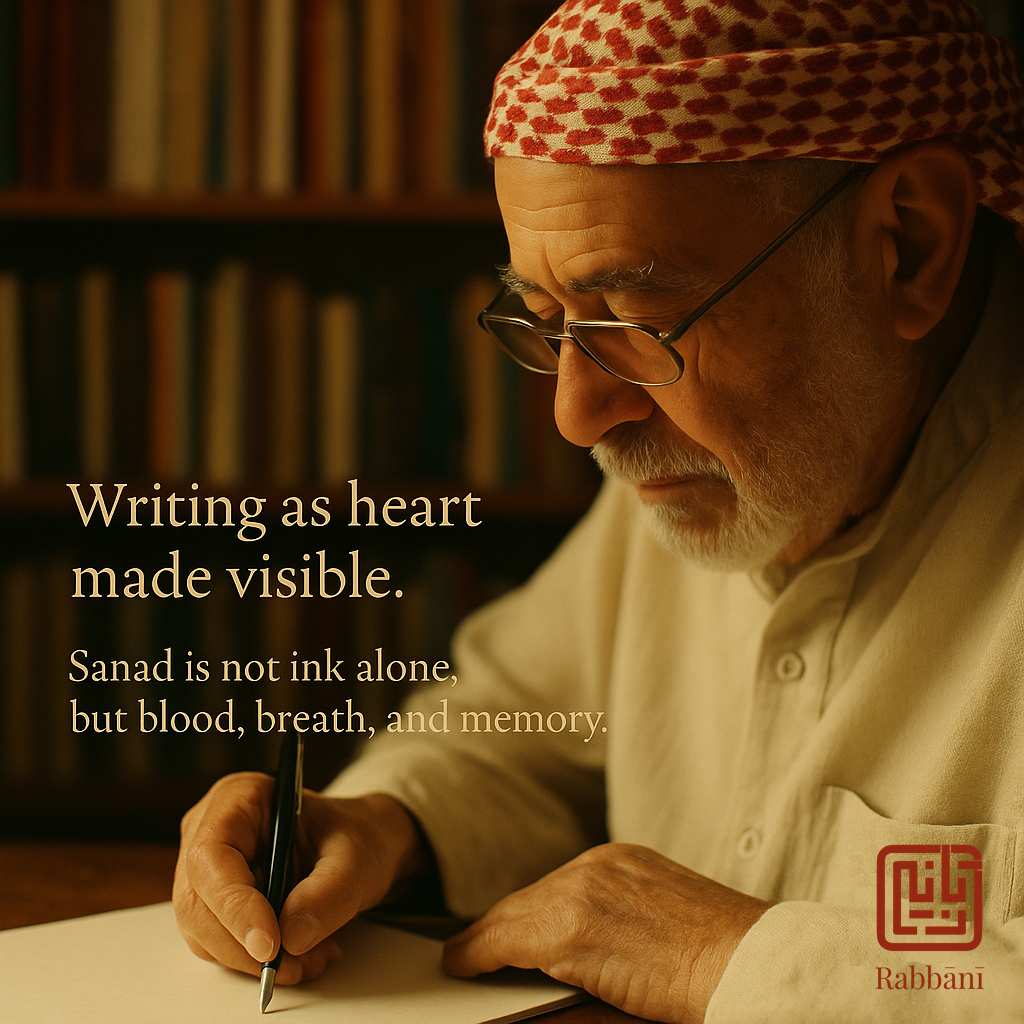
And then, a detail that stills me: the Shaykh reminded that the index finger carries a vein to the heart. The same finger that cradles the pen. Writing, then, is not merely ink — it is the heart made visible.
This is adab as-suḥba — the courtesy of companionship. Sometimes a verse must be allowed to enter and sit in the heart until it ripens into fruit. Its meaning multiplies.
A Good Word, A Good Tree
The Qur’an says: “A good word is like a good tree whose root is firmly fixed, and whose branches reach the heavens. It gives its fruit at all times, by the permission of its Lord.” (Ibrāhīm 14:24–25).
Masooda spoke of how the verse itself visited her — once even on a screen in Ramadan, tugging her heart like a breeze that compelled her to sit and drink from it. She returned to it again and again, until its shade and fruit became part of her.
This is the work of suḥba, dhikr (remembrance), and ʿilm (knowledge) braided together: soil, water, sun. Good words are nourishment, shelter, and fruit. They live beyond their first moment, feeding others long after.
Oceans Without Shore
“If all the trees on earth were pens, and the ocean were ink, refilled by seven more oceans, still the Words of Allah would not be exhausted.” (Luqmān 31:27).
The tree becomes pen, the ocean becomes ink — and still it is not enough. Knowledge is boundless, and our writing, reading, and speaking are only drops.
Ijāzah is like a rope stretched across generations, so we are not stranded with only our nafs (ego-self) in shallow waters. The sanad becomes a coastline, teacher to student, name to name, heart to heart. Waves advance, pens move, yet the ink of Allah’s words runs deeper than we can fathom.
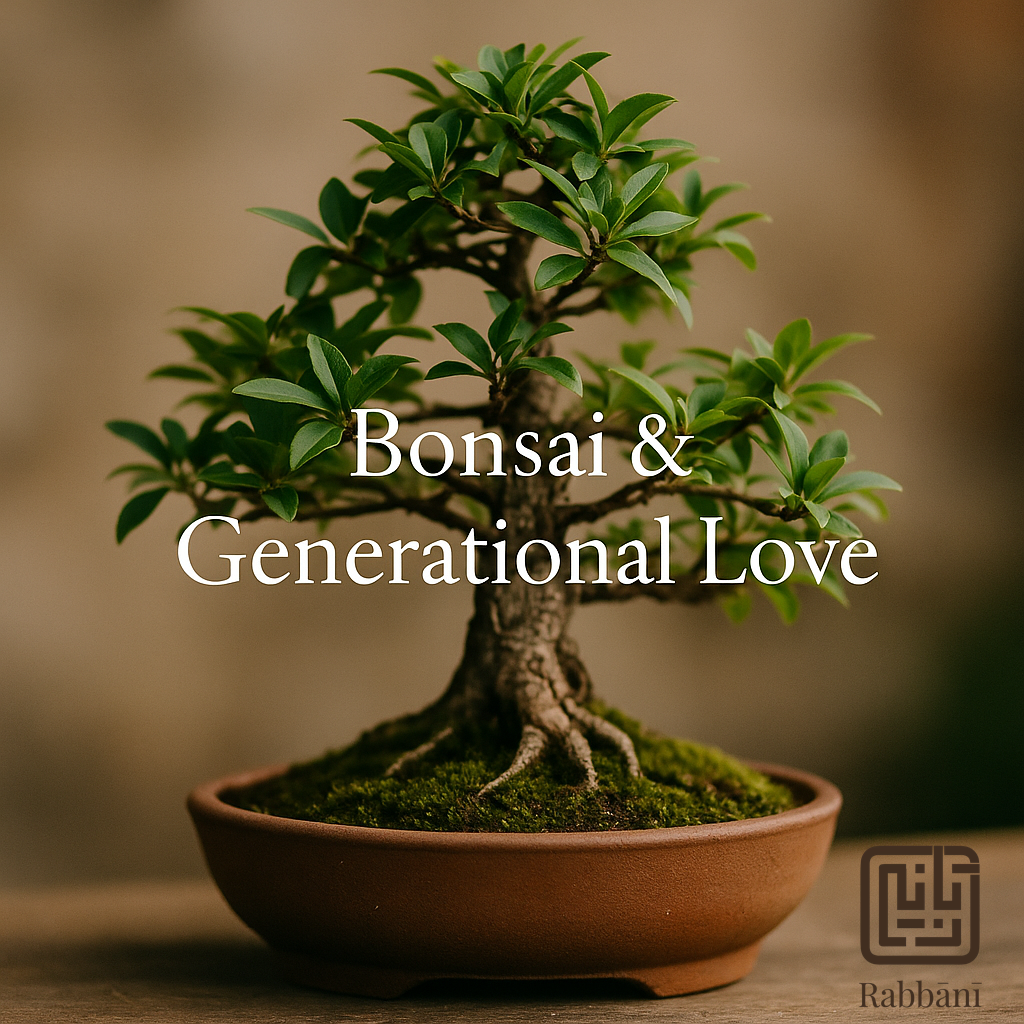
Bonsai, Hidden Garments, Generational Love
Not all transmission is vast like oceans or towering like trees. Some is slow and deliberate, like a bonsai — carefully pruned, shaped across years, carrying endurance in its smallness. Generational love can be like this: cut back, tended carefully, yet still alive.
Charity is like a hidden garment — a warmth felt but not displayed. And the link to Allah is direct, unmediated, suḥbawith the Real.
Because we began in a garden, we will return to it. To remain a child in the garden — curious, open, growing — is the secret of maturity.
The Farm with a Heart
The land itself was described as a body. One farm to another, the same anatomy: if the brain is sound, the farm is sound. And deeper still, the heart of the farm. It was as though I was hearing the ḥadīth: “Verily, in the body there is a piece of flesh; if it is sound, the whole body is sound. If it is corrupted, the whole body is corrupted. Verily, it is the heart.”
The farm is a mirror of us, and we are mirrors of the farm. Soil, water, mind, heart — they rise and fall together.
And another secret: beautiful people are hidden from the world, like seeds in soil waiting to rise. Their signs are etched into the land, into quiet generosity, into living Qur’an carried in silence. Who would have thought that on the first colonial farm one might hear Qur’an spoken back by the soil, the wind, the hidden awliyāʾ (friends of God)?
Hidden people, hidden farms, hidden saints — Allah scatters them where we least expect.
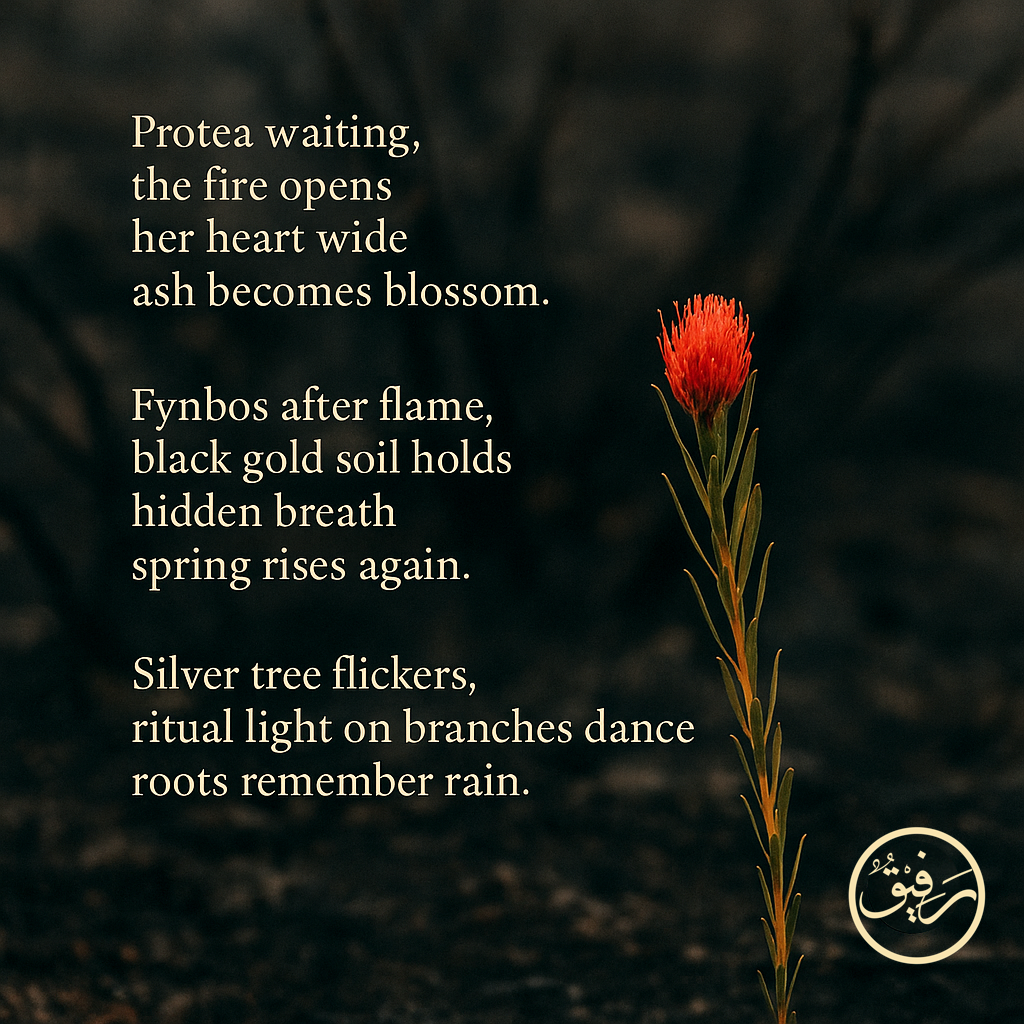
Fire and Blossom
Here the Cape flora speaks:
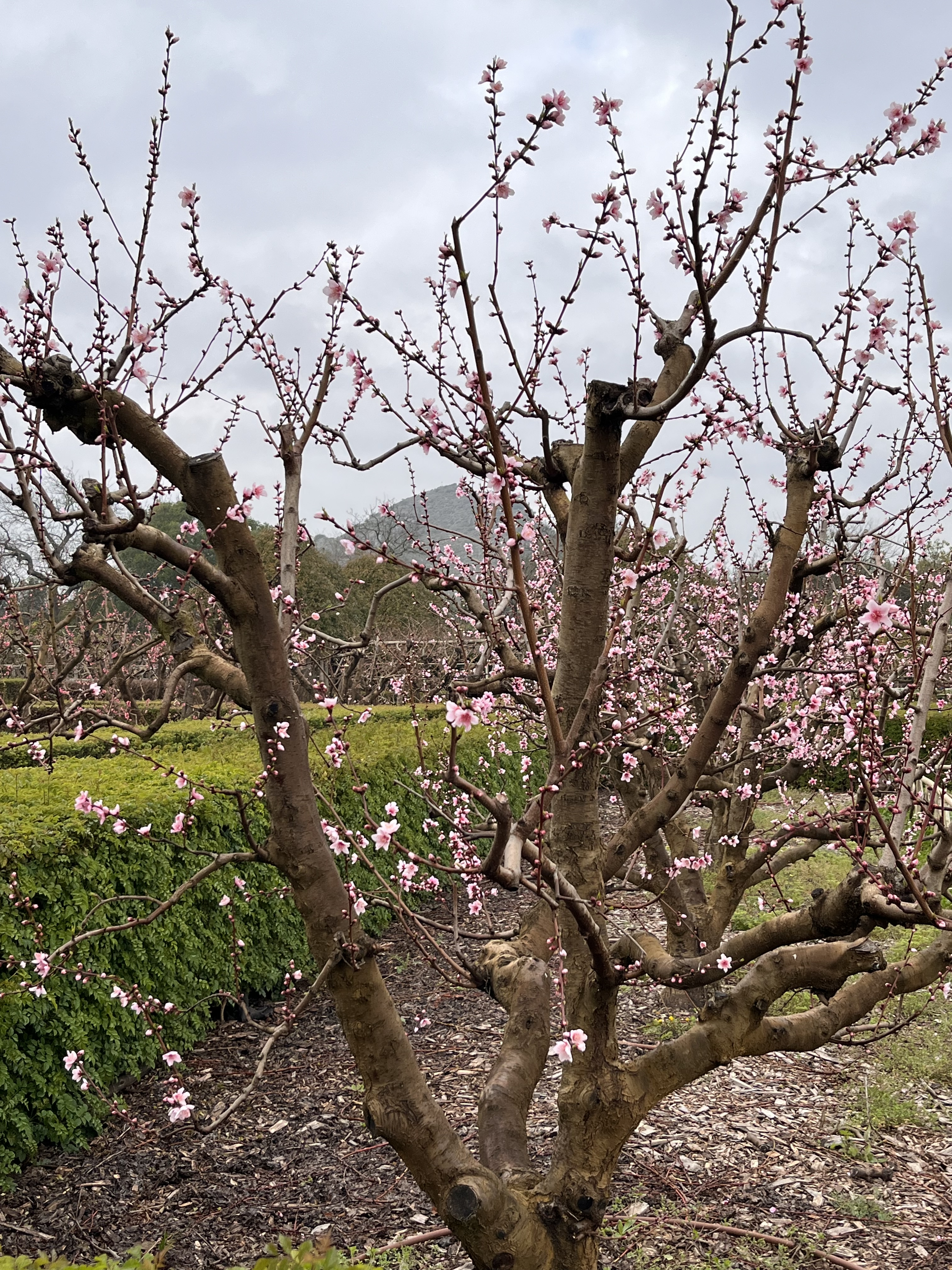
Protea waiting, the fire opens her heart wide, ash becomes blossom.
So too is the heart. Fire opens what is hidden; patience reveals what is promised.
Dhikr as Greater
All of this — sanad, suḥba, ʿilm, trees, oceans, farms, blossoms — is gathered by one thread: dhikr.
“Wa la dhikrullāhi akbar” — “And the remembrance of Allah is greater, without a doubt.” (ʿAnkabūt 29:45).
Greater than what? Greater than the fire that tests the protea, greater than the nafs that bends the farm, greater than even the words we speak when they are empty of Him. Dhikr transforms knowledge into light, suḥba into companionship, trees into nourishment, oceans into signs without end.
And yet dhikr is even wider than many of us think. It is not only on the tongue, in recitation or chanting. It is also in the body: in breath, in muscle, in tendon, in presence, in stillness. It is kindness, humility, love, and community — whether Muslim, Christian, or Buddhist — meeting each other in harmony and poise.
This too is dhikr. Treasures we must preserve with care, if we wish to remain bridges to safety.
Because we began in a garden, we will return to it. The good word remains a good tree. The ocean remains ink that cannot be exhausted. And remembrance — dhikrullāh — is greater than them all.
Postscript
There are words from the poet Shabbir Banoobhai that linger here — like water poured into an empty cup, still teaching us what thirst means:
wisdom in a jug an empty cup you said pour till it’s full
i tried and tried finally sighed and said it’s empty still
These lines feel like the secret of suhba itself: to never be satisfied with one sip, to know the thirst itself is part of the gift.
Acknowledgement
With gratitude to Shaykh Allie Khalfe, whose dars planted these roots, and to his student Masooda Fadal, who shared these reflections and passed on their fragrance.
Glossary of Terms
Ṣuḥba (صُحبة) — Companionship; keeping company with teachers, friends, or the Divine. In Sufi tradition: the courtesy of companionship (adab as-suḥba).
Sanad (سند) — A chain of transmission linking teachers and students across generations.
Ijāzah (إجازة) — Authorisation or license to transmit a text or knowledge, usually granted by a teacher to a student.
ʿUlamāʾ (علماء) — Scholars of Islam; those learned in the sciences of religion.
Nikāh (نكاح) — Marriage contract.
Al-Fātiḥa (الفاتحة) — “The Opening,” the first chapter of the Qur’an, often recited in prayer and blessings.
Ṣalawāt (صلوات) — Prayers and blessings upon the Prophet Muhammad ﷺ.
Dhikr (ذكر) — Remembrance of Allah; includes recitation, prayer, and also presence, breath, stillness, and actions of kindness.
Nafs (نفس) — The self or ego; the inner self that inclines to desire, distraction, or pride.
Awliyāʾ (أولياء) — “Friends of God”; saints, those close to Allah through devotion and purity of heart.
The Prophet in Our Veins: On the Scent, Sound, and Song of Cape Devotion
Introduction: Rabi al-Awwal and the Living Presence
Rabi al-Awwal has arrived — the month in which many commemorate the birth of the Prophet Muhammad ﷺ. But beyond the formal gatherings and public sermons, there are other ways his presence is felt.
This blog reflects on three threads of remembrance: the Prophet ﷺ as a guide in our political struggles, a source of poetic longing, and a quiet presence in our daily lives — folded into our homes, habits, and inherited silences.
I. The Constitution of Madinah and the Call of Islam: A Political Sunnah of Justice
In the 1980s, the anti-apartheid movement in South Africa gave birth to many political and religious formations. Among them was the Call of Islam, a progressive Muslim organization that took inspiration from the Prophet Muhammad’s ﷺ example as a political and ethical leader.
At the heart of its formation was a sense that Islam was not simply a private affair, but a force for justice. The Prophet’s ﷺ Constitution of Madinah — a model for pluralism, shared civic belonging, and accountability — offered a living blueprint. In our reading circles and public addresses, we didn’t only study fiqh. We studied the Sunnah of justice, the Sunnah of solidarity, and the Sunnah of standing with the oppressed.
This legacy reached a milestone in the 1992 National Muslim Conference, where Muslims from diverse traditions gathered to imagine a future democratic South Africa. The Prophet’s ﷺ example was not presented as abstraction but as compass — guiding how Muslims might live in plural, equal dignity with others.
Today, the landscape is very different. There are Muslim judges, radio stations, political parties. But let us remember: these were not always guaranteed. Many of the freedoms now enjoyed were carried on the shoulders of those who took risk — and who understood the Prophet ﷺ not only as a man of prayer, but as a statesman of vision.
II. Verse as Vessel: Poetic Devotion and Madīḥ
In the lands of Africa, madīḥ — praise poetry — has always been more than art. It is invocation, love-letter, protest, and memory. In my own work, I’ve found that poetry often says what footnotes cannot.
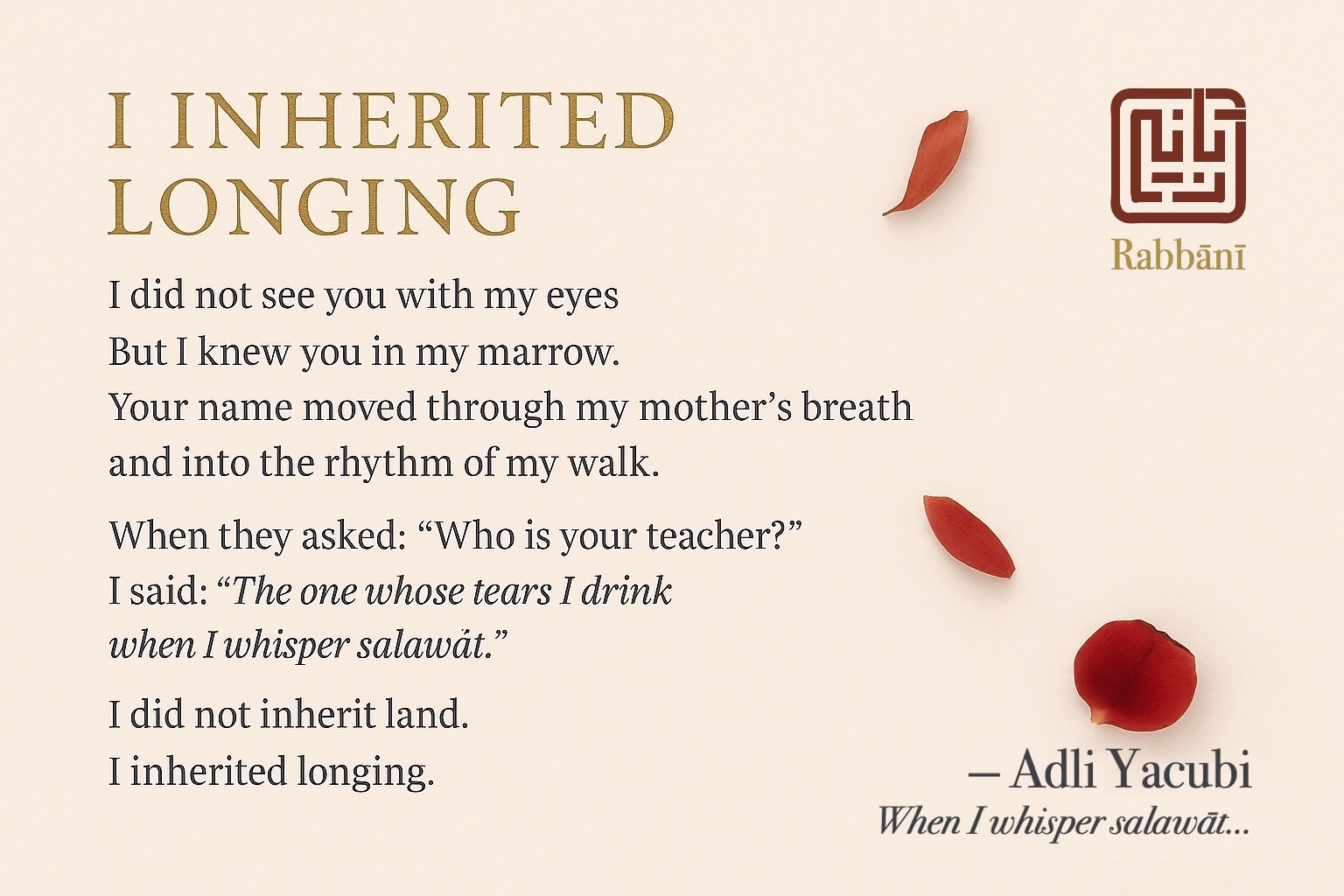
Take for example this poem, I Inherited Longing:
I did not see you with my eyes But I knew you in my marrow. Your name moved through my mother’s breath and into the rhythm of my walk.
When they asked: “Who is your teacher?” I said: “The one whose tears I drink when I whisper salawāt.”
I did not inherit land. I inherited longing.
This is not biography. It is embodiment.
Across Cape Town and Johannesburg, poets still recite verses that draw the Prophet ﷺ close — not as distant figure, but as intimate companion. This is how many of us came to know him: not through doctrine alone, but through dhikr, dreams, rhythm, and rhyme.
III. The Prophet Among the People — Salawāt and Everyday Sunnah
If sīrah shapes our public imagination and verse stirs our hearts, then the most enduring presence of the Prophet ﷺ lies not in the pages of a book, but in the lived habits of South African Muslims. In Cape Town especially, his memory is invoked not only in grand commemorations but in the daily, quiet acts of care, courtesy, and devotion.
From the kettle always on the boil to the salawāt murmured in pre-dawn hours, the Prophet’s ﷺ legacy breathes through a tradition of service and subtlety. One sees his trace in janāzah preparations, in unspoken generosity, and in how the kitchen is cleaned before Maghrib. These are not mere habits. They are sacred echoes — practices with deep Prophetic roots.
Among the Cape’s most enduring spiritual inheritances is the Ratib al-Haddād, chanted for decades — if not centuries — in mosques and homes. This litany, associated with the Ba ʿAlawī tradition of Hadhramaut, Yemen, is recited rhythmically, often in gatherings after Maghrib or ‘Ishā’. Alongside it, a particular standing salawāt is recited with heartfelt rhythm, in the deep belief that the light and rūḥ of the Prophet ﷺ enters the space when we call upon him. This is not metaphor. It is presence.
The Cape is also home to a rare spiritual text: an Afrikaans Ratib al-Haddād written in Arabic script. In it, Kaaps-Afrikaans phrases — such as Onse Here is Groot and Help ons met die dode — appear with Qur’anic reverence. The tasbīḥ, duʿā’, and barakah of our forebears were carried in a mother tongue now often dismissed. But they knew what they were doing: encoding devotion into daily speech, transmitting Prophetic rhythm in a creole born of struggle and longing.
Perhaps most evocatively, the Riwayat al-Birzanji — a melodic storytelling of the Prophet’s ﷺ birth and life — is performed during Moulood celebrations. My sisters would sing the first Riwayah in rich melody, sometimes referred to as laaghoe, or in Arabic terms, maqāmāt. These musical modes carried not only tune but transmission, passing down a soundscape of longing across generations.
These gatherings — echoing devotional practices from South Asia, East and North Africa, and Southeast Asia — show that Cape Muslims are not an isolated outpost. We are part of a vast archipelago of Prophetic love, linked not only by history but by rhythm, breath, and remembrance.
The First Riwayah composed by Sayyid Ja’far Ibn Hasan Al-Barzanji. In Arabic and English translation.
IV. Kramats and Cape Saints: Circles of Protection
If you trace a map around Cape Town, you will find sacred sites known as kramats — shrines of saintly Muslims, many of them exiled scholars or spiritual leaders, whose presence shaped the region’s barakah.
Among the most revered is the kramat on Robben Island, believed to be the resting place of Tuang Mahmud Moturu, a 17th-century imam from Indonesia exiled by the Dutch. According to oral tradition, he carried with him the Qur’an and the example of the Prophet ﷺ. Even Nelson Mandela is said to have visited the kramat while imprisoned — a quiet act of respect for the spiritual presence that surrounded him.
These kramats, stretching from Robben Island to Constantia, Faure to Bain’s Kloof, form what many refer to as a Circle of Islam, a protective perimeter believed by many Cape Muslims to spiritually guard the city. Even today, before departing for Hajj, many families visit these shrines to offer fātiḥah, seeking barakah and requesting the intercession of these tuangs — elder scholars and saints who represent a spiritual lineage of struggle, exile, remembrance, and return.
It is no accident that these saints were also poets, teachers, and bearers of the sunnah. Their legacies weave the political with the spiritual, the literary with the lived. They stand as embodied representations of Prophetic devotion: not merely followers, but inheritors — those who carried the scent, the sound, and the story of the Beloved ﷺ into the soil of the Cape.
These shrines are not merely gravesites. They are circles of remembrance. People visit with incense and duʿā’. Children are told stories. Salawāt is recited softly in the wind. In these spaces, the Prophet’s ﷺ spirit is invoked not as metaphor, but as living memory — guiding, protecting, witnessing.
V. The Prophet at the Table
When guests arrive in Cape Muslim homes, the first word is often “Ahlan wa sahlan.” It means “Welcome,” but more than that, it means: “Come as one whose path has been made smooth.” This is the spirit of the Prophet ﷺ at the table.
Food is sacred here. When someone leaves for Hajj, families gather to recite salawāt and Qur’an. At weddings, a murmur of salawāt often follows the couple as they walk out — not choreographed, just habit. These are rhythms inherited, not invented.
One of the most fragrant practices is the rampies sny — the cutting and perfuming of rose petals and leaves in preparation for the Moulood. Elders and children sit together, scenting the petals with rosewater, folding them into small cloths, whispering praises. It is not performance. It is love.
The Prophet ﷺ is not only remembered here. He is welcomed — into the threshold, into the breath, into the heart of the home.
Conclusion: The Prophet in Our Veins
Prophet Muhammad ﷺ is with us — in scent, sound, and song. He is in our veins. Pic: Shafiq Morton
We began with the idea that the Prophet Muhammad ﷺ is not a distant figure. Not only in the libraries, not only in the inherited manuscripts or well-attended Mawlid halls. He walks with us still — in our struggles for justice, in our poetry of longing, and in the subtle ways we greet, grieve, and gather.
In South Africa — and especially in the Cape — this presence is not always announced from the pulpits or debated in institutions. It is poured into tea. It is stitched into janāzah cloth. It is recited in whispered salawāt and sung in melodies passed down from mother to daughter, uncle to nephew.
The Prophet’s ﷺ legacy here has always been both principled and poetic — shaped by anti-apartheid resistance as much as by spiritual yearning. And in the rampies of Moulood, the maqāmāt of the Riwayah, and the rhythm of the Afrikaans Ratib, we find not just echoes of his name, but traces of his light.
He is with us — in scent, sound, and song. He is in our veins.
PostScript
Here is a beautiful salawāt from Salat an-Nuraniyya of Ahmad al-Badawi; also called Salawat Badawi Kubra…
O Allah! Exalt, greet and bless our master and liege lord Muḥammad, the Tree of Original Light, the Sparkle of the Handful of Divine Mercy, the Best of All Humankind, the Noblest of Physical Frames, the Vessel of the Lord’s Secrets and Storehouse of the Sciences of the Elect, the Possessor of the Original Divine Grasp, Resplendent Grace, and Uppermost Rank, under whose flag line up all the prophets, so that they are from him and point to him.
Fast-Forward into the Institute, Returning to the Circles
A week with the IslamicText Institute and Azzawia’s living tradition
It was a whirlwind week — Arabic on Tuesday, fiqh on Wednesday, Kitabush Shukr on Sunday, and Mawlood practice at Azzawia to close. What began as a fast-forward plunge into the Institute ended as a return to the circles that have always held the rhythm of Cape Town’s tradition.
It began with a handshake at Azzawia. Shaykh Allie Khalfe smiled, extended his hand, and with that simple gesture drew me into a current that would carry me through a whirlwind week — Arabic, fiqh, gratitude, and finally the rhythms of Mawlood.
Where Azzawia’s circles had been steady and calm, the IslamicText Institute moved like a river already in motion. One week felt like fast-forwarding through months of learning, not skipping steps, but running to keep pace.
Tuesday Night – Kitāb al-Asāsī (Arabic)
The week began with Arabic, the Kitāb al-Asāsī.
Stepping into the Arabic class at the IslamicText Institute felt like boarding a train already in full motion. The Shaykh and the students were moving at speed, voices alternating between reading aloud, parsing grammar, and drilling vocabulary. On the board, examples unfolded in careful script: prepositions locking words into the genitive, adjectives matching their nouns in gender and case, colours shifting form depending on what they described. What for some students was revision, for others — like me — was a plunge into deep waters.
The pedagogy was exacting. Shaykh Allie did not slow the pace, but instead invited everyone to rise with it. “Read, now explain, now apply,” was the rhythm. Mistakes were corrected swiftly, but with humour; every slip was a lesson, every correction a reminder that Arabic is both precise and merciful — demanding effort, but always rewarding persistence. You could sense that this was no ordinary language class. It was training the mind to think with Qur’anic logic, to tune the tongue to sacred precision.
For me, it felt beyond capacity. Months of Arabic study had not prepared me for the quick-fire exchanges, the confident parsing, the way students moved from grammar to meaning almost effortlessly. Yet this sense of inadequacy became its own teacher: a reminder that humility is the door to knowledge. The Shaykh’s method left no space for passivity; to survive, one had to participate, stumble, rise again, and keep pace with the moving current.
And yet, beneath the intensity, a deeper truth was visible. This Arabic — this Kitāb al-Asāsī — was not an isolated discipline. It was the key, the doorway to everything else. Without it, the texts of fiqh and ʿaqīdah that followed on Wednesday would remain veiled. With it, even a little of it, the veils began to lift. As the class closed, I realised that I had not simply attended a language lesson. I had glimpsed the scaffolding of the tradition — the way Arabic itself becomes the vessel carrying law, creed, and devotion across centuries.
The experience was like being dropped onto a moving train: you find your balance by running. And the Shaykh’s clarity carried us along.
Wednesday Night – Fiqh and ʿAqīdah in Motion
If Tuesday was about catching the rhythm of Arabic grammar, Wednesday was a double immersion — first in the law of prayer (Fiqh), then in the foundations of belief (ʿAqīdah).
In the Fiqh class, we entered al-Majmūʿ of Imām al-Nawawī, studying the conditions for a valid prayer (Shurūt Ṣiḥḥat al-Ṣalāh). Shaykh Allie Khalfe reminded us that prayer is not just a series of movements, but an act that only takes its true form when certain conditions are met: purity, covering the body, facing the qiblah, the right time, and the intention. Without these, the prayer is incomplete — like trying to build a house without laying its foundation.
What struck me most was how the discussion flowed between law and purpose. Technical details (such as what invalidates purity or how to define proper covering) were paired with reminders of why these rules exist: to help us stand before Allah with clarity and humility. Even for someone familiar with the Shāfiʿī tradition, it felt fresh — like polishing something you thought was already shining.
After Fiqh came ʿAqīdah, using the poem al-Jawharah as our guide. The Shaykh paused on a verse about knowing what Allah loves and what He dislikes, and how this knowledge has two sources: Revelation (the Qur’an and hadith) and the insight of the heart. The latter, he explained, is rare and precious — not every reflection is reliable, but when guided by sincerity and remembrance, it can be a light Allah places within the heart.
The room grew quiet at this point. It was as if the text had shifted from rules to reflection, inviting us inward. One student described it as moving from the “outer map” of worship into the “inner compass” that helps us navigate love and awe of Allah.
Together, these two sessions showed me the balance of Islamic learning: law to protect the structure of worship, belief to enliven its spirit.
Sunday Morning – Kitābush Shukr (Gratitude)
The class opened with Shaykh Allie Khalfe guiding us into Bayān al-Tamyīz — the explanation of distinguishing between what Allah the Exalted loves and what He dislikes.
As Imam al-Ghazālī reminds us, gratitude (shukr) is not merely a feeling but an act: to use Allah’s blessings in obedience to Him. Ingratitude (kufr al-niʿmah) is its opposite — using those same blessings in disobedience.
The Shaykh highlighted that distinguishing between Allah’s love and dislike has two sources:
Revelation — the Qur’an and the Prophetic Sunnah.
Insight of the Heart — reflection with the “eye of the heart,” rare and difficult, yet precious when granted.
A fellow student captured it beautifully:
“The meaning of gratitude is to use the blessings that Allah the Exalted has bestowed upon us in obedience to Him; and the meaning of ingratitude is the opposite… Revelation is the foundation, but the inner sight is what polishes the heart.”
In this way, Shaykh Allie urged us to see shukr not as abstract, but as practice — prayer, fasting, feeding the needy, speaking truth — until life itself becomes an act of thanks.
Sunday Evening – Mawlood Practice at Azzawia
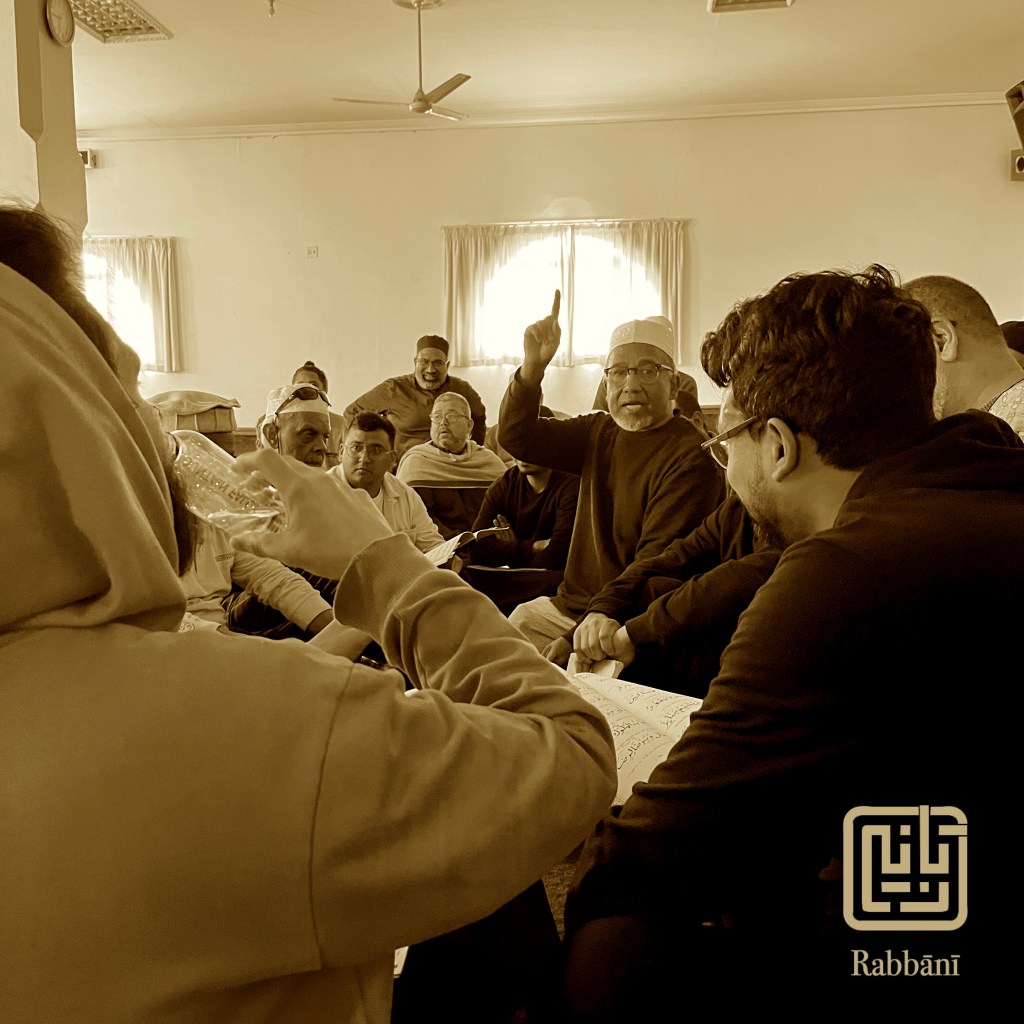
As the sun lowered that same Sunday, I stepped back into Azzawia — not for fiqh or grammar, but for song.
The Mawlood practice was alive:
A conductor guiding the voices — “higher here, lower there, let me show you.”
Laughter and corrections, Afrikaaps mixing with Arabic across the room.
Pages of the Barzanji Mawlood open, voices rising and falling, the rhythm of devotion rehearsed until it became natural.
Behind the practice, in conversation, plans unfolded: flowers and rose water, daljies and samoosas, volunteers preparing. The anticipation of the Mawlood itself, still weeks away, hovered in the air.
It felt like the body of the community rehearsing, tuning itself — men and women, Afrikaans and English, sacred text and local voice, all weaving into one.
Closing Reflection – Learning at Speed, Returning to Circles
By the week’s end, I had been swept into three modes of learning — the sharp sprint of Arabic grammar, the layered dialogue of fiqh, the contemplative unfolding of gratitude, and the embodied devotion of Mawlood practice.
The Institute was fast-forward — a current already in motion. Azzawia remained steady — circles rooted in the soil. Together, they are not opposites, but complements.
I left with my notes still warm in my hands, the echo of recitation still in my ears. Learning at speed. Remembering at depth.
And in both places — gratitude.
🤲 Dua at the End
اللَّهُمَّ اجعل هذا العلم نورًا في قلوبنا، وعملاً صالحًا في حياتنا، وذُخرًا لنا يوم نلقاك. O Allah, make this knowledge a light in our hearts, a righteous action in our lives, and a provision for us on the Day we meet You.
🔗 Cross-link
👉 For a deeper sense of Azzawia’s slower rhythm, see my earlier reflection: In the Circles of Azzawia.
From Sunday’s Kitāb al-Shukr to Monday’s Minhāj al-Ṭālibīn, tracing the chains of Shāfiʿī knowledge, the whispered wisdom of teachers, and a daily breeze of remembrance.
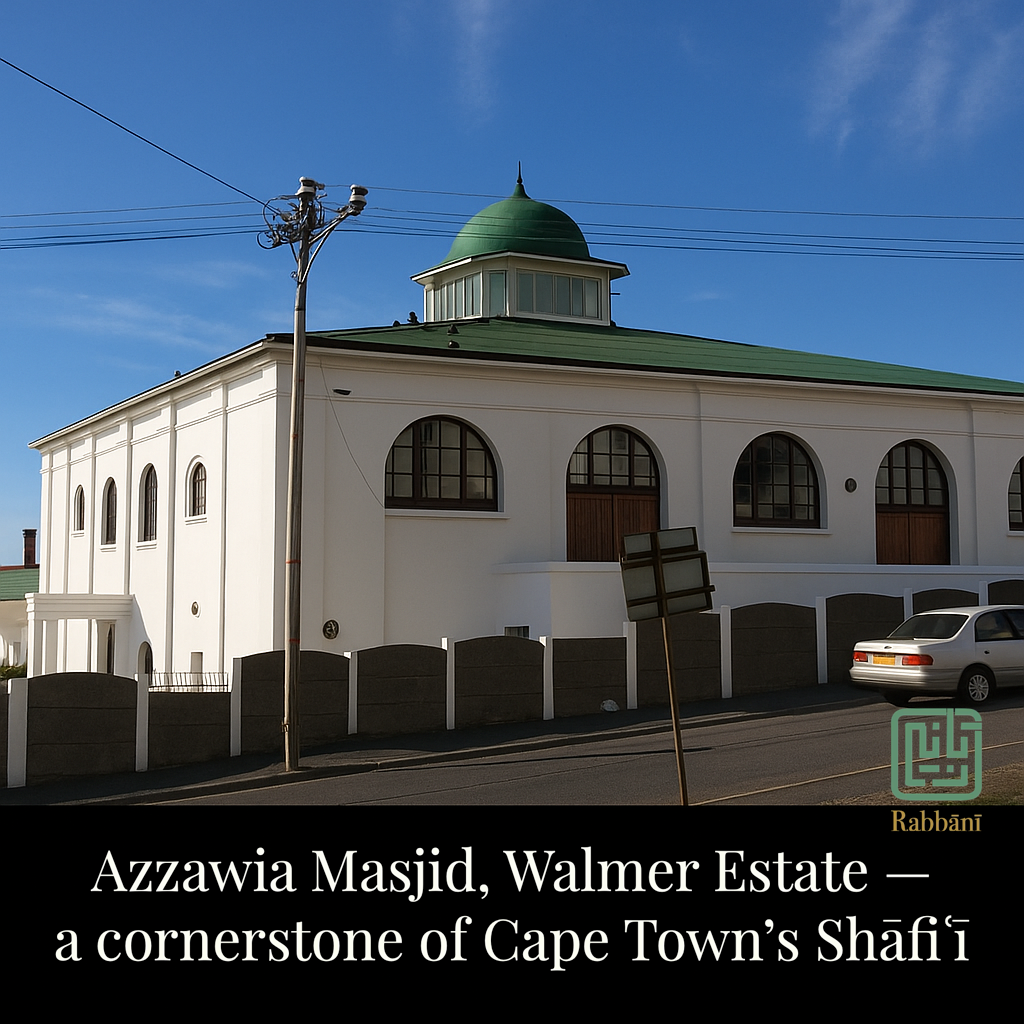
Azzawia Masjid, Walmer Estate – a cornerstone of Cape Town’s Shāfiʿī scholarship and spiritual tradition.
Sunday Morning – Chains of Knowledge, Wings of Mercy
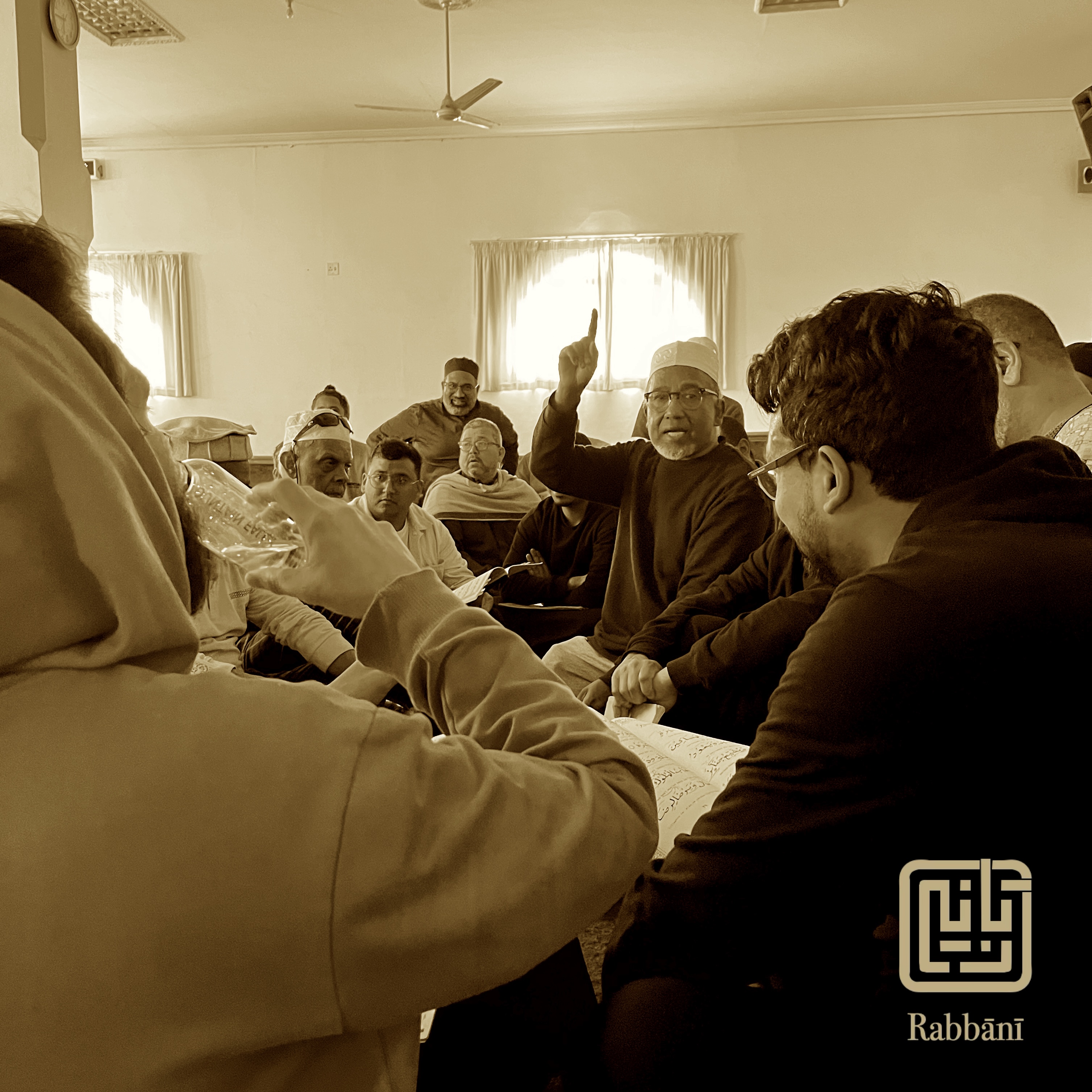
Last Friday, Al Ameen, my swaer, took me to Al Azawia Mosque in Walmer Estate. I had only wanted to greet Shaykh Achmad Hendricks, who was delivering the Jumuʿah khuṭbah. But in the front ṣaff, I also took hands with Shaykh Allie Khalfe.
He smiled and said, “Adli, I’m glad you are here in Cape Town. Come to my dars this Sunday morning.”
I went.
The gathering was in the old style — a teacher seated, a text in Arabic before him, the words flowing into English explanation. Shaykh Allie was reading from Imām al-Ghazālī’s Kitāb al-Shukr (Book of Gratitude). Before the lesson began, Rashaad recited the Qaṣīda al-Burda Sharīf with the beat of the duff — a reminder that knowledge, in our tradition, is not only in the mind but in the heart, the breath, the rhythm.
The room carried the scent of chains of transmission — ustādh to ustādh, back to the author, to the early masters, to the Messenger ﷺ. We were given a chart in Arabic, thirty or so key uṣūl al-fiqh terms, the kind that open doors into the Qurʾān’s architecture. A gift in itself.
Shaykh Allie moved between concepts — ʿilm, tafakkur, ḥāl; gratitude as both unveiling and action; the way arrogance blinds and mercy gives wings; Allah’s command in the Qur’an for Mūsā عليه السلام to speak kindly even to Pharaoh; and how every act, every vessel, every design is part of tawḥīd.
He reminded us that knowledge is not a library of abstractions but an ʿamal — a living response. That Bismillah should precede everything, and that the chains we hold are not shackles but the silsilah — the unbroken links of teachers and students — which, when pulled, draw the heart closer to Allah.
At the end, he placed in my hands a book: A Journey Through Time with Al-Shāfiʿī, Muhammad bin Idris, Volume 2. Another link in the chain, another door to open.
I left with the sense that gratitude itself is a journey — from the first Bismillah to the final Alhamdulillah — and that Cape Town, for all its winds, still holds corners where the old way of learning is alive, unbroken, and quietly shining.
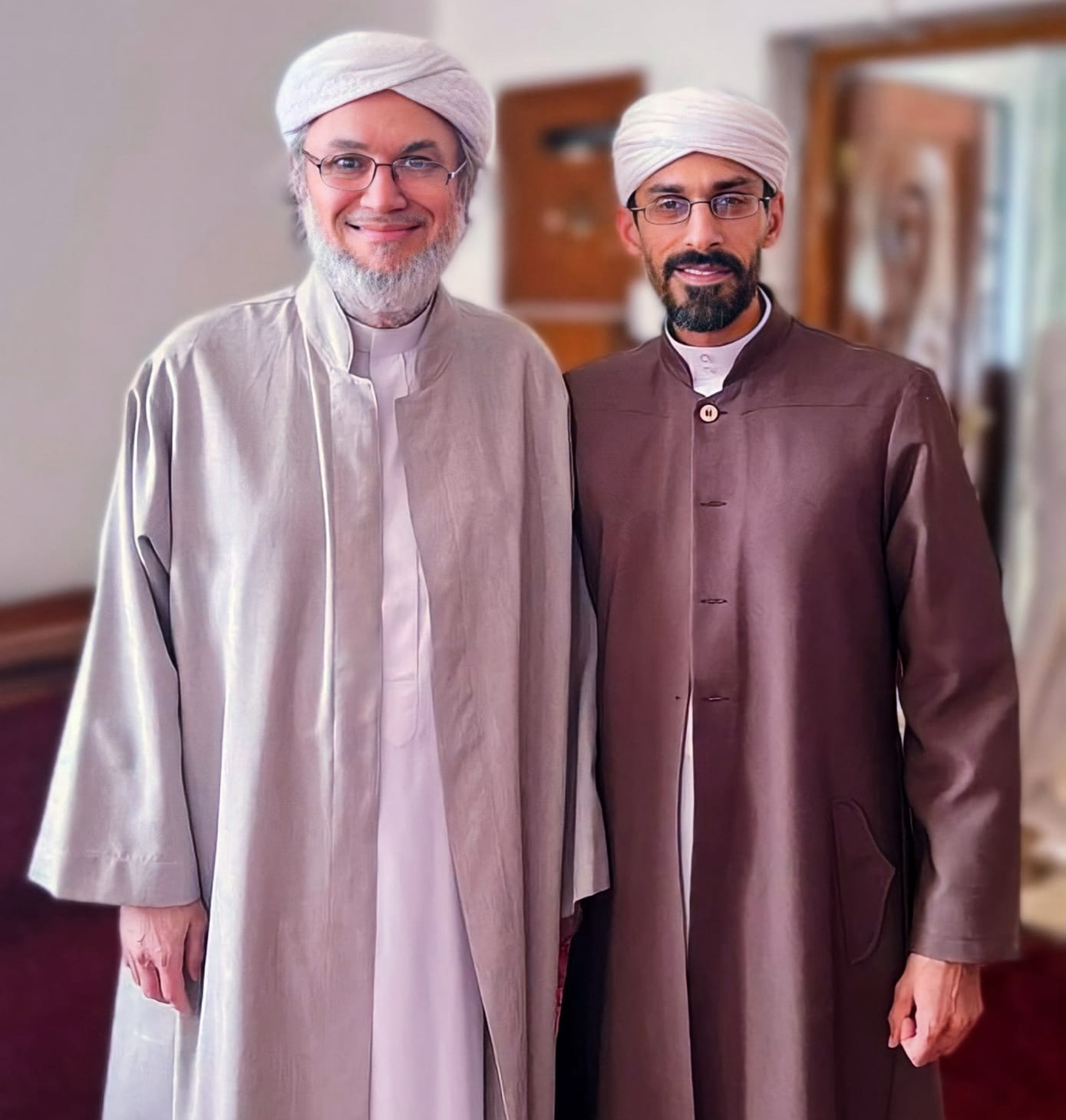
Two pillars of Cape Town’s Shāfiʿī tradition — Shaykh Achmad Hendricks (left) and Shaykh Allie Khalfe (right). Between them flows an unbroken silsilah: the study circles, the Qur’anic sciences, the breath of dhikr, and the living manners of the tradition. Under their guidance, the old way of learning — text in hand, hearts attentive — remains alive in Cape Town.
Monday Night – Two Hours on an Introduction
On Monday night, 11 August 2025, I returned to Azzawia Mosque — this time for the weekly dars with Shaykh Achmad Hendricks.
The WhatsApp invitation from Rashaad Samaai had been simple:
Shaykh Ahmad is currently teaching the Minhāj al-Ṭālibīn of Imām al-Nawawī and the Risālah of Imām al-Qushayrī.
My madhhab is Shāfiʿī — as is the majority of Cape Muslims — so to sit in a reading of Imām al-Nawawī’s masterpiece felt like stepping into my own inheritance.
Shaykh Achmad spent two hours on just the introduction — pausing on its closing lines:
Finally, in cases where there is divergence of opinion among authorities I shall give an impartial exposition of the two opposing theories, the two sides from which one may consider the question in dispute, and the two methods of reasoning adopted in order to solve it; and then I will also, where there is occasion for it, quote separately the decisions of our imam al-Shāfiʿī, and note the relative value of the different appreciations.
From that, a whole world opened: the discipline of fairness, the patience to hold two views in one’s hands, and the humility to weigh them without arrogance.
It took me back to a scene years ago in the Haram at Makkah. A teacher had just finished lecturing his students. When he rose, they swarmed him like bees — those nearest whispering their questions, the teacher answering in whispers too. Everyone leaned in to catch the words. Then, when he departed, they rushed into the market to buy the books he had mentioned.
That is knowledge — not the cold storage of facts, but the living pursuit: sitting, listening, writing, memorising. The kind that makes the heart lean forward. The kind that, even in an age of instant answers, still requires the slow, deliberate turning of a page.
A Gift for the Road – Daily Adhkār
As we stepped out into the cool Cape Town night, Rashaad Samaai pressed a page into my hand.
“It’s from Shaykh Achmad,” he said.
On it was a short litany to be read three times daily — Names of Allah drawn from the Qur’an and the hearts of the early saints:
Bismi Allāh al-Raḥmān al-Raḥīm, Yā Allāh In the Name of Allah, the Most Compassionate, the Most Merciful. O Allah.
Yā Wāḥid, Yā Aḥad — O The One, O The Unique Yā Wājid, Yā Jawwād — O The All-Perceiving, O The Most Generous
Infikhnee bi-nafkhati khayr — blow into me a breeze of goodness
Innaka ʿalā kulli shay’in Qadīr — Indeed, Allah has Power over all things.
A simple gift, but in it, a whole ocean — remembrance for the tongue, stillness for the heart, and a daily returning to the Source.
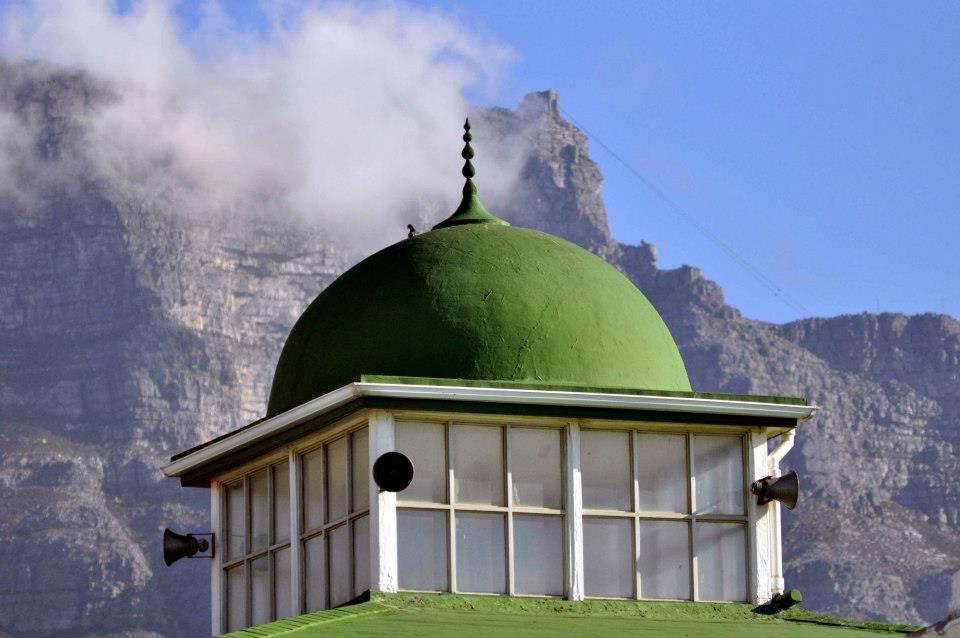
The green dome of Azzawia Masjid rises like a lantern against the stone face of Table Mountain, a reminder that Cape Town’s spiritual horizon is as enduring as its natural one. From here, the call to prayer has travelled across decades of wind and history, mingling with the clouds that crown the mountain. Under this dome, chains of knowledge are kept alive — voices of teachers, pages of sacred texts, and the quiet remembrance of Allah, all anchored in the heart of the city. [Pic: Shafiq Morton]
Closing line: And so the circles of Azzawia turn — each dars a link, each link a step — until the seeker finds that the journey was not only to the masjid on the hill, but deeper into the heart of the chain itself.
✨ A Door Opens: The Story Behind Rabbānī Creative Studio
There are doors we walk through without noticing, and then there are doors that change the way we see. Rabbānī Creative Studio was one of those doors.
It began as sketches and fragments, growing into a space that felt less like a business and more like a miḥrāb — not just a niche in the wall, but a place to face what matters most. Every design, every word, is a way of turning toward beauty, memory, and meaning.
What We Create
Rabbānī Creative Studio combines the art of storytelling with the craft of design — bringing together history, heritage, and heart in every project. Our work ranges from intimate, single-page scrolls to full-length publications, always rooted in thoughtful aesthetics and cultural resonance.
Above: Four recent editions of NWASA Update (Issues 7–10), designed and produced by Rabbānī Creative Studio — from layout to print-ready publication.
1. Magazines & Periodicals
Full-layout design, editorial support, and branding for publications. Example: Four complete editions of NWASA Update (Issues 7–10), from concept to print-ready files.
2. Commemorative Scrolls & Posters
Custom-designed scrolls and posters for milestones — Hajj, weddings, anniversaries, and memorials — blending text, imagery, and heritage motifs.
3. Books & Anthologies
Cover design, interior layout, and thematic visual concepts for poetry collections, historical works, and memoirs.
4. Heritage & Cultural Projects
Visual storytelling and identity work for community heritage initiatives, exhibitions, and cultural campaigns.
5. Branding & Identity
Logos, seals, and visual systems inspired by classical design traditions, adapted for modern digital and print needs.
Our Way of Working
We work slowly when needed, urgently when called for — always with care. Our style blends modern design with heritage textures, drawing on Cape memory, Islamic art, and global traditions.
“What began as sketches and fragments grew into a space that felt less like a business and more like a miḥrāb — a place to face what matters most.”
An Ongoing Invitation
Rabbānī Creative Studio is now a home for creative work that carries a pulse — spiritual, cultural, and human.
It’s for those who believe beauty can be an act of care. It’s for those who want words to live not just on the screen but in the heart.
And it’s an open door.
You’re welcome to step inside.
The Door Is Open
If you would like to:
Commission a unique design
Collaborate on a heritage project
Preserve your story in words and images
… then step inside. Let’s create something that lasts.




 Adli Yacubi