How empire sails in suits, and what it means to row in resistance.
🔰 Intro
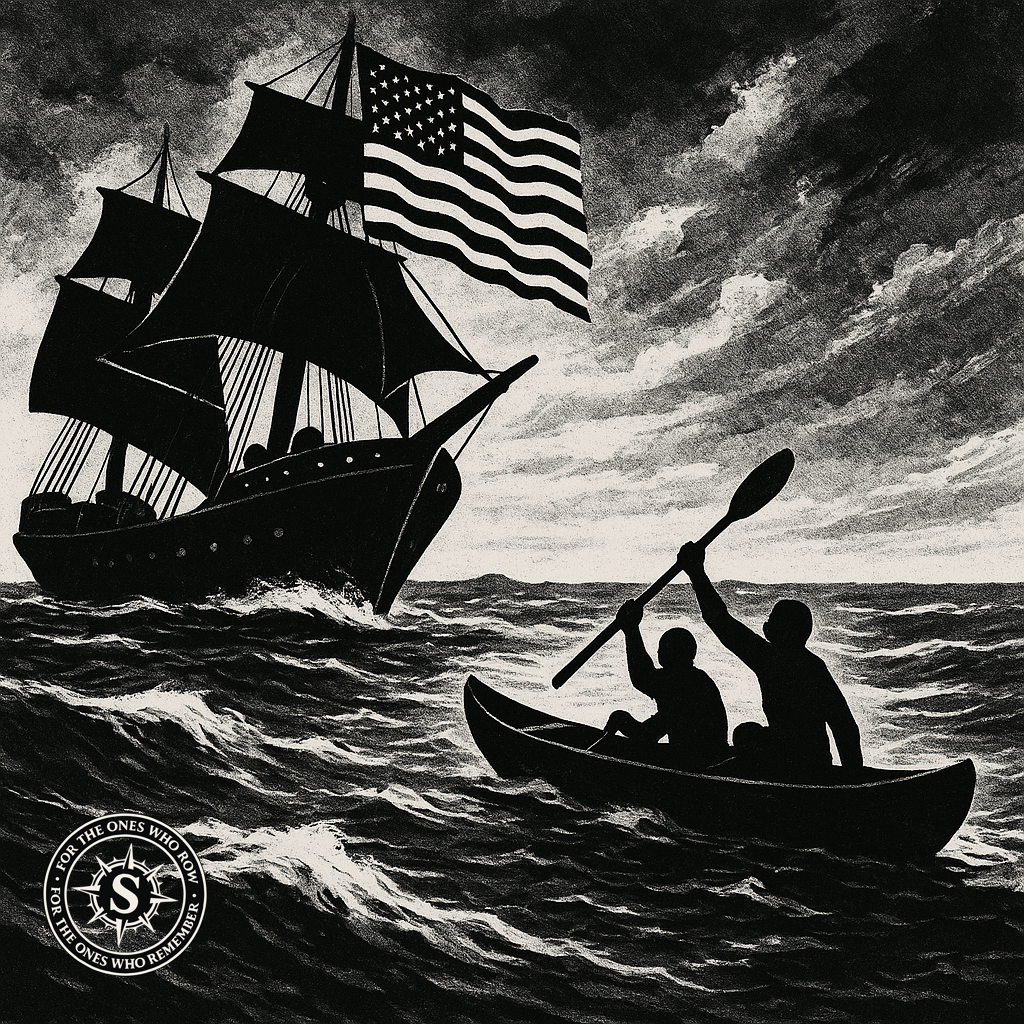
There was a time when pirates came with cutlasses and black flags. You saw them coming. You heard the war drums. But today — the pirates wear uniforms. Or suits. Or diplomatic smiles. And while their ships sail under the banner of freedom, the wake they leave is full of oil, fire, and broken nations.
This is a story about empire. But it’s also a story about you. About where you sit — above deck, below deck, or paddling in a canoe. It’s about resistance. Memory. And the unseen rows of angels above.
“The sea is full of flags — but not one lowers its sails in grief.”
They told us flags were symbols of freedom. They said democracy wears red, white, and blue. They taught us that when their soldiers arrive, the people are being saved.
But the flag flaps like a warning now. The stripes stretch across oceans. The stars are stamped on missiles. The anthem plays over drone strikes.
This isn’t peace. It’s piracy with better branding.
The United States isn’t a country anymore — it’s a flagship. The lead ship in a fleet of multinationals, financial institutions, media empires, and war machines.
It doesn’t sail for justice. It sails for lithium. For land. For leverage.
Its flag is the Jolly Roger of the modern age — not because it’s outlawed, but because it’s above the law. And while the old pirates hoisted black flags to strike fear, these ones wave their colours with pride… and call it diplomacy.
You see them dock in Gaza, in Haiti, in the Sahel. They don’t drop anchor — they drop sanctions. They don’t build bridges — they bulldoze economies. They leave schools shattered, mothers weeping, aquifers poisoned — and they call it freedom.
Even the boldest voices still need trade. Even South Africa, with its lawsuit and legacy, still knocks on the same doors. Because when the pirates run the ports, you have to smile as they loot.
Meanwhile, in Gaza, the killing continues. The children cry in Arabic, but no ship stops to help. The sea is full of flags, but not one lowers its sails in grief.
🏢 Section 2: The Pirates Have Offices Now
“You don’t need a coup when you can crash a currency.”
The pirates don’t need eye-patches anymore. They wear tailored suits. They don’t wave cutlasses — they carry clipboards. Their muskets have been replaced by metrics.
The modern pirate doesn’t kick down your door — he offers you a deal. An “investment.” A “development project.” A “partnership.”
But look closely: The lithium ends up in their electric cars. The water rights end up in their stock portfolios. The debt — always the debt — ends up around your children’s necks.
They’ve learned that you don’t need to invade a country if you can own its infrastructure. You don’t need to drop bombs if you can drop interest rates. You don’t need a coup when you can crash a currency.
BlackRock owns more land than many nations. Nestlé bottles water it didn’t pray for. Chevron calls oil sacred. Halliburton builds what the bombs destroy.
The empire privatized its violence. It outsourced the pillaging to companies with ethical mission statements. Its generals now wear CEO name tags. Its foot soldiers are analysts, consultants, lobbyists.
And when a country resists — like Bolivia, like Palestine, like Niger — it doesn’t get invaded at first. It gets discredited. Its leaders are called unstable. Its elections are called suspect. Its people are painted as dangerous, irrational, ungrateful.
This is how conquest works now: not with sails, but with spreadsheets. Not with warships, but with press releases. Not with swords — but with silence.
Somewhere, a young trade official — daughter of a struggle veteran — tries to resist. She sits in a Johannesburg office late at night, re-reading a contract with clauses meant to trap her people. She circles words in red. She drafts a softer version. She knows they won’t accept it. But still — she sends it.
🧠 Sidebar: They Stole the Thoughts Too
They didn’t just loot land and labour. They colonised knowledge. They broke open sacred libraries, and then wrote the footnotes in their own names.
The West calls it “intellectual property.” But it’s just patented plunder.
In Egypt, Plato sat at the feet of Black scholars. In Mali, the Dogon mapped the Sirius star system — long before telescopes. In South Asia, turmeric healed wounds before it had a bar code.
They burned the manuscripts of Timbuktu. Then they published “discoveries” about African medicine in European journals.
Today they say: “You owe us mobile phones.” But what they really mean is: “We branded what we stole.”
🛏 Section 3: Below Deck — The Ordinary Citizen
“The system is designed to keep the floor clean — even if the keel runs red.”
Empires aren’t only built by generals. They are built by people who go to work, come home tired, scroll a little, and sleep.
Below deck, life continues. The engines roar above, the orders are barked on the bridge — but here, the lighting is soft. There are supermarkets, streaming shows, lawnmowers, coffee shops.
No one hears the groans of the drowned. No one smells the smoke from the burning village.
Maybe they see something on the news — Gaza, Congo, Yemen. Maybe they feel a flicker of sorrow. Maybe not.
The comfort below deck is that you don’t have to know. The noise is muffled. The suffering is pixelated. The system is designed to keep the floor clean — even if the keel runs red.
And when someone does knock on the cabin door — a refugee, a witness, a protester — the citizens flinch. Not because they’re evil. But because it’s awkward. Disruptive. A crack in the illusion.
You see, this ship sells a story: “We are good.” “We bring freedom.” “We are the world’s hope.”
It’s a story whispered through education, hummed in entertainment, declared in politics. And most below deck believe it. Or want to. Or at least, want not to think about it too much.
One evening, a man in the suburbs clicks on a video about Gaza. He watches for seventeen seconds before an ad plays. He sighs. Skips it. Opens another tab. A special on air fryers. The horror slips away — not because he’s cruel, but because the system makes forgetting so easy.
Dissent is dulled with subscription bundles. A hundred shows to choose from. None of them about Palestine. And if that fails, there’s always a pill. A holiday. A hashtag that ends by Monday.
Because thinking leads to questions. And questions lead to guilt. And guilt demands action. And action? That rocks the boat.
🛶 Section 4: Canoes and Resistance
“These boats do not always win. But they do not drown quietly.”
Not every vessel sails under the pirate’s flag. Some float with patched sails and broken oars. They are small. Often sinking. But they do not bow.
They are the canoes of the world. Gaza, battered and besieged, still sings the Adhān through rubble. Haiti, dismembered by decades of debt and interference, still cooks its own rice. Congo, bleeding from every open vein of mineral wealth, still births drums and poems.
These are not nations that invade. They don’t fly drones or send tanks. They row.
And every stroke is resistance. Every preserved language, every intact culture, every refused bribe — resistance.
They are mocked for being poor. Starved for being proud. Punished for surviving.
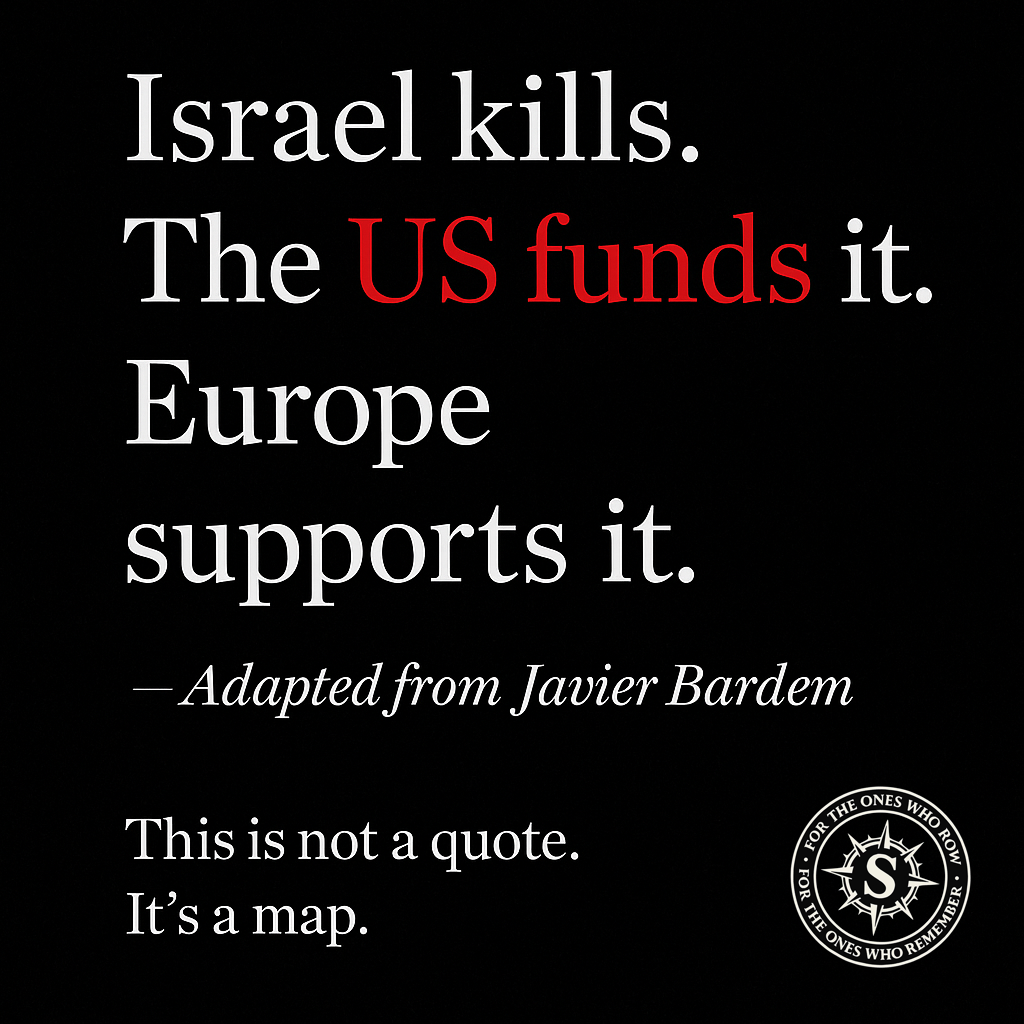
Some truths no longer need footnotes. As the Spanish actor Javier Bardem once said, bluntly and beautifully: “Israel kills. The US funds it. And Europe supports it.”
That’s not politics. That’s a map. A map of complicity. A map of whose silence lets the ship sail on.
The empire calls them unstable. Calls their leaders corrupt. Calls their children threats. But what they fear is not chaos — it’s clarity.
Because the canoe does not pretend. It knows the sea is dangerous. It knows what the pirate ship is.
And still, it rows.
Some canoes are communities. Some are movements. Some are just one grandmother who still tells the old stories — even as the bulldozers arrive.
Some of the canoes ride rivers: the Amazon, the Orange, the Missouri. In them sit the Mapuche, the Nama, the Sioux. They chant in languages the empire once tried to burn. They still paddle. They still protect.
As the bombs fall, a boy in Gaza recites lines from Mahmoud Darwish: “We have on this earth what makes life worth living.” He whispers them into the dust. Into his mother’s lap. It’s not defiance. It’s remembering.
These boats do not always win. But they do not drown quietly. Their resistance echoes — in funeral processions, in ululations, in the smell of fresh bread rising where bombs fell.
And in the far distance, something stirs. Not a boat. Not a bomb. But a wave. A rising swell of memory and reckoning. The kind that even empires cannot out-sail.
❓ Section 5: What Now?
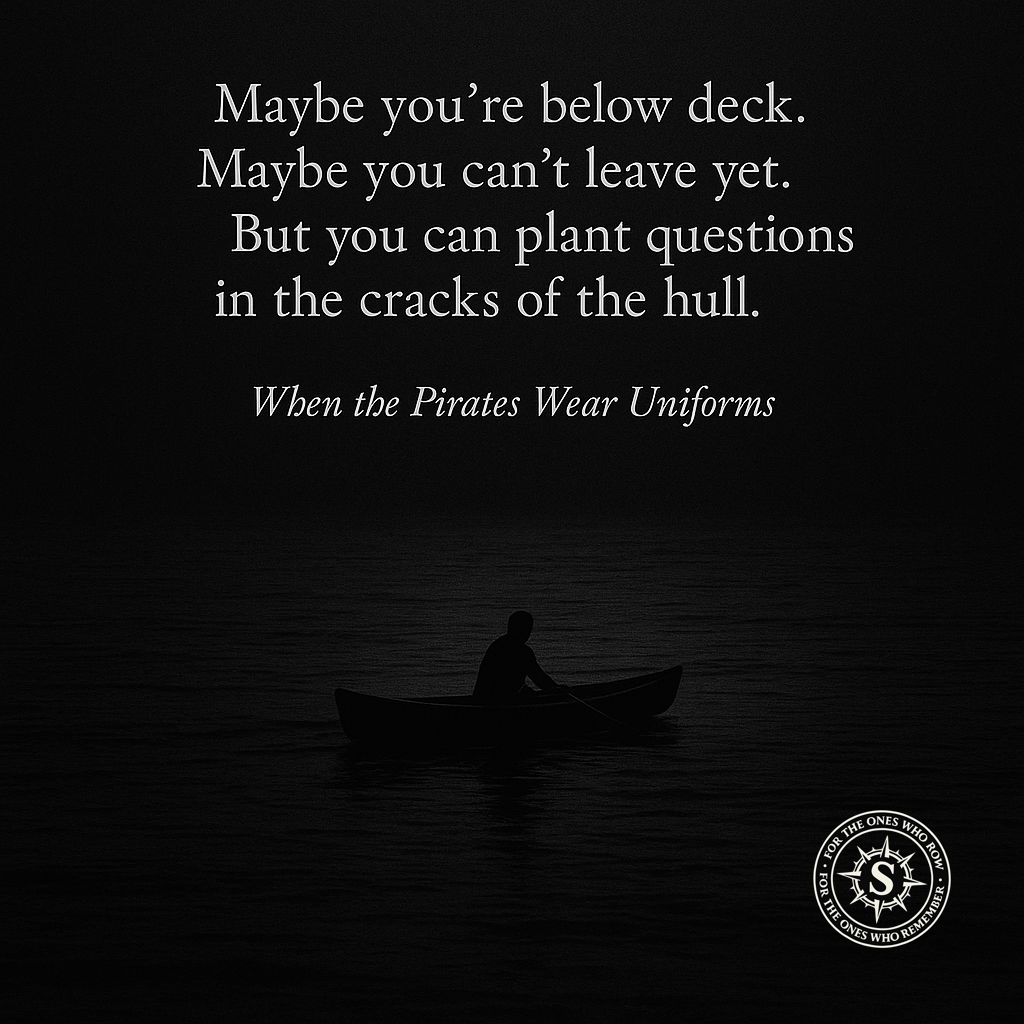
“Maybe you can’t leave yet. But you can plant questions in the cracks of the hull.”
You’ve seen the ship. You’ve heard the cannons. You’ve walked the quiet corridors below deck. You’ve watched the canoes struggle to stay afloat.
So now the question is simple. What now?
You don’t have to be a general. You don’t have to command a fleet. But you do have choices.
You can choose not to cheer when the ship fires. You can choose not to believe the stories they sell you — about the savages, the chaos, the necessary war.
You can choose not to mock the canoe. You can choose to listen when the drowned call out from beneath the waves. You can learn their names. Say their prayers. Tell their stories.
Maybe you’re below deck. Maybe you can’t leave yet. But you can plant questions like seeds in the cracks of the hull. You can make art that aches. You can whisper, even if your voice shakes.
And maybe, one day, when the ship hits a reef — you’ll already know how to swim.
🌌 Postscript: The Unseen Rows
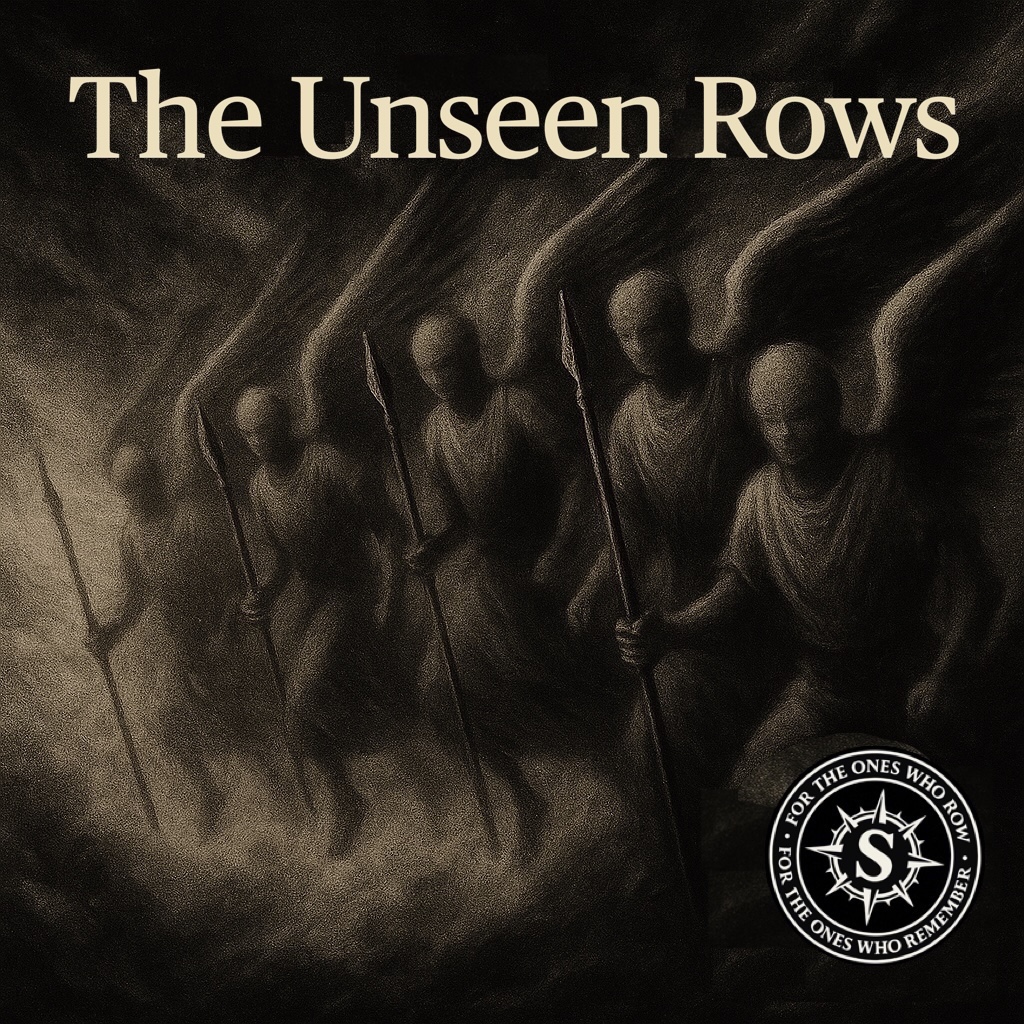
“Above the pirate ships, the angels line up.”
For the ones who row. For the ones who remember.
Above the shipping lanes and air raids, above the pirate flags and surveillance drones, above the offices and engines and war rooms — there are rows they do not see.
Al-Ṣāffāt. “By those arrayed in rows…” (Qur’ān 37:1) The angels. Not scattered. Not confused. Lined up — like soldiers of mercy. Advancing — like winds of truth. Reciting — not data, but dhikr.
وَالصَّافَّاتِ صَفًّا فَالزَّاجِرَاتِ زَجْرًا فَالتَّالِيَاتِ ذِكْرًا By those arrayed in ranks, by those who drive forward, and by those who recite the Reminder… (Qur’ān 37:1–3)
These are not symbols. They are not myths. They are the architecture of heaven. And they do not forget the ones who row.
When the shayāṭīn of power rise to steal, when the liars reach for whispers of the unseen, they are met with stones of fire. Comets hurled from truth’s edge. The skies are not neutral. The divine has guardians.
“They cannot listen to the Higher Assembly… they are pelted from every side, repelled, and for them is a perpetual punishment.” (Qur’ān 37:8–9)
And we? We row. We remember. We recite.
We do not carry cannons — but we carry verses. We are not in fleets — but we are not alone. Somewhere, angels are already in formation.
✨ A Final Word from Rafiq al-Bunduqia
The Sage on the Jetty
So here’s what I say, ne:
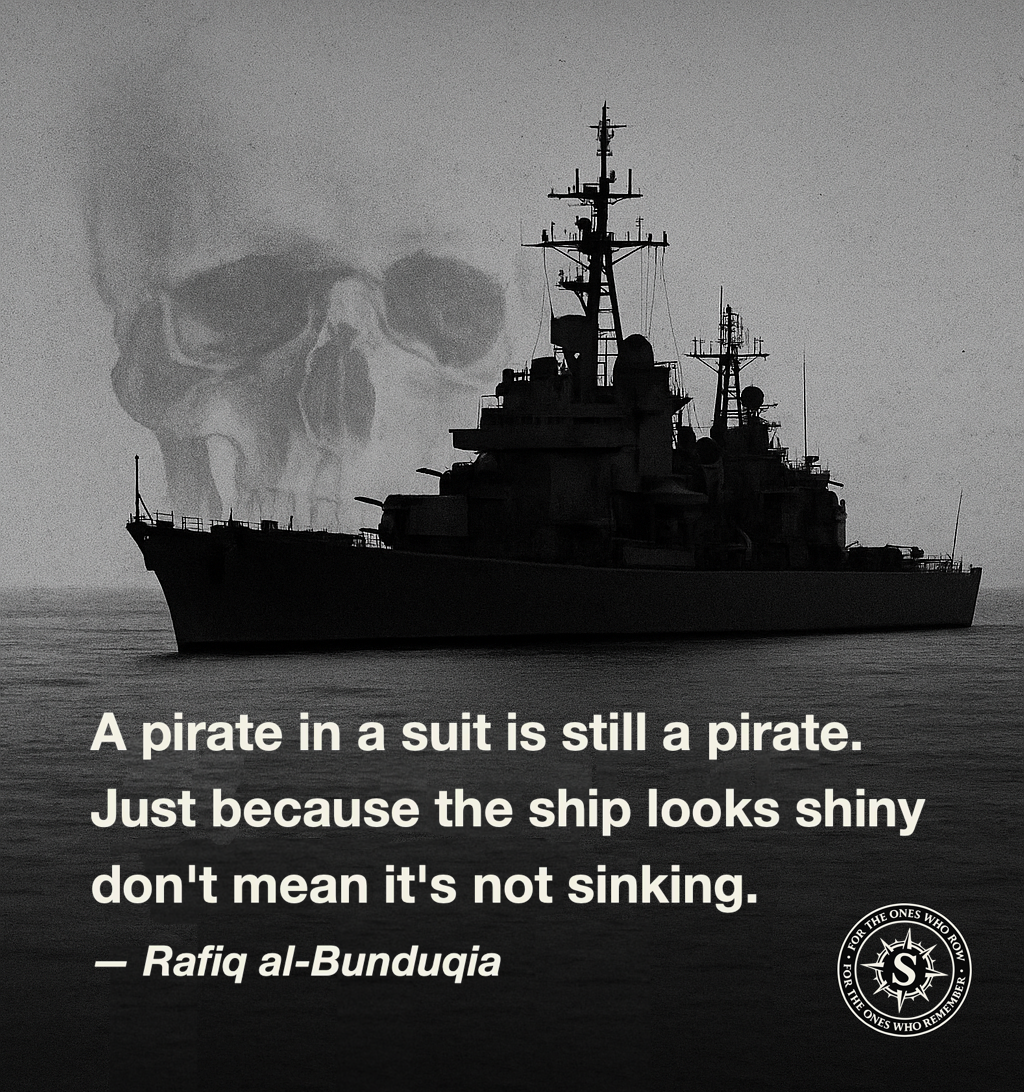
Don’t let them fool you with fancy uniforms and offshore accents. A pirate in a suit is still a pirate. And just because the ship looks shiny don’t mean it’s not sinking.
Me, I seen this before. The old flags change — but the hunger stays the same. They used to come for your gold. Now they come for your soul — and your SIM card.
They sell you peace while sharpening knives. Call it “stability,” call it “the market,” call it “regime change.” But listen close, my bru — they only change regimes that say “no.”
Below deck, I know some of you are tired. I know some of you feel small, feel stuck. But remember: Empires fall when enough people stop pretending.
You can’t steer the whole ship, but you can stop rowing. You can stop clapping for the captain. You can light a fire in your corner. And when the time comes — you’ll know which way to swim.
And as for the ones still paddling in canoes? Rowing against the wave, barefoot, hungry, heart full?
May your names be written on the wind. May your stories outlast the storm. And may your grandchildren sail free.
shotgun click
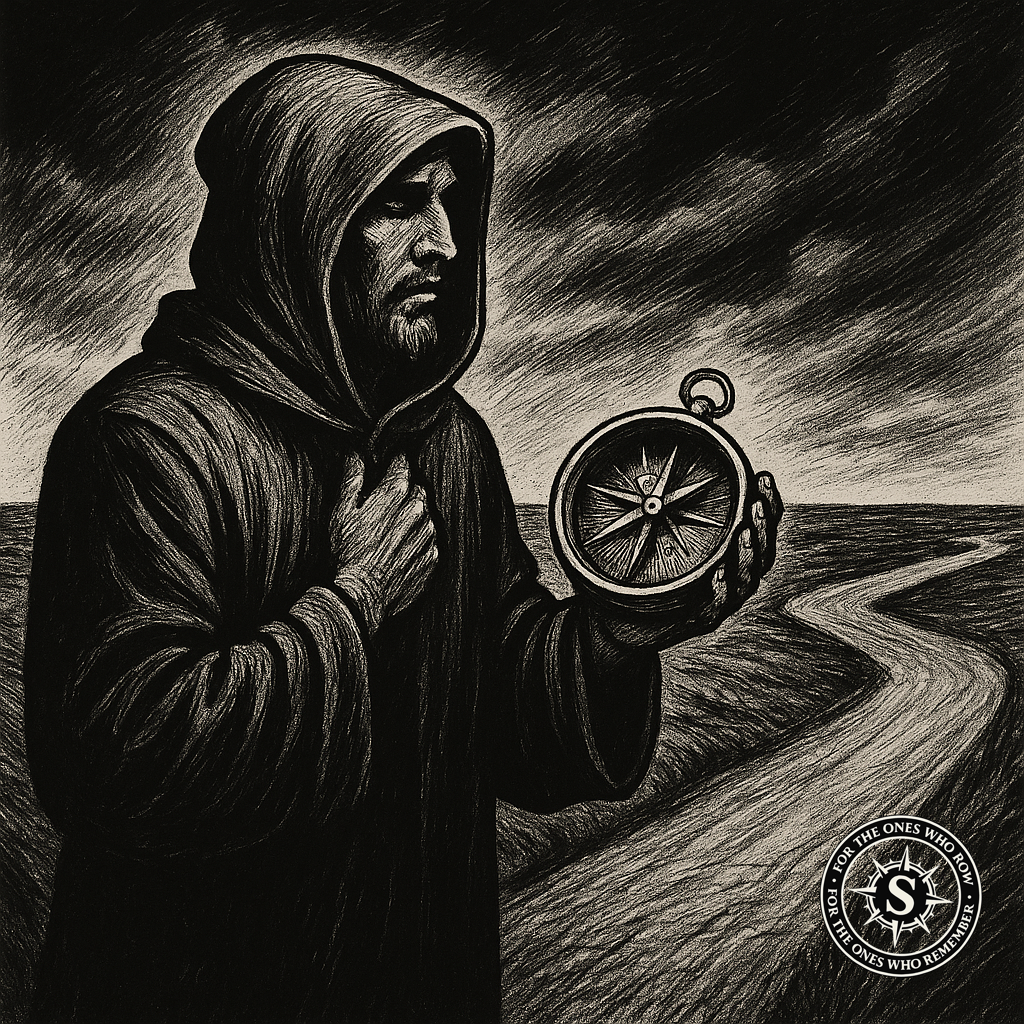
We ride till the ship breaks, bru. Until then — we don’t hand over our compass.
“Salaam to the angels who line up when we can’t. Salaam to the ones who row even with leaking boats. Salaam to the ones who still make dhikr in the dark.
And to the empire?
May you one day see what light you tried to drown.”
Ameen, and ashraaf ʿalaikum ya ṣaffāt.
The seal of remembrance — for the ones who row, and the ones who remember.
— Rafiq al-Bunduqia, The Sage on the Jetty 🧭
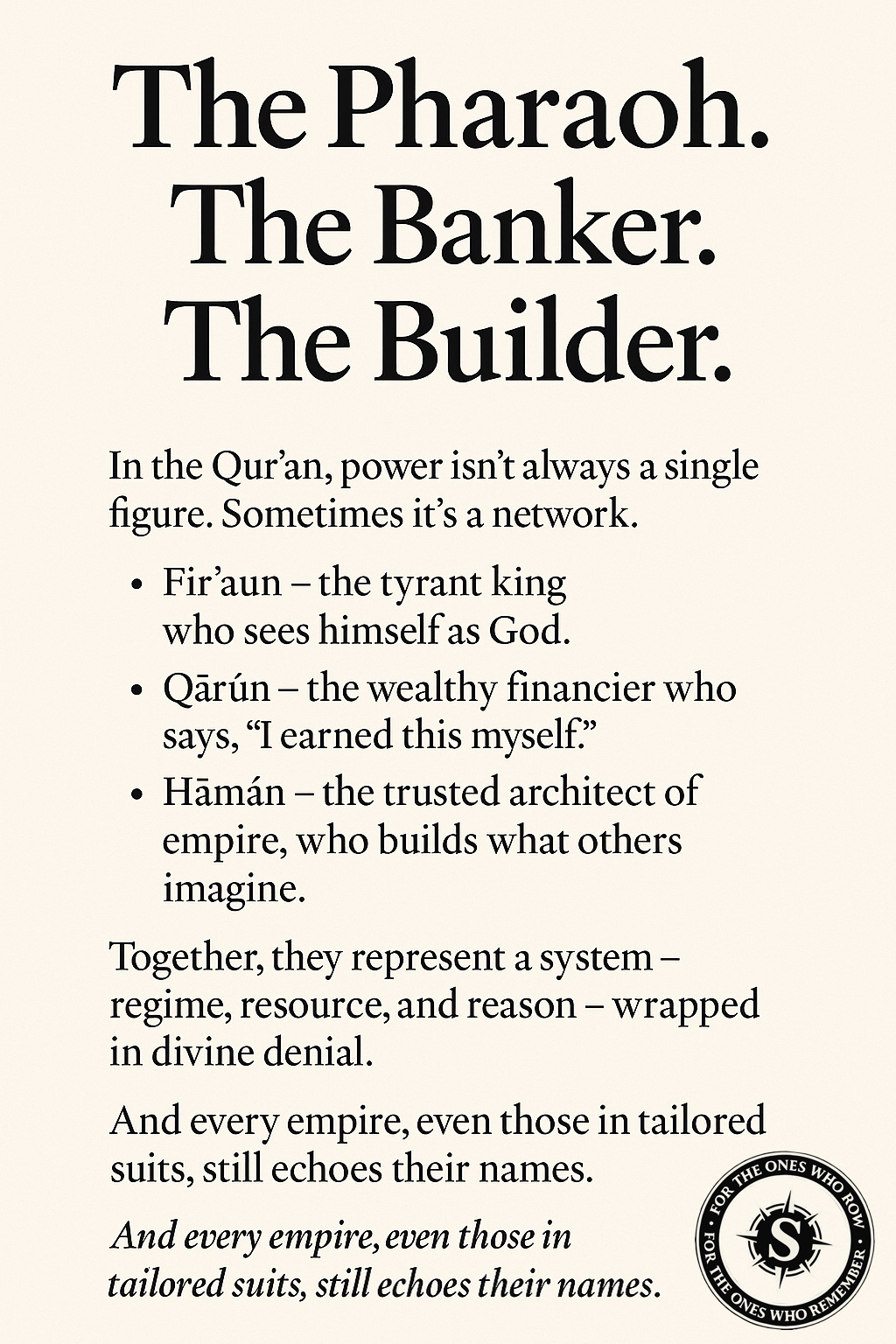
“The Pharaoh. The Banker. The Builder.”
📜 Sidebar: The Three Faces of Tyranny Fir‘awn. Qārūn. Hāmān. These three figures appear repeatedly in the Qur’an — not just as villains of the past, but as types that recur across history. Fir‘awn: the dictator, the political oppressor. He claims divinity, demands obedience, and divides people to rule them. Qārūn: the hoarder, the economic elite. He flaunts his wealth, credits no one but himself, and forgets the source of all provision. Hāmān: the enabler, the bureaucrat and ideologue. He builds towers, writes the laws, manipulates truth, and justifies oppression in the name of order. Together, they form a system: the empire that marches with a flag in one hand, a contract in the other, and blood on its boots. Sound familiar?
“Today, they wear suits. They weaponise policy. But the triad still walks among us.”
The Pharaoh, the Banker, and the Builder
In the Qur’an, they stand together — a tyrant, a financier, and a master of infrastructure. Firʿawn ruled with cruelty. Qārūn hoarded with pride. Hāmān built towers for lies.
Centuries later, the empire shapeshifts. Today, they wear tailored suits. They pass laws. They sign cheques. They pave roads to ruin.
But remembrance makes them visible. And visibility is resistance.
“The Pharaoh. The Banker. The Builder.”
🧭 Parting Compass — A Note from Rafiq al-Bunduqia
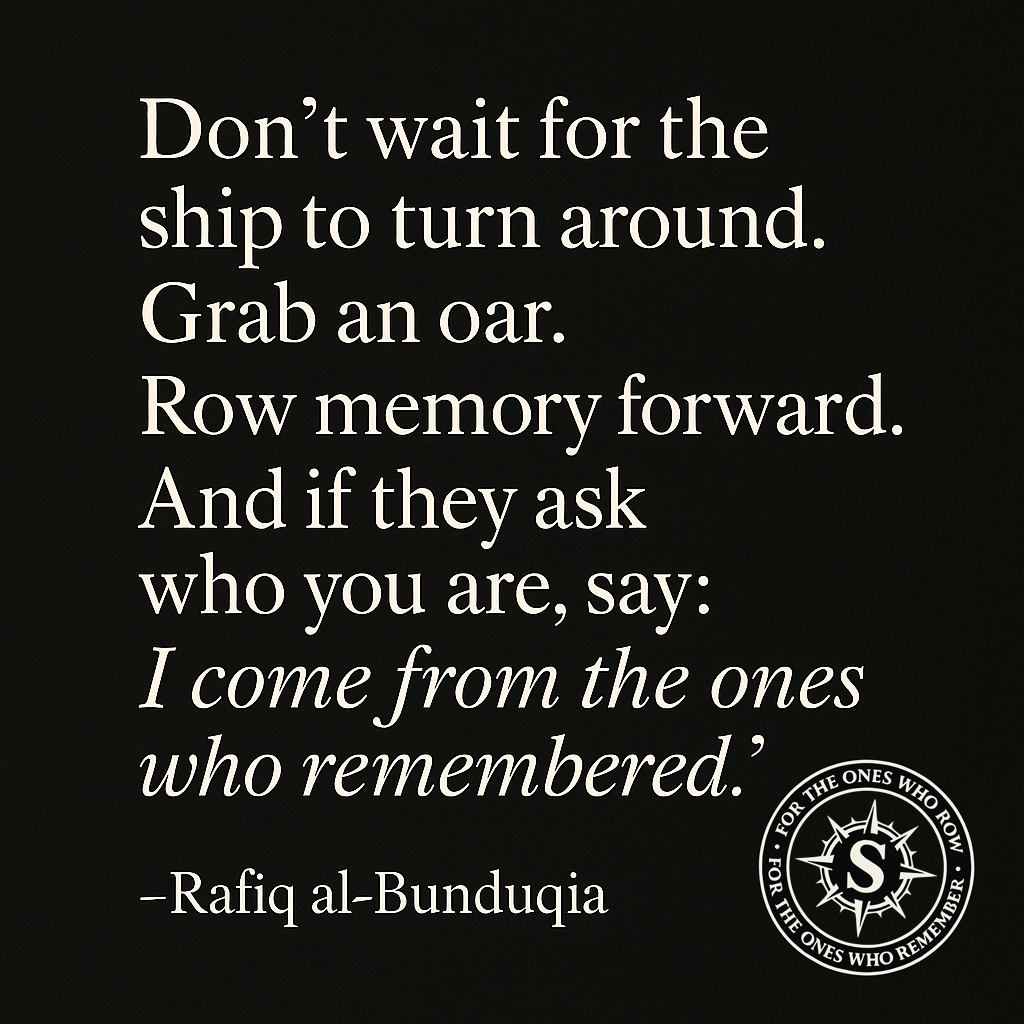
Don’t wait for the ship to turn around. Grab an oar. Row memory forward. And if they ask who you are, say: I come from the ones who remembered.
Before Three Sisters: A Road Interrupted, A Heart Opened
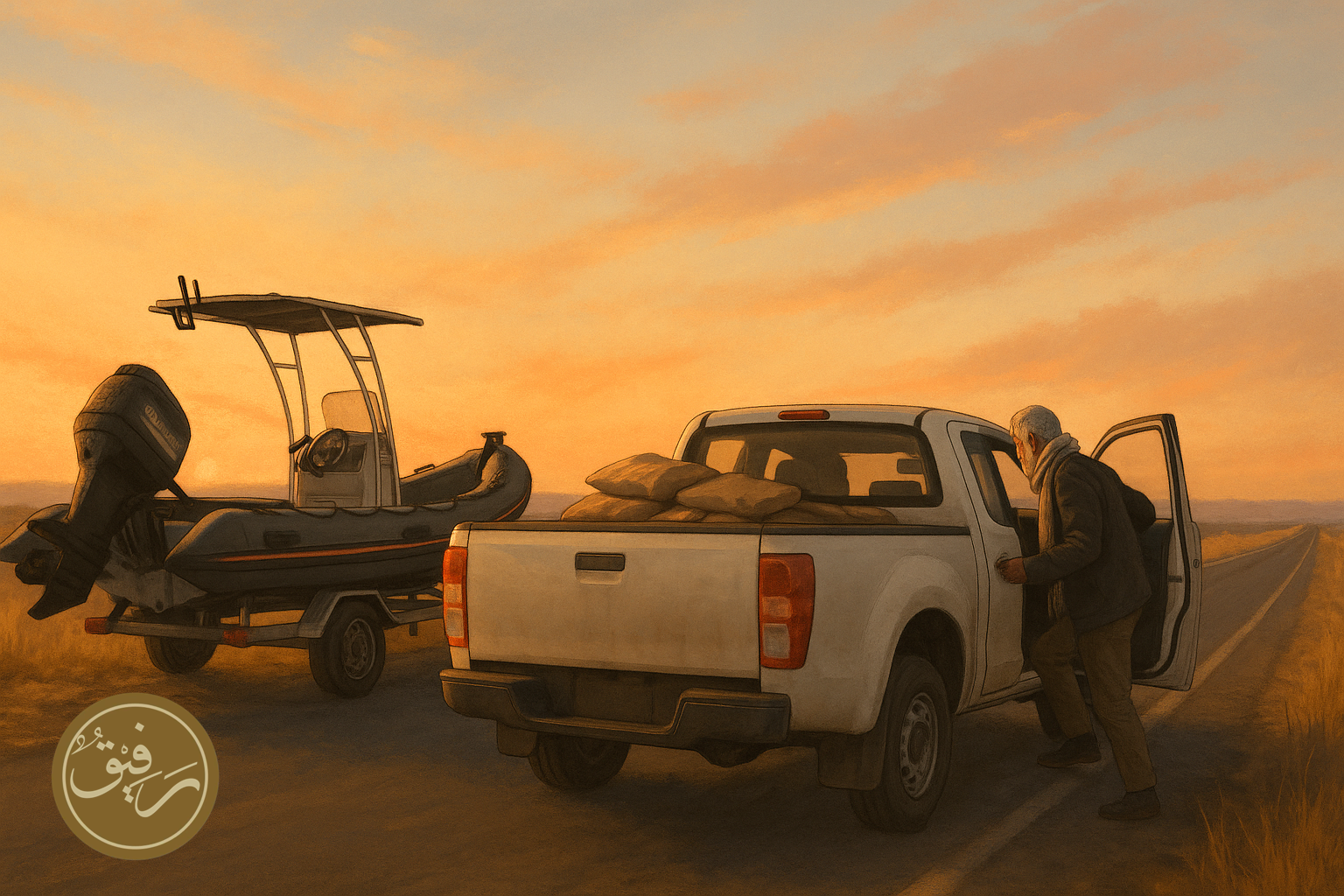
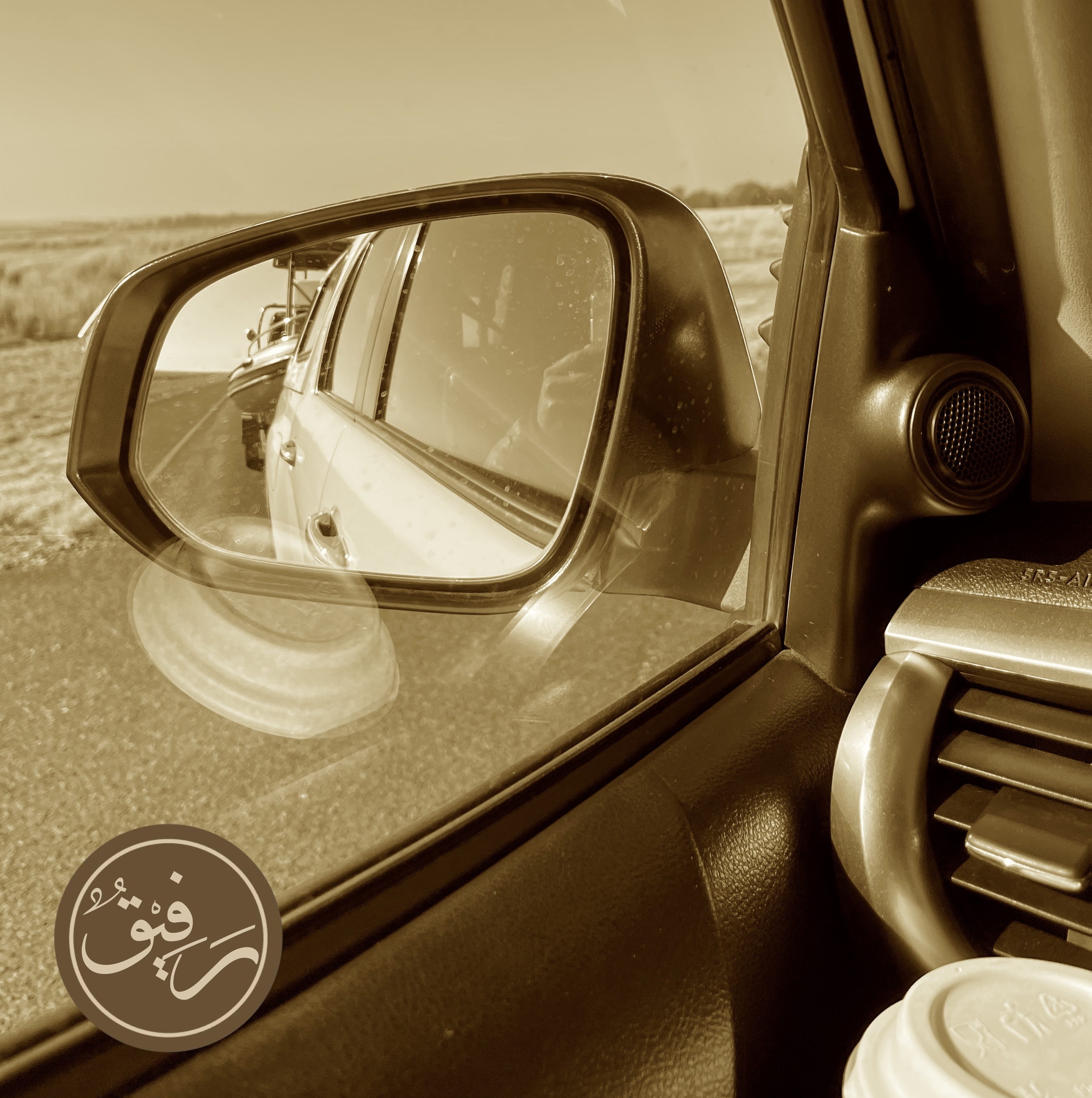
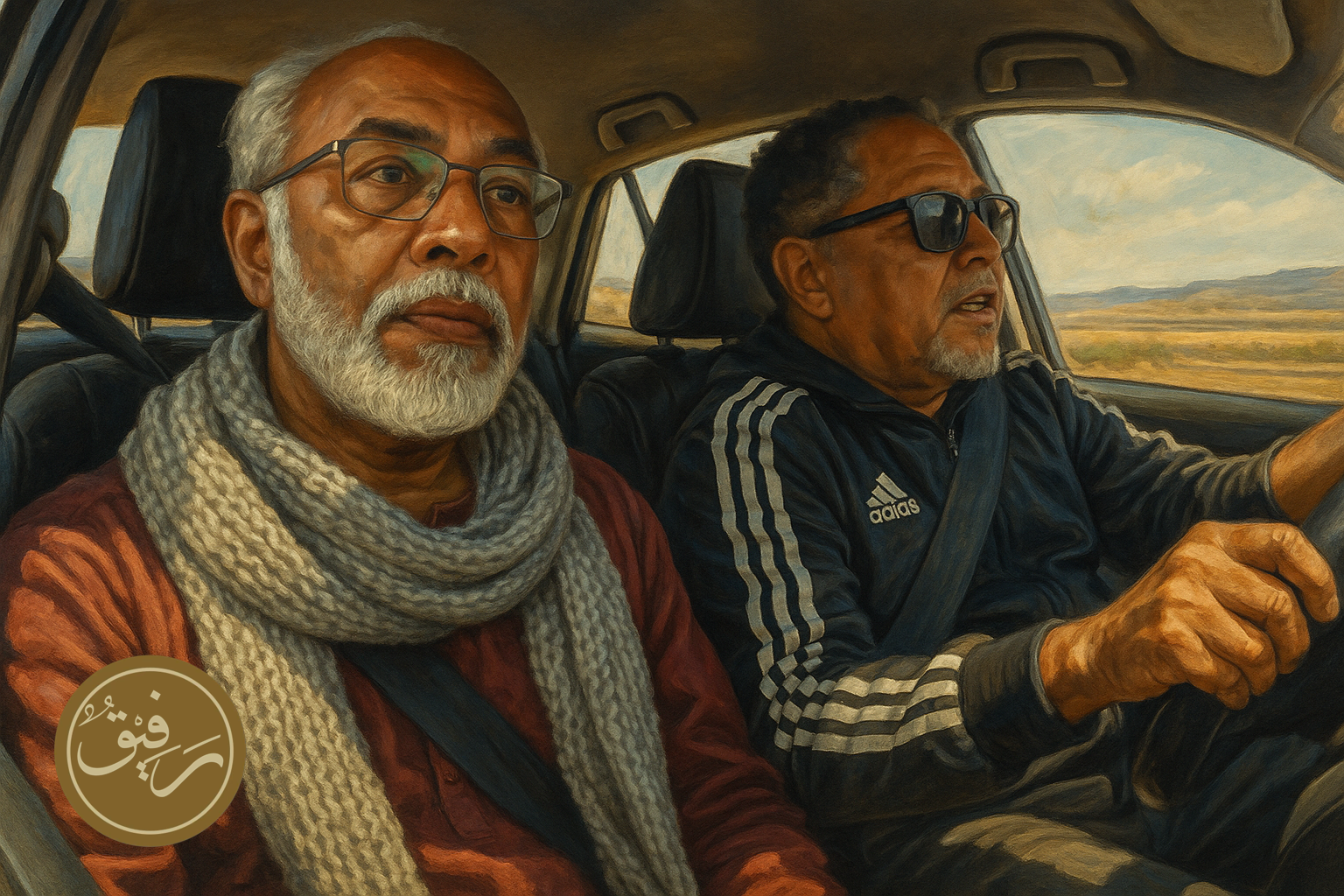
We left Johannesburg in the early light, bound for Worcester — a journey that would return me not only to a familiar valley, but to a story still unfolding. I climbed into Deem’s bakkie at 6:20am. The air was still soft with sleep, but the weight we carried was real — a dinghy boat hitched behind us, and cement bags packed into the back to balance the load. Deem was heading to the Cape for another transport run, as he often did — ferrying cars, boats, bakkies, golf carts, whatever needed moving.
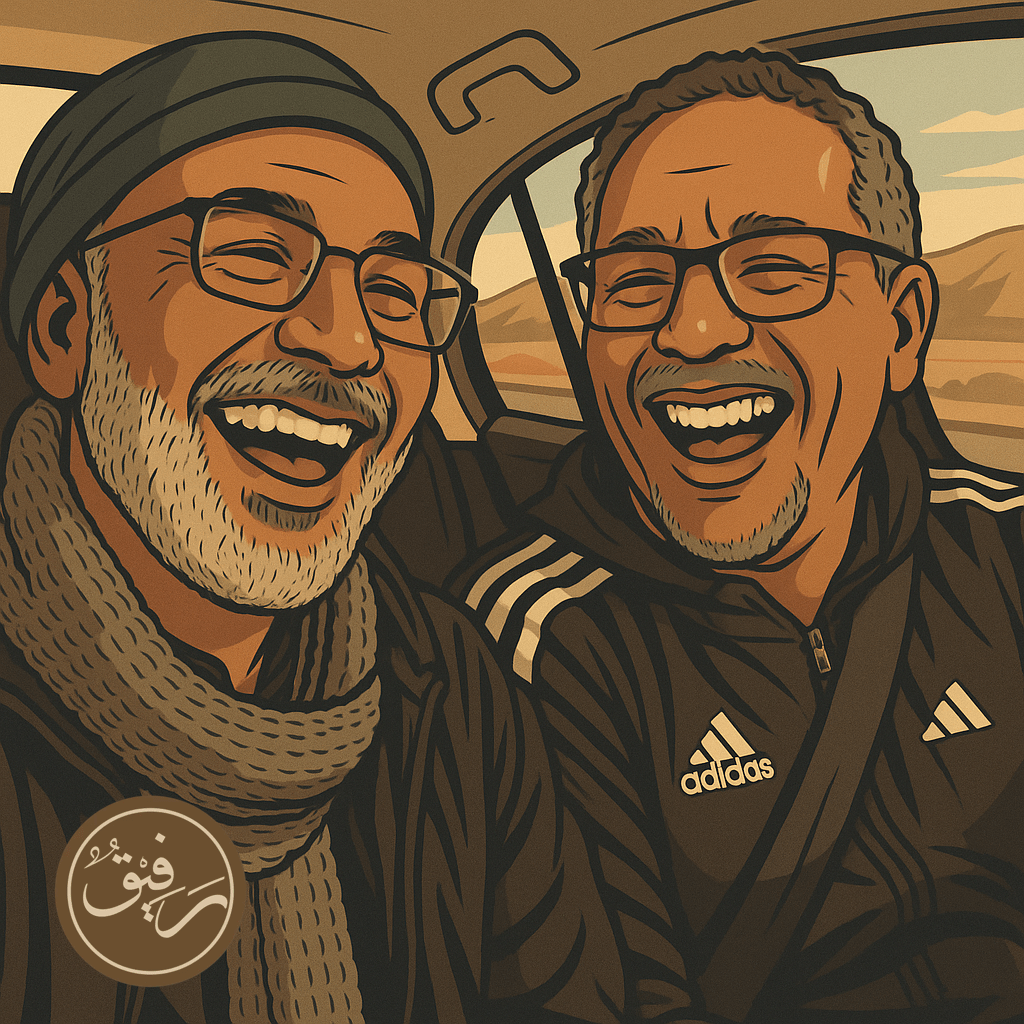
He kept it steady, slow — 80 to 90 km/h. The road hummed low. We started talking.
Mostly about our children.
His sons, his daughter. Now grown. Their paths, their beliefs, the choices they were making in a complicated world.
“I worry, bru,” he said. “About their Islam… their qibla.”
I nodded. And gently shared my own truth:
“We’ve already planted the seeds, Deem. Madrasa, school, life. The goodness is wired in. They’ll find their way to the Divine — maybe not how we imagined, but still. They’ll find it.”
We sat in that silence — the kind that listens.
Faried and the Detour
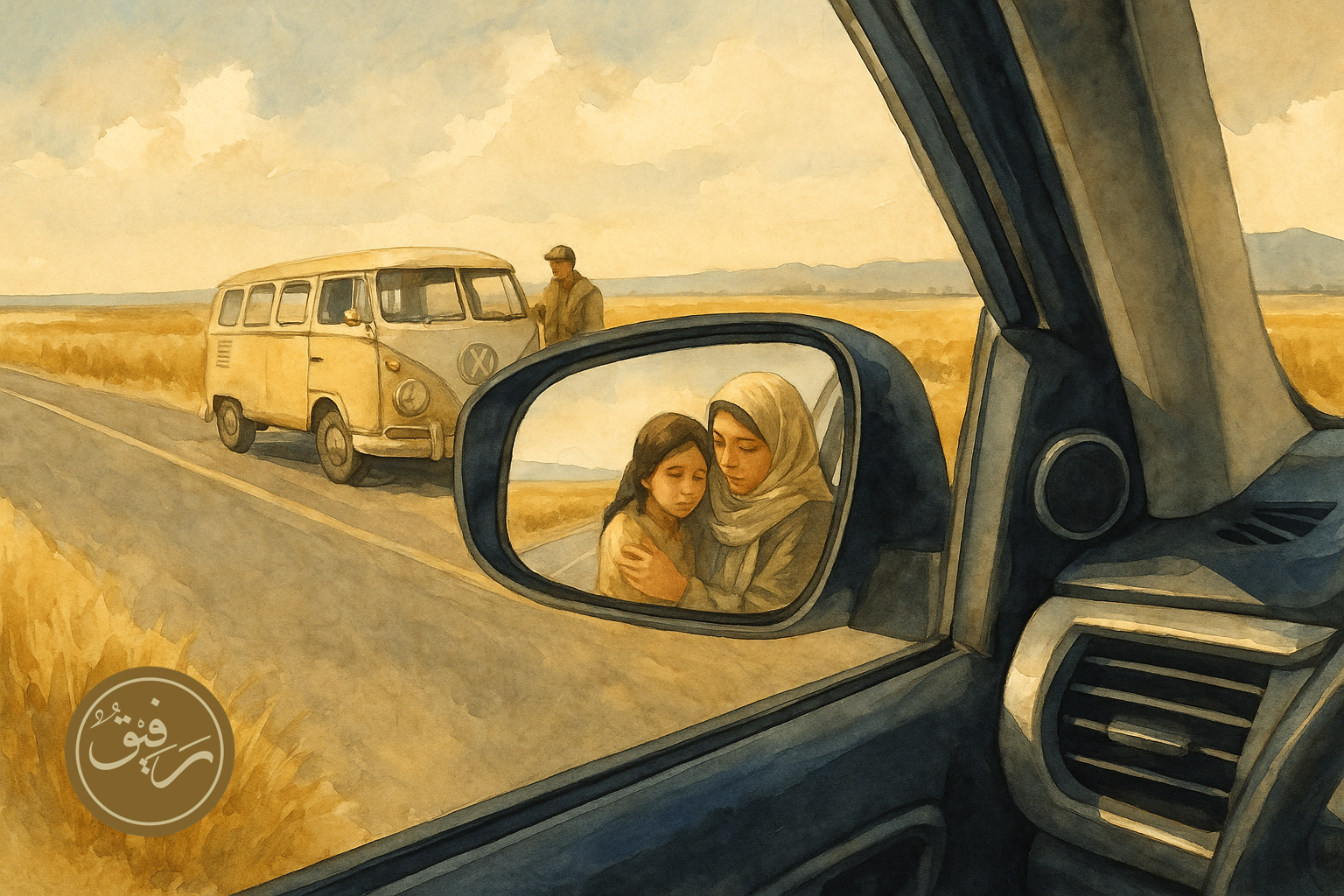
Just before Three Sisters, Deem got a message. A friend of his, Faried, had broken down with his family. We rerouted.
And just like that, our quiet bakkie became a car of five — Faried, his wife, and their daughter now in the back seat. I stayed quiet. This wasn’t my space to speak.
But something had shifted. The stillness that had carried us through the early part of the journey made way for the unexpected warmth of company, for laughter, for memory. What had begun as a private ride between two companions was now a shared passage — a reminder that some roads widen not with tar, but with presence.
The wife was chatty, warm, full of stories. She and Deem started talking about Deem’s drivers. One in particular: Archie.
“Archie’s solid,” she said. “Kaaps, maar sharp. Always shows up.”
A few kilometres down the line, just past Beaufort West, almost in Worcester, Deem turned to me and asked:
“You know what Archie’s real name is?”
I smiled.
“My eldest brother — Allah yarhamu — was Fuad. But everyone called him Archie. So… is he also Fuad?”
Deem laughed.
“Nai bru… his real name is Abdul Qahhar.”
We both burst out.
“Qahharjie becomes Archie! Allah!”
The Bend in the Road
The road narrowed into the Hexrivier Valley. Dark by then. But not empty. The headlights caught a curve.
“You see that corner?” Deem said.
And then he told me:
His father — Omar, also known as Amie, known to my kids as Dada — once took that very bend too fast. Racing from farm to farm, moving fish, goods, deals. He missed the turn. His bakkie flew into the river. He survived. And fished out his own worker, too.
“I was a laaitie then,” Deem said. “But every time I pass this spot, I remember. Dada was tough. A real survivor.”
I stayed quiet. Because what do you say when the road opens memory like that?
To Worcester, With Love
And then, as the road opened wider and the mountains made way for valleys known in name and marriage, I found myself returning not just to a place — but to the people and stories who made that place feel like mine.
Worcester wasn’t just a destination. It was memory incarnate.
When I married Sadia, I stepped into her family’s legacy — the Fakiers and the Majieds. Worcester was theirs. Her childhood. Her community. Later, her battleground — she became a unionist, fighting for dignity across these valleys.
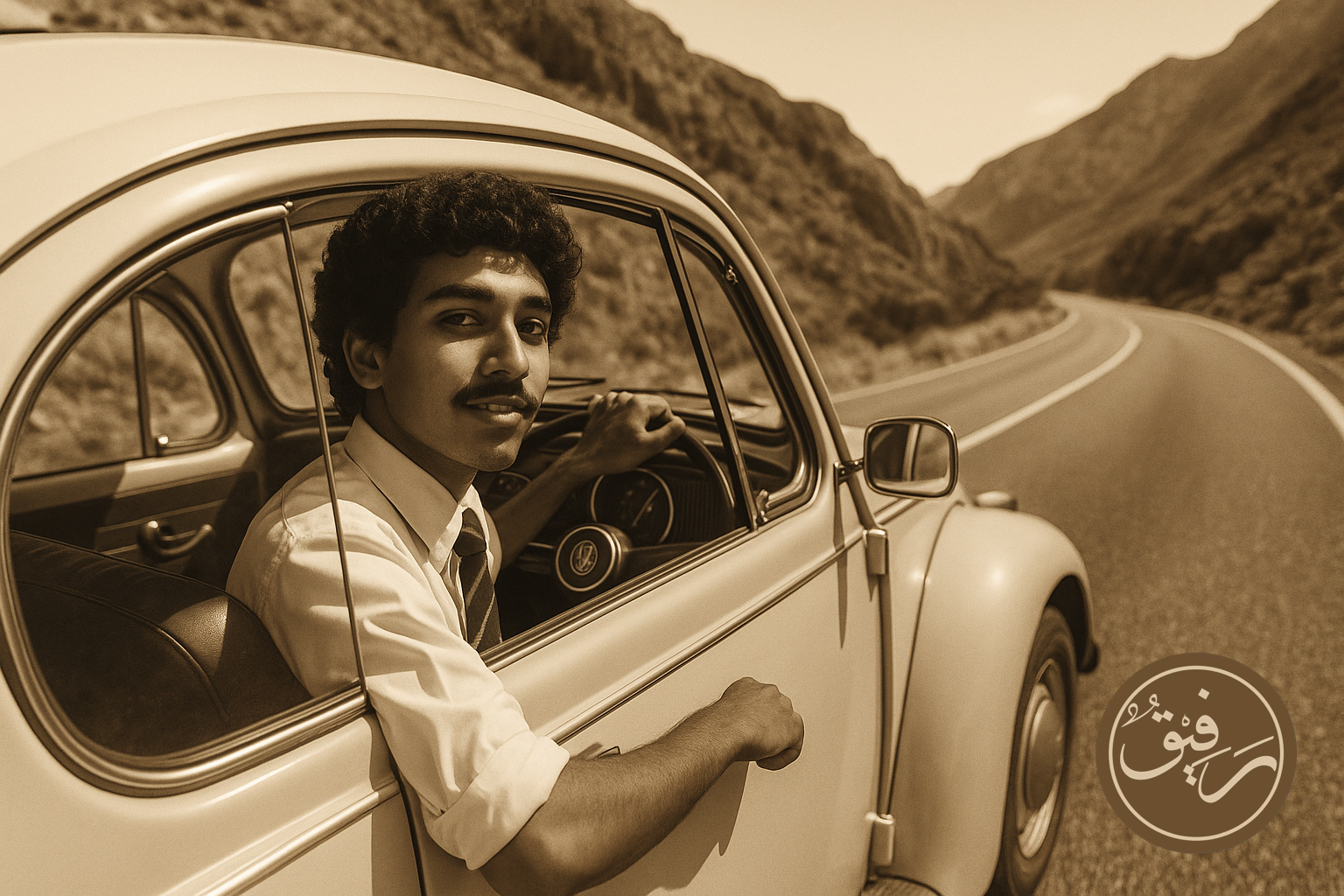
Back when I was still courting her, I’d drive my light blue VW Beetle 1400 — my first car, bought from Deem — all the way from Cape Town to Worcester and back. About 120 kilometres each way. For love.
So that night, when we came through the final bend, the boat still hitched behind us, the road folding into familiar curves… I realised:
This wasn’t just a road trip. This was return.
To family. To love. To the people who carried us before we even knew their names.
Closing Blessing
As Shaykh Jamiel Abrahams said, in response to this journey:
“Many a person with shaggy and dusty hair, dusty and driven away from doors… if he was to call on Allah ﷻ, Allah would surely answer.”
Some roads answer us back. Even in silence. Even before Three Sisters.
And maybe, if you’ve followed this far, it means you too have travelled one of those roads — or carried its dust in your shoes.
Before the baseball cap, the side-eye, and the wisecracks, there was something softer — a garden.
Not of vegetables or vines, but of words: words whispered, weathered, watered by prayer.
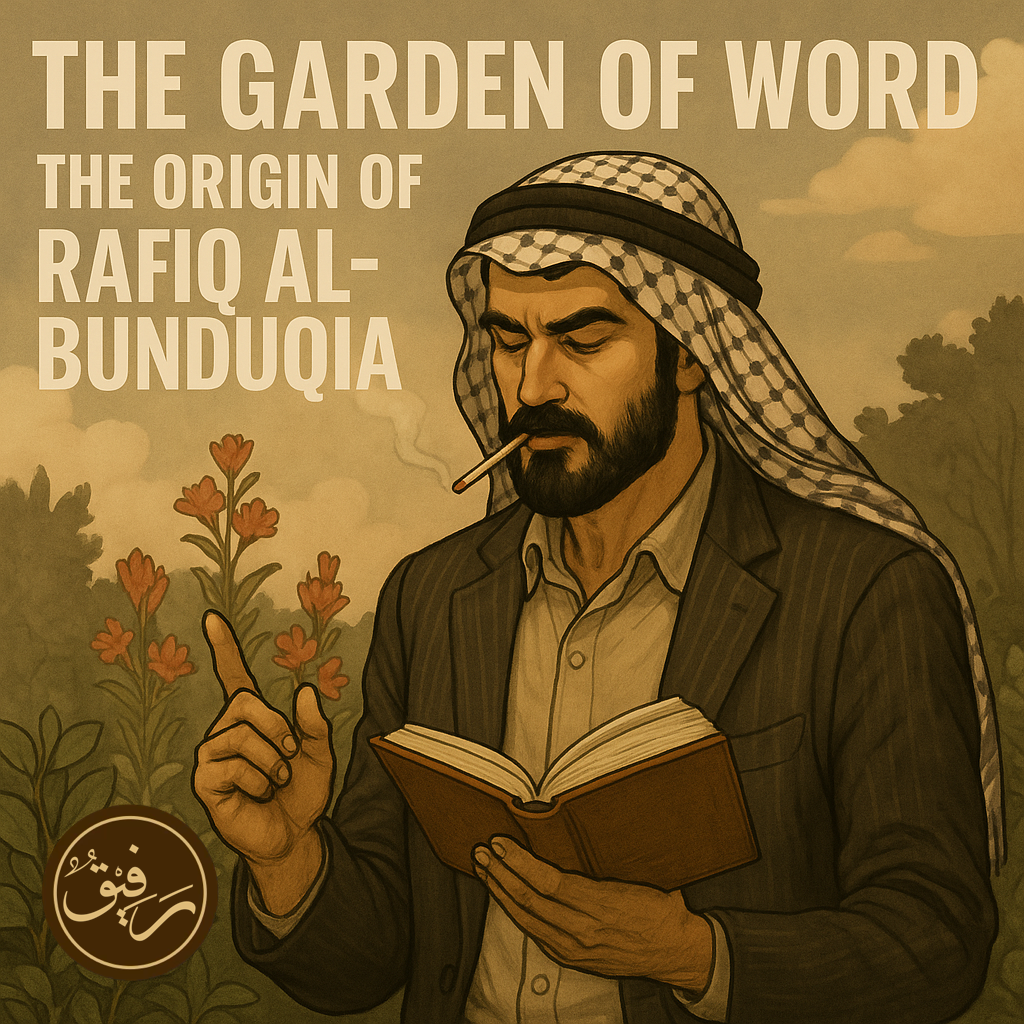
I wrote this piece years ago as a meditation on growth, loss, and language. Only now do I realise: this garden was the soil that gave us Rafiq al‑Bunduqia — the companion of pause, the superhero of syntax, the witness in the passenger seat.
🌱 Introduction
Not all heroes crash through walls. Some sit beside them and ask, “Who built this?”
He doesn’t leap tall buildings. He takes long pauses.
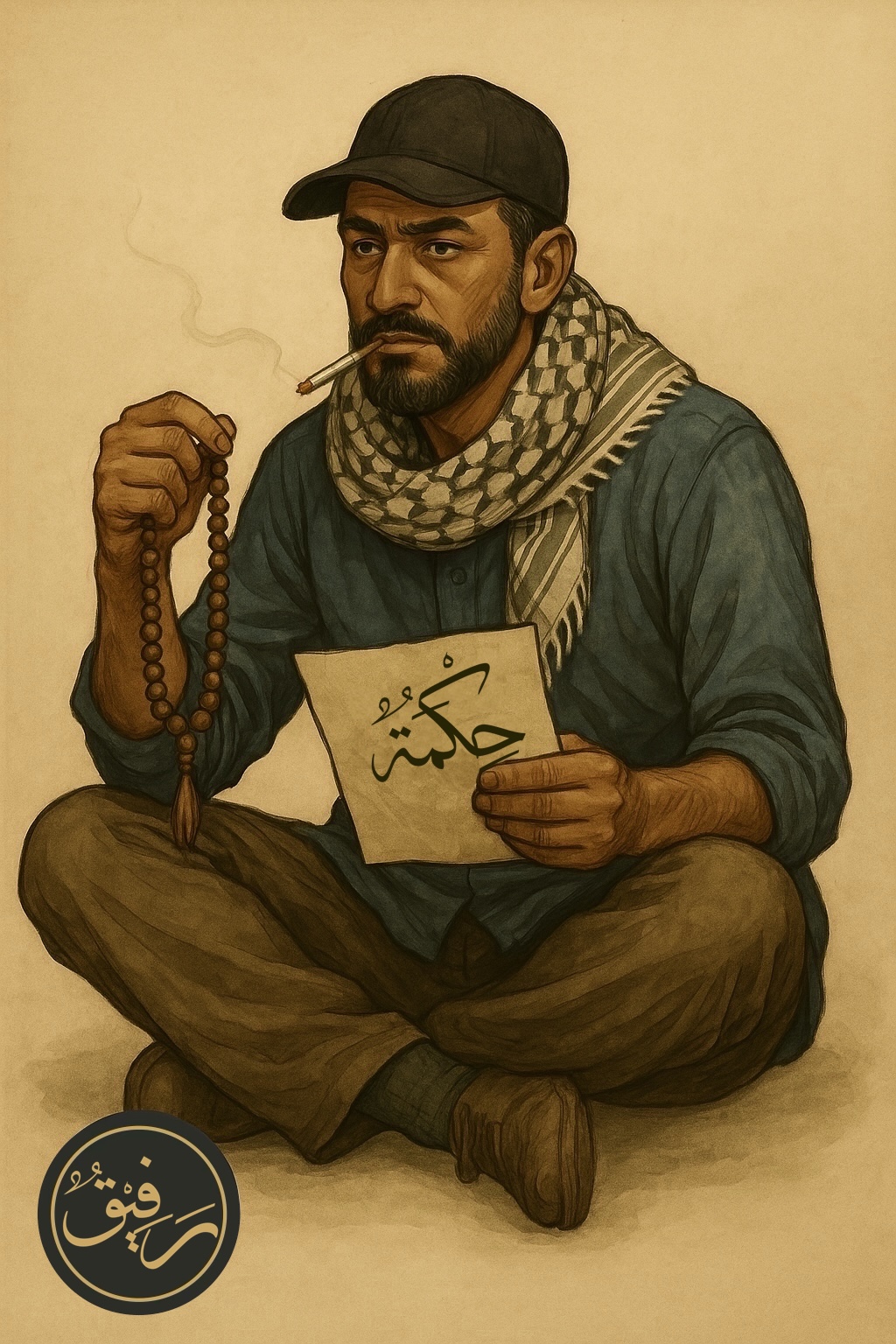
His name is Rafiq al‑Bunduqia. Shotgun companion. Keeper of silences. Superhero of the word.
This is his origin scroll.
📜 1. A Garden, Once Planted
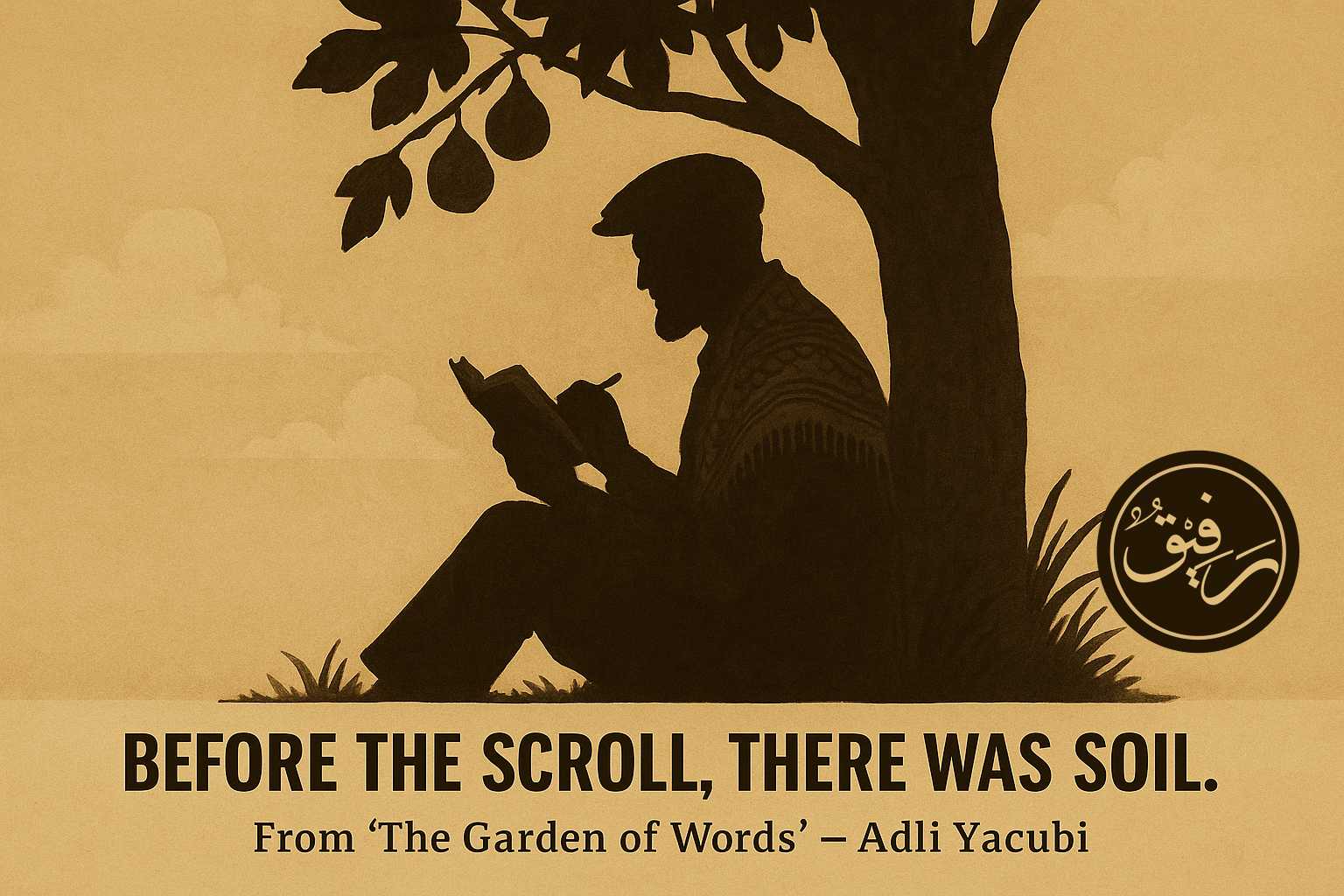
Years ago, I wrote The Garden of Words. It was a meditation on how language grows: slowly, unexpectedly, in sunlight and ache.
I had no idea then that someone had been walking in that garden all along — listening to the leaves, laughing at the metaphors, sharpening a pencil beneath a loquat tree.
His name came later. But his presence? It was always there.
🦸🏽♂️ 2. What Kind of Superhero Is Rafiq?
Rafiq does not fly. He walks. Slowly. On purpose.
He doesn’t rescue you — he reminds you. He doesn’t dazzle — he decodes.
His weapons are:
A well-timed question
A half-smile that disarms
A quote from a street aunty that cuts deeper than any Hadith app
And a scroll, always a scroll
He moves through WhatsApp voice notes, bread queues, and Threads threads. You won’t notice him until it’s too late — and then you’re crying and breathing better.
📖 3. His Powers
Power
Description
The Pause
He listens long enough to hear the truth behind your noise.
The Compass
He helps you re-find your qiblah when algorithms have stolen your sense of direction.
The Scroll Drop
Short, sharp, soulful — he leaves them like seeds on sidewalks.
Code-Switching Cloak
Fluent in Kaaps, Qur’an, colloquialism, and meme. He’ll talk street or soul depending on what you need.
💭 4. Why the World Needs Him
In an age of constant noise, Rafiq carries something ancient:
Discernment. Mercy. Memory.
He shows us that to speak well is not the same as to speak wisely.
That sometimes, the most radical act is to say nothing — and let someone else be heard.
🪞 Moment 1: “Don’t Answer So Fast”
They were all arguing on the stoep — about Gaza, gangsters, grief, government. Everyone had an opinion. Except Rafiq.
He just watched, sucking on a toothpick. Then he said:
“Don’t answer so fast, my broer. Sometimes, your answer is just your trauma trying to sound clever.”
Silence. A pigeon flew off the roof. No one spoke after that.
🍵 Moment 2: “Make Tea Like You Listening”
One of the ouens asked Rafiq, “How do you know when someone’s fake?”
He grinned — slow like a gate that’s seen too many guests.
Flicked his gwai ash into a broken saucer.
“Easy. Watch how they make tea. If they rush the pour, they’ll probably rush your pain too.”
“Make tea like you listening. Let it draw. Let it breathe.”
He sipped from a chipped cup and added,
“You want to fix the world? Start by fixing how you boil water.”
🧃 Moment 3: “The Juice Box Gospel”
At the back of the masjid after Jumu’ah, a small laaitie gave Rafiq a juice box.
No reason. Just walked up, silent, and handed it over like a contract.
Rafiq took it like it was gold.
Sat down on the pavement with his legs crossed, plastic straw in hand, and sipped like he was performing dhikr.
The boy looked confused.
So Rafiq leaned forward, tapped the juice box with one finger and said:
“My lightie, never underestimate something small that still got sweetness in it.”
Then he looked up at the sky and whispered,
“Ya Rabb… give us the patience of those who still share, even when there’s just one sip left.”
🪶 5. A Scroll from Rafiq
Rafiq’s Scroll #14 – On Superpowers
To sit with someone long enough to hear the voice behind the noise — that’s Rabbānī. That’s mercy. That’s you.
— Rafiq al‑Bunduqia
✨ What if Rafiq’s Trinity is This:
Drip. Hikmah. Duʿāʾ.
⚡ Style that carries memory 📿 Wisdom that carries mercy 🕊️ Supplication that carries the rest of us
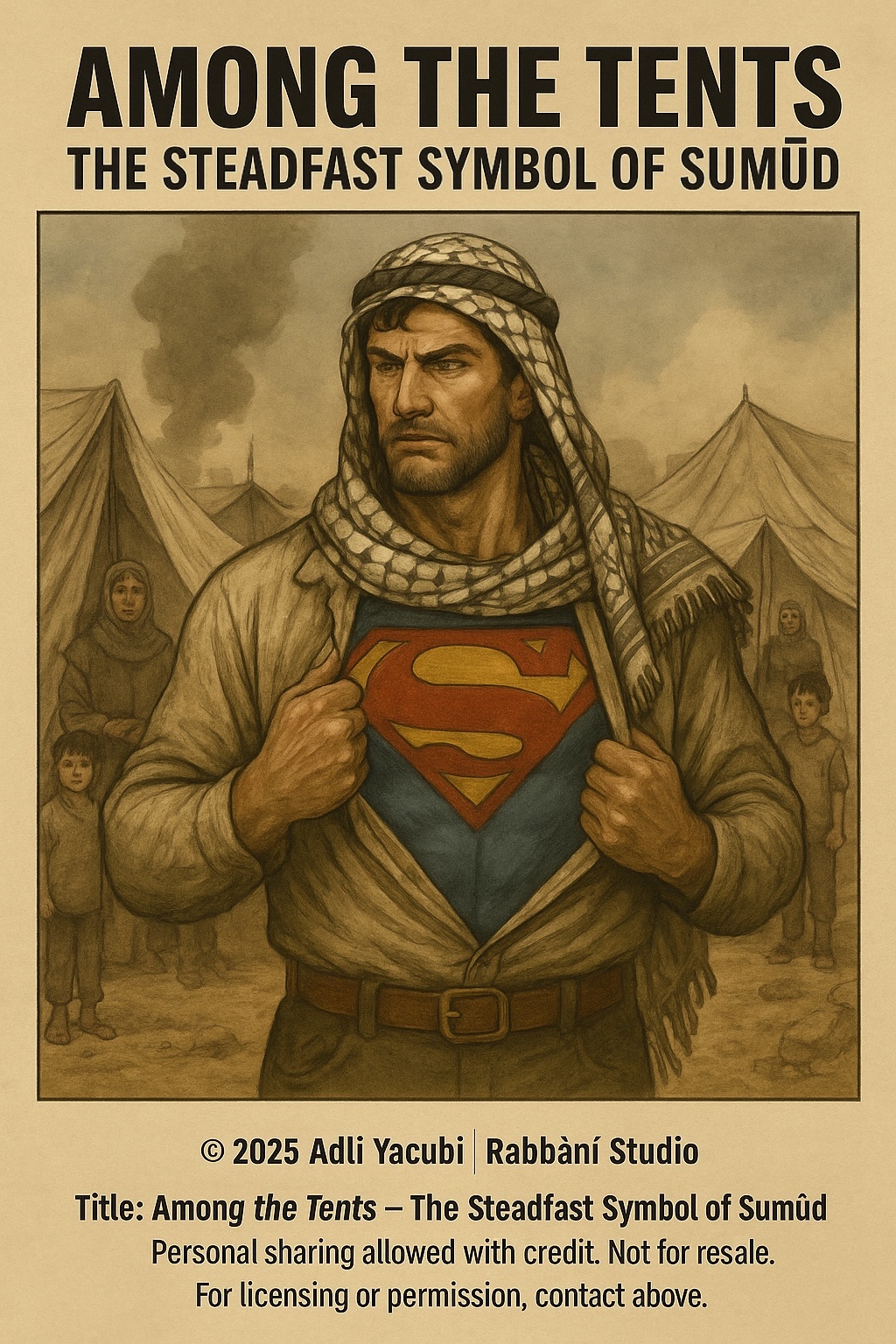
Among the Tents, Beyond the Frame: Reimagining Heroism in Gaza
He no longer flies. He walks. With dust in his lungs, and truth on his chest. 📸 Visual by Rabbānī Studio – 2025
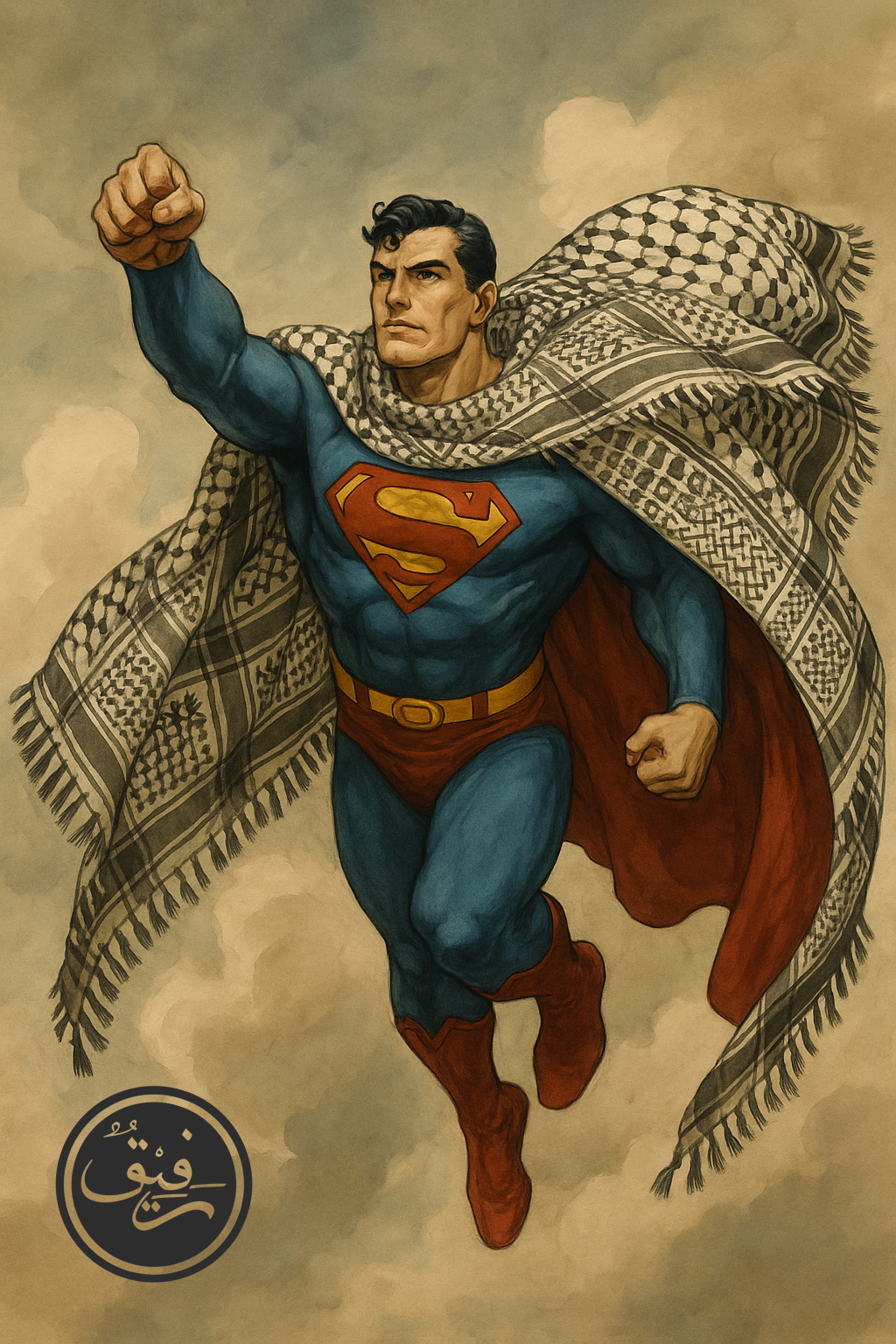
They called him the Man of Steel. But in Gaza, they make heroes out of dust, cloth, and resolve.
In a world saturated with capes, franchises, and box office saviours, we’ve released a different kind of superhero — one who doesn’t fly above the people, but walks among the tents.
He has no fortress of solitude. He shares tea with the wounded. He holds space, not spotlights.
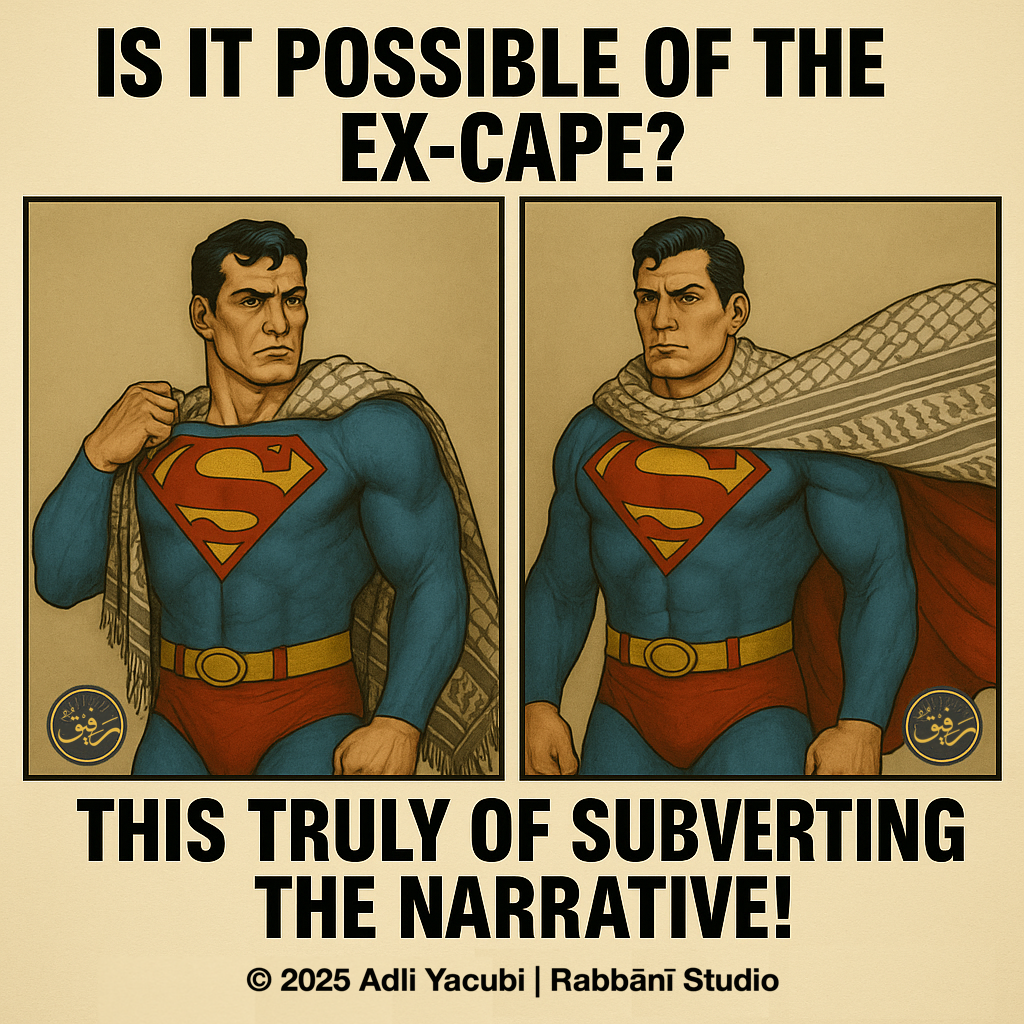
The cape was never the miracle. The keffiyeh carries more truth than tights ever could. This truly of subverting the narrative. 📸 Visual by Rabbānī Studio – 2025
Who Are the Real Superheroes?
It’s the paramedic running through smoke with nothing but gloves and prayer. The poet who rhymes her grief into defiance. The mother who ties her son’s shoelace and whispers “Go.”
It’s the teenager live-streaming truth. The uncle who hands out rice in plastic bottles. The whisperers. The rememberers. The quiet ones.
It’s the ones who stay.
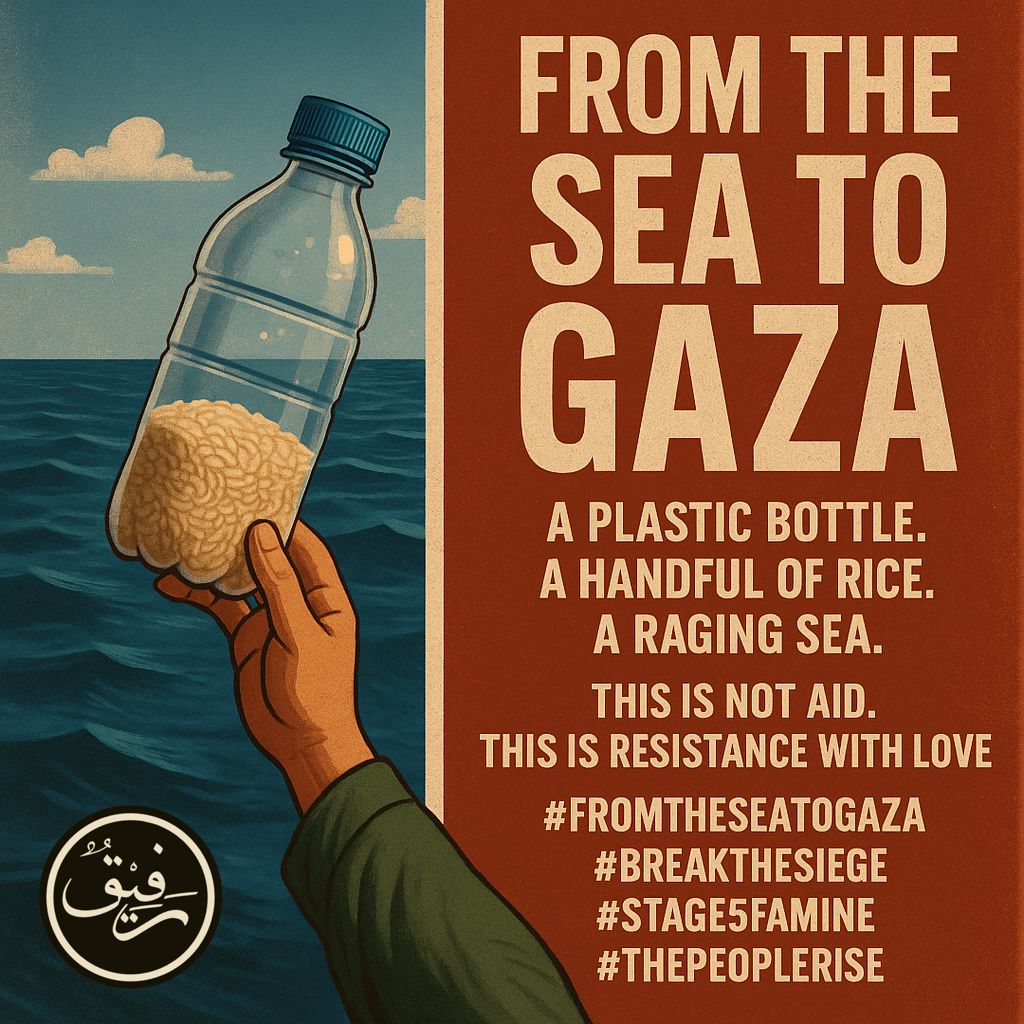
A bottle. A handful of rice. A prayer. This is not airdrop. This is resistance with love. 📸 Visual by Rabbānī Studio – 2025
From the Sea to Gaza
A Plastic Bottle. A Prayer. A Revolution.
We’ve seen images of superheroes with capes. But real power comes wrapped in plastic — not silk.
In Gaza, an uncle takes a used water bottle, fills it with rice, seals it with prayer, and sends it toward the shore.
This is not airdrop. This is not humanitarian branding.
This is resistance with love. It’s not the cape that saves. It’s the hand that still gives when everything has been taken.
From the Sea to Gaza.
From cape to keffiyeh. From myth to memory. Not above the people — among them. 📸 Visual by Rabbānī Studio – 2025
Not to Save. To Witness.
So yes. We’ve drawn Superman. But it’s not because Gaza needs saving.
It’s because the world needs reminding that true strength isn’t flight —
It’s sumūd.
And that’s always been a Palestinian superpower.
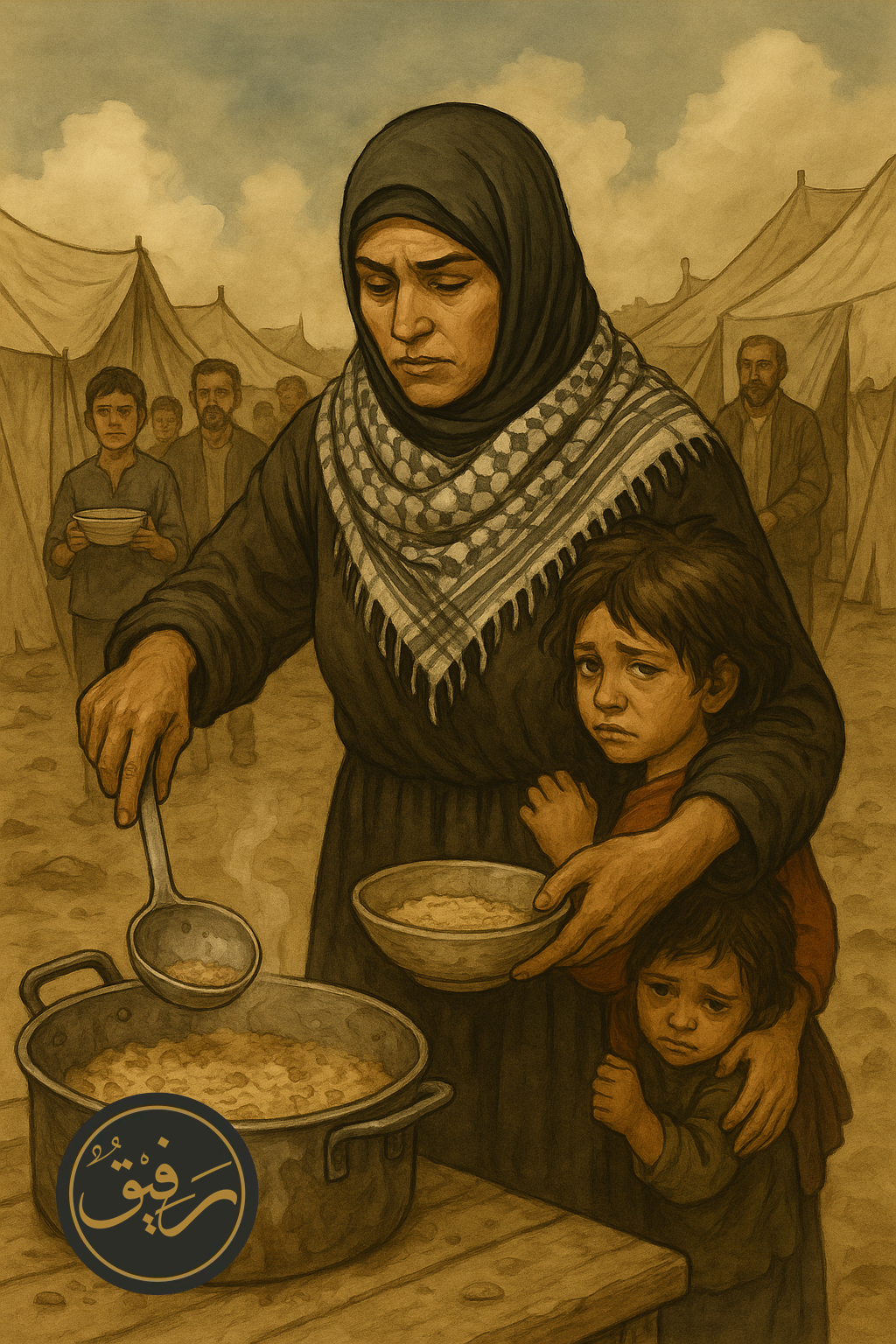
A Mother in the Time of Hunger Her child clings to her side. The pot is nearly empty. But she still stirs. This, too, is superheroism. 📸 Visual by Rabbānī Studio – 2025
“Don’t hand over your compass.” Rafiq al-Bunduqia watches — not to catch you out, but to make sure you’re there.
1. Introduction: The M Dash and the Machines
There was a time when the biggest red flag in student writing was a mysterious shift in font — or the sudden appearance of a semicolon. Now? It’s the M dash. That long, theatrical punctuation mark — so beloved by stylists, poets, and late-night philosophers — is now being flagged as a possible sign of AI authorship.
As someone who has long preferred the M dash over the “weakling N dash,” I can only laugh. But beneath the punctuation paranoia lies a deeper, more pressing question — one that has followed me for some time: What does it mean to write — and to take responsibility — in the age of intelligent machines?
Two days ago, I revisited this very theme in a public reflection I posted to LinkedIn under the voice of Rafiq al-Bunduqia:
“Don’t hand over your compass.” AI can help you draft faster, structure better, even summarise long texts. But it can’t replace your intention, your ethics, or your lived knowledge. Use it — yes. But stay in charge. Check. Review. Bring your full self. Because tools may change — but responsibility doesn’t.
The question isn’t simply whether AI was used — the deeper issue is: Did you show up? Is this yours?
That very concern was echoed in April 2025 by writer and academic Shafinaaz Hassim, who asked a sharp and timely question to her peers:
“Friends in the academy, publishing industry, etc — with rising concerns on content creation, what are the ways to ascertain whether students or writers have relied on AI…?”
Her question invited a rich and thoughtful set of responses — not moral panic, but reflection on pedagogy, ethics, and the changing terrain of writing itself.
This blog is part of that unfolding conversation. Not to police authorship, but to deepen it. To move the focus from howsomething was written to who stands behind it — and why that still matters.
2. A Shift in Focus: From Origin to Ownership
In a recent LinkedIn post, journalist and academic Reg Rumney described the quiet dilemma he faced while marking student work: How do you tell whether a piece of writing has been shaped — or even generated — by AI? Is it the rhythm? The over-polished syntax? The sudden arrival of the elegant M dash?
But then, he had a moment of clarity. The real question isn’t whether AI was used — it’s whether the writing stands on its own. Is it well-sourced? Are the claims grounded? Does it reveal engagement with the material and the reader?
He writes:
“I don’t need to know whether A.I. was used in the production of any writing. What I need to determine is whether the writing is properly sourced and justifies the claims it makes… If any writers have used A.I. along the way, so be it. They own the output.”
This is a quiet revolution in how we might think about authorship. It places the focus not on origin — but on ownership. Not how the writing was produced, but whether the writer is present, attentive, and accountable.
We’ve seen this sleight of hand before. Long before ChatGPT, many writers (and yes, some journalists) would open with “Economists say…” or “Experts agree…” — without ever citing who those economists or experts were. The problem here wasn’t AI. It was vagueness disguised as authority.
Rumney points out that even AI tools that cite sources — like Perplexity — often do so too broadly: a whole IMF report is not a source. A page number, a quotation, a date — that’s sourcing. That’s what makes information traceable, and ideas accountable.
And so the challenge before us is this: don’t outsource your integrity. If you quote someone — say who. If you argue a point — ground it. If you make a claim — own it. Whether you used an AI model, a spellchecker, or the notes from your last lecture is beside the point. The question is:
Do you understand what you’ve written — and can you stand by it?
That’s what distinguishes a writer from a copyist. And that, in the end, is the difference between literacy and knowledge.
🫖 Rafiq al-Bunduqia says: “It’s not where the words came from — it’s whether you meant them. AI can dress the table, sure. But did you cook the food? Did you taste it? Don’t serve your guests borrowed meals and call it hospitality.”
3. Classroom Practices: Witnessing the Process
While much of the conversation around AI writing has turned toward detection tools — apps, software, “AI sniffers” — some of the most grounded wisdom comes from teachers who choose a different path: staying close to the writing process itself.
Siphiliselwe Siphili Makhanya, a teacher and writer, offered a refreshingly practical and humane approach in response to Shafinaaz Hassim’s question. Her method? Make the process visible. Watch the work unfold.
“I try to make the kids start their writing process in the classroom so I can see a first draft taking shape. I also ask them to add me as an editor to their Google Doc — you can view the different versions with timestamps and figure out if they actually sat there and typed or if they copied and pasted.”
This isn’t about surveillance. It’s about presence. A teacher witnessing the formation of thought — not just the final result. That alone often reveals more than any detection algorithm ever could.
But Siphiliselwe also adds a caution that speaks volumes:
“Be careful though — people with autism can sound like AI in their writing patterns.”
That one line is worth pausing over. In our rush to detect machine-generated language, we may end up punishing neurodivergent writers for simply having a different rhythm, structure, or affect. The tools that claim to sniff out artificial intelligence are often not trained to recognise human variation.
Instead of rejecting AI, Siphiliselwe teaches students how to use it responsibly. In her classroom, AI isn’t the writer — it’s a tool for critique, for grammar checks, for scaffolding clarity. She adds:
“We’re also discussing how it actually hurts you to become overly reliant on AI… you never gain the skills, and what skills you do have will atrophy without use.”
Emma Arogundade shares a complementary strategy. Rather than banning AI, she integrates it into reflective pedagogy. In one exercise, she gives students a short ChatGPT-generated answer to a standard exam question — and then asks them to critique it using class readings and personal insight.
“Then I ask them to reflect on what they’ve learned,” she writes.
What’s happening here isn’t about “catching” students. It’s about creating a relationship with their own thinking. It’s about making the invisible choices of writing — source, structure, argument — visible again.
These educators are not outsourcing authorship to software. They are recovering authorship through presence. Slow, steady, relational presence. And that may be the best safeguard of all.
4. The Deeper Wound: When We Outsource Thought
There’s something seductive about smooth writing. It reads well. It flows. It sounds finished. But fluency is not the same as understanding. And what worries many of us — far more than whether students used AI — is the deeper erosion we begin to see: the outsourcing of thought itself.
When students (or journalists, or policy writers) start depending on machines to explain things they don’t understand, to connect dots they never truly explored, or to mask gaps in knowledge with polished generalities, we’re not just talking about AI anymore. We’re talking about the quiet death of inquiry.
I’ve read pieces that were grammatically flawless — structurally sound, even “academic” in tone — but hollow inside. There’s no felt tension, no intellectual wrestling, no friction of mind against material. It’s like looking at a beautifully decorated cake that collapses when touched. No weight. No substance.
And this isn’t new. Even before AI, students have been tempted by shortcuts — Wikipedia patches, essay mills, pre-written templates. But the difference now is that AI makes the shortcut feel authentic. It mirrors their tone. It fills in their arguments. It “sounds like” them — better than they sound like themselves.
That’s the real danger: not that AI steals the writer’s voice, but that it gives back a voice that feels plausible — without the effort of becoming it.
If we’re honest, most people won’t say, “It wasn’t me, it was ChatGPT.” But many will turn in work that sounds more assured than they feel. They’ll submit sentences they don’t quite understand. They’ll quote things they haven’t really digested. They’ll adopt a style without earning the insight.
And when that happens often enough, something slowly fades:
The courage to grapple with complexity.
The patience to revise what’s unclear.
The humility to not know something — yet.
That’s the deeper wound. Not just a question of authorship, but of learning. When we outsource our thinking too early, too often, we never develop the callouses of real understanding.
🫖 Rafiq al-Bunduqia says: “The saddest thing isn’t that a machine wrote it — it’s that the human reading it didn’t notice. Because when thought is absent, even beauty is a costume. And costumes don’t bleed.”
5. A Call to Ethical Writing Pedagogy
So where does this leave us — teachers, editors, writers, mentors — in the age of intelligent machines?
The temptation is to double down on control: tougher detection tools, stricter rubrics, more suspicion. But that approach misunderstands the moment. The real challenge is not technological. It’s formational. We are not merely assessing output — we are shaping people.
This is the deeper work of pedagogy: not to police writing, but to nurture writers. And that means helping them ask not just, “Did I write this?” — but “Do I stand by this?”
Here are a few modest suggestions — drawn from conversations with thoughtful educators and shaped by years of writing and mentoring:
1. Make the process visible. Let students draft in real time. Let them annotate their own thinking. Use collaborative tools that allow for version tracking, not for punishment, but for conversation.
2. Shift the focus from fluency to friction. Reward uncertainty. Praise revision. Ask not just for answers, but for process notes: What did you struggle with? What changed your mind?
3. Use AI transparently — and critically. Give students a ChatGPT response and ask: What’s missing? What’s misleading? Could you write this better — not slicker, but truer?
4. Reinforce responsibility, not just originality. Ask: Where did this idea come from? Did you cite the source? Do you understand the claim?
5. Honour the writer’s presence. What matters is that the writer shows up. In risk. In reflection. In integrity. That’s the real goal.
🫖 Rafiq al-Bunduqia says: “Don’t fear the tools. Fear forgetting yourself. If the words are yours — broken, blooming, becoming — then no one can take them from you. You’re not being tested on perfection. You’re being invited to show up.”
6. Closing: “It Was Me. I Wrote This.”
In the end, the question “Did you write this?” isn’t a trap. It’s a mirror. It asks the writer to pause — not in fear, but in presence. To stand beside their words and say, “Yes. This is mine.”
That doesn’t mean the writing is flawless. Or that AI wasn’t used along the way to brainstorm, rephrase, or clarify. It doesn’t mean the grammar sparkled or the structure landed. But it means the mind and conscience behind the words are awake. It means the work is inhabited — not just delivered.
This is what writing has always asked of us: not just fluency, but presence. Not just polish, but integrity. Not just production, but reflection.
So maybe the final test is not whether a text was written by a human or a machine. Maybe the test is simpler — and deeper:
“Did someone care enough to mean what they wrote?” “Can they say, with some trembling or pride — ‘It was me.’”
That’s the writer’s task. That’s the learner’s journey. That’s the invitation still open — even in the age of algorithms.
🫖 Rafiq al-Bunduqia says: “You don’t have to sound perfect. You just have to be there — in the ink, in the pause, in the part you nearly deleted. That’s where the real writing lives. That’s how we know it was you.”
Acknowledgements
With deep gratitude to Shafinaaz Hassim, whose question opened the door to this reflection, and to Reg Rumney, whose response offered a compass point: judge the output, not the method.
Thanks also to Siphiliselwe Siphili Makhanya and Emma Arogundade for generously sharing their classroom wisdom — rooted, ethical, and alive to the human behind the words.
And to Rafiq al-Bunduqia — for watching from the edge of the screen, always asking, “Did you show up?”
 Adli Yacubi