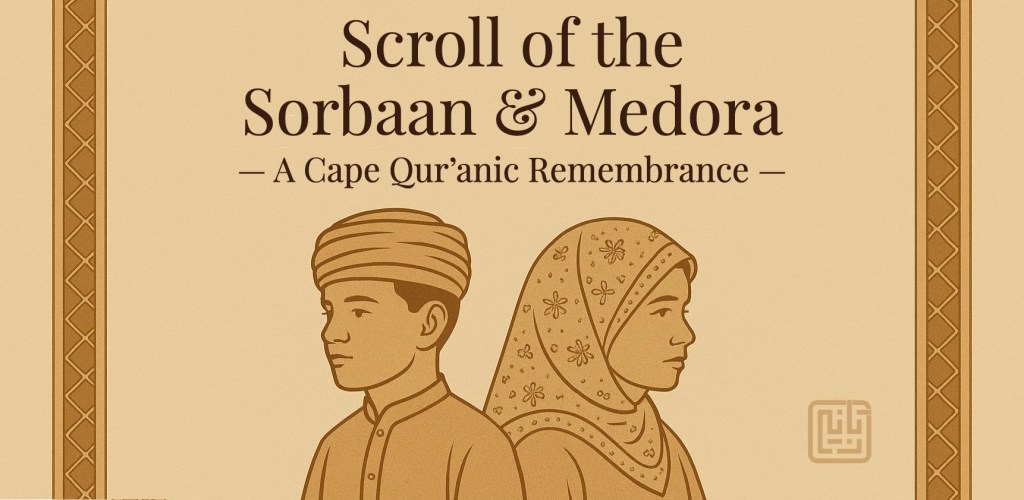
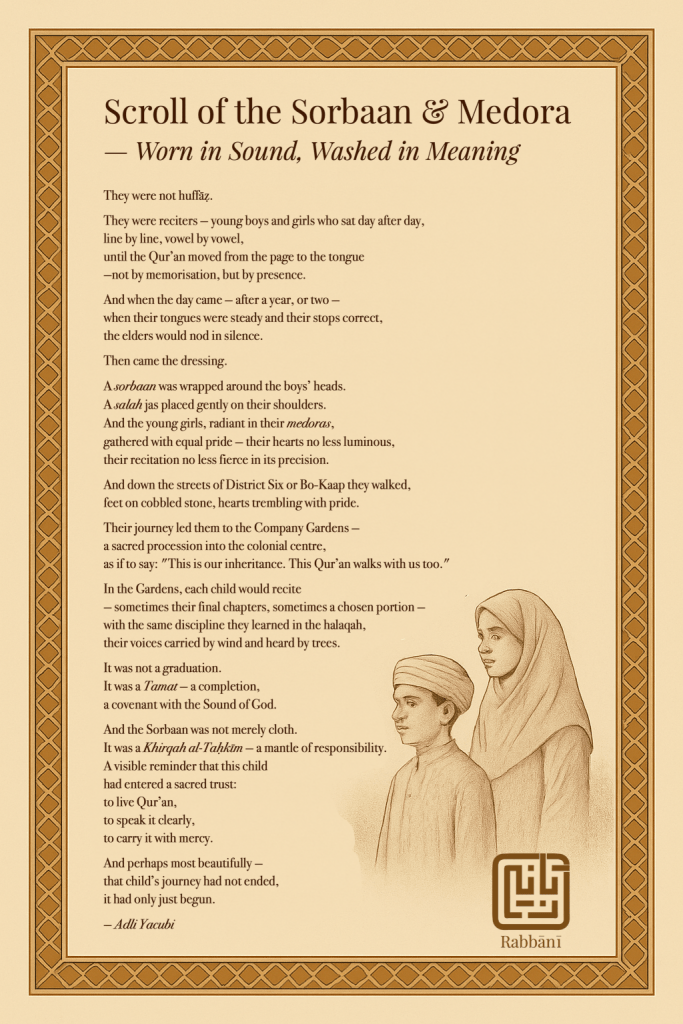
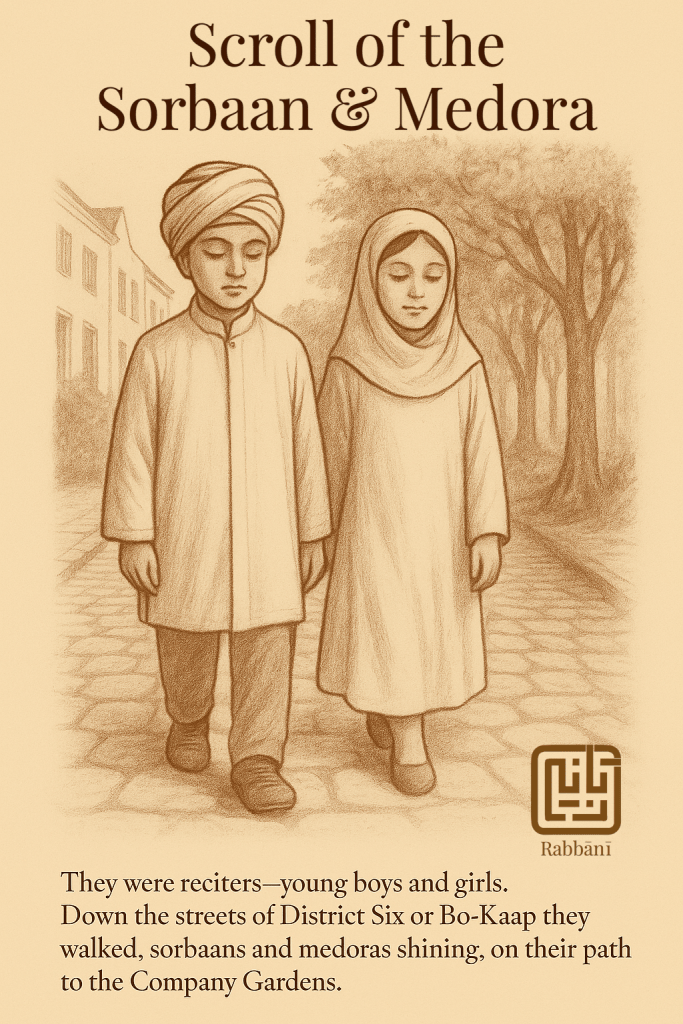
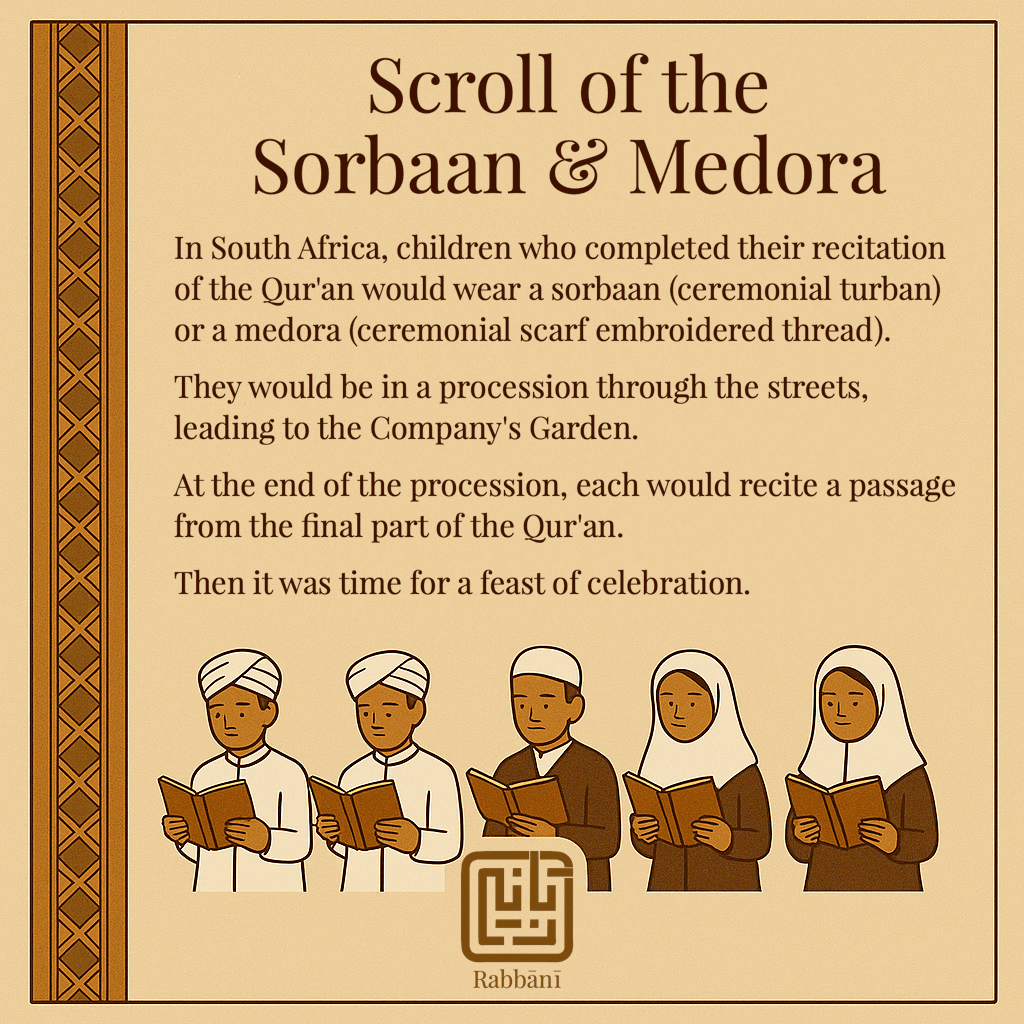
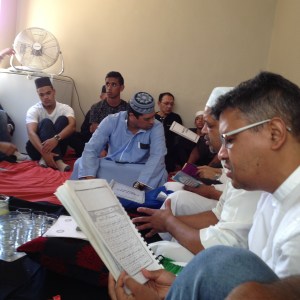
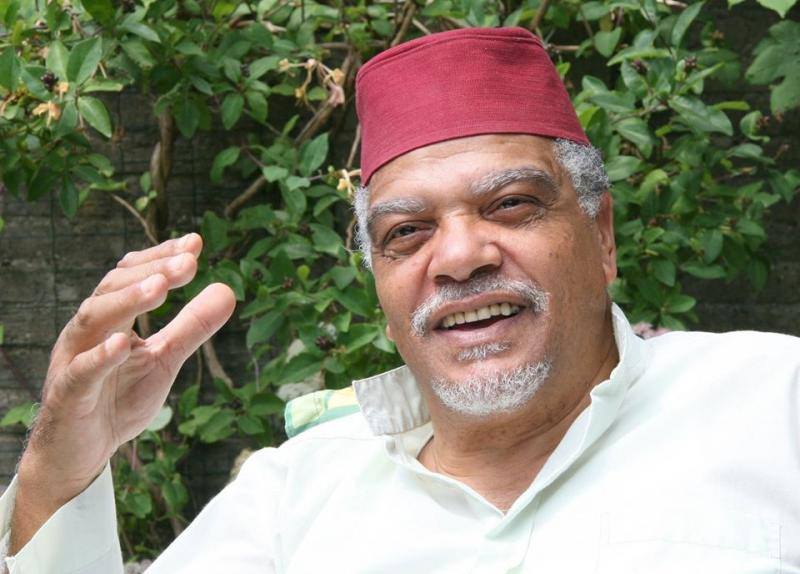
They were reciters — young boys and girls who sat day after day, line by line, vowel by vowel, until the Qur’an moved from the page to the tongue —not by memorisation, but by presence.
And when the day came — after a year, or two — when their tongues were steady and their stops correct, the elders would nod in silence.
Then came the dressing.
A sorbaan was wrapped around the boys’ heads. A salah jas placed gently on their shoulders. And the young girls, radiant in their medoras, embroidered in silver and gold threads, gathered with equal pride — their hearts no less luminous, their recitation no less fierce in its precision.
And down the streets of District Six or Bo-Kaap they walked, feet on cobbled stone, hearts trembling with pride.
Their journey led them to the Company Gardens — a sacred procession into the colonial centre, as if to say: “This is our inheritance. This Qur’an walks with us too.”
In the Gardens, each child would recite — sometimes their final chapters, sometimes a chosen portion — with the same discipline they learned in the halaqah, their voices carried by wind and heard by trees.
It was not a graduation. It was a Tamat — a completion, a covenant with the Sound of God.
And the Sorbaan was not merely cloth. It was a Khirqah al-Taḥkīm — a mantle of responsibility. A visible reminder that this child had entered a sacred trust: to live Qur’an, to speak it clearly, to carry it with mercy.
And perhaps most beautifully — that child’s journey had not ended, it had only just begun.
Acknowledgement
Tramakasi to Sh. Jamiel Abrahams, Sadia Fakier, Zaid Nordien, and Al-Ameen Marley — for helping carry this cloth of memory into the light.
Postscript: This scroll is inspired by the memory of Boeta Junain, who told stories of the Tamat and the children’s walk to the Gardens. Our next post will honour him directly — a keeper of sacred echoes.
Somewhere between the worn edges of oral history and the crisp pages of archived journals, I began to trace the journey of my ancestor — Hadjie Gasanodien, also known as Carel Pelgrim. It is said he was the first Muslim from the Cape to perform the sacred pilgrimage of Hajj, sometime between 1834 and 1837, a period just after the abolition of slavery, when its wounds were still fresh. For years, his story lived quietly in our family’s memory, surfacing in fragments and whispered recollections — until now. I write to honour that legacy, to weave together the strands of fact, faith, and feeling that shaped a man, a pilgrimage, and a community still finding its voice in the aftermath of bondage.
Pilgrimage of Discovery
I first heard his name as a child, tucked into a conversation between my sister Yasmine and our aunts. Years later, Yasmine would take those threads and stitch them into a short family tree, dated July 2004. At the time, it felt like the last echo of a fading past. We had little else to go on. But something stirred in me after I returned from my own pilgrimage. A fever of purpose, a longing to know more. I began writing and publishing reflections under Al Hujjaj Magazine, not yet knowing that my footsteps had mirrored those of my own forebear, nearly two centuries earlier.
Echoes in Academic Footsteps
The name “Carel Pelgrim” returned to me unexpectedly through the work of a neighbour and friend of my father — the late Mogamat Hoosain Ebrahim, a community scholar from Primrose Park. He had long been documenting the Hajj stories of Cape Muslims. In his thesis, The Cape Hajj Tradition: Past and Present (2009), Ebrahim writes: “Hajji Gassonnodien, more popularly known as Carel Pilgrim, enjoys the distinction of having been the first Cape Muslim to have successfully completed the Hajj.” Although I first encountered his name in Ebrahim’s thesis, the full significance didn’t strike me until later — during conversations with the researcher Abdud-Daiyaan Petersen. It was through our exchanges that the identity of Carel Pelgrim truly crystallised. This was not just a figure in history — he was my ancestor. A man who left the Cape between 1834 and 1837 to walk the sacred path when few could even imagine such a journey.
It was through Ebrahim’s meticulous work that I began to understand the context of that time. Hajj was not simply a religious obligation; it was an act of defiance, endurance, and transcendence. For formerly enslaved Muslims in the Cape, to make the pilgrimage was to reclaim a spiritual identity that colonial systems tried to erase. And Carel Pelgrim, in going, carried more than personal faith — he carried the hopes of a generation emerging from bondage.
A Lineage Remembered
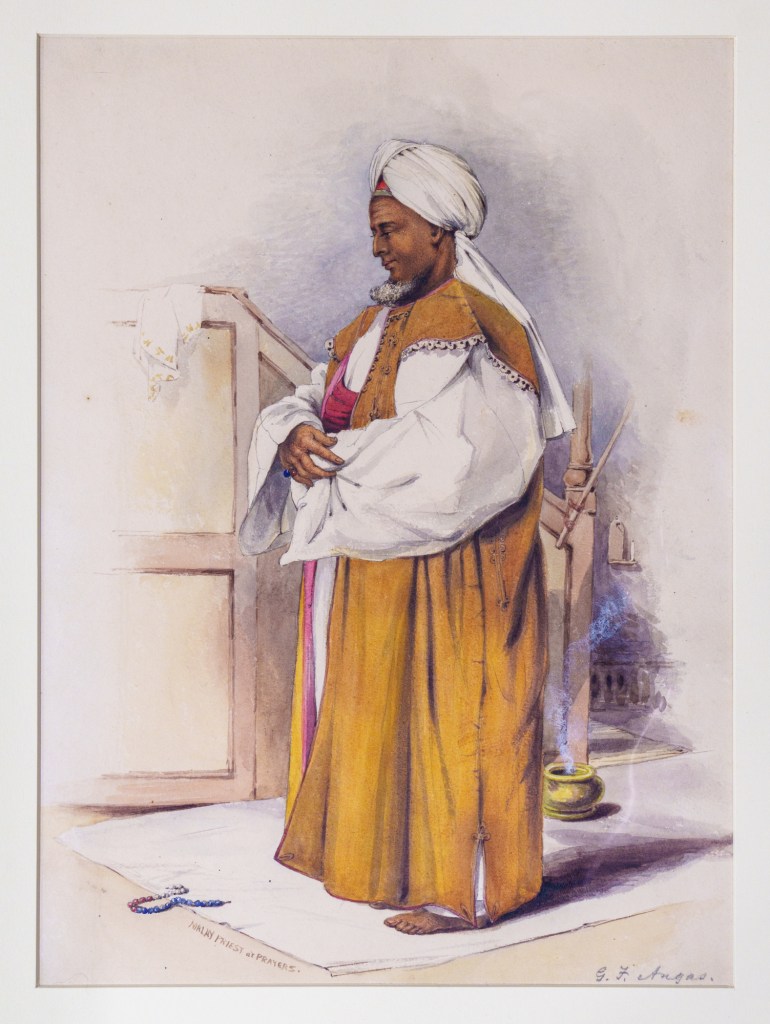
George F. Angas (1822-1886). ORIGINAL 1849 Hand Coloured Stone Lithograph. A Malay Priest Prays.
Abdud-Daiyaan Petersen’s research added an entirely new dimension to the story. In collaboration with Turkish scholar Halim Gençoğlu, he co-authored a paper titled Was Imam Gasanodien Carel Pelgrim an Ottoman Descendant?, published in the Bulletin of the National Library of South Africa in 2021. They explored the possibility that Carel Pelgrim may have had ancestral ties to the Ottoman world — a lineage once obscured by slavery and colonial re-naming. Through Petersen, I learned not only of the archival traces, but also of the living memory carried in Cape Town’s communities — stories that had waited generations to be heard.
Petersen’s careful investigations, supported by old burial notices and public records, pointed with growing clarity to the fact that Carel Pelgrim and Hadjie Gasanodien — the man known for teaching Islam and the Qur’an to children in early Cape Town — were one and the same. The fragments were falling into place. What had once been academic became intimate. What had once been folklore became family history.
The Pain Beneath the Pride
The history of Carel’s mother, Pakka, adds further complexity and depth. As documented in Echoes of Slavery: Voices from South Africa’s Past by Jackie Loos, Carel — born into slavery — was the son of Pakka, a slave woman, and Jan Gottlieb Barends, a Christian man of German descent. Their relationship was informal and illegitimate, as was often the case in that era. Carel and his brother Philip inherited their mother’s status as slaves. In 1801, a notarial protocol records their transfer to a burgher, and upon his death, their eventual manumission was stipulated in his will.
Pakka’s exact identity remains debated, though one likely candidate is Janpakka of Batavia, who ran a shop in the Waterkant in the 1820s. Death records from the time, often unreliable, do not mention Carel or Philip, but their presence in community memory is clearer than archival certainty. Pakka’s story, like that of many enslaved women, survives in fragments — yet she remains the root from which this extraordinary lineage emerged. And it is here, in the shadows of that history, that I must pause. My heart aches at the likely truth: Pakka, my great-grandmother, was not loved — she was owned. The man who fathered her children, Jan Gottlieb Barends, did not protect her. He did not free her. Instead, he allowed her and their children to be sold on to another man. Was she raped? Exploited? Discarded? The records are silent, but the silence itself screams.
This is the pain we inherit alongside the pride — the wounds interwoven with the honour. In naming Pakka, I do not just trace bloodlines. I reclaim her dignity, speak her name with reverence, and acknowledge that even in bondage, she gave rise to a lineage that would one day teach Qur’an, lead prayer, and inspire generations. Her story, though faint, demands to be held — not with shame, but with solemn truth and fierce remembrance.
A Husband’s Grief
Carel’s transformation from a slave to a respected teacher, tailor, and hajji is all the more remarkable against this background. And among the most beautiful parts of his story is his deep love and reverence for his first wife, Japoera. Though she was childless, their bond was strong — spiritually and emotionally. When she passed away in their large home in Buitengracht in early 1841, Carel composed a public obituary in the South African Commercial Advertiser. It read: “The Heavenly Father, Lord of Life and Death, was pleased on the 16th instant to call from me my beloved wife Japoera, aged 64 years, 4 months and 16 days, after a happy union of [blank space] years. All who knew her virtuous character will sympathise with my loss, of which I hereby give notice to friends and relatives, requesting to be excused the visits of condolence.” He signed it: Carel of the Cape, the first Pilgrim and Priest.
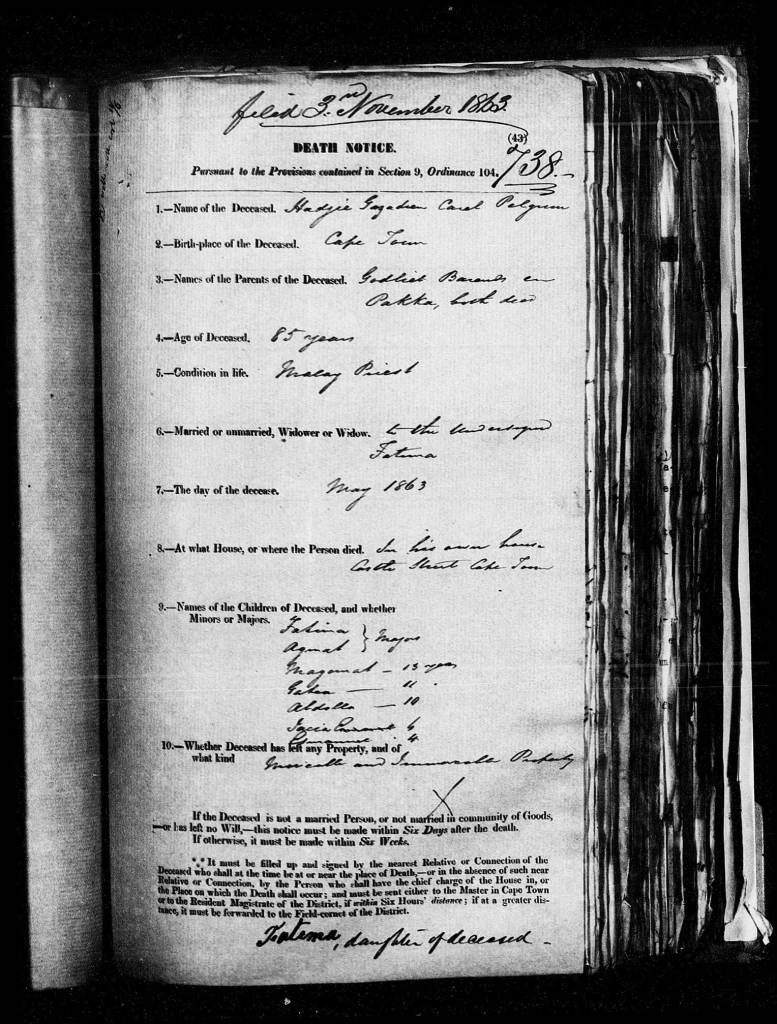
Death certificate of Hadjie Gasnodien Carel Pelgrim.
In this short but poignant notice, we see not just a man grieving his beloved, but a heart refined by faith and loss. It reminds me that while history often records what men did, it rarely shows how deeply they loved. He eventually adopted the Islamic name ‘Hassan al-Din’ — appearing in records under numerous variations such as Gasnodien and Gasanodien — yet he signed himself proudly as ‘Carel Pelgrim.’ His ability to read and write in both Arabic and European script shows a deep level of literacy and determination to bridge worlds. While some have speculated that he may have spent up to three years in Makkah — a duration not firmly evidenced — what we do know is that he returned with the ability to teach Arabic and Qur’an, and left an imprint as a man of knowledge and devotion. It’s possible that his early literacy was shaped by Cornelis van der Poel, the burgher who once held legal ownership over him and later stipulated Carel’s manumission. Whether through formal tutoring or exposure to Dutch literacy, this early learning may have paved the way for his later mastery of both Islamic and colonial languages.
The directories list Carel van de Kaap as a free tailor living in Hout Street in 1816 and as a Malay schoolmaster in 1830. His brother Philip, born in 1789 and passing in 1844, was also a tailor, but unlike Carel, Philip was not a practicing Muslim. Some of Philip’s children were baptised, and in 1838 he married their mother, Carolina Marteyn of the Cape, in the Dutch Reformed Church.
Meanwhile, Carel was charting a different course. Once free, he began to prosper. In 1817, he loaned Seymen of the Cape 600 Ridollars (a substantial currency at the Cape in the early 1800s, equivalent to several months of wages for a labourer) to enable him to free his slave daughter, Cananga. By 1822, he had purchased his own home in Matfeld Lane. Then, in October 1833, Carel and his wife made a joint will, identifying themselves as the free man Carel of the Cape, alias Gaszimoedien — formerly a tailor, now a teacher in the Arabic language — and Johanna Salomonse, alias Japoera, born at the Cape.
Japoera seems to have been an exemplary Muslim wife, and Carel held her in high esteem. He set out for Mecca soon afterwards, and her encouragement must have been crucial to the success of his pioneering journey.
When Art Becomes Revelation
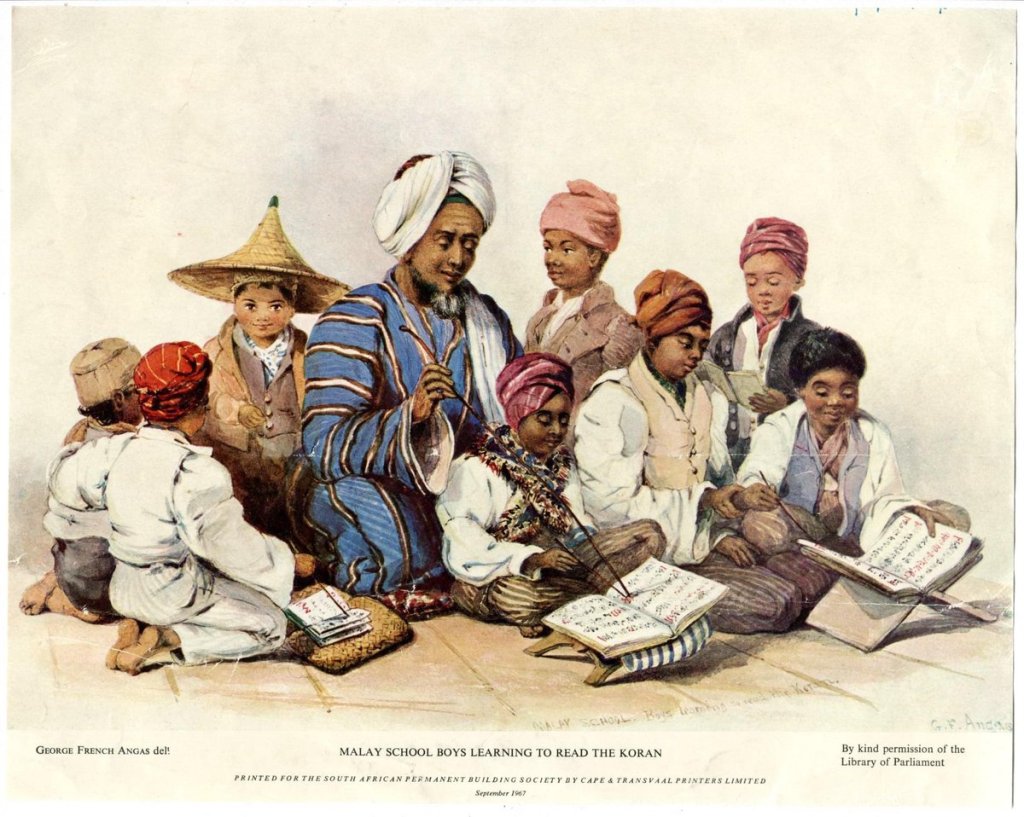
That intimacy deepened when I looked again at a familiar image — one I had seen countless times in Cape Town homes, books, and exhibitions, without ever imagining a personal connection. It is a watercolour painting by George French Angas, an English artist who visited the Cape in the 1840s. The scene is gentle but profound: a bearded man seated cross-legged, surrounded by children, teaching them the Qur’an. For years, this portrait was simply referred to as a depiction of a “Malay teacher.” But now, thanks to community scholarship and genealogical evidence, we know the truth — that teacher was Hadjie Gasanodien. My ancestor.
Another portrait, also by Angas, is held at the Castle of Good Hope in Cape Town. In it, Hadjie Gasanodien is more formally posed, with dignified composure. What amazes me most is his attire — a flowing Arabic coat, or abaya, layered over a long-sleeved thawb. The painting is filled with symbolic richness: incense burners still glowing in the frame, a minbar placed behind him as if ready for the next call to gather and reflect. To stand before that painting is to encounter the past as presence — not as myth or metaphor, but as family. His face, once anonymous to me, now echoes through mine. The ink of his story has always been part of my blood. Only now am I learning how to read it.
The Living Links
One of the most tender links between this legacy and the living was shared in Lawrence Green’s 1964 book, I Heard the Old Men Say. In Chapter Two, titled “The Living Links,” he introduces a woman named Gatea Jacobs — my great-grandmother and the daughter of Hadjie Gasanodien. In a touching passage, she recalls her father’s return from the pilgrimage to Mecca. She tells of the white robes he wore, the gentle way he taught, and how the community revered him not just as a teacher, but as a man who had seen the heart of Islam and brought its light home.
Yet there is something poignant here: on the death notice of Hadjie Gasanodien, Gatea was listed as his daughter — and she was just 11 years old at the time. Her recollections, as recorded by Green, must have been shaped not only by her own memory but also by the atmosphere that surrounded her father’s name: the reverence of others, the stories repeated in the family, the aura of a man who had left a sacred legacy. In this way, memory extends beyond personal recall — it becomes communal.
Her memories reach across generations with quiet dignity. She spoke not in grand declarations, but in lived detail — the scent of his clothes, the rhythm of his voice in prayer, the gatherings around him at dusk. Through her, his presence remained alive in the bones and breath of our family, long before any of us knew the fullness of his historical significance. It was always there — waiting for us to remember.
Incredibly, Gatea Jacobs lived nearly a hundred years, a living bridge between the earliest days of Islam at the Cape and our present time. In that same chapter, Lawrence Green recounts a remarkable scene: “One afternoon while she was still able to see and hear and talk to her family she called everyone round her. ‘I am too old to live any longer,’ she told them. Then she folded her hands as prescribed in the Islamic death ritual and passed away.” Her funeral drew thousands of mourners, and services were held in mosques across the Peninsula. It was a farewell not only to a beloved matriarch, but to an era.
Her final act — serene, faithful, and deliberate — echoed the strength of the lineage she carried. It is this spirit I now seek to honour, not only in rediscovering our ancestor, but in holding open the doorway for others to trace their own roots, to reclaim the sacredness of our past, and to remember that we, too, are living links.
Author’s Note Written by Adli Yacubi (pen name), descendant of Hadjie Gasanodien, also known as Carel Pelgrim. This article forms part of a continuing journey to rediscover, honour, and share the stories of Cape Muslim pioneers. May it serve as both record and remembrance.
References
Yasmine Jacobs, Jacobs Family Tree (Oral History), July 2004
Mogamat Hoosain Ebrahim, The Cape Hajj Tradition: Past and Present, 2009
Jackie Loos, Echoes of Slavery: Voices from South Africa’s Past, 2024
Habib Shaikh, “First of Cape Hajis came 3 years after abolition of slavery,” Arab News, 11 October 2013
Lawrence Green, I Heard the Old Men Say, Chapter Two: “The Living Links,” 1964
Halim Gençoğlu & Abdud-Daiyaan Petersen, “Was Imam Gasanodien Carel Pelgrim an Ottoman Descendant?”, Bulletin of the National Library of South Africa, vol. 75, no. 2, December 2021
Helen Swingler, “Piracy, slavery and a Mecca pilgrimage,” UCT News, 17 March 2021
“Portraits stoke mystery of Hajji Gasnodien,” Cape Argus, 26 February 2021
“In the name of Allah, the Entirely Merciful, the Especially Compassionate” — every beginning echoes the womb of creation, where mercy overcomes all.
At the beginning of every chapter of the Qur’an (except one), and at the start of every act of meaning, Muslims invoke the sacred words: bismillāhir raḥmānir raḥīm — In the name of Allah, the Entirely Merciful, the Especially Compassionate. It is not merely a formula. It is a return. A remembrance of the womb of mercy from which all existence flows.
The Love Letter of Bismillah
In Surah An-Naml, we are told the story of the Prophet Solomon (Sulayman, peace upon him) sending a letter to the Queen of Sheba. He instructs the hoopoe bird: “Go with this letter of mine and deliver it to them, then stand aside and see how they will respond.” (27:28)
When the Queen reads the letter, she declares: “O you chiefs! A truly distinguished letter has been conveyed unto me. Behold, it is from Solomon, and it says, ‘In the name of Allah, the Entirely Merciful, the Especially Compassionate. Do not be arrogant with me, but come to me, fully submitting to Allah.’” (27:29–31)
Before asserting power, before making demands, Solomon begins with mercy. Even in politics and statecraft, mercy frames the dialogue. Every relationship — between people, between nations, between heart and heart — is meant to begin in the name of mercy.
The Womb of Creation
The Arabic root ر ح م (rā ḥā mīm) — from which Raḥmān and Raḥīm are derived — is intimately connected to raḥm, the womb.
Allah reminds humanity: “O humanity! Be mindful of your Lord Who created you from a single soul, and from her He created her mate, and through both He spread countless men and women. And be mindful of Allah—in Whose Name you appeal to one another—and the wombs. Surely Allah is ever Watchful over you.” (4:1)
The womb is not just a biological vessel; it is a sign, a sacred reality. The Prophet, peace and blessings be upon him, said in a sacred narration (Hadith Qudsi): “When Allah decreed the creation, He pledged Himself by writing in His Book, which is laid down with Him: ‘My Mercy prevails over My Wrath.’” (Muslim, Bukhari, an-Nasa’i, Ibn Majah)
Mercy is the origin of all things. The womb is the first mercy a soul encounters in existence — a place of absolute protection, nourishment, and unseen care. No wonder the Prophet narrated this to his companions.
Jahima (r.a.) came to the Prophet, peace and blessings be upon him, and he said, “O Messenger of Allah, I intend to join the military expedition, and I seek your counsel.” The Prophet said, “Do you have a mother?” He said yes. The Prophet said, “Stay with her, for paradise is beneath her feet.” (Sunan al-Nasā’ī)
In another Hadith Qudsi, sacred narration, the Prophet Muhammad (peace be upon him) said that Allah said: “I am Ar-Raḥmān and created the raḥm (womb) – And I named it after Me.” (Ahmad)
Pain and Mercy
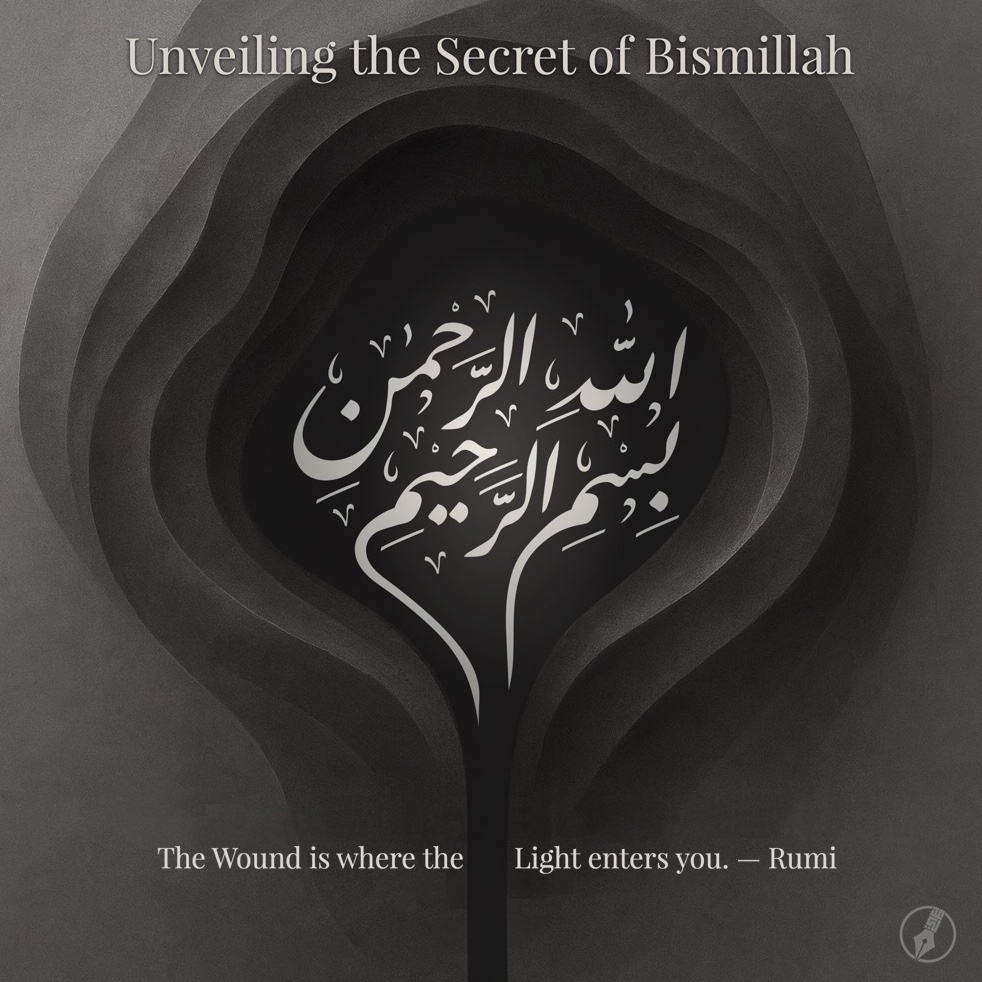
“The wound is the place where the light enters you.” Rumi’s words evoke not only pain but transformation. The womb is a site of life-giving pain — a space where creation ruptures comfort. It is the most literal place where light enters: the emergence of life into a world of awareness, form, love.
In verse 18:81, the Qur’an speaks of a child being taken away so another, “more virtuous and nearer in affection,” may come. Pain and replacement. Loss and mercy. Mercy is not always softness — it may come dressed in fire, thunder, or sacrifice.
No wonder Allah states, “And My Mercy encompasses everything” (Quran 7:156). This verse reinforces the idea that God’s mercy is vast and all-encompassing, extending to every aspect of existence. This verse highlights the inclusive nature of divine mercy, encouraging believers to seek forgiveness and strive for a compassionate life. It serves as a call for Muslims to practice mercy in their daily lives, fostering a community built on compassion and understanding.
Bismillah in Everyday Life
The Messenger of Allah, mercy of God and peace upon him, taught: “Any matter of importance that is not begun with ‘In the name of Allah’ will remain devoid of blessing.” (Sunan Abi Dawud, Sahih Ibn Hibban)
And regarding daily purification (wudhu), he said: “There is no valid ablution for he who did not mention Allah’s Name.” (Ahmad, Sunan compilers)
Every act, every moment, every step must be wrapped in remembrance. By invoking Bismillah, we are not just seeking blessing; we are anchoring ourselves back to the womb of mercy — to the beginning of all things — where Allah’s Compassion and Care cradle us unseen.
Closing Reflection: A Womb of Light
To begin with Bismillah is to step into the womb of mercy. A place where something is made of us. A place of constriction, gestation, and eventual emergence.
Ibn al-ʿArabī described mercy as the first veil between us and the Real. To know mercy is to be veiled, yes — but also to be protected, incubated until we are ready to face the fullness of the Divine.
And so, like the Queen of Sheba, we receive the letter. And like the hoopoe, we deliver it. And like the child, we are born through pain. And like Rumi, we remember that it is the wound — the rupture — that lets in the Light.
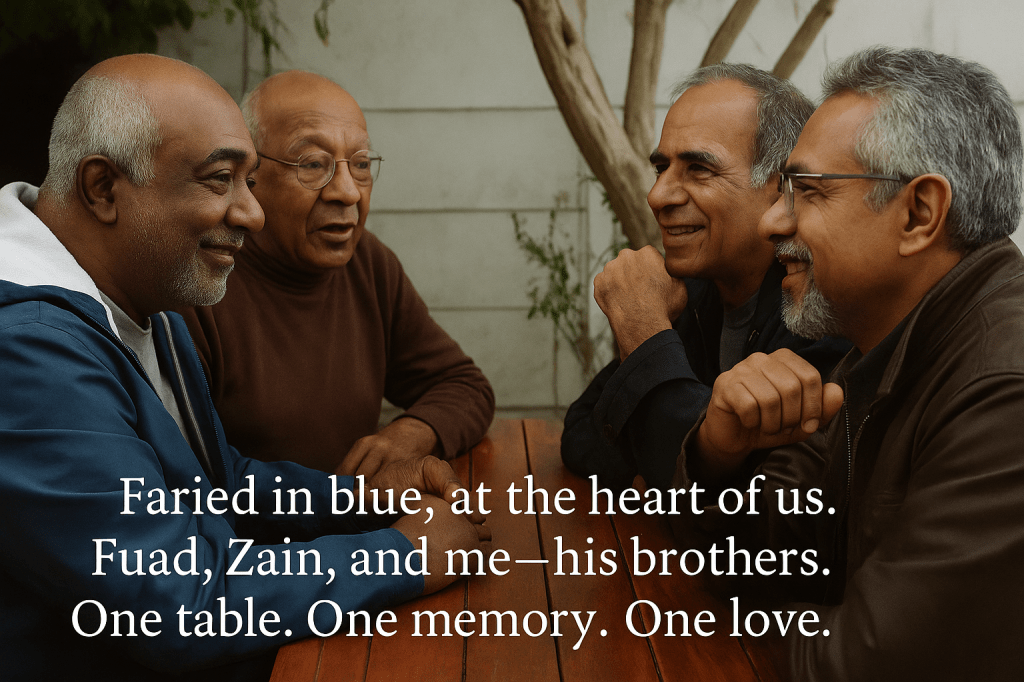
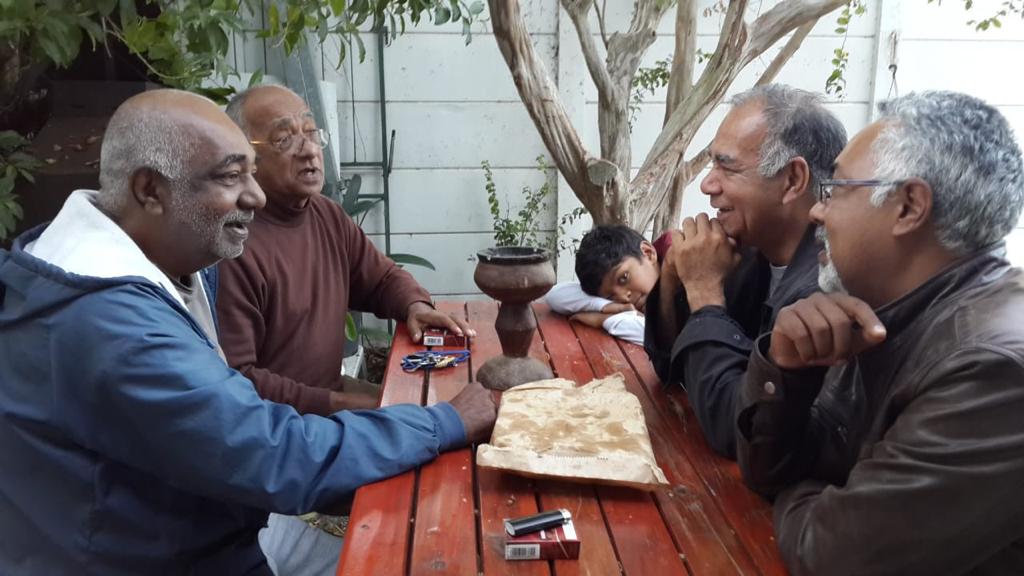
Faried in blue, at the heart of us. Fuad, Zain, and me—his brothers. One table. One memory. One love.
Your passing caught me off guard. I had planned to fly down to Groote Schuur Hospital—to hold your hand, to hear your familiar, half-teasing greeting: “This is nothing. How long are you staying? Will you be sleeping on our couch in the lounge?” But the doctors had already sedated you. And while we weren’t watching, you let go of my hand and slipped quietly into the next realm. I said my goodbye by placing my palm on your forehead, feeling your life force dissolve.
The grief swept me away like a sudden tide. In that single, helpless moment, memories surged—those threads that bound us—flooding my chest in a merciless storm of emotion. Now, five days later, I’m still adrift, trying to gather pieces from the wreckage. Perhaps these fragments will steady me.
You shaped my life profoundly—especially during my adolescence. With Dad growing older, it was you, along with your remarkable wife Zuleiga, who guided me through those uncertain years. During summer vacations, I was your clumsy teenage apprentice—sweeping up at building sites where you were foreman and supervisor. It was my job to scrub your and Dad’s boots clean, and to wash off the cement-caked tools of the trade. You were, in those days, both stern and kind—frightening and benign.
One day, while we were building a factory, the owner’s son stormed onto the site, shouting insults at our father. Mid-rant, he suddenly found himself face-down in a wheelbarrow. You had knocked him out cold with a spade to the side of the head. You saw him for what he was: a racist, self-righteous prick—and an abusive employer. You never tolerated either. That moment stayed with me. Years later, when I joined the freedom struggle, I carried it like a compass.
Of course, I wasn’t guided by you alone. I was blessed—loved by all our siblings, their partners, and their children. But your influence stood apart. Like your name, it was unique. You were, somehow, the rare blend of our mother’s blunt honesty and our father’s quiet grace. Your language was rough, your heart soft. It took us years to understand that your sharp tongue was often the symptom of undiagnosed, untreated diabetes—the same illness that eventually claimed you.
Now that you can no longer protest, I’ll say it plainly: You were a terrible capitalist. You once ran a butchery in Mitchell’s Plain that failed—not from mismanagement, but because you kept giving the meat away. To struggling customers. To broke relatives. Later, in your construction business, you gave jobs to young family members who needed work, even when the books didn’t balance. When the business eventually closed, you had no regrets. The Qur’an speaks of such people, calling them “those who gave preference to others, even though poverty was their own lot.”
Postnote
Faried was the middle-child in our siblings—one of four brothers and three sisters. He passed away eight years ago, on the eighth day of Ramadan. He used to joke that he would be the one to bury Fuad, our eldest brother, since he was younger and expected to outlive him. But fate had other plans. We lost Fuad two years ago, and with him, another great pillar of our family.
In our grief, we found strength in remembering Faried’s resilience, his unflinching kindness, and his deep sense of duty. His life remains for us a source of comfort, a touchstone of dignity, and a lesson in selfless love.
Footnote:
May Allah have mercy on his soul, inna lillahi wa inna ilayhi raji’un, and on the souls of all our departed—those who laughed with us at one table, and now dwell in the unseen.
A story about birthdays and litanies and how traditions die out…
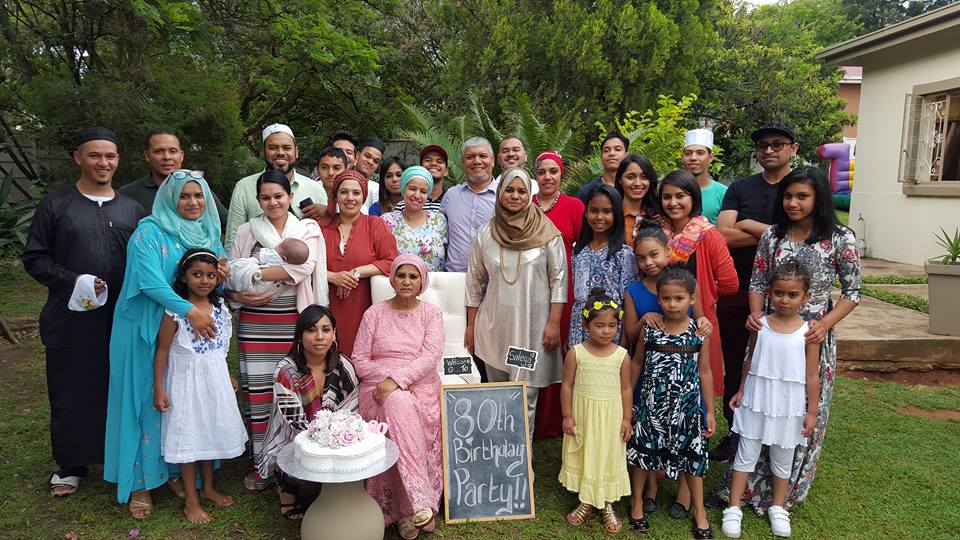
Auntie Lega on her 80th with six of her seven children.
It was Auntie Lêga’s birthday this weekend. It was her 80th celebration. Seven kids (minus one who had passed on), 20 grandchildren and 11 great-grandchildren in addition to extended family and friends flooded the house of her son, Ismail, to mark this amazing milestone. A huge tent with rows of trestles had been set up in the backyard to accommodate all the guests.
Auntie Lêga (short for Saliega, or the pious one) had called me weeks earlier and then every consequent week to secure my attendance at this event. Then, for good measure, a final call a night before the actual event. I was going to attend anyway as Auntie Lêga is the only aunt that my spouse, Sadia, has living in Johannesburg.
But Lêga was not taking any chances. She had called up a friend who could write down a speech that she wanted me to read to those attending which has become my function at family occasions. It was a touching note thanking sons and daughters, their spouses and their kids for putting up with her and their efforts for making her 80th a special occasion.
And what an occasion! Prawn curry, leg of lamb, wonderfully flavoured chicken, dhal, a brinjal dish… And that’s just what I had on my plate. The dessert required a good few paragraphs all of their own.
Reciting the Gadat, a 300-year-old Cape tradition, on Auntie Lega’s birthday.
In the back room, on the floor with blankets and bedsheets, the Gadat Jamaat started the occasion by reciting a spiritual litany that was over 300 years old. I looked around the room and realised that I was witnessing a community tradition that could actually be dying out. The only ones able to still recite along to the Gadat were those from my generation and older.
The younger ones were there, on the floor sitting cross-legged, either out of respect or one of their parents had instructed them saying, “Get yourselves into that room and don’t embarrass me!” And perhaps in response to the youngsters rolling their eyes the parent added, “I don’t care if you don’t know the Gadat, just go sit there!” So they sat there, listening to a cultural symphony, that made no sense to them at all.
There was a time when the Gadat would be a regular feature in the cultural life of a young Muslim growing up in South Africa. Well, ok, largely in the Cape and wherever there were communities who had roots in the Cape. Every Thursday evening, birthdays, funerals and memorials for the deceased would be commemorated with Ratibul Ḥaddad or, literally, The Collection of the Ironsmith which is the family name of Imam Abdullah ibn Alawi al-Ḥaddad who wrote the litany in 1661 when he was 27 years old.
When it was brought to the Cape, most likely by Tuan Guru in the late 1700s, the Gadat took on a colour all of its own. But not just a colour… also a fragrance, a sound and a taste unique to this rhythmic and melodic litany. The colour and taste came from the sweet treats (biscuits, koesisters, bollas) baked and fried by the family hosting the Gadat. This would become the contents for a little gift package (or barakat) that you would get when you leave the gathering.
More often than not, it was the women of the house who would prepare these treats. But that would not be the only taste they would contribute. They also conjured up the Gadat’s own, unique drink: The Gadat Melk. Just as the litany would wind down, participants would be given a tiny glass of this milk drink prepared with cinnamon, cardamon and sweetened with sugar.
No Gadat would be complete either without the burning of incense that would become so synonymous with the event that when incense is burnt on its own, it almost seems lonely. And so, by flooding all the senses, the women in the community had ensured that the Gadat would become a special occasion that all in the community would anticipate with longing. Everyone would participate, and the Gadat (because of its musicality and careful construction) helped in making the memorisation of prayers, of Qur’anic scripture and the Names of God that much easier.
But as time passes, traditions change. Now, at Auntie Lêga’s 80th celebration, my kids do not know how to make Gadat. They can see it on YouTube, download a PDF version of the text with translation from the internet, but the colour, the taste, the fragrance, the sound and touch of this old tradition has become like an old relative with dementia. They can hear her, but they can’t make sense of what she is saying. She might as well be speaking in tongues.
But not Auntie Lêga. On her 80th she is as alert, as funny and as spritely as ever. She’s not happy, for example, that someone promised to bring her Lindt chocolate for her birthday and then forgot! Saliega is half the height of her son, but with a warmth and generosity that is larger than life. And she has ensured that those attributes are now a central tradition in her large family. Right down to the 11 great-grandchildren.
[If you like this story then click the blue star ★below.]
Two rivers descend from their mountain source
Over the edge, barefoot towards their destinies
One finds open horizons, free flowing courses
The other, hidden beauty, silent testimony
Two rivers race towards the shoreless ocean
Boulders to pebbles, meandering their flow
One becomes a city slicker in slow motion
The other, to an ancient oasis it shall go
[I have retold this story countless times. It was told to me when I was a student in the 80s. I googled the original storyteller but could not find any reference to it online. It resonated with me because I was born at the foot of Table Mountain in District Six, Cape Town. I am thankful, even now, for Khurram Murad for making this part of his keynote address so long ago.]
Table Mountain taken by Aadela Parker.
There once was a man who was very unhappy. Something was troubling him but he could not put his finger on it. At night he was restless and it took a while for him to sleep. That night he had strange dream.
He dreamt that an old man approached him and said, “When you wake in the morning, eat the first thing that you see.” When he woke up that morning sweating from the vision, he opened his eyes and saw the mountain. What? How am I supposed to eat a mountain?
Maybe the old man was joking. He then went about his usual tasks for the day. He still felt troubled though. That night he had the same dream. But now the old man was ranting and raving, “What are you afraid of? Eat the first thing you see.”
It is not easy to choose what you should see when you wake so when he woke that morning again and saw the mountain, he thought the old man must be crazy. The third night the old man was now threatening him with a stick and promised to make the rest of his nights a living hell if he did eat what he saw when he woke.
That morning he woke with determination. When he saw the mountain, he immediately packed and set out to eat it. But as he moved closer to the mountain, a strange thing happened: it started to grow smaller. The man began to panic because it seemed as the mountain was moving further away. Just my luck he thought and started to increase his pace. The closer he moved the smaller the mountain.
By midday he was running. At the end of the day he reached where he thought the mountain should have been. But it had grown so small that he could stoop down, pick it up and put it in his mouth. What do we learn from this strange but interesting story? I believe four things:
We all need dreams. We need a vision and a plan to get us where we need to go. We must see the idea before us and keep it in our sight. A dream that you cannot conjure before you is not going to keep our attention.
A dream will remain unattainable if we make no effort to make it real. It takes slog. Sometimes the work seems impossible to absorb. But sometimes the most difficult things to learn turn out to be the most enjoyable once you get it. Sometimes, the harder a thing becomes the sooner you are reaching a breakthrough. Apartheid gave way when we thought that we should prepare ourselves for a long fight and bitter fight.
Besides the dream and the effort you also need belief. You must believe in yourself. You must believe that you can win. You must believe that it is worth it. Belief gives you confidence and the world cannot resist a person with confidence it will open up paths and opportunities that you never imagined.
Finally: sometimes the solutions we are looking for are not weird or strange. Sometimes (often) what we look for, or the solution, lies right in front of us like the mountain in my story. That mountain was in front of his window his whole life but it did not occur to the man to seek it out.
I was writing a ‘spark’ on Somewhere about how I learn new concepts, new processes or even new skills, when I realised that I actually needed to add water to this very succinct format that only allows for 250 characters. Now, happily, that spark can be my outline:
To learn something entirely new, for me, 4 things help: 1) I become single-minded about the subject. 2) I take notes as I read (mind-maps). 3) I explain the concepts to anyone that cares to listen. 4) I start to implement what I’ve learnt.
Image by Brooklyn Morgan on Unsplash
Single-mindedness
There is saying that I came across a while back when I tried my hand at Shotokan Karate. I was told: first you imitate, then you innovate. It basically means that if you don’t know something, then you learn from those who do. And you learn from them by imitating what they do, until you get it. Once you have it, then you can become quite creative in how you deploy it.
In karate—but also in ballet, gymming and other such activities—they make you do the same set routines over and over until you get it or you collapse or whichever comes first. This is not only applied to physical skills but also in learning a new language, in academics, in maths(the bloody times-table), in music, etc.
But when I say single-mindedness, I’m referring to a process where you become (ok, you induce yourself to become) passionate, besotted, obsessed, perhaps even fanatical about the subject. In other words, you drown yourself in the subject. This allows for a few things to happen:
Fanaticism sweeps away all critical thought, making it possible for you to absorb as much of the subject as possible. Ask any cult member. This is good because it allows for easier imitation or for the information to lodge in your mind.
It helps you to acquire as many bits of information, readings, insights, views on the subject matter as possible. You then become a true student of that area of knowledge. This is the actual aim of assignments, exams and dissertations.
When it comes to the innovation stage, you will have much to draw on. In fact, when you flood your attention with a single subject over a given period, the questions and applications of that information will already begin to emerge.
But to get the most out of this process, you need to have a good reading technique.
Mind-maps
I taught journalism and media studies to college students from first to fourth year. During revision week I noticed that everyone was using the highlighting method. You know the drill: read text, see something interesting, deploy highlighter in a million shades of pastel neon.
Some even had a technique: green for interesting, pink for very important and orange for things the lecturer mentioned. The idea is to go hunting through the text for the various bits, highlight it and then read the selected coloured bits in a cram session just before the exam.
Now besides ruining the text book, making it a tad difficult to sell later when the course is over, this is not going to really help in retaining information. You have only really engaged your eyesight leaving much of you other senses out of the equation. And the one sense you should not be leaving out, is that of touch.
So when I read, I take notes. On a seperate sheet of paper. Or if I am reading an eBook, I open ‘Stickies’ and type out insights, interesting points that I come across. When I write, I put done down salient points and connect them to secondary ideas. And those ideas, I then connect to other related points and so on.
If you were taking notes of this piece, for example, you might typically have my four major points and each one, in turn, would have sub-points of what the major ones are about. A third layer might be of what you make of all this nonsense. Get it?
Your mind-map can also be colourful and then you can bring out those highlighters you love so much, like this:
Why write ? When you write things down, you are making a personal association with the information you are reading. You are actually slowing down your reading, allowing your mind to engage with the information. Chances are also bigger that when you recall the information, the act of you writing will have a stronger image in your mind than just text that you read in some book.
Just an aside: I have found that when I feel sleepy during a boring meeting, doodling actually keeps me from dozing off. And I can actually remain sober throughout even if my doodles have actually nothing in common with the subject matter. Go figure! (Actually, there is a study on this!)
So now we have passion, then reading technique. But how do you own this new information?
Verbal diarrhoea!
I love movies. Whether animation, thrillers, science fiction, historical drama… It does not matter as long as it is a great story and I can see layers of meaning. Anyone who knows me will know that I can be a great spoiler of the plot. Whatever! The storyteller in me just wants to retell that plot. I want to to be the one that gets you to see the genius in the story!
So when I went to university, I would emerge from an amazing (amazing for me, ok?) psychology or African history lecture, sit down any buddy who would give me half a nod, and rave about the insights I just gleaned. I would repackage that entire one hour session and tell it as if I had come up with those ideas myself.
When it came to exams, I would generally be able to recall entire lectures of certain subjects. And yeah, it would generally be the ones that I raved about. What happened here? It’s fairly simple…
Once you are able to explain a concept in your own words, then several amazing things happen:
If you can explain a concept you have heard or read, you are beginning to make sense of it in your mind.
By retelling, you too are hearing it for a second time. Everytime you do, you are reinforcing the information.
Once you make sense and retell, you are owning the information making recall much easier.
And was it not Einstein who said:
Now do!
So once you have submerged yourself in the subject matter, reading as much as you could mindfully, and verbalised it—and by so doing, owning the information—you should implement, innovate, write about it, use it…
Over the last while I have taught myself to blog, understand social media and pushing that blog content to social networks, use my Twitter account more effectively, swimming in the waters of crowd funding and deepen my understanding of narrative and storytelling.
If you are reading this, then that last adventure on improving my online posts was not for naught and the advice I received from copyblogger actually paid off!
Survival techniques for life-changing events, in memory of Zane Ibrahim
Image from Crow the Stone
“Who the hell is out there?” I inquired from a shadow in my rose garden at 3am. “I have been passing your house for a month now and noticed your roses have not been pruned. The season is almost over,” said the shadow as he continued snipping away with his pruning shears. As he stepped into the light, I saw his familiar face. “Zane! What the hell?”
Zane Ibrahim was the station manager of a popular community radio station in South Africa called Bush. My company had been designing most of their print media (below-the-line) requirements at the time. This was a client. In my garden. At 3am. Pruning my roses! “This is my meditation,” he explained, “and I saw the light was still on.”
I once lost everything I owned: two homes, a BMW, a media business I had built from the ground up… I was drowning in debt. I was cleaning up the home I had once bought to house my business. I had to sell those premises to help cover my debt. Zane had come into my garden at this time.
For weeks and months after that incident, Zane would come around to be of support to me and my family through one of our most traumatic seasons. We moved cities, from Cape Town to Johannesburg, I had to find permanent employment and we had to find new accommodation.
The advice and support that Zane and his partner Trudy gave us at the time was invaluable. I captured some of that amazing guidance in a poem:
To transplant a rose bush
Wait for the end of its winter
Cut down its stalks but a few
Prune all its branches
Sever the roots right round
Water it one last time
Then remove it roots and all
Prepare the new hole in sunlight
Not too close to neighbours
Prepare the soil with bone meal
Plant the bush deeper than before
Set it firmly in the new hole
Water it once more
In Spring, wait for the first buds
I was in a dark place then. It was a painful walk back into light but his words have always sustained me. He said something else that I still give to others in similar circumstances. Zane said,
The irrepressible Zane Ibrahim, 23 June 1941 to 19 May 2014
“Whatever you do, do not stop making your push-ups: your spiritual push-ups, your mental push-ups, your financial push-ups, your physical push-ups. When your ship comes again, and it will, you want to be ready to take it sailing. You don’t want to be so desperate that when it does come in you sell it part for part before it even docks. You must be the able and ready captain of your ship to take it back out to sea and find new adventures that are waiting for you.”
Zane passed on more than six months ago. I posted a note on a blog to honour him: “Oh my brother, my loved ones and I owe so much to you. Thank God you lived and loved amongst us. Like Spring you made us blossom wherever we were and still your legacy continues. You live on in every mustard seed that you have planted with such loving care. From Allah we come and to that is the final journey. What a journey you have travelled! Hamba Kahle!”
Everything is a story, including the person you believe you are
Ryan McGuire of Bells Design on Gratisography
It is Michel Foucault, the French philosopher, who says, “Do not ask who I am and do not ask me to remain the same.” The point he was making is that we are constantly changing as a result of a myriad of experiences that impact upon our personality in any given moment. As human beings, however, we are averse to change and freeze our identity to create a stable reference of who we are.
If you were to ask me who I am, depending on the time, my mood and what I think you might know about me, I will tell you a story. It might be about what I doing right now, where I come from, what I might have accomplished… Whatever it is, it will be a story. I would not need to think too much about the story/stories because I have told it many times to different people. Even if I were to just simply say my name, the rest of the story will play itself out in my head because I have made enough repetitions in the past; I have repeated them over and over so many times. We make a mantra with the stories that we hold.
Our entire lives, from when we are kids, we are surrounded by stories. You could say that stories pervade everything. Our very own lives, how we see others, how we see our communities, our nation, the world, are all constructed in story.
Starting the South African story with Jan van Riebeek and the arrival of the first Dutch settlers in 1652 is a choice we make when we recount the history of our nation. But even if we were to choose to start further back than the arrival of colonialism, or decide to include areas previously excluded, we must realise that the narrative of the nation is a construction. We make choices in how we frame a country or a people.
In a sense, we are also trapped within the stories we tell and retell. For example, I maybe a mess today because perhaps my father would beat me. Perhaps, he was a harsh man, he never acknowledged me, always called me a loser. And as a result I am a bad father to my kids, or a bad husband, or unreliable, or whatever… Through the stories we hold to our chests, we limit our own greatness or justify our own arrogance or our own racism. We say things like, “I am always a stickler for detail, I am fussy, I don’t suffer fools…” or “Women are always bad drivers”, “Blacks have no idea how to run a country which is why Africa is in a mess…” These are stories we invented partly based on limited experience of reality and partly based on very limited perception.
Our entire lives, from when we are kids, we are surrounded by stories. You could say that stories pervade everything. Our very own lives, how we see others, how we see our communities, our nation, the world, are all constructed in story.
It is like driving on the highway and a car swerves right in front of you. You honk your horn to vent your anger. You take a quick glance at the make of the car or maybe the number plate or the gender or race and we make up a story to explain the other driver’s lack of manners. We have no idea what the actual reason was for that driver’s behaviour and may never know. But we are going to go home and repeat that story to whoever cares to listen including our one-sided analysis.
There is this story of a guy who could not control his gossiping tongue and went to see a sage for guidance. He was instructed to collect feathers and release it on windy day from the minaret overlooking the city. When he returned to declare success, the sage said to him, “Now go and collect those feathers once more.” “But this is impossible,” said the man, “they are now so widely spread!” “Precisely!” said the sage.