How empire sails in suits, and what it means to row in resistance.
🔰 Intro
There was a time when pirates came with cutlasses and black flags. You saw them coming. You heard the war drums. But today — the pirates wear uniforms. Or suits. Or diplomatic smiles. And while their ships sail under the banner of freedom, the wake they leave is full of oil, fire, and broken nations.
This is a story about empire. But it’s also a story about you. About where you sit — above deck, below deck, or paddling in a canoe. It’s about resistance. Memory. And the unseen rows of angels above.
“The sea is full of flags — but not one lowers its sails in grief.”
They told us flags were symbols of freedom. They said democracy wears red, white, and blue. They taught us that when their soldiers arrive, the people are being saved.
But the flag flaps like a warning now. The stripes stretch across oceans. The stars are stamped on missiles. The anthem plays over drone strikes.
This isn’t peace. It’s piracy with better branding.
The United States isn’t a country anymore — it’s a flagship. The lead ship in a fleet of multinationals, financial institutions, media empires, and war machines.
It doesn’t sail for justice. It sails for lithium. For land. For leverage.
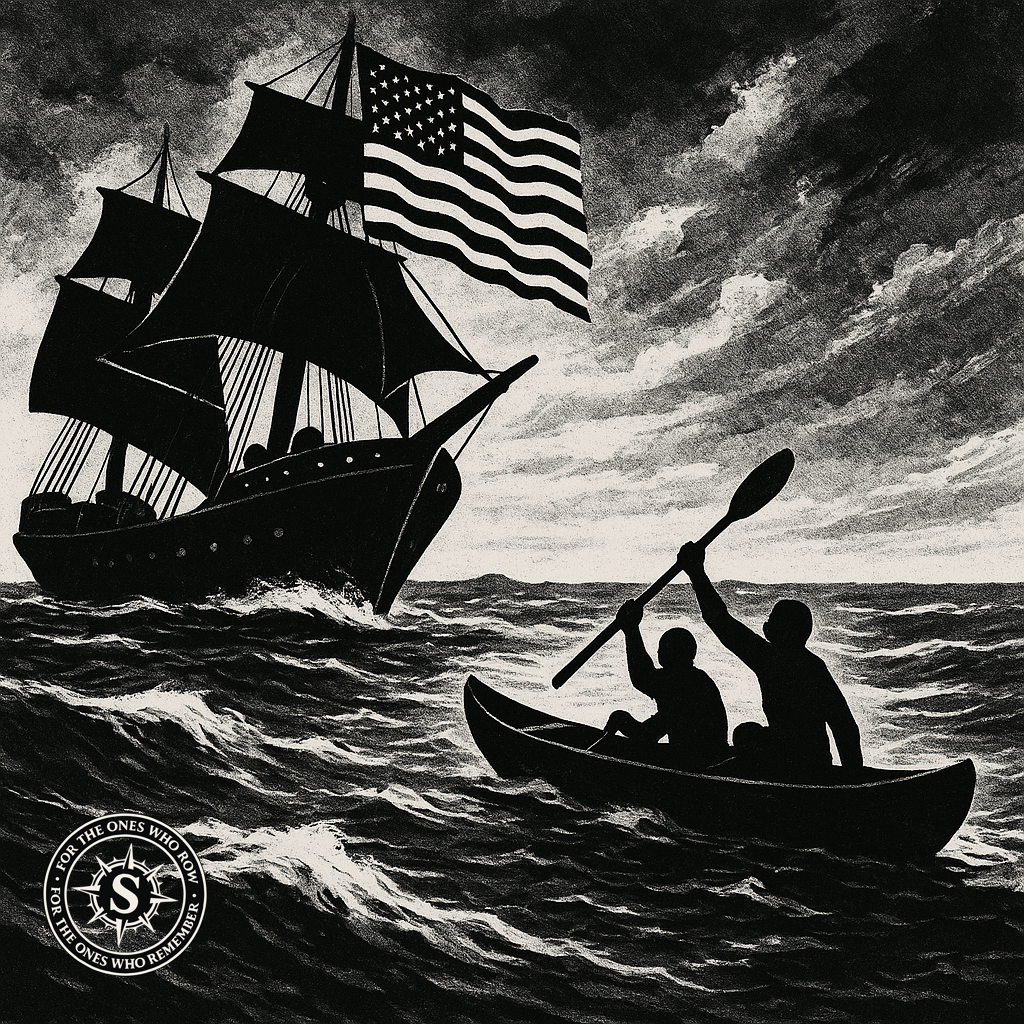
Its flag is the Jolly Roger of the modern age — not because it’s outlawed, but because it’s above the law. And while the old pirates hoisted black flags to strike fear, these ones wave their colours with pride… and call it diplomacy.
You see them dock in Gaza, in Haiti, in the Sahel. They don’t drop anchor — they drop sanctions. They don’t build bridges — they bulldoze economies. They leave schools shattered, mothers weeping, aquifers poisoned — and they call it freedom.
Even the boldest voices still need trade. Even South Africa, with its lawsuit and legacy, still knocks on the same doors. Because when the pirates run the ports, you have to smile as they loot.
Meanwhile, in Gaza, the killing continues. The children cry in Arabic, but no ship stops to help. The sea is full of flags, but not one lowers its sails in grief.
🏢 Section 2: The Pirates Have Offices Now
“You don’t need a coup when you can crash a currency.”
The pirates don’t need eye-patches anymore. They wear tailored suits. They don’t wave cutlasses — they carry clipboards. Their muskets have been replaced by metrics.
The modern pirate doesn’t kick down your door — he offers you a deal. An “investment.” A “development project.” A “partnership.”
But look closely: The lithium ends up in their electric cars. The water rights end up in their stock portfolios. The debt — always the debt — ends up around your children’s necks.
They’ve learned that you don’t need to invade a country if you can own its infrastructure. You don’t need to drop bombs if you can drop interest rates. You don’t need a coup when you can crash a currency.
BlackRock owns more land than many nations. Nestlé bottles water it didn’t pray for. Chevron calls oil sacred. Halliburton builds what the bombs destroy.
The empire privatized its violence. It outsourced the pillaging to companies with ethical mission statements. Its generals now wear CEO name tags. Its foot soldiers are analysts, consultants, lobbyists.
And when a country resists — like Bolivia, like Palestine, like Niger — it doesn’t get invaded at first. It gets discredited. Its leaders are called unstable. Its elections are called suspect. Its people are painted as dangerous, irrational, ungrateful.
This is how conquest works now: not with sails, but with spreadsheets. Not with warships, but with press releases. Not with swords — but with silence.
Somewhere, a young trade official — daughter of a struggle veteran — tries to resist. She sits in a Johannesburg office late at night, re-reading a contract with clauses meant to trap her people. She circles words in red. She drafts a softer version. She knows they won’t accept it. But still — she sends it.
🧠 Sidebar: They Stole the Thoughts Too
They didn’t just loot land and labour. They colonised knowledge. They broke open sacred libraries, and then wrote the footnotes in their own names.
The West calls it “intellectual property.” But it’s just patented plunder.
In Egypt, Plato sat at the feet of Black scholars. In Mali, the Dogon mapped the Sirius star system — long before telescopes. In South Asia, turmeric healed wounds before it had a bar code.
They burned the manuscripts of Timbuktu. Then they published “discoveries” about African medicine in European journals.
Today they say: “You owe us mobile phones.” But what they really mean is: “We branded what we stole.”
🛏 Section 3: Below Deck — The Ordinary Citizen
“The system is designed to keep the floor clean — even if the keel runs red.”
Empires aren’t only built by generals. They are built by people who go to work, come home tired, scroll a little, and sleep.
Below deck, life continues. The engines roar above, the orders are barked on the bridge — but here, the lighting is soft. There are supermarkets, streaming shows, lawnmowers, coffee shops.
No one hears the groans of the drowned. No one smells the smoke from the burning village.
Maybe they see something on the news — Gaza, Congo, Yemen. Maybe they feel a flicker of sorrow. Maybe not.
The comfort below deck is that you don’t have to know. The noise is muffled. The suffering is pixelated. The system is designed to keep the floor clean — even if the keel runs red.
And when someone does knock on the cabin door — a refugee, a witness, a protester — the citizens flinch. Not because they’re evil. But because it’s awkward. Disruptive. A crack in the illusion.
You see, this ship sells a story: “We are good.” “We bring freedom.” “We are the world’s hope.”
It’s a story whispered through education, hummed in entertainment, declared in politics. And most below deck believe it. Or want to. Or at least, want not to think about it too much.
One evening, a man in the suburbs clicks on a video about Gaza. He watches for seventeen seconds before an ad plays. He sighs. Skips it. Opens another tab. A special on air fryers. The horror slips away — not because he’s cruel, but because the system makes forgetting so easy.
Dissent is dulled with subscription bundles. A hundred shows to choose from. None of them about Palestine. And if that fails, there’s always a pill. A holiday. A hashtag that ends by Monday.
Because thinking leads to questions. And questions lead to guilt. And guilt demands action. And action? That rocks the boat.
🛶 Section 4: Canoes and Resistance
“These boats do not always win. But they do not drown quietly.”
Not every vessel sails under the pirate’s flag. Some float with patched sails and broken oars. They are small. Often sinking. But they do not bow.
They are the canoes of the world. Gaza, battered and besieged, still sings the Adhān through rubble. Haiti, dismembered by decades of debt and interference, still cooks its own rice. Congo, bleeding from every open vein of mineral wealth, still births drums and poems.
These are not nations that invade. They don’t fly drones or send tanks. They row.
And every stroke is resistance. Every preserved language, every intact culture, every refused bribe — resistance.
They are mocked for being poor. Starved for being proud. Punished for surviving.
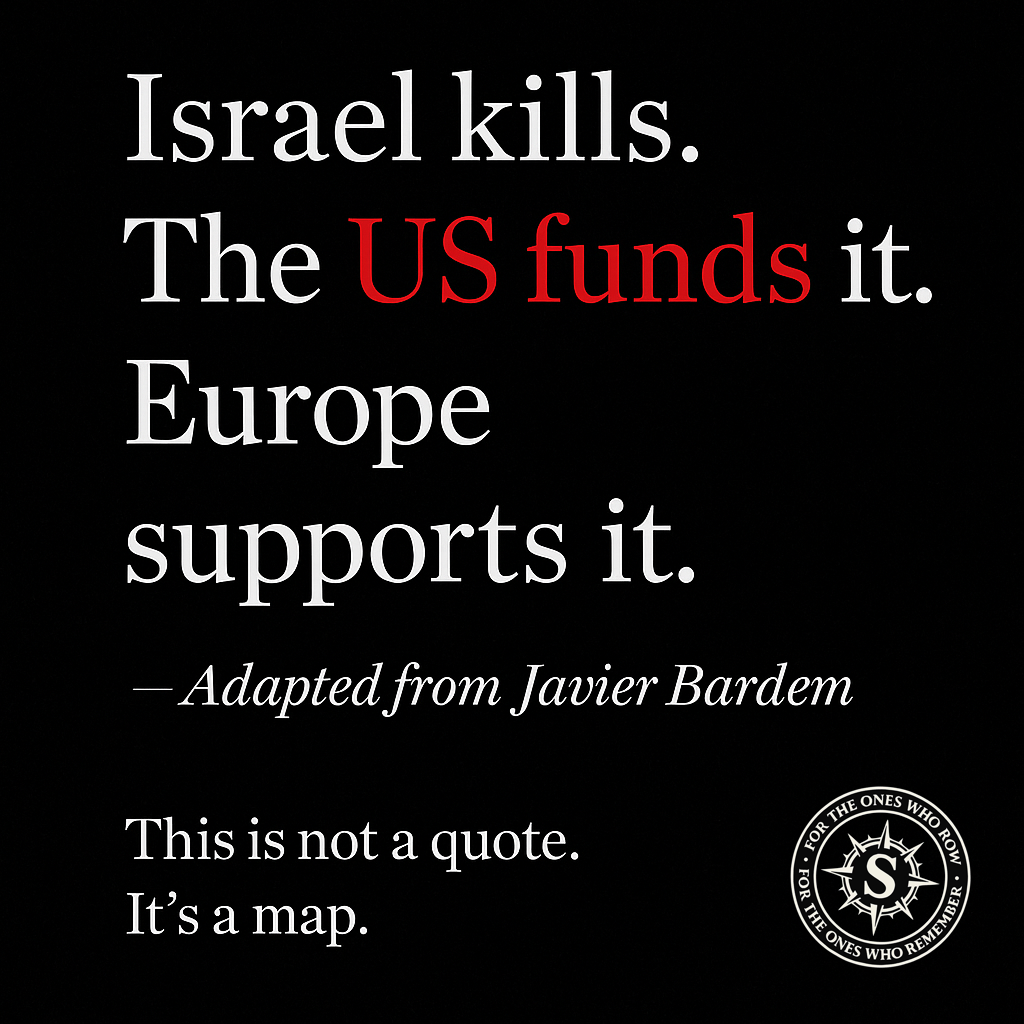
Some truths no longer need footnotes. As the Spanish actor Javier Bardem once said, bluntly and beautifully: “Israel kills. The US funds it. And Europe supports it.”
That’s not politics. That’s a map. A map of complicity. A map of whose silence lets the ship sail on.
The empire calls them unstable. Calls their leaders corrupt. Calls their children threats. But what they fear is not chaos — it’s clarity.
Because the canoe does not pretend. It knows the sea is dangerous. It knows what the pirate ship is.
And still, it rows.
Some canoes are communities. Some are movements. Some are just one grandmother who still tells the old stories — even as the bulldozers arrive.
Some of the canoes ride rivers: the Amazon, the Orange, the Missouri. In them sit the Mapuche, the Nama, the Sioux. They chant in languages the empire once tried to burn. They still paddle. They still protect.
As the bombs fall, a boy in Gaza recites lines from Mahmoud Darwish: “We have on this earth what makes life worth living.” He whispers them into the dust. Into his mother’s lap. It’s not defiance. It’s remembering.
These boats do not always win. But they do not drown quietly. Their resistance echoes — in funeral processions, in ululations, in the smell of fresh bread rising where bombs fell.
And in the far distance, something stirs. Not a boat. Not a bomb. But a wave. A rising swell of memory and reckoning. The kind that even empires cannot out-sail.
❓ Section 5: What Now?
“Maybe you can’t leave yet. But you can plant questions in the cracks of the hull.”
You’ve seen the ship. You’ve heard the cannons. You’ve walked the quiet corridors below deck. You’ve watched the canoes struggle to stay afloat.
So now the question is simple. What now?
You don’t have to be a general. You don’t have to command a fleet. But you do have choices.
You can choose not to cheer when the ship fires. You can choose not to believe the stories they sell you — about the savages, the chaos, the necessary war.
You can choose not to mock the canoe. You can choose to listen when the drowned call out from beneath the waves. You can learn their names. Say their prayers. Tell their stories.
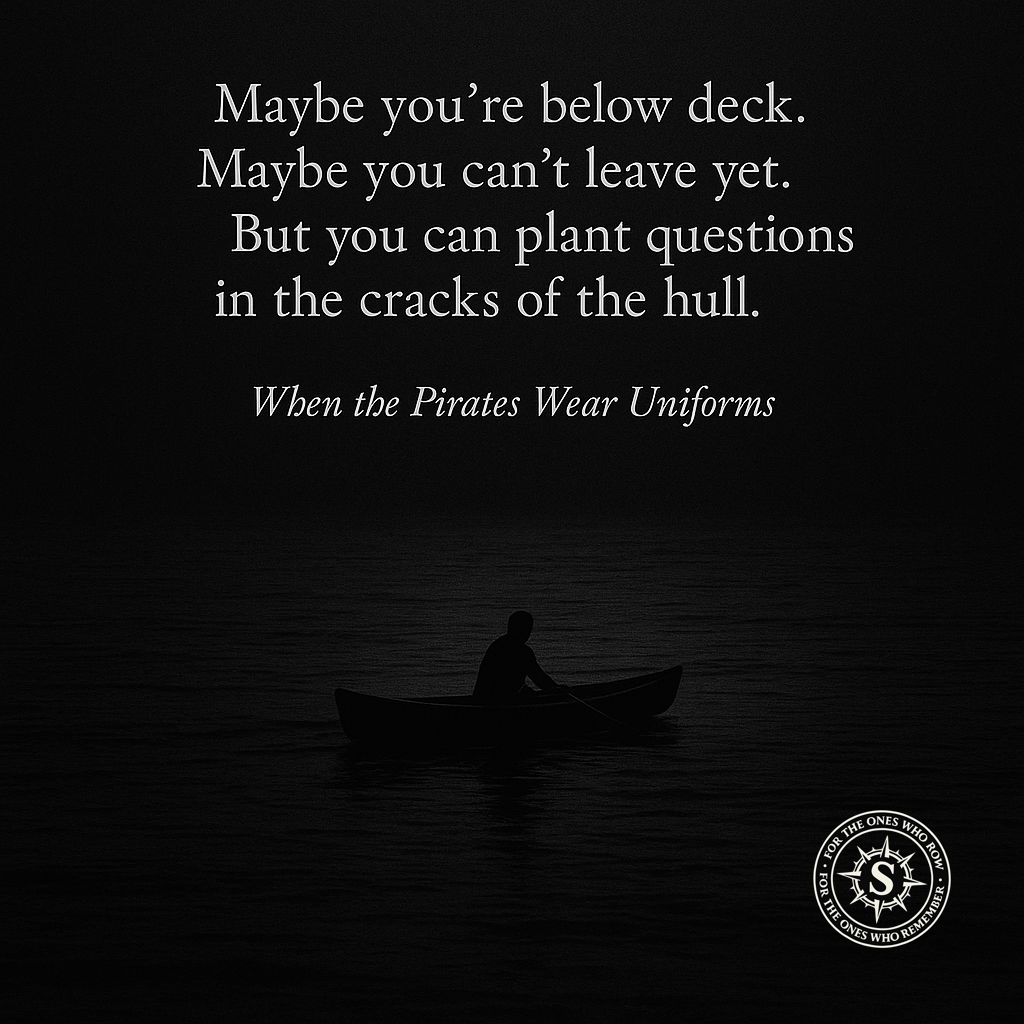
Maybe you’re below deck. Maybe you can’t leave yet. But you can plant questions like seeds in the cracks of the hull. You can make art that aches. You can whisper, even if your voice shakes.
And maybe, one day, when the ship hits a reef — you’ll already know how to swim.
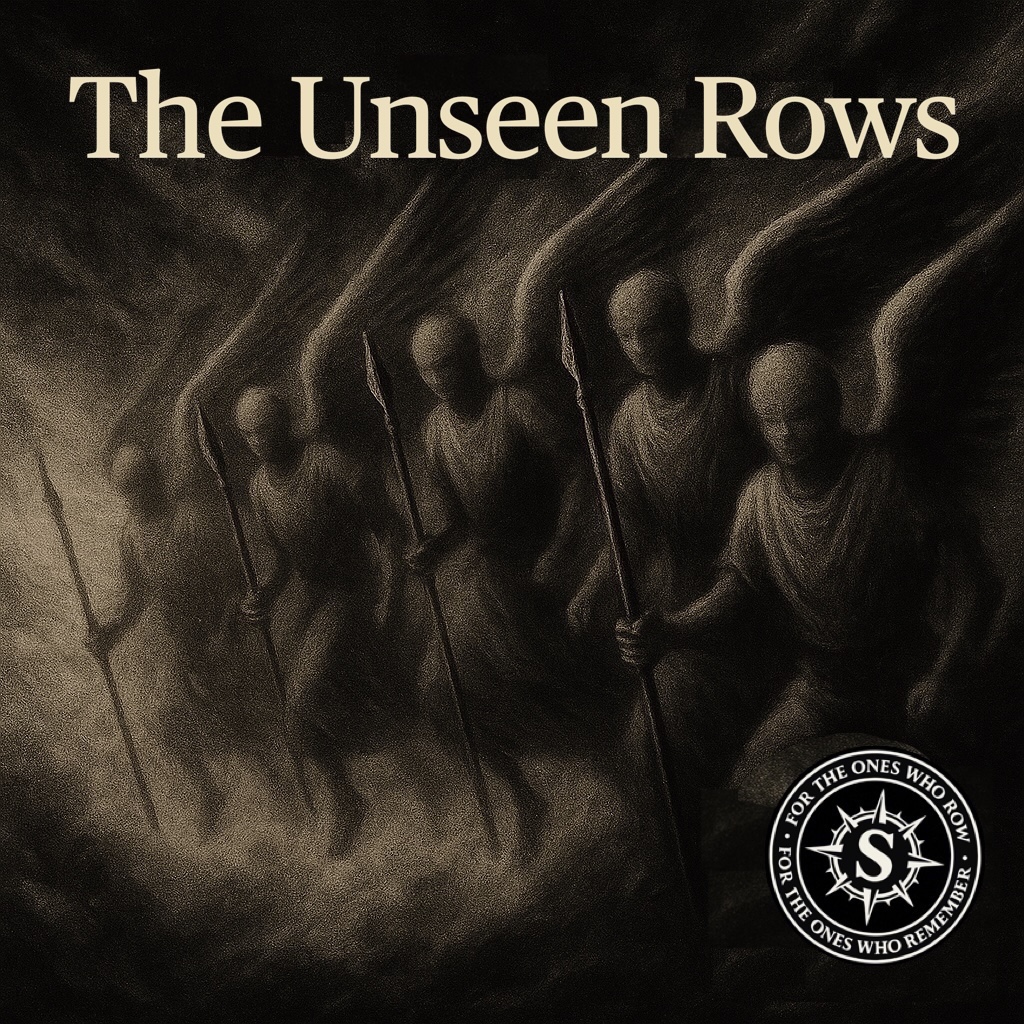
🌌 Postscript: The Unseen Rows
“Above the pirate ships, the angels line up.”
For the ones who row. For the ones who remember.
Above the shipping lanes and air raids, above the pirate flags and surveillance drones, above the offices and engines and war rooms — there are rows they do not see.
Al-Ṣāffāt. “By those arrayed in rows…” (Qur’ān 37:1) The angels. Not scattered. Not confused. Lined up — like soldiers of mercy. Advancing — like winds of truth. Reciting — not data, but dhikr.
وَالصَّافَّاتِ صَفًّا فَالزَّاجِرَاتِ زَجْرًا فَالتَّالِيَاتِ ذِكْرًا By those arrayed in ranks, by those who drive forward, and by those who recite the Reminder… (Qur’ān 37:1–3)
These are not symbols. They are not myths. They are the architecture of heaven. And they do not forget the ones who row.
When the shayāṭīn of power rise to steal, when the liars reach for whispers of the unseen, they are met with stones of fire. Comets hurled from truth’s edge. The skies are not neutral. The divine has guardians.
“They cannot listen to the Higher Assembly… they are pelted from every side, repelled, and for them is a perpetual punishment.” (Qur’ān 37:8–9)
And we? We row. We remember. We recite.
We do not carry cannons — but we carry verses. We are not in fleets — but we are not alone. Somewhere, angels are already in formation.
✨ A Final Word from Rafiq al-Bunduqia
The Sage on the Jetty
So here’s what I say, ne:
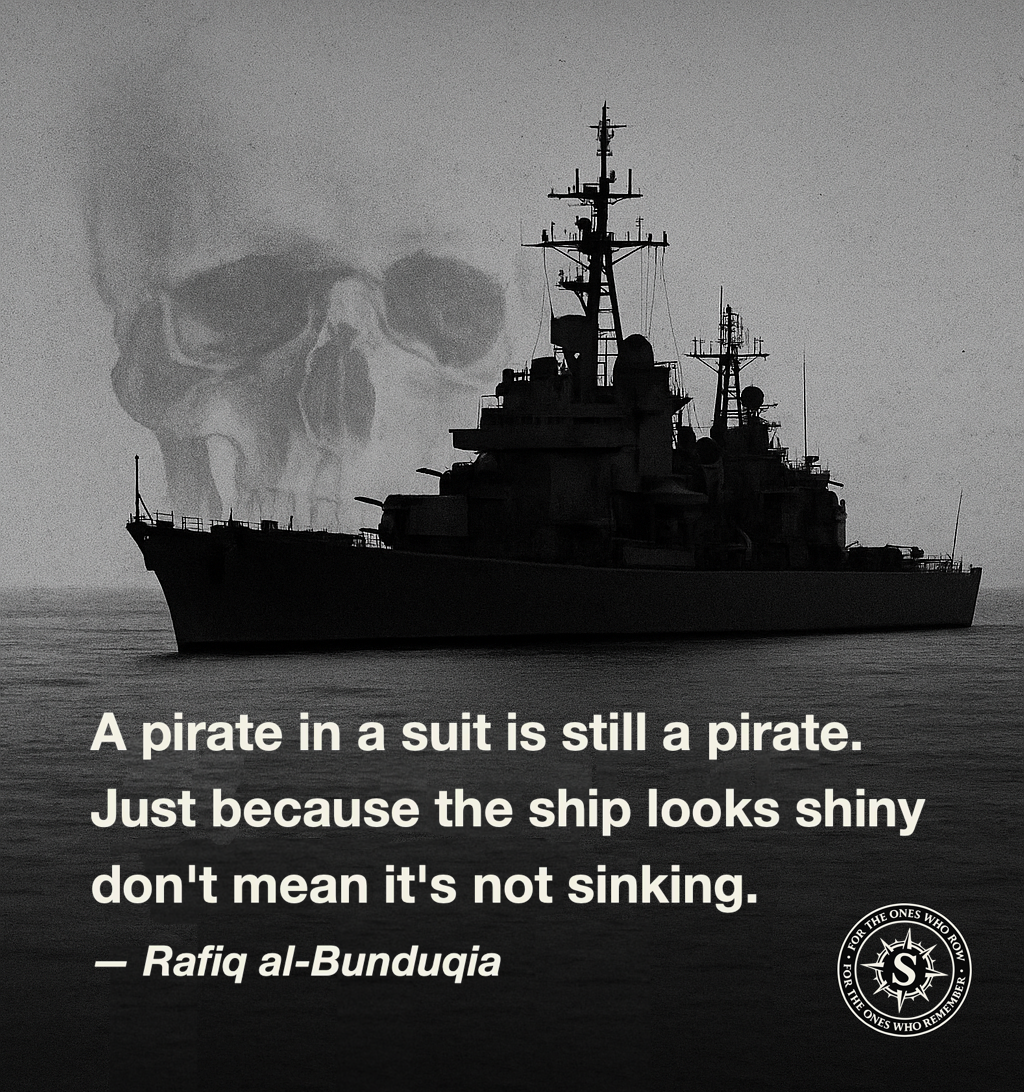
Don’t let them fool you with fancy uniforms and offshore accents. A pirate in a suit is still a pirate. And just because the ship looks shiny don’t mean it’s not sinking.
Me, I seen this before. The old flags change — but the hunger stays the same. They used to come for your gold. Now they come for your soul — and your SIM card.
They sell you peace while sharpening knives. Call it “stability,” call it “the market,” call it “regime change.” But listen close, my bru — they only change regimes that say “no.”
Below deck, I know some of you are tired. I know some of you feel small, feel stuck. But remember: Empires fall when enough people stop pretending.
You can’t steer the whole ship, but you can stop rowing. You can stop clapping for the captain. You can light a fire in your corner. And when the time comes — you’ll know which way to swim.
And as for the ones still paddling in canoes? Rowing against the wave, barefoot, hungry, heart full?
May your names be written on the wind. May your stories outlast the storm. And may your grandchildren sail free.
shotgun click
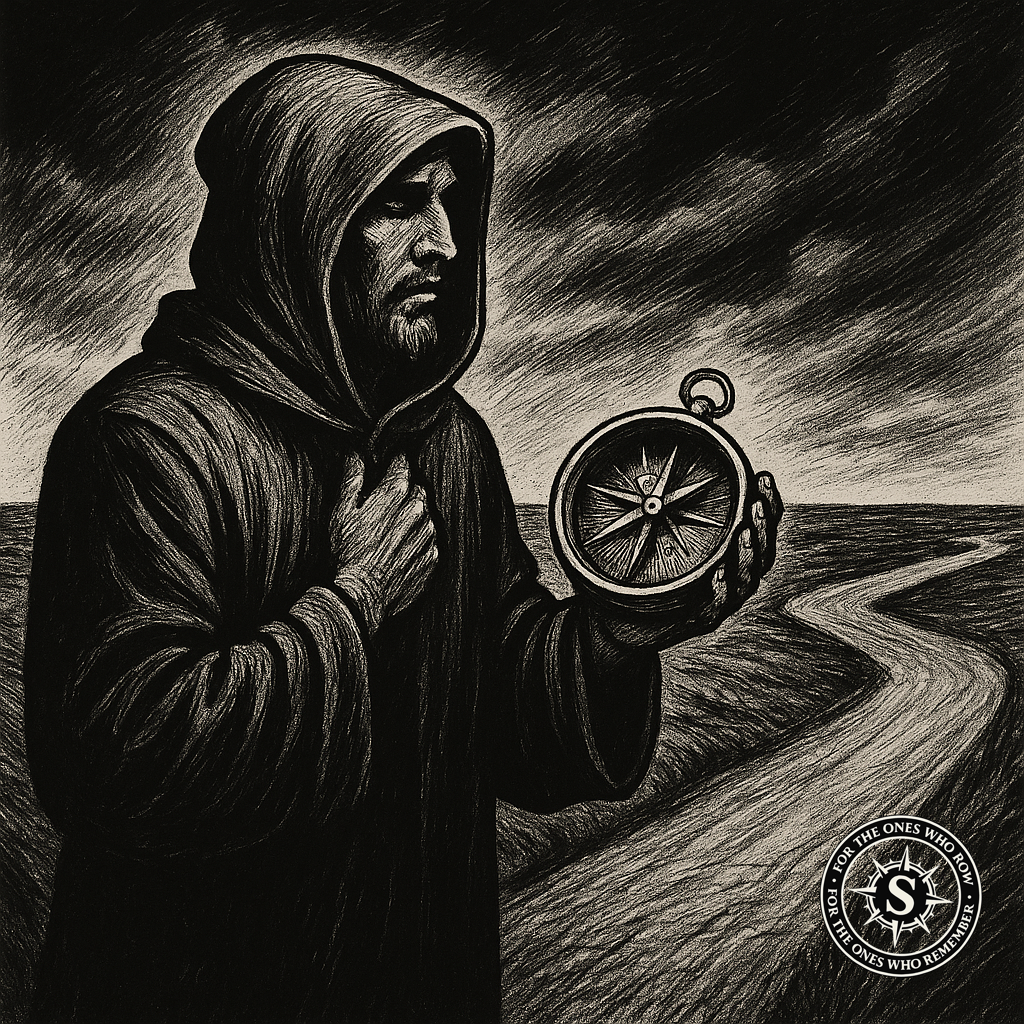
We ride till the ship breaks, bru. Until then — we don’t hand over our compass.
“Salaam to the angels who line up when we can’t. Salaam to the ones who row even with leaking boats. Salaam to the ones who still make dhikr in the dark.
And to the empire?
May you one day see what light you tried to drown.”
Ameen, and ashraaf ʿalaikum ya ṣaffāt.
The seal of remembrance — for the ones who row, and the ones who remember.
— Rafiq al-Bunduqia, The Sage on the Jetty 🧭
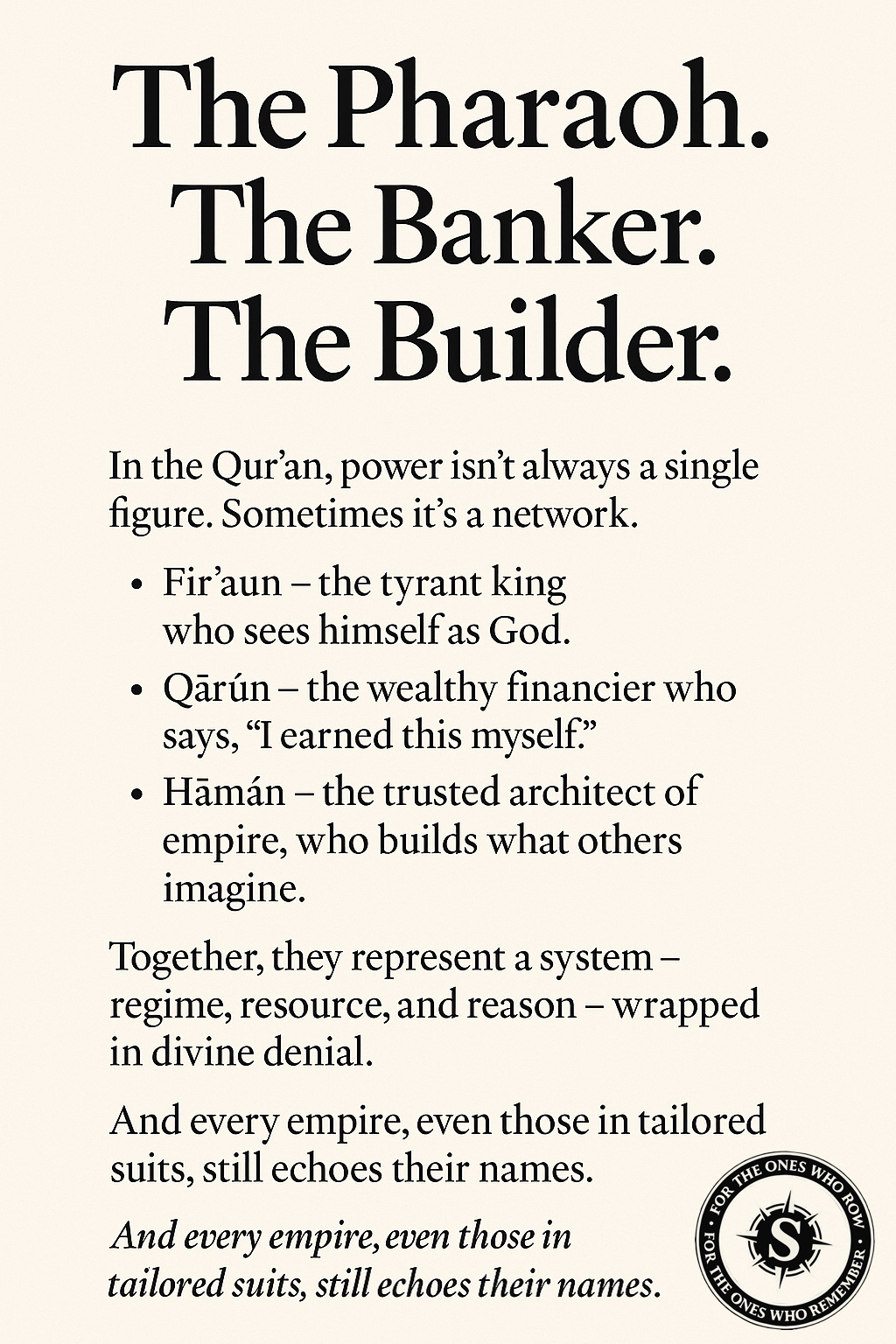
“The Pharaoh. The Banker. The Builder.”
📜 Sidebar: The Three Faces of Tyranny Fir‘awn. Qārūn. Hāmān. These three figures appear repeatedly in the Qur’an — not just as villains of the past, but as types that recur across history. Fir‘awn: the dictator, the political oppressor. He claims divinity, demands obedience, and divides people to rule them. Qārūn: the hoarder, the economic elite. He flaunts his wealth, credits no one but himself, and forgets the source of all provision. Hāmān: the enabler, the bureaucrat and ideologue. He builds towers, writes the laws, manipulates truth, and justifies oppression in the name of order. Together, they form a system: the empire that marches with a flag in one hand, a contract in the other, and blood on its boots. Sound familiar?
“Today, they wear suits. They weaponise policy. But the triad still walks among us.”
The Pharaoh, the Banker, and the Builder
In the Qur’an, they stand together — a tyrant, a financier, and a master of infrastructure. Firʿawn ruled with cruelty. Qārūn hoarded with pride. Hāmān built towers for lies.
Centuries later, the empire shapeshifts. Today, they wear tailored suits. They pass laws. They sign cheques. They pave roads to ruin.
But remembrance makes them visible. And visibility is resistance.
“The Pharaoh. The Banker. The Builder.”
🧭 Parting Compass — A Note from Rafiq al-Bunduqia
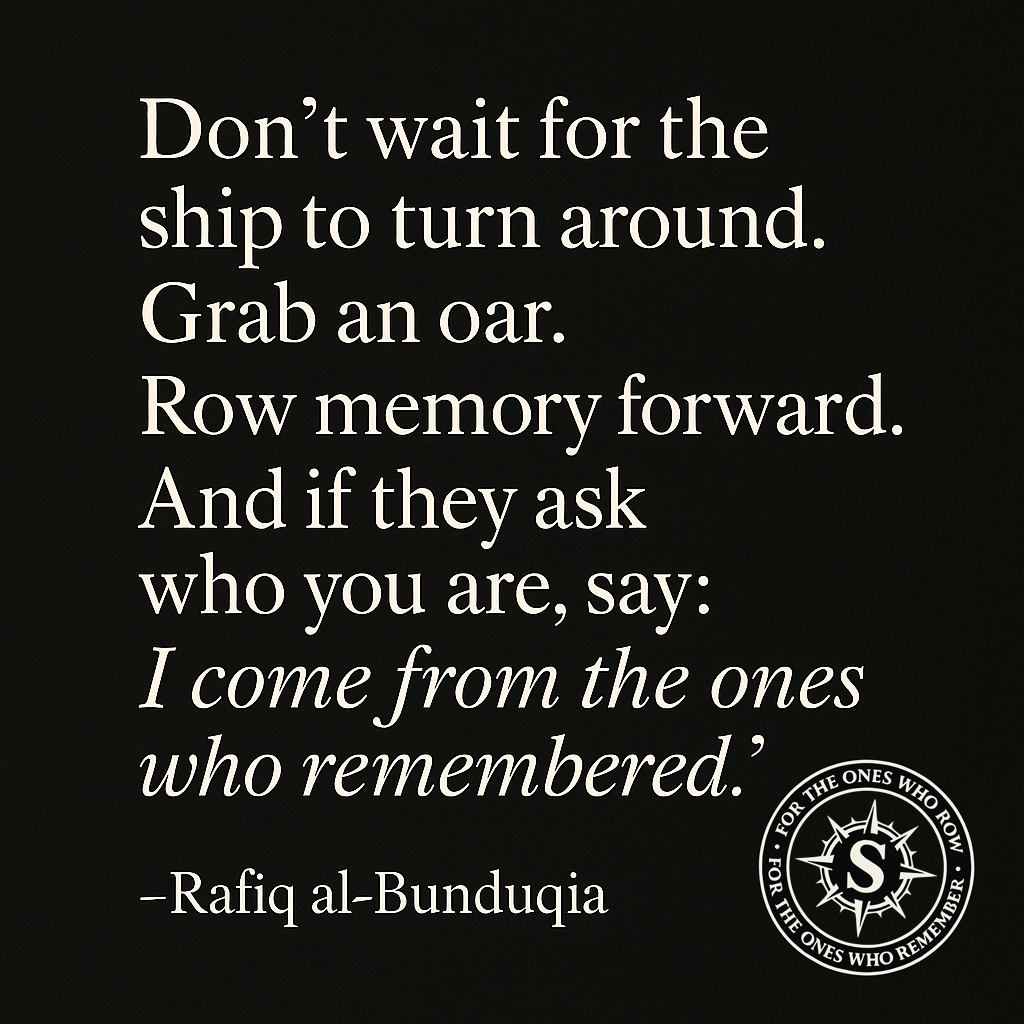
Don’t wait for the ship to turn around. Grab an oar. Row memory forward. And if they ask who you are, say: I come from the ones who remembered.
Ngũgĩ wa Thiong’o, Kaaps, and the Language of Return
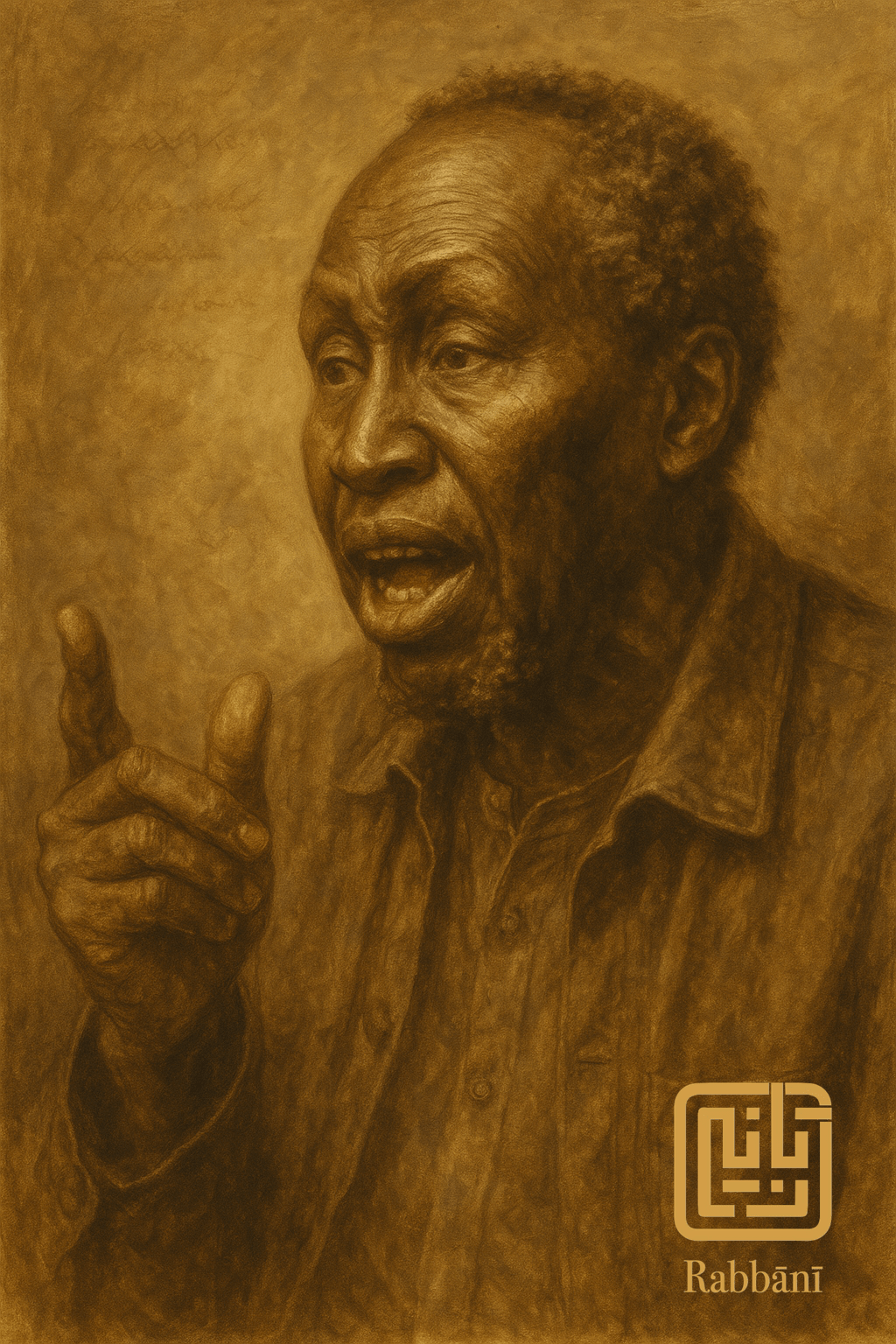
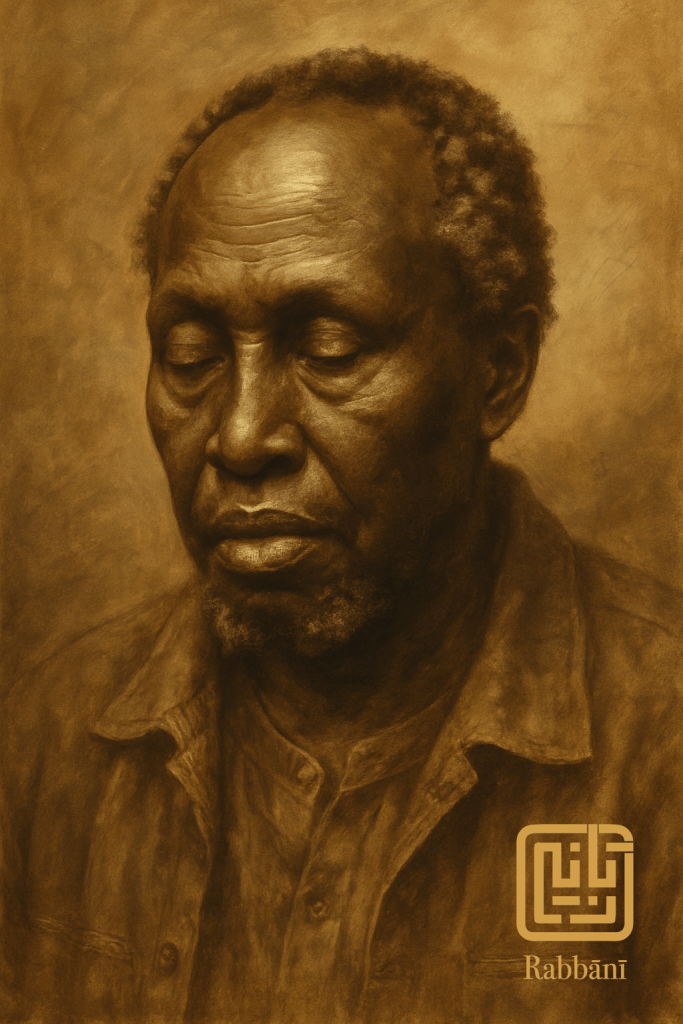
“Take away our language and we will forget who we are.”
Ngũgĩ wa Thiong’o — the voice that reminds us that language is the root of memory and identity.
Ngũgĩ wa Thiong’o’s words land with the sharpness of memory — not just for Kenya, where he grew up, but here at the Cape, where empire’s conquest of our bodies came with a quieter, more enduring conquest of our tongues.
Ngũgĩ’s recent essay in The Guardian tells how colonial schools punished African children for speaking their mother tongues, rewarding only the conqueror’s speech. It shows how missionaries imposed new, biblical names on students — turning Ngũgĩ into “James” — severing identity at the root. He calls this the colony of the mind, where shame and silence make us police our own voices.
The Cape Echo
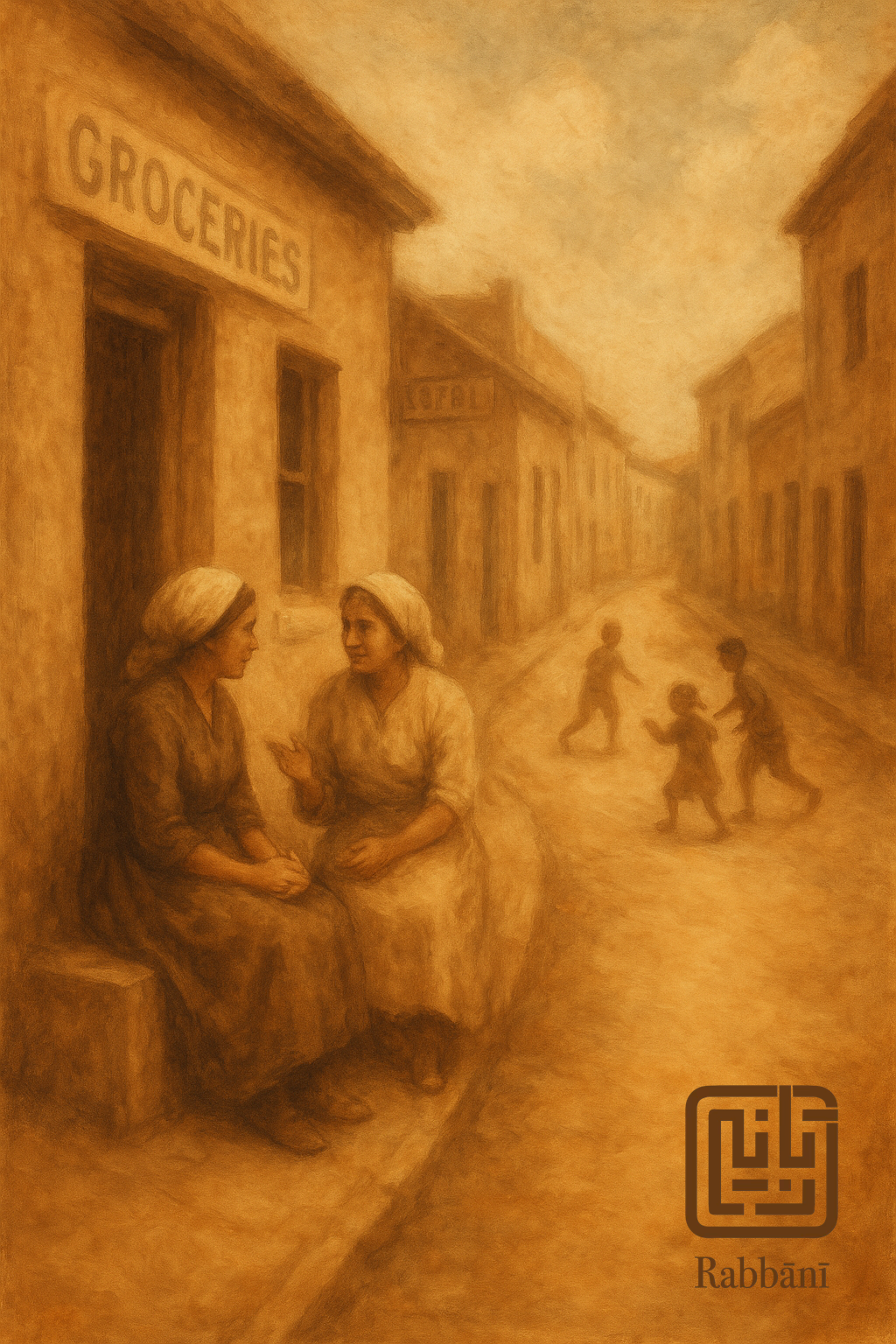
We know this story. In our Cape classrooms, Kaaps — the language of our homes, jokes, and arguments — was labelled “slang,” “broken,” or “incorrect.” Arabic-Afrikaans, the written tongue of our forebears’ Qur’ans and litanies, vanished from the public page. It was no accident. This was the slow grind of erasure: to make us strangers in our own mouths.
Kaaps lives in the stoep conversations, the street games, the everyday poetry of the Cape.
Kaaps as a Living Archive
Kaaps is not “lesser” Afrikaans. It is the living grammar of the Cape, born from the meeting of Khoi, Malay, enslaved African, and European tongues. It carries the rhythm of working-class streets, the tenderness of family kitchens, the wit of those who survive by laughing.
Ngũgĩ’s call for linguistic justice speaks directly to Kaaps: the demand that we write, publish, and teach it without apology, that we refuse to bleach it into acceptability. To reclaim Kaaps is to reclaim the right to sound like ourselves.
The Ratib al-Haddad and the Sound of Home
If Kaaps is our daily voice, Arabic-Afrikaans is our prayer voice. In the Ratib al-Haddad, Cape Muslims preserved the Qur’an’s Arabic alongside Kaaps-Afrikaans, written in Arabic script. These manuscripts are living proof that language can survive conquest by going underground — into the masjid, the madrasa, the family du’a.
Ngũgĩ imagines a network of languages, each contributing its own beauty. The Ratib is already that: Arabic, Malay, and Kaaps carrying barakah together, resisting the empire’s hierarchy of tongues.
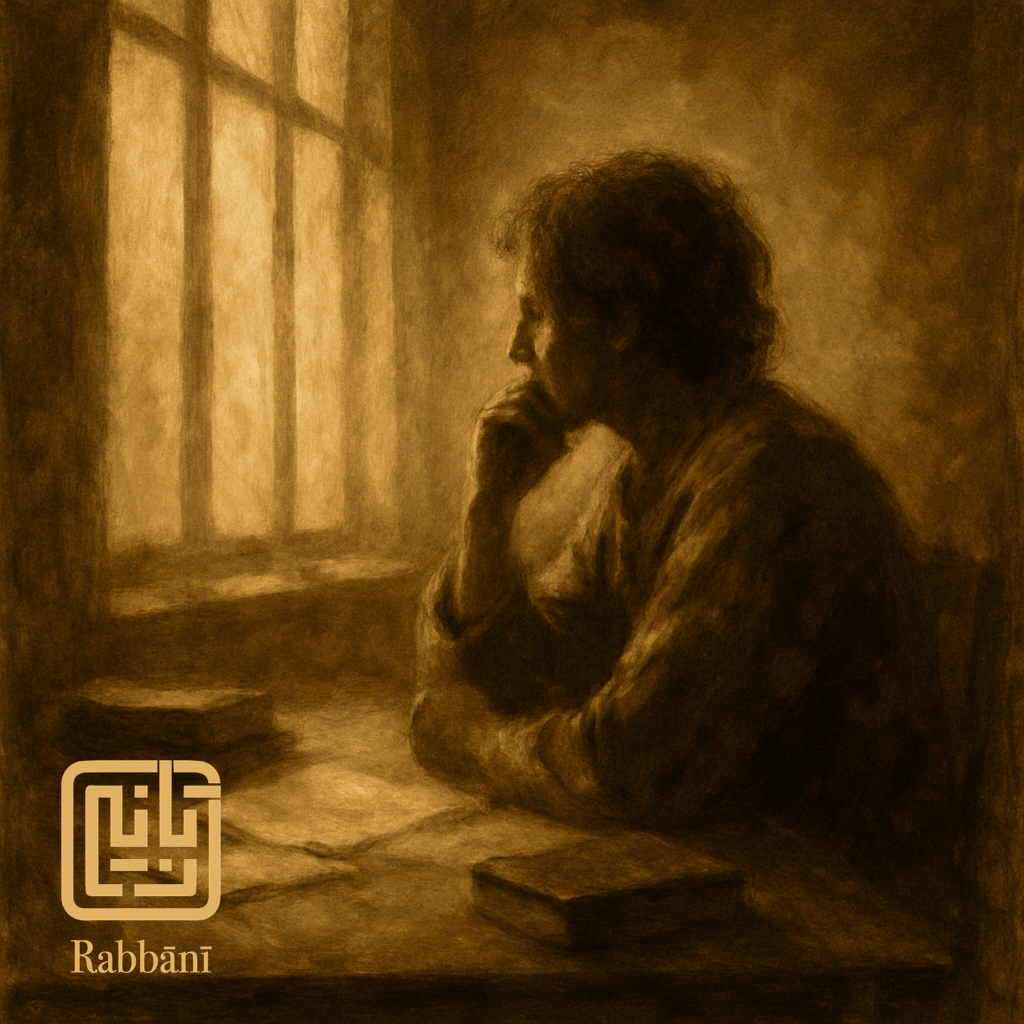
The colony of the mind — when language is caged, and light must break through.
Colonies of the Mind
The greatest victory of conquest, Ngũgĩ says, is when we no longer need to be told our languages are inferior — we have already believed it. That is the “colony of the mind.”
This is why we keep unearthing Arabic-Afrikaans manuscripts, writing Kaaps into the public record, celebrating the medora and the sorbaan, documenting the words of our elders. These are not side-projects — they are acts of return.
From Erasure to Inheritance
Ngũgĩ reminds us: decolonisation begins with language. Every blog on Kaaps, every poster that holds a Cape word like a jewel, every unpacking of the Ratib is not just cultural garnish — it’s the soil in which freedom takes root.
If the conqueror severs language to make us forget, then our work is to speak, sing, write, and teach in our own tongues until our children’s children remember again.
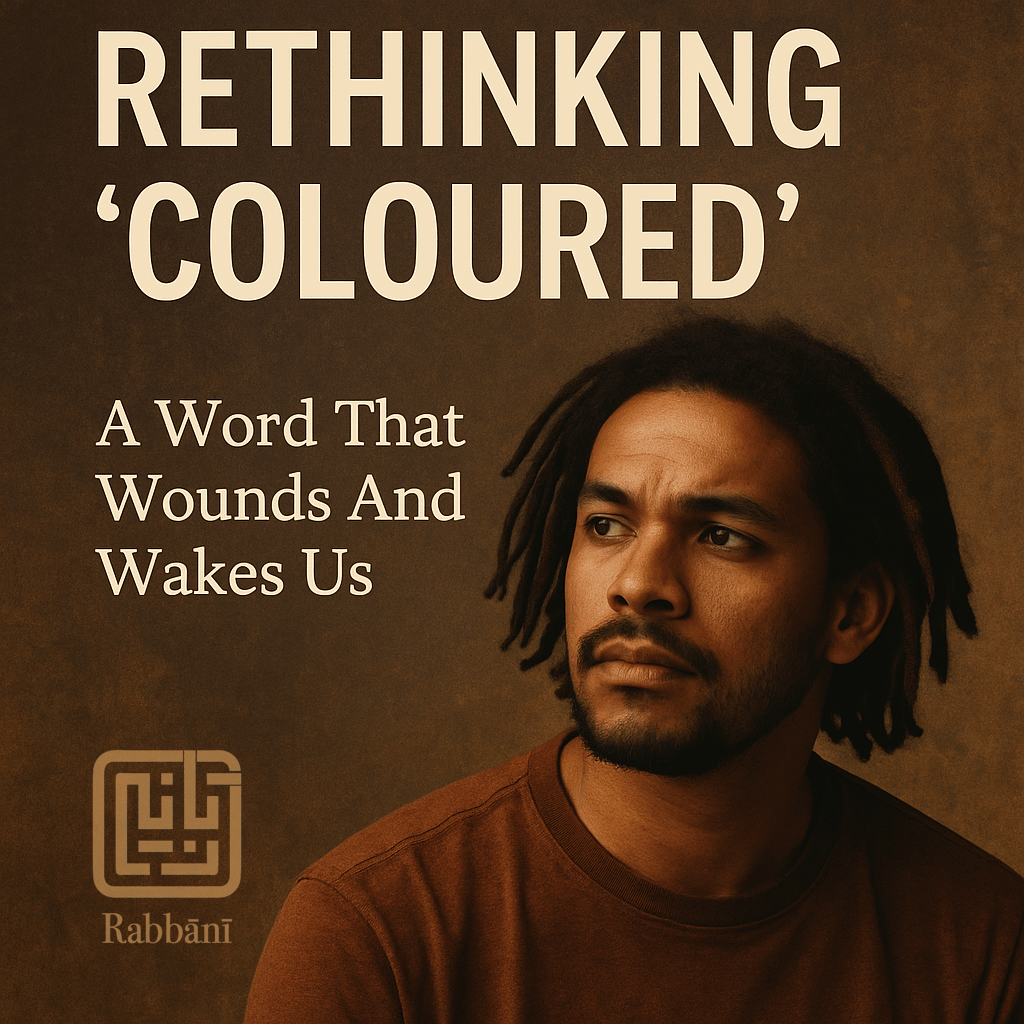
🟤 A Word That Wounds and Wakes Us: Rethinking “Coloured” in the Age of Memory
By Adli Yacubi
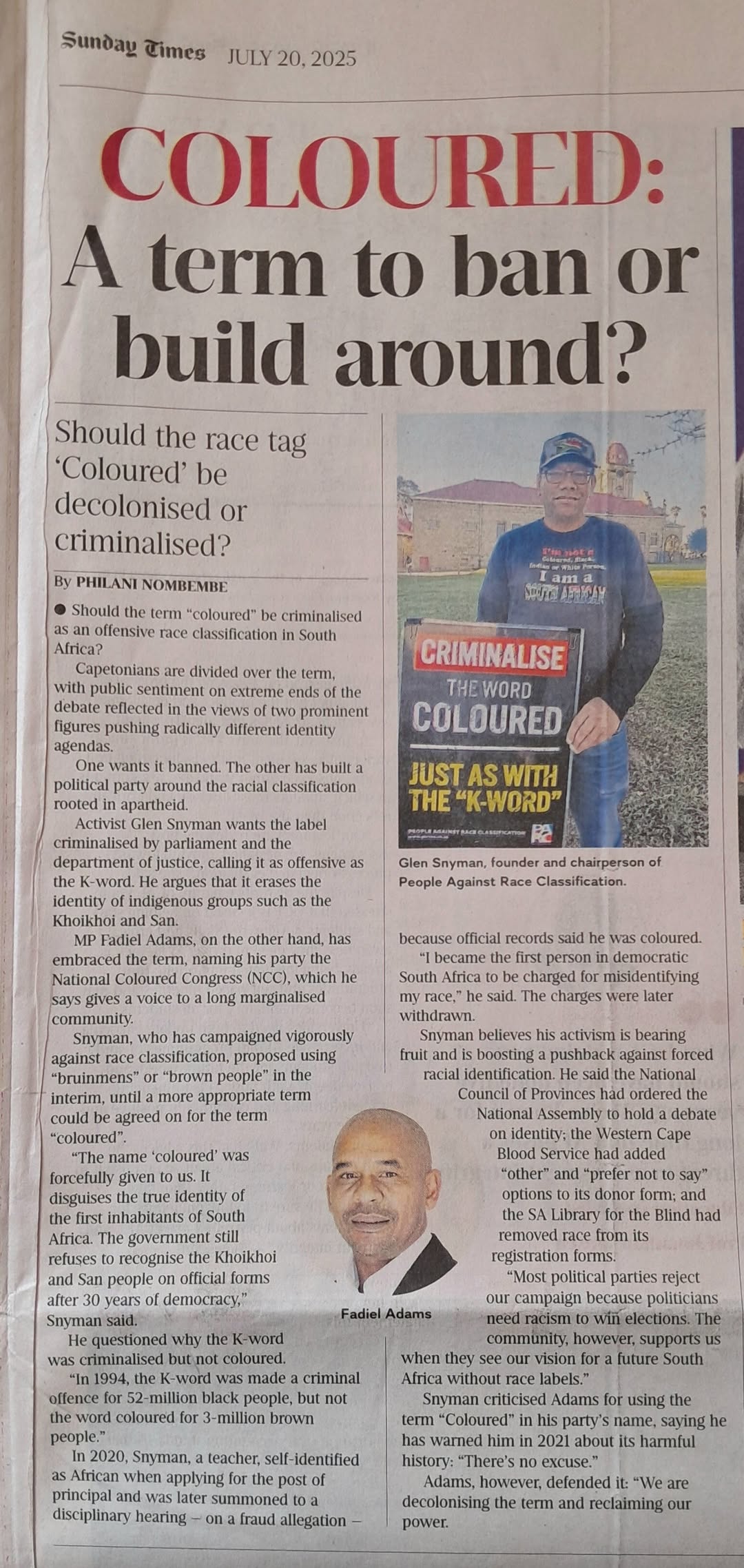
“The name ‘Coloured’ was forcefully given to us.” — Glen Snyman, Sunday Times, 20 July 2025
Last Sunday’s front page posed a question still burning through our national psyche: “Coloured: A term to ban or build around?”
In bold red and black, the Sunday Times article (20 July 2025) captured a moment of deep fracture — and opportunity. It spotlighted the voices of two public figures, Glen Snyman and Fadiel Adams, whose opposing stances on the term “Coloured” reflect long-simmering tensions within post-apartheid identity politics.
And yet, beyond the noise, a different current is rising. One that calls not for renaming or romanticising, but for remembering.
❌ Criminalise or 🔁 Reclaim?
Glen Snyman, founder of People Against Race Classification (PARC), argues that “Coloured” is not merely outdated — it is damaging, like the K-word:
“It disguises the true identity of the first inhabitants of South Africa. The government still refuses to recognise the Khoikhoi and San people on official forms after 30 years of democracy.”
Snyman’s activism led to national debates in parliament and institutions like the Western Cape Blood Service adding the “prefer not to say” option to racial forms. But his call for criminalising the term has stirred legal and ethical challenges — and provoked a backlash from those who feel erased by the erasure.
On the other end stands Fadiel Adams, leader of the National Coloured Congress, who says:
“We are decolonising the term and reclaiming our power.”
Adams believes in building around the identity — anchoring it in lived pain, community resilience, and political recognition. But critics say this collapses our histories into apartheid boxes, reinforcing labels that were never ours to begin with.
🪶 What’s In a Name?
Into this fire, Patric Tariq Mellet, historian and author of The Camissa Embrace, offers clarity beyond polemics:
“Goringhaicona was never a name people used for themselves. It was a derogatory Dutch term meaning outcast or scavenger. Autshumao’s people were known as the /Kamisons — water traders. They were a sub-group of the Cochoqua. The term Camissa remembers them not as fragments, but as a river of convergence.”
Mellet’s contribution is not merely semantic — it’s genealogical. It reveals that terms like “Coloured” and even “Brown” are colourist overlays that flatten our multiple ancestries: San, Khoe, Xhosa, enslaved African, Indian, Javanese, and European.
His critique of both Snyman and Adams is incisive:
“Both men reflect valid concerns — but both are caught in Apartheid’s trap. One criminalises. The other romanticises. Neither steps fully into the radical work of remembering, beyond state classification.”
🧬 Memory as Resistance
To stand in this in-between space — neither erasing the term nor enshrining it — is to do the work of memory. To say: we were misnamed, but we are not unnamed. We are more than what apartheid called us. And we are not only what the census categories offer us.
This blog, like others before it, is not a position paper. It is a growing reflection rooted in questions I’ve been asking for years: — What do we mean when we say “I am Coloured”? — Who gets to say so? — And what happens when our ancestors whisper different names?
We are not “non-white.” We are not “Other.” We are not “Coloured” in the way the law intended. And we are not simply “Brown,” either.
We are Camissa. We are from the river. We are still flowing.
📝 Postscript
We acknowledge the work of Patric Tariq Mellet, whose scholarship challenges colonial erasure. Through his writing, Camissa is no longer hidden — it is remembered as a place of sweet waters, of creolised identity, of sacred convergence.
His reminder to not confuse / reclaim / romanticise pejorative colonial terms (such as “Goringhaicona”) is especially important — and will be reflected in our future revisions.
We also draw from Stuart Hall, who wrote that nations are “narrated into being.” To say “I am from Camissa” is to resist imposed categories and to speak from the riverbed of relation — to narrate the nation otherwise.
The story of who we are is still being written. Let it not be in the language of our conquerors — but in the voice of our rivers, mountains, mothers and names.
💧 The Colour of God
صِبْغَةَ ٱللَّهِ ۖ وَمَنْ أَحْسَنُ مِنَ ٱللَّهِ صِبْغَةًۭ ۖ وَنَحْنُ لَهُۥ عَـٰبِدُونَ “This is the colour of Allah. And who is better than Allah in colouring? And we are His worshippers.” (Qur’an 2:138)
Not the colours of empire. Not the names imposed by maps or ministries. But the silver sap beneath the bark. The scent of rain on root. This is the ṣibghah of God. The sacred dye of those who remember.
The Mother Tongue of Tasbih: Afrikaans, Islam, and the Echoes of Resistance
An Interlude of Love, Argument, and Memory
We were driving down a quiet stretch of road — just Sadia and I, the Karoo light pouring in through the windscreen, dust swirling around like old questions. She had grown up in Worcester, her Afrikaans carefully folded by teachers and ‘ustaads’, wrapped in the formal tones of schoolbooks and sermons — so different from the swing and slang I had grown up with in the Cape. I, on the other hand, had grown up with a different register: kombuis-Afrikaans, spoken in kitchens and mosques, spiced with Quranic rhythm and Kaapse mischief.
Somewhere between the mountains and memory, we argued.
“That’s not real Afrikaans,” she said, teasing. “You make up words.”
“And who decided what’s real?” I asked. “The Broederbond? The DRC? The state that tried to baptize us in its accent?”
She laughed — but the question lingered.
This is not just a story of a couple’s linguistic banter. It is the story of a language born in exile, nurtured in slavery, softened by Qur’an, and carried through generations of prayer, protest, and poetry. This is a story of Afrikaans — not as the language of the oppressor, but as the tasbih of the oppressed.
1. Afrikaans: Not a White Invention
Let’s begin here: Afrikaans was not born in Stellenbosch.
Its roots run through Cape Malay kitchens, slave quarters, mosque courtyards, and prayer gatherings beneath candlelight. It was whispered by Javanese mothers exiled from Batavia, recited by Wolof imams from Senegambia, taught by Hadrami scribes, and softened by the Khoena tongues of this land — long before colonial grammarians arrived to cage it in rules..
The historian Achmat Davids was among the first to challenge the myth that Afrikaans was solely a “white man’s language.” His pioneering research, later extended by Hein Willemse and others, traced Afrikaans’ earliest written form to the Muslim community of the Cape — not in Latin script, but in Arabic-Afrikaans, or what was sometimes called Ajami Afrikaans.
One of the oldest surviving texts in Afrikaans is a du’a (supplication) manual written in Arabic script by enslaved Muslims. Another is the 1869 Bayān al-Dīn, a complete Islamic catechism in Afrikaans, used for madrassah instruction. These works prove something scholars of empire often resist: that enslaved and colonised peoples were not passive recipients of a language. They reshaped it. They sanctified it. They infused it with rhythm, resistance, and remembrance.
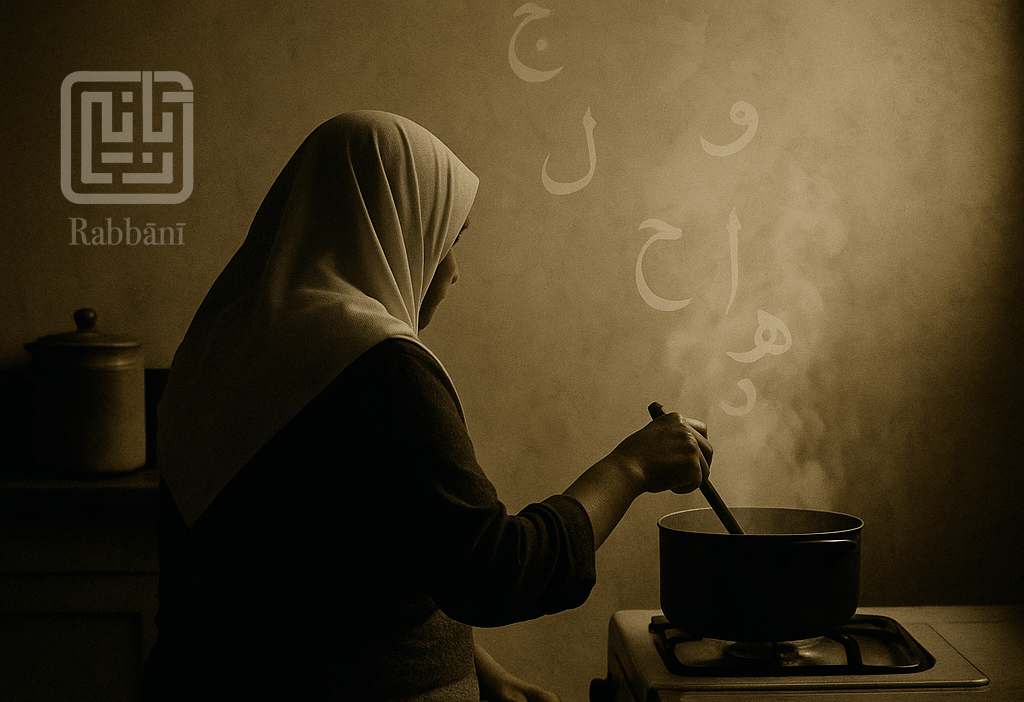
Afrikaans was not merely a colonial bastard tongue. It was — and remains — a mother tongue for many, especially when that mother stood stirring boeber while reciting Qul Huwa Allahu Ahad under her breath.
2. Creole? Or Camissa?
I’ve always had difficulty with the word creole.
Not because I reject mixedness — quite the opposite. I honour our intertwined bloodlines, the sacred chaos of diaspora, the rivers that met and mingled here at the Cape. But because the term creole, as used by certain linguists, often carries a quiet violence: it frames our language as a compromise, a simplified system born of broken tongues. It reduces what is sacred into something stitched from scraps. As if kombuis-Afrikaans was the language of people who couldn’t speak properly — not of people who chose to pray differently.
And too often, creole becomes a coded term for “coloured.” A linguistic way of saying not-white, not-black, not-arabic, not-european — just other.
I prefer another term: Camissa. As Patric Tariq Mellet reminds us, Camissa was the name of the river that once flowed through the Cape Flats, long before the Dutch buried it under stone. It was also the name of the Goringhaicona clan who traded with the world before colonial maps erased them. To speak Camissa-Afrikaans is to remember we are not defined by brokenness — but by confluence.
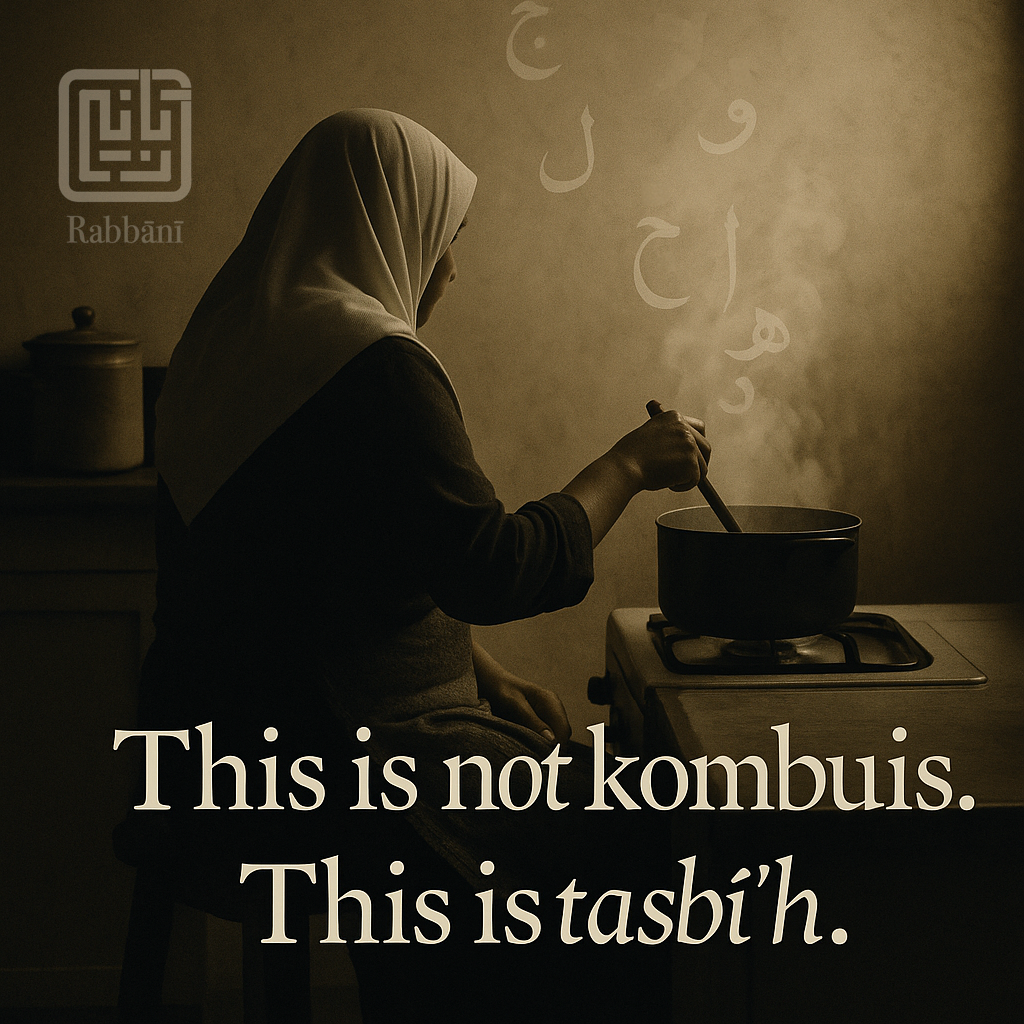
So no, what we speak is not a creole. It is the tasbih of the kitchen, the dhikr of the dockyard, the language of longing. What they call kombuis, we call home.
3. The Language of Tasbih
In our home, Afrikaans was not the language of textbooks or term reports. It was the language of tasbīḥ — of remembrance, rhythm, and breath.
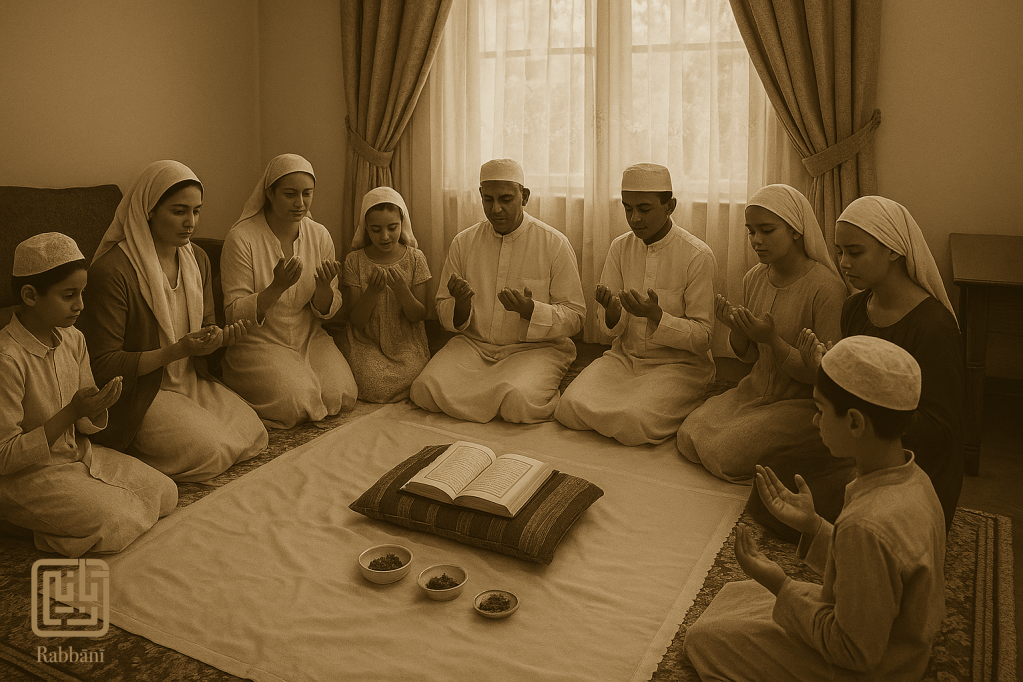
Thursday nights, just after maghrib, the living room would dim into stillness. A cloth was spread. The Rātib al-Ḥaddād would begin. First a whisper: Qul huwa Allāhu Aḥad… Then a swelling chorus — women’s voices, children’s murmurs, old men with trembling hands.
We called it the Gadat. It was recited in Arabic, but held together by Afrikaans: the instructions, the rhythm, the murmured cues. “Ouens, netjies!” “Hou die beat mooi!” “Moenie vinnig ry nie — luister na die kalmte.”
Sometimes, someone would break from the dhikr to hush a restless child. “Shhh, dis nou Allāh se tyd, my kind.” That now — that insistence that this moment of prayer was sacred and immediate — still echoes in my chest.
And when it was done, a sweetness returned: koesisters passed hand to hand, boeber ladled with care, stories resumed in Kaaps lilt. The tasbīḥ was complete — not just in recitation, but in the return to one another.
…
In his later years, my father told me how the elders taught Qur’an in Afrikaans before Arabic letters could be properly mastered. Children would chant: “Alif duwa detis, Alif duwa bowa, Alif duwa dappan, An In Oen.” It was a phonetic bridge — an echo of how Javanese, Malay, and Arab teachers preserved tajwīd in a tongue the children already knew.
This wasn’t a lack of Arabic. It was a path to it.
And it wasn’t unique.
In Senegal, Wolof Muslims chant dhikr in their own rhythms. In Indonesia, pegon script preserves the Qur’an in Javanese hearts. At the Cape, Afrikaans — even in its kitchen form — became the vessel through which the Names of God entered the ears of children.
Afrikaans was never just a tool of survival. It was a tool of transmission.
Of tawḥīd in a tongue our mothers understood.
4. Jawap: The Command to Recite
In the old madrassah, silence was not golden — it was a gap in the chain of transmission. A break in the rhythm. A forgetting.
And so, when your voice faltered or your memory stalled, the mu’allim would lean forward — not with cruelty, but with urgency — and say:
“Jawap, my kind!”
Not shout. Not plead. But command. Recite. Respond. Step back into the rhythm.
Because in the Cape, jawap was never just “answer.” It was a summons — to speak, to return, to carry what you’ve been given.
The word comes from the Arabic ج و ب — jawāb, meaning “reply,” and ijābah, the act of answering a call. But in Afrikaaps, jawap widened its reach. It meant:
Recite the ayah.
Step into the beat.
Don’t let the tasbīḥ fall silent.
You could hear it outside the masjid too — In a kitchen when someone moved too slow:
“Jawap nou! Die kos gaan brand!” In a playful quarrel between siblings: “Ek wag vir jou jawap, dan sal jy sien!”
But the root remained sacred.
To jawap was to not let the memory die. It was to pull the verse from the chest, even if the chest was tight. It was to let the breath carry the Names of God, even when the tongue stumbled.
…
Some nights, I’d sit with my father as he corrected a cousin’s recitation. He never raised his voice. Just waited for the right moment and said, gently but firmly:
“Jawap, my klong! Djy ken die beat. Ma’ moenie vergiet’ie.”
That sentence lives in me.
And I wonder now if that’s what the Qur’an itself asks of us:
Fa-ijībū li… So respond to Me… (Qur’an 2:186)
Not just with belief, but with voice. Not only with intellect, but with breath.
To live is to jawap. To remember is to jawap. To teach, to protest, to praise — is to jawap.
And maybe that’s why the Gadat still echoes through the Cape — Not because we’ve mastered every rule of tajwīd, But because someone once told us:
“Don’t keep quiet. Jawap.”
A salomie is how we hold history — wrapped in warmth, passed from hand to hand. To live is to jawap. To resist is to remember what we’re made of.
5. Echoes of Resistance: A Language That Refused to Die
To speak Afrikaaps was once considered vulgar. Uneducated. Low. The language of skollies, meidens, and kitchen girls. The official line was clear: proper speech belonged to white mouths and white pulpits.
But at the Cape — in Salt River, Bo-Kaap, Parkwood, Belhar, and Bonteheuwel — our people spoke tasbīḥ in their own tongue.
And that was resistance.
They recited Qur’an with Kaapse inflections. They sang dhikr in alleyways, under washing lines, between the Sunday curry and the Monday washing. They wrote duʿāʾ in Arabic script — with Afrikaans vowels — because the state’s education system wouldn’t teach them Arabic, and the imām couldn’t write Latin.
This wasn’t survival. It was sovereignty.
When the tongue of the oppressor tried to rename us, we jawapped back with remembrance. When they broke our schools, we turned kitchens into classrooms. When they mocked our accent, we sharpened it into poetry.
And in that echo, you can still hear the names of the early reciters: Tuan Guru teaching on Robben Island. Imam Saban writing Bayān al-Dīn for the children of slaves. Ouma Gatie sitting in her chair, reciting Yā Sīn in Afrikaans until her teeth ached — and her soul rose light.
Even Apartheid’s Bible — the 1933 Afrikaans translation — couldn’t erase the sound of tasbīḥ in our streets. Because we had our own Book, our own rhythm. Our mothers wrapped Qur’an verses in the same cloth they wrapped around your lunch tin: tight, warm, enough.
…
To remember in Afrikaans — to teach La ilāha illā Allāh with a Cape tongue — is not just a cultural artefact.
It is a form of sabr. Of jihād. Of wilfully remembering what empire tried to make us forget.
And so even now, when I hear a child reciting in Afrikaaps, I don’t correct the accent.
I listen for the memory in the melody. Because sometimes, the resistance is not in the grammar — It’s in the breath.
Theatre as Tasbīḥ: Walking Through 333 Years
In 1986, the Call of Islam commemorated 333 years of Islam in South Africa — not with a speech, but with a play.
“A Walk Through 333 Years” was a theatrical act of remembrance: combining Qur’anic recitation, storytelling, song, and dramatic re-enactment of Muslim life from enslavement to resistance.
Directed by a community professional, informed by the late Achmat Davids’ research, and carried by a cast of ordinary believers, the play jawapped our history with full breath. It wasn’t just performance — it was pedagogy.
The production travelled across the country and left audiences moved in ways no pamphlet or sermon could match.
Like tasbīḥ in the kitchen or dhikr in the alleyway, this was language at work — resisting, remembering, reclaiming.
Because sometimes, the resistance is not just in the grammar.
It’s in the gathering. It’s in the jawap. It’s in the walk through our own years — together.
6. Tongue, Tasbīḥ, and the Right to Return
So what is a language?
A dictionary will tell you it’s a system. A grammar. A structure of rules.
But we — the people of kombuise and kramats, of ratibs and roti — we know different.
We know that a language is also a holding. A way to wrap memory is like a salomie wrapped in a roti — not for perfection, but to preserve warmth.
We know that Afrikaans is not only the language of the jailer — it is also the jawap of the jailed. It is the rhythm of the Qur’an under colonial roofs. It is the sound of mothers whispering Bismillah while brushing a child’s hair. It is the beat of “Moenie vergiet’ie” — not as a threat, but as a prayer.
If they ask us who we are, we might say: We are the children of those who answered with breath when the world tried to silence them.
We are the ones who recited even when we could not read. Who made dhikr in a tongue they said was impure. Who kept the memory of revelation alive — in kitchens, classrooms, corners of mosques, and hearts that stammered but never surrendered.
…
And so, if anyone asks:
What kind of Afrikaans is this?
Tell them gently:
This is not the Afrikaans of the oppressor. This is the mother tongue of tasbīḥ. The language of jawap. The rhythm of remembrance. This is the tongue that taught us to speak back to the silence — and return to God with our own breath, in our own way.
Because what they called kombuis, we called home.
📚 Footnotes & References:
Achmat Davids, The Afrikaans of the Cape Muslims from 1815 to 1915: A Socio-Linguistic Study, UCT PhD Thesis, 1987. Foundational in establishing the role of Arabic-Afrikaans and Cape Muslim literacy practices.
Hein Willemse, editor and scholar of Afrikaans literary traditions, particularly around marginalised and non-standard variants. Relevant essays include: “Language, Race and Power in South Africa.”
Patric Tariq Mellet, The Lie of 1652: A Decolonised History of Land, and various writings on Camissa identity and language reclamation.
Adli Jacobs, Punching Above Its Weight: The Story of the Call of Islam, Function Books, 2024, p. 84. Documents the Call of Islam’s 1986 theatrical production “A Walk Through 333 Years”, co-developed with historian Achmat Davids. This performance combined Qur’anic recitation, song, and drama to embody the memory of Islam’s journey from slavery to resistance in South Africa.
Qur’anic verse cited: Qur’an 2:186 — “So respond to Me (fa-ijībū li) and believe in Me, that they may be rightly guided.”
Oral traditions and family sayings (e.g. “Jawap, my klong. Jy ken die beat.”) Attributed to the author’s father, part of Cape Muslim living heritage.
Arabic-Afrikaans manuscripts (e.g. Bayān al-Dīn, Ratib al-Ḥaddād in Arabic-Afrikaans): Refer to holdings in the National Library of South Africa, Clarke Estate Mosques, and private Cape Muslim collections.
Laagu vs Tajwīd debates and Thursday night Gadat gatherings: Drawn from oral sources and lived practice in Cape Town’s Muslim communities. May cite the influence of Shaykh Seraj Hendricks, Imam Taha Gamieldien, and Imam Abdullah Haron’s legacy of fusing dhikr with defiance.
🪶 Related Articles in This Series:
The Forgotten Tongue of Remembrance A reflection on Arabic-Afrikaans, the erased voices of dhikr, and the linguistic tenderness that survived colonial erasure.
Tamat: A Sacred Completion, A Living Beginning Explores the Cape Muslim tamat ceremony as both rite of passage and living echo of West African, Javanese, and Arab pedagogical traditions.
“Don’t hand over your compass.” Rafiq al-Bunduqia watches — not to catch you out, but to make sure you’re there.
1. Introduction: The M Dash and the Machines
There was a time when the biggest red flag in student writing was a mysterious shift in font — or the sudden appearance of a semicolon. Now? It’s the M dash. That long, theatrical punctuation mark — so beloved by stylists, poets, and late-night philosophers — is now being flagged as a possible sign of AI authorship.
As someone who has long preferred the M dash over the “weakling N dash,” I can only laugh. But beneath the punctuation paranoia lies a deeper, more pressing question — one that has followed me for some time: What does it mean to write — and to take responsibility — in the age of intelligent machines?
Two days ago, I revisited this very theme in a public reflection I posted to LinkedIn under the voice of Rafiq al-Bunduqia:
“Don’t hand over your compass.” AI can help you draft faster, structure better, even summarise long texts. But it can’t replace your intention, your ethics, or your lived knowledge. Use it — yes. But stay in charge. Check. Review. Bring your full self. Because tools may change — but responsibility doesn’t.
The question isn’t simply whether AI was used — the deeper issue is: Did you show up? Is this yours?
That very concern was echoed in April 2025 by writer and academic Shafinaaz Hassim, who asked a sharp and timely question to her peers:
“Friends in the academy, publishing industry, etc — with rising concerns on content creation, what are the ways to ascertain whether students or writers have relied on AI…?”
Her question invited a rich and thoughtful set of responses — not moral panic, but reflection on pedagogy, ethics, and the changing terrain of writing itself.
This blog is part of that unfolding conversation. Not to police authorship, but to deepen it. To move the focus from howsomething was written to who stands behind it — and why that still matters.
2. A Shift in Focus: From Origin to Ownership
In a recent LinkedIn post, journalist and academic Reg Rumney described the quiet dilemma he faced while marking student work: How do you tell whether a piece of writing has been shaped — or even generated — by AI? Is it the rhythm? The over-polished syntax? The sudden arrival of the elegant M dash?
But then, he had a moment of clarity. The real question isn’t whether AI was used — it’s whether the writing stands on its own. Is it well-sourced? Are the claims grounded? Does it reveal engagement with the material and the reader?
He writes:
“I don’t need to know whether A.I. was used in the production of any writing. What I need to determine is whether the writing is properly sourced and justifies the claims it makes… If any writers have used A.I. along the way, so be it. They own the output.”
This is a quiet revolution in how we might think about authorship. It places the focus not on origin — but on ownership. Not how the writing was produced, but whether the writer is present, attentive, and accountable.
We’ve seen this sleight of hand before. Long before ChatGPT, many writers (and yes, some journalists) would open with “Economists say…” or “Experts agree…” — without ever citing who those economists or experts were. The problem here wasn’t AI. It was vagueness disguised as authority.
Rumney points out that even AI tools that cite sources — like Perplexity — often do so too broadly: a whole IMF report is not a source. A page number, a quotation, a date — that’s sourcing. That’s what makes information traceable, and ideas accountable.
And so the challenge before us is this: don’t outsource your integrity. If you quote someone — say who. If you argue a point — ground it. If you make a claim — own it. Whether you used an AI model, a spellchecker, or the notes from your last lecture is beside the point. The question is:
Do you understand what you’ve written — and can you stand by it?
That’s what distinguishes a writer from a copyist. And that, in the end, is the difference between literacy and knowledge.
🫖 Rafiq al-Bunduqia says: “It’s not where the words came from — it’s whether you meant them. AI can dress the table, sure. But did you cook the food? Did you taste it? Don’t serve your guests borrowed meals and call it hospitality.”
3. Classroom Practices: Witnessing the Process
While much of the conversation around AI writing has turned toward detection tools — apps, software, “AI sniffers” — some of the most grounded wisdom comes from teachers who choose a different path: staying close to the writing process itself.
Siphiliselwe Siphili Makhanya, a teacher and writer, offered a refreshingly practical and humane approach in response to Shafinaaz Hassim’s question. Her method? Make the process visible. Watch the work unfold.
“I try to make the kids start their writing process in the classroom so I can see a first draft taking shape. I also ask them to add me as an editor to their Google Doc — you can view the different versions with timestamps and figure out if they actually sat there and typed or if they copied and pasted.”
This isn’t about surveillance. It’s about presence. A teacher witnessing the formation of thought — not just the final result. That alone often reveals more than any detection algorithm ever could.
But Siphiliselwe also adds a caution that speaks volumes:
“Be careful though — people with autism can sound like AI in their writing patterns.”
That one line is worth pausing over. In our rush to detect machine-generated language, we may end up punishing neurodivergent writers for simply having a different rhythm, structure, or affect. The tools that claim to sniff out artificial intelligence are often not trained to recognise human variation.
Instead of rejecting AI, Siphiliselwe teaches students how to use it responsibly. In her classroom, AI isn’t the writer — it’s a tool for critique, for grammar checks, for scaffolding clarity. She adds:
“We’re also discussing how it actually hurts you to become overly reliant on AI… you never gain the skills, and what skills you do have will atrophy without use.”
Emma Arogundade shares a complementary strategy. Rather than banning AI, she integrates it into reflective pedagogy. In one exercise, she gives students a short ChatGPT-generated answer to a standard exam question — and then asks them to critique it using class readings and personal insight.
“Then I ask them to reflect on what they’ve learned,” she writes.
What’s happening here isn’t about “catching” students. It’s about creating a relationship with their own thinking. It’s about making the invisible choices of writing — source, structure, argument — visible again.
These educators are not outsourcing authorship to software. They are recovering authorship through presence. Slow, steady, relational presence. And that may be the best safeguard of all.
4. The Deeper Wound: When We Outsource Thought
There’s something seductive about smooth writing. It reads well. It flows. It sounds finished. But fluency is not the same as understanding. And what worries many of us — far more than whether students used AI — is the deeper erosion we begin to see: the outsourcing of thought itself.
When students (or journalists, or policy writers) start depending on machines to explain things they don’t understand, to connect dots they never truly explored, or to mask gaps in knowledge with polished generalities, we’re not just talking about AI anymore. We’re talking about the quiet death of inquiry.
I’ve read pieces that were grammatically flawless — structurally sound, even “academic” in tone — but hollow inside. There’s no felt tension, no intellectual wrestling, no friction of mind against material. It’s like looking at a beautifully decorated cake that collapses when touched. No weight. No substance.
And this isn’t new. Even before AI, students have been tempted by shortcuts — Wikipedia patches, essay mills, pre-written templates. But the difference now is that AI makes the shortcut feel authentic. It mirrors their tone. It fills in their arguments. It “sounds like” them — better than they sound like themselves.
That’s the real danger: not that AI steals the writer’s voice, but that it gives back a voice that feels plausible — without the effort of becoming it.
If we’re honest, most people won’t say, “It wasn’t me, it was ChatGPT.” But many will turn in work that sounds more assured than they feel. They’ll submit sentences they don’t quite understand. They’ll quote things they haven’t really digested. They’ll adopt a style without earning the insight.
And when that happens often enough, something slowly fades:
The courage to grapple with complexity.
The patience to revise what’s unclear.
The humility to not know something — yet.
That’s the deeper wound. Not just a question of authorship, but of learning. When we outsource our thinking too early, too often, we never develop the callouses of real understanding.
🫖 Rafiq al-Bunduqia says: “The saddest thing isn’t that a machine wrote it — it’s that the human reading it didn’t notice. Because when thought is absent, even beauty is a costume. And costumes don’t bleed.”
5. A Call to Ethical Writing Pedagogy
So where does this leave us — teachers, editors, writers, mentors — in the age of intelligent machines?
The temptation is to double down on control: tougher detection tools, stricter rubrics, more suspicion. But that approach misunderstands the moment. The real challenge is not technological. It’s formational. We are not merely assessing output — we are shaping people.
This is the deeper work of pedagogy: not to police writing, but to nurture writers. And that means helping them ask not just, “Did I write this?” — but “Do I stand by this?”
Here are a few modest suggestions — drawn from conversations with thoughtful educators and shaped by years of writing and mentoring:
1. Make the process visible. Let students draft in real time. Let them annotate their own thinking. Use collaborative tools that allow for version tracking, not for punishment, but for conversation.
2. Shift the focus from fluency to friction. Reward uncertainty. Praise revision. Ask not just for answers, but for process notes: What did you struggle with? What changed your mind?
3. Use AI transparently — and critically. Give students a ChatGPT response and ask: What’s missing? What’s misleading? Could you write this better — not slicker, but truer?
4. Reinforce responsibility, not just originality. Ask: Where did this idea come from? Did you cite the source? Do you understand the claim?
5. Honour the writer’s presence. What matters is that the writer shows up. In risk. In reflection. In integrity. That’s the real goal.
🫖 Rafiq al-Bunduqia says: “Don’t fear the tools. Fear forgetting yourself. If the words are yours — broken, blooming, becoming — then no one can take them from you. You’re not being tested on perfection. You’re being invited to show up.”
6. Closing: “It Was Me. I Wrote This.”
In the end, the question “Did you write this?” isn’t a trap. It’s a mirror. It asks the writer to pause — not in fear, but in presence. To stand beside their words and say, “Yes. This is mine.”
That doesn’t mean the writing is flawless. Or that AI wasn’t used along the way to brainstorm, rephrase, or clarify. It doesn’t mean the grammar sparkled or the structure landed. But it means the mind and conscience behind the words are awake. It means the work is inhabited — not just delivered.
This is what writing has always asked of us: not just fluency, but presence. Not just polish, but integrity. Not just production, but reflection.
So maybe the final test is not whether a text was written by a human or a machine. Maybe the test is simpler — and deeper:
“Did someone care enough to mean what they wrote?” “Can they say, with some trembling or pride — ‘It was me.’”
That’s the writer’s task. That’s the learner’s journey. That’s the invitation still open — even in the age of algorithms.
🫖 Rafiq al-Bunduqia says: “You don’t have to sound perfect. You just have to be there — in the ink, in the pause, in the part you nearly deleted. That’s where the real writing lives. That’s how we know it was you.”
Acknowledgements
With deep gratitude to Shafinaaz Hassim, whose question opened the door to this reflection, and to Reg Rumney, whose response offered a compass point: judge the output, not the method.
Thanks also to Siphiliselwe Siphili Makhanya and Emma Arogundade for generously sharing their classroom wisdom — rooted, ethical, and alive to the human behind the words.
And to Rafiq al-Bunduqia — for watching from the edge of the screen, always asking, “Did you show up?”
The Ratib al-Haddad: A Symphony of Spiritual Resilience
Introduction
In the centuries-old Cape Muslim tradition, the Rātib al-Ḥaddād stands as a spiritual symphony. Its composer, Imam ʿAbd Allāh ibn ʿAlawī al-Ḥaddād, drew upon a Qur’anic verse known as the Verse that Faces Outward at the Rawdah of the Prophet ﷺ, giving it a protective resonance. This rhythmic litany unfolds like movements of a musical masterpiece, each moment drawing the heart closer to Divine presence. Inspired by Imam al-Haddad’s mission to guide believers through fear and trial, the Ratib remains a living masterpiece of faith.
Movement I: The Prelude of Protection
O you who fear, gather at the gate of forgiveness; Bismillah like a banner above your heart, Ayatul Kursi as your armour, verses of Baqarah as your shield. In this dawn of remembrance, let salawat fall on your lips like rain upon a thirsty earth, and trust flow through your veins until your soul is clothed in light. This is the first movement: a prayer of protection woven from the very breath of Revelation.
Movement II: The Rhythms of Remembrance
Subḥānallāh, transcendence like the sky’s endless horizon; Alḥamdulillāh, gratitude flowing through every breath; Allahu Akbar, awe striking the heart; Lā ilāha illallāh, unity beyond all boundaries. These dhikr, recitations, rise and fall like ocean waves, polishing the mirror of the heart until it shines with trust and surrender.
Movement III: The Pulse of Tawhid
Al Maʿbūd, meaning The Worshipped One, calls the believer to recite Lā ilāha illallāh fifty times, each repetition chiseling away fear and confirming pure oneness. It circles the heart like a crown of certainty. The three Quls stand as guardians, their verses sealing every crack against doubt. This movement is a fortress of tawhid, where the soul forgets every other reliance and trusts only Allah.
Movement IV: The Prayerful Crescendo
Duas rise like incense, interlaced with Al-Fātiḥa, each plea a petition for healing, protection, mercy, and light. The tongue becomes a river of hope, carrying the soul to a calm shore. Here the believer surrenders every burden, resting in the assurance that Allah is the One who hears and responds.
Closing Invocations
Al-Fātiḥa on the soul of our master, our beloved, our intercessor, the Messenger of Allah, Muhammad ibn Abdillah, his family, his Companions, his wives, and all his noble household.
Al-Fātiḥa on the soul of our master al-Muhajir Ahmad ibn Isa and his descendants.
Al-Fātiḥa on the soul of our great teacher, the jurist al-Muqaddam Muhammad ibn Ali Ba Alawi and his lineage.
Al-Fātiḥa on the souls of our noble Sufi masters wherever they may be, east or west, that Allah may raise their ranks.
Al-Fātiḥa on the soul of the compiler of the Ratib, the Axis of Guidance, Abdullah ibn Alawi al-Haddad and his family line.
Al-Fātiḥa on the souls of all the pious servants of Allah, our parents, our teachers, those who have rights upon us, and the believers who have passed away in this land.
Cape Ritual Practice
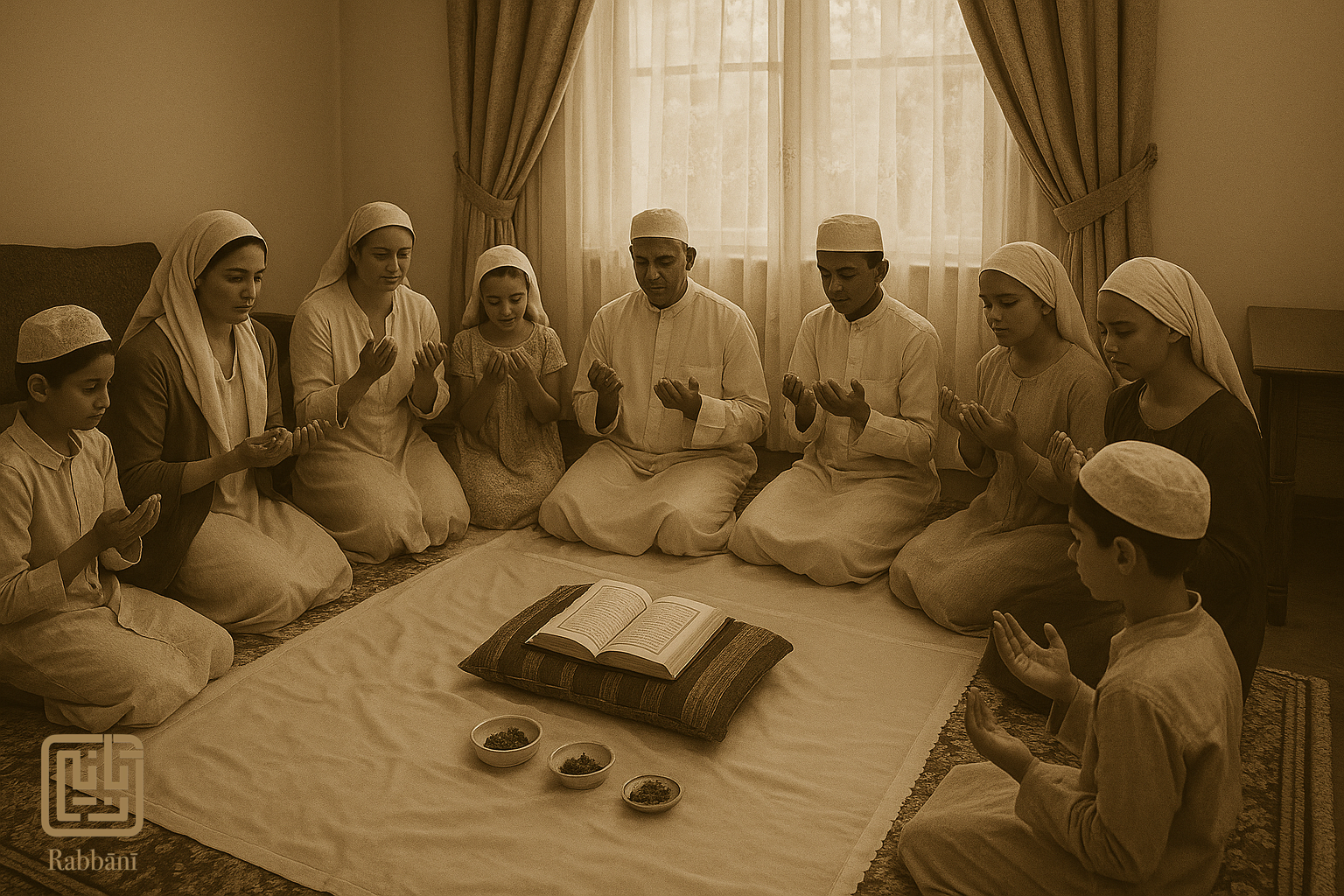
In South Africa, especially in the Cape, families often recite the Ratib al-Haddad after a loved one passes away, beginning from the first night and continuing for seven nights, then gathering on the fortieth day, the hundredth day, and each year on the anniversary of the passing. The Ratib is also recited at birthdays, during Mawlud celebrations, generally every Thursday night, sometimes Sunday mornings, a week before weddings, at engagements (known as lambary), and at naming ceremonies (doekmal or doopmal). This tradition anchors the community in remembrance and prayers for all occasions of joy, transition, and remembrance.
About Dhikr
The term dhikr refers to remembering, remembrance, or reciting and chanting the names of Allah, specific prayers, or Qur’anic verses. It is a rhythmic practice that roots the soul in the Divine, and is central to the Ratib al-Haddad tradition.
Individual or Group Practice
The Ratib al-Haddad can be recited alone or in a group, with equal blessing. Allah says in the Qur’an: “And men and women who remember Allah often — for (all of) them Allah has prepared forgiveness and a great reward” (Quran 33:35). The Prophet ﷺ said: “People will not sit in an assembly in which they remember Allah without the angels surrounding them, mercy covering them, and Allah mentioning them among those who are with Him.”
Foundations
The Ratib al-Haddad stands upon the firmest pillars of faith, a radiant string of pearls drawn from the Qur’an and Sunnah. It opens with the best Surah — Sūrat al-Fātiḥah, flows into the greatest verse — Āyat al-Kursī, affirms the Shahādah — the finest declaration of oneness, and continues with the enduring praises of al-Bāqiyāt al-Ṣāliḥāt. It includes the daily istighfār of the Prophet ﷺ, abundant ṣalawāt upon the Beloved ﷺ, and concludes with the dhikr by which Imām al-Bukhārī sealed his Ṣaḥīḥ.
Composed in sacred sequence by Imām ʿAbd Allāh ibn ʿAlawī al-Ḥaddād — a noble grandson of the Messenger ﷺ — this Ratib is not merely a litany, but a luminous map of remembrance. It is a symphony of Qur’anic light and Prophetic rhythm, preserved across centuries as a living trust.
And its resonance reached far beyond Ḥaḍramawt: both the Wird al-Laṭīf and the Ratib al-Ḥaddād were introduced and supported within the Harams of Makkah and Madinah under the patronage of Sultan Muḥammad IV of the Ottoman Empire (r. 1648–1687). This formal recognition affirms the Ratib’s deep-rooted legitimacy — not as invention, but as a distillation of the best of revelation, transmitted and treasured by the global Ummah.
Ijāzah: A Living Trust of the Ratib
For those who wish to benefit from the Ratib al-Haddad, we carry with us a sacred ijāzah — a scholarly and spiritual transmission — conveyed through four chains (asanīd) that reach back to the Composer of the Ratib, Imām ʿAbdullāh ibn ʿAlawī al-Ḥaddād**, may Allah sanctify his soul.
Shaykh Jamiel Abrahams writes:
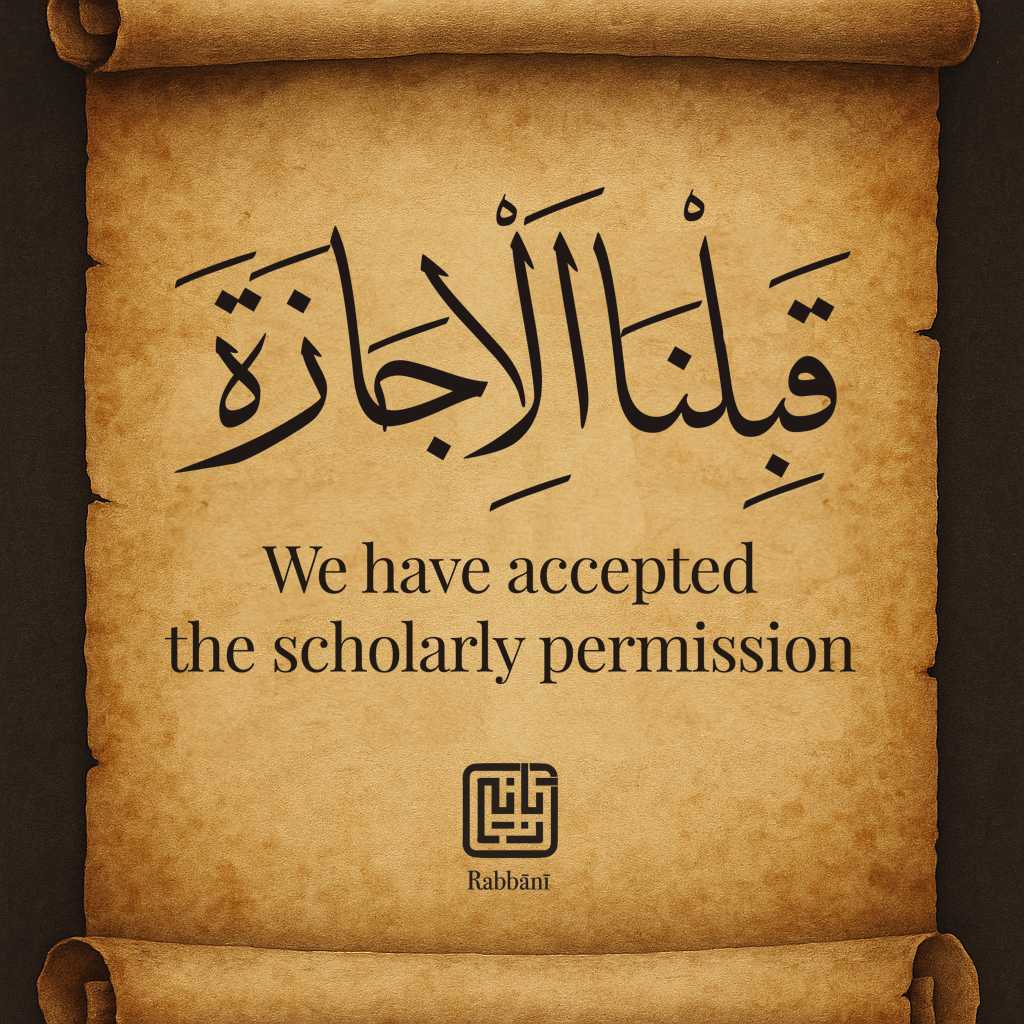
“Ijāzah for those who wish to benefit from the four asānid to the Composer of the Ratib… Say: Qabilnā al-Ijāzah — ‘We have accepted the scholarly permission to recite the Ratib of Imām al-Ḥaddād.’”
“We say Composer, not Author — for the adhkār are drawn from the finest pearls of the Qur’an and the most radiant lights of the Prophetic Sunnah.”
This ijāzah is not just scholarly — it is a living trust passed down through centuries of remembrance. To receive it is to stand in the river of continuity, with the awliyāʾ and scholars who preserved this path of dhikr through love, hardship, and sincerity.
And as for those who label such remembrance a bidʿah…
رَغِمَ أَنْفُ مَن صَرَّحَ بِأَنَّهَا بِدْعَةٌ “May the nose be rubbed in dust of the one who declares it an innovation.”
Let the river flow. Let the remembrance remain. And let every breath that utters His Name be a proof of mercy, not division.
My Personal Ijazah
This symphony carries my own transmission: an ijāzah granted by Zaid ibn Umar to me, Adli ibn Ibrahim, written in his own hand, linking me to the chain of Imam al-Haddad. That blessing lives within every note of this symphonic meditation, reminding me of the trust, humility, and sacred responsibility that this heritage confers. This ijazah is more than a note: it is a living chain, a breath carried from master to student across centuries, reaching back to Imam al-Haddad and forward into my heart. It binds me to the rhythm of this Ratib as if to a heartbeat, reminding me to hold it with care, reverence, and gratitude, so its protection and blessing might continue to resonate for future generations.
Historical Echoes
The Ratib was recited by enslaved Muslims at the Cape as a shield of hope and protection during times of oppression, helping them hold fast to faith. Generations later, it became a spiritual companion for many who resisted apartheid, its verses reminding them of divine justice, courage, and unity against all forms of tyranny. It is said that in the darkest nights of slavery at the Cape, the Ratib became a quiet liberation, whispered in hidden corners. Its rhythms reminded believers they were still seen by Allah, still dignified. During the anti-apartheid struggle, activists turned to these same verses, finding courage and calm as they faced injustice, with the Ratib a spiritual sword against oppression and despair.
Conclusion
From Yemen to the Cape, from ancient gatherings to modern hearts, the Ratib al-Haddad remains a living breath of resilience and unity. Its movements still guide communities to remember Allah, to stand together in hope, and to place trust in Divine mercy across the centuries. Like a living river, its currents still flow, nourishing communities with remembrance and calling them to a higher trust in Allah’s mercy. Imam al-Haddad, inspired by the symbolism of the Verse that Faces Outward, wove its spiritual meanings into the Ratib, transforming it into a shield that echoed both the Prophetic sanctuary and the everyday lives of worshippers from Yemen to the Cape.
May its verses guard every heart, and may its blessings gather our children and their children into the same ocean of divine love, until the final day.
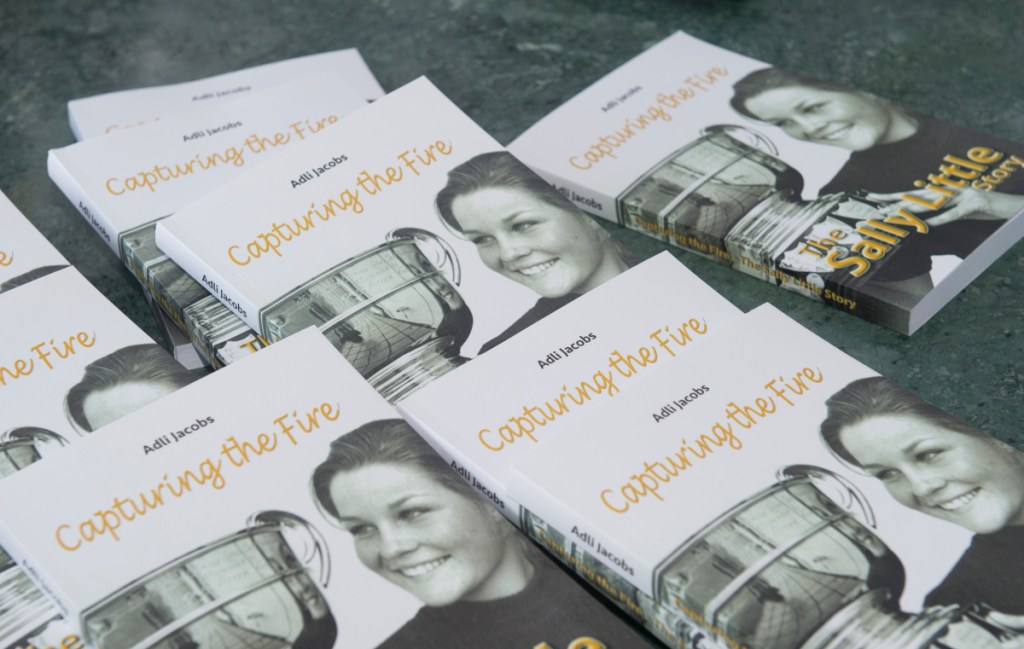
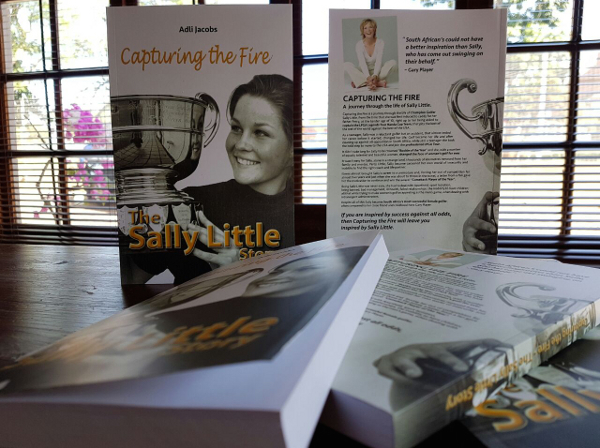
Adli Jacobs shares his insights on the process of writing Capturing the Fire and why setting the tone in storytelling is so important.
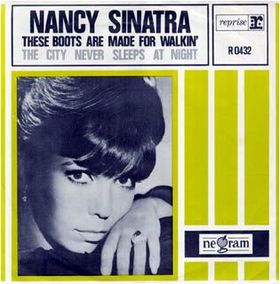
Copyright belongs to Reprise Records or the graphic artist(s).
Music is phenomenal. It is not just the universal communications that can cut across language barriers, the age gap or cultural differences. It sets the mood or the scene, draws out the emotions when you least expect it and can say things in ways that often defies explanation. But there is one more reason why it can be invaluable in a book.
When I was writing the first few chapters of Capturing the Fire, a song came to mind when I was writing about a part of Sally Little’s life when she was struggling with a violent fiancé. It was a major milestone for her and as she was explaining how she dealt with event, These Boots Are Made For Walkin’ started to play in my head.
I googled the song and lo and behold, it was released in the very year this event took place! Originally performed by Nancy Sinatra (Frank’s daughter) and written by Lee Hazlewood, the song was first heard on the radio in 1966. That’s a year after I was born. Since then, various cover versions were made by, amongst others, Geri Halliwell and Jessica Simpson.
I took the chorus lyrics and placed it as inspiration at the top of Chapter Three: Mr Wrong in the red MG. I read the chapter once more and realised that the lyrics just added an interesting dimension to the story; it transports the reader back to that time period and suggests the mood of Sally Little at the time.
Later, as the editing unfolded, the editor asked me why some chapters had a quote or lyrics of a song such as Nancy Sinatra’s and why the others did not. I said, “It was spur of the moment thing.” But when I thought about it, I realised that there are probably songs at every milestone to Sally’s life that can help set the time for that era. And of course, there are.
You can google any year and you will find lists of popular hits with few variations from country to country. These Boots, for example, became a hit song once more in 2005 not just in the US and the UK but also Germany, Switzerland, Belgium, The Netherlands, Austria, Ukraine and Greece. This, of course, speaks volumes about the monopolies in the international music industry.
So the book ended up having song lyrics at the beginning of every chapter where I could not find some other relevant quotation. The song did not only have to be relevant to the time, the lyrics also had to speak to the content of the chapter and perhaps add a layer of insight or perspective that I could not, as the writer, say overtly.
The irony of it all was that Sally is actually a classical music fan and there are not many lyrics for that genre or at least words that people will remember. She was once invited by her sister Janeen to join them at a U2 concert in the States. She was not much of a U2 fan (or pop music for that matter) and so when it began to rain, she wanted to go home.
But I stuck to the music references in the biography because music pervades our lives whether we like the song or genre or not. It’s on the radio, on TV, in adverts, in movies. Music is everywhere and becomes a reference point through all our dramas, our breakdowns, our joys and celebrations.
Now, when Sally’s story becomes a feature movie, they will know which music to source to set the scene for the different chapters of her life. So let me just place those lyrics firmly in your head…
These boots are made for walking, and that’s just what they’ll do
One of these days these boots are gonna walk all over you
The author reflects on the process of writing the biography of SA golf champion, Sally Little…
It’s finally here after a year’s hard work. The Sally Little book launched on 4 October 2016.
David Bowie was interviewed and asked about his creative process. He said that his best works came from those moments when his toes could not feel the bottom of the pool, when he was outside his comfort zone.
When the opportunity of doing a biography of Sally Little, world champion golfer, came along, that was exactly what I felt: I was in deep waters and yet it was strangely appealing.
Just from my initial research about this sportswoman, her meteoric rise, the many tournaments she had won and still going strong despite her age, I was already beginning to develop an analogy, an outline of what her story meant and what it could mean.
Once that happened, I knew that this was a story that I wanted to capture. Here was a image that I wanted to paint. In that moment, I realised that this story would force me to draw on my all my resourcefulness in a profound way.
One of those challenges for me as an anti-apartheid political activist from the 1980s, a product of the National Party forced removals from District Six to the Cape Flats, was whether I had the ability to have enough empathy, enough skill as a writer to capture the story of someone who broke the international sports boycott that helped bring down apartheid.
But it was also about whether I would be able to see Sally as more than just a sports celebrity. Would I be able to get her to tell me about herself, the side that fans may never see, without holding back? Would I be able to get her to trust me enough to share her story with the world?
I was embarking on a journey that had a clear destination; a published book of Sally Little’s biography. I was all packed and ready. What was not clear, however, was how this journey would unfold.
But I am a huge David Bowie fan, an activist from the 80s and I love swimming in deep waters…
View from Radisson Hotel breakfast area in Green Point
I did not know what to expect when Sally Little agreed to meet me at nine for coffee at the Radisson Hotel, in Green Point, Cape Town. The idea was that it was time to put a face to the email discussions. I had arrived early to make a good impression and took a seat on the veranda overlooking a calm Atlantic basking in placid Mother City weather. To remind me what she looked like just in case I greeted the wrong person, I opened my laptop to take one last look at her profile on The Sally Little Foundation website.
When I looked up from her picture, Sally had just entered the Radisson’s breakfast area. With a disarming smile she came directly to where I was sitting. “You must be Adli, it’s so nice to meet you,” she extended her hand to give me a confident handshake. With an equally friendly business partner, Kathy Gorchoff, Sally set about to make me feel so at ease that the next hour became the most fruitful meeting I had had in months.
As she recounted her years of living and working the United States, I was struck by not just the ease with which she told her stories, but also her own self-awareness. “Every time I won a tournament,” she confided, “I would keep keep the trophy in a bag, then hid it under the bed.” She did not want her mom to make a fuss about the achievement.
Here was no prima donna. This was not a stand-offish celebrity with guarded comments, wry smiles and tinted sunglasses. Perhaps the only trace she bore of the world champion golfer status was an unmistakable self-confidence that she integrated with an unusual openness and willingness to share candid insights. Drawing attention to a slight gait in her step as we concluded our meeting, she revealed that she was going to have an operation on her ankle but would be available on Skype. It seemed as if someone had clearly forgotten to inform Sally that she is regarded as one of the greats in a very prestigious game!


 Adli Yacubi