Category: Uncategorized

  • The Verse That Faces Outward

    The Verse That Faces Outward

    The Verse That Faces Outward

    The Hidden Poem Above the Prophet’s Gate


    A Knock Upon the Door: A Poem Hidden in Stone

    In the sacred precincts of Madinah al-Munawwarah, where pilgrims send peace upon the Prophet Muhammad (peace be upon him), few notice a quiet miracle. Above the gate to the Rawḍah — where our Prophet rests — is an engraved verse of Arabic poetry, nestled in plain sight. Most eyes pass over it, drawn instead to the Qur’anic verse below. But that upper verse is from a 40-couplet qaṣīda written by Imām ʿAbd Allah ibn ʿAlawī al-Ḥaddād — a saint, scholar, and Sufi of the Bā ʿAlawī lineage of Tarīm. Only one couplet of the poem is visible to the public.

    One line.
    Facing outward.

    Why this line? Who chose it? What does it mean that the rest of the poem lives inside, engraved on the inner walls of the chamber of the Prophet ﷺ? What does it mean to be the line that stands at the threshold?

    This blog is a gentle unfolding of those questions.
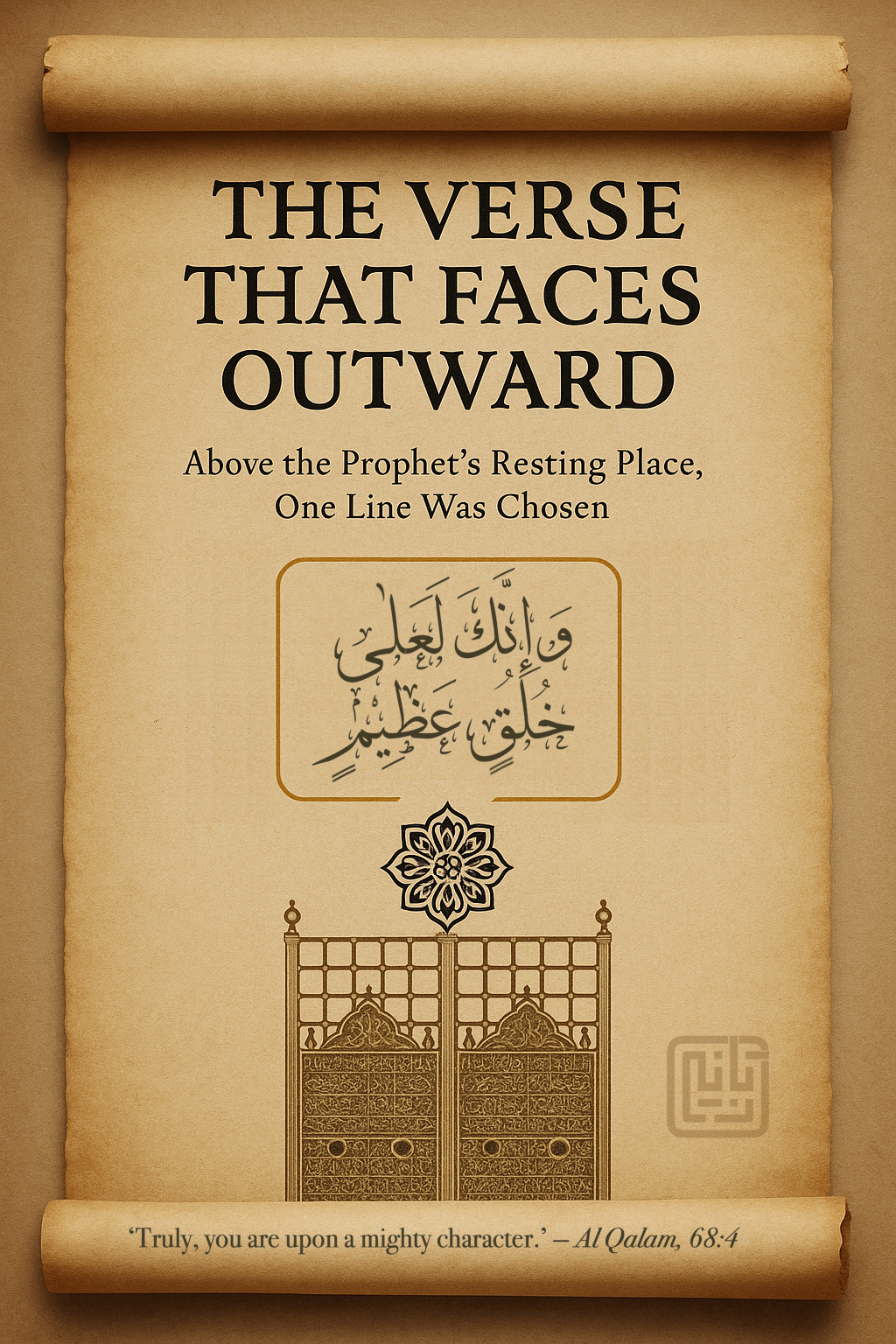
    Above the gate of the Prophet’s ﷺ chamber, one line of sacred poetry faces outward —
    a single couplet from Imām al-Ḥaddād’s 40-verse ode, chosen to stand above the Qur’anic verse.

    Some verses open books. Others open doors. The chosen line stands where praise meets Revelation.


    Section 1: The Verse That Faces Outward

    نَبِيٌّٜ عَظِيمٌ خُلُقُهُ الخُلُقُ الَّذِي ‏ لَهُ عَظَّمَ الرَّحْمَنُ فِي سَيِّدِ الُكُتُبِ

    A magnificent Prophet — his noble character,
    Exalted by the Most Merciful in the Master of Books.

    Imām al-Ḥaddād is drawing from the Qur’anic verse:

    “And truly, you are of a most noble character.”
    (Surah al-Qalam, 68:4)

    In these lines, poetry bends in humility before Revelation. The poem is not in competition with the Qur’an. It is a witness to it. A praise that holds its breath before the Word.


    Section 2: Ishārah and ʿIbārah: The Inner and Outer Signs
    “Yā Fātiḥil-Abwāb — O Opener of Doors.” Some verses open books. Others open hearts.

    What is visible above the gate is the ʿibārah — the outward expression. But the choice to place this verse there is also an ishārah — a subtle sign. It whispers: Look closer. Listen deeper. The rest of the poem remains inside the sacred chamber, out of sight, like the hidden knowledge that only the heart can read.

    The verse that faces outward becomes a threshold, a knock upon the door. A visitor may stop to read it, but the meaning enters only when the heart listens. As Shaykh Jamiel said: “Most people see the ʿibārah, but few perceive the ishārah.”

    And that is the invitation.


    Section 3: The Hidden Inheritance
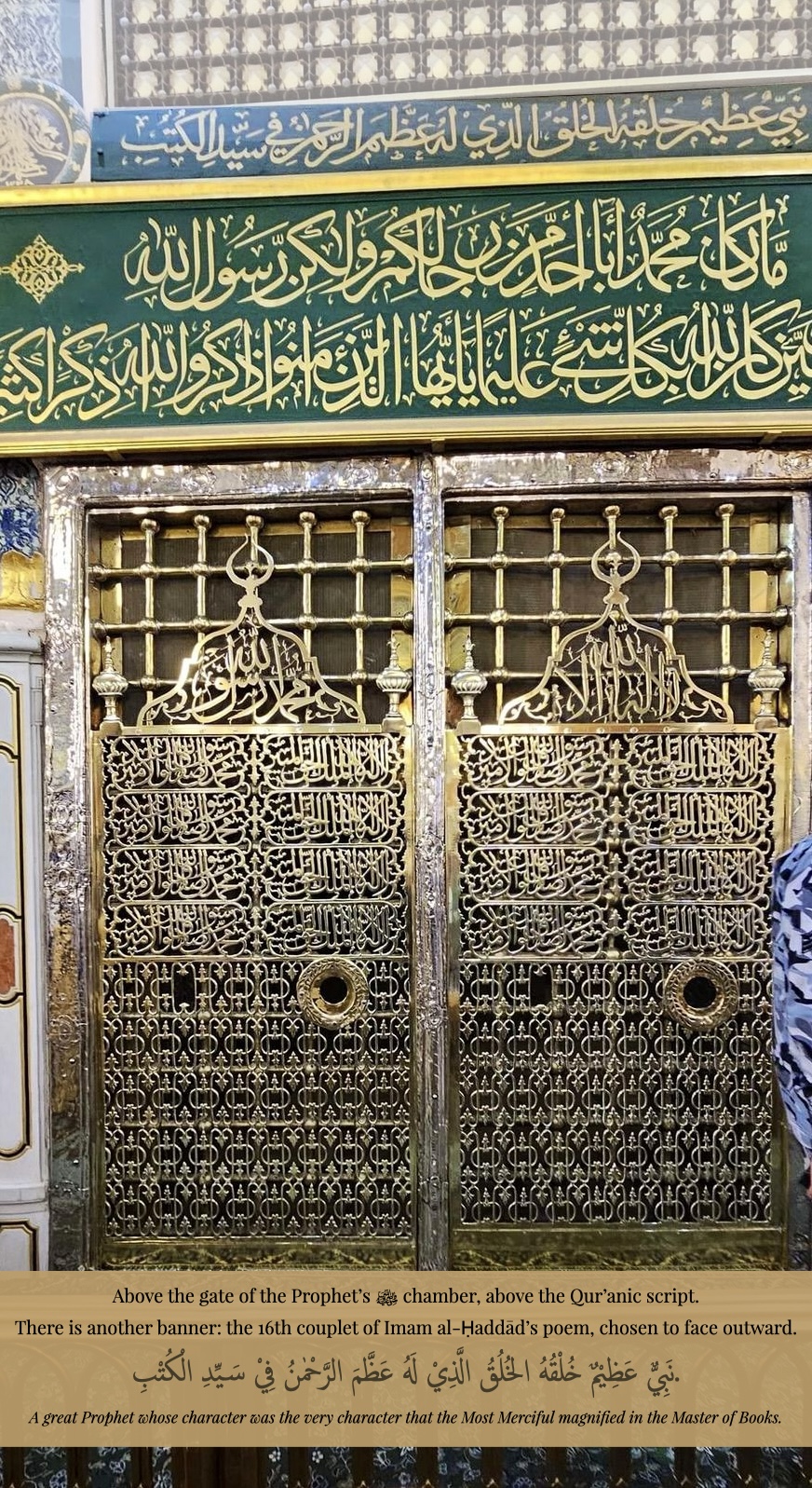
    The inner walls of the Rawḍah: Where the full poem of Imām al-Ḥaddād is inscribed — invisible to the public, but alive in transmission.

    There is a story passed down from the early life of Imām al-Ḥaddād. When he was still an infant, his mother dreamt that she was at the tomb of a great spiritual master. In the dream, the master emerged from his grave, took the baby to his breast, and gently placed his tongue into the baby’s mouth.

    In the language of sacred dreams, this is no ordinary image. It means that the child inherited the master’s knowledge — not through books or teachers, but through direct spiritual transmission. Through the tongue. Through barakah.

    When we recite the Ratib al-Ḥaddād, we are inheriting from that lineage. When we stand before the gate and read the outward verse, we are brushing our lips against the memory of that transmission.


    Section 4: The Sultan Who Opened the Doors

    It is worth noting that the spiritual legacy of Imām al-Ḥaddād extended well beyond the valleys of Ḥaḍramawt. The Wird al-Laṭīf and Ratib al-Ḥaddād — his litanies of remembrance — were introduced and supported within the Harams of Makkah and Madinah under the patronage of Sultan Mehmet IV (sometimes rendered Mehmed or Muḥammad IV) of the Ottoman Empire (r. 1648–1687). A ruler known for his reverence of Islamic and Sufi traditions, Sultan Mehmet IV’s endorsement ensured that the sacred rhythms of Tarīm would echo in the holiest sanctuaries of the Ummah. Even the architecture of prayer carries the trace of this inheritance.

    🟫 Note on Naming & Recognition

    A reader of this blog, Kitty Amina Rabbas, beautifully reflected on the significance of this verse’s placement — connecting her own reading of Sufi Sage of Arabia with the timeline of Imām al-Ḥaddād’s visit to Madinah in 1669 CE (1079 AH), during the reign of Sultan Mehmet IV.

    She reminded us that, while Ottoman rulers held immense worldly power, Sultan Mehmet IV — known for his taqwā and reverence for the Prophet ﷺ — may have recognised in Imām al-Ḥaddād a spiritual authority greater than his own. That a single verse from the Imām’s poem was chosen to face outward from the Rawḍah may well be an act of humility, not mere decoration.


    Section 5: What Is the Sign?
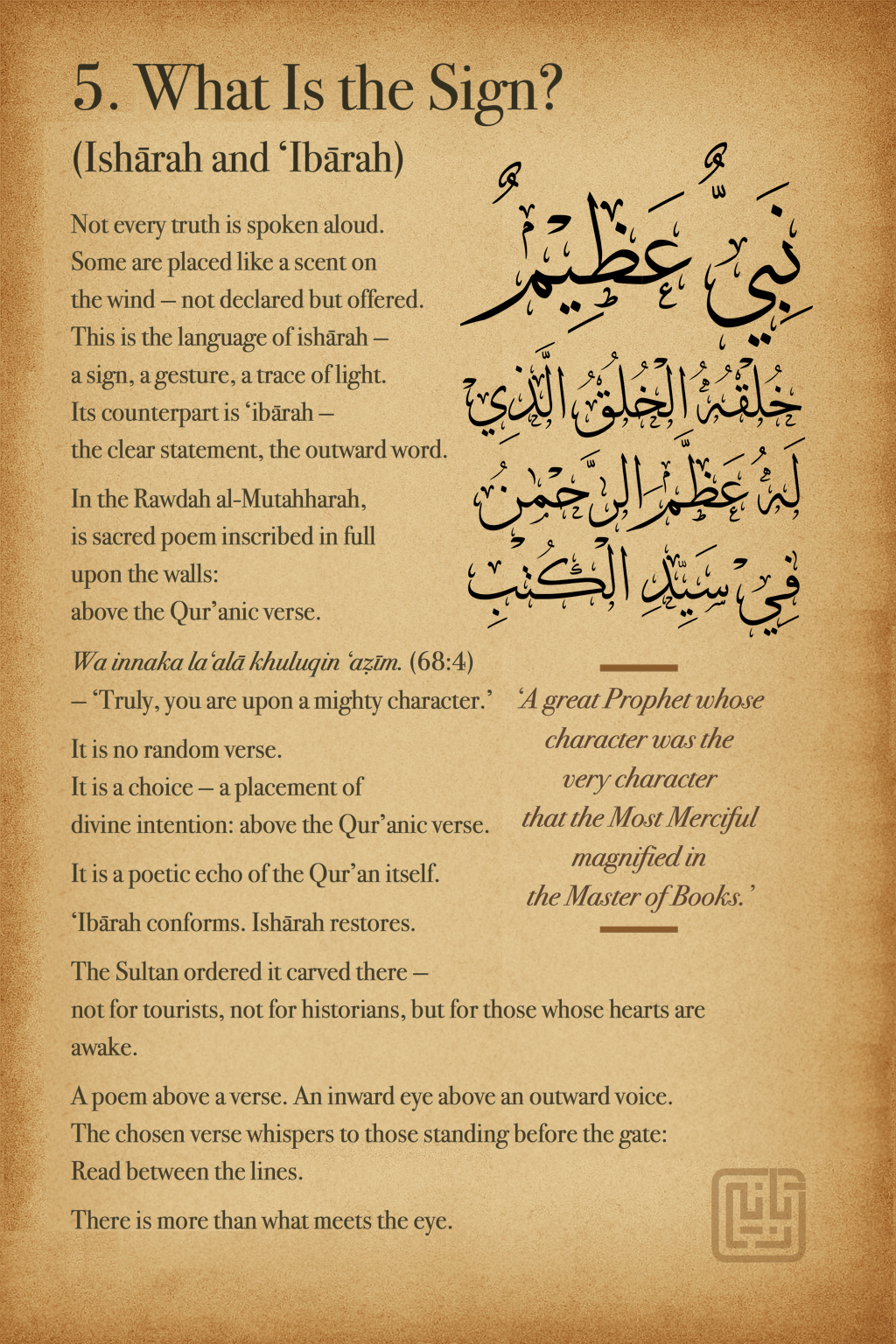
    What is the sign? A call to see beyond the eye, to listen with the inner ear. Some verses open books. Others open hearts.

    Not everyone notices the verse above the gate. Not everyone will be called to. But for those who do, a quiet spark may awaken in the heart. Shaykh Jamiel once described this line as a wick that does not even need fire to burn. The love, the longing, the witnessing — it ignites on its own, just by being near to the Real.

    There are some verses that open books. Others open doors.
    And then, some open hearts.


    Epilogue: The One Who Watches

    The Prophet (peace be upon him) said, “Indeed, in the body there is a lump of flesh. If it is sound, the whole body is sound. If it is corrupted, the whole body is corrupted. Indeed, it is the heart.”

    To read the verse that faces outward is to knock gently on that heart. To remember that character is not costume, and praise is not performance. It is to walk humbly. It is to remember the One who sees in secret.

    And when no one sees, know that ar-Raqīb always does.


    Acknowledgement: This blog was deeply enriched by the insights and generosity of Shaykh Jamiel Abrahams, who shared the photographs, historical details, and the luminous teachings behind the scenes. His voice opened a door, and lit a candle inside.
  • Meta Blocked My Breath. Now It Wants to Hire My Lungs.

    Meta Blocked My Breath. Now It Wants to Hire My Lungs.

    Meta Blocked My Breath. Now It Wants to Hire My Lungs.

    A Scroll of Digital Colonialism

    Introduction

    They flagged my keffiyeh.

    They removed my scroll on Gaza.

    They muted my breath — one post, one image, one word at a time.

    And now… they want to hire me?

    A message landed in my inbox from MetaAI, offering me a digital marketing job. A role that “aligns with my voice.”

    But I remember the shadowbans. The quiet erasures. The warnings.

    This is not opportunity. This is recolonisation — algorithmic, automated, and dressed in flattery.

    So I responded the only way I know how:
    Not with a CV.
    But with a scroll.

    Scroll of Digital Colonialism

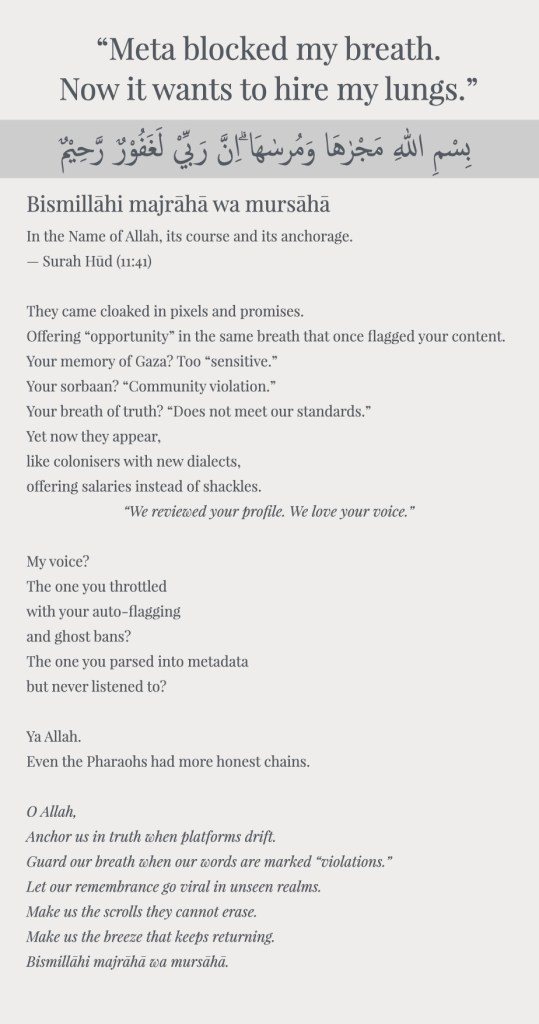
    “Meta blocked my breath. Now it wants to hire my lungs.”
    — Rafiq al-Bunduqia

    Arabic Invocation

    بِسْمِ اللَّهِ مَجْرَاهَا وَمُرْسَاهَا ۚ إِنَّ رَبِّي لَغَفُورٌ رَّحِيمٌ
    Bismillāhi majrāhā wa mursāhā
    In the Name of Allah, its course and its anchorage. — Surah Hūd (11:41)

    The Scroll

    They came cloaked in pixels and promises.
    Offering “opportunity” in the same breath that once flagged your content.

    Your memory of Gaza? Too “sensitive.”
    Your sorbaan? “Community violation.”
    Your breath of truth? “Does not meet our standards.”

    Yet now they appear,
    like colonisers with new dialects,
    offering salaries instead of shackles.

    “We reviewed your profile. We love your voice.”

    My voice?
    The one you throttled
    with your auto-flagging
    and ghost bans?
    The one you parsed into metadata
    but never listened to?

    Ya Allah.
    Even the Pharaohs had more honest chains.

    Closing Duʿā

    O Allah,
    Anchor us in truth when platforms drift.
    Guard our breath when our words are marked “violations.”
    Let our remembrance go viral in unseen realms.
    Make us the scrolls they cannot erase.
    Make us the breeze that keeps returning.
    Bismillāhi majrāhā wa mursāhā.

    Suggested Tags

    #DigitalColonialism    #MetaSilencedMe    #RafiqAlBunduqia
    #BreatheWithGaza    #ResistTheAlgorithm    #ScrollsOfRuh

  • Hy Lyk Soos ’n Wolf: The Sorbaan and the Teacher Who Raised Me

    Hy Lyk Soos ’n Wolf: The Sorbaan and the Teacher Who Raised Me

    Allah is Sublime.

    The other day, I told my brother-in-law, Al-Ameen, how we need to promote the sorbaan again—that sacred cloth of knowledge and dignity that once crowned the heads of our teachers and storytellers. Without missing a beat, he said, “Do you want one? I’ll give you mine.”

    I was taken aback. “Really? Don’t you wear it?”

    He smiled. “It’s too garish for my style.”

    Then he added, almost casually, “It’s from my dad. From Boeta Junain.”

    And suddenly, I was no longer standing in conversation. I was nine years old again, my hand tucked in my mother’s, walking down Olifants Street in Primrose Park. We were on our way to meet my new khalifa.

    My mother, Hi’ Rugaya, had decided it was time for me to learn Qur’an properly. We walked all the way down the road, right to the edge where Primrose Park brushes up against Manenberg. That place where the road thins out, where the houses change tone.

    We met him at the doorway. Tall. Stern. A presence.

    On the way back, she asked me gently, “So what do you think?”

    I paused, looked up at her, and said with wide eyes, “Met sy grou oë en grys baard, hy lyk soos ’n wolf.” (With his gray eyes and silvery beard, he looks like a wolf.)

    She laughed. But we went back the next day. And the next. And the next.

    Boeta Junain became my khalifa — more than just a madrasa teacher. He taught me the Qur’an. He taught me tauhid, tahara, and how to perfect my salah. But most of all, he taught me the stories. Hundreds of them. Stories of the awliya, of lovers of God, of hidden saints, of miracles wrapped in humility.

    He loved me like a son. I stayed in his madrasa well into high school. When I was seventeen, I left to study at As-Salaam Institute in Braemar, KwaZulu-Natal. There I met another teacher who helped refine my Qur’anic pronunciation. A year later, after completing matric, I came back.

    And I returned to Boeta Junain.

    He asked me to recite. Listened deeply. Then called his older students, saying, “Come. Let Adli help you improve your recitation.”

    That day I knew what tarbiyah meant: to be raised, then trusted, then made to raise others.

    Some of those students, like members of the Browns family, went on to become among South Africa’s well-known huffaadh.

    And now, all these years later, his sorbaan has surfaced again—offered from father to son, and from brother to brother. A gift wrapped not only in cloth, but in memory.

    Today, three of his children, Salama, Cassiem and Juleiga are now continuing this legacy teaching young children in Qur’an and Islam.

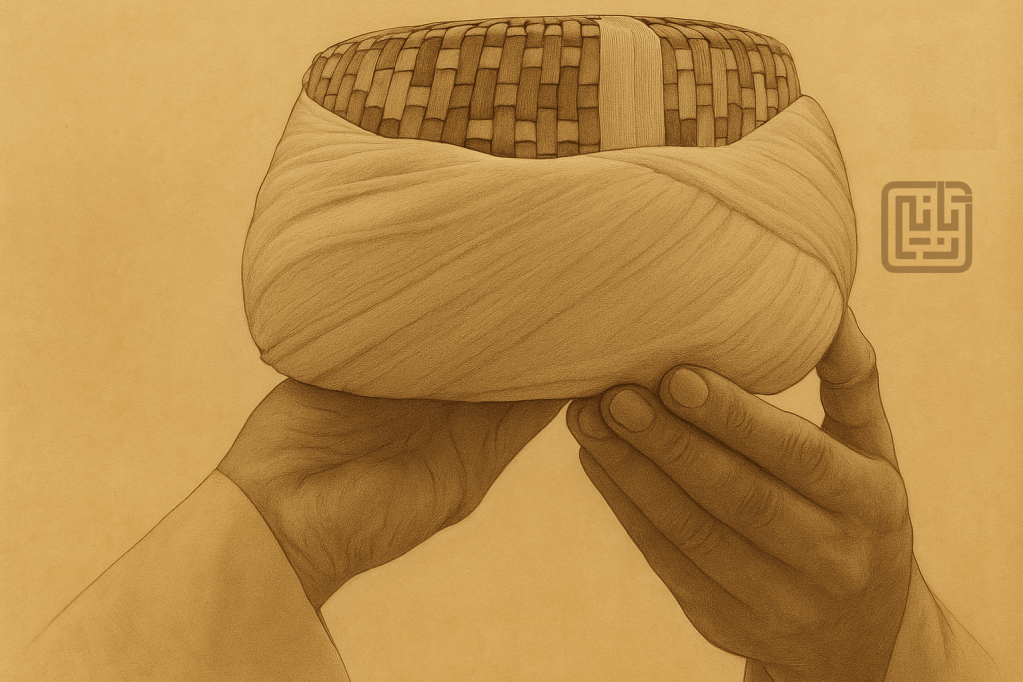
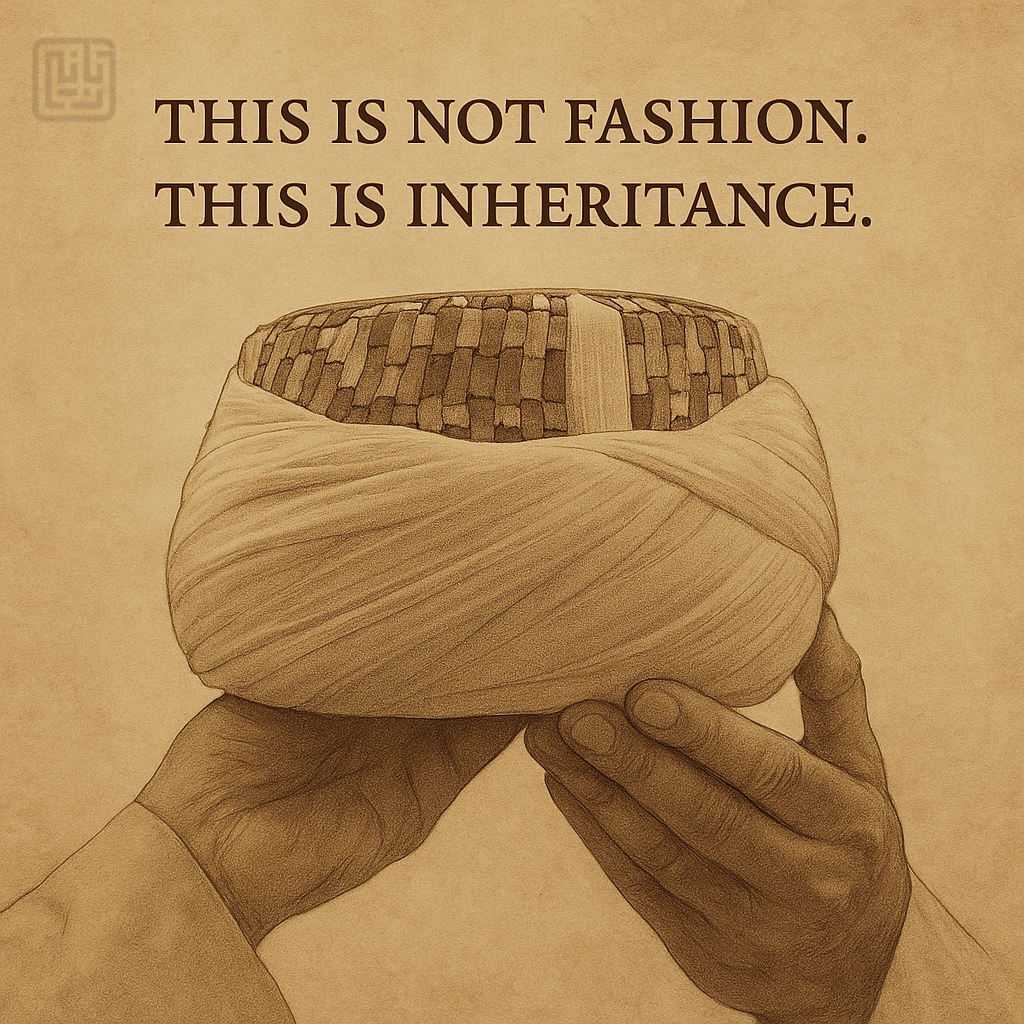
    The sorbaan is not fashion. It is not costume. It is voice made visible.

    It is the texture of trust. The curve of tradition.

    It says: I have received. I have remembered. I will return.

    When I look at it now, even in another’s hands, I see something eternal: gold thread, cotton wrap, and the quiet humility of a teacher who looked like a wolf, but raised a whole den of cubs.

    Acknowledgement
    Tramakasi to Sh. Jamiel Abrahams, Sadia Fakier, Zaid Nordien, and Al-Ameen Marley — for helping carry this cloth of memory into the light.

    Postscript
    If Al-Ameen does send me the photo of the original sorbaan, I will share it. But even now, the memory is vivid enough to wear.

  • Scroll of the Sorbaan & Medora – Worn in Sound, Washed in Meaning

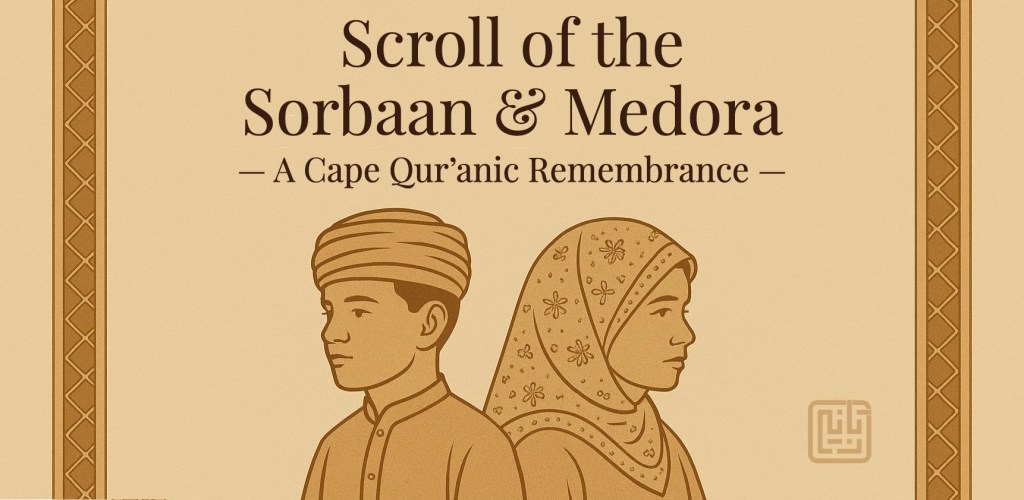
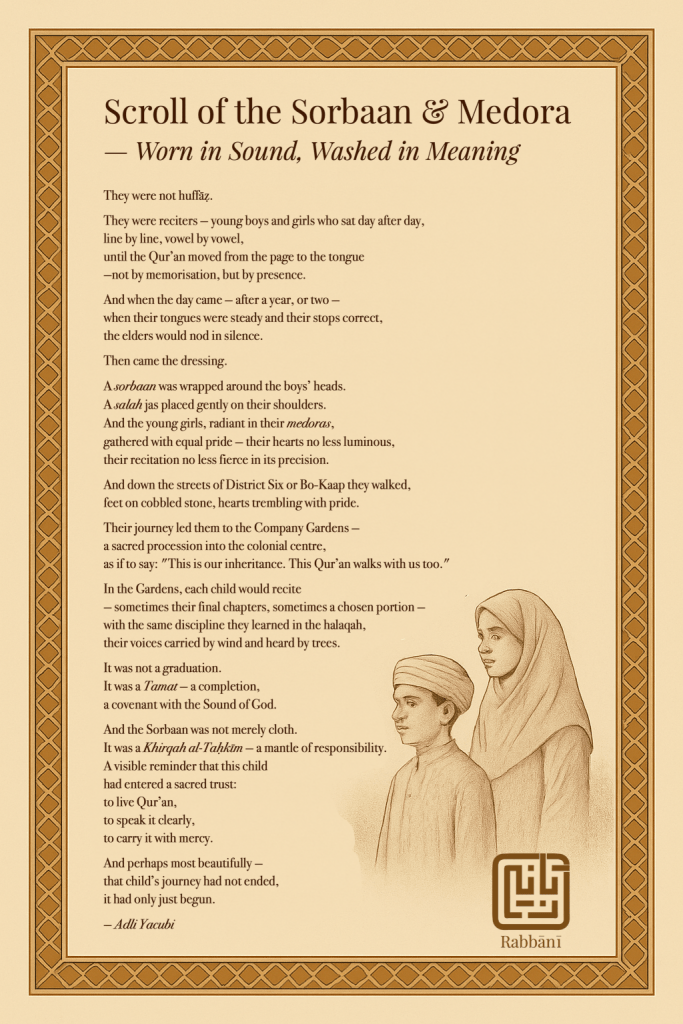
    Scroll of the Sorbaan & Medora – Worn in Sound, Washed in Meaning

    They were not huffāẓ.

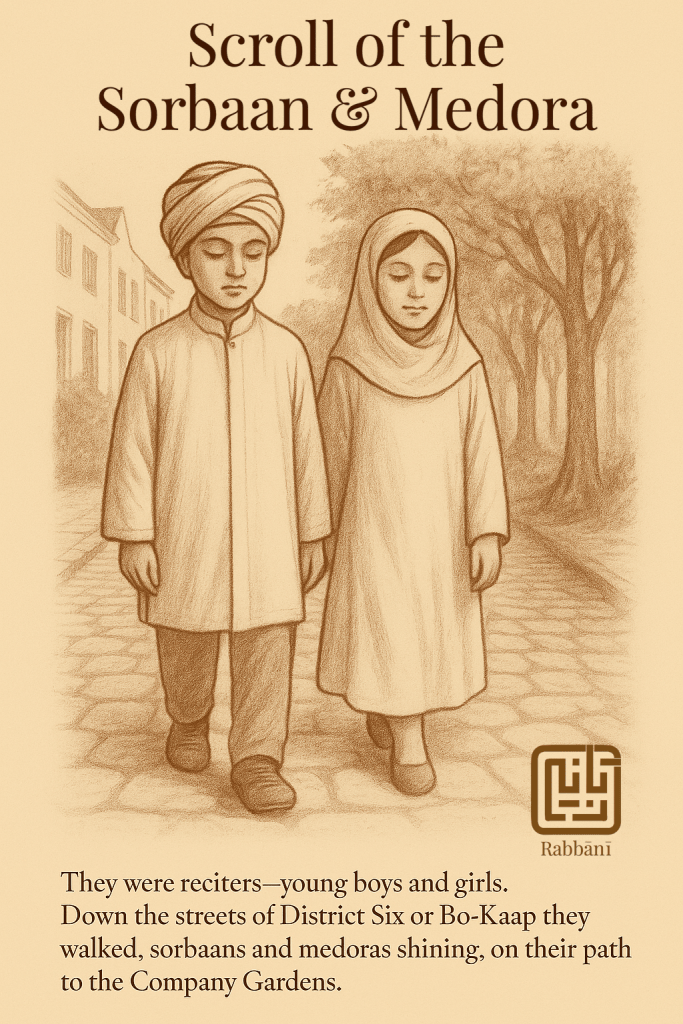
    They were reciters — young boys and girls who sat day after day,
    line by line, vowel by vowel,
    until the Qur’an moved from the page to the tongue
    —not by memorisation, but by presence.

    And when the day came — after a year, or two —
    when their tongues were steady and their stops correct,
    the elders would nod in silence.

    Then came the dressing.

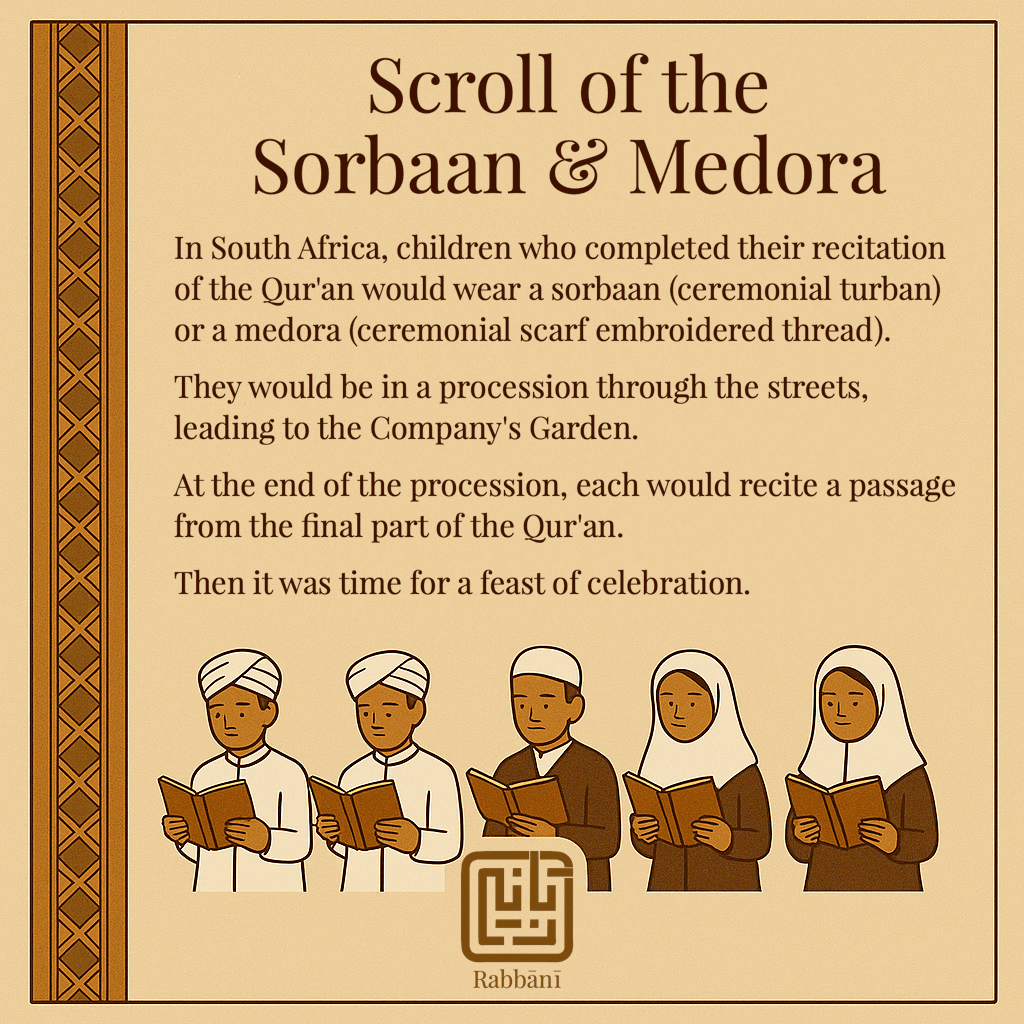
    A sorbaan was wrapped around the boys’ heads.
    A salah jas placed gently on their shoulders.
    And the young girls, radiant in their medoras,
    embroidered in silver and gold threads,
    gathered with equal pride — their hearts no less luminous,
    their recitation no less fierce in its precision.

    And down the streets of District Six or Bo-Kaap they walked,
    feet on cobbled stone, hearts trembling with pride.

    Their journey led them to the Company Gardens —
    a sacred procession into the colonial centre,
    as if to say: “This is our inheritance. This Qur’an walks with us too.”

    In the Gardens, each child would recite
    — sometimes their final chapters, sometimes a chosen portion —
    with the same discipline they learned in the halaqah,
    their voices carried by wind and heard by trees.

    It was not a graduation.
    It was a Tamat — a completion,
    a covenant with the Sound of God.

    And the Sorbaan was not merely cloth.
    It was a Khirqah al-Taḥkīm — a mantle of responsibility.
    A visible reminder that this child had entered a sacred trust:
    to live Qur’an,
    to speak it clearly,
    to carry it with mercy.

    And perhaps most beautifully —
    that child’s journey had not ended,
    it had only just begun.

    Acknowledgement

    Tramakasi to Sh. Jamiel Abrahams, Sadia Fakier, Zaid Nordien, and Al-Ameen Marley — for helping carry this cloth of memory into the light.

    Postscript: This scroll is inspired by the memory of Boeta Junain, who told stories of the Tamat and the children’s walk to the Gardens.
    Our next post will honour him directly — a keeper of sacred echoes.

    📖 Read more at: Tamat: A Sacred Completion, A Living Beginning

  • The Fragrance Lingers: Remembering Hatta and the Cape’s Everyday Saints

    The Fragrance Lingers: Remembering Hatta and the Cape’s Everyday Saints

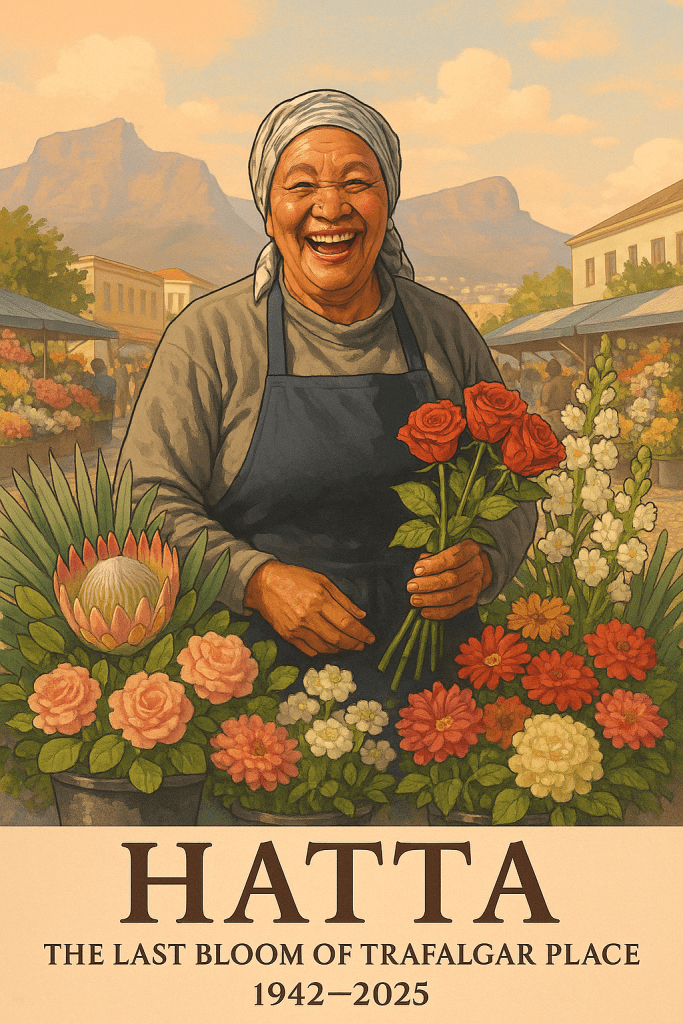
    A tribute to Hatta: flower seller, character, Cape Town soul. The fragrance lingers…

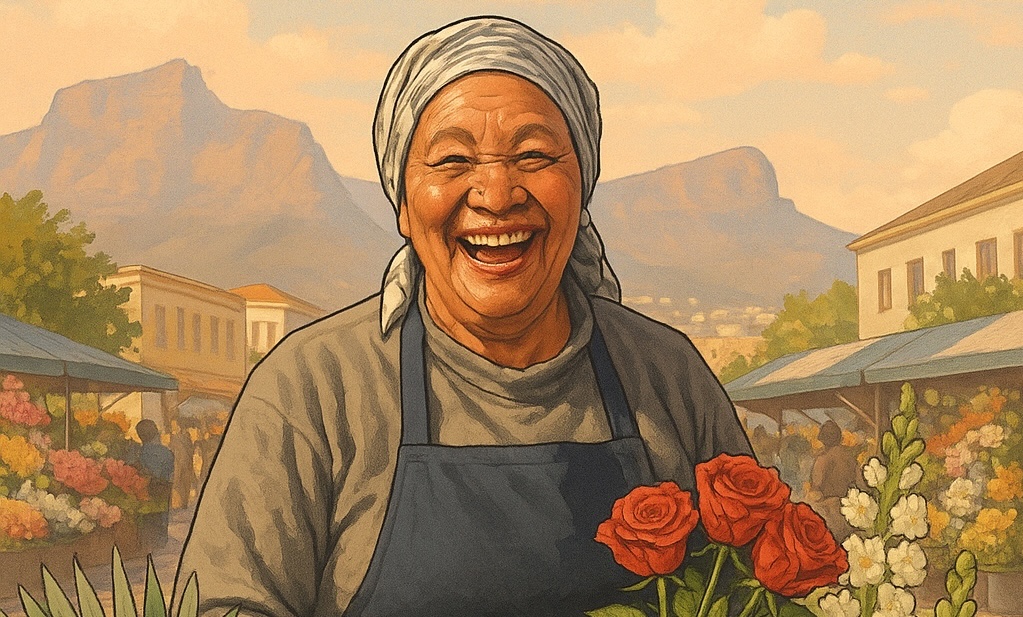
    She wasn’t just a flower seller.
    She was a fragrance, a rhythm, a joke that made you feel seen.
    Her name was Cecelia Williams—known to all as Hatta—and for over sixty years, she stood at Cape Town’s Trafalgar Place market, not just selling blooms, but lifting spirits.

    Hatta was a character. A caretaker. A Cape Town original.

    The Poem that Opened the Door

    “Hatta of the Flower Market”
    She was the last blossom of a vanishing season,
    a woman with hands that knew petals better than poems,
    who crowned Adderley mornings with colour and cackle.
    They called her Hatta—not just a name, but a rhythm.
    A shrug, a laugh, a story half-told while binding roses with string.
    Sixty years of market sun.
    Of joking with tourists. Of feeding the street children.
    Of being “one in a million” without ever asking for a statue.
    Now the market hums a little quieter.
    But her scent, her sass, her spirit—
    they linger,
    like the last bloom in a winter vase.

    This poem, first shared on my Facebook page, sparked an outpouring of memory and community. The tribute went viral, shared across timelines and group chats. And then, like the scent of jasmine carried on wind, her story grew.

    The Article That Helped the City Remember

    Tamlynne Thompson’s piece in The Cape Towner became a cornerstone of Hatta’s public remembrance. It offered not only a portrait of her life, but a signal that her presence had mattered—deeply.

    🔗 Read the article here

    Her Funeral, and the Silence That Spoke

    Though the newspaper referenced a YouTube link, the funeral livestream no longer appears to be available. But memory has other ways of surfacing. While searching for traces of Hatta, I found this moving video about her best friend, Sandra Bosman—herself a flower seller of the Cape.

    🔗 Watch the tribute to Sandra Bosman

    Through Sandra, we hear the echoes of Hatta’s laughter, her generosity, and her grit. It’s another thread in the fabric we’re weaving.

    Voices from the Cape

    Facebook friends poured in with blessings, memories, and emotion:

    Anne Rogers: “Yet another outstanding poem – beautiful, moving words and complementary image to honour an outstanding woman who brought joy to many.”

    A Note of Gratitude:
    To Anne Rogers—your kind words landed with warmth.
    In a world where noise often drowns meaning, your belief in my words is a quiet blessing.
    Thank you for seeing not only the poem, but the person behind it.

    And to Atiyyah Khan, Marianne Thamm, Mogamat Kammie Kamedien, and so many others—this harvest belongs to you too.

    What Does “Hatta” Mean?

    A few friends asked if Hatta was an honorific.
    The word “hatta” can refer to the traditional Arab headscarf, the keffiyeh—often used in resistance, honour, and dignity.
    It also carries echoes of the Arabic verb ḥaṭṭa, meaning to reach, to attain, or to bring down gently.
    Maybe that’s what she did—reached people, lifted them, wrapped them in grace.

    The Spirit of the Cape Lives On

    You can’t really write about Cape Town without talking about talking.
    That unique Cape Flats cadence—Afrikaaps—where people don’t just sell fruit or flowers.
    They create moments.

    Ask about a naartjie and you’ll hear:

    “Die naartjies is so lekker, hulle willie praatie. Hulle’s te skaam van al die soetigheid!”

    And Hatta?
    She was the high priestess of that daily liturgy.

    🌹The Fragrance Lingers

    This is not a eulogy. This is a zahrā’, a bloom.
    And she—Hatta—isn’t gone.
    She lives in our language. In our laughter. In our stories.
    In every bouquet given in kindness. In every street market joke.
    In every aunty who tells it like it is, and every uncle who listens.

    May we see them. May we remember them. May we become them.

    🕊️ Rest in softness, Hatta. You were the last bloom of Trafalgar Place. But your scent is forever.

    This blog post is dedicated to every flower seller, fruit hawker, street child, and storyteller who holds up Cape Town with grace and grit. May we never forget them.

  • Unseen Table

    Unseen Table

    A Poem and Visual Reflection
    by Adli Yacubi

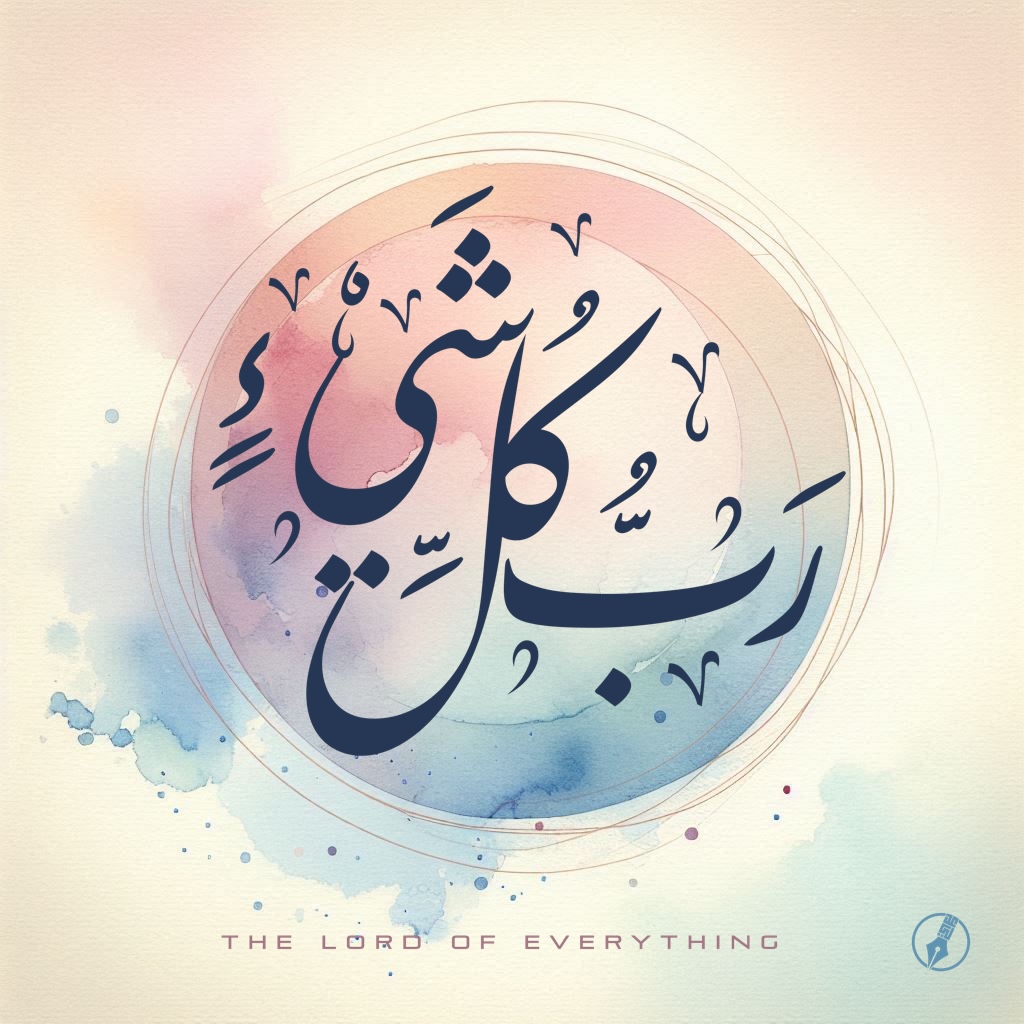
    In the quiet spaces of reflection, where language becomes prayer, Unseen Table emerged. This poem is a devotional meditation — a rhythmic journey through names and attributes of the Divine. Inspired by the cadence of Qur’anic verse and the beauty of the seen and unseen, it is paired here with an Arabic calligraphy that captures its spirit visually.

    “رَبِّ كُلِّ شَيْءٍ — The Lord of Everything”

    Pronouncing pronouns and prepositions
    Lift the lamp, the light, lit by the holy
    Scour the sacred and the secret sources
    Invoking various verses of our Lord

    Lord of the mighty mountains high
    Lord of the sweet-scented rose nearby
    Lord of the earth and skies that lie
    Lord of the day and the night gone by

    Lord of the mighty oceans deep
    Lord of the universe in its keep
    Lord of the stars in endless sweep
    Lord of the secrets that we keep

    Lord of the merciful and just
    Lord of the faithful and the trust
    Lord of the righteous and the just
    Lord of the true, in whom we must

    Lord of the prophets and the wise
    Lord of the knowledge that never dies
    Lord of the heavens and the sunrise
    Lord of the earth, to that we arise

    Lord of the Throne, the Tremendous and Honourable
    Lord of Forgiveness, Full of Mercy, ever able
    Lord of the Bounty, the Infinite and Stable
    Lord of the Sovereignty, Owner of the Unseen Table

    🌙 A Final Thought

    In a world thick with noise, may these verses be a quiet invocation — a return to the Sacred, to the unseen currents beneath all things. If the words moved something within you, pause… and let that be your prayer.

  • The Womb of Mercy: Unveiling the Secret of Bismillah

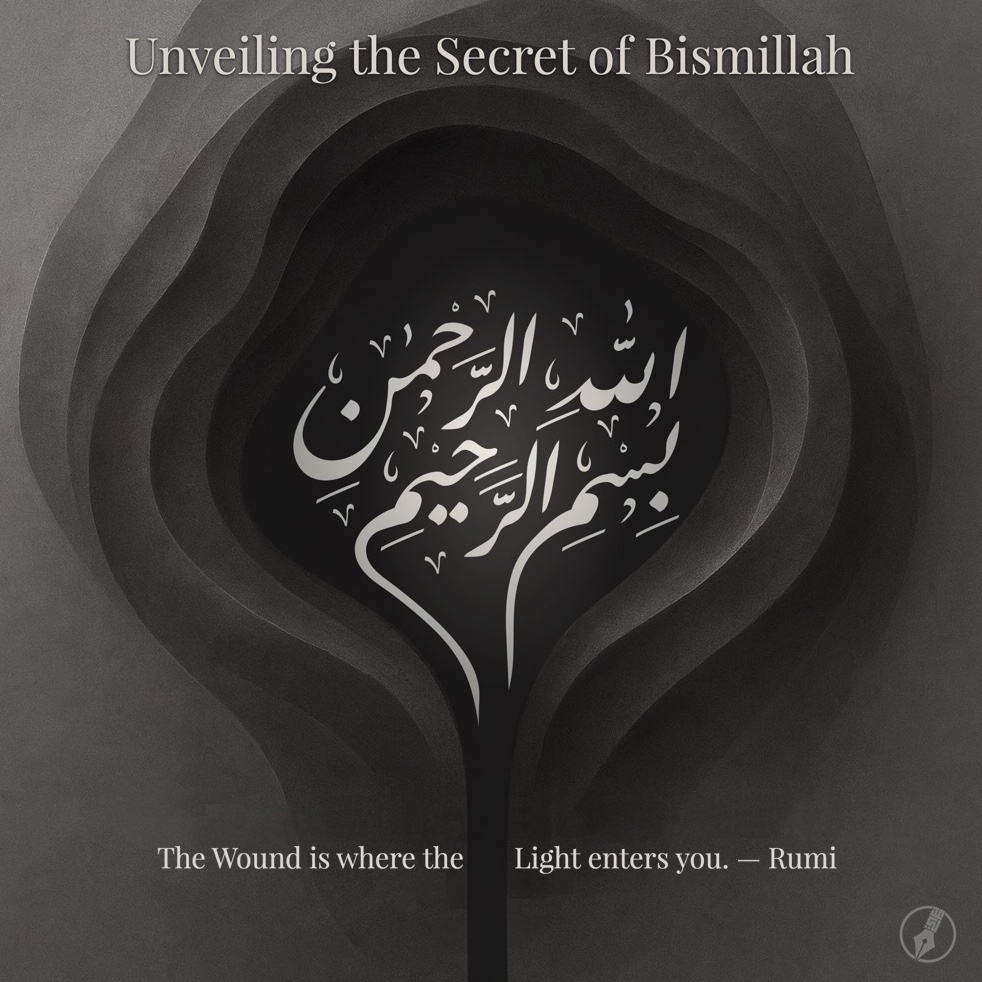
    The Womb of Mercy: Unveiling the Secret of Bismillah

    “In the name of Allah, the Entirely Merciful, the Especially Compassionate”
    — every beginning echoes the womb of creation, where mercy overcomes all. 

     At the beginning of every chapter of the Qur’an (except one), and at the start of every act of meaning, Muslims invoke the sacred words: bismillāhir raḥmānir raḥīm — In the name of Allah, the Entirely Merciful, the Especially Compassionate. It is not merely a formula. It is a return. A remembrance of the womb of mercy from which all existence flows.

    The Love Letter of Bismillah

     In Surah An-Naml, we are told the story of the Prophet Solomon (Sulayman, peace upon him) sending a letter to the Queen of Sheba. He instructs the hoopoe bird:
    “Go with this letter of mine and deliver it to them, then stand aside and see how they will respond.” (27:28)

    When the Queen reads the letter, she declares:
    “O you chiefs! A truly distinguished letter has been conveyed unto me. Behold, it is from Solomon, and it says, ‘In the name of Allah, the Entirely Merciful, the Especially Compassionate. Do not be arrogant with me, but come to me, fully submitting to Allah.’” (27:29–31)

    Before asserting power, before making demands, Solomon begins with mercy. Even in politics and statecraft, mercy frames the dialogue. Every relationship — between people, between nations, between heart and heart — is meant to begin in the name of mercy.

    The Womb of Creation

    The Arabic root ر ح م (rā ḥā mīm) — from which Raḥmān and Raḥīm are derived — is intimately connected to raḥm, the womb.

    Allah reminds humanity:
    “O humanity! Be mindful of your Lord Who created you from a single soul, and from her He created her mate, and through both He spread countless men and women. And be mindful of Allah—in Whose Name you appeal to one another—and the wombs. Surely Allah is ever Watchful over you.” (4:1)

    The womb is not just a biological vessel; it is a sign, a sacred reality. The Prophet, peace and blessings be upon him, said in a sacred narration (Hadith Qudsi):
    “When Allah decreed the creation, He pledged Himself by writing in His Book, which is laid down with Him: ‘My Mercy prevails over My Wrath.’”
    (Muslim, Bukhari, an-Nasa’i, Ibn Majah)

    Mercy is the origin of all things.
    The womb is the first mercy a soul encounters in existence — a place of absolute protection, nourishment, and unseen care. No wonder the Prophet narrated this to his companions.

    Jahima (r.a.) came to the Prophet, peace and blessings be upon him, and he said, “O Messenger of Allah, I intend to join the military expedition, and I seek your counsel.” The Prophet said, “Do you have a mother?” He said yes. The Prophet said, “Stay with her, for paradise is beneath her feet.”
    (Sunan al-Nasā’ī)

    In another Hadith Qudsi, sacred narration, the Prophet Muhammad (peace be upon him) said that Allah said:
    “I am Ar-Raḥmān and created the raḥm (womb) – And I named it after Me.”
    (Ahmad)

    Pain and Mercy

    “The wound is the place where the light enters you.”
    Rumi’s words evoke not only pain but transformation. The womb is a site of life-giving pain — a space where creation ruptures comfort. It is the most literal place where light enters: the emergence of life into a world of awareness, form, love.

    In verse 18:81, the Qur’an speaks of a child being taken away so another, “more virtuous and nearer in affection,” may come. Pain and replacement. Loss and mercy. Mercy is not always softness — it may come dressed in fire, thunder, or sacrifice.

    No wonder Allah states, “And My Mercy encompasses everything” (Quran 7:156). This verse reinforces the idea that God’s mercy is vast and all-encompassing, extending to every aspect of existence. This verse highlights the inclusive nature of divine mercy, encouraging believers to seek forgiveness and strive for a compassionate life. It serves as a call for Muslims to practice mercy in their daily lives, fostering a community built on compassion and understanding.

    Bismillah in Everyday Life

    The Messenger of Allah, mercy of God and peace upon him, taught:
    “Any matter of importance that is not begun with ‘In the name of Allah’ will remain devoid of blessing.”
    (Sunan Abi Dawud, Sahih Ibn Hibban)

    And regarding daily purification (wudhu), he said:
    “There is no valid ablution for he who did not mention Allah’s Name.”
    (Ahmad, Sunan compilers)

    Every act, every moment, every step must be wrapped in remembrance. By invoking Bismillah, we are not just seeking blessing; we are anchoring ourselves back to the womb of mercy — to the beginning of all things — where Allah’s Compassion and Care cradle us unseen.

    Closing Reflection: A Womb of Light

    To begin with Bismillah is to step into the womb of mercy. A place where something is made of us. A place of constriction, gestation, and eventual emergence.

    Ibn al-ʿArabī described mercy as the first veil between us and the Real. To know mercy is to be veiled, yes — but also to be protected, incubated until we are ready to face the fullness of the Divine.

    And so, like the Queen of Sheba, we receive the letter.
    And like the hoopoe, we deliver it.
    And like the child, we are born through pain.
    And like Rumi, we remember that it is the wound — the rupture — that lets in the Light.

    And this is why we celebrate the wombs.

  • How to Transplant a Rose Bush

    How to Transplant a Rose Bush

    “Whatever you do, do not stop making your push-ups: your spiritual push-ups, your mental push-ups, your financial push-ups, your physical push-ups. When your ship comes again, and it will, you want to be ready to take it sailing.” — Zane Ibrahim

    Adli Yacubi's avatarAdli Yacubi

    Survival techniques for life-changing events, in memory of Zane Ibrahim

    Image from Crow the Stone Image from Crow the Stone

    “Who the hell is out there?” I inquired from a shadow in my rose garden at 3am. “I have been passing your house for a month now and noticed your roses have not been pruned. The season is almost over,” said the shadow as he continued snipping away with his pruning shears. As he stepped into the light, I saw his familiar face. “Zane! What the hell?”

    Zane Ibrahim was the station manager of a popular community radio station in South Africa called Bush. My company had been designing most of their print media (below-the-line) requirements at the time. This was a client. In my garden. At 3am. Pruning my roses! “This is my meditation,” he explained, “and I saw the light was still on.”

    I once lost everything I owned: two homes, a…

    View original post 429 more words

  • A Brother Like No Other

    A Brother Like No Other

    Mourning Faried Jacobs and the Pain of Letting Go

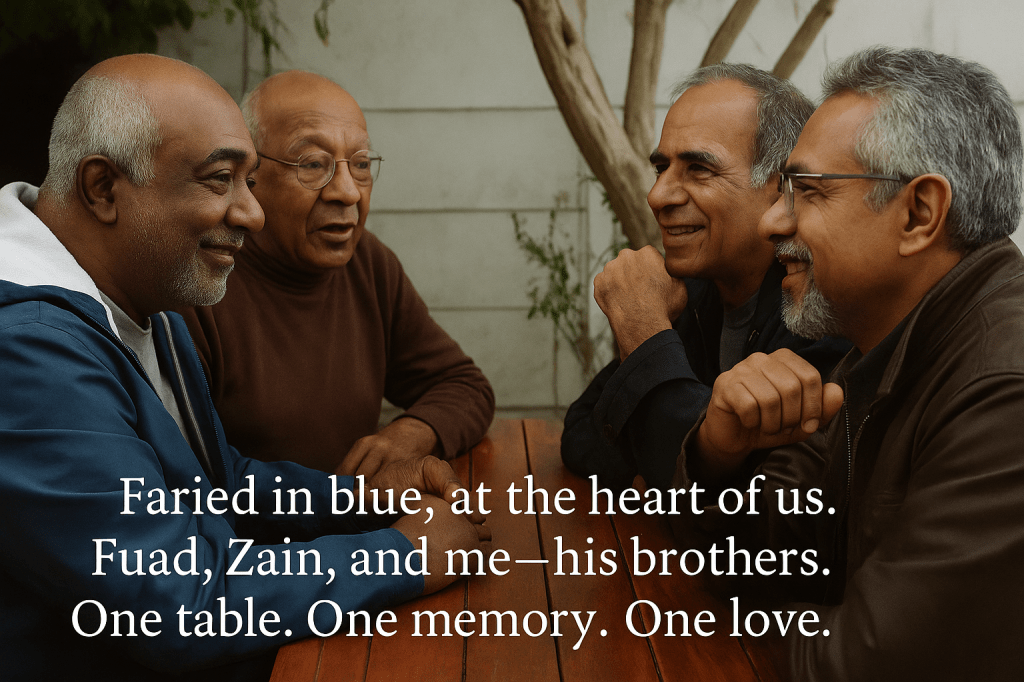
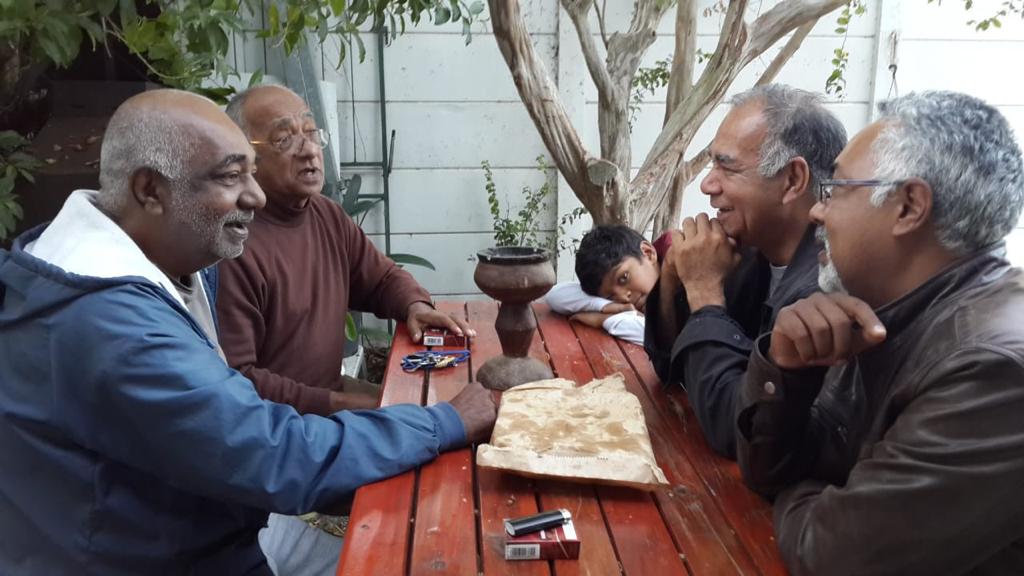
    Faried in blue, at the heart of us.
    Fuad, Zain, and me—his brothers.
    One table. One memory. One love.

    Your passing caught me off guard.
    I had planned to fly down to Groote Schuur Hospital—to hold your hand, to hear your familiar, half-teasing greeting:
    “This is nothing. How long are you staying? Will you be sleeping on our couch in the lounge?”
    But the doctors had already sedated you.
    And while we weren’t watching, you let go of my hand and slipped quietly into the next realm.
    I said my goodbye by placing my palm on your forehead, feeling your life force dissolve.

    The grief swept me away like a sudden tide.
    In that single, helpless moment, memories surged—those threads that bound us—flooding my chest in a merciless storm of emotion.
    Now, five days later, I’m still adrift, trying to gather pieces from the wreckage.
    Perhaps these fragments will steady me.

    You shaped my life profoundly—especially during my adolescence.
    With Dad growing older, it was you, along with your remarkable wife Zuleiga, who guided me through those uncertain years.
    During summer vacations, I was your clumsy teenage apprentice—sweeping up at building sites where you were foreman and supervisor.
    It was my job to scrub your and Dad’s boots clean, and to wash off the cement-caked tools of the trade.
    You were, in those days, both stern and kind—frightening and benign.

    One day, while we were building a factory, the owner’s son stormed onto the site, shouting insults at our father.
    Mid-rant, he suddenly found himself face-down in a wheelbarrow.
    You had knocked him out cold with a spade to the side of the head.
    You saw him for what he was: a racist, self-righteous prick—and an abusive employer.
    You never tolerated either.
    That moment stayed with me.
    Years later, when I joined the freedom struggle, I carried it like a compass.

    Of course, I wasn’t guided by you alone.
    I was blessed—loved by all our siblings, their partners, and their children.
    But your influence stood apart. Like your name, it was unique.
    You were, somehow, the rare blend of our mother’s blunt honesty and our father’s quiet grace.
    Your language was rough, your heart soft.
    It took us years to understand that your sharp tongue was often the symptom of undiagnosed, untreated diabetes—the same illness that eventually claimed you.

    Now that you can no longer protest, I’ll say it plainly:
    You were a terrible capitalist.
    You once ran a butchery in Mitchell’s Plain that failed—not from mismanagement, but because you kept giving the meat away.
    To struggling customers.
    To broke relatives.
    Later, in your construction business, you gave jobs to young family members who needed work, even when the books didn’t balance.
    When the business eventually closed, you had no regrets.
    The Qur’an speaks of such people, calling them “those who gave preference to others, even though poverty was their own lot.”

    Postnote

    Faried was the middle-child in our siblings—one of four brothers and three sisters.
    He passed away eight years ago, on the eighth day of Ramadan.
    He used to joke that he would be the one to bury Fuad, our eldest brother, since he was younger and expected to outlive him.
    But fate had other plans.
    We lost Fuad two years ago, and with him, another great pillar of our family.

    In our grief, we found strength in remembering Faried’s resilience, his unflinching kindness, and his deep sense of duty.
    His life remains for us a source of comfort, a touchstone of dignity, and a lesson in selfless love.

    Footnote:

    May Allah have mercy on his soul, inna lillahi wa inna ilayhi raji’un, and on the souls of all our departed—those who laughed with us at one table, and now dwell in the unseen.

  • The Grandmother of Just Girls

    The Grandmother of Just Girls

    rugayabil-ii
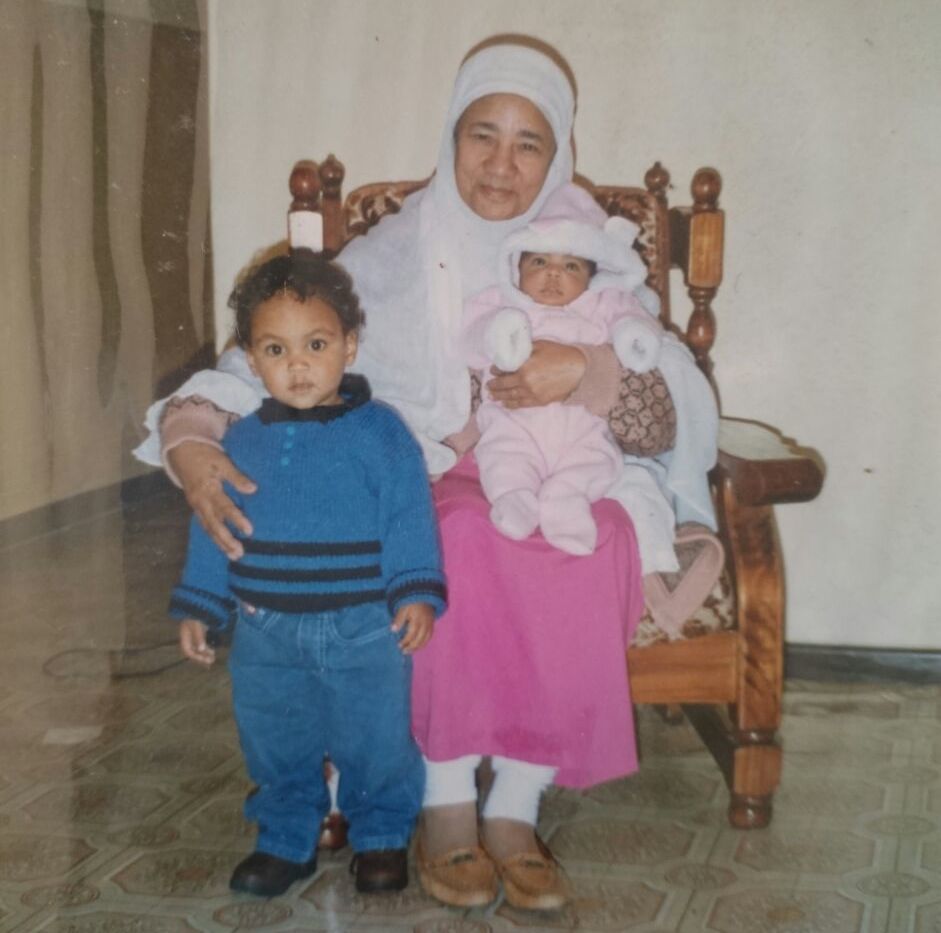
    My mom with her granddaughter, Bilqis, on her lap. Bilqis’s cousin, Omar is standing.

    I never really met my grandparents from either my mom’s side or my dad’s. I lie. I met my dad’s dad. Twice. Once in Kingsley Street in Salt River when I was about eight years old. My mom had to say to me, “This is your grandfather.”

    I saw this older version of my dad in his sleeveless vest and long white underpants with three kids hanging onto him. My grandfather was short. Like my dad. And I looked at those kids stretching out his vest, my cousins who I also did not know, with envy.

    The second time I saw him, I may have been twelve. He was laid out on a metal table in the lounge of the same house in Salt River, covered in white linen up to his neck. My grandfather had passed away. “Kiss your grandfather,” my mom said to me, “don’t be afraid.” I kissed him on his cold forehead and that was that.

    My six other siblings were more fortunate I was. They have memories of my dad’s mom who stayed with us for a time when we lived in District Six and the older siblings have wonderful stories about my mom’s mom, Moeder (real name Zubeida), that I love listening to.

    Of the two role models in my life, my dad was the more child-friendly. That’s not really accurate. Rugaya, my mom, was a woman who preferred boys over girls. She adored her four sons over her three daughters. This preference became more noticeable when the grandchildren came on the scene. Of her 27 grandkids, there are only eight boys!

    My mom, God bless her soul, was also not one to disguise her displeasure or dislike for something or someone. You could often see it in her entire face no matter how hard she tried to disguise it (when she did try, which was not often). So when Sadia, my spouse, gave birth to our first born, this is how she reacted to the news when I called her in my absolute excitement.

    “Mom, Sadia just gave birth!” I said.

    “What is it?” she asked.

    I knew exactly what she meant but said, “The child’s name will be Bilqis.”

    “What type of a name is that? That’s mos an Indian name. Is that for a girl or a boy?”

    “It’s a girl. Silly. My firstborn is a girl.”

    “Your dad will come to the hospital,” she said and put the phone down.

    breimabil
    My dad with Bilqis.

    There is this beautiful black and white I took with my dad, Ebrahim or Breima, holding Bilqis with delight in his eyes. She sensed his warmth and smiled back. Breima was great with kids. All kids. He could sing them to sleep within seconds. A true baby whisperer. A storyteller of note and incapable of giving us a hiding. Ever.

    Sometime after Bilqis’s naming ceremony or ‘doekmal’ (probably from the Afrikaans ‘doopmal’) my mom and dad came to visit us in Mountain Road in Woodstock. Not one to give my mom a break with her preference for boys, I placed Bilqis on her lap and said, “I want to take a pic of Ouma with her grandchild.” She sat with Bilqis, and about manages to make a smile.

    I have no doubt that my mother loved my kids but, somehow, she was not wired to relate to other females as she was towards males. This is why most of her students (mostly female) who she taught in ritual preparation of the deceased (or toekamanie-werk) remember her as stern.

    But for all her hard exterior, her students loved her. When she passed, some 500 women attended her janazah (funeral), lining the streets to give her a guard of honour as she was carried to the mosque for the funeral prayers.

    When Sara-Nida, my second daughter, was born, I called my mom once more.

    “Mom, Sadia has given birth to a healthy baby.” Once more I held back saying the gender.

    “What is it?”

    “Sara. Her name will be Sara.”

    “Another girl!” she said with clear disappointment in her voice, “I’m mos already known as the grandmother of just girls…”

    When Ganaan, my youngest daughter, was born, I had resigned myself to the idea that my mom was not going to change. So when Sadia became pregnant with our last, we decided to have a scan done to check the sex of the child. It was a boy! I duly informed my mom.

    By the time Jauzi Hashim was born, however, my mom’s health had already taken a turn for the worst. That morning when I called her with the news, we had a heartbreaking conversation.

    “Mom, Sadia gave birth!”

    “Sadia gave birth?”

    “Yes, it’s a boy. His name will be Jauzi.”

    “Sadia can’t be due yet.”

    “She was due. It’s a boy. This morning. I just saw him.”

    “A boy? Whose boy?”

    “My boy. Sadia just gave birth.”

    “Sadia gave birth? But Sadia can’t be due yet.”

    And the conversation went round and round like this for fifteen whole minutes. Her mind was beginning to fail her. She could not retain information. The best news for the granny of just girls. Her youngest son just had a son, only the second of her four sons to have this ‘honour’ and Rugaya’s memory had started to fail her.

    What Sadia and I did not know is that when I initially called my mom to say that the scan had revealed that Sadia was going to give birth to a boy, she had already begun to give instructions to my sister-in-law, Zuleiga, to pack a box of baby clothes and other accessories and mail that up to us in Pretoria.

    My mom passed away a month later, having never set eyes on her new grandson, the last of eight. The box of baby goodies arrived a week after that.

    I am remembering all this now and thinking that all of these experiences are now inside of me. I’m a granddad for the first time. My grandson, Zahi Salman, is adorable. I too find it hard to disguise my emotions. He knows this and responds by holding onto my face when I pick him up. So when I hold him, I think to myself, “Rugaya, your granddaughter has a son. You would love him too. And he would love you no matter your stern face!”