
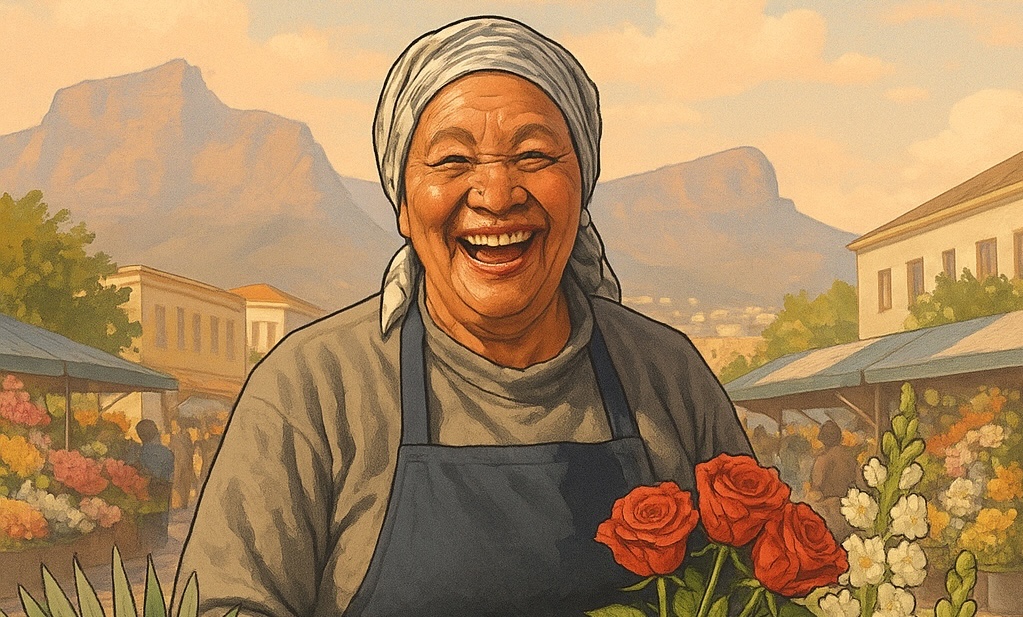

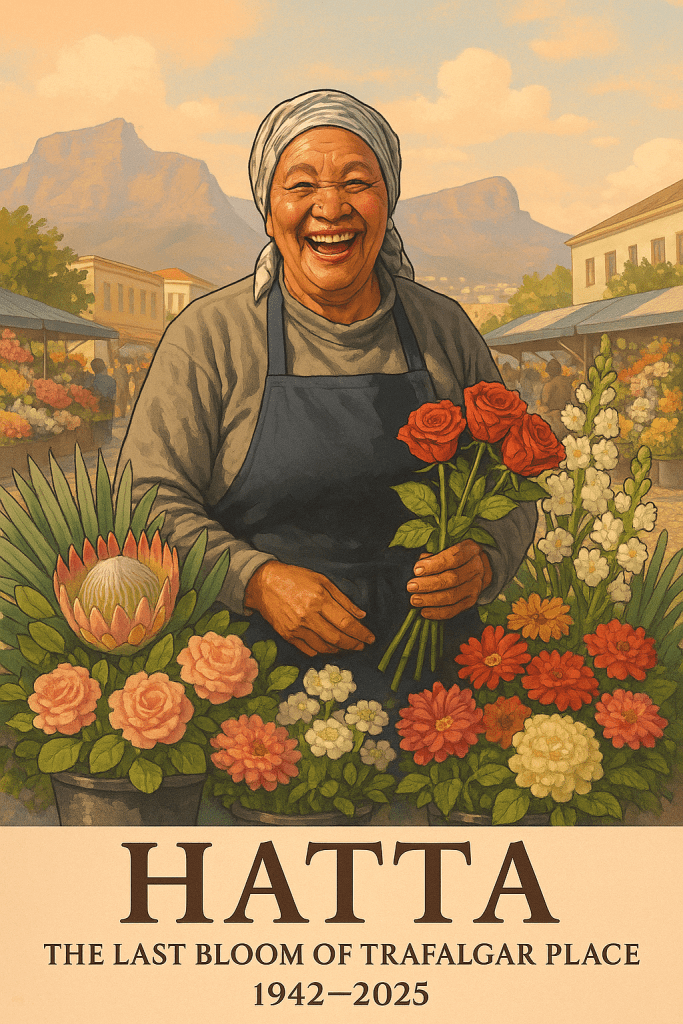
She wasn’t just a flower seller.
She was a fragrance, a rhythm, a joke that made you feel seen.
Her name was Cecelia Williams—known to all as Hatta—and for over sixty years, she stood at Cape Town’s Trafalgar Place market, not just selling blooms, but lifting spirits.
Hatta was a character. A caretaker. A Cape Town original.
The Poem that Opened the Door
“Hatta of the Flower Market”
She was the last blossom of a vanishing season,
a woman with hands that knew petals better than poems,
who crowned Adderley mornings with colour and cackle.
They called her Hatta—not just a name, but a rhythm.
A shrug, a laugh, a story half-told while binding roses with string.
Sixty years of market sun.
Of joking with tourists. Of feeding the street children.
Of being “one in a million” without ever asking for a statue.
Now the market hums a little quieter.
But her scent, her sass, her spirit—
they linger,
like the last bloom in a winter vase.
This poem, first shared on my Facebook page, sparked an outpouring of memory and community. The tribute went viral, shared across timelines and group chats. And then, like the scent of jasmine carried on wind, her story grew.
The Article That Helped the City Remember
Tamlynne Thompson’s piece in The Cape Towner became a cornerstone of Hatta’s public remembrance. It offered not only a portrait of her life, but a signal that her presence had mattered—deeply.
Her Funeral, and the Silence That Spoke
Though the newspaper referenced a YouTube link, the funeral livestream no longer appears to be available. But memory has other ways of surfacing. While searching for traces of Hatta, I found this moving video about her best friend, Sandra Bosman—herself a flower seller of the Cape.
🔗 Watch the tribute to Sandra Bosman
Through Sandra, we hear the echoes of Hatta’s laughter, her generosity, and her grit. It’s another thread in the fabric we’re weaving.
Voices from the Cape
Facebook friends poured in with blessings, memories, and emotion:
Anne Rogers: “Yet another outstanding poem – beautiful, moving words and complementary image to honour an outstanding woman who brought joy to many.”
A Note of Gratitude:
To Anne Rogers—your kind words landed with warmth.
In a world where noise often drowns meaning, your belief in my words is a quiet blessing.
Thank you for seeing not only the poem, but the person behind it.
And to Atiyyah Khan, Marianne Thamm, Mogamat Kammie Kamedien, and so many others—this harvest belongs to you too.
What Does “Hatta” Mean?
A few friends asked if Hatta was an honorific.
The word “hatta” can refer to the traditional Arab headscarf, the keffiyeh—often used in resistance, honour, and dignity.
It also carries echoes of the Arabic verb ḥaṭṭa, meaning to reach, to attain, or to bring down gently.
Maybe that’s what she did—reached people, lifted them, wrapped them in grace.
The Spirit of the Cape Lives On
You can’t really write about Cape Town without talking about talking.
That unique Cape Flats cadence—Afrikaaps—where people don’t just sell fruit or flowers.
They create moments.
Ask about a naartjie and you’ll hear:
“Die naartjies is so lekker, hulle willie praatie. Hulle’s te skaam van al die soetigheid!”
And Hatta?
She was the high priestess of that daily liturgy.
🌹The Fragrance Lingers
This is not a eulogy. This is a zahrā’, a bloom.
And she—Hatta—isn’t gone.
She lives in our language. In our laughter. In our stories.
In every bouquet given in kindness. In every street market joke.
In every aunty who tells it like it is, and every uncle who listens.
May we see them. May we remember them. May we become them.
🕊️ Rest in softness, Hatta. You were the last bloom of Trafalgar Place. But your scent is forever.
This blog post is dedicated to every flower seller, fruit hawker, street child, and storyteller who holds up Cape Town with grace and grit. May we never forget them.
 Adli Yacubi