Tag: Carpe Diem

  • In the Circles of Azzawia

    In the Circles of Azzawia

    In the Circles of Azzawia

    From Sunday’s Kitāb al-Shukr to Monday’s Minhāj al-Ṭālibīn, tracing the chains of Shāfiʿī knowledge, the whispered wisdom of teachers, and a daily breeze of remembrance.

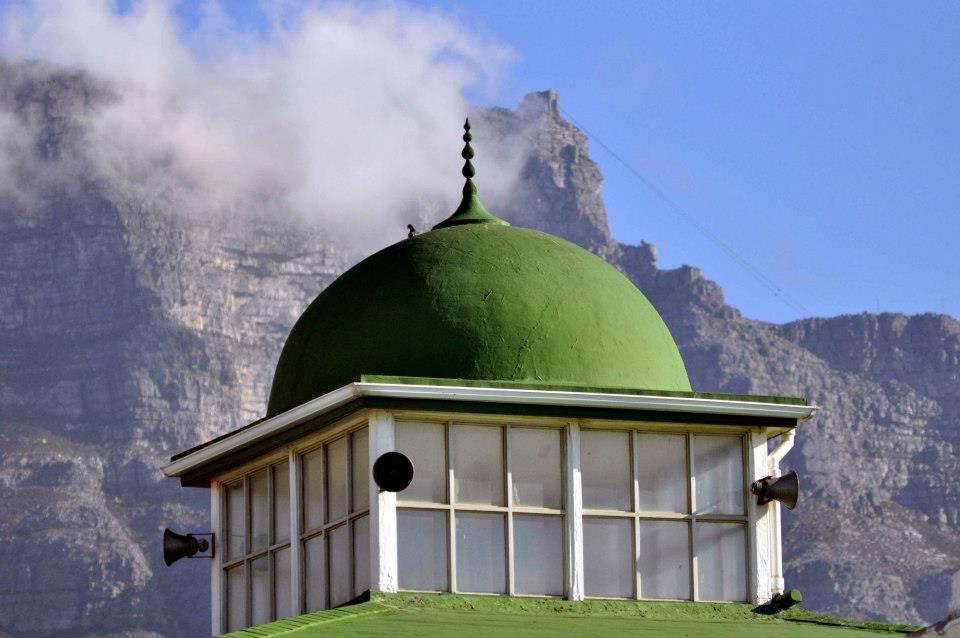
    Azzawia Masjid, Walmer Estate – a cornerstone of Cape Town’s Shāfiʿī scholarship and spiritual tradition.

    Sunday Morning – Chains of Knowledge, Wings of Mercy

    Last Friday, Al Ameen, my swaer, took me to Al Azawia Mosque in Walmer Estate. I had only wanted to greet Shaykh Achmad Hendricks, who was delivering the Jumuʿah khuṭbah. But in the front ṣaff, I also took hands with Shaykh Allie Khalfe.

    He smiled and said, “Adli, I’m glad you are here in Cape Town. Come to my dars this Sunday morning.”

    I went.

    The gathering was in the old style — a teacher seated, a text in Arabic before him, the words flowing into English explanation. Shaykh Allie was reading from Imām al-Ghazālī’s Kitāb al-Shukr (Book of Gratitude). Before the lesson began, Rashaad recited the Qaṣīda al-Burda Sharīf with the beat of the duff — a reminder that knowledge, in our tradition, is not only in the mind but in the heart, the breath, the rhythm.

    The room carried the scent of chains of transmission — ustādh to ustādh, back to the author, to the early masters, to the Messenger ﷺ. We were given a chart in Arabic, thirty or so key uṣūl al-fiqh terms, the kind that open doors into the Qurʾān’s architecture. A gift in itself.

    Shaykh Allie moved between concepts — ʿilmtafakkurḥāl; gratitude as both unveiling and action; the way arrogance blinds and mercy gives wings; Allah’s command in the Qur’an for Mūsā عليه السلام to speak kindly even to Pharaoh; and how every act, every vessel, every design is part of tawḥīd.

    He reminded us that knowledge is not a library of abstractions but an ʿamal — a living response. That Bismillah should precede everything, and that the chains we hold are not shackles but the silsilah — the unbroken links of teachers and students — which, when pulled, draw the heart closer to Allah.

    At the end, he placed in my hands a book: A Journey Through Time with Al-Shāfiʿī, Muhammad bin Idris, Volume 2. Another link in the chain, another door to open.

    I left with the sense that gratitude itself is a journey — from the first Bismillah to the final Alhamdulillah — and that Cape Town, for all its winds, still holds corners where the old way of learning is alive, unbroken, and quietly shining.
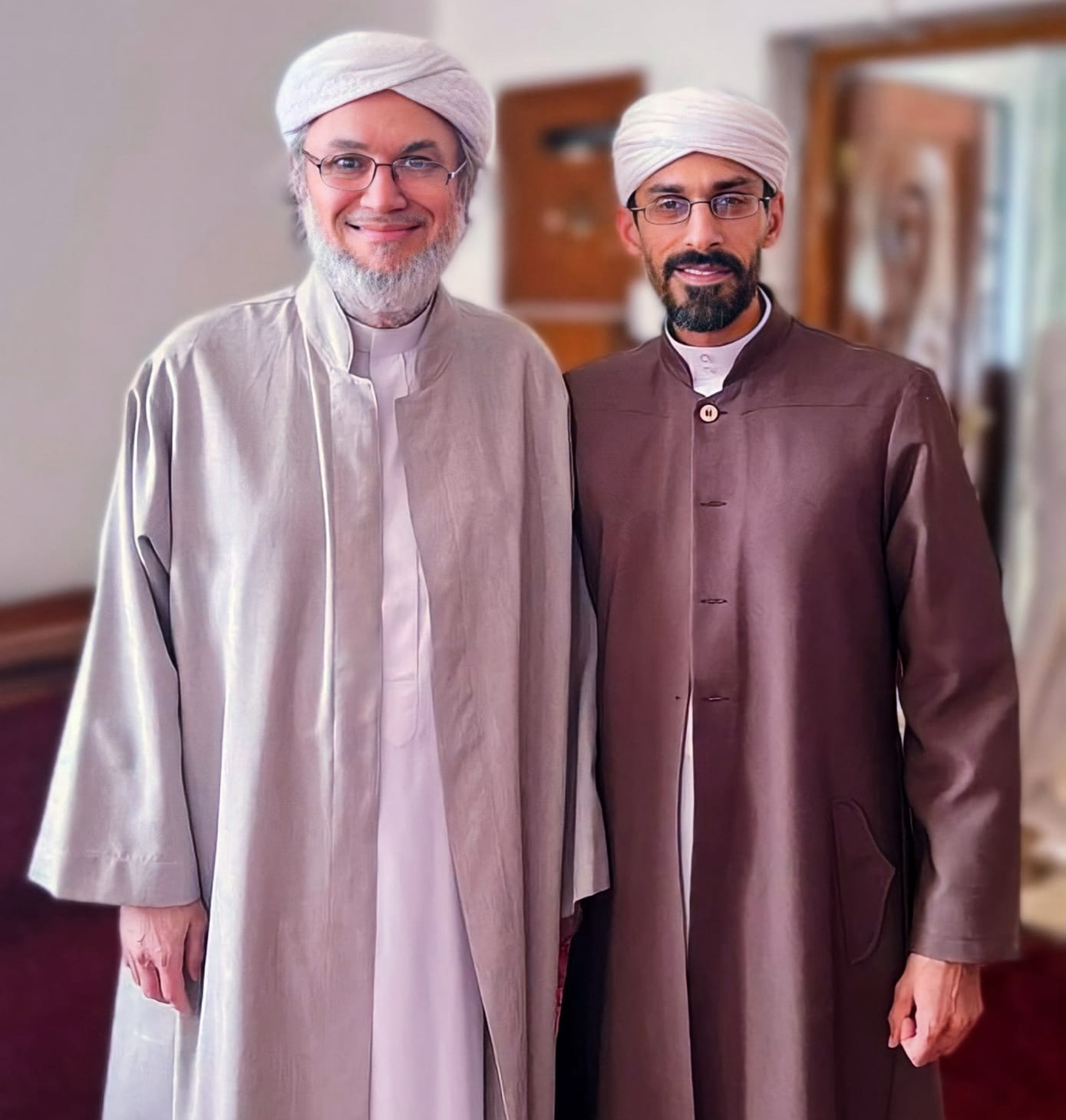
    Two pillars of Cape Town’s Shāfiʿī tradition — Shaykh Achmad Hendricks (left) and Shaykh Allie Khalfe (right).
    Between them flows an unbroken silsilah: the study circles, the Qur’anic sciences, the breath of dhikr, and the living manners of the tradition. Under their guidance, the old way of learning — text in hand, hearts attentive — remains alive in Cape Town.

    Monday Night – Two Hours on an Introduction

    On Monday night, 11 August 2025, I returned to Azzawia Mosque — this time for the weekly dars with Shaykh Achmad Hendricks.

    The WhatsApp invitation from Rashaad Samaai had been simple:

    Shaykh Ahmad is currently teaching the Minhāj al-Ṭālibīn of Imām al-Nawawī and the Risālah of Imām al-Qushayrī.

    My madhhab is Shāfiʿī — as is the majority of Cape Muslims — so to sit in a reading of Imām al-Nawawī’s masterpiece felt like stepping into my own inheritance.

    Shaykh Achmad spent two hours on just the introduction — pausing on its closing lines:

    Finally, in cases where there is divergence of opinion among authorities I shall give an impartial exposition of the two opposing theories, the two sides from which one may consider the question in dispute, and the two methods of reasoning adopted in order to solve it; and then I will also, where there is occasion for it, quote separately the decisions of our imam al-Shāfiʿī, and note the relative value of the different appreciations.

    From that, a whole world opened: the discipline of fairness, the patience to hold two views in one’s hands, and the humility to weigh them without arrogance.

    It took me back to a scene years ago in the Haram at Makkah. A teacher had just finished lecturing his students. When he rose, they swarmed him like bees — those nearest whispering their questions, the teacher answering in whispers too. Everyone leaned in to catch the words. Then, when he departed, they rushed into the market to buy the books he had mentioned.

    That is knowledge — not the cold storage of facts, but the living pursuit: sitting, listening, writing, memorising. The kind that makes the heart lean forward. The kind that, even in an age of instant answers, still requires the slow, deliberate turning of a page.


    A Gift for the Road – Daily Adhkār

    As we stepped out into the cool Cape Town night, Rashaad Samaai pressed a page into my hand.

    “It’s from Shaykh Achmad,” he said.

    On it was a short litany to be read three times daily — Names of Allah drawn from the Qur’an and the hearts of the early saints:

    Bismi Allāh al-Raḥmān al-Raḥīm, Yā Allāh
    In the Name of Allah, the Most Compassionate, the Most Merciful. O Allah.

    Yā Wāḥid, Yā Aḥad — O The One, O The Unique
    Yā Wājid, Yā Jawwād — O The All-Perceiving, O The Most Generous

    Infikhnee bi-nafkhati khayr — blow into me a breeze of goodness

    Innaka ʿalā kulli shay’in Qadīr — Indeed, Allah has Power over all things.

    A simple gift, but in it, a whole ocean — remembrance for the tongue, stillness for the heart, and a daily returning to the Source.
    The green dome of Azzawia Masjid rises like a lantern against the stone face of Table Mountain, a reminder that Cape Town’s spiritual horizon is as enduring as its natural one. From here, the call to prayer has travelled across decades of wind and history, mingling with the clouds that crown the mountain. Under this dome, chains of knowledge are kept alive — voices of teachers, pages of sacred texts, and the quiet remembrance of Allah, all anchored in the heart of the city. [Pic: Shafiq Morton]

    Closing line:
    And so the circles of Azzawia turn — each dars a link, each link a step — until the seeker finds that the journey was not only to the masjid on the hill, but deeper into the heart of the chain itself.
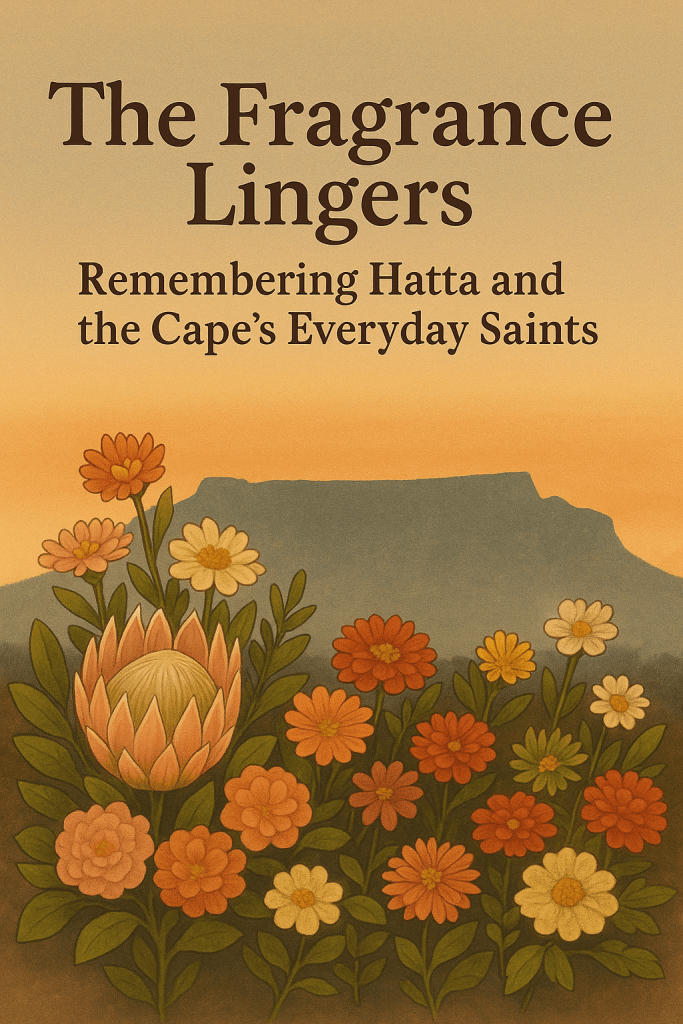
  • The Fragrance Lingers: Remembering Hatta and the Cape’s Everyday Saints

    The Fragrance Lingers: Remembering Hatta and the Cape’s Everyday Saints

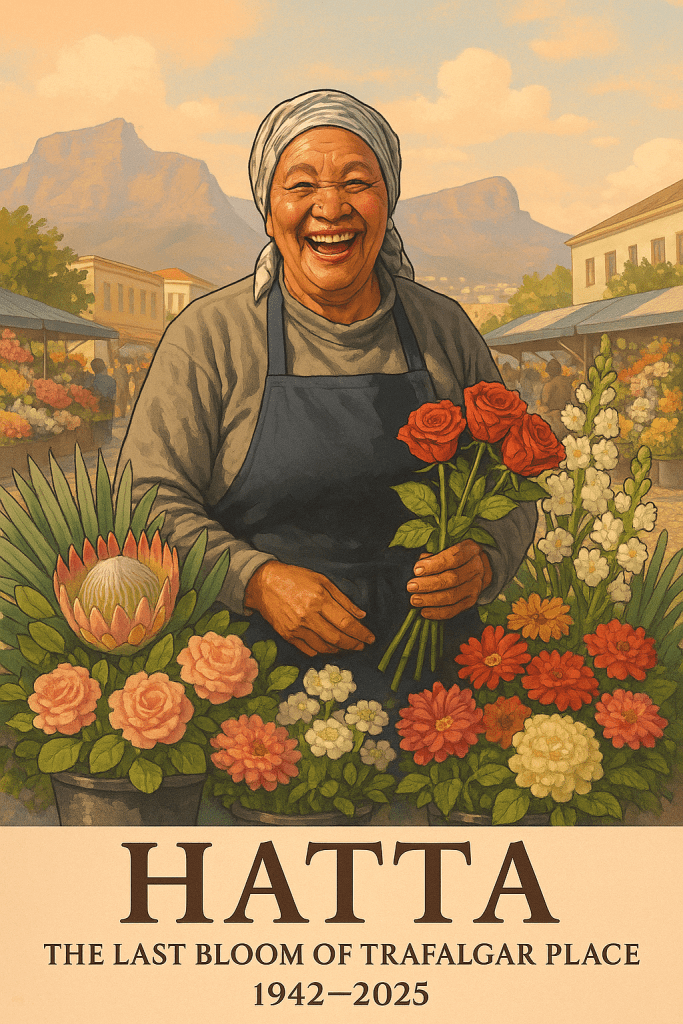
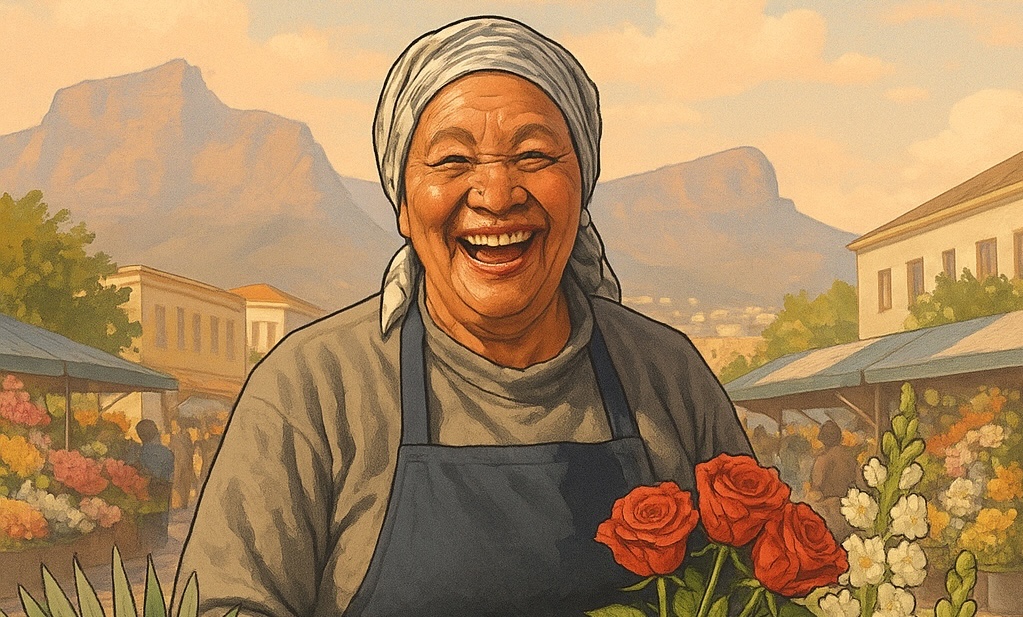
    A tribute to Hatta: flower seller, character, Cape Town soul. The fragrance lingers…

    She wasn’t just a flower seller.
    She was a fragrance, a rhythm, a joke that made you feel seen.
    Her name was Cecelia Williams—known to all as Hatta—and for over sixty years, she stood at Cape Town’s Trafalgar Place market, not just selling blooms, but lifting spirits.

    Hatta was a character. A caretaker. A Cape Town original.

    The Poem that Opened the Door

    “Hatta of the Flower Market”
    She was the last blossom of a vanishing season,
    a woman with hands that knew petals better than poems,
    who crowned Adderley mornings with colour and cackle.
    They called her Hatta—not just a name, but a rhythm.
    A shrug, a laugh, a story half-told while binding roses with string.
    Sixty years of market sun.
    Of joking with tourists. Of feeding the street children.
    Of being “one in a million” without ever asking for a statue.
    Now the market hums a little quieter.
    But her scent, her sass, her spirit—
    they linger,
    like the last bloom in a winter vase.

    This poem, first shared on my Facebook page, sparked an outpouring of memory and community. The tribute went viral, shared across timelines and group chats. And then, like the scent of jasmine carried on wind, her story grew.

    The Article That Helped the City Remember

    Tamlynne Thompson’s piece in The Cape Towner became a cornerstone of Hatta’s public remembrance. It offered not only a portrait of her life, but a signal that her presence had mattered—deeply.

    🔗 Read the article here

    Her Funeral, and the Silence That Spoke

    Though the newspaper referenced a YouTube link, the funeral livestream no longer appears to be available. But memory has other ways of surfacing. While searching for traces of Hatta, I found this moving video about her best friend, Sandra Bosman—herself a flower seller of the Cape.

    🔗 Watch the tribute to Sandra Bosman

    Through Sandra, we hear the echoes of Hatta’s laughter, her generosity, and her grit. It’s another thread in the fabric we’re weaving.

    Voices from the Cape

    Facebook friends poured in with blessings, memories, and emotion:

    Anne Rogers: “Yet another outstanding poem – beautiful, moving words and complementary image to honour an outstanding woman who brought joy to many.”

    A Note of Gratitude:
    To Anne Rogers—your kind words landed with warmth.
    In a world where noise often drowns meaning, your belief in my words is a quiet blessing.
    Thank you for seeing not only the poem, but the person behind it.

    And to Atiyyah Khan, Marianne Thamm, Mogamat Kammie Kamedien, and so many others—this harvest belongs to you too.

    What Does “Hatta” Mean?

    A few friends asked if Hatta was an honorific.
    The word “hatta” can refer to the traditional Arab headscarf, the keffiyeh—often used in resistance, honour, and dignity.
    It also carries echoes of the Arabic verb ḥaṭṭa, meaning to reachto attain, or to bring down gently.
    Maybe that’s what she did—reached people, lifted them, wrapped them in grace.

    The Spirit of the Cape Lives On

    You can’t really write about Cape Town without talking about talking.
    That unique Cape Flats cadence—Afrikaaps—where people don’t just sell fruit or flowers.
    They create moments.

    Ask about a naartjie and you’ll hear:

    “Die naartjies is so lekker, hulle willie praatie. Hulle’s te skaam van al die soetigheid!”

    And Hatta?
    She was the high priestess of that daily liturgy.

    🌹The Fragrance Lingers

    This is not a eulogy. This is a zahrā’, a bloom.
    And she—Hatta—isn’t gone.
    She lives in our language. In our laughter. In our stories.
    In every bouquet given in kindness. In every street market joke.
    In every aunty who tells it like it is, and every uncle who listens.

    May we see them. May we remember them. May we become them.

    🕊️ Rest in softness, Hatta. You were the last bloom of Trafalgar Place. But your scent is forever.

    This blog post is dedicated to every flower seller, fruit hawker, street child, and storyteller who holds up Cape Town with grace and grit. May we never forget them.

  • Unseen Table

    Unseen Table

    A Poem and Visual Reflection
    by Adli Yacubi

    In the quiet spaces of reflection, where language becomes prayer, Unseen Table emerged. This poem is a devotional meditation — a rhythmic journey through names and attributes of the Divine. Inspired by the cadence of Qur’anic verse and the beauty of the seen and unseen, it is paired here with an Arabic calligraphy that captures its spirit visually.

    “رَبِّ كُلِّ شَيْءٍ — The Lord of Everything”

    Pronouncing pronouns and prepositions
    Lift the lamp, the light, lit by the holy
    Scour the sacred and the secret sources
    Invoking various verses of our Lord

    Lord of the mighty mountains high
    Lord of the sweet-scented rose nearby
    Lord of the earth and skies that lie
    Lord of the day and the night gone by

    Lord of the mighty oceans deep
    Lord of the universe in its keep
    Lord of the stars in endless sweep
    Lord of the secrets that we keep

    Lord of the merciful and just
    Lord of the faithful and the trust
    Lord of the righteous and the just
    Lord of the true, in whom we must

    Lord of the prophets and the wise
    Lord of the knowledge that never dies
    Lord of the heavens and the sunrise
    Lord of the earth, to that we arise

    Lord of the Throne, the Tremendous and Honourable
    Lord of Forgiveness, Full of Mercy, ever able
    Lord of the Bounty, the Infinite and Stable
    Lord of the Sovereignty, Owner of the Unseen Table

    🌙 A Final Thought

    In a world thick with noise, may these verses be a quiet invocation — a return to the Sacred, to the unseen currents beneath all things. If the words moved something within you, pause… and let that be your prayer.

  • How do you even begin to eat a mountain?

    How do you even begin to eat a mountain?

    [I have retold this story countless times. It was told to me when I was a student in the 80s. I googled the original storyteller but could not find any reference to it online. It resonated with me because I was born at the foot of Table Mountain in District Six, Cape Town. I am thankful, even now, for Khurram Murad for making this part of his keynote address so long ago.]

    table-mountain
    Table Mountain taken by Aadela Parker.

    There once was a man who was very unhappy. Something was troubling him but he could not put his finger on it. At night he was restless and it took a while for him to sleep. That night he had strange dream.

    He dreamt that an old man approached him and said, “When you wake in the morning, eat the first thing that you see.” When he woke up that morning sweating from the vision, he opened his eyes and saw the mountain. What? How am I supposed to eat a mountain?

    Maybe the old man was joking. He then went about his usual tasks for the day. He still felt troubled though. That night he had the same dream. But now the old man was ranting and raving, “What are you afraid of? Eat the first thing you see.”

    It is not easy to choose what you should see when you wake so when he woke that morning again and saw the mountain, he thought the old man must be crazy. The third night the old man was now threatening him with a stick and promised to make the rest of his nights a living hell if he did eat what he saw when he woke.

    That morning he woke with determination. When he saw the mountain, he immediately packed and set out to eat it. But as he moved closer to the mountain, a strange thing happened: it started to grow smaller. The man began to panic because it seemed as the mountain was moving further away. Just my luck he thought and started to increase his pace. The closer he moved the smaller the mountain.

    By midday he was running. At the end of the day he reached where he thought the mountain should have been. But it had grown so small that he could stoop down, pick it up and put it in his mouth. What do we learn from this strange but interesting story? I believe four things:

    • We all need dreams. We need a vision and a plan to get us where we need to go. We must see the idea before us and keep it in our sight. A dream that you cannot conjure before you is not going to keep our attention.
    • A dream will remain unattainable if we make no effort to make it real. It takes slog. Sometimes the work seems impossible to absorb. But sometimes the most difficult things to learn turn out to be the most enjoyable once you get it. Sometimes, the harder a thing becomes the sooner you are reaching a breakthrough. Apartheid gave way when we thought that we should prepare ourselves for a long fight and bitter fight.
    • Besides the dream and the effort you also need belief. You must believe in yourself. You must believe that you can win. You must believe that it is worth it. Belief gives you confidence and the world cannot resist a person with confidence it will open up paths and opportunities that you never imagined.
    • Finally: sometimes the solutions we are looking for are not weird or strange. Sometimes (often) what we look for, or the solution, lies right in front of us like the mountain in my story. That mountain was in front of his window his whole life but it did not occur to the man to seek it out.
  • How to learn something entirely new in just 4 steps

    How to learn something entirely new in just 4 steps

    It starts by diving in boots and all…

    I was writing a ‘spark’ on Somewhere about how I learn new concepts, new processes or even new skills, when I realised that I actually needed to add water to this very succinct format that only allows for 250 characters. Now, happily, that spark can be my outline:

    To learn something entirely new, for me, 4 things help: 1) I become single-minded about the subject. 2) I take notes as I read (mind-maps). 3) I explain the concepts to anyone that cares to listen. 4) I start to implement what I’ve learnt.

    Image by Brooklyn Morgan on Unsplash

    Single-mindedness

    There is saying that I came across a while back when I tried my hand at Shotokan Karate. I was told: first you imitate, then you innovate. It basically means that if you don’t know something, then you learn from those who do. And you learn from them by imitating what they do, until you get it. Once you have it, then you can become quite creative in how you deploy it.

    In karate—but also in ballet, gymming and other such activities—they make you do the same set routines over and over until you get it or you collapse or whichever comes first. This is not only applied to physical skills but also in learning a new language, in academics, in maths(the bloody times-table), in music, etc.

    But when I say single-mindedness, I’m referring to a process where you become (ok, you induce yourself to become) passionate, besotted, obsessed, perhaps even fanatical about the subject. In other words, you drown yourself in the subject. This allows for a few things to happen:

    1. Fanaticism sweeps away all critical thought, making it possible for you to absorb as much of the subject as possible. Ask any cult member. This is good because it allows for easier imitation or for the information to lodge in your mind.
    2. It helps you to acquire as many bits of information, readings, insights, views on the subject matter as possible. You then become a true student of that area of knowledge. This is the actual aim of assignments, exams and dissertations.
    3. When it comes to the innovation stage, you will have much to draw on. In fact, when you flood your attention with a single subject over a given period, the questions and applications of that information will already begin to emerge.

    But to get the most out of this process, you need to have a good reading technique.

    Mind-maps

    I taught journalism and media studies to college students from first to fourth year. During revision week I noticed that everyone was using the highlighting method. You know the drill: read text, see something interesting, deploy highlighter in a million shades of pastel neon.

    Some even had a technique: green for interesting, pink for very important and orange for things the lecturer mentioned. The idea is to go hunting through the text for the various bits, highlight it and then read the selected coloured bits in a cram session just before the exam.

    Now besides ruining the text book, making it a tad difficult to sell later when the course is over, this is not going to really help in retaining information. You have only really engaged your eyesight leaving much of you other senses out of the equation. And the one sense you should not be leaving out, is that of touch.

    So when I read, I take notes. On a seperate sheet of paper. Or if I am reading an eBook, I open ‘Stickies’ and type out insights, interesting points that I come across. When I write, I put done down salient points and connect them to secondary ideas. And those ideas, I then connect to other related points and so on.

    If you were taking notes of this piece, for example, you might typically have my four major points and each one, in turn, would have sub-points of what the major ones are about. A third layer might be of what you make of all this nonsense. Get it?

    Your mind-map can also be colourful and then you can bring out those highlighters you love so much, like this:

    Why write ? When you write things down, you are making a personal association with the information you are reading. You are actually slowing down your reading, allowing your mind to engage with the information. Chances are also bigger that when you recall the information, the act of you writing will have a stronger image in your mind than just text that you read in some book.

    Just an aside: I have found that when I feel sleepy during a boring meeting, doodling actually keeps me from dozing off. And I can actually remain sober throughout even if my doodles have actually nothing in common with the subject matter. Go figure! (Actually, there is a study on this!)

    So now we have passion, then reading technique. But how do you own this new information?

    Verbal diarrhoea!

    I love movies. Whether animation, thrillers, science fiction, historical drama… It does not matter as long as it is a great story and I can see layers of meaning. Anyone who knows me will know that I can be a great spoiler of the plot. Whatever! The storyteller in me just wants to retell that plot. want to to be the one that gets you to see the genius in the story!

    So when I went to university, I would emerge from an amazing (amazing for me, ok?) psychology or African history lecture, sit down any buddy who would give me half a nod, and rave about the insights I just gleaned. I would repackage that entire one hour session and tell it as if I had come up with those ideas myself.

    When it came to exams, I would generally be able to recall entire lectures of certain subjects. And yeah, it would generally be the ones that I raved about. What happened here? It’s fairly simple…

    Once you are able to explain a concept in your own words, then several amazing things happen:

    1. If you can explain a concept you have heard or read, you are beginning to make sense of it in your mind.
    2. By retelling, you too are hearing it for a second time. Everytime you do, you are reinforcing the information.
    3. Once you make sense and retell, you are owning the information making recall much easier.

    And was it not Einstein who said:

    Now do!

    So once you have submerged yourself in the subject matter, reading as much as you could mindfully, and verbalised it—and by so doing, owning the information—you should implement, innovate, write about it, use it…

    Over the last while I have taught myself to blog, understand social media and pushing that blog content to social networks, use my Twitter account more effectively, swimming in the waters of crowd funding and deepen my understanding of narrative and storytelling.

    If you are reading this, then that last adventure on improving my online posts was not for naught and the advice I received from copyblogger actually paid off!

    – First published on Medium

  • And here I thought I was the only one

    And here I thought I was the only one

    When I first saw Groundhog Day, I was drawn to its notion of Carpe Diem

    [Written in response to The Subtle Brilliance of ‘Groundhog Day’]

    Groundhog Day poster

    Bill Murray in Meatballs marks my days of questionable movie tastes in my youth. I was fourteen when the movie hit the circuit and I just had to see it. And as my tastes improved, so did the actor as he meandered his way through CaddyshackStripes and Ghostbusters. Arguably, Groundhog Day, was a Bill Murray that had matured as an actor, a watershed moment, sort of like the way John Travolta improved through his movie career.

    Throughout the 90s I would unpack the whole plot of Groundhog Day in workshops to inspire youth to take charge of their own transformation. I would explain that the Phil being trapped in the same day was often what our own lives are really like. We may number them differently, give them different names and watch different weather conditions play themselves out… Our days are basically the same. And we have trapped ourselves in this monotonous routine.

    The only way out was to acknowledge that we are wasting away with our lookalike days and then to make incremental changes. And if you focus on changing yourself, the rest will work itself out or won’t even matter. It worked so well, I remembered those moments and then deployed it once more to first year journalist students when I started lecturing. I then played clips of the movie because… well I could, as I had my class trapped for an hour a quarter!

    And here I was thinking that I was this freak for holding onto an oldie such as Groundhog Day. So thank you Remi for adding in all those layers of meaning to a movie that I already believed is inspirational…