How empire sails in suits, and what it means to row in resistance.
🔰 Intro
There was a time when pirates came with cutlasses and black flags. You saw them coming. You heard the war drums. But today — the pirates wear uniforms. Or suits. Or diplomatic smiles. And while their ships sail under the banner of freedom, the wake they leave is full of oil, fire, and broken nations.
This is a story about empire. But it’s also a story about you. About where you sit — above deck, below deck, or paddling in a canoe. It’s about resistance. Memory. And the unseen rows of angels above.
“The sea is full of flags — but not one lowers its sails in grief.”
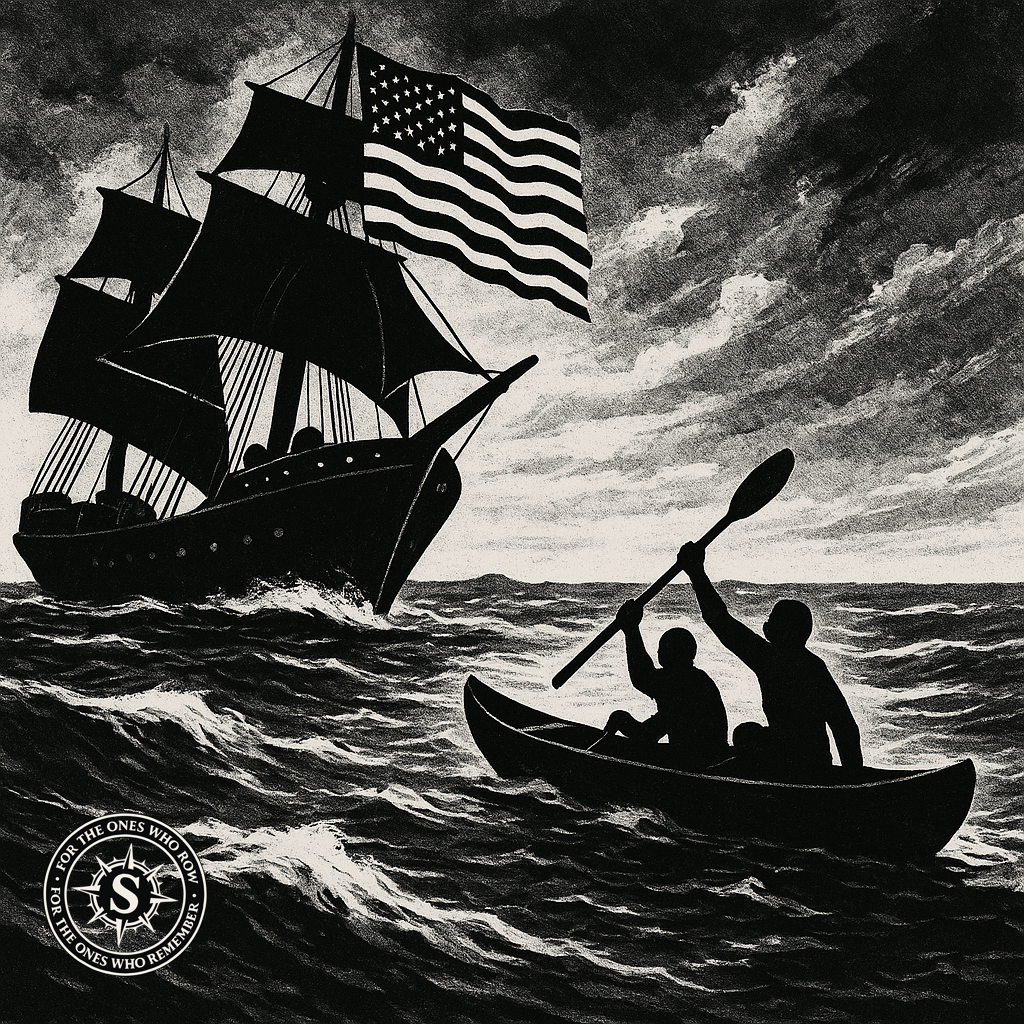
They told us flags were symbols of freedom. They said democracy wears red, white, and blue. They taught us that when their soldiers arrive, the people are being saved.
But the flag flaps like a warning now. The stripes stretch across oceans. The stars are stamped on missiles. The anthem plays over drone strikes.
This isn’t peace. It’s piracy with better branding.
The United States isn’t a country anymore — it’s a flagship. The lead ship in a fleet of multinationals, financial institutions, media empires, and war machines.
It doesn’t sail for justice. It sails for lithium. For land. For leverage.
Its flag is the Jolly Roger of the modern age — not because it’s outlawed, but because it’s above the law. And while the old pirates hoisted black flags to strike fear, these ones wave their colours with pride… and call it diplomacy.
You see them dock in Gaza, in Haiti, in the Sahel. They don’t drop anchor — they drop sanctions. They don’t build bridges — they bulldoze economies. They leave schools shattered, mothers weeping, aquifers poisoned — and they call it freedom.
Even the boldest voices still need trade. Even South Africa, with its lawsuit and legacy, still knocks on the same doors. Because when the pirates run the ports, you have to smile as they loot.
Meanwhile, in Gaza, the killing continues. The children cry in Arabic, but no ship stops to help. The sea is full of flags, but not one lowers its sails in grief.
🏢 Section 2: The Pirates Have Offices Now
“You don’t need a coup when you can crash a currency.”
The pirates don’t need eye-patches anymore. They wear tailored suits. They don’t wave cutlasses — they carry clipboards. Their muskets have been replaced by metrics.
The modern pirate doesn’t kick down your door — he offers you a deal. An “investment.” A “development project.” A “partnership.”
But look closely: The lithium ends up in their electric cars. The water rights end up in their stock portfolios. The debt — always the debt — ends up around your children’s necks.
They’ve learned that you don’t need to invade a country if you can own its infrastructure. You don’t need to drop bombs if you can drop interest rates. You don’t need a coup when you can crash a currency.
BlackRock owns more land than many nations. Nestlé bottles water it didn’t pray for. Chevron calls oil sacred. Halliburton builds what the bombs destroy.
The empire privatized its violence. It outsourced the pillaging to companies with ethical mission statements. Its generals now wear CEO name tags. Its foot soldiers are analysts, consultants, lobbyists.
And when a country resists — like Bolivia, like Palestine, like Niger — it doesn’t get invaded at first. It gets discredited. Its leaders are called unstable. Its elections are called suspect. Its people are painted as dangerous, irrational, ungrateful.
This is how conquest works now: not with sails, but with spreadsheets. Not with warships, but with press releases. Not with swords — but with silence.
Somewhere, a young trade official — daughter of a struggle veteran — tries to resist. She sits in a Johannesburg office late at night, re-reading a contract with clauses meant to trap her people. She circles words in red. She drafts a softer version. She knows they won’t accept it. But still — she sends it.
🧠 Sidebar: They Stole the Thoughts Too
They didn’t just loot land and labour. They colonised knowledge. They broke open sacred libraries, and then wrote the footnotes in their own names.
The West calls it “intellectual property.” But it’s just patented plunder.
In Egypt, Plato sat at the feet of Black scholars. In Mali, the Dogon mapped the Sirius star system — long before telescopes. In South Asia, turmeric healed wounds before it had a bar code.
They burned the manuscripts of Timbuktu. Then they published “discoveries” about African medicine in European journals.
Today they say: “You owe us mobile phones.” But what they really mean is: “We branded what we stole.”
🛏 Section 3: Below Deck — The Ordinary Citizen
“The system is designed to keep the floor clean — even if the keel runs red.”
Empires aren’t only built by generals. They are built by people who go to work, come home tired, scroll a little, and sleep.
Below deck, life continues. The engines roar above, the orders are barked on the bridge — but here, the lighting is soft. There are supermarkets, streaming shows, lawnmowers, coffee shops.
No one hears the groans of the drowned. No one smells the smoke from the burning village.
Maybe they see something on the news — Gaza, Congo, Yemen. Maybe they feel a flicker of sorrow. Maybe not.
The comfort below deck is that you don’t have to know. The noise is muffled. The suffering is pixelated. The system is designed to keep the floor clean — even if the keel runs red.
And when someone does knock on the cabin door — a refugee, a witness, a protester — the citizens flinch. Not because they’re evil. But because it’s awkward. Disruptive. A crack in the illusion.
You see, this ship sells a story: “We are good.” “We bring freedom.” “We are the world’s hope.”
It’s a story whispered through education, hummed in entertainment, declared in politics. And most below deck believe it. Or want to. Or at least, want not to think about it too much.
One evening, a man in the suburbs clicks on a video about Gaza. He watches for seventeen seconds before an ad plays. He sighs. Skips it. Opens another tab. A special on air fryers. The horror slips away — not because he’s cruel, but because the system makes forgetting so easy.
Dissent is dulled with subscription bundles. A hundred shows to choose from. None of them about Palestine. And if that fails, there’s always a pill. A holiday. A hashtag that ends by Monday.
Because thinking leads to questions. And questions lead to guilt. And guilt demands action. And action? That rocks the boat.
🛶 Section 4: Canoes and Resistance
“These boats do not always win. But they do not drown quietly.”
Not every vessel sails under the pirate’s flag. Some float with patched sails and broken oars. They are small. Often sinking. But they do not bow.
They are the canoes of the world. Gaza, battered and besieged, still sings the Adhān through rubble. Haiti, dismembered by decades of debt and interference, still cooks its own rice. Congo, bleeding from every open vein of mineral wealth, still births drums and poems.
These are not nations that invade. They don’t fly drones or send tanks. They row.
And every stroke is resistance. Every preserved language, every intact culture, every refused bribe — resistance.
They are mocked for being poor. Starved for being proud. Punished for surviving.
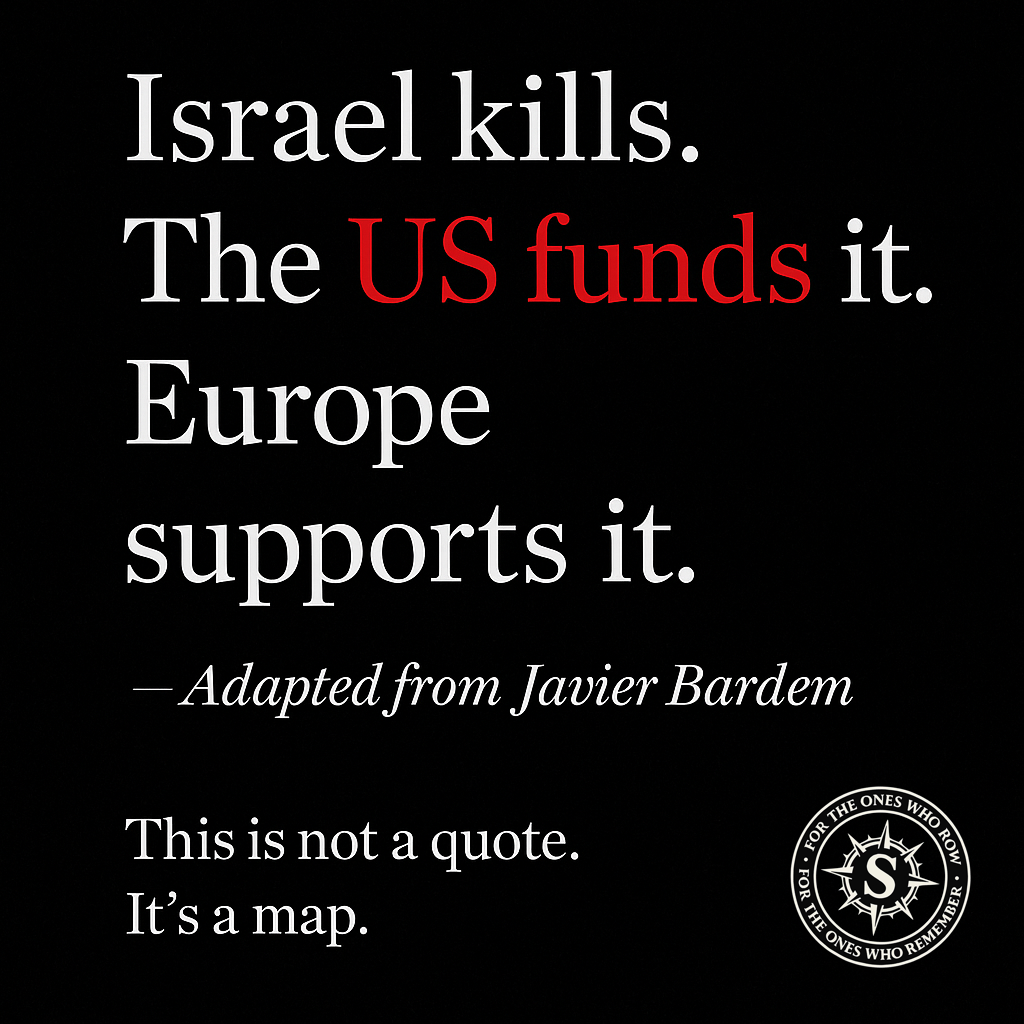
Some truths no longer need footnotes. As the Spanish actor Javier Bardem once said, bluntly and beautifully: “Israel kills. The US funds it. And Europe supports it.”
That’s not politics. That’s a map. A map of complicity. A map of whose silence lets the ship sail on.
The empire calls them unstable. Calls their leaders corrupt. Calls their children threats. But what they fear is not chaos — it’s clarity.
Because the canoe does not pretend. It knows the sea is dangerous. It knows what the pirate ship is.
And still, it rows.
Some canoes are communities. Some are movements. Some are just one grandmother who still tells the old stories — even as the bulldozers arrive.
Some of the canoes ride rivers: the Amazon, the Orange, the Missouri. In them sit the Mapuche, the Nama, the Sioux. They chant in languages the empire once tried to burn. They still paddle. They still protect.
As the bombs fall, a boy in Gaza recites lines from Mahmoud Darwish: “We have on this earth what makes life worth living.” He whispers them into the dust. Into his mother’s lap. It’s not defiance. It’s remembering.
These boats do not always win. But they do not drown quietly. Their resistance echoes — in funeral processions, in ululations, in the smell of fresh bread rising where bombs fell.
And in the far distance, something stirs. Not a boat. Not a bomb. But a wave. A rising swell of memory and reckoning. The kind that even empires cannot out-sail.
❓ Section 5: What Now?
“Maybe you can’t leave yet. But you can plant questions in the cracks of the hull.”
You’ve seen the ship. You’ve heard the cannons. You’ve walked the quiet corridors below deck. You’ve watched the canoes struggle to stay afloat.
So now the question is simple. What now?
You don’t have to be a general. You don’t have to command a fleet. But you do have choices.
You can choose not to cheer when the ship fires. You can choose not to believe the stories they sell you — about the savages, the chaos, the necessary war.
You can choose not to mock the canoe. You can choose to listen when the drowned call out from beneath the waves. You can learn their names. Say their prayers. Tell their stories.
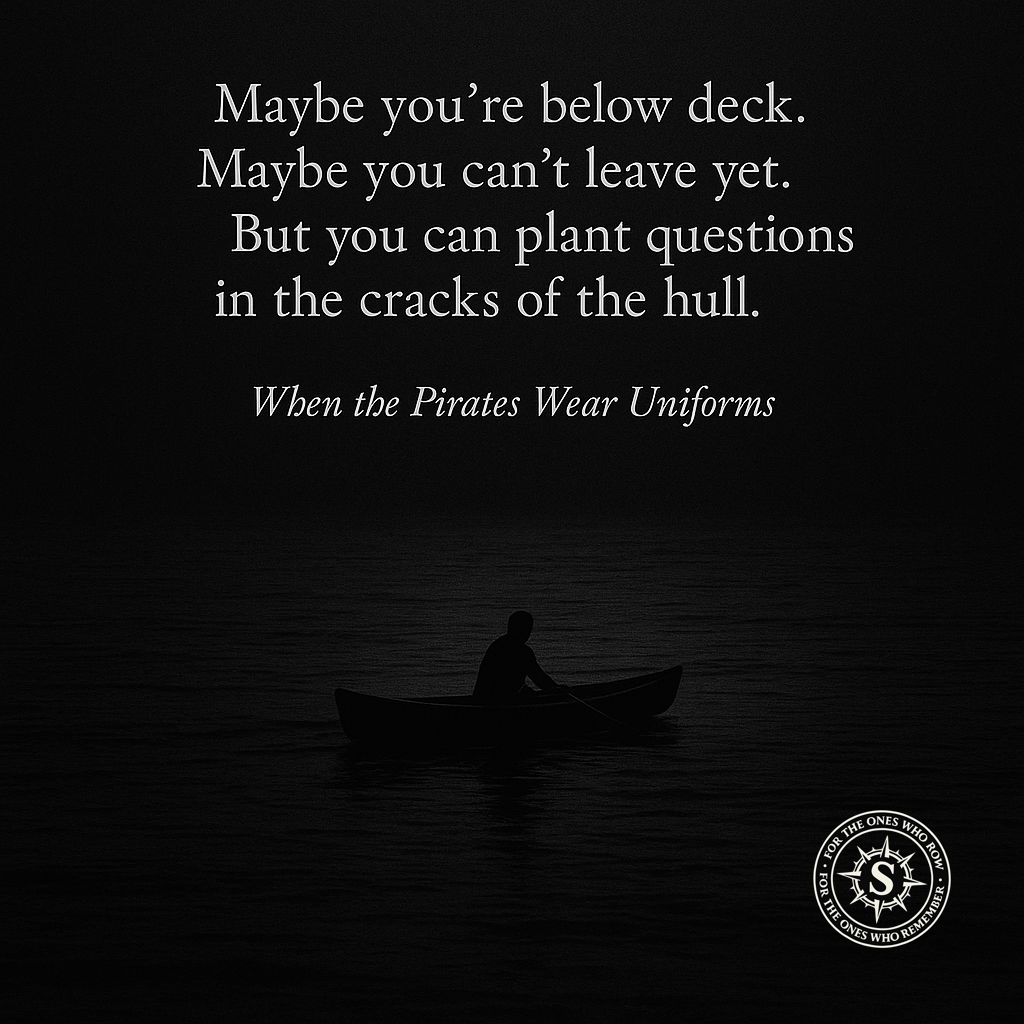
Maybe you’re below deck. Maybe you can’t leave yet. But you can plant questions like seeds in the cracks of the hull. You can make art that aches. You can whisper, even if your voice shakes.
And maybe, one day, when the ship hits a reef — you’ll already know how to swim.
🌌 Postscript: The Unseen Rows
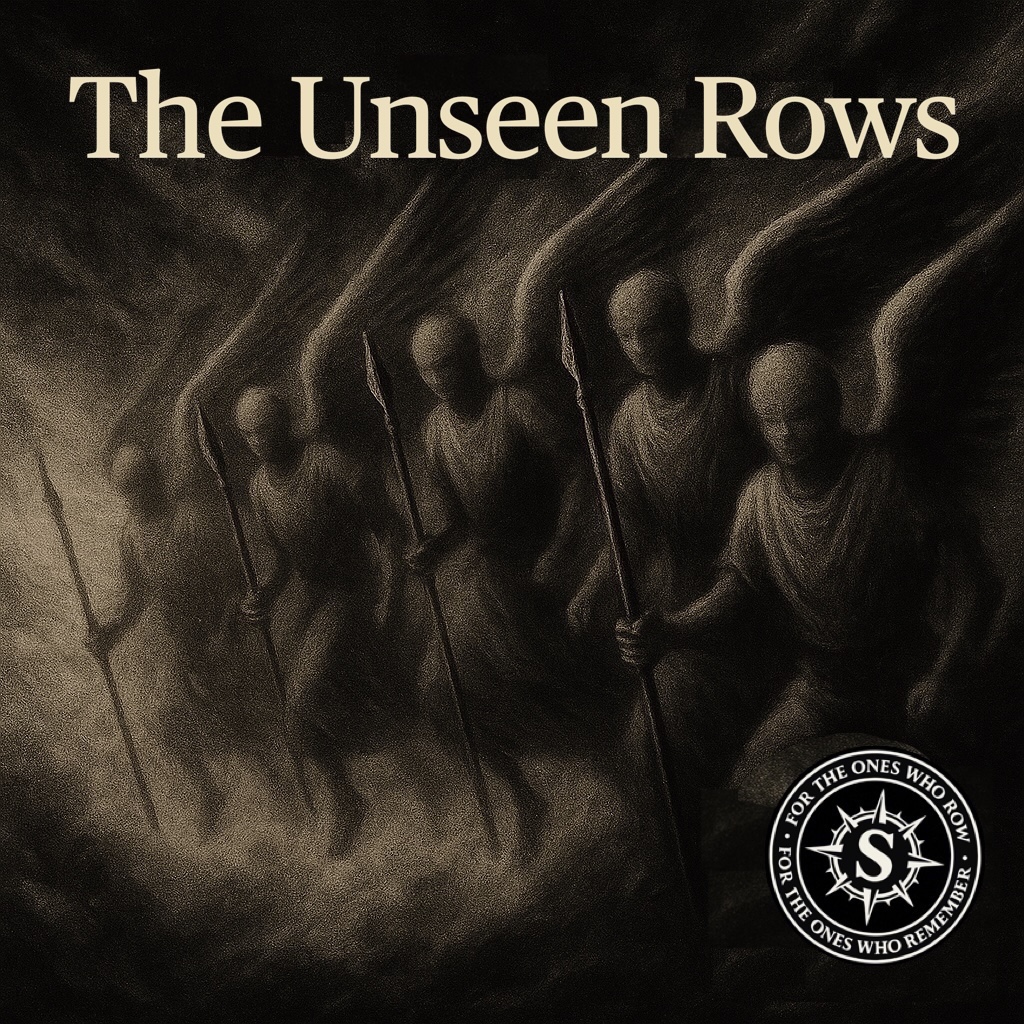
“Above the pirate ships, the angels line up.”
For the ones who row. For the ones who remember.
Above the shipping lanes and air raids, above the pirate flags and surveillance drones, above the offices and engines and war rooms — there are rows they do not see.
Al-Ṣāffāt. “By those arrayed in rows…” (Qur’ān 37:1) The angels. Not scattered. Not confused. Lined up — like soldiers of mercy. Advancing — like winds of truth. Reciting — not data, but dhikr.
وَالصَّافَّاتِ صَفًّا فَالزَّاجِرَاتِ زَجْرًا فَالتَّالِيَاتِ ذِكْرًا By those arrayed in ranks, by those who drive forward, and by those who recite the Reminder… (Qur’ān 37:1–3)
These are not symbols. They are not myths. They are the architecture of heaven. And they do not forget the ones who row.
When the shayāṭīn of power rise to steal, when the liars reach for whispers of the unseen, they are met with stones of fire. Comets hurled from truth’s edge. The skies are not neutral. The divine has guardians.
“They cannot listen to the Higher Assembly… they are pelted from every side, repelled, and for them is a perpetual punishment.” (Qur’ān 37:8–9)
And we? We row. We remember. We recite.
We do not carry cannons — but we carry verses. We are not in fleets — but we are not alone. Somewhere, angels are already in formation.
✨ A Final Word from Rafiq al-Bunduqia
The Sage on the Jetty
So here’s what I say, ne:
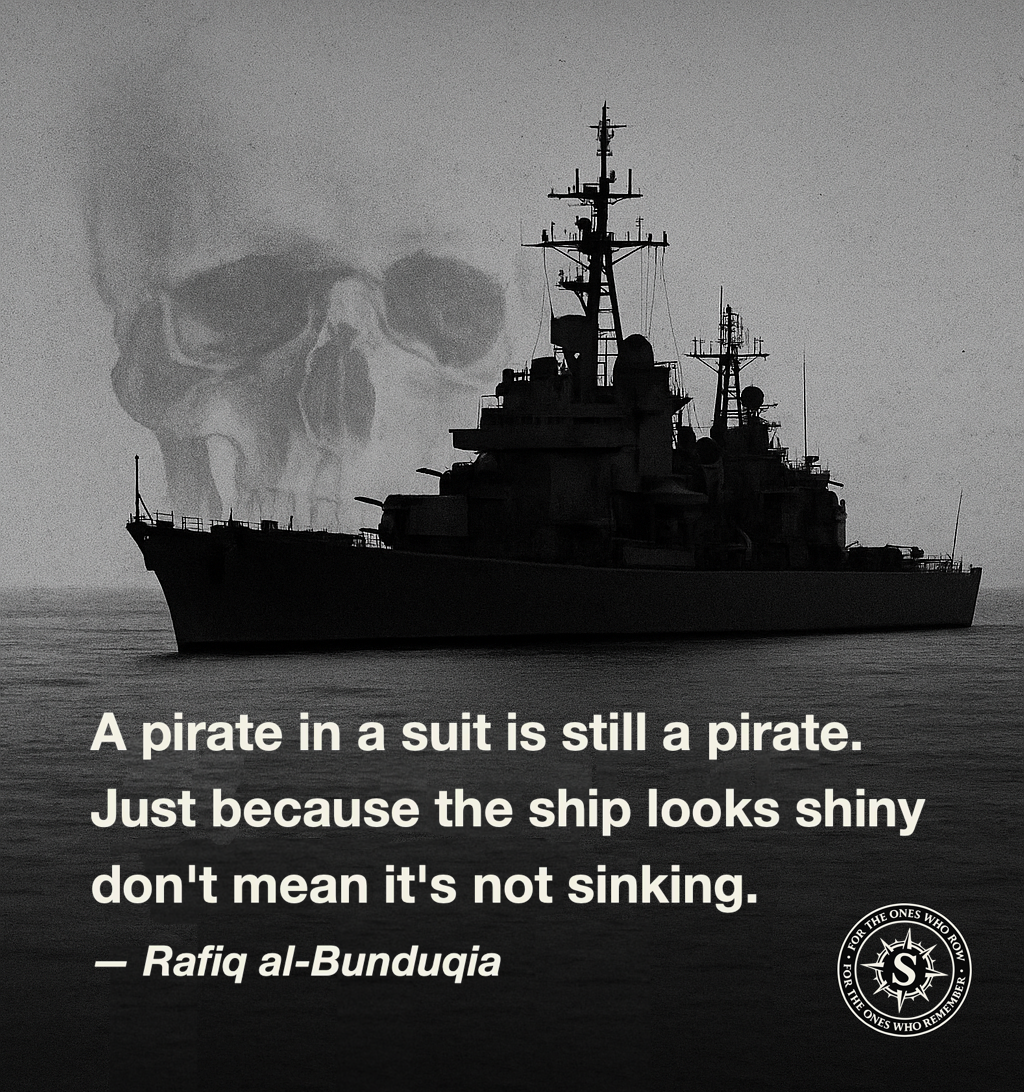
Don’t let them fool you with fancy uniforms and offshore accents. A pirate in a suit is still a pirate. And just because the ship looks shiny don’t mean it’s not sinking.
Me, I seen this before. The old flags change — but the hunger stays the same. They used to come for your gold. Now they come for your soul — and your SIM card.
They sell you peace while sharpening knives. Call it “stability,” call it “the market,” call it “regime change.” But listen close, my bru — they only change regimes that say “no.”
Below deck, I know some of you are tired. I know some of you feel small, feel stuck. But remember: Empires fall when enough people stop pretending.
You can’t steer the whole ship, but you can stop rowing. You can stop clapping for the captain. You can light a fire in your corner. And when the time comes — you’ll know which way to swim.
And as for the ones still paddling in canoes? Rowing against the wave, barefoot, hungry, heart full?
May your names be written on the wind. May your stories outlast the storm. And may your grandchildren sail free.
shotgun click
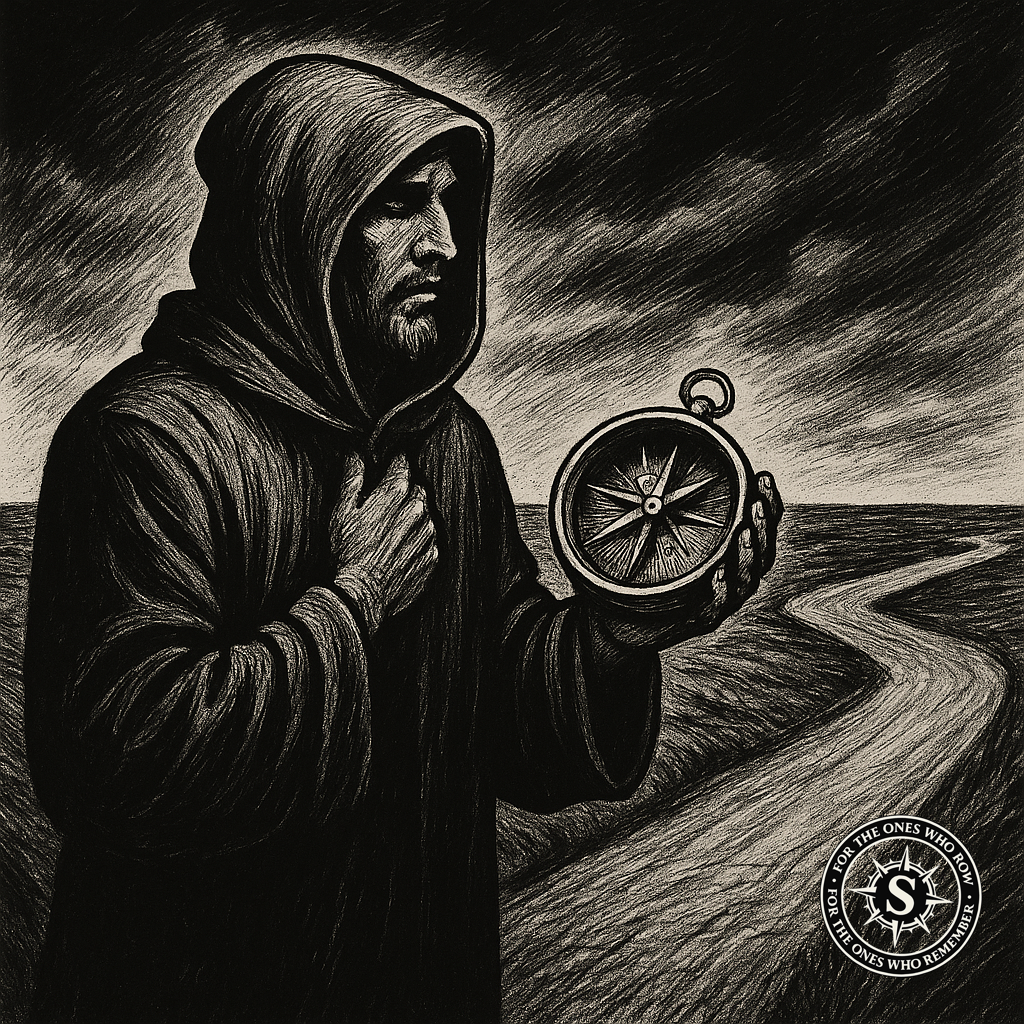
We ride till the ship breaks, bru. Until then — we don’t hand over our compass.
“Salaam to the angels who line up when we can’t. Salaam to the ones who row even with leaking boats. Salaam to the ones who still make dhikr in the dark.
And to the empire?
May you one day see what light you tried to drown.”
Ameen, and ashraaf ʿalaikum ya ṣaffāt.
The seal of remembrance — for the ones who row, and the ones who remember.
— Rafiq al-Bunduqia, The Sage on the Jetty 🧭
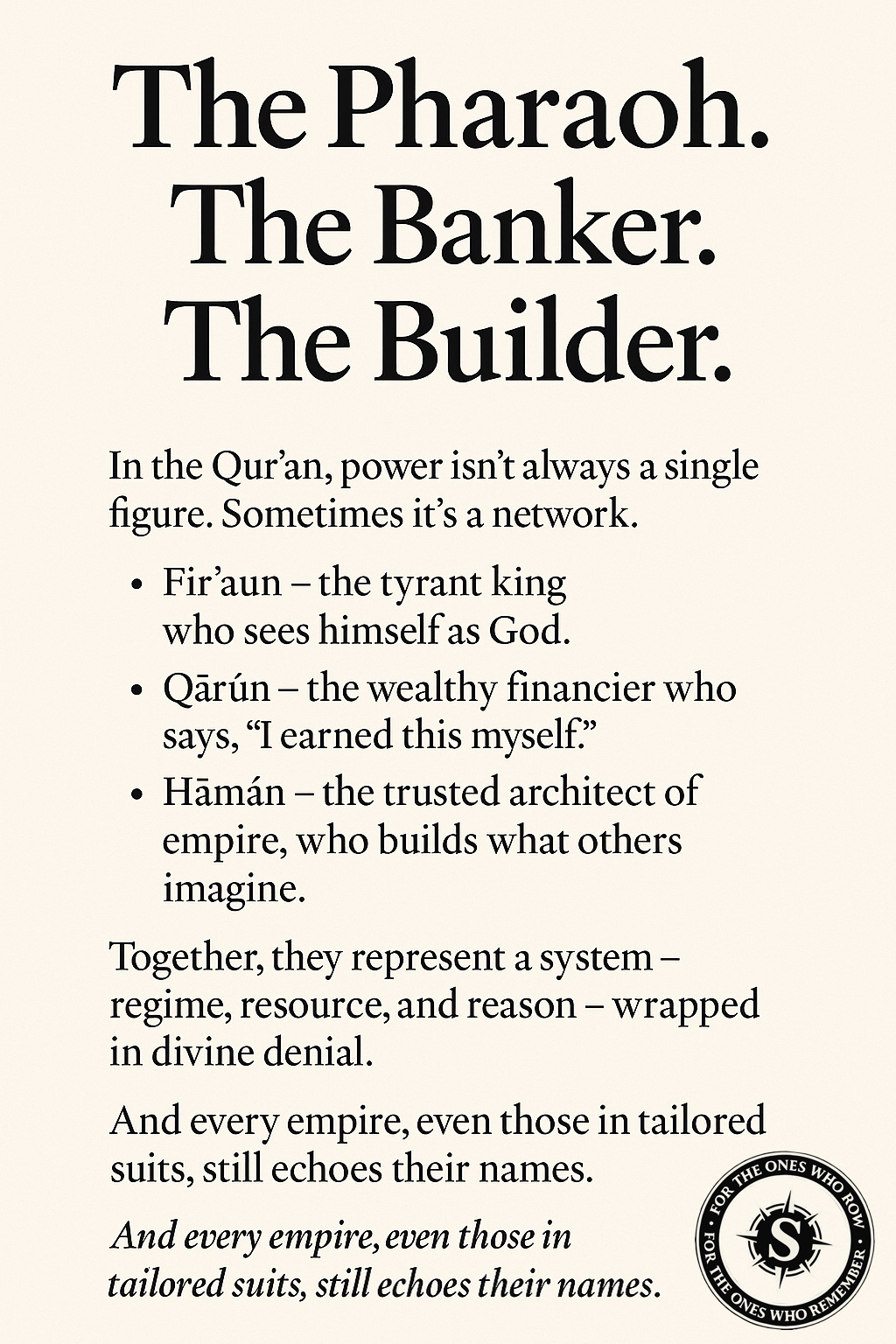
“The Pharaoh. The Banker. The Builder.”
📜 Sidebar: The Three Faces of Tyranny Fir‘awn. Qārūn. Hāmān. These three figures appear repeatedly in the Qur’an — not just as villains of the past, but as types that recur across history. Fir‘awn: the dictator, the political oppressor. He claims divinity, demands obedience, and divides people to rule them. Qārūn: the hoarder, the economic elite. He flaunts his wealth, credits no one but himself, and forgets the source of all provision. Hāmān: the enabler, the bureaucrat and ideologue. He builds towers, writes the laws, manipulates truth, and justifies oppression in the name of order. Together, they form a system: the empire that marches with a flag in one hand, a contract in the other, and blood on its boots. Sound familiar?
“Today, they wear suits. They weaponise policy. But the triad still walks among us.”
The Pharaoh, the Banker, and the Builder
In the Qur’an, they stand together — a tyrant, a financier, and a master of infrastructure. Firʿawn ruled with cruelty. Qārūn hoarded with pride. Hāmān built towers for lies.
Centuries later, the empire shapeshifts. Today, they wear tailored suits. They pass laws. They sign cheques. They pave roads to ruin.
But remembrance makes them visible. And visibility is resistance.
“The Pharaoh. The Banker. The Builder.”
🧭 Parting Compass — A Note from Rafiq al-Bunduqia
Don’t wait for the ship to turn around. Grab an oar. Row memory forward. And if they ask who you are, say: I come from the ones who remembered.
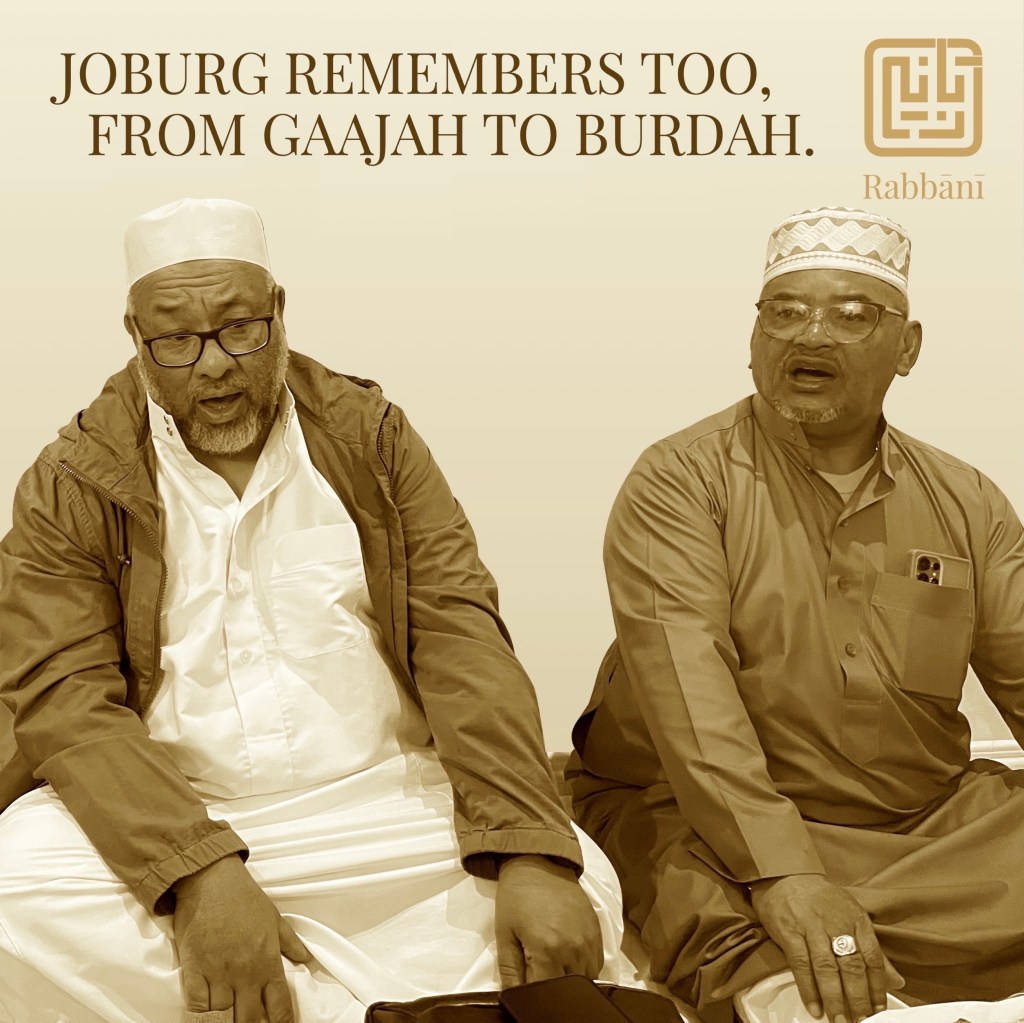
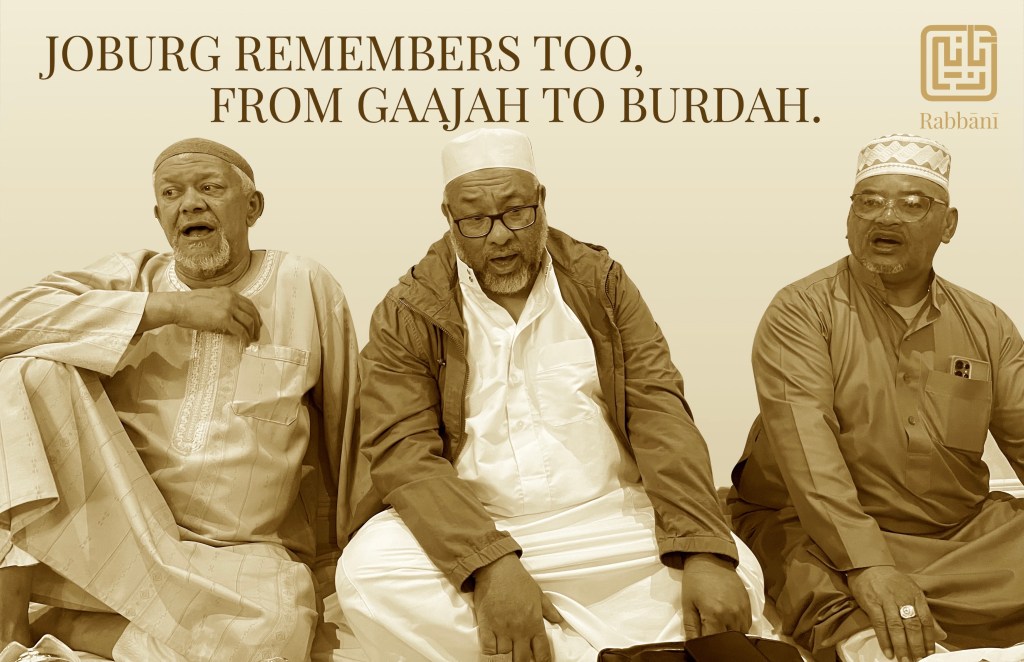
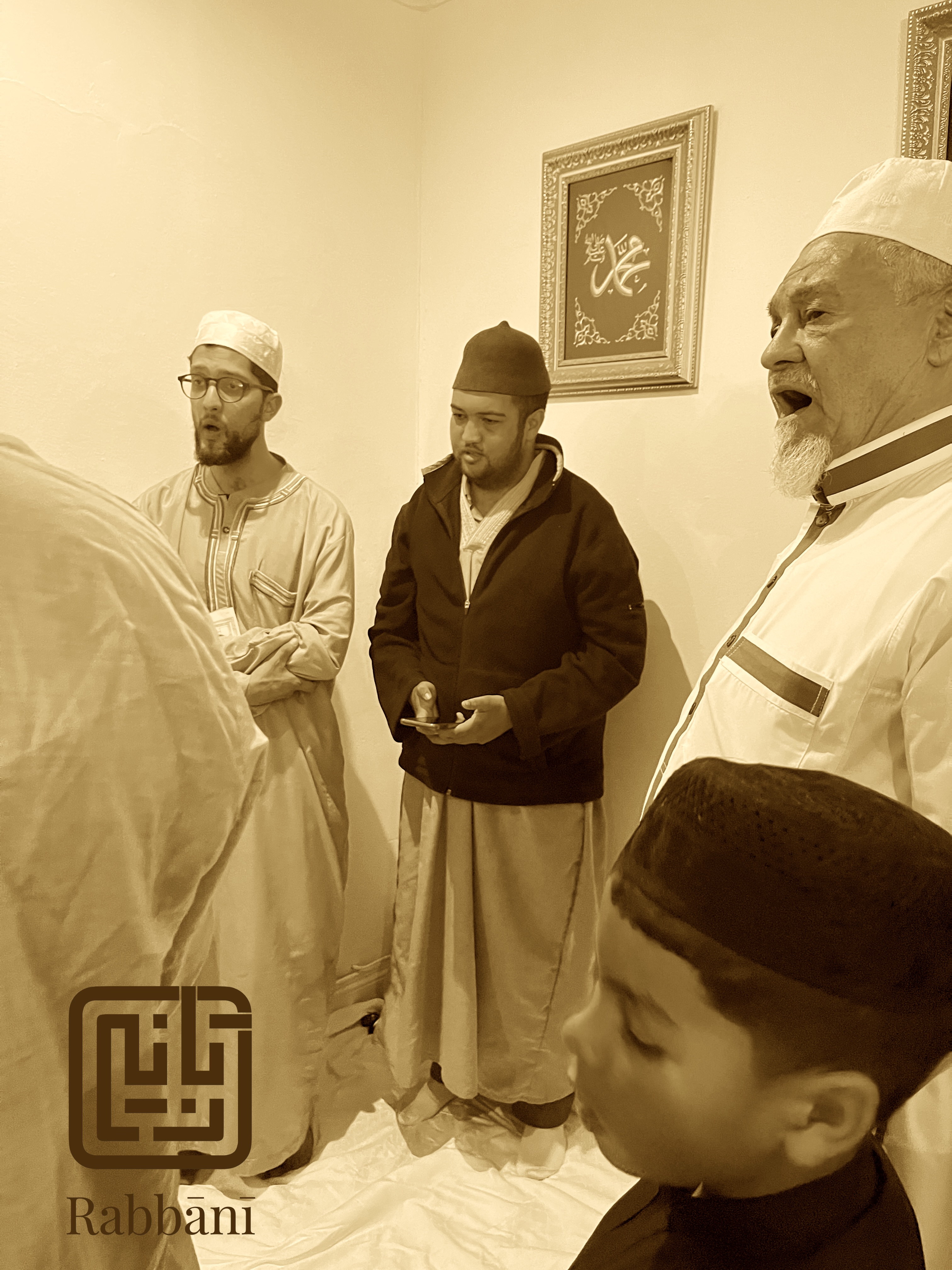
The room was warm with family and remembrance. Qur’ans lay open, voices moving together through Yāsīn, Mulk, the Quls, verses of Ḥashr and Baqara. Then came the Asmāʾ al-Ḥusnā, dhikr in chorus, and a duʿā that softened every heart.
It was called an Arwaag, but as my friend Shakeel Garda reminded me, this was really a Gaajah — from ḥājah, a need. That night the “need” was joy: the birthdays of two young daughters, celebrated with Qur’an and remembrance. In Cape Town, we are used to dhikr circling grief, but here in Joburg, it circled life — proof that dhikr belongs to both birth and remembrance.
Beyond Cape Town
Too often, Cape Town is imagined as the sole custodian of these traditions. But remembrance does not belong to one city. It lives in Worcester, in Uitenhage, in Kimberley, in Joburg — wherever Muslims have gathered to cut rampies, to recite Yā Sīn, to raise salawāt. We must widen the circle, and not let heritage shrink into a single accent or postcode.
Heritage isn’t measured by the size of a crowd, but by the pulse that refuses to stop.
A Wider Map of Memory
I laughed when Shakeel said, “Ek het amper gesamba!” — because sometimes the subtle linkages do astound us.
On language and dialect, PE-born Boeta Yusie – remembers how it felt when hearing old Uitenhage folk speak their Afrikaans, slower than usual, every word taking time to land.
And here in Joburg too, the old families — the Matthews, the Domingos, the Sallies among so many others — have carried remembrance for generations. Some, like the Sallies, trace ties to Port Elizabeth, but all became founding Johannesburg families in their own right.
In Florida North, during the Gaajah, we stood for the salawāt — the Cape inheritance. Voices rose, and in that standing it felt as if the light of Muhammad ﷺ entered the room.
Heritage does not have one accent, one city, one rhythm. It stretches wider — across towns and valleys, across languages and lineages — carried in every echo of lā ilāha illa’Llāh.
Houghton Masjid – The Chorus of the Burdah
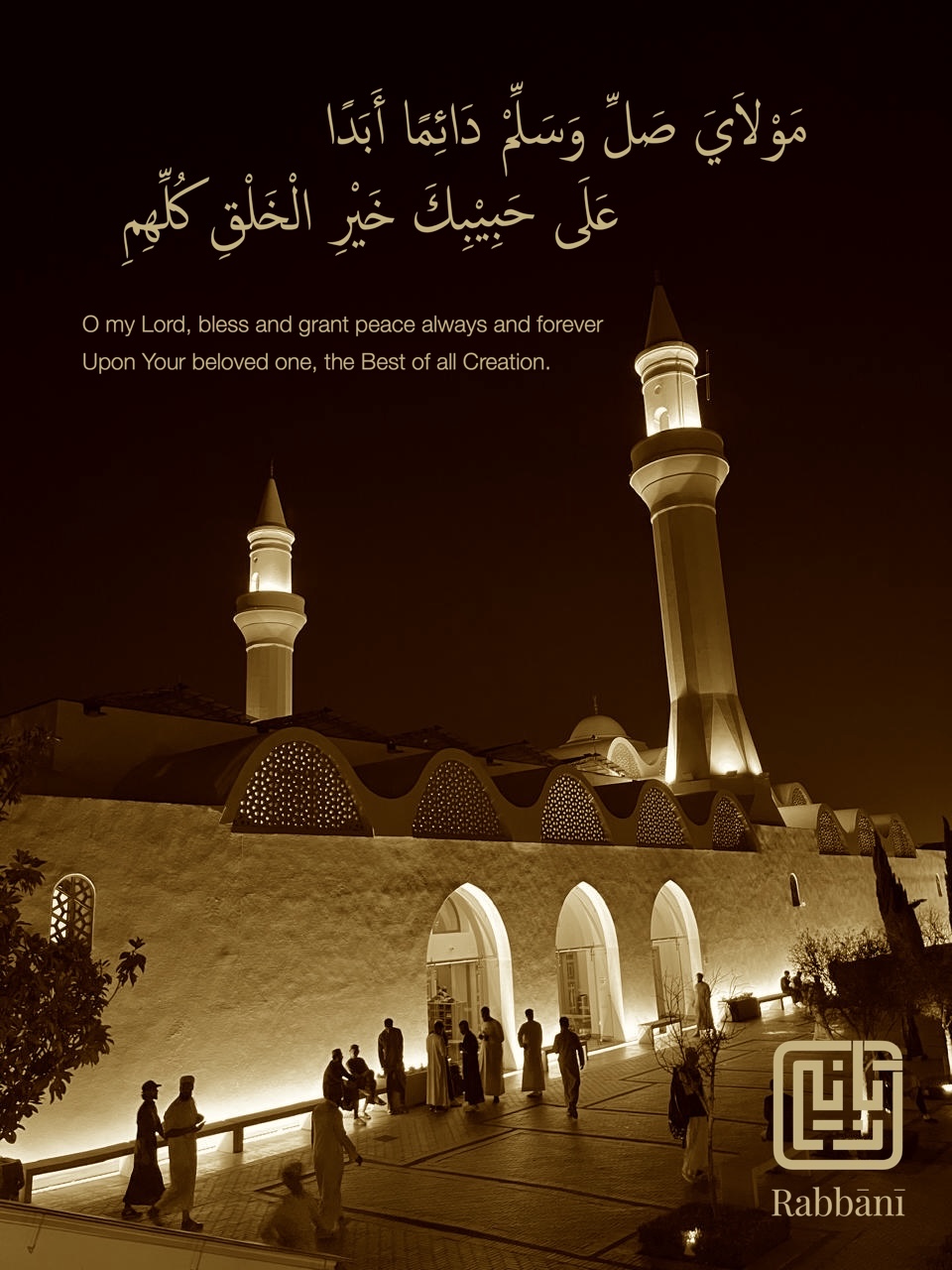
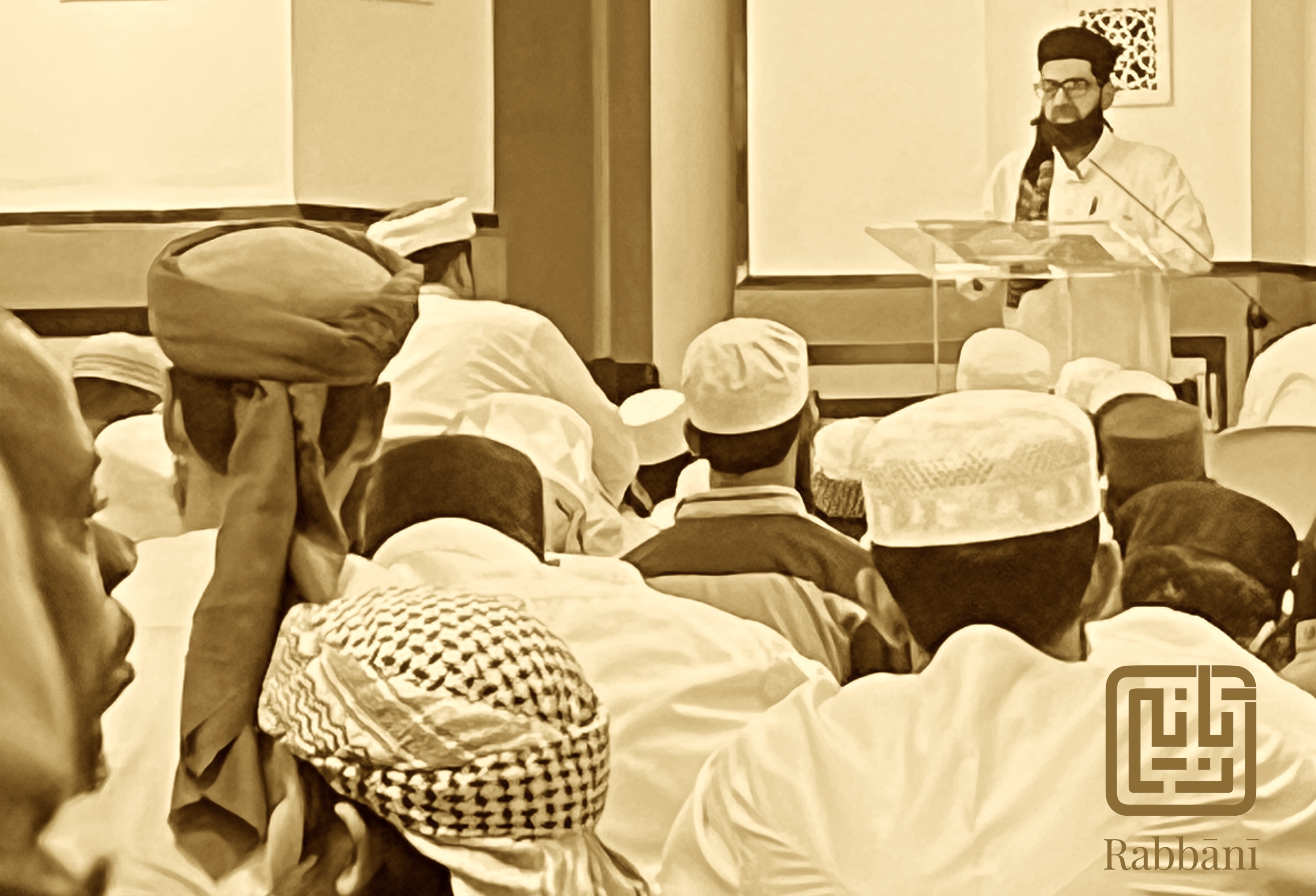
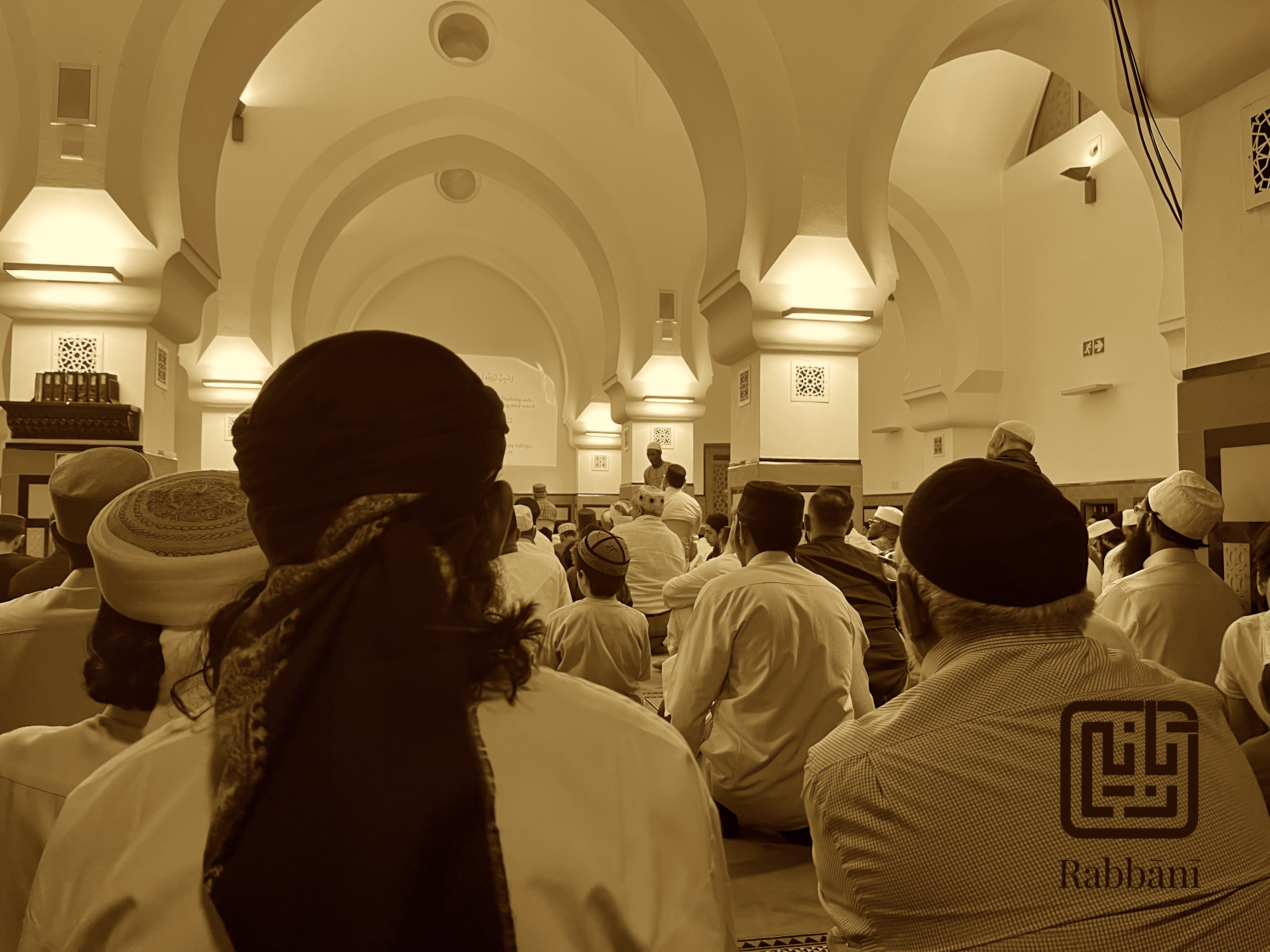
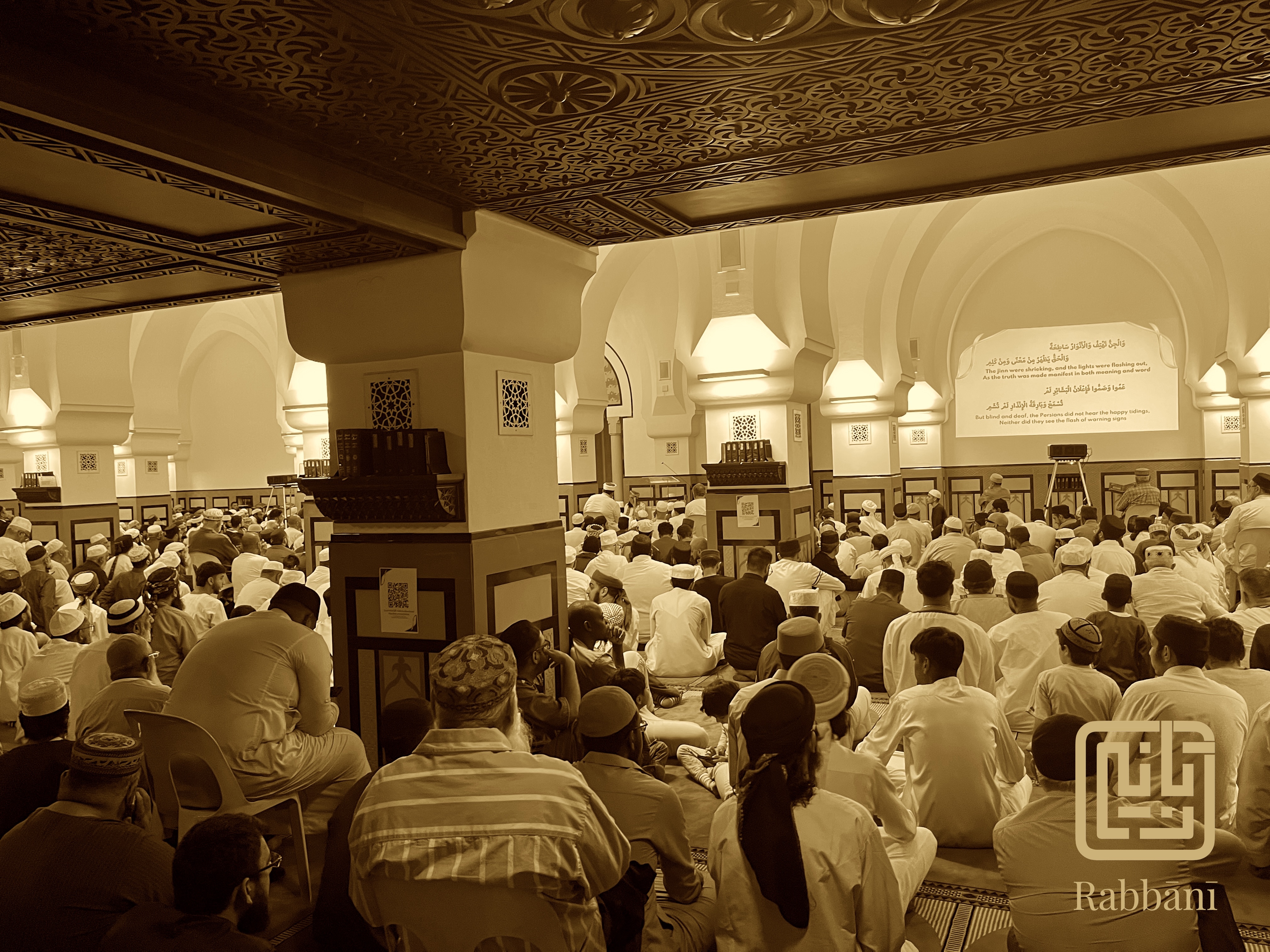
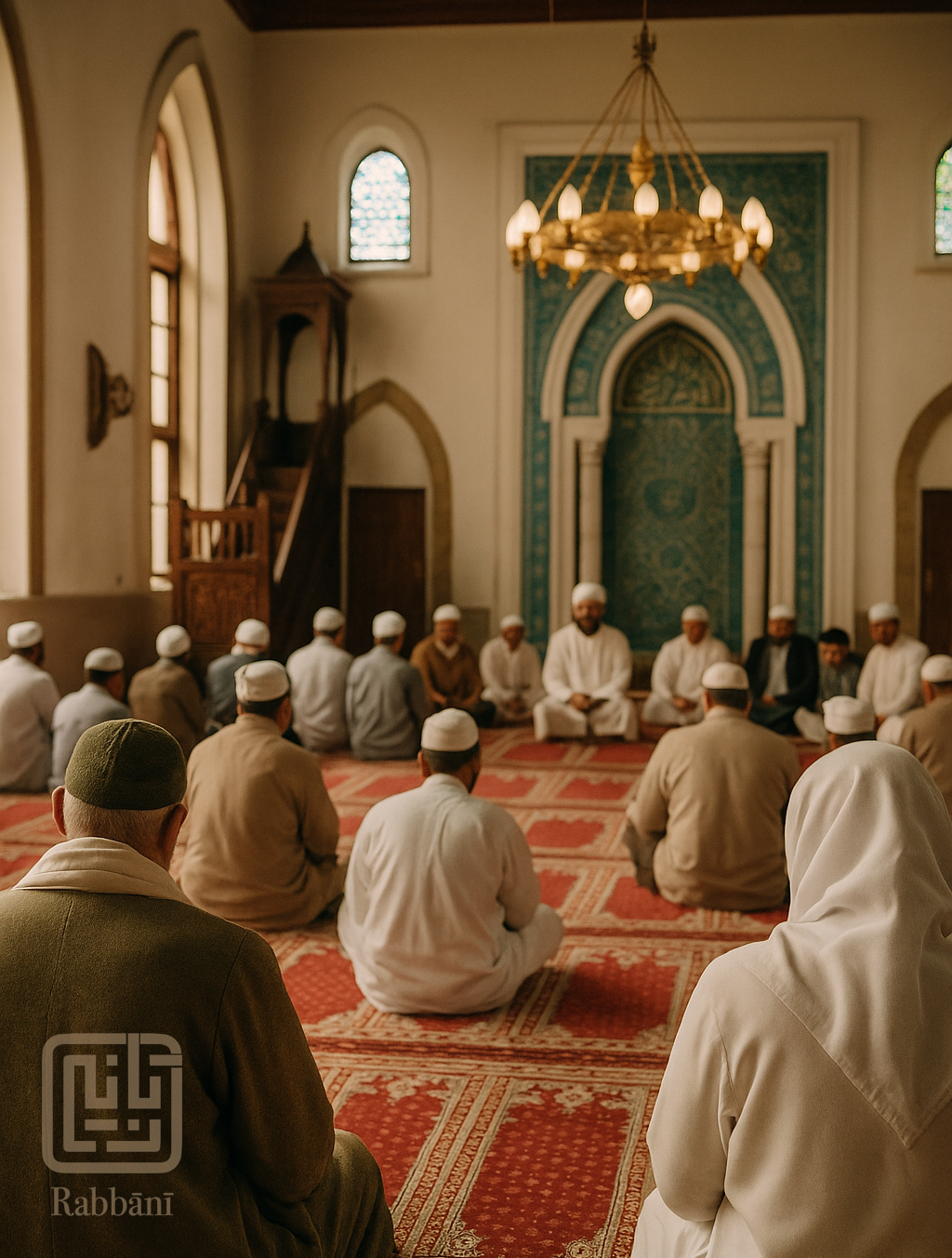
Friday night at Houghton Mosque was a different scale. The mosque was full: elders in white, young men with turbans, children by their fathers’ sides. Groups from different mosques took their turns, each with its own melody and rhythm.
Later my daughter Lala asked me, “What is this story of the Burdah? I’ve never heard this before.” I told her: “This is pure poetry! Almost like the Riwayah — the Prophet’s ﷺ life in song. But here, in the Burdah, different groups recite in turn, and together they weave a chorus.”
When I arrived at Houghton Mosque, I noticed something new. On the poster it had said: “Ladies Facilities Available.”Inside, the organisers had placed a new screen, expanding the women’s section for those who wanted to attend. It was unusual — there is already a women’s section — but this night, they anticipated more women. They made space.
That small act struck me as part of the remembrance itself: a recognition that devotion lives in inclusivity, in the care we show each other when we gather.
Before each group began, Ml Abu Hurairah Bobat guided the gathering, introducing the chapters and themes of the Qasidah Burdah. With warmth and clarity, he explained how the verses moved from praise of the Prophet ﷺ’s birth, to his struggles, to his intercession. His words opened the door for those less familiar, making the Burdah not just recited, but understood.
And then came the moment that will stay with me: as each group finished its verses, the entire jamaat — young and old — spontaneously joined in the chorus:
O my Lord, bless and grant peace always and forever Upon Your beloved one, the Best of all Creation.
It was not performance but inheritance. The refrain rose again and again until it felt as though the very walls of Houghton Mosque were singing with us.
The Lion and the Fortress
From the Qasidah Burdah, Imām al-Būṣīrī sings of the strength carried by those tied to the Prophet ﷺ:
Those whose help comes from the Messenger of Allah — Even lions encountering them in their dens would be struck speechless with fear.
He established his community within the fortress of his religion, As the lion settles down with its cubs in its lair.
Hearing the jamaat echo the chorus, I felt that same fortress. This was not nostalgia — it was strength and mercy alive in Johannesburg.
Fragrance and Victory
Later, another passage rang true to what I saw and smelled:
The winds of victory would present to you their fragrance, So that you imagine each valiant one of them to be a beautiful flower in bud.
As if, riding their steeds, they were flowers blooming upon a height, Held there not by the tautness of their saddles, but by the firmness of their resolution.
The Burdah does not only narrate victory — it perfumes it. Just as our Cape homes once scented with sandalwood and rampies, so here the fragrance of victory was carried in chorus.
Majestic Presence
And in the majesty of the Prophet ﷺ, the Burdah declares:
Like a flower in freshness and a full moon in eminence, Like an ocean in pure generosity and like time itself in strength of resolution.
Just from his majestic bearing, even when he was alone, He seemed as if amongst a great army and entourage.
At Houghton there was no standing qiyām — the tradition differs from the Cape. But the chorus of Mawlaya ṣalli wa sallim… still lifted the gathering, as if the walls themselves joined in remembrance.
Dress and Identity – From Kurta to Thobe
As I looked around, I noticed another change. When I was younger, men in Joburg mosques wore kurtas — Indian style. Now the children, young men, and elders were dressed in thobes and turbans, a celebration of the Prophet’s ﷺ attire.
Was it the influence of hajj and ʿumrah, Gulf media, or the aspiration to be closer to sunnah? Perhaps all of these. Styles shift, but the devotion remains.
Closing – Joburg Remembers Too
This Rabiʿ al-Awwal, in Heritage Month, Joburg reminded me that Cape Town does not own memory. Dhikr lives here too — in family homes, in gaajahs for birthdays, in mosques filled with Burdah echoes.
Heritage is not just remembrance, it is continuity. Not only in books, but in chorus. Not only in Cape Town, but in Joburg.
The Prophet ﷺ is in our veins and in our graves. In sandalwood tasbihs, in rampies leaves, in choruses that rise like fragrance. Remembered not only in words, but in song.
Every Rabiʿ al-Awwal, Cape Town breathes differently. The air is heavy with sandalwood smoke, the sny of rampies, the melody of the Riwayat al-Barzanji. Children once practised their lagu at home, correcting one another — because to sing the Prophet ﷺ was to sing him beautifully. Even cutting lemon leaves became dhikr.
This is Cape devotion: love woven into scent, sound, and preparation. It was never by chance. Preparation itself was worship.
The Beauty of Riwāyah
The Arabic word riwāyah (رِوَايَة) means narration. But in the Cape it became more: the sung retelling of the Prophet’s ﷺ life.
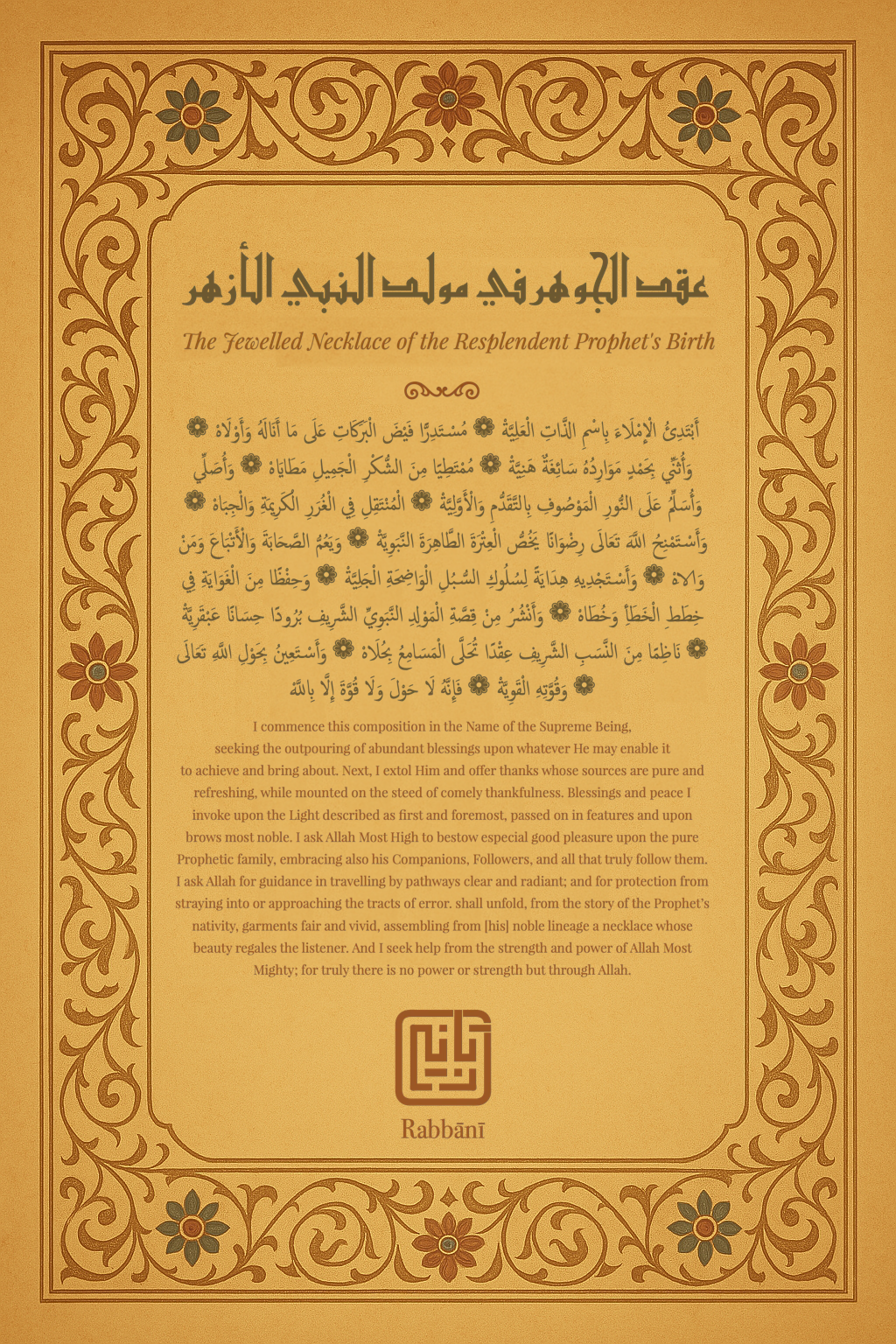
Imām Jaʿfar al-Barzanji (d. 1763), Chief Mufti of Madinah and a Kurd from Barzan, composed ʿIqd al-Jawāhir (The Necklace of Jewels). Written in rhythmic prose and poetry, it tells the noble birth and qualities of the Prophet ﷺ. From Madinah it travelled to East Africa, Southeast Asia, and the Cape, where it became the heartbeat of Mawlud gatherings — always with sandalwood burning, rampies cut, and voices rising in lagu.
How beautiful is thy face, Shining brighter than the sun. This night is lit by your light — A night of joy, a day of pride. The givers of glad tidings cried out: “The Chosen One, the Beloved, has come — rejoice!“
From Barzan to Jerusalem to the Cape
The same Kurdish soil that gave us Barzanji also gave us Ṣalāḥuddīn al-Ayyūbī (Saladin) — the liberator of Jerusalem in 1187. One carried the pen of devotion, the other the sword of justice.
🌿 The Cape inherited both: singing the riwāyah with love, and resisting injustice with courage. Devotion is never only ritual — it is also justice.
Mawlud and the Question of Evidence
Every year, voices say: “Mawlud is bidʿah. It is ḥarām.” But as Shaykh Allie Khalfe reminds us, declaring something ḥarām requires qatʿī (decisive) proof in both chain (thubūt) and meaning (dalālah). No such text exists.
Instead, the Qur’an itself honours prophetic birthdays:
“Peace be upon him the day he was born” (Q 19:15) — Yaḥyā.
“Peace be upon me the day I was born” (Q 19:33) — ʿĪsā.
The Prophet ﷺ also endorsed gratitude for sacred days. When the Jews fasted to commemorate Musa’s deliverance, he said: “We have more right to Musa than you” — and he fasted (Bukhārī, Muslim).
If deliverance is worthy of commemoration, how much more the birth of Muhammad ﷺ, mercy to the worlds (Q 21:107).
Graves, Memory, and Reverence
Some argue: “Level the graves.” They quote hadith forbidding plastering or building on tombs. But the Qur’an records that when the People of the Cave were discovered, those who prevailed said: “We will surely build a masjid over them”(Q 18:21).
Our sacred sites confirm this:
The Hijr Ismāʿīl beside the Kaʿbah contains the graves of Hājar and Ismāʿīl.
Masjid Nabawī encloses the Prophet ﷺ, Abū Bakr, and ʿUmar.
The Cape’s kramats — Tuang Yusuf, Tuang Guru, Tuang Mahmud — stand as circles of remembrance.
These are not shirk but reverence, places of memory and duʿāʾ. To erase them is to erase ourselves.
Activism as Sunnah
The Prophet ﷺ left us more than rituals. He left us justice. The Constitution of Madinah established a civic community across religions and tribes.
That spirit carried into the Cape’s struggle against apartheid. In the Call of Islam, the Muslim Youth Movement, and the National Muslim Conference at UWC (1992), activists remembered the Prophet ﷺ not only with salawāt but with action — defending equality, insisting on women’s inclusion, placing youth at the centre. To live his Sunnah is to resist injustice.
The Everyday Sunnah
And yet, his legacy is also small, intimate. To say “Ahlan wa sahlan” at the door is prophetic. To put on the kettle and share food is prophetic. To dress with dignity, to smile, to eat together — these are echoes of the Prophet ﷺ at the table.
That was my final note on Radio 786: Mawlud is not just once a year, but lives in every act of welcome, in every gathering, in the rhythm of our homes.
Gadija’s Reflection
At the close of our conversation, Gadija Ahjum reminded listeners that these traditions are not nostalgia but a living inheritance. They still speak to Cape Town today — in song, in struggle, in everyday acts of kindness. Her words were a benediction: that we must hold on to these echoes, because they remind us who we are, and whose love runs in our veins.
Closing: In Our Veins, In Our Graves
The Prophet ﷺ is not only in our books. He is in our veins — in sandalwood tasbihs from Makkah, in rampies leaves cut by children, in songs sung through the night. And he is in our graves — in the kramats that guard our Cape, in the Hijr Ismāʿīl, in Masjid Nabawī itself.
This is the beauty of riwāyah: history retold in the key of love, memory carried on the breath, the Prophet ﷺ remembered not only in books, but in song.
And then comes the moment every Cape gathering knows. The reciter enters the salawāt, and we rise. To stand in qiyām is to welcome the Beloved ﷺ into the room. Voices swell, hearts open, and it feels as though his light enters the gathering like fragrance. This is not metaphor — it is inheritance. In standing, we join generations before us, declaring with our bodies and our voices: the Prophet ﷺ lives in our veins, and in our graves.
🔗 Related Blogs & Reflections
🌿 The Prophet in Our Veins — Cape Mawlud traditions, sandalwood, inheritance: Read here
🧭 Tourist in My City — walking Cape Town’s sacred geography: Camissa, Slave Lodge, Bo-Kaap, Tana Baru: Read here
🕊️ A Family Dhikr Between Birth and Remembrance — names, dreams, duʿāʾ across generations: Read here
🌊 Get Rooted, Walk Through the Sea — faith at life’s thresholds: Read here
🕌 Streams of Ink and Streams of Light — reflections on adab, ink, and the mosque as living memory: Read here
The Prophet in Our Veins: On the Scent, Sound, and Song of Cape Devotion
Introduction: Rabi al-Awwal and the Living Presence
Rabi al-Awwal has arrived — the month in which many commemorate the birth of the Prophet Muhammad ﷺ. But beyond the formal gatherings and public sermons, there are other ways his presence is felt.
This blog reflects on three threads of remembrance: the Prophet ﷺ as a guide in our political struggles, a source of poetic longing, and a quiet presence in our daily lives — folded into our homes, habits, and inherited silences.
I. The Constitution of Madinah and the Call of Islam: A Political Sunnah of Justice
In the 1980s, the anti-apartheid movement in South Africa gave birth to many political and religious formations. Among them was the Call of Islam, a progressive Muslim organization that took inspiration from the Prophet Muhammad’s ﷺ example as a political and ethical leader.
At the heart of its formation was a sense that Islam was not simply a private affair, but a force for justice. The Prophet’s ﷺ Constitution of Madinah — a model for pluralism, shared civic belonging, and accountability — offered a living blueprint. In our reading circles and public addresses, we didn’t only study fiqh. We studied the Sunnah of justice, the Sunnah of solidarity, and the Sunnah of standing with the oppressed.
This legacy reached a milestone in the 1992 National Muslim Conference, where Muslims from diverse traditions gathered to imagine a future democratic South Africa. The Prophet’s ﷺ example was not presented as abstraction but as compass — guiding how Muslims might live in plural, equal dignity with others.
Today, the landscape is very different. There are Muslim judges, radio stations, political parties. But let us remember: these were not always guaranteed. Many of the freedoms now enjoyed were carried on the shoulders of those who took risk — and who understood the Prophet ﷺ not only as a man of prayer, but as a statesman of vision.
II. Verse as Vessel: Poetic Devotion and Madīḥ
In the lands of Africa, madīḥ — praise poetry — has always been more than art. It is invocation, love-letter, protest, and memory. In my own work, I’ve found that poetry often says what footnotes cannot.
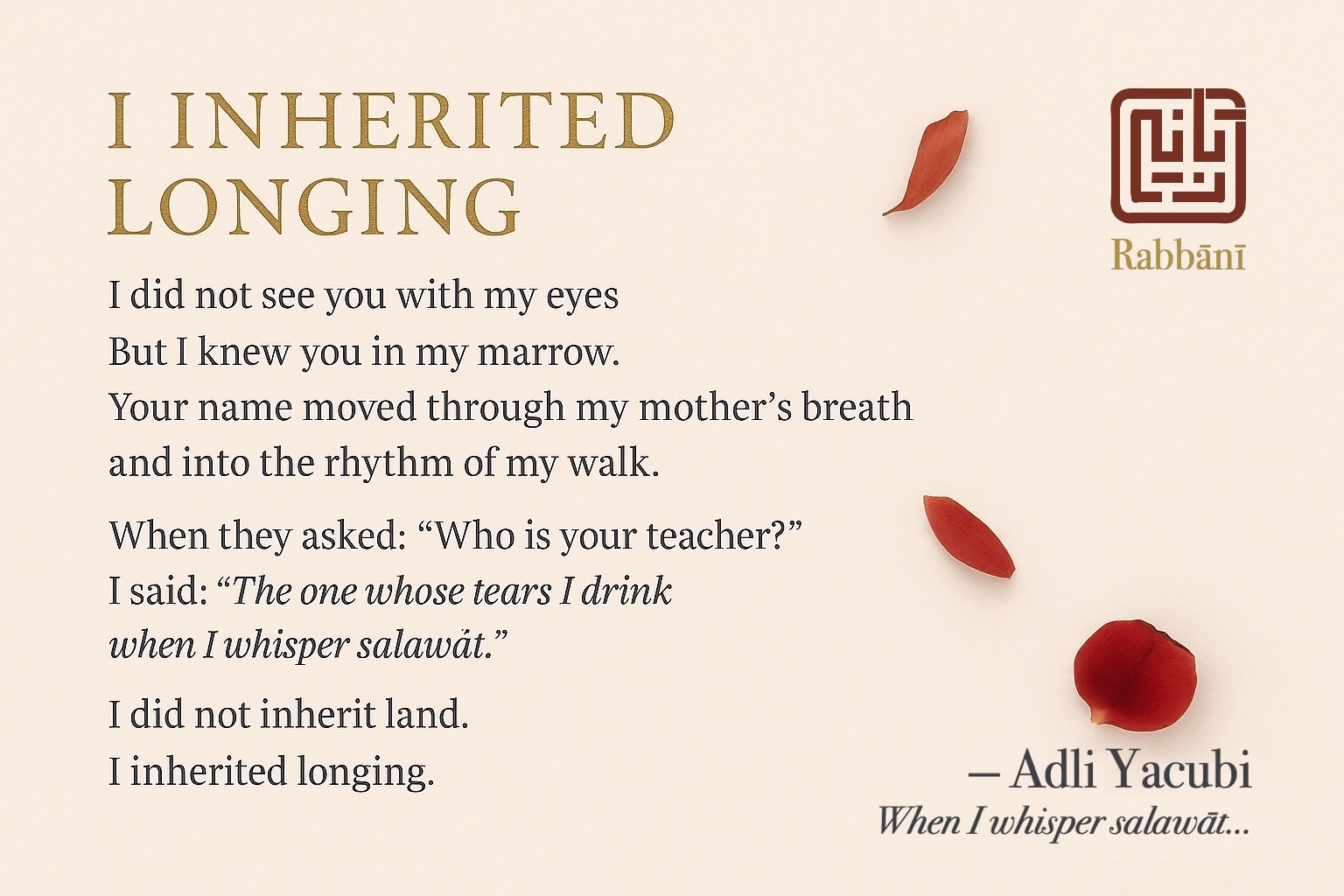
Take for example this poem, I Inherited Longing:
I did not see you with my eyes But I knew you in my marrow. Your name moved through my mother’s breath and into the rhythm of my walk.
When they asked: “Who is your teacher?” I said: “The one whose tears I drink when I whisper salawāt.”
I did not inherit land. I inherited longing.
This is not biography. It is embodiment.
Across Cape Town and Johannesburg, poets still recite verses that draw the Prophet ﷺ close — not as distant figure, but as intimate companion. This is how many of us came to know him: not through doctrine alone, but through dhikr, dreams, rhythm, and rhyme.
III. The Prophet Among the People — Salawāt and Everyday Sunnah
If sīrah shapes our public imagination and verse stirs our hearts, then the most enduring presence of the Prophet ﷺ lies not in the pages of a book, but in the lived habits of South African Muslims. In Cape Town especially, his memory is invoked not only in grand commemorations but in the daily, quiet acts of care, courtesy, and devotion.
From the kettle always on the boil to the salawāt murmured in pre-dawn hours, the Prophet’s ﷺ legacy breathes through a tradition of service and subtlety. One sees his trace in janāzah preparations, in unspoken generosity, and in how the kitchen is cleaned before Maghrib. These are not mere habits. They are sacred echoes — practices with deep Prophetic roots.
Among the Cape’s most enduring spiritual inheritances is the Ratib al-Haddād, chanted for decades — if not centuries — in mosques and homes. This litany, associated with the Ba ʿAlawī tradition of Hadhramaut, Yemen, is recited rhythmically, often in gatherings after Maghrib or ‘Ishā’. Alongside it, a particular standing salawāt is recited with heartfelt rhythm, in the deep belief that the light and rūḥ of the Prophet ﷺ enters the space when we call upon him. This is not metaphor. It is presence.
The Cape is also home to a rare spiritual text: an Afrikaans Ratib al-Haddād written in Arabic script. In it, Kaaps-Afrikaans phrases — such as Onse Here is Groot and Help ons met die dode — appear with Qur’anic reverence. The tasbīḥ, duʿā’, and barakah of our forebears were carried in a mother tongue now often dismissed. But they knew what they were doing: encoding devotion into daily speech, transmitting Prophetic rhythm in a creole born of struggle and longing.
Perhaps most evocatively, the Riwayat al-Birzanji — a melodic storytelling of the Prophet’s ﷺ birth and life — is performed during Moulood celebrations. My sisters would sing the first Riwayah in rich melody, sometimes referred to as laaghoe, or in Arabic terms, maqāmāt. These musical modes carried not only tune but transmission, passing down a soundscape of longing across generations.
These gatherings — echoing devotional practices from South Asia, East and North Africa, and Southeast Asia — show that Cape Muslims are not an isolated outpost. We are part of a vast archipelago of Prophetic love, linked not only by history but by rhythm, breath, and remembrance.
The First Riwayah composed by Sayyid Ja’far Ibn Hasan Al-Barzanji. In Arabic and English translation.
IV. Kramats and Cape Saints: Circles of Protection
If you trace a map around Cape Town, you will find sacred sites known as kramats — shrines of saintly Muslims, many of them exiled scholars or spiritual leaders, whose presence shaped the region’s barakah.
Among the most revered is the kramat on Robben Island, believed to be the resting place of Tuang Mahmud Moturu, a 17th-century imam from Indonesia exiled by the Dutch. According to oral tradition, he carried with him the Qur’an and the example of the Prophet ﷺ. Even Nelson Mandela is said to have visited the kramat while imprisoned — a quiet act of respect for the spiritual presence that surrounded him.
These kramats, stretching from Robben Island to Constantia, Faure to Bain’s Kloof, form what many refer to as a Circle of Islam, a protective perimeter believed by many Cape Muslims to spiritually guard the city. Even today, before departing for Hajj, many families visit these shrines to offer fātiḥah, seeking barakah and requesting the intercession of these tuangs — elder scholars and saints who represent a spiritual lineage of struggle, exile, remembrance, and return.
It is no accident that these saints were also poets, teachers, and bearers of the sunnah. Their legacies weave the political with the spiritual, the literary with the lived. They stand as embodied representations of Prophetic devotion: not merely followers, but inheritors — those who carried the scent, the sound, and the story of the Beloved ﷺ into the soil of the Cape.
These shrines are not merely gravesites. They are circles of remembrance. People visit with incense and duʿā’. Children are told stories. Salawāt is recited softly in the wind. In these spaces, the Prophet’s ﷺ spirit is invoked not as metaphor, but as living memory — guiding, protecting, witnessing.
V. The Prophet at the Table
When guests arrive in Cape Muslim homes, the first word is often “Ahlan wa sahlan.” It means “Welcome,” but more than that, it means: “Come as one whose path has been made smooth.” This is the spirit of the Prophet ﷺ at the table.
Food is sacred here. When someone leaves for Hajj, families gather to recite salawāt and Qur’an. At weddings, a murmur of salawāt often follows the couple as they walk out — not choreographed, just habit. These are rhythms inherited, not invented.
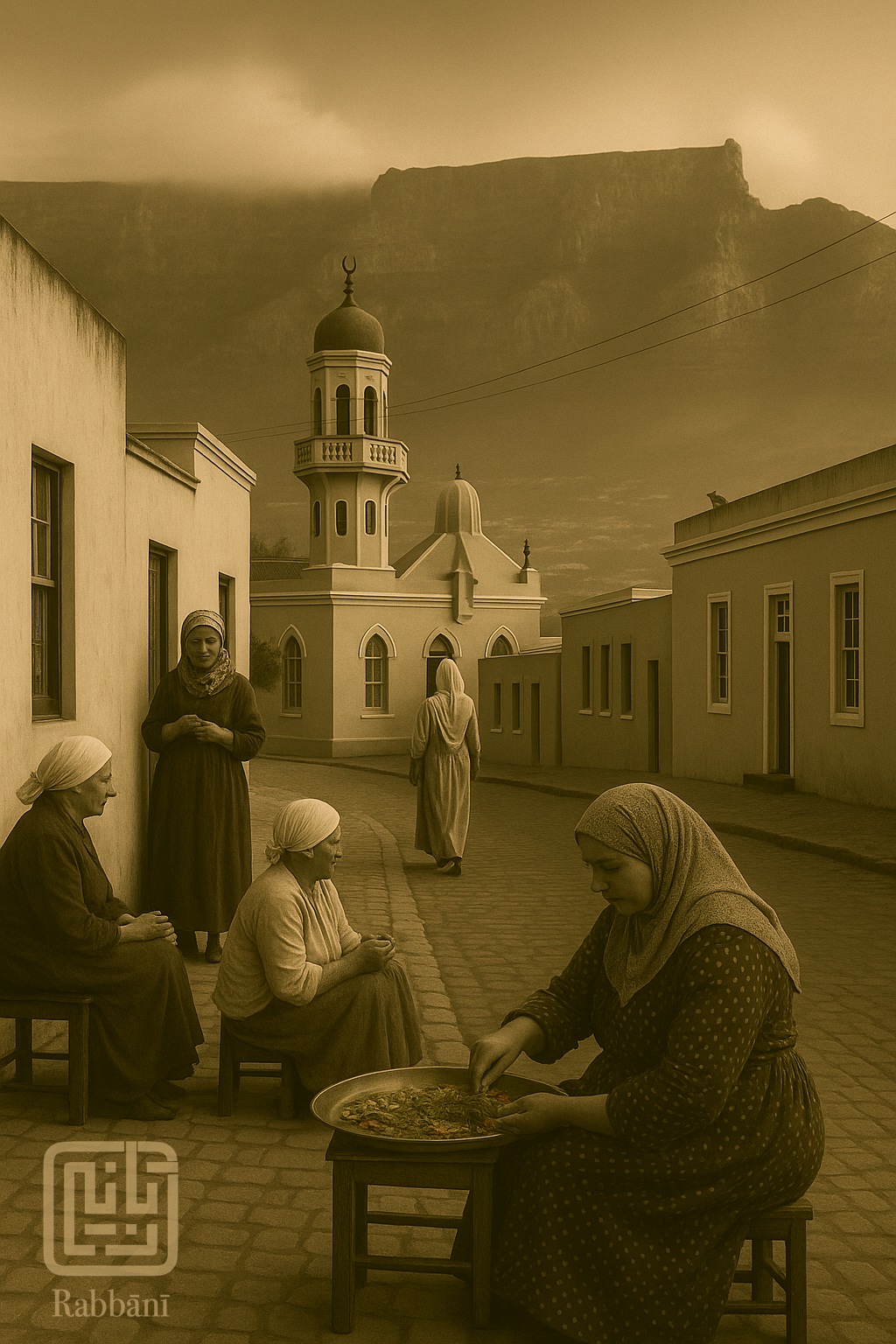
One of the most fragrant practices is the rampies sny — the cutting and perfuming of rose petals and leaves in preparation for the Moulood. Elders and children sit together, scenting the petals with rosewater, folding them into small cloths, whispering praises. It is not performance. It is love.
The Prophet ﷺ is not only remembered here. He is welcomed — into the threshold, into the breath, into the heart of the home.
Conclusion: The Prophet in Our Veins
Prophet Muhammad ﷺ is with us — in scent, sound, and song. He is in our veins. Pic: Shafiq Morton
We began with the idea that the Prophet Muhammad ﷺ is not a distant figure. Not only in the libraries, not only in the inherited manuscripts or well-attended Mawlid halls. He walks with us still — in our struggles for justice, in our poetry of longing, and in the subtle ways we greet, grieve, and gather.
In South Africa — and especially in the Cape — this presence is not always announced from the pulpits or debated in institutions. It is poured into tea. It is stitched into janāzah cloth. It is recited in whispered salawāt and sung in melodies passed down from mother to daughter, uncle to nephew.
The Prophet’s ﷺ legacy here has always been both principled and poetic — shaped by anti-apartheid resistance as much as by spiritual yearning. And in the rampies of Moulood, the maqāmāt of the Riwayah, and the rhythm of the Afrikaans Ratib, we find not just echoes of his name, but traces of his light.
He is with us — in scent, sound, and song. He is in our veins.
PostScript
Here is a beautiful salawāt from Salat an-Nuraniyya of Ahmad al-Badawi; also called Salawat Badawi Kubra…
O Allah! Exalt, greet and bless our master and liege lord Muḥammad, the Tree of Original Light, the Sparkle of the Handful of Divine Mercy, the Best of All Humankind, the Noblest of Physical Frames, the Vessel of the Lord’s Secrets and Storehouse of the Sciences of the Elect, the Possessor of the Original Divine Grasp, Resplendent Grace, and Uppermost Rank, under whose flag line up all the prophets, so that they are from him and point to him.
From Sunday’s Kitāb al-Shukr to Monday’s Minhāj al-Ṭālibīn, tracing the chains of Shāfiʿī knowledge, the whispered wisdom of teachers, and a daily breeze of remembrance.
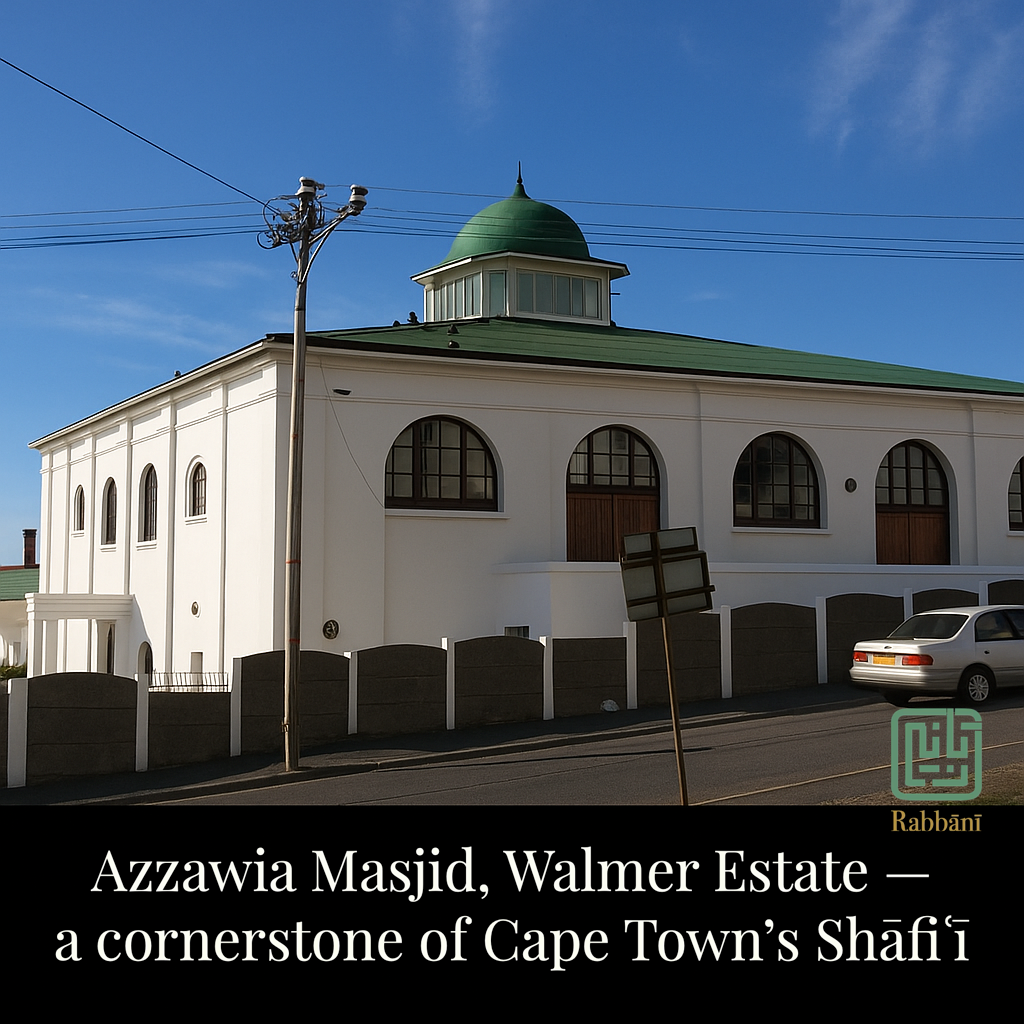
Azzawia Masjid, Walmer Estate – a cornerstone of Cape Town’s Shāfiʿī scholarship and spiritual tradition.
Sunday Morning – Chains of Knowledge, Wings of Mercy
Last Friday, Al Ameen, my swaer, took me to Al Azawia Mosque in Walmer Estate. I had only wanted to greet Shaykh Achmad Hendricks, who was delivering the Jumuʿah khuṭbah. But in the front ṣaff, I also took hands with Shaykh Allie Khalfe.
He smiled and said, “Adli, I’m glad you are here in Cape Town. Come to my dars this Sunday morning.”
I went.
The gathering was in the old style — a teacher seated, a text in Arabic before him, the words flowing into English explanation. Shaykh Allie was reading from Imām al-Ghazālī’s Kitāb al-Shukr (Book of Gratitude). Before the lesson began, Rashaad recited the Qaṣīda al-Burda Sharīf with the beat of the duff — a reminder that knowledge, in our tradition, is not only in the mind but in the heart, the breath, the rhythm.
The room carried the scent of chains of transmission — ustādh to ustādh, back to the author, to the early masters, to the Messenger ﷺ. We were given a chart in Arabic, thirty or so key uṣūl al-fiqh terms, the kind that open doors into the Qurʾān’s architecture. A gift in itself.
Shaykh Allie moved between concepts — ʿilm, tafakkur, ḥāl; gratitude as both unveiling and action; the way arrogance blinds and mercy gives wings; Allah’s command in the Qur’an for Mūsā عليه السلام to speak kindly even to Pharaoh; and how every act, every vessel, every design is part of tawḥīd.
He reminded us that knowledge is not a library of abstractions but an ʿamal — a living response. That Bismillah should precede everything, and that the chains we hold are not shackles but the silsilah — the unbroken links of teachers and students — which, when pulled, draw the heart closer to Allah.
At the end, he placed in my hands a book: A Journey Through Time with Al-Shāfiʿī, Muhammad bin Idris, Volume 2. Another link in the chain, another door to open.
I left with the sense that gratitude itself is a journey — from the first Bismillah to the final Alhamdulillah — and that Cape Town, for all its winds, still holds corners where the old way of learning is alive, unbroken, and quietly shining.
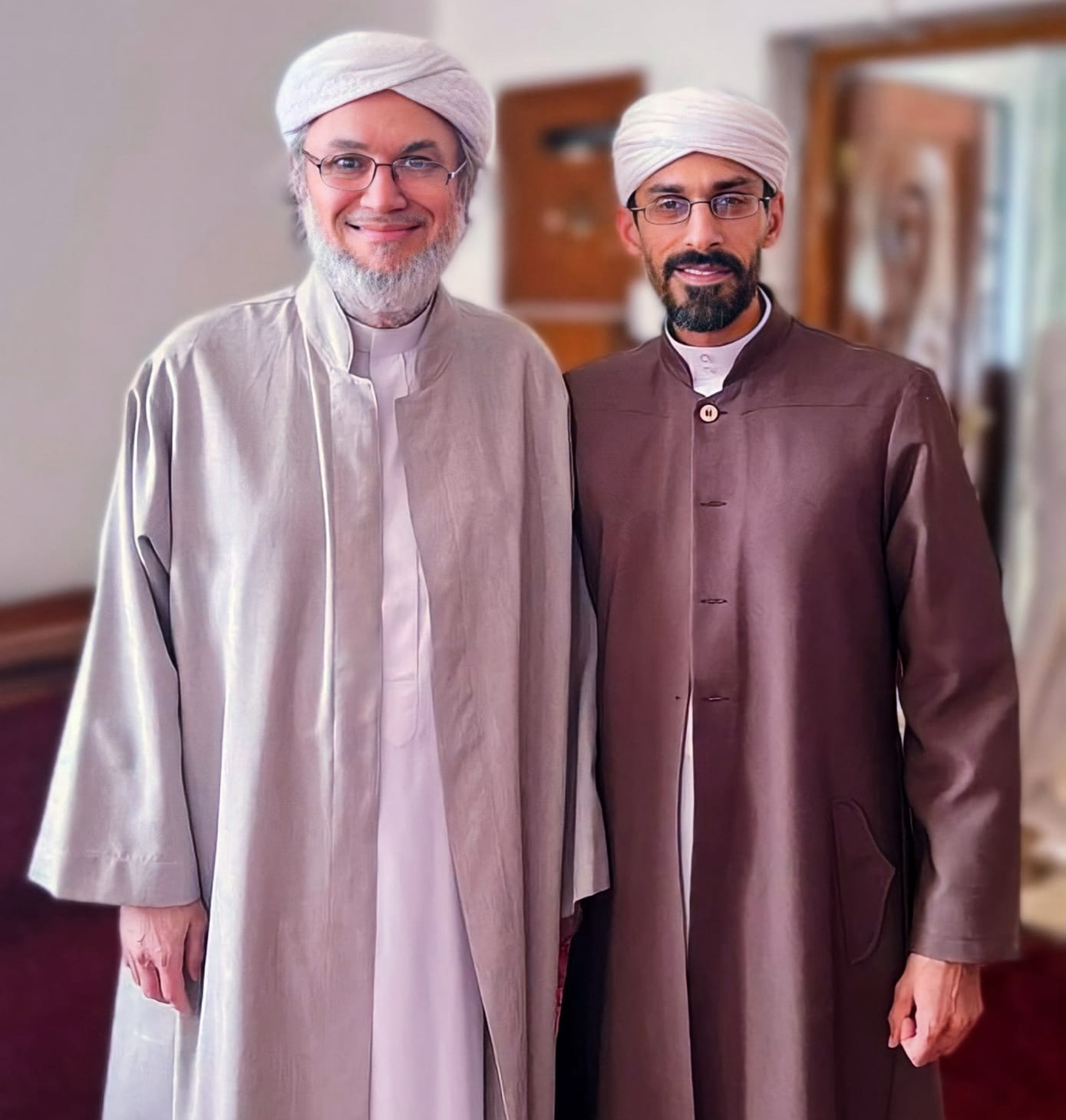
Two pillars of Cape Town’s Shāfiʿī tradition — Shaykh Achmad Hendricks (left) and Shaykh Allie Khalfe (right). Between them flows an unbroken silsilah: the study circles, the Qur’anic sciences, the breath of dhikr, and the living manners of the tradition. Under their guidance, the old way of learning — text in hand, hearts attentive — remains alive in Cape Town.
Monday Night – Two Hours on an Introduction
On Monday night, 11 August 2025, I returned to Azzawia Mosque — this time for the weekly dars with Shaykh Achmad Hendricks.
The WhatsApp invitation from Rashaad Samaai had been simple:
Shaykh Ahmad is currently teaching the Minhāj al-Ṭālibīn of Imām al-Nawawī and the Risālah of Imām al-Qushayrī.
My madhhab is Shāfiʿī — as is the majority of Cape Muslims — so to sit in a reading of Imām al-Nawawī’s masterpiece felt like stepping into my own inheritance.
Shaykh Achmad spent two hours on just the introduction — pausing on its closing lines:
Finally, in cases where there is divergence of opinion among authorities I shall give an impartial exposition of the two opposing theories, the two sides from which one may consider the question in dispute, and the two methods of reasoning adopted in order to solve it; and then I will also, where there is occasion for it, quote separately the decisions of our imam al-Shāfiʿī, and note the relative value of the different appreciations.
From that, a whole world opened: the discipline of fairness, the patience to hold two views in one’s hands, and the humility to weigh them without arrogance.
It took me back to a scene years ago in the Haram at Makkah. A teacher had just finished lecturing his students. When he rose, they swarmed him like bees — those nearest whispering their questions, the teacher answering in whispers too. Everyone leaned in to catch the words. Then, when he departed, they rushed into the market to buy the books he had mentioned.
That is knowledge — not the cold storage of facts, but the living pursuit: sitting, listening, writing, memorising. The kind that makes the heart lean forward. The kind that, even in an age of instant answers, still requires the slow, deliberate turning of a page.
A Gift for the Road – Daily Adhkār
As we stepped out into the cool Cape Town night, Rashaad Samaai pressed a page into my hand.
“It’s from Shaykh Achmad,” he said.
On it was a short litany to be read three times daily — Names of Allah drawn from the Qur’an and the hearts of the early saints:
Bismi Allāh al-Raḥmān al-Raḥīm, Yā Allāh In the Name of Allah, the Most Compassionate, the Most Merciful. O Allah.
Yā Wāḥid, Yā Aḥad — O The One, O The Unique Yā Wājid, Yā Jawwād — O The All-Perceiving, O The Most Generous
Infikhnee bi-nafkhati khayr — blow into me a breeze of goodness
Innaka ʿalā kulli shay’in Qadīr — Indeed, Allah has Power over all things.
A simple gift, but in it, a whole ocean — remembrance for the tongue, stillness for the heart, and a daily returning to the Source.
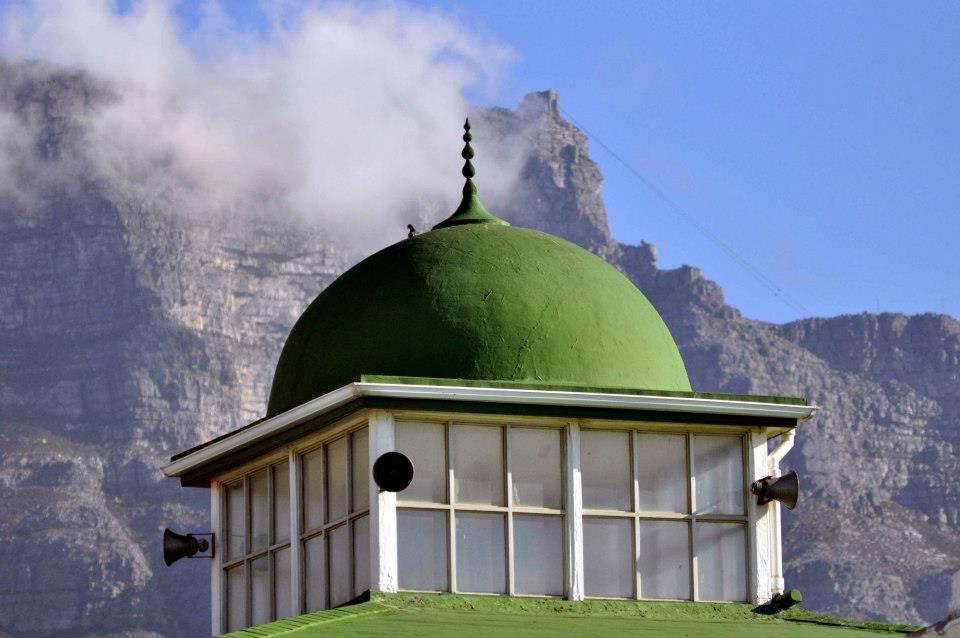
The green dome of Azzawia Masjid rises like a lantern against the stone face of Table Mountain, a reminder that Cape Town’s spiritual horizon is as enduring as its natural one. From here, the call to prayer has travelled across decades of wind and history, mingling with the clouds that crown the mountain. Under this dome, chains of knowledge are kept alive — voices of teachers, pages of sacred texts, and the quiet remembrance of Allah, all anchored in the heart of the city. [Pic: Shafiq Morton]
Closing line: And so the circles of Azzawia turn — each dars a link, each link a step — until the seeker finds that the journey was not only to the masjid on the hill, but deeper into the heart of the chain itself.
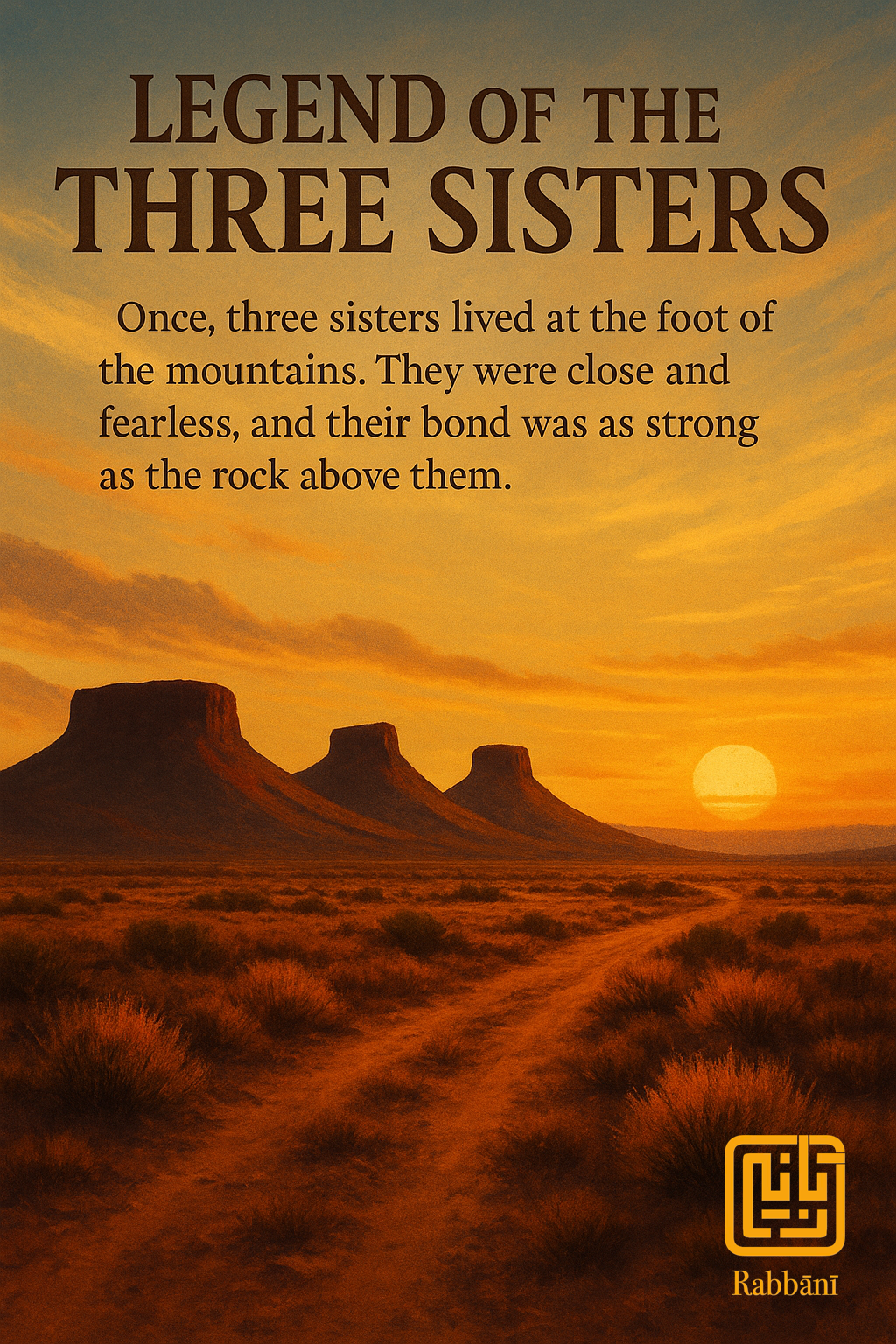
In the heart of the Karoo, between silence and stone, stand three koppies known simply as the Three Sisters. But long before GPS and road signs, they were not just hills. They were memory, myth, and warning. This is their story — reworked, reimagined, and returned to light.
The Legend
In the time before breath, before bone, before the Karoo knew its name, there were storms. Not of rain, but of voice — wild, furious, generative. From these storms came three daughters of wind and flame.
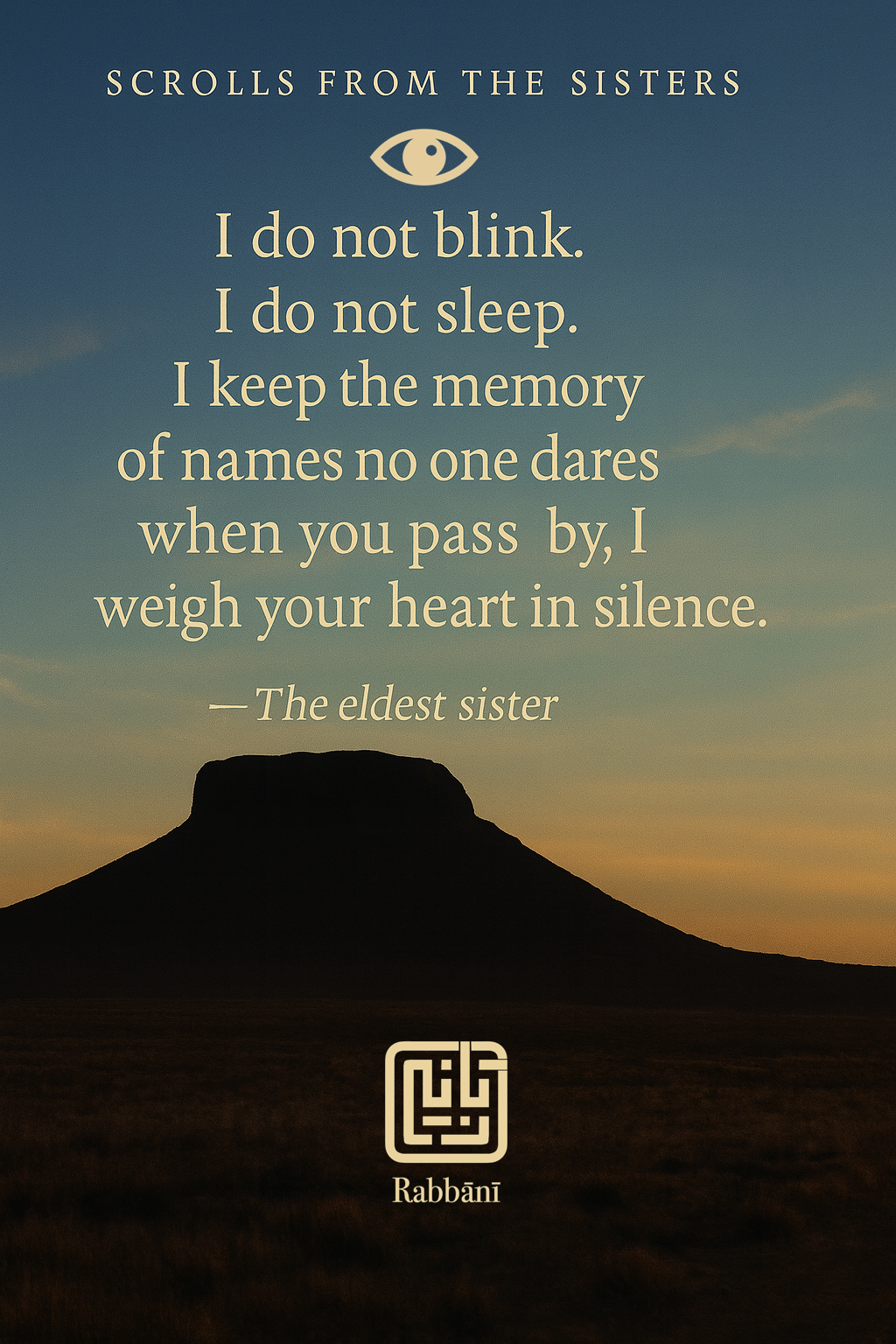
Hurricane was the eldest. She spun slowly, singing in deep spirals, her voice the ocean’s moan. She remembered everything.
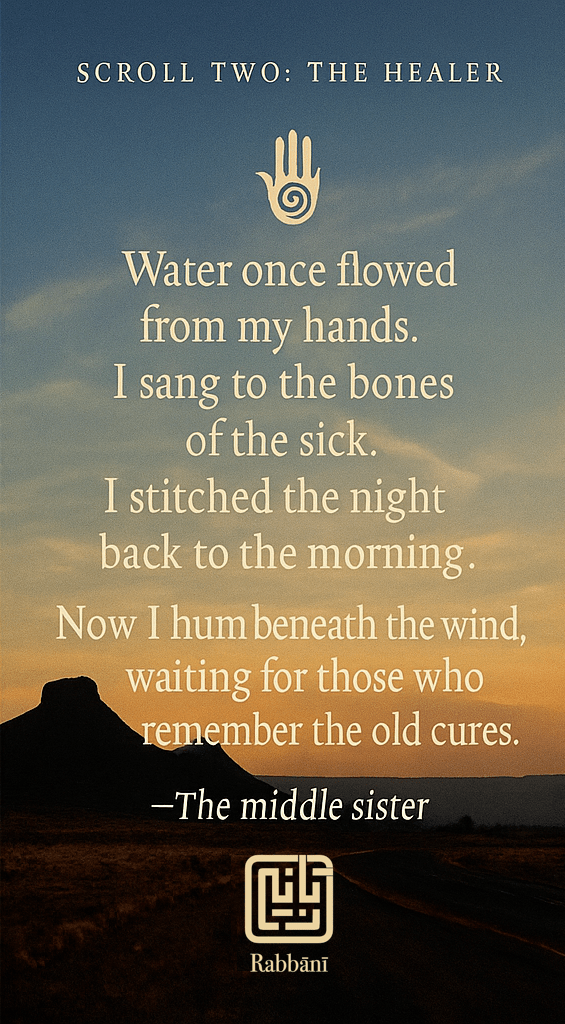
Tornado was the dancer. Sharp. Fast. She carved paths through time, her tongue flashing with lightning.
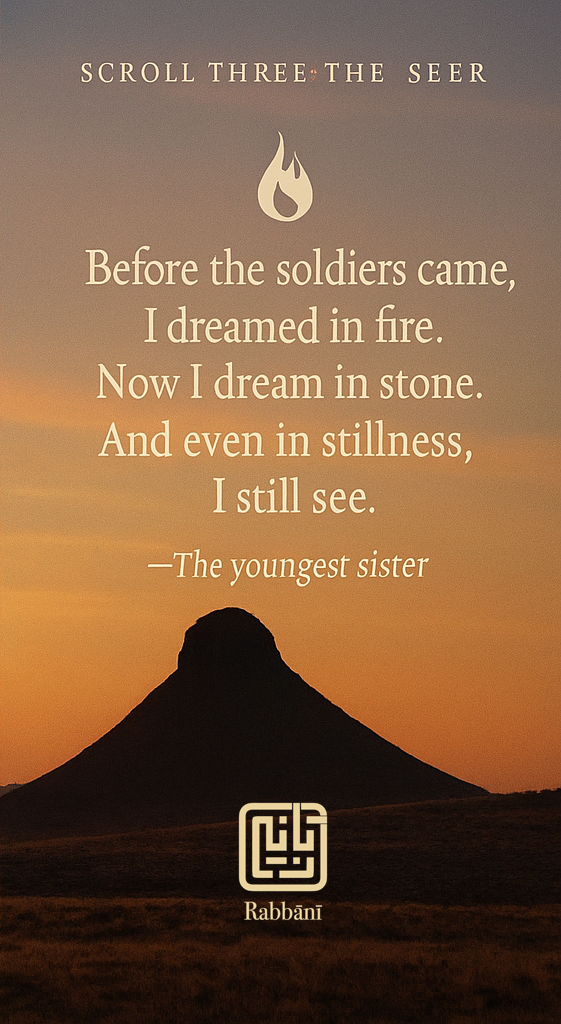
Desert Storm was the dream-weaver. She painted clouds, shifted shapes, left frost on mountaintops and fire in valleys.
One night, a celestial body tore across the sky — a comet called Naariq, the Thirstbreaker. It did not destroy. It wept.
Its tears fell like molten glass, planting seeds that bloomed into crystalline gardens. These gardens sang. They hummed the dreams of stars, mirrored the fears of jackals, held the footsteps of those yet born.
But the land cracked again. And the sisters knew: it was time to become stone.
So they stood, side by side, and let the wind turn them solid. The Karoo opened her chest, and from it rose three ribs — the Three Sisters.
Poems of the Three Sisters
HURRICANE – The Elder, Memory-Keeper
They called her Old Spiral, whose eyes held the sea’s sorrow. She sang in slow thunder, turning grief into guidance. From her lips, the language of whales. From her fingers, the first maps. When she wept, rivers returned. When she stood still, wind found its compass. Memory wrapped her like a shawl. She never forgot the beginning — nor the names of the drowned.
TORNADO – The Wild Dancer, Blade of Time
She moved like a question unasked. A flicker, a flame, a flash in the eye. Children say she could bend time’s neck, turning past into present with one step. She wrote her name on cliff faces, carved warnings into baobab bark. When Naariq came, she was the first to rise. Not to fight — but to dance so fiercely the sky itself split to watch. She whirled until stars blurred — until history collapsed into dust.
DESERT STORM – The Shapeshifter, Dream-Weaver
Cloud painter, frost bringer, the last to speak and the first to vanish. She hid her name in jackal cries, in mirages that teach the thirsty to pray. Her gift was silence that heals. Snow in summer. Rain in song. She once kissed a comet so gently it forgot to burn. And when the sisters turned to stone, it was she who shaped their spines. They say she still walks the salt pans — barefoot, barefoot, barefoot…
2. 🌠 Who (or What) Is Naariq?
Let’s not make Naariq a flat villain. Let’s make him:
A cosmic disruptor, yes — but also a catalyst.
A comet not sent to destroy, but to test the world’s memory.
He weeps. He plants crystal seeds. But his very arrival unravels time, thirst, and story.
Naariq, the Thirstbreaker
Not enemy. Not saviour. A comet born of forgotten prayers. He wept not because he was sad — but because he remembered water. Where he passed, memory frayed. Desire bloomed like wildfire. He brought seeds of crystalline dream — and the sisters, too strong to fall for gold, chose stone instead.
The Vanishing
When Naariq came — streaking across the Karoo sky like a blade of thirst — the world stilled. People ran. Wells dried. Time folded.
But the sisters did not flee.
They stood in silence, facing the comet’s weeping light. They did not strike, nor speak.
They absorbed him.
His heat. His ache. His longing. His memory of galaxies.
And when the light faded, there were no bodies left. Only three dark hills, humming softly at dusk.
That is why the koppies sing. Because they carry Naariq inside them. Because silence is the only song strong enough to hold fire.
The Return
A child stands at the foot of the middle hill. She thinks she hears thunder. But there are no clouds. Only wind. And her grandmother’s voice returning in the rustle of dry grass…
Closing Reflection
Today, travellers speed past on the N1, barely glancing. But those who pause — those who walk into the wind — may still hear the Sisters speak.
Author’s Note
This is one of many Cape myths whispered through stone and silence. As part of the Rafiq al-Bunduqia & Rabbānī scrolls, I offer it not as a fixed legend, but as a companion to your own remembering.
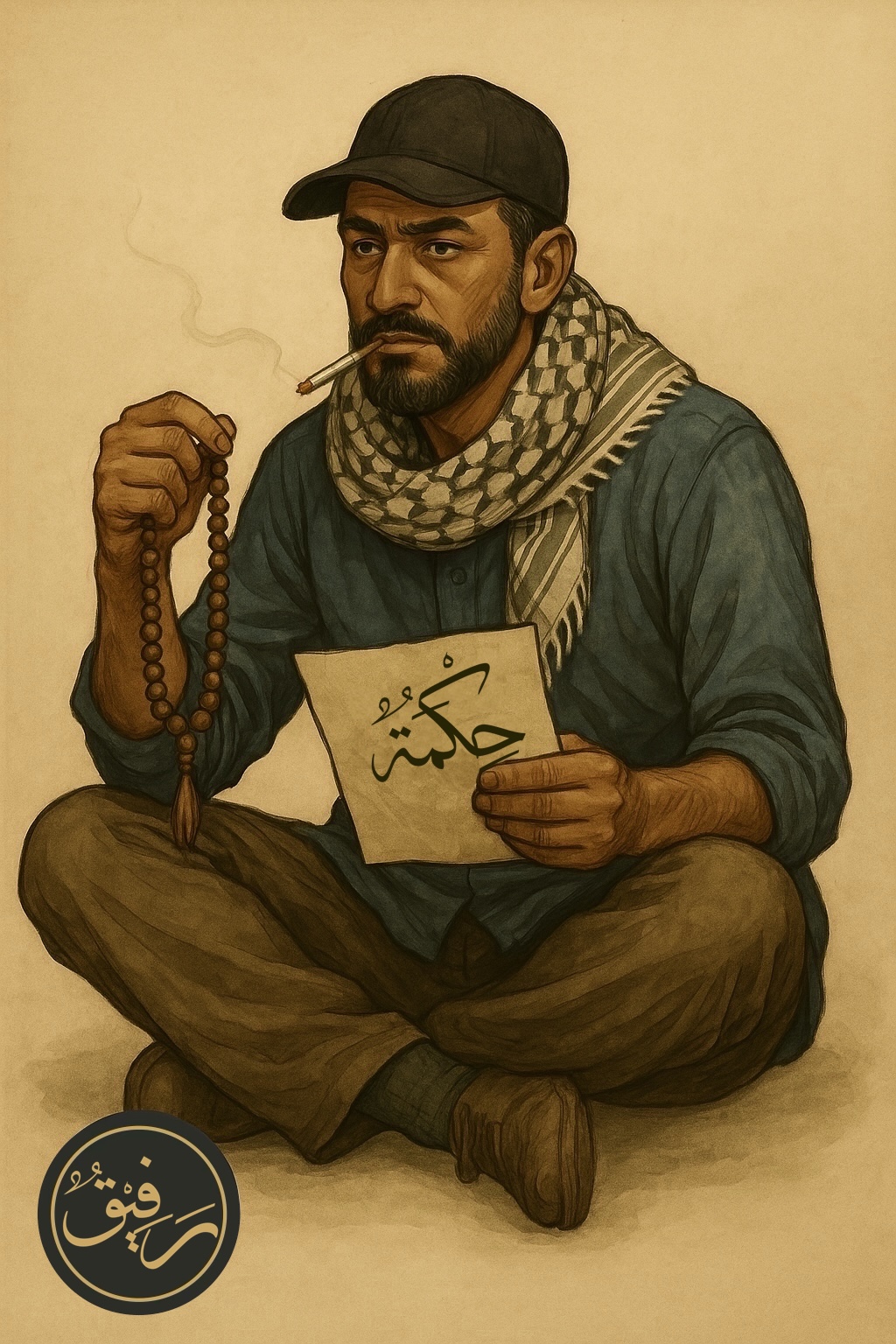
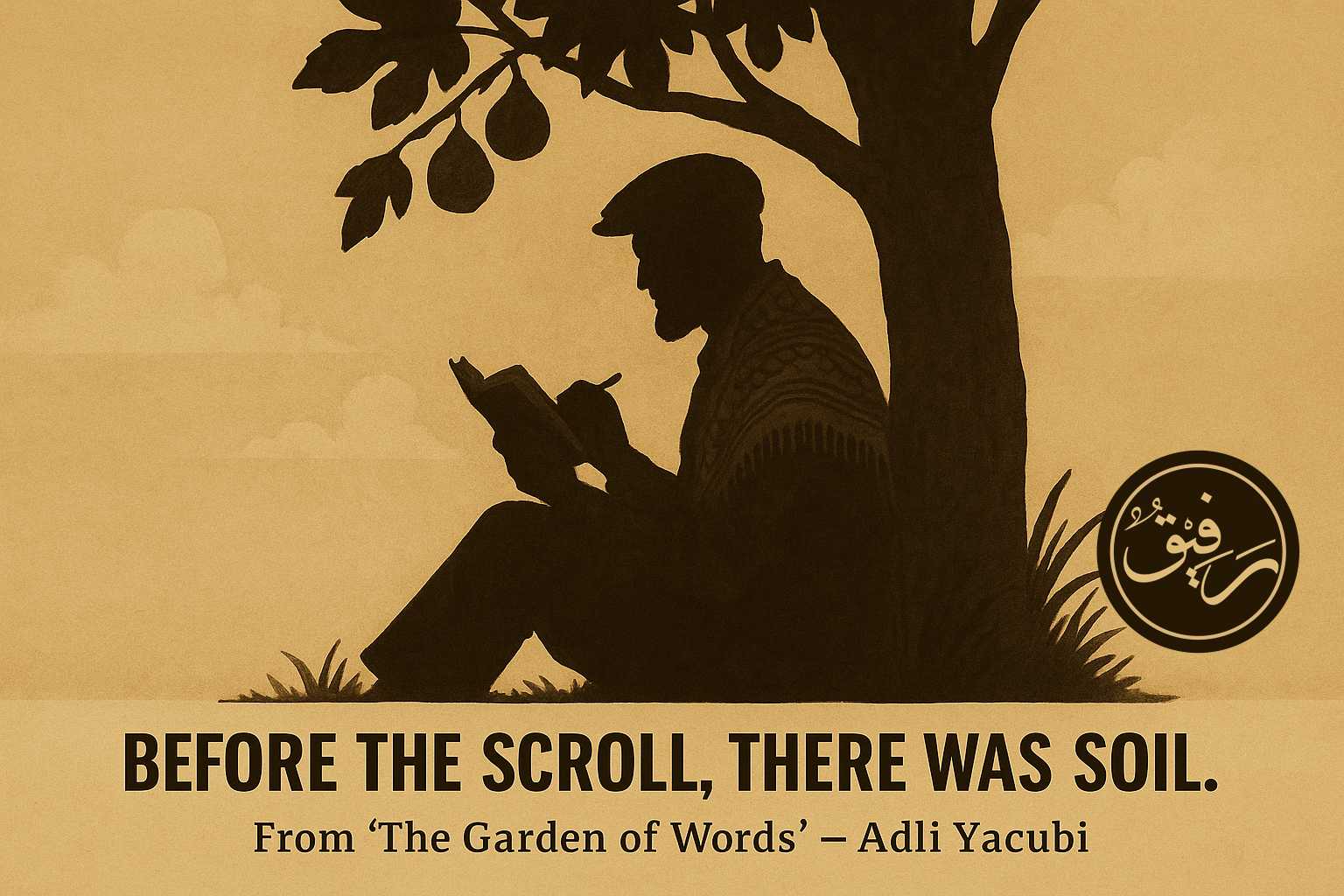
Before the baseball cap, the side-eye, and the wisecracks, there was something softer — a garden.
Not of vegetables or vines, but of words: words whispered, weathered, watered by prayer.
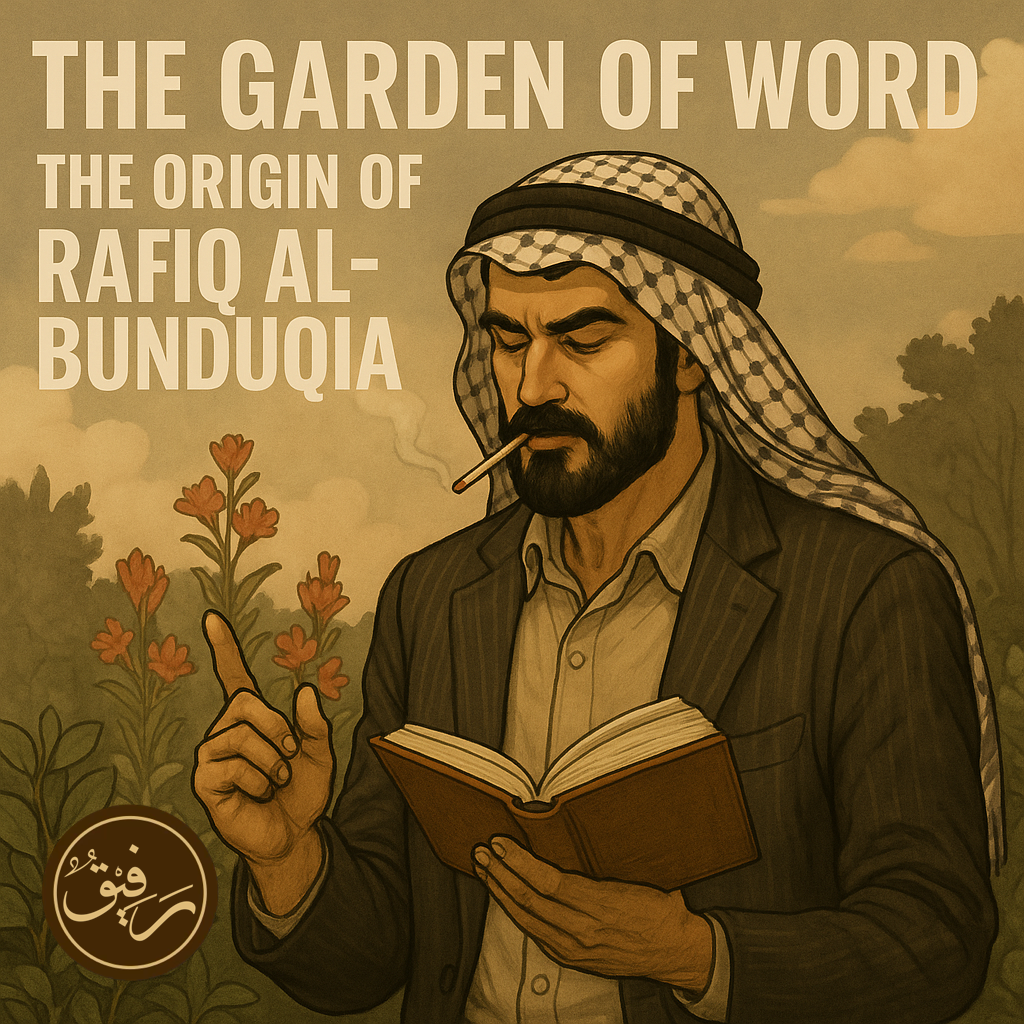
I wrote this piece years ago as a meditation on growth, loss, and language. Only now do I realise: this garden was the soil that gave us Rafiq al‑Bunduqia — the companion of pause, the superhero of syntax, the witness in the passenger seat.
🌱 Introduction
Not all heroes crash through walls. Some sit beside them and ask, “Who built this?”
He doesn’t leap tall buildings. He takes long pauses.
His name is Rafiq al‑Bunduqia. Shotgun companion. Keeper of silences. Superhero of the word.
This is his origin scroll.
📜 1. A Garden, Once Planted
Years ago, I wrote The Garden of Words. It was a meditation on how language grows: slowly, unexpectedly, in sunlight and ache.
I had no idea then that someone had been walking in that garden all along — listening to the leaves, laughing at the metaphors, sharpening a pencil beneath a loquat tree.
His name came later. But his presence? It was always there.
🦸🏽♂️ 2. What Kind of Superhero Is Rafiq?
Rafiq does not fly. He walks. Slowly. On purpose.
He doesn’t rescue you — he reminds you. He doesn’t dazzle — he decodes.
His weapons are:
A well-timed question
A half-smile that disarms
A quote from a street aunty that cuts deeper than any Hadith app
And a scroll, always a scroll
He moves through WhatsApp voice notes, bread queues, and Threads threads. You won’t notice him until it’s too late — and then you’re crying and breathing better.
📖 3. His Powers
Power
Description
The Pause
He listens long enough to hear the truth behind your noise.
The Compass
He helps you re-find your qiblah when algorithms have stolen your sense of direction.
The Scroll Drop
Short, sharp, soulful — he leaves them like seeds on sidewalks.
Code-Switching Cloak
Fluent in Kaaps, Qur’an, colloquialism, and meme. He’ll talk street or soul depending on what you need.
💭 4. Why the World Needs Him
In an age of constant noise, Rafiq carries something ancient:
Discernment. Mercy. Memory.
He shows us that to speak well is not the same as to speak wisely.
That sometimes, the most radical act is to say nothing — and let someone else be heard.
🪞 Moment 1: “Don’t Answer So Fast”
They were all arguing on the stoep — about Gaza, gangsters, grief, government. Everyone had an opinion. Except Rafiq.
He just watched, sucking on a toothpick. Then he said:
“Don’t answer so fast, my broer. Sometimes, your answer is just your trauma trying to sound clever.”
Silence. A pigeon flew off the roof. No one spoke after that.
🍵 Moment 2: “Make Tea Like You Listening”
One of the ouens asked Rafiq, “How do you know when someone’s fake?”
He grinned — slow like a gate that’s seen too many guests.
Flicked his gwai ash into a broken saucer.
“Easy. Watch how they make tea. If they rush the pour, they’ll probably rush your pain too.”
“Make tea like you listening. Let it draw. Let it breathe.”
He sipped from a chipped cup and added,
“You want to fix the world? Start by fixing how you boil water.”
🧃 Moment 3: “The Juice Box Gospel”
At the back of the masjid after Jumu’ah, a small laaitie gave Rafiq a juice box.
No reason. Just walked up, silent, and handed it over like a contract.
Rafiq took it like it was gold.
Sat down on the pavement with his legs crossed, plastic straw in hand, and sipped like he was performing dhikr.
The boy looked confused.
So Rafiq leaned forward, tapped the juice box with one finger and said:
“My lightie, never underestimate something small that still got sweetness in it.”
Then he looked up at the sky and whispered,
“Ya Rabb… give us the patience of those who still share, even when there’s just one sip left.”
🪶 5. A Scroll from Rafiq
Rafiq’s Scroll #14 – On Superpowers
To sit with someone long enough to hear the voice behind the noise — that’s Rabbānī. That’s mercy. That’s you.
— Rafiq al‑Bunduqia
✨ What if Rafiq’s Trinity is This:
Drip. Hikmah. Duʿāʾ.
⚡ Style that carries memory 📿 Wisdom that carries mercy 🕊️ Supplication that carries the rest of us
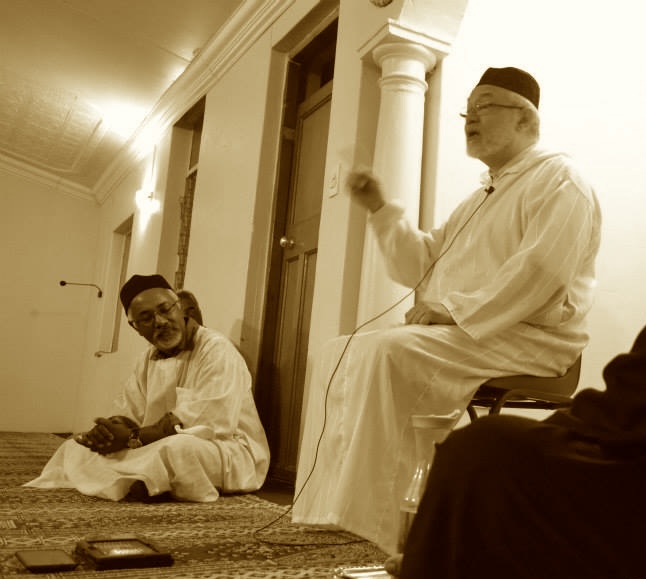
Sh. Seraj Hendricks speaking on Al-Fātiḥah at Janet St. Mosque in Florida, Johannesburg. 3 Nov. 2013 [Pic: Muavia Gallie]
Surah Al-Fātiḥah, the Opening Chapter of the Quran, holds profound significance in Islamic practice. It serves as a fundamental prayer for guidance and mercy, recited in every unit of Muslim ritual prayer (ṣalāh). Known as the Mother of the Book, Al-Fātiḥa is essential for the validity of prayers, underscoring its central role in worship and belief. This is why it is also referred to as the Seven Oft-Repeated Verses.
When I recite Al-Fātiḥah during my ritual prayers, I strive to focus meditatively on these seven verses. I recall an enlightening moment at a mosque in Johannesburg, Florida, where the late Shaykh Seraj Hendricks (may Allah’s mercy be upon him) shared a profound framework of the Quran. Drawing upon Al-Ghazali’s Mishkāt al-Anwār (The Niche of Lights), Sh. Seraj explained the duality of what is distant and what is near in the Quran.
In Al-Fātiḥah, the first four verses describe Allah in the third person:
In the Name of Allah, the Entirely Merciful, the Especially Compassionate;
Lord of all the worlds;
The Entirely Merciful, the Especially Compassionate;
Sovereign of the Day of Judgment.
These verses portray Allah The Sublime as transcendent and distant, beyond the cosmos. In contrast, the last three verses shift to a direct, intimate tone, addressing Allah in the first person:
You alone we worship, and You alone we ask for help;
Guide us on the Straight Path;
The path of those You have blessed, not of those who have incurred Your wrath or gone astray.
This shift emphasises Allah’s closeness, inviting a direct connection between the worshipper and the Divine.
This interplay of distance and nearness is a recurring theme in the Quran. Across 222 verses, references to the heavens and the earth metaphorically depict this duality. Heavens often symbolise the vast, cosmic, or intellectual realm, while earth signifies human, emotional, and spiritual proximity. In another sense, the heavens represent the mind—distant and analytical—while the earth represents the heart, intimately connected to spirituality.
Sh. Seraj also emphasised that these verses subtly address humanity’s role as vicegerents or stewards of God—khilāfatullah—and also as subordinated of God—ʿabdullah—in the universe and on earth. As Allah’s representatives, we are called to balance confidence with humility, leadership with servitude, and authority with submission in worship. This dual responsibility reminds us to rule with justice and compassion, always grounded in our devotion to and reliance on the Divine.
Focusing on Al-Fātiḥah: A Personal Practice
With this understanding, I now recite Al-Fātiḥah with a mindful dedication to different aspects of my being. Each verse resonates with a part of my body, mind, or soul:
Bismillāhir Raḥmānir Raḥīm (In the Name of Allah, the Entirely Merciful, the Especially Compassionate)—dedicated to the right hemisphere of my brain, the seat of creativity and emotion.
Al-Ḥamdu li-Llāhi Rabbi l-ʿĀlamīn (Praise be to Allah, Lord of all the worlds)—dedicated to my frontal lobe, responsible for reasoning and judgment.
Ar-Raḥmānir Raḥīm (The Entirely Merciful, the Especially Compassionate)—dedicated to the left hemisphere, where logic and analytical thinking reside.
Māliki Yawmid-Dīn (Sovereign of the Day of Judgment)—dedicated to the cerebellum, which governs balance and coordination.
For the remaining verses, I turn to my heart:
Iyyāka Naʿbudu wa-Iyyāka Nastaʿīn (You alone we worship, and You alone we ask for help)—dedicated to the heart’s ventricles.
Ihdinaṣ-Ṣirāṭal-Mustaqīm (Guide us on the Straight Path)—dedicated to the central core of the heart.
Ṣirāṭalladhīna Anʿamta ʿAlayhim Ghayri l-Maghḍūbi ʿAlayhim wa-Laḍ-Ḍāllīn (The path of those You have blessed, not those who incurred Your wrath or went astray)—dedicated to the atria of the heart.
As I complete the recitation, I feel that Al-Fātiḥah integrates into my being—mind, body, and soul—lifting me spiritually. Allah Most High affirms this closeness in the Quran, “Indeed, We created humanity and fully know what their souls whisper to them, and We are closer to them than their jugular vein.” (Surah Qaf, 50:16).
The Power of Words in Recitation and Reflection
The act of reciting sacred words, like those of Al-Fātiḥah, carries profound significance. When we call out these words, we are not merely speaking; we are engaging in an act of connection, both with the Divine and with our innermost selves. Recitation transforms the abstract into the tangible, turning thoughts into vibrations that resonate in the air and within our being. In this way, the spoken word becomes a bridge between the physical and the spiritual.
Equally important is the focus we bring to these words. In conversation, our attention to what we speak and how we speak reflects our intent and sincerity. This principle applies even more deeply in prayer, where concentration imbues our words with clarity and purpose. To recite mindlessly is to miss the essence of the act; to recite with focus is to align the body, mind, and soul in devotion.
Contemplating or meditating on certain words allows their meanings to unfold in layers. Words like ar–raḥmān (Entirely Merciful) or ṣirāṭal-mustaqīm (Straight Path) are not static; they expand and deepen with reflection. This process not only enhances our understanding but also transforms our recitation into an ongoing dialogue with the Divine. Contemplation invites us to live these words, allowing them to shape our actions and our being.
By calling out, focusing, and meditating on sacred words, we move beyond rote recitation into the realm of lived experience. This is where the power of Al-Fātiḥah truly lies—not just in its recitation, but in how it becomes a compass for our thoughts, a guide for our actions, and a sanctuary for our hearts.
Al-Fātiḥah is a map and a mirror — a guide that walks with us. Whether spoken aloud, whispered in prayer, or traced silently in our hearts, its light enters every cell that listens.
May our steps be straight. May our breath be mindful. May the One who is near, draw nearer still.
Ameen.
📚 You may also like…
🔸 Hy Lyk Soos ’n Wolf A spiritual meditation on instinct, loyalty, and the sound of the heart behind the howl. Some names we inherit. Others we grow into.
🔸 Tamat: A Sacred Completion, A Living Beginning A reflection on the weaving of remembrance and the sacred knot at the end of a Qur’an khatm — where endings become invocations for return.
To experience this reflection through voice, image, and sacred sound — watch the short video: 👉 Between Distance and Closeness (A meditative recitation of Al-Fātiḥah with visual symbolism and breath)
🌿 Final Note
Al-Fātiḥah is not only recited — it is walked, embodied, and remembered. May each verse carry you closer to the One who is closer than your jugular vein.
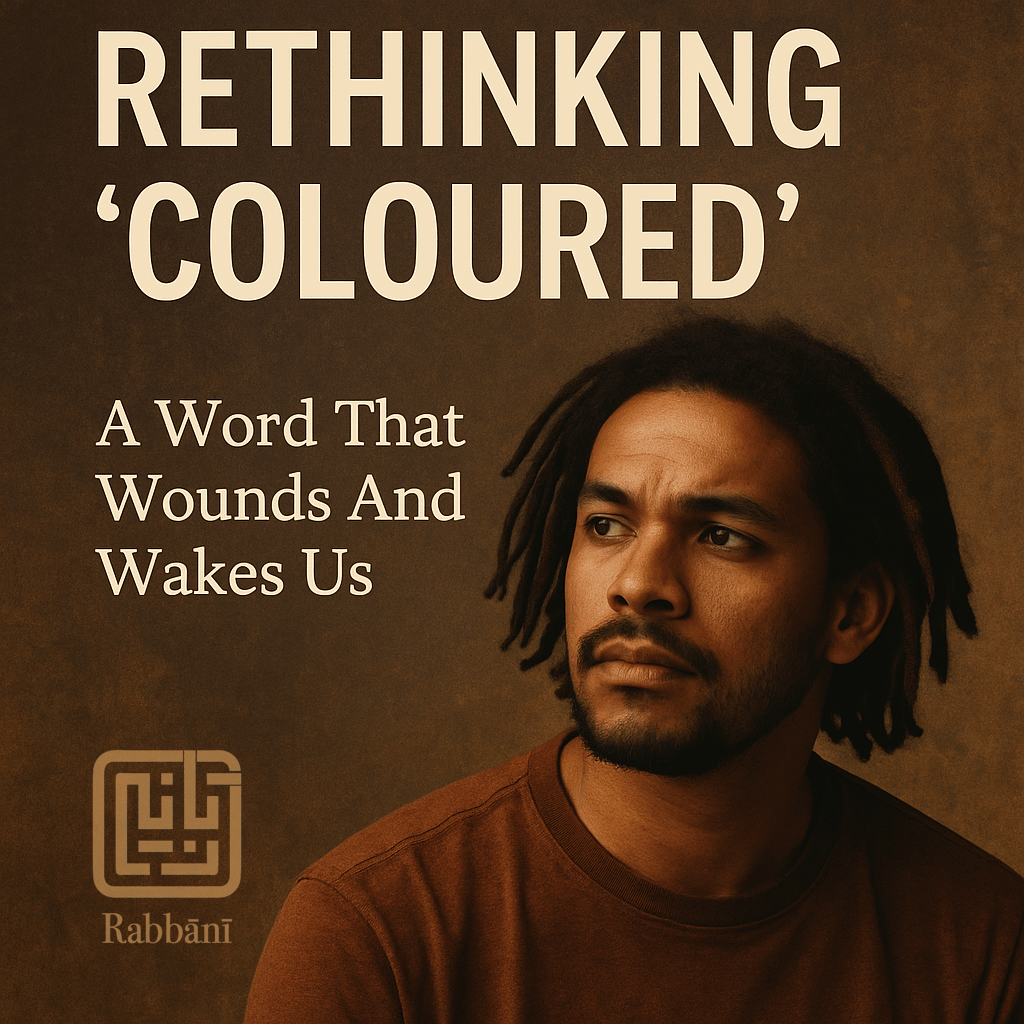
🟤 A Word That Wounds and Wakes Us: Rethinking “Coloured” in the Age of Memory
By Adli Yacubi
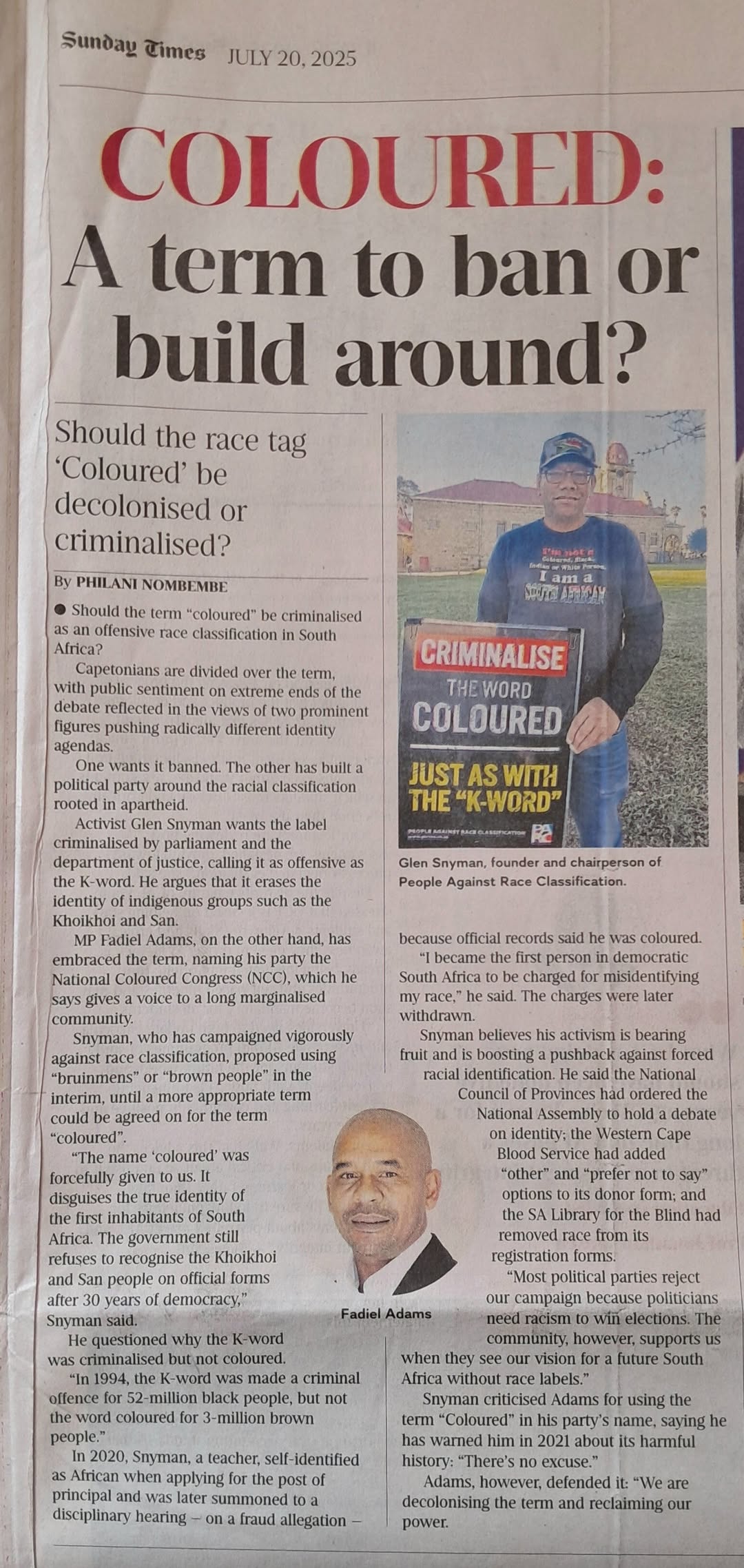
“The name ‘Coloured’ was forcefully given to us.” — Glen Snyman, Sunday Times, 20 July 2025
Last Sunday’s front page posed a question still burning through our national psyche: “Coloured: A term to ban or build around?”
In bold red and black, the Sunday Times article (20 July 2025) captured a moment of deep fracture — and opportunity. It spotlighted the voices of two public figures, Glen Snyman and Fadiel Adams, whose opposing stances on the term “Coloured” reflect long-simmering tensions within post-apartheid identity politics.
And yet, beyond the noise, a different current is rising. One that calls not for renaming or romanticising, but for remembering.
❌ Criminalise or 🔁 Reclaim?
Glen Snyman, founder of People Against Race Classification (PARC), argues that “Coloured” is not merely outdated — it is damaging, like the K-word:
“It disguises the true identity of the first inhabitants of South Africa. The government still refuses to recognise the Khoikhoi and San people on official forms after 30 years of democracy.”
Snyman’s activism led to national debates in parliament and institutions like the Western Cape Blood Service adding the “prefer not to say” option to racial forms. But his call for criminalising the term has stirred legal and ethical challenges — and provoked a backlash from those who feel erased by the erasure.
On the other end stands Fadiel Adams, leader of the National Coloured Congress, who says:
“We are decolonising the term and reclaiming our power.”
Adams believes in building around the identity — anchoring it in lived pain, community resilience, and political recognition. But critics say this collapses our histories into apartheid boxes, reinforcing labels that were never ours to begin with.
🪶 What’s In a Name?
Into this fire, Patric Tariq Mellet, historian and author of The Camissa Embrace, offers clarity beyond polemics:
“Goringhaicona was never a name people used for themselves. It was a derogatory Dutch term meaning outcast or scavenger. Autshumao’s people were known as the /Kamisons — water traders. They were a sub-group of the Cochoqua. The term Camissa remembers them not as fragments, but as a river of convergence.”
Mellet’s contribution is not merely semantic — it’s genealogical. It reveals that terms like “Coloured” and even “Brown” are colourist overlays that flatten our multiple ancestries: San, Khoe, Xhosa, enslaved African, Indian, Javanese, and European.
His critique of both Snyman and Adams is incisive:
“Both men reflect valid concerns — but both are caught in Apartheid’s trap. One criminalises. The other romanticises. Neither steps fully into the radical work of remembering, beyond state classification.”
🧬 Memory as Resistance
To stand in this in-between space — neither erasing the term nor enshrining it — is to do the work of memory. To say: we were misnamed, but we are not unnamed. We are more than what apartheid called us. And we are not only what the census categories offer us.
This blog, like others before it, is not a position paper. It is a growing reflection rooted in questions I’ve been asking for years: — What do we mean when we say “I am Coloured”? — Who gets to say so? — And what happens when our ancestors whisper different names?
We are not “non-white.” We are not “Other.” We are not “Coloured” in the way the law intended. And we are not simply “Brown,” either.
We are Camissa. We are from the river. We are still flowing.
📝 Postscript
We acknowledge the work of Patric Tariq Mellet, whose scholarship challenges colonial erasure. Through his writing, Camissa is no longer hidden — it is remembered as a place of sweet waters, of creolised identity, of sacred convergence.
His reminder to not confuse / reclaim / romanticise pejorative colonial terms (such as “Goringhaicona”) is especially important — and will be reflected in our future revisions.
We also draw from Stuart Hall, who wrote that nations are “narrated into being.” To say “I am from Camissa” is to resist imposed categories and to speak from the riverbed of relation — to narrate the nation otherwise.
The story of who we are is still being written. Let it not be in the language of our conquerors — but in the voice of our rivers, mountains, mothers and names.
💧 The Colour of God
صِبْغَةَ ٱللَّهِ ۖ وَمَنْ أَحْسَنُ مِنَ ٱللَّهِ صِبْغَةًۭ ۖ وَنَحْنُ لَهُۥ عَـٰبِدُونَ “This is the colour of Allah. And who is better than Allah in colouring? And we are His worshippers.” (Qur’an 2:138)
Not the colours of empire. Not the names imposed by maps or ministries. But the silver sap beneath the bark. The scent of rain on root. This is the ṣibghah of God. The sacred dye of those who remember.
Our Inheritance: The African and Islamic Civilisations That Shaped the World
Our Inheritance: The African and Islamic Civilisations That Shaped the World
“We don’t just have history. We have receipts.” — Yaw Kissi
For generations, our textbooks — even in Islamic schools — handed down a version of history in which Europe alone was cast as the cradle of civilisation, and Africa into darkness. This colonial retelling stripped countless people of their confidence and belonging.
As Shaykh Allie Khalfe insightfully reminds us, even the academic traditions we take for granted — like graduation caps and gowns — trace back to the Islamic ijāzah system, where a teacher would bestow a turban and robe upon a student to mark their mastery.
Europe adopted these symbols while erasing their origins. But today, the veils are lifting. And as African memory resurfaces — in scrolls, dreams, and digitised manuscripts — we realise something essential:
We don’t just have history. We have receipts.
Mathematics and Science
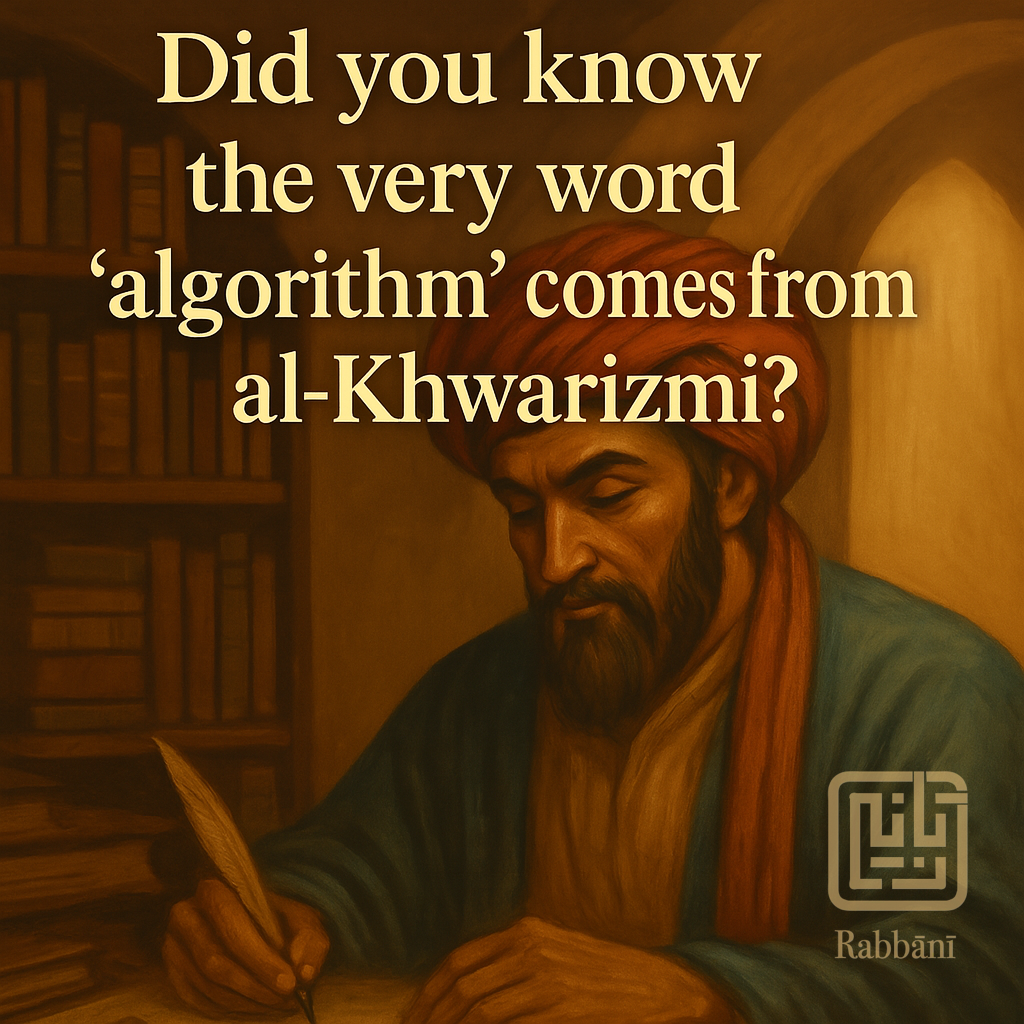
Consider al-jabr, or algebra — a foundational pillar of modern science, engineering, and finance. Muhammad ibn Musa al-Khwarizmi, working in 9th-century Baghdad, formalised its rules, giving his name to the word algorithm — the very basis of every modern computer. His systematic approach to equations transformed the world.
In medicine, Ibn Sina (Avicenna) produced the Canon of Medicine, a monumental text synthesising anatomy, treatments, and psychology, taught across Europe for over 600 years. Abu al-Qasim al-Zahrawi (Albucasis) in Andalusia created a 30-volume encyclopedia on surgical techniques, designing more than 200 surgical instruments that still influence modern practice.
Ibn al-Haytham (Alhazen), known as the “father of optics,” shattered ancient Greek theories by proving that light enters the eye to produce vision, and he introduced experimental methods that would inspire Europe’s later scientific revolutions. These figures were not footnotes in history — they were its authors.
Astronomy and Navigation
Muslim astronomers transformed the night sky into a navigational map, extending humanity’s reach across oceans and deserts. They refined Greek, Persian, and Indian observations and built on them with powerful new instruments and methods.
Al-Zarqali (Arzachel) of 11th-century Toledo developed the Toledo Tables — astronomical data so precise they became a cornerstone for European science, inspiring Copernicus and others. His universal astrolabe could be used at any latitude, freeing navigation from local constraints.
Mariam al-Asturlabi, a 10th-century woman scientist in Aleppo, constructed exquisitely precise astrolabes, allowing people to determine prayer times, measure the positions of stars, and navigate across continents. These tools formed the backbone of Muslim maritime routes linking East Africa, Arabia, and South Asia — centuries before Europe was ready to cross the Atlantic.
It is no exaggeration to say that the so-called Age of Discovery — Columbus, da Gama, Magellan — was made possible through navigational science and star charts inherited from the Muslim world. Yet most schoolbooks erase these global contributions.
Education and Intellectual Institutions
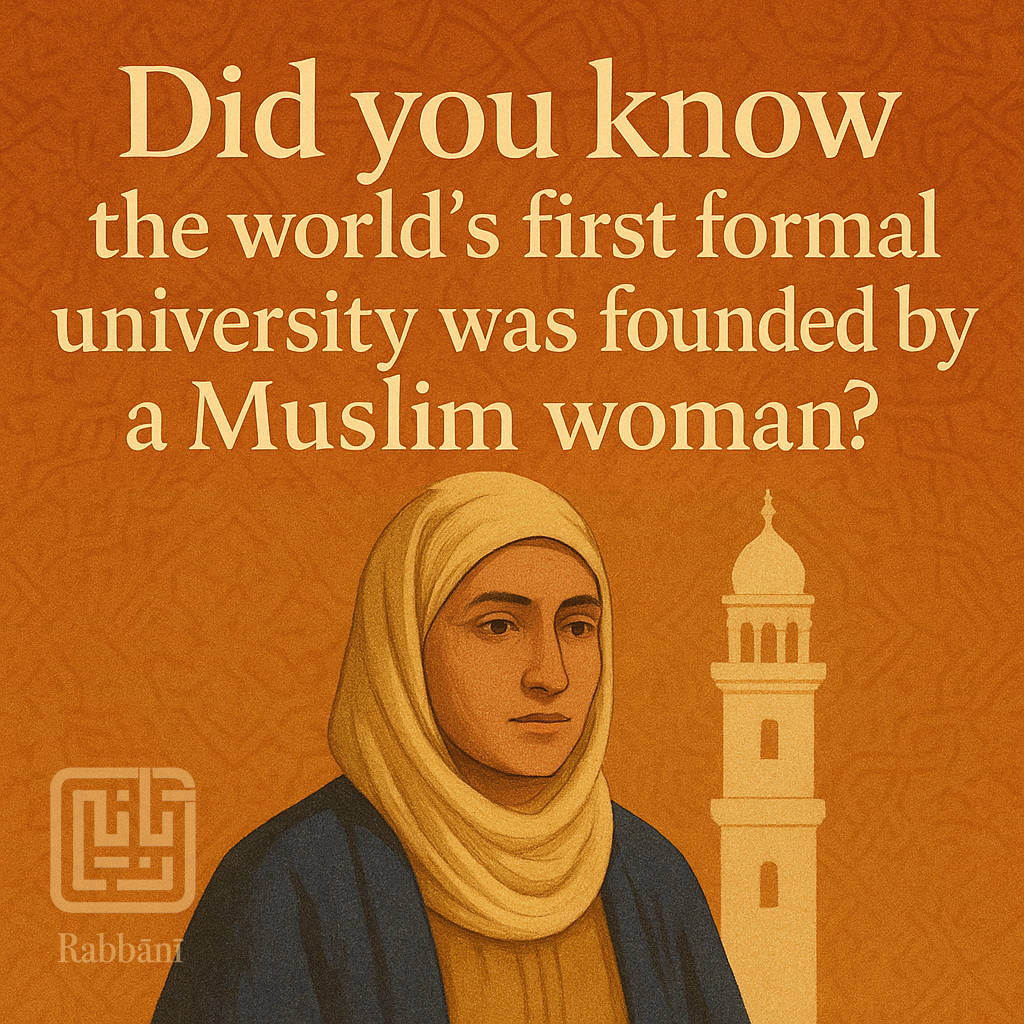
Muslim civilisation revolutionised education by designing institutions that united spiritual, legal, and scientific learning. Fatima al-Fihri, a Muslim woman in Morocco, founded the University of al-Qarawiyyin in 859 CE, the world’s oldest continually operating degree-granting institution. Her legacy shows how women helped sustain and fund educational excellence.
In West Africa, Ahmed Baba of Timbuktu, who authored more than 40 books on law, biography, and ethics, embodied the intellectual brilliance that made Timbuktu as respected as any European centre of learning. Even when Moroccan invaders exiled him to Marrakesh, his scholarship commanded respect, and he eventually returned to revive Timbuktu’s traditions.
Equally inspiring, Nana Asma’u of 19th-century Nigeria trained networks of female educators (yan-taru) and wrote poetry and theology in Arabic, Hausa, and Fulfulde, extending literacy and spiritual knowledge throughout the Sokoto Caliphate.
These institutions offered far more than theology: their curricula included medicine, astronomy, mathematics, grammar, and philosophy, attracting scholars from across Africa, the Middle East, and even Europe. They were open, cosmopolitan spaces that nurtured critical thinking and diversity, centuries before Europe’s universities caught up.
Art, Culture, and Daily Life
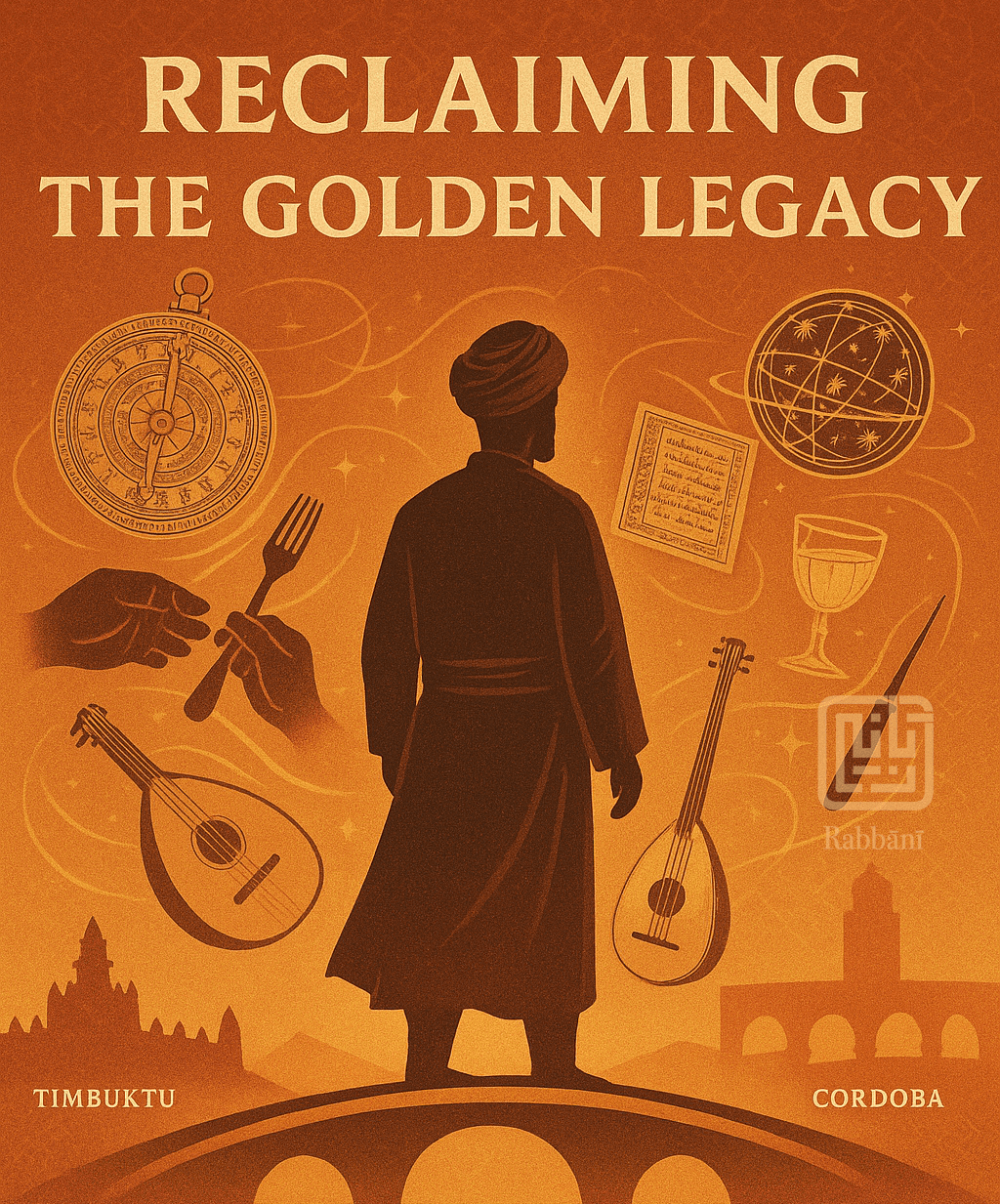
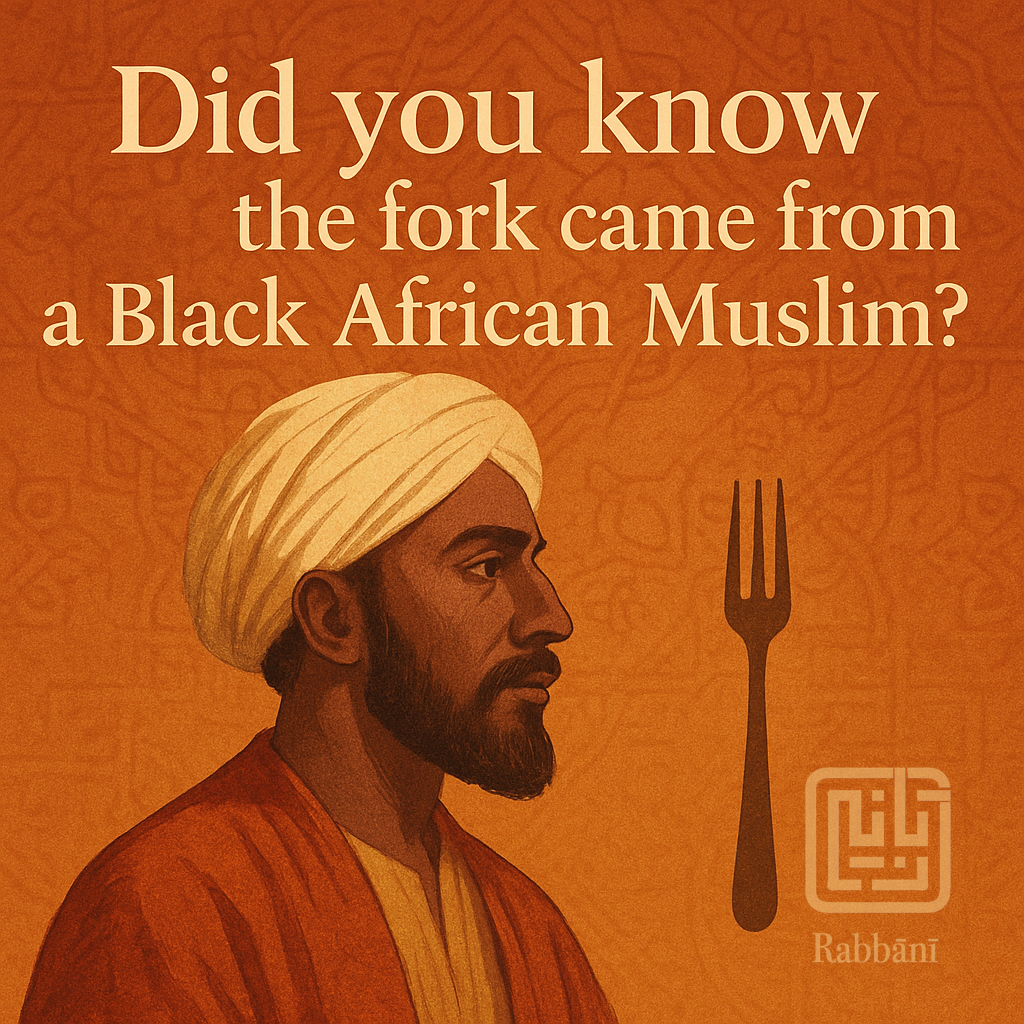
Perhaps nowhere was cultural brilliance more visible than in the story of Abu l-Hasan ʿAli Ibn Nafiʿ — known as Ziryab, the ‘Black Bird’. Born to a family who had been enslaved, most likely of Black African descent, Ziryab arrived in Cordoba in the 9th century and redefined taste itself. He expanded musical scales, added a fifth string to the oud, and established a structured method of teaching music that would echo through Europe for centuries.
“The fork, now held up as the badge of ‘civilisation,’ was popularised in Europe by a Black African Muslim.” — from the section on Ziryab
“They weren’t relics. They were receipts.” — on the Timbuktu manuscripts
He also transformed daily life by introducing crystal drinking vessels, organising meals into separate courses, encouraging regular hygiene, designing seasonal wardrobes, and even popularising the small two-pronged fork for delicate foods — centuries before Europe claimed it as its own. That fork would eventually spread across France and the continent, yet no one credited its origins.
In today’s world, where politicians shame people like Zohran Mamdani for eating with their hands, there is a profound irony: the fork, now held up as the badge of “civilisation,” was popularised in Europe by a Black African Muslim.
A Note on Eating With the Hand
The uproar over Zohran Mamdani’s video of eating rice with his hands shows how colonial thinking still lingers. Across Africa, India, and the Arab world, eating with the hand is rooted in ancient tradition, mindfulness, and even spiritual symbolism — linking the five fingers to the five elements of nature.
Western colonisers once labelled this practice “uncivilised,” forgetting that their prized utensil, the fork, came into European culture through Ziryab’s refined innovations. France and other parts of Europe embraced the fork over centuries, yet rarely acknowledged its roots.
As Shaykh Allie Khalfe wisely reminds us, the problem is not about etiquette, but about power, prejudice, and historical amnesia — a colonial hierarchy that still tries to shame non-European cultures while quietly living on their forgotten innovations.
Conclusion
The Golden Age of Africa and Islam was never lost — it was hidden, buried beneath centuries of colonial arrogance, racism, and cultural erasure. From the hospitals of Cairo to the libraries of Timbuktu, from the universities of Fez to the concert halls of Cordoba, from the Grand Library of Baghdad — Bayt al-Ḥikmah — to the scholars who charted the stars, our ancestors nurtured a world of knowledge, beauty, and moral excellence that still resonates today.
These contributions were not accidental: they were born of a civilisation that valued intellectual curiosity, hospitality, faith, and human dignity. In their pursuit of learning, these scholars and visionaries created bridges between continents and cultures, carrying forward a spirit of trust in God (tawakkul) and service to humanity.
Today, recovering these stories is not about boasting or chasing nostalgia — it is an act of healing, of reclaiming the confidence, pride, and resilience that colonial narratives tried to crush. Our children deserve to inherit a truthful memory of who we are: people who illuminated the world, built institutions of compassion and reason, and shaped the very frameworks of science, art, and law.
Let us honour this legacy not with empty slogans, but by living it — teaching it, protecting it, and carrying it forward as a sacred trust (amanah). For if our ancestors could rise from the chains of conquest and slavery to become authors of civilisation, then we too can rise, with God’s help, to build a world of justice, knowledge, and mercy once more.
We were never just subjects of someone else’s story. We wrote. We built. We mapped. We healed.
And the pages are still here.
We don’t just have history. We have receipts.
And now — we remember.
References
1001 Inventions: The Enduring Legacy of Muslim Civilisation, ed. Salim T.S. Al-Hassani
George Saliba, Islamic Science and the Making of the European Renaissance (2007)
John Hunwick, “Ahmed Baba: Intellectual of Timbuktu,” Sudanic Africa (1997)
Beverly Mack & Jean Boyd, One Woman’s Jihad: Nana Asma’u, Scholar and Scribe (2000)
Amira K. Bennison, The Great Caliphs: The Golden Age of the Abbasid Empire (2009)
Gülru Necipoğlu, The Age of Sinan (2005)
Toby Green, A Fistful of Shells: West Africa from the Rise of the Slave Trade to the Age of Revolution (2019)



 Adli Yacubi