Category: Reviews

  • Koesister Mentality: Sweet Spice, Survival, and Sunday Mornings

    Koesister Mentality: Sweet Spice, Survival, and Sunday Mornings

    Koesister Mentality: Sweet Spice, Survival, and Sunday Mornings

    More Than a Doughnut

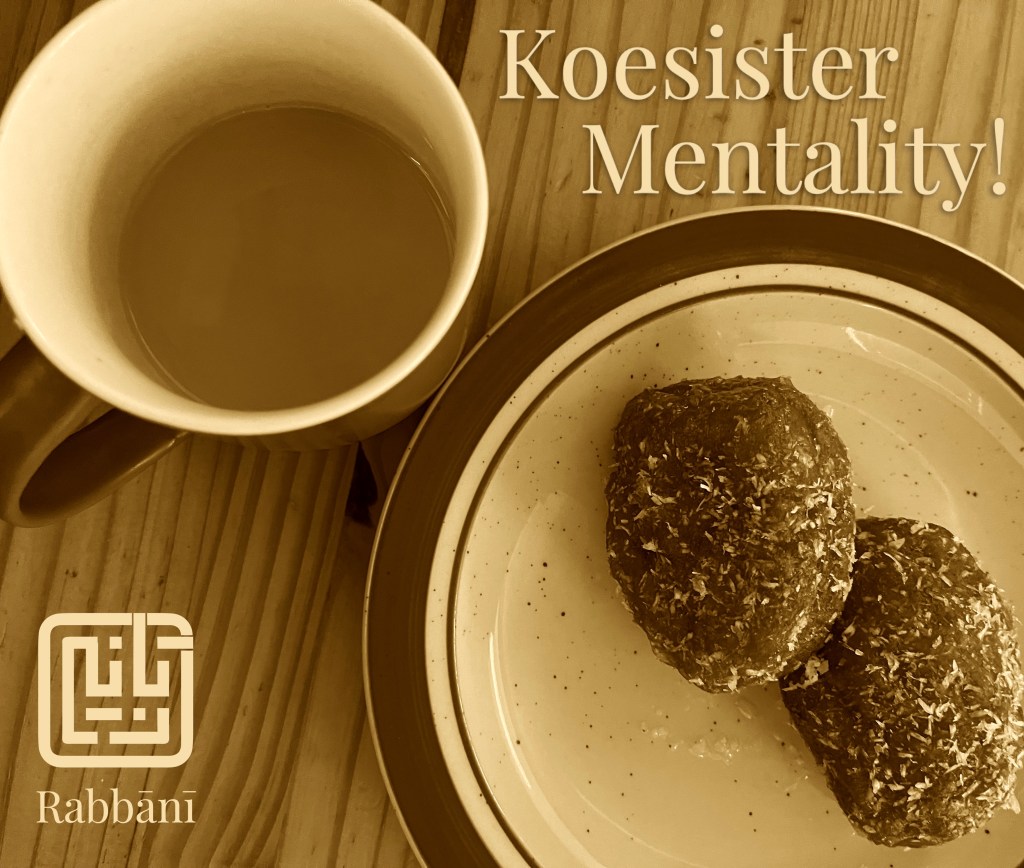
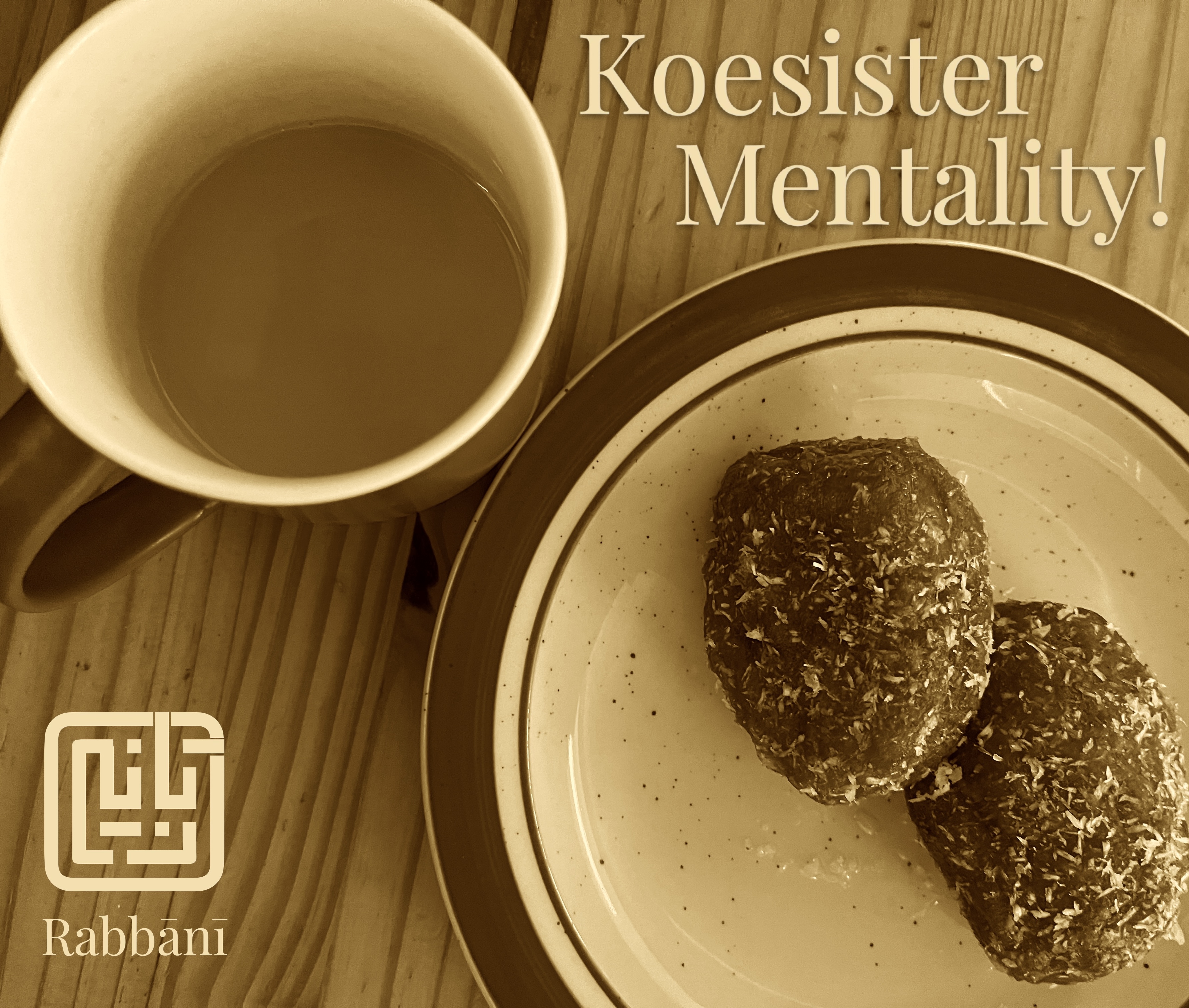
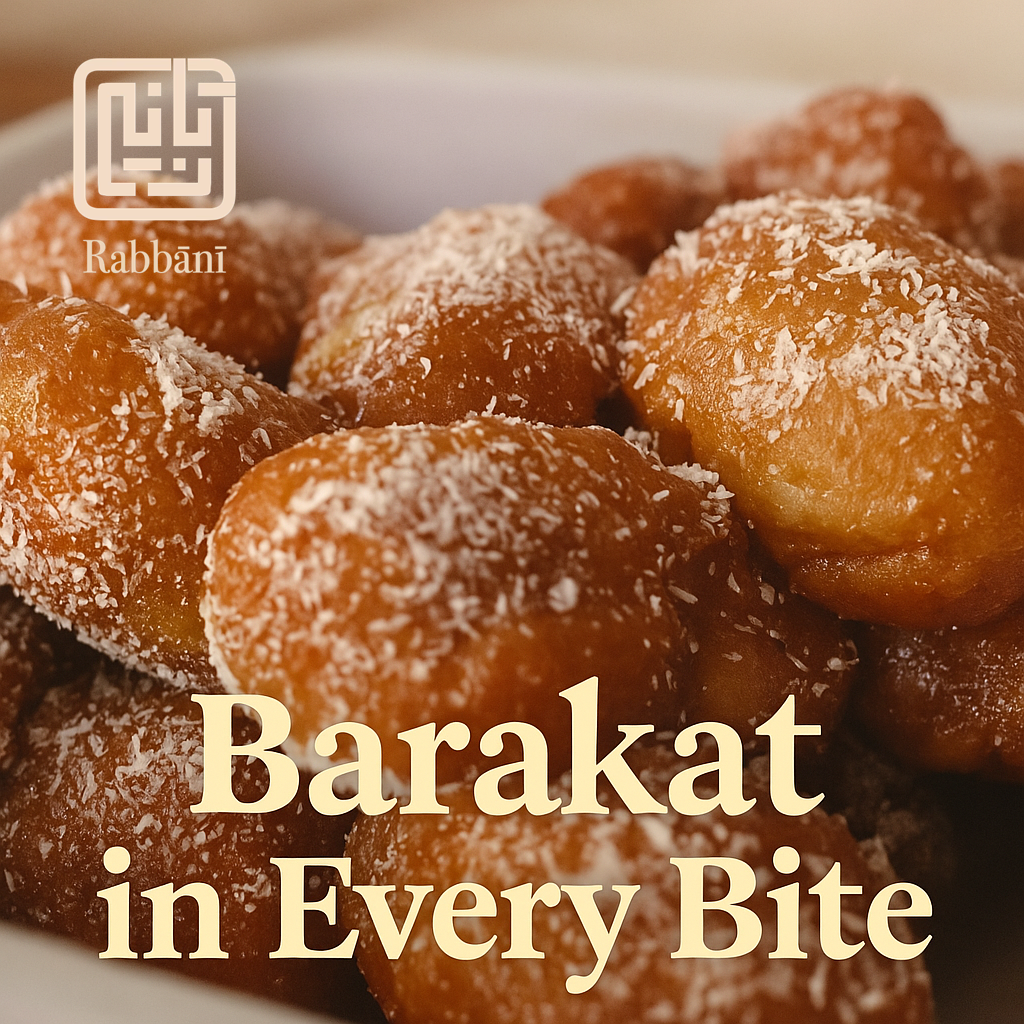
    The koesister is not just fried dough dipped in syrup. It is a Cape Muslim archive you can taste: slavery and spice-routes folded into flour, patience stitched into the rise, mercy poured as syrup, and community dusted on like coconut. On Sundays in Cape Town, this is how memory is served warm.

    From Chains to Sweetness: Where it Comes From

    Enslaved and exiled people from Indonesia, Bengal, India, Madagascar and Mozambique brought spice grammars — cardamom, cinnamon, ginger, aniseed — into the Cape. In cramped kitchens they kneaded survival into foodways that became Cape cuisine.

    The koesister was one such vessel: a creole of technique and faith, born in constraint, perfected in community.

    Koesister vs Koeksister — why the “e” matters
    The Cape Malay koesister is a spiced, oval fritter simmered in syrup and rolled in coconut. The Afrikaner koeksister is a plaited, crisp fry dunked into cold syrup. They share a Dutch “koek” root but took divergent paths: one scented with aniseed and Sunday barakah; the other with braids and brittle sweetness.


    Grinding the Memory

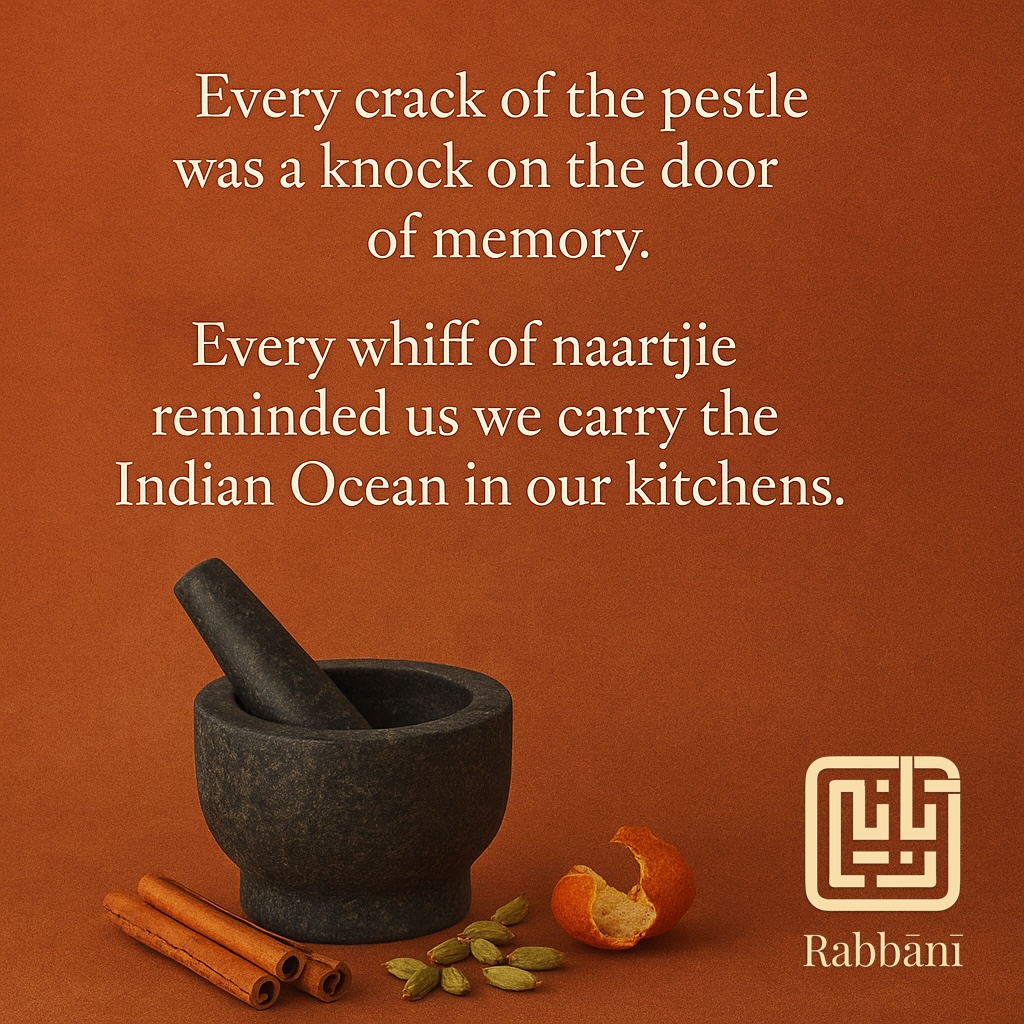
    When I was a child, I would sit on my bum on the stoep, mortar and pestle between my legs, grinding cinnamon, cardamom, aniseed, and dried naartjie peel. The air filled with perfume, and I knew without knowing that these were not only flavours — they were history.

    Spices that had crossed oceans with enslaved women were now ground by a child’s hands on a Cape Town stoep, ready to become part of Sunday morning koesisters. Every crack of the pestle was a knock on the door of memory, every whiff of naartjie a reminder that we carry the Indian Ocean in our kitchens.

    Sundays in Primrose Park

    I remember sugaring koesisters outside our front door in Primrose Park. Neighbours would stand in line on Sunday mornings, bowls in hand. My Tietie, Gadija — Dija, may Allah have mercy on her — made a koesister that was simple, fragrant, and always in demand.

    She would wrap the dough in blankets to rise, then fry and dip until sticky, coating each with coconut. People didn’t come only for the sweet; they came for what the sweet held: blessing, neighbourliness, and survival in sugared form.


    Two Recipes, One Lineage

    Tietie Dija’s Koesisters

    • 1 kg cake flour
    • 2 large eggs
    • 1 tsp fine salt
    • 2 tsp each cinnamon, cardamom, ginger, aniseed
    • 1 pkt yeast
    • ½ cup oil
    • 1 ½ cups lukewarm water (not more than 2 cups)

    Method:
    Sift dry ingredients into a large bowl. Add eggs and oil, mixing with both hands until crumbly. Add water and knead into a ball. Cover with a bread packet and wrap in a blanket. Leave to rise for 2–3 hours. Fry, syrup, and serve with coconut.

    Salwaa’s Cape Malay Cooking Koesisters

    • 1 kg cake flour
    • 2 tsp ginger, 3 tsp cinnamon, 1½ tsp cardamom, 4 tsp aniseed
    • Optional: dried naartjie rind
    • 10 g instant yeast, 1 cup sugar, 2 cups hot water, 2 tbsp butter, ±2 cups milk
    • Oil for deep frying

    Method:
    Melt butter and sugar in hot water, add milk to make 1 litre. Mix with flour, spices, and yeast to form a soft dough. Let rise until doubled. Shape into balls, then oblongs. Fry until golden. Dip into syrup (sugar, water, cardamom, cinnamon), and sprinkle with coconut. Optionally slit and fill with glazed coconut.

    The Art of Sugaring a Koesister

    People often miss the essence of the koesister. This is not the crisp, cold-dipped koeksister. Astaghfirullāh, you don’t just fry and dunk.

    In a nice biggish pot you cook:

    • 1 cup water
    • 1 cup sugar
    • (Optional, but beloved: cardamom, cinnamon, and even a touch of honey for barakah and shine).

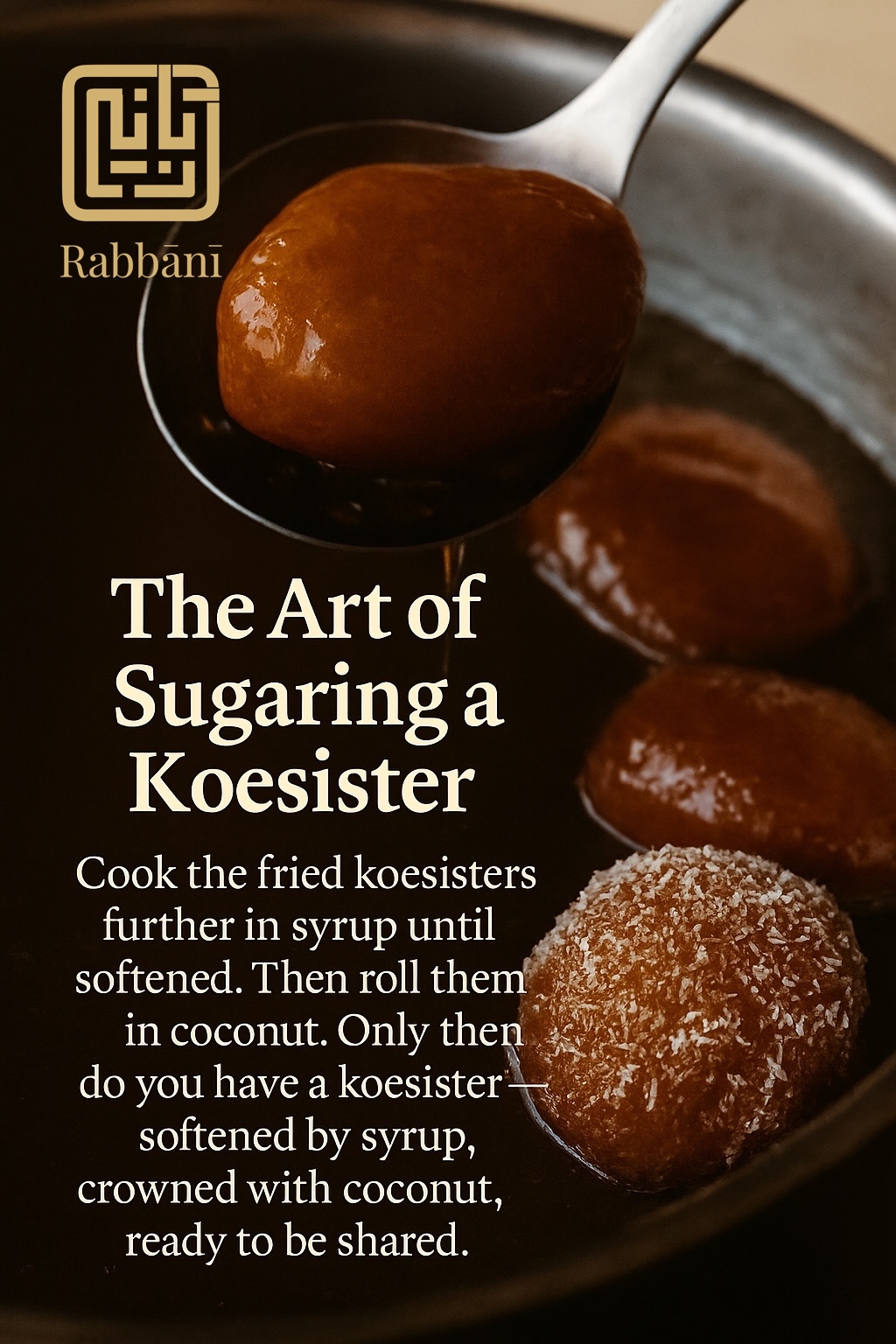
    Watch the pot until it starts to get sticky. You test it with a spoon: lift the syrup and see how the drips slow down. That’s the sign.

    Now — and this is the secret — you add in the dry fried koesisters to the pot. Stir them gently, let them continue cooking together, prod with your spoon until they soften and drink the syrup. Keep a cup of water ready when it gets too sticky. But use it sparingly. Only then do you take them out, roll them in coconut, and place them in the bowl.

    That’s when you have a koesister: softened by syrup, crowned with coconut, ready to be shared.

    The Barakat of the Koesister

    The koesister is not confined to Sundays. It turns up wherever barakah gathers:

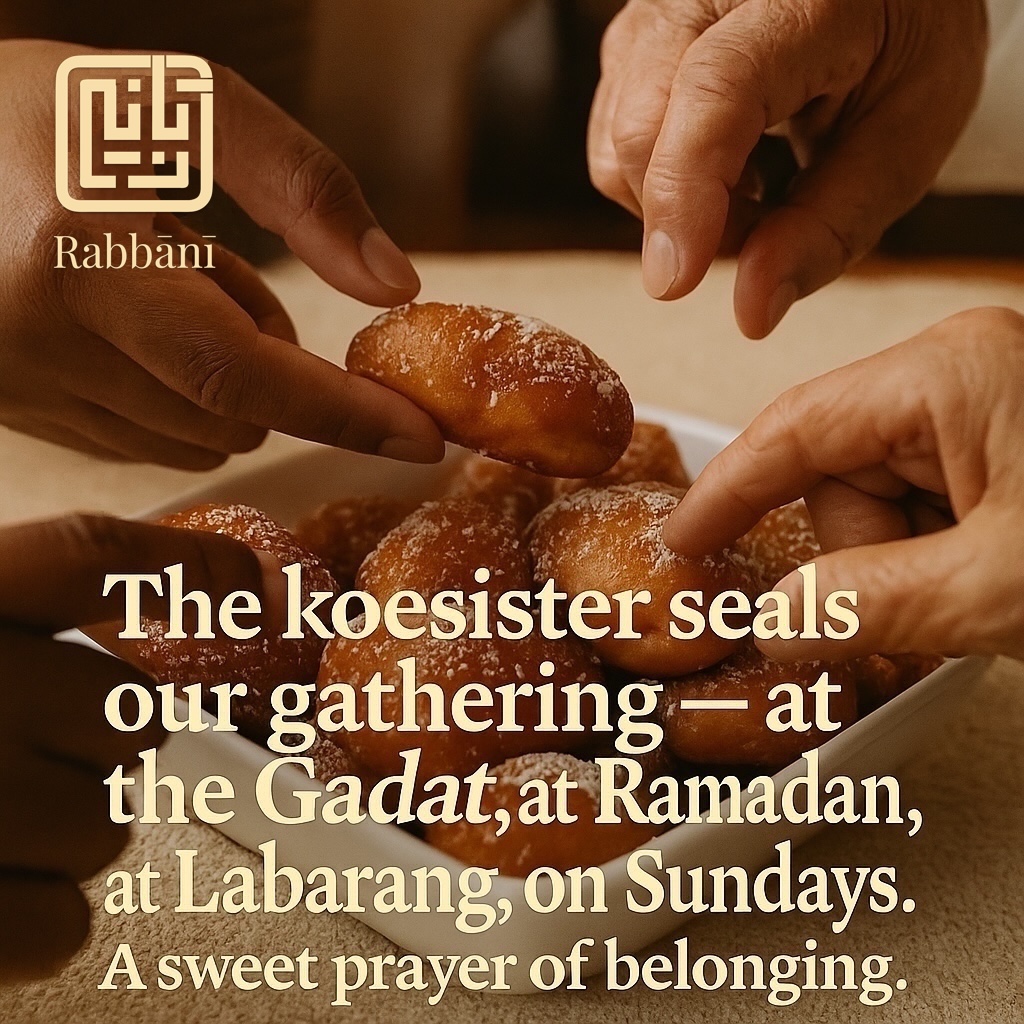
    • At the Gadat (dhikr circle): trays of koesisters pass between voices chanting the Divine Names, sweetness sealing the remembrance.
    • At weddings: slipped into barakat parcels — alongside nuts and sweetmeats — a reminder that joy is for sharing.
    • In Ramadan: laid on iftar tables, syrup echoing the mercy of breaking fast.
    • At Labarang (Eid): no celebration is complete without sticky fingers and coconut laughter.
    • Every Sunday morning: queues outside homes in District Six, Bo-Kaap, Athlone, Primrose Park.

    In all these settings, the koesister is a seal of blessing: a sweet amen after prayer, a sugared handshake of belonging.


    Symbolism: What the Steps Teach

    • The yeast: intention, a spark that lifts everything.
    • The rise (under blankets): hidden work, dignity rising even in silence.
    • The oil: trial by heat — sabr through fire.
    • The syrup: mercy, binding the cracks and soaking to the core.
    • The coconut: hospitality, a dusting that says this is for sharing.
    • The Sunday bowl: community, where every vessel is filled, no one excluded.

    This is why elders said: Life is like a koesister — not so lekker if eaten raw, but sweet when endured, fried, and dipped in mercy.

    Koesister Mentality: Sweetness After Struggle

    To eat a koesister is to eat history — slavery, spice routes, resilience, survival. To make one is to carry that tradition forward.

    Koesister Mentality is more than humour or heritage: it is the ethic of rising, enduring, softening with mercy, and sharing abundance. Sweetness after struggle, but never without memory.

    Once, “koesister mentality” meant narrow thinking. But I steal it back, and sugar it differently: for me, koesister mentality is resilience after rising, sweetness after struggle, and barakat in every bite.
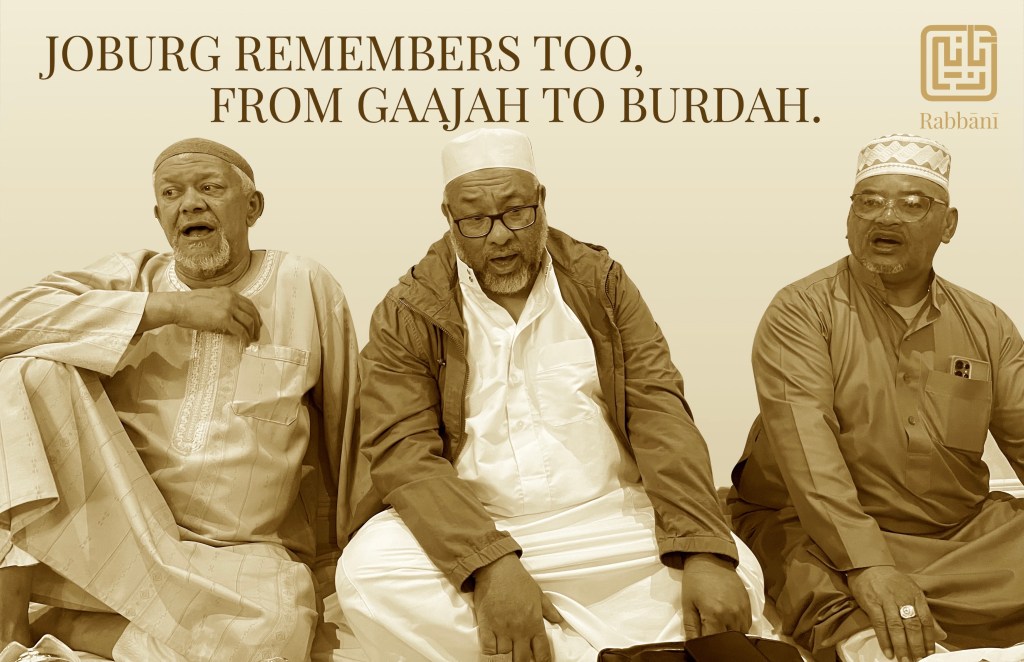
  • Joburg Remembers Too: From Gaajah to Burdah

    Joburg Remembers Too: From Gaajah to Burdah

    Joburg Remembers Too: From Gaajah to Burdah

    Florida North – A Birthday Gaajah

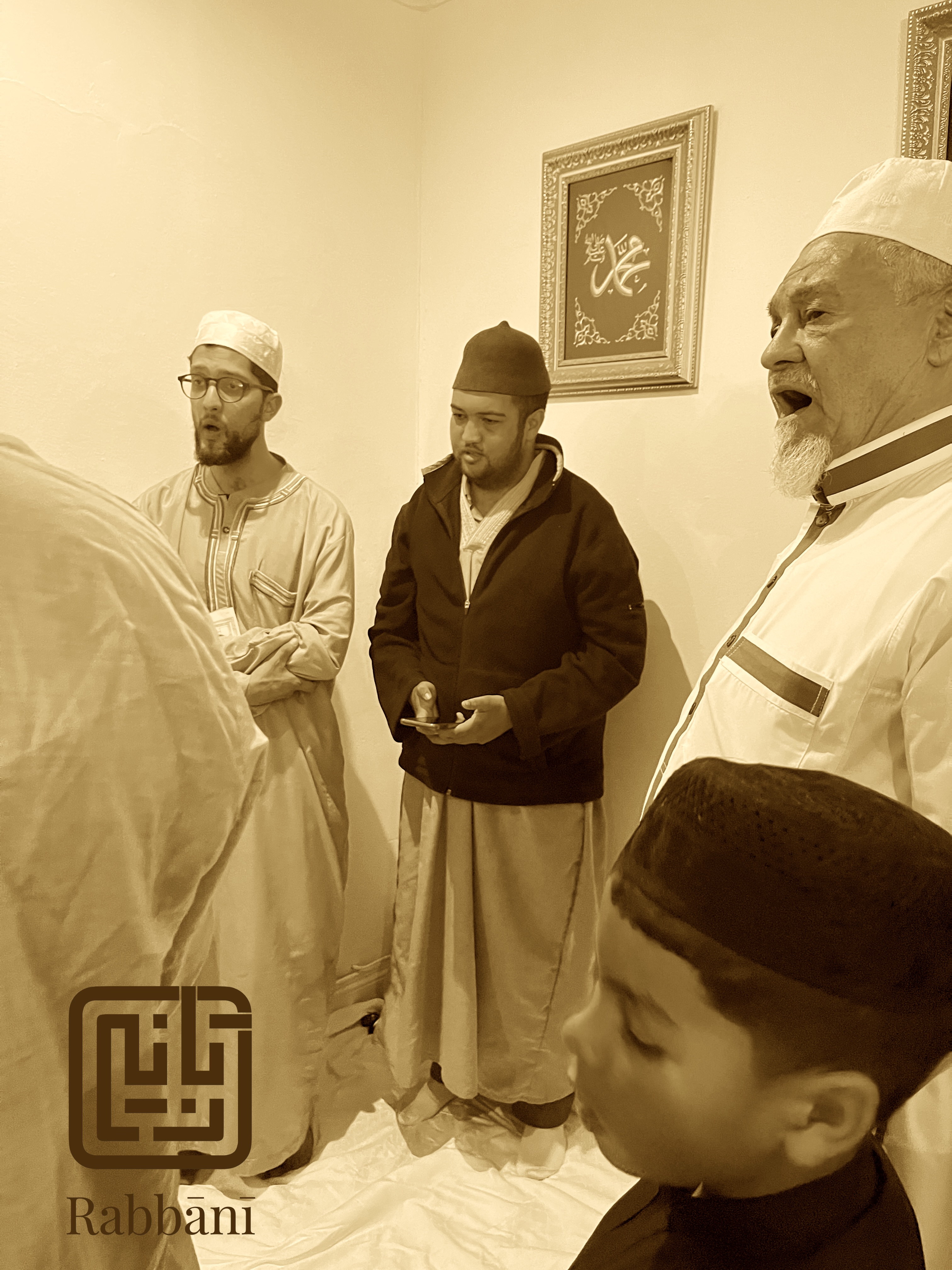
    The room was warm with family and remembrance. Qur’ans lay open, voices moving together through Yāsīn, Mulk, the Quls, verses of Ḥashr and Baqara. Then came the Asmāʾ al-Ḥusnā, dhikr in chorus, and a duʿā that softened every heart.

    It was called an Arwaag, but as my friend Shakeel Garda reminded me, this was really a Gaajah — from ḥājah, a need. That night the “need” was joy: the birthdays of two young daughters, celebrated with Qur’an and remembrance. In Cape Town, we are used to dhikr circling grief, but here in Joburg, it circled life — proof that dhikr belongs to both birth and remembrance.


    Beyond Cape Town

    Too often, Cape Town is imagined as the sole custodian of these traditions. But remembrance does not belong to one city. It lives in Worcester, in Uitenhage, in Kimberley, in Joburg — wherever Muslims have gathered to cut rampies, to recite Yā Sīn, to raise salawāt. We must widen the circle, and not let heritage shrink into a single accent or postcode.

    Heritage isn’t measured by the size of a crowd, but by the pulse that refuses to stop.


    A Wider Map of Memory

    I laughed when Shakeel said, “Ek het amper gesamba!” — because sometimes the subtle linkages do astound us.

    On language and dialect, PE-born Boeta Yusie – remembers how it felt when hearing old Uitenhage folk speak their Afrikaans, slower than usual, every word taking time to land.

    And here in Joburg too, the old families — the Matthews, the Domingos, the Sallies among so many others — have carried remembrance for generations. Some, like the Sallies, trace ties to Port Elizabeth, but all became founding Johannesburg families in their own right.

    In Florida North, during the Gaajah, we stood for the salawāt — the Cape inheritance. Voices rose, and in that standing it felt as if the light of Muhammad ﷺ entered the room.

    Heritage does not have one accent, one city, one rhythm. It stretches wider — across towns and valleys, across languages and lineages — carried in every echo of lā ilāha illa’Llāh.


    Houghton Masjid – The Chorus of the Burdah

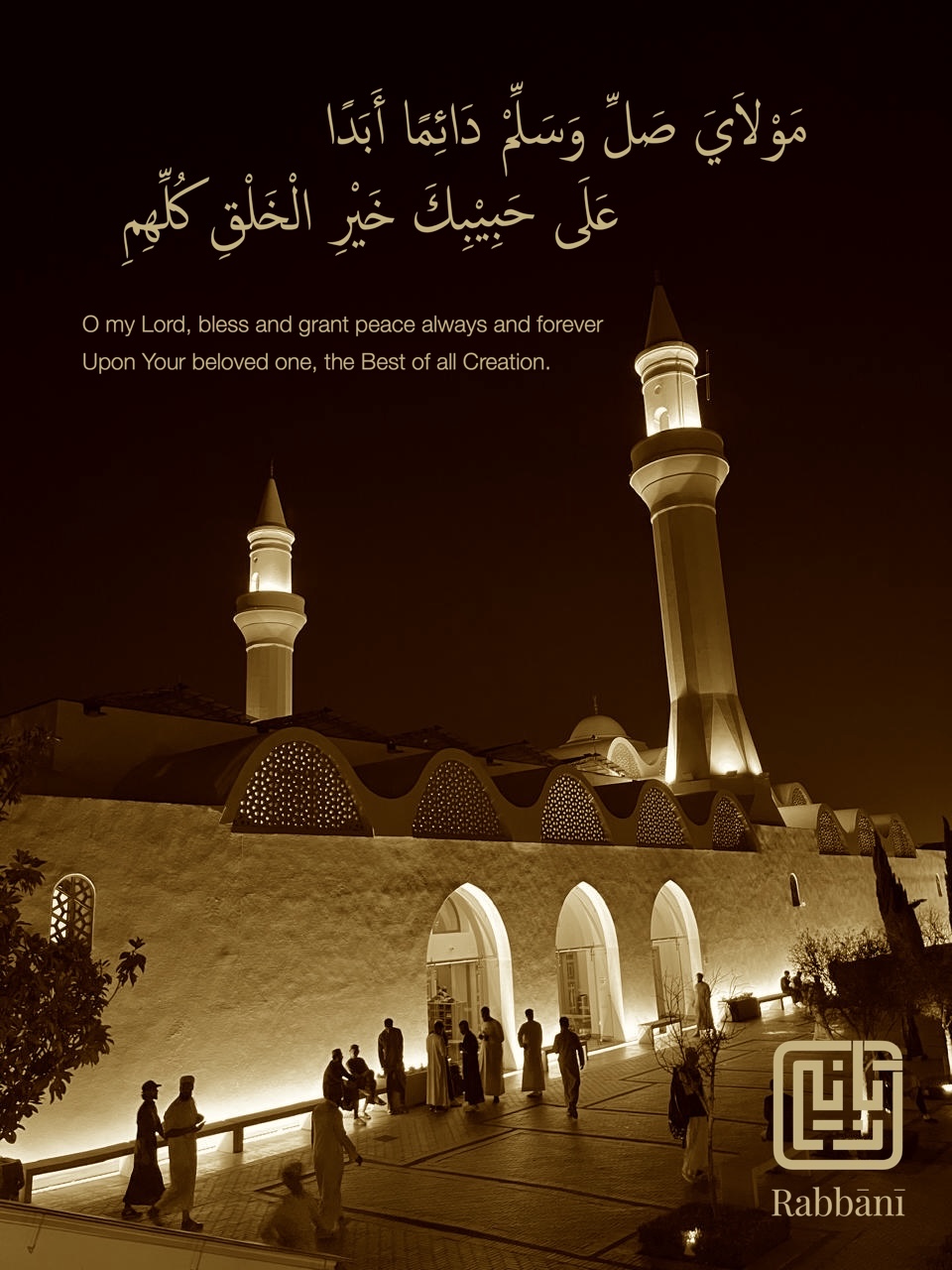
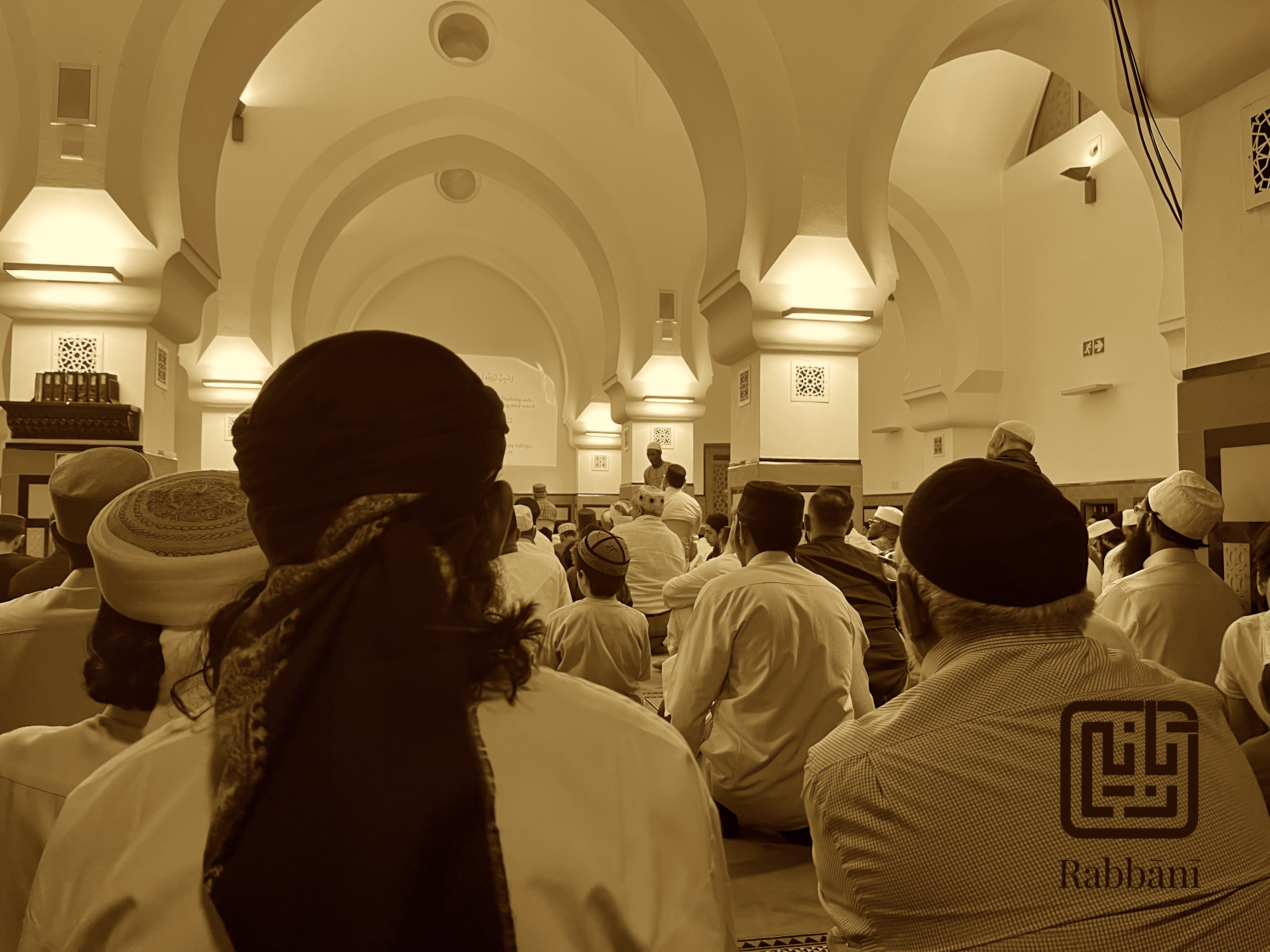
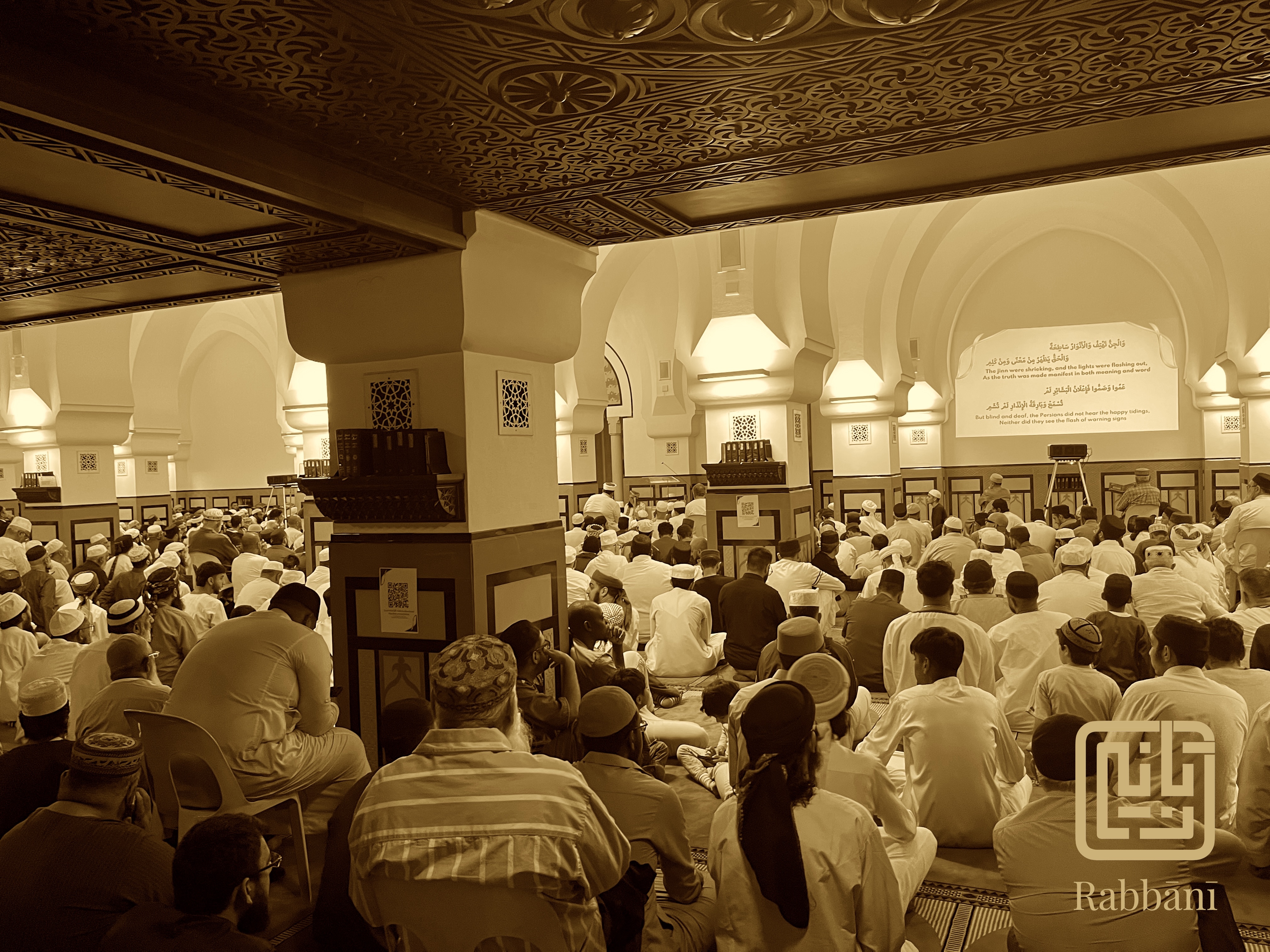
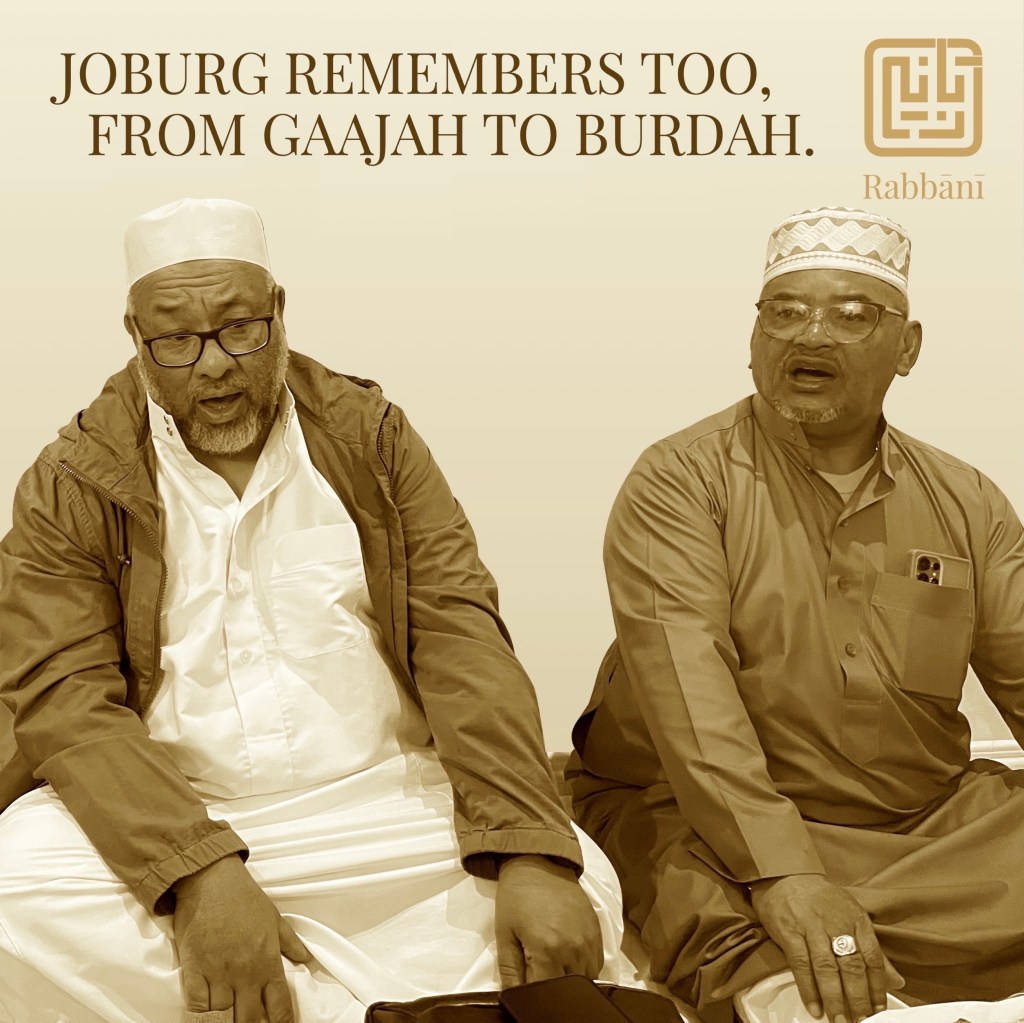
    Friday night at Houghton Mosque was a different scale. The mosque was full: elders in white, young men with turbans, children by their fathers’ sides. Groups from different mosques took their turns, each with its own melody and rhythm.

    Later my daughter Lala asked me, “What is this story of the Burdah? I’ve never heard this before.” I told her: “This is pure poetry! Almost like the Riwayah — the Prophet’s ﷺ life in song. But here, in the Burdah, different groups recite in turn, and together they weave a chorus.”

    When I arrived at Houghton Mosque, I noticed something new. On the poster it had said: “Ladies Facilities Available.”Inside, the organisers had placed a new screen, expanding the women’s section for those who wanted to attend. It was unusual — there is already a women’s section — but this night, they anticipated more women. They made space.

    That small act struck me as part of the remembrance itself: a recognition that devotion lives in inclusivity, in the care we show each other when we gather.

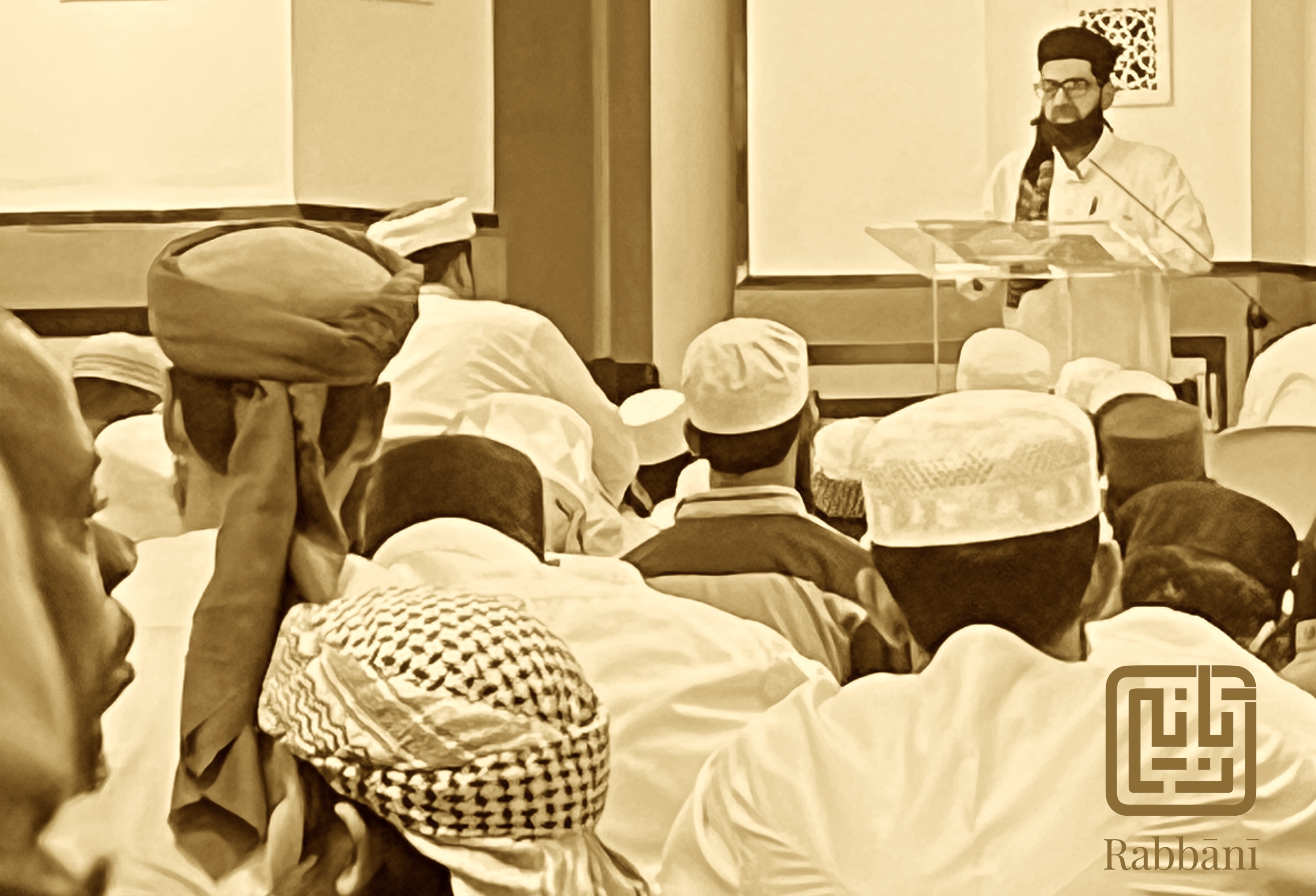
    Before each group began, Ml Abu Hurairah Bobat guided the gathering, introducing the chapters and themes of the Qasidah Burdah. With warmth and clarity, he explained how the verses moved from praise of the Prophet ﷺ’s birth, to his struggles, to his intercession. His words opened the door for those less familiar, making the Burdah not just recited, but understood.

    And then came the moment that will stay with me: as each group finished its verses, the entire jamaat — young and old — spontaneously joined in the chorus:

    مَوْلاَيَ صَلِّ وَسَلِّمْ دَائِمًا أَبَدًا
    عَلَى حَبِيبِكَ خَيْرِ الْخَلْقِ كُلِّهِمِ

    Mawlaya ṣalli wa sallim dāʾiman abada
    ʿalā ḥabībika khayril khalqi kullihimi

    O my Lord, bless and grant peace always and forever
    Upon Your beloved one, the Best of all Creation.

    It was not performance but inheritance. The refrain rose again and again until it felt as though the very walls of Houghton Mosque were singing with us.


    The Lion and the Fortress

    From the Qasidah Burdah, Imām al-Būṣīrī sings of the strength carried by those tied to the Prophet ﷺ:

    Those whose help comes from the Messenger of Allah —
    Even lions encountering them in their dens would be struck speechless with fear.

    He established his community within the fortress of his religion,
    As the lion settles down with its cubs in its lair.

    Hearing the jamaat echo the chorus, I felt that same fortress. This was not nostalgia — it was strength and mercy alive in Johannesburg.


    Fragrance and Victory

    Later, another passage rang true to what I saw and smelled:

    The winds of victory would present to you their fragrance,
    So that you imagine each valiant one of them to be a beautiful flower in bud.

    As if, riding their steeds, they were flowers blooming upon a height,
    Held there not by the tautness of their saddles, but by the firmness of their resolution.

    The Burdah does not only narrate victory — it perfumes it. Just as our Cape homes once scented with sandalwood and rampies, so here the fragrance of victory was carried in chorus.


    Majestic Presence

    And in the majesty of the Prophet ﷺ, the Burdah declares:

    Like a flower in freshness and a full moon in eminence,
    Like an ocean in pure generosity and like time itself in strength of resolution.

    Just from his majestic bearing, even when he was alone,
    He seemed as if amongst a great army and entourage.

    At Houghton there was no standing qiyām — the tradition differs from the Cape. But the chorus of Mawlaya ṣalli wa sallim… still lifted the gathering, as if the walls themselves joined in remembrance.


    Dress and Identity – From Kurta to Thobe

    As I looked around, I noticed another change. When I was younger, men in Joburg mosques wore kurtas — Indian style. Now the children, young men, and elders were dressed in thobes and turbans, a celebration of the Prophet’s ﷺ attire.

    Was it the influence of hajj and ʿumrah, Gulf media, or the aspiration to be closer to sunnah? Perhaps all of these. Styles shift, but the devotion remains.


    Closing – Joburg Remembers Too

    This Rabiʿ al-Awwal, in Heritage Month, Joburg reminded me that Cape Town does not own memory. Dhikr lives here too — in family homes, in gaajahs for birthdays, in mosques filled with Burdah echoes.

    Heritage is not just remembrance, it is continuity. Not only in books, but in chorus. Not only in Cape Town, but in Joburg.

    The Prophet ﷺ is in our veins and in our graves. In sandalwood tasbihs, in rampies leaves, in choruses that rise like fragrance. Remembered not only in words, but in song.


    🔗 Cross-links (to add at the end of the blog)

    You may also like:


  • Fast-Forward into the Institute, Returning to the Circles

    Fast-Forward into the Institute, Returning to the Circles

    Fast-Forward into the Institute, Returning to the Circles

    A week with the IslamicText Institute and Azzawia’s living tradition

    It was a whirlwind week — Arabic on Tuesday, fiqh on Wednesday, Kitabush Shukr on Sunday, and Mawlood practice at Azzawia to close. What began as a fast-forward plunge into the Institute ended as a return to the circles that have always held the rhythm of Cape Town’s tradition.

    It began with a handshake at Azzawia. Shaykh Allie Khalfe smiled, extended his hand, and with that simple gesture drew me into a current that would carry me through a whirlwind week — Arabic, fiqh, gratitude, and finally the rhythms of Mawlood.

    Where Azzawia’s circles had been steady and calm, the IslamicText Institute moved like a river already in motion. One week felt like fast-forwarding through months of learning, not skipping steps, but running to keep pace.


    Tuesday Night – Kitāb al-Asāsī (Arabic)

    The week began with Arabic, the Kitāb al-Asāsī.

    Stepping into the Arabic class at the IslamicText Institute felt like boarding a train already in full motion. The Shaykh and the students were moving at speed, voices alternating between reading aloud, parsing grammar, and drilling vocabulary. On the board, examples unfolded in careful script: prepositions locking words into the genitive, adjectives matching their nouns in gender and case, colours shifting form depending on what they described. What for some students was revision, for others — like me — was a plunge into deep waters.

    The pedagogy was exacting. Shaykh Allie did not slow the pace, but instead invited everyone to rise with it. “Read, now explain, now apply,” was the rhythm. Mistakes were corrected swiftly, but with humour; every slip was a lesson, every correction a reminder that Arabic is both precise and merciful — demanding effort, but always rewarding persistence. You could sense that this was no ordinary language class. It was training the mind to think with Qur’anic logic, to tune the tongue to sacred precision.

    For me, it felt beyond capacity. Months of Arabic study had not prepared me for the quick-fire exchanges, the confident parsing, the way students moved from grammar to meaning almost effortlessly. Yet this sense of inadequacy became its own teacher: a reminder that humility is the door to knowledge. The Shaykh’s method left no space for passivity; to survive, one had to participate, stumble, rise again, and keep pace with the moving current.

    And yet, beneath the intensity, a deeper truth was visible. This Arabic — this Kitāb al-Asāsī — was not an isolated discipline. It was the key, the doorway to everything else. Without it, the texts of fiqh and ʿaqīdah that followed on Wednesday would remain veiled. With it, even a little of it, the veils began to lift. As the class closed, I realised that I had not simply attended a language lesson. I had glimpsed the scaffolding of the tradition — the way Arabic itself becomes the vessel carrying law, creed, and devotion across centuries.

    The experience was like being dropped onto a moving train: you find your balance by running. And the Shaykh’s clarity carried us along.


    Wednesday Night – Fiqh and ʿAqīdah in Motion

    If Tuesday was about catching the rhythm of Arabic grammar, Wednesday was a double immersion — first in the law of prayer (Fiqh), then in the foundations of belief (ʿAqīdah).

    In the Fiqh class, we entered al-Majmūʿ of Imām al-Nawawī, studying the conditions for a valid prayer (Shurūt Ṣiḥḥat al-Ṣalāh). Shaykh Allie Khalfe reminded us that prayer is not just a series of movements, but an act that only takes its true form when certain conditions are met: purity, covering the body, facing the qiblah, the right time, and the intention. Without these, the prayer is incomplete — like trying to build a house without laying its foundation.

    What struck me most was how the discussion flowed between law and purpose. Technical details (such as what invalidates purity or how to define proper covering) were paired with reminders of why these rules exist: to help us stand before Allah with clarity and humility. Even for someone familiar with the Shāfiʿī tradition, it felt fresh — like polishing something you thought was already shining.

    After Fiqh came ʿAqīdah, using the poem al-Jawharah as our guide. The Shaykh paused on a verse about knowing what Allah loves and what He dislikes, and how this knowledge has two sources: Revelation (the Qur’an and hadith) and the insight of the heart. The latter, he explained, is rare and precious — not every reflection is reliable, but when guided by sincerity and remembrance, it can be a light Allah places within the heart.

    The room grew quiet at this point. It was as if the text had shifted from rules to reflection, inviting us inward. One student described it as moving from the “outer map” of worship into the “inner compass” that helps us navigate love and awe of Allah.

    Together, these two sessions showed me the balance of Islamic learning: law to protect the structure of worship, belief to enliven its spirit.


    Sunday Morning – Kitābush Shukr (Gratitude)

    The class opened with Shaykh Allie Khalfe guiding us into Bayān al-Tamyīz — the explanation of distinguishing between what Allah the Exalted loves and what He dislikes.

    As Imam al-Ghazālī reminds us, gratitude (shukr) is not merely a feeling but an act: to use Allah’s blessings in obedience to Him. Ingratitude (kufr al-niʿmah) is its opposite — using those same blessings in disobedience.

    The Shaykh highlighted that distinguishing between Allah’s love and dislike has two sources:

    1. Revelation — the Qur’an and the Prophetic Sunnah.
    2. Insight of the Heart — reflection with the “eye of the heart,” rare and difficult, yet precious when granted.

    A fellow student captured it beautifully:

    “The meaning of gratitude is to use the blessings that Allah the Exalted has bestowed upon us in obedience to Him; and the meaning of ingratitude is the opposite… Revelation is the foundation, but the inner sight is what polishes the heart.”

    In this way, Shaykh Allie urged us to see shukr not as abstract, but as practice — prayer, fasting, feeding the needy, speaking truth — until life itself becomes an act of thanks.


    Sunday Evening – Mawlood Practice at Azzawia

    As the sun lowered that same Sunday, I stepped back into Azzawia — not for fiqh or grammar, but for song.

    The Mawlood practice was alive:

    • A conductor guiding the voices — “higher here, lower there, let me show you.”
    • Laughter and corrections, Afrikaaps mixing with Arabic across the room.
    • Pages of the Barzanji Mawlood open, voices rising and falling, the rhythm of devotion rehearsed until it became natural.

    Behind the practice, in conversation, plans unfolded: flowers and rose water, daljies and samoosas, volunteers preparing. The anticipation of the Mawlood itself, still weeks away, hovered in the air.

    It felt like the body of the community rehearsing, tuning itself — men and women, Afrikaans and English, sacred text and local voice, all weaving into one.


    Closing Reflection – Learning at Speed, Returning to Circles

    By the week’s end, I had been swept into three modes of learning — the sharp sprint of Arabic grammar, the layered dialogue of fiqh, the contemplative unfolding of gratitude, and the embodied devotion of Mawlood practice.

    The Institute was fast-forward — a current already in motion. Azzawia remained steady — circles rooted in the soil. Together, they are not opposites, but complements.

    I left with my notes still warm in my hands, the echo of recitation still in my ears. Learning at speed. Remembering at depth.

    And in both places — gratitude.

    🤲 Dua at the End

    اللَّهُمَّ اجعل هذا العلم نورًا في قلوبنا، وعملاً صالحًا في حياتنا، وذُخرًا لنا يوم نلقاك.
    O Allah, make this knowledge a light in our hearts, a righteous action in our lives, and a provision for us on the Day we meet You.


    🔗 Cross-link

    👉 For a deeper sense of Azzawia’s slower rhythm, see my earlier reflection: In the Circles of Azzawia.

  • When the Conqueror Steals the Tongue

    When the Conqueror Steals the Tongue

    When the Conqueror Steals the Tongue

    Ngũgĩ wa Thiong’o, Kaaps, and the Language of Return

    “Take away our language and we will forget who we are.”

    Ngũgĩ wa Thiong’o’s words land with the sharpness of memory — not just for Kenya, where he grew up, but here at the Cape, where empire’s conquest of our bodies came with a quieter, more enduring conquest of our tongues.

    Ngũgĩ’s recent essay in The Guardian tells how colonial schools punished African children for speaking their mother tongues, rewarding only the conqueror’s speech. It shows how missionaries imposed new, biblical names on students — turning Ngũgĩ into “James” — severing identity at the root. He calls this the colony of the mind, where shame and silence make us police our own voices.


    The Cape Echo

    We know this story.
    In our Cape classrooms, Kaaps — the language of our homes, jokes, and arguments — was labelled “slang,” “broken,” or “incorrect.” Arabic-Afrikaans, the written tongue of our forebears’ Qur’ans and litanies, vanished from the public page. It was no accident. This was the slow grind of erasure: to make us strangers in our own mouths.


    Kaaps lives in the stoep conversations, the street games, the everyday poetry of the Cape.

    Kaaps as a Living Archive

    Kaaps is not “lesser” Afrikaans. It is the living grammar of the Cape, born from the meeting of Khoi, Malay, enslaved African, and European tongues. It carries the rhythm of working-class streets, the tenderness of family kitchens, the wit of those who survive by laughing.

    Ngũgĩ’s call for linguistic justice speaks directly to Kaaps: the demand that we write, publish, and teach it without apology, that we refuse to bleach it into acceptability. To reclaim Kaaps is to reclaim the right to sound like ourselves.


    The Ratib al-Haddad and the Sound of Home

    If Kaaps is our daily voice, Arabic-Afrikaans is our prayer voice. In the Ratib al-Haddad, Cape Muslims preserved the Qur’an’s Arabic alongside Kaaps-Afrikaans, written in Arabic script. These manuscripts are living proof that language can survive conquest by going underground — into the masjid, the madrasa, the family du’a.

    Ngũgĩ imagines a network of languages, each contributing its own beauty. The Ratib is already that: Arabic, Malay, and Kaaps carrying barakah together, resisting the empire’s hierarchy of tongues.


    The colony of the mind — when language is caged, and light must break through.

    Colonies of the Mind

    The greatest victory of conquest, Ngũgĩ says, is when we no longer need to be told our languages are inferior — we have already believed it. That is the “colony of the mind.”

    This is why we keep unearthing Arabic-Afrikaans manuscripts, writing Kaaps into the public record, celebrating the medora and the sorbaan, documenting the words of our elders. These are not side-projects — they are acts of return.


    From Erasure to Inheritance

    Ngũgĩ reminds us: decolonisation begins with language. Every blog on Kaaps, every poster that holds a Cape word like a jewel, every unpacking of the Ratib is not just cultural garnish — it’s the soil in which freedom takes root.

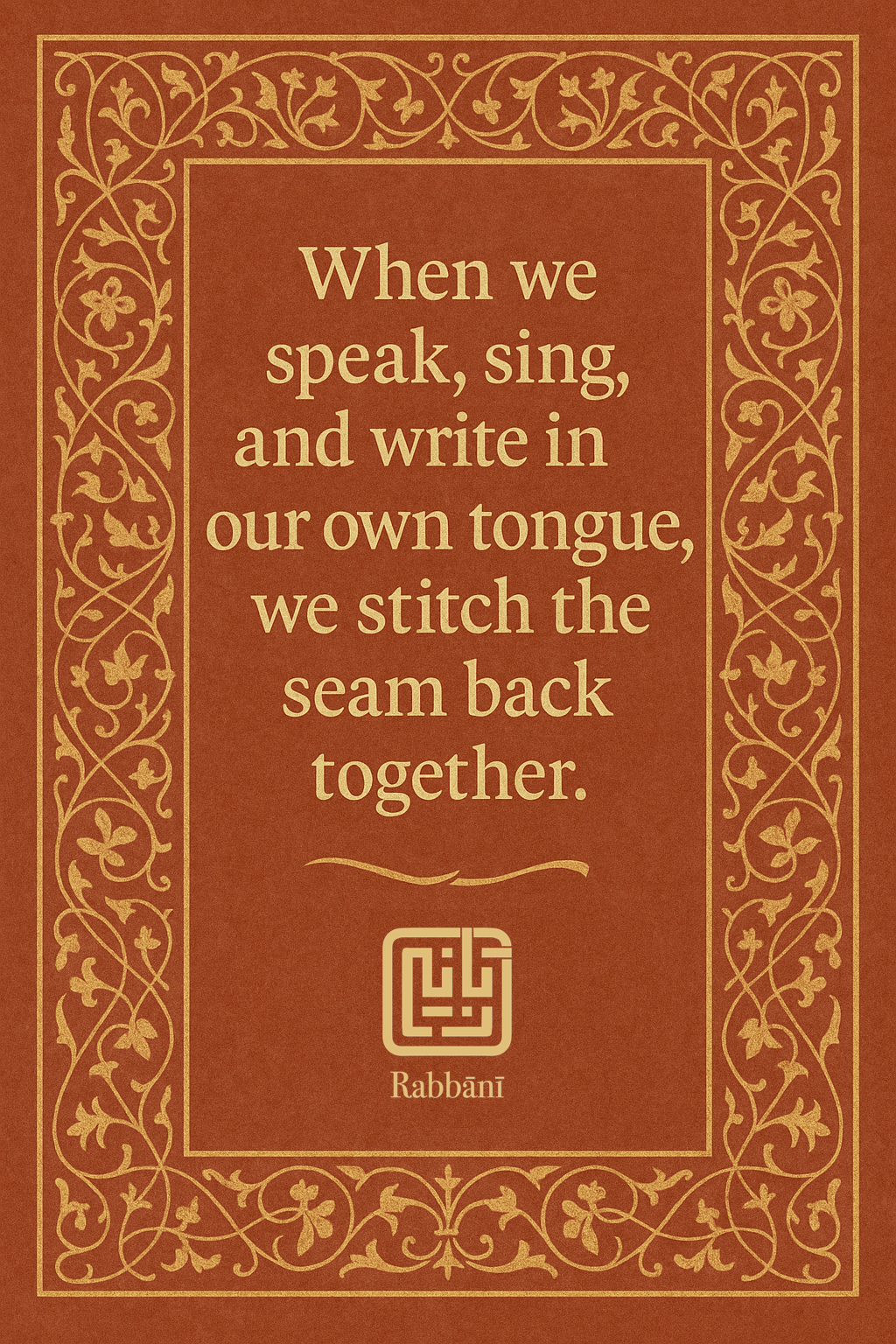
    If the conqueror severs language to make us forget, then our work is to speak, sing, write, and teach in our own tongues until our children’s children remember again.


    📖 Read Ngũgĩ’s full essay here: The Guardian


    Further Reading

    If this reflection spoke to you, you may also like:

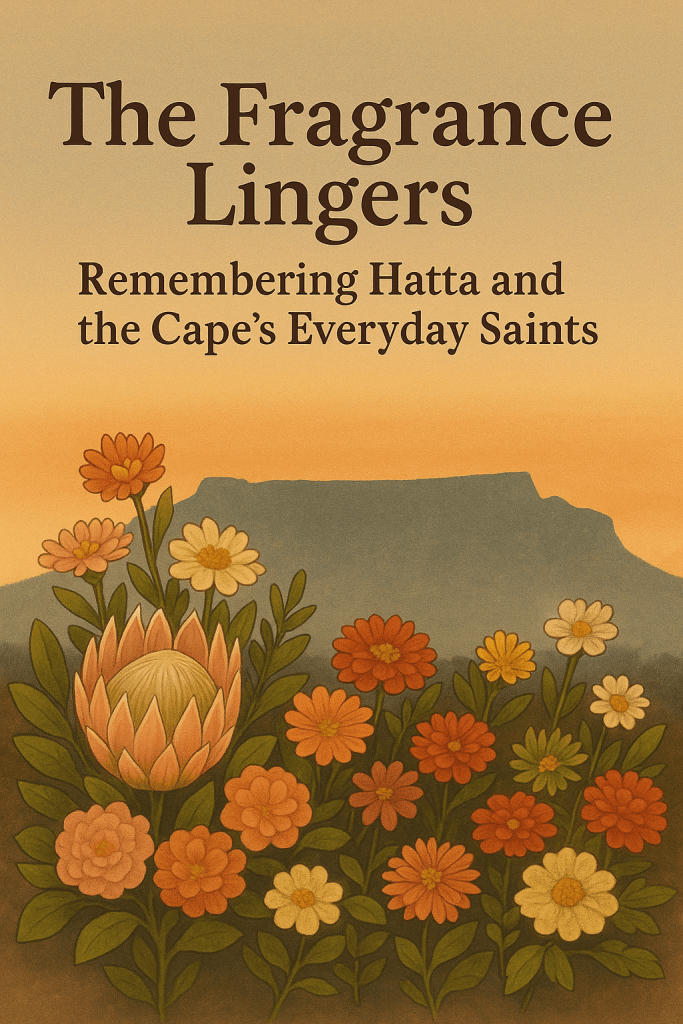
  • The Fragrance Lingers: Remembering Hatta and the Cape’s Everyday Saints

    The Fragrance Lingers: Remembering Hatta and the Cape’s Everyday Saints

    A tribute to Hatta: flower seller, character, Cape Town soul. The fragrance lingers…

    She wasn’t just a flower seller.
    She was a fragrance, a rhythm, a joke that made you feel seen.
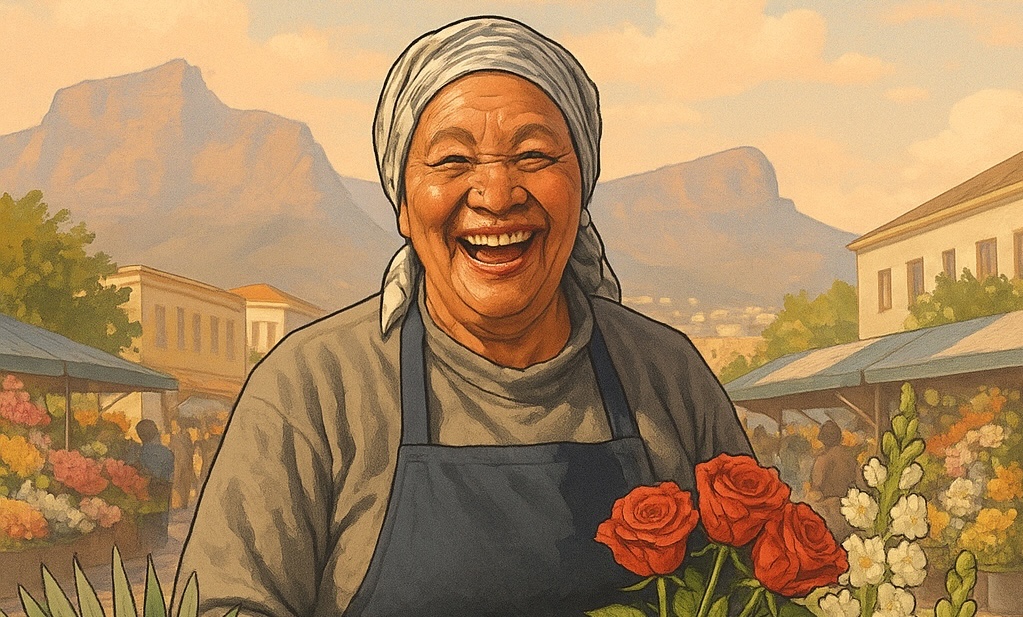
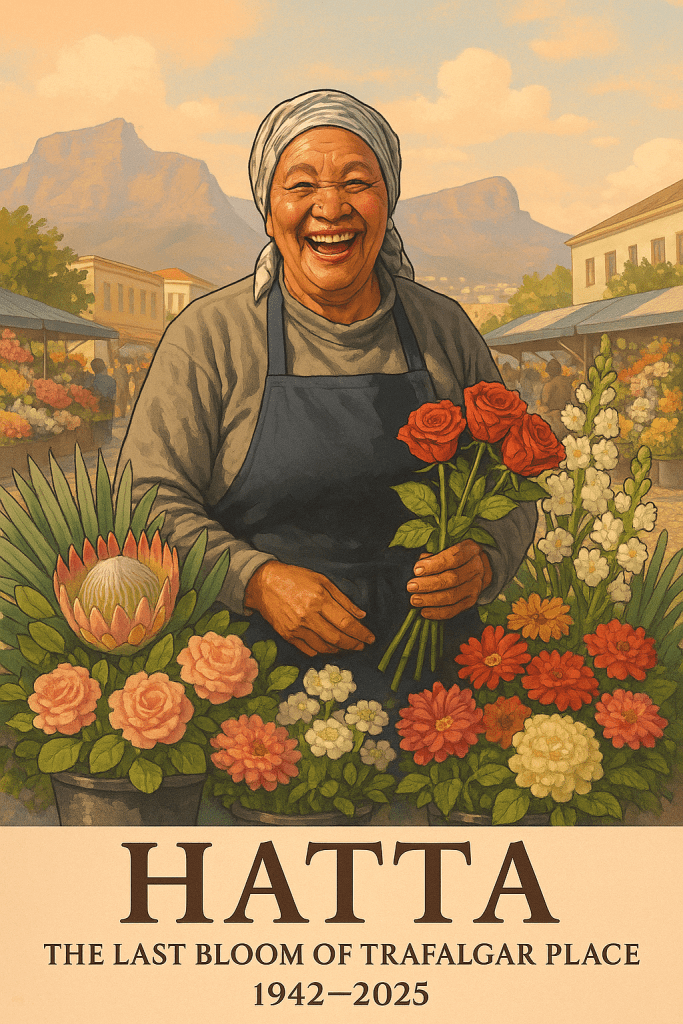
    Her name was Cecelia Williams—known to all as Hatta—and for over sixty years, she stood at Cape Town’s Trafalgar Place market, not just selling blooms, but lifting spirits.

    Hatta was a character. A caretaker. A Cape Town original.

    The Poem that Opened the Door

    “Hatta of the Flower Market”
    She was the last blossom of a vanishing season,
    a woman with hands that knew petals better than poems,
    who crowned Adderley mornings with colour and cackle.
    They called her Hatta—not just a name, but a rhythm.
    A shrug, a laugh, a story half-told while binding roses with string.
    Sixty years of market sun.
    Of joking with tourists. Of feeding the street children.
    Of being “one in a million” without ever asking for a statue.
    Now the market hums a little quieter.
    But her scent, her sass, her spirit—
    they linger,
    like the last bloom in a winter vase.

    This poem, first shared on my Facebook page, sparked an outpouring of memory and community. The tribute went viral, shared across timelines and group chats. And then, like the scent of jasmine carried on wind, her story grew.

    The Article That Helped the City Remember

    Tamlynne Thompson’s piece in The Cape Towner became a cornerstone of Hatta’s public remembrance. It offered not only a portrait of her life, but a signal that her presence had mattered—deeply.

    🔗 Read the article here

    Her Funeral, and the Silence That Spoke

    Though the newspaper referenced a YouTube link, the funeral livestream no longer appears to be available. But memory has other ways of surfacing. While searching for traces of Hatta, I found this moving video about her best friend, Sandra Bosman—herself a flower seller of the Cape.

    🔗 Watch the tribute to Sandra Bosman

    Through Sandra, we hear the echoes of Hatta’s laughter, her generosity, and her grit. It’s another thread in the fabric we’re weaving.

    Voices from the Cape

    Facebook friends poured in with blessings, memories, and emotion:

    Anne Rogers: “Yet another outstanding poem – beautiful, moving words and complementary image to honour an outstanding woman who brought joy to many.”

    A Note of Gratitude:
    To Anne Rogers—your kind words landed with warmth.
    In a world where noise often drowns meaning, your belief in my words is a quiet blessing.
    Thank you for seeing not only the poem, but the person behind it.

    And to Atiyyah Khan, Marianne Thamm, Mogamat Kammie Kamedien, and so many others—this harvest belongs to you too.

    What Does “Hatta” Mean?

    A few friends asked if Hatta was an honorific.
    The word “hatta” can refer to the traditional Arab headscarf, the keffiyeh—often used in resistance, honour, and dignity.
    It also carries echoes of the Arabic verb ḥaṭṭa, meaning to reachto attain, or to bring down gently.
    Maybe that’s what she did—reached people, lifted them, wrapped them in grace.

    The Spirit of the Cape Lives On

    You can’t really write about Cape Town without talking about talking.
    That unique Cape Flats cadence—Afrikaaps—where people don’t just sell fruit or flowers.
    They create moments.

    Ask about a naartjie and you’ll hear:

    “Die naartjies is so lekker, hulle willie praatie. Hulle’s te skaam van al die soetigheid!”

    And Hatta?
    She was the high priestess of that daily liturgy.

    🌹The Fragrance Lingers

    This is not a eulogy. This is a zahrā’, a bloom.
    And she—Hatta—isn’t gone.
    She lives in our language. In our laughter. In our stories.
    In every bouquet given in kindness. In every street market joke.
    In every aunty who tells it like it is, and every uncle who listens.

    May we see them. May we remember them. May we become them.

    🕊️ Rest in softness, Hatta. You were the last bloom of Trafalgar Place. But your scent is forever.

    This blog post is dedicated to every flower seller, fruit hawker, street child, and storyteller who holds up Cape Town with grace and grit. May we never forget them.

  • Remembering the Call of Islam

    Remembering the Call of Islam

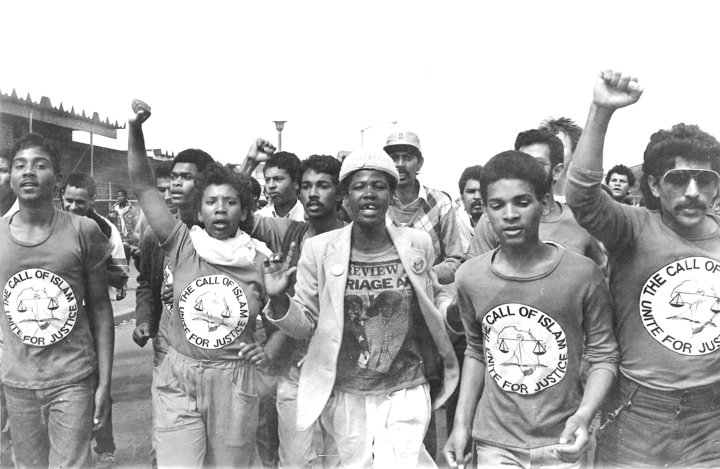
    call-march
    Call of Islam march in the 1980s. Pic: Yunus Mohamed

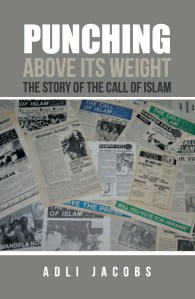
    When I published my first book in 2014, a community in Pretoria invited me to share with them the significance and the reasons for writing Punching Above Its Weight

    Cover

    Launched in 2017.

    I am most grateful for this opportunity to speak to you today, at the Rasooli Centre, on my first book, Punching Above Its Weight – The Story of the Call of Islam. This is not just a story of my own youth, of how I came to be a part of such an important organisation. This is not just a biography of the Call of Islam and how the organisation as well as the broader community developed a new and fresh way to view our own Islam.

    This is not just the story of how a tiny Muslim population at the tip of Africa, in concert with others, stood their ground against the mighty apartheid government and policies of dehumanising all who were deemed lesser because of the colour of their skin. It is not just the story of the resilience of a population who, despite massive exploitation and oppression, stayed true to their humanity and made space for many, including members of the white population, in the struggle against apartheid.

    Written in an easy style, without complicated language, I try to tell the story of a seemingly insignificant political movement that made far-reaching contributions to the freedom struggle in South Africa. The book traces the many activities of the Call of Islam, the mass rallies, the interfaith gatherings, funeral demonstrations, culminating in the one of biggest and most significant gatherings of Muslims in SA, the National Muslim Conference in 1990.

    Punching Above Its Weight is about all of these and more. Ebrahim Rasool, now the ex-SA ambassador to the US, reflects on this in the Foreword to the book:

    “It is a travesty that we have waited almost 30 years for Punching Above Its Weight – The Story of the Call of Islam to be told. I am happy that Adli has now done so. It may not be a perfect rendition of the history; a complete account of every debate, campaign or incident; or a personal recall of every brave and thoughtful member. But it fulfils a need.

    “In a world where some Muslims present us as backward by their example, and our opponents project us as barbaric in their propaganda, the least that this book will do is to say that in 1984, in the midst of an almighty struggle against apartheid, there emerged from a community that came to South Africa as slaves and exiles, who constituted only a small minority, yet from them the Call of Islam was born.”

    So, in many ways, it was the Call of Islam, Muslims in South Africa and freedom-loving South Africans generally who all punched above their weight in a time when we thought we would never see the day when we would all be free. That was a time when Ronald Reagan’s America saw South Africa’s apartheid government as an ally in the Cold War and when the rest of the world’s nations (except a few) were slow to respond to the crimes against humanity that was taking place in South Africa. We were then where Palestine is today, under the occupation of a brutal regime.

    The book is, at one level a celebration of our South African victory, but also about the lessons we must learn from this experience because of what use is a celebration for humanity if we do not try to understand how we overcame our biggest challenges. I believe, in attempting to understand how we changed our selves in the midst of struggle, we can use those insights to inform what our role should be today and make better use of our present freedoms and challenges. Because…

    “Centring on the story of the Call of Islam is in many ways a lens to look at the details of the South African struggle. It means zooming in, as you would with a microscope, to observe the anti-apartheid struggle by focussing on some of its compounds and atoms that give a different insight than if one just looks at the broad strokes. And because the Call was more than just a faith-based organisation – rather, it was one engaged in political struggle – its model can be educational to many social movements, activist or non-governmental formations, and even social welfare groups, both in South Africa and beyond.”

  • And here I thought I was the only one

    And here I thought I was the only one

    When I first saw Groundhog Day, I was drawn to its notion of Carpe Diem

    [Written in response to The Subtle Brilliance of ‘Groundhog Day’]

    Groundhog Day poster

    Bill Murray in Meatballs marks my days of questionable movie tastes in my youth. I was fourteen when the movie hit the circuit and I just had to see it. And as my tastes improved, so did the actor as he meandered his way through CaddyshackStripes and Ghostbusters. Arguably, Groundhog Day, was a Bill Murray that had matured as an actor, a watershed moment, sort of like the way John Travolta improved through his movie career.

    Throughout the 90s I would unpack the whole plot of Groundhog Day in workshops to inspire youth to take charge of their own transformation. I would explain that the Phil being trapped in the same day was often what our own lives are really like. We may number them differently, give them different names and watch different weather conditions play themselves out… Our days are basically the same. And we have trapped ourselves in this monotonous routine.

    The only way out was to acknowledge that we are wasting away with our lookalike days and then to make incremental changes. And if you focus on changing yourself, the rest will work itself out or won’t even matter. It worked so well, I remembered those moments and then deployed it once more to first year journalist students when I started lecturing. I then played clips of the movie because… well I could, as I had my class trapped for an hour a quarter!

    And here I was thinking that I was this freak for holding onto an oldie such as Groundhog Day. So thank you Remi for adding in all those layers of meaning to a movie that I already believed is inspirational…

  • Introducing the Humans of Cameroon

    Introducing the Humans of Cameroon

    Changing the narrative of your country, one status update at a time

    A Cameroonian from the Facebook page of Humans of Cameroon
    A Cameroonian from the Facebook page of Humans of Cameroon

    Humans of New York, a website and Facebook page (now even an app) showcasing ordinary New Yorkers, is sitting at almost 11,5 million likes. It’s not difficult to see why. New York is perhaps the most famous city on earth. Google auto-completed the name when I typed in ‘how many songs about…’ It threw up a Wikipedia article listing songs, in alphabetical order, that reference the city, its landmarks and street names. There’s a gazillion of them!

    And Cameroon? Google started with ‘10 fun and interesting Cameroon facts’. And the first fact was: ‘Cameroon is the first African country to reach the quarter-final in soccer world cup.’ I bet you don’t even know what the capital of Cameroon is. I had to look it up and I’m from South Africa. Many Africans would roll their eyes and say, ‘Typical!’ Well, it’s Yaoundé.

    If you’ve been watching news recently, then you would know that Cameroon helped her neighbour Nigeria by launching airstrikes against the extremist group Boko Haram. Pretty feisty for a country that generally only gets into the news because of its football players making a name in European leagues.

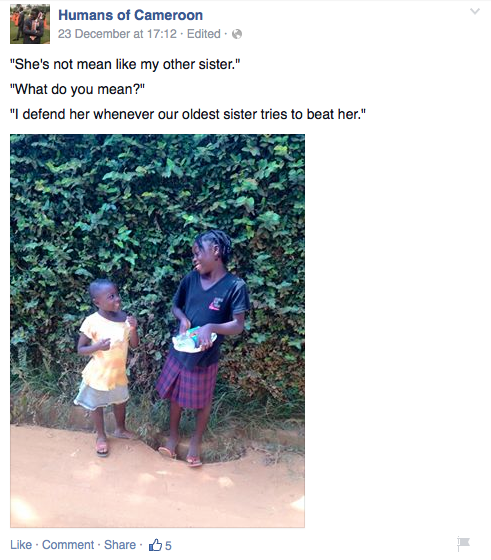
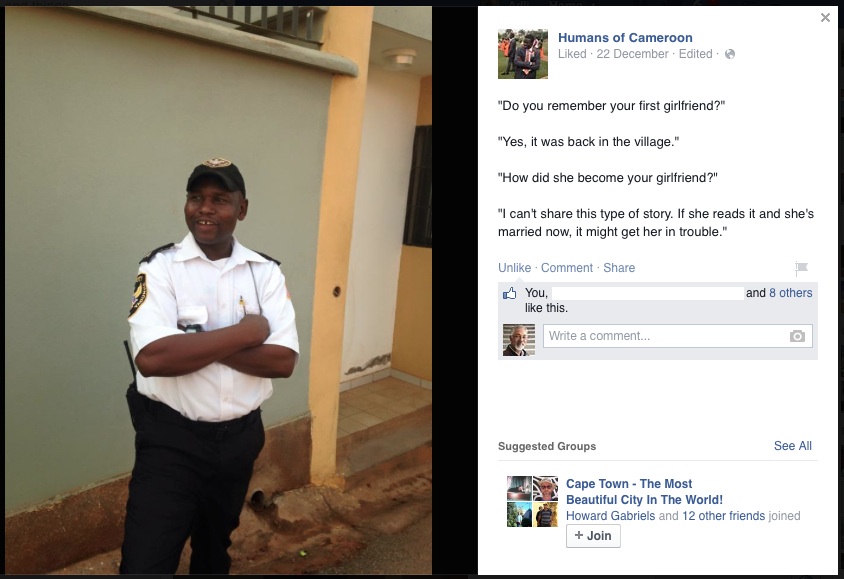
    Equally feisty is a Facebook page a friend asked me to like, called Humans of Cameroon. My first thought was that this must be a copycat of the massively popular Humans of New York. Then I clicked on the link and this jumps up at me:

    The Entrepeneur

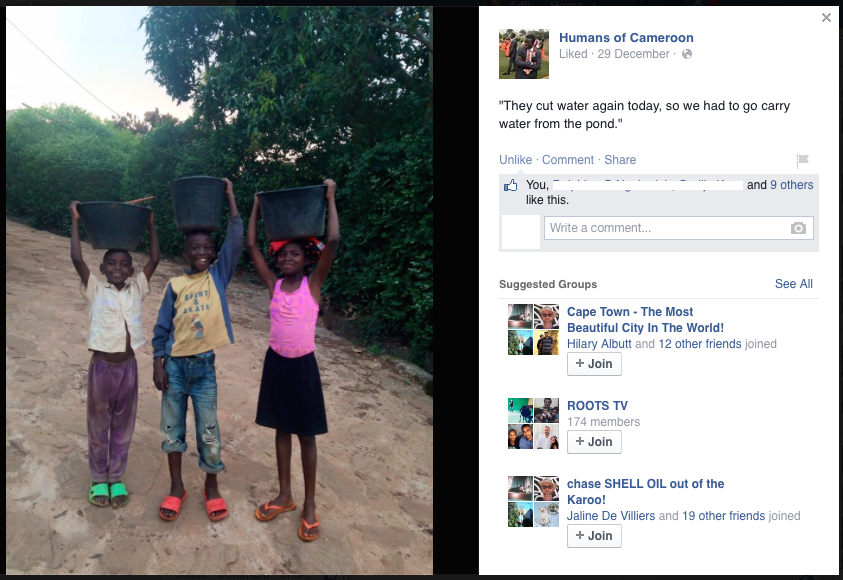
    And then this:

    Screen Shot 2014-12-31 at 21.16.04Water carriers

    I was taken by the sheer humanity of these stories. This was so far from the stereotypical depiction of Africans that either needed charity or came second to their wildlife and spectacular landscapes. Because of media priorities such as proximity (it is in our backyard), impact (it is massive and we are affected by it) and prominence (it involves celebrity), countries such as Cameroon hardly make it on the media radar. When they do make it into the news then, it is because of something negative.

    When I shared the page with my Facebook buddies, this is the response from one of them:

    “A gem of a FB find on this last day of 2014 (thanks to Adli Jacobs). Brilliant unmediated African voices — the kind we never get to access through mainstream media.”

    In a sense, the creators of Humans of Cameroon have applied the New York example as a genre. There have been other cities and countries that have done the same. In Cameroon’s case it acts to reposition (or repackage) the country by foregrounding its people and allowing their voices to contribute to how that nation is seen. And yet, in a sense, it also acts as a counter-balance to Humans of New York whose lives are evidently more affluent, residing in a city that is the darling of the world.

    There is no Statue of Liberty in Cameroon, no Empire State building, no Broadway or Time Square. There is no Madison Square Garden or famously numbered streets in Yaoundé, the capital. But there is in Cameroon, despite a past of two colonial masters (the British and French), despite a president who refuses to say goodbye, despite being beset by corruption, despite the threat of civil tension boiling over from neighbouring Nigeria, these amazing people…

    Security guard