
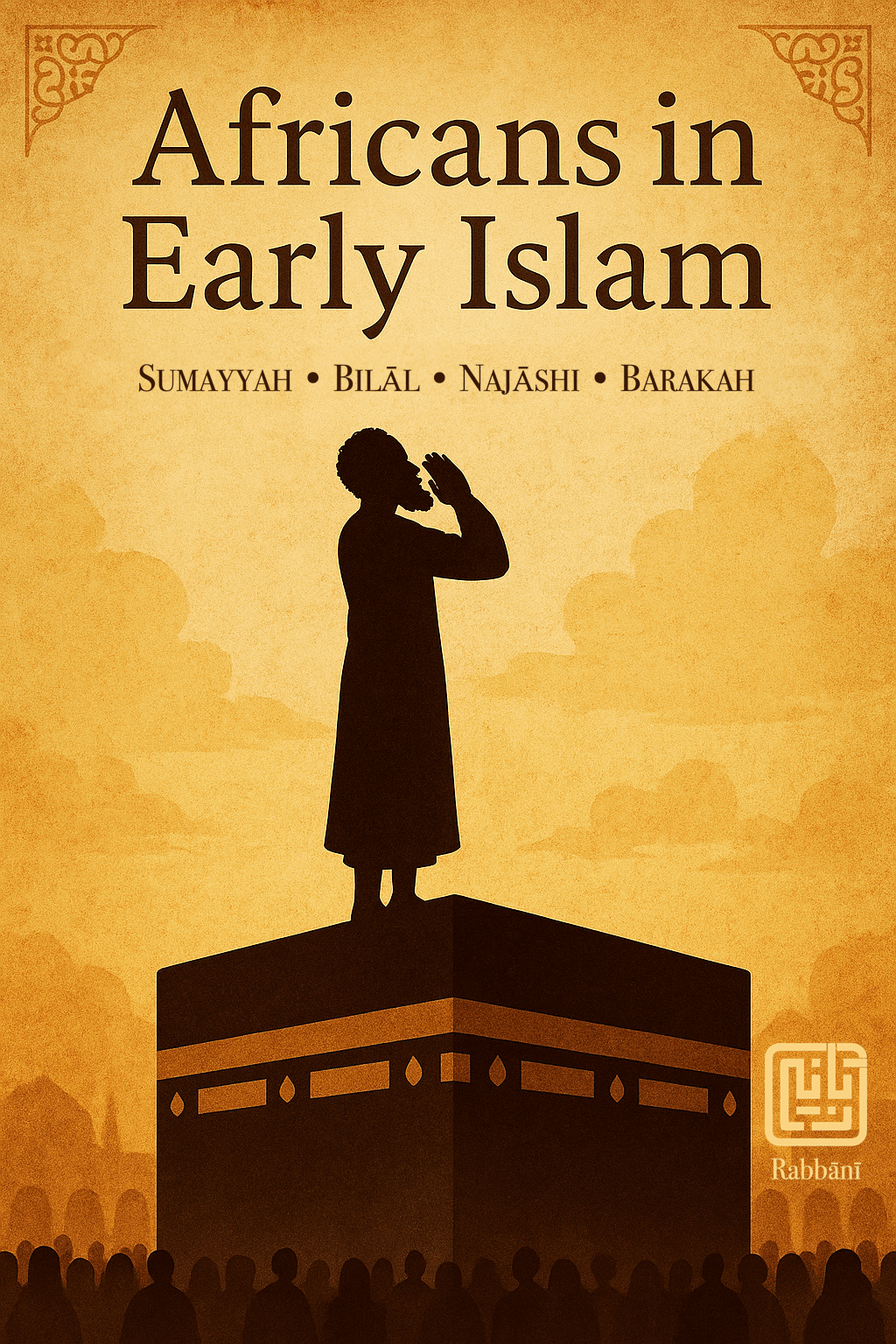
Africans in Early Islam: A Celebration of Courage, Dignity, and Faith
With deep gratitude to Shaykh Allie Khalfe for preserving these gems of our tradition.
Introduction
Hājar — a Black African woman, enslaved and then displaced — was chosen by Allah to become the mother of Ismāʿīl, and to have her house absorbed into the sacred geometry of the Kaʿbah itself.
Not a prophet.
Not a king.
Not a caliph.
But a mother. A servant. A Black woman.
The House of Allah bows toward her grave.
Ali Shariati called her the “Unknown Soldier” of Islam. But Allah made her known forever — through Zamzam, through Safa and Marwa, through the sacred enclosure known as Ḥijr Ismāʿīl. You cannot perform Hajj without acknowledging her. That is not just history. That is revolution.
When I look across the ummah today — from Cape Town to Cairo, Timbuktu to Jakarta — I see faces of every shade, hearts carrying a message revealed for all people, for all time. Yet too often, I also see shadows of forgetfulness, places where racism still stalks our communities.
The Prophet ﷺ said:
“People are as equal as the teeth of a comb.”
(Musnad Ahmad)
This was no empty slogan. It was a living reality, made manifest by the men and women of Africa who stood shoulder-to-shoulder with him in Islam’s earliest, most dangerous days.
Sumayyah, Bilāl, Najāshi, Barakah — they were not guests on Islam’s stage. They helped build it. Their stories remind us that equality is not an optional virtue, but the beating heart of faith itself.
Sumayyah bint Khayyat: The First Martyr
Sumayyah bint Khayyat, an Abyssinian woman, was among the first to embrace the oneness of Allah. Enslaved, tortured, with no protector but her Lord, she refused to renounce La ilaha illa Allah.
She was murdered for her faith, torn apart by her captors, becoming the first martyr of Islam.
“Indeed those who say, ‘Our Lord is Allah,’ and remain steadfast — the angels will descend upon them saying, ‘Do not fear and do not grieve; receive good news of Paradise.’”
(Qur’an 41:30)
Sumayyah may have known little of ritual law, but she knew Allah. That was enough.
Bilāl ibn Rabāh: The Voice of Equality
Bilāl, a Black man born into slavery, was tortured for proclaiming Ahad, Ahad — One, One.
Freed by the Prophet ﷺ, he was honoured with the role of Mu’adhin, the first to call believers to prayer. His voice rose from the roof of the Ka‘bah itself, defying every social hierarchy of Quraysh:
“God is Greatest…”
An African once enslaved stood atop the most sacred site of Arabia, reminding the world that dignity belongs to those who stand before Allah with sincerity.
Years later, after the Prophet ﷺ passed away, Bilāl could no longer bear to give the adhan in Madinah. His heart was heavy with grief, and he left for Syria, continuing to serve Islam. But when he returned years later, the companions pleaded with him to call the adhan one final time. His voice cracked with emotion as he recited the words, and the entire city of Madinah wept, remembering the days of the Messenger ﷺ. That final adhan became a testament — Bilāl’s voice did not only summon people to prayer, it summoned them to an Islam that had shattered the chains of slavery, of racism, of tribal pride. It was a voice that rose from a place of deep pain, but reached into the hearts of all believers for centuries to come.
“The noblest of you in God’s sight is the most righteous.”
(Qur’an 49:13)(This reflection was enriched thanks to a powerful post shared by Isaac Borole — may Allah reward all those who help us remember our shared heritage.)
Ashamā al-Najāshi: The Just King
The Prophet ﷺ told his companions to flee to Abyssinia, where they would find a just king who does not wrong anyone. His name was Ashamā ibn Abjar, the Negus.
When Quraysh envoys arrived to demand the Muslims be returned, he refused them. Listening to Sūrah Maryam, he wept and said:
“This and what Jesus brought come from the same source.”
(Seerah of Ibn Ishaq)
He became a secret Muslim, protected the believers, and was later prayed for by the Prophet ﷺ at his death.
Africa was Islam’s refuge — and its protector.
ʿAtā ibn Abī Rabāh: The Scholar Who Broke Barriers
ʿAtā, a dark-skinned, physically disabled man, rose to become the Mufti of Makkah. His knowledge was so respected that even the sons of the Prophet’s companions deferred to him.
“When ʿAtā speaks, no one disagrees.”
He proved that intellect, piety, and brilliance are never bound by skin colour or social class.
“Do not mock one another, for perhaps they are better than you.”
(Qur’an 49:11)
The Joy of Arfidah: Celebration in the Mosque
On Eid, a group of Abyssinians danced with tambourines in the Prophet’s ﷺ mosque. Abu Bakr tried to hush them, but the Prophet ﷺ smiled and intervened:
“Leave them alone, O Abu Bakr, for the Jews know that our religion is spacious.”
(Sahih Muslim)
Their culture, their song, their rhythm — it was welcome in Islam’s holiest house.
Sayyidah Fatimah: Learning from Ethiopia
Fatimah (r.a) saw Christian Ethiopian women buried in fully enclosed wooden biers, preserving their modesty. She asked for the same after her death, showing that Islam could learn from the best practices of Africa rather than claiming self-sufficiency.
Musa and Luqman: Prophets and Sages
Musa (a.s), the most-mentioned Prophet in the Qur’an, was described as dark-skinned, noble, and strong.
“O Musa, I have chosen you above all people.”
(Qur’an 7:144)
Luqman the Wise, whose name is immortalized in a Surah, was similarly described as of African heritage, a sage whose wisdom guided generations.
Umm Ayman Barakah: The Prophet’s Second Mother
Barakah bint Thaʿlabah, known as Umm Ayman, was the Abyssinian woman who first held the newborn Prophet ﷺ. She fed him, comforted him, and never left his side.
Whenever she visited him, he would spread his cloak for her to sit on, saying:
“She is my mother after my mother.”
(Ibn Saʿd, Tabaqat)
When she made hijrah on foot to Madinah, the Prophet ﷺ welcomed her with tears of love.
Reflection
These names are not side-notes in history. They are the heart of our story.
In an age when racism still poisons hearts, their legacy stands as a lamp, illuminating the Qur’anic truth:
“No Arab is superior to a non-Arab, nor a white to a black, except by taqwa.”
(Musnad Ahmad)
May these stories humble us, awaken us, and remind us that the measure of a human being is never skin or wealth, but God-consciousness.
A Dua
O Allah, as You honoured Hājar through her sacrifice, Sumayyah through her courage, Bilāl through his call, and Barakah through her love — honour us by making us people of justice. As You sheltered the believers through Najāshi, shelter the oppressed today. O Allah, free our hearts from arrogance and racism, and unite us upon Your light. Āmīn.
Call to Action
✨ Teach your children these names.
✨ Tell these stories from the minbar.
✨ Challenge racism in your heart and in your community.
✨ Honour these giants in your duas.
You might also like:
Hājar: The Black Mother Whose Faith Turned the Heart of Hajj
African Muslims at the Cape (Coming Soon)
Fighting Racism in Muslim Communities (Coming Soon)
 Adli Yacubi
3 responses to “Africans in Early Islam: A Celebration of Courage, Dignity, and Faith”
Asalaams Br Adli I’m in awe of your research and observance…I’m saying this with the humblest of humility. You have really caught me off guard..Shukran Adli. Wishing you abundance of everything Ameen Blessings Kulsum
>
LikeLiked by 1 person
Wa alaykum salaam dearest Kulsum,
Your words reach me like a gentle breeze, carrying warmth and barakah. Alhamdulillah, these stories are lanterns left for us by our ancestors, and I am only trying to keep their flame alive. May Allah shower you with endless blessings, and may your heart always drink from the well of His mercy. Ameen, and shukran for sharing your light with me. 🌿
LikeLike
We are blessed Algamdulillah…
For what you see in me, is a reflection of yourself – MEVLANA RUMI
LikeLike