Hājar: The Black Mother Whose Faith Turned the Heart of Hajj
With deep gratitude to all who preserve these sacred stories.
Introduction
Hājar — a Black African woman, enslaved and then displaced — was chosen by Allah to become the mother of Ismāʿīl, and to have her house absorbed into the sacred geometry of the Kaʿbah itself.
Not a prophet.
Not a queen.
Not a caliph.
But a mother. A servant. A Black woman.
The House of Allah bows toward her grave.
Ali Shariati called her the “Unknown Soldier” of Islam. But Allah made her known forever — through Zamzam, through Safa and Marwa, through the sacred enclosure known as Ḥijr Ismāʿīl. You cannot perform Hajj without acknowledging her. That is not just history. That is revolution.
When I look across the ummah today — from Cape Town to Cairo, Timbuktu to Jakarta — I see faces of every shade, hearts carrying a message revealed for all people, for all time. Yet too often, I also see shadows of forgetfulness, places where racism still stalks our communities.
Hājar’s story stands to remind us:
Allah honours whom He wills.
1️⃣ Introduction to Hājar’s Background
Hājar was an African woman, described in traditional sources as a servant of Sarah, married to Ibrahim (a.s), and the mother of Ismāʿīl. She was displaced, left alone with her child in a barren valley with no shelter or food, yet her faith did not break.
When Ibrahim prepared to leave, she asked him only one question:
“Has Allah commanded you to do this?”
He said yes.
And she replied:
“Then He will not abandon us.”
In those words, you hear an entire revolution of trust.
2️⃣ The Test in the Valley
Ibrahim (a.s) left them in that desolate place, answering Allah’s command. Hājar stood alone, with her child crying from thirst, under a burning sun. The Qur’an echoes Ibrahim’s prayer for them in Surah Ibrahim (14:37):
“Our Lord, I have settled some of my descendants in an uncultivated valley near Your sacred House, our Lord, that they may establish prayer…”
While Ibrahim placed his trust in Allah and walked away, Hājar held the child close and placed her trust in Allah while staying put.
3️⃣ The Sa‘y of Hājar
The baby, Ismāʿīl, cried in hunger. Hājar’s heart broke, but she did not surrender to despair. She ran to Safa, looking for water. Then to Marwa. Then back again. Seven times she ran between those hills, searching, hoping, refusing to quit.
This was not a ritual yet — this was a desperate mother in motion, placing faith in her feet as well as her heart.
Allah loved that moment so much that He turned it into an act of worship until the end of time. The Prophet ﷺ established the sa‘y as a pillar of both Hajj and ʿUmrah, hardwiring Hājar’s courage into the fabric of Islamic devotion.
4️⃣ Zamzam: The Well of Mercy
After her seventh run, the angel of Allah appeared, striking the earth where Ismāʿīl’s heels had kicked, and water gushed forth. Hājar rushed to gather it, crying “Zamzam, Zamzam” — gather, gather.
What an image:
A mother shaping the flow of a spring that would sustain a civilization.
Even today, millions drink Zamzam, quenching their thirst from the miracle granted to her trust.
5️⃣ Zamzam and the Birth of Quraysh
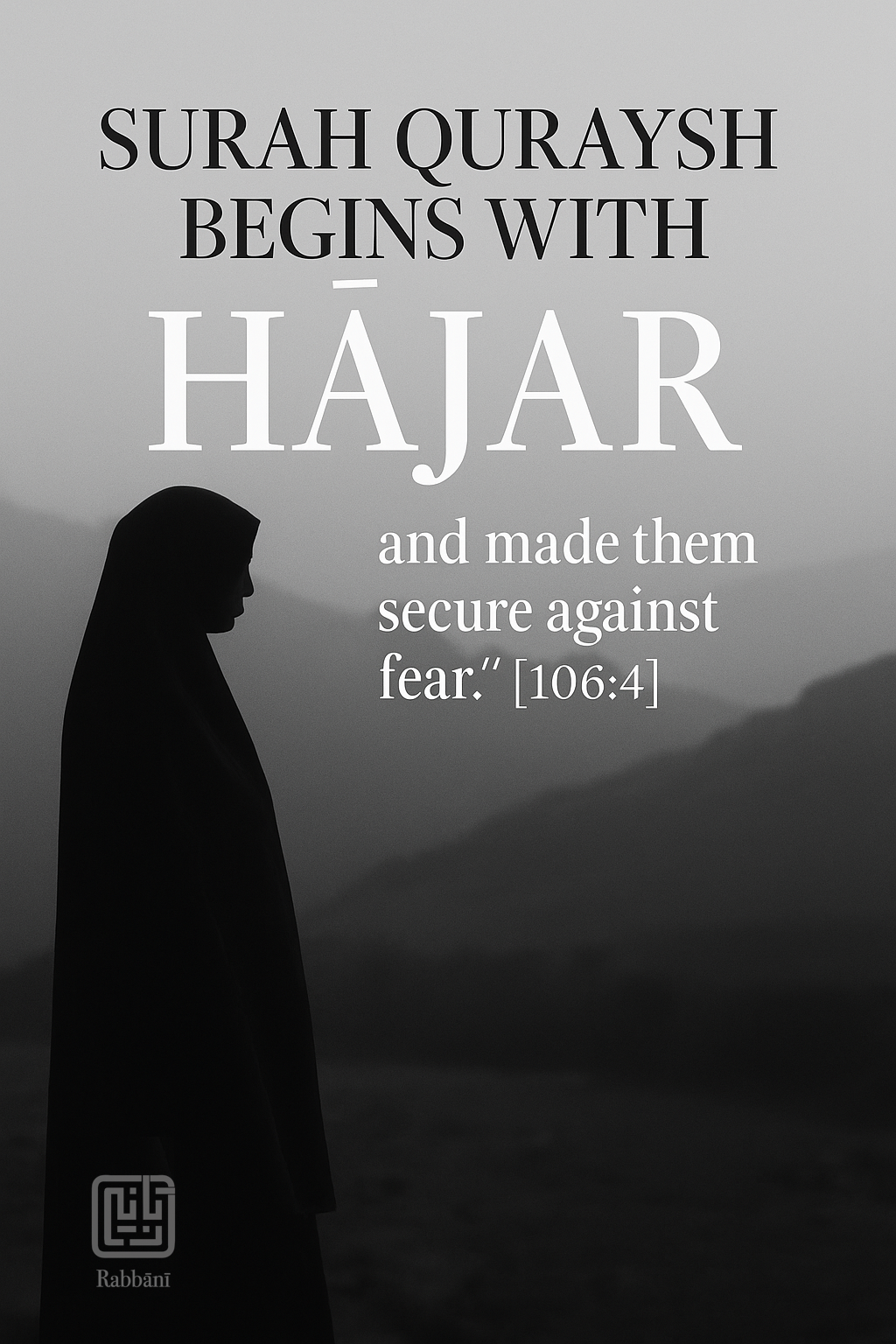
From Zamzam, life returned to that valley. Birds gathered, signaling water, and desert tribes came to settle there with Hājar’s permission. From these settlements, a community grew, and over centuries, the Quraysh tribe took shape — the tribe that would eventually protect the Kaʿbah and see the birth of the Prophet ﷺ himself.
Allah reminds Quraysh of these blessings in Surah Quraysh:
“Let them worship the Lord of this House, Who has fed them against hunger and made them secure against fear.”
(Qur’an 106:3–4)
The security and provision mentioned here trace directly back to Hājar’s courage, the water of Zamzam, and the revival of Makkah as a place of blessing.
She was not only the mother of Ismāʿīl. She was the grandmother of the Quraysh, the one whose faith made their existence possible.
6️⃣ The Kaʿbah and the Ḥijr Ismāʿīl
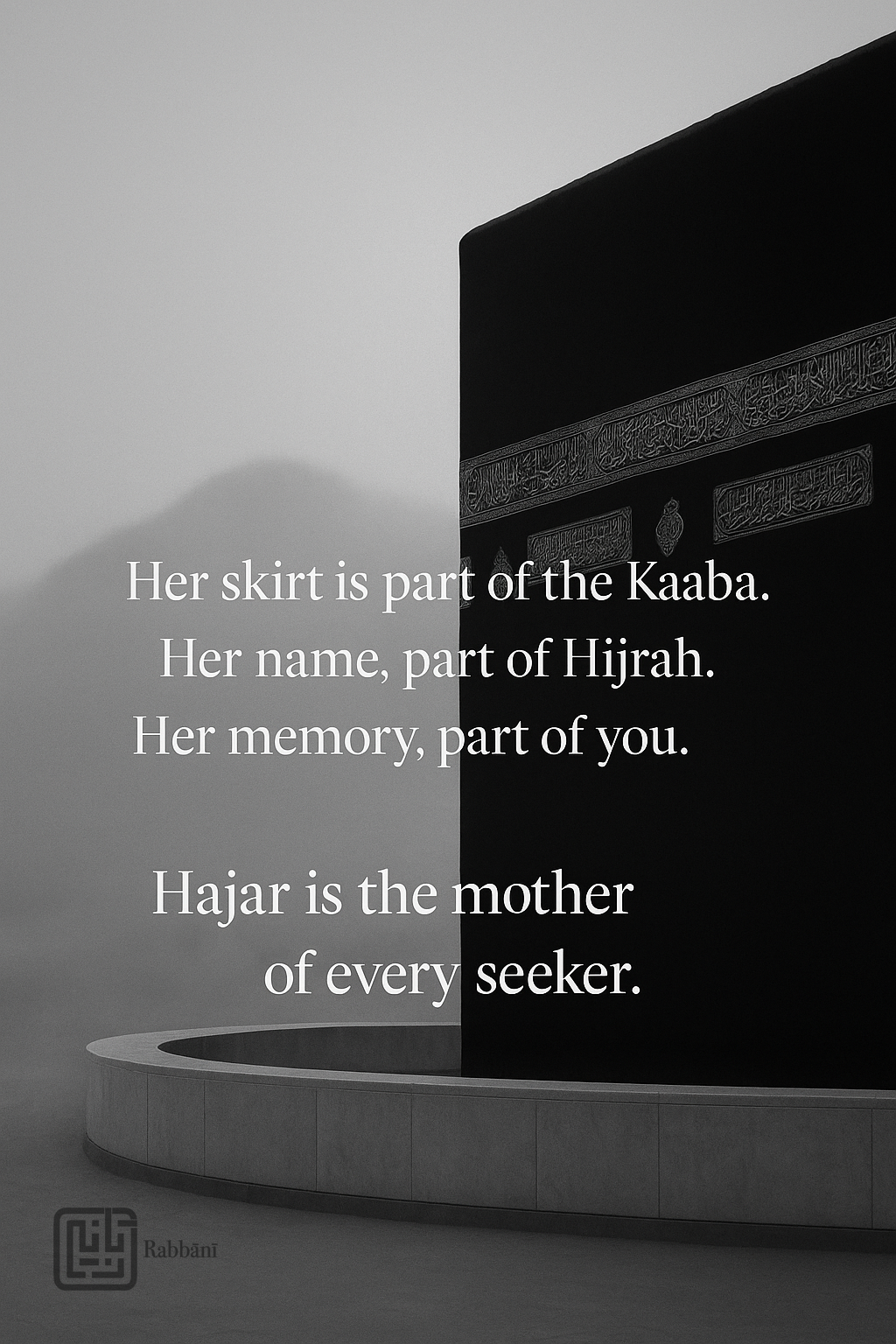
Years later, when Ismāʿīl (a.s) and Ibrahim (a.s) rebuilt the Kaʿbah, Hājar was still there to witness it. When she passed away, Allah honoured her so greatly that her grave was placed within the semi-circular enclosure next to the Kaʿbah — the Ḥijr Ismāʿīl.
Even today, every Muslim who bows toward the Kaʿbah bows toward the grave of a Black mother, a woman whose heart trusted Allah completely.
If the Kaʿbah is the heart of the Muslim world, then Hājar is the pulse that keeps it beating.
7️⃣ The Symbolism of Hājar
Hājar is not just a historical figure — she is a living ritual.
Every sa‘y repeats her running.
Every sip of Zamzam repeats her hope.
Every glance at the Kaʿbah remembers the woman whose grave lies in its shade.
The Prophet ﷺ hardwired her courage into the pillars of worship, so no pilgrim can ever complete Hajj or ʿUmrah without walking in her footsteps.
Ali Shariati called her the “Unknown Soldier” of Islam. But Allah made her known forever.
He made her sa‘y eternal.
He made her water a source of life.
He made her grave a sign of dignity.
For every woman who has been dismissed, for every person who has been enslaved, for every soul who has been left alone in the desert of despair — Hājar is the proof that Allah sees you, Allah remembers you, and Allah can make your struggle immortal.
8️⃣ Modern Resonance
In our time, the stories of Black women are still pushed to the margins. Hājar corrects that. She was a Black woman, a servant, alone — yet Allah made her footsteps a sacred pillar, her water a miracle, her grave a sanctuary.
Every year, millions repeat her ritual, even if they do not say her name. Millions face the Kaʿbah, even if they do not know who rests in its courtyard.
Hājar shows us that Allah honours faith wherever He finds it, and that He can transform even the most overlooked among us into the authors of history.
If she was enough to carry the future of Islam on her shoulders,
then every Black woman is enough.
And still, we must ask — as reader Khaliq Dollie so piercingly put it:
“How can anyone who has performed Hajj have even the slightest amount of racism or be sexist — unless, of course, they only perform the ritualistic aspects without comprehending?”
This is more than a question. It is a reckoning.
How can one run where a Black woman ran,
drink from her well,
bow toward her grave —
and still carry arrogance in the heart?
Unless the ritual never reached the bloodstream.
Unless the heart never opened to her story.
Hājar does not just invite motion; she demands meaning.
Not just performance, but transformation.
Not just remembrance, but repentance.
As the Qur’an reminds us:
“It is neither their flesh nor their blood that reaches Allah, but it is your taqwā that reaches Him.”
— Surah al-Ḥajj, 22:37
True Hajj begins where ego ends — in humility, in honour, in justice.
To walk her path is to honour every Hājar still unnamed —
every woman, every Black body, every soul left in the desert with nothing but trust.
9️⃣ Conclusion
Pilgrims still run between Safa and Marwa.
Children still drink from Zamzam.
Believers still circle the Kaʿbah.
All of these acts, day after day, year after year, remain living proof of a woman’s courage — a woman whom the world tried to forget.
Hājar did not hold a royal title. She did not lead an army. She was not a prophet. She was a mother. A servant. A displaced Black woman. Yet Allah made her story the foundation of the sanctuary itself, built the House of God around her grave, and made her sa‘y part of every pilgrimage until the end of time.
That is not just history. That is revolution.
May every step we take between Safa and Marwa remind us of her strength. May every sip of Zamzam honour her trust. And may every glance toward the Kaʿbah remember the mother who gave it life.
🌿 A Dua
O Allah, as You accepted Hājar’s faith, accept our faith. As You answered her cry for water, answer our cries for hope. As You made her story immortal, make our footsteps sincere and worthy of Your mercy. Let her memory heal the hearts still wounded by racism, and honour every mother who stands alone with trust in You. Āmīn.
A Reflection Inspired by a Reader:
A friend reminded me that Hājar’s courage speaks also to hidden forms of abandonment: how we sometimes feel unseen, even by ourselves. Her words — “Allah will not abandon us” — are an anchor not just for surviving the desert, but for surviving the storms within. May we never abandon our own hearts, nor each other.
As the Qur’an reminds us:
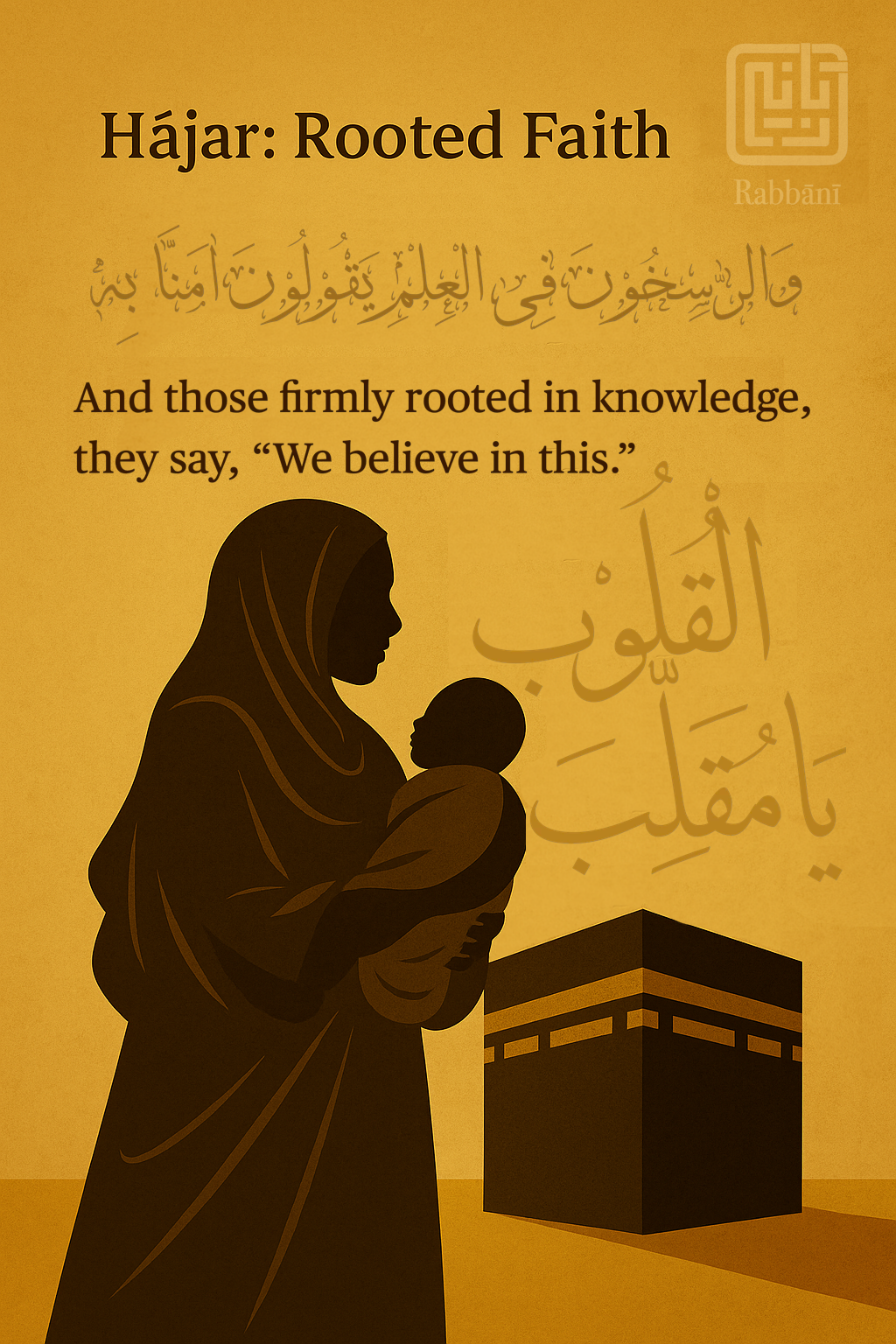
“And those firmly rooted in knowledge say, ‘We believe in it; all of it is from our Lord.’”
(Qur’an 3:7)
Another Reflection Inspired by Masooda Fadal:
She reminded me that Ibrahim (a.s), when leaving his father’s community, said:
“I am turning to my Lord. He will feed me and clothe me. He suffices me.”
Alongside him, in the same family, Hājar carried that same radical trust, saying:
“Allah will not abandon us.”
There is a deep yet silent beauty in their inner shared knowing — a spiritual inheritance that flowed between father and mother and reached their child, becoming a collective, rasikh rooted faith.
Masooda also reflected that Hājar’s story amplifies the message of gender and race: that women equally embody the path of submission. While Ibrahim is often seen as the template of pure tawakkul, Hājar mirrored it so beautifully, showing that Allah honoured her Black, feminine courage with the same divine legacy.
This teaches us that abandonment is not only physical; it can be subtle, hidden, even within ourselves. Hājar’s faith is an antidote to all those layers — reminding us never to abandon our own hearts, nor each other.
Comment Prompt
Who in your family or community reminds you of Hājar? Share their story — let us honour these mothers of faith together.
 Adli Yacubi