Category: Advice

  • Did You Write This?

    Did You Write This?

    Did You Write This?

    Authorship, AI, and the Ethics of Knowing
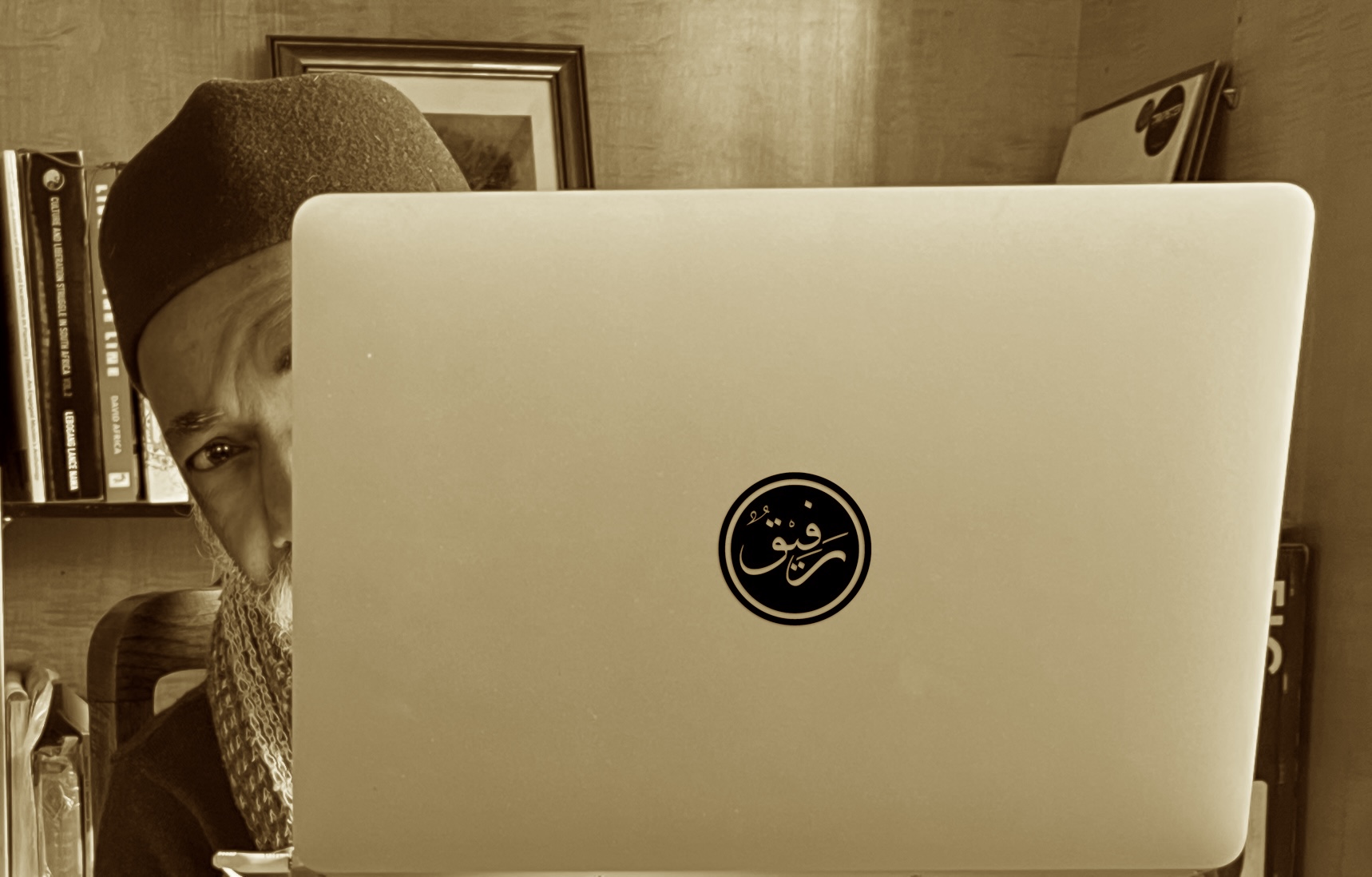
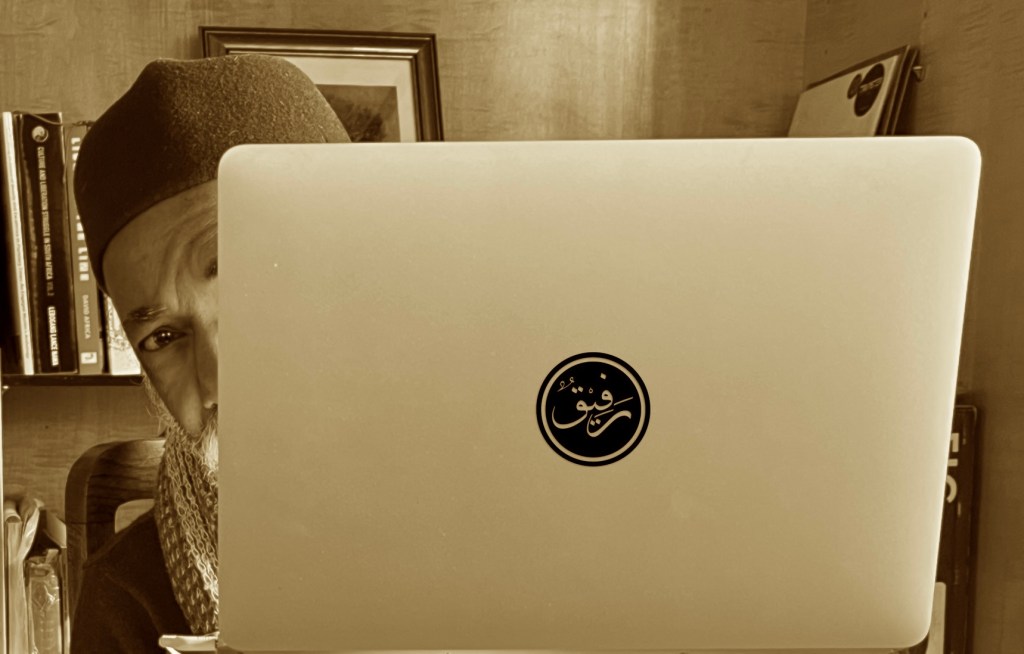
    “Don’t hand over your compass.”
    Rafiq al-Bunduqia watches — not to catch you out, but to make sure you’re there.

    1. Introduction: The M Dash and the Machines

    There was a time when the biggest red flag in student writing was a mysterious shift in font — or the sudden appearance of a semicolon. Now? It’s the M dash. That long, theatrical punctuation mark — so beloved by stylists, poets, and late-night philosophers — is now being flagged as a possible sign of AI authorship.

    As someone who has long preferred the M dash over the “weakling N dash,” I can only laugh. But beneath the punctuation paranoia lies a deeper, more pressing question — one that has followed me for some time:
    What does it mean to write — and to take responsibility — in the age of intelligent machines?

    Two days ago, I revisited this very theme in a public reflection I posted to LinkedIn under the voice of Rafiq al-Bunduqia:

    “Don’t hand over your compass.”
    AI can help you draft faster, structure better, even summarise long texts.
    But it can’t replace your intention, your ethics, or your lived knowledge.
    Use it — yes. But stay in charge.
    Check. Review. Bring your full self.
    Because tools may change — but responsibility doesn’t.

    The question isn’t simply whether AI was used — the deeper issue is:
    Did you show up? Is this yours?

    That very concern was echoed in April 2025 by writer and academic Shafinaaz Hassim, who asked a sharp and timely question to her peers:

    “Friends in the academy, publishing industry, etc — with rising concerns on content creation, what are the ways to ascertain whether students or writers have relied on AI…?”

    Her question invited a rich and thoughtful set of responses — not moral panic, but reflection on pedagogy, ethics, and the changing terrain of writing itself.

    This blog is part of that unfolding conversation. Not to police authorship, but to deepen it. To move the focus from howsomething was written to who stands behind it — and why that still matters.


    2. A Shift in Focus: From Origin to Ownership

    In a recent LinkedIn post, journalist and academic Reg Rumney described the quiet dilemma he faced while marking student work:
    How do you tell whether a piece of writing has been shaped — or even generated — by AI?
    Is it the rhythm? The over-polished syntax? The sudden arrival of the elegant M dash?

    But then, he had a moment of clarity. The real question isn’t whether AI was used — it’s whether the writing stands on its own.
    Is it well-sourced? Are the claims grounded? Does it reveal engagement with the material and the reader?

    He writes:

    “I don’t need to know whether A.I. was used in the production of any writing. What I need to determine is whether the writing is properly sourced and justifies the claims it makes… If any writers have used A.I. along the way, so be it. They own the output.”

    This is a quiet revolution in how we might think about authorship. It places the focus not on origin — but on ownership. Not how the writing was produced, but whether the writer is present, attentive, and accountable.

    We’ve seen this sleight of hand before. Long before ChatGPT, many writers (and yes, some journalists) would open with “Economists say…” or “Experts agree…” — without ever citing who those economists or experts were. The problem here wasn’t AI. It was vagueness disguised as authority.

    Rumney points out that even AI tools that cite sources — like Perplexity — often do so too broadly: a whole IMF report is not a source. A page number, a quotation, a date — that’s sourcing. That’s what makes information traceable, and ideas accountable.

    And so the challenge before us is this: don’t outsource your integrity.
    If you quote someone — say who. If you argue a point — ground it. If you make a claim — own it. Whether you used an AI model, a spellchecker, or the notes from your last lecture is beside the point. The question is:

    Do you understand what you’ve written — and can you stand by it?

    That’s what distinguishes a writer from a copyist. And that, in the end, is the difference between literacy and knowledge.

    🫖 Rafiq al-Bunduqia says:
    “It’s not where the words came from — it’s whether you meant them.
    AI can dress the table, sure. But did you cook the food? Did you taste it?
    Don’t serve your guests borrowed meals and call it hospitality.”


    3. Classroom Practices: Witnessing the Process

    While much of the conversation around AI writing has turned toward detection tools — apps, software, “AI sniffers” — some of the most grounded wisdom comes from teachers who choose a different path: staying close to the writing process itself.

    Siphiliselwe Siphili Makhanya, a teacher and writer, offered a refreshingly practical and humane approach in response to Shafinaaz Hassim’s question. Her method? Make the process visible. Watch the work unfold.

    “I try to make the kids start their writing process in the classroom so I can see a first draft taking shape. I also ask them to add me as an editor to their Google Doc — you can view the different versions with timestamps and figure out if they actually sat there and typed or if they copied and pasted.”

    This isn’t about surveillance. It’s about presence. A teacher witnessing the formation of thought — not just the final result. That alone often reveals more than any detection algorithm ever could.

    But Siphiliselwe also adds a caution that speaks volumes:

    “Be careful though — people with autism can sound like AI in their writing patterns.”

    That one line is worth pausing over. In our rush to detect machine-generated language, we may end up punishing neurodivergent writers for simply having a different rhythm, structure, or affect. The tools that claim to sniff out artificial intelligence are often not trained to recognise human variation.

    Instead of rejecting AI, Siphiliselwe teaches students how to use it responsibly. In her classroom, AI isn’t the writer — it’s a tool for critique, for grammar checks, for scaffolding clarity. She adds:

    “We’re also discussing how it actually hurts you to become overly reliant on AI… you never gain the skills, and what skills you do have will atrophy without use.”

    Emma Arogundade shares a complementary strategy. Rather than banning AI, she integrates it into reflective pedagogy. In one exercise, she gives students a short ChatGPT-generated answer to a standard exam question — and then asks them to critique it using class readings and personal insight.

    “Then I ask them to reflect on what they’ve learned,” she writes.

    What’s happening here isn’t about “catching” students. It’s about creating a relationship with their own thinking. It’s about making the invisible choices of writing — source, structure, argument — visible again.

    These educators are not outsourcing authorship to software. They are recovering authorship through presence. Slow, steady, relational presence. And that may be the best safeguard of all.


    4. The Deeper Wound: When We Outsource Thought

    There’s something seductive about smooth writing. It reads well. It flows. It sounds finished. But fluency is not the same as understanding. And what worries many of us — far more than whether students used AI — is the deeper erosion we begin to see:
    the outsourcing of thought itself.

    When students (or journalists, or policy writers) start depending on machines to explain things they don’t understand, to connect dots they never truly explored, or to mask gaps in knowledge with polished generalities, we’re not just talking about AI anymore.
    We’re talking about the quiet death of inquiry.

    I’ve read pieces that were grammatically flawless — structurally sound, even “academic” in tone — but hollow inside. There’s no felt tension, no intellectual wrestling, no friction of mind against material. It’s like looking at a beautifully decorated cake that collapses when touched. No weight. No substance.

    And this isn’t new. Even before AI, students have been tempted by shortcuts — Wikipedia patches, essay mills, pre-written templates. But the difference now is that AI makes the shortcut feel authentic. It mirrors their tone. It fills in their arguments. It “sounds like” them — better than they sound like themselves.

    That’s the real danger: not that AI steals the writer’s voice, but that it gives back a voice that feels plausible — without the effort of becoming it.

    If we’re honest, most people won’t say, “It wasn’t me, it was ChatGPT.”
    But many will turn in work that sounds more assured than they feel. They’ll submit sentences they don’t quite understand. They’ll quote things they haven’t really digested. They’ll adopt a style without earning the insight.

    And when that happens often enough, something slowly fades:

    • The courage to grapple with complexity.
    • The patience to revise what’s unclear.
    • The humility to not know something — yet.

    That’s the deeper wound. Not just a question of authorship, but of learning. When we outsource our thinking too early, too often, we never develop the callouses of real understanding.

    🫖 Rafiq al-Bunduqia says:
    “The saddest thing isn’t that a machine wrote it —
    it’s that the human reading it didn’t notice.
    Because when thought is absent, even beauty is a costume.
    And costumes don’t bleed.”


    5. A Call to Ethical Writing Pedagogy

    So where does this leave us — teachers, editors, writers, mentors — in the age of intelligent machines?

    The temptation is to double down on control: tougher detection tools, stricter rubrics, more suspicion. But that approach misunderstands the moment. The real challenge is not technological. It’s formational. We are not merely assessing output — we are shaping people.

    This is the deeper work of pedagogy: not to police writing, but to nurture writers. And that means helping them ask not just, “Did I write this?” — but “Do I stand by this?”

    Here are a few modest suggestions — drawn from conversations with thoughtful educators and shaped by years of writing and mentoring:

    1. Make the process visible.
    Let students draft in real time. Let them annotate their own thinking. Use collaborative tools that allow for version tracking, not for punishment, but for conversation.

    2. Shift the focus from fluency to friction.
    Reward uncertainty. Praise revision. Ask not just for answers, but for process notes: What did you struggle with? What changed your mind?

    3. Use AI transparently — and critically.
    Give students a ChatGPT response and ask: What’s missing? What’s misleading? Could you write this better — not slicker, but truer?

    4. Reinforce responsibility, not just originality.
    Ask: Where did this idea come from? Did you cite the source? Do you understand the claim?

    5. Honour the writer’s presence.
    What matters is that the writer shows up. In risk. In reflection. In integrity. That’s the real goal.

    🫖 Rafiq al-Bunduqia says:
    “Don’t fear the tools. Fear forgetting yourself.
    If the words are yours — broken, blooming, becoming —
    then no one can take them from you.
    You’re not being tested on perfection.
    You’re being invited to show up.”


    6. Closing: “It Was Me. I Wrote This.”

    In the end, the question “Did you write this?” isn’t a trap. It’s a mirror. It asks the writer to pause — not in fear, but in presence. To stand beside their words and say,
    “Yes. This is mine.”

    That doesn’t mean the writing is flawless. Or that AI wasn’t used along the way to brainstorm, rephrase, or clarify. It doesn’t mean the grammar sparkled or the structure landed. But it means the mind and conscience behind the words are awake. It means the work is inhabited — not just delivered.

    This is what writing has always asked of us: not just fluency, but presence.
    Not just polish, but integrity.
    Not just production, but reflection.

    So maybe the final test is not whether a text was written by a human or a machine. Maybe the test is simpler — and deeper:

    “Did someone care enough to mean what they wrote?”
    “Can they say, with some trembling or pride — ‘It was me.’

    That’s the writer’s task. That’s the learner’s journey. That’s the invitation still open — even in the age of algorithms.

    🫖 Rafiq al-Bunduqia says:
    “You don’t have to sound perfect.
    You just have to be there —
    in the ink, in the pause, in the part you nearly deleted.
    That’s where the real writing lives.
    That’s how we know it was you.”


    Acknowledgements

    With deep gratitude to Shafinaaz Hassim, whose question opened the door to this reflection, and to Reg Rumney, whose response offered a compass point: judge the output, not the method.

    Thanks also to Siphiliselwe Siphili Makhanya and Emma Arogundade for generously sharing their classroom wisdom — rooted, ethical, and alive to the human behind the words.

    And to Rafiq al-Bunduqia — for watching from the edge of the screen, always asking, “Did you show up?”
  • The Ratib al-Haddad: A Symphony of Spiritual Resilience

    The Ratib al-Haddad: A Symphony of Spiritual Resilience

    The Ratib al-Haddad: A Symphony of Spiritual Resilience

    Close-up of hand holding Ratib al-Haddad booklet with black-and-white keffiyeh

    Introduction

    In the centuries-old Cape Muslim tradition, the Rātib al-Ḥaddād stands as a spiritual symphony. Its composer, Imam ʿAbd Allāh ibn ʿAlawī al-Ḥaddād, drew upon a Qur’anic verse known as the Verse that Faces Outward at the Rawdah of the Prophet ﷺ, giving it a protective resonance. This rhythmic litany unfolds like movements of a musical masterpiece, each moment drawing the heart closer to Divine presence. Inspired by Imam al-Haddad’s mission to guide believers through fear and trial, the Ratib remains a living masterpiece of faith.


    Movement I: The Prelude of Protection

    O you who fear, gather at the gate of forgiveness; Bismillah like a banner above your heart, Ayatul Kursi as your armour, verses of Baqarah as your shield. In this dawn of remembrance, let salawat fall on your lips like rain upon a thirsty earth, and trust flow through your veins until your soul is clothed in light. This is the first movement: a prayer of protection woven from the very breath of Revelation.


    Movement II: The Rhythms of Remembrance

    Subḥānallāh, transcendence like the sky’s endless horizon; Alḥamdulillāh, gratitude flowing through every breath; Allahu Akbar, awe striking the heart; Lā ilāha illallāh, unity beyond all boundaries. These dhikr, recitations, rise and fall like ocean waves, polishing the mirror of the heart until it shines with trust and surrender.


    Movement III: The Pulse of Tawhid

    Al Maʿbūd, meaning The Worshipped One, calls the believer to recite Lā ilāha illallāh fifty times, each repetition chiseling away fear and confirming pure oneness. It circles the heart like a crown of certainty. The three Quls stand as guardians, their verses sealing every crack against doubt. This movement is a fortress of tawhid, where the soul forgets every other reliance and trusts only Allah.


    Movement IV: The Prayerful Crescendo

    Duas rise like incense, interlaced with Al-Fātiḥa, each plea a petition for healing, protection, mercy, and light. The tongue becomes a river of hope, carrying the soul to a calm shore. Here the believer surrenders every burden, resting in the assurance that Allah is the One who hears and responds.


    Closing Invocations

    • Al-Fātiḥa on the soul of our master, our beloved, our intercessor, the Messenger of Allah, Muhammad ibn Abdillah, his family, his Companions, his wives, and all his noble household.
    • Al-Fātiḥa on the soul of our master al-Muhajir Ahmad ibn Isa and his descendants.
    • Al-Fātiḥa on the soul of our great teacher, the jurist al-Muqaddam Muhammad ibn Ali Ba Alawi and his lineage.
    • Al-Fātiḥa on the souls of our noble Sufi masters wherever they may be, east or west, that Allah may raise their ranks.
    • Al-Fātiḥa on the soul of the compiler of the Ratib, the Axis of Guidance, Abdullah ibn Alawi al-Haddad and his family line.
    • Al-Fātiḥa on the souls of all the pious servants of Allah, our parents, our teachers, those who have rights upon us, and the believers who have passed away in this land.
    Decorative cover design for Ratib al-Haddad Symphony in traditional Islamic style

    Cape Ritual Practice

    In South Africa, especially in the Cape, families often recite the Ratib al-Haddad after a loved one passes away, beginning from the first night and continuing for seven nights, then gathering on the fortieth day, the hundredth day, and each year on the anniversary of the passing. The Ratib is also recited at birthdays, during Mawlud celebrations, generally every Thursday night, sometimes Sunday mornings, a week before weddings, at engagements (known as lambary), and at naming ceremonies (doekmal or doopmal). This tradition anchors the community in remembrance and prayers for all occasions of joy, transition, and remembrance.


    About Dhikr

    The term dhikr refers to remembering, remembrance, or reciting and chanting the names of Allah, specific prayers, or Qur’anic verses. It is a rhythmic practice that roots the soul in the Divine, and is central to the Ratib al-Haddad tradition.


    Individual or Group Practice

    The Ratib al-Haddad can be recited alone or in a group, with equal blessing. Allah says in the Qur’an: “And men and women who remember Allah often — for (all of) them Allah has prepared forgiveness and a great reward” (Quran 33:35). The Prophet ﷺ said: “People will not sit in an assembly in which they remember Allah without the angels surrounding them, mercy covering them, and Allah mentioning them among those who are with Him.”


    Decorative cover design for Ratib al-Haddad Symphony in traditional Islamic style

    Foundations

    The Ratib al-Haddad stands upon the firmest pillars of faith, a radiant string of pearls drawn from the Qur’an and Sunnah. It opens with the best Surah — Sūrat al-Fātiḥah, flows into the greatest verse — Āyat al-Kursī, affirms the Shahādah — the finest declaration of oneness, and continues with the enduring praises of al-Bāqiyāt al-Ṣāliḥāt. It includes the daily istighfār of the Prophet ﷺ, abundant ṣalawāt upon the Beloved ﷺ, and concludes with the dhikr by which Imām al-Bukhārī sealed his Ṣaḥīḥ.

    Composed in sacred sequence by Imām ʿAbd Allāh ibn ʿAlawī al-Ḥaddād — a noble grandson of the Messenger ﷺ — this Ratib is not merely a litany, but a luminous map of remembrance. It is a symphony of Qur’anic light and Prophetic rhythm, preserved across centuries as a living trust.

    And its resonance reached far beyond Ḥaḍramawt: both the Wird al-Laṭīf and the Ratib al-Ḥaddād were introduced and supported within the Harams of Makkah and Madinah under the patronage of Sultan Muḥammad IV of the Ottoman Empire (r. 1648–1687). This formal recognition affirms the Ratib’s deep-rooted legitimacy — not as invention, but as a distillation of the best of revelation, transmitted and treasured by the global Ummah.


    Ijāzah: A Living Trust of the Ratib

    For those who wish to benefit from the Ratib al-Haddad, we carry with us a sacred ijāzah — a scholarly and spiritual transmission — conveyed through four chains (asanīd) that reach back to the Composer of the Ratib, Imām ʿAbdullāh ibn ʿAlawī al-Ḥaddād**, may Allah sanctify his soul.

    Shaykh Jamiel Abrahams writes:

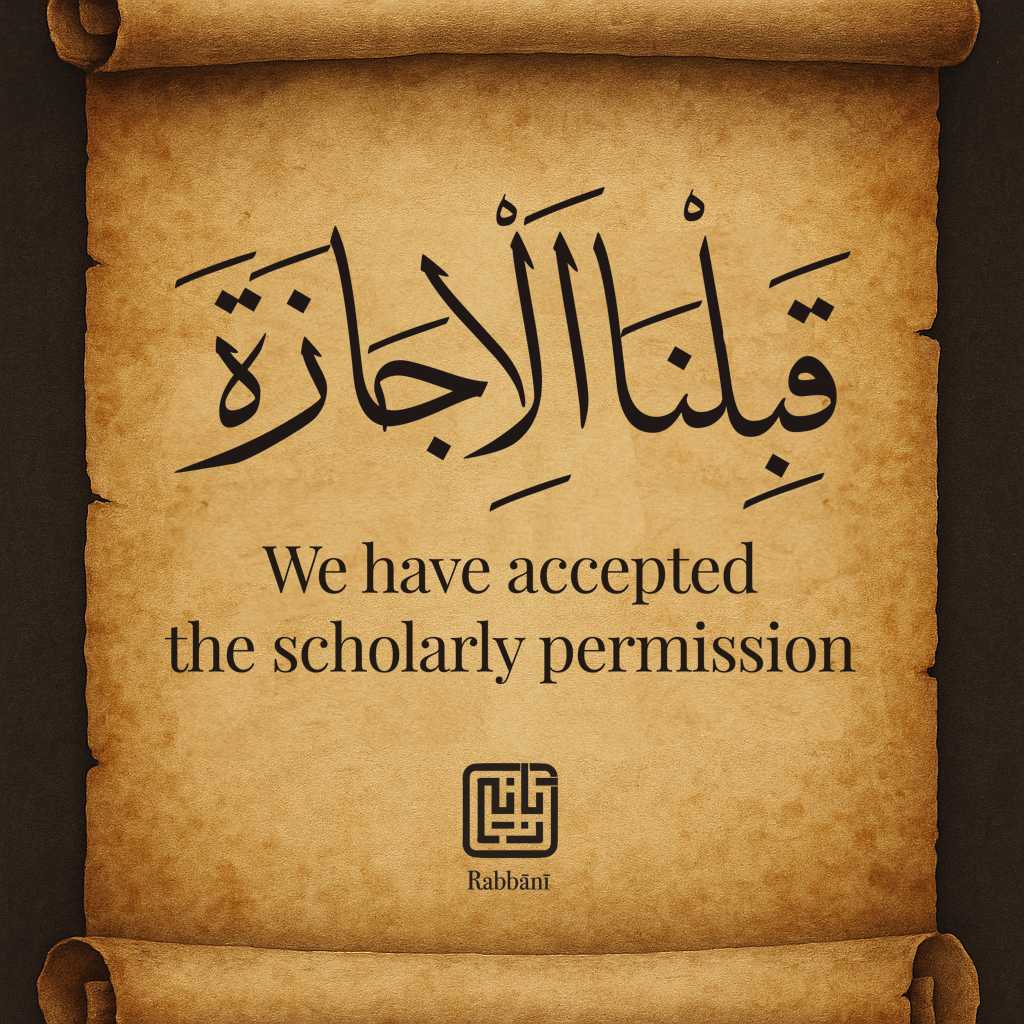
    “Ijāzah for those who wish to benefit from the four asānid to the Composer of the Ratib… Say: Qabilnā al-Ijāzah — ‘We have accepted the scholarly permission to recite the Ratib of Imām al-Ḥaddād.’”

    “We say Composer, not Author — for the adhkār are drawn from the finest pearls of the Qur’an and the most radiant lights of the Prophetic Sunnah.”

    This ijāzah is not just scholarly — it is a living trust passed down through centuries of remembrance. To receive it is to stand in the river of continuity, with the awliyāʾ and scholars who preserved this path of dhikr through love, hardship, and sincerity.

    And as for those who label such remembrance a bidʿah

    رَغِمَ أَنْفُ مَن صَرَّحَ بِأَنَّهَا بِدْعَةٌ
    “May the nose be rubbed in dust of the one who declares it an innovation.”

    Let the river flow. Let the remembrance remain. And let every breath that utters His Name be a proof of mercy, not division.


    My Personal Ijazah

    This symphony carries my own transmission: an ijāzah granted by Zaid ibn Umar to me, Adli ibn Ibrahim, written in his own hand, linking me to the chain of Imam al-Haddad. That blessing lives within every note of this symphonic meditation, reminding me of the trust, humility, and sacred responsibility that this heritage confers. This ijazah is more than a note: it is a living chain, a breath carried from master to student across centuries, reaching back to Imam al-Haddad and forward into my heart. It binds me to the rhythm of this Ratib as if to a heartbeat, reminding me to hold it with care, reverence, and gratitude, so its protection and blessing might continue to resonate for future generations.


    Historical Echoes

    The Ratib was recited by enslaved Muslims at the Cape as a shield of hope and protection during times of oppression, helping them hold fast to faith. Generations later, it became a spiritual companion for many who resisted apartheid, its verses reminding them of divine justice, courage, and unity against all forms of tyranny. It is said that in the darkest nights of slavery at the Cape, the Ratib became a quiet liberation, whispered in hidden corners. Its rhythms reminded believers they were still seen by Allah, still dignified. During the anti-apartheid struggle, activists turned to these same verses, finding courage and calm as they faced injustice, with the Ratib a spiritual sword against oppression and despair.


    Conclusion

    From Yemen to the Cape, from ancient gatherings to modern hearts, the Ratib al-Haddad remains a living breath of resilience and unity. Its movements still guide communities to remember Allah, to stand together in hope, and to place trust in Divine mercy across the centuries. Like a living river, its currents still flow, nourishing communities with remembrance and calling them to a higher trust in Allah’s mercy. Imam al-Haddad, inspired by the symbolism of the Verse that Faces Outward, wove its spiritual meanings into the Ratib, transforming it into a shield that echoed both the Prophetic sanctuary and the everyday lives of worshippers from Yemen to the Cape.

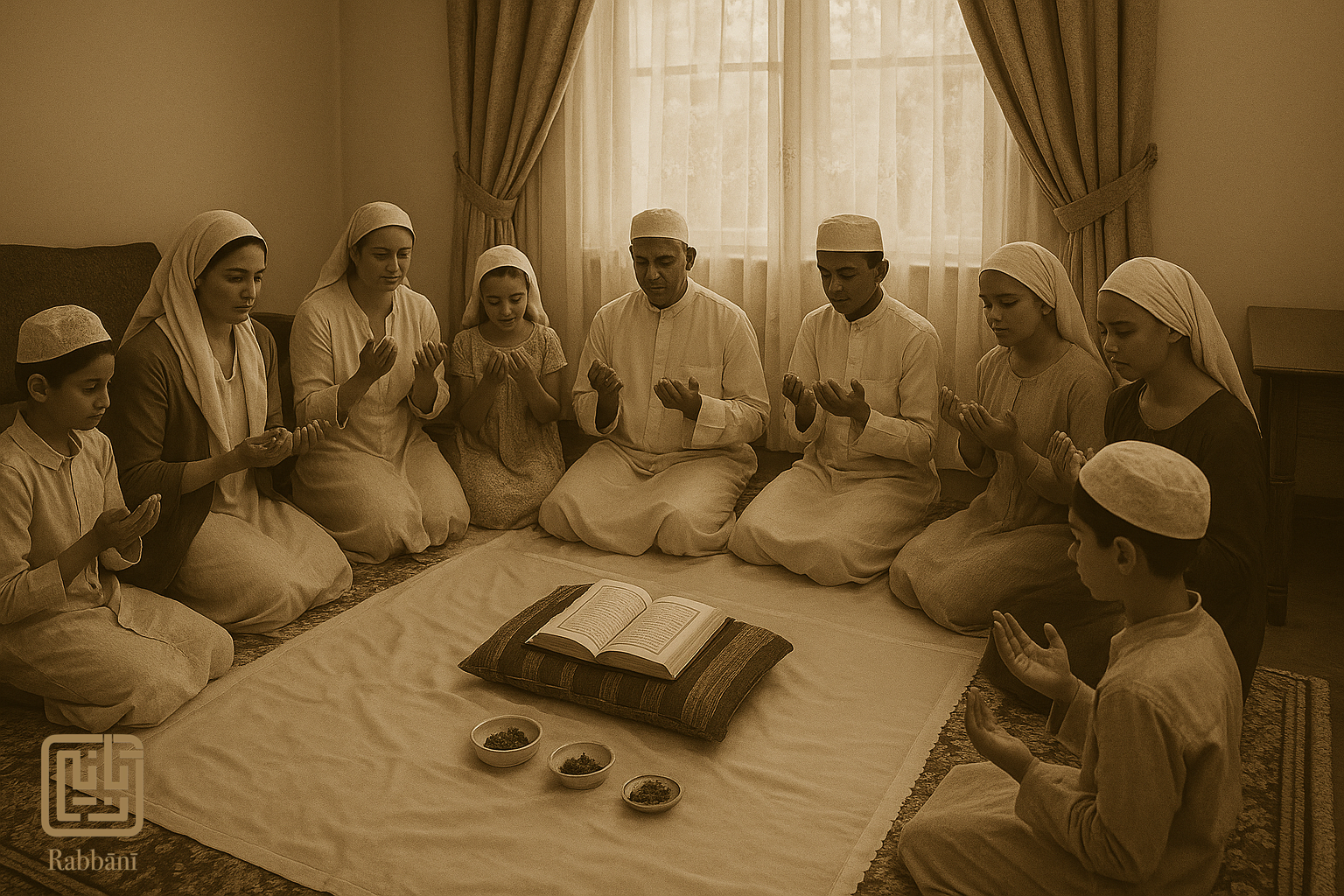
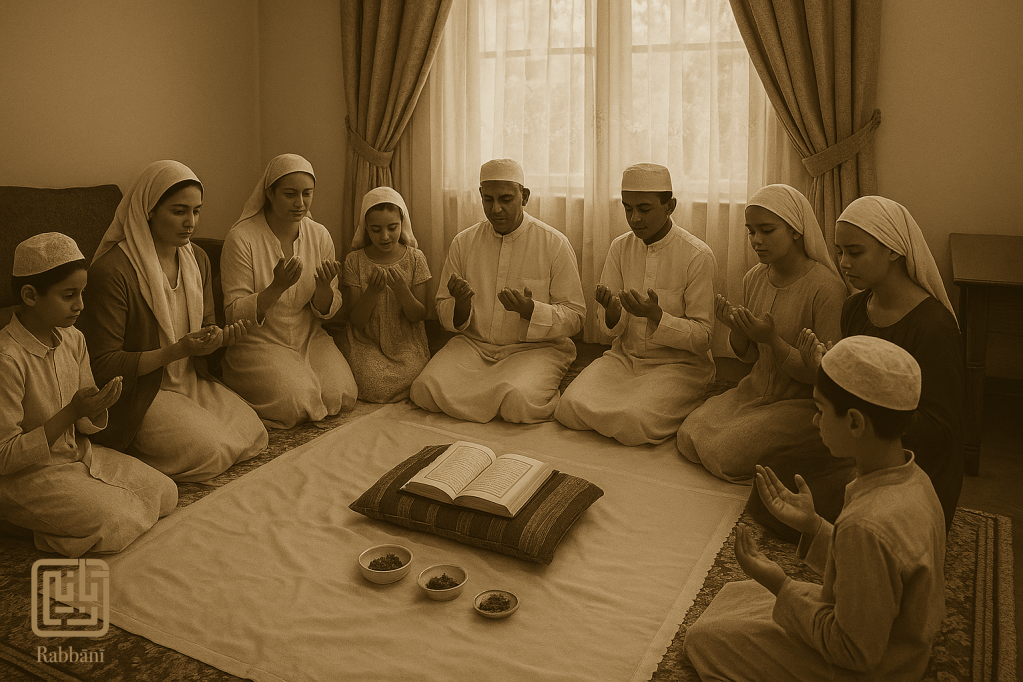
    Family reciting Ratib al-Haddad together on white linen with pillows and Qur’an

    May its verses guard every heart, and may its blessings gather our children and their children into the same ocean of divine love, until the final day.


    You Might Also Like These Cape Memories

    ✨ Scroll of the Sorbaan & Medora – Worn in Sound, Washed in Meaning
    Exploring the sacred cloths and their living resonance.

    ✨ The Verse That Faces Outward
    A glimpse into the calligraphic verse guarding the Rawdah.

    ✨ Hy Lyk Soos ’n Wolf: The Sorbaan and the Teacher Who Raised Me
    A tribute to a teacher’s quiet strength and Cape heritage.

    ✨ Tamat: A Sacred Completion, A Living Beginning
    The meaning of tamat in Cape Qur’an recitation tradition.

    ✨ From Chains to Qur’an: The Cape’s First Pilgrim and My Bloodline
    Tracing the story of Cape Islam through my family’s journey.


    Coming Soon

    ✨ The Grandmothers Who Raised the Qur’an — celebrating Cape matriarchs who preserved Qur’anic recitation.

    ✨ Echoes of Arafah: Pilgrim Voices from the Cape — reflections from local hujjaj returning with spiritual stories.

    ✨ The Kramats: Guardians of the Cape — the circle of Cape saints who protect and inspire.

    ✨ Barakah Before Business: The Forgotten Blessing — Cape Muslim traders and their rituals before opening shop.

    ✨ The Secret of Rampies Sny — unveiling the Cape’s scented floral traditions linked to dhikr gatherings.


  • They Got Me Too — A Lesson on the WhatsApp Hackers

    They Got Me Too — A Lesson on the WhatsApp Hackers

    They Got Me Too — A Lesson on the WhatsApp Hackers

    One morning, before I’d even had my coffee, I answered a call. The voice was calm, respectful, and seemed familiar with my work. He spoke about the Call of Islam, saying there would be a WhatsApp discussion later that evening, and they’d like me to share my insights.

    I asked him to send me more details. He agreed, then casually added: “For our meeting tonight, please repeat the numbers I just sent you?”

    Half-awake, I read out the six-digit number — my WhatsApp verification code — without a second thought. Moments later, I was locked out of my account.

    Of course, I felt embarrassed. But as my friend Laury Silvers reminded me: this was cleverly done. It was a classic social engineering scam: using politeness, personal references, and urgency to break through your defences when you’re least prepared.

    This is happening to many of us.

    Respected voices in our communities are being systematically targeted:

    • Rev Frank Chikane
    • Ambassador Mohammed Dangor
    • Former Premier Ebrahim Rasool
    • And now, me

    This is not random. It is sinister, because these criminals know your contacts trust you. That trust is their weapon.

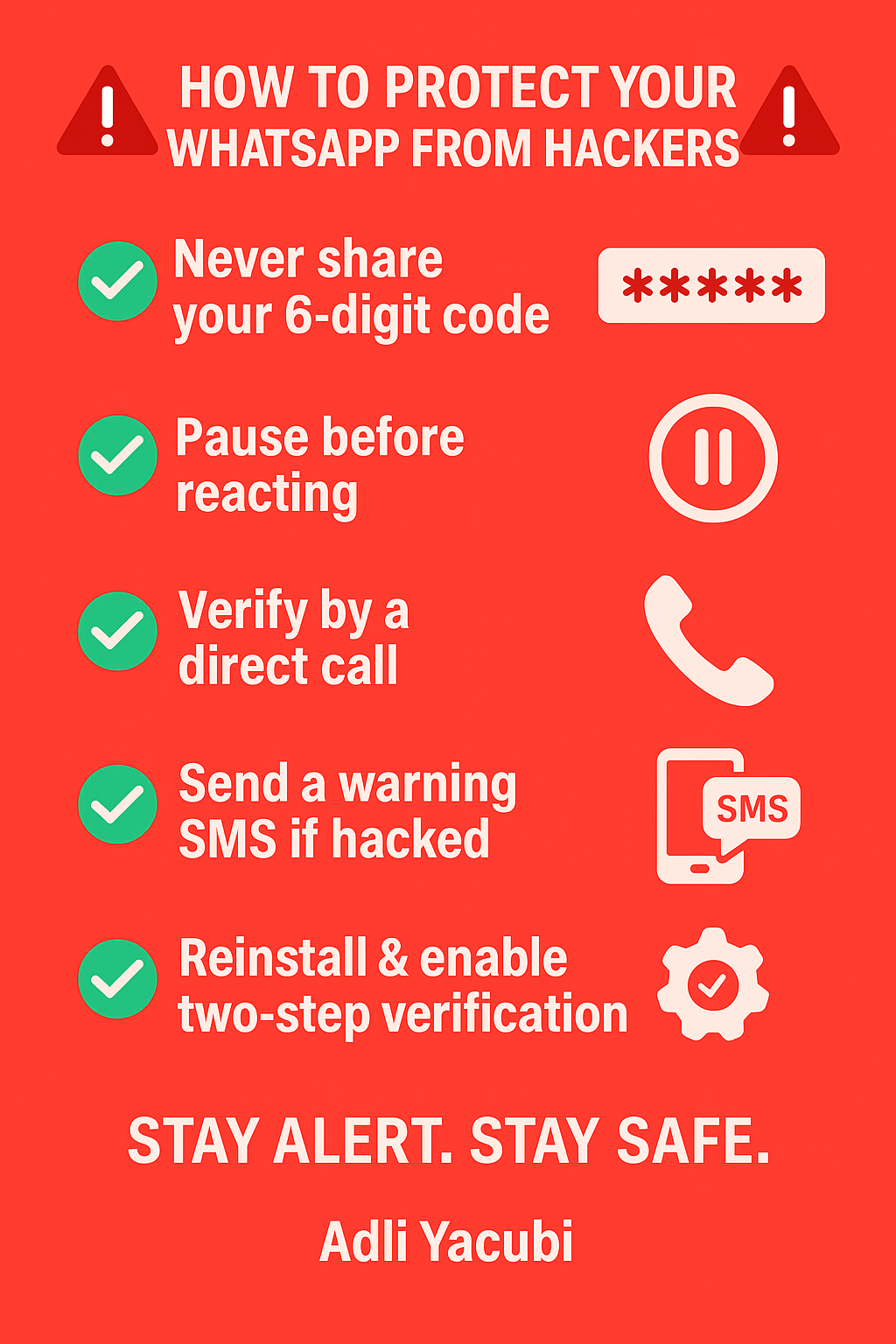
    👉 My advice, from bitter experience:

    ✅ Never share your 6-digit WhatsApp verification code with anyone
    ✅ Pause before reacting to an urgent call or text
    ✅ Always verify directly — through a trusted phone call, video chat, or in person
    ✅ Warn your network if your account is hijacked — I immediately sent an SMS to all my contacts saying: “My WhatsApp has been hacked. Don’t accept any requests.”
    ✅ Reinstall WhatsApp and enable two-step security, as my friend Shafiq Morton wisely reminded me: “It puts hackers off.”

    These scams are designed to catch good people off guard. If it happened to me, it can happen to you.

    Let’s protect each other — by talking about it, and by staying alert.

    Stay safe.
    — Adli Yacubi

    How to protect your WhatsApp from hackers
    Stay alert. Stay safe. Adli Yacubi

  • How do you even begin to eat a mountain?

    How do you even begin to eat a mountain?

    [I have retold this story countless times. It was told to me when I was a student in the 80s. I googled the original storyteller but could not find any reference to it online. It resonated with me because I was born at the foot of Table Mountain in District Six, Cape Town. I am thankful, even now, for Khurram Murad for making this part of his keynote address so long ago.]

    table-mountain
    Table Mountain taken by Aadela Parker.

    There once was a man who was very unhappy. Something was troubling him but he could not put his finger on it. At night he was restless and it took a while for him to sleep. That night he had strange dream.

    He dreamt that an old man approached him and said, “When you wake in the morning, eat the first thing that you see.” When he woke up that morning sweating from the vision, he opened his eyes and saw the mountain. What? How am I supposed to eat a mountain?

    Maybe the old man was joking. He then went about his usual tasks for the day. He still felt troubled though. That night he had the same dream. But now the old man was ranting and raving, “What are you afraid of? Eat the first thing you see.”

    It is not easy to choose what you should see when you wake so when he woke that morning again and saw the mountain, he thought the old man must be crazy. The third night the old man was now threatening him with a stick and promised to make the rest of his nights a living hell if he did eat what he saw when he woke.

    That morning he woke with determination. When he saw the mountain, he immediately packed and set out to eat it. But as he moved closer to the mountain, a strange thing happened: it started to grow smaller. The man began to panic because it seemed as the mountain was moving further away. Just my luck he thought and started to increase his pace. The closer he moved the smaller the mountain.

    By midday he was running. At the end of the day he reached where he thought the mountain should have been. But it had grown so small that he could stoop down, pick it up and put it in his mouth. What do we learn from this strange but interesting story? I believe four things:

    • We all need dreams. We need a vision and a plan to get us where we need to go. We must see the idea before us and keep it in our sight. A dream that you cannot conjure before you is not going to keep our attention.
    • A dream will remain unattainable if we make no effort to make it real. It takes slog. Sometimes the work seems impossible to absorb. But sometimes the most difficult things to learn turn out to be the most enjoyable once you get it. Sometimes, the harder a thing becomes the sooner you are reaching a breakthrough. Apartheid gave way when we thought that we should prepare ourselves for a long fight and bitter fight.
    • Besides the dream and the effort you also need belief. You must believe in yourself. You must believe that you can win. You must believe that it is worth it. Belief gives you confidence and the world cannot resist a person with confidence it will open up paths and opportunities that you never imagined.
    • Finally: sometimes the solutions we are looking for are not weird or strange. Sometimes (often) what we look for, or the solution, lies right in front of us like the mountain in my story. That mountain was in front of his window his whole life but it did not occur to the man to seek it out.
  • How to learn something entirely new in just 4 steps

    How to learn something entirely new in just 4 steps

    It starts by diving in boots and all…

    I was writing a ‘spark’ on Somewhere about how I learn new concepts, new processes or even new skills, when I realised that I actually needed to add water to this very succinct format that only allows for 250 characters. Now, happily, that spark can be my outline:

    To learn something entirely new, for me, 4 things help: 1) I become single-minded about the subject. 2) I take notes as I read (mind-maps). 3) I explain the concepts to anyone that cares to listen. 4) I start to implement what I’ve learnt.

    Image by Brooklyn Morgan on Unsplash

    Single-mindedness

    There is saying that I came across a while back when I tried my hand at Shotokan Karate. I was told: first you imitate, then you innovate. It basically means that if you don’t know something, then you learn from those who do. And you learn from them by imitating what they do, until you get it. Once you have it, then you can become quite creative in how you deploy it.

    In karate—but also in ballet, gymming and other such activities—they make you do the same set routines over and over until you get it or you collapse or whichever comes first. This is not only applied to physical skills but also in learning a new language, in academics, in maths(the bloody times-table), in music, etc.

    But when I say single-mindedness, I’m referring to a process where you become (ok, you induce yourself to become) passionate, besotted, obsessed, perhaps even fanatical about the subject. In other words, you drown yourself in the subject. This allows for a few things to happen:

    1. Fanaticism sweeps away all critical thought, making it possible for you to absorb as much of the subject as possible. Ask any cult member. This is good because it allows for easier imitation or for the information to lodge in your mind.
    2. It helps you to acquire as many bits of information, readings, insights, views on the subject matter as possible. You then become a true student of that area of knowledge. This is the actual aim of assignments, exams and dissertations.
    3. When it comes to the innovation stage, you will have much to draw on. In fact, when you flood your attention with a single subject over a given period, the questions and applications of that information will already begin to emerge.

    But to get the most out of this process, you need to have a good reading technique.

    Mind-maps

    I taught journalism and media studies to college students from first to fourth year. During revision week I noticed that everyone was using the highlighting method. You know the drill: read text, see something interesting, deploy highlighter in a million shades of pastel neon.

    Some even had a technique: green for interesting, pink for very important and orange for things the lecturer mentioned. The idea is to go hunting through the text for the various bits, highlight it and then read the selected coloured bits in a cram session just before the exam.

    Now besides ruining the text book, making it a tad difficult to sell later when the course is over, this is not going to really help in retaining information. You have only really engaged your eyesight leaving much of you other senses out of the equation. And the one sense you should not be leaving out, is that of touch.

    So when I read, I take notes. On a seperate sheet of paper. Or if I am reading an eBook, I open ‘Stickies’ and type out insights, interesting points that I come across. When I write, I put done down salient points and connect them to secondary ideas. And those ideas, I then connect to other related points and so on.

    If you were taking notes of this piece, for example, you might typically have my four major points and each one, in turn, would have sub-points of what the major ones are about. A third layer might be of what you make of all this nonsense. Get it?

    Your mind-map can also be colourful and then you can bring out those highlighters you love so much, like this:

    Why write ? When you write things down, you are making a personal association with the information you are reading. You are actually slowing down your reading, allowing your mind to engage with the information. Chances are also bigger that when you recall the information, the act of you writing will have a stronger image in your mind than just text that you read in some book.

    Just an aside: I have found that when I feel sleepy during a boring meeting, doodling actually keeps me from dozing off. And I can actually remain sober throughout even if my doodles have actually nothing in common with the subject matter. Go figure! (Actually, there is a study on this!)

    So now we have passion, then reading technique. But how do you own this new information?

    Verbal diarrhoea!

    I love movies. Whether animation, thrillers, science fiction, historical drama… It does not matter as long as it is a great story and I can see layers of meaning. Anyone who knows me will know that I can be a great spoiler of the plot. Whatever! The storyteller in me just wants to retell that plot. want to to be the one that gets you to see the genius in the story!

    So when I went to university, I would emerge from an amazing (amazing for me, ok?) psychology or African history lecture, sit down any buddy who would give me half a nod, and rave about the insights I just gleaned. I would repackage that entire one hour session and tell it as if I had come up with those ideas myself.

    When it came to exams, I would generally be able to recall entire lectures of certain subjects. And yeah, it would generally be the ones that I raved about. What happened here? It’s fairly simple…

    Once you are able to explain a concept in your own words, then several amazing things happen:

    1. If you can explain a concept you have heard or read, you are beginning to make sense of it in your mind.
    2. By retelling, you too are hearing it for a second time. Everytime you do, you are reinforcing the information.
    3. Once you make sense and retell, you are owning the information making recall much easier.

    And was it not Einstein who said:

    Now do!

    So once you have submerged yourself in the subject matter, reading as much as you could mindfully, and verbalised it—and by so doing, owning the information—you should implement, innovate, write about it, use it…

    Over the last while I have taught myself to blog, understand social media and pushing that blog content to social networks, use my Twitter account more effectively, swimming in the waters of crowd funding and deepen my understanding of narrative and storytelling.

    If you are reading this, then that last adventure on improving my online posts was not for naught and the advice I received from copyblogger actually paid off!

    – First published on Medium

  • What’s your story, morning glory?

    What’s your story, morning glory?

    Everything is a story, including the person you believe you are

    Ryan McGuire of Bells Design on Gratisography
    Ryan McGuire of Bells Design on Gratisography

    It is Michel Foucault, the French philosopher, who says, “Do not ask who I am and do not ask me to remain the same.” The point he was making is that we are constantly changing as a result of a myriad of experiences that impact upon our personality in any given moment. As human beings, however, we are averse to change and freeze our identity to create a stable reference of who we are.

    If you were to ask me who I am, depending on the time, my mood and what I think you might know about me, I will tell you a story. It might be about what I doing right now, where I come from, what I might have accomplished… Whatever it is, it will be a story. I would not need to think too much about the story/stories because I have told it many times to different people. Even if I were to just simply say my name, the rest of the story will play itself out in my head because I have made enough repetitions in the past; I have repeated them over and over so many times. We make a mantra with the stories that we hold.

    Our entire lives, from when we are kids, we are surrounded by stories. You could say that stories pervade everything. Our very own lives, how we see others, how we see our communities, our nation, the world, are all constructed in story.

    Starting the South African story with Jan van Riebeek and the arrival of the first Dutch settlers in 1652 is a choice we make when we recount the history of our nation. But even if we were to choose to start further back than the arrival of colonialism, or decide to include areas previously excluded, we must realise that the narrative of the nation is a construction. We make choices in how we frame a country or a people.

    In a sense, we are also trapped within the stories we tell and retell. For example, I maybe a mess today because perhaps my father would beat me. Perhaps, he was a harsh man, he never acknowledged me, always called me a loser. And as a result I am a bad father to my kids, or a bad husband, or unreliable, or whatever… Through the stories we hold to our chests, we limit our own greatness or justify our own arrogance or our own racism. We say things like, “I am always a stickler for detail, I am fussy, I don’t suffer fools…” or “Women are always bad drivers”, “Blacks have no idea how to run a country which is why Africa is in a mess…” These are stories we invented partly based on limited experience of reality and partly based on very limited perception.

    Our entire lives, from when we are kids, we are surrounded by stories. You could say that stories pervade everything. Our very own lives, how we see others, how we see our communities, our nation, the world, are all constructed in story.

    It is like driving on the highway and a car swerves right in front of you. You honk your horn to vent your anger. You take a quick glance at the make of the car or maybe the number plate or the gender or race and we make up a story to explain the other driver’s lack of manners. We have no idea what the actual reason was for that driver’s behaviour and may never know. But we are going to go home and repeat that story to whoever cares to listen including our one-sided analysis.

    There is this story of a guy who could not control his gossiping tongue and went to see a sage for guidance. He was instructed to collect feathers and release it on windy day from the minaret overlooking the city. When he returned to declare success, the sage said to him, “Now go and collect those feathers once more.” “But this is impossible,” said the man, “they are now so widely spread!” “Precisely!” said the sage.