A Khutbah for Jayden-Lee and Every Child We Couldn’t Save
By Adli Yacubi
“Our Lord! Grant us from our spouses and offspring the comfort of our eyes, and make us leaders for the righteous.” — Surah Al-Furqān (25:74)
🕯️ Khutbah Part One: The Dignity of Children in the Eyes of the Prophet صلى الله عليه وسلم
All praise is due to Allah, the Most Merciful, the Most Just. We bear witness that there is no god but Allah, and that Muhammad ﷺ is His servant and final Messenger. May peace and blessings be upon him, his family, his companions, and all who walk in his light.
Today, I want to speak not to power, nor to politics — but to something more vulnerable, more sacred: the hearts of our children.
Too often in our mosques and gatherings, we speak about parents, or we speak to the youth, but we rarely speak for the child — the one still learning how to speak, the one still waiting to be held, seen, protected.
The Prophet ﷺ saw children not as a nuisance, not as future workers, not as sinners-in-waiting — but as mirrors of mercy.
He ﷺ played with children. He kissed them on their foreheads. He carried Hasan and Husain on his shoulders, even during salah. He lengthened his sujūd because his grandson was sitting on his back — and he didn’t want to disturb the child’s joy.
He ﷺ said:
“He is not one of us who does not show mercy to our young and respect to our elders.” (Tirmidhi)
And when a man said, “I have ten children and have never kissed one of them,” the Prophet ﷺ replied:
“What can I do if Allah has removed mercy from your heart?”
This is who we are meant to follow. This is who we claim to love.
So let me ask: How then did we allow a child — eleven years old — to be beaten in a flat, left undressed on a staircase, while his body slowly faded not far from our schools, not far from our mosques?
Where were we? Where was the mercy of this ummah?
🙏🏾 Khutbah Part Two: Jayden-Lee Meek and the Silence That Kills
A child named Jayden-Lee Meek was reported missing in May 2025. He lived in Fleurhof, not far from where I once lived. He was found unconscious on the stairs of the very building where he stayed. He died in the hospital. He was 11.
The latest reports suggest this was no accident. Not a fall. Not mischief. But a beating. Possibly by someone who should have loved him. Possibly by someone he trusted to protect him.
And while he was being beaten — no neighbour intervened. No one called the police. And when he was missing — too many stayed quiet.
And maybe, we tell ourselves this is “not my business.” Or worse — maybe we’ve come to believe that hitting children is just discipline.
My own daughter once said to me, when she was still in school in Florida: “Daddy, some parents think it’s normal — to hit with a slipper, a belt, even a fist.” It shook me.
So when Jayden-Lee was killed, some didn’t see a crime — they saw something “familiar.” But where is the line? When does punishment become cruelty? And how far must it go before we decide it’s “too much”?
The truth is: The line was crossed the moment mercy was left behind. The line was crossed the first time we taught our children that pain is a form of love.
And Jayden tried to speak. At school — Royal College in Florida — classmates say he spoke of hunger. He said he was often left alone. He showed bruises. He said he was scared.
Some of this was reportedly shared with teachers. Enough for the Gauteng Department of Education to admit:
“There may be some truth to the allegations that the school knew.”
But nothing was done. The silence wasn’t only at home. It echoed in the corridors of a place meant to protect him.
So what is the line, if not this? How many times must a child cry before we believe them?
Ya Allah… What kind of silence is this?
The Qur’an says:
“And do not kill your children for fear of poverty. We provide for them and for you. Surely killing them is a heinous sin.” Surah Al-Isra (17:31) “When the girl (or child) buried alive is asked: for what sin was she killed…” Surah At-Takwir (81:8-9)
But what of those children not buried, but beaten? Not unborn, but unseen?
Who will answer for Jayden?
Who will answer for all the children who suffer in silence — whose bruises are explained away, whose cries are dismissed, whose names we forget until it is too late?
The Prophet ﷺ did not simply tolerate children — he honoured them. He treated them as people of dignity, not property. And he warned us:
“Each of you is a shepherd, and each of you is responsible for your flock.” (Bukhari, Muslim)
So let us ask again: Who is responsible for Jayden-Lee?
🤲🏽 Closing Duʻā
O Allah, You are the Protector of the weak. The Guardian of the orphan. The Avenger of the oppressed.
Grant Jayden-Lee peace in the next world. Forgive what he endured in this one. Do not let his pain return void. And awaken this ummah — awaken our communities — before another child suffers in silence.
Let our homes be filled with mercy. Let our schools be sanctuaries. Let our masājid echo with the laughter of safe, joyful children.
And let us never forget: To love a child is a form of worship. To protect a child is a form of jihad. To weep for a child is a form of duʻā.
🕯️
Justice for Jayden-Lee Meek. And justice for every child we were too distracted to see.
🔗 Sources
‘Jayden-Lee’s school knew about abuse’: Gauteng Department of Education investigates allegations, IOL, 16 July 2025.
Jayden-Lee Meek murder: How blood and school books led to his mother’s arrest, IOL, 15 July 2025.
Tiffany Meek faces charges: murder, crimen injuria, and defeating the ends of justice, IOL, 11–15 July 2025.
(Passed down through the mothers. Told now in your hands.)
My mother told me this story. She said her own mother heard it from her mother. So now, I pass it to you — like a seed in the wind — so that you, too, might send it down the line.
If you look toward our mountain — Table Mountain — you’ll see the cloth of cloud spread across its top like a table set for guests. To the right: the lion, his back forming Signal Hill, his mane rising into Lion’s Head. To the left: Devil’s Peak, brooding. The lion and the devil seated at the same table. What a sight for any ship entering Table Bay!
But this story is older than the ships. Older than the settlers who named those peaks. Older even than the first Khoi and San who walked these lands.
Long, long ago — perhaps 22,000 years or more — the people lived far inland. The land was green. Rivers ran deep. Wild animals moved in herds like shadows. The earth was generous.
But then the rains lessened. The land grew hotter, harder. Some clans became violent. The world was shifting.
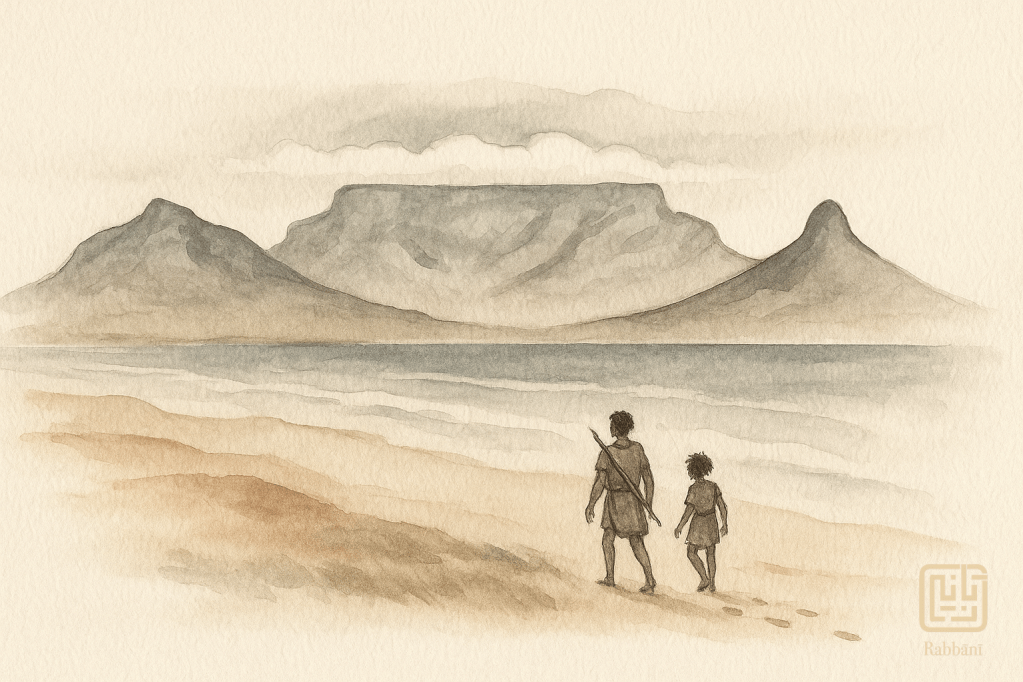
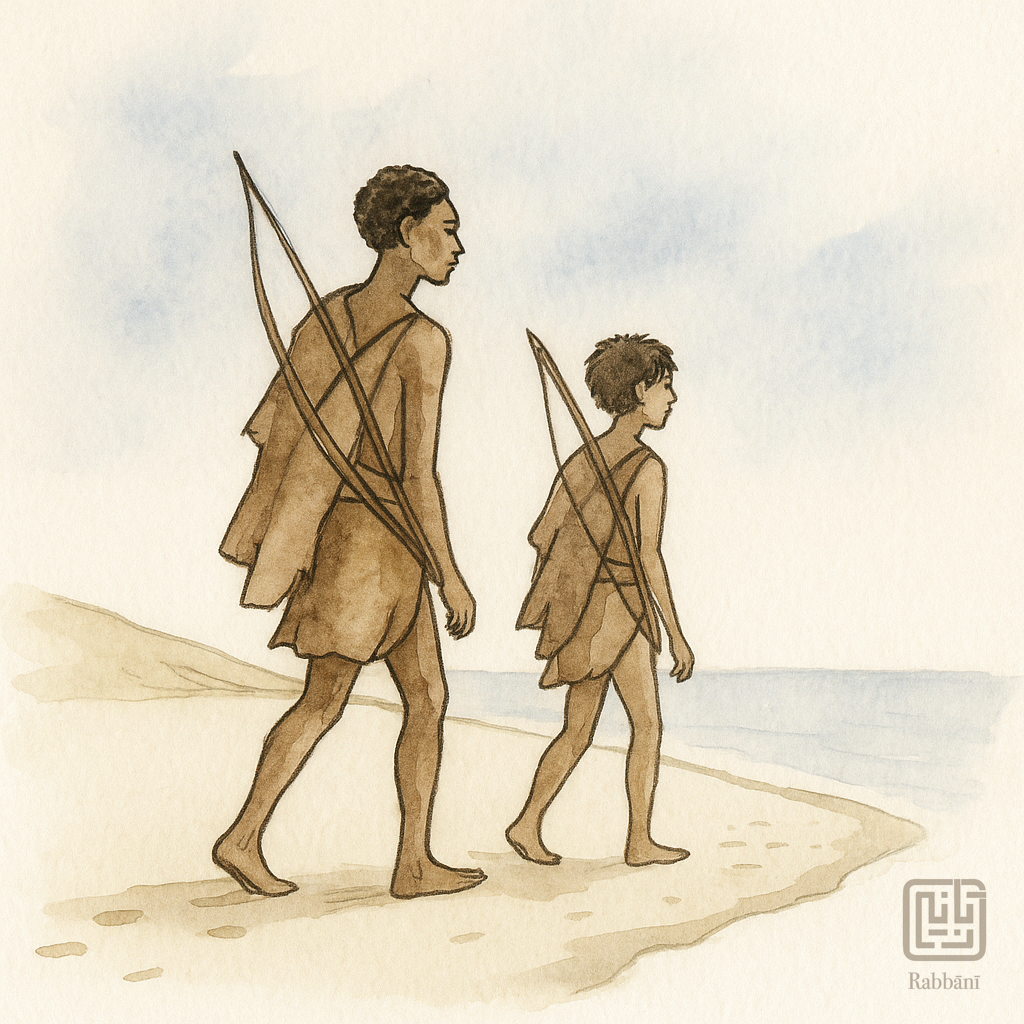
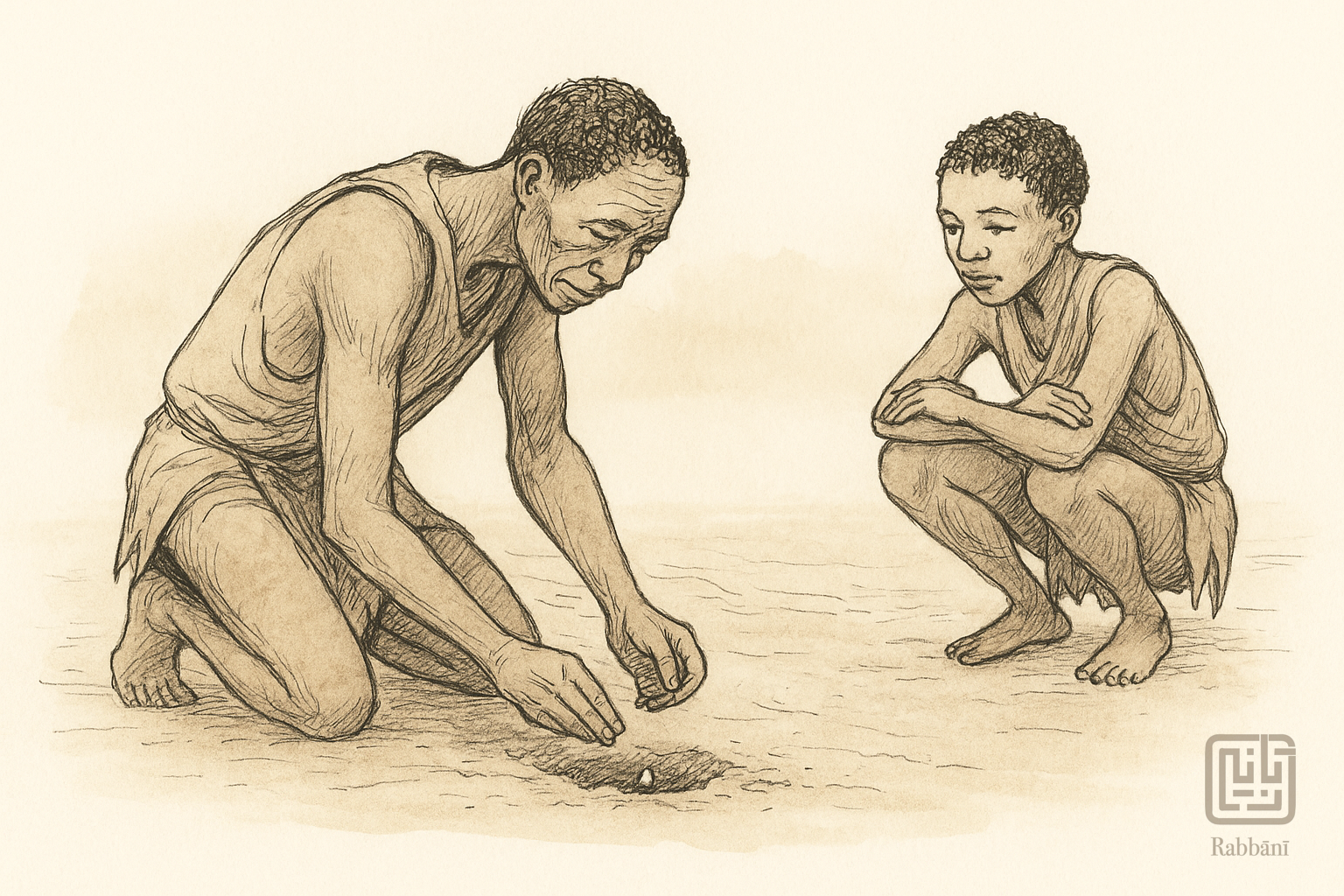
And so it was that a man named Gubi — a fire-maker, a spark of a man — took his young son, Nori, and journeyed south along the Atlantic edge. Not fleeing. Seeking.
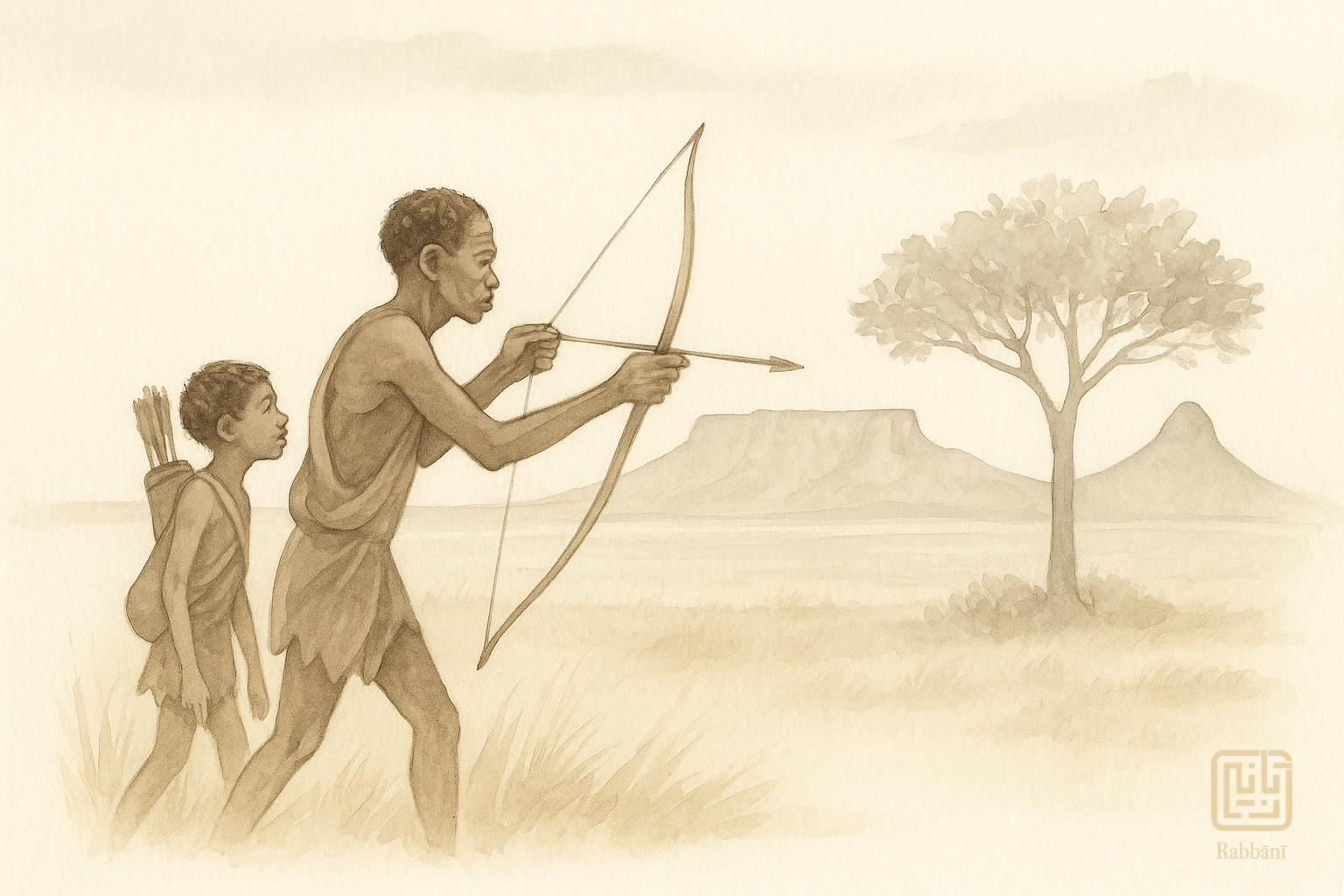
Their goods were wrapped in leather. Their bows slung across their backs. They followed the cold sea winds, walking toward a dream of sanctuary.
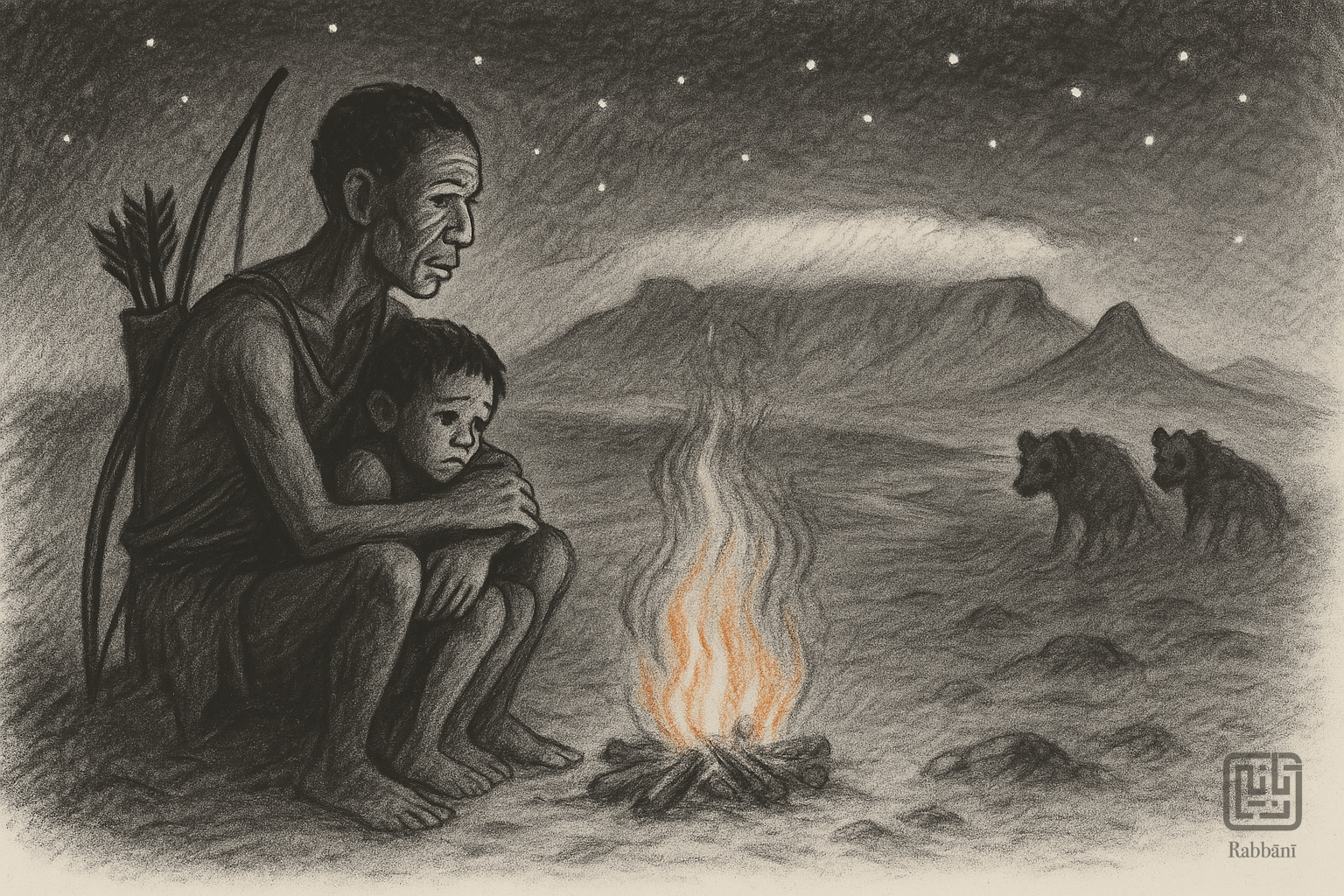
One night, as their fire danced in the dunes, hyenas came snarling through the dark — hunting porcupines. Gubi rose with fire in hand, casting its light wide, pushing the predators back into the night.
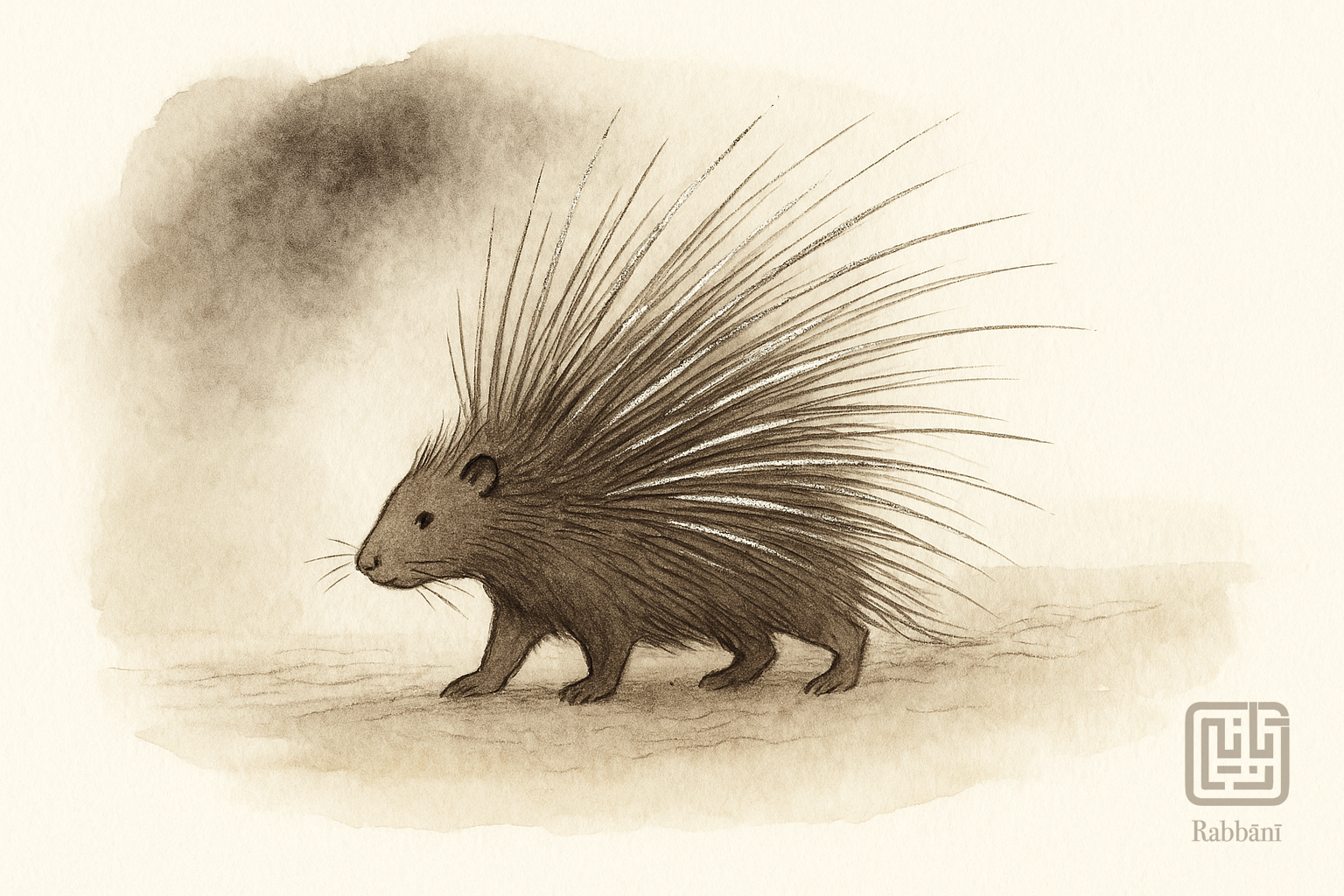
From the shadows came a porcupine. But this was no ordinary porcupine. She was old — a sage — her quills silver with wisdom. She stepped forward and spoke in a voice like rustling leaves:
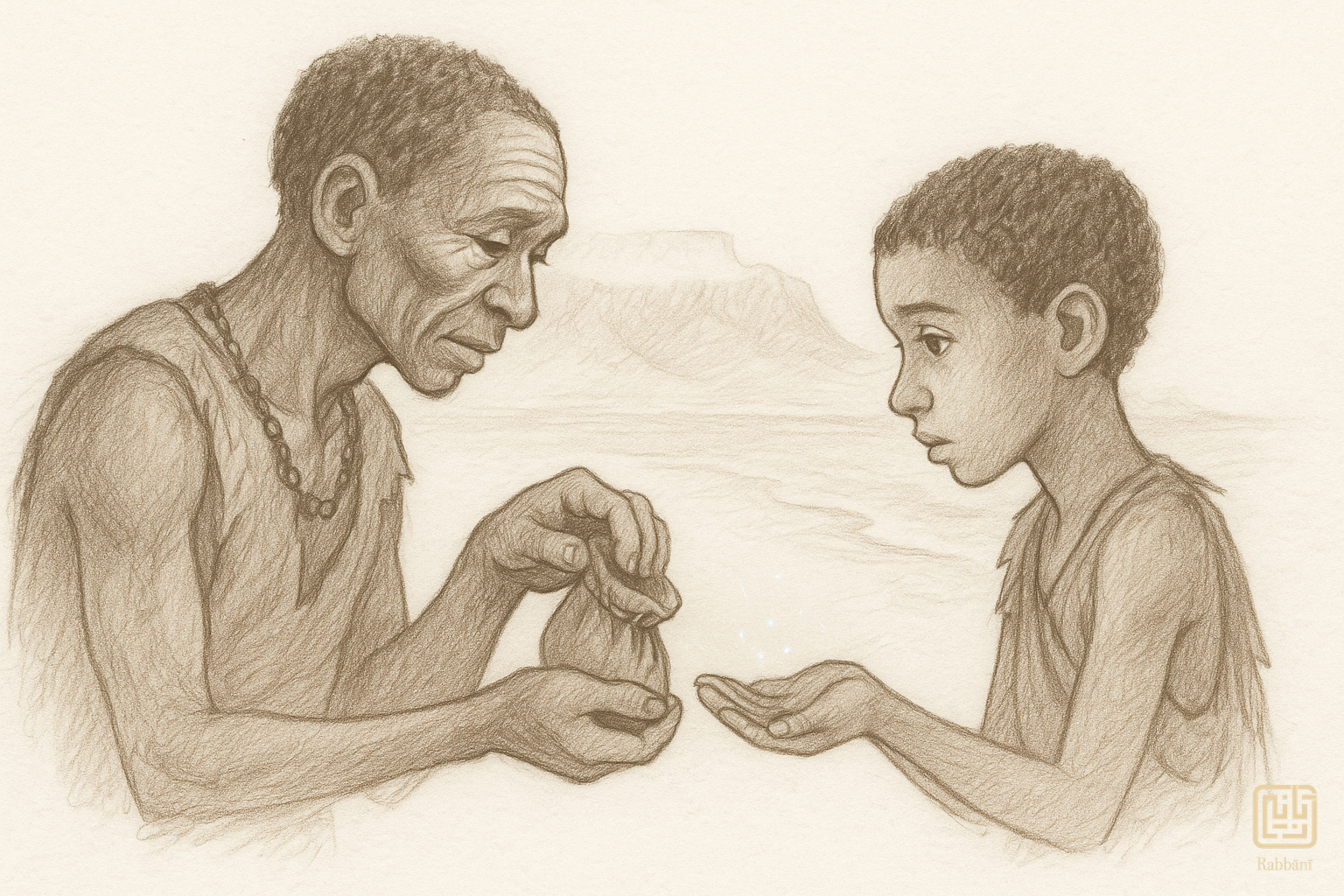
“You have shown courage and care. For this, I give you a pouch.”
Inside: a handful of shimmering seeds — soft, silver-tipped, unlike anything they had seen.
She said: “As you walk, look for the place where the sea makes clouds. When you find it, plant these. If they grow, you’ll know: this is your place.”
And so they walked on.
And when they reached the foot of the mountain — flat, cloud-veiled, vast — Gubi and Nori felt the truth of it in their bones.
They planted the seeds.
And by dawn, the Silver Trees had begun to rise — shimmering, breathing, alive.
Not just plants. A blessing.
And that is how the Silver Tree — found only here — came to live beneath Table Mountain. Not brought by botanists. Not named by settlers. But gifted by a porcupine, Planted by Gubi and Nori, Rooted in fire, story, and seed.
And when the rains came, those Silver Trees drank from the river that flowed down the mountain — the one they called Camissa — the place of sweet waters, rushing underground, murmuring toward the sea.
Even now, that river runs — quietly — beneath the city that forgot it. But the mountain remembers.
It remembers its own name.
Not Table. But Hoerikwaggo — the Mountain of the Sea. To its right, the curled-back hill they once called The Sleeping Lion — its back arched into what settlers would name Signal Hill, its mane rising into Lion’s Head. To the left, the shadowed one — once called Windmaker’s Watch, now called Devil’s Peak.
The land is older than its names. And stories, like rivers, find their way back.
Epilogue
Some stories are planted, not written. They take root in silence. They grow in the shade of memory.
This is one of those.
Passed from mother to daughter, from father to son, from fire-circle to ear, from silence to word.
The Silver Tree still stands. The mountain still watches. And somewhere, Gubi and Nori are still walking — between cloud and coast, between the land’s longing and the sky’s answer.
So tell this story again.
When the mountain is misted, when the wind shifts, when the child beside you asks, “Where did we come from?” Tell them…
“Let me tell you the story of Gubi and Nori — the spark and the seeker — and the tree that shimmered with yes.”
Postscript
This story is told in honour of those who remind us that memory is a form of resistance.
We acknowledge Patric Tariq Mellet, whose book The Camissa Embrace reclaims the deep currents beneath colonial erasure. Through his work, Camissa is no longer hidden — it is remembered as a place of sweet waters, of creolised identity, of sacred convergence.
We also draw from Stuart Hall, particularly The Fateful Triangle: Race, Ethnicity, Nation, which reminds us that nations are not simply born — they are narrated into being. To say I am from Camissa is to resist imposed categories and to speak from the riverbed of relation — to narrate the nation otherwise.
This reflection flows alongside the companion essay:
I wrote this story in honour of a voice passed through many generations — from my mother, to her mother, and beyond. It weaves ancestral memory with imagination, drawing from the wisdom of our lands, our rivers, and our people.
Gubi and Nori may be characters in legend, but they carry something real: the spirit of all those who walked before names, who travelled with seeds, and who listened deeply to the mountain’s silence.
I offer this story as a small act of remembering — a quiet prayer that memory may once again run like water beneath the city.
– Adli Yacubi Writer. Listener. Wordsmith of the Sweet Waters.
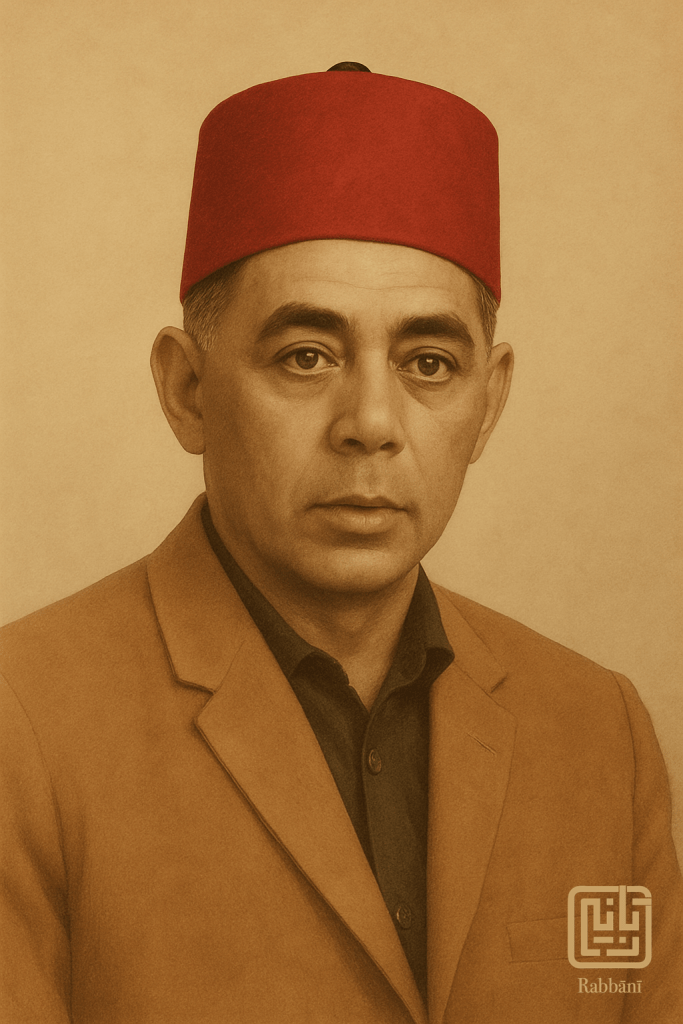
Our Father: Braima Winter — The Man Who Read the Weather and Raised Us with Words
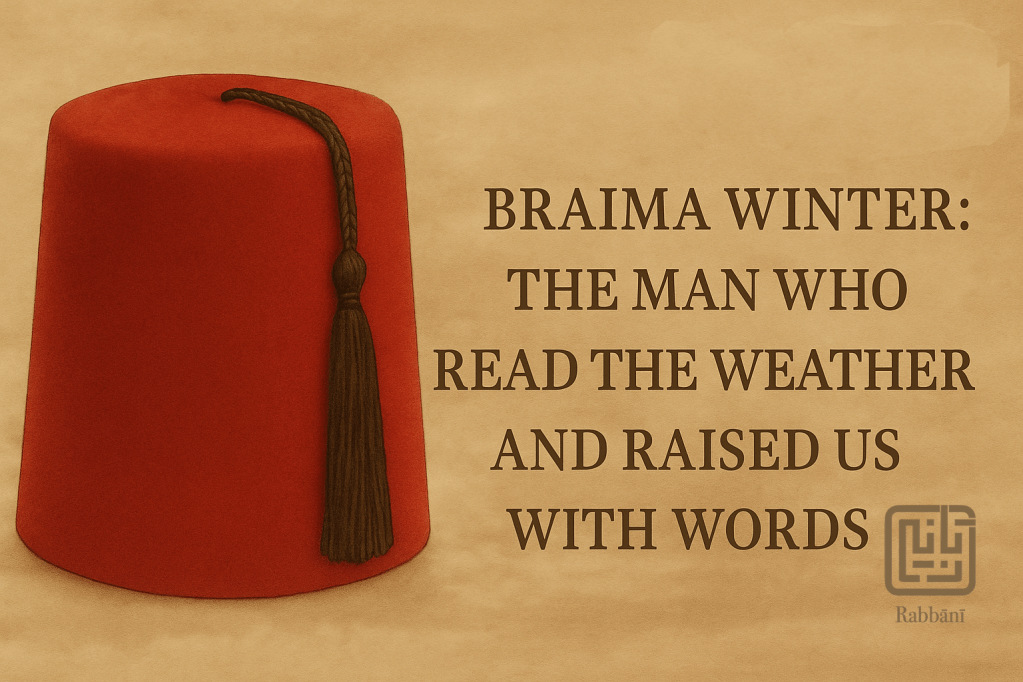
Braima in His Red Koefiyya Not just a head covering, but a hush of dignity. A crown worn by those who build without boasting, who read clouds like verses, and raise children like minarets — quietly, steadfastly, towards the Light.
They called him Braima Baard. But he was clean-shaven. They called him Braima Winter. Because even if there was only one cloud in the sky, he’d say: “Dis winter, Gaya.”
He was our father: Ebrahim Abdul Aziz Jacobs. Born of tailors and dressmakers — his father, Abdul Aziz, worked with thread; his mother, Gadija, crafted fabric into form. From such soft-handed lineage, he turned to bricks and cement.
His mother once teased him, laughing: “Met jou sag handjies, wat soos ‘n bricklayer gan djy maak?”
But he became one. And not just any bricklayer. He built kilns. He protected cement floors. He shaped the foundations that others would walk on long after he left the site. He built a good few walls of Primrose Park masjid (called Jamiya Tus Sabr).
He guided others. Trained them. Gave them skills, and more than that, dignity.
Yet behind all of this physical work was another kind of labour — of language, of laughter, of letters. He was the spine of our family’s love of books, storytelling, and sly, gentle humour. He was reading before most could walk. As a child, already in his diapers, he was immersed in words, letters, pages. No one had to push him. It was in him.
Imam Ghazali. Ibn Battuta. Jalāl al-Dīn Rūmī. Shams Tabrizi. He didn’t just read. He remembered. And retold. And spun.
He raised seven children with his hands, but never truly raised his hand at them. His discipline was the silence between sentences. His presence was the lesson.
We never feared him. We trusted him. Because the man who knew where every cloud was going — also knew how to hold a storm.
He didn’t build palaces. He built people. He built us.
And when he dressed, he often wore his red koefiyya — not the long turban of his childhood, but a shorter, neat fez with a tassel, worn by men who held pride without noise. It was the kind worn by many hadjies after the sorbaan had fallen out of fashion. It became his crown.
One Fajr morning, when I was a teenager, he woke me gently. We walked together through the streetlights of Primrose Park toward the mosque. I looked around and said, “So many Muslim houses still have their lights off. Don’t they make salah?” He chuckled softly, and said, “Perhaps they are praying while their lights are off so that they can go back to sleep. You must focus on your own salah. Other Muslims are not your concern.”
And perhaps this was the secret of his laqab… As Shaykh Jamiel Abrahams reflected:
“The secret of this Laqab… is that no Winter will pass except that he is Madhkour — remembered — even by the non-living creation. Better than making dhikr, he becomes Madhkour — mentioned and remembered — by his Rabb.”
May Allah grant us all to become Madhkour. Āmīn.
“What a lovely man. He was always saying to us, ‘Kom biesmielah,’ and happy to have us around.” — Shamiel Isaacs, Bonteheuwel (Call of Islam)
And today, as we recite stories, as we reach for bricks and books and blessings — we say: Braima Winter, we remember. And we still feel your weather. And your words. And your mercy.
Innā li-llāhi wa-ʾinnā ʾilayhi rājiʿūn Surely to Allah we belong and to that we will return. [Surah Baqarah, 2:156]
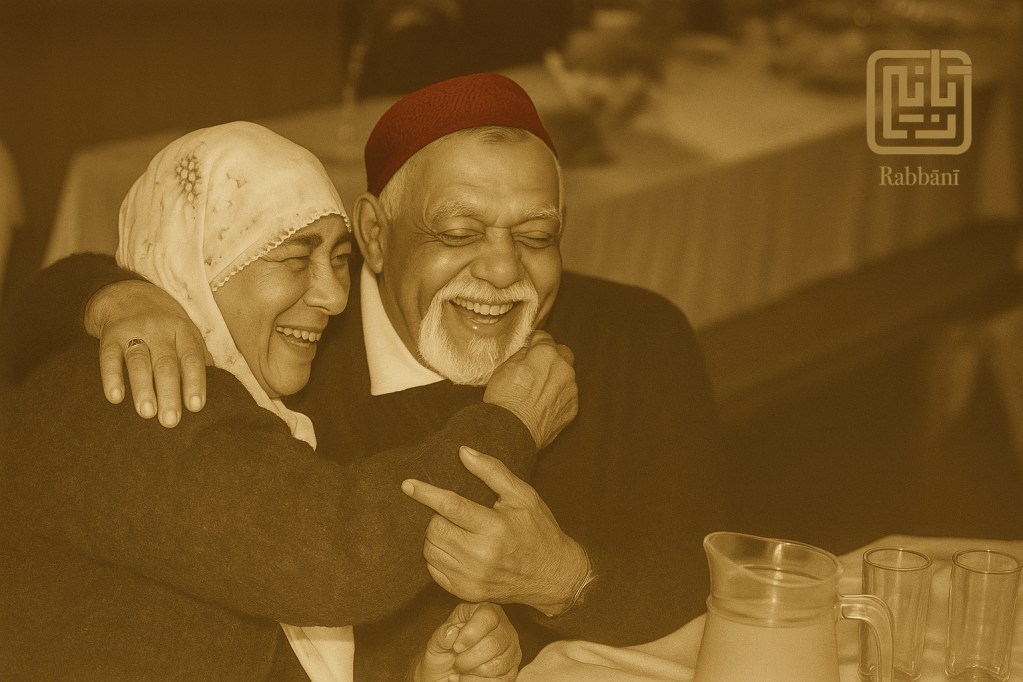
And this is how we remember him best: Laughing beside Gaya, the love of his life — as if the whole world had just whispered a joke only they could understand.
Braima and Gaya Laughing — A Crowned Moment of Mercy
Somewhere between the worn edges of oral history and the crisp pages of archived journals, I began to trace the journey of my ancestor — Hadjie Gasanodien, also known as Carel Pelgrim. It is said he was the first Muslim from the Cape to perform the sacred pilgrimage of Hajj, sometime between 1834 and 1837, a period just after the abolition of slavery, when its wounds were still fresh. For years, his story lived quietly in our family’s memory, surfacing in fragments and whispered recollections — until now. I write to honour that legacy, to weave together the strands of fact, faith, and feeling that shaped a man, a pilgrimage, and a community still finding its voice in the aftermath of bondage.
Pilgrimage of Discovery
I first heard his name as a child, tucked into a conversation between my sister Yasmine and our aunts. Years later, Yasmine would take those threads and stitch them into a short family tree, dated July 2004. At the time, it felt like the last echo of a fading past. We had little else to go on. But something stirred in me after I returned from my own pilgrimage. A fever of purpose, a longing to know more. I began writing and publishing reflections under Al Hujjaj Magazine, not yet knowing that my footsteps had mirrored those of my own forebear, nearly two centuries earlier.
Echoes in Academic Footsteps
The name “Carel Pelgrim” returned to me unexpectedly through the work of a neighbour and friend of my father — the late Mogamat Hoosain Ebrahim, a community scholar from Primrose Park. He had long been documenting the Hajj stories of Cape Muslims. In his thesis, The Cape Hajj Tradition: Past and Present (2009), Ebrahim writes: “Hajji Gassonnodien, more popularly known as Carel Pilgrim, enjoys the distinction of having been the first Cape Muslim to have successfully completed the Hajj.” Although I first encountered his name in Ebrahim’s thesis, the full significance didn’t strike me until later — during conversations with the researcher Abdud-Daiyaan Petersen. It was through our exchanges that the identity of Carel Pelgrim truly crystallised. This was not just a figure in history — he was my ancestor. A man who left the Cape between 1834 and 1837 to walk the sacred path when few could even imagine such a journey.
It was through Ebrahim’s meticulous work that I began to understand the context of that time. Hajj was not simply a religious obligation; it was an act of defiance, endurance, and transcendence. For formerly enslaved Muslims in the Cape, to make the pilgrimage was to reclaim a spiritual identity that colonial systems tried to erase. And Carel Pelgrim, in going, carried more than personal faith — he carried the hopes of a generation emerging from bondage.
A Lineage Remembered
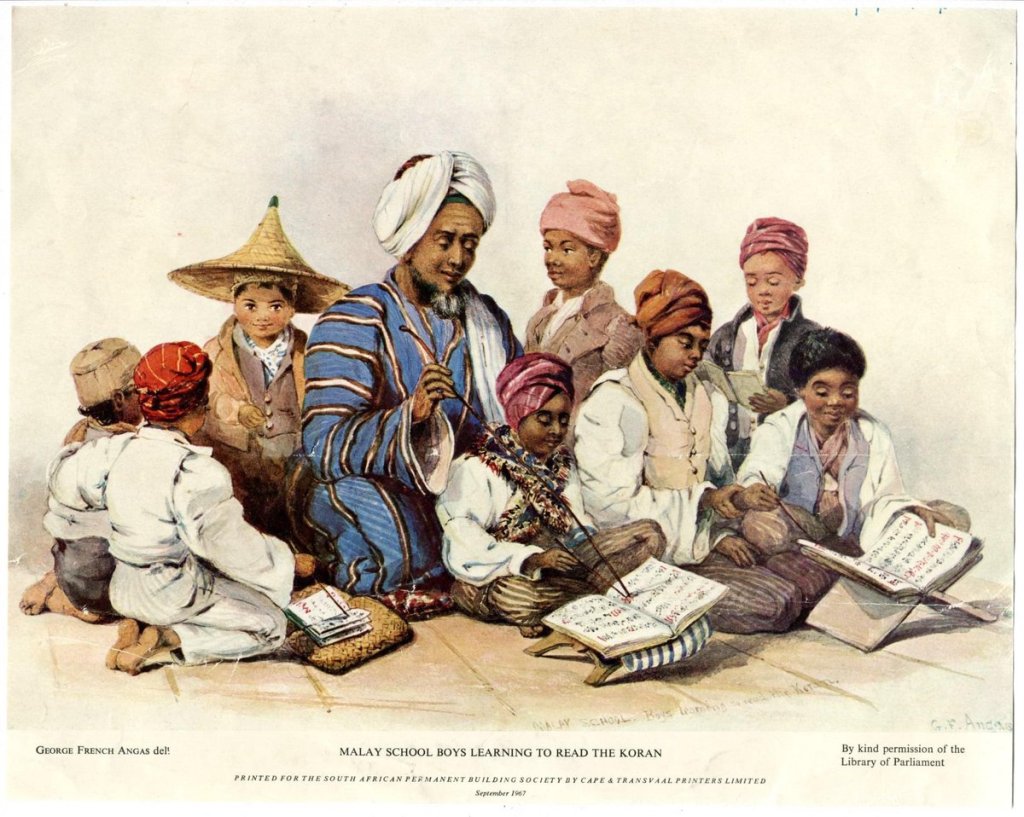
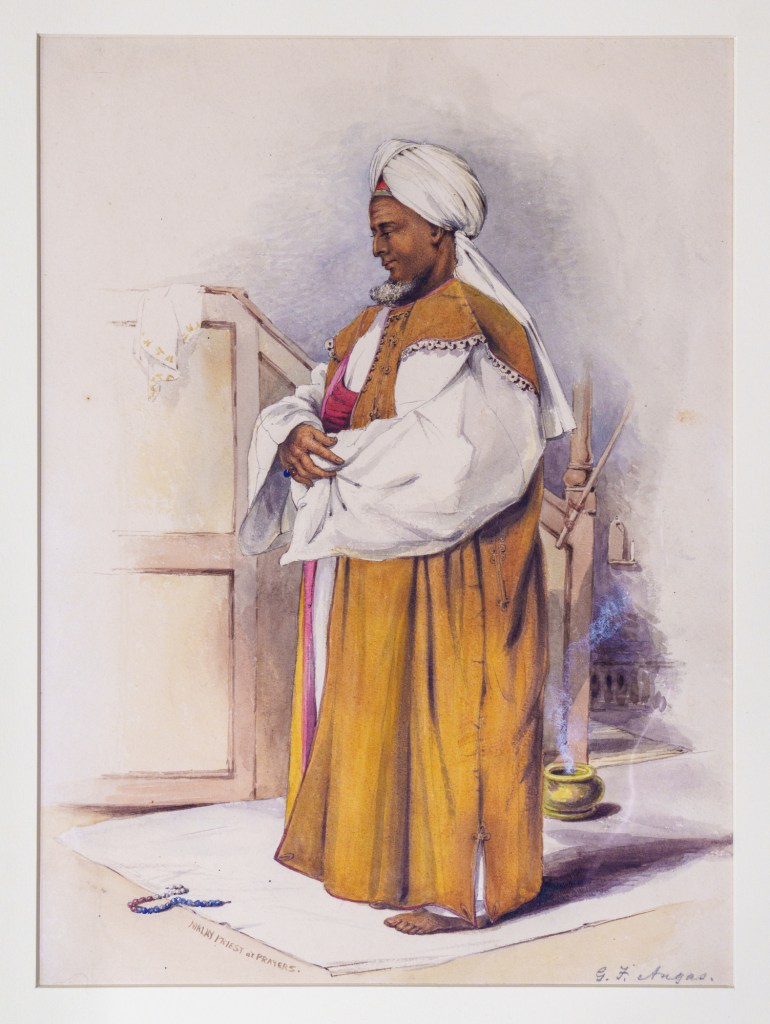
George F. Angas (1822-1886). ORIGINAL 1849 Hand Coloured Stone Lithograph. A Malay Priest Prays.
Abdud-Daiyaan Petersen’s research added an entirely new dimension to the story. In collaboration with Turkish scholar Halim Gençoğlu, he co-authored a paper titled Was Imam Gasanodien Carel Pelgrim an Ottoman Descendant?, published in the Bulletin of the National Library of South Africa in 2021. They explored the possibility that Carel Pelgrim may have had ancestral ties to the Ottoman world — a lineage once obscured by slavery and colonial re-naming. Through Petersen, I learned not only of the archival traces, but also of the living memory carried in Cape Town’s communities — stories that had waited generations to be heard.
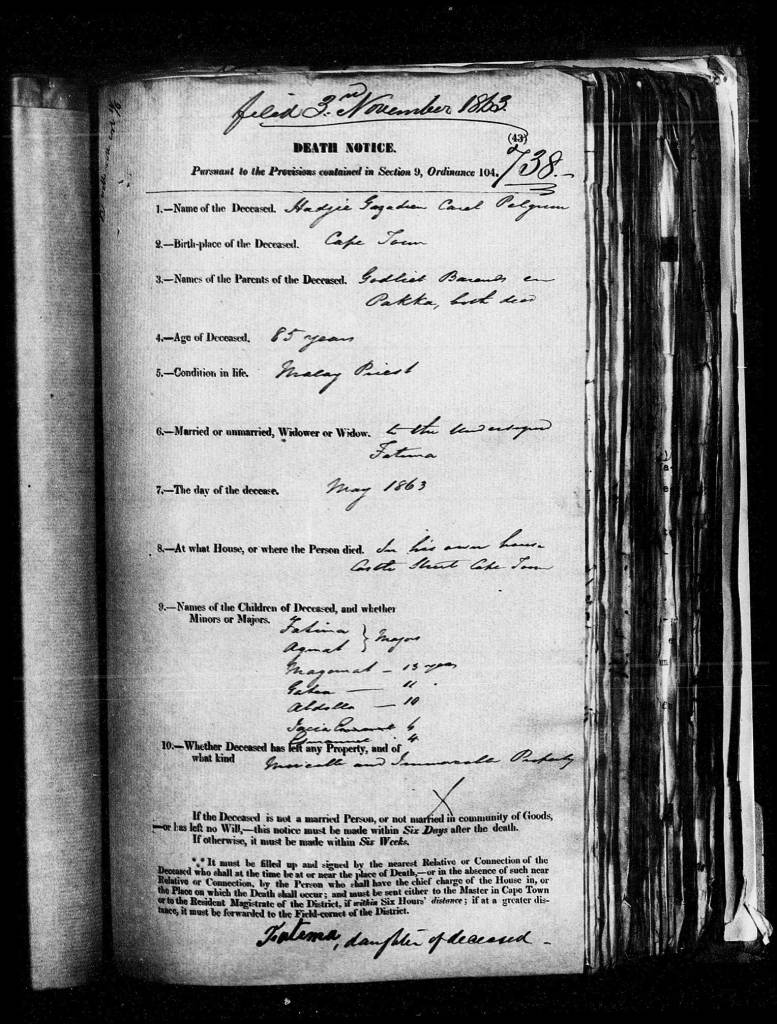
Petersen’s careful investigations, supported by old burial notices and public records, pointed with growing clarity to the fact that Carel Pelgrim and Hadjie Gasanodien — the man known for teaching Islam and the Qur’an to children in early Cape Town — were one and the same. The fragments were falling into place. What had once been academic became intimate. What had once been folklore became family history.
The Pain Beneath the Pride
The history of Carel’s mother, Pakka, adds further complexity and depth. As documented in Echoes of Slavery: Voices from South Africa’s Past by Jackie Loos, Carel — born into slavery — was the son of Pakka, a slave woman, and Jan Gottlieb Barends, a Christian man of German descent. Their relationship was informal and illegitimate, as was often the case in that era. Carel and his brother Philip inherited their mother’s status as slaves. In 1801, a notarial protocol records their transfer to a burgher, and upon his death, their eventual manumission was stipulated in his will.
Pakka’s exact identity remains debated, though one likely candidate is Janpakka of Batavia, who ran a shop in the Waterkant in the 1820s. Death records from the time, often unreliable, do not mention Carel or Philip, but their presence in community memory is clearer than archival certainty. Pakka’s story, like that of many enslaved women, survives in fragments — yet she remains the root from which this extraordinary lineage emerged. And it is here, in the shadows of that history, that I must pause. My heart aches at the likely truth: Pakka, my great-grandmother, was not loved — she was owned. The man who fathered her children, Jan Gottlieb Barends, did not protect her. He did not free her. Instead, he allowed her and their children to be sold on to another man. Was she raped? Exploited? Discarded? The records are silent, but the silence itself screams.
This is the pain we inherit alongside the pride — the wounds interwoven with the honour. In naming Pakka, I do not just trace bloodlines. I reclaim her dignity, speak her name with reverence, and acknowledge that even in bondage, she gave rise to a lineage that would one day teach Qur’an, lead prayer, and inspire generations. Her story, though faint, demands to be held — not with shame, but with solemn truth and fierce remembrance.
A Husband’s Grief
Carel’s transformation from a slave to a respected teacher, tailor, and hajji is all the more remarkable against this background. And among the most beautiful parts of his story is his deep love and reverence for his first wife, Japoera. Though she was childless, their bond was strong — spiritually and emotionally. When she passed away in their large home in Buitengracht in early 1841, Carel composed a public obituary in the South African Commercial Advertiser. It read: “The Heavenly Father, Lord of Life and Death, was pleased on the 16th instant to call from me my beloved wife Japoera, aged 64 years, 4 months and 16 days, after a happy union of [blank space] years. All who knew her virtuous character will sympathise with my loss, of which I hereby give notice to friends and relatives, requesting to be excused the visits of condolence.” He signed it: Carel of the Cape, the first Pilgrim and Priest.
Death certificate of Hadjie Gasnodien Carel Pelgrim.
In this short but poignant notice, we see not just a man grieving his beloved, but a heart refined by faith and loss. It reminds me that while history often records what men did, it rarely shows how deeply they loved. He eventually adopted the Islamic name ‘Hassan al-Din’ — appearing in records under numerous variations such as Gasnodien and Gasanodien — yet he signed himself proudly as ‘Carel Pelgrim.’ His ability to read and write in both Arabic and European script shows a deep level of literacy and determination to bridge worlds. While some have speculated that he may have spent up to three years in Makkah — a duration not firmly evidenced — what we do know is that he returned with the ability to teach Arabic and Qur’an, and left an imprint as a man of knowledge and devotion. It’s possible that his early literacy was shaped by Cornelis van der Poel, the burgher who once held legal ownership over him and later stipulated Carel’s manumission. Whether through formal tutoring or exposure to Dutch literacy, this early learning may have paved the way for his later mastery of both Islamic and colonial languages.
The directories list Carel van de Kaap as a free tailor living in Hout Street in 1816 and as a Malay schoolmaster in 1830. His brother Philip, born in 1789 and passing in 1844, was also a tailor, but unlike Carel, Philip was not a practicing Muslim. Some of Philip’s children were baptised, and in 1838 he married their mother, Carolina Marteyn of the Cape, in the Dutch Reformed Church.
Meanwhile, Carel was charting a different course. Once free, he began to prosper. In 1817, he loaned Seymen of the Cape 600 Ridollars (a substantial currency at the Cape in the early 1800s, equivalent to several months of wages for a labourer) to enable him to free his slave daughter, Cananga. By 1822, he had purchased his own home in Matfeld Lane. Then, in October 1833, Carel and his wife made a joint will, identifying themselves as the free man Carel of the Cape, alias Gaszimoedien — formerly a tailor, now a teacher in the Arabic language — and Johanna Salomonse, alias Japoera, born at the Cape.
Japoera seems to have been an exemplary Muslim wife, and Carel held her in high esteem. He set out for Mecca soon afterwards, and her encouragement must have been crucial to the success of his pioneering journey.
When Art Becomes Revelation
That intimacy deepened when I looked again at a familiar image — one I had seen countless times in Cape Town homes, books, and exhibitions, without ever imagining a personal connection. It is a watercolour painting by George French Angas, an English artist who visited the Cape in the 1840s. The scene is gentle but profound: a bearded man seated cross-legged, surrounded by children, teaching them the Qur’an. For years, this portrait was simply referred to as a depiction of a “Malay teacher.” But now, thanks to community scholarship and genealogical evidence, we know the truth — that teacher was Hadjie Gasanodien. My ancestor.
Another portrait, also by Angas, is held at the Castle of Good Hope in Cape Town. In it, Hadjie Gasanodien is more formally posed, with dignified composure. What amazes me most is his attire — a flowing Arabic coat, or abaya, layered over a long-sleeved thawb. The painting is filled with symbolic richness: incense burners still glowing in the frame, a minbar placed behind him as if ready for the next call to gather and reflect. To stand before that painting is to encounter the past as presence — not as myth or metaphor, but as family. His face, once anonymous to me, now echoes through mine. The ink of his story has always been part of my blood. Only now am I learning how to read it.
The Living Links
One of the most tender links between this legacy and the living was shared in Lawrence Green’s 1964 book, I Heard the Old Men Say. In Chapter Two, titled “The Living Links,” he introduces a woman named Gatea Jacobs — my great-grandmother and the daughter of Hadjie Gasanodien. In a touching passage, she recalls her father’s return from the pilgrimage to Mecca. She tells of the white robes he wore, the gentle way he taught, and how the community revered him not just as a teacher, but as a man who had seen the heart of Islam and brought its light home.
Yet there is something poignant here: on the death notice of Hadjie Gasanodien, Gatea was listed as his daughter — and she was just 11 years old at the time. Her recollections, as recorded by Green, must have been shaped not only by her own memory but also by the atmosphere that surrounded her father’s name: the reverence of others, the stories repeated in the family, the aura of a man who had left a sacred legacy. In this way, memory extends beyond personal recall — it becomes communal.
Her memories reach across generations with quiet dignity. She spoke not in grand declarations, but in lived detail — the scent of his clothes, the rhythm of his voice in prayer, the gatherings around him at dusk. Through her, his presence remained alive in the bones and breath of our family, long before any of us knew the fullness of his historical significance. It was always there — waiting for us to remember.
Incredibly, Gatea Jacobs lived nearly a hundred years, a living bridge between the earliest days of Islam at the Cape and our present time. In that same chapter, Lawrence Green recounts a remarkable scene: “One afternoon while she was still able to see and hear and talk to her family she called everyone round her. ‘I am too old to live any longer,’ she told them. Then she folded her hands as prescribed in the Islamic death ritual and passed away.” Her funeral drew thousands of mourners, and services were held in mosques across the Peninsula. It was a farewell not only to a beloved matriarch, but to an era.
Her final act — serene, faithful, and deliberate — echoed the strength of the lineage she carried. It is this spirit I now seek to honour, not only in rediscovering our ancestor, but in holding open the doorway for others to trace their own roots, to reclaim the sacredness of our past, and to remember that we, too, are living links.
Author’s Note Written by Adli Yacubi (pen name), descendant of Hadjie Gasanodien, also known as Carel Pelgrim. This article forms part of a continuing journey to rediscover, honour, and share the stories of Cape Muslim pioneers. May it serve as both record and remembrance.
References
Yasmine Jacobs, Jacobs Family Tree (Oral History), July 2004
Mogamat Hoosain Ebrahim, The Cape Hajj Tradition: Past and Present, 2009
Jackie Loos, Echoes of Slavery: Voices from South Africa’s Past, 2024
Habib Shaikh, “First of Cape Hajis came 3 years after abolition of slavery,” Arab News, 11 October 2013
Lawrence Green, I Heard the Old Men Say, Chapter Two: “The Living Links,” 1964
Halim Gençoğlu & Abdud-Daiyaan Petersen, “Was Imam Gasanodien Carel Pelgrim an Ottoman Descendant?”, Bulletin of the National Library of South Africa, vol. 75, no. 2, December 2021
Helen Swingler, “Piracy, slavery and a Mecca pilgrimage,” UCT News, 17 March 2021
“Portraits stoke mystery of Hajji Gasnodien,” Cape Argus, 26 February 2021
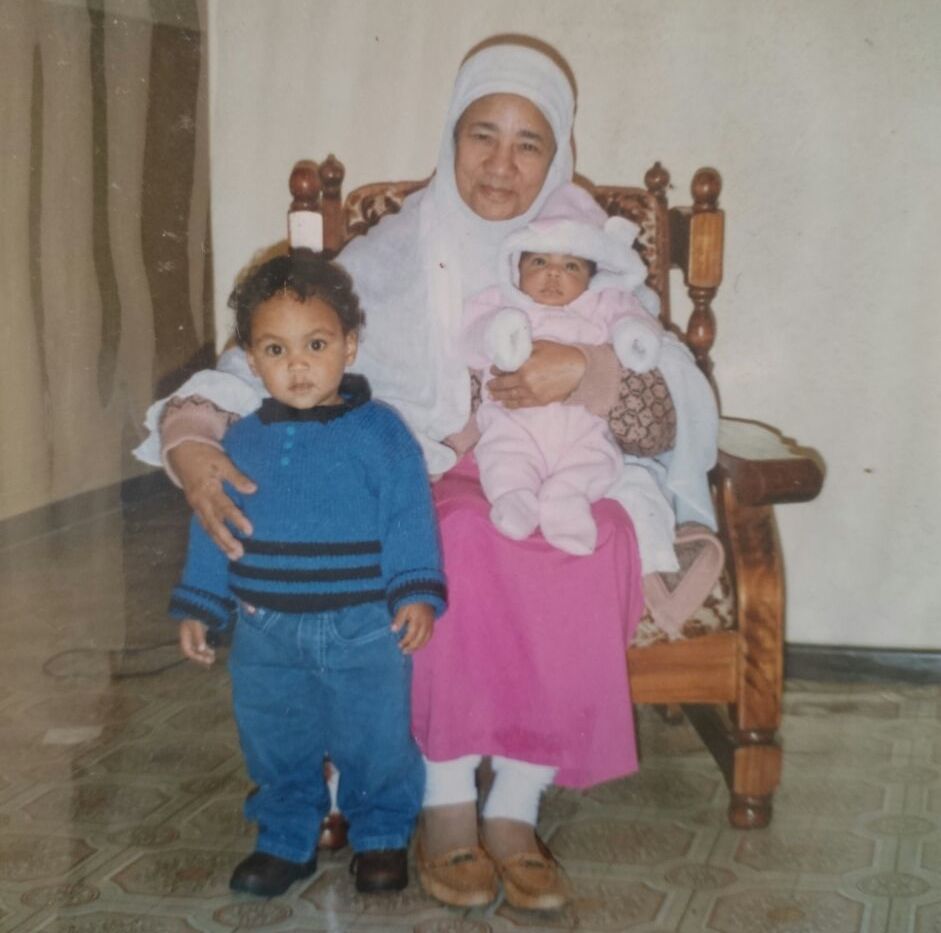
My mom with her granddaughter, Bilqis, on her lap. Bilqis’s cousin, Omar is standing.
I never really met my grandparents from either my mom’s side or my dad’s. I lie. I met my dad’s dad. Twice. Once in Kingsley Street in Salt River when I was about eight years old. My mom had to say to me, “This is your grandfather.”
I saw this older version of my dad in his sleeveless vest and long white underpants with three kids hanging onto him. My grandfather was short. Like my dad. And I looked at those kids stretching out his vest, my cousins who I also did not know, with envy.
The second time I saw him, I may have been twelve. He was laid out on a metal table in the lounge of the same house in Salt River, covered in white linen up to his neck. My grandfather had passed away. “Kiss your grandfather,” my mom said to me, “don’t be afraid.” I kissed him on his cold forehead and that was that.
My six other siblings were more fortunate I was. They have memories of my dad’s mom who stayed with us for a time when we lived in District Six and the older siblings have wonderful stories about my mom’s mom, Moeder (real name Zubeida), that I love listening to.
Of the two role models in my life, my dad was the more child-friendly. That’s not really accurate. Rugaya, my mom, was a woman who preferred boys over girls. She adored her four sons over her three daughters. This preference became more noticeable when the grandchildren came on the scene. Of her 27 grandkids, there are only eight boys!
My mom, God bless her soul, was also not one to disguise her displeasure or dislike for something or someone. You could often see it in her entire face no matter how hard she tried to disguise it (when she did try, which was not often). So when Sadia, my spouse, gave birth to our first born, this is how she reacted to the news when I called her in my absolute excitement.
“Mom, Sadia just gave birth!” I said.
“What is it?” she asked.
I knew exactly what she meant but said, “The child’s name will be Bilqis.”
“What type of a name is that? That’s mos an Indian name. Is that for a girl or a boy?”
“It’s a girl. Silly. My firstborn is a girl.”
“Your dad will come to the hospital,” she said and put the phone down.
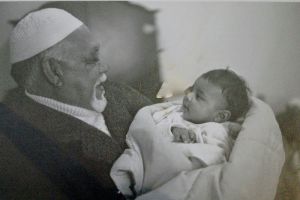
My dad with Bilqis.
There is this beautiful black and white I took with my dad, Ebrahim or Breima, holding Bilqis with delight in his eyes. She sensed his warmth and smiled back. Breima was great with kids. All kids. He could sing them to sleep within seconds. A true baby whisperer. A storyteller of note and incapable of giving us a hiding. Ever.
Sometime after Bilqis’s naming ceremony or ‘doekmal’ (probably from the Afrikaans ‘doopmal’) my mom and dad came to visit us in Mountain Road in Woodstock. Not one to give my mom a break with her preference for boys, I placed Bilqis on her lap and said, “I want to take a pic of Ouma with her grandchild.” She sat with Bilqis, and about manages to make a smile.
I have no doubt that my mother loved my kids but, somehow, she was not wired to relate to other females as she was towards males. This is why most of her students (mostly female) who she taught in ritual preparation of the deceased (or toekamanie-werk) remember her as stern.
But for all her hard exterior, her students loved her. When she passed, some 500 women attended her janazah (funeral), lining the streets to give her a guard of honour as she was carried to the mosque for the funeral prayers.
When Sara-Nida, my second daughter, was born, I called my mom once more.
“Mom, Sadia has given birth to a healthy baby.” Once more I held back saying the gender.
“What is it?”
“Sara. Her name will be Sara.”
“Another girl!” she said with clear disappointment in her voice, “I’m mos already known as the grandmother of just girls…”
When Ganaan, my youngest daughter, was born, I had resigned myself to the idea that my mom was not going to change. So when Sadia became pregnant with our last, we decided to have a scan done to check the sex of the child. It was a boy! I duly informed my mom.
By the time Jauzi Hashim was born, however, my mom’s health had already taken a turn for the worst. That morning when I called her with the news, we had a heartbreaking conversation.
“Mom, Sadia gave birth!”
“Sadia gave birth?”
“Yes, it’s a boy. His name will be Jauzi.”
“Sadia can’t be due yet.”
“She was due. It’s a boy. This morning. I just saw him.”
“A boy? Whose boy?”
“My boy. Sadia just gave birth.”
“Sadia gave birth? But Sadia can’t be due yet.”
And the conversation went round and round like this for fifteen whole minutes. Her mind was beginning to fail her. She could not retain information. The best news for the granny of just girls. Her youngest son just had a son, only the second of her four sons to have this ‘honour’ and Rugaya’s memory had started to fail her.
What Sadia and I did not know is that when I initially called my mom to say that the scan had revealed that Sadia was going to give birth to a boy, she had already begun to give instructions to my sister-in-law, Zuleiga, to pack a box of baby clothes and other accessories and mail that up to us in Pretoria.
My mom passed away a month later, having never set eyes on her new grandson, the last of eight. The box of baby goodies arrived a week after that.
I am remembering all this now and thinking that all of these experiences are now inside of me. I’m a granddad for the first time. My grandson, Zahi Salman, is adorable. I too find it hard to disguise my emotions. He knows this and responds by holding onto my face when I pick him up. So when I hold him, I think to myself, “Rugaya, your granddaughter has a son. You would love him too. And he would love you no matter your stern face!”


 Adli Yacubi