Category: Poetry

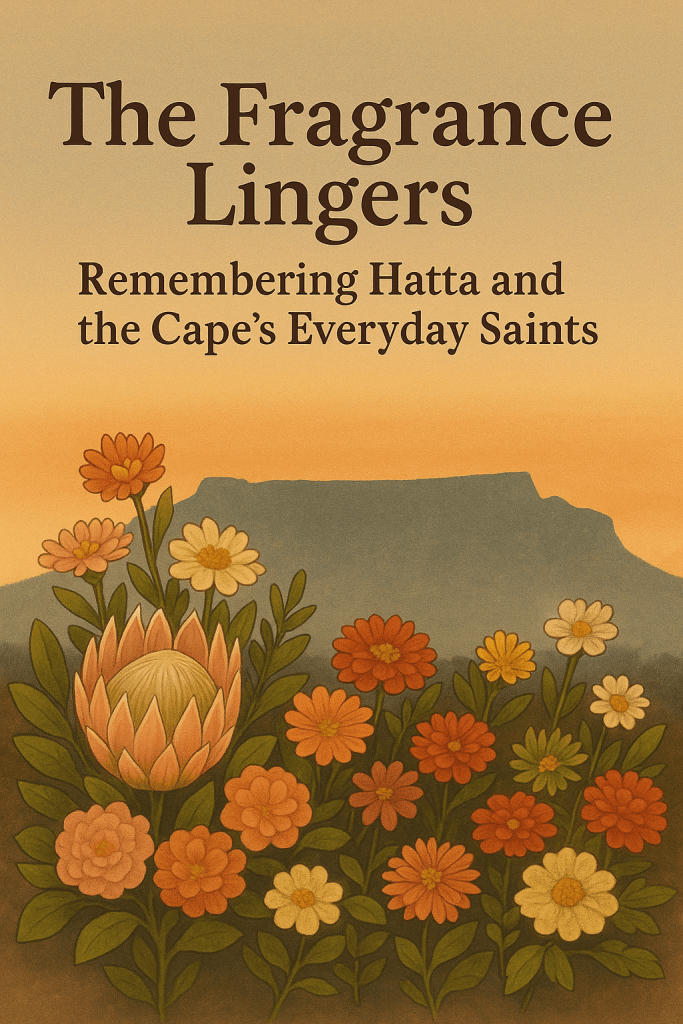
  • The Fragrance Lingers: Remembering Hatta and the Cape’s Everyday Saints

    The Fragrance Lingers: Remembering Hatta and the Cape’s Everyday Saints

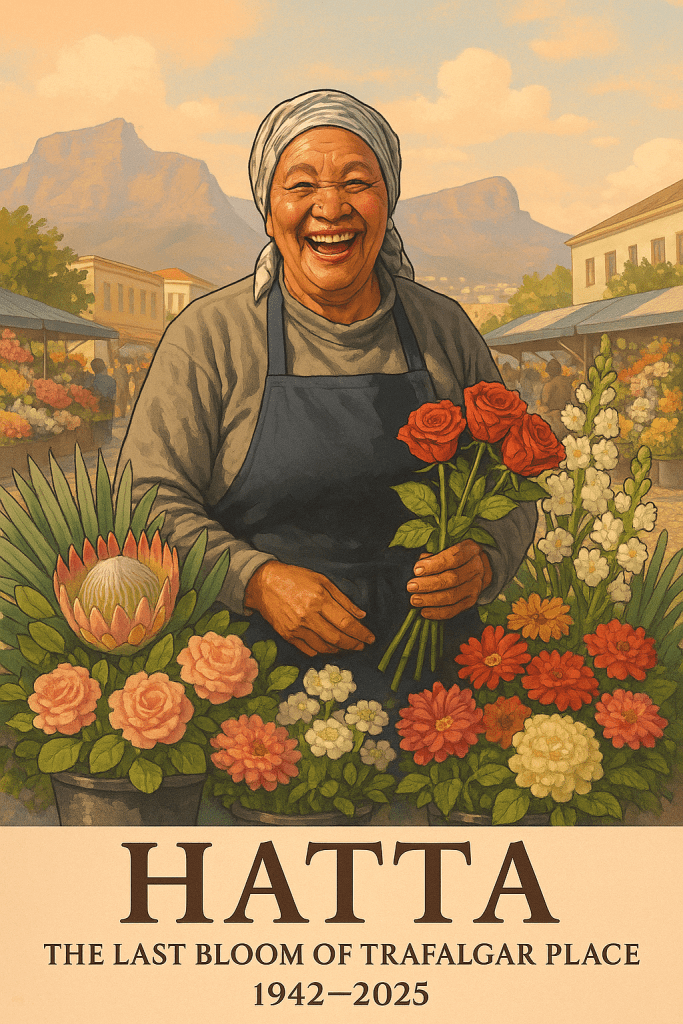
    A tribute to Hatta: flower seller, character, Cape Town soul. The fragrance lingers…

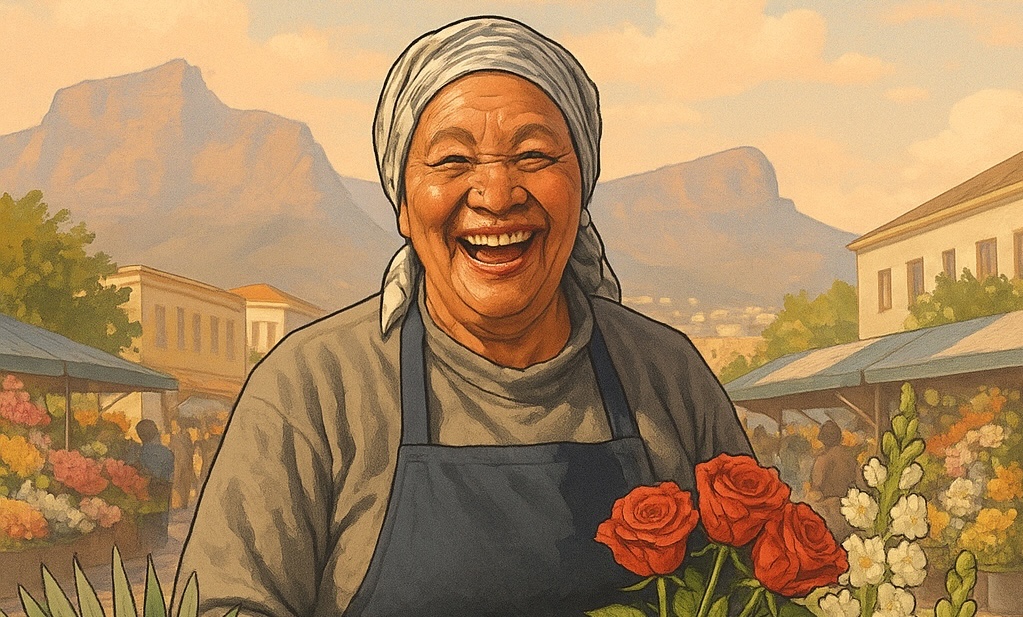
    She wasn’t just a flower seller.
    She was a fragrance, a rhythm, a joke that made you feel seen.
    Her name was Cecelia Williams—known to all as Hatta—and for over sixty years, she stood at Cape Town’s Trafalgar Place market, not just selling blooms, but lifting spirits.

    Hatta was a character. A caretaker. A Cape Town original.

    The Poem that Opened the Door

    “Hatta of the Flower Market”
    She was the last blossom of a vanishing season,
    a woman with hands that knew petals better than poems,
    who crowned Adderley mornings with colour and cackle.
    They called her Hatta—not just a name, but a rhythm.
    A shrug, a laugh, a story half-told while binding roses with string.
    Sixty years of market sun.
    Of joking with tourists. Of feeding the street children.
    Of being “one in a million” without ever asking for a statue.
    Now the market hums a little quieter.
    But her scent, her sass, her spirit—
    they linger,
    like the last bloom in a winter vase.

    This poem, first shared on my Facebook page, sparked an outpouring of memory and community. The tribute went viral, shared across timelines and group chats. And then, like the scent of jasmine carried on wind, her story grew.

    The Article That Helped the City Remember

    Tamlynne Thompson’s piece in The Cape Towner became a cornerstone of Hatta’s public remembrance. It offered not only a portrait of her life, but a signal that her presence had mattered—deeply.

    🔗 Read the article here

    Her Funeral, and the Silence That Spoke

    Though the newspaper referenced a YouTube link, the funeral livestream no longer appears to be available. But memory has other ways of surfacing. While searching for traces of Hatta, I found this moving video about her best friend, Sandra Bosman—herself a flower seller of the Cape.

    🔗 Watch the tribute to Sandra Bosman

    Through Sandra, we hear the echoes of Hatta’s laughter, her generosity, and her grit. It’s another thread in the fabric we’re weaving.

    Voices from the Cape

    Facebook friends poured in with blessings, memories, and emotion:

    Anne Rogers: “Yet another outstanding poem – beautiful, moving words and complementary image to honour an outstanding woman who brought joy to many.”

    A Note of Gratitude:
    To Anne Rogers—your kind words landed with warmth.
    In a world where noise often drowns meaning, your belief in my words is a quiet blessing.
    Thank you for seeing not only the poem, but the person behind it.

    And to Atiyyah Khan, Marianne Thamm, Mogamat Kammie Kamedien, and so many others—this harvest belongs to you too.

    What Does “Hatta” Mean?

    A few friends asked if Hatta was an honorific.
    The word “hatta” can refer to the traditional Arab headscarf, the keffiyeh—often used in resistance, honour, and dignity.
    It also carries echoes of the Arabic verb ḥaṭṭa, meaning to reachto attain, or to bring down gently.
    Maybe that’s what she did—reached people, lifted them, wrapped them in grace.

    The Spirit of the Cape Lives On

    You can’t really write about Cape Town without talking about talking.
    That unique Cape Flats cadence—Afrikaaps—where people don’t just sell fruit or flowers.
    They create moments.

    Ask about a naartjie and you’ll hear:

    “Die naartjies is so lekker, hulle willie praatie. Hulle’s te skaam van al die soetigheid!”

    And Hatta?
    She was the high priestess of that daily liturgy.

    🌹The Fragrance Lingers

    This is not a eulogy. This is a zahrā’, a bloom.
    And she—Hatta—isn’t gone.
    She lives in our language. In our laughter. In our stories.
    In every bouquet given in kindness. In every street market joke.
    In every aunty who tells it like it is, and every uncle who listens.

    May we see them. May we remember them. May we become them.

    🕊️ Rest in softness, Hatta. You were the last bloom of Trafalgar Place. But your scent is forever.

    This blog post is dedicated to every flower seller, fruit hawker, street child, and storyteller who holds up Cape Town with grace and grit. May we never forget them.
  • Unseen Table

    Unseen Table

    A Poem and Visual Reflection
    by Adli Yacubi

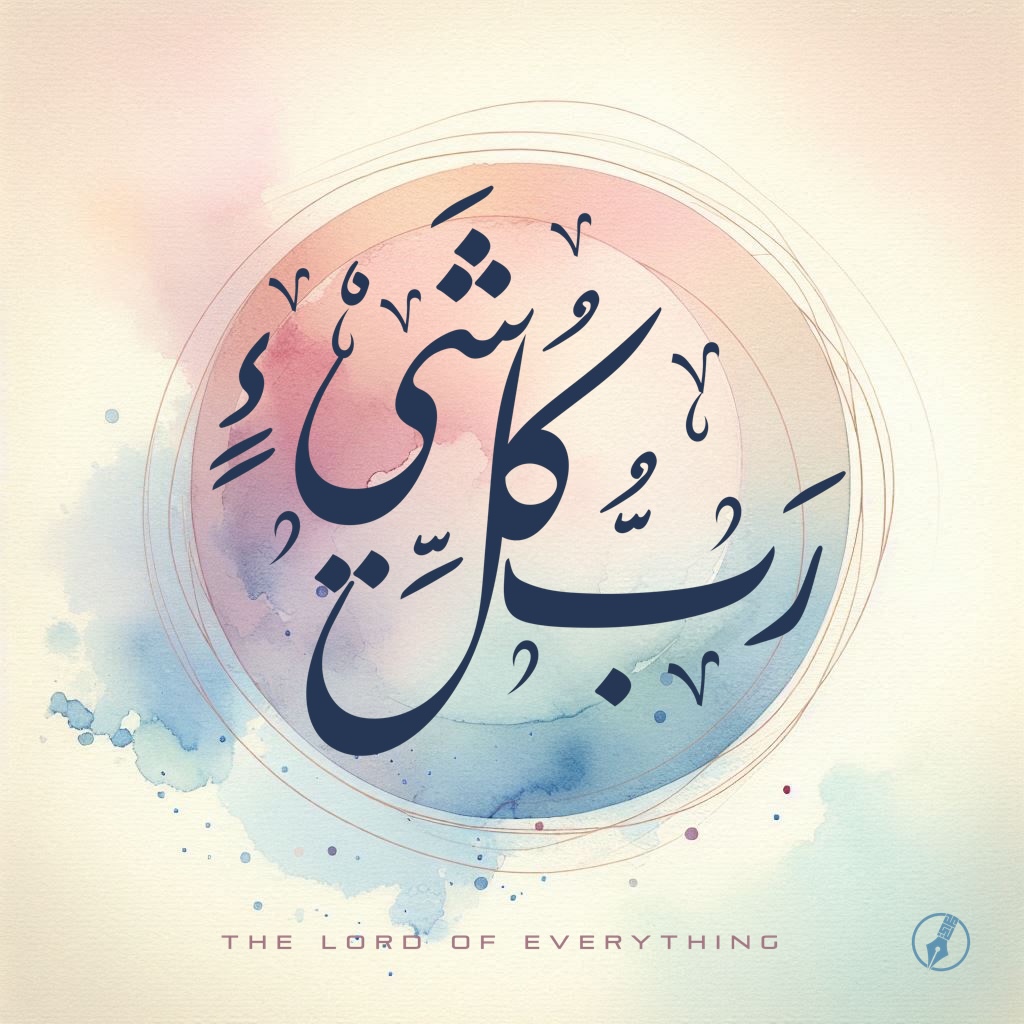
    In the quiet spaces of reflection, where language becomes prayer, Unseen Table emerged. This poem is a devotional meditation — a rhythmic journey through names and attributes of the Divine. Inspired by the cadence of Qur’anic verse and the beauty of the seen and unseen, it is paired here with an Arabic calligraphy that captures its spirit visually.

    “رَبِّ كُلِّ شَيْءٍ — The Lord of Everything”

    Pronouncing pronouns and prepositions
    Lift the lamp, the light, lit by the holy
    Scour the sacred and the secret sources
    Invoking various verses of our Lord

    Lord of the mighty mountains high
    Lord of the sweet-scented rose nearby
    Lord of the earth and skies that lie
    Lord of the day and the night gone by

    Lord of the mighty oceans deep
    Lord of the universe in its keep
    Lord of the stars in endless sweep
    Lord of the secrets that we keep

    Lord of the merciful and just
    Lord of the faithful and the trust
    Lord of the righteous and the just
    Lord of the true, in whom we must

    Lord of the prophets and the wise
    Lord of the knowledge that never dies
    Lord of the heavens and the sunrise
    Lord of the earth, to that we arise

    Lord of the Throne, the Tremendous and Honourable
    Lord of Forgiveness, Full of Mercy, ever able
    Lord of the Bounty, the Infinite and Stable
    Lord of the Sovereignty, Owner of the Unseen Table

    🌙 A Final Thought

    In a world thick with noise, may these verses be a quiet invocation — a return to the Sacred, to the unseen currents beneath all things. If the words moved something within you, pause… and let that be your prayer.

  • A Brother Like No Other

    A Brother Like No Other

    Mourning Faried Jacobs and the Pain of Letting Go

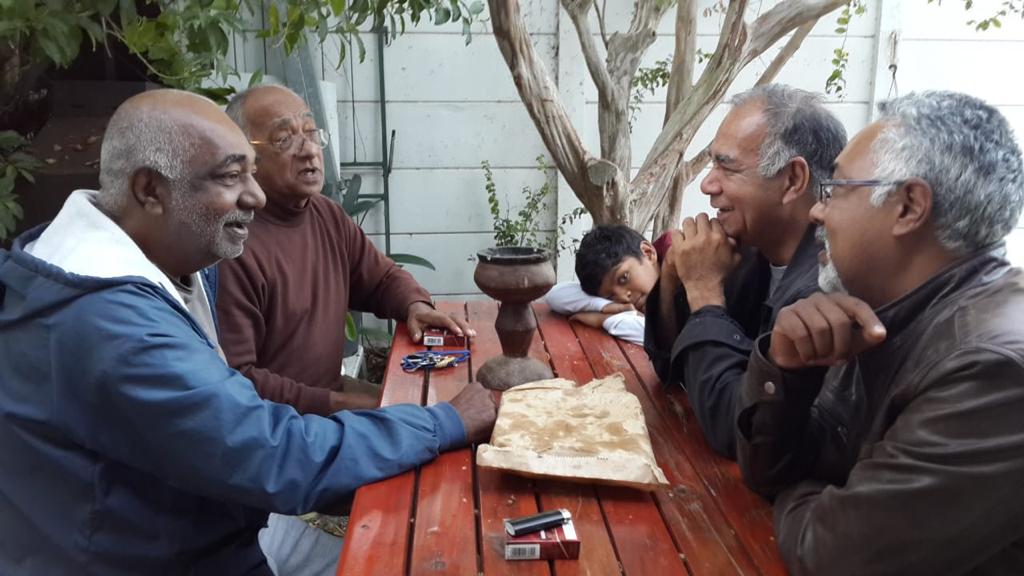
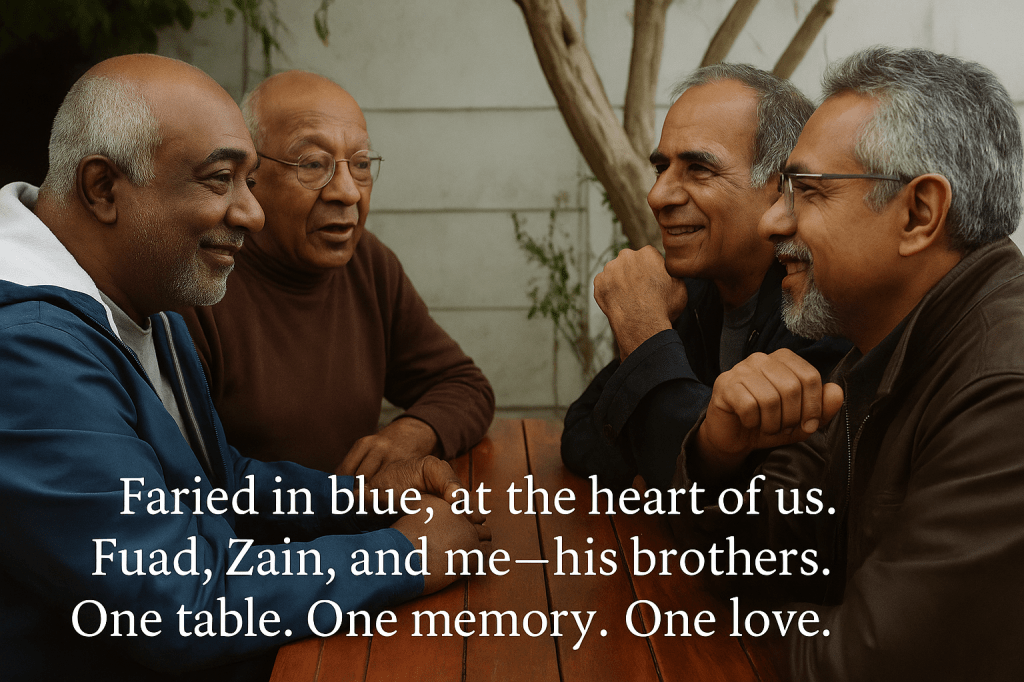
    Faried in blue, at the heart of us.
    Fuad, Zain, and me—his brothers.
    One table. One memory. One love.

    Your passing caught me off guard.
    I had planned to fly down to Groote Schuur Hospital—to hold your hand, to hear your familiar, half-teasing greeting:
    “This is nothing. How long are you staying? Will you be sleeping on our couch in the lounge?”
    But the doctors had already sedated you.
    And while we weren’t watching, you let go of my hand and slipped quietly into the next realm.
    I said my goodbye by placing my palm on your forehead, feeling your life force dissolve.

    The grief swept me away like a sudden tide.
    In that single, helpless moment, memories surged—those threads that bound us—flooding my chest in a merciless storm of emotion.
    Now, five days later, I’m still adrift, trying to gather pieces from the wreckage.
    Perhaps these fragments will steady me.

    You shaped my life profoundly—especially during my adolescence.
    With Dad growing older, it was you, along with your remarkable wife Zuleiga, who guided me through those uncertain years.
    During summer vacations, I was your clumsy teenage apprentice—sweeping up at building sites where you were foreman and supervisor.
    It was my job to scrub your and Dad’s boots clean, and to wash off the cement-caked tools of the trade.
    You were, in those days, both stern and kind—frightening and benign.

    One day, while we were building a factory, the owner’s son stormed onto the site, shouting insults at our father.
    Mid-rant, he suddenly found himself face-down in a wheelbarrow.
    You had knocked him out cold with a spade to the side of the head.
    You saw him for what he was: a racist, self-righteous prick—and an abusive employer.
    You never tolerated either.
    That moment stayed with me.
    Years later, when I joined the freedom struggle, I carried it like a compass.

    Of course, I wasn’t guided by you alone.
    I was blessed—loved by all our siblings, their partners, and their children.
    But your influence stood apart. Like your name, it was unique.
    You were, somehow, the rare blend of our mother’s blunt honesty and our father’s quiet grace.
    Your language was rough, your heart soft.
    It took us years to understand that your sharp tongue was often the symptom of undiagnosed, untreated diabetes—the same illness that eventually claimed you.

    Now that you can no longer protest, I’ll say it plainly:
    You were a terrible capitalist.
    You once ran a butchery in Mitchell’s Plain that failed—not from mismanagement, but because you kept giving the meat away.
    To struggling customers.
    To broke relatives.
    Later, in your construction business, you gave jobs to young family members who needed work, even when the books didn’t balance.
    When the business eventually closed, you had no regrets.
    The Qur’an speaks of such people, calling them “those who gave preference to others, even though poverty was their own lot.”

    Postnote

    Faried was the middle-child in our siblings—one of four brothers and three sisters.
    He passed away eight years ago, on the eighth day of Ramadan.
    He used to joke that he would be the one to bury Fuad, our eldest brother, since he was younger and expected to outlive him.
    But fate had other plans.
    We lost Fuad two years ago, and with him, another great pillar of our family.

    In our grief, we found strength in remembering Faried’s resilience, his unflinching kindness, and his deep sense of duty.
    His life remains for us a source of comfort, a touchstone of dignity, and a lesson in selfless love.

    Footnote:

    May Allah have mercy on his soul, inna lillahi wa inna ilayhi raji’un, and on the souls of all our departed—those who laughed with us at one table, and now dwell in the unseen.

  • Two Rivers

    Two Rivers

    cosmic-timetraveller
    Pic by Cosmic Timetraveller on Unsplash

    Two rivers descend from their mountain source
    Over the edge, barefoot towards their destinies
    One finds open horizons, free flowing courses
    The other, hidden beauty, silent testimony

    Two rivers race towards the shoreless ocean
    Boulders to pebbles, meandering their flow
    One becomes a city slicker in slow motion
    The other, to an ancient oasis it shall go

  • That Feeling When You Fly

    That Feeling When You Fly

    julia-revitt
    Pic by Julia Revitt on Unsplash

    The standing and the folding
    The proud amongst the humble
    The asking and the holding
    It all begins to crumble

    The open and the secret
    The silence and the noise
    The profane wrapped in sacred
    The quiet informs the voice

    The salute and the worship
    The body and the soul
    Resolute and with purpose
    Drink water from the bowl

    On the carpet, on the sand
    The wall behind the shroud
    How a seed becomes a plant
    While waiting for a cloud

    Invisible rain come pouring
    Securing every heart
    On the living, on the snoring
    Tearing everything apart

    Rivers run from higher ground
    From mountain to the valley
    The rider does not make a sound
    A moment she will tarry

    The opening and the closing
    The earth beneath the sky
    The poetry and the rhyming
    That feeling when you fly

  • Drawn

    Drawn

    Oscar Keys.jpg
    Pic: Oscar Keys on Unsplash

    I’m drawn to you
    Like a salmon
    Running upstream
    Risking all
    To return
    From where she began

    I yearn for you
    Like a sunflower
    Turns its face
    To follow
    A star
    Always out of reach

    I search for you
    Like a droplet
    Falling to earth
    Becoming stream
    Forever swimming
    To the sea

    [First published on Medium]