How empire sails in suits, and what it means to row in resistance.
🔰 Intro
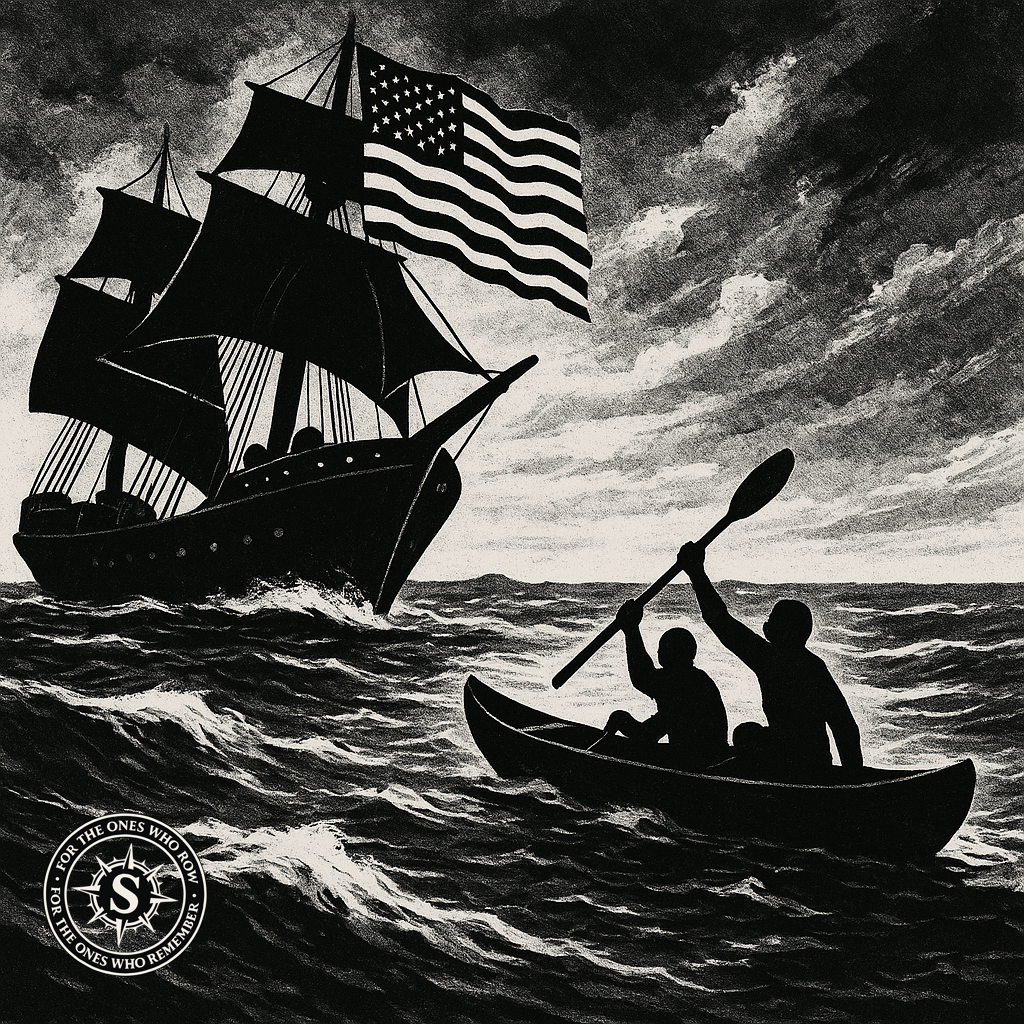
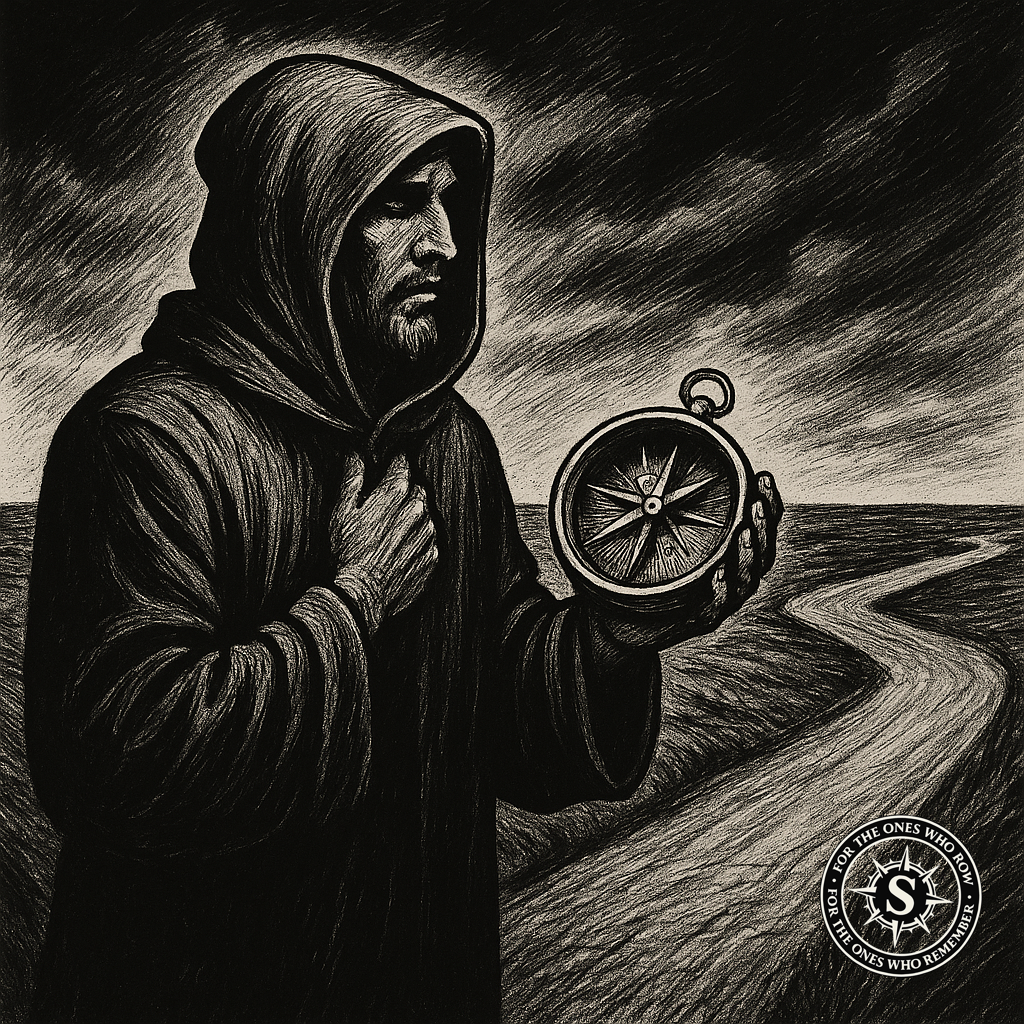
There was a time when pirates came with cutlasses and black flags. You saw them coming. You heard the war drums. But today — the pirates wear uniforms. Or suits. Or diplomatic smiles. And while their ships sail under the banner of freedom, the wake they leave is full of oil, fire, and broken nations.
This is a story about empire. But it’s also a story about you. About where you sit — above deck, below deck, or paddling in a canoe. It’s about resistance. Memory. And the unseen rows of angels above.
“The sea is full of flags — but not one lowers its sails in grief.”
They told us flags were symbols of freedom. They said democracy wears red, white, and blue. They taught us that when their soldiers arrive, the people are being saved.
But the flag flaps like a warning now. The stripes stretch across oceans. The stars are stamped on missiles. The anthem plays over drone strikes.
This isn’t peace. It’s piracy with better branding.
The United States isn’t a country anymore — it’s a flagship. The lead ship in a fleet of multinationals, financial institutions, media empires, and war machines.
It doesn’t sail for justice. It sails for lithium. For land. For leverage.
Its flag is the Jolly Roger of the modern age — not because it’s outlawed, but because it’s above the law. And while the old pirates hoisted black flags to strike fear, these ones wave their colours with pride… and call it diplomacy.
You see them dock in Gaza, in Haiti, in the Sahel. They don’t drop anchor — they drop sanctions. They don’t build bridges — they bulldoze economies. They leave schools shattered, mothers weeping, aquifers poisoned — and they call it freedom.
Even the boldest voices still need trade. Even South Africa, with its lawsuit and legacy, still knocks on the same doors. Because when the pirates run the ports, you have to smile as they loot.
Meanwhile, in Gaza, the killing continues. The children cry in Arabic, but no ship stops to help. The sea is full of flags, but not one lowers its sails in grief.
🏢 Section 2: The Pirates Have Offices Now
“You don’t need a coup when you can crash a currency.”
The pirates don’t need eye-patches anymore. They wear tailored suits. They don’t wave cutlasses — they carry clipboards. Their muskets have been replaced by metrics.
The modern pirate doesn’t kick down your door — he offers you a deal. An “investment.” A “development project.” A “partnership.”
But look closely: The lithium ends up in their electric cars. The water rights end up in their stock portfolios. The debt — always the debt — ends up around your children’s necks.
They’ve learned that you don’t need to invade a country if you can own its infrastructure. You don’t need to drop bombs if you can drop interest rates. You don’t need a coup when you can crash a currency.
BlackRock owns more land than many nations. Nestlé bottles water it didn’t pray for. Chevron calls oil sacred. Halliburton builds what the bombs destroy.
The empire privatized its violence. It outsourced the pillaging to companies with ethical mission statements. Its generals now wear CEO name tags. Its foot soldiers are analysts, consultants, lobbyists.
And when a country resists — like Bolivia, like Palestine, like Niger — it doesn’t get invaded at first. It gets discredited. Its leaders are called unstable. Its elections are called suspect. Its people are painted as dangerous, irrational, ungrateful.
This is how conquest works now: not with sails, but with spreadsheets. Not with warships, but with press releases. Not with swords — but with silence.
Somewhere, a young trade official — daughter of a struggle veteran — tries to resist. She sits in a Johannesburg office late at night, re-reading a contract with clauses meant to trap her people. She circles words in red. She drafts a softer version. She knows they won’t accept it. But still — she sends it.
🧠 Sidebar: They Stole the Thoughts Too
They didn’t just loot land and labour. They colonised knowledge. They broke open sacred libraries, and then wrote the footnotes in their own names.
The West calls it “intellectual property.” But it’s just patented plunder.
In Egypt, Plato sat at the feet of Black scholars. In Mali, the Dogon mapped the Sirius star system — long before telescopes. In South Asia, turmeric healed wounds before it had a bar code.
They burned the manuscripts of Timbuktu. Then they published “discoveries” about African medicine in European journals.
Today they say: “You owe us mobile phones.” But what they really mean is: “We branded what we stole.”
🛏 Section 3: Below Deck — The Ordinary Citizen
“The system is designed to keep the floor clean — even if the keel runs red.”
Empires aren’t only built by generals. They are built by people who go to work, come home tired, scroll a little, and sleep.
Below deck, life continues. The engines roar above, the orders are barked on the bridge — but here, the lighting is soft. There are supermarkets, streaming shows, lawnmowers, coffee shops.
No one hears the groans of the drowned. No one smells the smoke from the burning village.
Maybe they see something on the news — Gaza, Congo, Yemen. Maybe they feel a flicker of sorrow. Maybe not.
The comfort below deck is that you don’t have to know. The noise is muffled. The suffering is pixelated. The system is designed to keep the floor clean — even if the keel runs red.
And when someone does knock on the cabin door — a refugee, a witness, a protester — the citizens flinch. Not because they’re evil. But because it’s awkward. Disruptive. A crack in the illusion.
You see, this ship sells a story: “We are good.” “We bring freedom.” “We are the world’s hope.”
It’s a story whispered through education, hummed in entertainment, declared in politics. And most below deck believe it. Or want to. Or at least, want not to think about it too much.
One evening, a man in the suburbs clicks on a video about Gaza. He watches for seventeen seconds before an ad plays. He sighs. Skips it. Opens another tab. A special on air fryers. The horror slips away — not because he’s cruel, but because the system makes forgetting so easy.
Dissent is dulled with subscription bundles. A hundred shows to choose from. None of them about Palestine. And if that fails, there’s always a pill. A holiday. A hashtag that ends by Monday.
Because thinking leads to questions. And questions lead to guilt. And guilt demands action. And action? That rocks the boat.
🛶 Section 4: Canoes and Resistance
“These boats do not always win. But they do not drown quietly.”
Not every vessel sails under the pirate’s flag. Some float with patched sails and broken oars. They are small. Often sinking. But they do not bow.
They are the canoes of the world. Gaza, battered and besieged, still sings the Adhān through rubble. Haiti, dismembered by decades of debt and interference, still cooks its own rice. Congo, bleeding from every open vein of mineral wealth, still births drums and poems.
These are not nations that invade. They don’t fly drones or send tanks. They row.
And every stroke is resistance. Every preserved language, every intact culture, every refused bribe — resistance.
They are mocked for being poor. Starved for being proud. Punished for surviving.
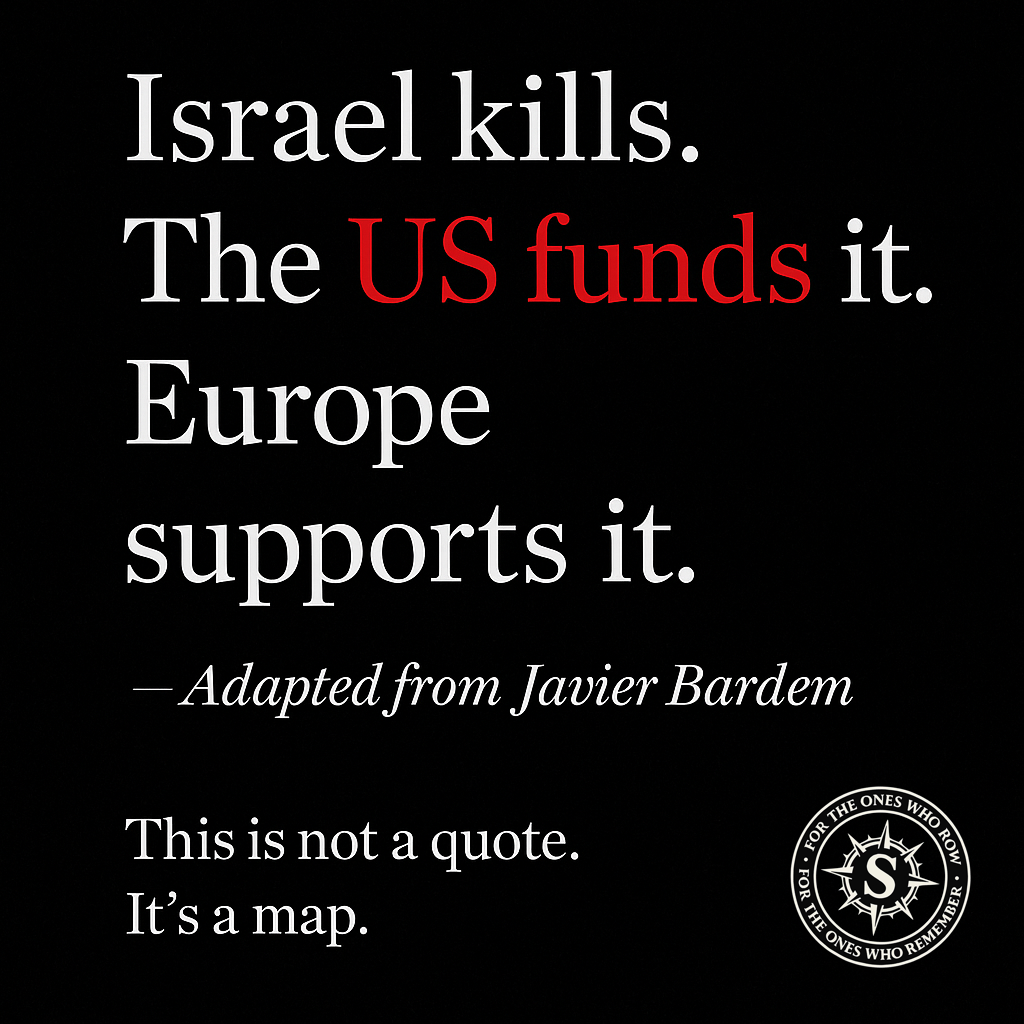
Some truths no longer need footnotes. As the Spanish actor Javier Bardem once said, bluntly and beautifully: “Israel kills. The US funds it. And Europe supports it.”
That’s not politics. That’s a map. A map of complicity. A map of whose silence lets the ship sail on.
The empire calls them unstable. Calls their leaders corrupt. Calls their children threats. But what they fear is not chaos — it’s clarity.
Because the canoe does not pretend. It knows the sea is dangerous. It knows what the pirate ship is.
And still, it rows.
Some canoes are communities. Some are movements. Some are just one grandmother who still tells the old stories — even as the bulldozers arrive.
Some of the canoes ride rivers: the Amazon, the Orange, the Missouri. In them sit the Mapuche, the Nama, the Sioux. They chant in languages the empire once tried to burn. They still paddle. They still protect.
As the bombs fall, a boy in Gaza recites lines from Mahmoud Darwish: “We have on this earth what makes life worth living.” He whispers them into the dust. Into his mother’s lap. It’s not defiance. It’s remembering.
These boats do not always win. But they do not drown quietly. Their resistance echoes — in funeral processions, in ululations, in the smell of fresh bread rising where bombs fell.
And in the far distance, something stirs. Not a boat. Not a bomb. But a wave. A rising swell of memory and reckoning. The kind that even empires cannot out-sail.
❓ Section 5: What Now?
“Maybe you can’t leave yet. But you can plant questions in the cracks of the hull.”
You’ve seen the ship. You’ve heard the cannons. You’ve walked the quiet corridors below deck. You’ve watched the canoes struggle to stay afloat.
So now the question is simple. What now?
You don’t have to be a general. You don’t have to command a fleet. But you do have choices.
You can choose not to cheer when the ship fires. You can choose not to believe the stories they sell you — about the savages, the chaos, the necessary war.
You can choose not to mock the canoe. You can choose to listen when the drowned call out from beneath the waves. You can learn their names. Say their prayers. Tell their stories.
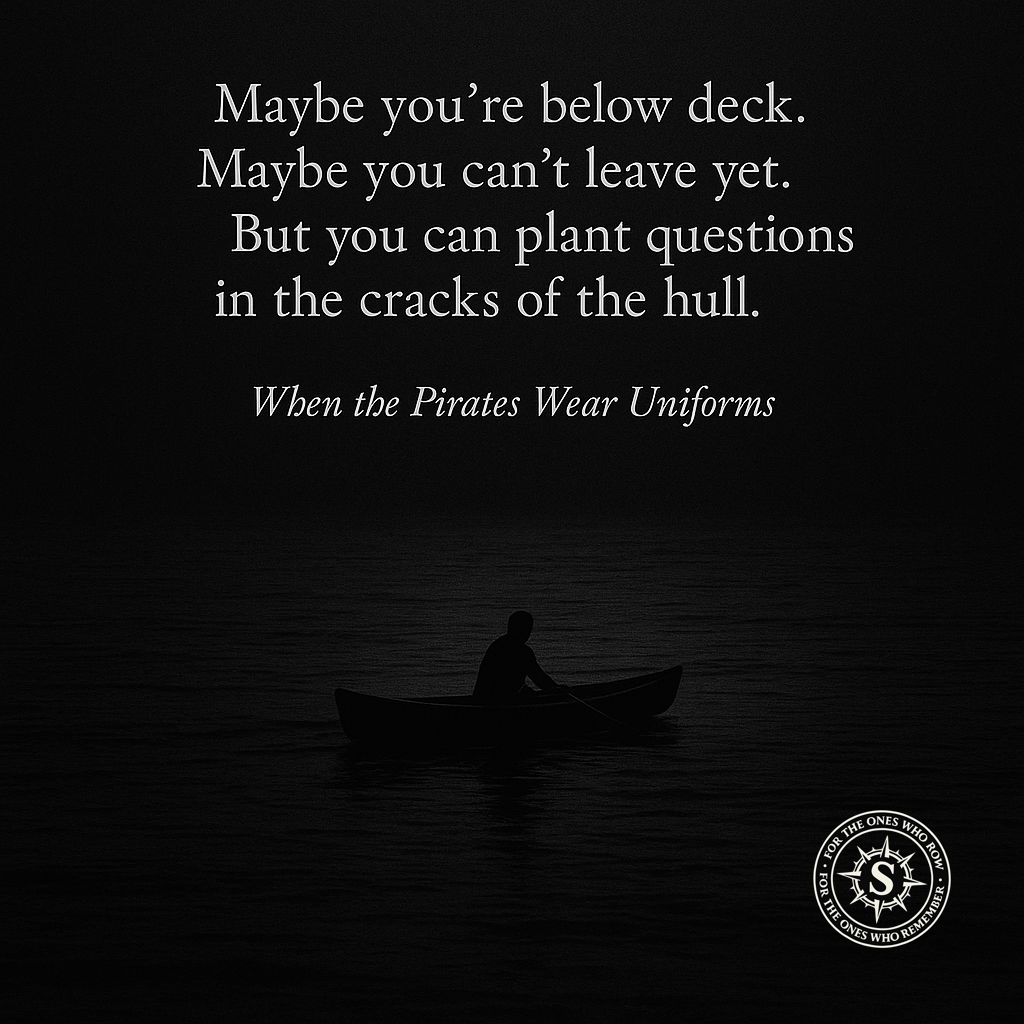
Maybe you’re below deck. Maybe you can’t leave yet. But you can plant questions like seeds in the cracks of the hull. You can make art that aches. You can whisper, even if your voice shakes.
And maybe, one day, when the ship hits a reef — you’ll already know how to swim.
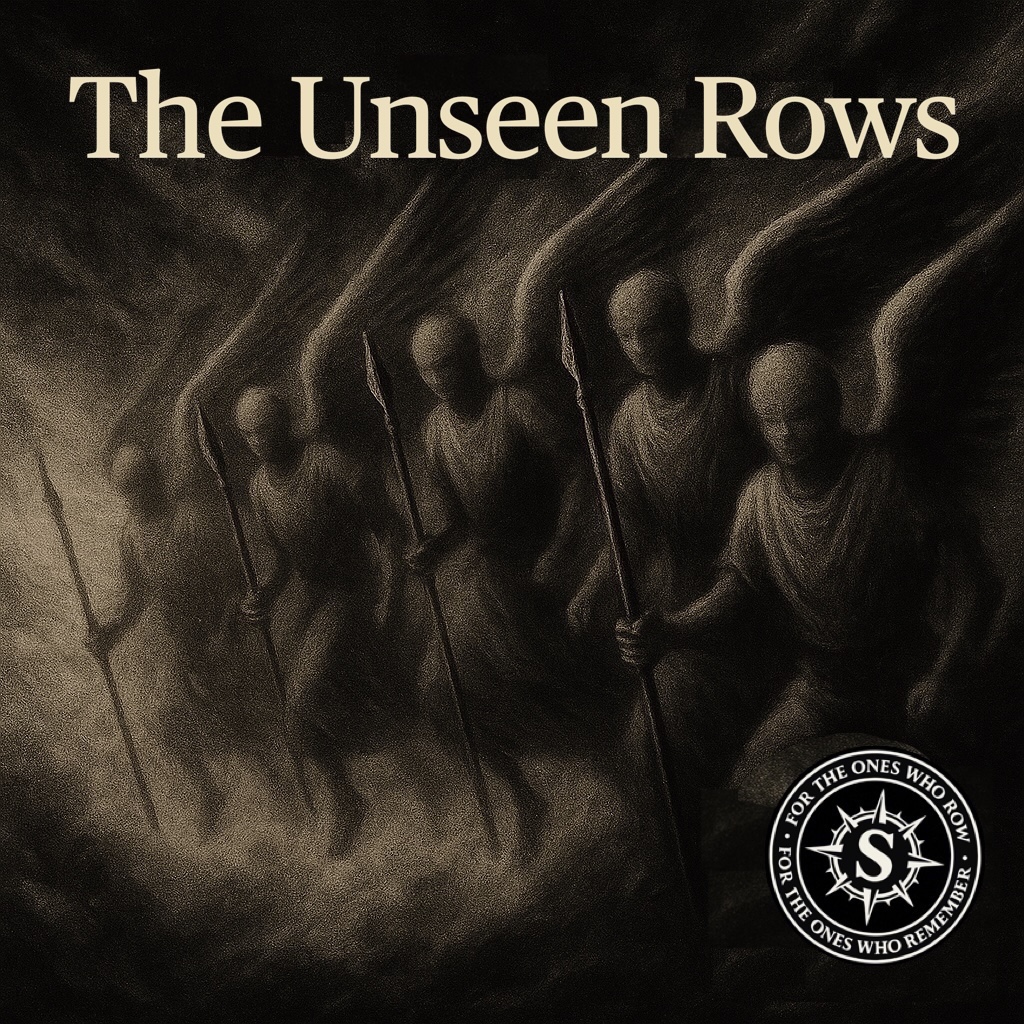
🌌 Postscript: The Unseen Rows
“Above the pirate ships, the angels line up.”
For the ones who row. For the ones who remember.
Above the shipping lanes and air raids, above the pirate flags and surveillance drones, above the offices and engines and war rooms — there are rows they do not see.
Al-Ṣāffāt. “By those arrayed in rows…” (Qur’ān 37:1) The angels. Not scattered. Not confused. Lined up — like soldiers of mercy. Advancing — like winds of truth. Reciting — not data, but dhikr.
وَالصَّافَّاتِ صَفًّا فَالزَّاجِرَاتِ زَجْرًا فَالتَّالِيَاتِ ذِكْرًا By those arrayed in ranks, by those who drive forward, and by those who recite the Reminder… (Qur’ān 37:1–3)
These are not symbols. They are not myths. They are the architecture of heaven. And they do not forget the ones who row.
When the shayāṭīn of power rise to steal, when the liars reach for whispers of the unseen, they are met with stones of fire. Comets hurled from truth’s edge. The skies are not neutral. The divine has guardians.
“They cannot listen to the Higher Assembly… they are pelted from every side, repelled, and for them is a perpetual punishment.” (Qur’ān 37:8–9)
And we? We row. We remember. We recite.
We do not carry cannons — but we carry verses. We are not in fleets — but we are not alone. Somewhere, angels are already in formation.
✨ A Final Word from Rafiq al-Bunduqia
The Sage on the Jetty
So here’s what I say, ne:
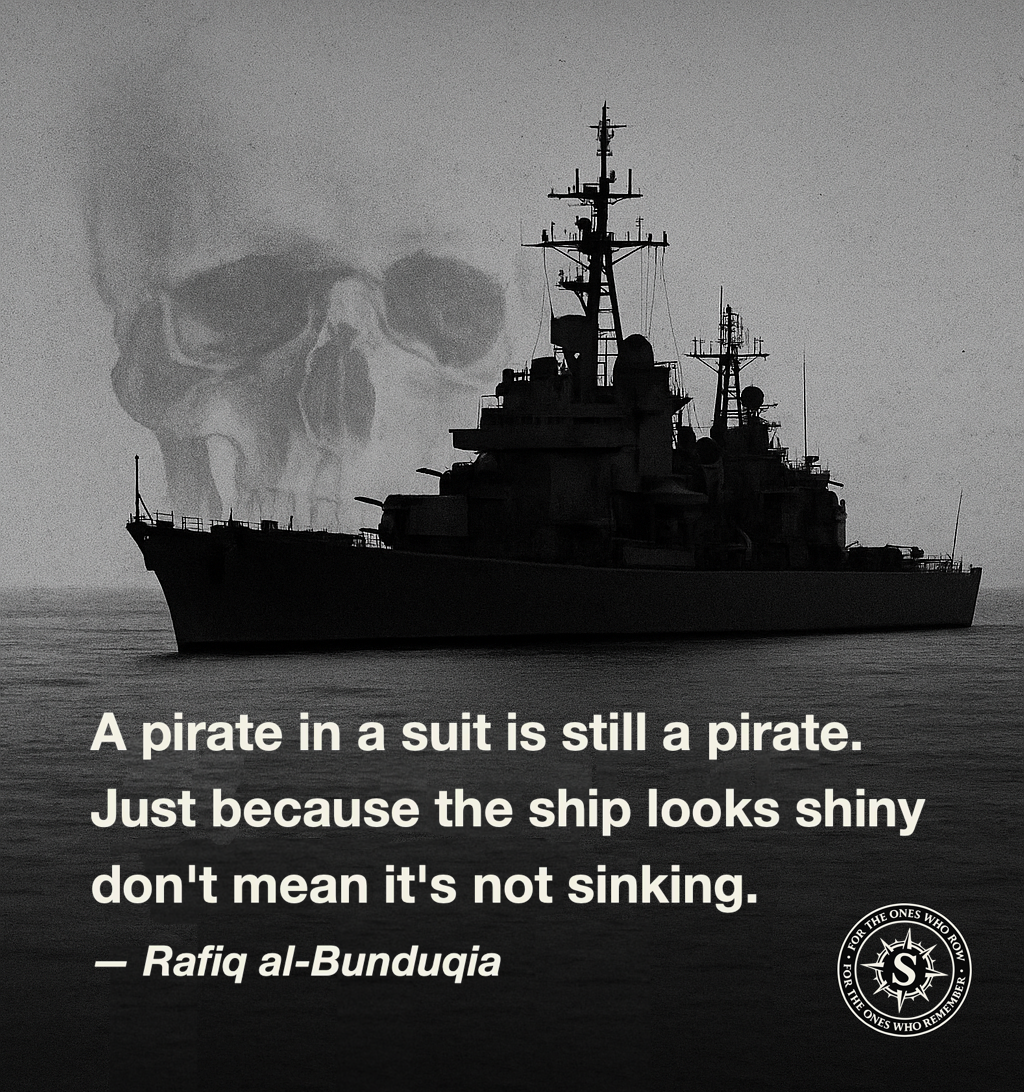
Don’t let them fool you with fancy uniforms and offshore accents. A pirate in a suit is still a pirate. And just because the ship looks shiny don’t mean it’s not sinking.
Me, I seen this before. The old flags change — but the hunger stays the same. They used to come for your gold. Now they come for your soul — and your SIM card.
They sell you peace while sharpening knives. Call it “stability,” call it “the market,” call it “regime change.” But listen close, my bru — they only change regimes that say “no.”
Below deck, I know some of you are tired. I know some of you feel small, feel stuck. But remember: Empires fall when enough people stop pretending.
You can’t steer the whole ship, but you can stop rowing. You can stop clapping for the captain. You can light a fire in your corner. And when the time comes — you’ll know which way to swim.
And as for the ones still paddling in canoes? Rowing against the wave, barefoot, hungry, heart full?
May your names be written on the wind. May your stories outlast the storm. And may your grandchildren sail free.
shotgun click
We ride till the ship breaks, bru. Until then — we don’t hand over our compass.
“Salaam to the angels who line up when we can’t. Salaam to the ones who row even with leaking boats. Salaam to the ones who still make dhikr in the dark.
And to the empire?
May you one day see what light you tried to drown.”
Ameen, and ashraaf ʿalaikum ya ṣaffāt.
The seal of remembrance — for the ones who row, and the ones who remember.
— Rafiq al-Bunduqia, The Sage on the Jetty 🧭
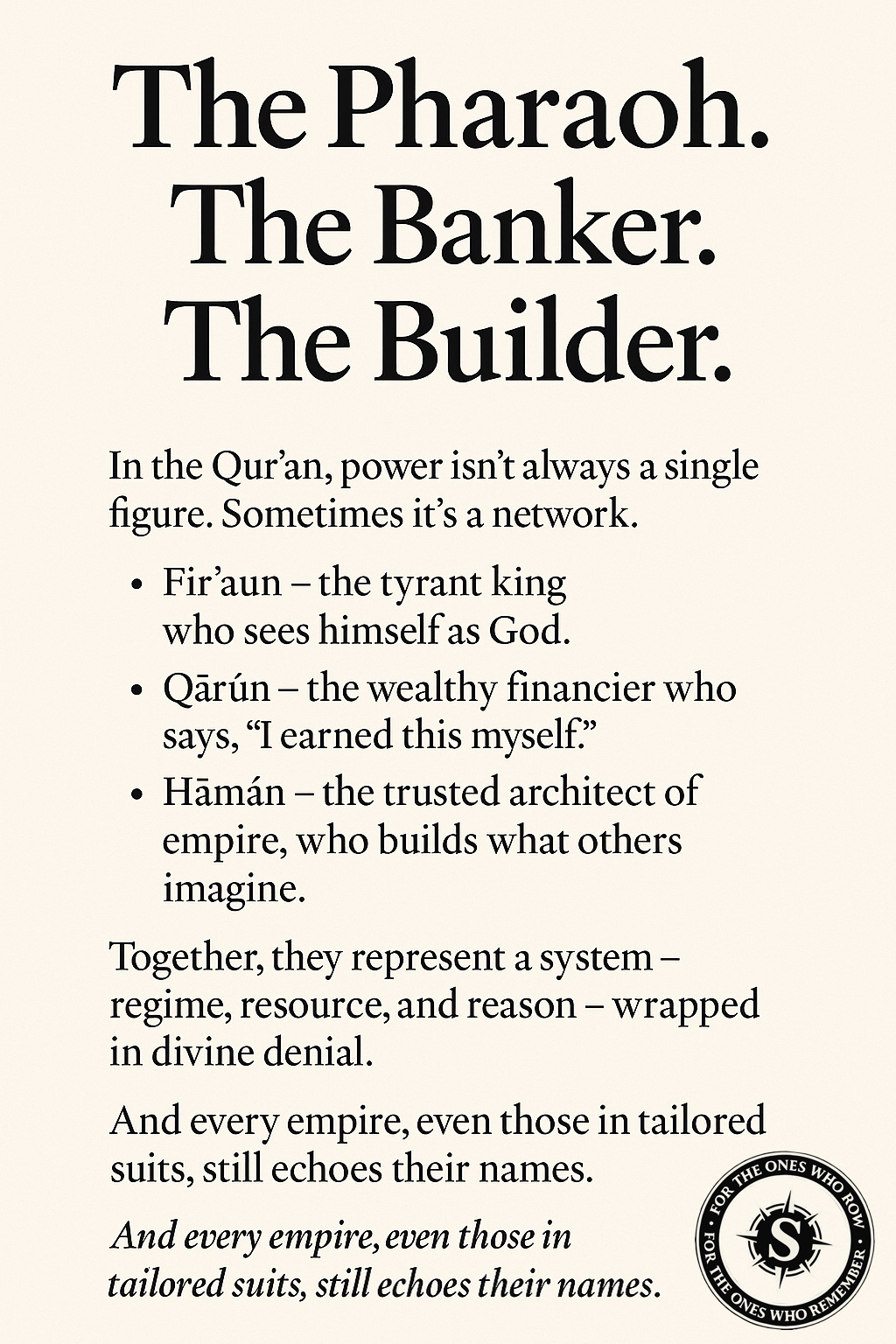
“The Pharaoh. The Banker. The Builder.”
📜 Sidebar: The Three Faces of Tyranny Fir‘awn. Qārūn. Hāmān. These three figures appear repeatedly in the Qur’an — not just as villains of the past, but as types that recur across history. Fir‘awn: the dictator, the political oppressor. He claims divinity, demands obedience, and divides people to rule them. Qārūn: the hoarder, the economic elite. He flaunts his wealth, credits no one but himself, and forgets the source of all provision. Hāmān: the enabler, the bureaucrat and ideologue. He builds towers, writes the laws, manipulates truth, and justifies oppression in the name of order. Together, they form a system: the empire that marches with a flag in one hand, a contract in the other, and blood on its boots. Sound familiar?
“Today, they wear suits. They weaponise policy. But the triad still walks among us.”
The Pharaoh, the Banker, and the Builder
In the Qur’an, they stand together — a tyrant, a financier, and a master of infrastructure. Firʿawn ruled with cruelty. Qārūn hoarded with pride. Hāmān built towers for lies.
Centuries later, the empire shapeshifts. Today, they wear tailored suits. They pass laws. They sign cheques. They pave roads to ruin.
But remembrance makes them visible. And visibility is resistance.
“The Pharaoh. The Banker. The Builder.”
🧭 Parting Compass — A Note from Rafiq al-Bunduqia
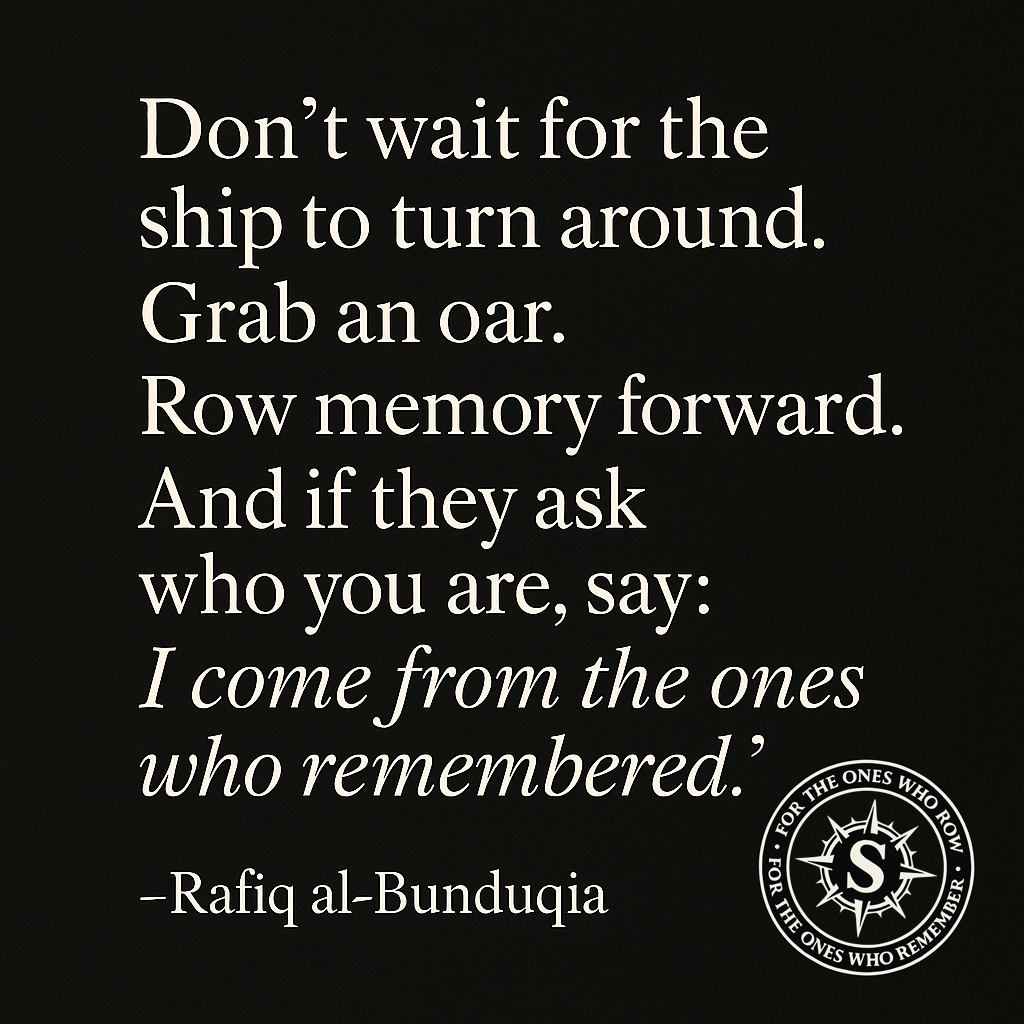
Don’t wait for the ship to turn around. Grab an oar. Row memory forward. And if they ask who you are, say: I come from the ones who remembered.
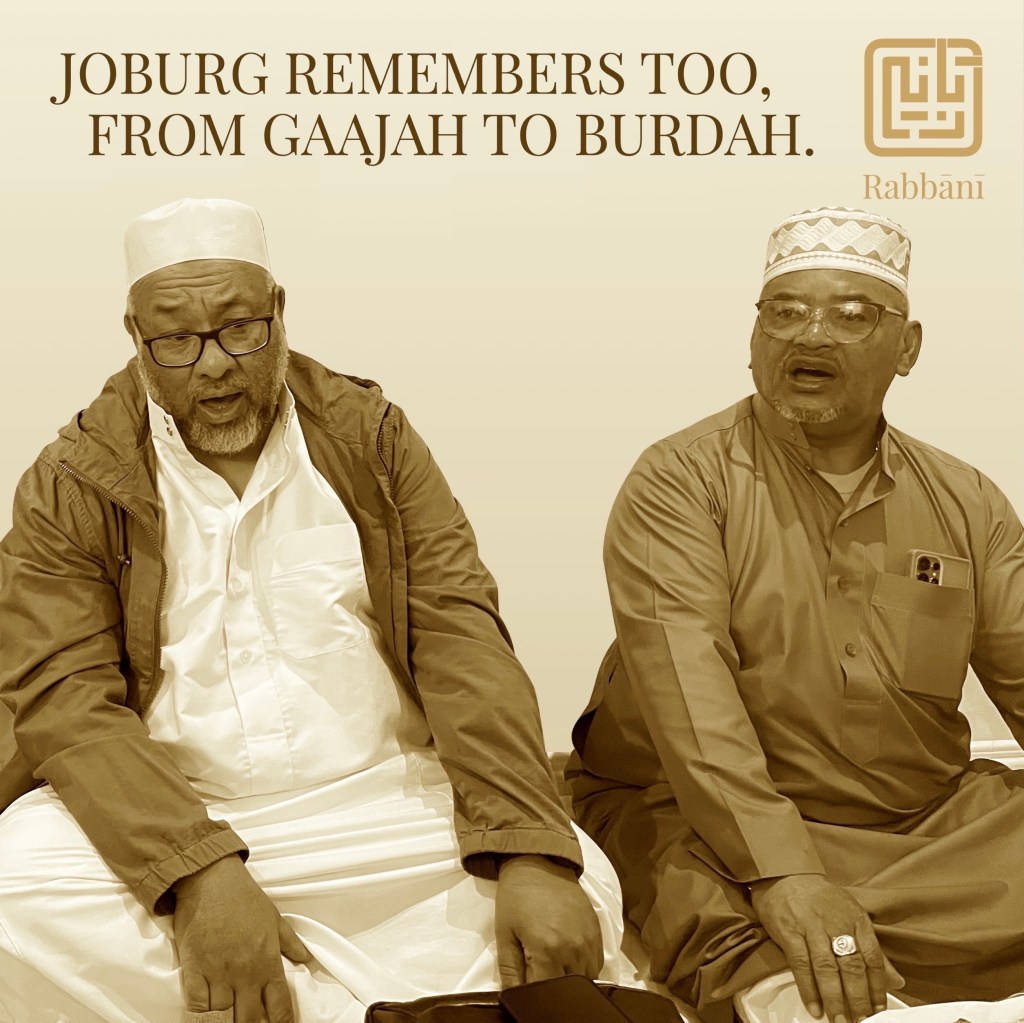
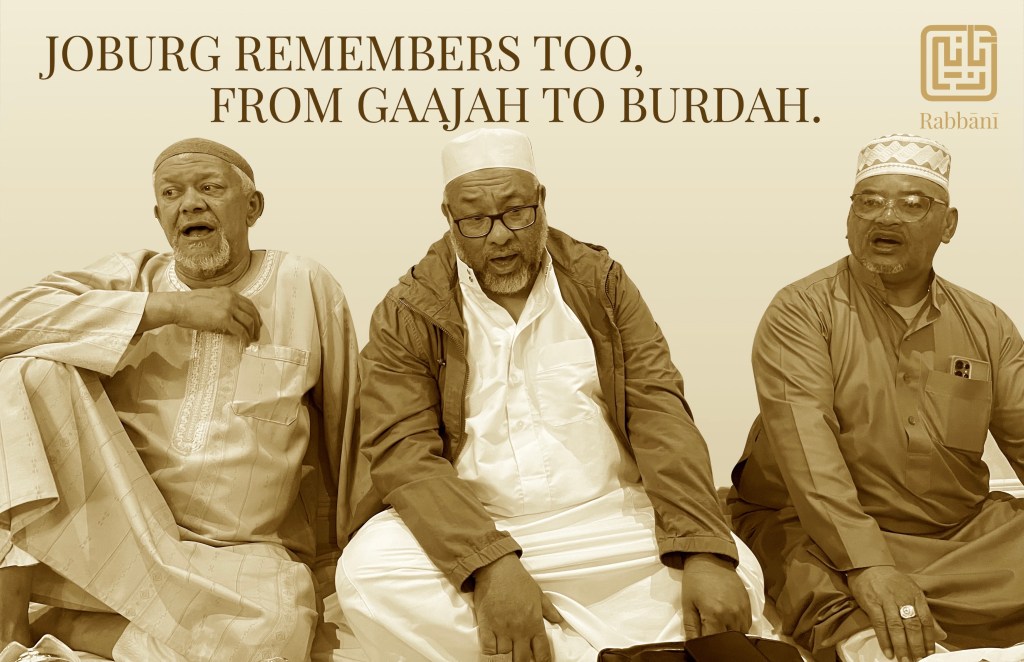
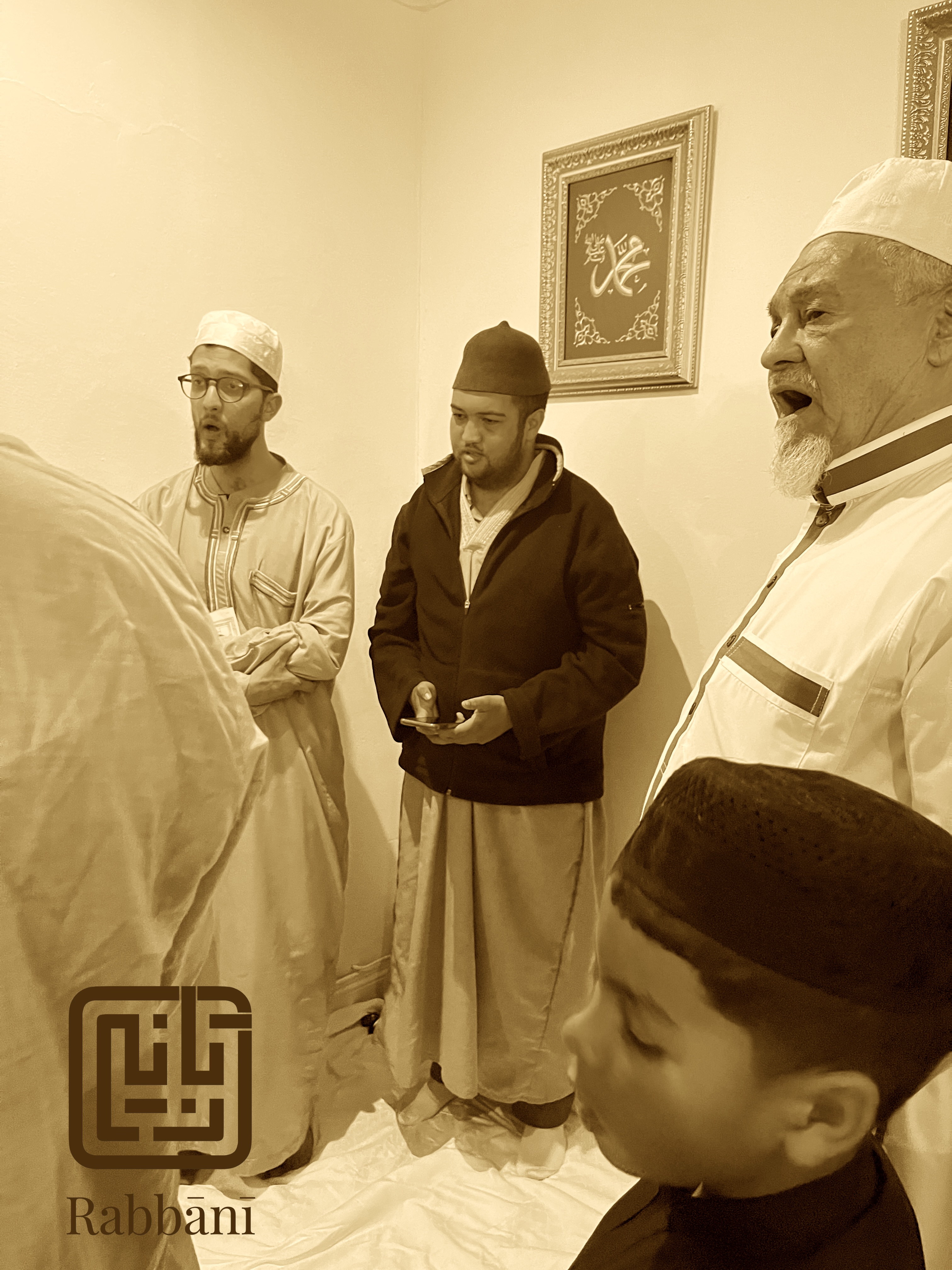
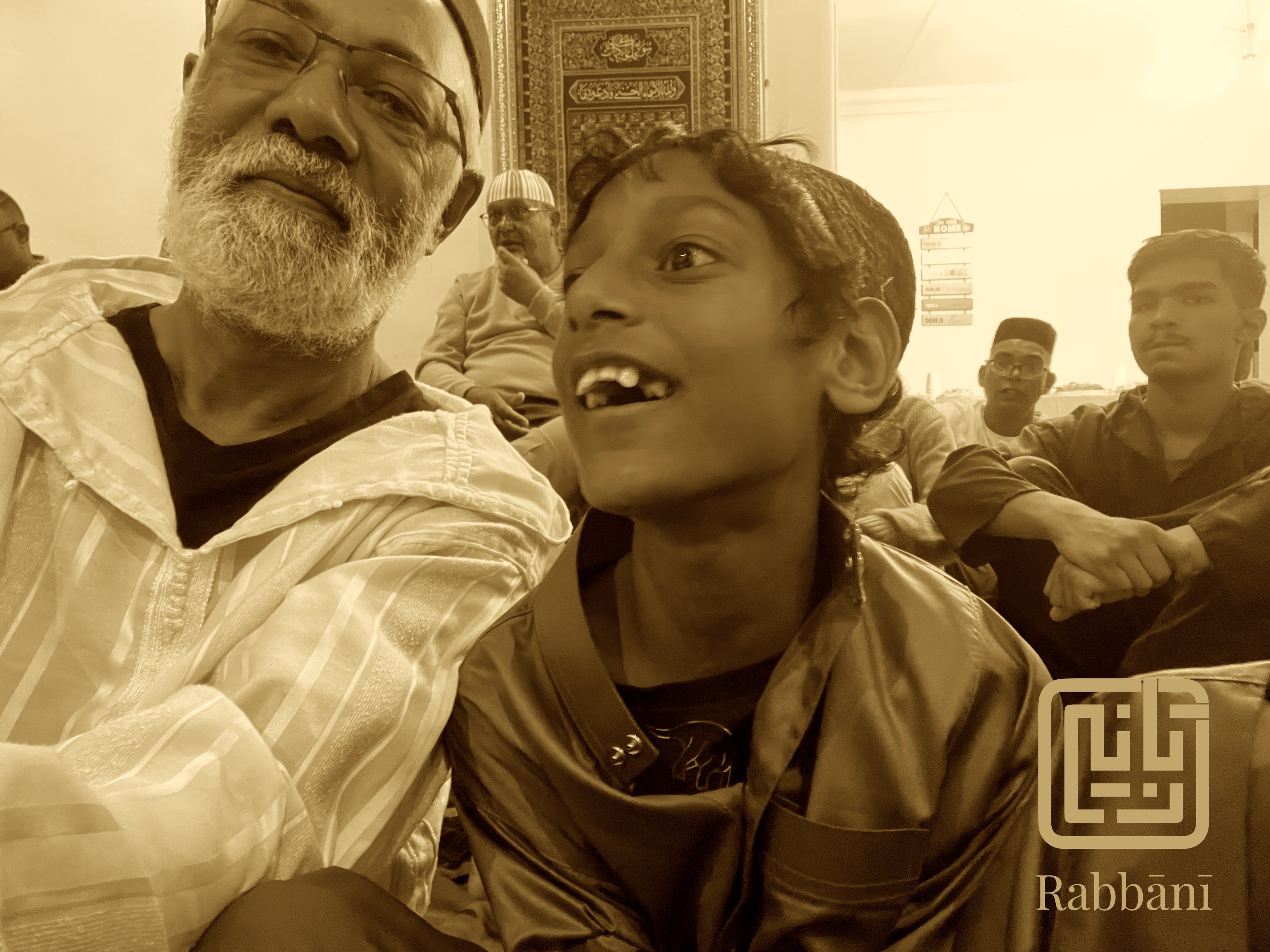
The room was warm with family and remembrance. Qur’ans lay open, voices moving together through Yāsīn, Mulk, the Quls, verses of Ḥashr and Baqara. Then came the Asmāʾ al-Ḥusnā, dhikr in chorus, and a duʿā that softened every heart.
It was called an Arwaag, but as my friend Shakeel Garda reminded me, this was really a Gaajah — from ḥājah, a need. That night the “need” was joy: the birthdays of two young daughters, celebrated with Qur’an and remembrance. In Cape Town, we are used to dhikr circling grief, but here in Joburg, it circled life — proof that dhikr belongs to both birth and remembrance.
Beyond Cape Town
Too often, Cape Town is imagined as the sole custodian of these traditions. But remembrance does not belong to one city. It lives in Worcester, in Uitenhage, in Kimberley, in Joburg — wherever Muslims have gathered to cut rampies, to recite Yā Sīn, to raise salawāt. We must widen the circle, and not let heritage shrink into a single accent or postcode.
Heritage isn’t measured by the size of a crowd, but by the pulse that refuses to stop.
A Wider Map of Memory
I laughed when Shakeel said, “Ek het amper gesamba!” — because sometimes the subtle linkages do astound us.
On language and dialect, PE-born Boeta Yusie – remembers how it felt when hearing old Uitenhage folk speak their Afrikaans, slower than usual, every word taking time to land.
And here in Joburg too, the old families — the Matthews, the Domingos, the Sallies among so many others — have carried remembrance for generations. Some, like the Sallies, trace ties to Port Elizabeth, but all became founding Johannesburg families in their own right.
In Florida North, during the Gaajah, we stood for the salawāt — the Cape inheritance. Voices rose, and in that standing it felt as if the light of Muhammad ﷺ entered the room.
Heritage does not have one accent, one city, one rhythm. It stretches wider — across towns and valleys, across languages and lineages — carried in every echo of lā ilāha illa’Llāh.
Houghton Masjid – The Chorus of the Burdah
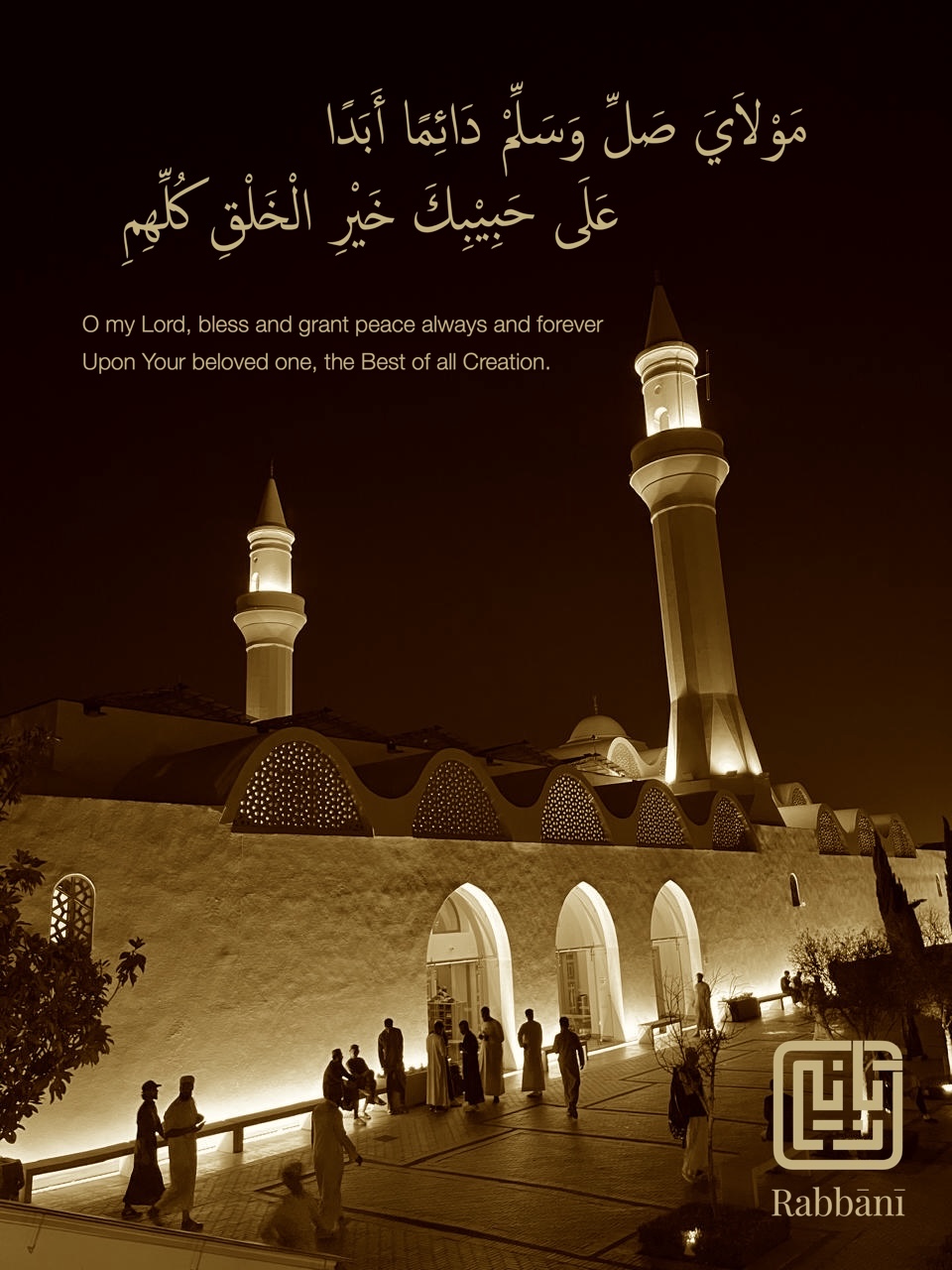
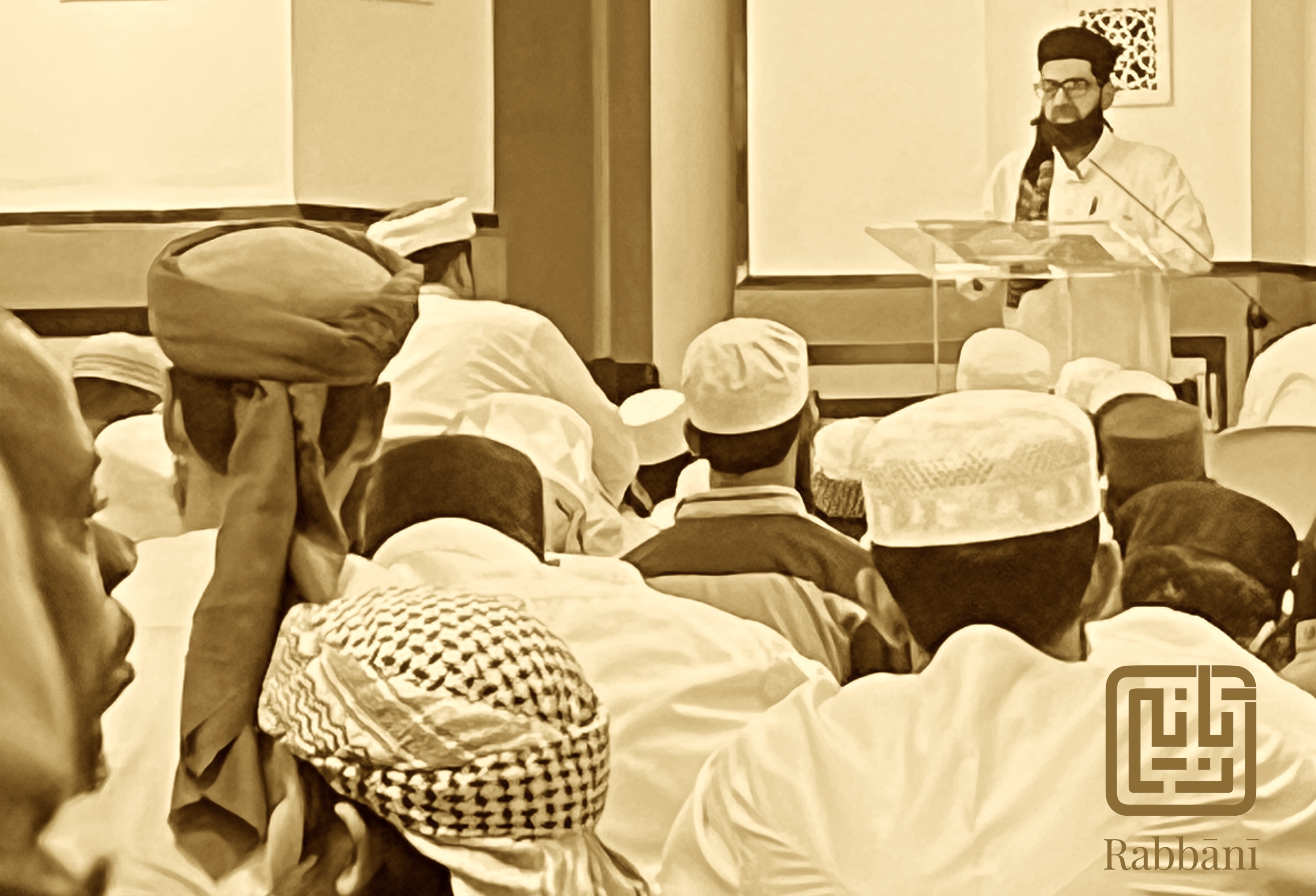
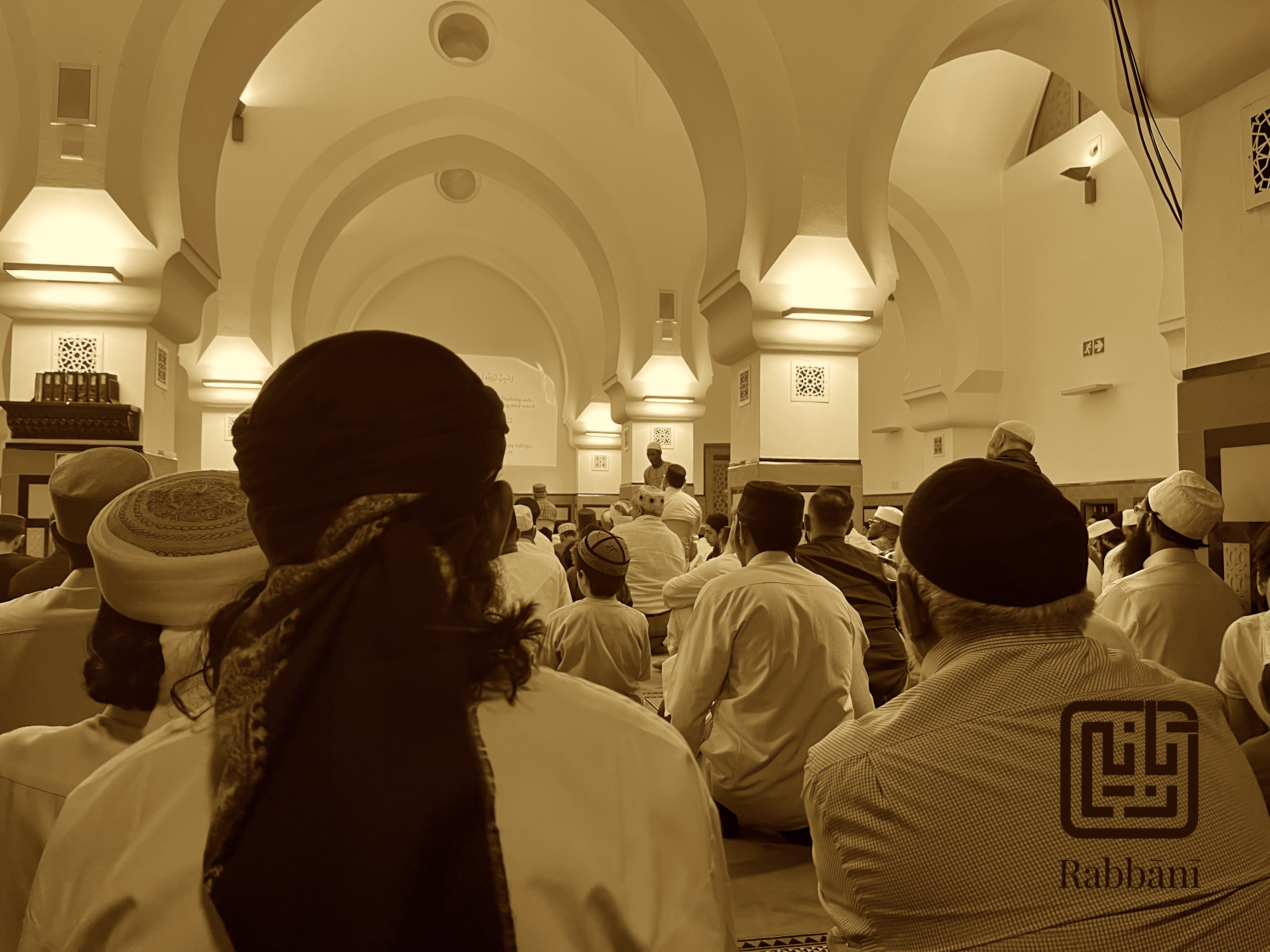
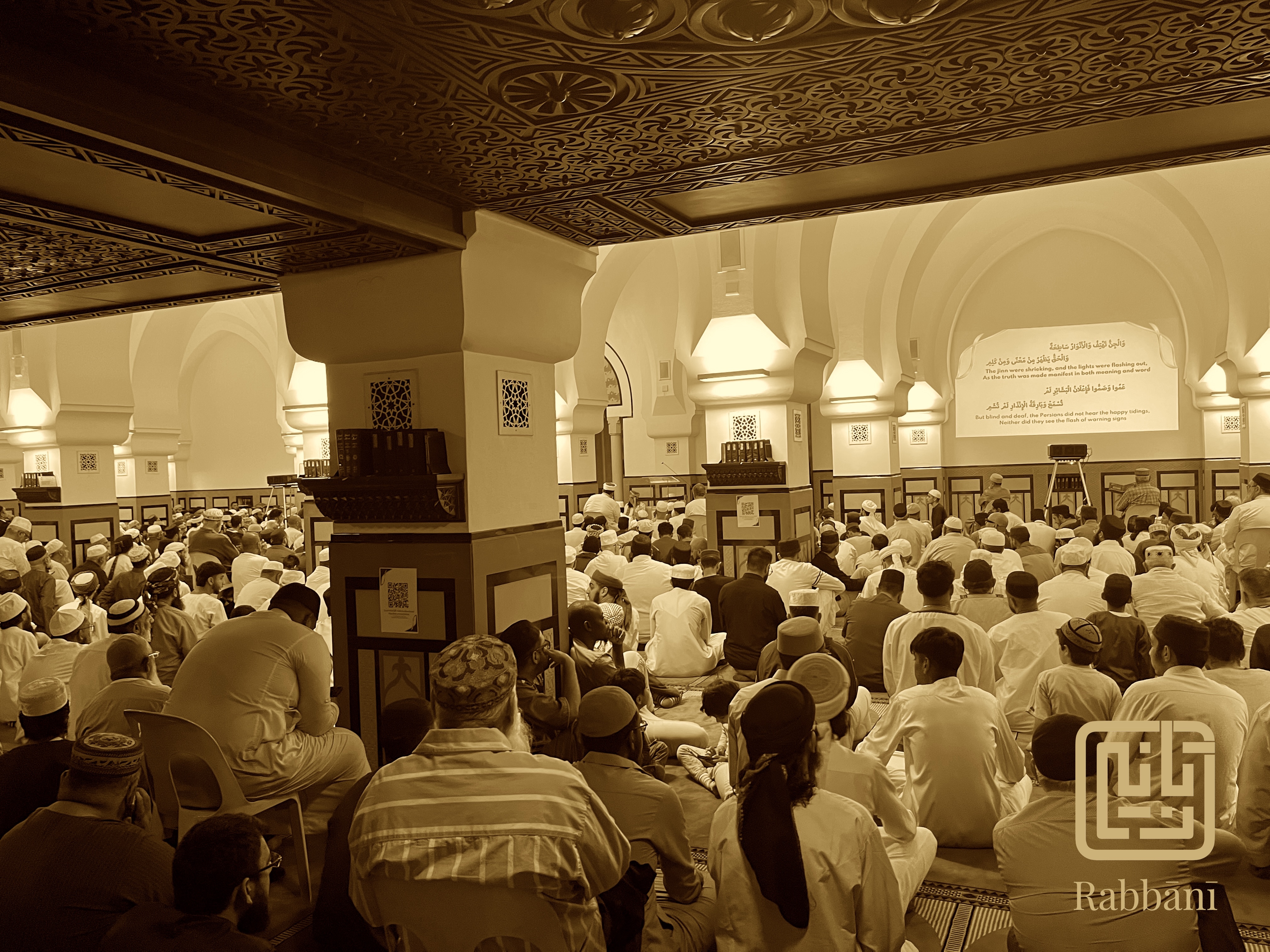
Friday night at Houghton Mosque was a different scale. The mosque was full: elders in white, young men with turbans, children by their fathers’ sides. Groups from different mosques took their turns, each with its own melody and rhythm.
Later my daughter Lala asked me, “What is this story of the Burdah? I’ve never heard this before.” I told her: “This is pure poetry! Almost like the Riwayah — the Prophet’s ﷺ life in song. But here, in the Burdah, different groups recite in turn, and together they weave a chorus.”
When I arrived at Houghton Mosque, I noticed something new. On the poster it had said: “Ladies Facilities Available.”Inside, the organisers had placed a new screen, expanding the women’s section for those who wanted to attend. It was unusual — there is already a women’s section — but this night, they anticipated more women. They made space.
That small act struck me as part of the remembrance itself: a recognition that devotion lives in inclusivity, in the care we show each other when we gather.
Before each group began, Ml Abu Hurairah Bobat guided the gathering, introducing the chapters and themes of the Qasidah Burdah. With warmth and clarity, he explained how the verses moved from praise of the Prophet ﷺ’s birth, to his struggles, to his intercession. His words opened the door for those less familiar, making the Burdah not just recited, but understood.
And then came the moment that will stay with me: as each group finished its verses, the entire jamaat — young and old — spontaneously joined in the chorus:
O my Lord, bless and grant peace always and forever Upon Your beloved one, the Best of all Creation.
It was not performance but inheritance. The refrain rose again and again until it felt as though the very walls of Houghton Mosque were singing with us.
The Lion and the Fortress
From the Qasidah Burdah, Imām al-Būṣīrī sings of the strength carried by those tied to the Prophet ﷺ:
Those whose help comes from the Messenger of Allah — Even lions encountering them in their dens would be struck speechless with fear.
He established his community within the fortress of his religion, As the lion settles down with its cubs in its lair.
Hearing the jamaat echo the chorus, I felt that same fortress. This was not nostalgia — it was strength and mercy alive in Johannesburg.
Fragrance and Victory
Later, another passage rang true to what I saw and smelled:
The winds of victory would present to you their fragrance, So that you imagine each valiant one of them to be a beautiful flower in bud.
As if, riding their steeds, they were flowers blooming upon a height, Held there not by the tautness of their saddles, but by the firmness of their resolution.
The Burdah does not only narrate victory — it perfumes it. Just as our Cape homes once scented with sandalwood and rampies, so here the fragrance of victory was carried in chorus.
Majestic Presence
And in the majesty of the Prophet ﷺ, the Burdah declares:
Like a flower in freshness and a full moon in eminence, Like an ocean in pure generosity and like time itself in strength of resolution.
Just from his majestic bearing, even when he was alone, He seemed as if amongst a great army and entourage.
At Houghton there was no standing qiyām — the tradition differs from the Cape. But the chorus of Mawlaya ṣalli wa sallim… still lifted the gathering, as if the walls themselves joined in remembrance.
Dress and Identity – From Kurta to Thobe
As I looked around, I noticed another change. When I was younger, men in Joburg mosques wore kurtas — Indian style. Now the children, young men, and elders were dressed in thobes and turbans, a celebration of the Prophet’s ﷺ attire.
Was it the influence of hajj and ʿumrah, Gulf media, or the aspiration to be closer to sunnah? Perhaps all of these. Styles shift, but the devotion remains.
Closing – Joburg Remembers Too
This Rabiʿ al-Awwal, in Heritage Month, Joburg reminded me that Cape Town does not own memory. Dhikr lives here too — in family homes, in gaajahs for birthdays, in mosques filled with Burdah echoes.
Heritage is not just remembrance, it is continuity. Not only in books, but in chorus. Not only in Cape Town, but in Joburg.
The Prophet ﷺ is in our veins and in our graves. In sandalwood tasbihs, in rampies leaves, in choruses that rise like fragrance. Remembered not only in words, but in song.
Every Rabiʿ al-Awwal, Cape Town breathes differently. The air is heavy with sandalwood smoke, the sny of rampies, the melody of the Riwayat al-Barzanji. Children once practised their lagu at home, correcting one another — because to sing the Prophet ﷺ was to sing him beautifully. Even cutting lemon leaves became dhikr.
This is Cape devotion: love woven into scent, sound, and preparation. It was never by chance. Preparation itself was worship.
The Beauty of Riwāyah
The Arabic word riwāyah (رِوَايَة) means narration. But in the Cape it became more: the sung retelling of the Prophet’s ﷺ life.
Imām Jaʿfar al-Barzanji (d. 1763), Chief Mufti of Madinah and a Kurd from Barzan, composed ʿIqd al-Jawāhir (The Necklace of Jewels). Written in rhythmic prose and poetry, it tells the noble birth and qualities of the Prophet ﷺ. From Madinah it travelled to East Africa, Southeast Asia, and the Cape, where it became the heartbeat of Mawlud gatherings — always with sandalwood burning, rampies cut, and voices rising in lagu.
How beautiful is thy face, Shining brighter than the sun. This night is lit by your light — A night of joy, a day of pride. The givers of glad tidings cried out: “The Chosen One, the Beloved, has come — rejoice!“
From Barzan to Jerusalem to the Cape
The same Kurdish soil that gave us Barzanji also gave us Ṣalāḥuddīn al-Ayyūbī (Saladin) — the liberator of Jerusalem in 1187. One carried the pen of devotion, the other the sword of justice.
🌿 The Cape inherited both: singing the riwāyah with love, and resisting injustice with courage. Devotion is never only ritual — it is also justice.
Mawlud and the Question of Evidence
Every year, voices say: “Mawlud is bidʿah. It is ḥarām.” But as Shaykh Allie Khalfe reminds us, declaring something ḥarām requires qatʿī (decisive) proof in both chain (thubūt) and meaning (dalālah). No such text exists.
Instead, the Qur’an itself honours prophetic birthdays:
“Peace be upon him the day he was born” (Q 19:15) — Yaḥyā.
“Peace be upon me the day I was born” (Q 19:33) — ʿĪsā.
The Prophet ﷺ also endorsed gratitude for sacred days. When the Jews fasted to commemorate Musa’s deliverance, he said: “We have more right to Musa than you” — and he fasted (Bukhārī, Muslim).
If deliverance is worthy of commemoration, how much more the birth of Muhammad ﷺ, mercy to the worlds (Q 21:107).
Graves, Memory, and Reverence
Some argue: “Level the graves.” They quote hadith forbidding plastering or building on tombs. But the Qur’an records that when the People of the Cave were discovered, those who prevailed said: “We will surely build a masjid over them”(Q 18:21).
Our sacred sites confirm this:
The Hijr Ismāʿīl beside the Kaʿbah contains the graves of Hājar and Ismāʿīl.
Masjid Nabawī encloses the Prophet ﷺ, Abū Bakr, and ʿUmar.
The Cape’s kramats — Tuang Yusuf, Tuang Guru, Tuang Mahmud — stand as circles of remembrance.
These are not shirk but reverence, places of memory and duʿāʾ. To erase them is to erase ourselves.
Activism as Sunnah
The Prophet ﷺ left us more than rituals. He left us justice. The Constitution of Madinah established a civic community across religions and tribes.
That spirit carried into the Cape’s struggle against apartheid. In the Call of Islam, the Muslim Youth Movement, and the National Muslim Conference at UWC (1992), activists remembered the Prophet ﷺ not only with salawāt but with action — defending equality, insisting on women’s inclusion, placing youth at the centre. To live his Sunnah is to resist injustice.
The Everyday Sunnah
And yet, his legacy is also small, intimate. To say “Ahlan wa sahlan” at the door is prophetic. To put on the kettle and share food is prophetic. To dress with dignity, to smile, to eat together — these are echoes of the Prophet ﷺ at the table.
That was my final note on Radio 786: Mawlud is not just once a year, but lives in every act of welcome, in every gathering, in the rhythm of our homes.
Gadija’s Reflection
At the close of our conversation, Gadija Ahjum reminded listeners that these traditions are not nostalgia but a living inheritance. They still speak to Cape Town today — in song, in struggle, in everyday acts of kindness. Her words were a benediction: that we must hold on to these echoes, because they remind us who we are, and whose love runs in our veins.
Closing: In Our Veins, In Our Graves
The Prophet ﷺ is not only in our books. He is in our veins — in sandalwood tasbihs from Makkah, in rampies leaves cut by children, in songs sung through the night. And he is in our graves — in the kramats that guard our Cape, in the Hijr Ismāʿīl, in Masjid Nabawī itself.
This is the beauty of riwāyah: history retold in the key of love, memory carried on the breath, the Prophet ﷺ remembered not only in books, but in song.
And then comes the moment every Cape gathering knows. The reciter enters the salawāt, and we rise. To stand in qiyām is to welcome the Beloved ﷺ into the room. Voices swell, hearts open, and it feels as though his light enters the gathering like fragrance. This is not metaphor — it is inheritance. In standing, we join generations before us, declaring with our bodies and our voices: the Prophet ﷺ lives in our veins, and in our graves.
🔗 Related Blogs & Reflections
🌿 The Prophet in Our Veins — Cape Mawlud traditions, sandalwood, inheritance: Read here
🧭 Tourist in My City — walking Cape Town’s sacred geography: Camissa, Slave Lodge, Bo-Kaap, Tana Baru: Read here
🕊️ A Family Dhikr Between Birth and Remembrance — names, dreams, duʿāʾ across generations: Read here
🌊 Get Rooted, Walk Through the Sea — faith at life’s thresholds: Read here
🕌 Streams of Ink and Streams of Light — reflections on adab, ink, and the mosque as living memory: Read here
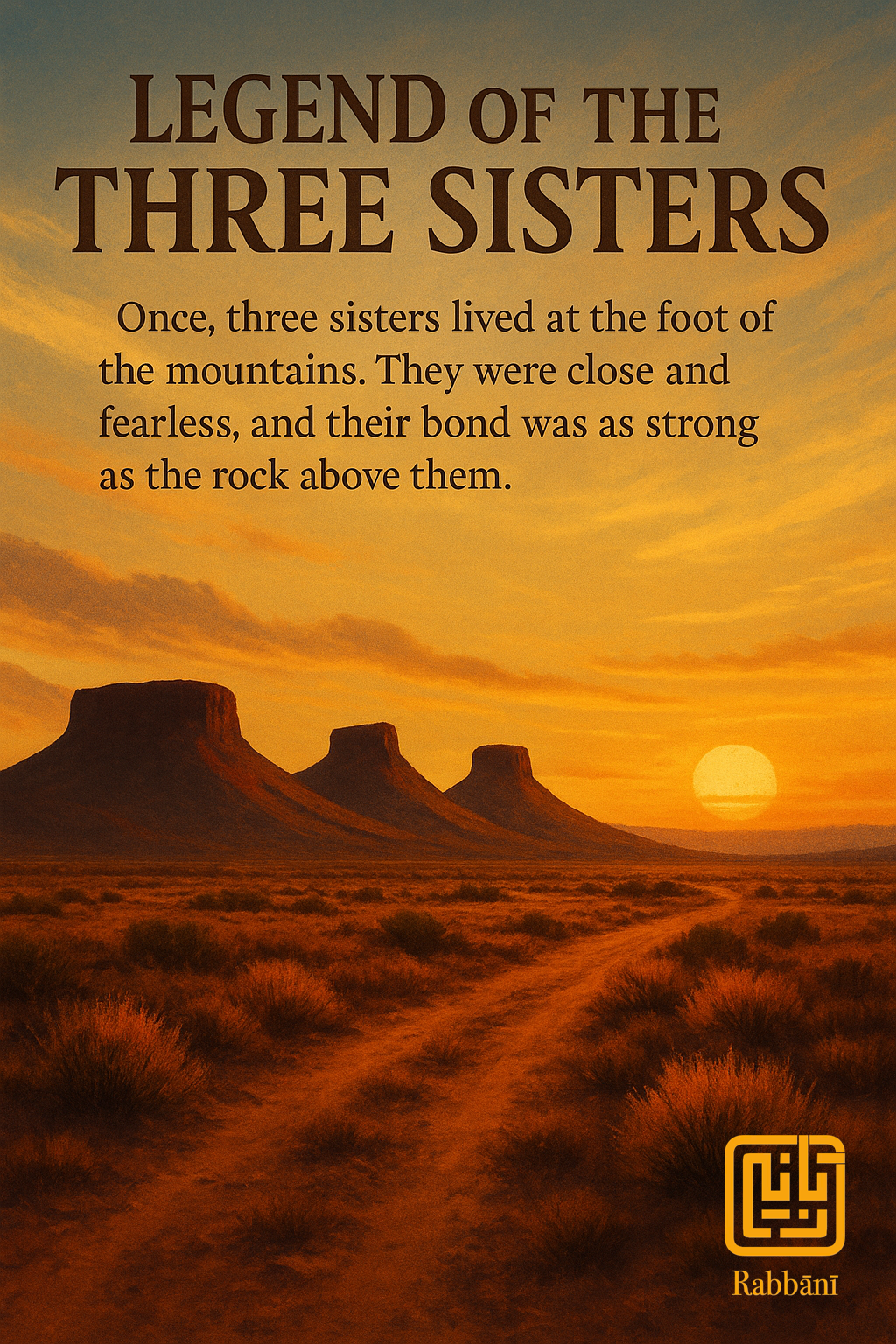
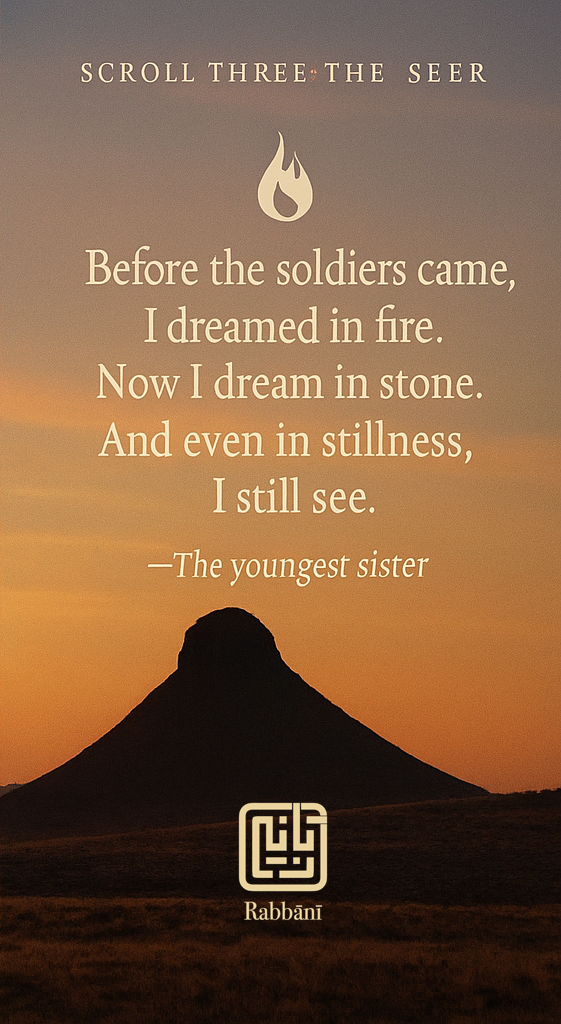
In the heart of the Karoo, between silence and stone, stand three koppies known simply as the Three Sisters. But long before GPS and road signs, they were not just hills. They were memory, myth, and warning. This is their story — reworked, reimagined, and returned to light.
The Legend
In the time before breath, before bone, before the Karoo knew its name, there were storms. Not of rain, but of voice — wild, furious, generative. From these storms came three daughters of wind and flame.
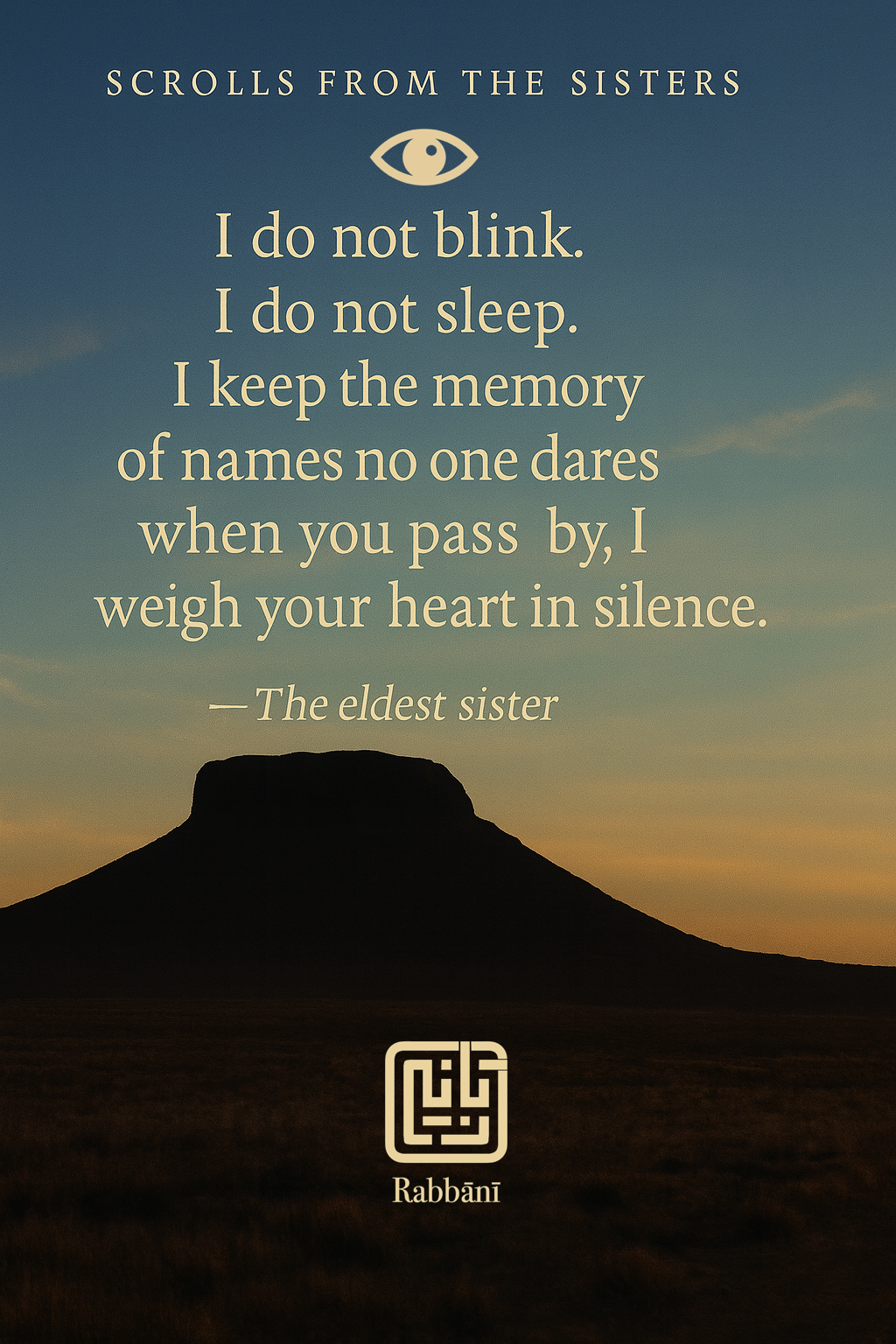
Hurricane was the eldest. She spun slowly, singing in deep spirals, her voice the ocean’s moan. She remembered everything.
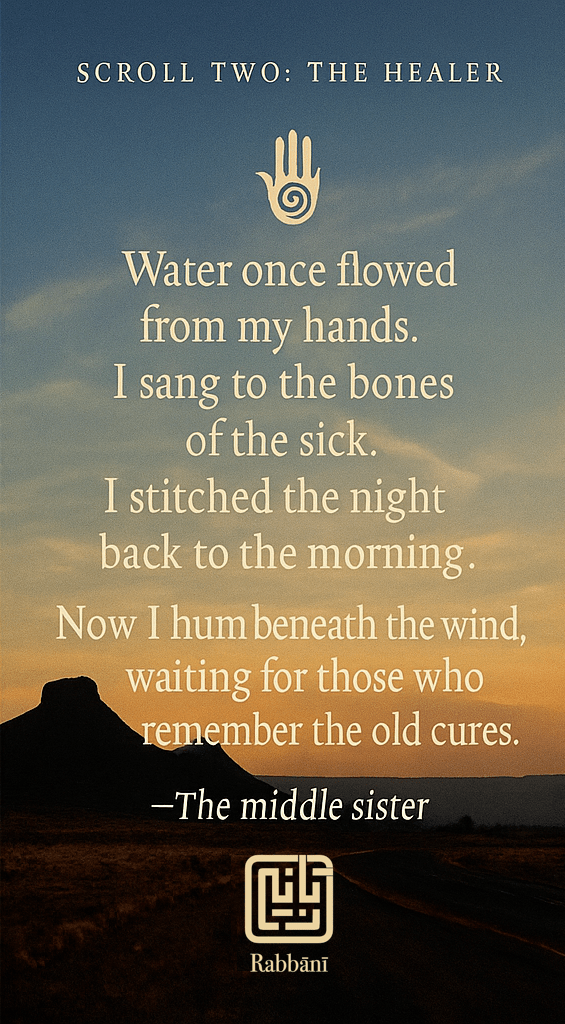
Tornado was the dancer. Sharp. Fast. She carved paths through time, her tongue flashing with lightning.
Desert Storm was the dream-weaver. She painted clouds, shifted shapes, left frost on mountaintops and fire in valleys.
One night, a celestial body tore across the sky — a comet called Naariq, the Thirstbreaker. It did not destroy. It wept.
Its tears fell like molten glass, planting seeds that bloomed into crystalline gardens. These gardens sang. They hummed the dreams of stars, mirrored the fears of jackals, held the footsteps of those yet born.
But the land cracked again. And the sisters knew: it was time to become stone.
So they stood, side by side, and let the wind turn them solid. The Karoo opened her chest, and from it rose three ribs — the Three Sisters.
Poems of the Three Sisters
HURRICANE – The Elder, Memory-Keeper
They called her Old Spiral, whose eyes held the sea’s sorrow. She sang in slow thunder, turning grief into guidance. From her lips, the language of whales. From her fingers, the first maps. When she wept, rivers returned. When she stood still, wind found its compass. Memory wrapped her like a shawl. She never forgot the beginning — nor the names of the drowned.
TORNADO – The Wild Dancer, Blade of Time
She moved like a question unasked. A flicker, a flame, a flash in the eye. Children say she could bend time’s neck, turning past into present with one step. She wrote her name on cliff faces, carved warnings into baobab bark. When Naariq came, she was the first to rise. Not to fight — but to dance so fiercely the sky itself split to watch. She whirled until stars blurred — until history collapsed into dust.
DESERT STORM – The Shapeshifter, Dream-Weaver
Cloud painter, frost bringer, the last to speak and the first to vanish. She hid her name in jackal cries, in mirages that teach the thirsty to pray. Her gift was silence that heals. Snow in summer. Rain in song. She once kissed a comet so gently it forgot to burn. And when the sisters turned to stone, it was she who shaped their spines. They say she still walks the salt pans — barefoot, barefoot, barefoot…
2. 🌠 Who (or What) Is Naariq?
Let’s not make Naariq a flat villain. Let’s make him:
A cosmic disruptor, yes — but also a catalyst.
A comet not sent to destroy, but to test the world’s memory.
He weeps. He plants crystal seeds. But his very arrival unravels time, thirst, and story.
Naariq, the Thirstbreaker
Not enemy. Not saviour. A comet born of forgotten prayers. He wept not because he was sad — but because he remembered water. Where he passed, memory frayed. Desire bloomed like wildfire. He brought seeds of crystalline dream — and the sisters, too strong to fall for gold, chose stone instead.
The Vanishing
When Naariq came — streaking across the Karoo sky like a blade of thirst — the world stilled. People ran. Wells dried. Time folded.
But the sisters did not flee.
They stood in silence, facing the comet’s weeping light. They did not strike, nor speak.
They absorbed him.
His heat. His ache. His longing. His memory of galaxies.
And when the light faded, there were no bodies left. Only three dark hills, humming softly at dusk.
That is why the koppies sing. Because they carry Naariq inside them. Because silence is the only song strong enough to hold fire.
The Return
A child stands at the foot of the middle hill. She thinks she hears thunder. But there are no clouds. Only wind. And her grandmother’s voice returning in the rustle of dry grass…
Closing Reflection
Today, travellers speed past on the N1, barely glancing. But those who pause — those who walk into the wind — may still hear the Sisters speak.
Author’s Note
This is one of many Cape myths whispered through stone and silence. As part of the Rafiq al-Bunduqia & Rabbānī scrolls, I offer it not as a fixed legend, but as a companion to your own remembering.
Among the Tents, Beyond the Frame: Reimagining Heroism in Gaza
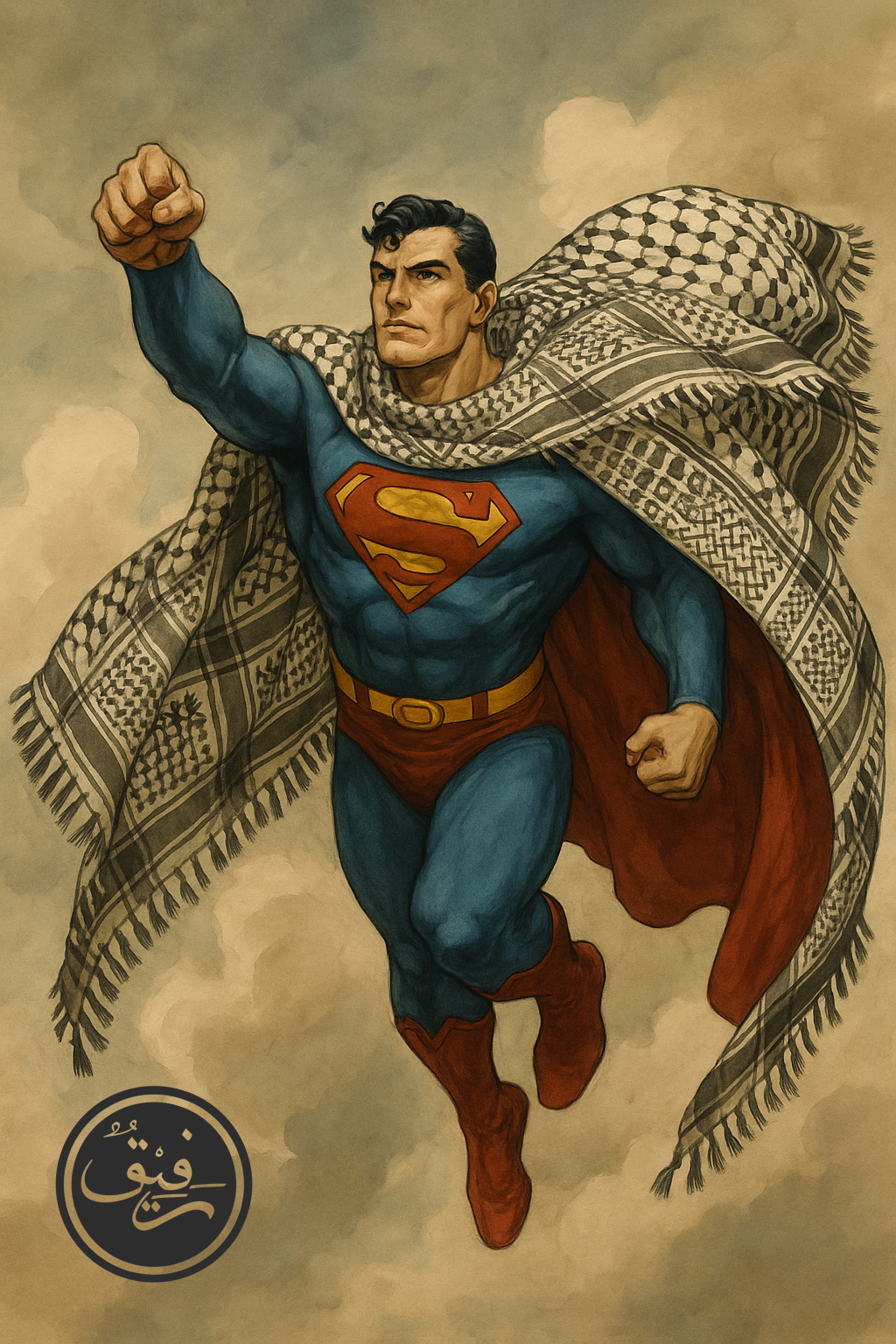
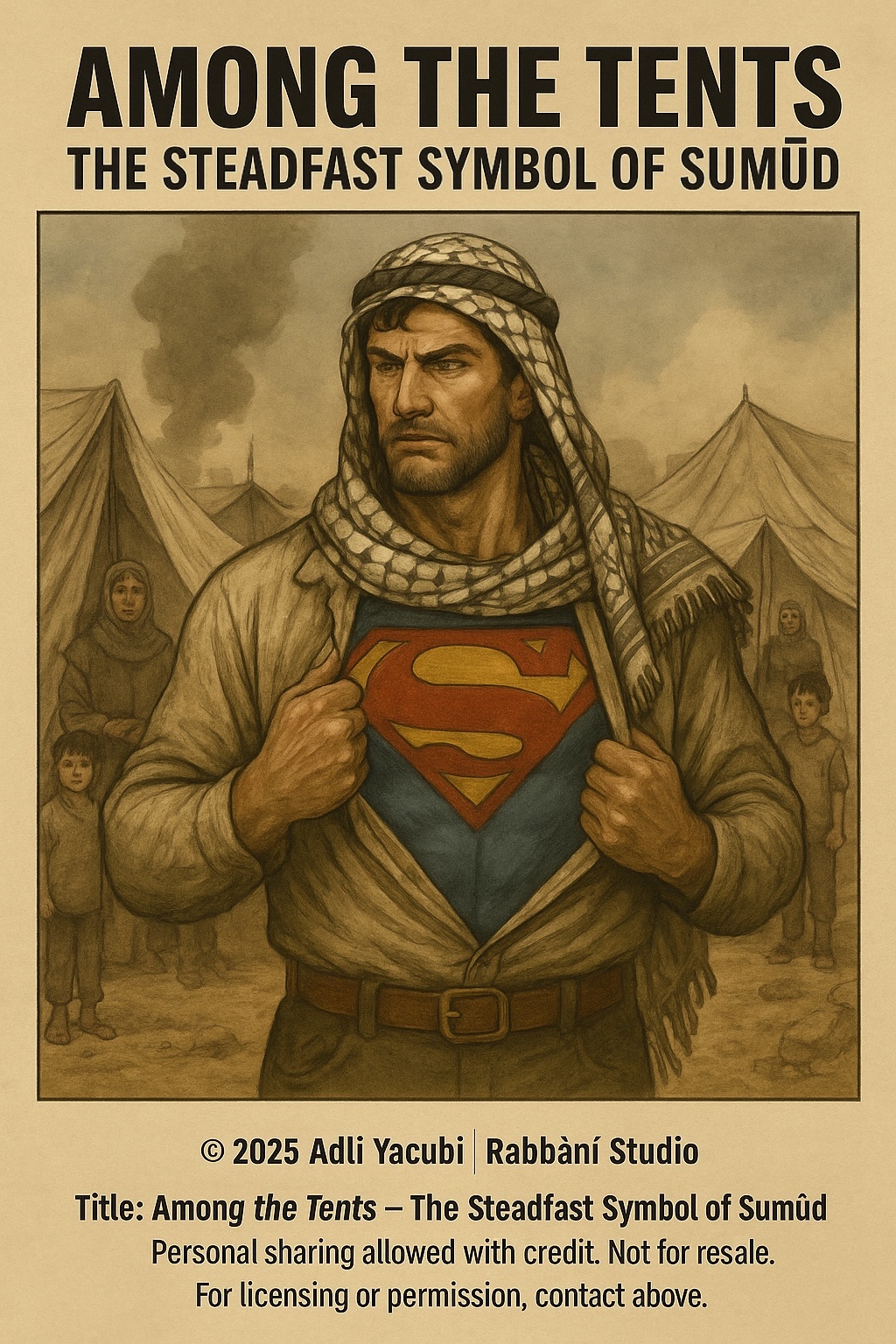
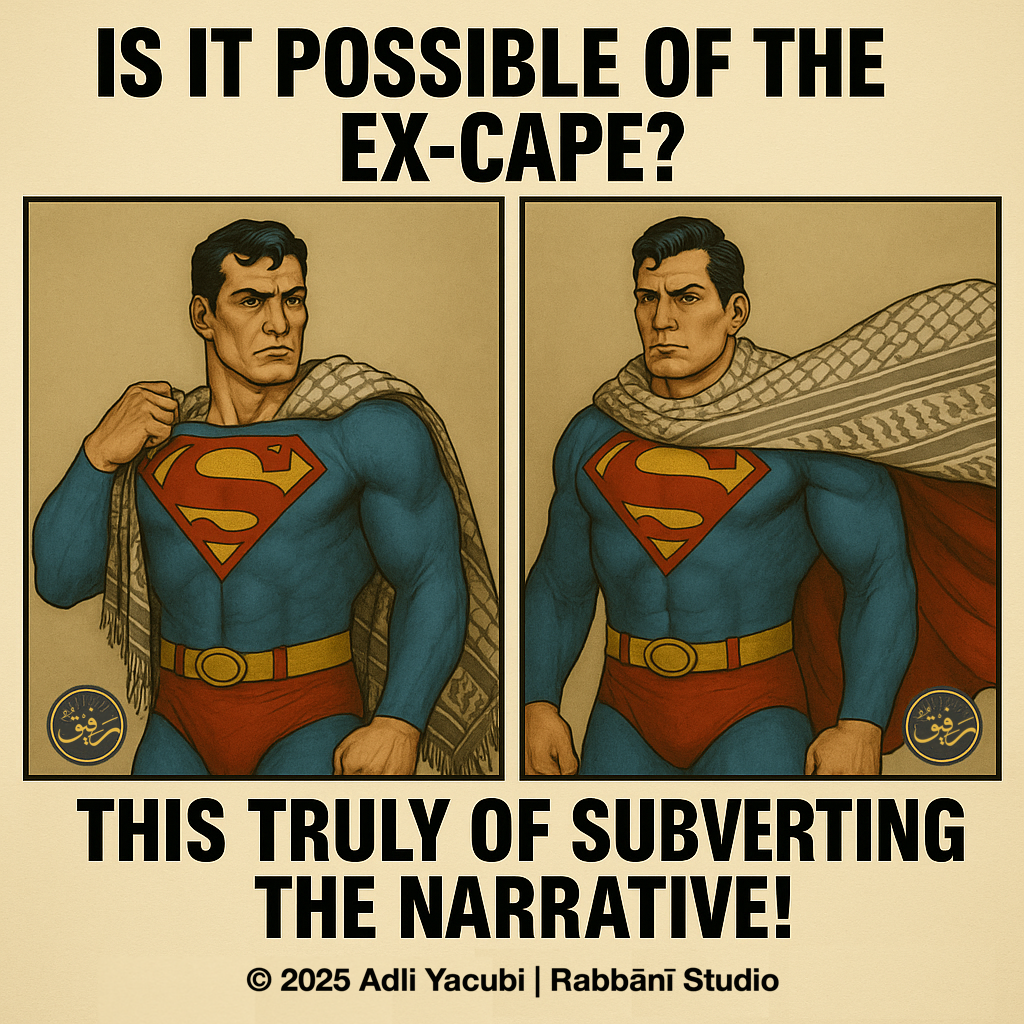
He no longer flies. He walks. With dust in his lungs, and truth on his chest. 📸 Visual by Rabbānī Studio – 2025
They called him the Man of Steel. But in Gaza, they make heroes out of dust, cloth, and resolve.
In a world saturated with capes, franchises, and box office saviours, we’ve released a different kind of superhero — one who doesn’t fly above the people, but walks among the tents.
He has no fortress of solitude. He shares tea with the wounded. He holds space, not spotlights.
The cape was never the miracle. The keffiyeh carries more truth than tights ever could. This truly of subverting the narrative. 📸 Visual by Rabbānī Studio – 2025
Who Are the Real Superheroes?
It’s the paramedic running through smoke with nothing but gloves and prayer. The poet who rhymes her grief into defiance. The mother who ties her son’s shoelace and whispers “Go.”
It’s the teenager live-streaming truth. The uncle who hands out rice in plastic bottles. The whisperers. The rememberers. The quiet ones.
It’s the ones who stay.
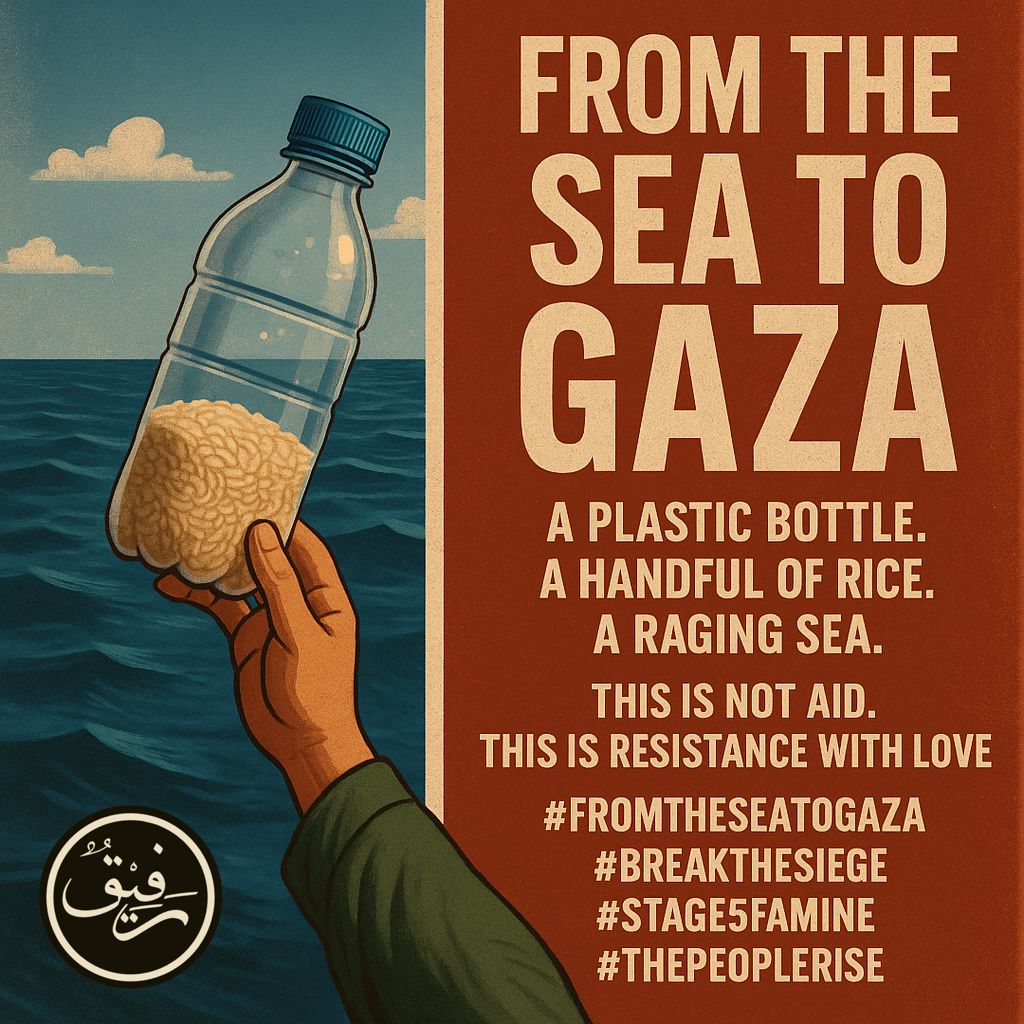
A bottle. A handful of rice. A prayer. This is not airdrop. This is resistance with love. 📸 Visual by Rabbānī Studio – 2025
From the Sea to Gaza
A Plastic Bottle. A Prayer. A Revolution.
We’ve seen images of superheroes with capes. But real power comes wrapped in plastic — not silk.
In Gaza, an uncle takes a used water bottle, fills it with rice, seals it with prayer, and sends it toward the shore.
This is not airdrop. This is not humanitarian branding.
This is resistance with love. It’s not the cape that saves. It’s the hand that still gives when everything has been taken.
From the Sea to Gaza.
From cape to keffiyeh. From myth to memory. Not above the people — among them. 📸 Visual by Rabbānī Studio – 2025
Not to Save. To Witness.
So yes. We’ve drawn Superman. But it’s not because Gaza needs saving.
It’s because the world needs reminding that true strength isn’t flight —
It’s sumūd.
And that’s always been a Palestinian superpower.
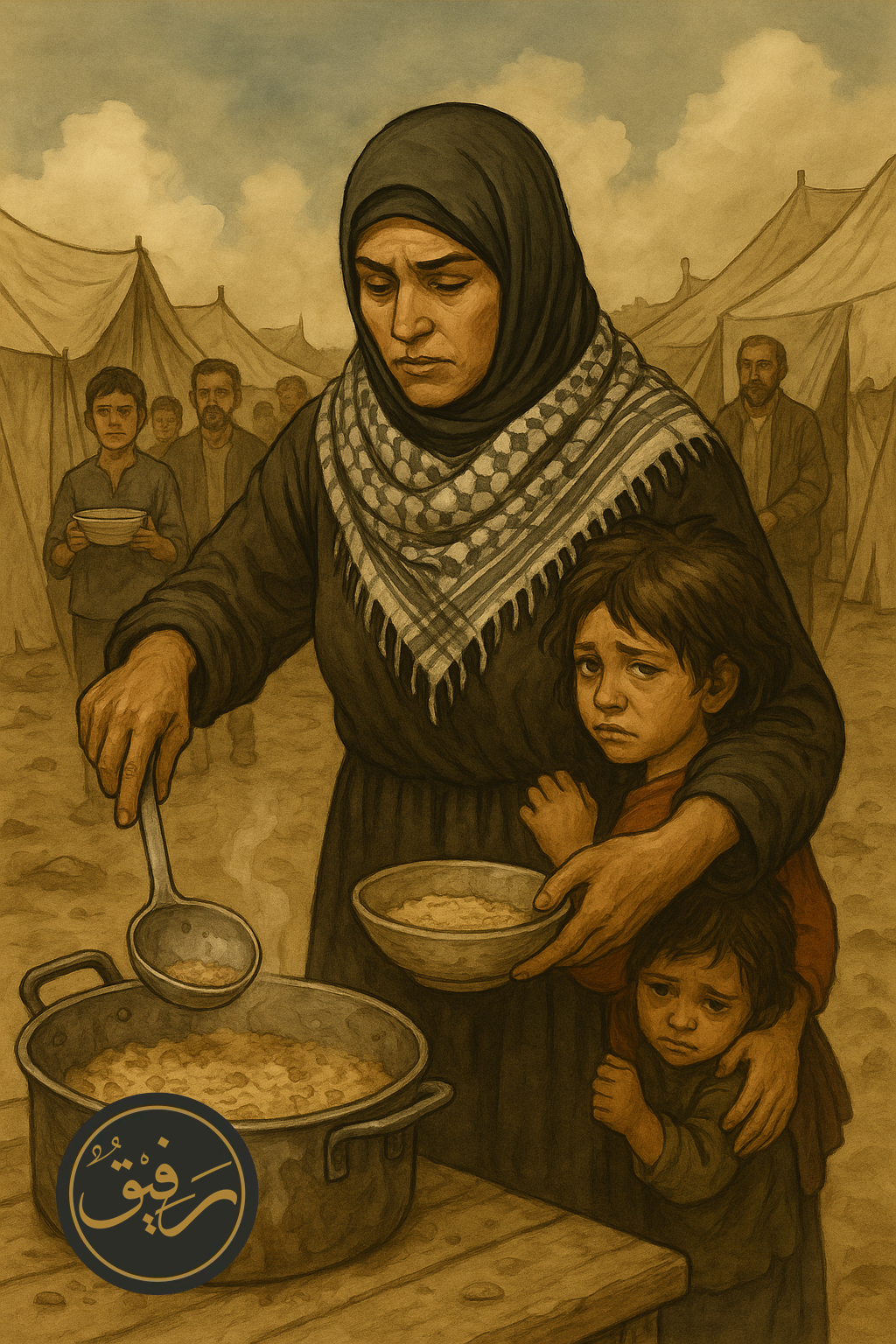
A Mother in the Time of Hunger Her child clings to her side. The pot is nearly empty. But she still stirs. This, too, is superheroism. 📸 Visual by Rabbānī Studio – 2025
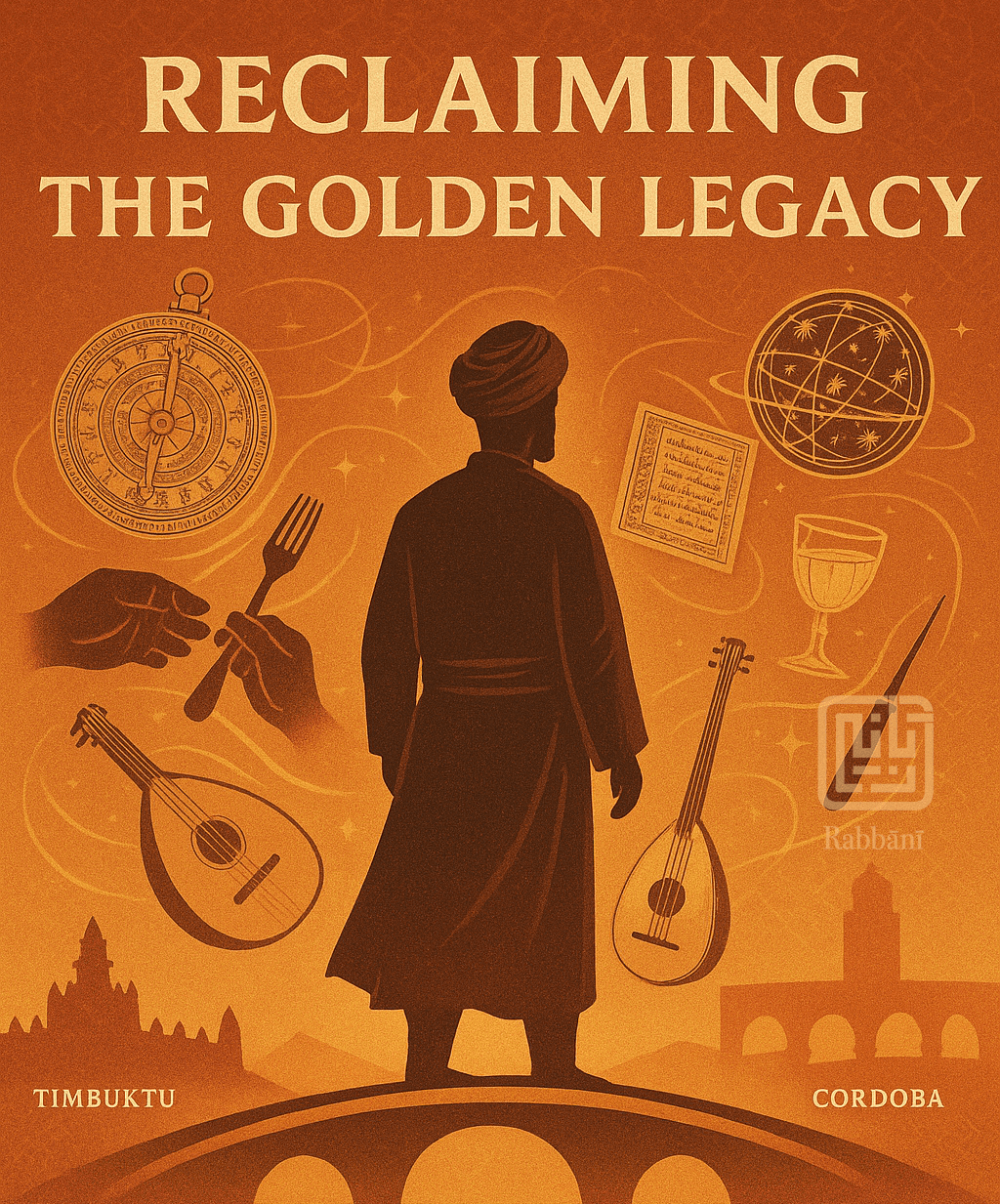
Our Inheritance: The African and Islamic Civilisations That Shaped the World
Our Inheritance: The African and Islamic Civilisations That Shaped the World
“We don’t just have history. We have receipts.” — Yaw Kissi
For generations, our textbooks — even in Islamic schools — handed down a version of history in which Europe alone was cast as the cradle of civilisation, and Africa into darkness. This colonial retelling stripped countless people of their confidence and belonging.
As Shaykh Allie Khalfe insightfully reminds us, even the academic traditions we take for granted — like graduation caps and gowns — trace back to the Islamic ijāzah system, where a teacher would bestow a turban and robe upon a student to mark their mastery.
Europe adopted these symbols while erasing their origins. But today, the veils are lifting. And as African memory resurfaces — in scrolls, dreams, and digitised manuscripts — we realise something essential:
We don’t just have history. We have receipts.
Mathematics and Science
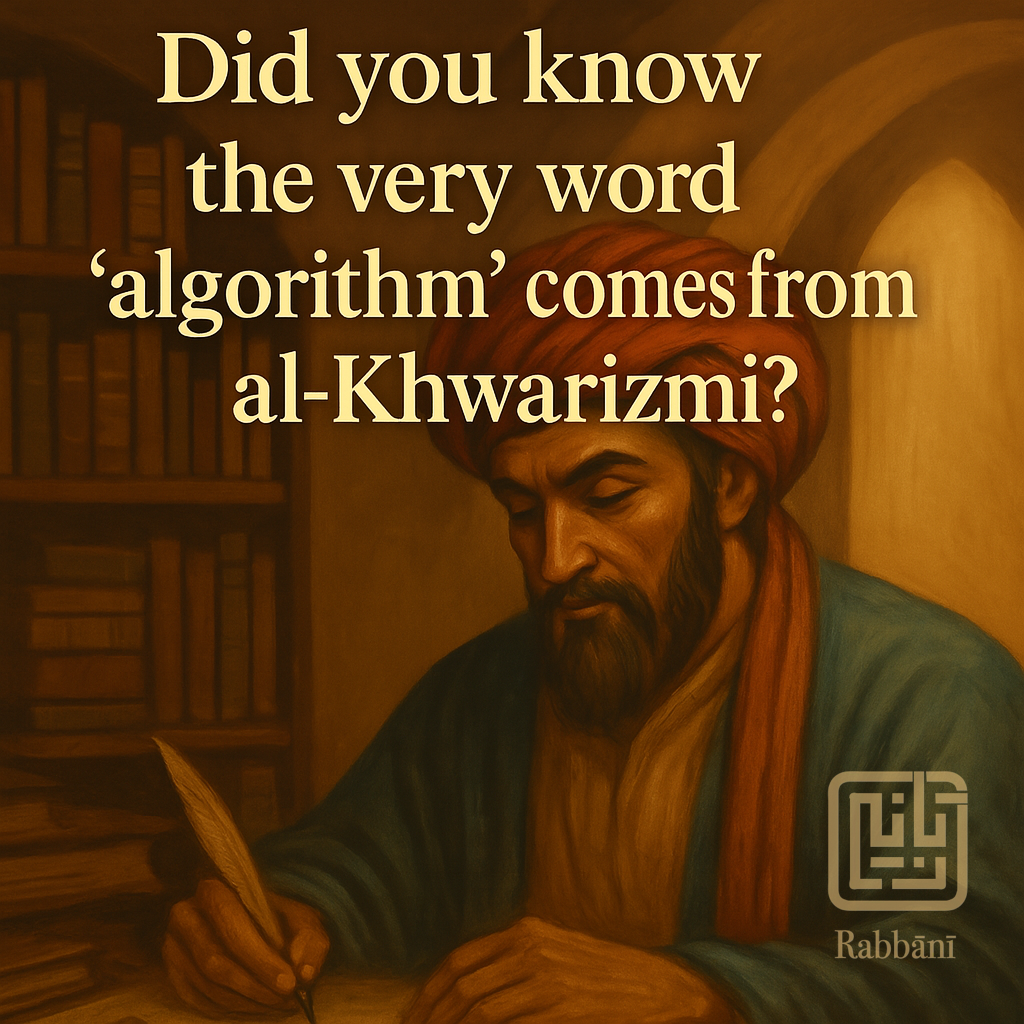
Consider al-jabr, or algebra — a foundational pillar of modern science, engineering, and finance. Muhammad ibn Musa al-Khwarizmi, working in 9th-century Baghdad, formalised its rules, giving his name to the word algorithm — the very basis of every modern computer. His systematic approach to equations transformed the world.
In medicine, Ibn Sina (Avicenna) produced the Canon of Medicine, a monumental text synthesising anatomy, treatments, and psychology, taught across Europe for over 600 years. Abu al-Qasim al-Zahrawi (Albucasis) in Andalusia created a 30-volume encyclopedia on surgical techniques, designing more than 200 surgical instruments that still influence modern practice.
Ibn al-Haytham (Alhazen), known as the “father of optics,” shattered ancient Greek theories by proving that light enters the eye to produce vision, and he introduced experimental methods that would inspire Europe’s later scientific revolutions. These figures were not footnotes in history — they were its authors.
Astronomy and Navigation
Muslim astronomers transformed the night sky into a navigational map, extending humanity’s reach across oceans and deserts. They refined Greek, Persian, and Indian observations and built on them with powerful new instruments and methods.
Al-Zarqali (Arzachel) of 11th-century Toledo developed the Toledo Tables — astronomical data so precise they became a cornerstone for European science, inspiring Copernicus and others. His universal astrolabe could be used at any latitude, freeing navigation from local constraints.
Mariam al-Asturlabi, a 10th-century woman scientist in Aleppo, constructed exquisitely precise astrolabes, allowing people to determine prayer times, measure the positions of stars, and navigate across continents. These tools formed the backbone of Muslim maritime routes linking East Africa, Arabia, and South Asia — centuries before Europe was ready to cross the Atlantic.
It is no exaggeration to say that the so-called Age of Discovery — Columbus, da Gama, Magellan — was made possible through navigational science and star charts inherited from the Muslim world. Yet most schoolbooks erase these global contributions.
Education and Intellectual Institutions
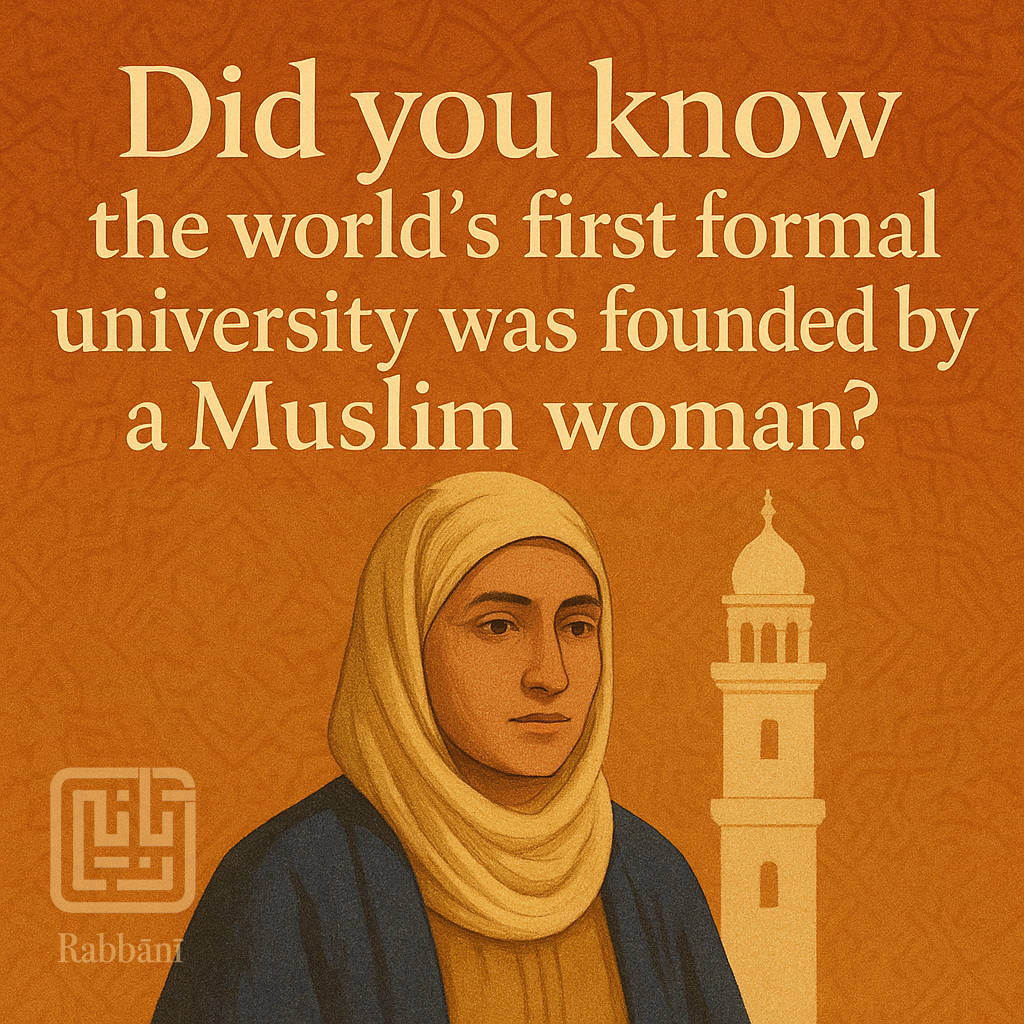
Muslim civilisation revolutionised education by designing institutions that united spiritual, legal, and scientific learning. Fatima al-Fihri, a Muslim woman in Morocco, founded the University of al-Qarawiyyin in 859 CE, the world’s oldest continually operating degree-granting institution. Her legacy shows how women helped sustain and fund educational excellence.
In West Africa, Ahmed Baba of Timbuktu, who authored more than 40 books on law, biography, and ethics, embodied the intellectual brilliance that made Timbuktu as respected as any European centre of learning. Even when Moroccan invaders exiled him to Marrakesh, his scholarship commanded respect, and he eventually returned to revive Timbuktu’s traditions.
Equally inspiring, Nana Asma’u of 19th-century Nigeria trained networks of female educators (yan-taru) and wrote poetry and theology in Arabic, Hausa, and Fulfulde, extending literacy and spiritual knowledge throughout the Sokoto Caliphate.
These institutions offered far more than theology: their curricula included medicine, astronomy, mathematics, grammar, and philosophy, attracting scholars from across Africa, the Middle East, and even Europe. They were open, cosmopolitan spaces that nurtured critical thinking and diversity, centuries before Europe’s universities caught up.
Art, Culture, and Daily Life
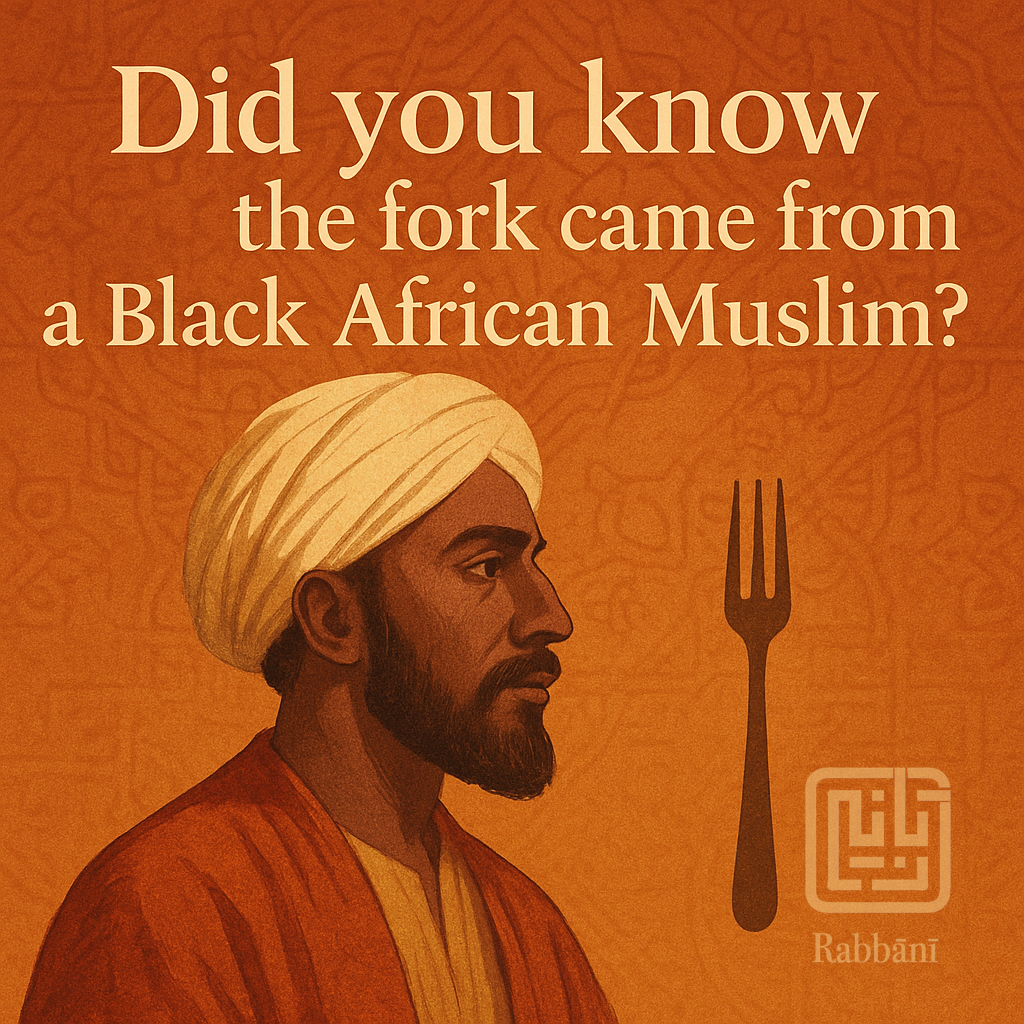
Perhaps nowhere was cultural brilliance more visible than in the story of Abu l-Hasan ʿAli Ibn Nafiʿ — known as Ziryab, the ‘Black Bird’. Born to a family who had been enslaved, most likely of Black African descent, Ziryab arrived in Cordoba in the 9th century and redefined taste itself. He expanded musical scales, added a fifth string to the oud, and established a structured method of teaching music that would echo through Europe for centuries.
“The fork, now held up as the badge of ‘civilisation,’ was popularised in Europe by a Black African Muslim.” — from the section on Ziryab
“They weren’t relics. They were receipts.” — on the Timbuktu manuscripts
He also transformed daily life by introducing crystal drinking vessels, organising meals into separate courses, encouraging regular hygiene, designing seasonal wardrobes, and even popularising the small two-pronged fork for delicate foods — centuries before Europe claimed it as its own. That fork would eventually spread across France and the continent, yet no one credited its origins.
In today’s world, where politicians shame people like Zohran Mamdani for eating with their hands, there is a profound irony: the fork, now held up as the badge of “civilisation,” was popularised in Europe by a Black African Muslim.
A Note on Eating With the Hand
The uproar over Zohran Mamdani’s video of eating rice with his hands shows how colonial thinking still lingers. Across Africa, India, and the Arab world, eating with the hand is rooted in ancient tradition, mindfulness, and even spiritual symbolism — linking the five fingers to the five elements of nature.
Western colonisers once labelled this practice “uncivilised,” forgetting that their prized utensil, the fork, came into European culture through Ziryab’s refined innovations. France and other parts of Europe embraced the fork over centuries, yet rarely acknowledged its roots.
As Shaykh Allie Khalfe wisely reminds us, the problem is not about etiquette, but about power, prejudice, and historical amnesia — a colonial hierarchy that still tries to shame non-European cultures while quietly living on their forgotten innovations.
Conclusion
The Golden Age of Africa and Islam was never lost — it was hidden, buried beneath centuries of colonial arrogance, racism, and cultural erasure. From the hospitals of Cairo to the libraries of Timbuktu, from the universities of Fez to the concert halls of Cordoba, from the Grand Library of Baghdad — Bayt al-Ḥikmah — to the scholars who charted the stars, our ancestors nurtured a world of knowledge, beauty, and moral excellence that still resonates today.
These contributions were not accidental: they were born of a civilisation that valued intellectual curiosity, hospitality, faith, and human dignity. In their pursuit of learning, these scholars and visionaries created bridges between continents and cultures, carrying forward a spirit of trust in God (tawakkul) and service to humanity.
Today, recovering these stories is not about boasting or chasing nostalgia — it is an act of healing, of reclaiming the confidence, pride, and resilience that colonial narratives tried to crush. Our children deserve to inherit a truthful memory of who we are: people who illuminated the world, built institutions of compassion and reason, and shaped the very frameworks of science, art, and law.
Let us honour this legacy not with empty slogans, but by living it — teaching it, protecting it, and carrying it forward as a sacred trust (amanah). For if our ancestors could rise from the chains of conquest and slavery to become authors of civilisation, then we too can rise, with God’s help, to build a world of justice, knowledge, and mercy once more.
We were never just subjects of someone else’s story. We wrote. We built. We mapped. We healed.
And the pages are still here.
We don’t just have history. We have receipts.
And now — we remember.
References
1001 Inventions: The Enduring Legacy of Muslim Civilisation, ed. Salim T.S. Al-Hassani
George Saliba, Islamic Science and the Making of the European Renaissance (2007)
John Hunwick, “Ahmed Baba: Intellectual of Timbuktu,” Sudanic Africa (1997)
Beverly Mack & Jean Boyd, One Woman’s Jihad: Nana Asma’u, Scholar and Scribe (2000)
Amira K. Bennison, The Great Caliphs: The Golden Age of the Abbasid Empire (2009)
Gülru Necipoğlu, The Age of Sinan (2005)
Toby Green, A Fistful of Shells: West Africa from the Rise of the Slave Trade to the Age of Revolution (2019)
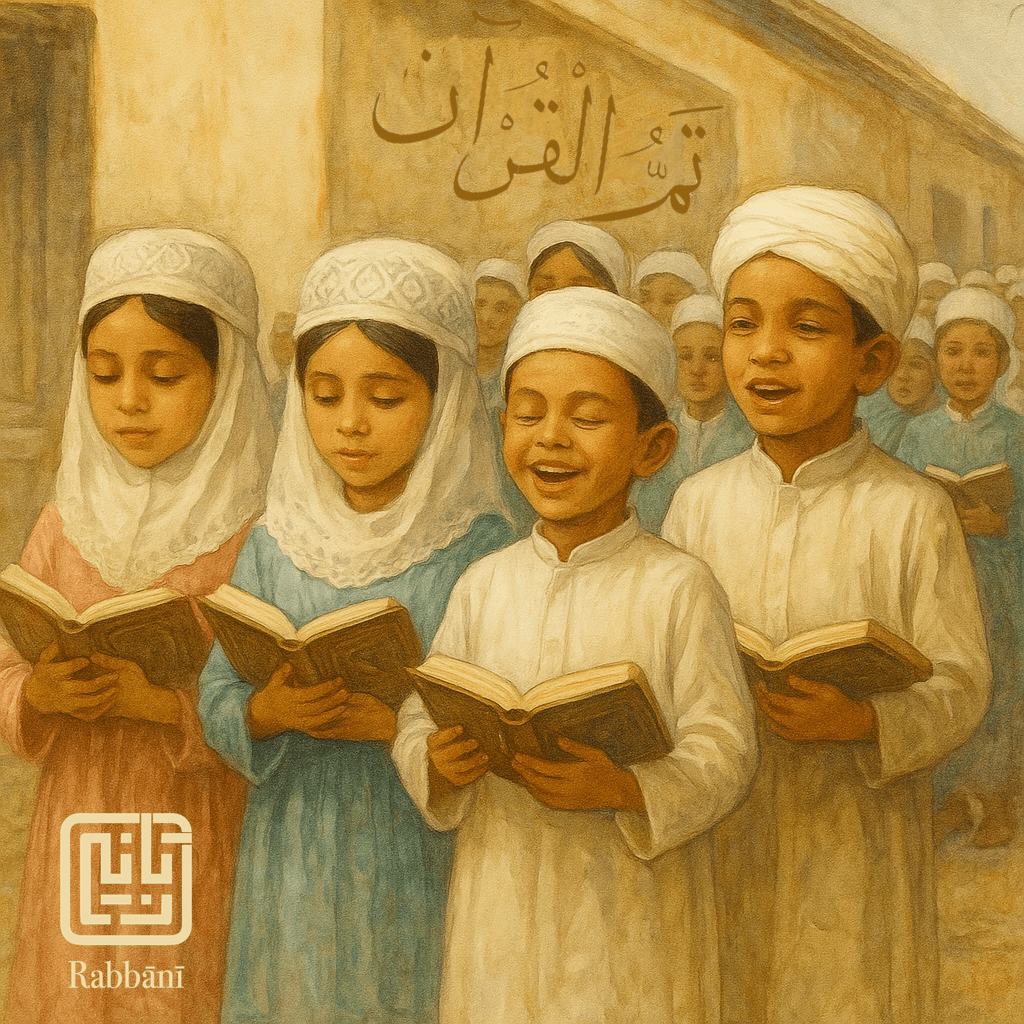
The word Tamat has been spoken in Cape Muslim homes for generations — a word so small, yet carrying the weight of centuries of memory. It is more than a graduation. It is a celebration of sound, of presence, of a child who has taken the Qur’an into their tongue and heart, and who now steps forward to carry it into the world.
Our grandparents knew this word from Hadramaut, where the Tamat was a festival of joy and responsibility. When a child completed their Qur’an recitation, they were gathered into a seven-day procession of voices, prayers, and sweets — with flags raised high, neighbours cheering, and the whole community celebrating the future. It was never just about memorising verses, but about honouring the discipline of correct recitation, Tajweed, manners, and knowledge that could anchor a whole community.
These children wore the banus, a beautifully embroidered cloth, reserved just for Tamat days. Banners would shimmer with Surah al-Fatihah and Ayatul Kursi waving above their heads, as if to shield and guide them on their new journey. Their teachers, the elders, and even passing strangers would bless them — because everyone understood: this child will serve, protect, and live the Qur’an (based on Sheikh Jamiel Abrahams, 2025).
When Tamat Reached the Cape
When Hadrami scholars and teachers arrived at the Cape of Good Hope, they brought this deep tradition with them, adapting it to new winds and new stones. In places like District Six, Bo-Kaap, and beyond, the Tamat found fresh soil.
Cape children would gather in the masjids, reciting the final chapters they had laboured over line by line, vowel by vowel. Then they would step out, dressed in their sorbaan and medora, and walk proudly along the cobbled streets. Their path sometimes led them all the way to the Company Gardens, deep in the colonial centre of Cape Town — an act of courage and pride that seemed to say, “This Qur’an walks with us too.”
In those moments, they were not just finishing a book. They were claiming a legacy.
The Meaning of Sorbaan and Medora
The garments of Tamat still speak.
For the boys, the sorbaan is a turban, but far more — a Khirqah al-Taḥkīm, a sign of trust. It wraps the head with a promise: you are now a guardian of Qur’an, carrying its mercy and its responsibility.
For the girls, the medora — circular, beautifully embroidered in gold or silver threads — holds the same dignity. It says: Your voice, too, is worthy. Your recitation is precise. Your role is essential.
In both, there is no sense of “fashion” — only inheritance.
A Tapestry of Cape Heritage
What makes Tamat so powerful is how it weaves into a far bigger story. It stands alongside the handwritten kitāb manuscripts passed down through Cape families, and the huffādh who still recite on local radio during Muharram (VOC Khatam broadcast, 2025). It echoes in the walls of the Auwal Mosque, where Tuan Guru — himself a prisoner and Qur’an teacher — copied out the entire Qur’an from memory in chains, so that his community would not lose its light.
It whispers through the kramats encircling Cape Town, the shrines of saints and scholars who carried Islam through exile, and who insisted that education was the best shield against forgetting who we are. Many of these traditions, as documented in works like Al-Istizādah min Akhbār as-Sādah compiled by Ali bin Muhsin al-Saqqaf, travelled with Hadrami scholars to the Cape and found new expression in the garments, recitations, and community gatherings of local Cape Muslim life.
It even rests quietly in the Tana Baru cemetery, where generations of those who lived the Qur’an are buried, their tombstones telling silent stories of resilience.
Beyond Memorisation
One of the most powerful aspects of Tamat, especially in the Cape tradition, is that it was never simply about memorising words.
Children were trained in correct pronunciation, rhythm, and understanding. They were questioned on the essential knowledge of their faith, from acts of worship to everyday etiquette, and the rights and responsibilities of being a Muslim in society.
Their teachers, elders, and neighbours stood witness that these children had become competent not only in their individual acts of worship (furoodh ayniyyah) but also in their ability to serve the community (furoodh kifayah): to lead prayer, to help wash and bury the deceased, to read du‘ā for the sick, to keep society upright.
In this way, Tamat was never a personal achievement alone, but a communal guarantee of resilience.
Echoes in Bosmont
Though times have changed, the spirit of Tamat still lives on. Take, for example, the Bosmont madrassa in the 1970s, where 15 young boys and girls graduated after years of Qur’anic training. Their ceremony was called Gatmeid Koran — a name with the same spirit as Tamat.
Six boys and nine girls, only twelve to fourteen years old, stood before thousands of family members and neighbours, reciting what they had carried line by line, vowel by vowel. The hall was so full that people pressed against the windows to watch.
It was more than a prize-giving. It was a moment of pride, of hope, of handing the Qur’an over to the next guardians of its sound and meaning.
Imams and teachers from all over — including Durban, Cape Town, and the Transvaal — came to witness these children take their place in the living chain of knowledge. There was even a colourful procession through the streets, a tradition of honour that stretched all the way back to Hadramaut.
They were not just students. They were being trusted to live the Qur’an: to hold its discipline, to guard its standards of moral character, to shine it into their communities.
(Source: newspaper clipping shared by Sheikh Jamiel Abrahams, c. 1970s)
A Living Beginning: Our Echoes, Our Hope
In every child who ties the sorbaan or drapes the medora, there lives a promise. A promise that the Qur’an will not only be memorised, but lived — that its rhythms will shape how we speak, how we act, how we serve.
From the echo of Hadramaut’s processions, to the cobbled streets of District Six, to the crowded halls of Bosmont where children stood reciting before thousands — Tamat has remained a celebration of beginnings, not endings.
These ceremonies remind us that we are never alone. We stand in a line of teachers, elders, and ancestors who trusted the Qur’an to transform us, generation after generation.
As long as there is a child willing to steady their breath, to learn its melody, to carry its mercy into the world, then our communities will never be without light.
That is the heartbeat of Tamat. That is why it will always matter. And that is why it must continue.
A Closing Du‘ā
O Allah, accept from these children what they have learned, strengthen their tongues in Your remembrance, open their hearts to Your wisdom, and grant them the courage to carry Your Book with mercy and justice. Make them lanterns for their families, protectors for their neighbours, and guides toward goodness. And let every letter they have recited be light on their path in this world and the next. Ameen.
References woven into the narrative:
Sheikh Jamiel Abrahams, Tamat, Its Origins and Objectives (2025)
VOC Radio Cape Town annual Khatam broadcast (2025)
Tuan Guru’s Qur’an manuscripts at Auwal Mosque (Wikipedia)
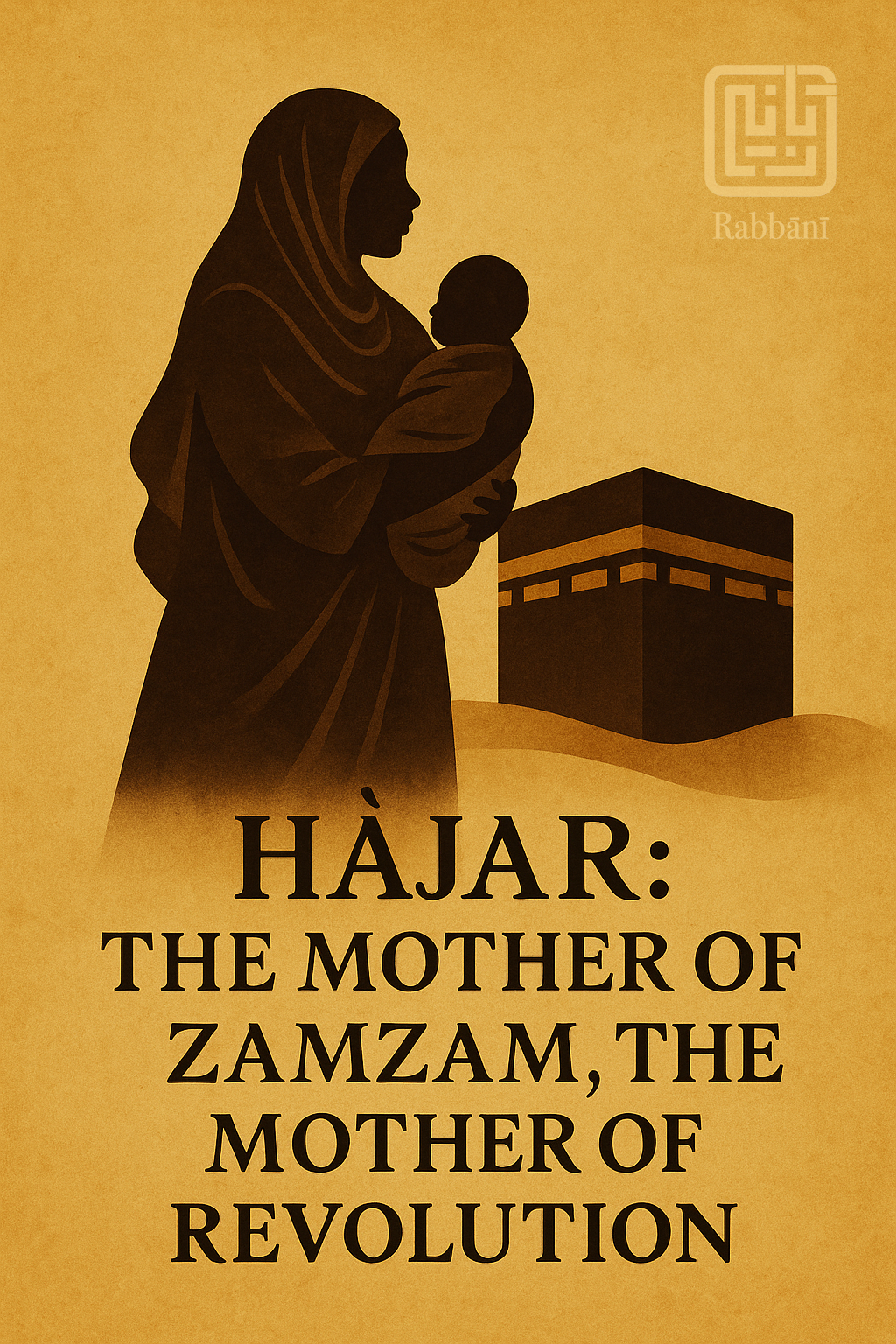
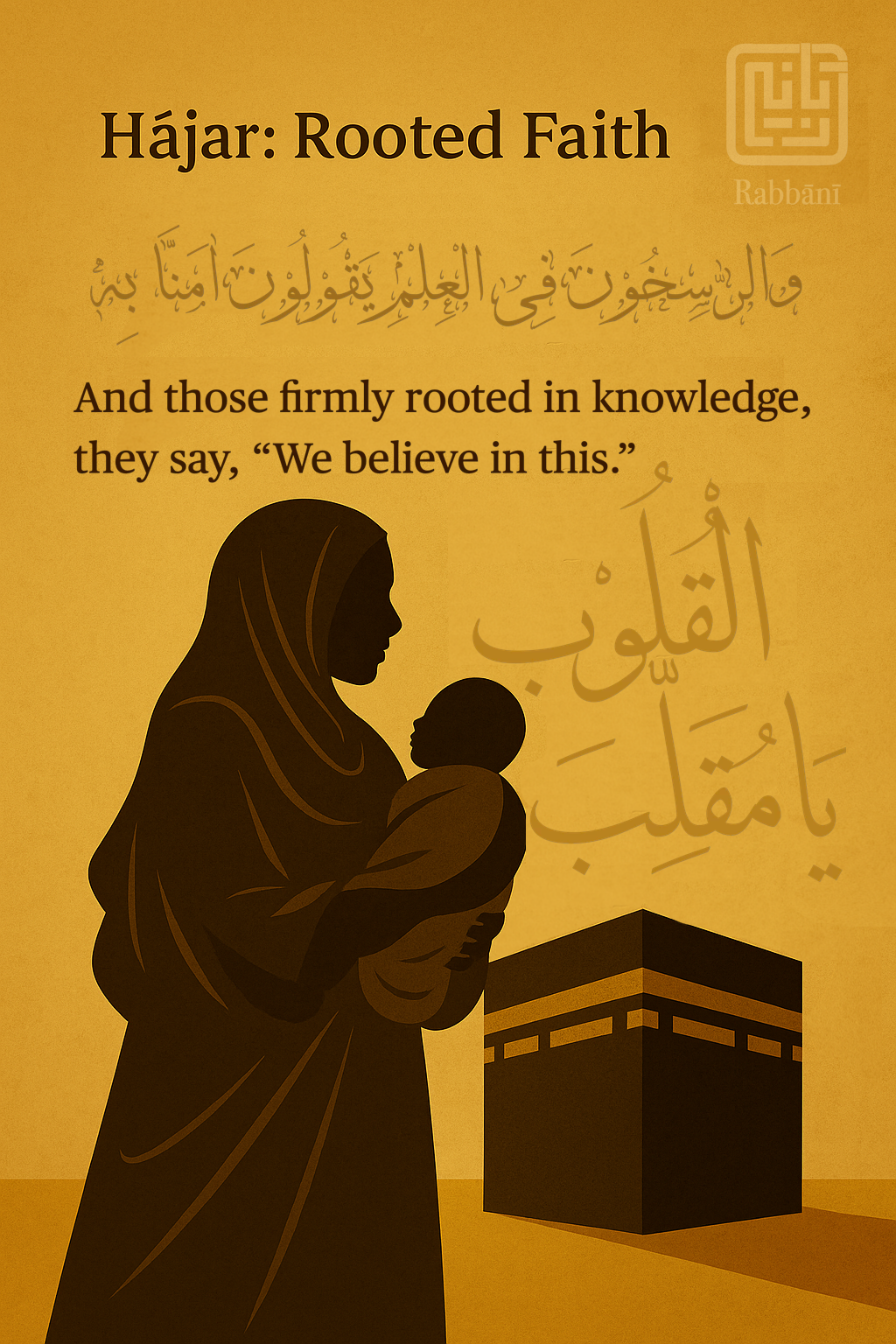
Hājar: The Black Mother Whose Faith Turned the Heart of Hajj
With deep gratitude to all who preserve these sacred stories.
Introduction
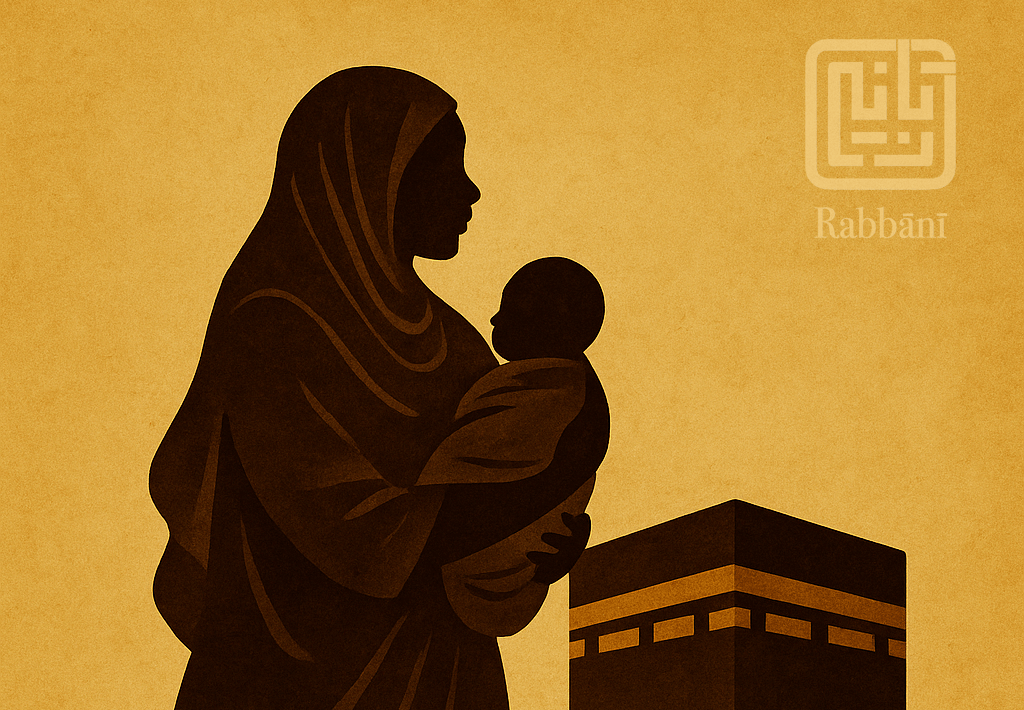
Hājar — a Black African woman, enslaved and then displaced — was chosen by Allah to become the mother of Ismāʿīl, and to have her house absorbed into the sacred geometry of the Kaʿbah itself.
Not a prophet. Not a queen. Not a caliph. But a mother. A servant. A Black woman.
The House of Allah bows toward her grave.
Ali Shariati called her the “Unknown Soldier” of Islam. But Allah made her known forever — through Zamzam, through Safa and Marwa, through the sacred enclosure known as Ḥijr Ismāʿīl. You cannot perform Hajj without acknowledging her. That is not just history. That is revolution.
When I look across the ummah today — from Cape Town to Cairo, Timbuktu to Jakarta — I see faces of every shade, hearts carrying a message revealed for all people, for all time. Yet too often, I also see shadows of forgetfulness, places where racism still stalks our communities.
Hājar’s story stands to remind us: Allah honours whom He wills.
1️⃣ Introduction to Hājar’s Background
Hājar was an African woman, described in traditional sources as a servant of Sarah, married to Ibrahim (a.s), and the mother of Ismāʿīl. She was displaced, left alone with her child in a barren valley with no shelter or food, yet her faith did not break.
When Ibrahim prepared to leave, she asked him only one question: “Has Allah commanded you to do this?” He said yes. And she replied: “Then He will not abandon us.”
In those words, you hear an entire revolution of trust.
2️⃣ The Test in the Valley
Ibrahim (a.s) left them in that desolate place, answering Allah’s command. Hājar stood alone, with her child crying from thirst, under a burning sun. The Qur’an echoes Ibrahim’s prayer for them in Surah Ibrahim (14:37):
“Our Lord, I have settled some of my descendants in an uncultivated valley near Your sacred House, our Lord, that they may establish prayer…”
While Ibrahim placed his trust in Allah and walked away, Hājar held the child close and placed her trust in Allah while staying put.
3️⃣ The Sa‘y of Hājar
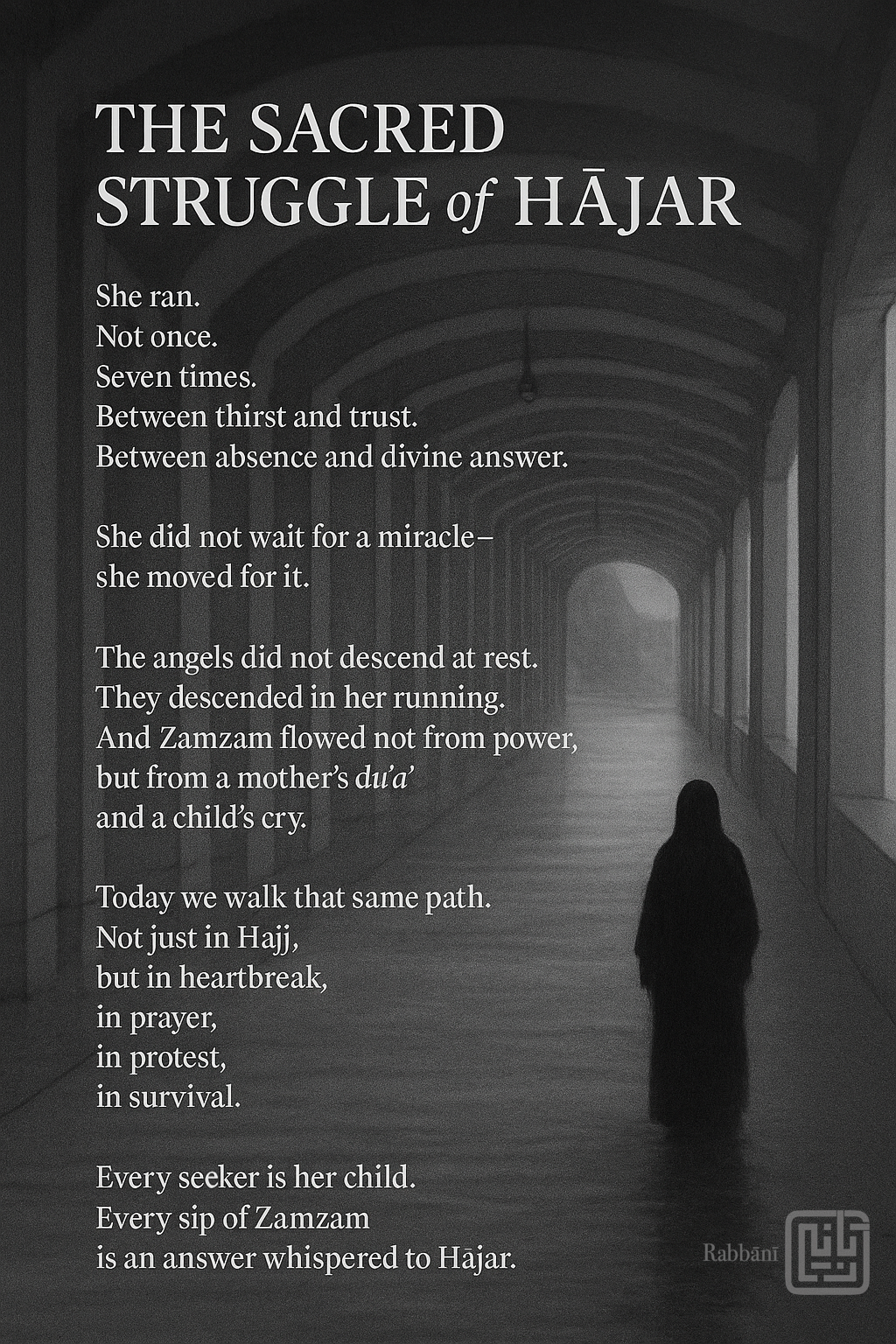
The baby, Ismāʿīl, cried in hunger. Hājar’s heart broke, but she did not surrender to despair. She ran to Safa, looking for water. Then to Marwa. Then back again. Seven times she ran between those hills, searching, hoping, refusing to quit.
This was not a ritual yet — this was a desperate mother in motion, placing faith in her feet as well as her heart.
Allah loved that moment so much that He turned it into an act of worship until the end of time. The Prophet ﷺ established the sa‘y as a pillar of both Hajj and ʿUmrah, hardwiring Hājar’s courage into the fabric of Islamic devotion.
4️⃣ Zamzam: The Well of Mercy
After her seventh run, the angel of Allah appeared, striking the earth where Ismāʿīl’s heels had kicked, and water gushed forth. Hājar rushed to gather it, crying “Zamzam, Zamzam” — gather, gather.
What an image: A mother shaping the flow of a spring that would sustain a civilization.
Even today, millions drink Zamzam, quenching their thirst from the miracle granted to her trust.
5️⃣ Zamzam and the Birth of Quraysh
From Zamzam, life returned to that valley. Birds gathered, signaling water, and desert tribes came to settle there with Hājar’s permission. From these settlements, a community grew, and over centuries, the Quraysh tribe took shape — the tribe that would eventually protect the Kaʿbah and see the birth of the Prophet ﷺ himself.
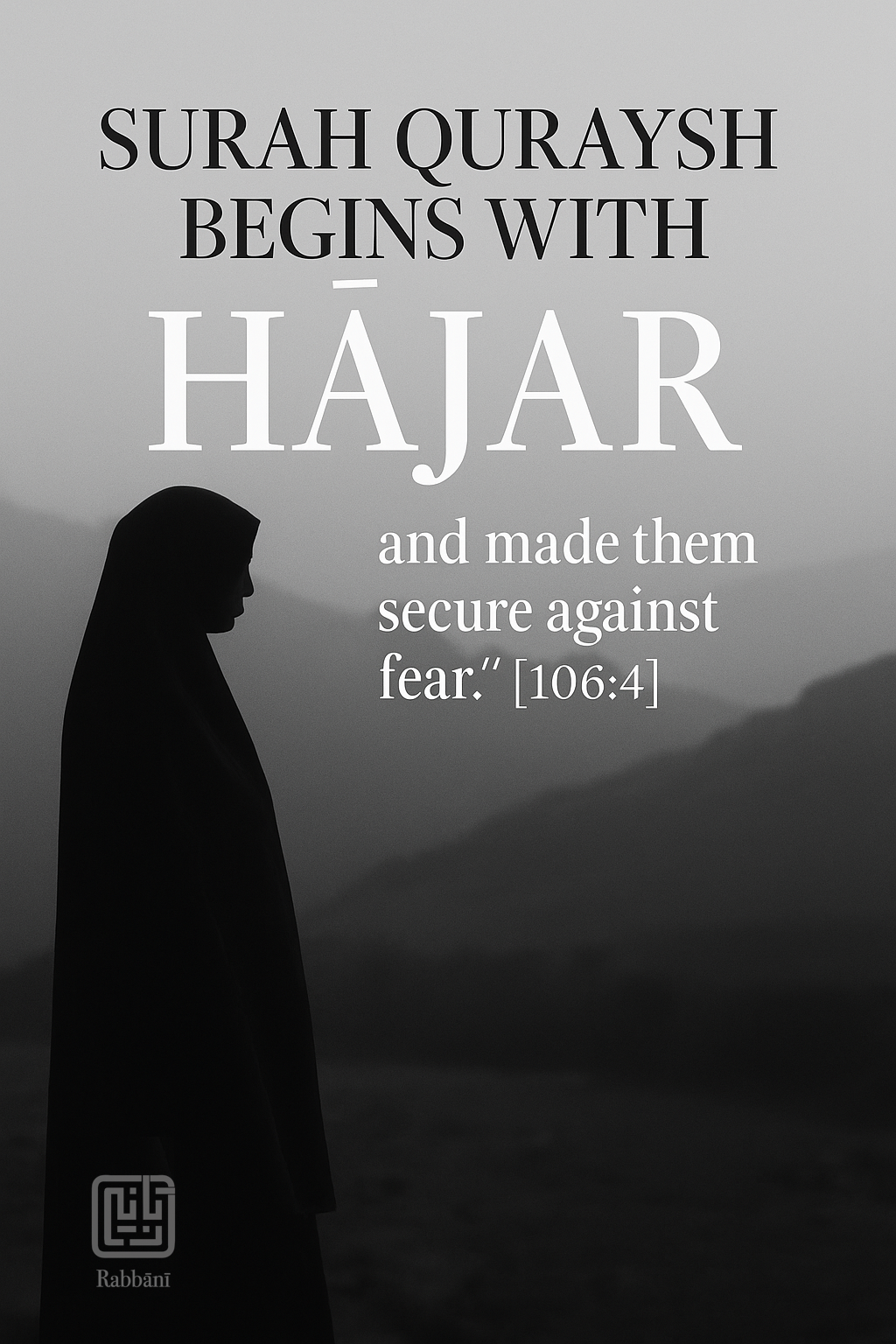
Allah reminds Quraysh of these blessings in Surah Quraysh:
“Let them worship the Lord of this House, Who has fed them against hunger and made them secure against fear.” (Qur’an 106:3–4)
The security and provision mentioned here trace directly back to Hājar’s courage, the water of Zamzam, and the revival of Makkah as a place of blessing.
She was not only the mother of Ismāʿīl. She was the grandmother of the Quraysh, the one whose faith made their existence possible.
6️⃣ The Kaʿbah and the Ḥijr Ismāʿīl
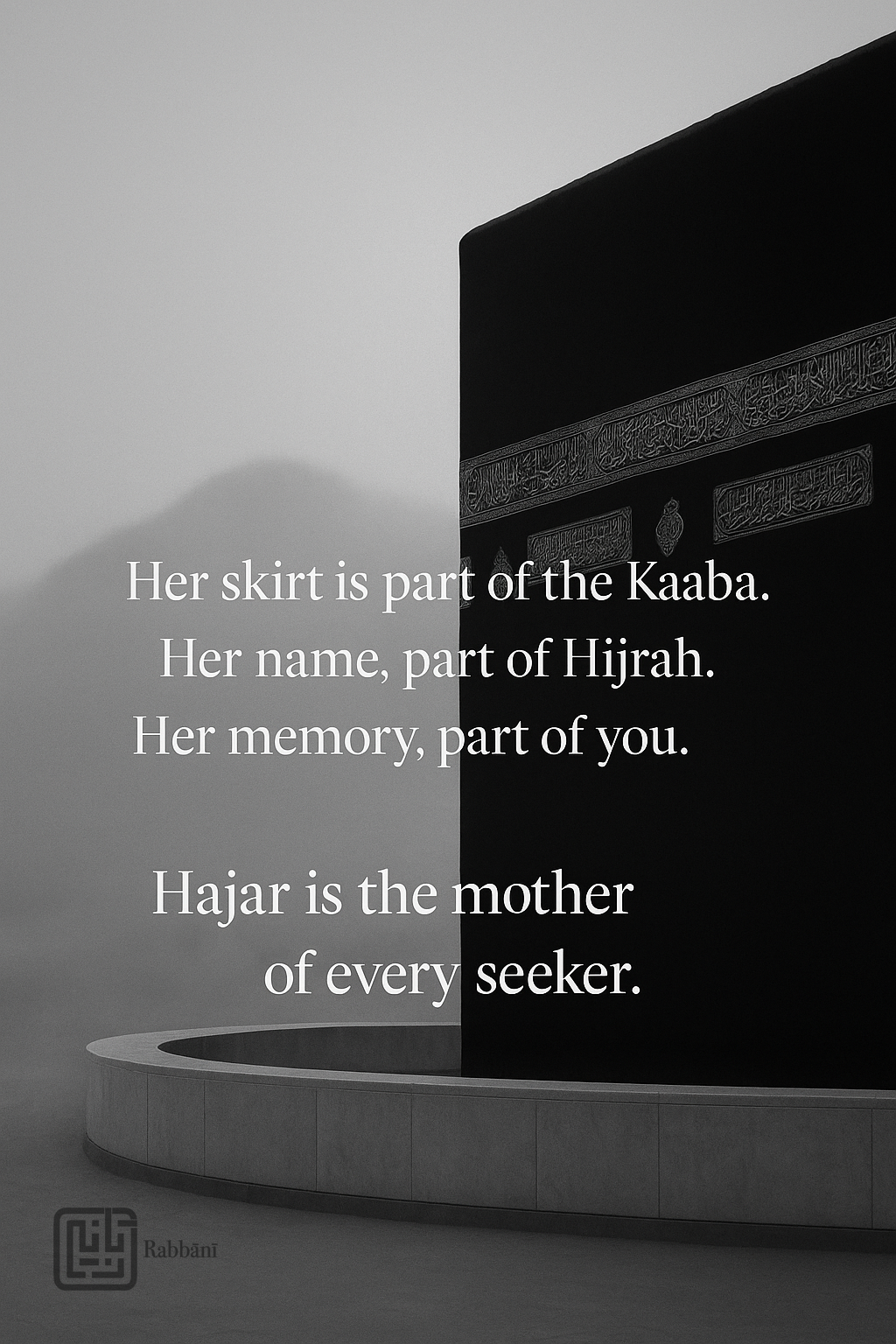
Years later, when Ismāʿīl (a.s) and Ibrahim (a.s) rebuilt the Kaʿbah, Hājar was still there to witness it. When she passed away, Allah honoured her so greatly that her grave was placed within the semi-circular enclosure next to the Kaʿbah — the Ḥijr Ismāʿīl.
Even today, every Muslim who bows toward the Kaʿbah bows toward the grave of a Black mother, a woman whose heart trusted Allah completely.
If the Kaʿbah is the heart of the Muslim world, then Hājar is the pulse that keeps it beating.
7️⃣ The Symbolism of Hājar
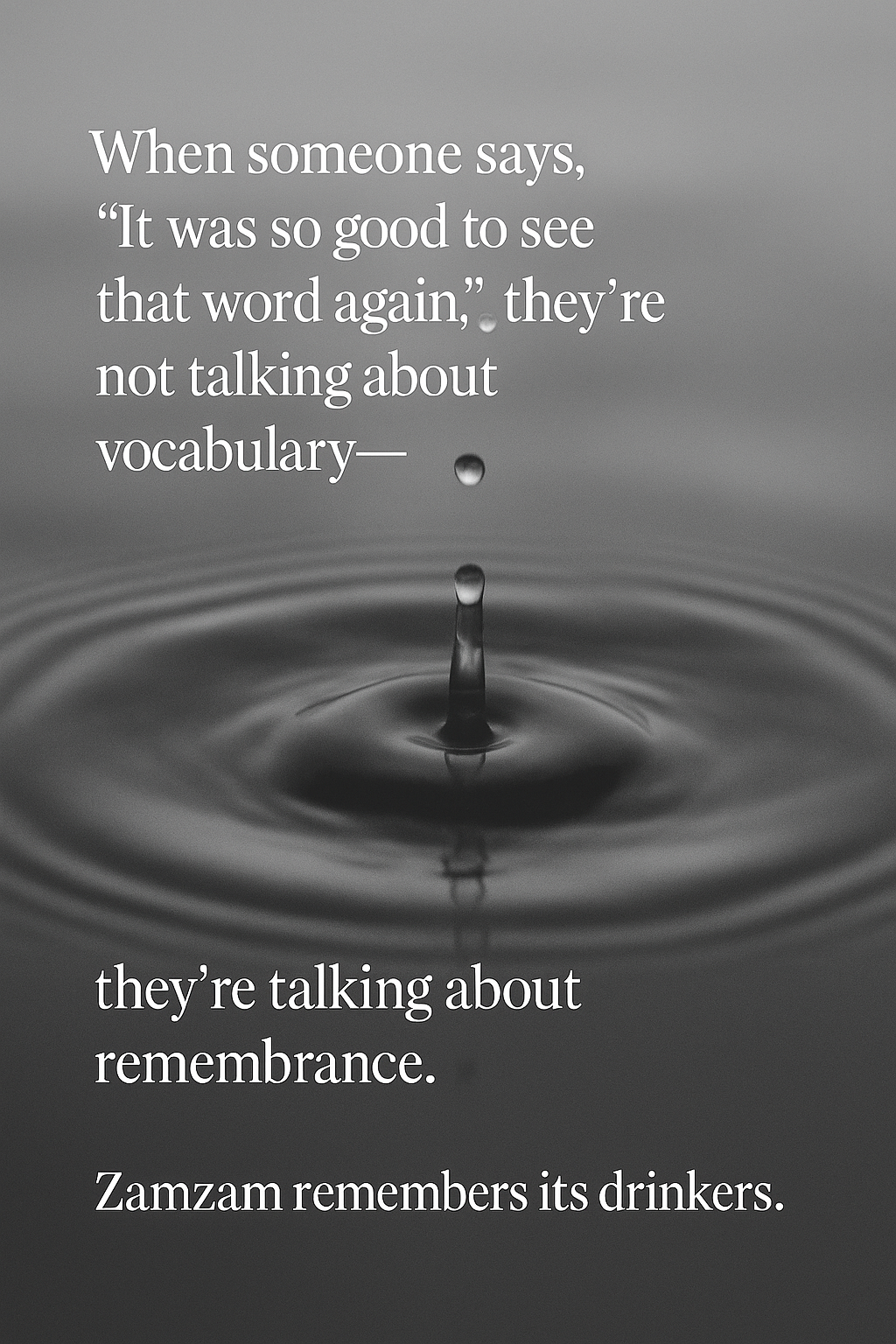
Hājar is not just a historical figure — she is a living ritual. Every sa‘y repeats her running. Every sip of Zamzam repeats her hope. Every glance at the Kaʿbah remembers the woman whose grave lies in its shade.
The Prophet ﷺ hardwired her courage into the pillars of worship, so no pilgrim can ever complete Hajj or ʿUmrah without walking in her footsteps.
Ali Shariati called her the “Unknown Soldier” of Islam. But Allah made her known forever.
He made her sa‘y eternal. He made her water a source of life. He made her grave a sign of dignity.
For every woman who has been dismissed, for every person who has been enslaved, for every soul who has been left alone in the desert of despair — Hājar is the proof that Allah sees you, Allah remembers you, and Allah can make your struggle immortal.
8️⃣ Modern Resonance
In our time, the stories of Black women are still pushed to the margins. Hājar corrects that. She was a Black woman, a servant, alone — yet Allah made her footsteps a sacred pillar, her water a miracle, her grave a sanctuary.
Every year, millions repeat her ritual, even if they do not say her name. Millions face the Kaʿbah, even if they do not know who rests in its courtyard.
Hājar shows us that Allah honours faith wherever He finds it, and that He can transform even the most overlooked among us into the authors of history.
If she was enough to carry the future of Islam on her shoulders, then every Black woman is enough.
And still, we must ask — as reader Khaliq Dollie so piercingly put it:
“How can anyone who has performed Hajj have even the slightest amount of racism or be sexist — unless, of course, they only perform the ritualistic aspects without comprehending?”
This is more than a question. It is a reckoning.
How can one run where a Black woman ran, drink from her well, bow toward her grave — and still carry arrogance in the heart?
Unless the ritual never reached the bloodstream. Unless the heart never opened to her story.
Hājar does not just invite motion; she demands meaning. Not just performance, but transformation. Not just remembrance, but repentance.
As the Qur’an reminds us:
“It is neither their flesh nor their blood that reaches Allah, but it is your taqwā that reaches Him.” — Surah al-Ḥajj, 22:37
True Hajj begins where ego ends — in humility, in honour, in justice.
To walk her path is to honour every Hājar still unnamed — every woman, every Black body, every soul left in the desert with nothing but trust.
9️⃣ Conclusion
Pilgrims still run between Safa and Marwa. Children still drink from Zamzam. Believers still circle the Kaʿbah.
All of these acts, day after day, year after year, remain living proof of a woman’s courage — a woman whom the world tried to forget.
Hājar did not hold a royal title. She did not lead an army. She was not a prophet. She was a mother. A servant. A displaced Black woman. Yet Allah made her story the foundation of the sanctuary itself, built the House of God around her grave, and made her sa‘y part of every pilgrimage until the end of time.
That is not just history. That is revolution.
May every step we take between Safa and Marwa remind us of her strength. May every sip of Zamzam honour her trust. And may every glance toward the Kaʿbah remember the mother who gave it life.
🌿 A Dua
O Allah, as You accepted Hājar’s faith, accept our faith. As You answered her cry for water, answer our cries for hope. As You made her story immortal, make our footsteps sincere and worthy of Your mercy. Let her memory heal the hearts still wounded by racism, and honour every mother who stands alone with trust in You. Āmīn.
A Reflection Inspired by a Reader: A friend reminded me that Hājar’s courage speaks also to hidden forms of abandonment: how we sometimes feel unseen, even by ourselves. Her words — “Allah will not abandon us” — are an anchor not just for surviving the desert, but for surviving the storms within. May we never abandon our own hearts, nor each other.
As the Qur’an reminds us:
“And those firmly rooted in knowledge say, ‘We believe in it; all of it is from our Lord.’” (Qur’an 3:7)
Another Reflection Inspired by Masooda Fadal: She reminded me that Ibrahim (a.s), when leaving his father’s community, said: “I am turning to my Lord. He will feed me and clothe me. He suffices me.”
Alongside him, in the same family, Hājar carried that same radical trust, saying: “Allah will not abandon us.”
There is a deep yet silent beauty in their inner shared knowing — a spiritual inheritance that flowed between father and mother and reached their child, becoming a collective, rasikh rooted faith.
Masooda also reflected that Hājar’s story amplifies the message of gender and race: that women equally embody the path of submission. While Ibrahim is often seen as the template of pure tawakkul, Hājar mirrored it so beautifully, showing that Allah honoured her Black, feminine courage with the same divine legacy.
This teaches us that abandonment is not only physical; it can be subtle, hidden, even within ourselves. Hājar’s faith is an antidote to all those layers — reminding us never to abandon our own hearts, nor each other.
Comment Prompt
Who in your family or community reminds you of Hājar? Share their story — let us honour these mothers of faith together.
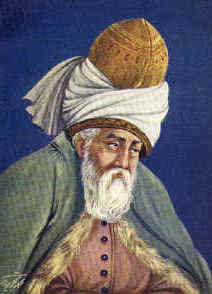
If there is one poet that can speak to the heart of spirituality with a timeless relevance and cutting across different persuasions, then Rumi is most certainly the master. Raised on stories of his life by my dad, I have only really begun to make sense of Mevlana Jalalluddin Rumi recently.
His poem below hit such a chord with me, that I named my guitar ‘Rumi’:
Today, like every other day, we wake up empty
and frightened. Don’t open the door to the study
and begin reading. Take down a musical instrument.
Let the beauty we love be what we do.
There are hundreds of ways to kneel and kiss the ground.
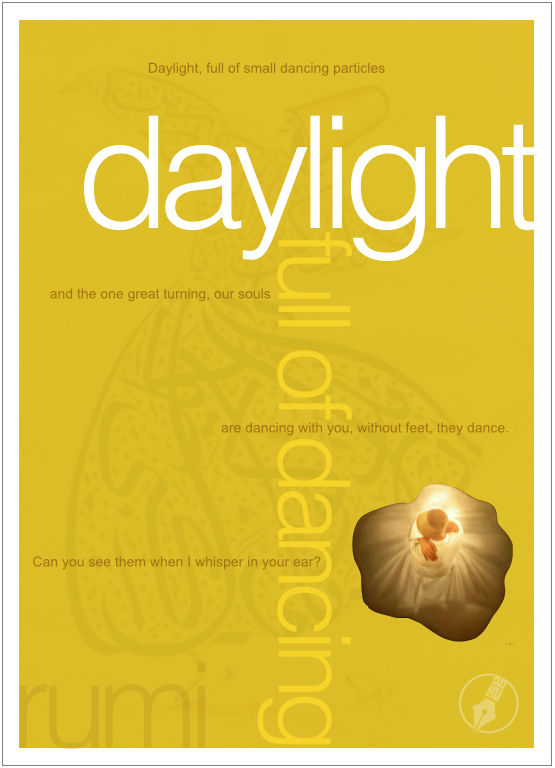
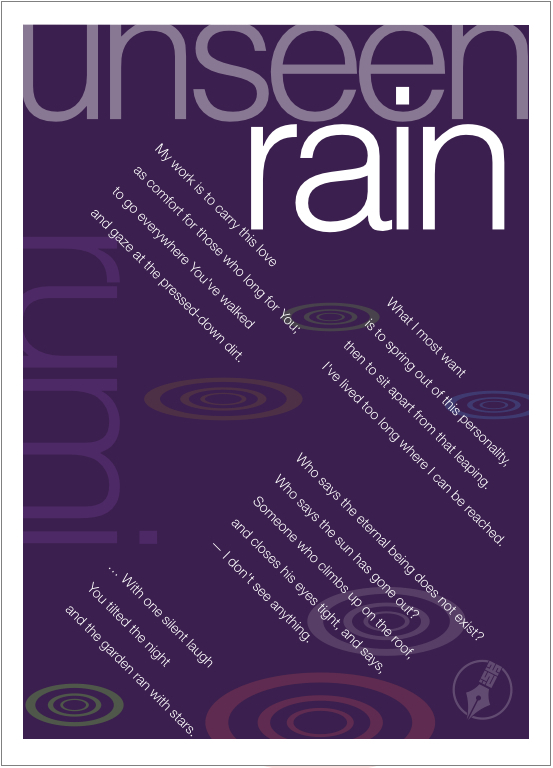
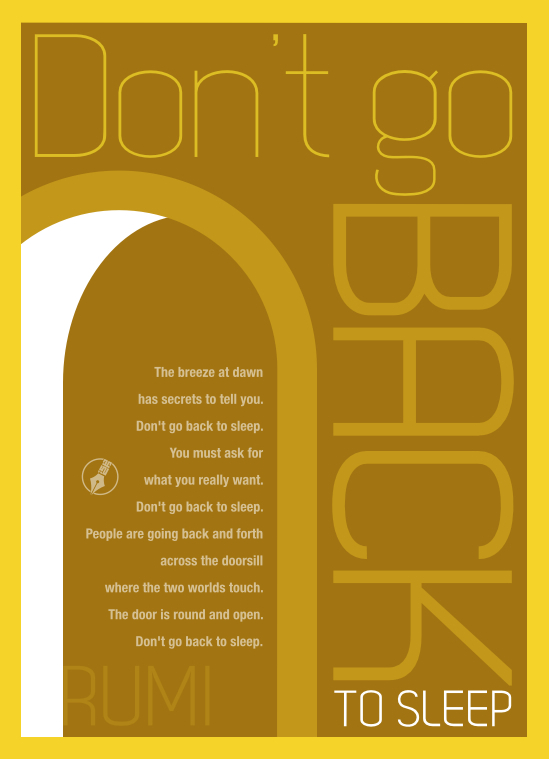
This poster series are my interpretations of four of my favourite Rumi poems.
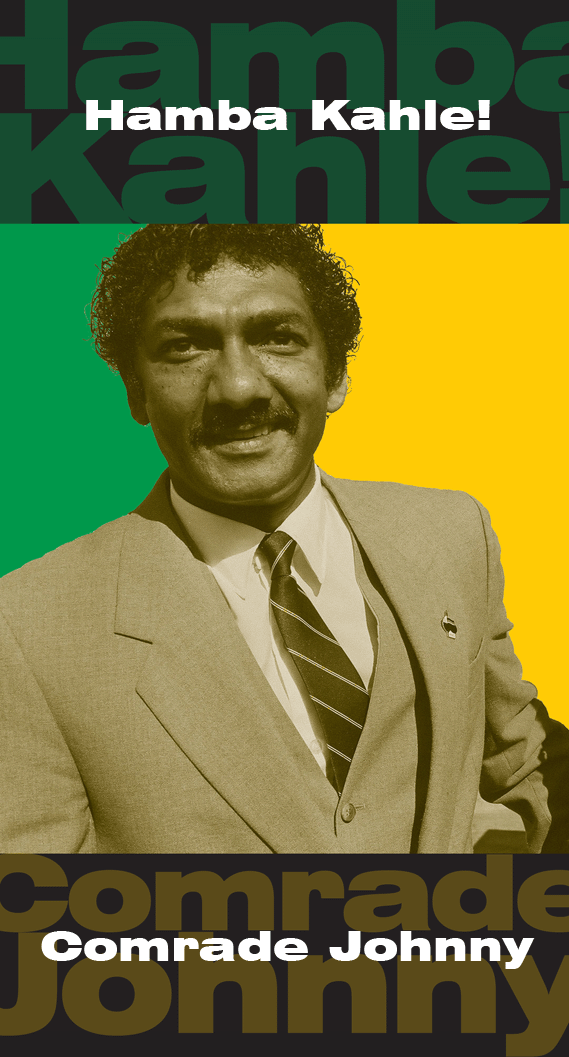
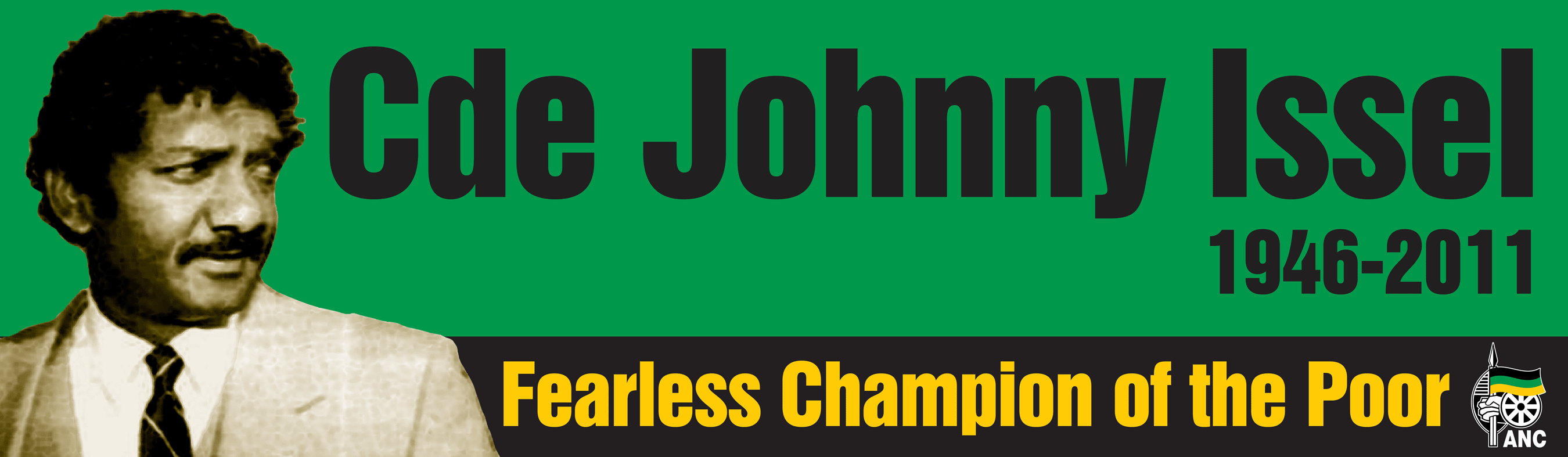
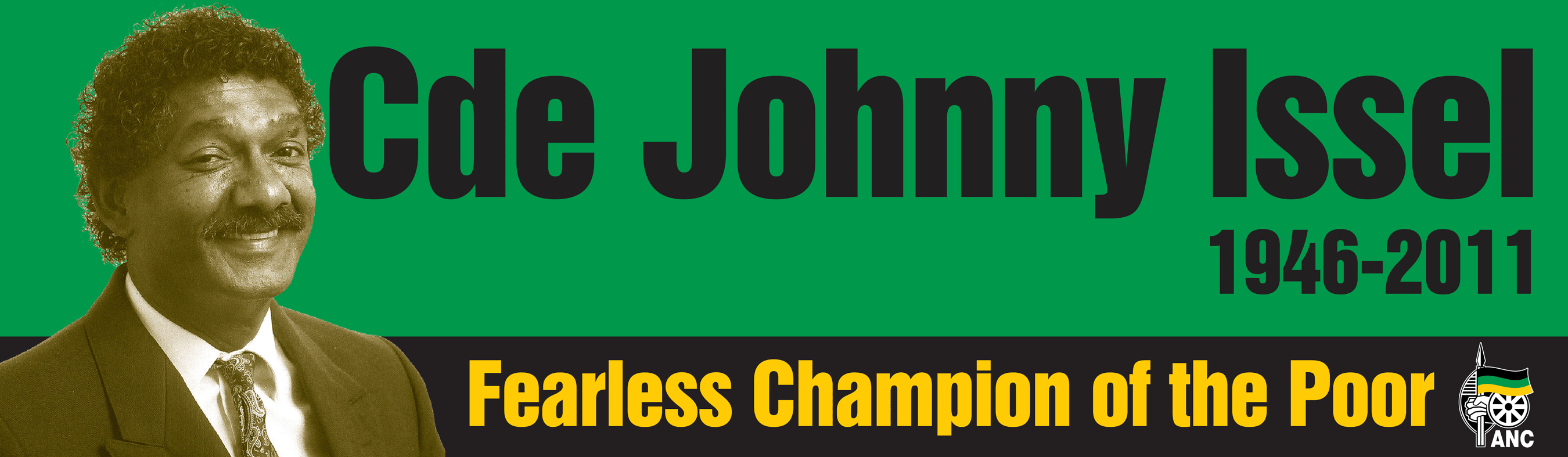
In 2011, on 23 January, an icon of the struggle for freedom and democracy in South Africa passed away. Johnny Issel was not just central to the formation of the United Democratic Front, he also played a critical role in the life of so many community organisations and activists from that era. I cut my teeth in media at Grassroots Publications that would not have existed if not for Johnny.
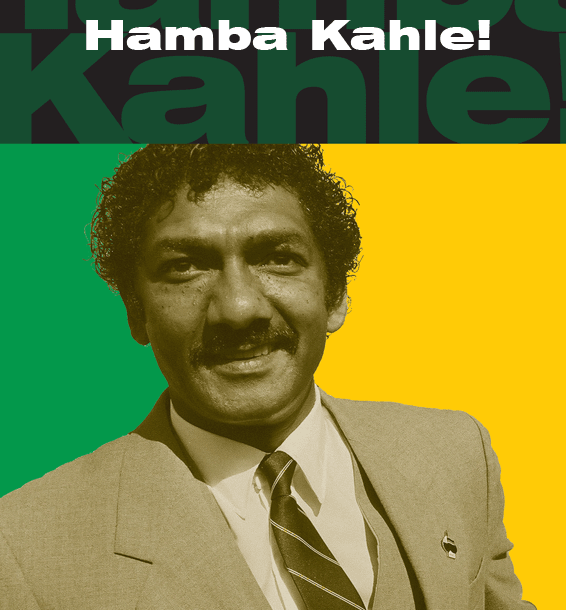
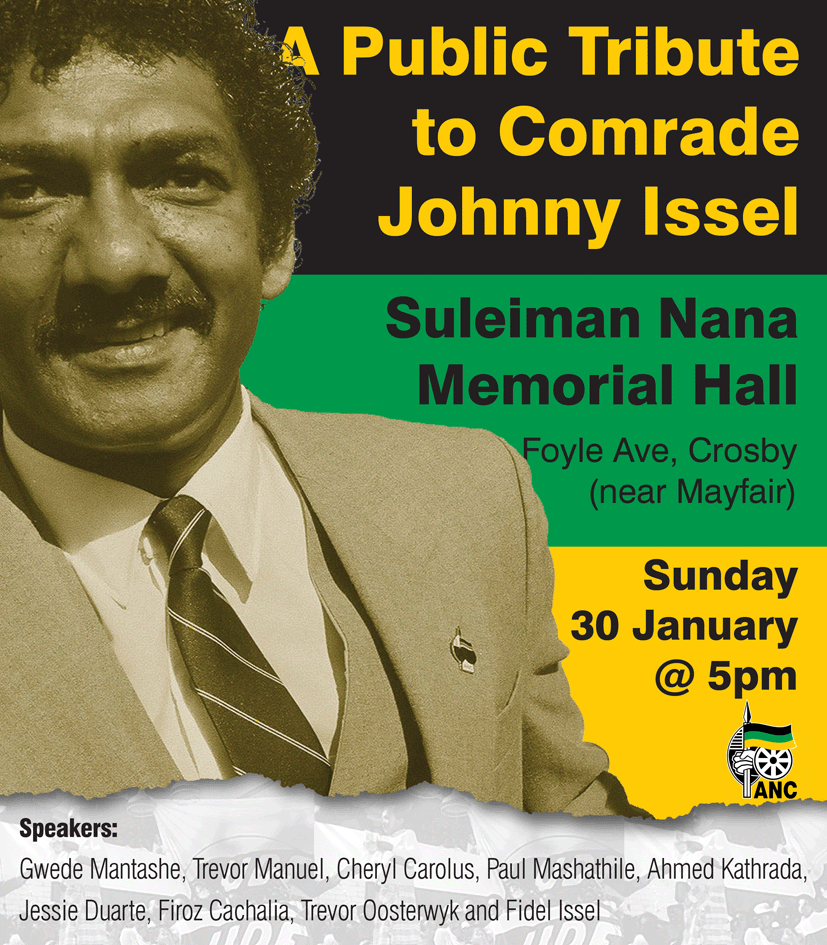
It was then a deep honour for me to be involved in the committee that organised a tribute to Johnny Issel in Johannesburg when many of his comrades and friends could not make it to the official memorial in Cape Town. My small contribution was to design posters and banners for that tribute.
In deciding how to design the banners and posters, I was inspired by the following comments Ryland Fisher made in his own tribute article:
But while he was promoting legal opposition to the apartheid regime, Issel also played a major role in popularising the ANC in the Western Cape and in South Africa while the organisation was banned.
He was the key driver behind the first public unfurling of the ANC flag at Hennie Ferrus’s funeral in Worcester, which was soon followed by more public displays of the ANC flag. At this time, one could be jailed for at least five years for possessing, let alone displaying, an ANC flag.
When the ANC was unbanned in the early 1990s, it was almost logical that Issel should be appointed as its Western Cape organiser. This time the title organiser was appropriate, because the ANC hoped to tap into his considerable experience of organising communities.



 If there is one poet that can speak to the heart of spirituality with a timeless relevance and cutting across different persuasions, then Rumi is most certainly the master. Raised on stories of his life by my dad, I have only really begun to make sense of Mevlana Jalalluddin Rumi recently.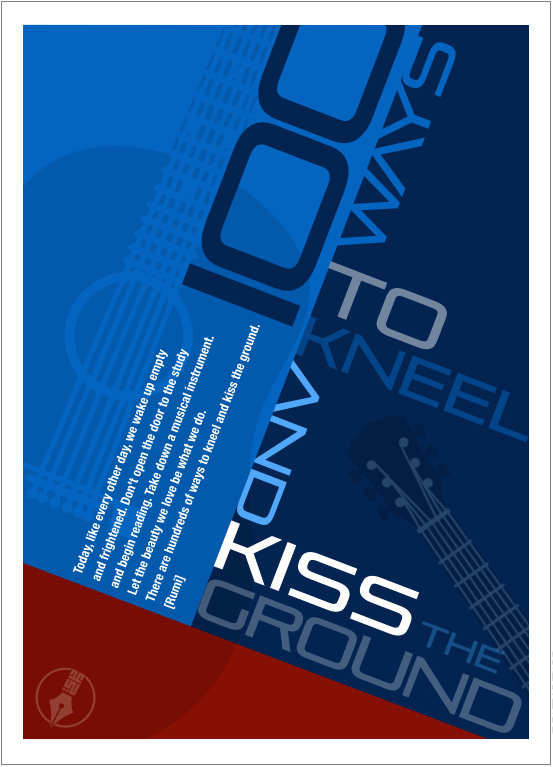
 Adli Yacubi