Tag: Anti-Apartheid

  • The Boy Who Waved Back: Remembering Riefaat Hattas of Manenberg
    The Boy Who Waved Back: Remembering Riefaat Hattas of Manenberg

    The Boy Who Waved Back: Remembering Riefaat Hattas of Manenberg

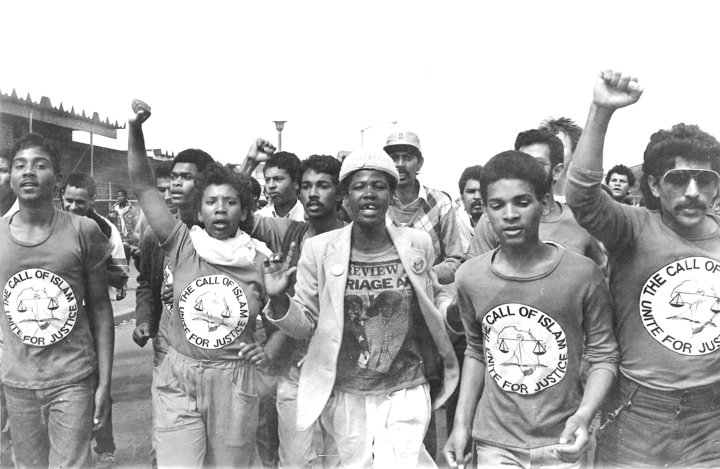
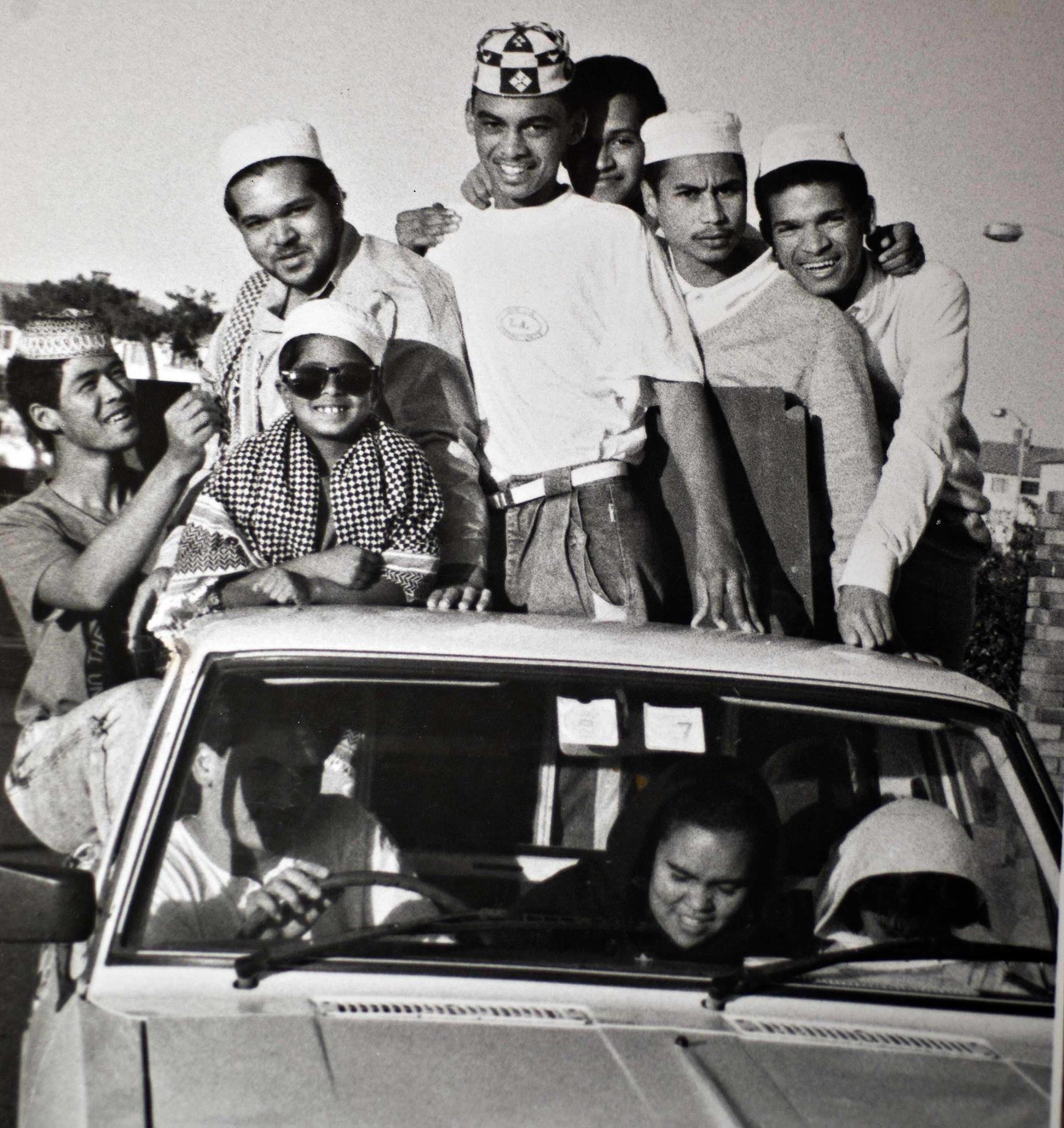
    Young activists of the Call of Islam, Manenberg, 1980s.
    Riefaat Hattas, second from top right, stands among friends and comrades — a generation brimming with laughter, courage, and purpose. [Pic: Yunus Mohamed]

    Manenberg: Where Struggle Learned to Laugh

    There’s a photograph from another time — a car crowded with boys and brothers, some perched atop, some packed inside, all lit by the unmistakable fire of youth. Manenberg, 1980s: a borrowed car, a shared cause, a city holding its breath.

    Among them is Riefaat Hattas — eyes forward, a quiet anchor in the rising tide.

    Those who lived through the 1980s on the Cape Flats will remember:
    Cars that carried more than passengers — they carried dreams, sometimes fugitives.
    Boys who became men before their time.
    Smiles that defied a brutal state.

    It was here, at Silverstream, in schoolyards dusted with chalk and hope, that Riefaat found his voice.
    A student leader, a Call of Islam activist, he joined a movement that dared to speak justice in the language of faith.


    A Life Shaped by Struggle

    Riefaat Hattas was born in 1968 and grew up in Manenberg, places shaped by apartheid’s sharp edges and the stubborn dignity of ordinary families. He matriculated at Silverstream Secondary in 1986, a year that would change his life and the country.

    That year, he led a student march — Casspirs ringed the school, hundreds of unarmed students brutalized by the SADF.
    He was only 18 — but already a leader, a UDF and ANC supporter, mentored by Celeste Naidoo and MK underground structures.

    In November 1985, during a march to honour detainees and the fallen, Riefaat was arrested under the Terrorism Act.
    Tortured at Manenberg station, interrogated, violated, broken down — then sent to Victor Verster Prison.

    “The National Party should take responsibility for destroying and ruining our lives.”
    — Riefaat Hattas, TRC Hearings, 1997


    Testimony and Trauma

    Riefaat’s scars ran deep, but he spoke them aloud at the Truth and Reconciliation Commission:

    “We aged ten to fifteen years in a matter of months… We never realized the kind of psychological stress and trauma we have been subjected to… I’m messed up because of what I went through during my high school days.”

    He admitted the cost:
    Nervous wreck, unable to finish school in a normal way. Many friends became casualties — some went into hiding, some fled, others fell into drugs or gangs.
    Riefaat himself needed weekly counseling to manage the trauma that never left.

    “Money can put something meaningful into my life. I have been tortured, I have nightmares, I could pay for counselling.”


    Action Without Fear

    Those who knew him say he was action-oriented, never content to sit on the sidelines.
    He became known for his directness, for “not being afraid.”
    He worked as a professional assistant officer for the City of Cape Town, always serving — quietly, sometimes with a smile that held both pain and possibility.
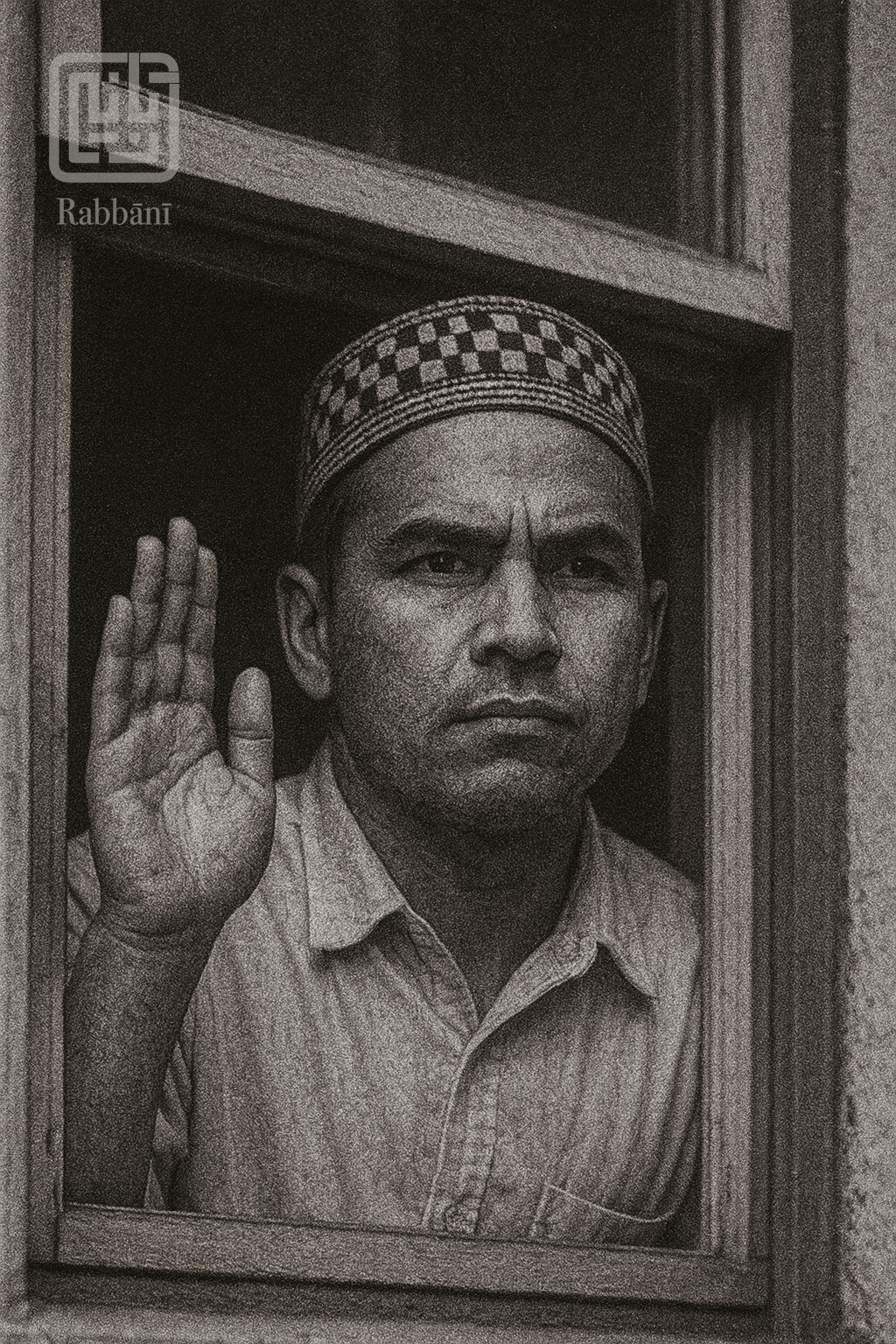

    Riefaat Hattas, looking out from an embassy window, kufiyyah on, defiant and unbroken.
    This scene — recreated in tribute — echoes the iconic image of a young comrade who refused to disappear, even when others scattered.

    Another time, he famously waved from the window of the American embassy during a similar protest. That photo is still an icon: the boy who refused to disappear.


    Legacy: The Freedoms We Now Inherit

    The freedoms Cape Town’s Muslims (and South Africans in general) enjoy today — to gather, to pray, to march, to speak — were won by Riefaat’s generation at terrible cost.

    “We never knew how big our contribution would become, how our struggle would free so many others.”
    So said a comrade at his janazah, echoing Ebrahim Rasool’s words.

    “He was one who stood out for justice as a witness to Allah. Riefaat carried the scars of torture and never broke — he stood in the embassy window, waving, so we would know not to run. The freedom we have today was won by his courage and the courage of his generation. Let us not pray perfunctorily; let us remember what was paid for us.”

    Stories now echo from one generation to the next.
    Medat Adams’ young son hears the “old days” — torture, detentions, the moppies that kept hope alive when hope seemed like madness.
    Riefaat was a storyteller, a writer of comic skits for the nag troop, a keeper of laughter in the midst of struggle.

    Riefaat: Lightness in the Struggle

    At rallies and mass meetings, Riefaat was always the one looking for a piece of cardboard — anything, just to make salaah on, wherever he found himself.

    During the matric exam boycotts, a group of them hid out at a teacher’s house. When the teacher came out, he called, “I can see you, Achmat!” — because Achmat was so tall, he couldn’t hide behind a bush.

    After court appearances, Riefaat would lead the hungry crew straight into a janazah house along Thornton Road — knowing there would always be food, and never standing on ceremony.

    Once, passing Pollsmoor Prison, he hung out the car window and led everyone in shouting, “Viva Mandela!” At the drive-in later that night, seeing white kids lugging their mattress home, he yelled out, “Sê ve jou ma — jy’t ’n comrade gesien!” [Tell your mom that you saw a comrade!]

    He had a gift for turning every moment — even hunger, boredom, or fear — into a kind of resistance and joy.


    #masekin — Ma se Kind, My Mother’s Child

    Not just the humble, not just the poor —
    but every child of the Cape,
    every struggler, every brother, every sister
    carried in the memory of mothers
    who gave more than they had,
    who called each of us masekin —
    my mother’s child,
    so no one would feel alone.

    For Riefaat, it was the truth of his life:
    He belonged to the people,
    and the people belonged to him.


    Legacy: Freedom, Memory, and Sacred Song

    But Riefaat was also a keeper of remembrance.

    Who can forget the play, 333 Years of Islam in South Africa?
    He wasn’t just a participant — he was central, guiding the theatre piece, leading voices through the opening invocation.
    He would start the Ratibul Haddad, and his voice — deep, insistent — would call out “Qul huwallahu ahad…” until the whole circle answered.
    He loved the Gadat, cherished the sacred rhythms that stitched community and soul together.

    These weren’t performances; they were living acts of ibadah, of memory, of survival.
    Riefaat made sure that in our struggle, we didn’t forget our dhikr, our poetry, our song.

    It’s no wonder he led the Gadat like he was born to it —
    his Hattas (Attas) blood remembering the names
    that sailed from Hadhramaut to the Cape.
    Barakah doesn’t always skip a generation;
    sometimes it lands on the tongue of a child who never forgot.

    [The Attas (Al-Attas) family are a Hadhrami lineage whose spiritual traditions—like the Ratibul Attas and the Gadat—helped shape Cape Muslim remembrance.]
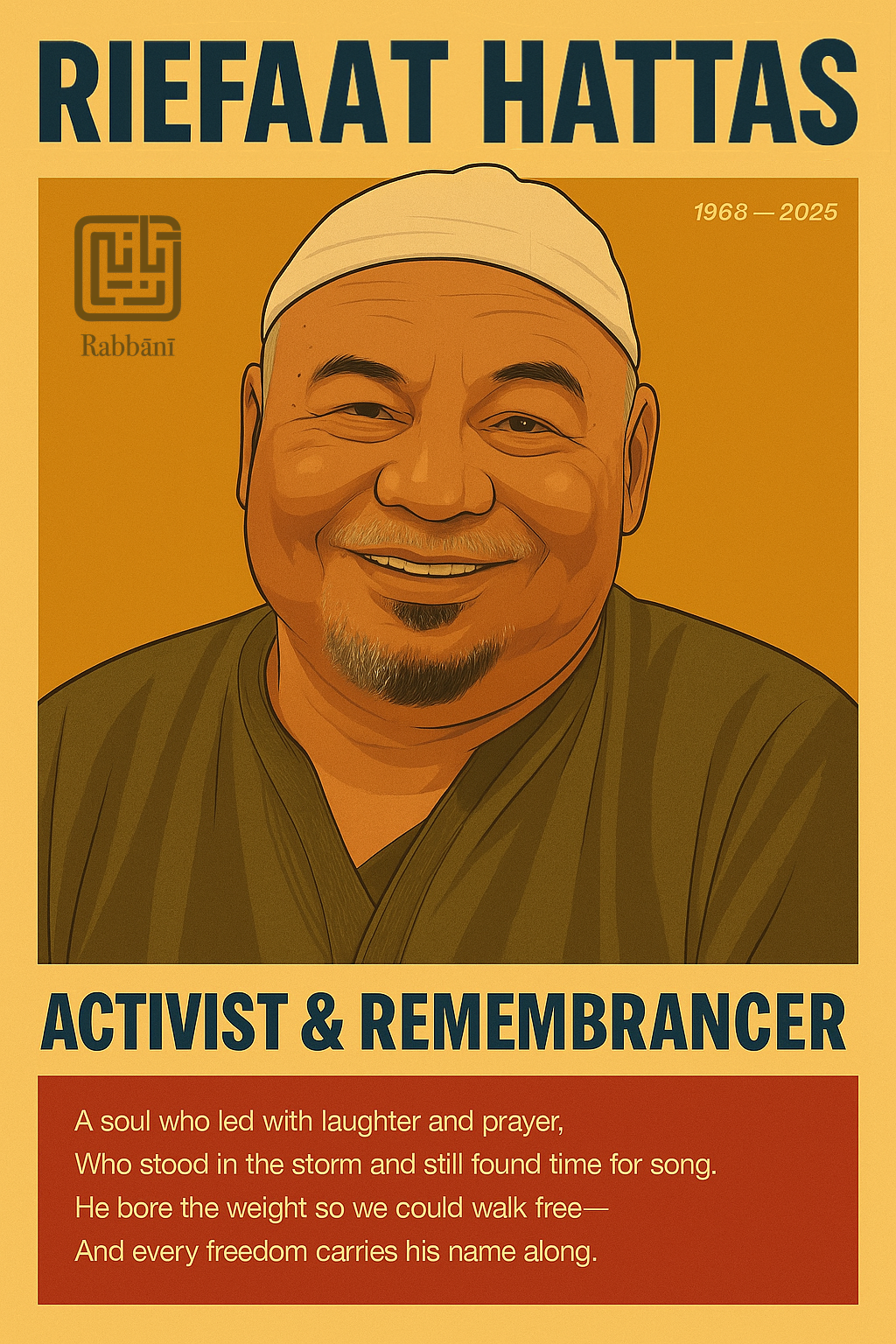

    Riefaat Hattas, years after the struggle.
    Still carrying the light, the smile, and the steadfastness that defined his youth.
    A witness to history — and a reminder that joy is its own act of resistance.

    Legacy at Work: Community Builder in the City

    After the struggle, Riefaat entered the City of Cape Town at the most basic level in the electricity department — but he never stopped building. According to Farouk Robertson (Communications, City of Cape Town), Riefaat steadily worked his way up to become central in community education for the City’s energy cluster. He was a true driver of interdepartmental, community-facing initiatives: creative, innovative, and never afraid to challenge technocrats to see things from the community’s point of view. He didn’t just serve; he inspired — often sharing new approaches and championing programs that brought real, active engagement into the City’s work.

    Even in the workspace, he was a man of progressive action.

    (Thanks to Farouk Robertson, via Shamile Manie, for these memories.)


    Closing Prayer

    May Allah gather Riefaat among the steadfast.
    May his wounds be healed in the gardens of peace.
    May we remember him — in our freedoms, in our laughter, in every act of justice — as the one who waved back when the world turned away.


    Tramakasi — Our Thanks

    This tribute would not have been possible without the memories, love, and testimony of those who knew Riefaat best.
    With deep gratitude to Ambassador Ebrahim Rasool, Shamile Manie, Salih Davids, Medat Adams, Dawood Hattas, Zieyaat Hattas, and the rest of his dear family — for their witness, their courage, and their generosity in holding Riefaat’s story with both pain and pride.

    May Allah bless you all. Tramakasi. Shukran. Thank you.


    References & Further Reading

    Oral Tribute:
    Ebrahim Rasool. “Janazah Tribute for Riefaat Hattas.” Delivered at Riefaat Hattas’s janazah, July 2025. (Notes and excerpts via Shamile Manie and Adli Yacubi’s transcription.)

    TRC Testimony:
    Hattas, Riefaat. Testimony at the Truth and Reconciliation Commission Children’s Hearing, Athlone, Cape Town, 22 May 1997.
    (As quoted in: SAPA, “TRC hears emotional testimony at children’s hearing,” 22 May 1997.)

    Activist Testimony & Reparations:
    “Govt ‘spits in face of apartheid victims’.” Mail & Guardian, 5 October 2000.
    (Quoting Riefaat Hattas on the cost of struggle and reparations.)

    Facebook Tributes & Community Memory:
    Jason Patrick Hanslo, “#masekin: Riefaat Hattas,” Facebook, 5 May 2022.

    Personal Correspondence and Memories:
    Shamile Manie, WhatsApp messages to Adli Yacubi, July 2025.
    Salih Davids, “My Brother in Islam, Riefaat” (tribute poem), July 2025.
    Ebrahim Rasool, Janazah Tribute, July 2025.

    Photographs:
    Yunus Mohamed, “Call of Islam, Manenberg, 1980s.”

    Published Blog Draft:
    Adli Yacubi, “The Boy Who Waved Back: Remembering Riefaat Hattas of Manenberg,” unpublished manuscript and blog, July 2025.
  • The Ratib al-Haddad: A Symphony of Spiritual Resilience

    The Ratib al-Haddad: A Symphony of Spiritual Resilience

    The Ratib al-Haddad: A Symphony of Spiritual Resilience

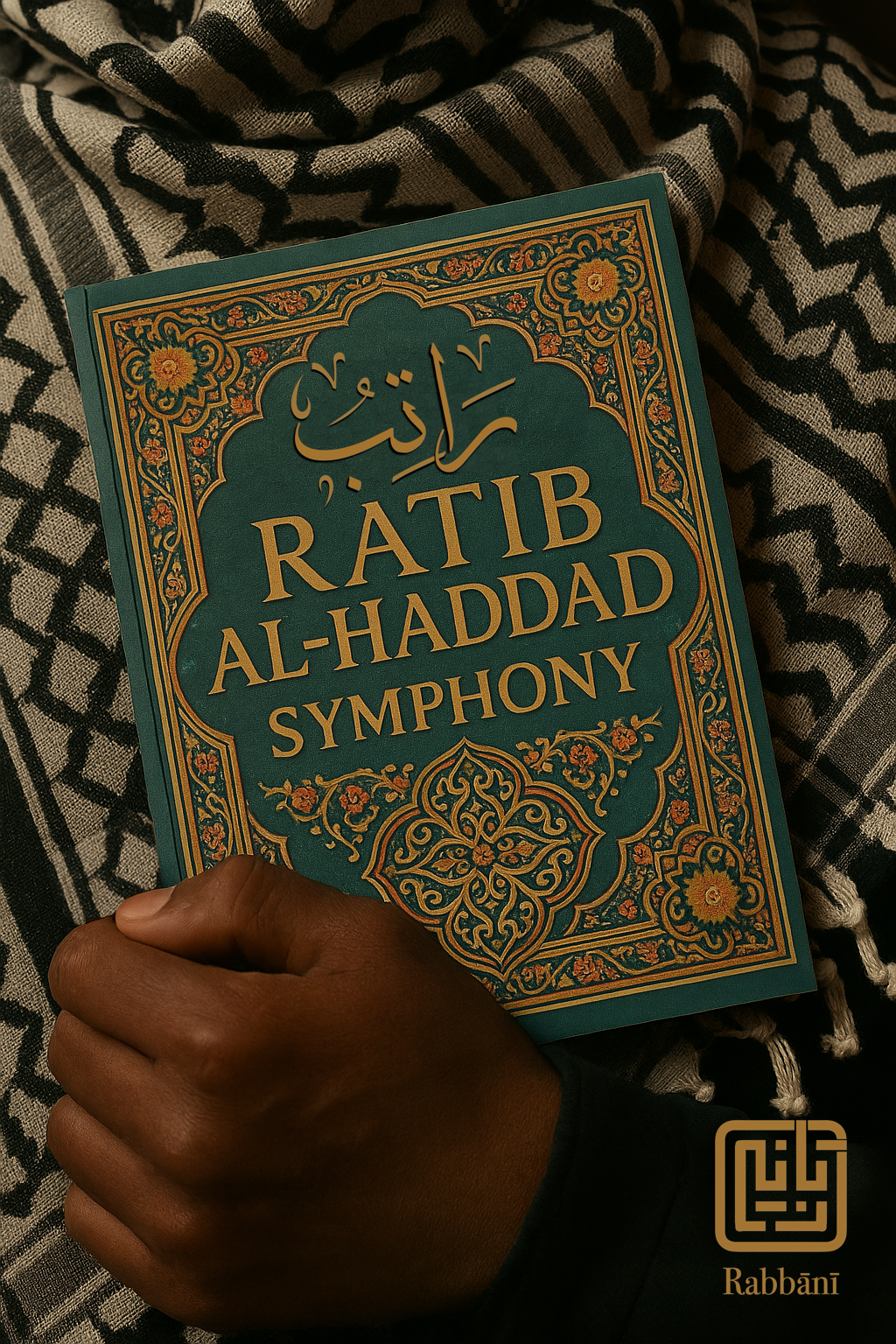
    Close-up of hand holding Ratib al-Haddad booklet with black-and-white keffiyeh

    Introduction

    In the centuries-old Cape Muslim tradition, the Rātib al-Ḥaddād stands as a spiritual symphony. Its composer, Imam ʿAbd Allāh ibn ʿAlawī al-Ḥaddād, drew upon a Qur’anic verse known as the Verse that Faces Outward at the Rawdah of the Prophet ﷺ, giving it a protective resonance. This rhythmic litany unfolds like movements of a musical masterpiece, each moment drawing the heart closer to Divine presence. Inspired by Imam al-Haddad’s mission to guide believers through fear and trial, the Ratib remains a living masterpiece of faith.


    Movement I: The Prelude of Protection

    O you who fear, gather at the gate of forgiveness; Bismillah like a banner above your heart, Ayatul Kursi as your armour, verses of Baqarah as your shield. In this dawn of remembrance, let salawat fall on your lips like rain upon a thirsty earth, and trust flow through your veins until your soul is clothed in light. This is the first movement: a prayer of protection woven from the very breath of Revelation.


    Movement II: The Rhythms of Remembrance

    Subḥānallāh, transcendence like the sky’s endless horizon; Alḥamdulillāh, gratitude flowing through every breath; Allahu Akbar, awe striking the heart; Lā ilāha illallāh, unity beyond all boundaries. These dhikr, recitations, rise and fall like ocean waves, polishing the mirror of the heart until it shines with trust and surrender.


    Movement III: The Pulse of Tawhid

    Al Maʿbūd, meaning The Worshipped One, calls the believer to recite Lā ilāha illallāh fifty times, each repetition chiseling away fear and confirming pure oneness. It circles the heart like a crown of certainty. The three Quls stand as guardians, their verses sealing every crack against doubt. This movement is a fortress of tawhid, where the soul forgets every other reliance and trusts only Allah.


    Movement IV: The Prayerful Crescendo

    Duas rise like incense, interlaced with Al-Fātiḥa, each plea a petition for healing, protection, mercy, and light. The tongue becomes a river of hope, carrying the soul to a calm shore. Here the believer surrenders every burden, resting in the assurance that Allah is the One who hears and responds.


    Closing Invocations

    • Al-Fātiḥa on the soul of our master, our beloved, our intercessor, the Messenger of Allah, Muhammad ibn Abdillah, his family, his Companions, his wives, and all his noble household.
    • Al-Fātiḥa on the soul of our master al-Muhajir Ahmad ibn Isa and his descendants.
    • Al-Fātiḥa on the soul of our great teacher, the jurist al-Muqaddam Muhammad ibn Ali Ba Alawi and his lineage.
    • Al-Fātiḥa on the souls of our noble Sufi masters wherever they may be, east or west, that Allah may raise their ranks.
    • Al-Fātiḥa on the soul of the compiler of the Ratib, the Axis of Guidance, Abdullah ibn Alawi al-Haddad and his family line.
    • Al-Fātiḥa on the souls of all the pious servants of Allah, our parents, our teachers, those who have rights upon us, and the believers who have passed away in this land.
    Decorative cover design for Ratib al-Haddad Symphony in traditional Islamic style

    Cape Ritual Practice

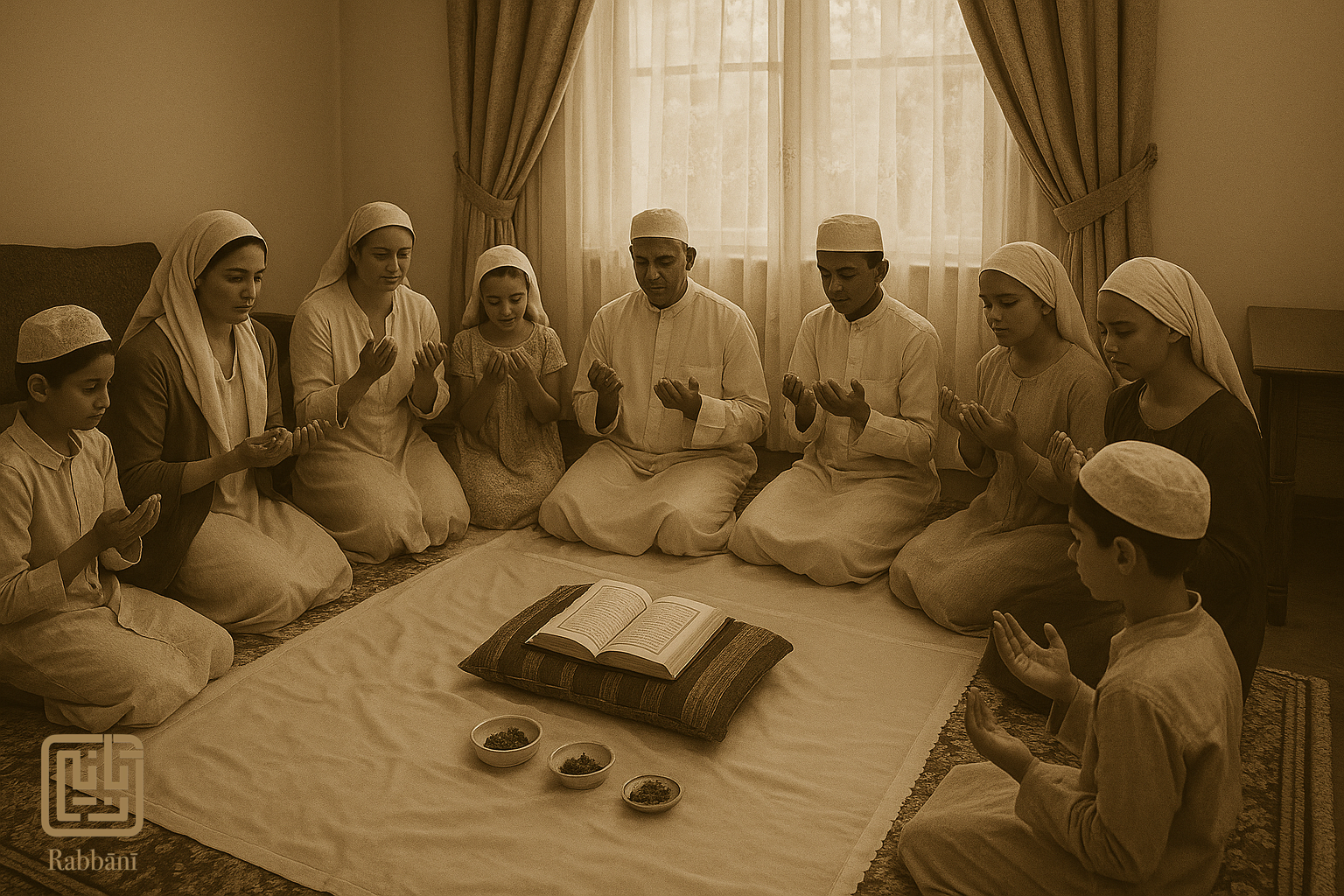
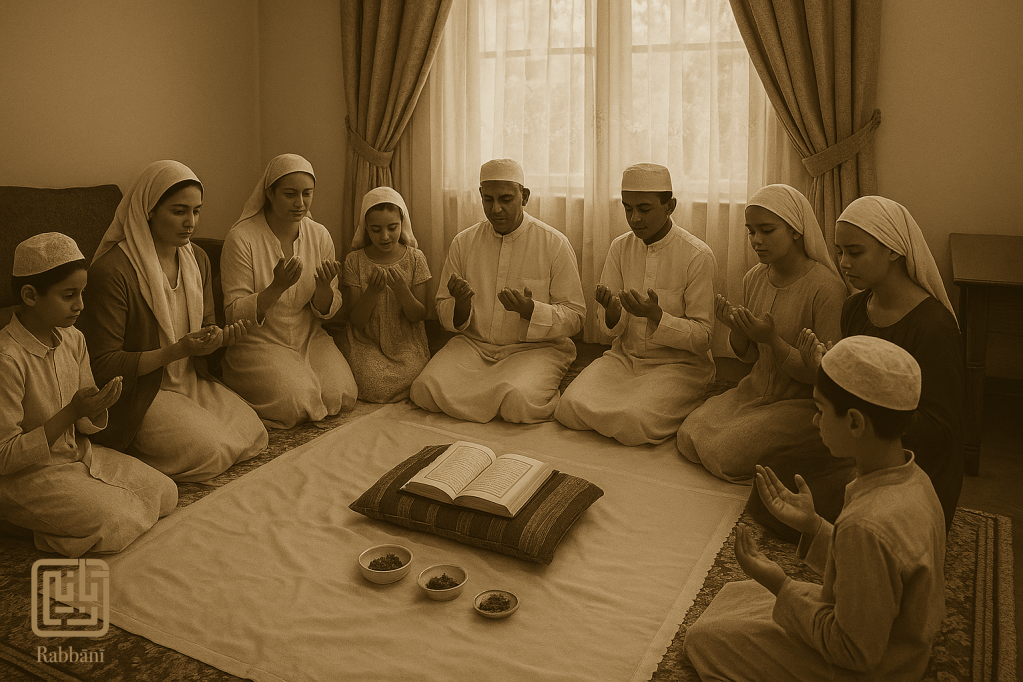
    In South Africa, especially in the Cape, families often recite the Ratib al-Haddad after a loved one passes away, beginning from the first night and continuing for seven nights, then gathering on the fortieth day, the hundredth day, and each year on the anniversary of the passing. The Ratib is also recited at birthdays, during Mawlud celebrations, generally every Thursday night, sometimes Sunday mornings, a week before weddings, at engagements (known as lambary), and at naming ceremonies (doekmal or doopmal). This tradition anchors the community in remembrance and prayers for all occasions of joy, transition, and remembrance.


    About Dhikr

    The term dhikr refers to remembering, remembrance, or reciting and chanting the names of Allah, specific prayers, or Qur’anic verses. It is a rhythmic practice that roots the soul in the Divine, and is central to the Ratib al-Haddad tradition.


    Individual or Group Practice

    The Ratib al-Haddad can be recited alone or in a group, with equal blessing. Allah says in the Qur’an: “And men and women who remember Allah often — for (all of) them Allah has prepared forgiveness and a great reward” (Quran 33:35). The Prophet ﷺ said: “People will not sit in an assembly in which they remember Allah without the angels surrounding them, mercy covering them, and Allah mentioning them among those who are with Him.”


    Decorative cover design for Ratib al-Haddad Symphony in traditional Islamic style

    Foundations

    The Ratib al-Haddad stands upon the firmest pillars of faith, a radiant string of pearls drawn from the Qur’an and Sunnah. It opens with the best Surah — Sūrat al-Fātiḥah, flows into the greatest verse — Āyat al-Kursī, affirms the Shahādah — the finest declaration of oneness, and continues with the enduring praises of al-Bāqiyāt al-Ṣāliḥāt. It includes the daily istighfār of the Prophet ﷺ, abundant ṣalawāt upon the Beloved ﷺ, and concludes with the dhikr by which Imām al-Bukhārī sealed his Ṣaḥīḥ.

    Composed in sacred sequence by Imām ʿAbd Allāh ibn ʿAlawī al-Ḥaddād — a noble grandson of the Messenger ﷺ — this Ratib is not merely a litany, but a luminous map of remembrance. It is a symphony of Qur’anic light and Prophetic rhythm, preserved across centuries as a living trust.

    And its resonance reached far beyond Ḥaḍramawt: both the Wird al-Laṭīf and the Ratib al-Ḥaddād were introduced and supported within the Harams of Makkah and Madinah under the patronage of Sultan Muḥammad IV of the Ottoman Empire (r. 1648–1687). This formal recognition affirms the Ratib’s deep-rooted legitimacy — not as invention, but as a distillation of the best of revelation, transmitted and treasured by the global Ummah.


    Ijāzah: A Living Trust of the Ratib

    For those who wish to benefit from the Ratib al-Haddad, we carry with us a sacred ijāzah — a scholarly and spiritual transmission — conveyed through four chains (asanīd) that reach back to the Composer of the Ratib, Imām ʿAbdullāh ibn ʿAlawī al-Ḥaddād**, may Allah sanctify his soul.

    Shaykh Jamiel Abrahams writes:

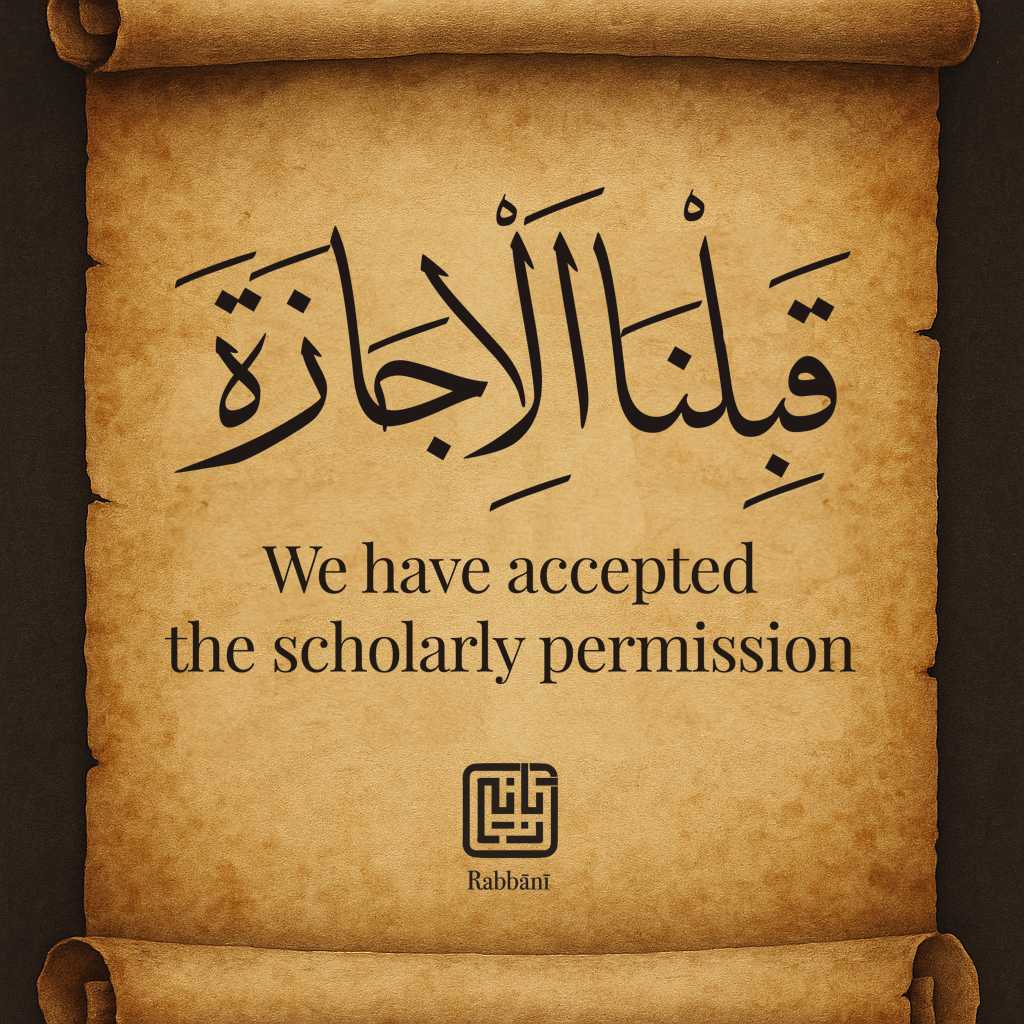
    “Ijāzah for those who wish to benefit from the four asānid to the Composer of the Ratib… Say: Qabilnā al-Ijāzah — ‘We have accepted the scholarly permission to recite the Ratib of Imām al-Ḥaddād.’”

    “We say Composer, not Author — for the adhkār are drawn from the finest pearls of the Qur’an and the most radiant lights of the Prophetic Sunnah.”

    This ijāzah is not just scholarly — it is a living trust passed down through centuries of remembrance. To receive it is to stand in the river of continuity, with the awliyāʾ and scholars who preserved this path of dhikr through love, hardship, and sincerity.

    And as for those who label such remembrance a bidʿah

    رَغِمَ أَنْفُ مَن صَرَّحَ بِأَنَّهَا بِدْعَةٌ
    “May the nose be rubbed in dust of the one who declares it an innovation.”

    Let the river flow. Let the remembrance remain. And let every breath that utters His Name be a proof of mercy, not division.


    My Personal Ijazah

    This symphony carries my own transmission: an ijāzah granted by Zaid ibn Umar to me, Adli ibn Ibrahim, written in his own hand, linking me to the chain of Imam al-Haddad. That blessing lives within every note of this symphonic meditation, reminding me of the trust, humility, and sacred responsibility that this heritage confers. This ijazah is more than a note: it is a living chain, a breath carried from master to student across centuries, reaching back to Imam al-Haddad and forward into my heart. It binds me to the rhythm of this Ratib as if to a heartbeat, reminding me to hold it with care, reverence, and gratitude, so its protection and blessing might continue to resonate for future generations.


    Historical Echoes

    The Ratib was recited by enslaved Muslims at the Cape as a shield of hope and protection during times of oppression, helping them hold fast to faith. Generations later, it became a spiritual companion for many who resisted apartheid, its verses reminding them of divine justice, courage, and unity against all forms of tyranny. It is said that in the darkest nights of slavery at the Cape, the Ratib became a quiet liberation, whispered in hidden corners. Its rhythms reminded believers they were still seen by Allah, still dignified. During the anti-apartheid struggle, activists turned to these same verses, finding courage and calm as they faced injustice, with the Ratib a spiritual sword against oppression and despair.


    Conclusion

    From Yemen to the Cape, from ancient gatherings to modern hearts, the Ratib al-Haddad remains a living breath of resilience and unity. Its movements still guide communities to remember Allah, to stand together in hope, and to place trust in Divine mercy across the centuries. Like a living river, its currents still flow, nourishing communities with remembrance and calling them to a higher trust in Allah’s mercy. Imam al-Haddad, inspired by the symbolism of the Verse that Faces Outward, wove its spiritual meanings into the Ratib, transforming it into a shield that echoed both the Prophetic sanctuary and the everyday lives of worshippers from Yemen to the Cape.

    Family reciting Ratib al-Haddad together on white linen with pillows and Qur’an

    May its verses guard every heart, and may its blessings gather our children and their children into the same ocean of divine love, until the final day.


    You Might Also Like These Cape Memories

    ✨ Scroll of the Sorbaan & Medora – Worn in Sound, Washed in Meaning
    Exploring the sacred cloths and their living resonance.

    ✨ The Verse That Faces Outward
    A glimpse into the calligraphic verse guarding the Rawdah.

    ✨ Hy Lyk Soos ’n Wolf: The Sorbaan and the Teacher Who Raised Me
    A tribute to a teacher’s quiet strength and Cape heritage.

    ✨ Tamat: A Sacred Completion, A Living Beginning
    The meaning of tamat in Cape Qur’an recitation tradition.

    ✨ From Chains to Qur’an: The Cape’s First Pilgrim and My Bloodline
    Tracing the story of Cape Islam through my family’s journey.


    Coming Soon

    ✨ The Grandmothers Who Raised the Qur’an — celebrating Cape matriarchs who preserved Qur’anic recitation.

    ✨ Echoes of Arafah: Pilgrim Voices from the Cape — reflections from local hujjaj returning with spiritual stories.

    ✨ The Kramats: Guardians of the Cape — the circle of Cape saints who protect and inspire.

    ✨ Barakah Before Business: The Forgotten Blessing — Cape Muslim traders and their rituals before opening shop.

    ✨ The Secret of Rampies Sny — unveiling the Cape’s scented floral traditions linked to dhikr gatherings.


  • Remembering the Call of Islam

    Remembering the Call of Islam

    call-march
    Call of Islam march in the 1980s. Pic: Yunus Mohamed

    When I published my first book in 2014, a community in Pretoria invited me to share with them the significance and the reasons for writing Punching Above Its Weight

    Cover

    Launched in 2017.

    I am most grateful for this opportunity to speak to you today, at the Rasooli Centre, on my first book, Punching Above Its Weight – The Story of the Call of Islam. This is not just a story of my own youth, of how I came to be a part of such an important organisation. This is not just a biography of the Call of Islam and how the organisation as well as the broader community developed a new and fresh way to view our own Islam.

    This is not just the story of how a tiny Muslim population at the tip of Africa, in concert with others, stood their ground against the mighty apartheid government and policies of dehumanising all who were deemed lesser because of the colour of their skin. It is not just the story of the resilience of a population who, despite massive exploitation and oppression, stayed true to their humanity and made space for many, including members of the white population, in the struggle against apartheid.

    Written in an easy style, without complicated language, I try to tell the story of a seemingly insignificant political movement that made far-reaching contributions to the freedom struggle in South Africa. The book traces the many activities of the Call of Islam, the mass rallies, the interfaith gatherings, funeral demonstrations, culminating in the one of biggest and most significant gatherings of Muslims in SA, the National Muslim Conference in 1990.

    Punching Above Its Weight is about all of these and more. Ebrahim Rasool, now the ex-SA ambassador to the US, reflects on this in the Foreword to the book:

    “It is a travesty that we have waited almost 30 years for Punching Above Its Weight – The Story of the Call of Islam to be told. I am happy that Adli has now done so. It may not be a perfect rendition of the history; a complete account of every debate, campaign or incident; or a personal recall of every brave and thoughtful member. But it fulfils a need.

    “In a world where some Muslims present us as backward by their example, and our opponents project us as barbaric in their propaganda, the least that this book will do is to say that in 1984, in the midst of an almighty struggle against apartheid, there emerged from a community that came to South Africa as slaves and exiles, who constituted only a small minority, yet from them the Call of Islam was born.”

    So, in many ways, it was the Call of Islam, Muslims in South Africa and freedom-loving South Africans generally who all punched above their weight in a time when we thought we would never see the day when we would all be free. That was a time when Ronald Reagan’s America saw South Africa’s apartheid government as an ally in the Cold War and when the rest of the world’s nations (except a few) were slow to respond to the crimes against humanity that was taking place in South Africa. We were then where Palestine is today, under the occupation of a brutal regime.

    The book is, at one level a celebration of our South African victory, but also about the lessons we must learn from this experience because of what use is a celebration for humanity if we do not try to understand how we overcame our biggest challenges. I believe, in attempting to understand how we changed our selves in the midst of struggle, we can use those insights to inform what our role should be today and make better use of our present freedoms and challenges. Because…

    “Centring on the story of the Call of Islam is in many ways a lens to look at the details of the South African struggle. It means zooming in, as you would with a microscope, to observe the anti-apartheid struggle by focussing on some of its compounds and atoms that give a different insight than if one just looks at the broad strokes. And because the Call was more than just a faith-based organisation – rather, it was one engaged in political struggle – its model can be educational to many social movements, activist or non-governmental formations, and even social welfare groups, both in South Africa and beyond.”