Tag: Cape Town

  • The Legend of the Silver Tree

    The Legend of the Silver Tree

    The Legend of the Silver Tree

    (Passed down through the mothers. Told now in your hands.)

    My mother told me this story.
    She said her own mother heard it from her mother.
    So now, I pass it to you — like a seed in the wind —
    so that you, too, might send it down the line.
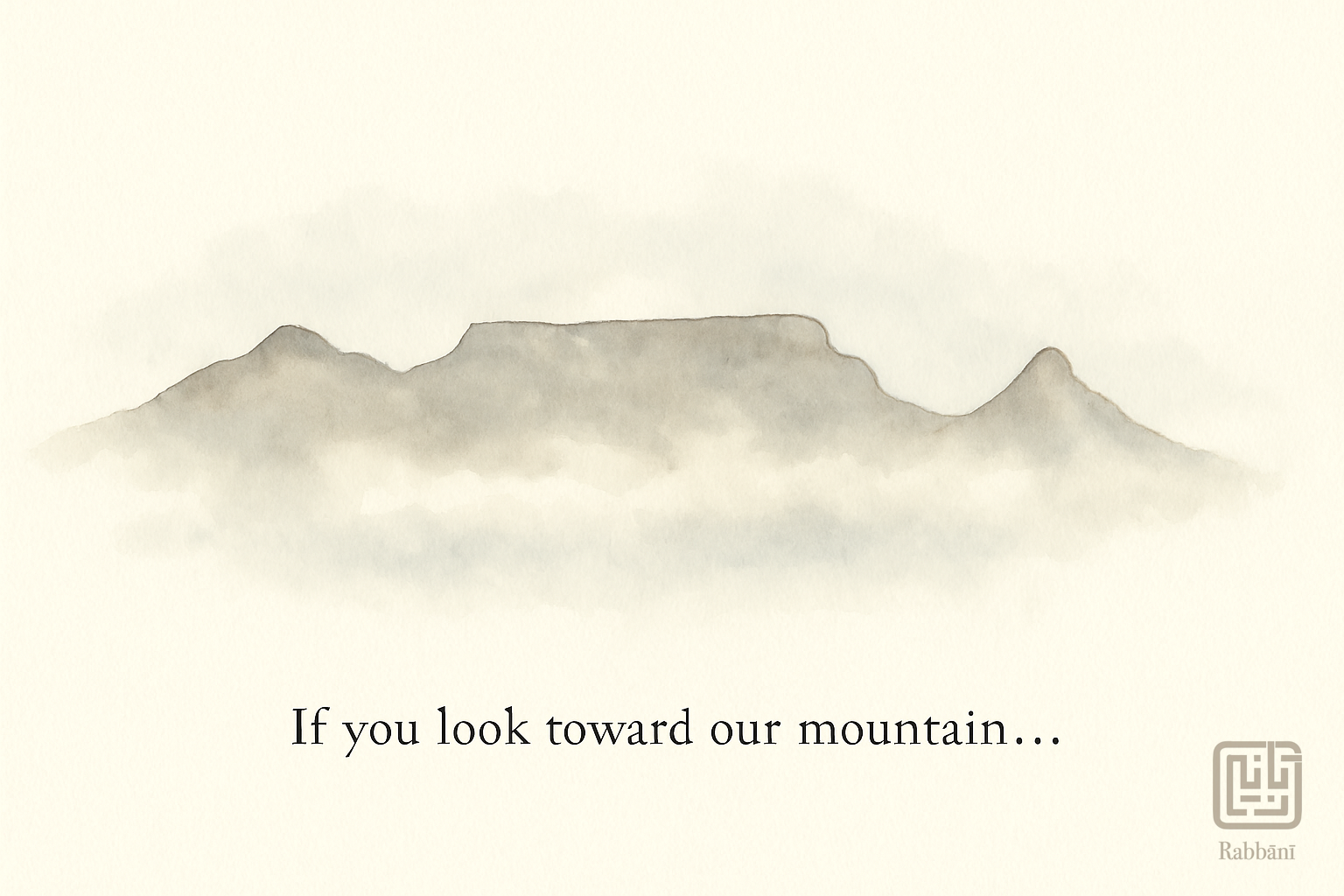
    If you look toward our mountain — Table Mountain —
    you’ll see the cloth of cloud spread across its top like a table set for guests.
    To the right: the lion, his back forming Signal Hill, his mane rising into Lion’s Head.
    To the left: Devil’s Peak, brooding.
    The lion and the devil seated at the same table.
    What a sight for any ship entering Table Bay!

    But this story is older than the ships.
    Older than the settlers who named those peaks.
    Older even than the first Khoi and San who walked these lands.

    Long, long ago — perhaps 22,000 years or more —
    the people lived far inland.
    The land was green. Rivers ran deep.
    Wild animals moved in herds like shadows.
    The earth was generous.

    But then the rains lessened.
    The land grew hotter, harder.
    Some clans became violent.
    The world was shifting.
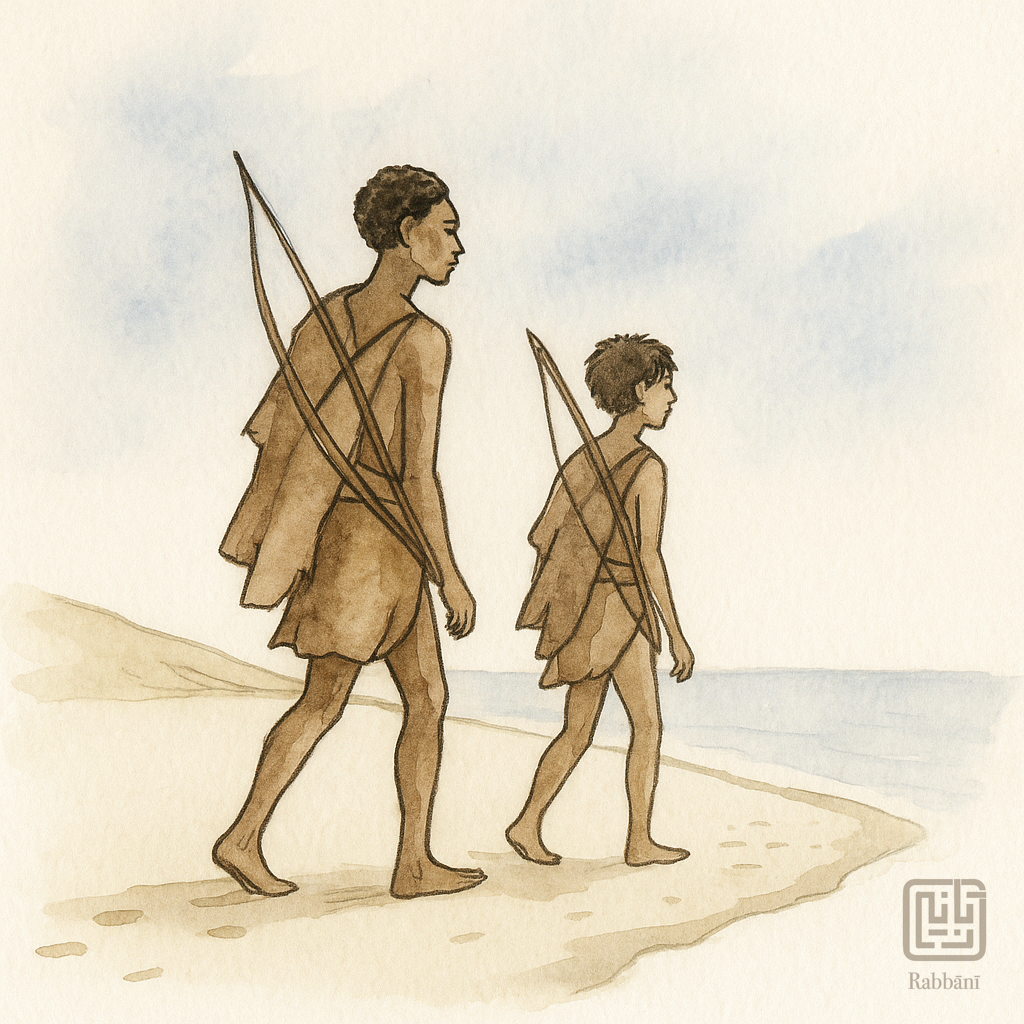
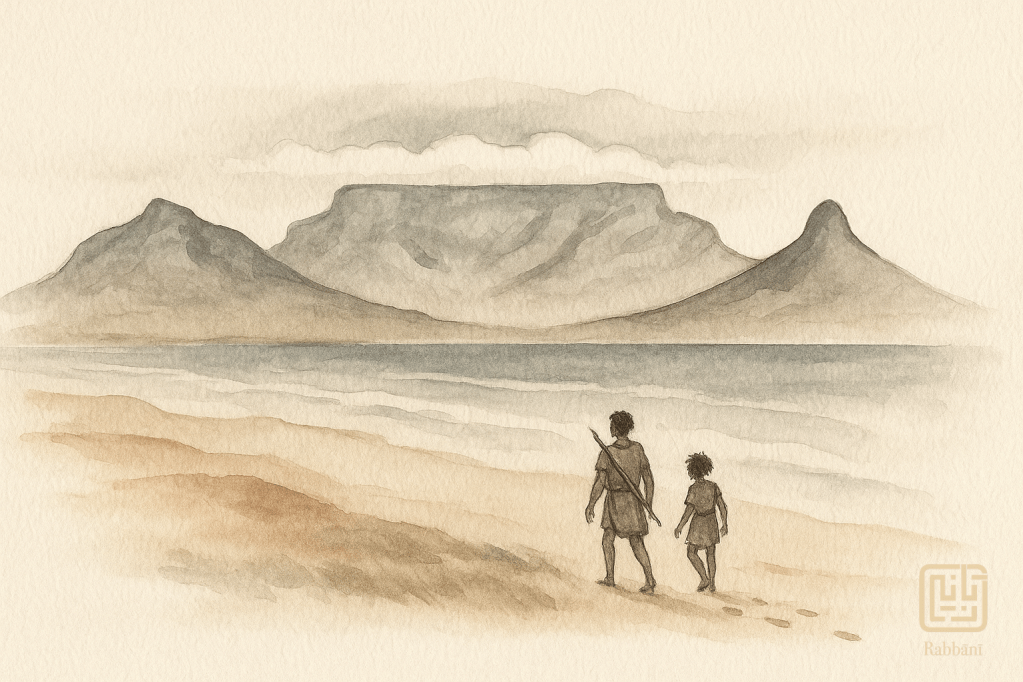
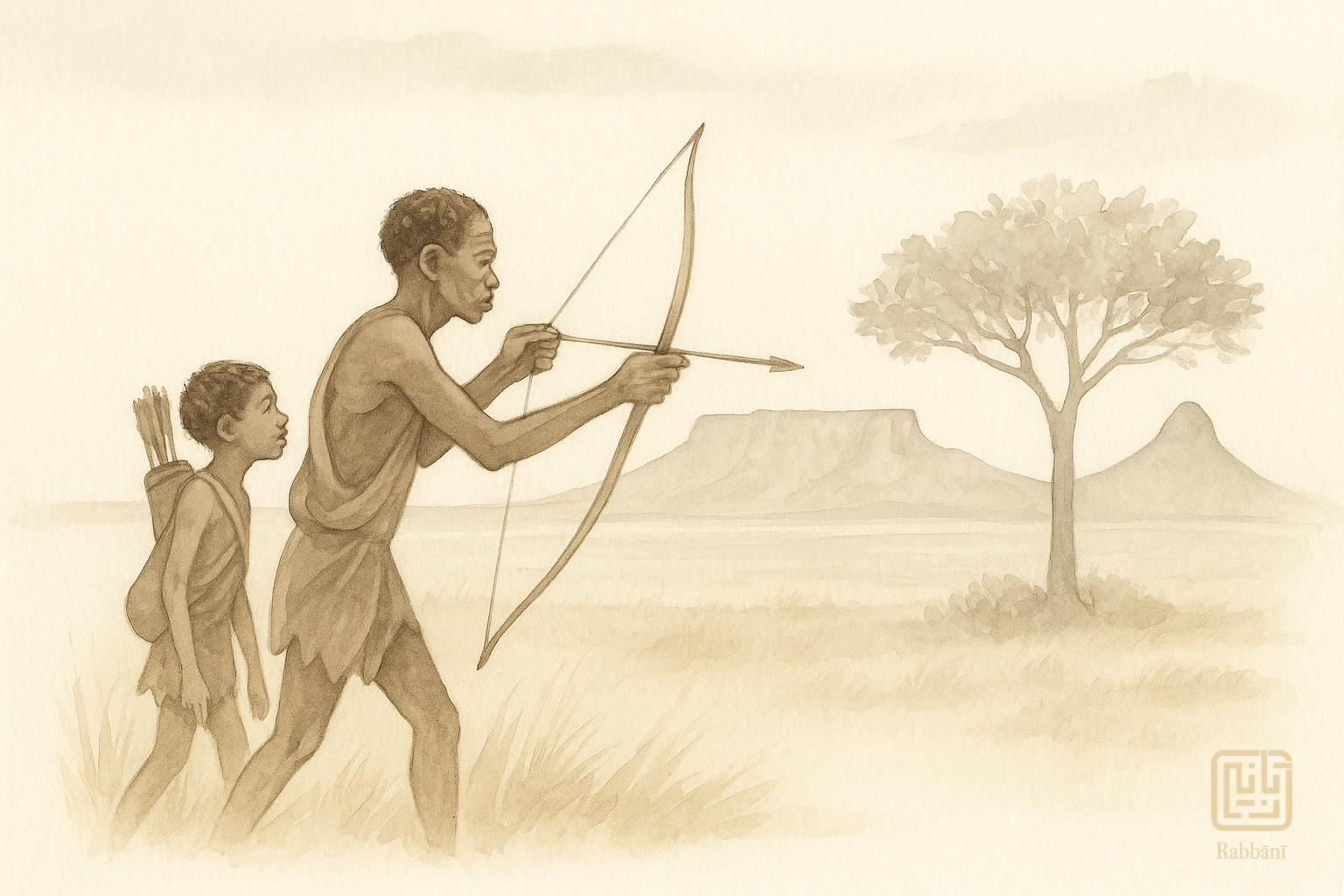
    And so it was that a man named Gubi — a fire-maker, a spark of a man —
    took his young son, Nori, and journeyed south along the Atlantic edge.
    Not fleeing.
    Seeking.

    Their goods were wrapped in leather.
    Their bows slung across their backs.
    They followed the cold sea winds,
    walking toward a dream of sanctuary.
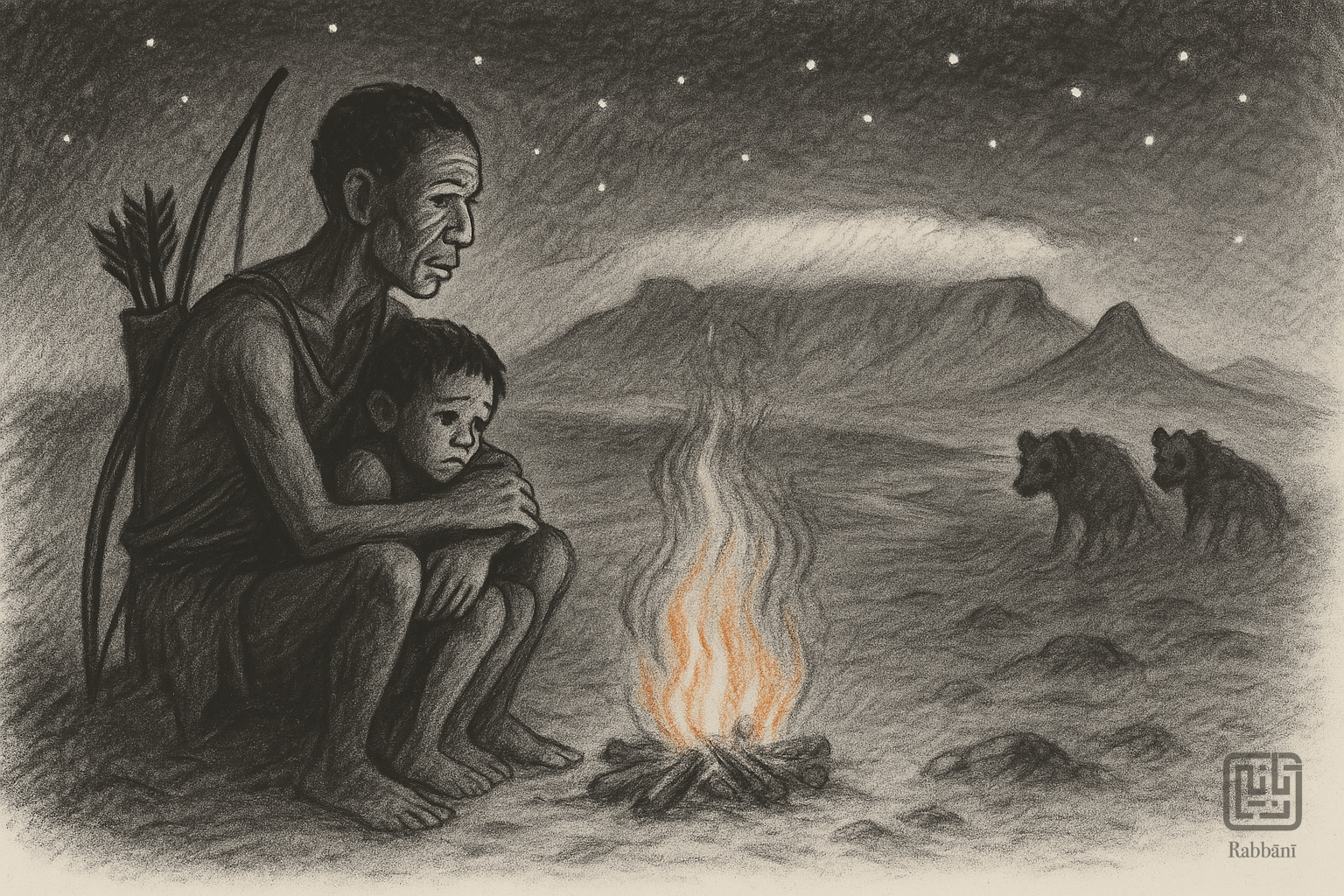
    One night, as their fire danced in the dunes,
    hyenas came snarling through the dark — hunting porcupines.
    Gubi rose with fire in hand, casting its light wide,
    pushing the predators back into the night.

    From the shadows came a porcupine.
    But this was no ordinary porcupine.
    She was old — a sage — her quills silver with wisdom.
    She stepped forward and spoke in a voice like rustling leaves:

    “You have shown courage and care.
    For this, I give you a pouch.”

    Inside: a handful of shimmering seeds —
    soft, silver-tipped, unlike anything they had seen.
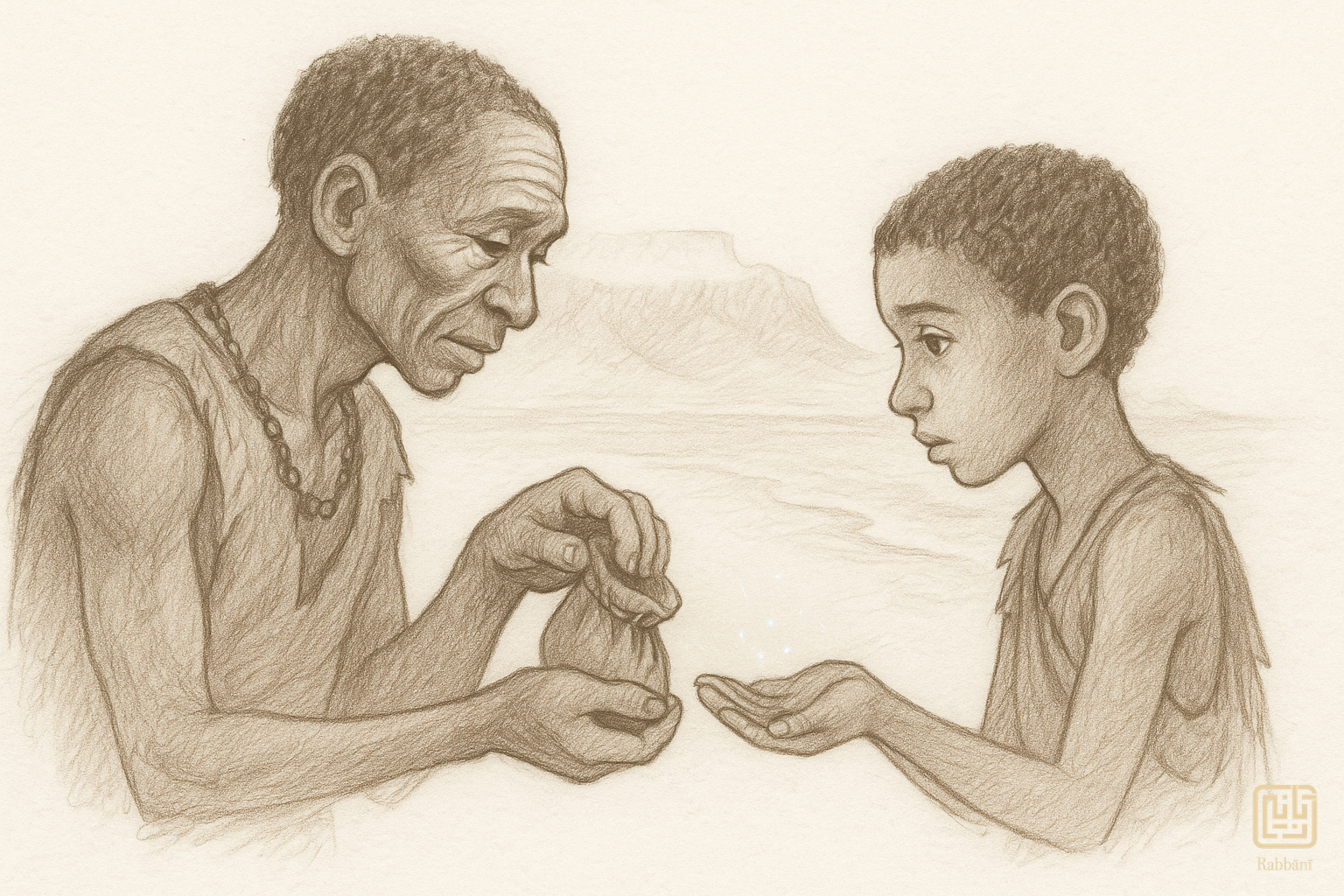
    She said:
    “As you walk,
    look for the place where the sea makes clouds.
    When you find it, plant these.
    If they grow, you’ll know: this is your place.”

    And so they walked on.

    And when they reached the foot of the mountain —
    flat, cloud-veiled, vast —
    Gubi and Nori felt the truth of it in their bones.
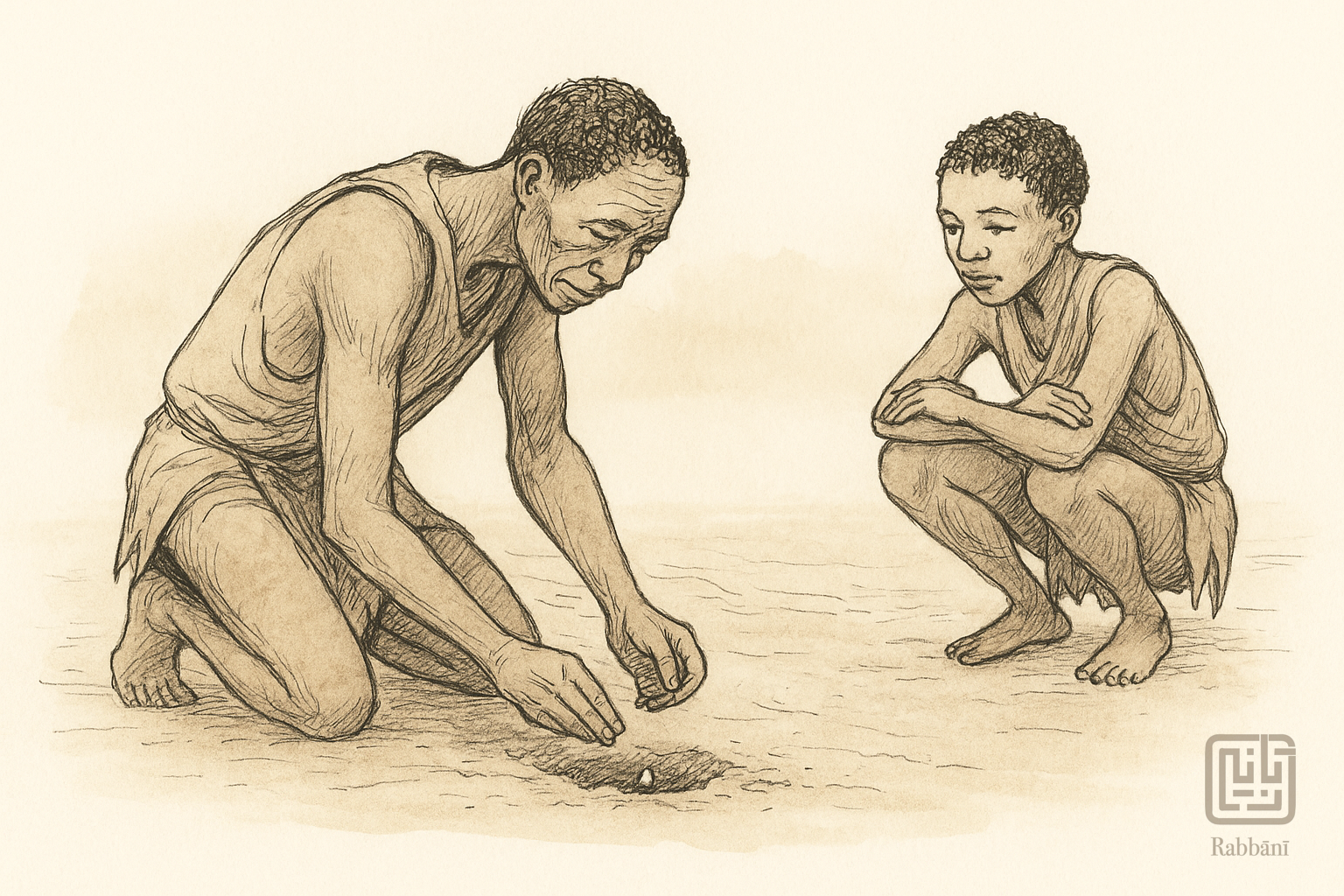
    They planted the seeds.

    And by dawn, the Silver Trees had begun to rise —
    shimmering, breathing, alive.

    Not just plants.
    A blessing.

    And that is how the Silver Tree — found only here —
    came to live beneath Table Mountain.
    Not brought by botanists.
    Not named by settlers.
    But gifted by a porcupine,
    Planted by Gubi and Nori,
    Rooted in fire, story, and seed.
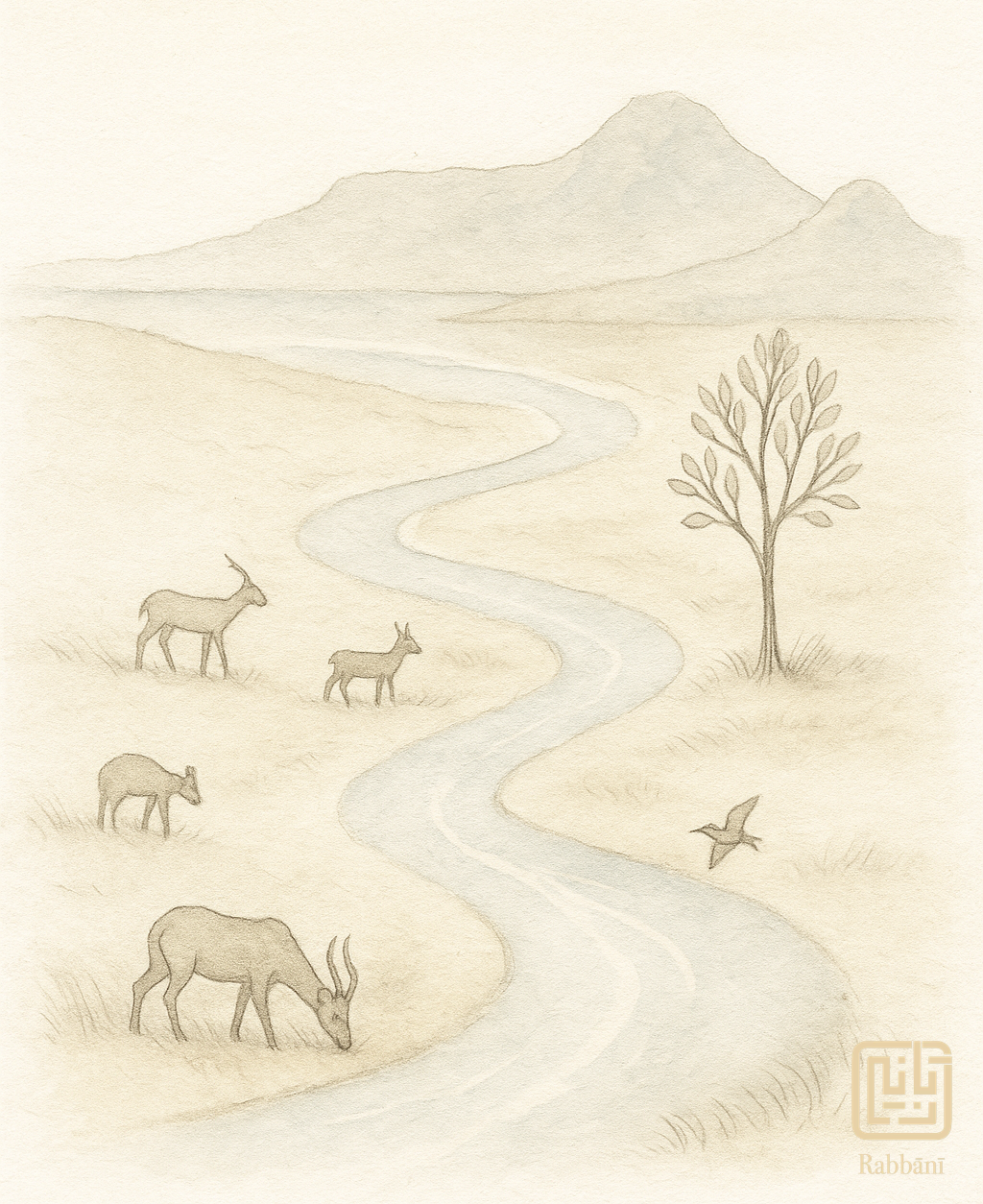
    And when the rains came,
    those Silver Trees
    drank from the river
    that flowed down the mountain —
    the one they called Camissa
    the place of sweet waters,
    rushing underground, murmuring toward the sea.

    Even now, that river runs — quietly —
    beneath the city that forgot it.
    But the mountain remembers.

    It remembers its own name.

    Not Table.
    But Hoerikwaggo — the Mountain of the Sea.
    To its right, the curled-back hill they once called The Sleeping Lion
    its back arched into what settlers would name Signal Hill,
    its mane rising into Lion’s Head.
    To the left, the shadowed one —
    once called Windmaker’s Watch,
    now called Devil’s Peak.

    The land is older than its names.
    And stories, like rivers, find their way back.

    Epilogue

    Some stories are planted, not written.
    They take root in silence.
    They grow in the shade of memory.

    This is one of those.

    Passed from mother to daughter, from father to son,
    from fire-circle to ear, from silence to word.

    The Silver Tree still stands.
    The mountain still watches.
    And somewhere, Gubi and Nori are still walking —
    between cloud and coast,
    between the land’s longing and the sky’s answer.

    So tell this story again.

    When the mountain is misted,
    when the wind shifts,
    when the child beside you asks,
    “Where did we come from?”
    Tell them…

    “Let me tell you the story of Gubi and Nori —
    the spark and the seeker —
    and the tree that shimmered with yes.”

    Postscript

    This story is told in honour of those who remind us that memory is a form of resistance.

    We acknowledge Patric Tariq Mellet, whose book The Camissa Embrace reclaims the deep currents beneath colonial erasure. Through his work, Camissa is no longer hidden — it is remembered as a place of sweet waters, of creolised identity, of sacred convergence.

    We also draw from Stuart Hall, particularly The Fateful Triangle: Race, Ethnicity, Nation, which reminds us that nations are not simply born — they are narrated into being.
    To say I am from Camissa is to resist imposed categories and to speak from the riverbed of relation — to narrate the nation otherwise.

    This reflection flows alongside the companion essay:

    → A Word That Wounds and Wakes Us: Rethinking “Coloured” in the Age of Memory
    which wrestles with the term “Coloured” — its violence, its survival, and the sacred dye of remembrance:
    ṣibghah Allāh — the Colour of God (Qur’an 2:138).

    🌿 Author’s Note

    I wrote this story in honour of a voice passed through many generations — from my mother, to her mother, and beyond. It weaves ancestral memory with imagination, drawing from the wisdom of our lands, our rivers, and our people.

    Gubi and Nori may be characters in legend, but they carry something real: the spirit of all those who walked before names, who travelled with seeds, and who listened deeply to the mountain’s silence.

    I offer this story as a small act of remembering — a quiet prayer that memory may once again run like water beneath the city.

    – Adli Yacubi
    Writer. Listener. Wordsmith of the Sweet Waters.

  • Zohran Mamdani: Lessons from a Cape Town Childhood, a New York Campaign, and a New Politics

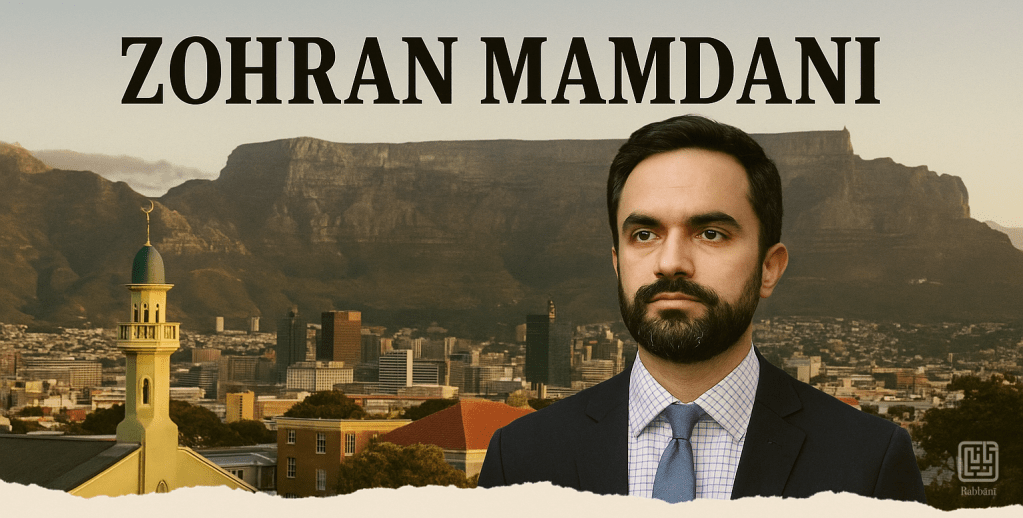
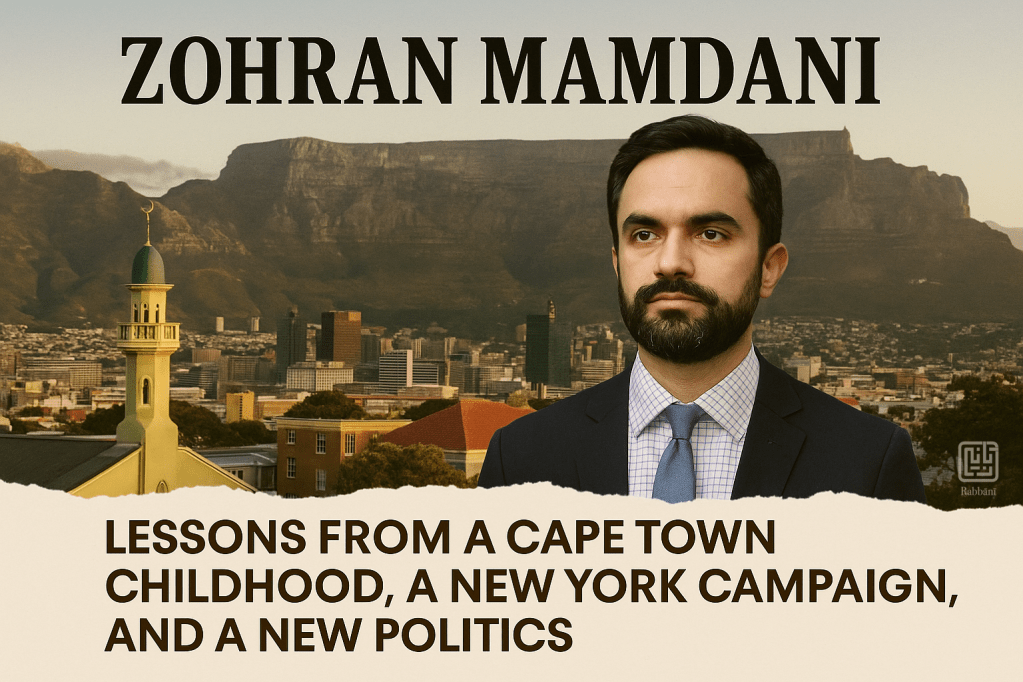
    Zohran Mamdani: Lessons from a Cape Town Childhood, a New York Campaign, and a New Politics

    Zohran Mamdani: Lessons from a Cape Town Childhood, a New York Campaign, and a New Politics

    On a windy June morning in Johannesburg, I opened my social media feed and was stunned to see the name “Zohran Mamdani” trending across platforms. Not because I didn’t know the name — but because I did, even if distantly. In the early 1990s, Zohran was a child in Cape Town, attending Saturday morning madrasa classes at the Claremont Main Road Mosque, a place deeply associated with the progressive Islamic movement of the time. His father, Professor Mahmood Mamdani, was already a towering intellectual figure in the post-apartheid ferment. I had been working at the National Language Project (NLP) then, and many of us — including colleagues like Gerda de Klerk — were connected to those circles of progressive faith, education, and social justice. Our paths may well have crossed with young Zohran, though it feels remarkable to see this child of that moment now emerge as the Democratic front-runner for mayor of New York City.

    As news of Zohran’s decisive victory spread — defeating establishment heavyweight Andrew Cuomo in the Democratic mayoral primary — friends from various corners of the globe began connecting the dots. A remarkable arc had come full circle: from Cape Town’s progressive mosques and language movements to the heart of one of the most complex urban political landscapes in the world.

    From Claremont to Queens: A Political Formation

    Zohran Mamdani’s victory didn’t emerge out of nowhere. It was cultivated in spaces that taught young people not to separate faith from justice, identity from compassion. The Claremont Main Road Mosque (CMRM), where Zohran received early Islamic education, has long been known as a place of inclusive, activist theology — led in those years by figures like Imam Dr. Rashied Omar and strongly shaped by South Africa’s anti-apartheid Islamic ethos.

    The family home was no less intellectually fertile. His father, Mahmood Mamdani, was not just a visiting scholar — as political analyst Steven Friedman rightly corrected on my Facebook post — but a full professor who directed a research institute at the University of Cape Town. Mahmood’s own writing — from Citizen and Subject to Neither Settler Nor Native — shaped global debates on colonialism, identity, and resistance (Scroll.in, 2025). His mother, Mira Nair, is an acclaimed filmmaker whose work explores the intersections of class, gender, memory, and post-colonial identity.

    Together, this upbringing embedded in Zohran an ethos of critical clarity and pluralist compassion — two virtues that would later characterise his campaign and its stunning success.

    Beyond the Soundbites: A Platform with Substance

    Media coverage has often portrayed Mamdani’s win as the result of digital mastery — an “influencer politician” who went viral. But as tech journalist Taylor Lorenz argues in her sharp critique, this reading is both shallow and dismissive. “He didn’t win because of TikTok or podcasts,” she writes. “He won because he was a generational political talent backed by years of disciplined organising.”

    Mamdani’s platform includes a $30/hour minimum wage by 2030, fare-free public buses, rent freezes, city-owned grocery stores, and universal childcare — funded through wealth and corporate taxes. These are not trendy slogans; they are deeply-researched, locally-grounded policy ideas forged in dialogue with tenants, cab drivers, community imams, and working-class coalitions.

    Indeed, the campaign’s integrity was evident in its structure: 27,000 volunteers, small-donor funding (average donation: $35), and widespread multilingual outreach that included Arabic, Bangla, Spanish, Urdu, and Fulani speakers. In an interview with The Fatu Network, Gambian-American organiser AjiFanta Marenah noted how Mamdani met with imams and elders from West Africa at Masjid Ar Rahmah — a mosque still grieving a devastating fire. Her words were telling: “This was not just outreach. He listened.

    A Movement Rooted in Memory and Meaning

    Mamdani’s win has been framed as a generational and demographic shift — and rightly so. At 33, he is poised to become the youngest mayor in NYC history. But this is not just about age. It is about political imagination.

    As writer Rachel Hurley observes: “He didn’t water down his vision. He spoke clearly — about Palestine, about police brutality, about inequality.” While some accused him of being too radical, others — including thousands of voters under 35 and nearly 80% of Asian-American voters in ranked-choice simulations — saw in him the first candidate in years who actually named their pain and offered structural responses.

    Importantly, he did not shy away from moral clarity. Whether affirming his support for BDS, resisting pressure to co-sign Holocaust memorial resolutions weaponized to silence Palestinian solidarity, or responding to racist attacks with unwavering calm, Mamdani refused to dilute his politics to appease critics.

    In this, one senses echoes of his father’s legacy — a fierce critic of authoritarianism whether in Uganda or the United States — and his mother’s poetic instinct to preserve human dignity through narrative.

    What This Means for South Africa and the Global South

    In a time when centrist parties are increasingly detached from grassroots movements, Mamdani’s campaign offers not just hope but a methodology for how to bridge that divide. The lessons are not only for American Democrats, as Rebecca Kirszner Katz argues in her New York Times piece — they are relevant for South Africa too.

    We, too, are grappling with the limits of post-liberation politics, the alienation of youth, and the search for a new language of ethics in the public square. Mamdani’s win reminds us that political change doesn’t only come through electoral machines. It can be built — step by step — through community relationships, principled clarity, and a refusal to play by the rules of elite consensus.

    His campaign did not begin with polling data or PR consultants. It began with people — Bronx tenants, Queens families, Harlem students, mosque elders. As Felix Biederman noted, “He never dumbed things down into meaninglessness.”

    Of course, Mamdani isn’t mayor yet; he still faces the general election in November. But his endorsement by former New York City Comptroller Brad Lander, and their warm joint appearance on The Late Show With Stephen Colbert, offered a powerful reminder of the long tradition of Muslim–Jewish solidarity. It echoed the interfaith alliances that shaped our own struggles against apartheid here in South Africa, affirming that courage and conscience can cross boundaries.

    As Robert Reich noted, Mamdani is “the corporate Democrat’s biggest nightmare” — precisely because he dares to center affordability, class solidarity, and moral clarity. Yet he is equally a supremacist’s nightmare, as Alon Mizrahi argued, because he is “a Muslim Normal”: calm, compassionate, politically lucid, refusing every easy stereotype. That double challenge — to both neoliberal machines and racialized fear — is what makes his rise so potent.

    Reclaiming the Power to Dream Together

    In the end, Zohran Mamdani’s rise is not just a story of one man’s success. It is the story of what becomes possible when movements — and memories — are nurtured with integrity. From Cape Town’s madrasa halls to New York’s subway stops, the values of mercy, justice, and collective dignity continue to ripple outward.

    In a time of fragmentation, Mamdani’s clarity invites us to build differently. To listen deeper. To organise not just against oppression, but toward belonging. And to believe, again, that cities — and hearts — can be won with vision.

    References:

    • Hurley, Rachel. Zohran Mamdani’s NYC Primary Win Is a Huge Lesson for Dems. RatCClips, June 25, 2025.
    • Lorenz, Taylor. Zohran Did Not Win Because of TikTok and Podcasts. UserMag, June 25, 2025.
    • Katz, Rebecca Kirszner. Democratic Leaders Tried to Crush Zohran Mamdani. They Should Have Been Taking Notes. New York Times, June 25, 2025.
    • Daily Maverick. Meet New York City’s Likely Next Mayor — with a South African Connection. June 25, 2025.
    • The Fatu Network. Introducing the Young Woman Behind Zohran Mamdani’s Shout-Out to His Gambian Uncles. June 26, 2025.
    • Reich, Robert. The Corporate Democrat’s Biggest Nightmare. Substack, June 26, 2025.
    • Mizrahi, Alon. They Don’t Hate Mamdani Because He’s a Muslim Radical. They Hate Him Because He’s a Muslim Normal. June 27, 2025.
    • Times of India. Zohran Mamdani: The Bronx Student Who Made Africana Studies His Political Compass. June 2025.
    • The Late Show with Stephen Colbert, featuring Zohran Mamdani and Brad Lander, June 2025.
    • Scroll.in. Seven Books by Ugandan Scholar Mahmood Mamdani, Father of NYC Mayoral Candidate Zohran Mamdani. June 25, 2025.

    If there is one truth I carry from writing this piece, it is that our stories are never just local, never just our own. They travel, they weave through other struggles, they bloom in places we may never see. Zohran Mamdani’s path reminds me — and perhaps reminds us all — that faith, courage, and community can plant seeds far beyond our imagining. In my own Rabbānī scrolls and design work, I have tried to hold on to that same ethic: to remember, to witness, and to keep building. May we all keep planting, keep walking, and keep creating together.

  • How do you even begin to eat a mountain?

    How do you even begin to eat a mountain?

    [I have retold this story countless times. It was told to me when I was a student in the 80s. I googled the original storyteller but could not find any reference to it online. It resonated with me because I was born at the foot of Table Mountain in District Six, Cape Town. I am thankful, even now, for Khurram Murad for making this part of his keynote address so long ago.]

    table-mountain
    Table Mountain taken by Aadela Parker.

    There once was a man who was very unhappy. Something was troubling him but he could not put his finger on it. At night he was restless and it took a while for him to sleep. That night he had strange dream.

    He dreamt that an old man approached him and said, “When you wake in the morning, eat the first thing that you see.” When he woke up that morning sweating from the vision, he opened his eyes and saw the mountain. What? How am I supposed to eat a mountain?

    Maybe the old man was joking. He then went about his usual tasks for the day. He still felt troubled though. That night he had the same dream. But now the old man was ranting and raving, “What are you afraid of? Eat the first thing you see.”

    It is not easy to choose what you should see when you wake so when he woke that morning again and saw the mountain, he thought the old man must be crazy. The third night the old man was now threatening him with a stick and promised to make the rest of his nights a living hell if he did eat what he saw when he woke.

    That morning he woke with determination. When he saw the mountain, he immediately packed and set out to eat it. But as he moved closer to the mountain, a strange thing happened: it started to grow smaller. The man began to panic because it seemed as the mountain was moving further away. Just my luck he thought and started to increase his pace. The closer he moved the smaller the mountain.

    By midday he was running. At the end of the day he reached where he thought the mountain should have been. But it had grown so small that he could stoop down, pick it up and put it in his mouth. What do we learn from this strange but interesting story? I believe four things:

    • We all need dreams. We need a vision and a plan to get us where we need to go. We must see the idea before us and keep it in our sight. A dream that you cannot conjure before you is not going to keep our attention.
    • A dream will remain unattainable if we make no effort to make it real. It takes slog. Sometimes the work seems impossible to absorb. But sometimes the most difficult things to learn turn out to be the most enjoyable once you get it. Sometimes, the harder a thing becomes the sooner you are reaching a breakthrough. Apartheid gave way when we thought that we should prepare ourselves for a long fight and bitter fight.
    • Besides the dream and the effort you also need belief. You must believe in yourself. You must believe that you can win. You must believe that it is worth it. Belief gives you confidence and the world cannot resist a person with confidence it will open up paths and opportunities that you never imagined.
    • Finally: sometimes the solutions we are looking for are not weird or strange. Sometimes (often) what we look for, or the solution, lies right in front of us like the mountain in my story. That mountain was in front of his window his whole life but it did not occur to the man to seek it out.