When I published my first book in 2014, a community in Pretoria invited me to share with them the significance and the reasons for writing Punching Above Its Weight…
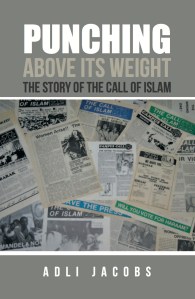
Launched in 2017.
I am most grateful for this opportunity to speak to you today, at the Rasooli Centre, on my first book, Punching Above Its Weight – The Story of the Call of Islam. This is not just a story of my own youth, of how I came to be a part of such an important organisation. This is not just a biography of the Call of Islam and how the organisation as well as the broader community developed a new and fresh way to view our own Islam.
This is not just the story of how a tiny Muslim population at the tip of Africa, in concert with others, stood their ground against the mighty apartheid government and policies of dehumanising all who were deemed lesser because of the colour of their skin. It is not just the story of the resilience of a population who, despite massive exploitation and oppression, stayed true to their humanity and made space for many, including members of the white population, in the struggle against apartheid.
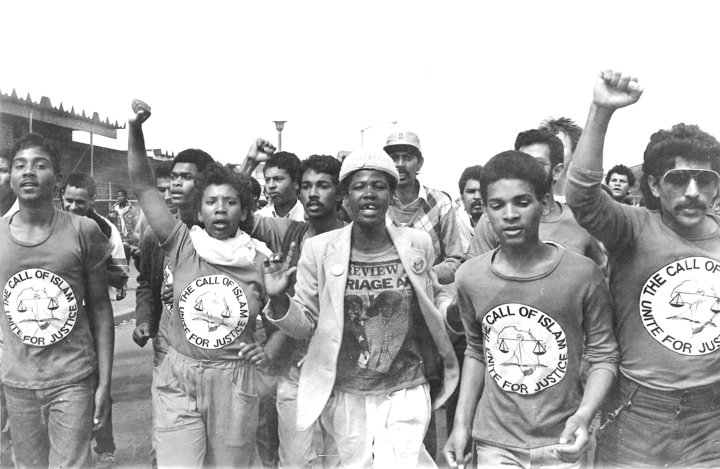
Written in an easy style, without complicated language, I try to tell the story of a seemingly insignificant political movement that made far-reaching contributions to the freedom struggle in South Africa. The book traces the many activities of the Call of Islam, the mass rallies, the interfaith gatherings, funeral demonstrations, culminating in the one of biggest and most significant gatherings of Muslims in SA, the National Muslim Conference in 1990.
Punching Above Its Weight is about all of these and more. Ebrahim Rasool, now the ex-SA ambassador to the US, reflects on this in the Foreword to the book:
“It is a travesty that we have waited almost 30 years for Punching Above Its Weight – The Story of the Call of Islam to be told. I am happy that Adli has now done so. It may not be a perfect rendition of the history; a complete account of every debate, campaign or incident; or a personal recall of every brave and thoughtful member. But it fulfils a need.
“In a world where some Muslims present us as backward by their example, and our opponents project us as barbaric in their propaganda, the least that this book will do is to say that in 1984, in the midst of an almighty struggle against apartheid, there emerged from a community that came to South Africa as slaves and exiles, who constituted only a small minority, yet from them the Call of Islam was born.”
So, in many ways, it was the Call of Islam, Muslims in South Africa and freedom-loving South Africans generally who all punched above their weight in a time when we thought we would never see the day when we would all be free. That was a time when Ronald Reagan’s America saw South Africa’s apartheid government as an ally in the Cold War and when the rest of the world’s nations (except a few) were slow to respond to the crimes against humanity that was taking place in South Africa. We were then where Palestine is today, under the occupation of a brutal regime.
The book is, at one level a celebration of our South African victory, but also about the lessons we must learn from this experience because of what use is a celebration for humanity if we do not try to understand how we overcame our biggest challenges. I believe, in attempting to understand how we changed our selves in the midst of struggle, we can use those insights to inform what our role should be today and make better use of our present freedoms and challenges. Because…
“Centring on the story of the Call of Islam is in many ways a lens to look at the details of the South African struggle. It means zooming in, as you would with a microscope, to observe the anti-apartheid struggle by focussing on some of its compounds and atoms that give a different insight than if one just looks at the broad strokes. And because the Call was more than just a faith-based organisation – rather, it was one engaged in political struggle – its model can be educational to many social movements, activist or non-governmental formations, and even social welfare groups, both in South Africa and beyond.”
 Adli Yacubi