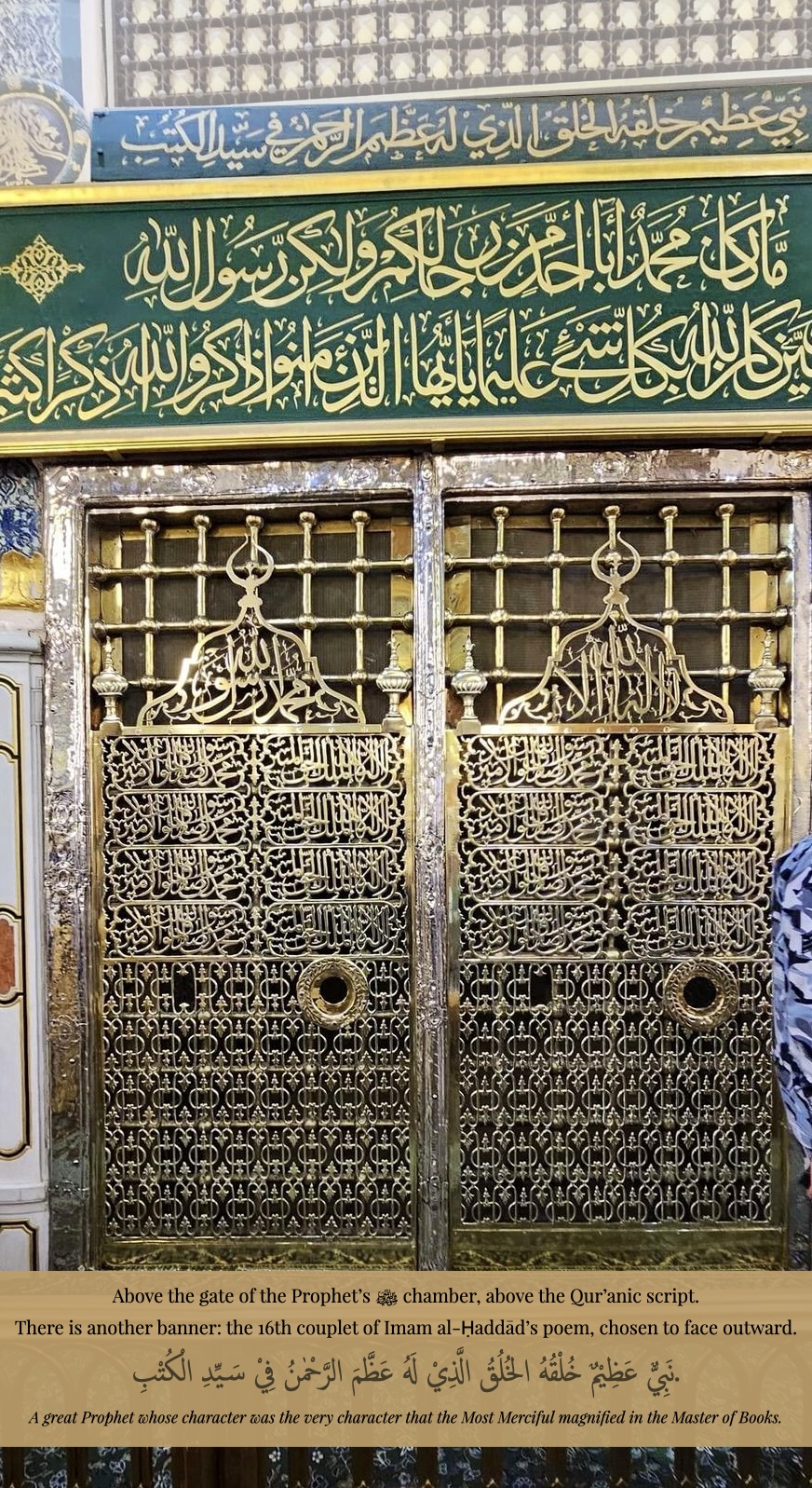
In the sacred precincts of Madinah al-Munawwarah, where pilgrims send peace upon the Prophet Muhammad (peace be upon him), few notice a quiet miracle. Above the gate to the Rawḍah — where our Prophet rests — is an engraved verse of Arabic poetry, nestled in plain sight. Most eyes pass over it, drawn instead to the Qur’anic verse below. But that upper verse is from a 40-couplet qaṣīda written by Imām ʿAbd Allah ibn ʿAlawī al-Ḥaddād — a saint, scholar, and Sufi of the Bā ʿAlawī lineage of Tarīm. Only one couplet of the poem is visible to the public.
One line.
Facing outward.
Why this line? Who chose it? What does it mean that the rest of the poem lives inside, engraved on the inner walls of the chamber of the Prophet ﷺ? What does it mean to be the line that stands at the threshold?
This blog is a gentle unfolding of those questions.
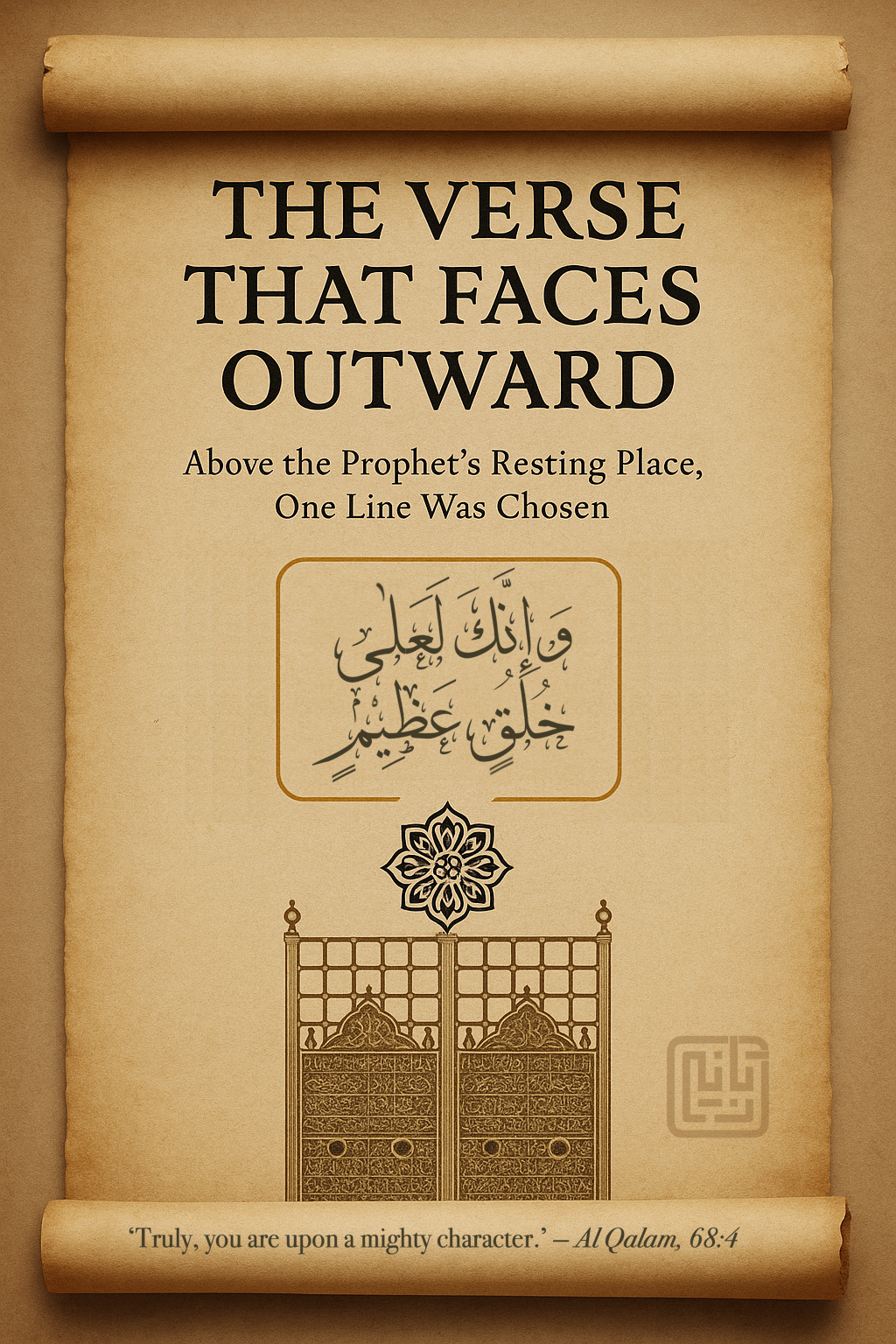
Above the gate of the Prophet’s ﷺ chamber, one line of sacred poetry faces outward — a single couplet from Imām al-Ḥaddād’s 40-verse ode, chosen to stand above the Qur’anic verse.
Some verses open books. Others open doors. The chosen line stands where praise meets Revelation.
A magnificent Prophet — his noble character,
Exalted by the Most Merciful in the Master of Books.
Imām al-Ḥaddād is drawing from the Qur’anic verse:
“And truly, you are of a most noble character.” (Surah al-Qalam, 68:4)
In these lines, poetry bends in humility before Revelation. The poem is not in competition with the Qur’an. It is a witness to it. A praise that holds its breath before the Word.
Section 2: Ishārah and ʿIbārah: The Inner and Outer Signs
“Yā Fātiḥil-Abwāb — O Opener of Doors.” Some verses open books. Others open hearts.
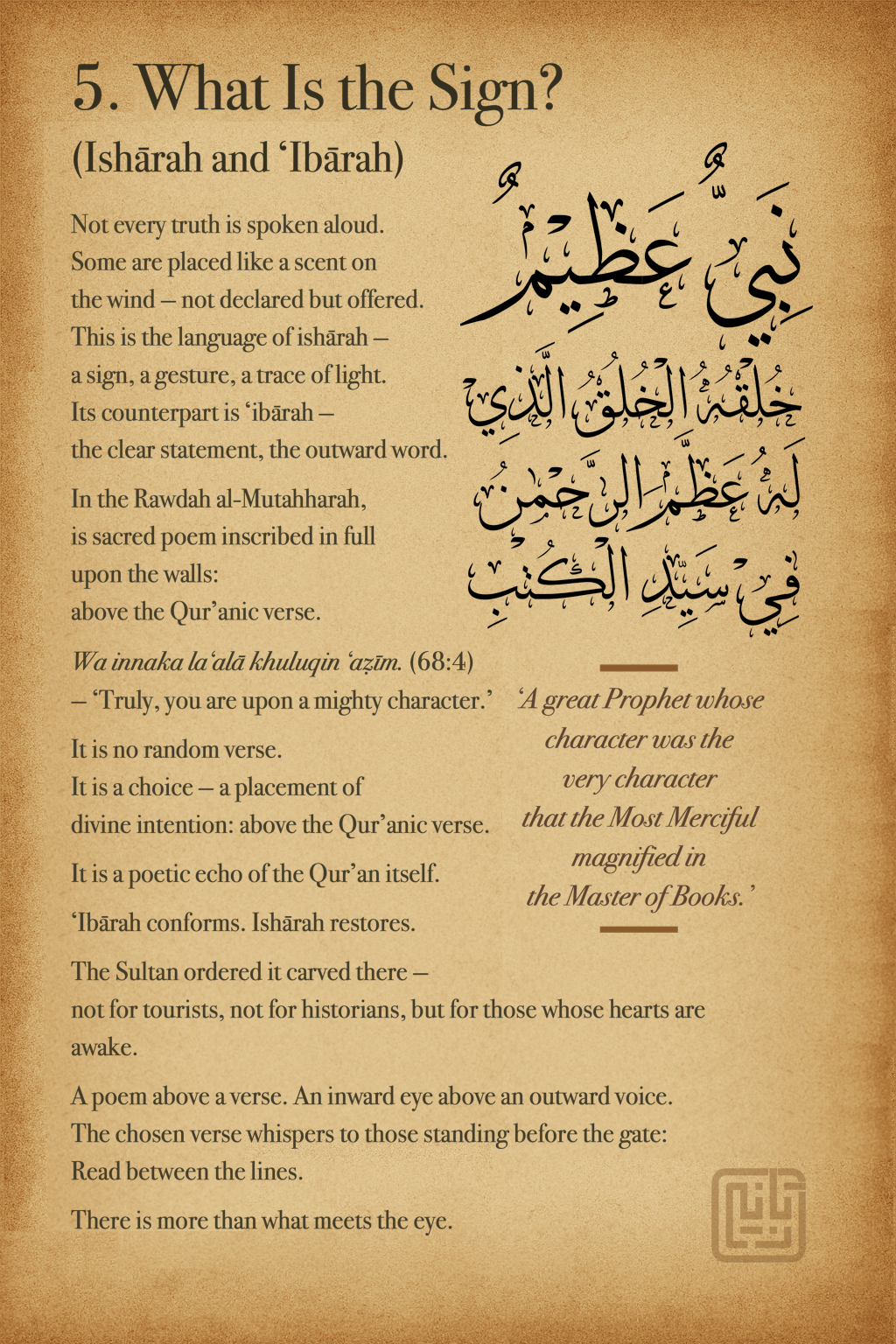
What is visible above the gate is the ʿibārah — the outward expression. But the choice to place this verse there is also an ishārah — a subtle sign. It whispers: Look closer. Listen deeper. The rest of the poem remains inside the sacred chamber, out of sight, like the hidden knowledge that only the heart can read.
The verse that faces outward becomes a threshold, a knock upon the door. A visitor may stop to read it, but the meaning enters only when the heart listens. As Shaykh Jamiel said: “Most people see the ʿibārah, but few perceive the ishārah.”
And that is the invitation.
Section 3: The Hidden Inheritance
The inner walls of the Rawḍah: Where the full poem of Imām al-Ḥaddād is inscribed — invisible to the public, but alive in transmission.
There is a story passed down from the early life of Imām al-Ḥaddād. When he was still an infant, his mother dreamt that she was at the tomb of a great spiritual master. In the dream, the master emerged from his grave, took the baby to his breast, and gently placed his tongue into the baby’s mouth.
In the language of sacred dreams, this is no ordinary image. It means that the child inherited the master’s knowledge — not through books or teachers, but through direct spiritual transmission. Through the tongue. Through barakah.
When we recite the Ratib al-Ḥaddād, we are inheriting from that lineage. When we stand before the gate and read the outward verse, we are brushing our lips against the memory of that transmission.
Section 4: The Sultan Who Opened the Doors
It is worth noting that the spiritual legacy of Imām al-Ḥaddād extended well beyond the valleys of Ḥaḍramawt. The Wird al-Laṭīf and Ratib al-Ḥaddād — his litanies of remembrance — were introduced and supported within the Harams of Makkah and Madinah under the patronage of Sultan Mehmet IV (sometimes rendered Mehmed or Muḥammad IV) of the Ottoman Empire (r. 1648–1687). A ruler known for his reverence of Islamic and Sufi traditions, Sultan Mehmet IV’s endorsement ensured that the sacred rhythms of Tarīm would echo in the holiest sanctuaries of the Ummah. Even the architecture of prayer carries the trace of this inheritance.
🟫 Note on Naming & Recognition
A reader of this blog, Kitty Amina Rabbas, beautifully reflected on the significance of this verse’s placement — connecting her own reading ofSufi Sage of Arabiawiththe timeline of Imām al-Ḥaddād’s visit to Madinah in 1669 CE (1079 AH), during the reign of Sultan Mehmet IV.
She reminded us that, while Ottoman rulers held immense worldly power, Sultan Mehmet IV — known for his taqwā and reverence for the Prophet ﷺ — may have recognised in Imām al-Ḥaddād a spiritual authority greater than his own. That a single verse from the Imām’s poem was chosen to face outward from the Rawḍah may well be an act of humility, not mere decoration.
Section 5: What Is the Sign?
What is the sign? A call to see beyond the eye, to listen with the inner ear. Some verses open books. Others open hearts.
Not everyone notices the verse above the gate. Not everyone will be called to. But for those who do, a quiet spark may awaken in the heart. Shaykh Jamiel once described this line as a wick that does not even need fire to burn. The love, the longing, the witnessing — it ignites on its own, just by being near to the Real.
There are some verses that open books. Others open doors.
And then, some open hearts.
Epilogue: The One Who Watches
The Prophet (peace be upon him) said, “Indeed, in the body there is a lump of flesh. If it is sound, the whole body is sound. If it is corrupted, the whole body is corrupted. Indeed, it is the heart.”
To read the verse that faces outward is to knock gently on that heart. To remember that character is not costume, and praise is not performance. It is to walk humbly. It is to remember the One who sees in secret.
And when no one sees, know that ar-Raqīb always does.
Acknowledgement: This blog was deeply enriched by the insights and generosity of Shaykh Jamiel Abrahams, who shared the photographs, historical details, and the luminous teachings behind the scenes. His voice opened a door, and lit a candle inside.
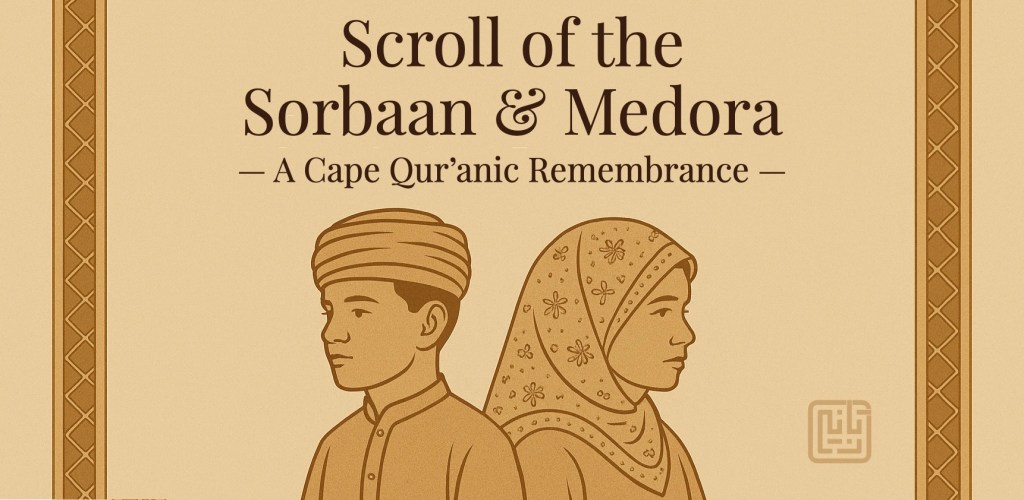
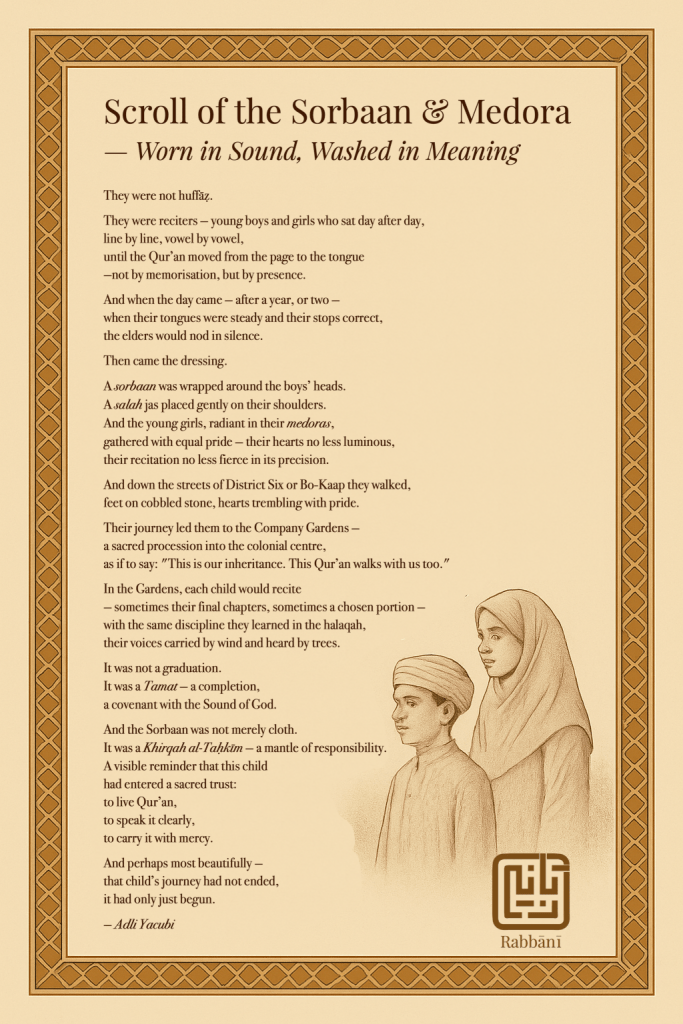
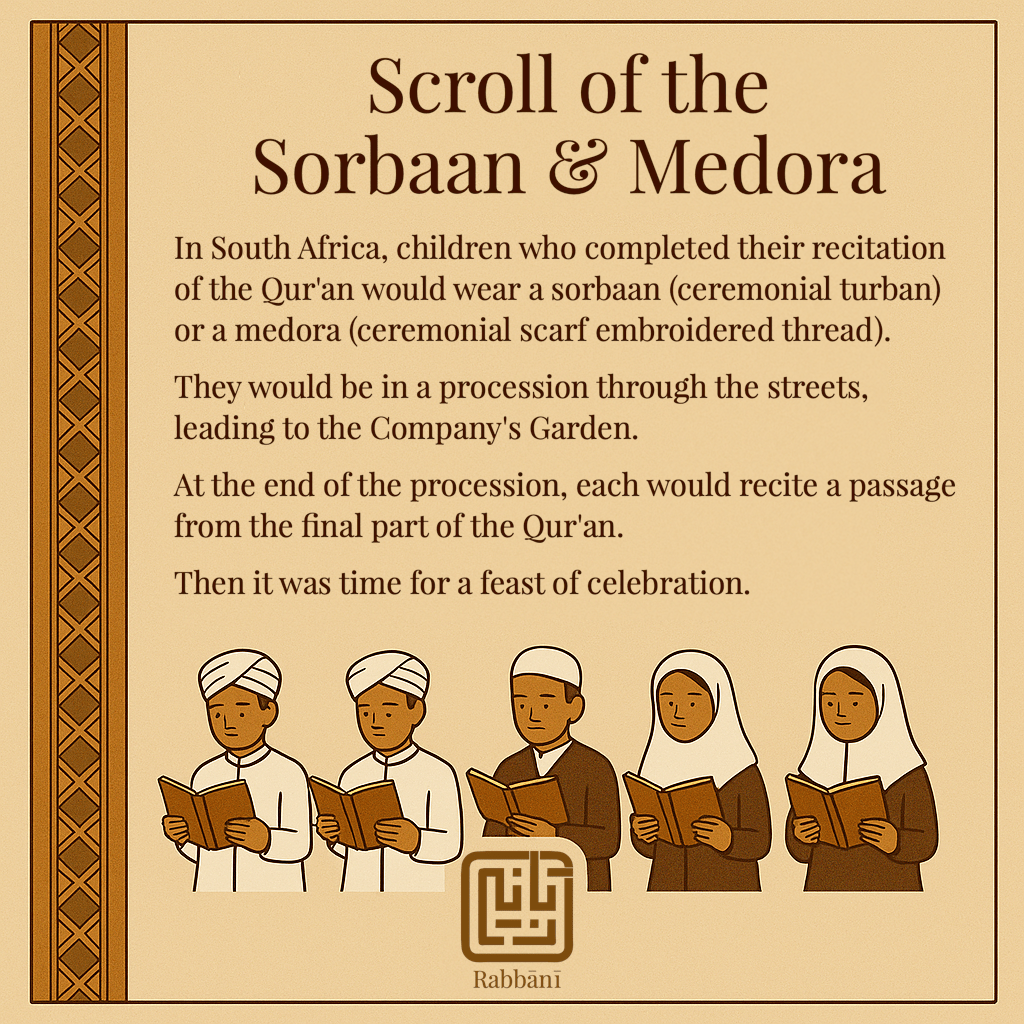
They were reciters — young boys and girls who sat day after day, line by line, vowel by vowel, until the Qur’an moved from the page to the tongue —not by memorisation, but by presence.
And when the day came — after a year, or two — when their tongues were steady and their stops correct, the elders would nod in silence.
Then came the dressing.
A sorbaan was wrapped around the boys’ heads. A salah jas placed gently on their shoulders. And the young girls, radiant in their medoras, embroidered in silver and gold threads, gathered with equal pride — their hearts no less luminous, their recitation no less fierce in its precision.
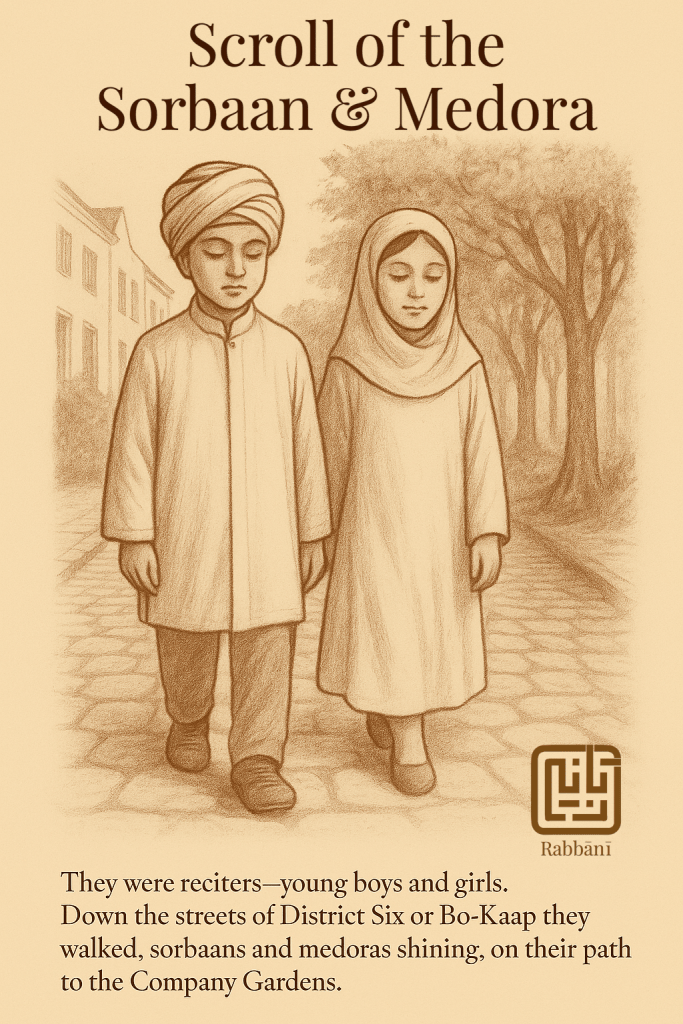
And down the streets of District Six or Bo-Kaap they walked, feet on cobbled stone, hearts trembling with pride.
Their journey led them to the Company Gardens — a sacred procession into the colonial centre, as if to say: “This is our inheritance. This Qur’an walks with us too.”
In the Gardens, each child would recite — sometimes their final chapters, sometimes a chosen portion — with the same discipline they learned in the halaqah, their voices carried by wind and heard by trees.
It was not a graduation. It was a Tamat — a completion, a covenant with the Sound of God.
And the Sorbaan was not merely cloth. It was a Khirqah al-Taḥkīm — a mantle of responsibility. A visible reminder that this child had entered a sacred trust: to live Qur’an, to speak it clearly, to carry it with mercy.
And perhaps most beautifully — that child’s journey had not ended, it had only just begun.
Acknowledgement
Tramakasi to Sh. Jamiel Abrahams, Sadia Fakier, Zaid Nordien, and Al-Ameen Marley — for helping carry this cloth of memory into the light.
Postscript: This scroll is inspired by the memory of Boeta Junain, who told stories of the Tamat and the children’s walk to the Gardens. Our next post will honour him directly — a keeper of sacred echoes.
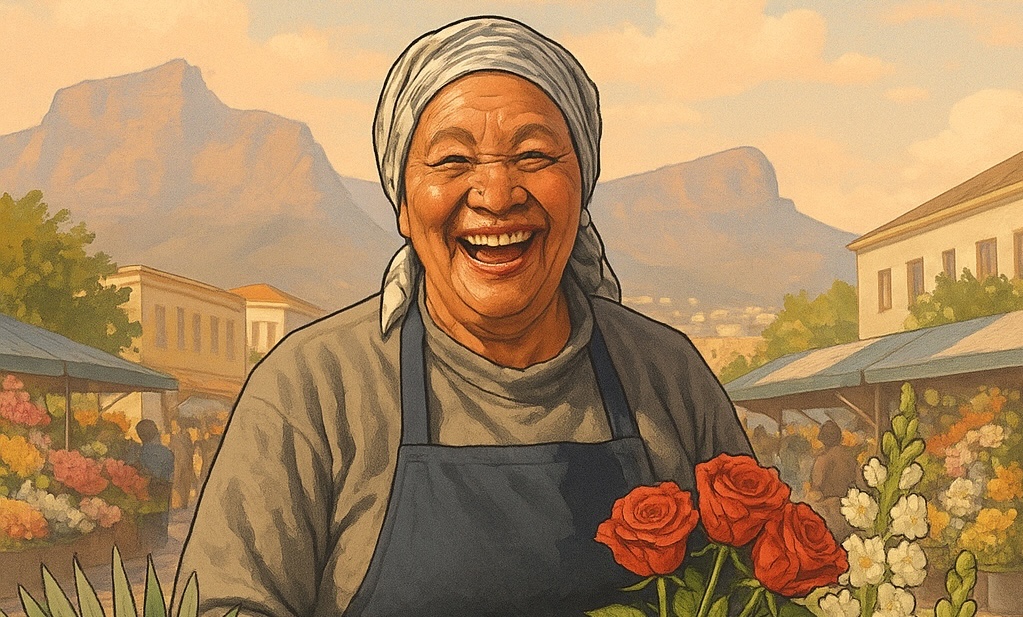
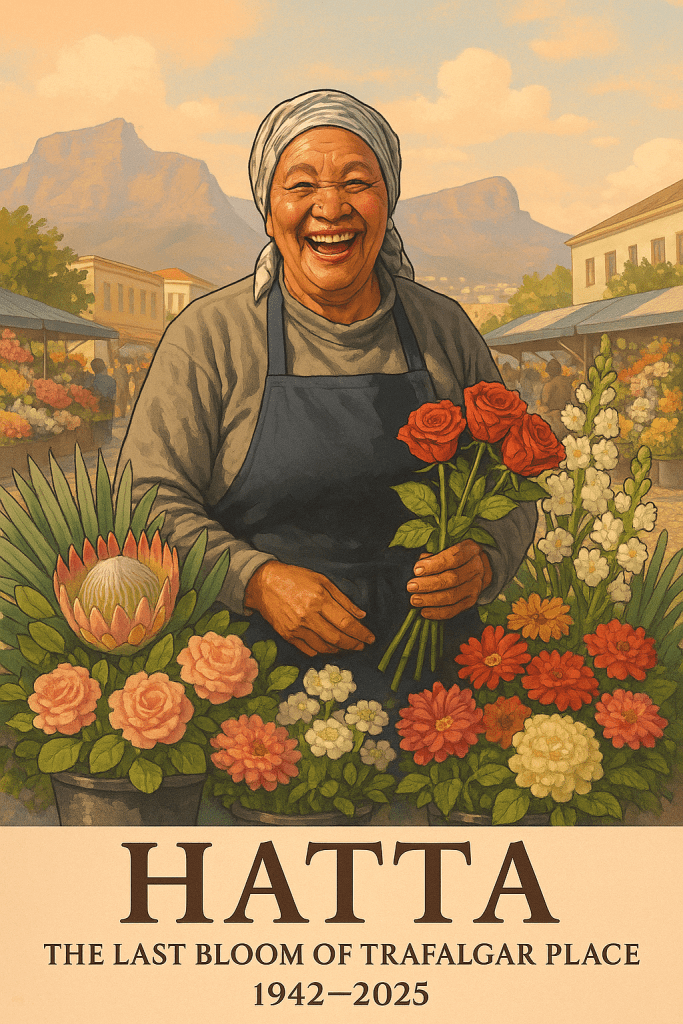
A tribute to Hatta: flower seller, character, Cape Town soul. The fragrance lingers…
She wasn’t just a flower seller. She was a fragrance, a rhythm, a joke that made you feel seen. Her name was Cecelia Williams—known to all as Hatta—and for over sixty years, she stood at Cape Town’s Trafalgar Place market, not just selling blooms, but lifting spirits.
Hatta was a character. A caretaker. A Cape Town original.
The Poem that Opened the Door
“Hatta of the Flower Market” She was the last blossom of a vanishing season, a woman with hands that knew petals better than poems, who crowned Adderley mornings with colour and cackle. They called her Hatta—not just a name, but a rhythm. A shrug, a laugh, a story half-told while binding roses with string. Sixty years of market sun. Of joking with tourists. Of feeding the street children. Of being “one in a million” without ever asking for a statue. Now the market hums a little quieter. But her scent, her sass, her spirit— they linger, like the last bloom in a winter vase.
This poem, first shared on my Facebook page, sparked an outpouring of memory and community. The tribute went viral, shared across timelines and group chats. And then, like the scent of jasmine carried on wind, her story grew.
The Article That Helped the City Remember
Tamlynne Thompson’s piece in TheCape Towner became a cornerstone of Hatta’s public remembrance. It offered not only a portrait of her life, but a signal that her presence had mattered—deeply.
Though the newspaper referenced a YouTube link, the funeral livestream no longer appears to be available. But memory has other ways of surfacing. While searching for traces of Hatta, I found this moving video about her best friend, Sandra Bosman—herself a flower seller of the Cape.
Through Sandra, we hear the echoes of Hatta’s laughter, her generosity, and her grit. It’s another thread in the fabric we’re weaving.
Voices from the Cape
Facebook friends poured in with blessings, memories, and emotion:
Anne Rogers:“Yet another outstanding poem – beautiful, moving words and complementary image to honour an outstanding woman who brought joy to many.”
A Note of Gratitude: To Anne Rogers—your kind words landed with warmth. In a world where noise often drowns meaning, your belief in my words is a quiet blessing. Thank you for seeing not only the poem, but the person behind it.
And to Atiyyah Khan, Marianne Thamm, Mogamat KammieKamedien, and so many others—this harvest belongs to you too.
What Does “Hatta” Mean?
A few friends asked if Hatta was an honorific. The word “hatta” can refer to the traditional Arab headscarf, the keffiyeh—often used in resistance, honour, and dignity. It also carries echoes of the Arabic verb ḥaṭṭa, meaning to reach, to attain, or to bring down gently. Maybe that’s what she did—reached people, lifted them, wrapped them in grace.
The Spirit of the Cape Lives On
You can’t really write about Cape Town without talking about talking. That unique Cape Flats cadence—Afrikaaps—where people don’t just sell fruit or flowers. They create moments.
Ask about a naartjie and you’ll hear:
“Die naartjies is so lekker, hulle willie praatie. Hulle’s te skaam van al die soetigheid!”
And Hatta? She was the high priestess of that daily liturgy.
🌹The FragranceLingers
This is not a eulogy. This is a zahrā’, a bloom. And she—Hatta—isn’t gone. She lives in our language. In our laughter. In our stories. In every bouquet given in kindness. In every street market joke. In every aunty who tells it like it is, and every uncle who listens.
May we see them. May we remember them. May we become them.
🕊️ Rest in softness, Hatta. You were the last bloom of Trafalgar Place. But your scent is forever.
This blog post is dedicated to every flower seller, fruit hawker, street child, and storyteller who holds up Cape Town with grace and grit. May we never forget them.
Somewhere between the worn edges of oral history and the crisp pages of archived journals, I began to trace the journey of my ancestor — Hadjie Gasanodien, also known as Carel Pelgrim. It is said he was the first Muslim from the Cape to perform the sacred pilgrimage of Hajj, sometime between 1834 and 1837, a period just after the abolition of slavery, when its wounds were still fresh. For years, his story lived quietly in our family’s memory, surfacing in fragments and whispered recollections — until now. I write to honour that legacy, to weave together the strands of fact, faith, and feeling that shaped a man, a pilgrimage, and a community still finding its voice in the aftermath of bondage.
Pilgrimage of Discovery
I first heard his name as a child, tucked into a conversation between my sister Yasmine and our aunts. Years later, Yasmine would take those threads and stitch them into a short family tree, dated July 2004. At the time, it felt like the last echo of a fading past. We had little else to go on. But something stirred in me after I returned from my own pilgrimage. A fever of purpose, a longing to know more. I began writing and publishing reflections under Al Hujjaj Magazine, not yet knowing that my footsteps had mirrored those of my own forebear, nearly two centuries earlier.
Echoes in Academic Footsteps
The name “Carel Pelgrim” returned to me unexpectedly through the work of a neighbour and friend of my father — the late Mogamat Hoosain Ebrahim, a community scholar from Primrose Park. He had long been documenting the Hajj stories of Cape Muslims. In his thesis, The Cape Hajj Tradition: Past and Present (2009), Ebrahim writes: “Hajji Gassonnodien, more popularly known as Carel Pilgrim, enjoys the distinction of having been the first Cape Muslim to have successfully completed the Hajj.” Although I first encountered his name in Ebrahim’s thesis, the full significance didn’t strike me until later — during conversations with the researcher Abdud-Daiyaan Petersen. It was through our exchanges that the identity of Carel Pelgrim truly crystallised. This was not just a figure in history — he was my ancestor. A man who left the Cape between 1834 and 1837 to walk the sacred path when few could even imagine such a journey.
It was through Ebrahim’s meticulous work that I began to understand the context of that time. Hajj was not simply a religious obligation; it was an act of defiance, endurance, and transcendence. For formerly enslaved Muslims in the Cape, to make the pilgrimage was to reclaim a spiritual identity that colonial systems tried to erase. And Carel Pelgrim, in going, carried more than personal faith — he carried the hopes of a generation emerging from bondage.
A Lineage Remembered
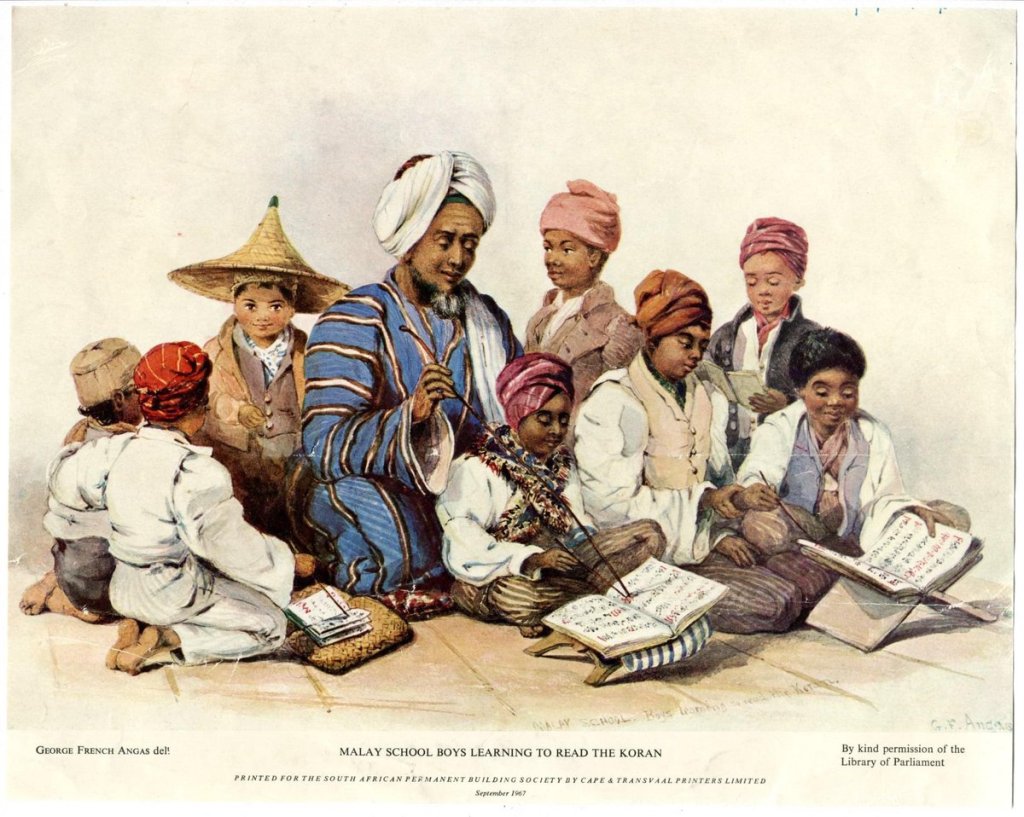
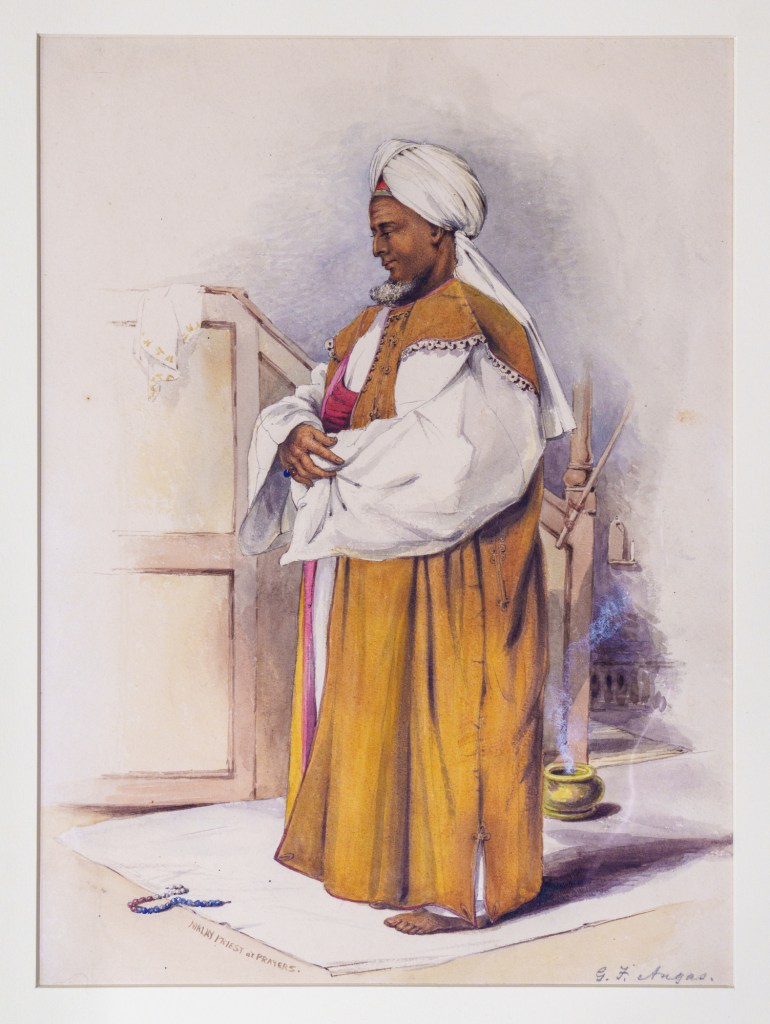
George F. Angas (1822-1886). ORIGINAL 1849 Hand Coloured Stone Lithograph. A Malay Priest Prays.
Abdud-Daiyaan Petersen’s research added an entirely new dimension to the story. In collaboration with Turkish scholar Halim Gençoğlu, he co-authored a paper titled Was Imam Gasanodien Carel Pelgrim an Ottoman Descendant?, published in the Bulletin of the National Library of South Africa in 2021. They explored the possibility that Carel Pelgrim may have had ancestral ties to the Ottoman world — a lineage once obscured by slavery and colonial re-naming. Through Petersen, I learned not only of the archival traces, but also of the living memory carried in Cape Town’s communities — stories that had waited generations to be heard.
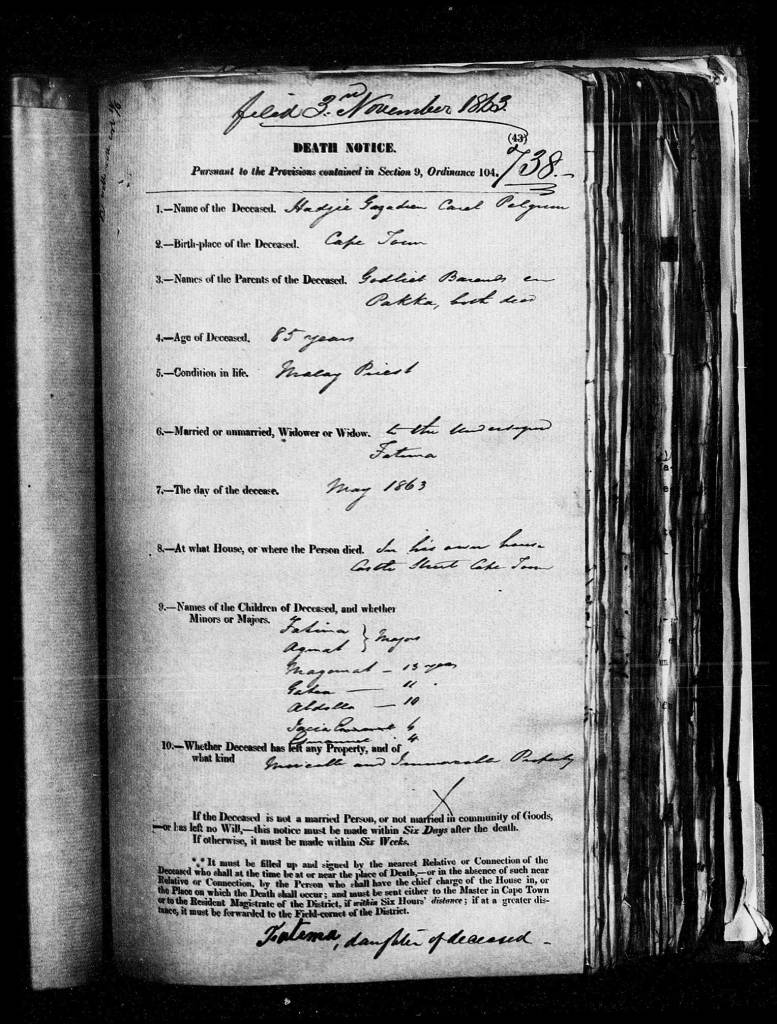
Petersen’s careful investigations, supported by old burial notices and public records, pointed with growing clarity to the fact that Carel Pelgrim and Hadjie Gasanodien — the man known for teaching Islam and the Qur’an to children in early Cape Town — were one and the same. The fragments were falling into place. What had once been academic became intimate. What had once been folklore became family history.
The Pain Beneath the Pride
The history of Carel’s mother, Pakka, adds further complexity and depth. As documented in Echoes of Slavery: Voices from South Africa’s Past by Jackie Loos, Carel — born into slavery — was the son of Pakka, a slave woman, and Jan Gottlieb Barends, a Christian man of German descent. Their relationship was informal and illegitimate, as was often the case in that era. Carel and his brother Philip inherited their mother’s status as slaves. In 1801, a notarial protocol records their transfer to a burgher, and upon his death, their eventual manumission was stipulated in his will.
Pakka’s exact identity remains debated, though one likely candidate is Janpakka of Batavia, who ran a shop in the Waterkant in the 1820s. Death records from the time, often unreliable, do not mention Carel or Philip, but their presence in community memory is clearer than archival certainty. Pakka’s story, like that of many enslaved women, survives in fragments — yet she remains the root from which this extraordinary lineage emerged. And it is here, in the shadows of that history, that I must pause. My heart aches at the likely truth: Pakka, my great-grandmother, was not loved — she was owned. The man who fathered her children, Jan Gottlieb Barends, did not protect her. He did not free her. Instead, he allowed her and their children to be sold on to another man. Was she raped? Exploited? Discarded? The records are silent, but the silence itself screams.
This is the pain we inherit alongside the pride — the wounds interwoven with the honour. In naming Pakka, I do not just trace bloodlines. I reclaim her dignity, speak her name with reverence, and acknowledge that even in bondage, she gave rise to a lineage that would one day teach Qur’an, lead prayer, and inspire generations. Her story, though faint, demands to be held — not with shame, but with solemn truth and fierce remembrance.
A Husband’s Grief
Carel’s transformation from a slave to a respected teacher, tailor, and hajji is all the more remarkable against this background. And among the most beautiful parts of his story is his deep love and reverence for his first wife, Japoera. Though she was childless, their bond was strong — spiritually and emotionally. When she passed away in their large home in Buitengracht in early 1841, Carel composed a public obituary in the South African Commercial Advertiser. It read: “The Heavenly Father, Lord of Life and Death, was pleased on the 16th instant to call from me my beloved wife Japoera, aged 64 years, 4 months and 16 days, after a happy union of [blank space] years. All who knew her virtuous character will sympathise with my loss, of which I hereby give notice to friends and relatives, requesting to be excused the visits of condolence.” He signed it: Carel of the Cape, the first Pilgrim and Priest.
Death certificate of Hadjie Gasnodien Carel Pelgrim.
In this short but poignant notice, we see not just a man grieving his beloved, but a heart refined by faith and loss. It reminds me that while history often records what men did, it rarely shows how deeply they loved. He eventually adopted the Islamic name ‘Hassan al-Din’ — appearing in records under numerous variations such as Gasnodien and Gasanodien — yet he signed himself proudly as ‘Carel Pelgrim.’ His ability to read and write in both Arabic and European script shows a deep level of literacy and determination to bridge worlds. While some have speculated that he may have spent up to three years in Makkah — a duration not firmly evidenced — what we do know is that he returned with the ability to teach Arabic and Qur’an, and left an imprint as a man of knowledge and devotion. It’s possible that his early literacy was shaped by Cornelis van der Poel, the burgher who once held legal ownership over him and later stipulated Carel’s manumission. Whether through formal tutoring or exposure to Dutch literacy, this early learning may have paved the way for his later mastery of both Islamic and colonial languages.
The directories list Carel van de Kaap as a free tailor living in Hout Street in 1816 and as a Malay schoolmaster in 1830. His brother Philip, born in 1789 and passing in 1844, was also a tailor, but unlike Carel, Philip was not a practicing Muslim. Some of Philip’s children were baptised, and in 1838 he married their mother, Carolina Marteyn of the Cape, in the Dutch Reformed Church.
Meanwhile, Carel was charting a different course. Once free, he began to prosper. In 1817, he loaned Seymen of the Cape 600 Ridollars (a substantial currency at the Cape in the early 1800s, equivalent to several months of wages for a labourer) to enable him to free his slave daughter, Cananga. By 1822, he had purchased his own home in Matfeld Lane. Then, in October 1833, Carel and his wife made a joint will, identifying themselves as the free man Carel of the Cape, alias Gaszimoedien — formerly a tailor, now a teacher in the Arabic language — and Johanna Salomonse, alias Japoera, born at the Cape.
Japoera seems to have been an exemplary Muslim wife, and Carel held her in high esteem. He set out for Mecca soon afterwards, and her encouragement must have been crucial to the success of his pioneering journey.
When Art Becomes Revelation
That intimacy deepened when I looked again at a familiar image — one I had seen countless times in Cape Town homes, books, and exhibitions, without ever imagining a personal connection. It is a watercolour painting by George French Angas, an English artist who visited the Cape in the 1840s. The scene is gentle but profound: a bearded man seated cross-legged, surrounded by children, teaching them the Qur’an. For years, this portrait was simply referred to as a depiction of a “Malay teacher.” But now, thanks to community scholarship and genealogical evidence, we know the truth — that teacher was Hadjie Gasanodien. My ancestor.
Another portrait, also by Angas, is held at the Castle of Good Hope in Cape Town. In it, Hadjie Gasanodien is more formally posed, with dignified composure. What amazes me most is his attire — a flowing Arabic coat, or abaya, layered over a long-sleeved thawb. The painting is filled with symbolic richness: incense burners still glowing in the frame, a minbar placed behind him as if ready for the next call to gather and reflect. To stand before that painting is to encounter the past as presence — not as myth or metaphor, but as family. His face, once anonymous to me, now echoes through mine. The ink of his story has always been part of my blood. Only now am I learning how to read it.
The Living Links
One of the most tender links between this legacy and the living was shared in Lawrence Green’s 1964 book, I Heard the Old Men Say. In Chapter Two, titled “The Living Links,” he introduces a woman named Gatea Jacobs — my great-grandmother and the daughter of Hadjie Gasanodien. In a touching passage, she recalls her father’s return from the pilgrimage to Mecca. She tells of the white robes he wore, the gentle way he taught, and how the community revered him not just as a teacher, but as a man who had seen the heart of Islam and brought its light home.
Yet there is something poignant here: on the death notice of Hadjie Gasanodien, Gatea was listed as his daughter — and she was just 11 years old at the time. Her recollections, as recorded by Green, must have been shaped not only by her own memory but also by the atmosphere that surrounded her father’s name: the reverence of others, the stories repeated in the family, the aura of a man who had left a sacred legacy. In this way, memory extends beyond personal recall — it becomes communal.
Her memories reach across generations with quiet dignity. She spoke not in grand declarations, but in lived detail — the scent of his clothes, the rhythm of his voice in prayer, the gatherings around him at dusk. Through her, his presence remained alive in the bones and breath of our family, long before any of us knew the fullness of his historical significance. It was always there — waiting for us to remember.
Incredibly, Gatea Jacobs lived nearly a hundred years, a living bridge between the earliest days of Islam at the Cape and our present time. In that same chapter, Lawrence Green recounts a remarkable scene: “One afternoon while she was still able to see and hear and talk to her family she called everyone round her. ‘I am too old to live any longer,’ she told them. Then she folded her hands as prescribed in the Islamic death ritual and passed away.” Her funeral drew thousands of mourners, and services were held in mosques across the Peninsula. It was a farewell not only to a beloved matriarch, but to an era.
Her final act — serene, faithful, and deliberate — echoed the strength of the lineage she carried. It is this spirit I now seek to honour, not only in rediscovering our ancestor, but in holding open the doorway for others to trace their own roots, to reclaim the sacredness of our past, and to remember that we, too, are living links.
Author’s Note Written by Adli Yacubi (pen name), descendant of Hadjie Gasanodien, also known as Carel Pelgrim. This article forms part of a continuing journey to rediscover, honour, and share the stories of Cape Muslim pioneers. May it serve as both record and remembrance.
References
Yasmine Jacobs, Jacobs Family Tree (Oral History), July 2004
Mogamat Hoosain Ebrahim, The Cape Hajj Tradition: Past and Present, 2009
Jackie Loos, Echoes of Slavery: Voices from South Africa’s Past, 2024
Habib Shaikh, “First of Cape Hajis came 3 years after abolition of slavery,” Arab News, 11 October 2013
Lawrence Green, I Heard the Old Men Say, Chapter Two: “The Living Links,” 1964
Halim Gençoğlu & Abdud-Daiyaan Petersen, “Was Imam Gasanodien Carel Pelgrim an Ottoman Descendant?”, Bulletin of the National Library of South Africa, vol. 75, no. 2, December 2021
Helen Swingler, “Piracy, slavery and a Mecca pilgrimage,” UCT News, 17 March 2021
“Portraits stoke mystery of Hajji Gasnodien,” Cape Argus, 26 February 2021
[I have retold this story countless times. It was told to me when I was a student in the 80s. I googled the original storyteller but could not find any reference to it online. It resonated with me because I was born at the foot of Table Mountain in District Six, Cape Town. I am thankful, even now, for Khurram Murad for making this part of his keynote address so long ago.]
Table Mountain taken by Aadela Parker.
There once was a man who was very unhappy. Something was troubling him but he could not put his finger on it. At night he was restless and it took a while for him to sleep. That night he had strange dream.
He dreamt that an old man approached him and said, “When you wake in the morning, eat the first thing that you see.” When he woke up that morning sweating from the vision, he opened his eyes and saw the mountain. What? How am I supposed to eat a mountain?
Maybe the old man was joking. He then went about his usual tasks for the day. He still felt troubled though. That night he had the same dream. But now the old man was ranting and raving, “What are you afraid of? Eat the first thing you see.”
It is not easy to choose what you should see when you wake so when he woke that morning again and saw the mountain, he thought the old man must be crazy. The third night the old man was now threatening him with a stick and promised to make the rest of his nights a living hell if he did eat what he saw when he woke.
That morning he woke with determination. When he saw the mountain, he immediately packed and set out to eat it. But as he moved closer to the mountain, a strange thing happened: it started to grow smaller. The man began to panic because it seemed as the mountain was moving further away. Just my luck he thought and started to increase his pace. The closer he moved the smaller the mountain.
By midday he was running. At the end of the day he reached where he thought the mountain should have been. But it had grown so small that he could stoop down, pick it up and put it in his mouth. What do we learn from this strange but interesting story? I believe four things:
We all need dreams. We need a vision and a plan to get us where we need to go. We must see the idea before us and keep it in our sight. A dream that you cannot conjure before you is not going to keep our attention.
A dream will remain unattainable if we make no effort to make it real. It takes slog. Sometimes the work seems impossible to absorb. But sometimes the most difficult things to learn turn out to be the most enjoyable once you get it. Sometimes, the harder a thing becomes the sooner you are reaching a breakthrough. Apartheid gave way when we thought that we should prepare ourselves for a long fight and bitter fight.
Besides the dream and the effort you also need belief. You must believe in yourself. You must believe that you can win. You must believe that it is worth it. Belief gives you confidence and the world cannot resist a person with confidence it will open up paths and opportunities that you never imagined.
Finally: sometimes the solutions we are looking for are not weird or strange. Sometimes (often) what we look for, or the solution, lies right in front of us like the mountain in my story. That mountain was in front of his window his whole life but it did not occur to the man to seek it out.
Changing the narrative of your country, one status update at a time
A Cameroonian from the Facebook page of Humans of Cameroon
Humans of New York, a website and Facebook page (now even an app) showcasing ordinary New Yorkers, is sitting at almost 11,5 million likes. It’s not difficult to see why. New York is perhaps the most famous city on earth. Google auto-completed the name when I typed in ‘how many songs about…’ It threw up a Wikipedia article listing songs, in alphabetical order, that reference the city, its landmarks and street names. There’s a gazillion of them!
And Cameroon? Google started with ‘10 fun and interesting Cameroon facts’. And the first fact was: ‘Cameroon is the first African country to reach the quarter-final in soccer world cup.’ I bet you don’t even know what the capital of Cameroon is. I had to look it up and I’m from South Africa. Many Africans would roll their eyes and say, ‘Typical!’ Well, it’s Yaoundé.
If you’ve been watching news recently, then you would know that Cameroon helped her neighbour Nigeria by launching airstrikes against the extremist group Boko Haram. Pretty feisty for a country that generally only gets into the news because of its football players making a name in European leagues.
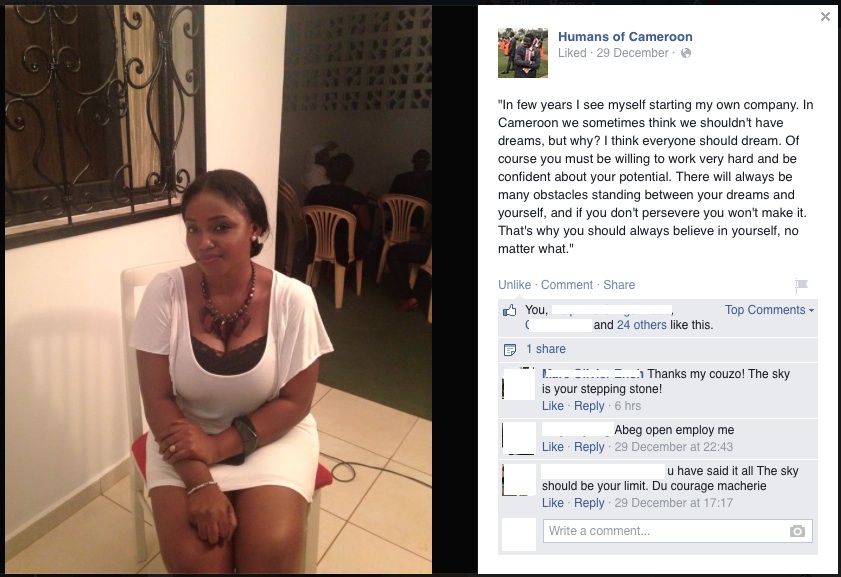
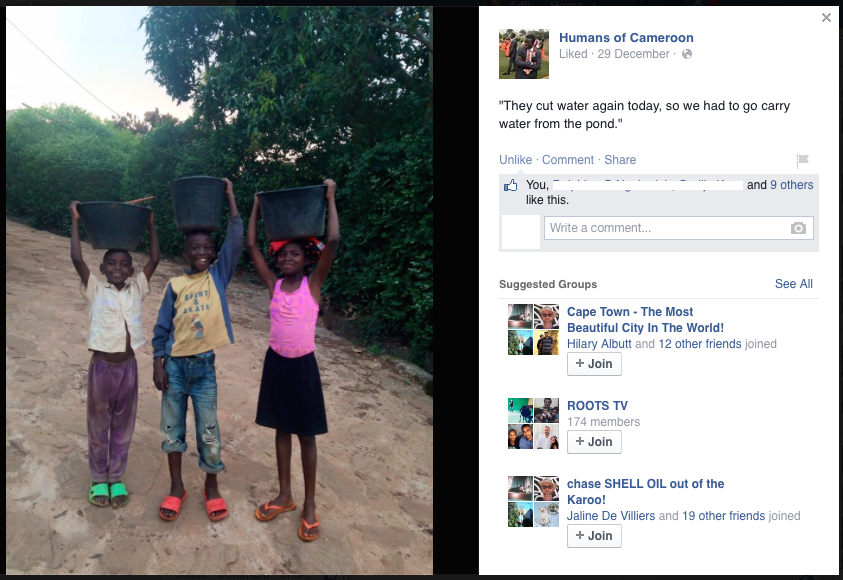
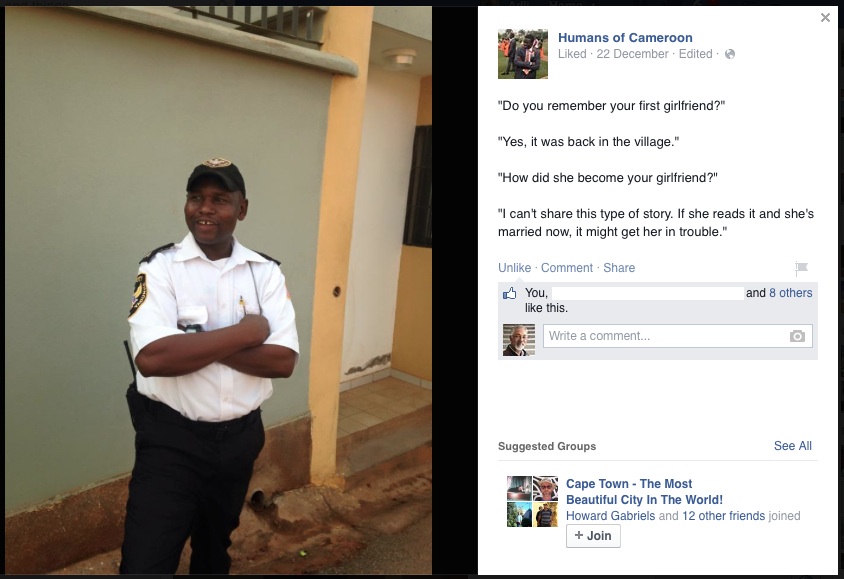
Equally feisty is a Facebook page a friend asked me to like, called Humans of Cameroon. My first thought was that this must be a copycat of the massively popular Humans of New York. Then I clicked on the link and this jumps up at me:
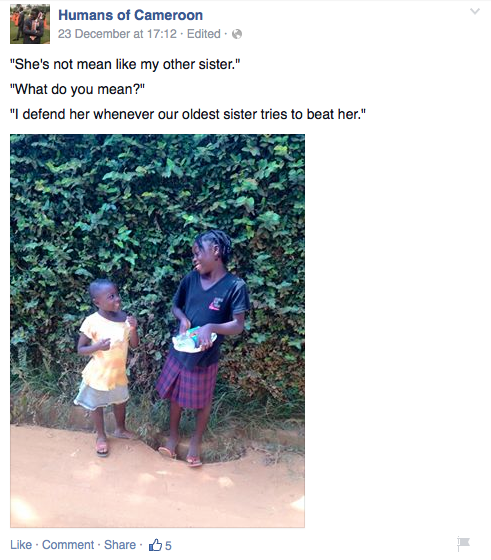
And then this:
I was taken by the sheer humanity of these stories. This was so far from the stereotypical depiction of Africans that either needed charity or came second to their wildlife and spectacular landscapes. Because of media priorities such as proximity (it is in our backyard), impact (it is massive and we are affected by it) and prominence (it involves celebrity), countries such as Cameroon hardly make it on the media radar. When they do make it into the news then, it is because of something negative.
When I shared the page with my Facebook buddies, this is the response from one of them:
“A gem of a FB find on this last day of 2014 (thanks to Adli Jacobs). Brilliant unmediated African voices — the kind we never get to access through mainstream media.”
In a sense, the creators of Humans of Cameroon have applied the New York example as a genre. There have been other cities and countries that have done the same. In Cameroon’s case it acts to reposition (or repackage) the country by foregrounding its people and allowing their voices to contribute to how that nation is seen. And yet, in a sense, it also acts as a counter-balance to Humans of New York whose lives are evidently more affluent, residing in a city that is the darling of the world.
There is no Statue of Liberty in Cameroon, no Empire State building, no Broadway or Time Square. There is no Madison Square Garden or famously numbered streets in Yaoundé, the capital. But there is in Cameroon, despite a past of two colonial masters (the British and French), despite a president who refuses to say goodbye, despite being beset by corruption, despite the threat of civil tension boiling over from neighbouring Nigeria, these amazing people…
Everything is a story, including the person you believe you are
Ryan McGuire of Bells Design on Gratisography
It is Michel Foucault, the French philosopher, who says, “Do not ask who I am and do not ask me to remain the same.” The point he was making is that we are constantly changing as a result of a myriad of experiences that impact upon our personality in any given moment. As human beings, however, we are averse to change and freeze our identity to create a stable reference of who we are.
If you were to ask me who I am, depending on the time, my mood and what I think you might know about me, I will tell you a story. It might be about what I doing right now, where I come from, what I might have accomplished… Whatever it is, it will be a story. I would not need to think too much about the story/stories because I have told it many times to different people. Even if I were to just simply say my name, the rest of the story will play itself out in my head because I have made enough repetitions in the past; I have repeated them over and over so many times. We make a mantra with the stories that we hold.
Our entire lives, from when we are kids, we are surrounded by stories. You could say that stories pervade everything. Our very own lives, how we see others, how we see our communities, our nation, the world, are all constructed in story.
Starting the South African story with Jan van Riebeek and the arrival of the first Dutch settlers in 1652 is a choice we make when we recount the history of our nation. But even if we were to choose to start further back than the arrival of colonialism, or decide to include areas previously excluded, we must realise that the narrative of the nation is a construction. We make choices in how we frame a country or a people.
In a sense, we are also trapped within the stories we tell and retell. For example, I maybe a mess today because perhaps my father would beat me. Perhaps, he was a harsh man, he never acknowledged me, always called me a loser. And as a result I am a bad father to my kids, or a bad husband, or unreliable, or whatever… Through the stories we hold to our chests, we limit our own greatness or justify our own arrogance or our own racism. We say things like, “I am always a stickler for detail, I am fussy, I don’t suffer fools…” or “Women are always bad drivers”, “Blacks have no idea how to run a country which is why Africa is in a mess…” These are stories we invented partly based on limited experience of reality and partly based on very limited perception.
Our entire lives, from when we are kids, we are surrounded by stories. You could say that stories pervade everything. Our very own lives, how we see others, how we see our communities, our nation, the world, are all constructed in story.
It is like driving on the highway and a car swerves right in front of you. You honk your horn to vent your anger. You take a quick glance at the make of the car or maybe the number plate or the gender or race and we make up a story to explain the other driver’s lack of manners. We have no idea what the actual reason was for that driver’s behaviour and may never know. But we are going to go home and repeat that story to whoever cares to listen including our one-sided analysis.
There is this story of a guy who could not control his gossiping tongue and went to see a sage for guidance. He was instructed to collect feathers and release it on windy day from the minaret overlooking the city. When he returned to declare success, the sage said to him, “Now go and collect those feathers once more.” “But this is impossible,” said the man, “they are now so widely spread!” “Precisely!” said the sage.
The story of how earth and water met and why we love strolling on the beach…
Image by Forrest Cavale on Unsplash
Sand, daughter of rock, and Sea, son of rain, finally met. Sea was shy and, for once, was unable to make waves. He hid behind a boulder. Sand was less bashful. She sought him out and cornered him on the waterfront. “I have been watching you for some time already and I like what I see,” said Sand, “You are just the cowboy for me. So why don’t you marry me?”
Sea was taken aback. “I like you too,” said Sea, going back and forth, “but you don’t want to marry someone like me.”
“But I do,” said Sand, “I think we make the perfect match.”
“But I’m unreliable,” replied Sea, “everyone knows that I come and go like the tide.”
“But every time you come in,” said Sand, “I will be refreshed.” She smiled widely.
“Sometimes the weather angers me,” said Sea desperately, “then I blow up a storm.”
“On my shore,” replied Sand, “have I been anything but the epitome of calm?”
“I have depths you cannot imagine,” answered Sea, “A darkness you will never fathom.”
“I lie in the sun all day,” said Sand, “and sometimes can be quite shallow, but I like a nice challenge.”
“Yes,” searched Sea, “but I am known to drown many things.”
“Whether I am under you or inside you,” replied Sand, “you can never swallow me.”
Finally, when he could not think of anything else, Sea said: “Do I have a choice?”
“I don’t think so,” replied Sand and smiled wider than any shoreline, “It is inevitable.”
The sun set quickly behind the horizon.
And so Sand and Sea were married. Under the watchful eyes of Moon, Sea regulated his tides. No matter how deep Sea was, you always found Sand holding him up. When he blew up in storm he found a place rest on the shores of Sand. There, with every incoming wave they renewed their love for each other and mingled in the breaking crest. They talked no more as there was no need for words any longer.
After many years, and with the help of Sun, Sand and Sea gave birth to offspring that would symbolise their love for each other. These children were the first humans made of Sand and Sea. Human beings combined calm and storm, shallow and deep, travelling and staying — the one part never being able to swallow the other.
People went all over the earth always keeping grandmother Sand under their feet to keep them firm and to build their homes. At first they only went where their uncles, the rivers were, and then later took water with them wherever they went. And till today, when lovers want to renew their love for each other they go walking on the shoreline with their feet mingling in the wet sand, their children building sandcastles that the tide will try to swallow… inevitably.









 Adli Yacubi