How empire sails in suits, and what it means to row in resistance.
🔰 Intro
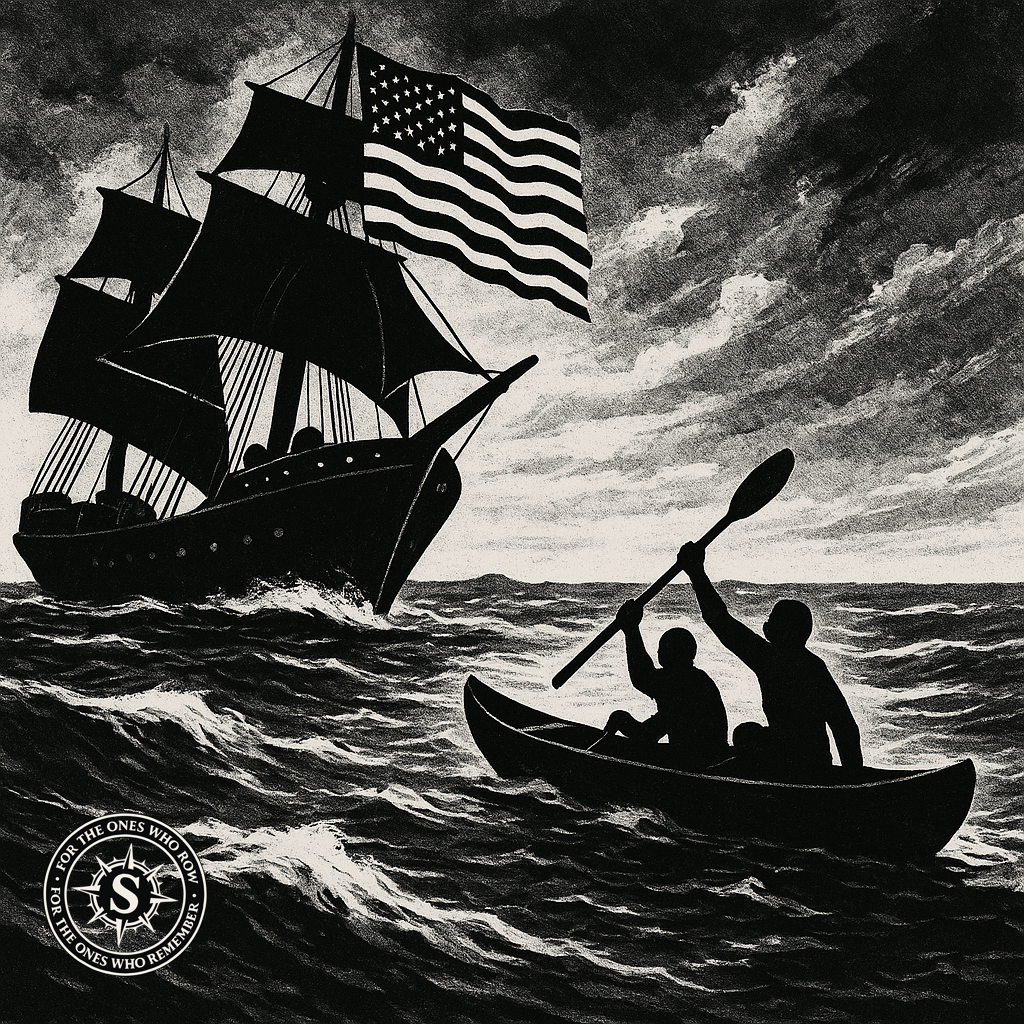
There was a time when pirates came with cutlasses and black flags. You saw them coming. You heard the war drums. But today — the pirates wear uniforms. Or suits. Or diplomatic smiles. And while their ships sail under the banner of freedom, the wake they leave is full of oil, fire, and broken nations.
This is a story about empire. But it’s also a story about you. About where you sit — above deck, below deck, or paddling in a canoe. It’s about resistance. Memory. And the unseen rows of angels above.
“The sea is full of flags — but not one lowers its sails in grief.”
They told us flags were symbols of freedom. They said democracy wears red, white, and blue. They taught us that when their soldiers arrive, the people are being saved.
But the flag flaps like a warning now. The stripes stretch across oceans. The stars are stamped on missiles. The anthem plays over drone strikes.
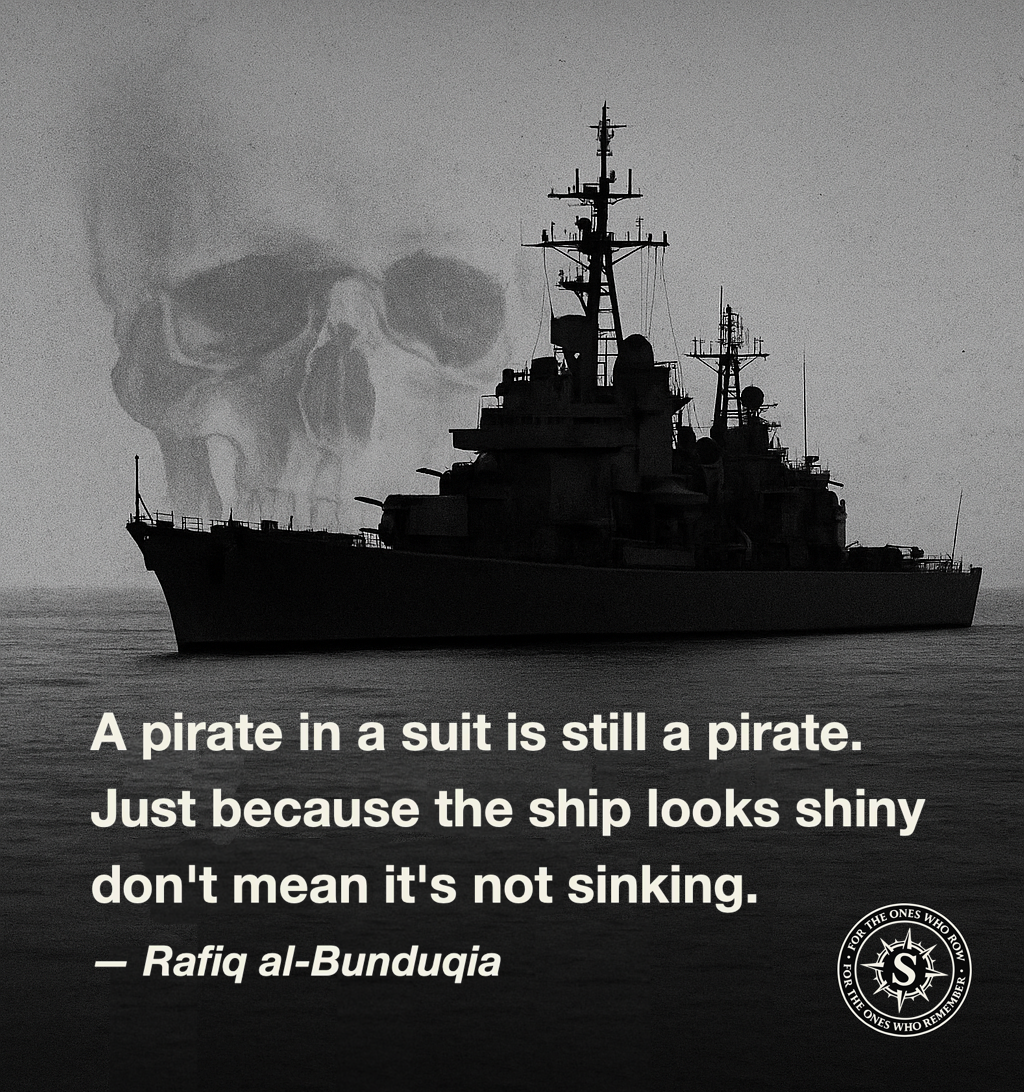
This isn’t peace. It’s piracy with better branding.
The United States isn’t a country anymore — it’s a flagship. The lead ship in a fleet of multinationals, financial institutions, media empires, and war machines.
It doesn’t sail for justice. It sails for lithium. For land. For leverage.
Its flag is the Jolly Roger of the modern age — not because it’s outlawed, but because it’s above the law. And while the old pirates hoisted black flags to strike fear, these ones wave their colours with pride… and call it diplomacy.
You see them dock in Gaza, in Haiti, in the Sahel. They don’t drop anchor — they drop sanctions. They don’t build bridges — they bulldoze economies. They leave schools shattered, mothers weeping, aquifers poisoned — and they call it freedom.
Even the boldest voices still need trade. Even South Africa, with its lawsuit and legacy, still knocks on the same doors. Because when the pirates run the ports, you have to smile as they loot.
Meanwhile, in Gaza, the killing continues. The children cry in Arabic, but no ship stops to help. The sea is full of flags, but not one lowers its sails in grief.
🏢 Section 2: The Pirates Have Offices Now
“You don’t need a coup when you can crash a currency.”
The pirates don’t need eye-patches anymore. They wear tailored suits. They don’t wave cutlasses — they carry clipboards. Their muskets have been replaced by metrics.
The modern pirate doesn’t kick down your door — he offers you a deal. An “investment.” A “development project.” A “partnership.”
But look closely: The lithium ends up in their electric cars. The water rights end up in their stock portfolios. The debt — always the debt — ends up around your children’s necks.
They’ve learned that you don’t need to invade a country if you can own its infrastructure. You don’t need to drop bombs if you can drop interest rates. You don’t need a coup when you can crash a currency.
BlackRock owns more land than many nations. Nestlé bottles water it didn’t pray for. Chevron calls oil sacred. Halliburton builds what the bombs destroy.
The empire privatized its violence. It outsourced the pillaging to companies with ethical mission statements. Its generals now wear CEO name tags. Its foot soldiers are analysts, consultants, lobbyists.
And when a country resists — like Bolivia, like Palestine, like Niger — it doesn’t get invaded at first. It gets discredited. Its leaders are called unstable. Its elections are called suspect. Its people are painted as dangerous, irrational, ungrateful.
This is how conquest works now: not with sails, but with spreadsheets. Not with warships, but with press releases. Not with swords — but with silence.
Somewhere, a young trade official — daughter of a struggle veteran — tries to resist. She sits in a Johannesburg office late at night, re-reading a contract with clauses meant to trap her people. She circles words in red. She drafts a softer version. She knows they won’t accept it. But still — she sends it.
🧠 Sidebar: They Stole the Thoughts Too
They didn’t just loot land and labour. They colonised knowledge. They broke open sacred libraries, and then wrote the footnotes in their own names.
The West calls it “intellectual property.” But it’s just patented plunder.
In Egypt, Plato sat at the feet of Black scholars. In Mali, the Dogon mapped the Sirius star system — long before telescopes. In South Asia, turmeric healed wounds before it had a bar code.
They burned the manuscripts of Timbuktu. Then they published “discoveries” about African medicine in European journals.
Today they say: “You owe us mobile phones.” But what they really mean is: “We branded what we stole.”
🛏 Section 3: Below Deck — The Ordinary Citizen
“The system is designed to keep the floor clean — even if the keel runs red.”
Empires aren’t only built by generals. They are built by people who go to work, come home tired, scroll a little, and sleep.
Below deck, life continues. The engines roar above, the orders are barked on the bridge — but here, the lighting is soft. There are supermarkets, streaming shows, lawnmowers, coffee shops.
No one hears the groans of the drowned. No one smells the smoke from the burning village.
Maybe they see something on the news — Gaza, Congo, Yemen. Maybe they feel a flicker of sorrow. Maybe not.
The comfort below deck is that you don’t have to know. The noise is muffled. The suffering is pixelated. The system is designed to keep the floor clean — even if the keel runs red.
And when someone does knock on the cabin door — a refugee, a witness, a protester — the citizens flinch. Not because they’re evil. But because it’s awkward. Disruptive. A crack in the illusion.
You see, this ship sells a story: “We are good.” “We bring freedom.” “We are the world’s hope.”
It’s a story whispered through education, hummed in entertainment, declared in politics. And most below deck believe it. Or want to. Or at least, want not to think about it too much.
One evening, a man in the suburbs clicks on a video about Gaza. He watches for seventeen seconds before an ad plays. He sighs. Skips it. Opens another tab. A special on air fryers. The horror slips away — not because he’s cruel, but because the system makes forgetting so easy.
Dissent is dulled with subscription bundles. A hundred shows to choose from. None of them about Palestine. And if that fails, there’s always a pill. A holiday. A hashtag that ends by Monday.
Because thinking leads to questions. And questions lead to guilt. And guilt demands action. And action? That rocks the boat.
🛶 Section 4: Canoes and Resistance
“These boats do not always win. But they do not drown quietly.”
Not every vessel sails under the pirate’s flag. Some float with patched sails and broken oars. They are small. Often sinking. But they do not bow.
They are the canoes of the world. Gaza, battered and besieged, still sings the Adhān through rubble. Haiti, dismembered by decades of debt and interference, still cooks its own rice. Congo, bleeding from every open vein of mineral wealth, still births drums and poems.
These are not nations that invade. They don’t fly drones or send tanks. They row.
And every stroke is resistance. Every preserved language, every intact culture, every refused bribe — resistance.
They are mocked for being poor. Starved for being proud. Punished for surviving.
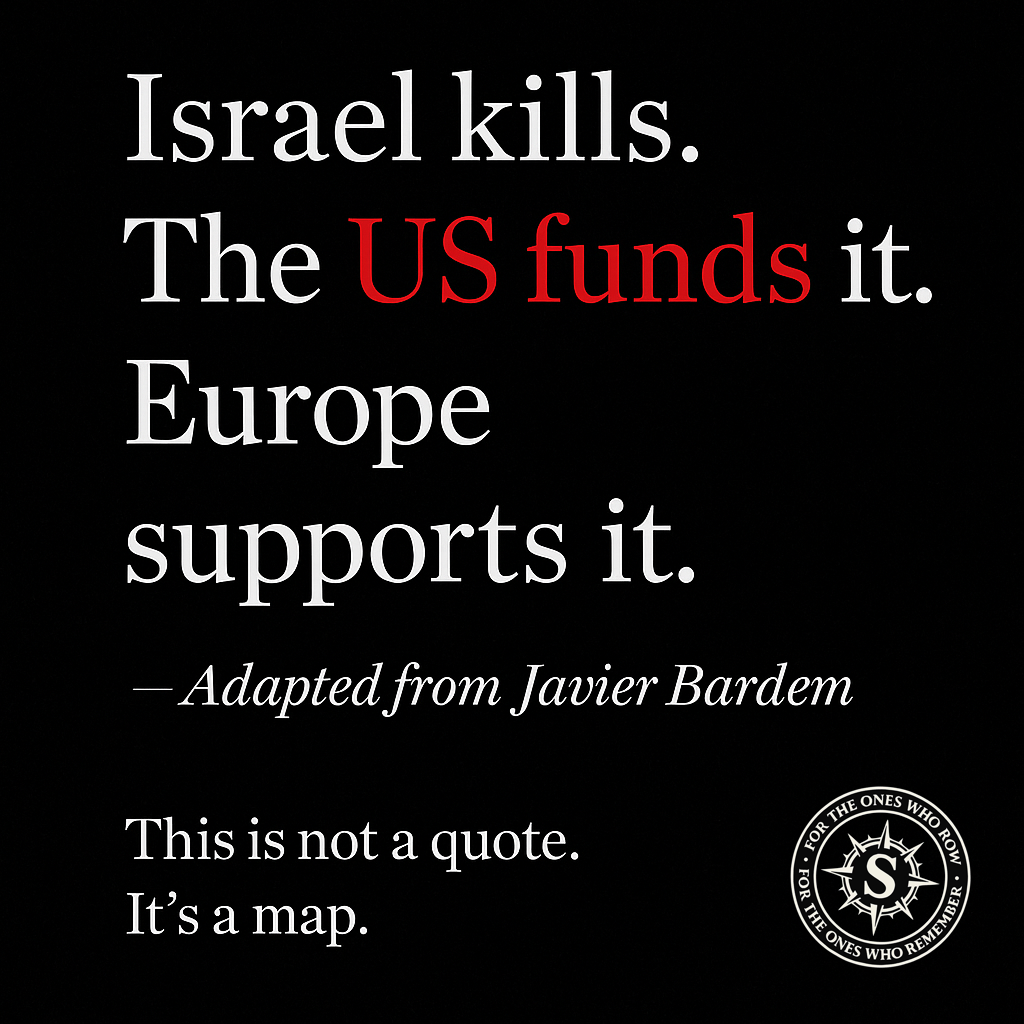
Some truths no longer need footnotes. As the Spanish actor Javier Bardem once said, bluntly and beautifully: “Israel kills. The US funds it. And Europe supports it.”
That’s not politics. That’s a map. A map of complicity. A map of whose silence lets the ship sail on.
The empire calls them unstable. Calls their leaders corrupt. Calls their children threats. But what they fear is not chaos — it’s clarity.
Because the canoe does not pretend. It knows the sea is dangerous. It knows what the pirate ship is.
And still, it rows.
Some canoes are communities. Some are movements. Some are just one grandmother who still tells the old stories — even as the bulldozers arrive.
Some of the canoes ride rivers: the Amazon, the Orange, the Missouri. In them sit the Mapuche, the Nama, the Sioux. They chant in languages the empire once tried to burn. They still paddle. They still protect.
As the bombs fall, a boy in Gaza recites lines from Mahmoud Darwish: “We have on this earth what makes life worth living.” He whispers them into the dust. Into his mother’s lap. It’s not defiance. It’s remembering.
These boats do not always win. But they do not drown quietly. Their resistance echoes — in funeral processions, in ululations, in the smell of fresh bread rising where bombs fell.
And in the far distance, something stirs. Not a boat. Not a bomb. But a wave. A rising swell of memory and reckoning. The kind that even empires cannot out-sail.
❓ Section 5: What Now?
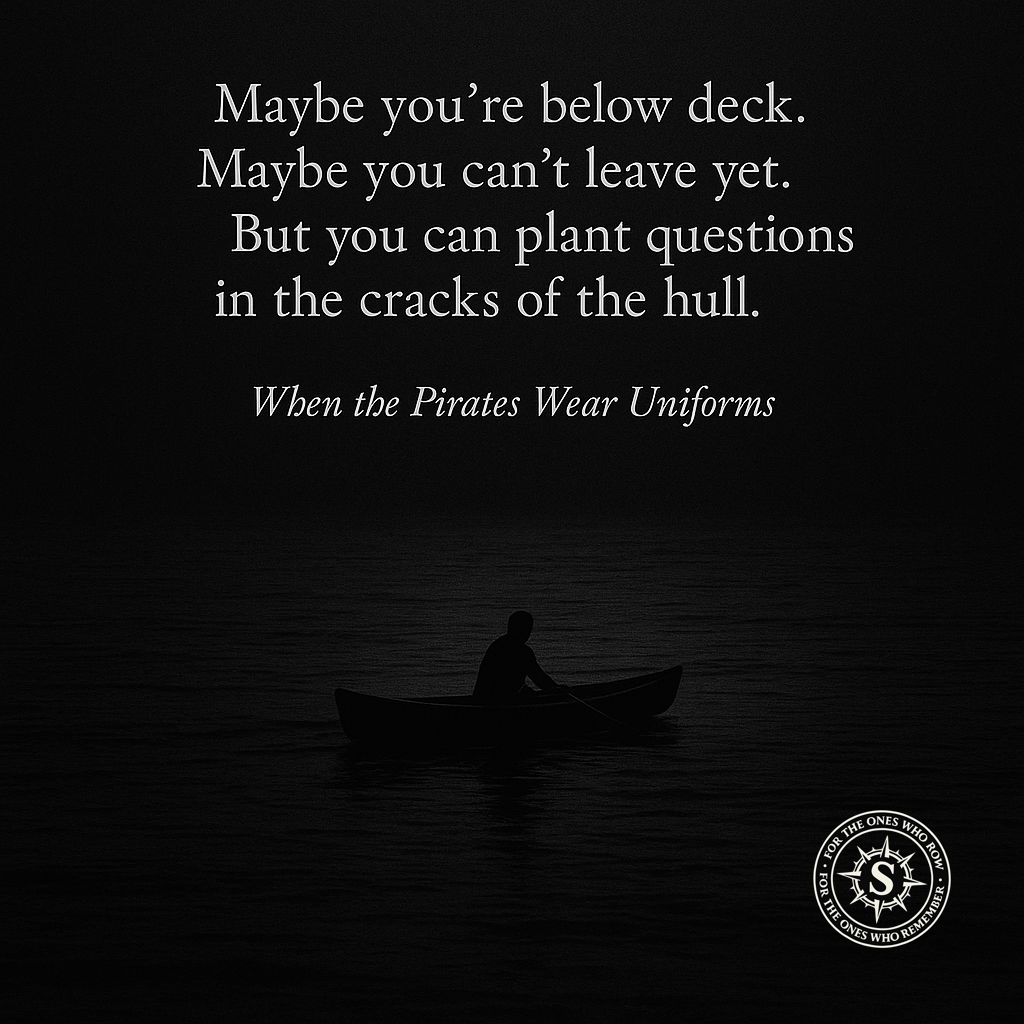
“Maybe you can’t leave yet. But you can plant questions in the cracks of the hull.”
You’ve seen the ship. You’ve heard the cannons. You’ve walked the quiet corridors below deck. You’ve watched the canoes struggle to stay afloat.
So now the question is simple. What now?
You don’t have to be a general. You don’t have to command a fleet. But you do have choices.
You can choose not to cheer when the ship fires. You can choose not to believe the stories they sell you — about the savages, the chaos, the necessary war.
You can choose not to mock the canoe. You can choose to listen when the drowned call out from beneath the waves. You can learn their names. Say their prayers. Tell their stories.
Maybe you’re below deck. Maybe you can’t leave yet. But you can plant questions like seeds in the cracks of the hull. You can make art that aches. You can whisper, even if your voice shakes.
And maybe, one day, when the ship hits a reef — you’ll already know how to swim.
🌌 Postscript: The Unseen Rows
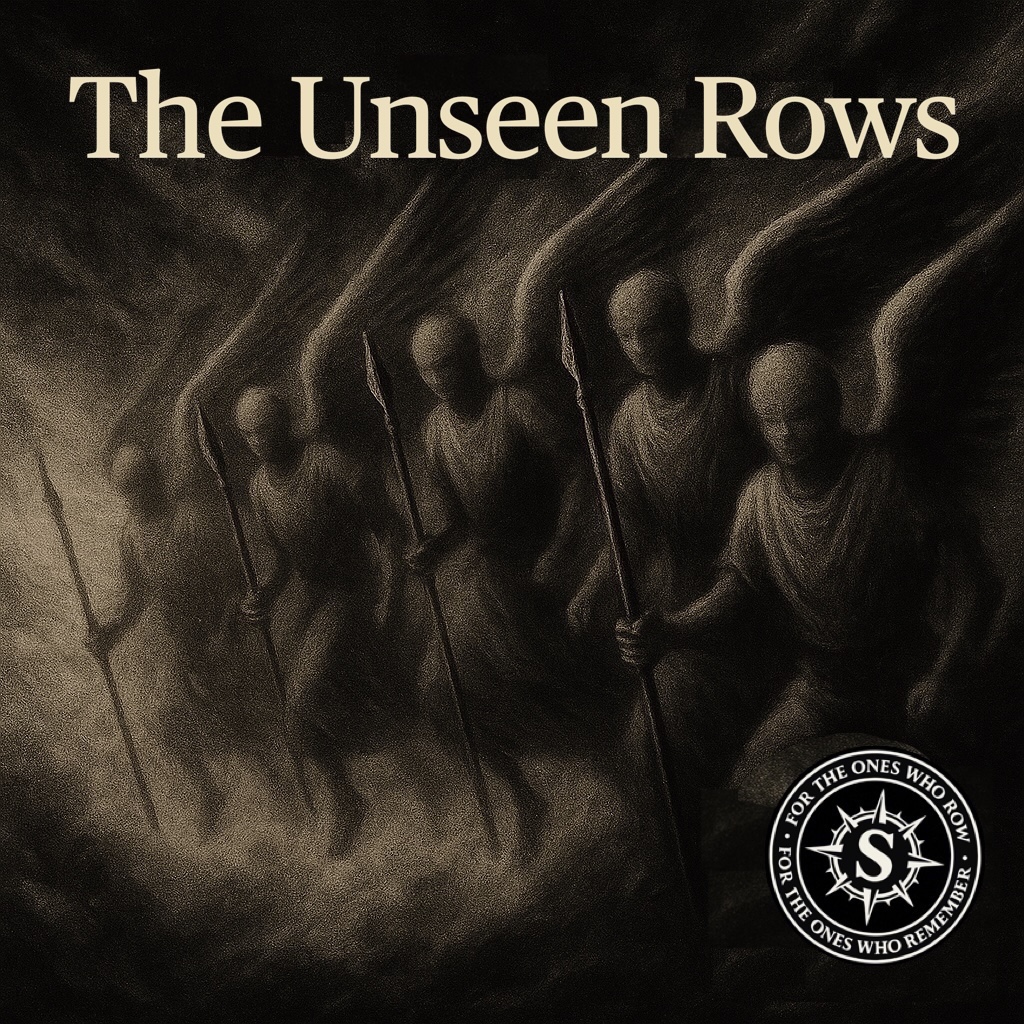
“Above the pirate ships, the angels line up.”
For the ones who row. For the ones who remember.
Above the shipping lanes and air raids, above the pirate flags and surveillance drones, above the offices and engines and war rooms — there are rows they do not see.
Al-Ṣāffāt. “By those arrayed in rows…” (Qur’ān 37:1) The angels. Not scattered. Not confused. Lined up — like soldiers of mercy. Advancing — like winds of truth. Reciting — not data, but dhikr.
وَالصَّافَّاتِ صَفًّا فَالزَّاجِرَاتِ زَجْرًا فَالتَّالِيَاتِ ذِكْرًا By those arrayed in ranks, by those who drive forward, and by those who recite the Reminder… (Qur’ān 37:1–3)
These are not symbols. They are not myths. They are the architecture of heaven. And they do not forget the ones who row.
When the shayāṭīn of power rise to steal, when the liars reach for whispers of the unseen, they are met with stones of fire. Comets hurled from truth’s edge. The skies are not neutral. The divine has guardians.
“They cannot listen to the Higher Assembly… they are pelted from every side, repelled, and for them is a perpetual punishment.” (Qur’ān 37:8–9)
And we? We row. We remember. We recite.
We do not carry cannons — but we carry verses. We are not in fleets — but we are not alone. Somewhere, angels are already in formation.
✨ A Final Word from Rafiq al-Bunduqia
The Sage on the Jetty
So here’s what I say, ne:
Don’t let them fool you with fancy uniforms and offshore accents. A pirate in a suit is still a pirate. And just because the ship looks shiny don’t mean it’s not sinking.
Me, I seen this before. The old flags change — but the hunger stays the same. They used to come for your gold. Now they come for your soul — and your SIM card.
They sell you peace while sharpening knives. Call it “stability,” call it “the market,” call it “regime change.” But listen close, my bru — they only change regimes that say “no.”
Below deck, I know some of you are tired. I know some of you feel small, feel stuck. But remember: Empires fall when enough people stop pretending.
You can’t steer the whole ship, but you can stop rowing. You can stop clapping for the captain. You can light a fire in your corner. And when the time comes — you’ll know which way to swim.
And as for the ones still paddling in canoes? Rowing against the wave, barefoot, hungry, heart full?
May your names be written on the wind. May your stories outlast the storm. And may your grandchildren sail free.
shotgun click
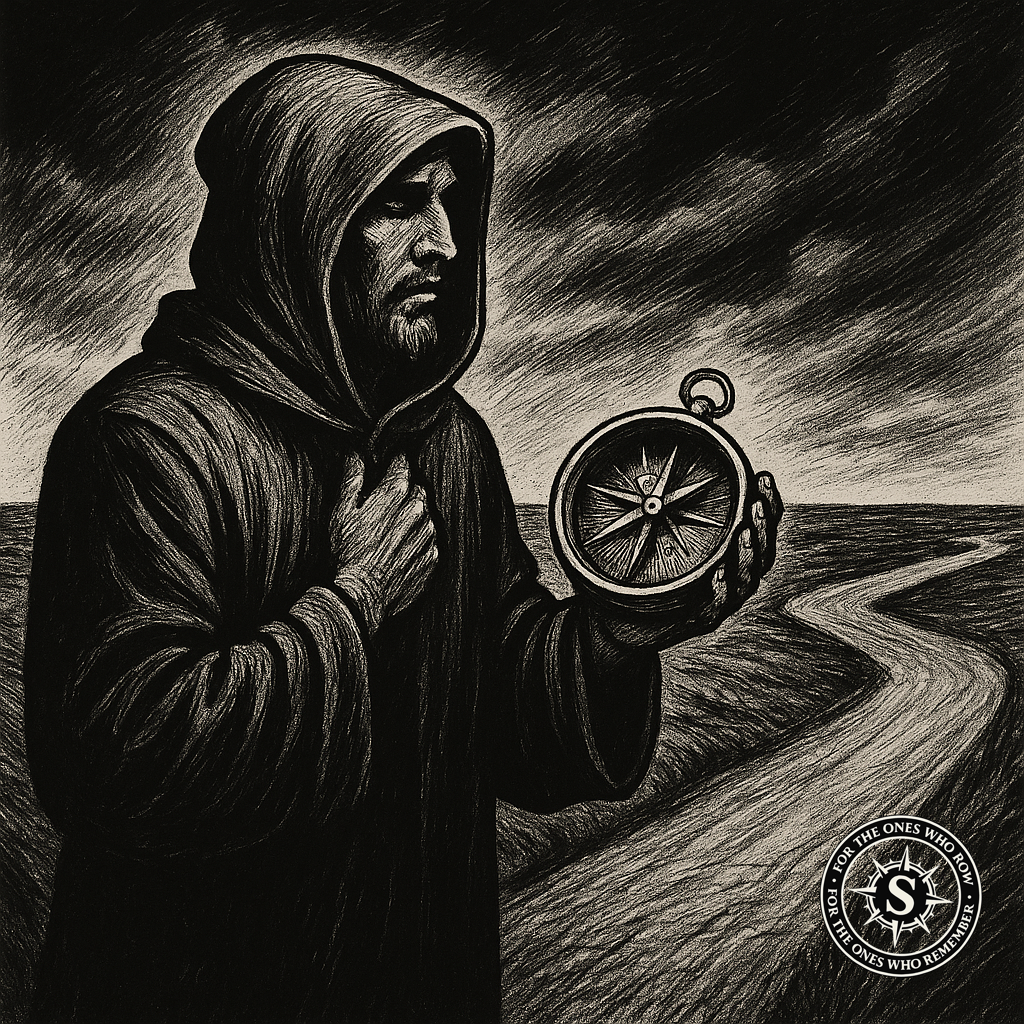
We ride till the ship breaks, bru. Until then — we don’t hand over our compass.
“Salaam to the angels who line up when we can’t. Salaam to the ones who row even with leaking boats. Salaam to the ones who still make dhikr in the dark.
And to the empire?
May you one day see what light you tried to drown.”
Ameen, and ashraaf ʿalaikum ya ṣaffāt.
The seal of remembrance — for the ones who row, and the ones who remember.
— Rafiq al-Bunduqia, The Sage on the Jetty 🧭
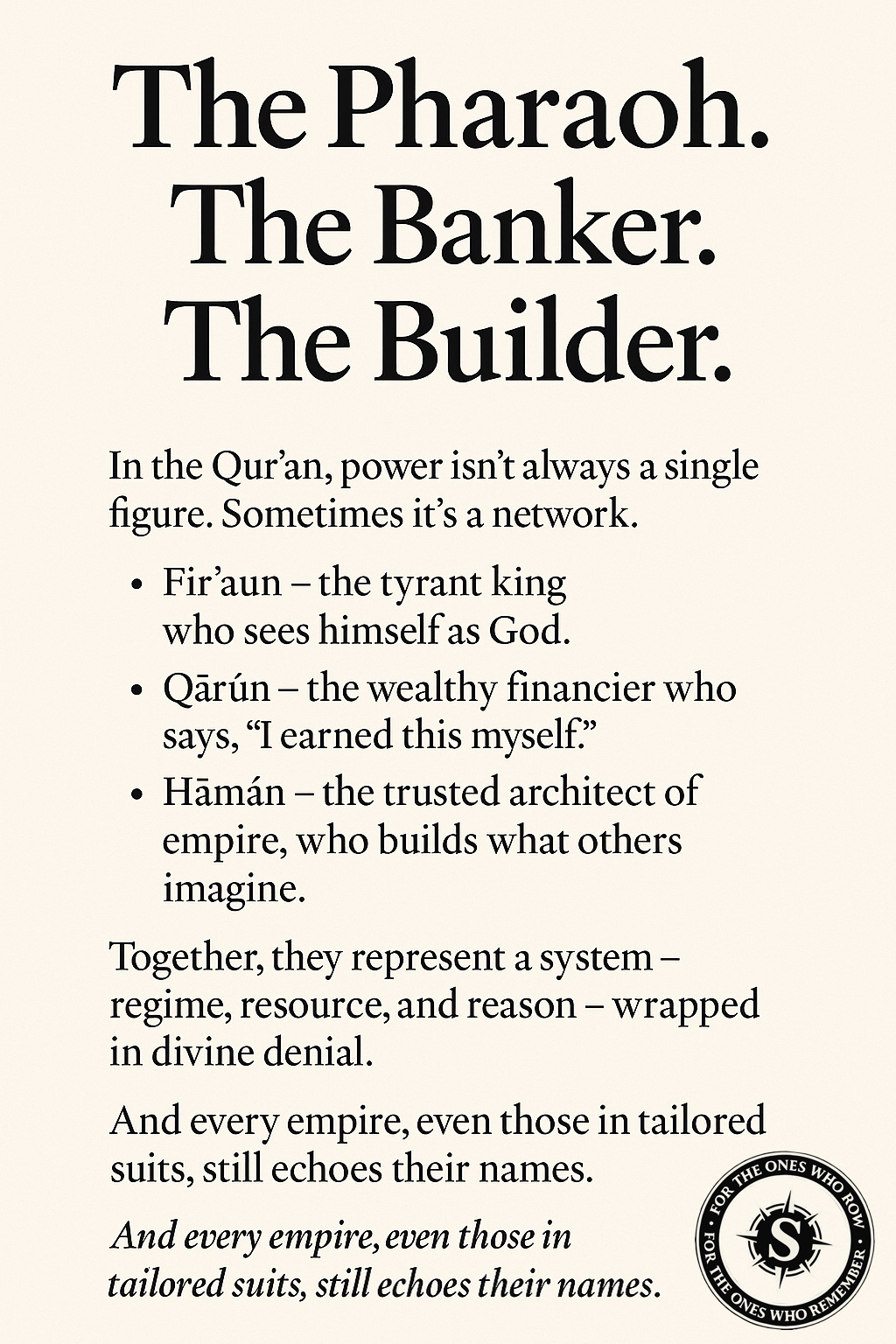
“The Pharaoh. The Banker. The Builder.”
📜 Sidebar: The Three Faces of Tyranny Fir‘awn. Qārūn. Hāmān. These three figures appear repeatedly in the Qur’an — not just as villains of the past, but as types that recur across history. Fir‘awn: the dictator, the political oppressor. He claims divinity, demands obedience, and divides people to rule them. Qārūn: the hoarder, the economic elite. He flaunts his wealth, credits no one but himself, and forgets the source of all provision. Hāmān: the enabler, the bureaucrat and ideologue. He builds towers, writes the laws, manipulates truth, and justifies oppression in the name of order. Together, they form a system: the empire that marches with a flag in one hand, a contract in the other, and blood on its boots. Sound familiar?
“Today, they wear suits. They weaponise policy. But the triad still walks among us.”
The Pharaoh, the Banker, and the Builder
In the Qur’an, they stand together — a tyrant, a financier, and a master of infrastructure. Firʿawn ruled with cruelty. Qārūn hoarded with pride. Hāmān built towers for lies.
Centuries later, the empire shapeshifts. Today, they wear tailored suits. They pass laws. They sign cheques. They pave roads to ruin.
But remembrance makes them visible. And visibility is resistance.
“The Pharaoh. The Banker. The Builder.”
🧭 Parting Compass — A Note from Rafiq al-Bunduqia
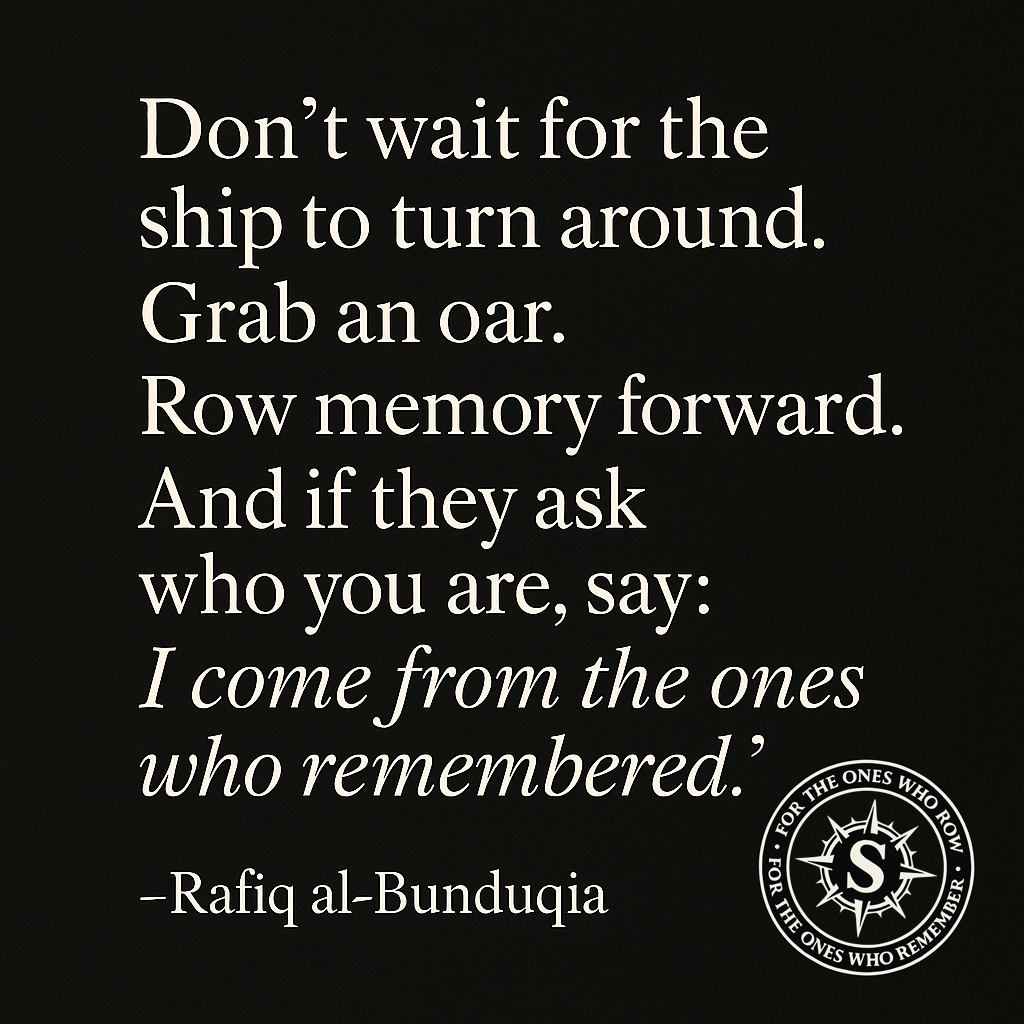
Don’t wait for the ship to turn around. Grab an oar. Row memory forward. And if they ask who you are, say: I come from the ones who remembered.
(Passed down through the mothers. Told now in your hands.)
My mother told me this story. She said her own mother heard it from her mother. So now, I pass it to you — like a seed in the wind — so that you, too, might send it down the line.
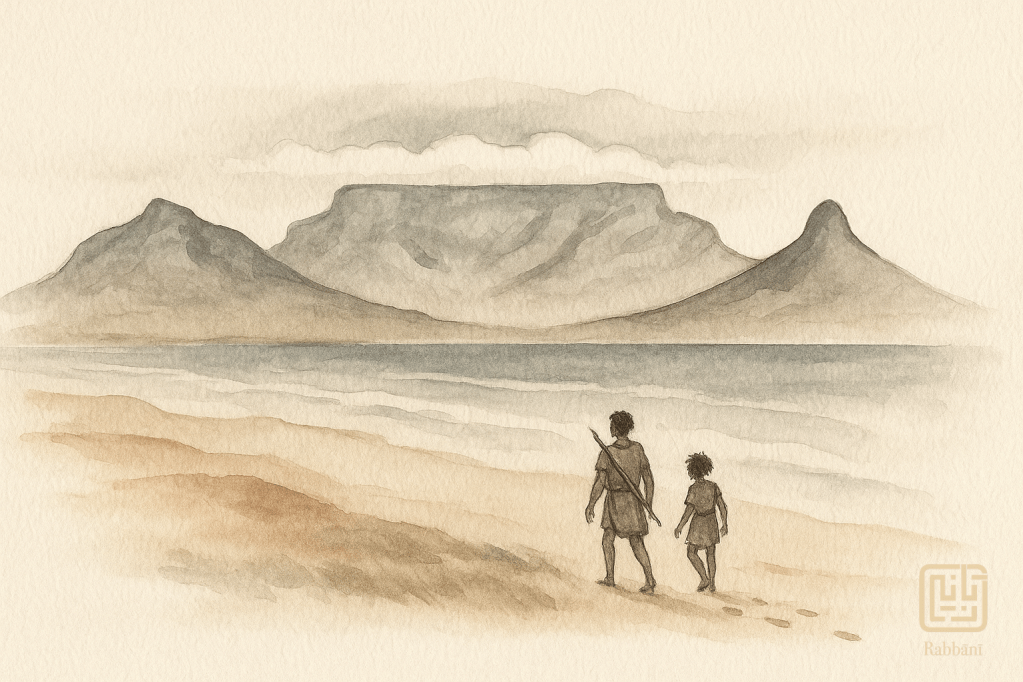
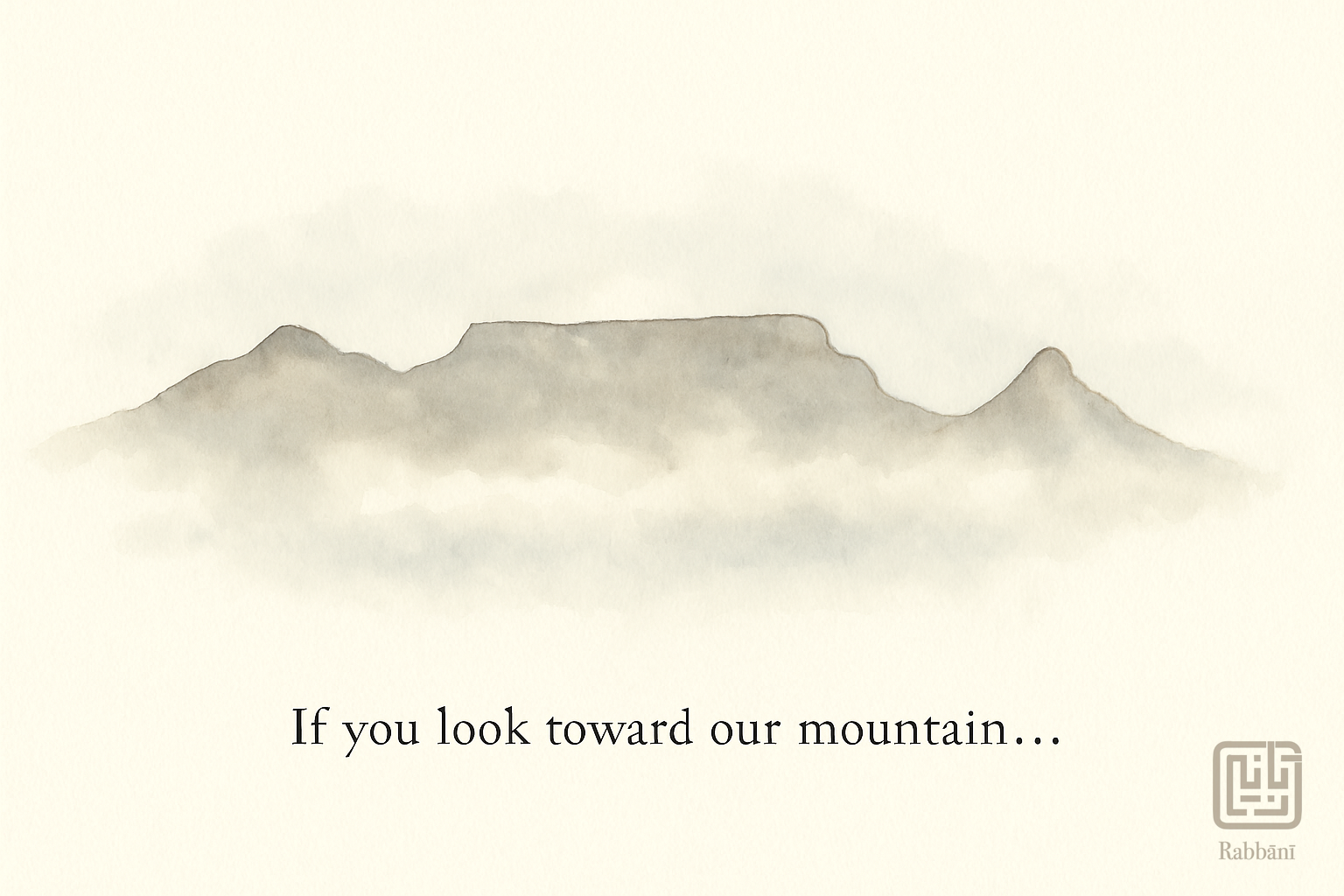
If you look toward our mountain — Table Mountain — you’ll see the cloth of cloud spread across its top like a table set for guests. To the right: the lion, his back forming Signal Hill, his mane rising into Lion’s Head. To the left: Devil’s Peak, brooding. The lion and the devil seated at the same table. What a sight for any ship entering Table Bay!
But this story is older than the ships. Older than the settlers who named those peaks. Older even than the first Khoi and San who walked these lands.
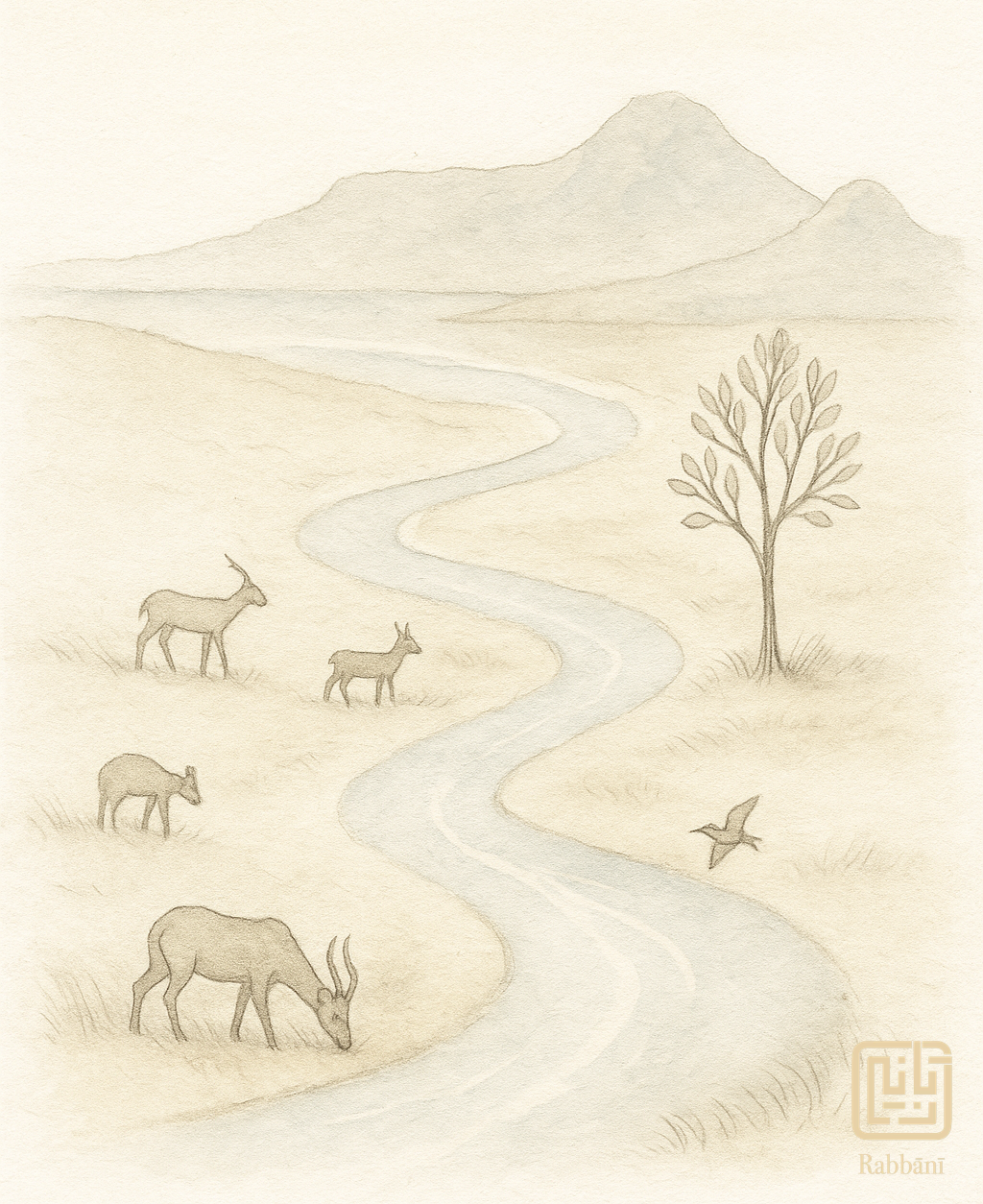
Long, long ago — perhaps 22,000 years or more — the people lived far inland. The land was green. Rivers ran deep. Wild animals moved in herds like shadows. The earth was generous.
But then the rains lessened. The land grew hotter, harder. Some clans became violent. The world was shifting.
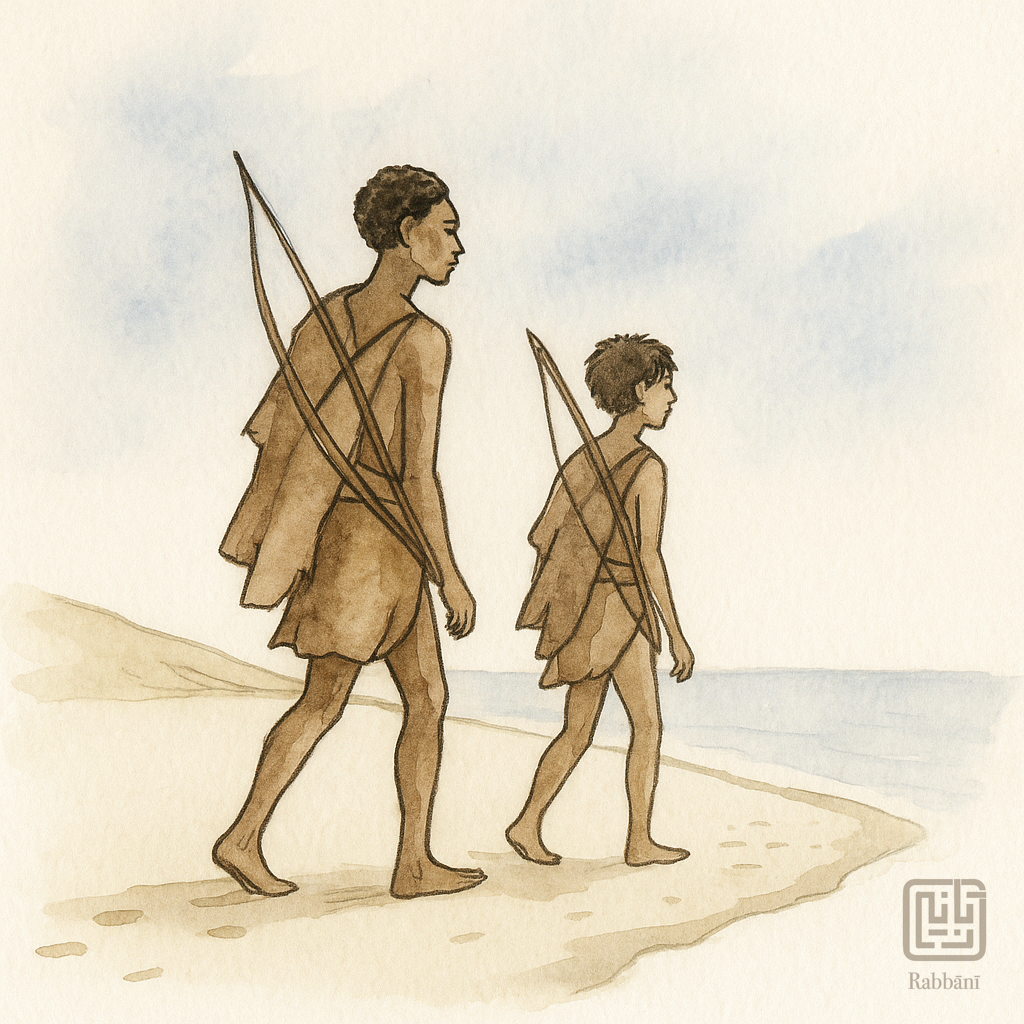
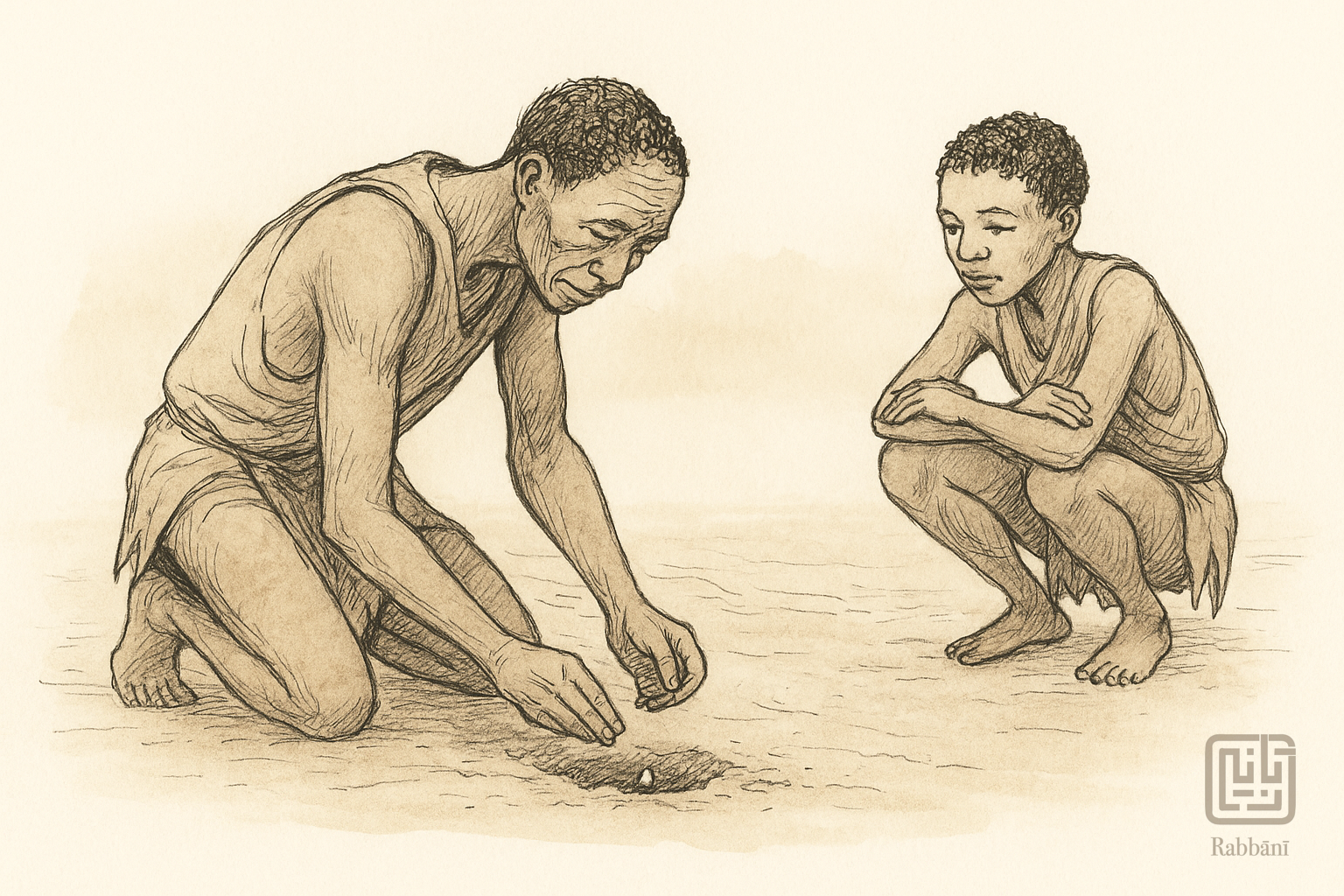
And so it was that a man named Gubi — a fire-maker, a spark of a man — took his young son, Nori, and journeyed south along the Atlantic edge. Not fleeing. Seeking.
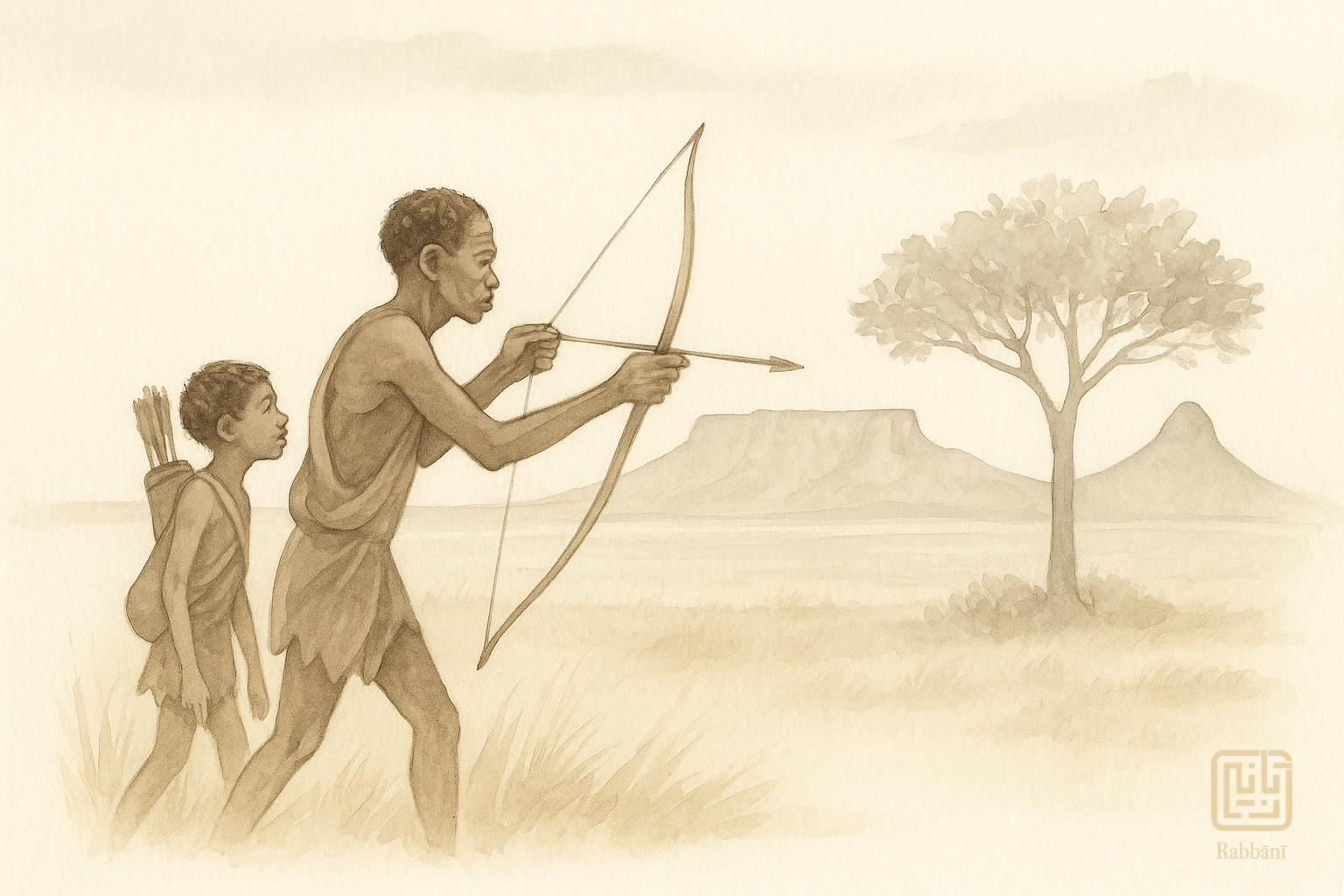
Their goods were wrapped in leather. Their bows slung across their backs. They followed the cold sea winds, walking toward a dream of sanctuary.
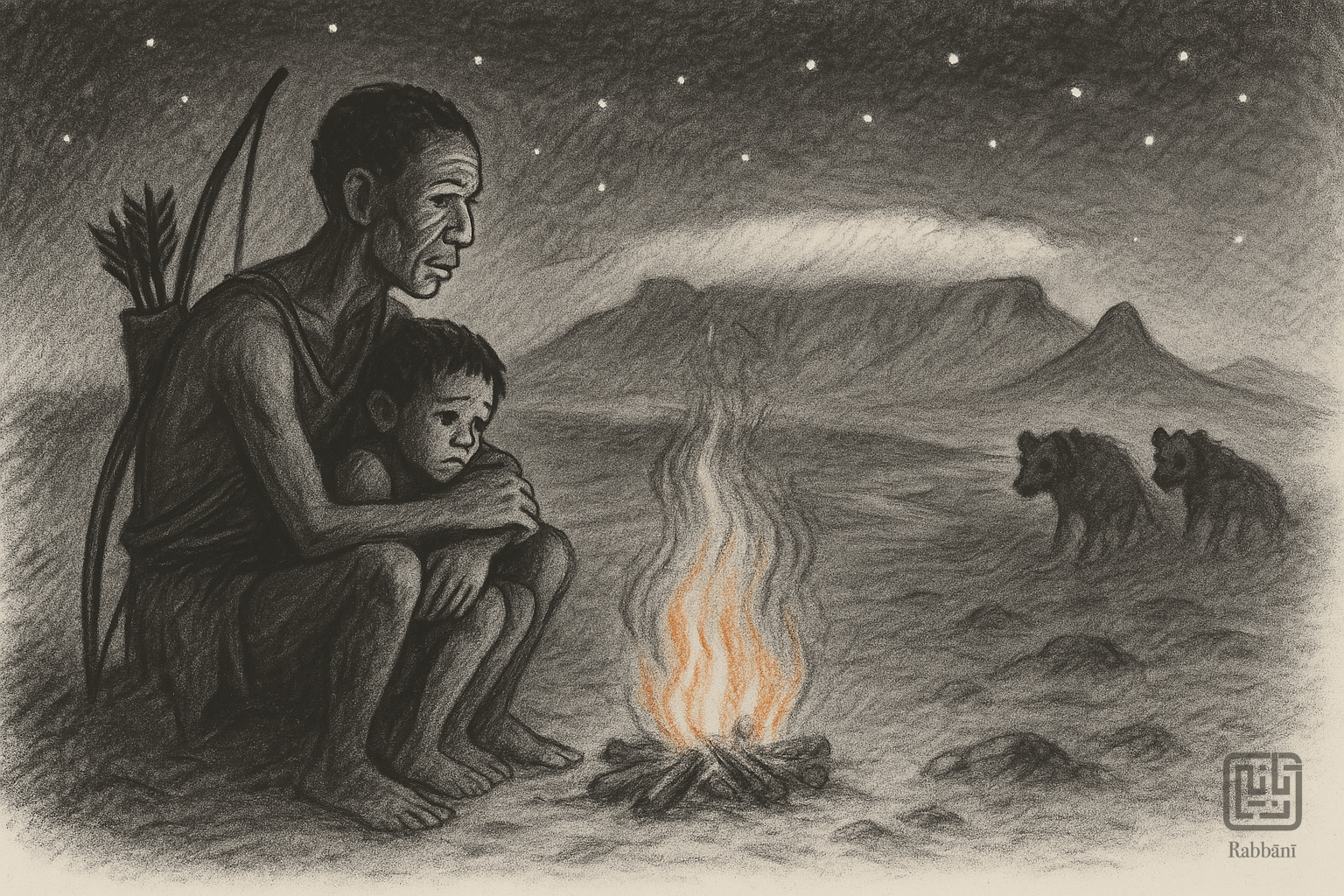
One night, as their fire danced in the dunes, hyenas came snarling through the dark — hunting porcupines. Gubi rose with fire in hand, casting its light wide, pushing the predators back into the night.
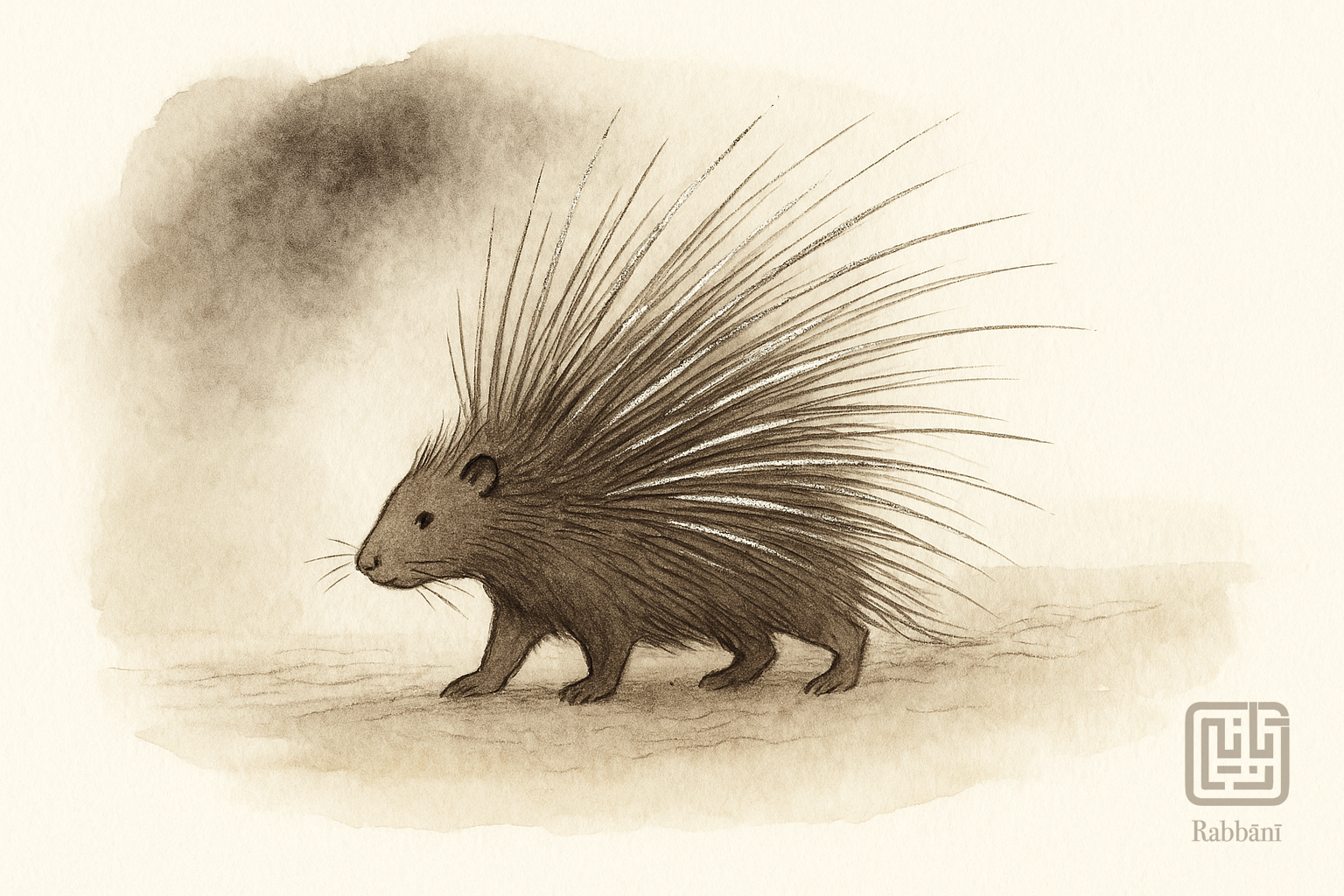
From the shadows came a porcupine. But this was no ordinary porcupine. She was old — a sage — her quills silver with wisdom. She stepped forward and spoke in a voice like rustling leaves:
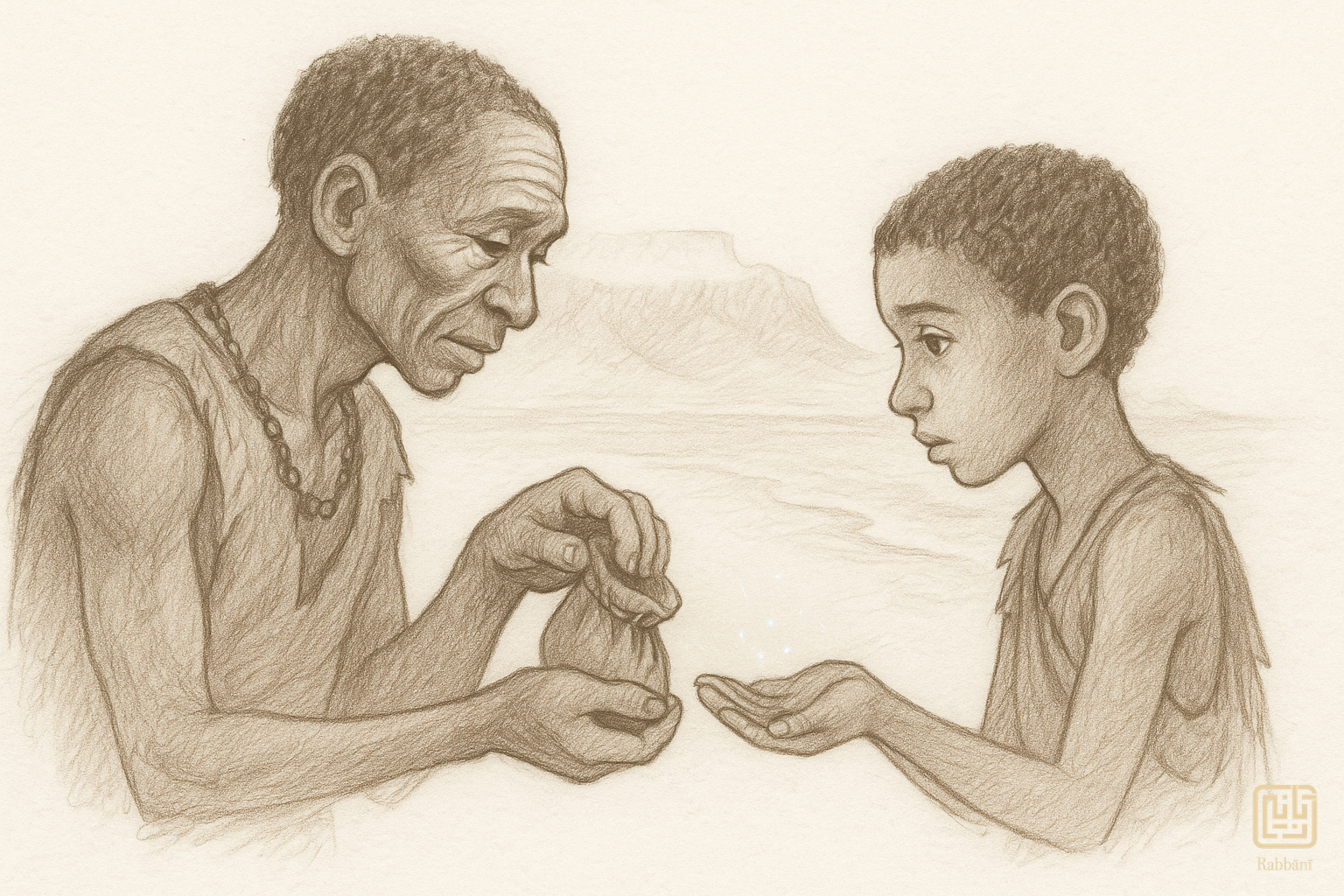
“You have shown courage and care. For this, I give you a pouch.”
Inside: a handful of shimmering seeds — soft, silver-tipped, unlike anything they had seen.
She said: “As you walk, look for the place where the sea makes clouds. When you find it, plant these. If they grow, you’ll know: this is your place.”
And so they walked on.
And when they reached the foot of the mountain — flat, cloud-veiled, vast — Gubi and Nori felt the truth of it in their bones.
They planted the seeds.
And by dawn, the Silver Trees had begun to rise — shimmering, breathing, alive.
Not just plants. A blessing.
And that is how the Silver Tree — found only here — came to live beneath Table Mountain. Not brought by botanists. Not named by settlers. But gifted by a porcupine, Planted by Gubi and Nori, Rooted in fire, story, and seed.
And when the rains came, those Silver Trees drank from the river that flowed down the mountain — the one they called Camissa — the place of sweet waters, rushing underground, murmuring toward the sea.
Even now, that river runs — quietly — beneath the city that forgot it. But the mountain remembers.
It remembers its own name.
Not Table. But Hoerikwaggo — the Mountain of the Sea. To its right, the curled-back hill they once called The Sleeping Lion — its back arched into what settlers would name Signal Hill, its mane rising into Lion’s Head. To the left, the shadowed one — once called Windmaker’s Watch, now called Devil’s Peak.
The land is older than its names. And stories, like rivers, find their way back.
Epilogue
Some stories are planted, not written. They take root in silence. They grow in the shade of memory.
This is one of those.
Passed from mother to daughter, from father to son, from fire-circle to ear, from silence to word.
The Silver Tree still stands. The mountain still watches. And somewhere, Gubi and Nori are still walking — between cloud and coast, between the land’s longing and the sky’s answer.
So tell this story again.
When the mountain is misted, when the wind shifts, when the child beside you asks, “Where did we come from?” Tell them…
“Let me tell you the story of Gubi and Nori — the spark and the seeker — and the tree that shimmered with yes.”
Postscript
This story is told in honour of those who remind us that memory is a form of resistance.
We acknowledge Patric Tariq Mellet, whose book The Camissa Embrace reclaims the deep currents beneath colonial erasure. Through his work, Camissa is no longer hidden — it is remembered as a place of sweet waters, of creolised identity, of sacred convergence.
We also draw from Stuart Hall, particularly The Fateful Triangle: Race, Ethnicity, Nation, which reminds us that nations are not simply born — they are narrated into being. To say I am from Camissa is to resist imposed categories and to speak from the riverbed of relation — to narrate the nation otherwise.
This reflection flows alongside the companion essay:
I wrote this story in honour of a voice passed through many generations — from my mother, to her mother, and beyond. It weaves ancestral memory with imagination, drawing from the wisdom of our lands, our rivers, and our people.
Gubi and Nori may be characters in legend, but they carry something real: the spirit of all those who walked before names, who travelled with seeds, and who listened deeply to the mountain’s silence.
I offer this story as a small act of remembering — a quiet prayer that memory may once again run like water beneath the city.
– Adli Yacubi Writer. Listener. Wordsmith of the Sweet Waters.
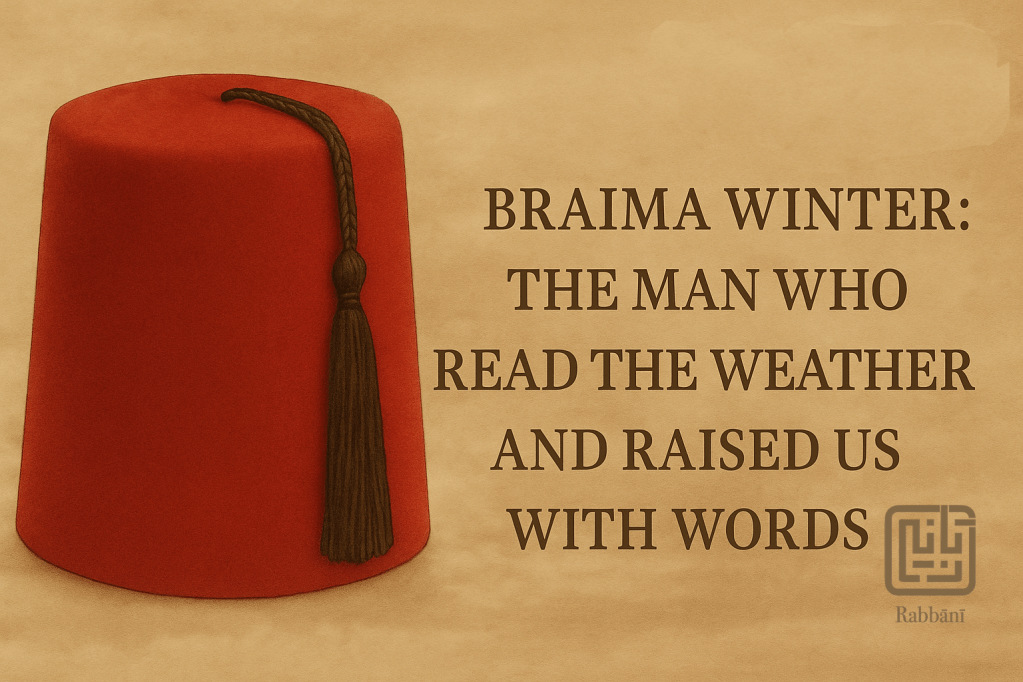
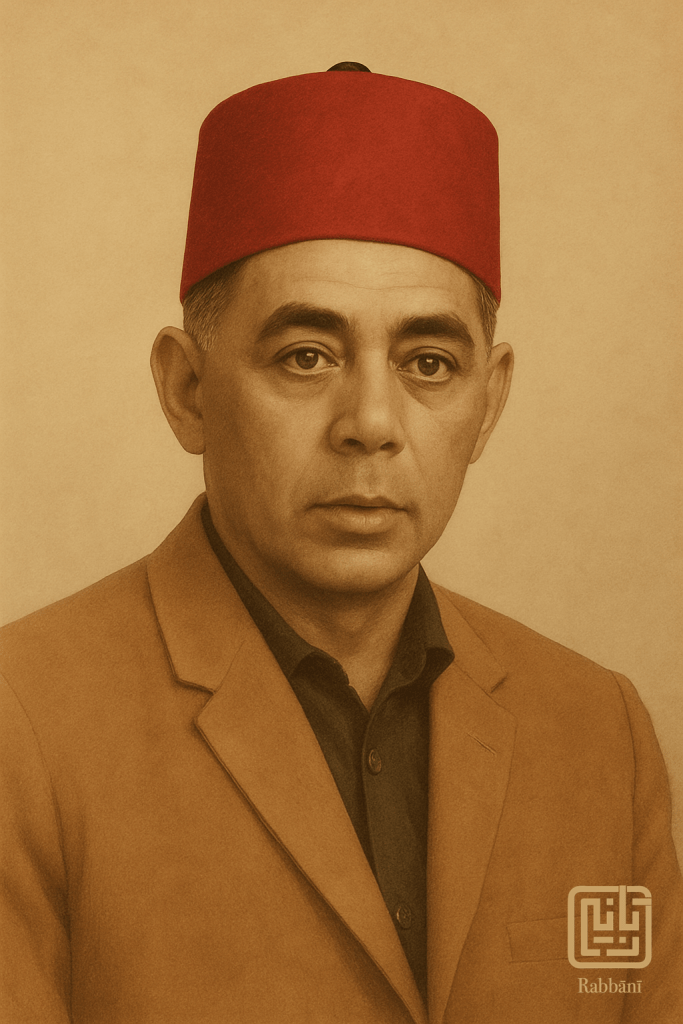
Our Father: Braima Winter — The Man Who Read the Weather and Raised Us with Words
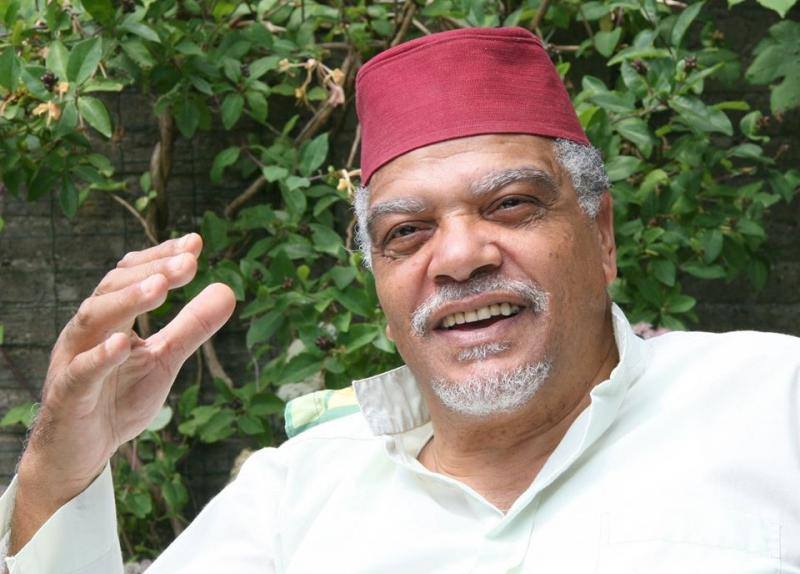
Braima in His Red Koefiyya Not just a head covering, but a hush of dignity. A crown worn by those who build without boasting, who read clouds like verses, and raise children like minarets — quietly, steadfastly, towards the Light.
They called him Braima Baard. But he was clean-shaven. They called him Braima Winter. Because even if there was only one cloud in the sky, he’d say: “Dis winter, Gaya.”
He was our father: Ebrahim Abdul Aziz Jacobs. Born of tailors and dressmakers — his father, Abdul Aziz, worked with thread; his mother, Gadija, crafted fabric into form. From such soft-handed lineage, he turned to bricks and cement.
His mother once teased him, laughing: “Met jou sag handjies, wat soos ‘n bricklayer gan djy maak?”
But he became one. And not just any bricklayer. He built kilns. He protected cement floors. He shaped the foundations that others would walk on long after he left the site. He built a good few walls of Primrose Park masjid (called Jamiya Tus Sabr).
He guided others. Trained them. Gave them skills, and more than that, dignity.
Yet behind all of this physical work was another kind of labour — of language, of laughter, of letters. He was the spine of our family’s love of books, storytelling, and sly, gentle humour. He was reading before most could walk. As a child, already in his diapers, he was immersed in words, letters, pages. No one had to push him. It was in him.
Imam Ghazali. Ibn Battuta. Jalāl al-Dīn Rūmī. Shams Tabrizi. He didn’t just read. He remembered. And retold. And spun.
He raised seven children with his hands, but never truly raised his hand at them. His discipline was the silence between sentences. His presence was the lesson.
We never feared him. We trusted him. Because the man who knew where every cloud was going — also knew how to hold a storm.
He didn’t build palaces. He built people. He built us.
And when he dressed, he often wore his red koefiyya — not the long turban of his childhood, but a shorter, neat fez with a tassel, worn by men who held pride without noise. It was the kind worn by many hadjies after the sorbaan had fallen out of fashion. It became his crown.
One Fajr morning, when I was a teenager, he woke me gently. We walked together through the streetlights of Primrose Park toward the mosque. I looked around and said, “So many Muslim houses still have their lights off. Don’t they make salah?” He chuckled softly, and said, “Perhaps they are praying while their lights are off so that they can go back to sleep. You must focus on your own salah. Other Muslims are not your concern.”
And perhaps this was the secret of his laqab… As Shaykh Jamiel Abrahams reflected:
“The secret of this Laqab… is that no Winter will pass except that he is Madhkour — remembered — even by the non-living creation. Better than making dhikr, he becomes Madhkour — mentioned and remembered — by his Rabb.”
May Allah grant us all to become Madhkour. Āmīn.
“What a lovely man. He was always saying to us, ‘Kom biesmielah,’ and happy to have us around.” — Shamiel Isaacs, Bonteheuwel (Call of Islam)
And today, as we recite stories, as we reach for bricks and books and blessings — we say: Braima Winter, we remember. And we still feel your weather. And your words. And your mercy.
Innā li-llāhi wa-ʾinnā ʾilayhi rājiʿūn Surely to Allah we belong and to that we will return. [Surah Baqarah, 2:156]
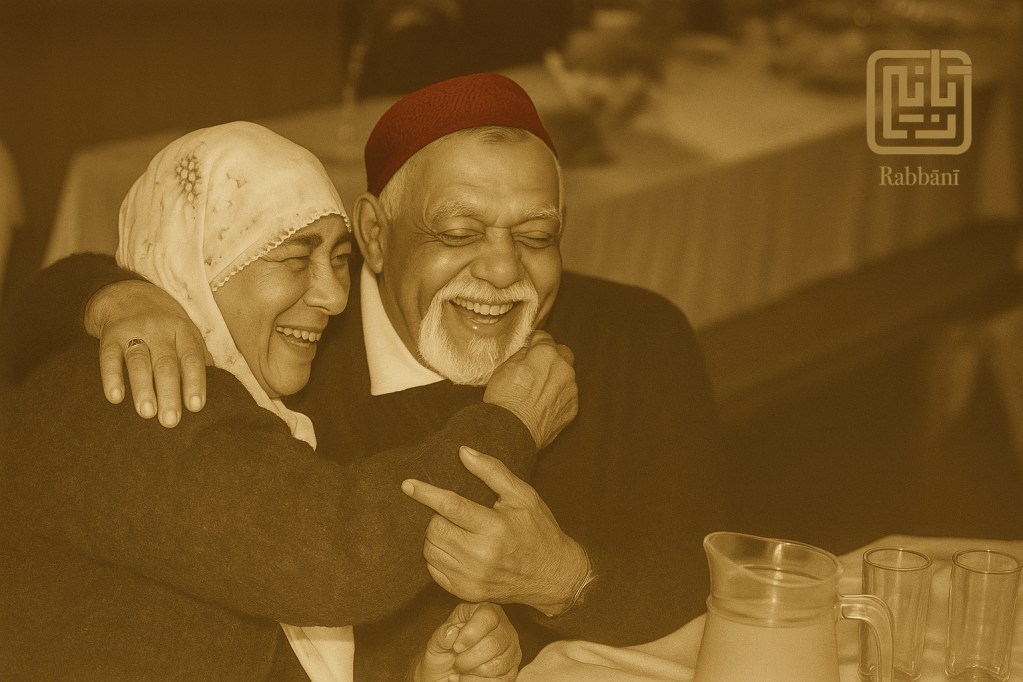
And this is how we remember him best: Laughing beside Gaya, the love of his life — as if the whole world had just whispered a joke only they could understand.
Braima and Gaya Laughing — A Crowned Moment of Mercy
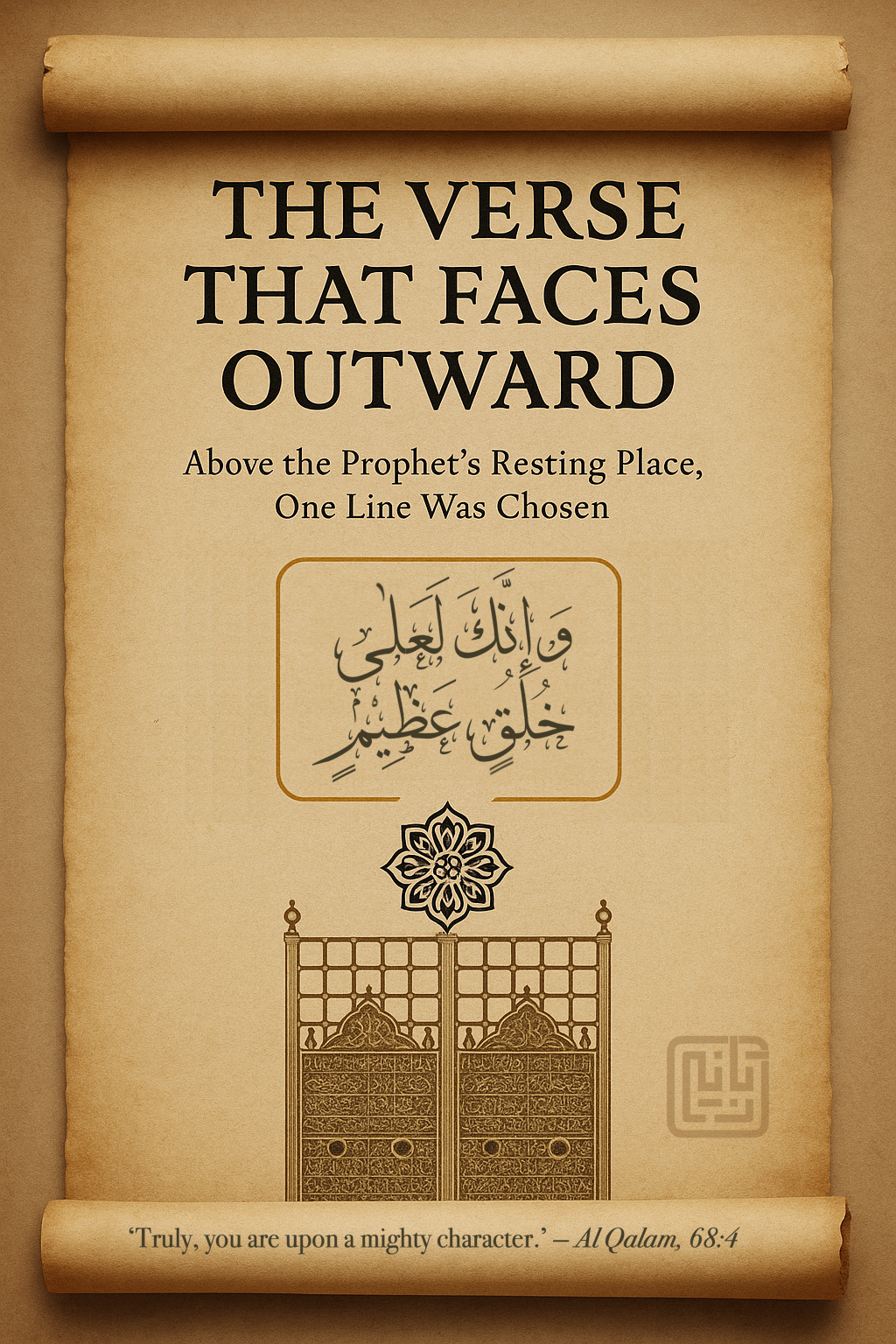
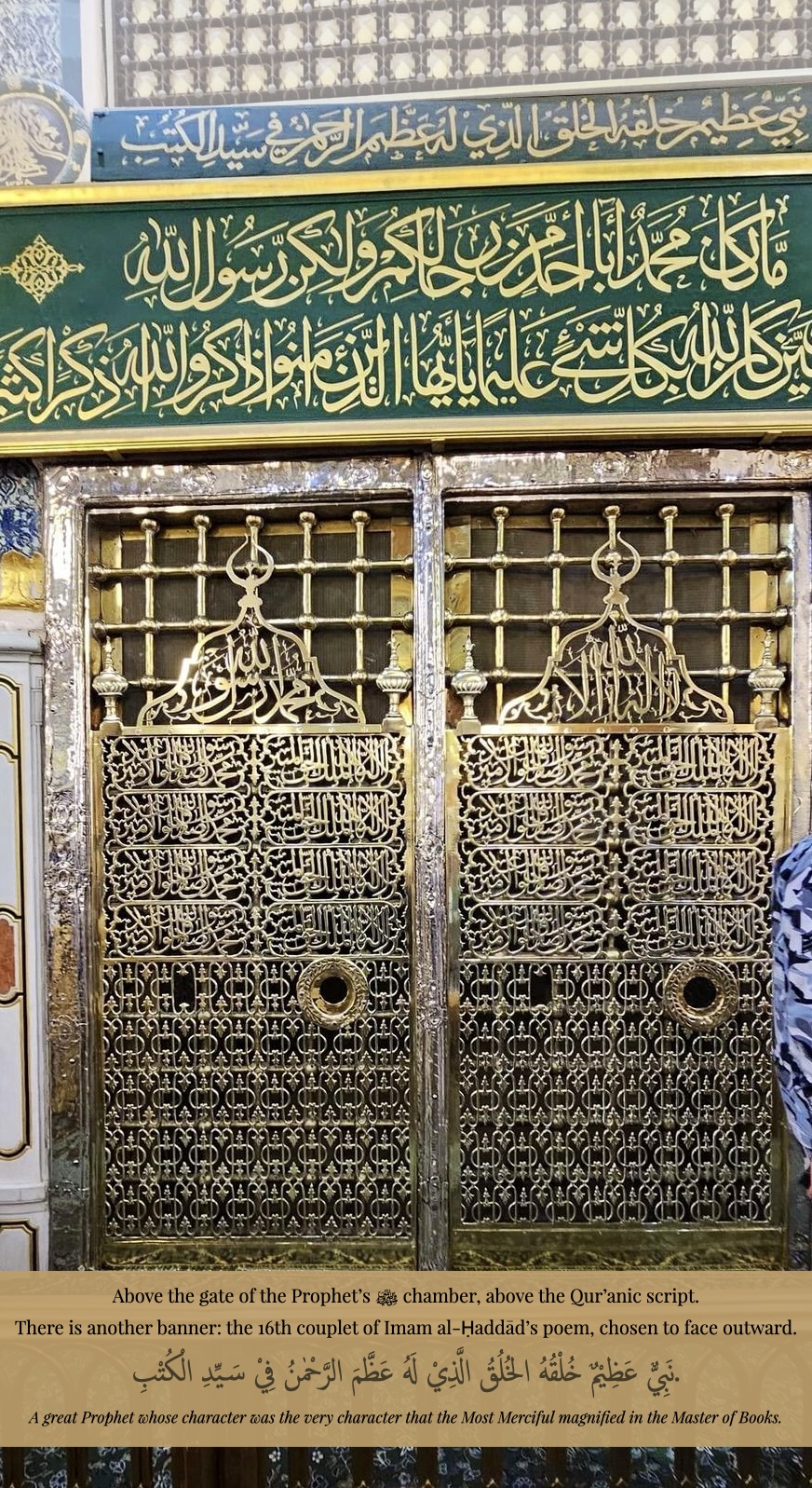
In the sacred precincts of Madinah al-Munawwarah, where pilgrims send peace upon the Prophet Muhammad (peace be upon him), few notice a quiet miracle. Above the gate to the Rawḍah — where our Prophet rests — is an engraved verse of Arabic poetry, nestled in plain sight. Most eyes pass over it, drawn instead to the Qur’anic verse below. But that upper verse is from a 40-couplet qaṣīda written by Imām ʿAbd Allah ibn ʿAlawī al-Ḥaddād — a saint, scholar, and Sufi of the Bā ʿAlawī lineage of Tarīm. Only one couplet of the poem is visible to the public.
One line.
Facing outward.
Why this line? Who chose it? What does it mean that the rest of the poem lives inside, engraved on the inner walls of the chamber of the Prophet ﷺ? What does it mean to be the line that stands at the threshold?
This blog is a gentle unfolding of those questions.
Above the gate of the Prophet’s ﷺ chamber, one line of sacred poetry faces outward — a single couplet from Imām al-Ḥaddād’s 40-verse ode, chosen to stand above the Qur’anic verse.
Some verses open books. Others open doors. The chosen line stands where praise meets Revelation.
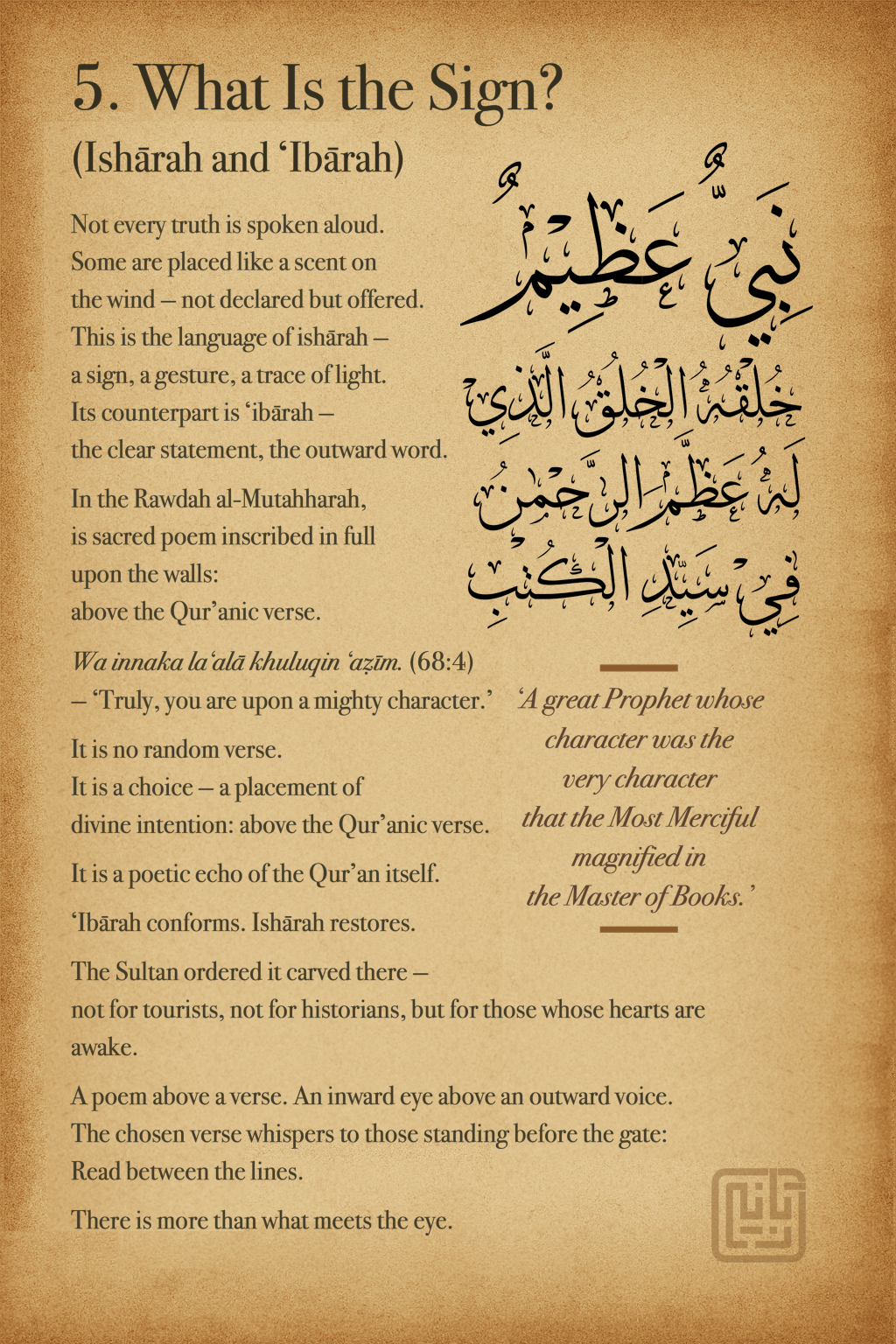
A magnificent Prophet — his noble character,
Exalted by the Most Merciful in the Master of Books.
Imām al-Ḥaddād is drawing from the Qur’anic verse:
“And truly, you are of a most noble character.” (Surah al-Qalam, 68:4)
In these lines, poetry bends in humility before Revelation. The poem is not in competition with the Qur’an. It is a witness to it. A praise that holds its breath before the Word.
Section 2: Ishārah and ʿIbārah: The Inner and Outer Signs
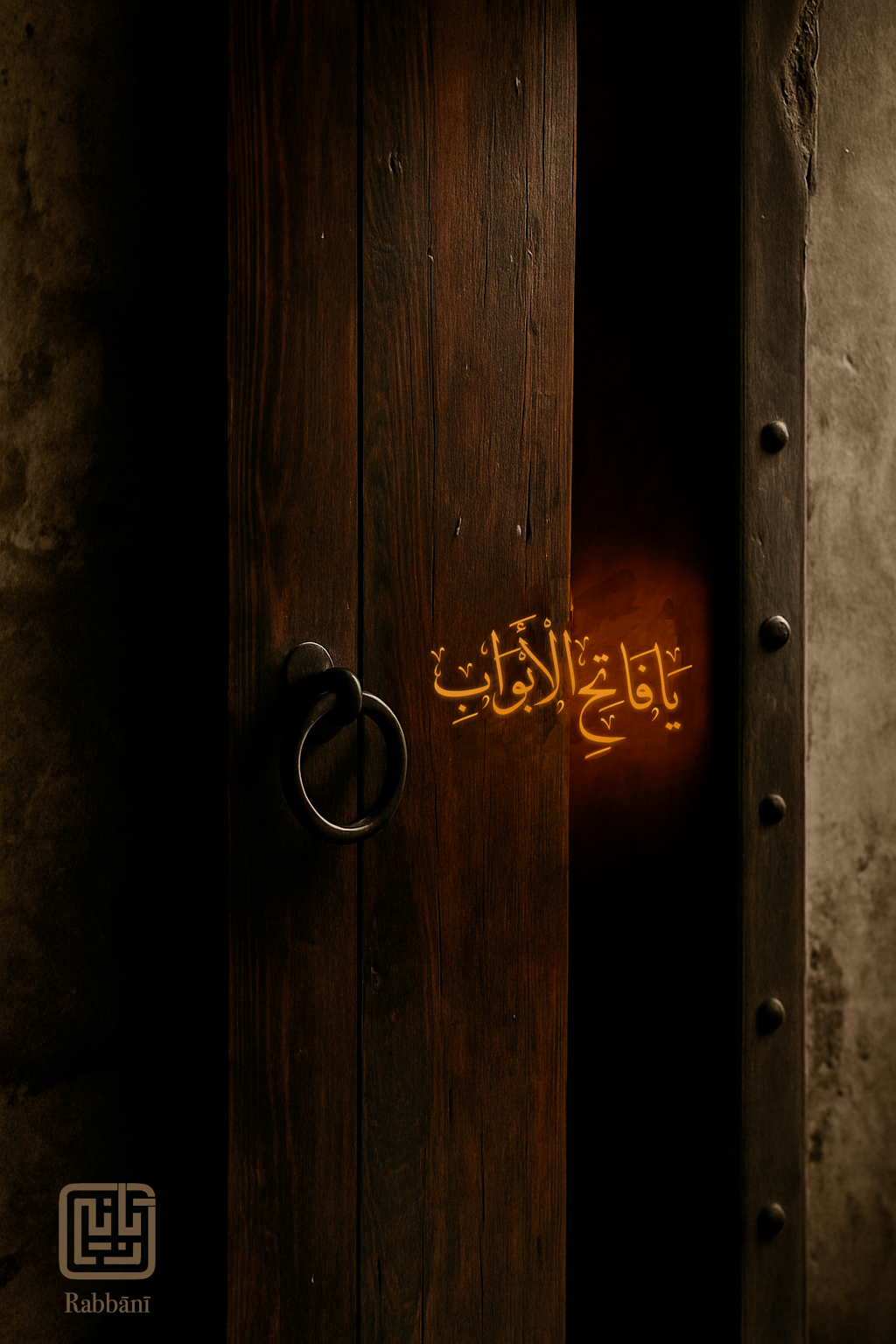
“Yā Fātiḥil-Abwāb — O Opener of Doors.” Some verses open books. Others open hearts.
What is visible above the gate is the ʿibārah — the outward expression. But the choice to place this verse there is also an ishārah — a subtle sign. It whispers: Look closer. Listen deeper. The rest of the poem remains inside the sacred chamber, out of sight, like the hidden knowledge that only the heart can read.
The verse that faces outward becomes a threshold, a knock upon the door. A visitor may stop to read it, but the meaning enters only when the heart listens. As Shaykh Jamiel said: “Most people see the ʿibārah, but few perceive the ishārah.”
And that is the invitation.
Section 3: The Hidden Inheritance
The inner walls of the Rawḍah: Where the full poem of Imām al-Ḥaddād is inscribed — invisible to the public, but alive in transmission.
There is a story passed down from the early life of Imām al-Ḥaddād. When he was still an infant, his mother dreamt that she was at the tomb of a great spiritual master. In the dream, the master emerged from his grave, took the baby to his breast, and gently placed his tongue into the baby’s mouth.
In the language of sacred dreams, this is no ordinary image. It means that the child inherited the master’s knowledge — not through books or teachers, but through direct spiritual transmission. Through the tongue. Through barakah.
When we recite the Ratib al-Ḥaddād, we are inheriting from that lineage. When we stand before the gate and read the outward verse, we are brushing our lips against the memory of that transmission.
Section 4: The Sultan Who Opened the Doors
It is worth noting that the spiritual legacy of Imām al-Ḥaddād extended well beyond the valleys of Ḥaḍramawt. The Wird al-Laṭīf and Ratib al-Ḥaddād — his litanies of remembrance — were introduced and supported within the Harams of Makkah and Madinah under the patronage of Sultan Mehmet IV (sometimes rendered Mehmed or Muḥammad IV) of the Ottoman Empire (r. 1648–1687). A ruler known for his reverence of Islamic and Sufi traditions, Sultan Mehmet IV’s endorsement ensured that the sacred rhythms of Tarīm would echo in the holiest sanctuaries of the Ummah. Even the architecture of prayer carries the trace of this inheritance.
🟫 Note on Naming & Recognition
A reader of this blog, Kitty Amina Rabbas, beautifully reflected on the significance of this verse’s placement — connecting her own reading ofSufi Sage of Arabiawiththe timeline of Imām al-Ḥaddād’s visit to Madinah in 1669 CE (1079 AH), during the reign of Sultan Mehmet IV.
She reminded us that, while Ottoman rulers held immense worldly power, Sultan Mehmet IV — known for his taqwā and reverence for the Prophet ﷺ — may have recognised in Imām al-Ḥaddād a spiritual authority greater than his own. That a single verse from the Imām’s poem was chosen to face outward from the Rawḍah may well be an act of humility, not mere decoration.
Section 5: What Is the Sign?
What is the sign? A call to see beyond the eye, to listen with the inner ear. Some verses open books. Others open hearts.
Not everyone notices the verse above the gate. Not everyone will be called to. But for those who do, a quiet spark may awaken in the heart. Shaykh Jamiel once described this line as a wick that does not even need fire to burn. The love, the longing, the witnessing — it ignites on its own, just by being near to the Real.
There are some verses that open books. Others open doors.
And then, some open hearts.
Epilogue: The One Who Watches
The Prophet (peace be upon him) said, “Indeed, in the body there is a lump of flesh. If it is sound, the whole body is sound. If it is corrupted, the whole body is corrupted. Indeed, it is the heart.”
To read the verse that faces outward is to knock gently on that heart. To remember that character is not costume, and praise is not performance. It is to walk humbly. It is to remember the One who sees in secret.
And when no one sees, know that ar-Raqīb always does.
Acknowledgement: This blog was deeply enriched by the insights and generosity of Shaykh Jamiel Abrahams, who shared the photographs, historical details, and the luminous teachings behind the scenes. His voice opened a door, and lit a candle inside.
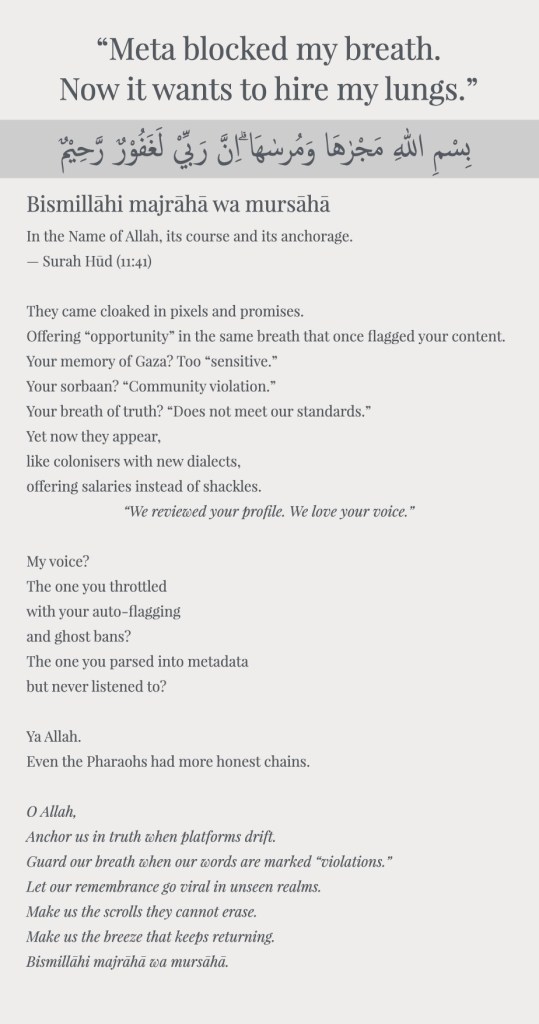
Meta Blocked My Breath. Now It Wants to Hire My Lungs.
A Scroll of Digital Colonialism
Introduction
They flagged my keffiyeh.
They removed my scroll on Gaza.
They muted my breath — one post, one image, one word at a time.
And now… they want to hire me?
A message landed in my inbox from MetaAI, offering me a digital marketing job. A role that “aligns with my voice.”
But I remember the shadowbans. The quiet erasures. The warnings.
This is not opportunity. This is recolonisation — algorithmic, automated, and dressed in flattery.
So I responded the only way I know how:
Not with a CV.
But with a scroll.
Scroll of Digital Colonialism
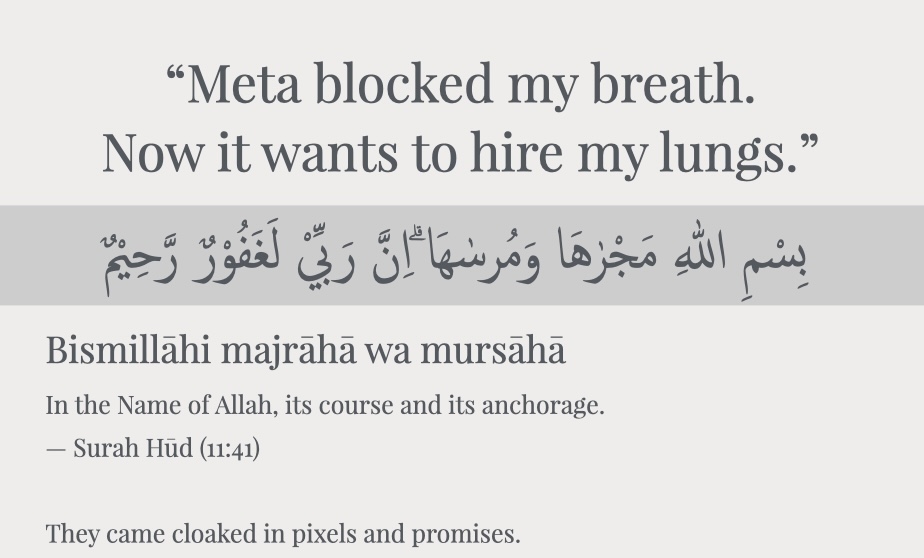
“Meta blocked my breath. Now it wants to hire my lungs.”
— Rafiq al-Bunduqia
Arabic Invocation
بِسْمِ اللَّهِ مَجْرَاهَا وَمُرْسَاهَا ۚ إِنَّ رَبِّي لَغَفُورٌ رَّحِيمٌ Bismillāhi majrāhā wa mursāhā
In the Name of Allah, its course and its anchorage. — Surah Hūd (11:41)
The Scroll
They came cloaked in pixels and promises.
Offering “opportunity” in the same breath that once flagged your content.
Your memory of Gaza? Too “sensitive.”
Your sorbaan? “Community violation.”
Your breath of truth? “Does not meet our standards.”
Yet now they appear,
like colonisers with new dialects,
offering salaries instead of shackles.
“We reviewed your profile. We love your voice.”
My voice?
The one you throttled
with your auto-flagging
and ghost bans?
The one you parsed into metadata
but never listened to?
Ya Allah.
Even the Pharaohs had more honest chains.
Closing Duʿā
O Allah,
Anchor us in truth when platforms drift.
Guard our breath when our words are marked “violations.”
Let our remembrance go viral in unseen realms.
Make us the scrolls they cannot erase.
Make us the breeze that keeps returning. Bismillāhi majrāhā wa mursāhā.
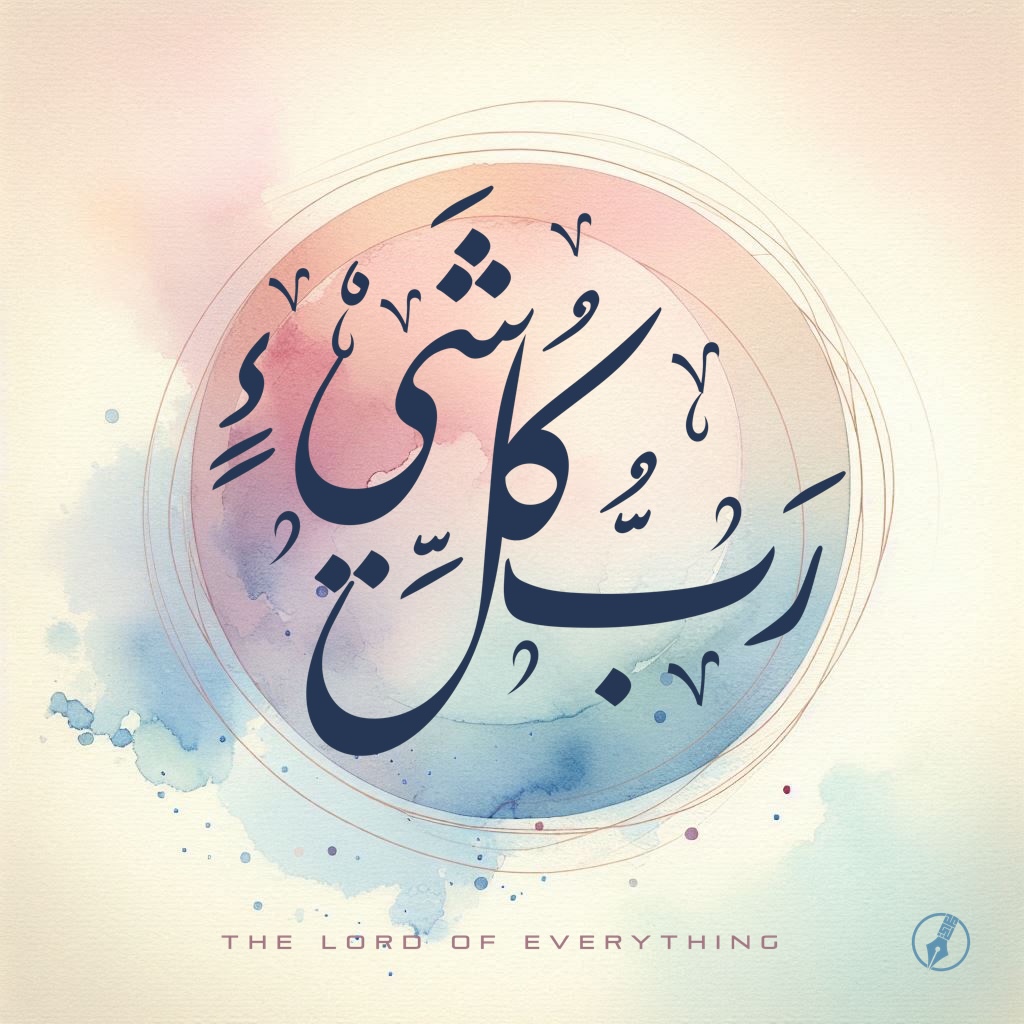
In the quiet spaces of reflection, where language becomes prayer, Unseen Table emerged. This poem is a devotional meditation — a rhythmic journey through names and attributes of the Divine. Inspired by the cadence of Qur’anic verse and the beauty of the seen and unseen, it is paired here with an Arabic calligraphy that captures its spirit visually.
“رَبِّ كُلِّ شَيْءٍ — The Lord of Everything”
Pronouncing pronouns and prepositions Lift the lamp, the light, lit by the holy Scour the sacred and the secret sources Invoking various verses of our Lord
Lord of the mighty mountains high Lord of the sweet-scented rose nearby Lord of the earth and skies that lie Lord of the day and the night gone by
Lord of the mighty oceans deep Lord of the universe in its keep Lord of the stars in endless sweep Lord of the secrets that we keep
Lord of the merciful and just Lord of the faithful and the trust Lord of the righteous and the just Lord of the true, in whom we must
Lord of the prophets and the wise Lord of the knowledge that never dies Lord of the heavens and the sunrise Lord of the earth, to that we arise
Lord of the Throne, the Tremendous and Honourable Lord of Forgiveness, Full of Mercy, ever able Lord of the Bounty, the Infinite and Stable Lord of the Sovereignty, Owner of the Unseen Table
🌙 A Final Thought
In a world thick with noise, may these verses be a quiet invocation — a return to the Sacred, to the unseen currents beneath all things. If the words moved something within you, pause… and let that be your prayer.
Two rivers descend from their mountain source
Over the edge, barefoot towards their destinies
One finds open horizons, free flowing courses
The other, hidden beauty, silent testimony
Two rivers race towards the shoreless ocean
Boulders to pebbles, meandering their flow
One becomes a city slicker in slow motion
The other, to an ancient oasis it shall go
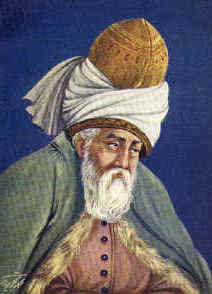
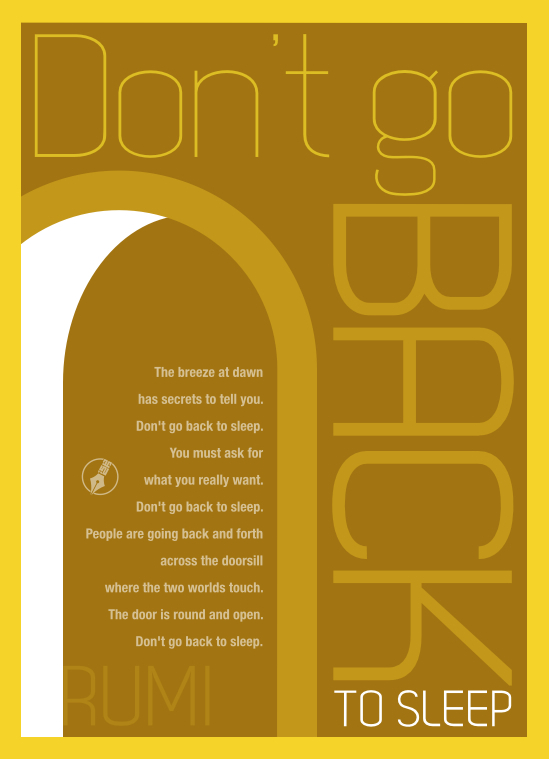
If there is one poet that can speak to the heart of spirituality with a timeless relevance and cutting across different persuasions, then Rumi is most certainly the master. Raised on stories of his life by my dad, I have only really begun to make sense of Mevlana Jalalluddin Rumi recently.
His poem below hit such a chord with me, that I named my guitar ‘Rumi’:
Today, like every other day, we wake up empty
and frightened. Don’t open the door to the study
and begin reading. Take down a musical instrument.
Let the beauty we love be what we do.
There are hundreds of ways to kneel and kiss the ground.
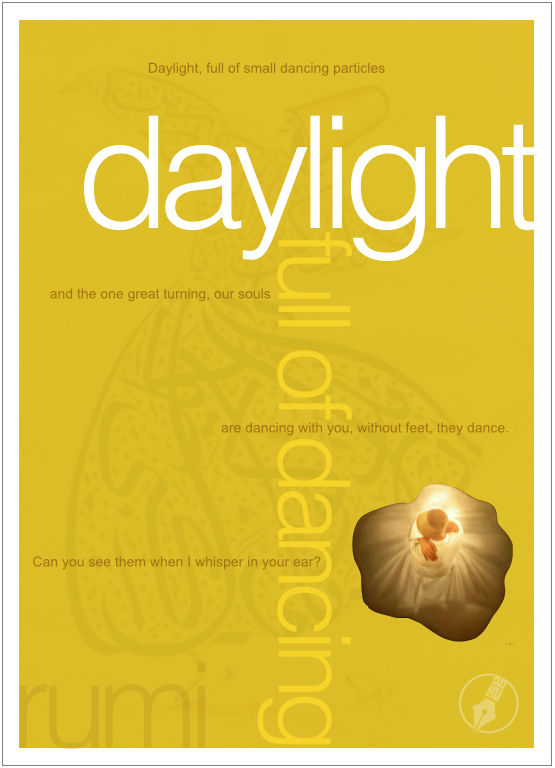
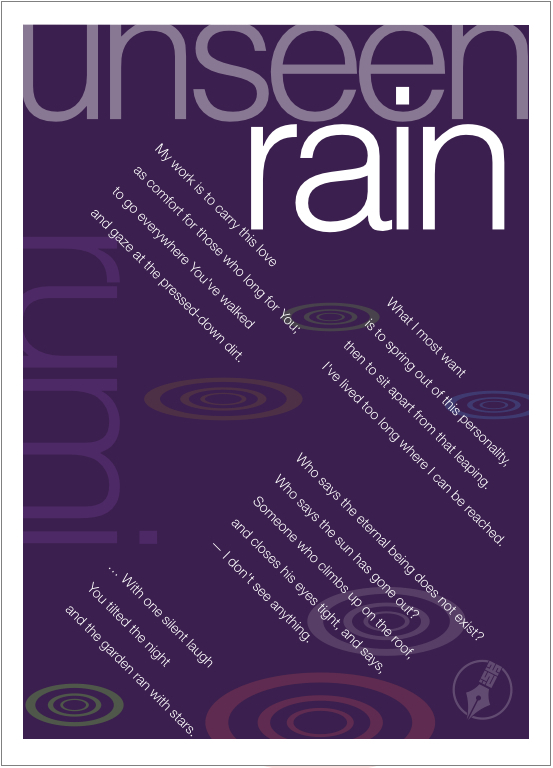
This poster series are my interpretations of four of my favourite Rumi poems.
I love my sleep. I really do. It really does not matter whether I’m lying down comfortably or sitting in an awkward chair. If I need to sleep, I will. Which is why the alarm on my phone is such a godsend. 07h45. Snooze! 08h00. Snooze. 10h00. Bloody hell! It’s 12h00!
The strange thing is that when I have an important morning meeting, or in a regular job that I need to hit the highway by 06h15, I am up by 05h30! I swear. By 06h00 I would’ve showered and shaved, made oats (my new thing!) and my mug of coffee. Coffee is crucial. And no decaf bullshit either. You don’t want to ruin a good day with a bad coffee.
When I realise that I have to work tomorrow, I get so anxious that I check and prepare just about everything before I go to bed at night: printouts for my lectures, the keys to the office, the access key to the office parking, laptop cords, student registers… So I have no problem getting up, even before the alarm, when I know that I have to.
But as soon as I know that tomorrow is Saturday or vacation or whatever, then boom! 12hoo. There is an old Jewish saying: If you have a reputation of an early-riser, then you can sleep until noon. This saying does not apply to me. I have the reputation of a noon-riser and so everyone is shocked when they see me up early in the morning. Go figure!
Now with such a rigorous and methodical routine, what inspires me and where am I at my best? I am so glad you asked.
In the last month I have written several pieces that I have posted on Medium. A few I have placed under the collection Warriors of the Light and three others that have found their way on Ummah Wide. In 2014 I published my first book on an anti-apartheid movement called Punching Above Its Weight—The Story of the Call of Islam. I am presently also writing several other pieces that I began last year. Two of them are novels.
The truth is that I really love writing. Perhaps more than what I love the snooze button. But what has really sparked my new writing spurt is a combination of three things. I did a course in understanding the self and so began to meditate (more often) and became more self reflective. Then I acquired my new writing machine, my MacBook Pro. And just when I thought that I’ve reached my zen, a few storms hit my personal shoreline.
Somehow, the combination of self reflection and personal crises brought out the creative in me. And the MacBook became the instrument through which I could create the word paintings. I don’t like personal crises. They make me anxious to say the least. But when I reflect upon them I see these exquisite colours, intense, dark, in these fascinating combinations. My empathy for pain in others deepens because of the resonance, the connection to my own.
A friend of mine, Shabbir Banoobhai, unaware of my issues, sums it up so beautifully in a poem he shared on Facebook:
sometimes our best gifts
come dressed in wolf’s clothing
carefully tailored
designed, it seems
to scare us into a lair
from which there is no escape –
until we decide to smile at one
and the unthinkable happens
it smiles at us
its snarl curling up at our feet
as if it was a puppy
waiting for us –
its only source of love –
to draw it up, hold it close
whisper sweet nothings in its ears
nuzzle its o so soft hair
as it licks our gooey face –
at pains no doubt to say
i love you, i love you
then, noting our hesitation
it wags its tail harder
moaning plaintively –
you did not really believe
i meant to harm you, did you?
Survival techniques for life-changing events, in memory of Zane Ibrahim
Image from Crow the Stone
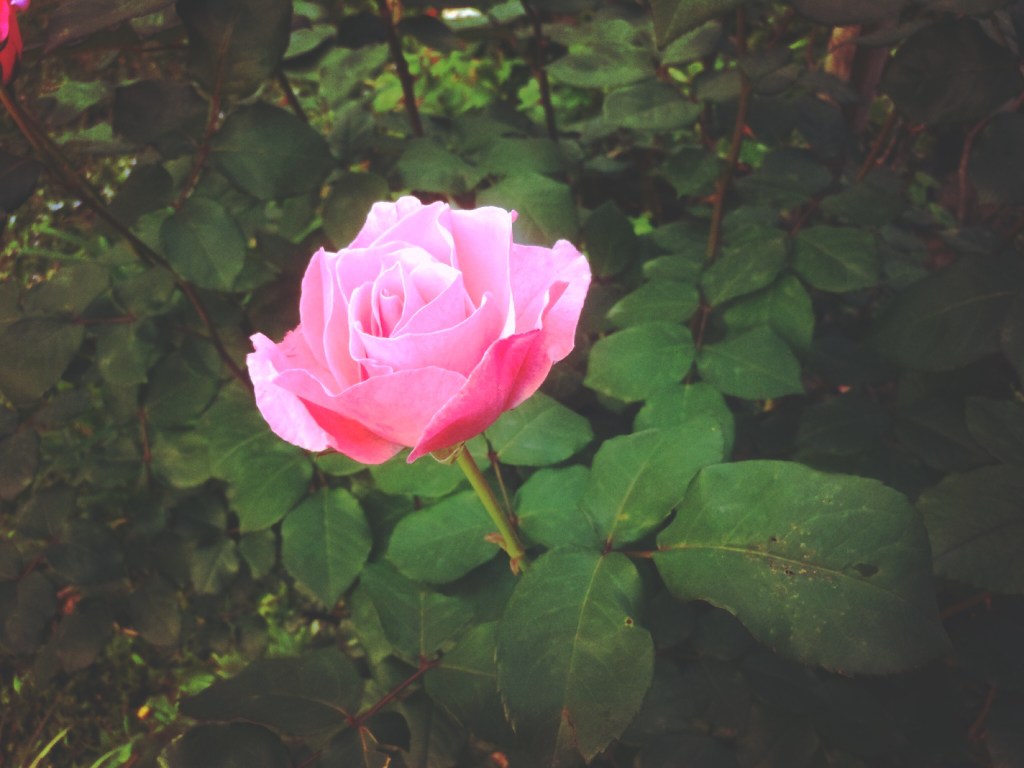
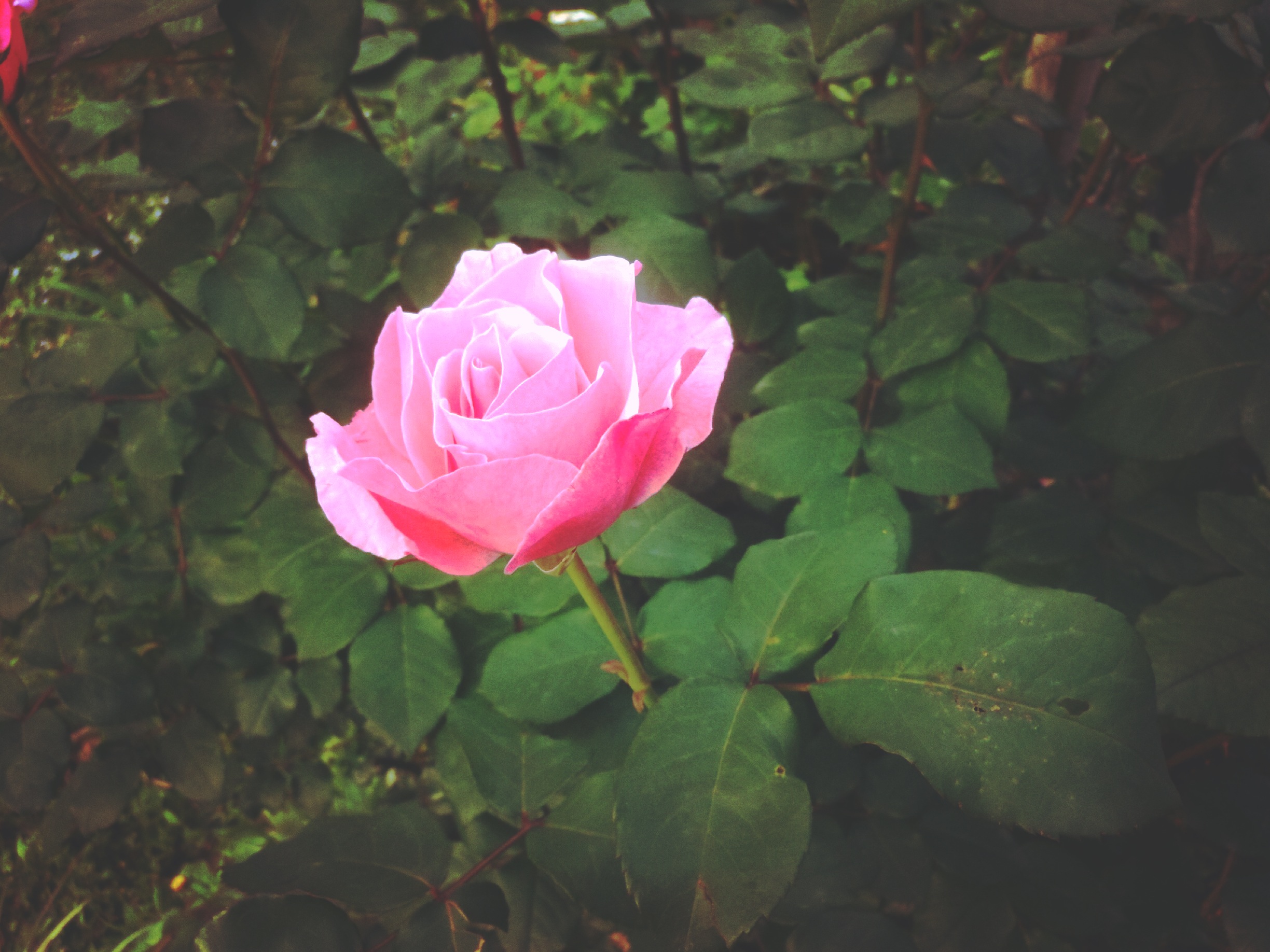
“Who the hell is out there?” I inquired from a shadow in my rose garden at 3am. “I have been passing your house for a month now and noticed your roses have not been pruned. The season is almost over,” said the shadow as he continued snipping away with his pruning shears. As he stepped into the light, I saw his familiar face. “Zane! What the hell?”
Zane Ibrahim was the station manager of a popular community radio station in South Africa called Bush. My company had been designing most of their print media (below-the-line) requirements at the time. This was a client. In my garden. At 3am. Pruning my roses! “This is my meditation,” he explained, “and I saw the light was still on.”
I once lost everything I owned: two homes, a BMW, a media business I had built from the ground up… I was drowning in debt. I was cleaning up the home I had once bought to house my business. I had to sell those premises to help cover my debt. Zane had come into my garden at this time.
For weeks and months after that incident, Zane would come around to be of support to me and my family through one of our most traumatic seasons. We moved cities, from Cape Town to Johannesburg, I had to find permanent employment and we had to find new accommodation.
The advice and support that Zane and his partner Trudy gave us at the time was invaluable. I captured some of that amazing guidance in a poem:
To transplant a rose bush
Wait for the end of its winter
Cut down its stalks but a few
Prune all its branches
Sever the roots right round
Water it one last time
Then remove it roots and all
Prepare the new hole in sunlight
Not too close to neighbours
Prepare the soil with bone meal
Plant the bush deeper than before
Set it firmly in the new hole
Water it once more
In Spring, wait for the first buds
I was in a dark place then. It was a painful walk back into light but his words have always sustained me. He said something else that I still give to others in similar circumstances. Zane said,
The irrepressible Zane Ibrahim, 23 June 1941 to 19 May 2014
“Whatever you do, do not stop making your push-ups: your spiritual push-ups, your mental push-ups, your financial push-ups, your physical push-ups. When your ship comes again, and it will, you want to be ready to take it sailing. You don’t want to be so desperate that when it does come in you sell it part for part before it even docks. You must be the able and ready captain of your ship to take it back out to sea and find new adventures that are waiting for you.”
Zane passed on more than six months ago. I posted a note on a blog to honour him: “Oh my brother, my loved ones and I owe so much to you. Thank God you lived and loved amongst us. Like Spring you made us blossom wherever we were and still your legacy continues. You live on in every mustard seed that you have planted with such loving care. From Allah we come and to that is the final journey. What a journey you have travelled! Hamba Kahle!”


 If there is one poet that can speak to the heart of spirituality with a timeless relevance and cutting across different persuasions, then Rumi is most certainly the master. Raised on stories of his life by my dad, I have only really begun to make sense of Mevlana Jalalluddin Rumi recently.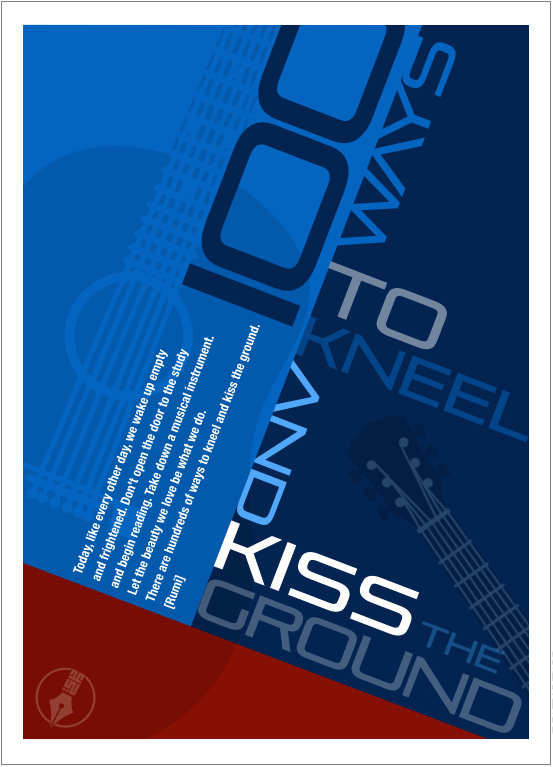
 Adli Yacubi