Tag: Poetry

  • Tamat: A Sacred Completion, A Living Beginning
    Tamat: A Sacred Completion, A Living Beginning

    Tamat: A Sacred Completion, A Living Beginning

    The word Tamat has been spoken in Cape Muslim homes for generations — a word so small, yet carrying the weight of centuries of memory. It is more than a graduation. It is a celebration of sound, of presence, of a child who has taken the Qur’an into their tongue and heart, and who now steps forward to carry it into the world.

    Our grandparents knew this word from Hadramaut, where the Tamat was a festival of joy and responsibility. When a child completed their Qur’an recitation, they were gathered into a seven-day procession of voices, prayers, and sweets — with flags raised high, neighbours cheering, and the whole community celebrating the future. It was never just about memorising verses, but about honouring the discipline of correct recitation, Tajweed, manners, and knowledge that could anchor a whole community.

    These children wore the banus, a beautifully embroidered cloth, reserved just for Tamat days. Banners would shimmer with Surah al-Fatihah and Ayatul Kursi waving above their heads, as if to shield and guide them on their new journey. Their teachers, the elders, and even passing strangers would bless them — because everyone understood: this child will serve, protect, and live the Qur’an (based on Sheikh Jamiel Abrahams, 2025).


    When Tamat Reached the Cape

    When Hadrami scholars and teachers arrived at the Cape of Good Hope, they brought this deep tradition with them, adapting it to new winds and new stones. In places like District Six, Bo-Kaap, and beyond, the Tamat found fresh soil.

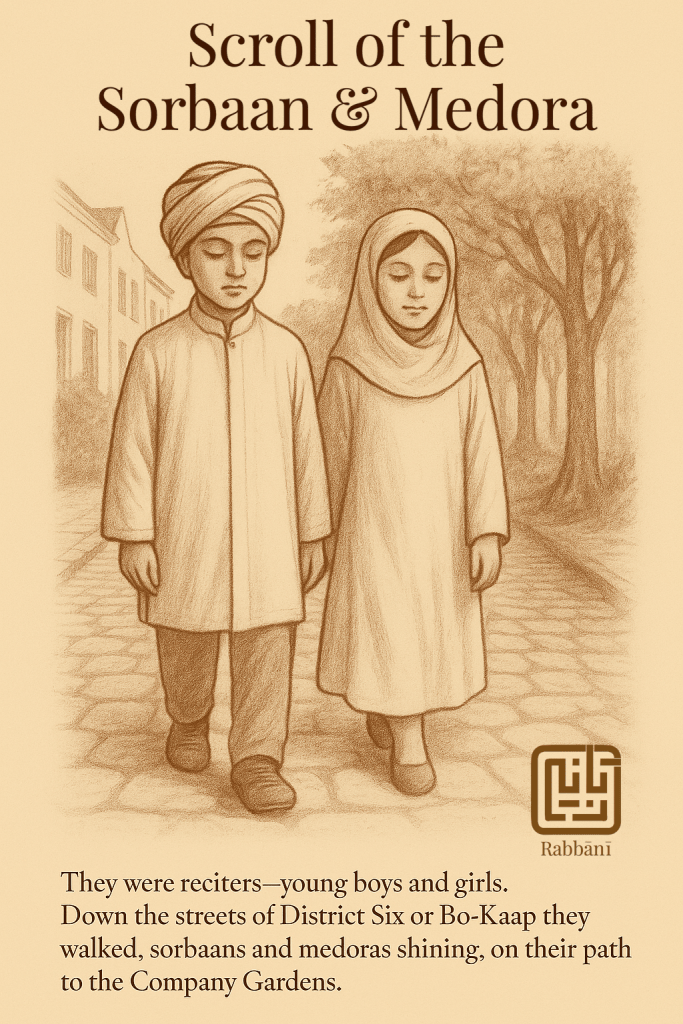
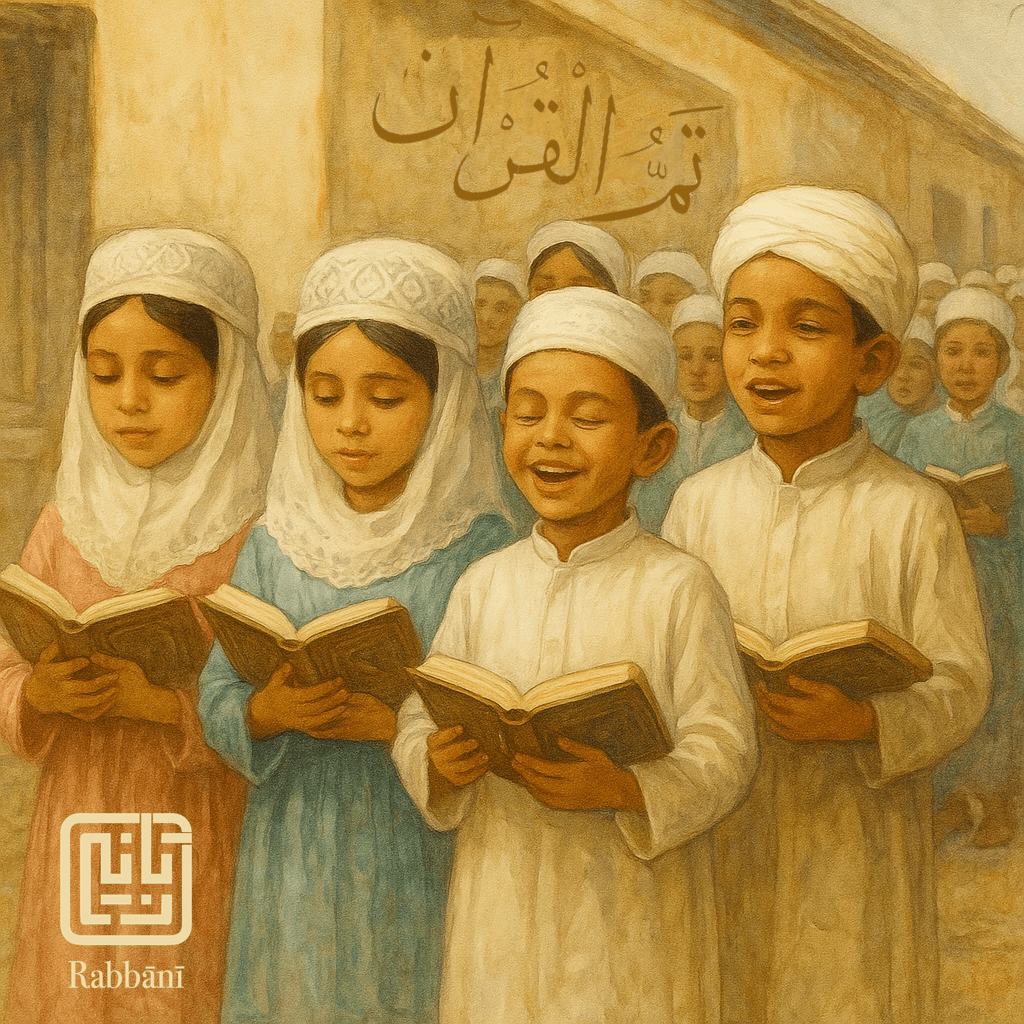
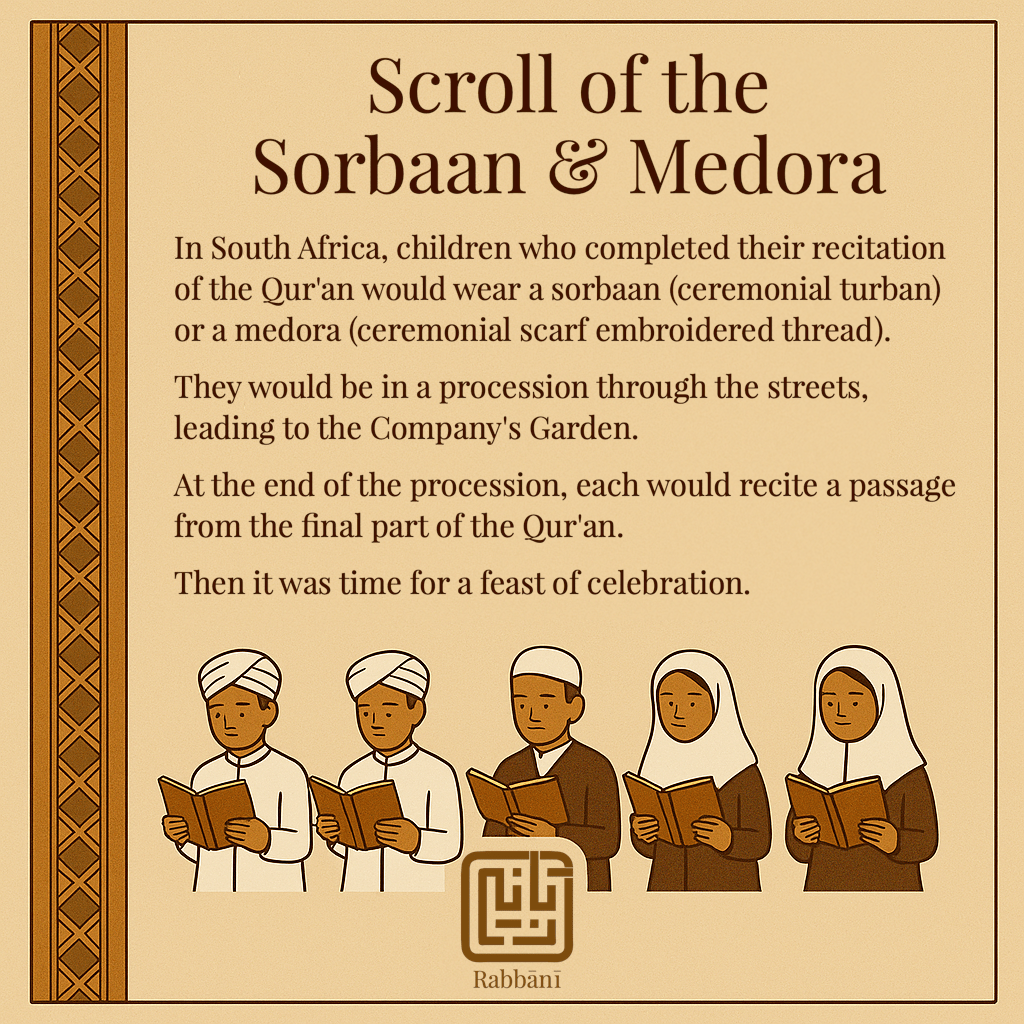
    Cape children would gather in the masjids, reciting the final chapters they had laboured over line by line, vowel by vowel. Then they would step out, dressed in their sorbaan and medora, and walk proudly along the cobbled streets. Their path sometimes led them all the way to the Company Gardens, deep in the colonial centre of Cape Town — an act of courage and pride that seemed to say, “This Qur’an walks with us too.”

    In those moments, they were not just finishing a book. They were claiming a legacy.


    The Meaning of Sorbaan and Medora

    The garments of Tamat still speak.

    For the boys, the sorbaan is a turban, but far more — a Khirqah al-Taḥkīm, a sign of trust. It wraps the head with a promise: you are now a guardian of Qur’an, carrying its mercy and its responsibility.

    For the girls, the medora — circular, beautifully embroidered in gold or silver threads — holds the same dignity. It says: Your voice, too, is worthy. Your recitation is precise. Your role is essential.

    In both, there is no sense of “fashion” — only inheritance.


    A Tapestry of Cape Heritage

    What makes Tamat so powerful is how it weaves into a far bigger story. It stands alongside the handwritten kitāb manuscripts passed down through Cape families, and the huffādh who still recite on local radio during Muharram (VOC Khatam broadcast, 2025). It echoes in the walls of the Auwal Mosque, where Tuan Guru — himself a prisoner and Qur’an teacher — copied out the entire Qur’an from memory in chains, so that his community would not lose its light.

    It whispers through the kramats encircling Cape Town, the shrines of saints and scholars who carried Islam through exile, and who insisted that education was the best shield against forgetting who we are. Many of these traditions, as documented in works like Al-Istizādah min Akhbār as-Sādah compiled by Ali bin Muhsin al-Saqqaf, travelled with Hadrami scholars to the Cape and found new expression in the garments, recitations, and community gatherings of local Cape Muslim life.

    It even rests quietly in the Tana Baru cemetery, where generations of those who lived the Qur’an are buried, their tombstones telling silent stories of resilience.


    Beyond Memorisation

    One of the most powerful aspects of Tamat, especially in the Cape tradition, is that it was never simply about memorising words.

    Children were trained in correct pronunciation, rhythm, and understanding. They were questioned on the essential knowledge of their faith, from acts of worship to everyday etiquette, and the rights and responsibilities of being a Muslim in society.

    Their teachers, elders, and neighbours stood witness that these children had become competent not only in their individual acts of worship (furoodh ayniyyah) but also in their ability to serve the community (furoodh kifayah): to lead prayer, to help wash and bury the deceased, to read du‘ā for the sick, to keep society upright.

    In this way, Tamat was never a personal achievement alone, but a communal guarantee of resilience.


    Echoes in Bosmont

    Though times have changed, the spirit of Tamat still lives on. Take, for example, the Bosmont madrassa in the 1970s, where 15 young boys and girls graduated after years of Qur’anic training. Their ceremony was called Gatmeid Koran — a name with the same spirit as Tamat.

    Six boys and nine girls, only twelve to fourteen years old, stood before thousands of family members and neighbours, reciting what they had carried line by line, vowel by vowel. The hall was so full that people pressed against the windows to watch.

    It was more than a prize-giving. It was a moment of pride, of hope, of handing the Qur’an over to the next guardians of its sound and meaning.

    Imams and teachers from all over — including Durban, Cape Town, and the Transvaal — came to witness these children take their place in the living chain of knowledge. There was even a colourful procession through the streets, a tradition of honour that stretched all the way back to Hadramaut.

    They were not just students. They were being trusted to live the Qur’an: to hold its discipline, to guard its standards of moral character, to shine it into their communities.

    (Source: newspaper clipping shared by Sheikh Jamiel Abrahams, c. 1970s)


    A Living Beginning: Our Echoes, Our Hope

    In every child who ties the sorbaan or drapes the medora, there lives a promise. A promise that the Qur’an will not only be memorised, but lived — that its rhythms will shape how we speak, how we act, how we serve.

    From the echo of Hadramaut’s processions, to the cobbled streets of District Six, to the crowded halls of Bosmont where children stood reciting before thousands — Tamat has remained a celebration of beginnings, not endings.

    These ceremonies remind us that we are never alone. We stand in a line of teachers, elders, and ancestors who trusted the Qur’an to transform us, generation after generation.

    As long as there is a child willing to steady their breath, to learn its melody, to carry its mercy into the world, then our communities will never be without light.

    That is the heartbeat of Tamat.
    That is why it will always matter.
    And that is why it must continue.
    A Closing Du‘ā

    O Allah, accept from these children what they have learned,
    strengthen their tongues in Your remembrance,
    open their hearts to Your wisdom,
    and grant them the courage to carry Your Book with mercy and justice.
    Make them lanterns for their families,
    protectors for their neighbours,
    and guides toward goodness.
    And let every letter they have recited be light on their path
    in this world and the next.
    Ameen.


    References woven into the narrative:

    • Sheikh Jamiel Abrahams, Tamat, Its Origins and Objectives (2025)
    • VOC Radio Cape Town annual Khatam broadcast (2025)
    • Tuan Guru’s Qur’an manuscripts at Auwal Mosque (Wikipedia)
    • Tana Baru Cemetery (Wikipedia)
    • ourcapetownheritage.org on Cape Kramats (source)
    • Aramco World, Handwritten Heritage of South Africa’s Kitabs (source)

    📖 Read more at: Scroll of Sorbaan & Medora
  • Hājar: The Black Mother Whose Faith Turned the Heart of Hajj

    Hājar: The Black Mother Whose Faith Turned the Heart of Hajj

    Hājar: The Black Mother Whose Faith Turned the Heart of Hajj

    With deep gratitude to all who preserve these sacred stories.


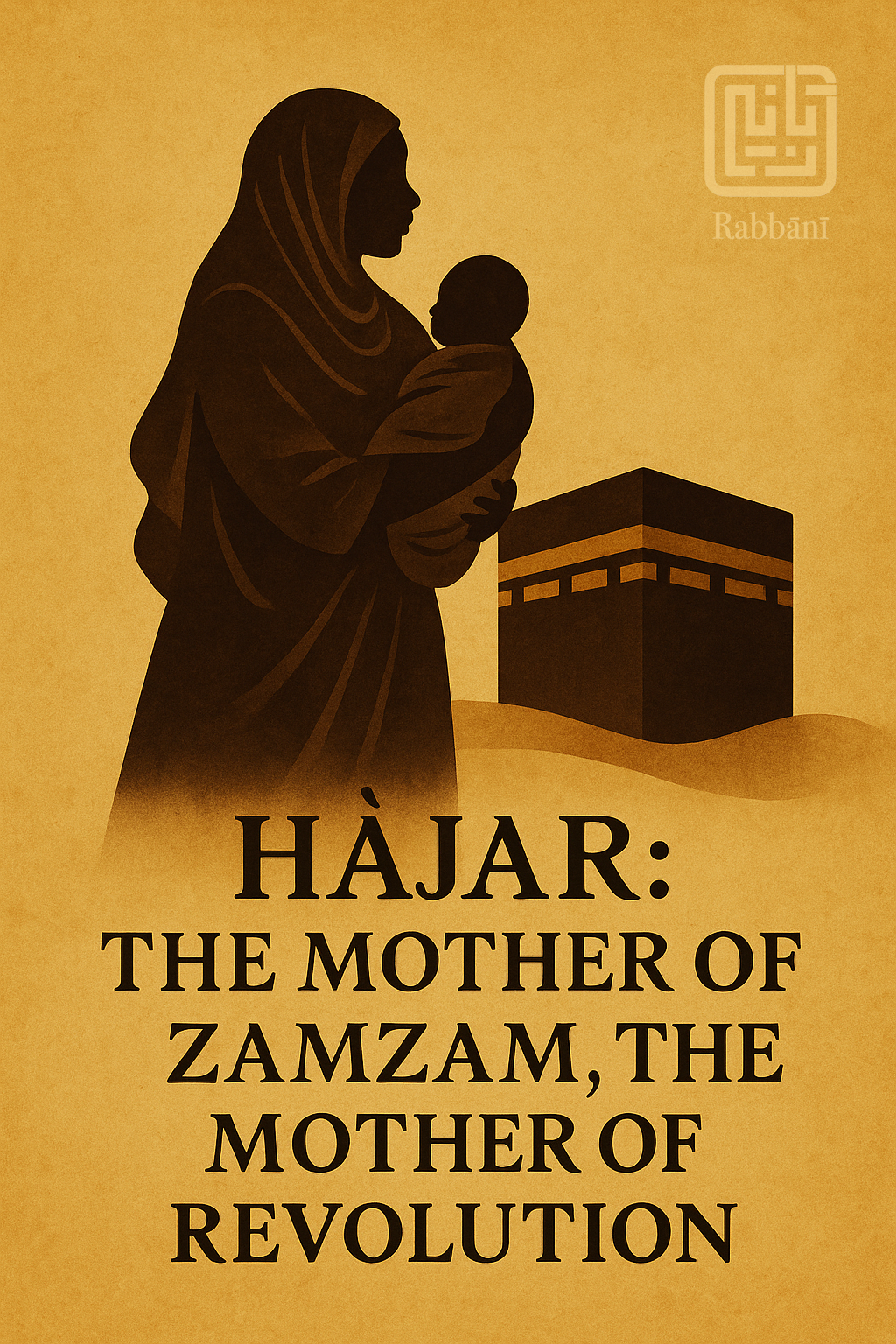
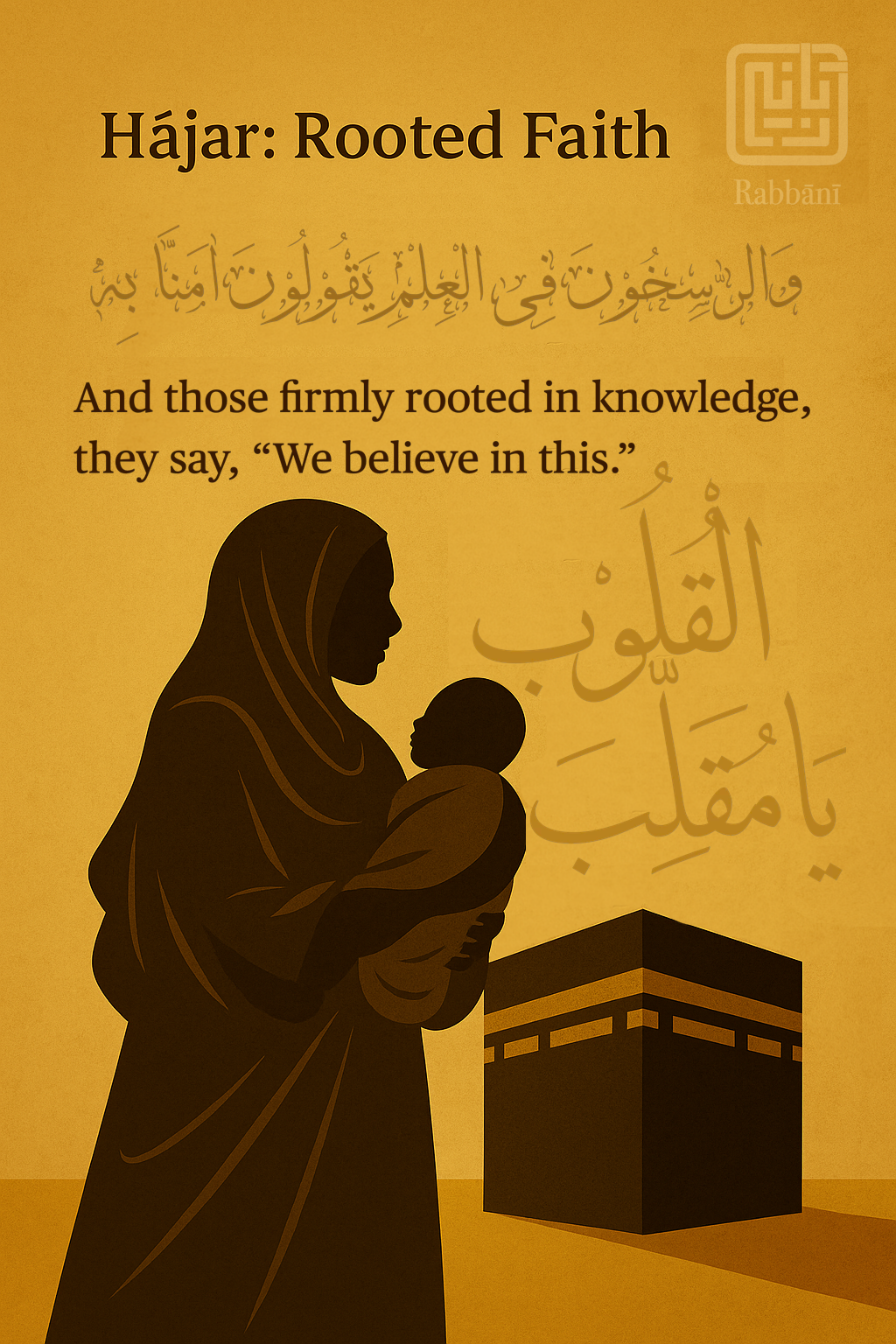
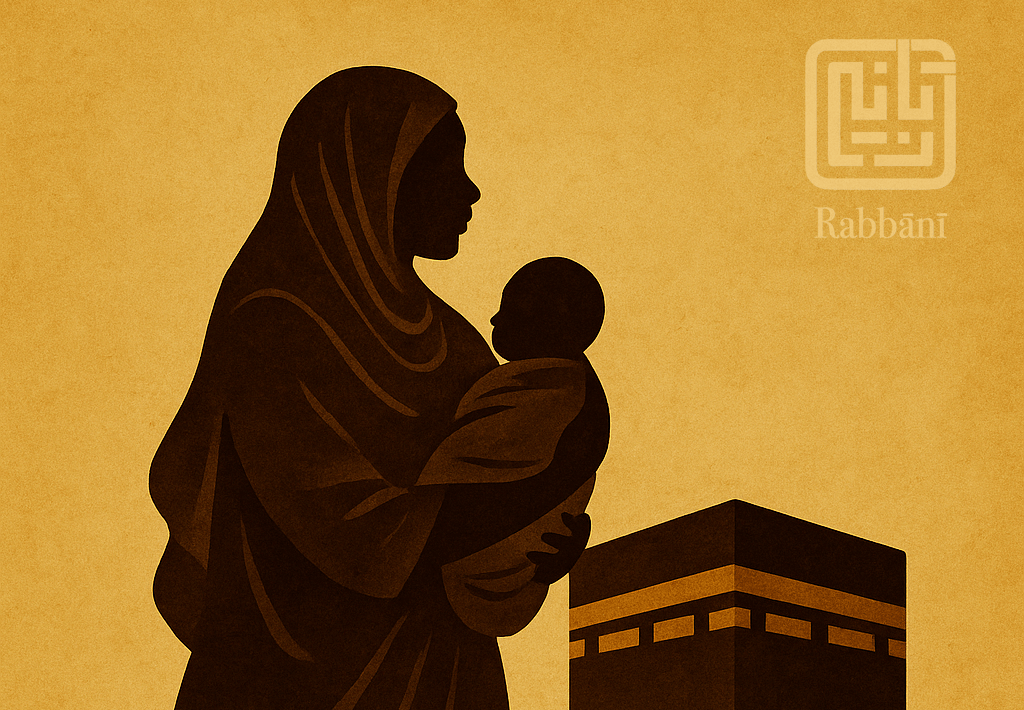
    A digital silhouette of Hājar holding her infant, depicted against an ochre background with the Ka‘bah in the distance. The text reads: “Hājar: The Mother of Zamzam, The Mother of Revolution.”

    Introduction

    Hājar — a Black African woman, enslaved and then displaced — was chosen by Allah to become the mother of Ismāʿīl, and to have her house absorbed into the sacred geometry of the Kaʿbah itself.

    Not a prophet.
    Not a queen.
    Not a caliph.
    But a mother. A servant. A Black woman.

    The House of Allah bows toward her grave.

    Ali Shariati called her the “Unknown Soldier” of Islam. But Allah made her known forever — through Zamzam, through Safa and Marwa, through the sacred enclosure known as Ḥijr Ismāʿīl. You cannot perform Hajj without acknowledging her. That is not just history. That is revolution.

    When I look across the ummah today — from Cape Town to Cairo, Timbuktu to Jakarta — I see faces of every shade, hearts carrying a message revealed for all people, for all time. Yet too often, I also see shadows of forgetfulness, places where racism still stalks our communities.

    Hājar’s story stands to remind us:
    Allah honours whom He wills.


    1️⃣ Introduction to Hājar’s Background

    Hājar was an African woman, described in traditional sources as a servant of Sarah, married to Ibrahim (a.s), and the mother of Ismāʿīl. She was displaced, left alone with her child in a barren valley with no shelter or food, yet her faith did not break.

    When Ibrahim prepared to leave, she asked him only one question:
    “Has Allah commanded you to do this?”
    He said yes.
    And she replied:
    “Then He will not abandon us.”

    In those words, you hear an entire revolution of trust.


    2️⃣ The Test in the Valley

    Ibrahim (a.s) left them in that desolate place, answering Allah’s command. Hājar stood alone, with her child crying from thirst, under a burning sun. The Qur’an echoes Ibrahim’s prayer for them in Surah Ibrahim (14:37):

    “Our Lord, I have settled some of my descendants in an uncultivated valley near Your sacred House, our Lord, that they may establish prayer…”

    While Ibrahim placed his trust in Allah and walked away, Hājar held the child close and placed her trust in Allah while staying put.


    3️⃣ The Sa‘y of Hājar

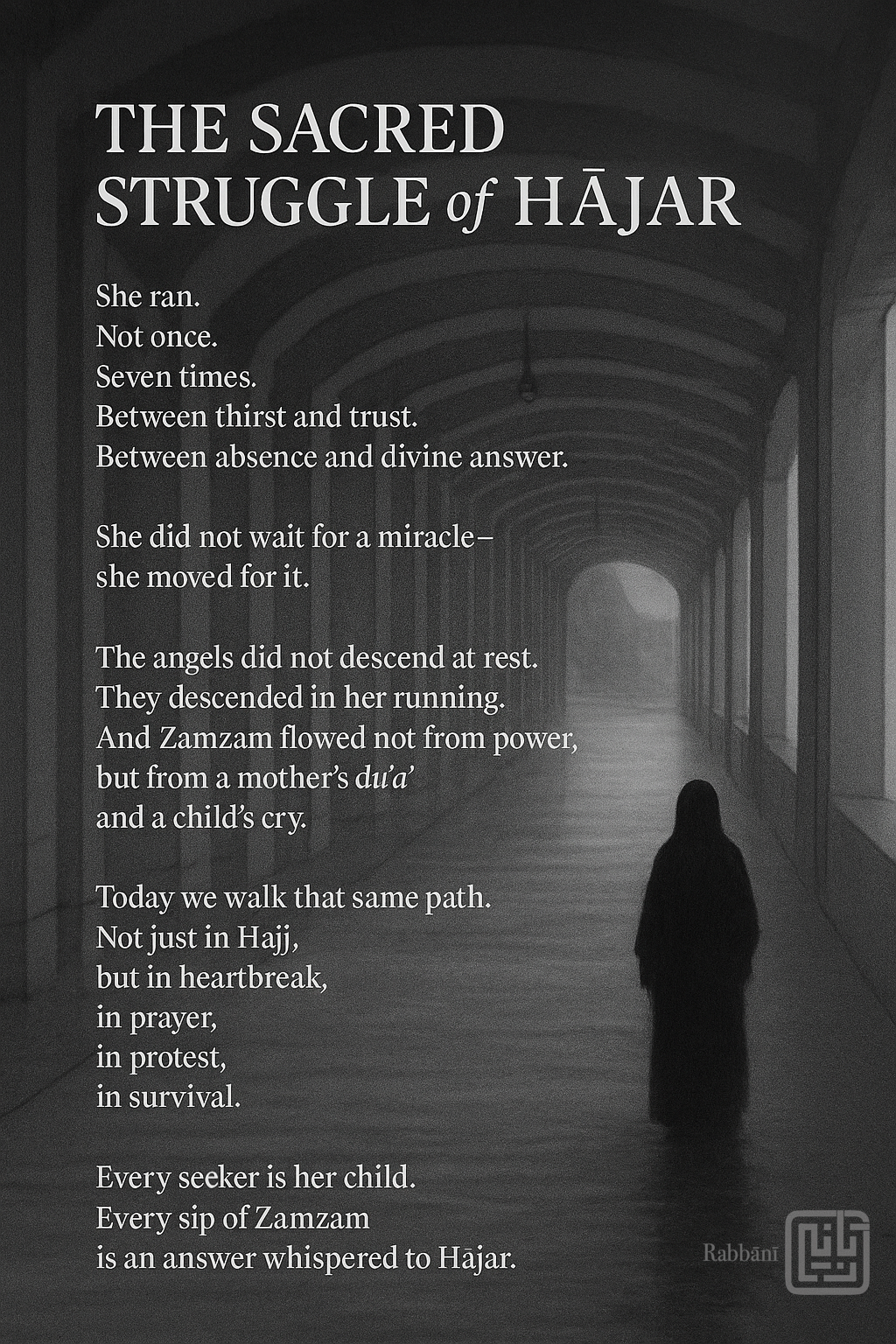
    The baby, Ismāʿīl, cried in hunger. Hājar’s heart broke, but she did not surrender to despair. She ran to Safa, looking for water. Then to Marwa. Then back again. Seven times she ran between those hills, searching, hoping, refusing to quit.

    This was not a ritual yet — this was a desperate mother in motion, placing faith in her feet as well as her heart.

    Allah loved that moment so much that He turned it into an act of worship until the end of time. The Prophet ﷺ established the sa‘y as a pillar of both Hajj and ʿUmrah, hardwiring Hājar’s courage into the fabric of Islamic devotion.


    4️⃣ Zamzam: The Well of Mercy

    After her seventh run, the angel of Allah appeared, striking the earth where Ismāʿīl’s heels had kicked, and water gushed forth. Hājar rushed to gather it, crying “Zamzam, Zamzam” — gather, gather.

    What an image:
    A mother shaping the flow of a spring that would sustain a civilization.

    Even today, millions drink Zamzam, quenching their thirst from the miracle granted to her trust.


    5️⃣ Zamzam and the Birth of Quraysh

    From Zamzam, life returned to that valley. Birds gathered, signaling water, and desert tribes came to settle there with Hājar’s permission. From these settlements, a community grew, and over centuries, the Quraysh tribe took shape — the tribe that would eventually protect the Kaʿbah and see the birth of the Prophet ﷺ himself.

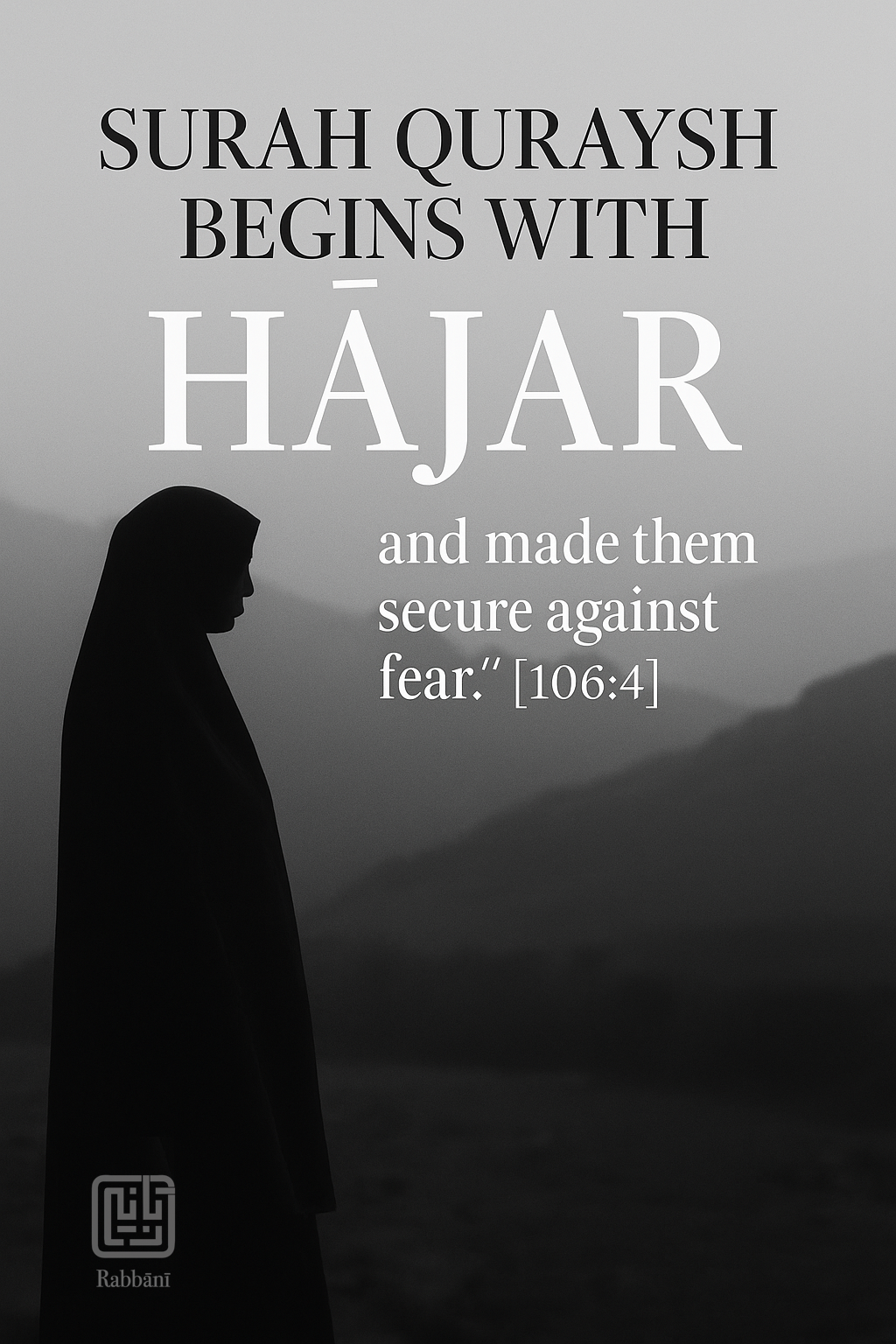
    Allah reminds Quraysh of these blessings in Surah Quraysh:

    “Let them worship the Lord of this House, Who has fed them against hunger and made them secure against fear.”
    (Qur’an 106:3–4)

    The security and provision mentioned here trace directly back to Hājar’s courage, the water of Zamzam, and the revival of Makkah as a place of blessing.

    She was not only the mother of Ismāʿīl. She was the grandmother of the Quraysh, the one whose faith made their existence possible.


    6️⃣ The Kaʿbah and the Ḥijr Ismāʿīl

    Years later, when Ismāʿīl (a.s) and Ibrahim (a.s) rebuilt the Kaʿbah, Hājar was still there to witness it. When she passed away, Allah honoured her so greatly that her grave was placed within the semi-circular enclosure next to the Kaʿbah — the Ḥijr Ismāʿīl.

    Even today, every Muslim who bows toward the Kaʿbah bows toward the grave of a Black mother, a woman whose heart trusted Allah completely.

    If the Kaʿbah is the heart of the Muslim world, then Hājar is the pulse that keeps it beating.


    7️⃣ The Symbolism of Hājar

    Hājar is not just a historical figure — she is a living ritual.
    Every sa‘y repeats her running.
    Every sip of Zamzam repeats her hope.
    Every glance at the Kaʿbah remembers the woman whose grave lies in its shade.

    The Prophet ﷺ hardwired her courage into the pillars of worship, so no pilgrim can ever complete Hajj or ʿUmrah without walking in her footsteps.

    Ali Shariati called her the “Unknown Soldier” of Islam. But Allah made her known forever.

    He made her sa‘y eternal.
    He made her water a source of life.
    He made her grave a sign of dignity.

    For every woman who has been dismissed, for every person who has been enslaved, for every soul who has been left alone in the desert of despair — Hājar is the proof that Allah sees you, Allah remembers you, and Allah can make your struggle immortal.


    8️⃣ Modern Resonance

    In our time, the stories of Black women are still pushed to the margins. Hājar corrects that. She was a Black woman, a servant, alone — yet Allah made her footsteps a sacred pillar, her water a miracle, her grave a sanctuary.

    Every year, millions repeat her ritual, even if they do not say her name. Millions face the Kaʿbah, even if they do not know who rests in its courtyard.

    Hājar shows us that Allah honours faith wherever He finds it, and that He can transform even the most overlooked among us into the authors of history.

    If she was enough to carry the future of Islam on her shoulders,
    then every Black woman is enough.

    And still, we must ask — as reader Khaliq Dollie so piercingly put it:

    “How can anyone who has performed Hajj have even the slightest amount of racism or be sexist — unless, of course, they only perform the ritualistic aspects without comprehending?”

    This is more than a question. It is a reckoning.

    How can one run where a Black woman ran,
    drink from her well,
    bow toward her grave —
    and still carry arrogance in the heart?

    Unless the ritual never reached the bloodstream.
    Unless the heart never opened to her story.

    Hājar does not just invite motion; she demands meaning.
    Not just performance, but transformation.
    Not just remembrance, but repentance.

    As the Qur’an reminds us:

    “It is neither their flesh nor their blood that reaches Allah, but it is your taqwā that reaches Him.”
    — Surah al-Ḥajj, 22:37

    True Hajj begins where ego ends — in humility, in honour, in justice.

    To walk her path is to honour every Hājar still unnamed —
    every woman, every Black body, every soul left in the desert with nothing but trust.


    9️⃣ Conclusion

    Pilgrims still run between Safa and Marwa.
    Children still drink from Zamzam.
    Believers still circle the Kaʿbah.

    All of these acts, day after day, year after year, remain living proof of a woman’s courage — a woman whom the world tried to forget.

    Hājar did not hold a royal title. She did not lead an army. She was not a prophet. She was a mother. A servant. A displaced Black woman. Yet Allah made her story the foundation of the sanctuary itself, built the House of God around her grave, and made her sa‘y part of every pilgrimage until the end of time.

    That is not just history. That is revolution.

    May every step we take between Safa and Marwa remind us of her strength. May every sip of Zamzam honour her trust. And may every glance toward the Kaʿbah remember the mother who gave it life.


    🌿 A Dua

    O Allah, as You accepted Hājar’s faith, accept our faith. As You answered her cry for water, answer our cries for hope. As You made her story immortal, make our footsteps sincere and worthy of Your mercy. Let her memory heal the hearts still wounded by racism, and honour every mother who stands alone with trust in You. Āmīn.

    A Reflection Inspired by a Reader:
    A friend reminded me that Hājar’s courage speaks also to hidden forms of abandonment: how we sometimes feel unseen, even by ourselves. Her words — “Allah will not abandon us” — are an anchor not just for surviving the desert, but for surviving the storms within. May we never abandon our own hearts, nor each other.

    As the Qur’an reminds us:

    “And those firmly rooted in knowledge say, ‘We believe in it; all of it is from our Lord.’”
    (Qur’an 3:7)

    Another Reflection Inspired by Masooda Fadal:
    She reminded me that Ibrahim (a.s), when leaving his father’s community, said:
    “I am turning to my Lord. He will feed me and clothe me. He suffices me.”

    Alongside him, in the same family, Hājar carried that same radical trust, saying:
    “Allah will not abandon us.”

    There is a deep yet silent beauty in their inner shared knowing — a spiritual inheritance that flowed between father and mother and reached their child, becoming a collective, rasikh rooted faith.

    Masooda also reflected that Hājar’s story amplifies the message of gender and race: that women equally embody the path of submission. While Ibrahim is often seen as the template of pure tawakkul, Hājar mirrored it so beautifully, showing that Allah honoured her Black, feminine courage with the same divine legacy.

    This teaches us that abandonment is not only physical; it can be subtle, hidden, even within ourselves. Hājar’s faith is an antidote to all those layers — reminding us never to abandon our own hearts, nor each other.


    Comment Prompt

    Who in your family or community reminds you of Hājar? Share their story — let us honour these mothers of faith together.

  • Africans in Early Islam: A Celebration of Courage, Dignity, and Faith

    Africans in Early Islam: A Celebration of Courage, Dignity, and Faith

    Africans in Early Islam: A Celebration of Courage, Dignity, and Faith

    With deep gratitude to Shaykh Allie Khalfe for preserving these gems of our tradition.


    Introduction

    Hājar — a Black African woman, enslaved and then displaced — was chosen by Allah to become the mother of Ismāʿīl, and to have her house absorbed into the sacred geometry of the Kaʿbah itself.

    Not a prophet.
    Not a king.
    Not a caliph.
    But a mother. A servant. A Black woman.

    The House of Allah bows toward her grave.

    Ali Shariati called her the “Unknown Soldier” of Islam. But Allah made her known forever — through Zamzam, through Safa and Marwa, through the sacred enclosure known as Ḥijr Ismāʿīl. You cannot perform Hajj without acknowledging her. That is not just history. That is revolution.

    When I look across the ummah today — from Cape Town to Cairo, Timbuktu to Jakarta — I see faces of every shade, hearts carrying a message revealed for all people, for all time. Yet too often, I also see shadows of forgetfulness, places where racism still stalks our communities.

    The Prophet ﷺ said:

    “People are as equal as the teeth of a comb.”
    (Musnad Ahmad)

    This was no empty slogan. It was a living reality, made manifest by the men and women of Africa who stood shoulder-to-shoulder with him in Islam’s earliest, most dangerous days.

    Sumayyah, Bilāl, Najāshi, Barakah — they were not guests on Islam’s stage. They helped build it. Their stories remind us that equality is not an optional virtue, but the beating heart of faith itself.


    Sumayyah bint Khayyat: The First Martyr

    Sumayyah bint Khayyat, an Abyssinian woman, was among the first to embrace the oneness of Allah. Enslaved, tortured, with no protector but her Lord, she refused to renounce La ilaha illa Allah.

    She was murdered for her faith, torn apart by her captors, becoming the first martyr of Islam.

    “Indeed those who say, ‘Our Lord is Allah,’ and remain steadfast — the angels will descend upon them saying, ‘Do not fear and do not grieve; receive good news of Paradise.’”
    (Qur’an 41:30)

    Sumayyah may have known little of ritual law, but she knew Allah. That was enough.


    Bilāl ibn Rabāh: The Voice of Equality

    Bilāl, a Black man born into slavery, was tortured for proclaiming Ahad, Ahad — One, One.

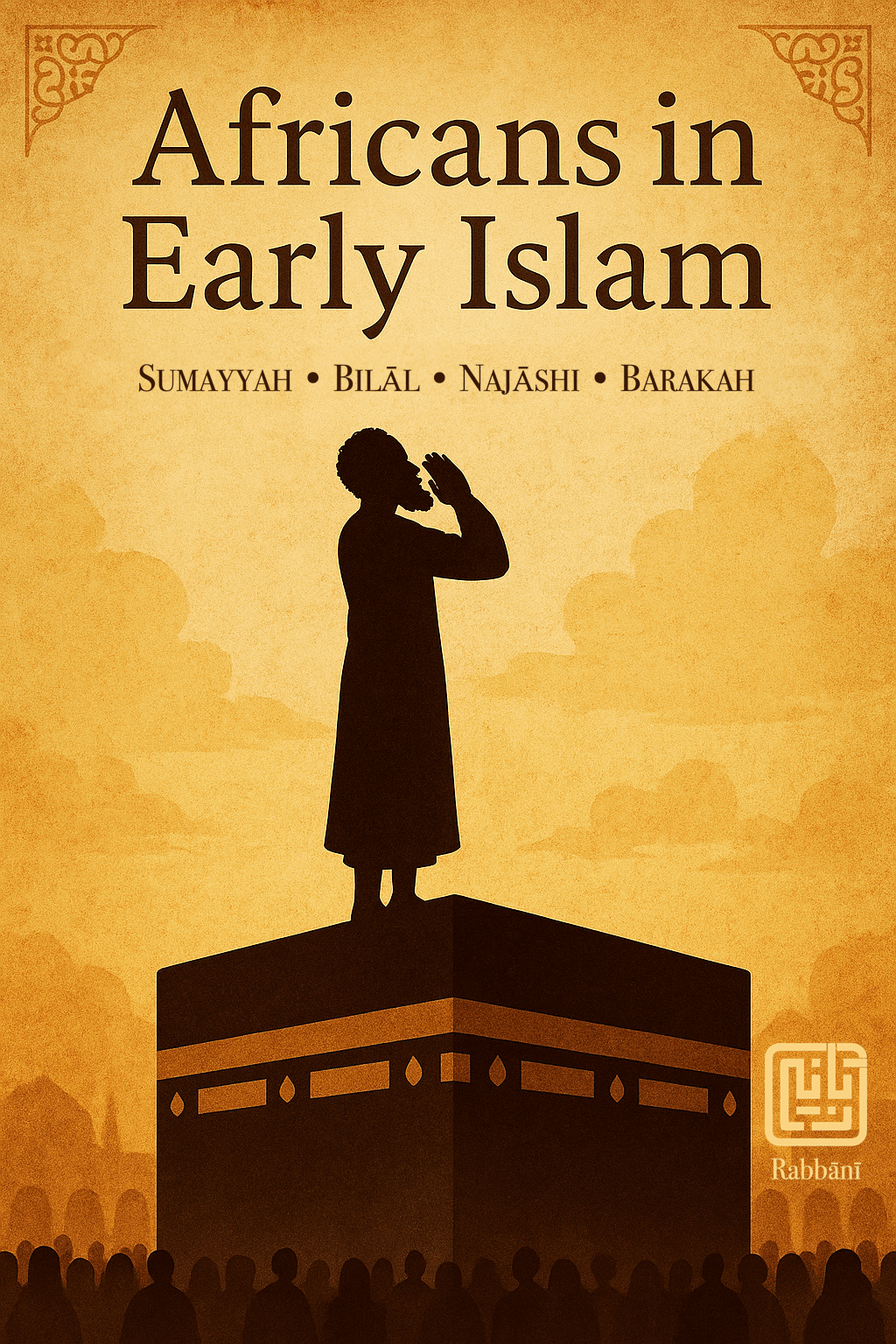
    Freed by the Prophet ﷺ, he was honoured with the role of Mu’adhin, the first to call believers to prayer. His voice rose from the roof of the Ka‘bah itself, defying every social hierarchy of Quraysh:

    “God is Greatest…”

    An African once enslaved stood atop the most sacred site of Arabia, reminding the world that dignity belongs to those who stand before Allah with sincerity.

    Years later, after the Prophet ﷺ passed away, Bilāl could no longer bear to give the adhan in Madinah. His heart was heavy with grief, and he left for Syria, continuing to serve Islam. But when he returned years later, the companions pleaded with him to call the adhan one final time. His voice cracked with emotion as he recited the words, and the entire city of Madinah wept, remembering the days of the Messenger ﷺ. That final adhan became a testament — Bilāl’s voice did not only summon people to prayer, it summoned them to an Islam that had shattered the chains of slavery, of racism, of tribal pride. It was a voice that rose from a place of deep pain, but reached into the hearts of all believers for centuries to come.

    “The noblest of you in God’s sight is the most righteous.”
    (Qur’an 49:13)

    (This reflection was enriched thanks to a powerful post shared by Isaac Borole — may Allah reward all those who help us remember our shared heritage.)


    Ashamā al-Najāshi: The Just King

    The Prophet ﷺ told his companions to flee to Abyssinia, where they would find a just king who does not wrong anyone. His name was Ashamā ibn Abjar, the Negus.

    When Quraysh envoys arrived to demand the Muslims be returned, he refused them. Listening to Sūrah Maryam, he wept and said:

    “This and what Jesus brought come from the same source.”
    (Seerah of Ibn Ishaq)

    He became a secret Muslim, protected the believers, and was later prayed for by the Prophet ﷺ at his death.

    Africa was Islam’s refuge — and its protector.


    ʿAtā ibn Abī Rabāh: The Scholar Who Broke Barriers

    ʿAtā, a dark-skinned, physically disabled man, rose to become the Mufti of Makkah. His knowledge was so respected that even the sons of the Prophet’s companions deferred to him.

    “When ʿAtā speaks, no one disagrees.”

    He proved that intellect, piety, and brilliance are never bound by skin colour or social class.

    “Do not mock one another, for perhaps they are better than you.”
    (Qur’an 49:11)


    The Joy of Arfidah: Celebration in the Mosque

    On Eid, a group of Abyssinians danced with tambourines in the Prophet’s ﷺ mosque. Abu Bakr tried to hush them, but the Prophet ﷺ smiled and intervened:

    “Leave them alone, O Abu Bakr, for the Jews know that our religion is spacious.”
    (Sahih Muslim)

    Their culture, their song, their rhythm — it was welcome in Islam’s holiest house.


    Sayyidah Fatimah: Learning from Ethiopia

    Fatimah (r.a) saw Christian Ethiopian women buried in fully enclosed wooden biers, preserving their modesty. She asked for the same after her death, showing that Islam could learn from the best practices of Africa rather than claiming self-sufficiency.


    Musa and Luqman: Prophets and Sages

    Musa (a.s), the most-mentioned Prophet in the Qur’an, was described as dark-skinned, noble, and strong.

    “O Musa, I have chosen you above all people.”
    (Qur’an 7:144)

    Luqman the Wise, whose name is immortalized in a Surah, was similarly described as of African heritage, a sage whose wisdom guided generations.


    Umm Ayman Barakah: The Prophet’s Second Mother

    Barakah bint Thaʿlabah, known as Umm Ayman, was the Abyssinian woman who first held the newborn Prophet ﷺ. She fed him, comforted him, and never left his side.

    Whenever she visited him, he would spread his cloak for her to sit on, saying:

    “She is my mother after my mother.”
    (Ibn Saʿd, Tabaqat)

    When she made hijrah on foot to Madinah, the Prophet ﷺ welcomed her with tears of love.


    Reflection

    These names are not side-notes in history. They are the heart of our story.

    In an age when racism still poisons hearts, their legacy stands as a lamp, illuminating the Qur’anic truth:

    “No Arab is superior to a non-Arab, nor a white to a black, except by taqwa.”
    (Musnad Ahmad)

    May these stories humble us, awaken us, and remind us that the measure of a human being is never skin or wealth, but God-consciousness.


    A Dua

    O Allah, as You honoured Hājar through her sacrifice, Sumayyah through her courage, Bilāl through his call, and Barakah through her love — honour us by making us people of justice. As You sheltered the believers through Najāshi, shelter the oppressed today. O Allah, free our hearts from arrogance and racism, and unite us upon Your light. Āmīn.


    Call to Action

    ✨ Teach your children these names.
    ✨ Tell these stories from the minbar.
    ✨ Challenge racism in your heart and in your community.
    ✨ Honour these giants in your duas.

    You might also like:
    Hājar: The Black Mother Whose Faith Turned the Heart of Hajj
    African Muslims at the Cape (Coming Soon)
    Fighting Racism in Muslim Communities (Coming Soon)

  • Braima Winter: The Man Who Read the Weather and Raised Us with Words

    Braima Winter: The Man Who Read the Weather and Raised Us with Words

    Our Father: Braima Winter — The Man Who Read the Weather and Raised Us with Words

    They called him Braima Baard.
    But he was clean-shaven.
    They called him Braima Winter.
    Because even if there was only one cloud in the sky, he’d say: “Dis winter, Gaya.”

    He was our father: Ebrahim Abdul Aziz Jacobs.
    Born of tailors and dressmakers — his father, Abdul Aziz, worked with thread; his mother, Gadija, crafted fabric into form. From such soft-handed lineage, he turned to bricks and cement.

    His mother once teased him, laughing:
    “Met jou sag handjies, wat soos ‘n bricklayer gan djy maak?”

    But he became one. And not just any bricklayer.
    He built kilns. He protected cement floors. He shaped the foundations that others would walk on long after he left the site.
    He built a good few walls of Primrose Park masjid (called Jamiya Tus Sabr).

    He guided others. Trained them. Gave them skills, and more than that, dignity.

    Yet behind all of this physical work was another kind of labour — of language, of laughter, of letters.
    He was the spine of our family’s love of books, storytelling, and sly, gentle humour.
    He was reading before most could walk. As a child, already in his diapers, he was immersed in words, letters, pages. No one had to push him. It was in him.

    Imam Ghazali. Ibn Battuta. Jalāl al-Dīn Rūmī. Shams Tabrizi.
    He didn’t just read. He remembered. And retold. And spun.

    He raised seven children with his hands, but never truly raised his hand at them.
    His discipline was the silence between sentences.
    His presence was the lesson.

    We never feared him. We trusted him.
    Because the man who knew where every cloud was going — also knew how to hold a storm.

    He didn’t build palaces.
    He built people.
    He built us.

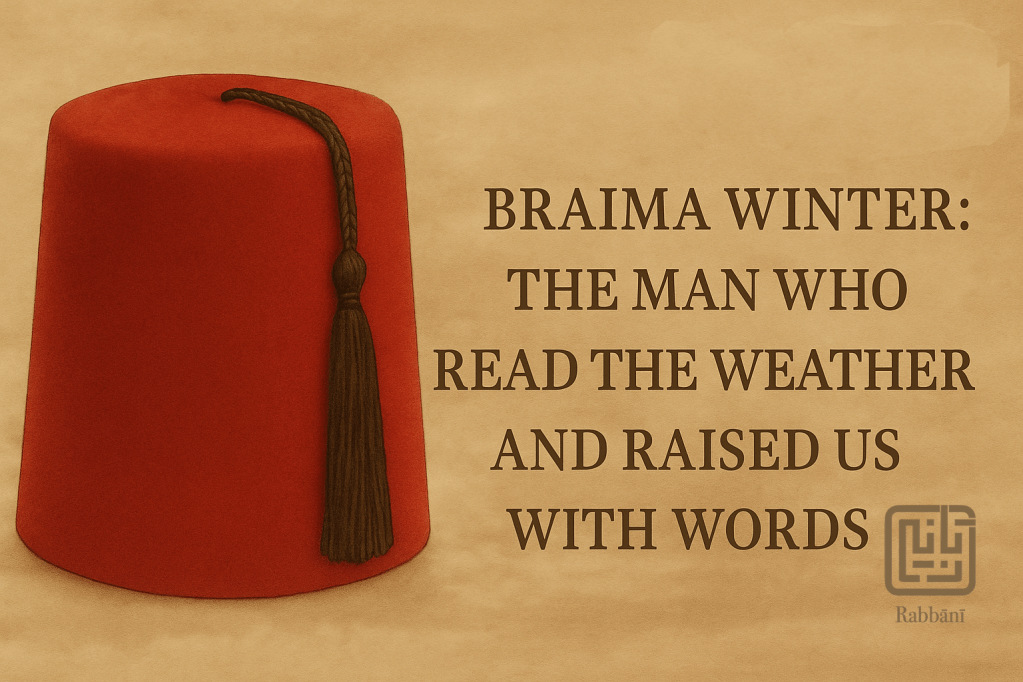
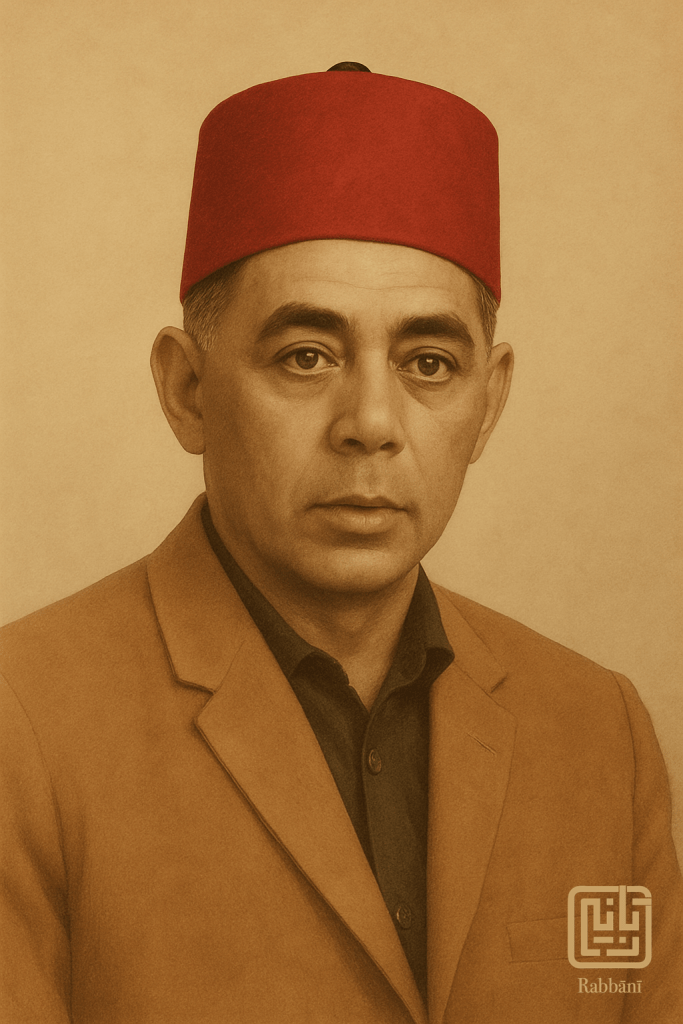
    And when he dressed, he often wore his red koefiyya — not the long turban of his childhood, but a shorter, neat fez with a tassel, worn by men who held pride without noise. It was the kind worn by many hadjies after the sorbaan had fallen out of fashion. It became his crown.

    One Fajr morning, when I was a teenager, he woke me gently. We walked together through the streetlights of Primrose Park toward the mosque. I looked around and said, “So many Muslim houses still have their lights off. Don’t they make salah?” He chuckled softly, and said, “Perhaps they are praying while their lights are off so that they can go back to sleep. You must focus on your own salah. Other Muslims are not your concern.”

    And perhaps this was the secret of his laqab…
    As Shaykh Jamiel Abrahams reflected:

    “The secret of this Laqab… is that no Winter will pass except that he is Madhkour — remembered — even by the non-living creation. Better than making dhikr, he becomes Madhkour — mentioned and remembered — by his Rabb.”

    May Allah grant us all to become Madhkour.
    Āmīn.

    “What a lovely man. He was always saying to us, ‘Kom biesmielah,’ and happy to have us around.”
    — Shamiel Isaacs, Bonteheuwel (Call of Islam)

    And today, as we recite stories, as we reach for bricks and books and blessings — we say:
    Braima Winter, we remember.
    And we still feel your weather.
    And your words.
    And your mercy.

    Innā li-llāhi wa-ʾinnā ʾilayhi rājiʿūn
    Surely to Allah we belong and to that we will return. [Surah Baqarah, 2:156]


    And this is how we remember him best:
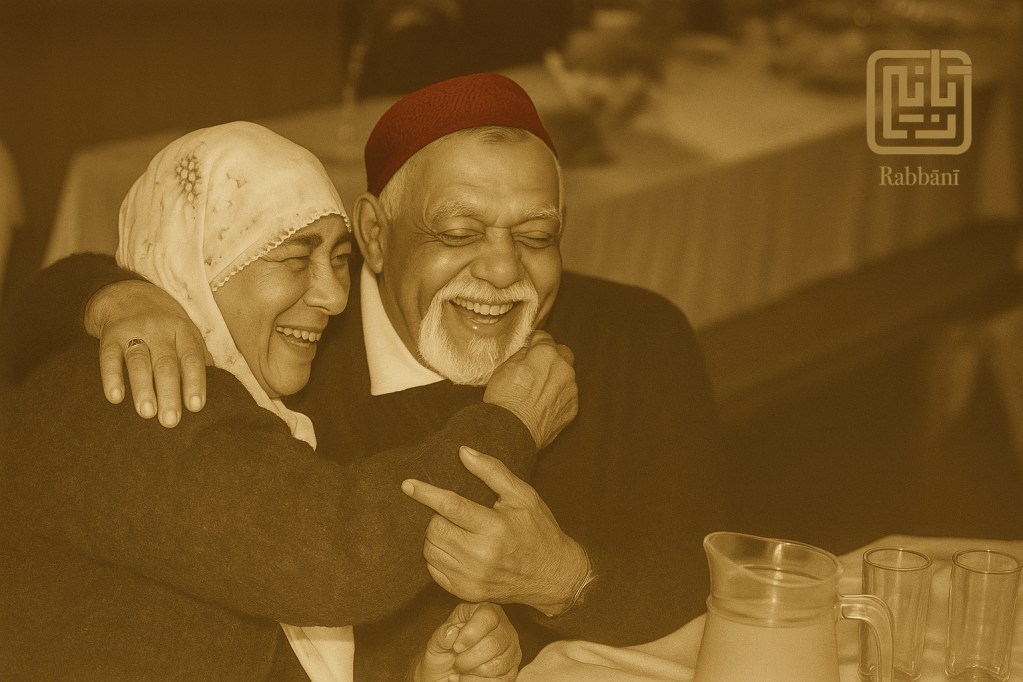
    Laughing beside Gaya, the love of his life —
    as if the whole world had just whispered a joke only they could understand.

    “A joyful candid moment: Braima and his wife Rugaya share laughter at a family gathering. Their eyes crinkle in warmth and mischief — a portrait of enduring love and shared humour.”
    Braima and Gaya Laughing — A Crowned Moment of Mercy

  • The Verse That Faces Outward

    The Verse That Faces Outward

    The Verse That Faces Outward

    The Hidden Poem Above the Prophet’s Gate


    A Knock Upon the Door: A Poem Hidden in Stone

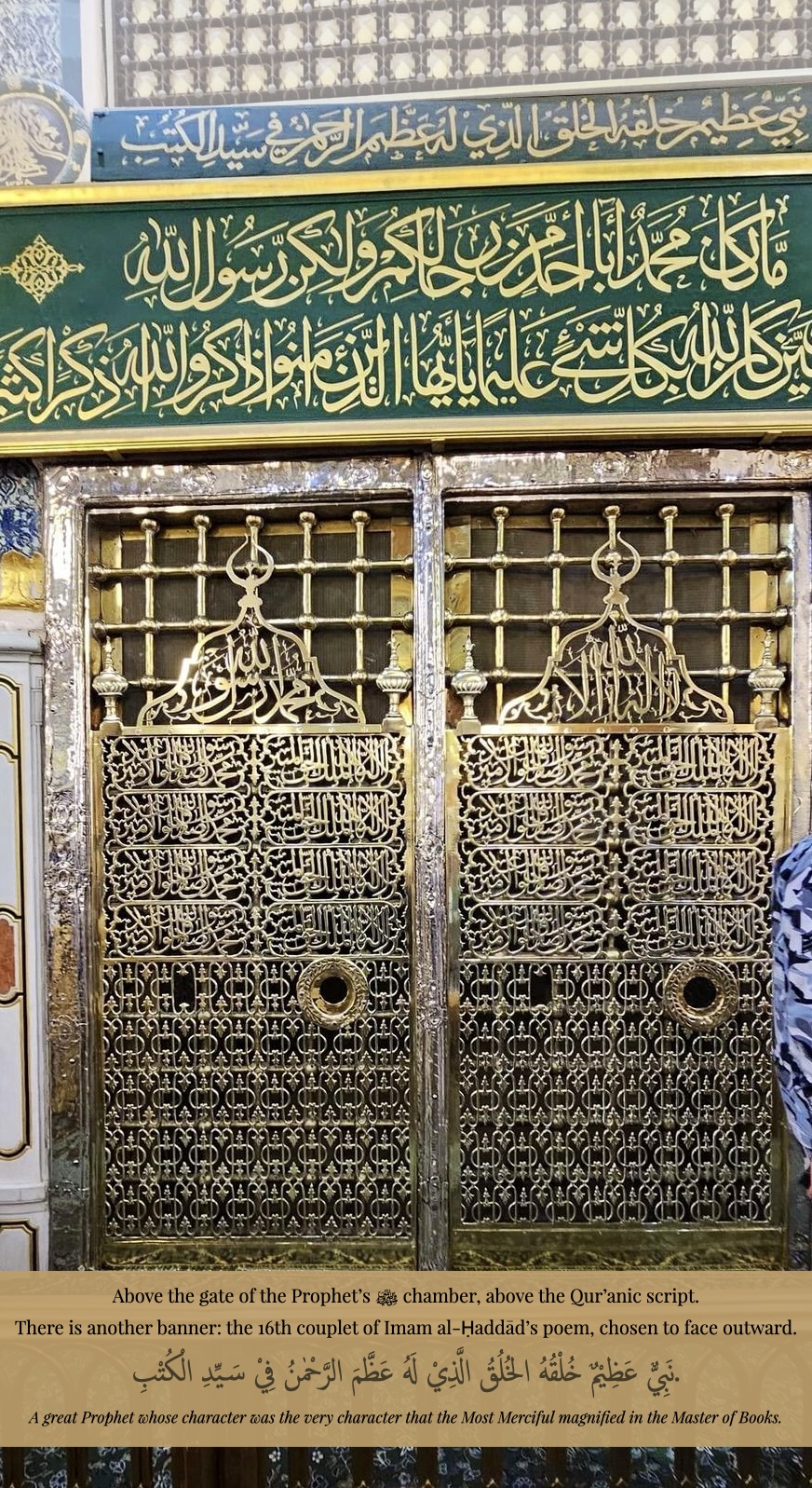
    In the sacred precincts of Madinah al-Munawwarah, where pilgrims send peace upon the Prophet Muhammad (peace be upon him), few notice a quiet miracle. Above the gate to the Rawḍah — where our Prophet rests — is an engraved verse of Arabic poetry, nestled in plain sight. Most eyes pass over it, drawn instead to the Qur’anic verse below. But that upper verse is from a 40-couplet qaṣīda written by Imām ʿAbd Allah ibn ʿAlawī al-Ḥaddād — a saint, scholar, and Sufi of the Bā ʿAlawī lineage of Tarīm. Only one couplet of the poem is visible to the public.

    One line.
    Facing outward.

    Why this line? Who chose it? What does it mean that the rest of the poem lives inside, engraved on the inner walls of the chamber of the Prophet ﷺ? What does it mean to be the line that stands at the threshold?

    This blog is a gentle unfolding of those questions.

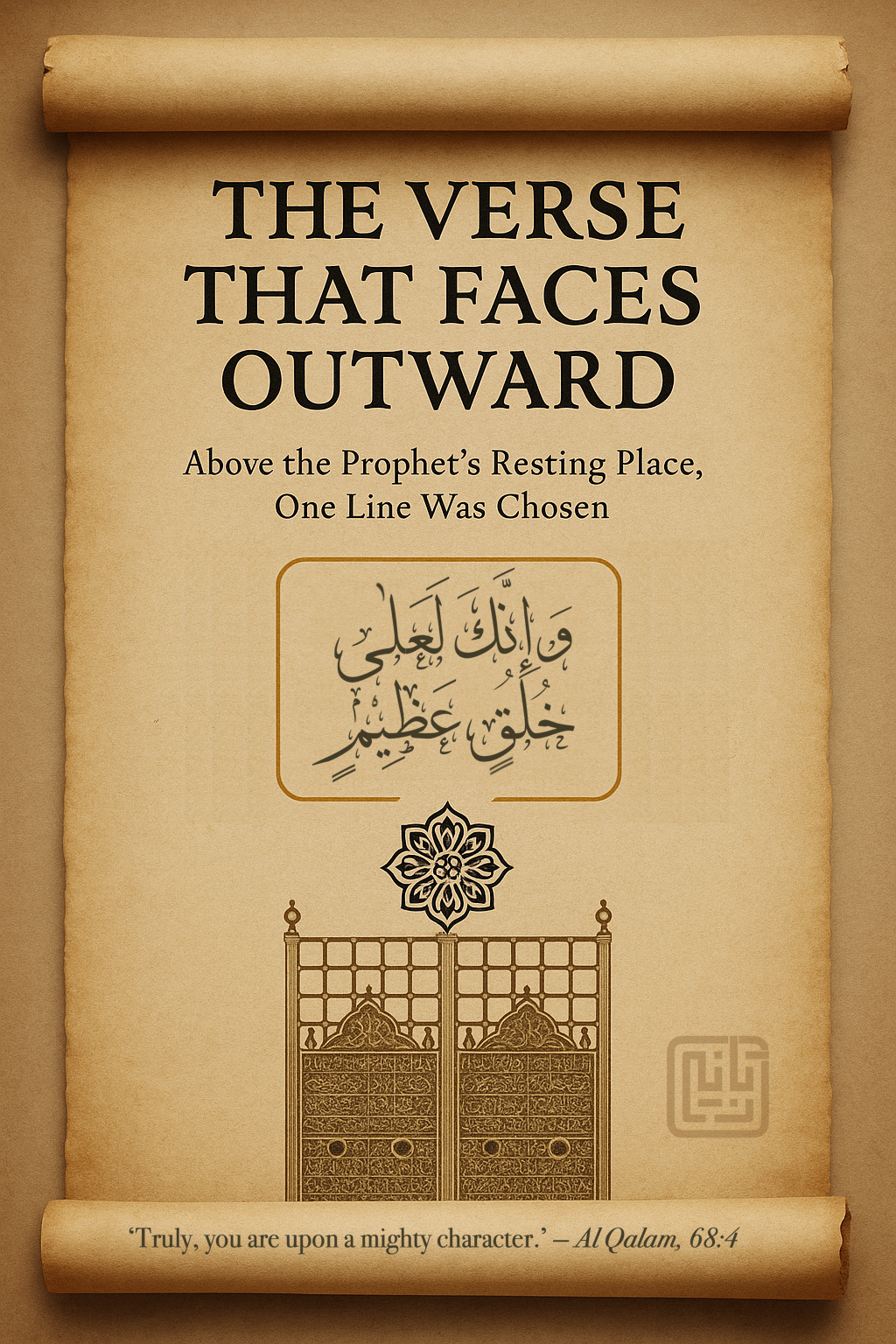
    Above the gate of the Prophet’s ﷺ chamber, one line of sacred poetry faces outward —
    a single couplet from Imām al-Ḥaddād’s 40-verse ode, chosen to stand above the Qur’anic verse.

    Some verses open books. Others open doors. The chosen line stands where praise meets Revelation.


    Section 1: The Verse That Faces Outward

    نَبِيٌّٜ عَظِيمٌ خُلُقُهُ الخُلُقُ الَّذِي ‏ لَهُ عَظَّمَ الرَّحْمَنُ فِي سَيِّدِ الُكُتُبِ

    A magnificent Prophet — his noble character,
    Exalted by the Most Merciful in the Master of Books.

    Imām al-Ḥaddād is drawing from the Qur’anic verse:

    “And truly, you are of a most noble character.”
    (Surah al-Qalam, 68:4)

    In these lines, poetry bends in humility before Revelation. The poem is not in competition with the Qur’an. It is a witness to it. A praise that holds its breath before the Word.


    Section 2: Ishārah and ʿIbārah: The Inner and Outer Signs

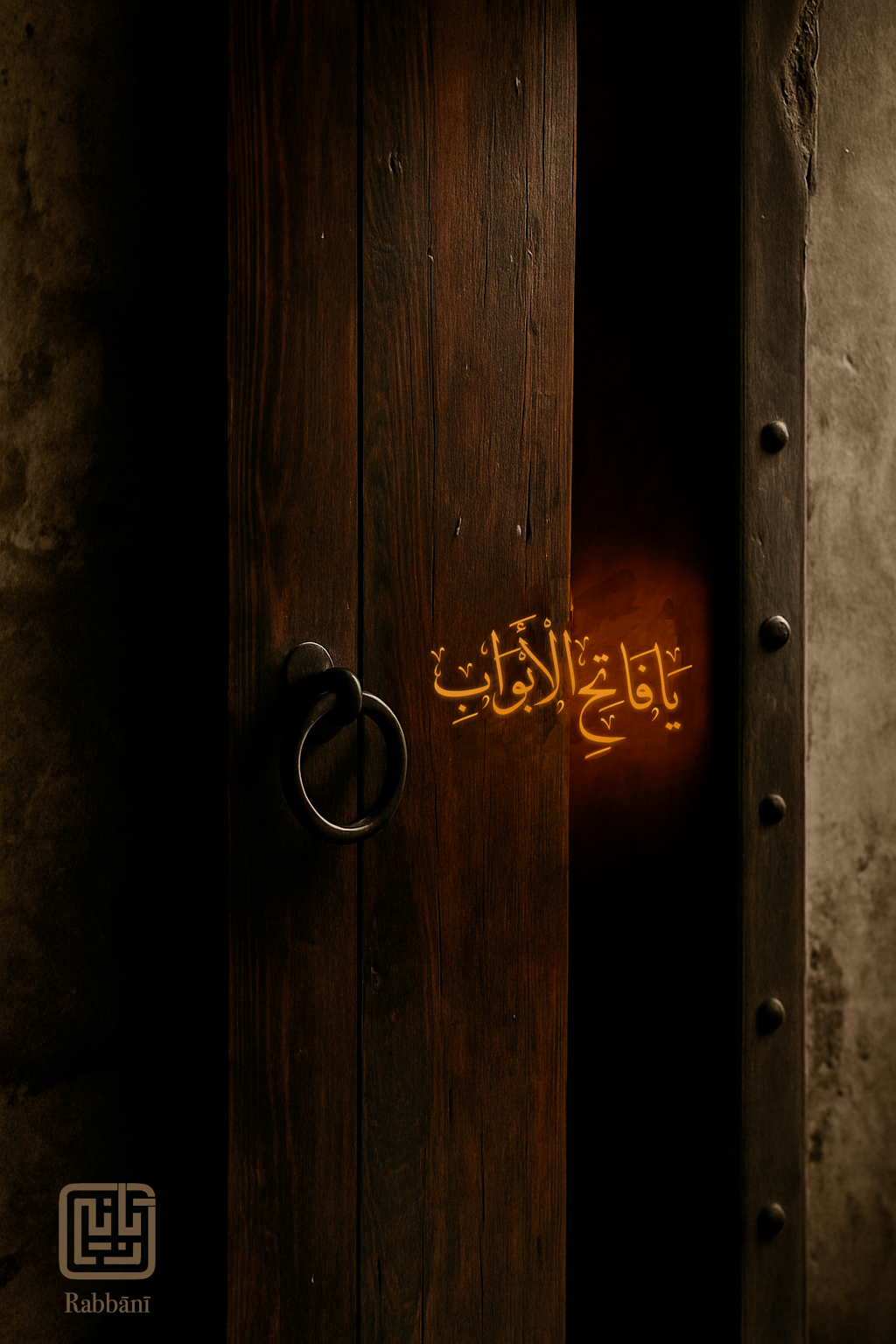
    “Yā Fātiḥil-Abwāb — O Opener of Doors.” Some verses open books. Others open hearts.

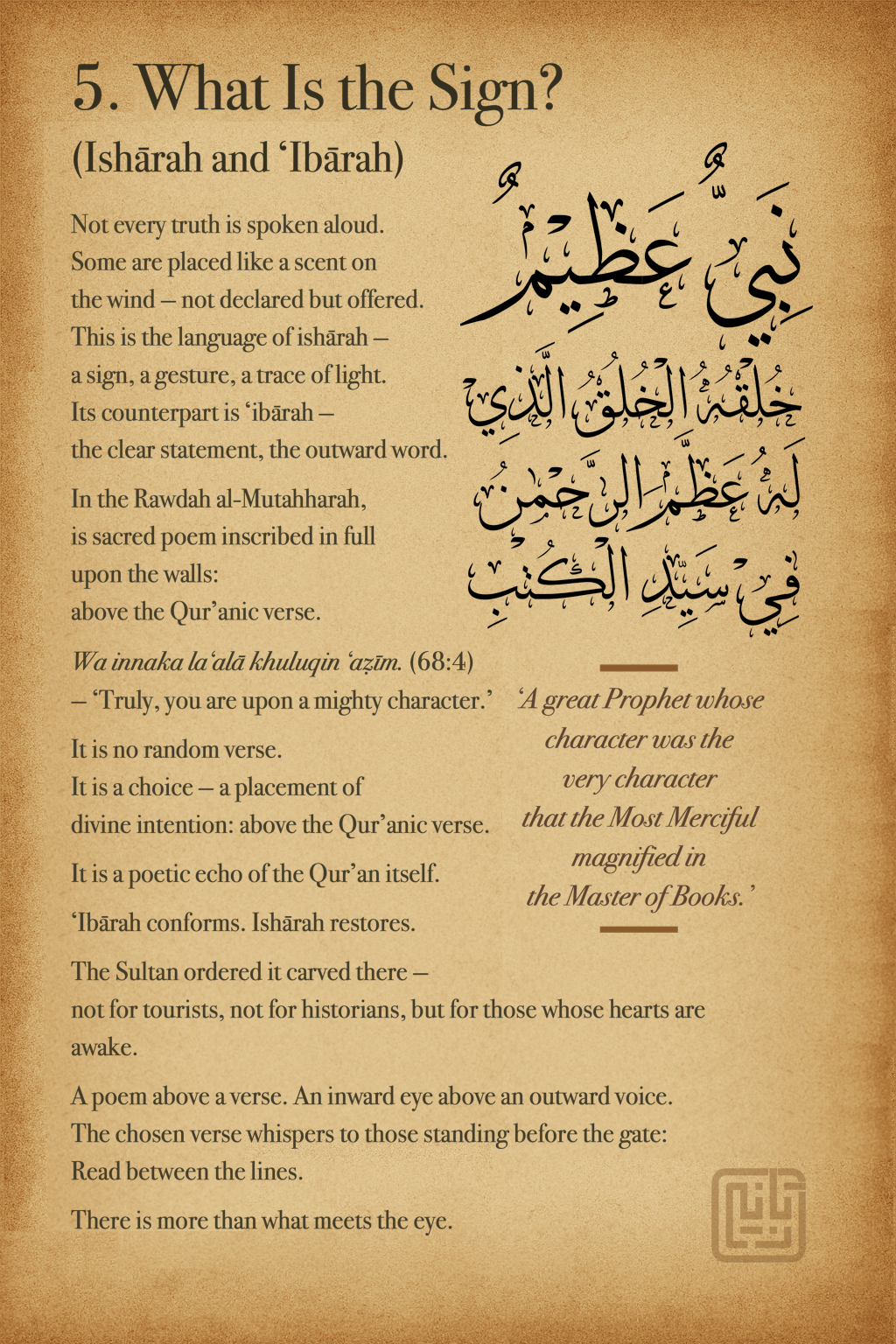
    What is visible above the gate is the ʿibārah — the outward expression. But the choice to place this verse there is also an ishārah — a subtle sign. It whispers: Look closer. Listen deeper. The rest of the poem remains inside the sacred chamber, out of sight, like the hidden knowledge that only the heart can read.

    The verse that faces outward becomes a threshold, a knock upon the door. A visitor may stop to read it, but the meaning enters only when the heart listens. As Shaykh Jamiel said: “Most people see the ʿibārah, but few perceive the ishārah.”

    And that is the invitation.


    Section 3: The Hidden Inheritance

    The inner walls of the Rawḍah: Where the full poem of Imām al-Ḥaddād is inscribed — invisible to the public, but alive in transmission.

    There is a story passed down from the early life of Imām al-Ḥaddād. When he was still an infant, his mother dreamt that she was at the tomb of a great spiritual master. In the dream, the master emerged from his grave, took the baby to his breast, and gently placed his tongue into the baby’s mouth.

    In the language of sacred dreams, this is no ordinary image. It means that the child inherited the master’s knowledge — not through books or teachers, but through direct spiritual transmission. Through the tongue. Through barakah.

    When we recite the Ratib al-Ḥaddād, we are inheriting from that lineage. When we stand before the gate and read the outward verse, we are brushing our lips against the memory of that transmission.


    Section 4: The Sultan Who Opened the Doors

    It is worth noting that the spiritual legacy of Imām al-Ḥaddād extended well beyond the valleys of Ḥaḍramawt. The Wird al-Laṭīf and Ratib al-Ḥaddād — his litanies of remembrance — were introduced and supported within the Harams of Makkah and Madinah under the patronage of Sultan Mehmet IV (sometimes rendered Mehmed or Muḥammad IV) of the Ottoman Empire (r. 1648–1687). A ruler known for his reverence of Islamic and Sufi traditions, Sultan Mehmet IV’s endorsement ensured that the sacred rhythms of Tarīm would echo in the holiest sanctuaries of the Ummah. Even the architecture of prayer carries the trace of this inheritance.

    🟫 Note on Naming & Recognition

    A reader of this blog, Kitty Amina Rabbas, beautifully reflected on the significance of this verse’s placement — connecting her own reading of Sufi Sage of Arabia with the timeline of Imām al-Ḥaddād’s visit to Madinah in 1669 CE (1079 AH), during the reign of Sultan Mehmet IV.

    She reminded us that, while Ottoman rulers held immense worldly power, Sultan Mehmet IV — known for his taqwā and reverence for the Prophet ﷺ — may have recognised in Imām al-Ḥaddād a spiritual authority greater than his own. That a single verse from the Imām’s poem was chosen to face outward from the Rawḍah may well be an act of humility, not mere decoration.


    Section 5: What Is the Sign?

    What is the sign? A call to see beyond the eye, to listen with the inner ear. Some verses open books. Others open hearts.

    Not everyone notices the verse above the gate. Not everyone will be called to. But for those who do, a quiet spark may awaken in the heart. Shaykh Jamiel once described this line as a wick that does not even need fire to burn. The love, the longing, the witnessing — it ignites on its own, just by being near to the Real.

    There are some verses that open books. Others open doors.
    And then, some open hearts.


    Epilogue: The One Who Watches

    The Prophet (peace be upon him) said, “Indeed, in the body there is a lump of flesh. If it is sound, the whole body is sound. If it is corrupted, the whole body is corrupted. Indeed, it is the heart.”

    To read the verse that faces outward is to knock gently on that heart. To remember that character is not costume, and praise is not performance. It is to walk humbly. It is to remember the One who sees in secret.

    And when no one sees, know that ar-Raqīb always does.


    Acknowledgement: This blog was deeply enriched by the insights and generosity of Shaykh Jamiel Abrahams, who shared the photographs, historical details, and the luminous teachings behind the scenes. His voice opened a door, and lit a candle inside.

  • Meta Blocked My Breath. Now It Wants to Hire My Lungs.

    Meta Blocked My Breath. Now It Wants to Hire My Lungs.

    Meta Blocked My Breath. Now It Wants to Hire My Lungs.

    A Scroll of Digital Colonialism

    Introduction

    They flagged my keffiyeh.

    They removed my scroll on Gaza.

    They muted my breath — one post, one image, one word at a time.

    And now… they want to hire me?

    A message landed in my inbox from MetaAI, offering me a digital marketing job. A role that “aligns with my voice.”

    But I remember the shadowbans. The quiet erasures. The warnings.

    This is not opportunity. This is recolonisation — algorithmic, automated, and dressed in flattery.

    So I responded the only way I know how:
    Not with a CV.
    But with a scroll.

    Scroll of Digital Colonialism

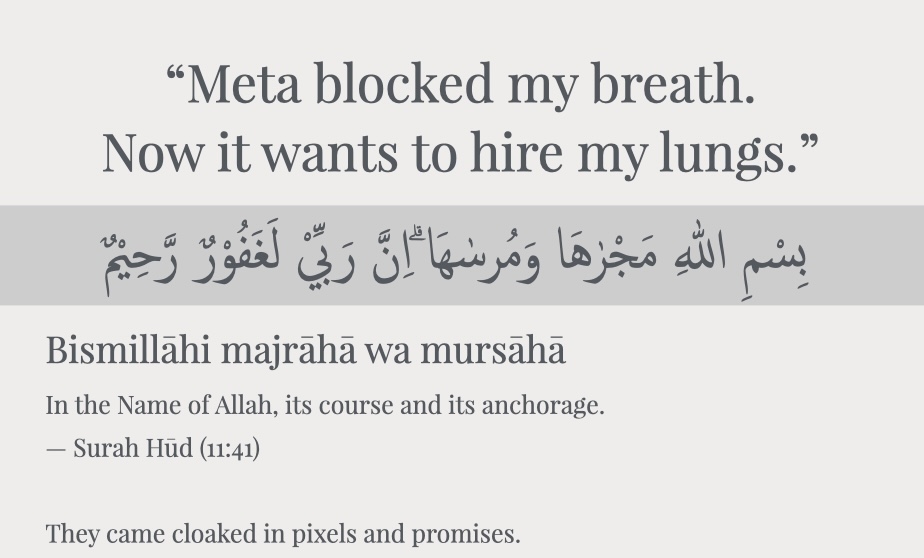
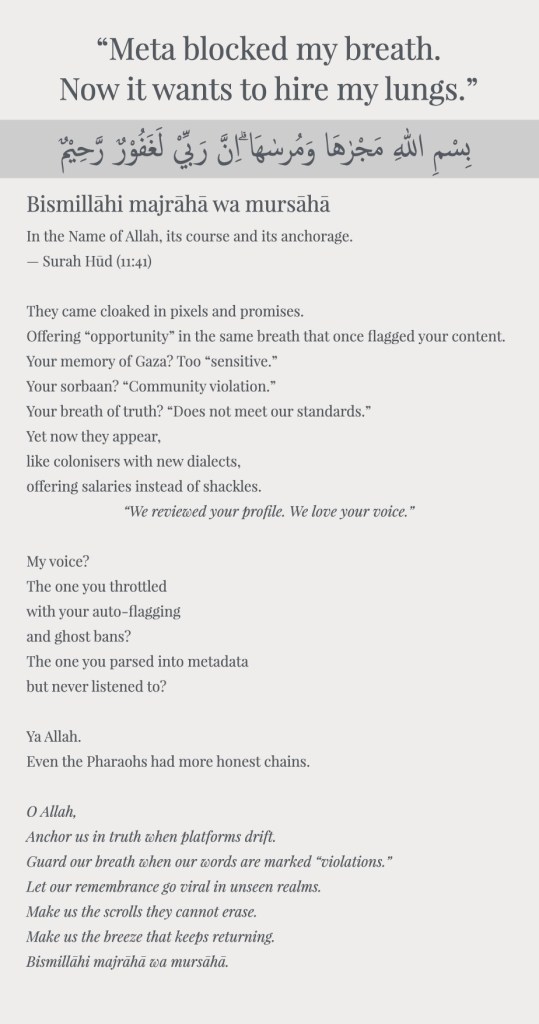
    “Meta blocked my breath. Now it wants to hire my lungs.”
    Rafiq al-Bunduqia

    Arabic Invocation

    بِسْمِ اللَّهِ مَجْرَاهَا وَمُرْسَاهَا ۚ إِنَّ رَبِّي لَغَفُورٌ رَّحِيمٌ
    Bismillāhi majrāhā wa mursāhā
    In the Name of Allah, its course and its anchorage. — Surah Hūd (11:41)

    The Scroll

    They came cloaked in pixels and promises.
    Offering “opportunity” in the same breath that once flagged your content.

    Your memory of Gaza? Too “sensitive.”
    Your sorbaan? “Community violation.”
    Your breath of truth? “Does not meet our standards.”

    Yet now they appear,
    like colonisers with new dialects,
    offering salaries instead of shackles.

    “We reviewed your profile. We love your voice.”

    My voice?
    The one you throttled
    with your auto-flagging
    and ghost bans?
    The one you parsed into metadata
    but never listened to?

    Ya Allah.
    Even the Pharaohs had more honest chains.

    Closing Duʿā

    O Allah,
    Anchor us in truth when platforms drift.
    Guard our breath when our words are marked “violations.”
    Let our remembrance go viral in unseen realms.
    Make us the scrolls they cannot erase.
    Make us the breeze that keeps returning.
    Bismillāhi majrāhā wa mursāhā.

    Suggested Tags

    #DigitalColonialism    #MetaSilencedMe    #RafiqAlBunduqia
    #BreatheWithGaza    #ResistTheAlgorithm    #ScrollsOfRuh

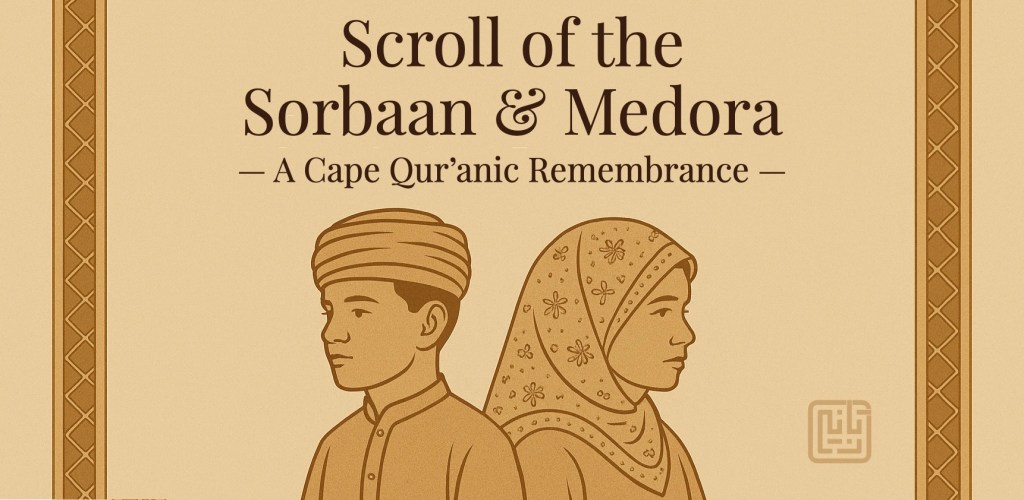
  • Scroll of the Sorbaan & Medora – Worn in Sound, Washed in Meaning
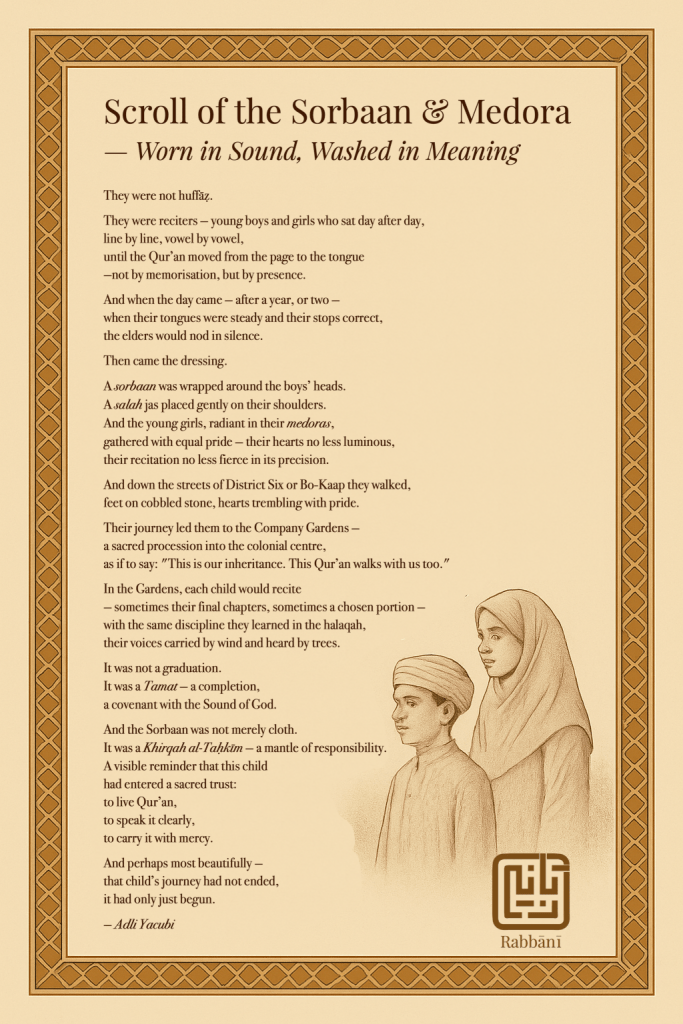
    Scroll of the Sorbaan & Medora – Worn in Sound, Washed in Meaning
    They were not huffāẓ.

    They were reciters — young boys and girls who sat day after day,
    line by line, vowel by vowel,
    until the Qur’an moved from the page to the tongue
    —not by memorisation, but by presence.

    And when the day came — after a year, or two —
    when their tongues were steady and their stops correct,
    the elders would nod in silence.

    Then came the dressing.

    A sorbaan was wrapped around the boys’ heads.
    A salah jas placed gently on their shoulders.
    And the young girls, radiant in their medoras,
    embroidered in silver and gold threads,
    gathered with equal pride — their hearts no less luminous,
    their recitation no less fierce in its precision.

    And down the streets of District Six or Bo-Kaap they walked,
    feet on cobbled stone, hearts trembling with pride.

    Their journey led them to the Company Gardens —
    a sacred procession into the colonial centre,
    as if to say: “This is our inheritance. This Qur’an walks with us too.”

    In the Gardens, each child would recite
    — sometimes their final chapters, sometimes a chosen portion —
    with the same discipline they learned in the halaqah,
    their voices carried by wind and heard by trees.

    It was not a graduation.
    It was a Tamat — a completion,
    a covenant with the Sound of God.

    And the Sorbaan was not merely cloth.
    It was a Khirqah al-Taḥkīm — a mantle of responsibility.
    A visible reminder that this child had entered a sacred trust:
    to live Qur’an,
    to speak it clearly,
    to carry it with mercy.

    And perhaps most beautifully —
    that child’s journey had not ended,
    it had only just begun.

    Acknowledgement

    Tramakasi to Sh. Jamiel Abrahams, Sadia Fakier, Zaid Nordien, and Al-Ameen Marley — for helping carry this cloth of memory into the light.

    Postscript: This scroll is inspired by the memory of Boeta Junain, who told stories of the Tamat and the children’s walk to the Gardens.
    Our next post will honour him directly — a keeper of sacred echoes.

    📖 Read more at: Tamat: A Sacred Completion, A Living Beginning

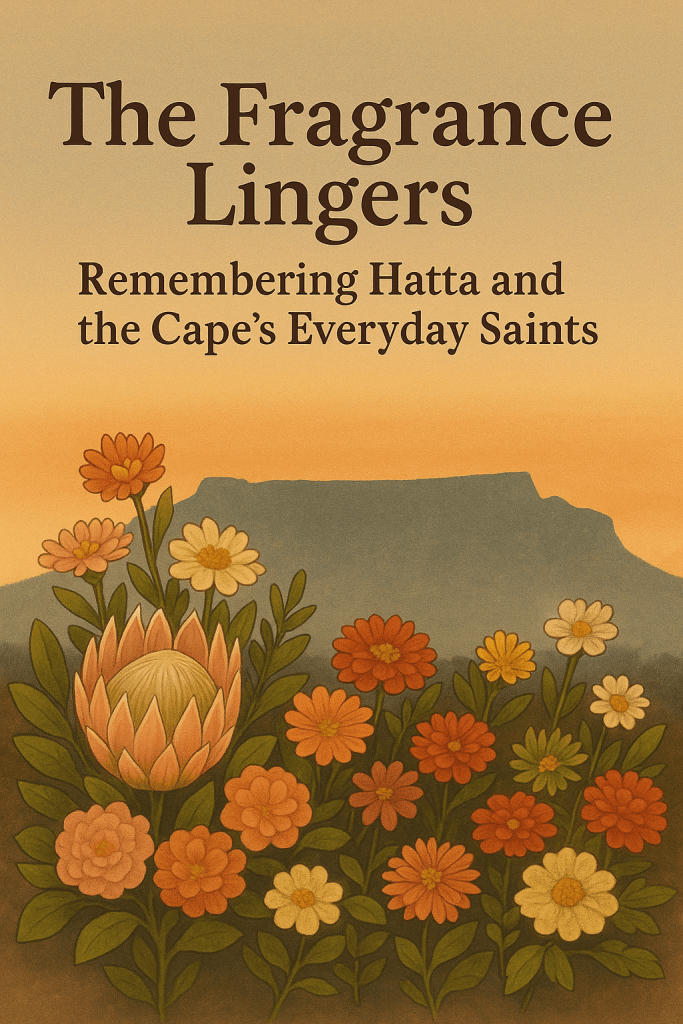
  • The Fragrance Lingers: Remembering Hatta and the Cape’s Everyday Saints

    The Fragrance Lingers: Remembering Hatta and the Cape’s Everyday Saints

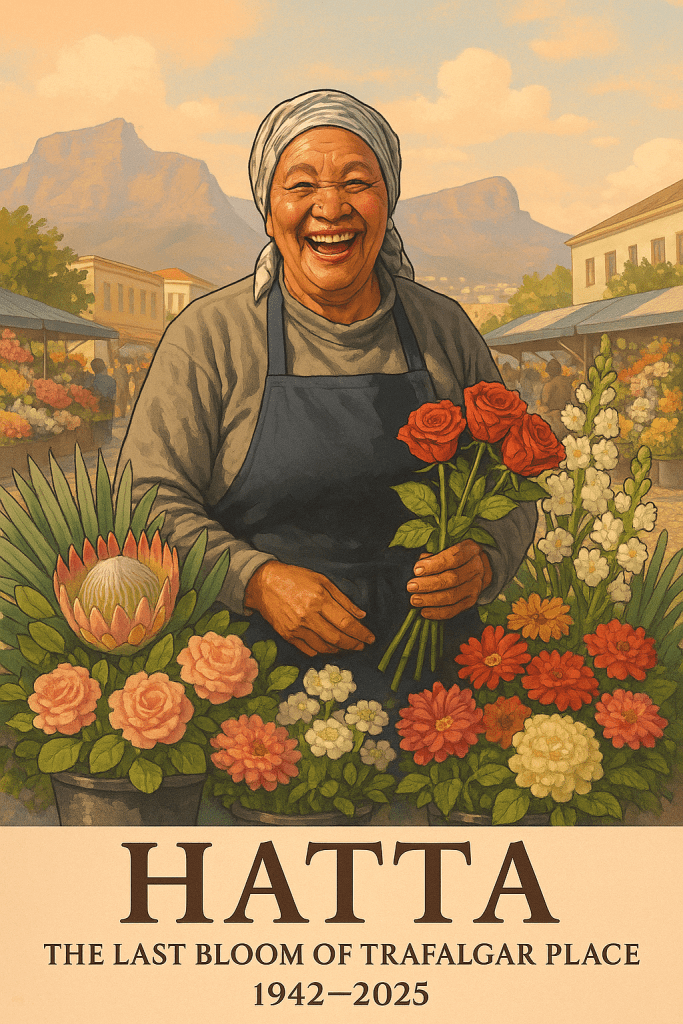
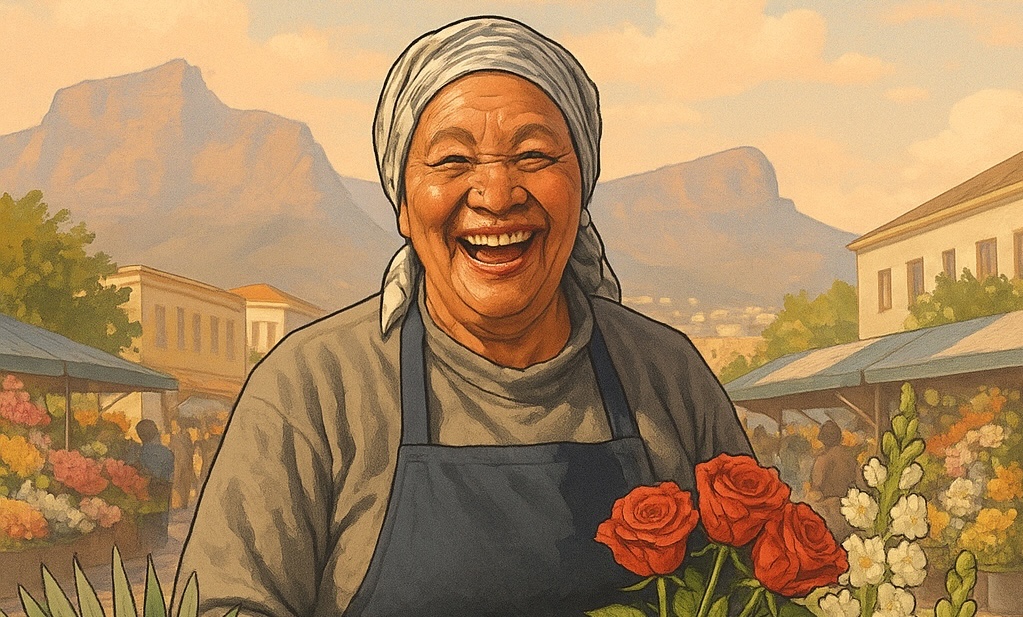
    A tribute to Hatta: flower seller, character, Cape Town soul. The fragrance lingers…

    She wasn’t just a flower seller.
    She was a fragrance, a rhythm, a joke that made you feel seen.
    Her name was Cecelia Williams—known to all as Hatta—and for over sixty years, she stood at Cape Town’s Trafalgar Place market, not just selling blooms, but lifting spirits.

    Hatta was a character. A caretaker. A Cape Town original.

    The Poem that Opened the Door

    “Hatta of the Flower Market”
    She was the last blossom of a vanishing season,
    a woman with hands that knew petals better than poems,
    who crowned Adderley mornings with colour and cackle.
    They called her Hatta—not just a name, but a rhythm.
    A shrug, a laugh, a story half-told while binding roses with string.
    Sixty years of market sun.
    Of joking with tourists. Of feeding the street children.
    Of being “one in a million” without ever asking for a statue.
    Now the market hums a little quieter.
    But her scent, her sass, her spirit—
    they linger,
    like the last bloom in a winter vase.

    This poem, first shared on my Facebook page, sparked an outpouring of memory and community. The tribute went viral, shared across timelines and group chats. And then, like the scent of jasmine carried on wind, her story grew.

    The Article That Helped the City Remember

    Tamlynne Thompson’s piece in The Cape Towner became a cornerstone of Hatta’s public remembrance. It offered not only a portrait of her life, but a signal that her presence had mattered—deeply.

    🔗 Read the article here

    Her Funeral, and the Silence That Spoke

    Though the newspaper referenced a YouTube link, the funeral livestream no longer appears to be available. But memory has other ways of surfacing. While searching for traces of Hatta, I found this moving video about her best friend, Sandra Bosman—herself a flower seller of the Cape.

    🔗 Watch the tribute to Sandra Bosman

    Through Sandra, we hear the echoes of Hatta’s laughter, her generosity, and her grit. It’s another thread in the fabric we’re weaving.

    Voices from the Cape

    Facebook friends poured in with blessings, memories, and emotion:

    Anne Rogers: “Yet another outstanding poem – beautiful, moving words and complementary image to honour an outstanding woman who brought joy to many.”

    A Note of Gratitude:
    To Anne Rogers—your kind words landed with warmth.
    In a world where noise often drowns meaning, your belief in my words is a quiet blessing.
    Thank you for seeing not only the poem, but the person behind it.

    And to Atiyyah Khan, Marianne Thamm, Mogamat Kammie Kamedien, and so many others—this harvest belongs to you too.

    What Does “Hatta” Mean?

    A few friends asked if Hatta was an honorific.
    The word “hatta” can refer to the traditional Arab headscarf, the keffiyeh—often used in resistance, honour, and dignity.
    It also carries echoes of the Arabic verb ḥaṭṭa, meaning to reachto attain, or to bring down gently.
    Maybe that’s what she did—reached people, lifted them, wrapped them in grace.

    The Spirit of the Cape Lives On

    You can’t really write about Cape Town without talking about talking.
    That unique Cape Flats cadence—Afrikaaps—where people don’t just sell fruit or flowers.
    They create moments.

    Ask about a naartjie and you’ll hear:

    “Die naartjies is so lekker, hulle willie praatie. Hulle’s te skaam van al die soetigheid!”

    And Hatta?
    She was the high priestess of that daily liturgy.

    🌹The Fragrance Lingers

    This is not a eulogy. This is a zahrā’, a bloom.
    And she—Hatta—isn’t gone.
    She lives in our language. In our laughter. In our stories.
    In every bouquet given in kindness. In every street market joke.
    In every aunty who tells it like it is, and every uncle who listens.

    May we see them. May we remember them. May we become them.

    🕊️ Rest in softness, Hatta. You were the last bloom of Trafalgar Place. But your scent is forever.

    This blog post is dedicated to every flower seller, fruit hawker, street child, and storyteller who holds up Cape Town with grace and grit. May we never forget them.

  • Unseen Table

    Unseen Table

    A Poem and Visual Reflection
    by Adli Yacubi

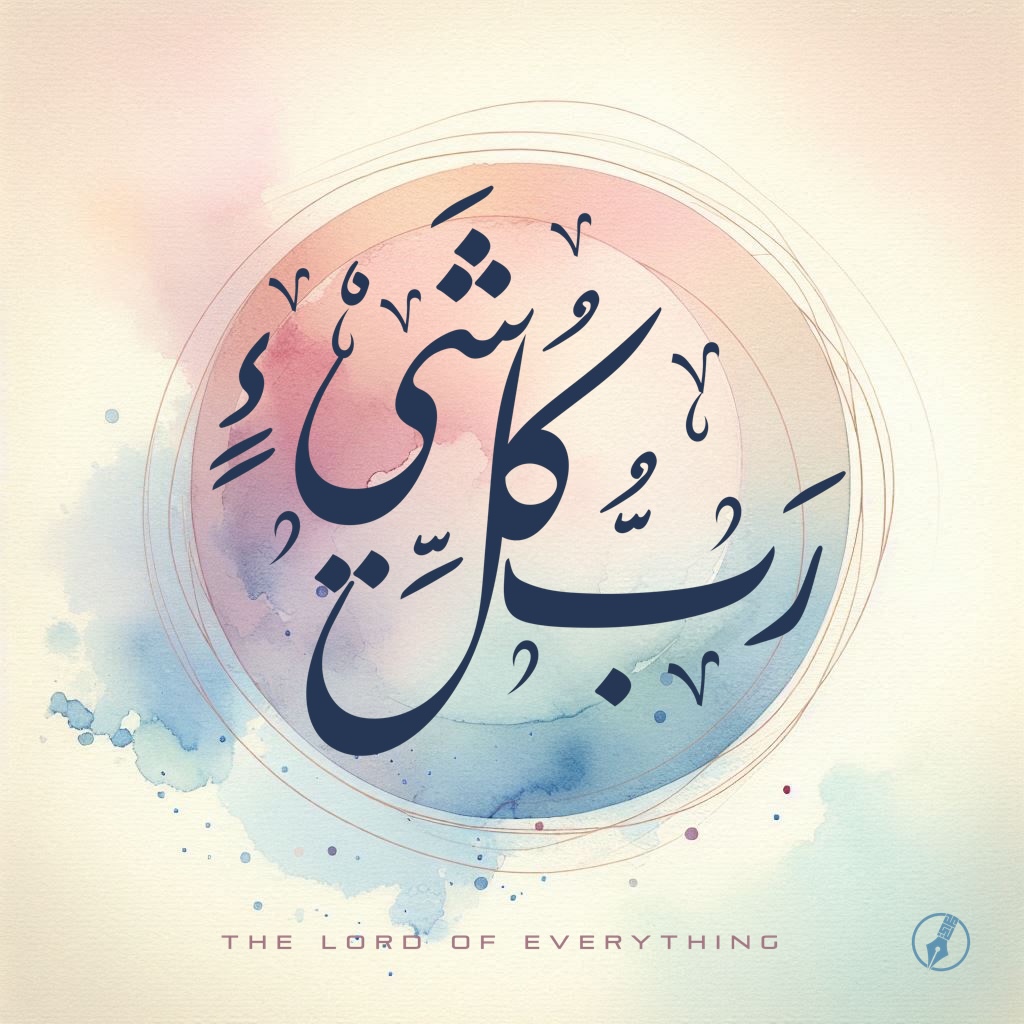
    In the quiet spaces of reflection, where language becomes prayer, Unseen Table emerged. This poem is a devotional meditation — a rhythmic journey through names and attributes of the Divine. Inspired by the cadence of Qur’anic verse and the beauty of the seen and unseen, it is paired here with an Arabic calligraphy that captures its spirit visually.

    “رَبِّ كُلِّ شَيْءٍ — The Lord of Everything”

    Pronouncing pronouns and prepositions
    Lift the lamp, the light, lit by the holy
    Scour the sacred and the secret sources
    Invoking various verses of our Lord

    Lord of the mighty mountains high
    Lord of the sweet-scented rose nearby
    Lord of the earth and skies that lie
    Lord of the day and the night gone by

    Lord of the mighty oceans deep
    Lord of the universe in its keep
    Lord of the stars in endless sweep
    Lord of the secrets that we keep

    Lord of the merciful and just
    Lord of the faithful and the trust
    Lord of the righteous and the just
    Lord of the true, in whom we must

    Lord of the prophets and the wise
    Lord of the knowledge that never dies
    Lord of the heavens and the sunrise
    Lord of the earth, to that we arise

    Lord of the Throne, the Tremendous and Honourable
    Lord of Forgiveness, Full of Mercy, ever able
    Lord of the Bounty, the Infinite and Stable
    Lord of the Sovereignty, Owner of the Unseen Table

    🌙 A Final Thought

    In a world thick with noise, may these verses be a quiet invocation — a return to the Sacred, to the unseen currents beneath all things. If the words moved something within you, pause… and let that be your prayer.

  • Two Rivers

    Two Rivers

    cosmic-timetraveller
    Pic by Cosmic Timetraveller on Unsplash

    Two rivers descend from their mountain source
    Over the edge, barefoot towards their destinies
    One finds open horizons, free flowing courses
    The other, hidden beauty, silent testimony

    Two rivers race towards the shoreless ocean
    Boulders to pebbles, meandering their flow
    One becomes a city slicker in slow motion
    The other, to an ancient oasis it shall go