Tag: Rabbani

  • Between Distance and Closeness: Walking the Path of Al-Fātiḥah

    Between Distance and Closeness: Walking the Path of Al-Fātiḥah

    Between Distance and Closeness

    Walking the Path of Al-Fātiḥah
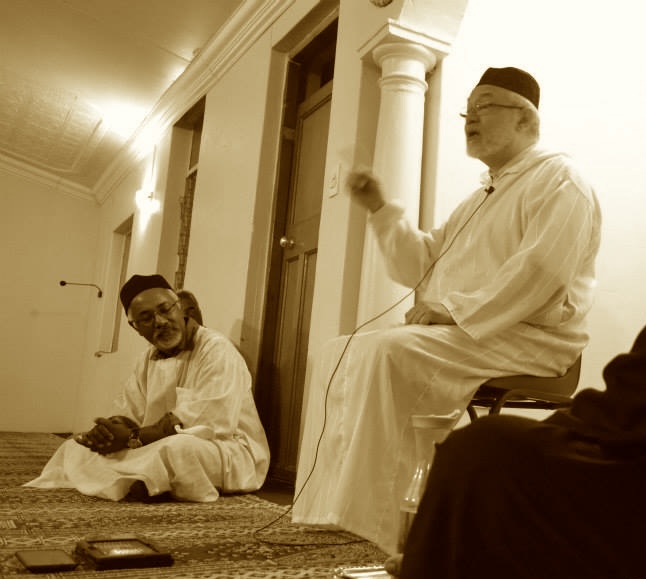
    Sh. Seraj Hendricks speaking on Al-Fātiḥah at Janet St. Mosque in Florida, Johannesburg. 3 Nov. 2013
    [Pic: Muavia Gallie]

    Surah Al-Fātiḥah, the Opening Chapter of the Quran, holds profound significance in Islamic practice. It serves as a fundamental prayer for guidance and mercy, recited in every unit of Muslim ritual prayer (ṣalāh). Known as the Mother of the Book, Al-Fātiḥa is essential for the validity of prayers, underscoring its central role in worship and belief. This is why it is also referred to as the Seven Oft-Repeated Verses.

    When I recite Al-Fātiḥah during my ritual prayers, I strive to focus meditatively on these seven verses. I recall an enlightening moment at a mosque in Johannesburg, Florida, where the late Shaykh Seraj Hendricks (may Allah’s mercy be upon him) shared a profound framework of the Quran. Drawing upon Al-Ghazali’s Mishkāt al-Anwār (The Niche of Lights), Sh. Seraj explained the duality of what is distant and what is near in the Quran.

    In Al-Fātiḥah, the first four verses describe Allah in the third person:

    • In the Name of Allah, the Entirely Merciful, the Especially Compassionate;
    • Lord of all the worlds;
    • The Entirely Merciful, the Especially Compassionate;
    • Sovereign of the Day of Judgment.

    These verses portray Allah The Sublime as transcendent and distant, beyond the cosmos. In contrast, the last three verses shift to a direct, intimate tone, addressing Allah in the first person:

    • You alone we worship, and You alone we ask for help;
    • Guide us on the Straight Path;
    • The path of those You have blessed, not of those who have incurred Your wrath or gone astray.

    This shift emphasises Allah’s closeness, inviting a direct connection between the worshipper and the Divine. 

    This interplay of distance and nearness is a recurring theme in the Quran. Across 222 verses, references to the heavens and the earth metaphorically depict this duality. Heavens often symbolise the vast, cosmic, or intellectual realm, while earth signifies human, emotional, and spiritual proximity. In another sense, the heavens represent the mind—distant and analytical—while the earth represents the heart, intimately connected to spirituality.

    Sh. Seraj also emphasised that these verses subtly address humanity’s role as vicegerents or stewards of God—khilāfatullah—and also as subordinated of God—ʿabdullah—in the universe and on earth. As Allah’s representatives, we are called to balance confidence with humility, leadership with servitude, and authority with submission in worship. This dual responsibility reminds us to rule with justice and compassion, always grounded in our devotion to and reliance on the Divine.


    Focusing on Al-Fātiḥah: A Personal Practice

    With this understanding, I now recite Al-Fātiḥah with a mindful dedication to different aspects of my being. Each verse resonates with a part of my body, mind, or soul:

    1. Bismillāhir Raḥmānir Raḥīm (In the Name of Allah, the Entirely Merciful, the Especially Compassionate)—dedicated to the right hemisphere of my brain, the seat of creativity and emotion.
    2. Al-Ḥamdu li-Llāhi Rabbi l-ʿĀlamīn (Praise be to Allah, Lord of all the worlds)—dedicated to my frontal lobe, responsible for reasoning and judgment.
    3. Ar-Raḥmānir Raḥīm (The Entirely Merciful, the Especially Compassionate)—dedicated to the left hemisphere, where logic and analytical thinking reside.
    4. Māliki Yawmid-Dīn (Sovereign of the Day of Judgment)—dedicated to the cerebellum, which governs balance and coordination.

    For the remaining verses, I turn to my heart:

    1. Iyyāka Naʿbudu wa-Iyyāka Nastaʿīn (You alone we worship, and You alone we ask for help)—dedicated to the heart’s ventricles.
    2. Ihdinaṣ-Ṣirāṭal-Mustaqīm (Guide us on the Straight Path)—dedicated to the central core of the heart.
    3. Ṣirāṭalladhīna Anʿamta ʿAlayhim Ghayri l-Maghḍūbi ʿAlayhim wa-Laḍ-Ḍāllīn (The path of those You have blessed, not those who incurred Your wrath or went astray)—dedicated to the atria of the heart.

    As I complete the recitation, I feel that Al-Fātiḥah integrates into my being—mind, body, and soul—lifting me spiritually. Allah Most High affirms this closeness in the Quran, “Indeed, We created humanity and fully know what their souls whisper to them, and We are closer to them than their jugular vein.” (Surah Qaf, 50:16).


    The Power of Words in Recitation and Reflection

    The act of reciting sacred words, like those of Al-Fātiḥah, carries profound significance. When we call out these words, we are not merely speaking; we are engaging in an act of connection, both with the Divine and with our innermost selves. Recitation transforms the abstract into the tangible, turning thoughts into vibrations that resonate in the air and within our being. In this way, the spoken word becomes a bridge between the physical and the spiritual.

    Equally important is the focus we bring to these words. In conversation, our attention to what we speak and how we speak reflects our intent and sincerity. This principle applies even more deeply in prayer, where concentration imbues our words with clarity and purpose. To recite mindlessly is to miss the essence of the act; to recite with focus is to align the body, mind, and soul in devotion.

    Contemplating or meditating on certain words allows their meanings to unfold in layers. Words like arraḥmān (Entirely Merciful) or ṣirāṭal-mustaqīm (Straight Path) are not static; they expand and deepen with reflection. This process not only enhances our understanding but also transforms our recitation into an ongoing dialogue with the Divine. Contemplation invites us to live these words, allowing them to shape our actions and our being.

    By calling out, focusing, and meditating on sacred words, we move beyond rote recitation into the realm of lived experience. This is where the power of Al-Fātiḥah truly lies—not just in its recitation, but in how it becomes a compass for our thoughts, a guide for our actions, and a sanctuary for our hearts.


    Al-Fātiḥah is a map and a mirror — a guide that walks with us. Whether spoken aloud, whispered in prayer, or traced silently in our hearts, its light enters every cell that listens.

    May our steps be straight.
    May our breath be mindful.
    May the One who is near, draw nearer still.

    Ameen.


    📚 You may also like…

    🔸 Hy Lyk Soos ’n Wolf
    A spiritual meditation on instinct, loyalty, and the sound of the heart behind the howl. Some names we inherit. Others we grow into.

    🔸 Tamat: A Sacred Completion, A Living Beginning
    A reflection on the weaving of remembrance and the sacred knot at the end of a Qur’an khatm — where endings become invocations for return.

    🔸 The Womb of Mercy: Unveiling the Secret of Bismillah
    Bismillāh as the gateway. A verse that holds a thousand worlds. A name that mothers every beginning.


    🎧 Watch the Companion Video

    To experience this reflection through voice, image, and sacred sound — watch the short video:
    👉 Between Distance and Closeness
    (A meditative recitation of Al-Fātiḥah with visual symbolism and breath)


    🌿 Final Note

    Al-Fātiḥah is not only recited — it is walked, embodied, and remembered.
    May each verse carry you closer to the One who is closer than your jugular vein.
  • A Word That Wounds and Wakes Us: Rethinking “Coloured” in the Age of Memory

    A Word That Wounds and Wakes Us: Rethinking “Coloured” in the Age of Memory

    🟤 A Word That Wounds and Wakes Us: Rethinking “Coloured” in the Age of Memory

    By Adli Yacubi

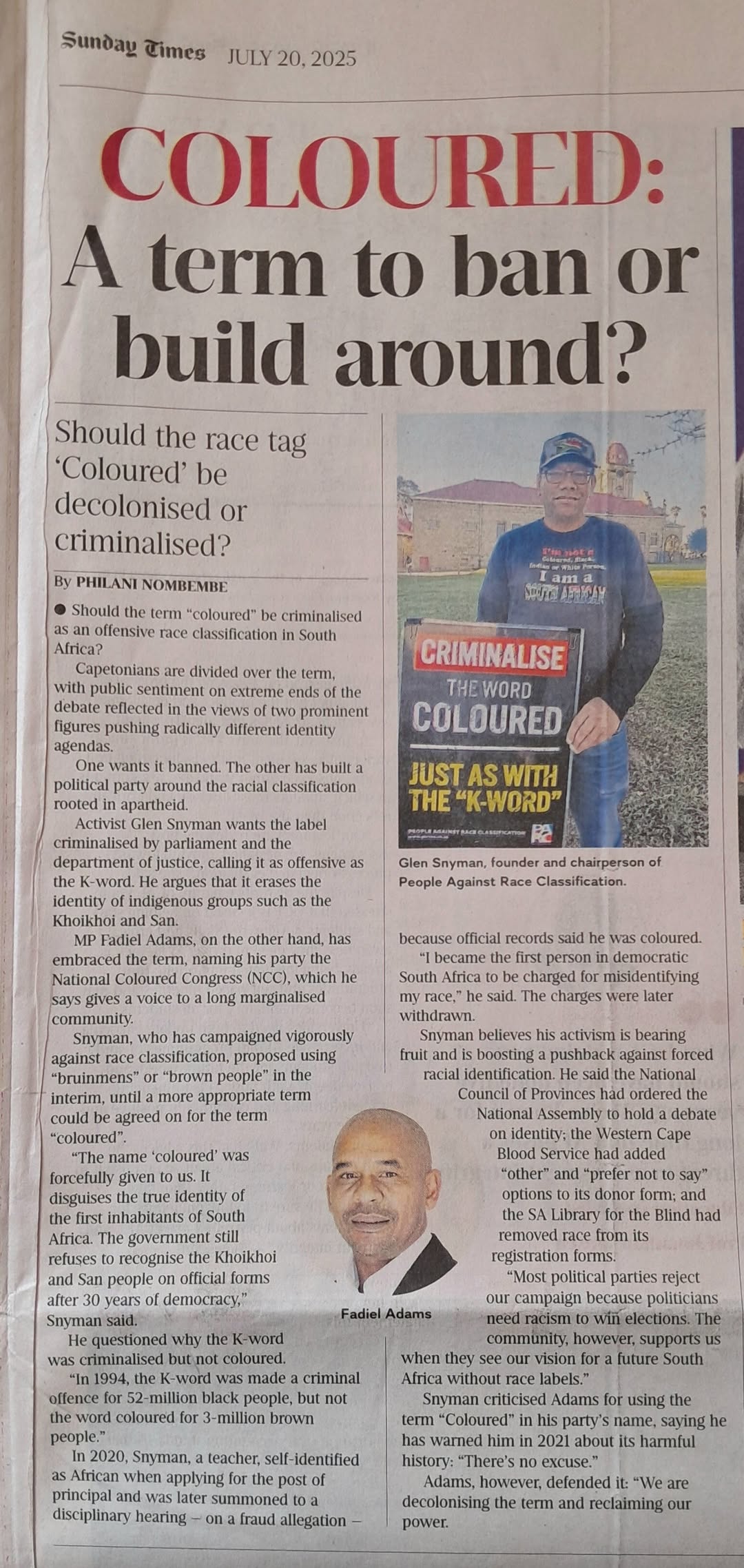
    “The name ‘Coloured’ was forcefully given to us.”
    — Glen Snyman, Sunday Times, 20 July 2025

    Last Sunday’s front page posed a question still burning through our national psyche:
    “Coloured: A term to ban or build around?”

    In bold red and black, the Sunday Times article (20 July 2025) captured a moment of deep fracture — and opportunity. It spotlighted the voices of two public figures, Glen Snyman and Fadiel Adams, whose opposing stances on the term “Coloured” reflect long-simmering tensions within post-apartheid identity politics.

    And yet, beyond the noise, a different current is rising. One that calls not for renaming or romanticising, but for remembering.

    ❌ Criminalise or 🔁 Reclaim?

    Glen Snyman, founder of People Against Race Classification (PARC), argues that “Coloured” is not merely outdated — it is damaging, like the K-word:

    “It disguises the true identity of the first inhabitants of South Africa. The government still refuses to recognise the Khoikhoi and San people on official forms after 30 years of democracy.”

    Snyman’s activism led to national debates in parliament and institutions like the Western Cape Blood Service adding the “prefer not to say” option to racial forms. But his call for criminalising the term has stirred legal and ethical challenges — and provoked a backlash from those who feel erased by the erasure.

    On the other end stands Fadiel Adams, leader of the National Coloured Congress, who says:

    “We are decolonising the term and reclaiming our power.”

    Adams believes in building around the identity — anchoring it in lived pain, community resilience, and political recognition. But critics say this collapses our histories into apartheid boxes, reinforcing labels that were never ours to begin with.

    🪶 What’s In a Name?

    Into this fire, Patric Tariq Mellet, historian and author of The Camissa Embrace, offers clarity beyond polemics:

    “Goringhaicona was never a name people used for themselves. It was a derogatory Dutch term meaning outcast or scavenger. Autshumao’s people were known as the /Kamisons — water traders. They were a sub-group of the Cochoqua. The term Camissa remembers them not as fragments, but as a river of convergence.”

    Mellet’s contribution is not merely semantic — it’s genealogical. It reveals that terms like “Coloured” and even “Brown” are colourist overlays that flatten our multiple ancestries: San, Khoe, Xhosa, enslaved African, Indian, Javanese, and European.

    His critique of both Snyman and Adams is incisive:

    “Both men reflect valid concerns — but both are caught in Apartheid’s trap. One criminalises. The other romanticises. Neither steps fully into the radical work of remembering, beyond state classification.”

    🧬 Memory as Resistance

    To stand in this in-between space — neither erasing the term nor enshrining it — is to do the work of memory. To say: we were misnamed, but we are not unnamed. We are more than what apartheid called us. And we are not only what the census categories offer us.

    This blog, like others before it, is not a position paper. It is a growing reflection rooted in questions I’ve been asking for years:
    — What do we mean when we say “I am Coloured”?
    — Who gets to say so?
    — And what happens when our ancestors whisper different names?

    We are not “non-white.” We are not “Other.”
    We are not “Coloured” in the way the law intended.
    And we are not simply “Brown,” either.

    We are Camissa. We are from the river.
    We are still flowing.

    📝 Postscript

    We acknowledge the work of Patric Tariq Mellet, whose scholarship challenges colonial erasure. Through his writing, Camissa is no longer hidden — it is remembered as a place of sweet waters, of creolised identity, of sacred convergence.

    His reminder to not confuse / reclaim / romanticise pejorative colonial terms (such as “Goringhaicona”) is especially important — and will be reflected in our future revisions.

    We also draw from Stuart Hall, who wrote that nations are “narrated into being.” To say “I am from Camissa” is to resist imposed categories and to speak from the riverbed of relation — to narrate the nation otherwise.

    The story of who we are is still being written. Let it not be in the language of our conquerors — but in the voice of our rivers, mountains, mothers and names.


    💧 The Colour of God

    صِبْغَةَ ٱللَّهِ ۖ وَمَنْ أَحْسَنُ مِنَ ٱللَّهِ صِبْغَةًۭ ۖ وَنَحْنُ لَهُۥ عَـٰبِدُونَ
    “This is the colour of Allah. And who is better than Allah in colouring? And we are His worshippers.” (Qur’an 2:138)

    Not the colours of empire. Not the names imposed by maps or ministries.
    But the silver sap beneath the bark. The scent of rain on root.
    This is the ṣibghah of God. The sacred dye of those who remember.


    📎 Read the full Sunday Times article: “Coloured: A term to ban or build around?” (20 July 2025)

    🧭 This story flows alongside others:
    – “The Mother Tongue of Tasbih”
    – “From Chains to Qur’an”
    – “The Legend of the Silver Tree”

  • Zohran Mamdani: Lessons from a Cape Town Childhood, a New York Campaign, and a New Politics

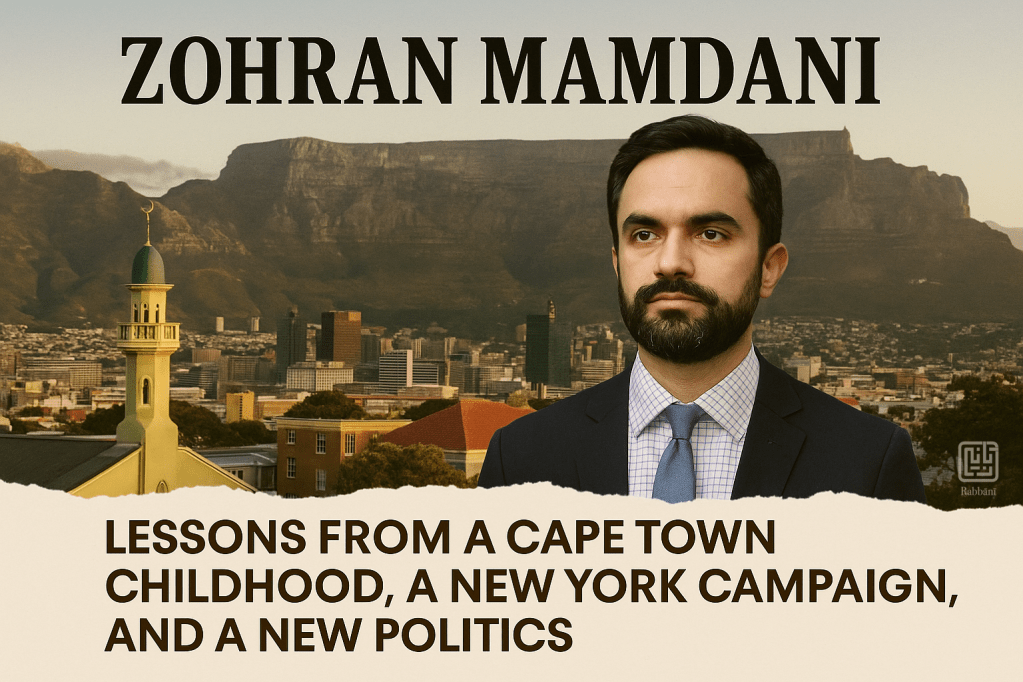
    Zohran Mamdani: Lessons from a Cape Town Childhood, a New York Campaign, and a New Politics

    Zohran Mamdani: Lessons from a Cape Town Childhood, a New York Campaign, and a New Politics

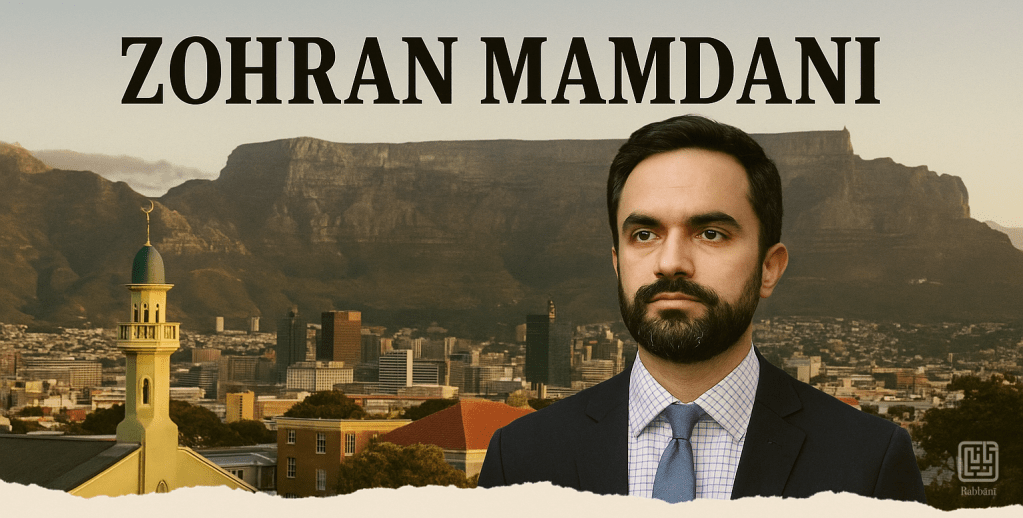
    On a windy June morning in Johannesburg, I opened my social media feed and was stunned to see the name “Zohran Mamdani” trending across platforms. Not because I didn’t know the name — but because I did, even if distantly. In the early 1990s, Zohran was a child in Cape Town, attending Saturday morning madrasa classes at the Claremont Main Road Mosque, a place deeply associated with the progressive Islamic movement of the time. His father, Professor Mahmood Mamdani, was already a towering intellectual figure in the post-apartheid ferment. I had been working at the National Language Project (NLP) then, and many of us — including colleagues like Gerda de Klerk — were connected to those circles of progressive faith, education, and social justice. Our paths may well have crossed with young Zohran, though it feels remarkable to see this child of that moment now emerge as the Democratic front-runner for mayor of New York City.

    As news of Zohran’s decisive victory spread — defeating establishment heavyweight Andrew Cuomo in the Democratic mayoral primary — friends from various corners of the globe began connecting the dots. A remarkable arc had come full circle: from Cape Town’s progressive mosques and language movements to the heart of one of the most complex urban political landscapes in the world.

    From Claremont to Queens: A Political Formation

    Zohran Mamdani’s victory didn’t emerge out of nowhere. It was cultivated in spaces that taught young people not to separate faith from justice, identity from compassion. The Claremont Main Road Mosque (CMRM), where Zohran received early Islamic education, has long been known as a place of inclusive, activist theology — led in those years by figures like Imam Dr. Rashied Omar and strongly shaped by South Africa’s anti-apartheid Islamic ethos.

    The family home was no less intellectually fertile. His father, Mahmood Mamdani, was not just a visiting scholar — as political analyst Steven Friedman rightly corrected on my Facebook post — but a full professor who directed a research institute at the University of Cape Town. Mahmood’s own writing — from Citizen and Subject to Neither Settler Nor Native — shaped global debates on colonialism, identity, and resistance (Scroll.in, 2025). His mother, Mira Nair, is an acclaimed filmmaker whose work explores the intersections of class, gender, memory, and post-colonial identity.

    Together, this upbringing embedded in Zohran an ethos of critical clarity and pluralist compassion — two virtues that would later characterise his campaign and its stunning success.

    Beyond the Soundbites: A Platform with Substance

    Media coverage has often portrayed Mamdani’s win as the result of digital mastery — an “influencer politician” who went viral. But as tech journalist Taylor Lorenz argues in her sharp critique, this reading is both shallow and dismissive. “He didn’t win because of TikTok or podcasts,” she writes. “He won because he was a generational political talent backed by years of disciplined organising.”

    Mamdani’s platform includes a $30/hour minimum wage by 2030, fare-free public buses, rent freezes, city-owned grocery stores, and universal childcare — funded through wealth and corporate taxes. These are not trendy slogans; they are deeply-researched, locally-grounded policy ideas forged in dialogue with tenants, cab drivers, community imams, and working-class coalitions.

    Indeed, the campaign’s integrity was evident in its structure: 27,000 volunteers, small-donor funding (average donation: $35), and widespread multilingual outreach that included Arabic, Bangla, Spanish, Urdu, and Fulani speakers. In an interview with The Fatu Network, Gambian-American organiser AjiFanta Marenah noted how Mamdani met with imams and elders from West Africa at Masjid Ar Rahmah — a mosque still grieving a devastating fire. Her words were telling: “This was not just outreach. He listened.

    A Movement Rooted in Memory and Meaning

    Mamdani’s win has been framed as a generational and demographic shift — and rightly so. At 33, he is poised to become the youngest mayor in NYC history. But this is not just about age. It is about political imagination.

    As writer Rachel Hurley observes: “He didn’t water down his vision. He spoke clearly — about Palestine, about police brutality, about inequality.” While some accused him of being too radical, others — including thousands of voters under 35 and nearly 80% of Asian-American voters in ranked-choice simulations — saw in him the first candidate in years who actually named their pain and offered structural responses.

    Importantly, he did not shy away from moral clarity. Whether affirming his support for BDS, resisting pressure to co-sign Holocaust memorial resolutions weaponized to silence Palestinian solidarity, or responding to racist attacks with unwavering calm, Mamdani refused to dilute his politics to appease critics.

    In this, one senses echoes of his father’s legacy — a fierce critic of authoritarianism whether in Uganda or the United States — and his mother’s poetic instinct to preserve human dignity through narrative.

    What This Means for South Africa and the Global South

    In a time when centrist parties are increasingly detached from grassroots movements, Mamdani’s campaign offers not just hope but a methodology for how to bridge that divide. The lessons are not only for American Democrats, as Rebecca Kirszner Katz argues in her New York Times piece — they are relevant for South Africa too.

    We, too, are grappling with the limits of post-liberation politics, the alienation of youth, and the search for a new language of ethics in the public square. Mamdani’s win reminds us that political change doesn’t only come through electoral machines. It can be built — step by step — through community relationships, principled clarity, and a refusal to play by the rules of elite consensus.

    His campaign did not begin with polling data or PR consultants. It began with people — Bronx tenants, Queens families, Harlem students, mosque elders. As Felix Biederman noted, “He never dumbed things down into meaninglessness.”

    Of course, Mamdani isn’t mayor yet; he still faces the general election in November. But his endorsement by former New York City Comptroller Brad Lander, and their warm joint appearance on The Late Show With Stephen Colbert, offered a powerful reminder of the long tradition of Muslim–Jewish solidarity. It echoed the interfaith alliances that shaped our own struggles against apartheid here in South Africa, affirming that courage and conscience can cross boundaries.

    As Robert Reich noted, Mamdani is “the corporate Democrat’s biggest nightmare” — precisely because he dares to center affordability, class solidarity, and moral clarity. Yet he is equally a supremacist’s nightmare, as Alon Mizrahi argued, because he is “a Muslim Normal”: calm, compassionate, politically lucid, refusing every easy stereotype. That double challenge — to both neoliberal machines and racialized fear — is what makes his rise so potent.

    Reclaiming the Power to Dream Together

    In the end, Zohran Mamdani’s rise is not just a story of one man’s success. It is the story of what becomes possible when movements — and memories — are nurtured with integrity. From Cape Town’s madrasa halls to New York’s subway stops, the values of mercy, justice, and collective dignity continue to ripple outward.

    In a time of fragmentation, Mamdani’s clarity invites us to build differently. To listen deeper. To organise not just against oppression, but toward belonging. And to believe, again, that cities — and hearts — can be won with vision.

    References:

    • Hurley, Rachel. Zohran Mamdani’s NYC Primary Win Is a Huge Lesson for Dems. RatCClips, June 25, 2025.
    • Lorenz, Taylor. Zohran Did Not Win Because of TikTok and Podcasts. UserMag, June 25, 2025.
    • Katz, Rebecca Kirszner. Democratic Leaders Tried to Crush Zohran Mamdani. They Should Have Been Taking Notes. New York Times, June 25, 2025.
    • Daily Maverick. Meet New York City’s Likely Next Mayor — with a South African Connection. June 25, 2025.
    • The Fatu Network. Introducing the Young Woman Behind Zohran Mamdani’s Shout-Out to His Gambian Uncles. June 26, 2025.
    • Reich, Robert. The Corporate Democrat’s Biggest Nightmare. Substack, June 26, 2025.
    • Mizrahi, Alon. They Don’t Hate Mamdani Because He’s a Muslim Radical. They Hate Him Because He’s a Muslim Normal. June 27, 2025.
    • Times of India. Zohran Mamdani: The Bronx Student Who Made Africana Studies His Political Compass. June 2025.
    • The Late Show with Stephen Colbert, featuring Zohran Mamdani and Brad Lander, June 2025.
    • Scroll.in. Seven Books by Ugandan Scholar Mahmood Mamdani, Father of NYC Mayoral Candidate Zohran Mamdani. June 25, 2025.

    If there is one truth I carry from writing this piece, it is that our stories are never just local, never just our own. They travel, they weave through other struggles, they bloom in places we may never see. Zohran Mamdani’s path reminds me — and perhaps reminds us all — that faith, courage, and community can plant seeds far beyond our imagining. In my own Rabbānī scrolls and design work, I have tried to hold on to that same ethic: to remember, to witness, and to keep building. May we all keep planting, keep walking, and keep creating together.

  • Hy Lyk Soos ’n Wolf: The Sorbaan and the Teacher Who Raised Me

    Hy Lyk Soos ’n Wolf: The Sorbaan and the Teacher Who Raised Me

    Allah is Sublime.

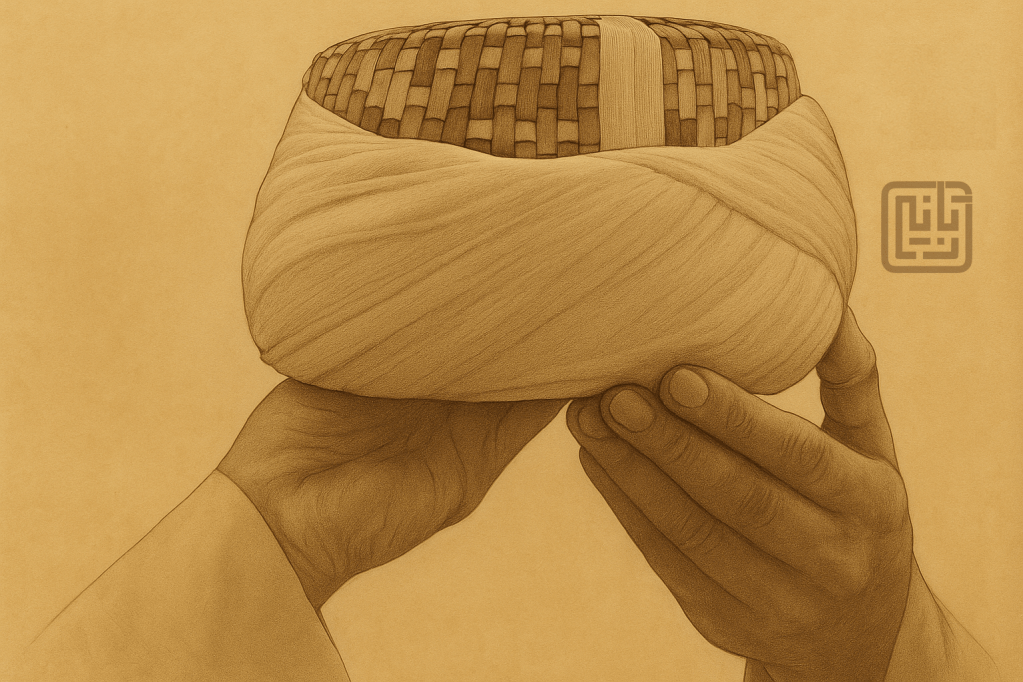
    The other day, I told my brother-in-law, Al-Ameen, how we need to promote the sorbaan again—that sacred cloth of knowledge and dignity that once crowned the heads of our teachers and storytellers. Without missing a beat, he said, “Do you want one? I’ll give you mine.”

    I was taken aback. “Really? Don’t you wear it?”

    He smiled. “It’s too garish for my style.”

    Then he added, almost casually, “It’s from my dad. From Boeta Junain.”

    And suddenly, I was no longer standing in conversation. I was nine years old again, my hand tucked in my mother’s, walking down Olifants Street in Primrose Park. We were on our way to meet my new khalifa.

    My mother, Hi’ Rugaya, had decided it was time for me to learn Qur’an properly. We walked all the way down the road, right to the edge where Primrose Park brushes up against Manenberg. That place where the road thins out, where the houses change tone.

    We met him at the doorway. Tall. Stern. A presence.

    On the way back, she asked me gently, “So what do you think?”

    I paused, looked up at her, and said with wide eyes, “Met sy grou oë en grys baard, hy lyk soos ’n wolf.” (With his gray eyes and silvery beard, he looks like a wolf.)

    She laughed. But we went back the next day. And the next. And the next.

    Boeta Junain became my khalifa — more than just a madrasa teacher. He taught me the Qur’an. He taught me tauhidtahara, and how to perfect my salah. But most of all, he taught me the stories. Hundreds of them. Stories of the awliya, of lovers of God, of hidden saints, of miracles wrapped in humility.

    He loved me like a son. I stayed in his madrasa well into high school. When I was seventeen, I left to study at As-Salaam Institute in Braemar, KwaZulu-Natal. There I met another teacher who helped refine my Qur’anic pronunciation. A year later, after completing matric, I came back.

    And I returned to Boeta Junain.

    He asked me to recite. Listened deeply. Then called his older students, saying, “Come. Let Adli help you improve your recitation.”

    That day I knew what tarbiyah meant: to be raised, then trusted, then made to raise others.

    Some of those students, like members of the Browns family, went on to become among South Africa’s well-known huffaadh.

    And now, all these years later, his sorbaan has surfaced again—offered from father to son, and from brother to brother. A gift wrapped not only in cloth, but in memory.

    Today, three of his children, Salama, Cassiem and Juleiga are now continuing this legacy teaching young children in Qur’an and Islam.

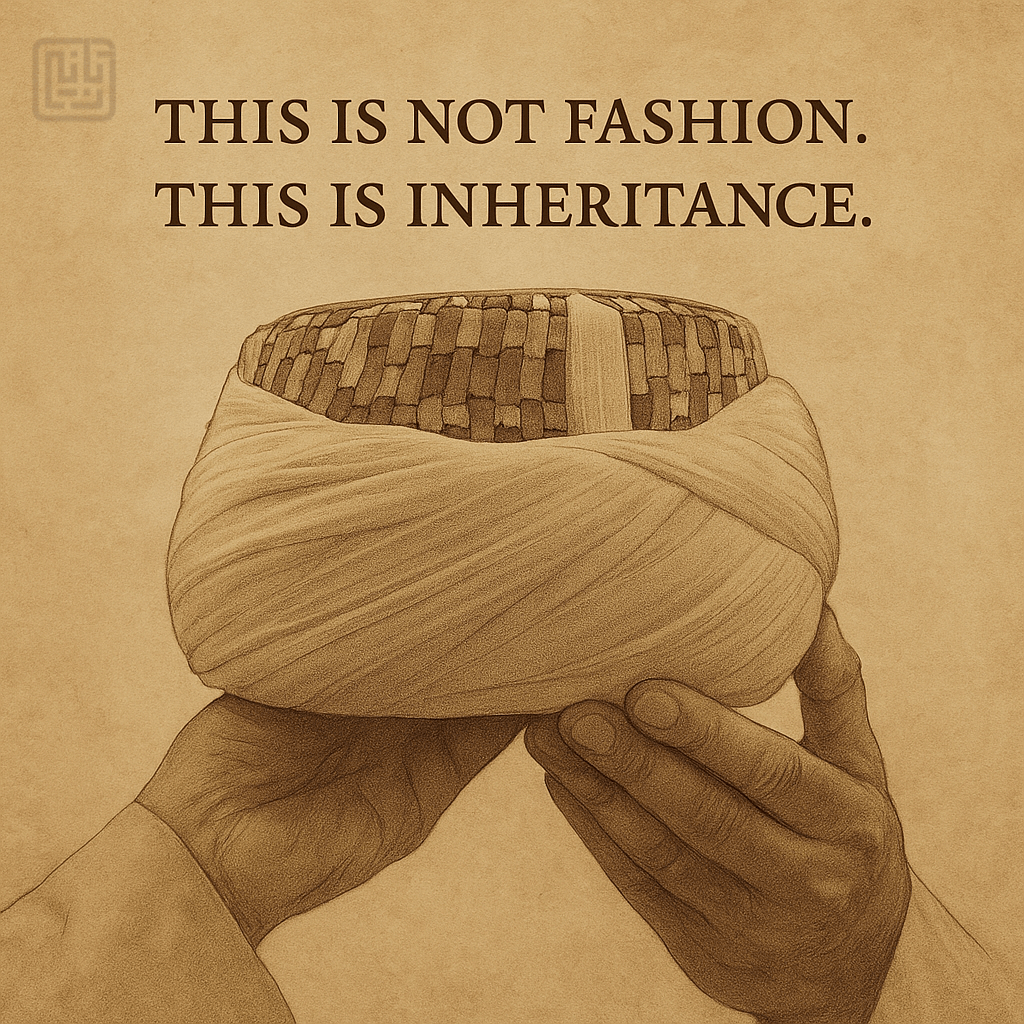
    The sorbaan is not fashion. It is not costume. It is voice made visible.

    It is the texture of trust. The curve of tradition.

    It says: I have received. I have remembered. I will return.

    When I look at it now, even in another’s hands, I see something eternal: gold thread, cotton wrap, and the quiet humility of a teacher who looked like a wolf, but raised a whole den of cubs.

    Acknowledgement
    Tramakasi to Sh. Jamiel Abrahams, Sadia Fakier, Zaid Nordien, and Al-Ameen Marley — for helping carry this cloth of memory into the light.

    Postscript
    If Al-Ameen does send me the photo of the original sorbaan, I will share it. But even now, the memory is vivid enough to wear.