
Between Distance and Closeness
Walking the Path of Al-Fātiḥah
[Pic: Muavia Gallie]
Surah Al-Fātiḥah, the Opening Chapter of the Quran, holds profound significance in Islamic practice. It serves as a fundamental prayer for guidance and mercy, recited in every unit of Muslim ritual prayer (ṣalāh). Known as the Mother of the Book, Al-Fātiḥa is essential for the validity of prayers, underscoring its central role in worship and belief. This is why it is also referred to as the Seven Oft-Repeated Verses.
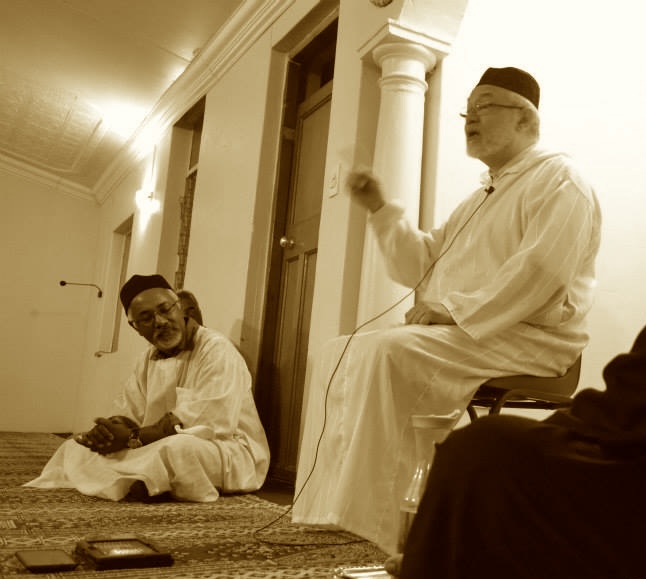
When I recite Al-Fātiḥah during my ritual prayers, I strive to focus meditatively on these seven verses. I recall an enlightening moment at a mosque in Johannesburg, Florida, where the late Shaykh Seraj Hendricks (may Allah’s mercy be upon him) shared a profound framework of the Quran. Drawing upon Al-Ghazali’s Mishkāt al-Anwār (The Niche of Lights), Sh. Seraj explained the duality of what is distant and what is near in the Quran.
In Al-Fātiḥah, the first four verses describe Allah in the third person:
- In the Name of Allah, the Entirely Merciful, the Especially Compassionate;
- Lord of all the worlds;
- The Entirely Merciful, the Especially Compassionate;
- Sovereign of the Day of Judgment.
These verses portray Allah The Sublime as transcendent and distant, beyond the cosmos. In contrast, the last three verses shift to a direct, intimate tone, addressing Allah in the first person:
- You alone we worship, and You alone we ask for help;
- Guide us on the Straight Path;
- The path of those You have blessed, not of those who have incurred Your wrath or gone astray.
This shift emphasises Allah’s closeness, inviting a direct connection between the worshipper and the Divine.
This interplay of distance and nearness is a recurring theme in the Quran. Across 222 verses, references to the heavens and the earth metaphorically depict this duality. Heavens often symbolise the vast, cosmic, or intellectual realm, while earth signifies human, emotional, and spiritual proximity. In another sense, the heavens represent the mind—distant and analytical—while the earth represents the heart, intimately connected to spirituality.
Sh. Seraj also emphasised that these verses subtly address humanity’s role as vicegerents or stewards of God—khilāfatullah—and also as subordinated of God—ʿabdullah—in the universe and on earth. As Allah’s representatives, we are called to balance confidence with humility, leadership with servitude, and authority with submission in worship. This dual responsibility reminds us to rule with justice and compassion, always grounded in our devotion to and reliance on the Divine.
Focusing on Al-Fātiḥah: A Personal Practice
With this understanding, I now recite Al-Fātiḥah with a mindful dedication to different aspects of my being. Each verse resonates with a part of my body, mind, or soul:
- Bismillāhir Raḥmānir Raḥīm (In the Name of Allah, the Entirely Merciful, the Especially Compassionate)—dedicated to the right hemisphere of my brain, the seat of creativity and emotion.
- Al-Ḥamdu li-Llāhi Rabbi l-ʿĀlamīn (Praise be to Allah, Lord of all the worlds)—dedicated to my frontal lobe, responsible for reasoning and judgment.
- Ar-Raḥmānir Raḥīm (The Entirely Merciful, the Especially Compassionate)—dedicated to the left hemisphere, where logic and analytical thinking reside.
- Māliki Yawmid-Dīn (Sovereign of the Day of Judgment)—dedicated to the cerebellum, which governs balance and coordination.
For the remaining verses, I turn to my heart:
- Iyyāka Naʿbudu wa-Iyyāka Nastaʿīn (You alone we worship, and You alone we ask for help)—dedicated to the heart’s ventricles.
- Ihdinaṣ-Ṣirāṭal-Mustaqīm (Guide us on the Straight Path)—dedicated to the central core of the heart.
- Ṣirāṭalladhīna Anʿamta ʿAlayhim Ghayri l-Maghḍūbi ʿAlayhim wa-Laḍ-Ḍāllīn (The path of those You have blessed, not those who incurred Your wrath or went astray)—dedicated to the atria of the heart.
As I complete the recitation, I feel that Al-Fātiḥah integrates into my being—mind, body, and soul—lifting me spiritually. Allah Most High affirms this closeness in the Quran, “Indeed, We created humanity and fully know what their souls whisper to them, and We are closer to them than their jugular vein.” (Surah Qaf, 50:16).
The Power of Words in Recitation and Reflection
The act of reciting sacred words, like those of Al-Fātiḥah, carries profound significance. When we call out these words, we are not merely speaking; we are engaging in an act of connection, both with the Divine and with our innermost selves. Recitation transforms the abstract into the tangible, turning thoughts into vibrations that resonate in the air and within our being. In this way, the spoken word becomes a bridge between the physical and the spiritual.
Equally important is the focus we bring to these words. In conversation, our attention to what we speak and how we speak reflects our intent and sincerity. This principle applies even more deeply in prayer, where concentration imbues our words with clarity and purpose. To recite mindlessly is to miss the essence of the act; to recite with focus is to align the body, mind, and soul in devotion.
Contemplating or meditating on certain words allows their meanings to unfold in layers. Words like ar–raḥmān (Entirely Merciful) or ṣirāṭal-mustaqīm (Straight Path) are not static; they expand and deepen with reflection. This process not only enhances our understanding but also transforms our recitation into an ongoing dialogue with the Divine. Contemplation invites us to live these words, allowing them to shape our actions and our being.
By calling out, focusing, and meditating on sacred words, we move beyond rote recitation into the realm of lived experience. This is where the power of Al-Fātiḥah truly lies—not just in its recitation, but in how it becomes a compass for our thoughts, a guide for our actions, and a sanctuary for our hearts.
Al-Fātiḥah is a map and a mirror — a guide that walks with us. Whether spoken aloud, whispered in prayer, or traced silently in our hearts, its light enters every cell that listens.
May our steps be straight.
May our breath be mindful.
May the One who is near, draw nearer still.Ameen.
📚 You may also like…
🔸 Hy Lyk Soos ’n Wolf
A spiritual meditation on instinct, loyalty, and the sound of the heart behind the howl. Some names we inherit. Others we grow into.
🔸 Tamat: A Sacred Completion, A Living Beginning
A reflection on the weaving of remembrance and the sacred knot at the end of a Qur’an khatm — where endings become invocations for return.
🔸 The Womb of Mercy: Unveiling the Secret of Bismillah
Bismillāh as the gateway. A verse that holds a thousand worlds. A name that mothers every beginning.
🎧 Watch the Companion Video
To experience this reflection through voice, image, and sacred sound — watch the short video:
👉 Between Distance and Closeness
(A meditative recitation of Al-Fātiḥah with visual symbolism and breath)
🌿 Final Note
Al-Fātiḥah is not only recited — it is walked, embodied, and remembered.
May each verse carry you closer to the One who is closer than your jugular vein.
 Adli Yacubi
2 responses to “Between Distance and Closeness: Walking the Path of Al-Fātiḥah”
refreshing view, inspiring
LikeLike
Tramakasi, Shanaaz, for calling this reflection “refreshing” and “inspiring.” Between Distance and Closeness: Walking the Path of Al-Fātiḥah tries to name that journey we all take—sometimes near, sometimes far, always searching for openings. Your words remind me that this path of meaning is not walked alone. Grateful for your presence and for every reader who pauses to reflect and respond. May Al-Fātiḥah continue to open doors for all of us, wherever we find ourselves.
LikeLike