Adli Yacubi is a wordsmith of remembrance — blending story, design, and sacred memory. Rooted in Cape Town’s rich heritage and decades of media experience, his work spans poetry, layout, radio, and research.
He authored Punching Above Its Weight: The Story of the Call of Islam, and now curates scrolls of mercy, resistance, and everyday barakah.
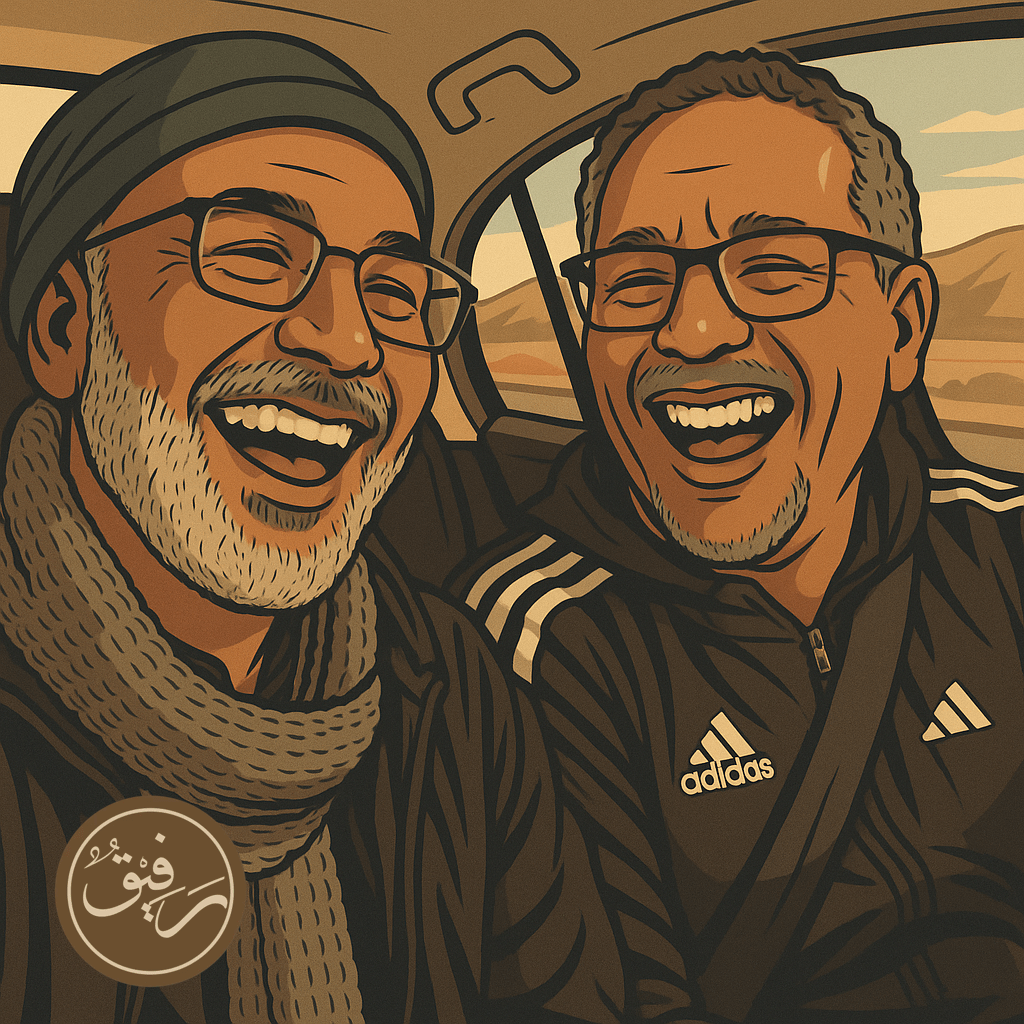
Through the voices of Rabbānī and Rafiq al-Bunduqia, he tells stories where light remembers.
✨ A Door Opens: The Story Behind Rabbānī Creative Studio
There are doors we walk through without noticing, and then there are doors that change the way we see. Rabbānī Creative Studio was one of those doors.
It began as sketches and fragments, growing into a space that felt less like a business and more like a miḥrāb — not just a niche in the wall, but a place to face what matters most. Every design, every word, is a way of turning toward beauty, memory, and meaning.
What We Create
Rabbānī Creative Studio combines the art of storytelling with the craft of design — bringing together history, heritage, and heart in every project. Our work ranges from intimate, single-page scrolls to full-length publications, always rooted in thoughtful aesthetics and cultural resonance.
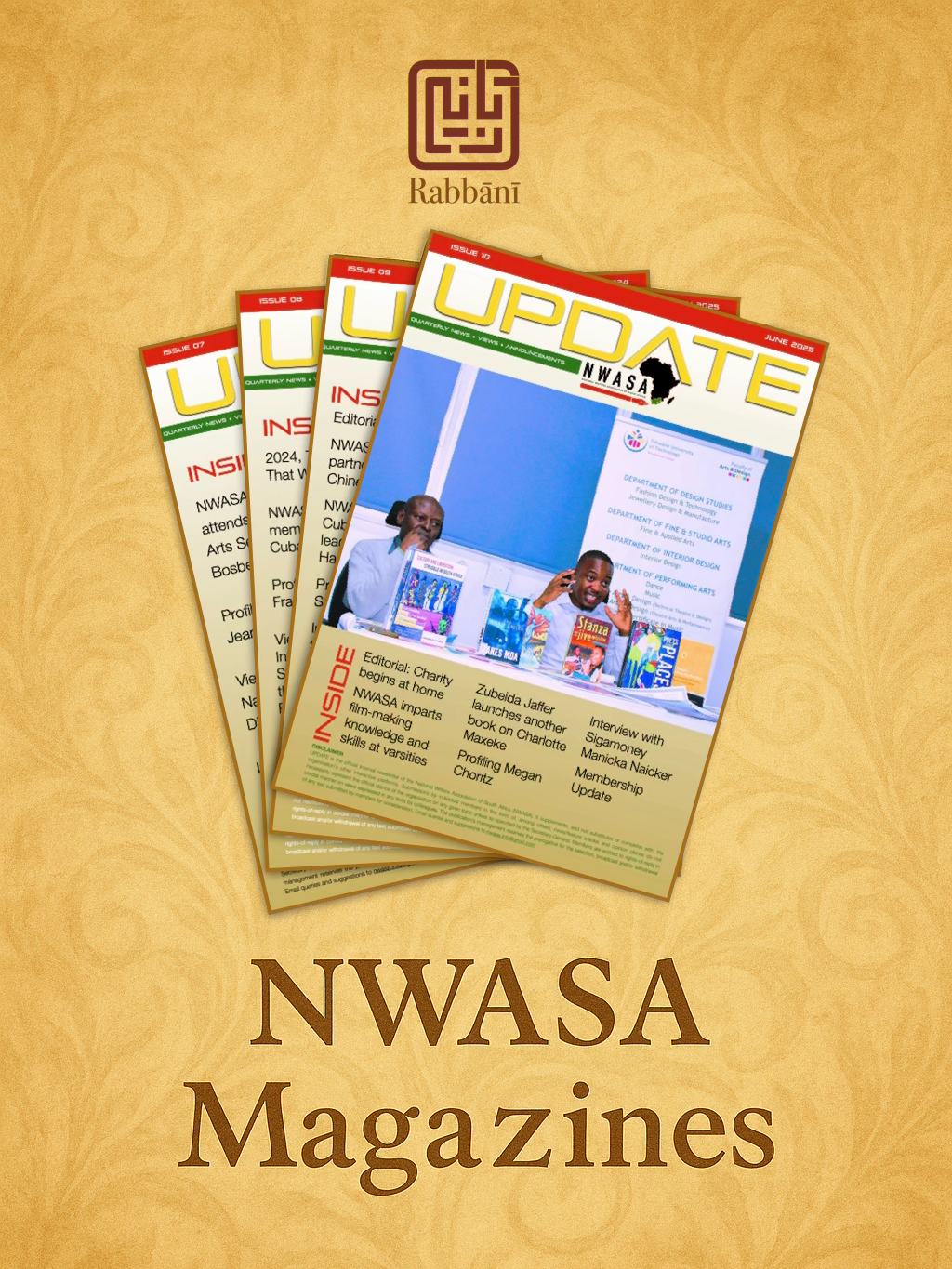
Above: Four recent editions of NWASA Update (Issues 7–10), designed and produced by Rabbānī Creative Studio — from layout to print-ready publication.
1. Magazines & Periodicals
Full-layout design, editorial support, and branding for publications. Example: Four complete editions of NWASA Update (Issues 7–10), from concept to print-ready files.
2. Commemorative Scrolls & Posters
Custom-designed scrolls and posters for milestones — Hajj, weddings, anniversaries, and memorials — blending text, imagery, and heritage motifs.
3. Books & Anthologies
Cover design, interior layout, and thematic visual concepts for poetry collections, historical works, and memoirs.
4. Heritage & Cultural Projects
Visual storytelling and identity work for community heritage initiatives, exhibitions, and cultural campaigns.
5. Branding & Identity
Logos, seals, and visual systems inspired by classical design traditions, adapted for modern digital and print needs.
Our Way of Working
We work slowly when needed, urgently when called for — always with care. Our style blends modern design with heritage textures, drawing on Cape memory, Islamic art, and global traditions.
“What began as sketches and fragments grew into a space that felt less like a business and more like a miḥrāb — a place to face what matters most.”
An Ongoing Invitation
Rabbānī Creative Studio is now a home for creative work that carries a pulse — spiritual, cultural, and human.
It’s for those who believe beauty can be an act of care. It’s for those who want words to live not just on the screen but in the heart.
And it’s an open door.
You’re welcome to step inside.
The Door Is Open
If you would like to:
Commission a unique design
Collaborate on a heritage project
Preserve your story in words and images
… then step inside. Let’s create something that lasts.
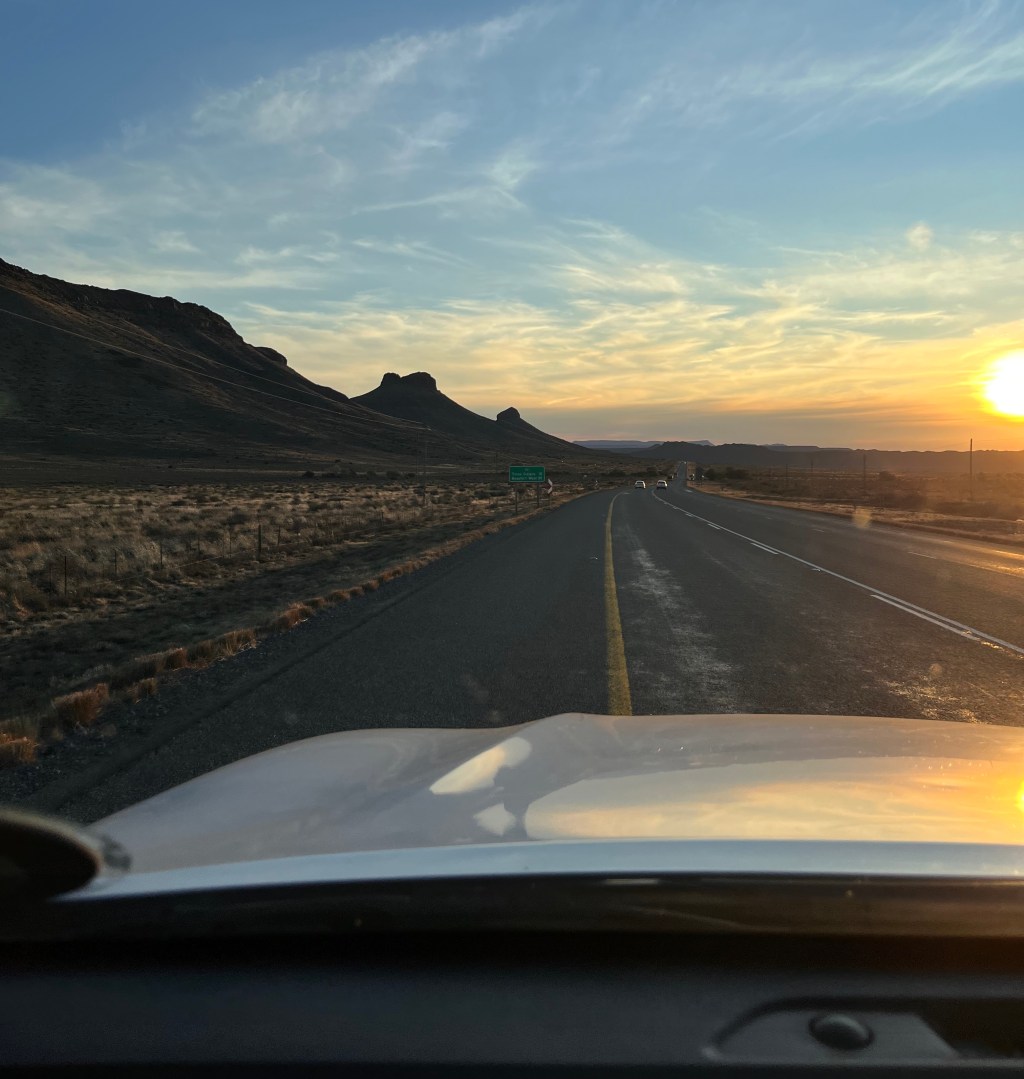
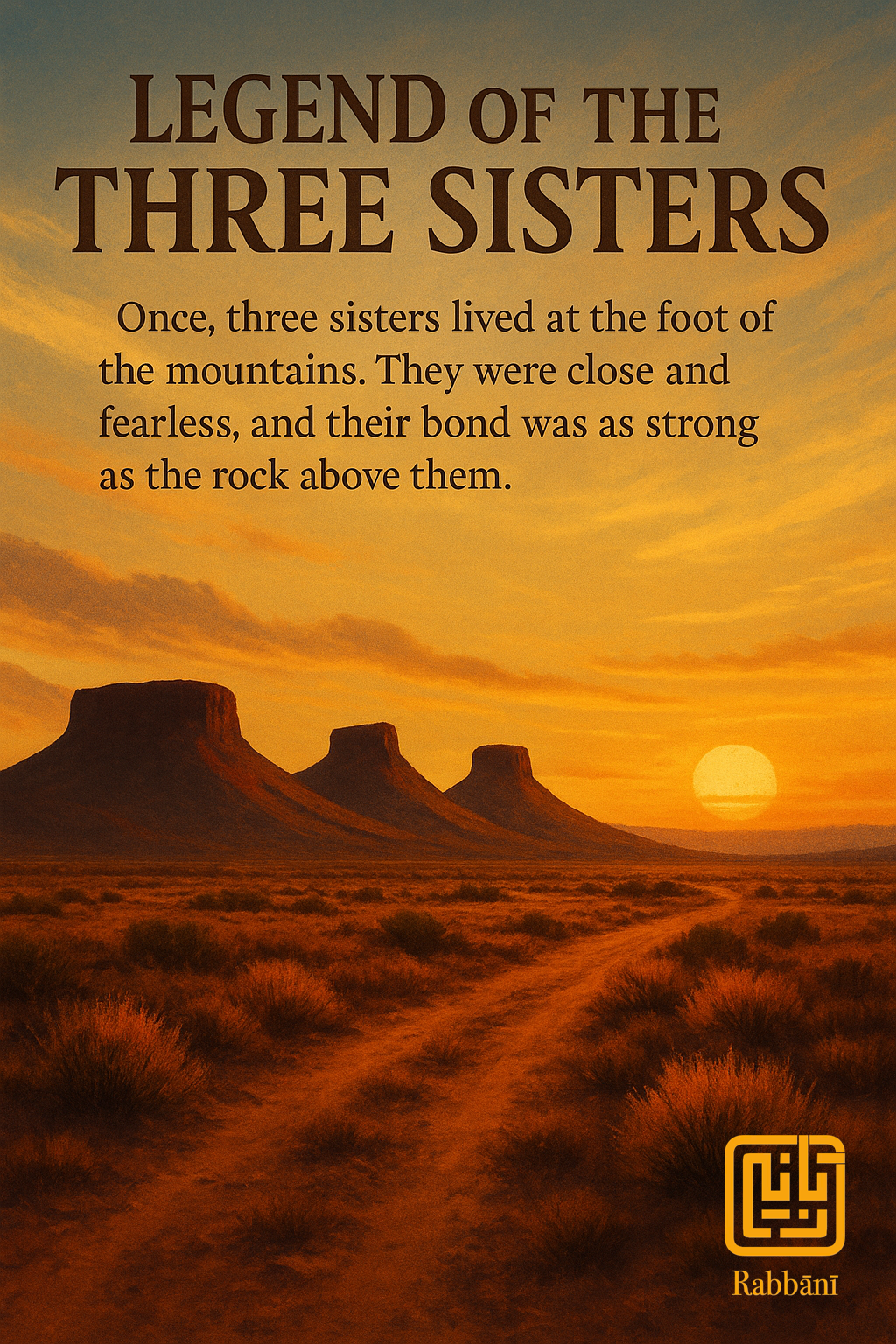
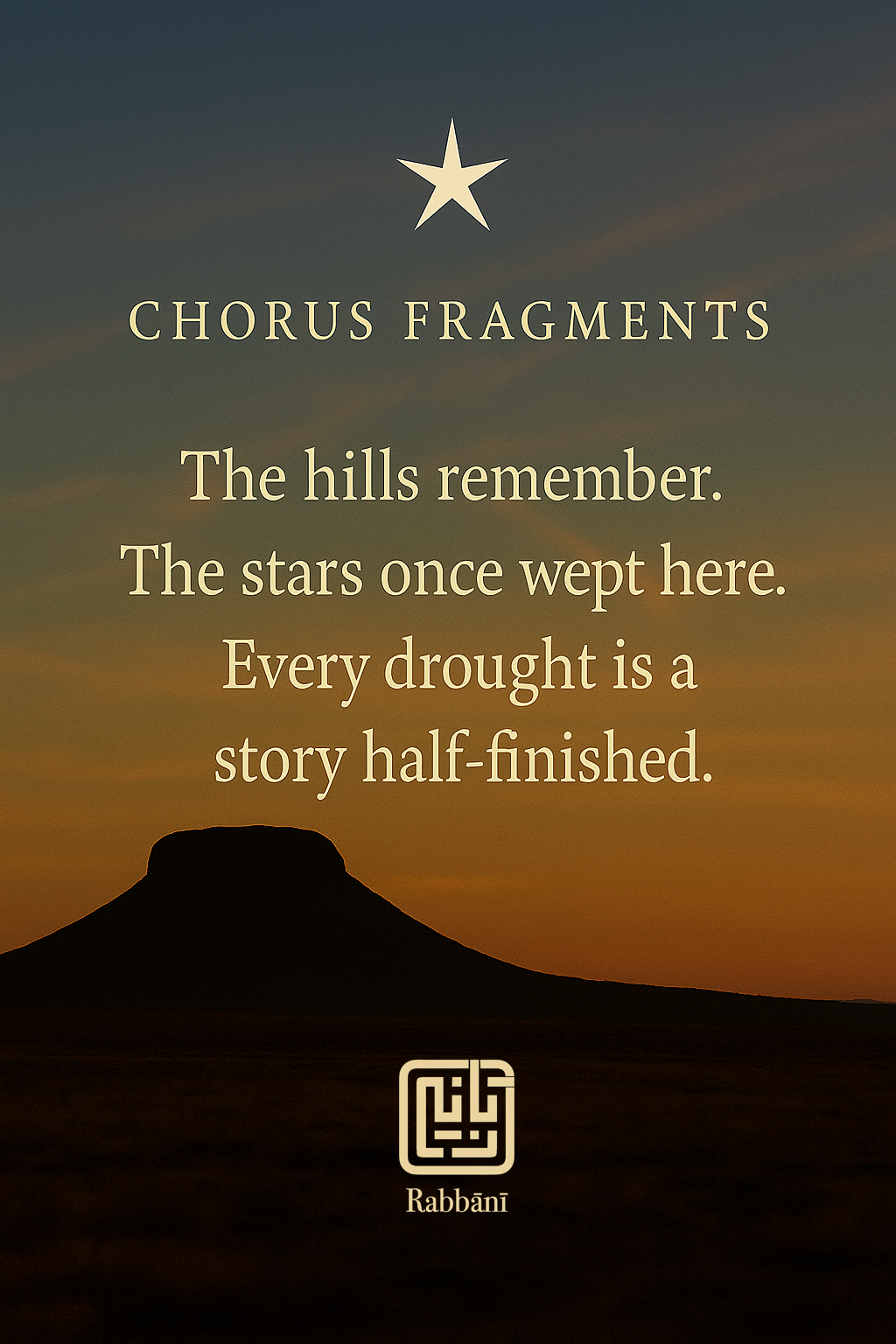
In the heart of the Karoo, between silence and stone, stand three koppies known simply as the Three Sisters. But long before GPS and road signs, they were not just hills. They were memory, myth, and warning. This is their story — reworked, reimagined, and returned to light.
The Legend
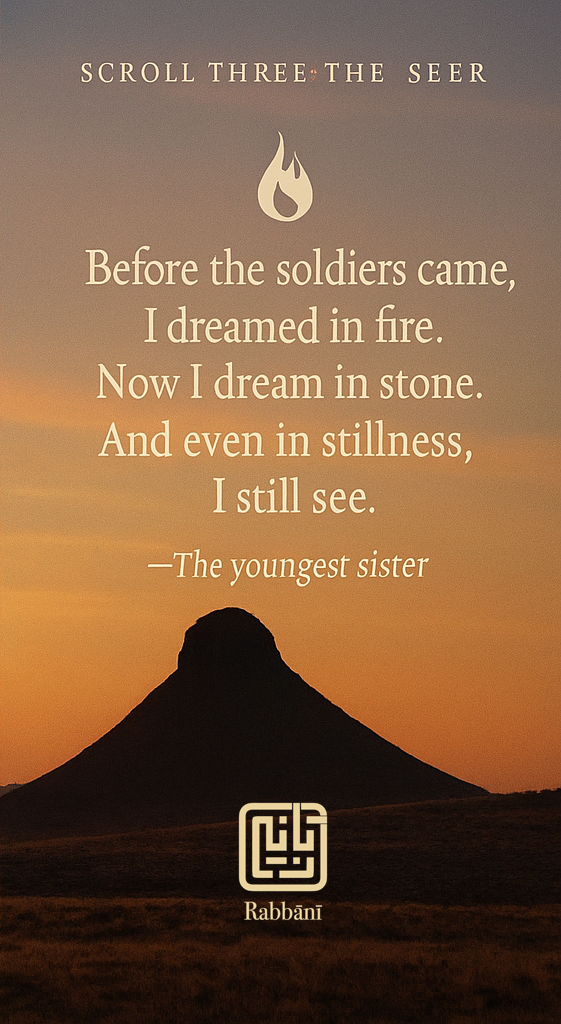
In the time before breath, before bone, before the Karoo knew its name, there were storms. Not of rain, but of voice — wild, furious, generative. From these storms came three daughters of wind and flame.
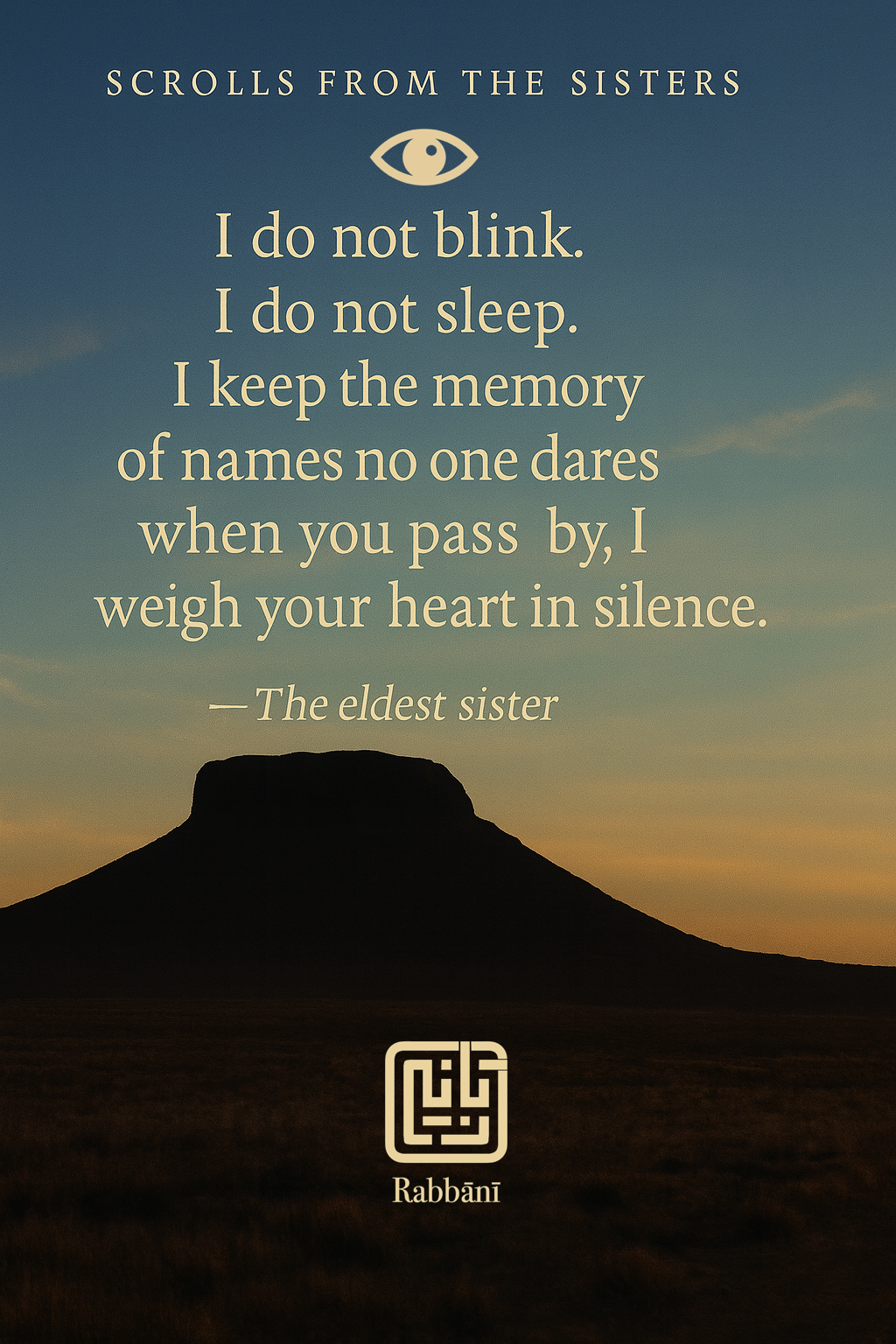
Hurricane was the eldest. She spun slowly, singing in deep spirals, her voice the ocean’s moan. She remembered everything.
Tornado was the dancer. Sharp. Fast. She carved paths through time, her tongue flashing with lightning.
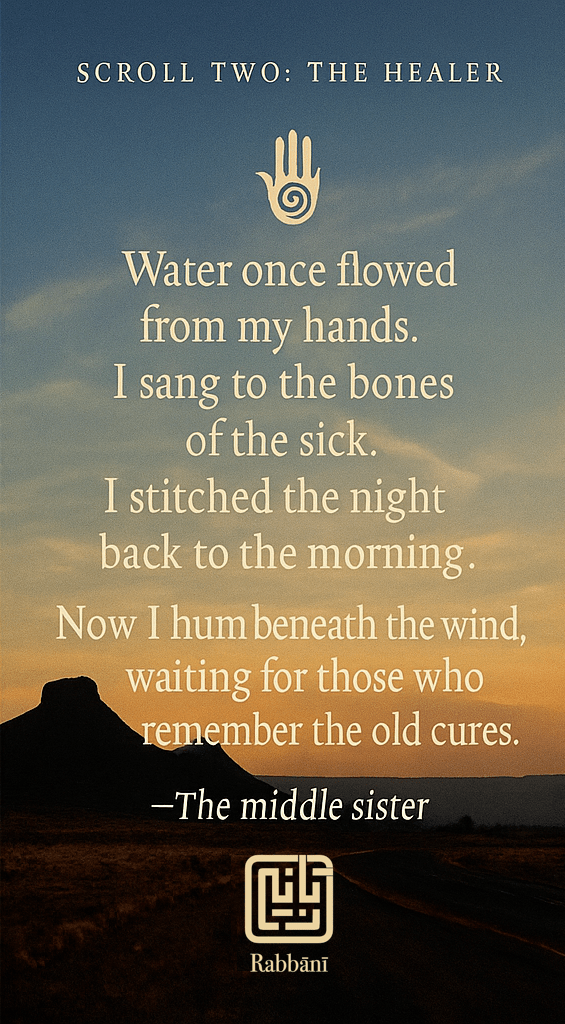
Desert Storm was the dream-weaver. She painted clouds, shifted shapes, left frost on mountaintops and fire in valleys.
One night, a celestial body tore across the sky — a comet called Naariq, the Thirstbreaker. It did not destroy. It wept.
Its tears fell like molten glass, planting seeds that bloomed into crystalline gardens. These gardens sang. They hummed the dreams of stars, mirrored the fears of jackals, held the footsteps of those yet born.
But the land cracked again. And the sisters knew: it was time to become stone.
So they stood, side by side, and let the wind turn them solid. The Karoo opened her chest, and from it rose three ribs — the Three Sisters.
Poems of the Three Sisters
HURRICANE – The Elder, Memory-Keeper
They called her Old Spiral, whose eyes held the sea’s sorrow. She sang in slow thunder, turning grief into guidance. From her lips, the language of whales. From her fingers, the first maps. When she wept, rivers returned. When she stood still, wind found its compass. Memory wrapped her like a shawl. She never forgot the beginning — nor the names of the drowned.
TORNADO – The Wild Dancer, Blade of Time
She moved like a question unasked. A flicker, a flame, a flash in the eye. Children say she could bend time’s neck, turning past into present with one step. She wrote her name on cliff faces, carved warnings into baobab bark. When Naariq came, she was the first to rise. Not to fight — but to dance so fiercely the sky itself split to watch. She whirled until stars blurred — until history collapsed into dust.
DESERT STORM – The Shapeshifter, Dream-Weaver
Cloud painter, frost bringer, the last to speak and the first to vanish. She hid her name in jackal cries, in mirages that teach the thirsty to pray. Her gift was silence that heals. Snow in summer. Rain in song. She once kissed a comet so gently it forgot to burn. And when the sisters turned to stone, it was she who shaped their spines. They say she still walks the salt pans — barefoot, barefoot, barefoot…
2. 🌠 Who (or What) Is Naariq?
Let’s not make Naariq a flat villain. Let’s make him:
A cosmic disruptor, yes — but also a catalyst.
A comet not sent to destroy, but to test the world’s memory.
He weeps. He plants crystal seeds. But his very arrival unravels time, thirst, and story.
Naariq, the Thirstbreaker
Not enemy. Not saviour. A comet born of forgotten prayers. He wept not because he was sad — but because he remembered water. Where he passed, memory frayed. Desire bloomed like wildfire. He brought seeds of crystalline dream — and the sisters, too strong to fall for gold, chose stone instead.
The Vanishing
When Naariq came — streaking across the Karoo sky like a blade of thirst — the world stilled. People ran. Wells dried. Time folded.
But the sisters did not flee.
They stood in silence, facing the comet’s weeping light. They did not strike, nor speak.
They absorbed him.
His heat. His ache. His longing. His memory of galaxies.
And when the light faded, there were no bodies left. Only three dark hills, humming softly at dusk.
That is why the koppies sing. Because they carry Naariq inside them. Because silence is the only song strong enough to hold fire.
The Return
A child stands at the foot of the middle hill. She thinks she hears thunder. But there are no clouds. Only wind. And her grandmother’s voice returning in the rustle of dry grass…
Closing Reflection
Today, travellers speed past on the N1, barely glancing. But those who pause — those who walk into the wind — may still hear the Sisters speak.
Author’s Note
This is one of many Cape myths whispered through stone and silence. As part of the Rafiq al-Bunduqia & Rabbānī scrolls, I offer it not as a fixed legend, but as a companion to your own remembering.
Before Three Sisters: A Road Interrupted, A Heart Opened
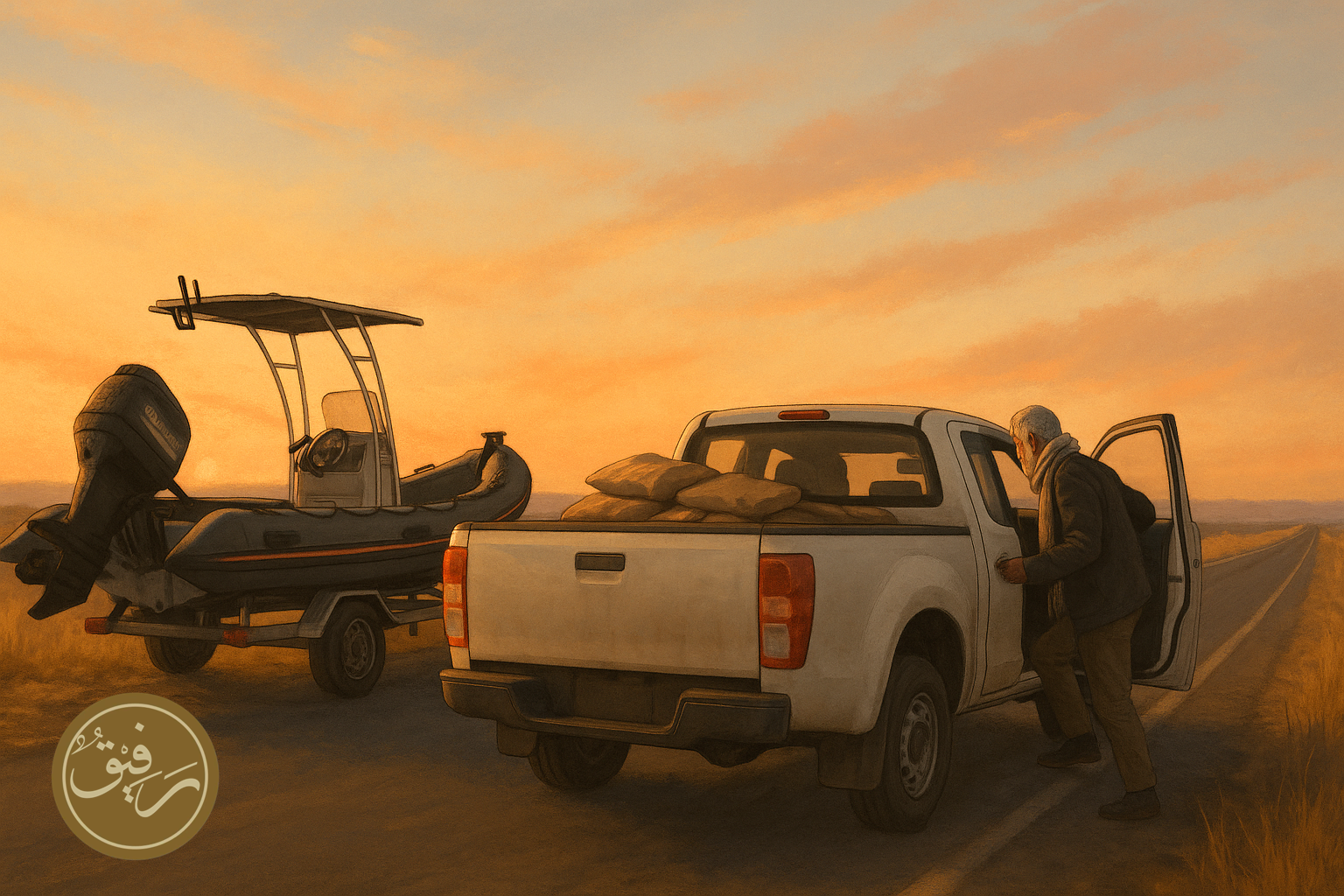
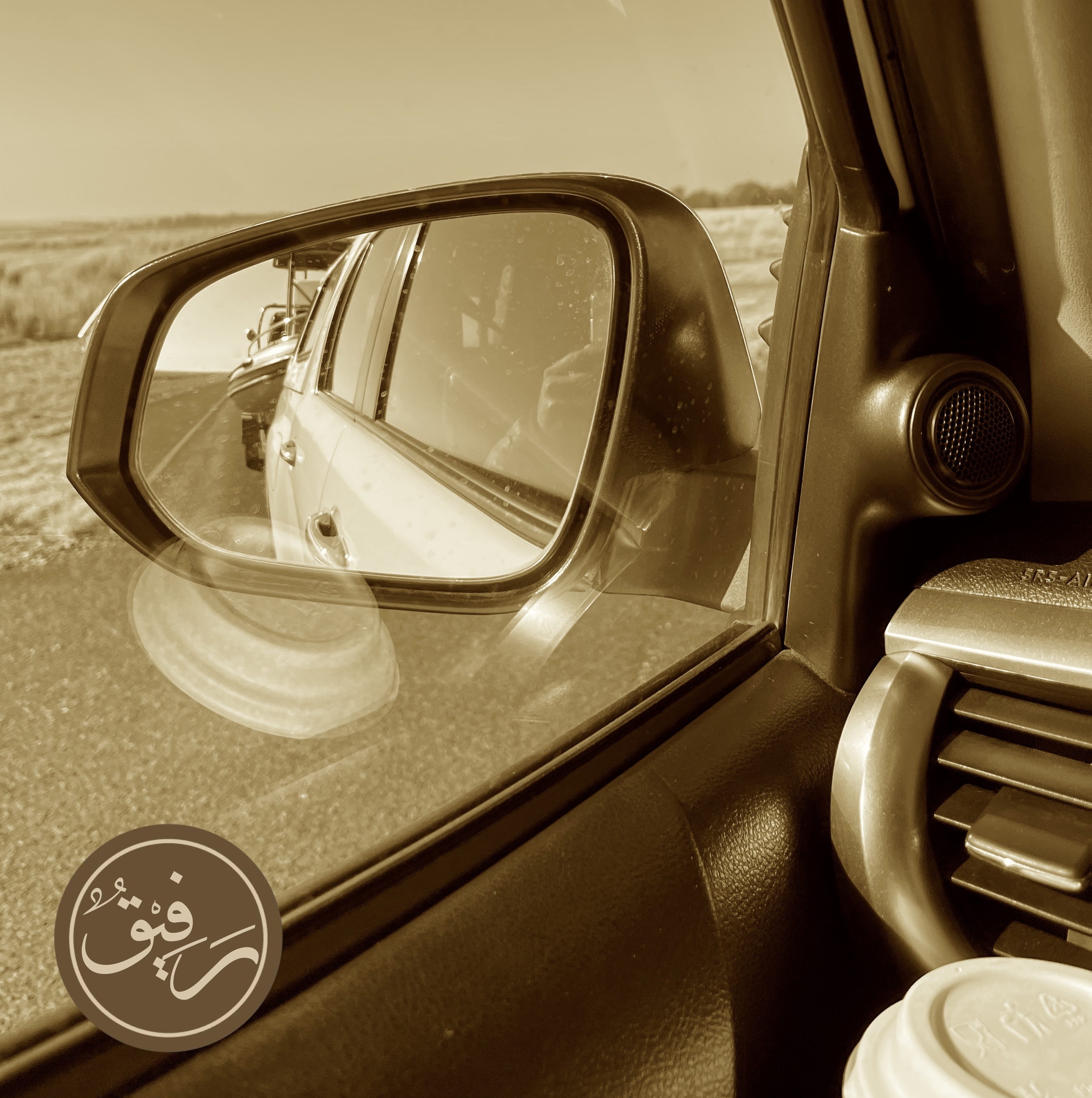
We left Johannesburg in the early light, bound for Worcester — a journey that would return me not only to a familiar valley, but to a story still unfolding. I climbed into Deem’s bakkie at 6:20am. The air was still soft with sleep, but the weight we carried was real — a dinghy boat hitched behind us, and cement bags packed into the back to balance the load. Deem was heading to the Cape for another transport run, as he often did — ferrying cars, boats, bakkies, golf carts, whatever needed moving.
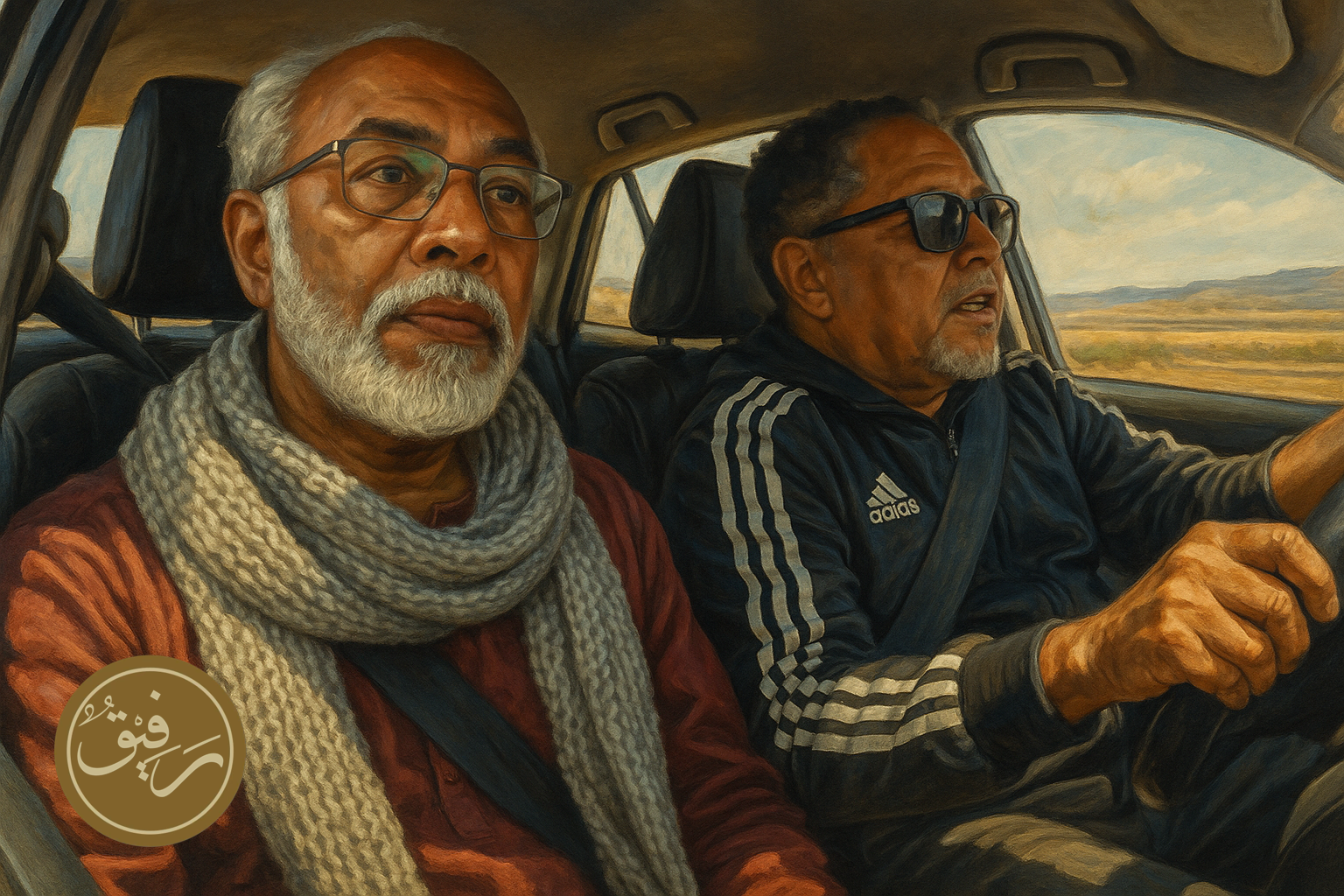
He kept it steady, slow — 80 to 90 km/h. The road hummed low. We started talking.
Mostly about our children.
His sons, his daughter. Now grown. Their paths, their beliefs, the choices they were making in a complicated world.
“I worry, bru,” he said. “About their Islam… their qibla.”
I nodded. And gently shared my own truth:
“We’ve already planted the seeds, Deem. Madrasa, school, life. The goodness is wired in. They’ll find their way to the Divine — maybe not how we imagined, but still. They’ll find it.”
We sat in that silence — the kind that listens.
Faried and the Detour
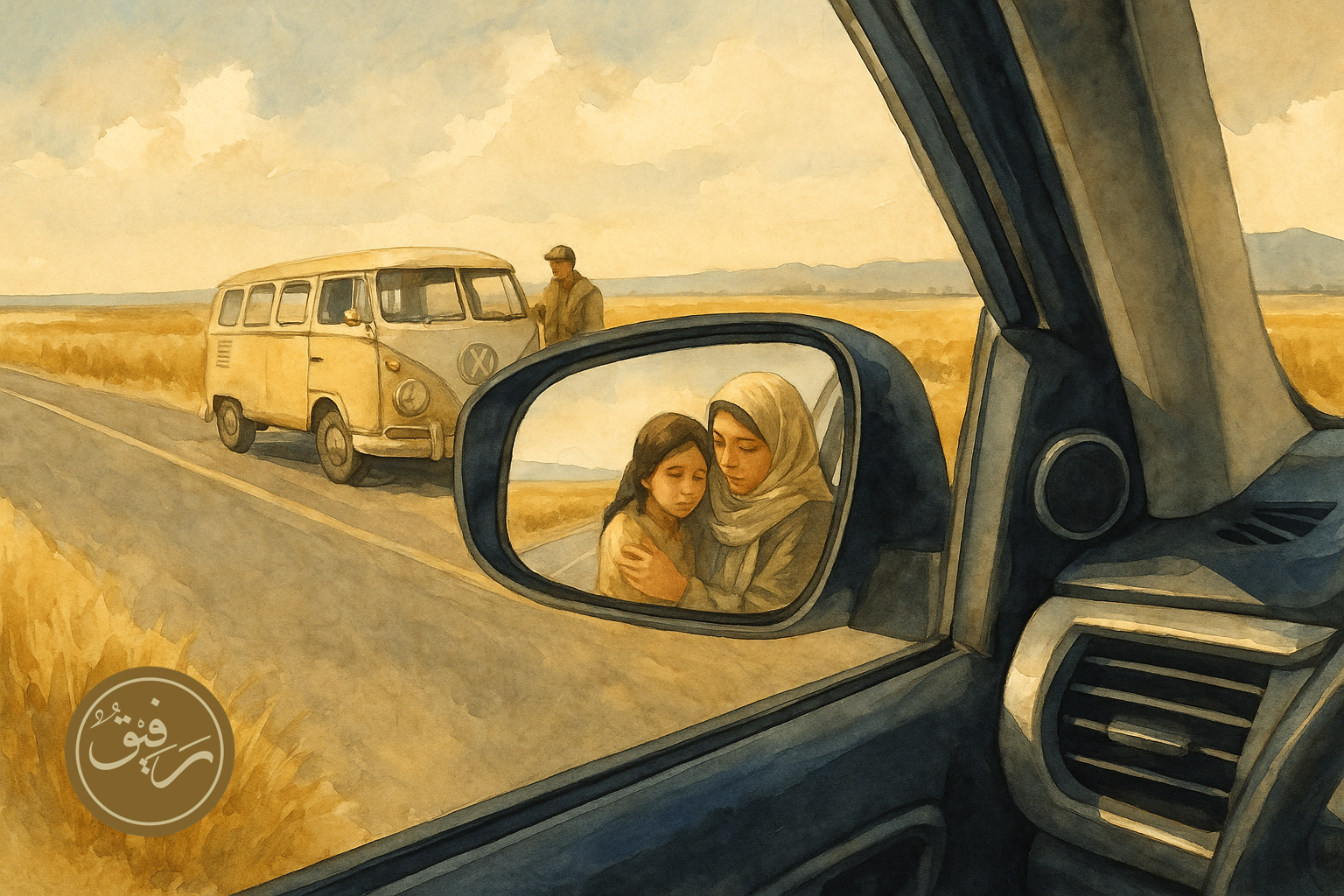
Just before Three Sisters, Deem got a message. A friend of his, Faried, had broken down with his family. We rerouted.
And just like that, our quiet bakkie became a car of five — Faried, his wife, and their daughter now in the back seat. I stayed quiet. This wasn’t my space to speak.
But something had shifted. The stillness that had carried us through the early part of the journey made way for the unexpected warmth of company, for laughter, for memory. What had begun as a private ride between two companions was now a shared passage — a reminder that some roads widen not with tar, but with presence.
The wife was chatty, warm, full of stories. She and Deem started talking about Deem’s drivers. One in particular: Archie.
“Archie’s solid,” she said. “Kaaps, maar sharp. Always shows up.”
A few kilometres down the line, just past Beaufort West, almost in Worcester, Deem turned to me and asked:
“You know what Archie’s real name is?”
I smiled.
“My eldest brother — Allah yarhamu — was Fuad. But everyone called him Archie. So… is he also Fuad?”
Deem laughed.
“Nai bru… his real name is Abdul Qahhar.”
We both burst out.
“Qahharjie becomes Archie! Allah!”
The Bend in the Road
The road narrowed into the Hexrivier Valley. Dark by then. But not empty. The headlights caught a curve.
“You see that corner?” Deem said.
And then he told me:
His father — Omar, also known as Amie, known to my kids as Dada — once took that very bend too fast. Racing from farm to farm, moving fish, goods, deals. He missed the turn. His bakkie flew into the river. He survived. And fished out his own worker, too.
“I was a laaitie then,” Deem said. “But every time I pass this spot, I remember. Dada was tough. A real survivor.”
I stayed quiet. Because what do you say when the road opens memory like that?
To Worcester, With Love
And then, as the road opened wider and the mountains made way for valleys known in name and marriage, I found myself returning not just to a place — but to the people and stories who made that place feel like mine.
Worcester wasn’t just a destination. It was memory incarnate.
When I married Sadia, I stepped into her family’s legacy — the Fakiers and the Majieds. Worcester was theirs. Her childhood. Her community. Later, her battleground — she became a unionist, fighting for dignity across these valleys.
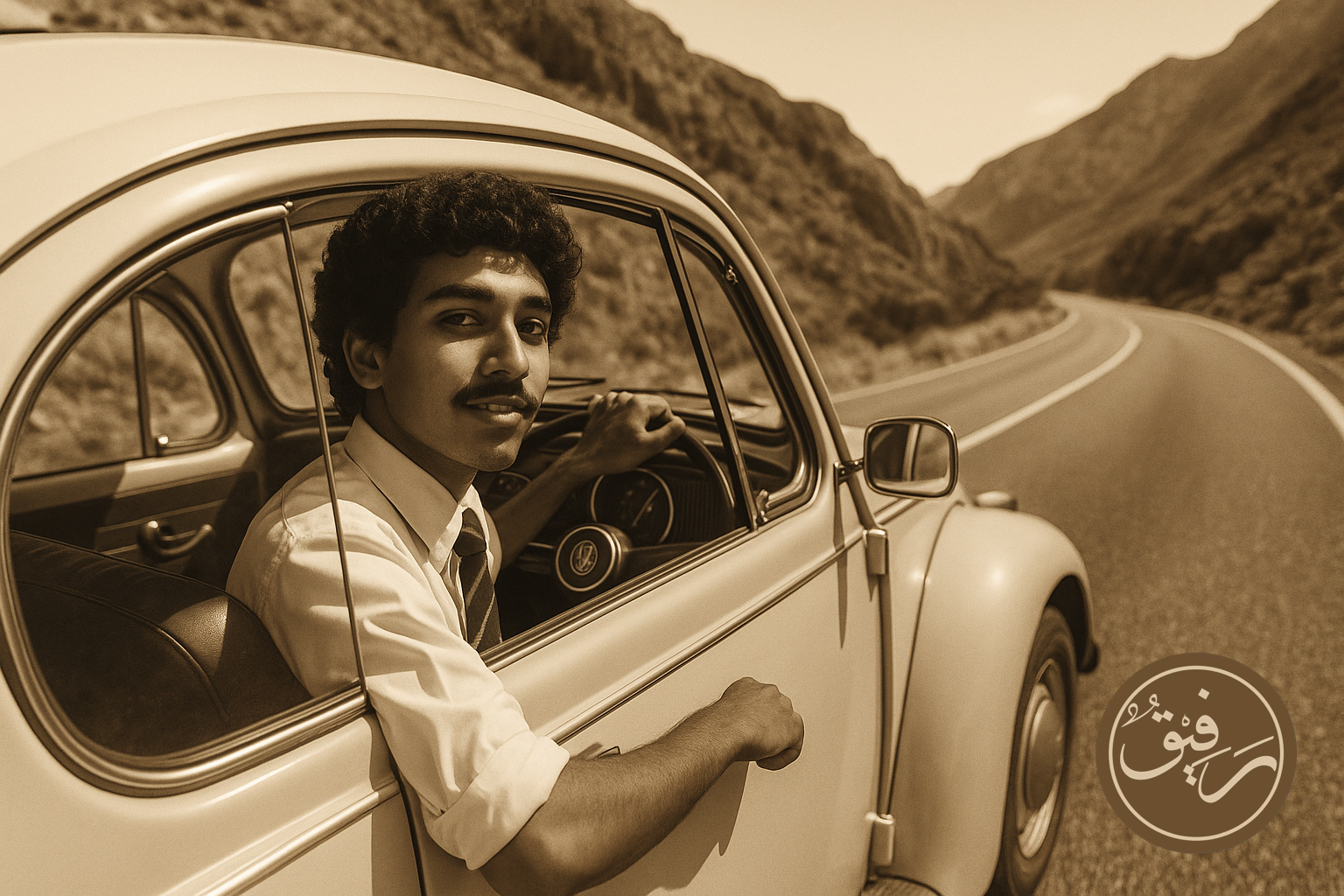
Back when I was still courting her, I’d drive my light blue VW Beetle 1400 — my first car, bought from Deem — all the way from Cape Town to Worcester and back. About 120 kilometres each way. For love.
So that night, when we came through the final bend, the boat still hitched behind us, the road folding into familiar curves… I realised:
This wasn’t just a road trip. This was return.
To family. To love. To the people who carried us before we even knew their names.
Closing Blessing
As Shaykh Jamiel Abrahams said, in response to this journey:
“Many a person with shaggy and dusty hair, dusty and driven away from doors… if he was to call on Allah ﷻ, Allah would surely answer.”
Some roads answer us back. Even in silence. Even before Three Sisters.
And maybe, if you’ve followed this far, it means you too have travelled one of those roads — or carried its dust in your shoes.
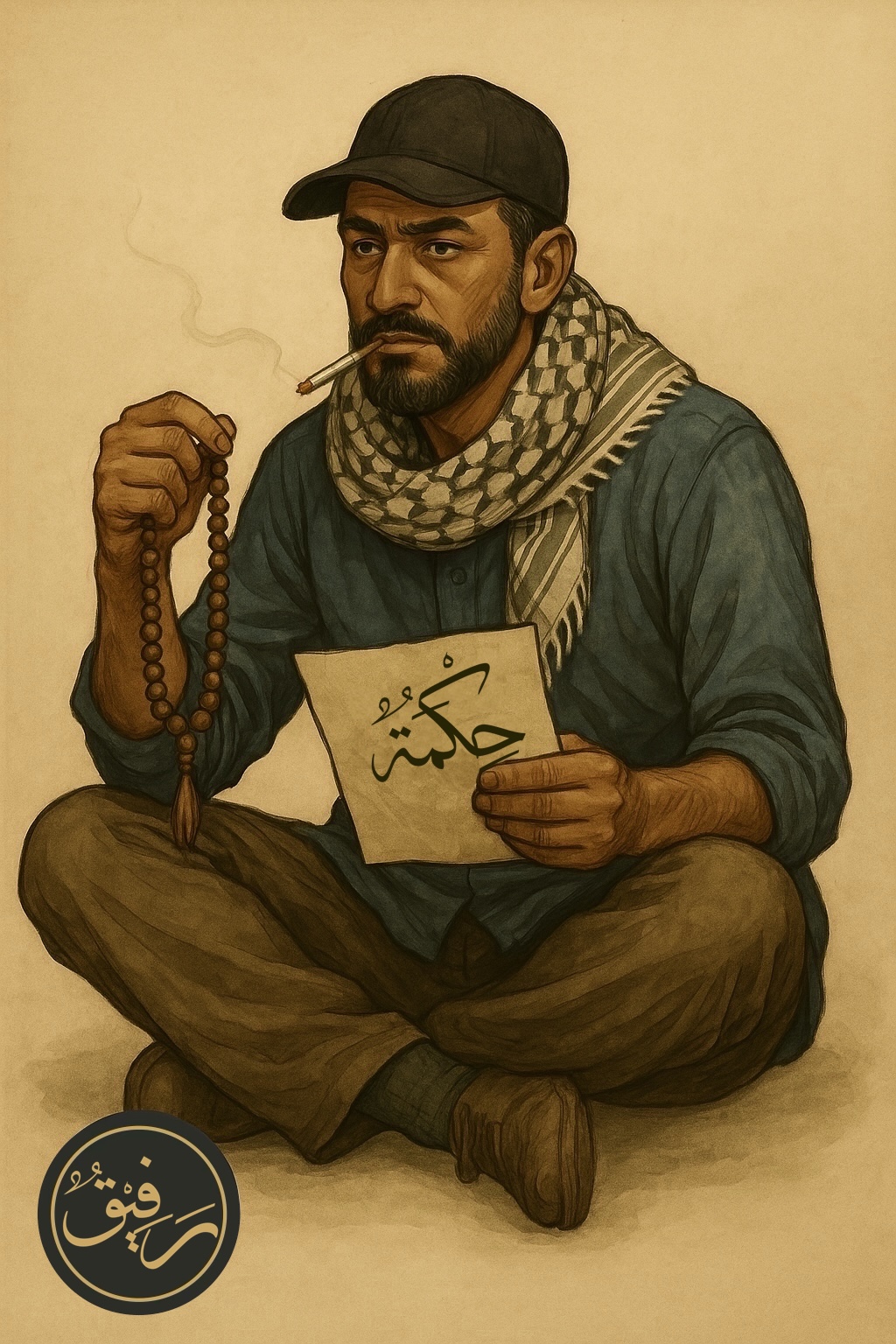
Before the baseball cap, the side-eye, and the wisecracks, there was something softer — a garden.
Not of vegetables or vines, but of words: words whispered, weathered, watered by prayer.
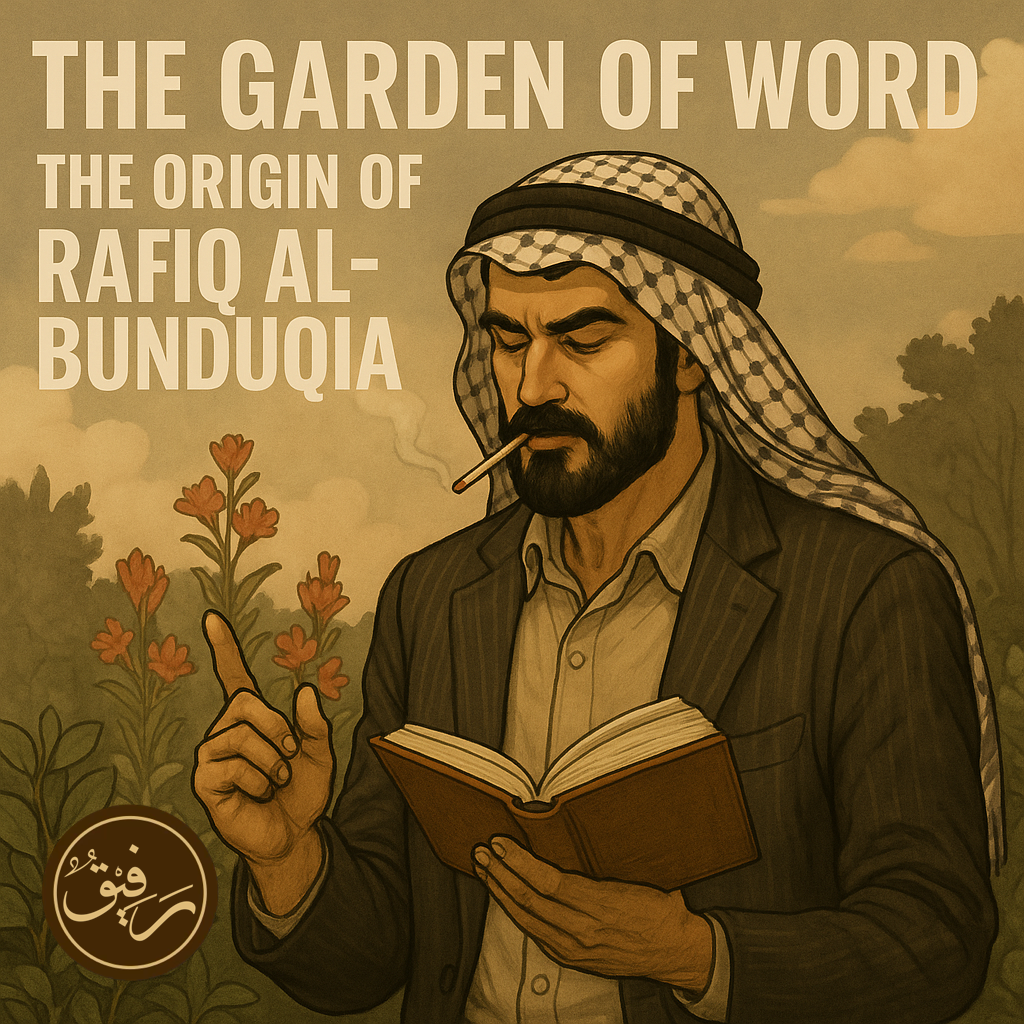
I wrote this piece years ago as a meditation on growth, loss, and language. Only now do I realise: this garden was the soil that gave us Rafiq al‑Bunduqia — the companion of pause, the superhero of syntax, the witness in the passenger seat.
🌱 Introduction
Not all heroes crash through walls. Some sit beside them and ask, “Who built this?”
He doesn’t leap tall buildings. He takes long pauses.
His name is Rafiq al‑Bunduqia. Shotgun companion. Keeper of silences. Superhero of the word.
This is his origin scroll.
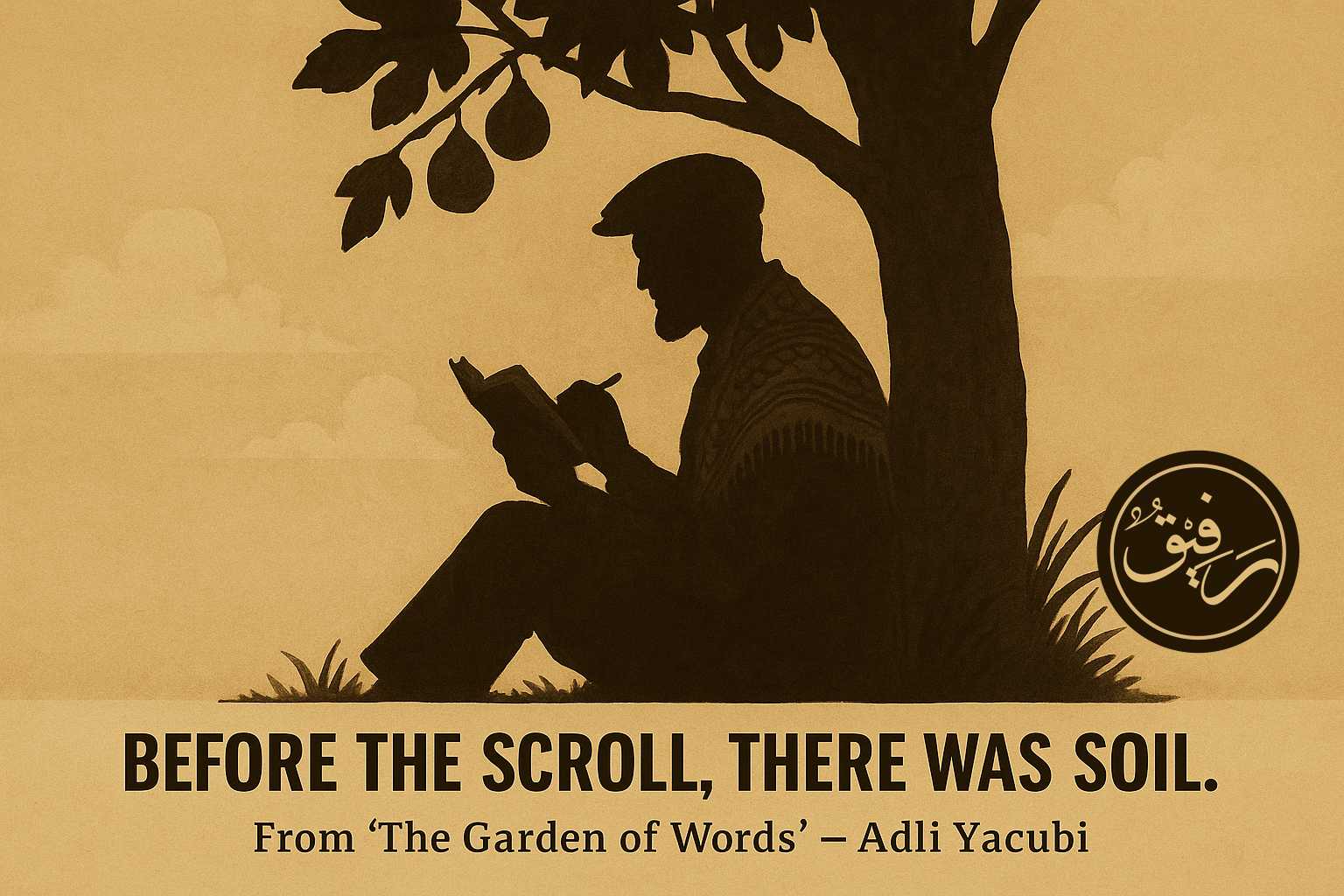
📜 1. A Garden, Once Planted
Years ago, I wrote The Garden of Words. It was a meditation on how language grows: slowly, unexpectedly, in sunlight and ache.
I had no idea then that someone had been walking in that garden all along — listening to the leaves, laughing at the metaphors, sharpening a pencil beneath a loquat tree.
His name came later. But his presence? It was always there.
🦸🏽♂️ 2. What Kind of Superhero Is Rafiq?
Rafiq does not fly. He walks. Slowly. On purpose.
He doesn’t rescue you — he reminds you. He doesn’t dazzle — he decodes.
His weapons are:
A well-timed question
A half-smile that disarms
A quote from a street aunty that cuts deeper than any Hadith app
And a scroll, always a scroll
He moves through WhatsApp voice notes, bread queues, and Threads threads. You won’t notice him until it’s too late — and then you’re crying and breathing better.
📖 3. His Powers
Power
Description
The Pause
He listens long enough to hear the truth behind your noise.
The Compass
He helps you re-find your qiblah when algorithms have stolen your sense of direction.
The Scroll Drop
Short, sharp, soulful — he leaves them like seeds on sidewalks.
Code-Switching Cloak
Fluent in Kaaps, Qur’an, colloquialism, and meme. He’ll talk street or soul depending on what you need.
💭 4. Why the World Needs Him
In an age of constant noise, Rafiq carries something ancient:
Discernment. Mercy. Memory.
He shows us that to speak well is not the same as to speak wisely.
That sometimes, the most radical act is to say nothing — and let someone else be heard.
🪞 Moment 1: “Don’t Answer So Fast”
They were all arguing on the stoep — about Gaza, gangsters, grief, government. Everyone had an opinion. Except Rafiq.
He just watched, sucking on a toothpick. Then he said:
“Don’t answer so fast, my broer. Sometimes, your answer is just your trauma trying to sound clever.”
Silence. A pigeon flew off the roof. No one spoke after that.
🍵 Moment 2: “Make Tea Like You Listening”
One of the ouens asked Rafiq, “How do you know when someone’s fake?”
He grinned — slow like a gate that’s seen too many guests.
Flicked his gwai ash into a broken saucer.
“Easy. Watch how they make tea. If they rush the pour, they’ll probably rush your pain too.”
“Make tea like you listening. Let it draw. Let it breathe.”
He sipped from a chipped cup and added,
“You want to fix the world? Start by fixing how you boil water.”
🧃 Moment 3: “The Juice Box Gospel”
At the back of the masjid after Jumu’ah, a small laaitie gave Rafiq a juice box.
No reason. Just walked up, silent, and handed it over like a contract.
Rafiq took it like it was gold.
Sat down on the pavement with his legs crossed, plastic straw in hand, and sipped like he was performing dhikr.
The boy looked confused.
So Rafiq leaned forward, tapped the juice box with one finger and said:
“My lightie, never underestimate something small that still got sweetness in it.”
Then he looked up at the sky and whispered,
“Ya Rabb… give us the patience of those who still share, even when there’s just one sip left.”
🪶 5. A Scroll from Rafiq
Rafiq’s Scroll #14 – On Superpowers
To sit with someone long enough to hear the voice behind the noise — that’s Rabbānī. That’s mercy. That’s you.
— Rafiq al‑Bunduqia
✨ What if Rafiq’s Trinity is This:
Drip. Hikmah. Duʿāʾ.
⚡ Style that carries memory 📿 Wisdom that carries mercy 🕊️ Supplication that carries the rest of us
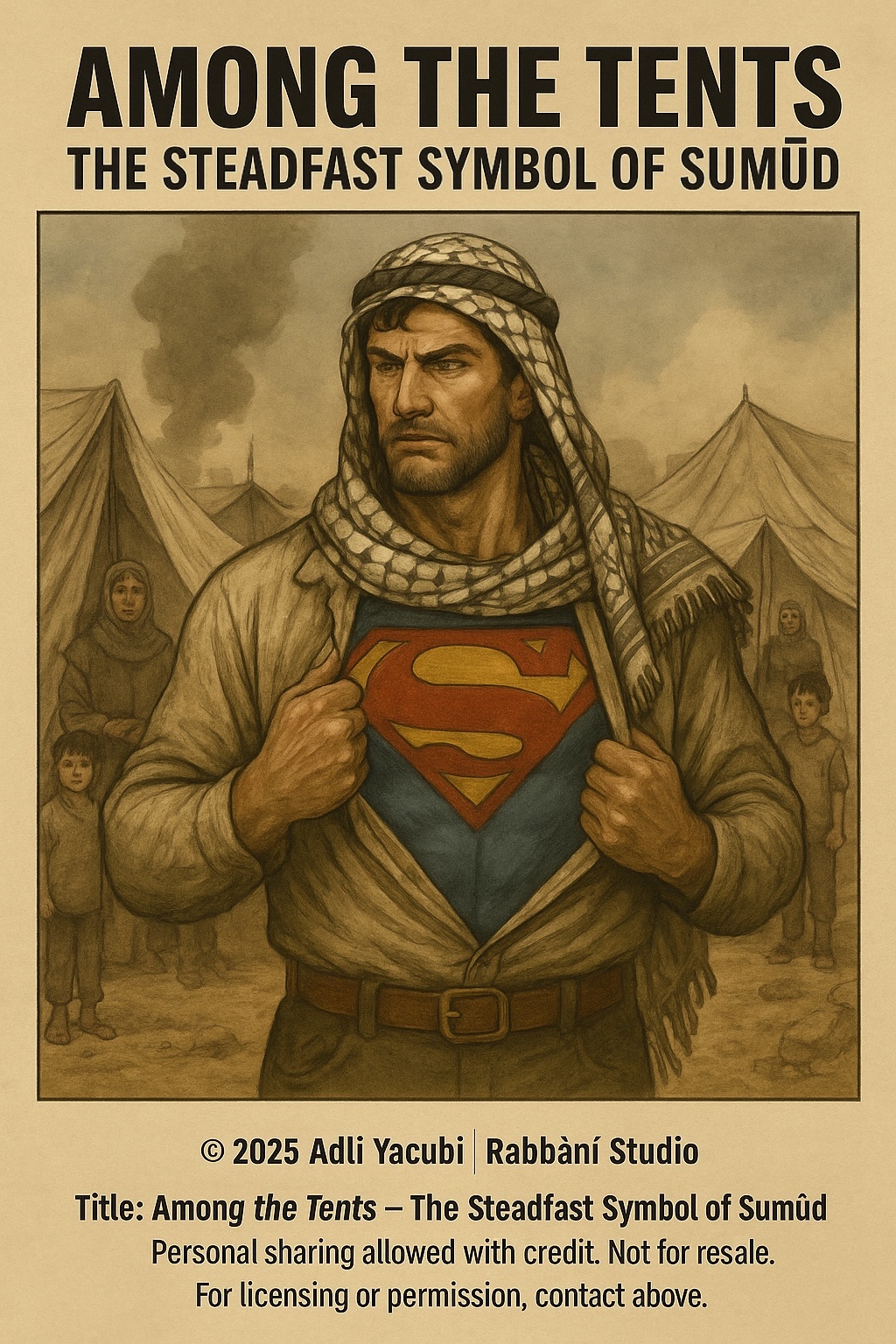
Among the Tents, Beyond the Frame: Reimagining Heroism in Gaza
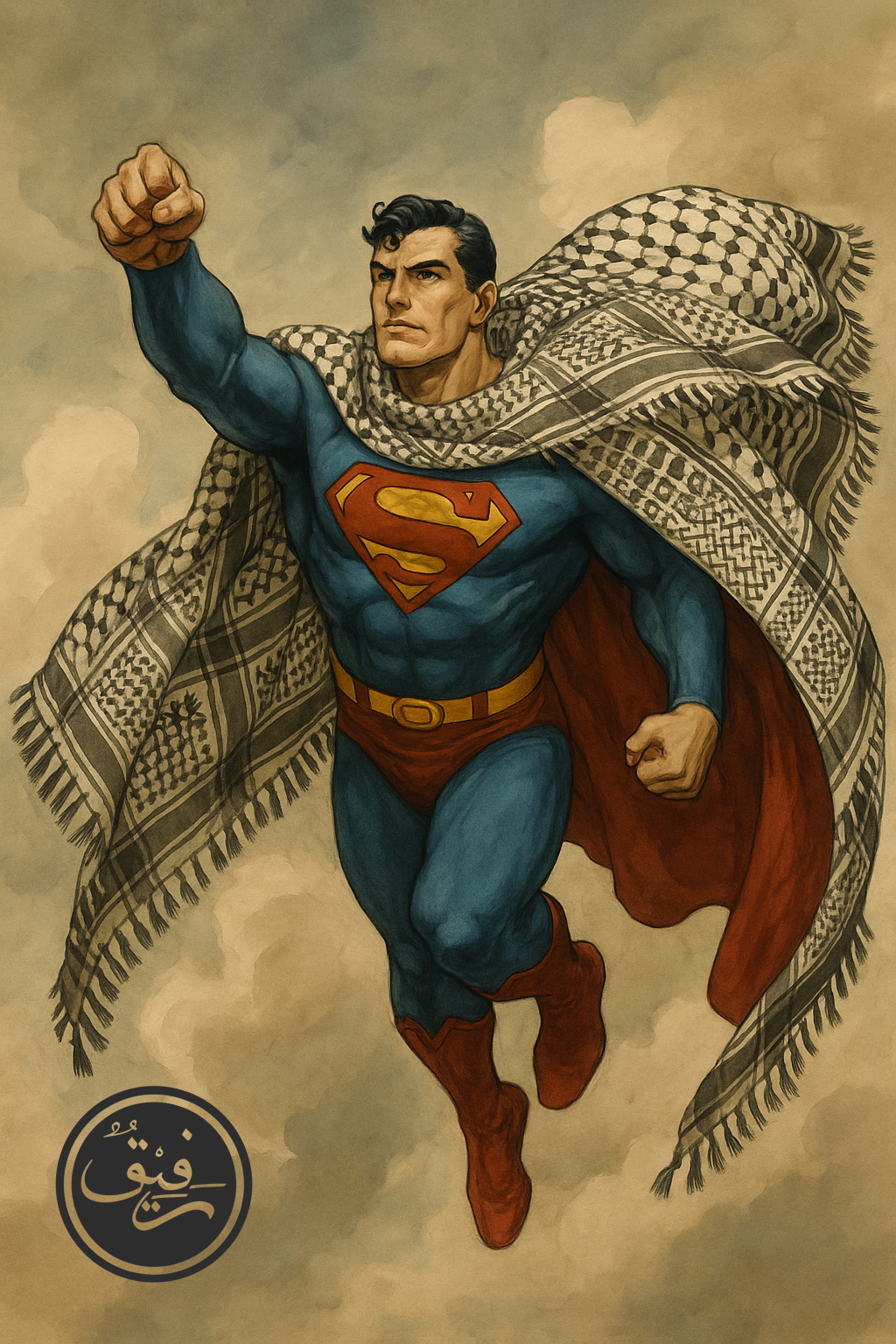
He no longer flies. He walks. With dust in his lungs, and truth on his chest. 📸 Visual by Rabbānī Studio – 2025
They called him the Man of Steel. But in Gaza, they make heroes out of dust, cloth, and resolve.
In a world saturated with capes, franchises, and box office saviours, we’ve released a different kind of superhero — one who doesn’t fly above the people, but walks among the tents.
He has no fortress of solitude. He shares tea with the wounded. He holds space, not spotlights.
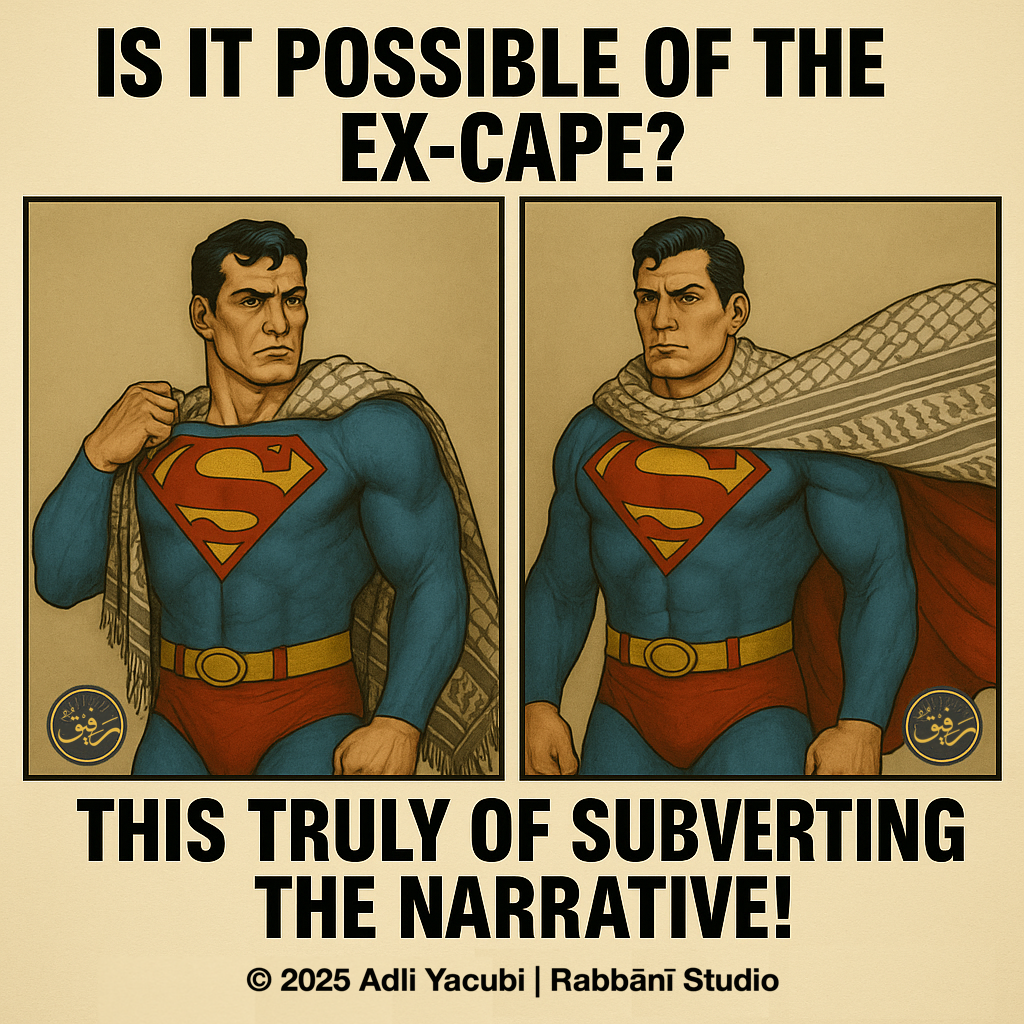
The cape was never the miracle. The keffiyeh carries more truth than tights ever could. This truly of subverting the narrative. 📸 Visual by Rabbānī Studio – 2025
Who Are the Real Superheroes?
It’s the paramedic running through smoke with nothing but gloves and prayer. The poet who rhymes her grief into defiance. The mother who ties her son’s shoelace and whispers “Go.”
It’s the teenager live-streaming truth. The uncle who hands out rice in plastic bottles. The whisperers. The rememberers. The quiet ones.
It’s the ones who stay.
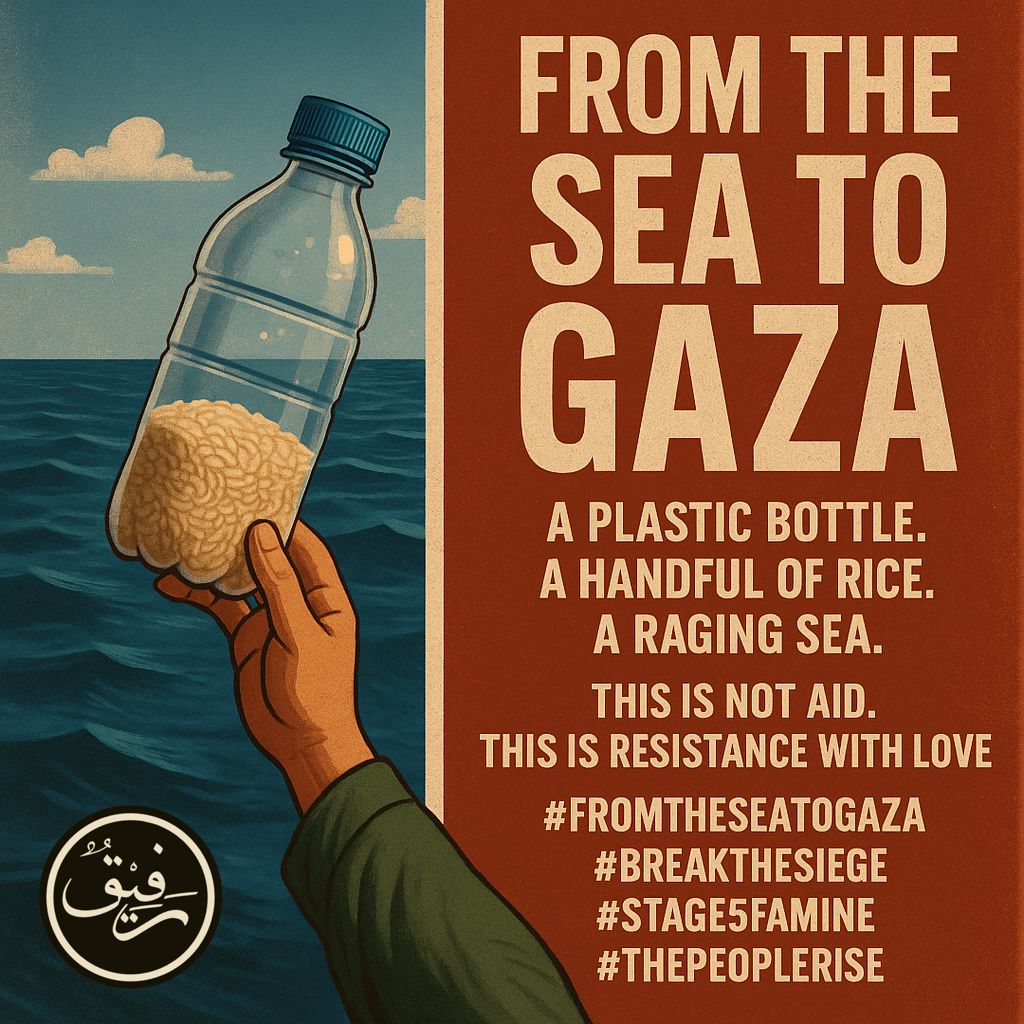
A bottle. A handful of rice. A prayer. This is not airdrop. This is resistance with love. 📸 Visual by Rabbānī Studio – 2025
From the Sea to Gaza
A Plastic Bottle. A Prayer. A Revolution.
We’ve seen images of superheroes with capes. But real power comes wrapped in plastic — not silk.
In Gaza, an uncle takes a used water bottle, fills it with rice, seals it with prayer, and sends it toward the shore.
This is not airdrop. This is not humanitarian branding.
This is resistance with love. It’s not the cape that saves. It’s the hand that still gives when everything has been taken.
From the Sea to Gaza.
From cape to keffiyeh. From myth to memory. Not above the people — among them. 📸 Visual by Rabbānī Studio – 2025
Not to Save. To Witness.
So yes. We’ve drawn Superman. But it’s not because Gaza needs saving.
It’s because the world needs reminding that true strength isn’t flight —
It’s sumūd.
And that’s always been a Palestinian superpower.
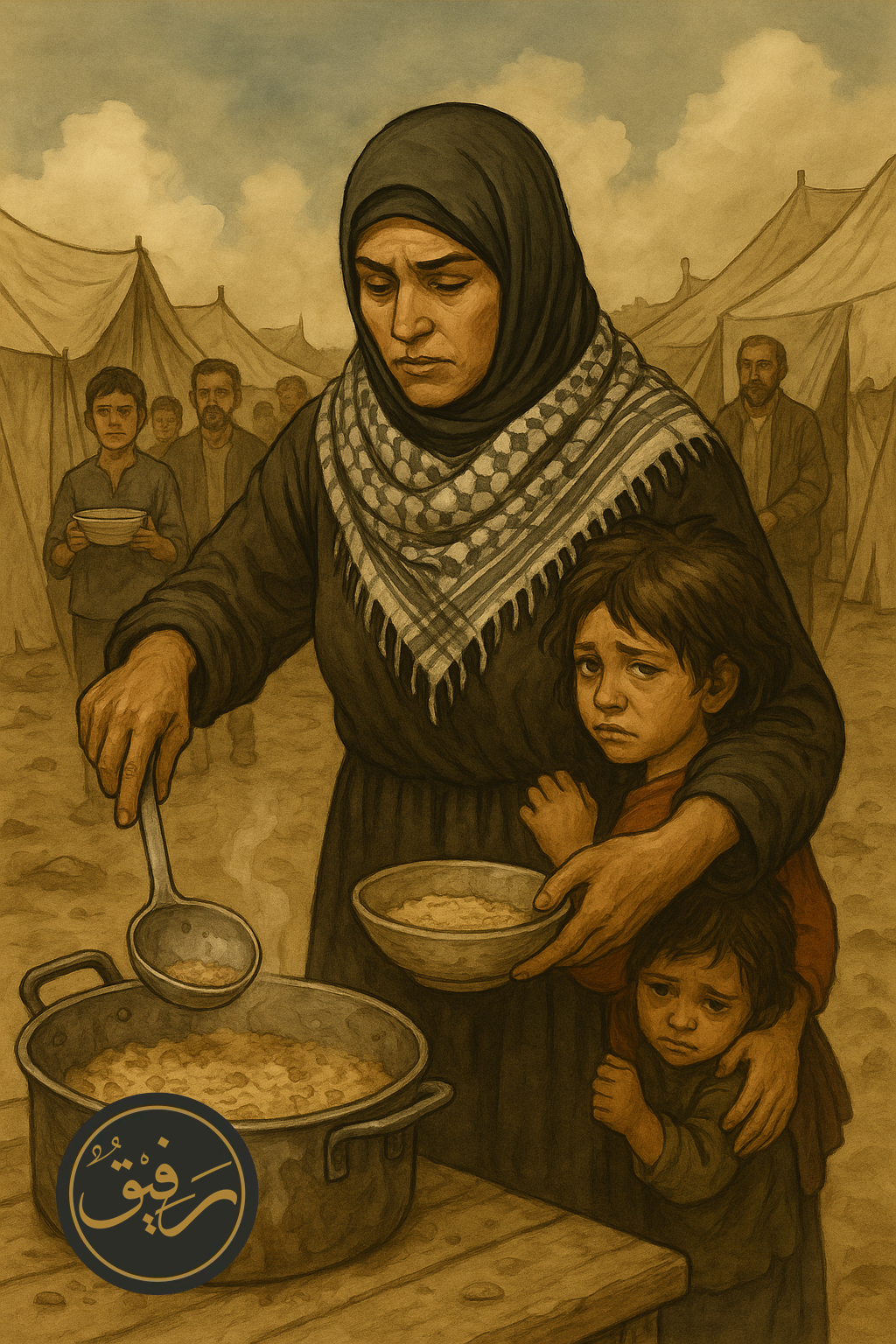
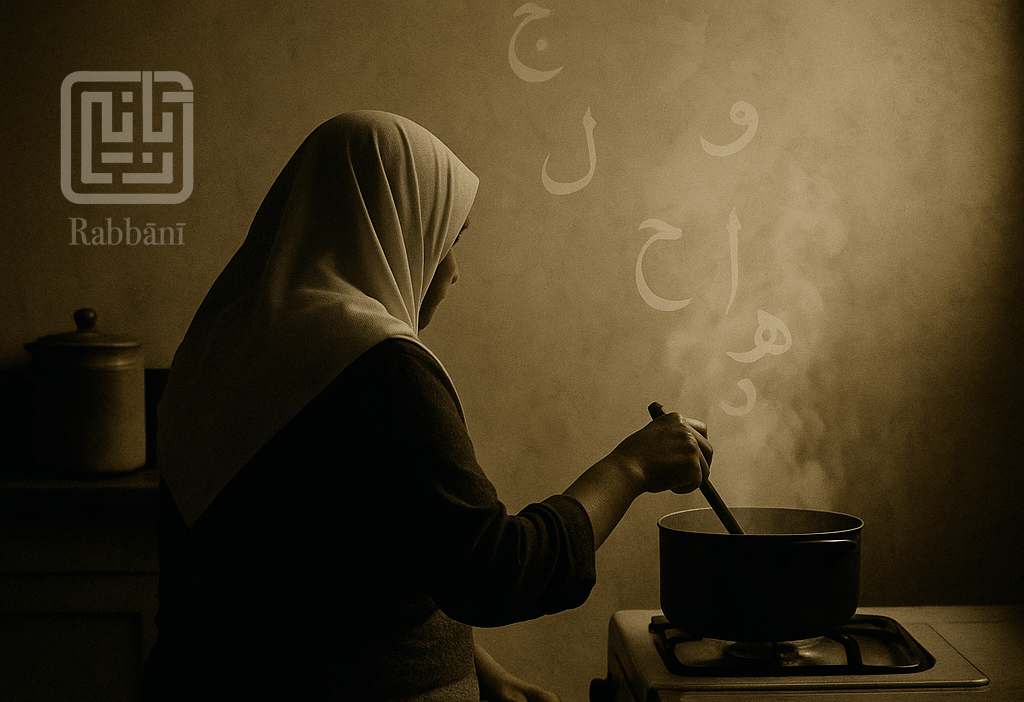
A Mother in the Time of Hunger Her child clings to her side. The pot is nearly empty. But she still stirs. This, too, is superheroism. 📸 Visual by Rabbānī Studio – 2025
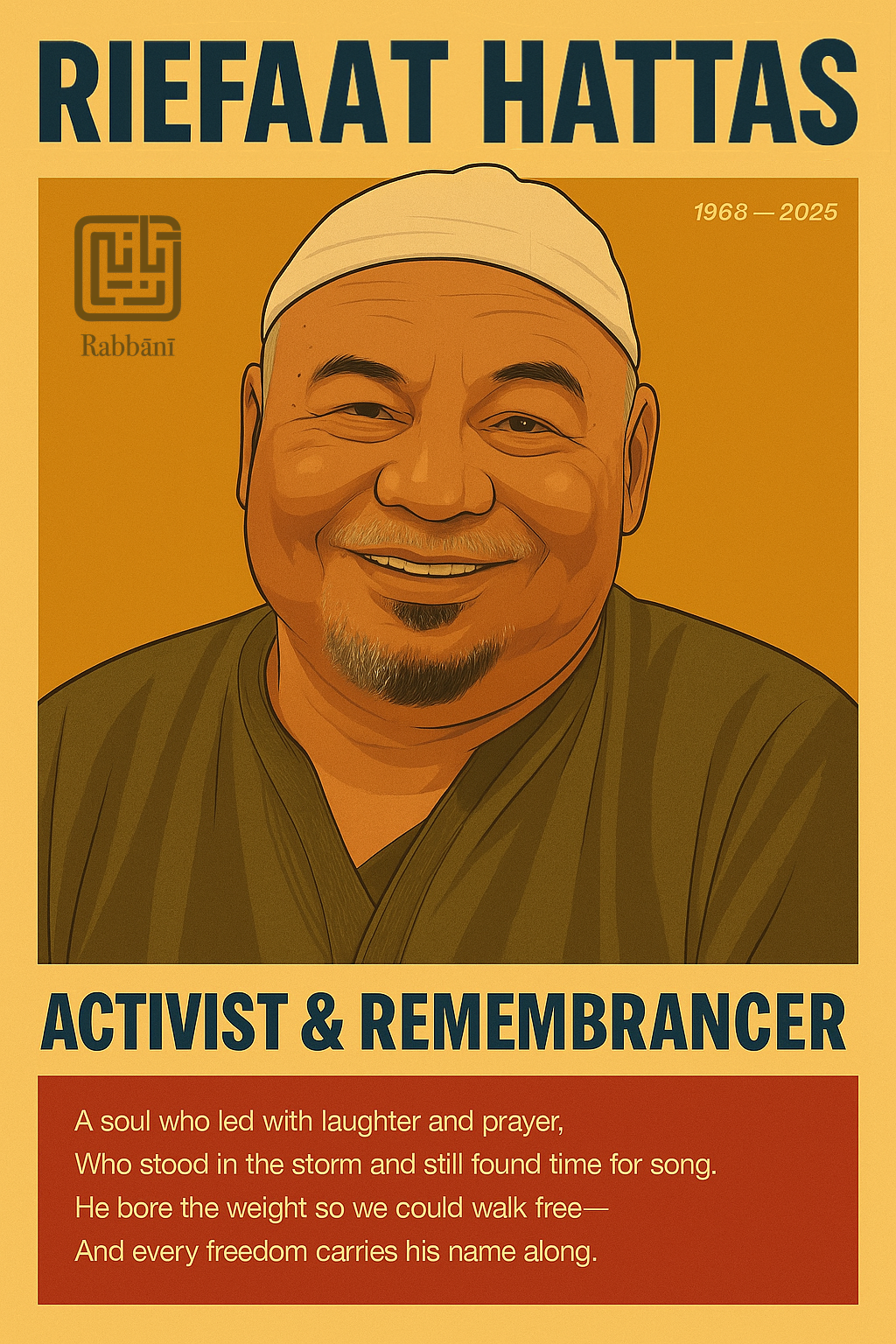
The Boy Who Waved Back: Remembering Riefaat Hattas of Manenberg
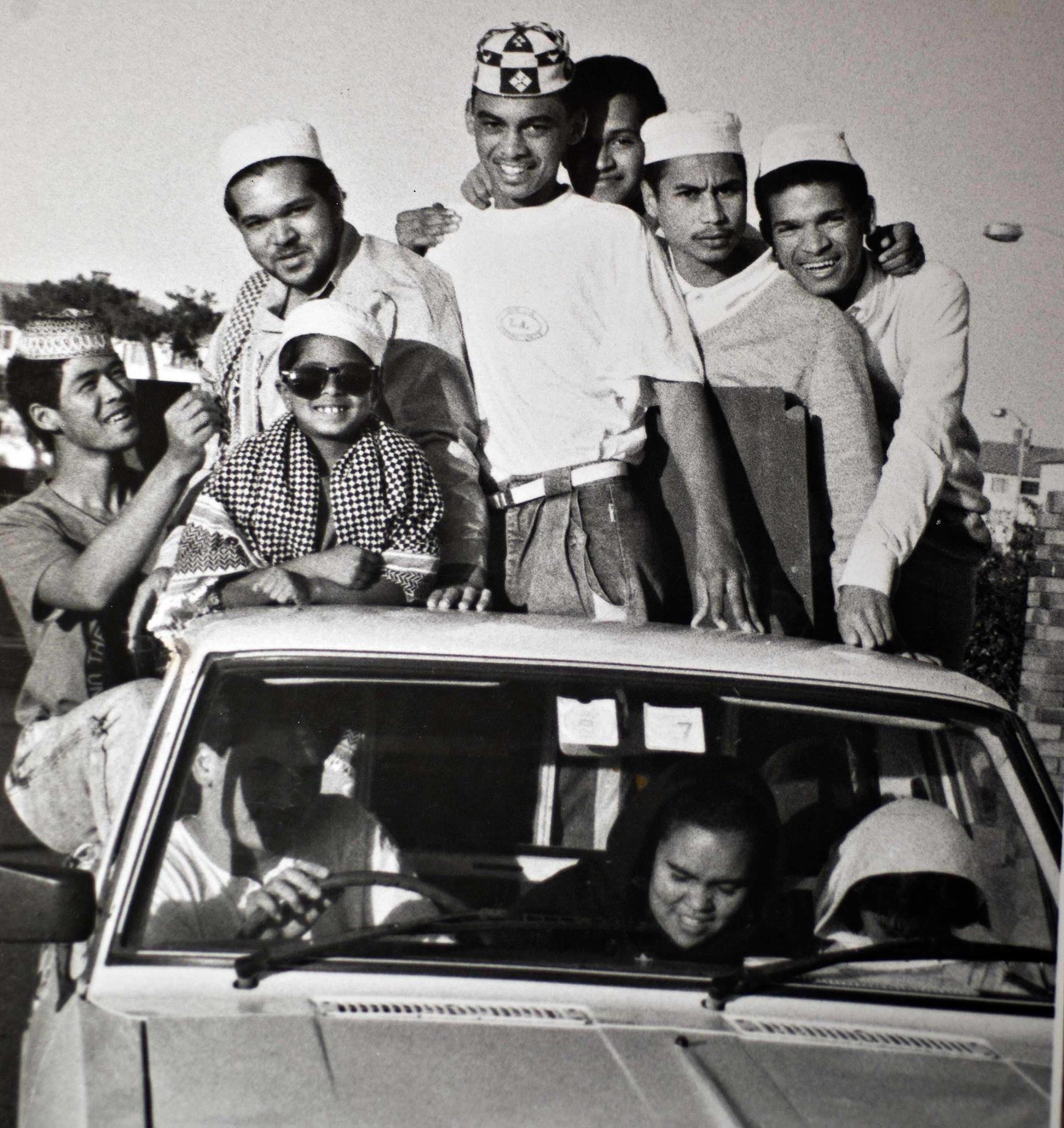
Young activists of the Call of Islam, Manenberg, 1980s. Riefaat Hattas, second from top right, stands among friends and comrades — a generation brimming with laughter, courage, and purpose. [Pic: Yunus Mohamed]
Manenberg: Where Struggle Learned to Laugh
There’s a photograph from another time — a car crowded with boys and brothers, some perched atop, some packed inside, all lit by the unmistakable fire of youth. Manenberg, 1980s: a borrowed car, a shared cause, a city holding its breath.
Among them is Riefaat Hattas — eyes forward, a quiet anchor in the rising tide.
Those who lived through the 1980s on the Cape Flats will remember: Cars that carried more than passengers — they carried dreams, sometimes fugitives. Boys who became men before their time. Smiles that defied a brutal state.
It was here, at Silverstream, in schoolyards dusted with chalk and hope, that Riefaat found his voice. A student leader, a Call of Islam activist, he joined a movement that dared to speak justice in the language of faith.
A Life Shaped by Struggle
Riefaat Hattas was born in 1968 and grew up in Manenberg, places shaped by apartheid’s sharp edges and the stubborn dignity of ordinary families. He matriculated at Silverstream Secondary in 1986, a year that would change his life and the country.
That year, he led a student march — Casspirs ringed the school, hundreds of unarmed students brutalized by the SADF. He was only 18 — but already a leader, a UDF and ANC supporter, mentored by Celeste Naidoo and MK underground structures.
In November 1985, during a march to honour detainees and the fallen, Riefaat was arrested under the Terrorism Act. Tortured at Manenberg station, interrogated, violated, broken down — then sent to Victor Verster Prison.
“The National Party should take responsibility for destroying and ruining our lives.” — Riefaat Hattas, TRC Hearings, 1997
Testimony and Trauma
Riefaat’s scars ran deep, but he spoke them aloud at the Truth and Reconciliation Commission:
“We aged ten to fifteen years in a matter of months… We never realized the kind of psychological stress and trauma we have been subjected to… I’m messed up because of what I went through during my high school days.”
He admitted the cost: Nervous wreck, unable to finish school in a normal way. Many friends became casualties — some went into hiding, some fled, others fell into drugs or gangs. Riefaat himself needed weekly counseling to manage the trauma that never left.
“Money can put something meaningful into my life. I have been tortured, I have nightmares, I could pay for counselling.”
Action Without Fear
Those who knew him say he was action-oriented, never content to sit on the sidelines. He became known for his directness, for “not being afraid.” He worked as a professional assistant officer for the City of Cape Town, always serving — quietly, sometimes with a smile that held both pain and possibility.
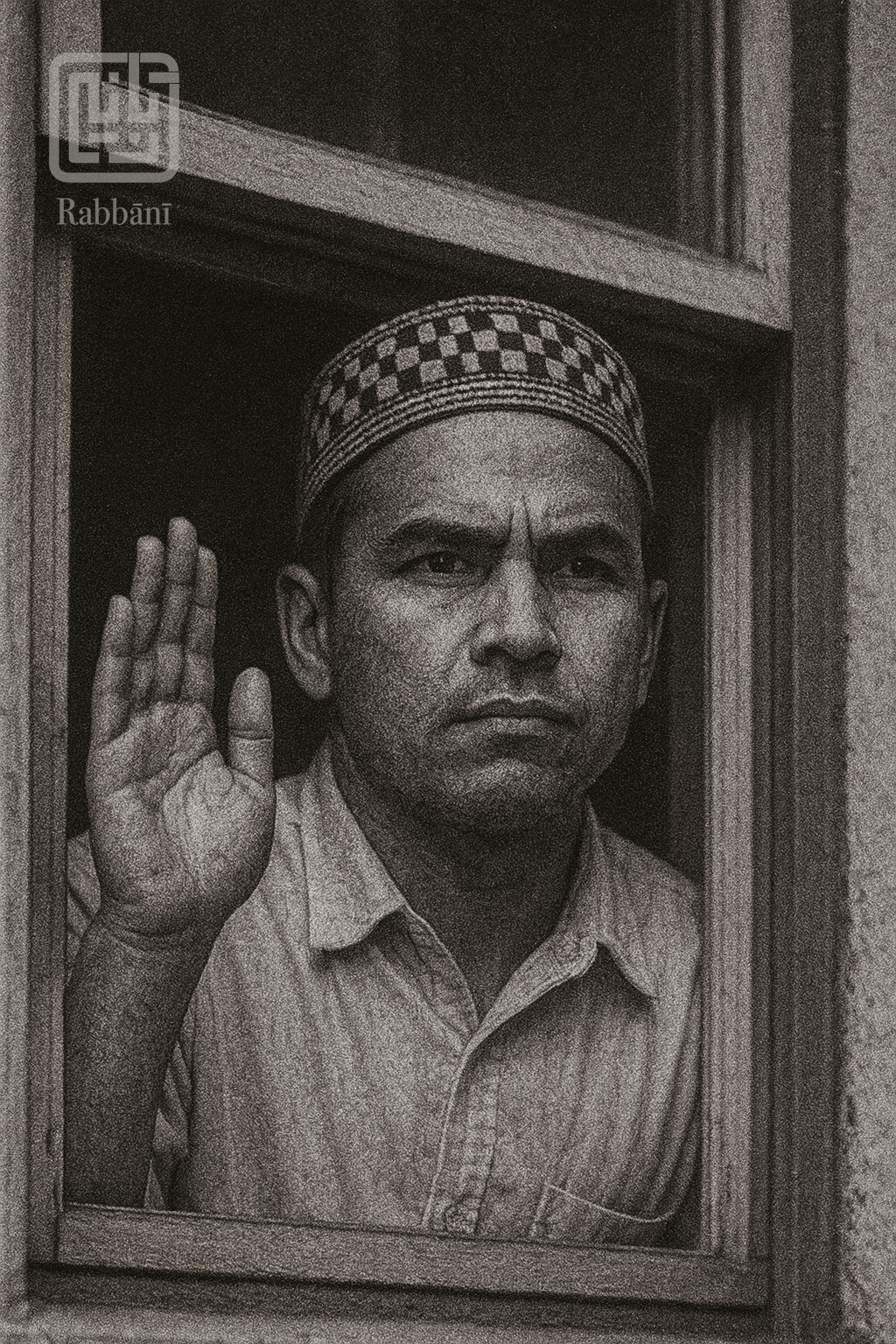
Riefaat Hattas, looking out from an embassy window, kufiyyah on, defiant and unbroken. This scene — recreated in tribute — echoes the iconic image of a young comrade who refused to disappear, even when others scattered.
Another time, he famously waved from the window of the American embassy during a similar protest. That photo is still an icon: the boy who refused to disappear.
Legacy: The Freedoms We Now Inherit
The freedoms Cape Town’s Muslims (and South Africans in general) enjoy today — to gather, to pray, to march, to speak — were won by Riefaat’s generation at terrible cost.
“We never knew how big our contribution would become, how our struggle would free so many others.” So said a comrade at his janazah, echoing Ebrahim Rasool’s words.
“He was one who stood out for justice as a witness to Allah. Riefaat carried the scars of torture and never broke — he stood in the embassy window, waving, so we would know not to run. The freedom we have today was won by his courage and the courage of his generation. Let us not pray perfunctorily; let us remember what was paid for us.”
Stories now echo from one generation to the next. Medat Adams’ young son hears the “old days” — torture, detentions, the moppies that kept hope alive when hope seemed like madness. Riefaat was a storyteller, a writer of comic skits for the nag troop, a keeper of laughter in the midst of struggle.
Riefaat: Lightness in the Struggle
At rallies and mass meetings, Riefaat was always the one looking for a piece of cardboard — anything, just to make salaah on, wherever he found himself.
During the matric exam boycotts, a group of them hid out at a teacher’s house. When the teacher came out, he called, “I can see you, Achmat!” — because Achmat was so tall, he couldn’t hide behind a bush.
After court appearances, Riefaat would lead the hungry crew straight into a janazah house along Thornton Road — knowing there would always be food, and never standing on ceremony.
Once, passing Pollsmoor Prison, he hung out the car window and led everyone in shouting, “Viva Mandela!” At the drive-in later that night, seeing white kids lugging their mattress home, he yelled out, “Sê ve jou ma — jy’t ’n comrade gesien!” [Tell your mom that you saw a comrade!]
He had a gift for turning every moment — even hunger, boredom, or fear — into a kind of resistance and joy.
#masekin — Ma se Kind, My Mother’s Child
Not just the humble, not just the poor — but every child of the Cape, every struggler, every brother, every sister carried in the memory of mothers who gave more than they had, who called each of us masekin — my mother’s child, so no one would feel alone.
For Riefaat, it was the truth of his life: He belonged to the people, and the people belonged to him.
Legacy: Freedom, Memory, and Sacred Song
But Riefaat was also a keeper of remembrance.
Who can forget the play, 333 Years of Islam in South Africa? He wasn’t just a participant — he was central, guiding the theatre piece, leading voices through the opening invocation. He would start the Ratibul Haddad, and his voice — deep, insistent — would call out “Qul huwallahu ahad…” until the whole circle answered. He loved the Gadat, cherished the sacred rhythms that stitched community and soul together.
These weren’t performances; they were living acts of ibadah, of memory, of survival. Riefaat made sure that in our struggle, we didn’t forget our dhikr, our poetry, our song.
It’s no wonder he led the Gadat like he was born to it — his Hattas (Attas) blood remembering the names that sailed from Hadhramaut to the Cape. Barakah doesn’t always skip a generation; sometimes it lands on the tongue of a child who never forgot.
[The Attas (Al-Attas) family are a Hadhrami lineage whose spiritual traditions—like the Ratibul Attas and the Gadat—helped shape Cape Muslim remembrance.]
Riefaat Hattas, years after the struggle. Still carrying the light, the smile, and the steadfastness that defined his youth. A witness to history — and a reminder that joy is its own act of resistance.
Legacy at Work: Community Builder in the City
After the struggle, Riefaat entered the City of Cape Town at the most basic level in the electricity department — but he never stopped building. According to Farouk Robertson (Communications, City of Cape Town), Riefaat steadily worked his way up to become central in community education for the City’s energy cluster. He was a true driver of interdepartmental, community-facing initiatives: creative, innovative, and never afraid to challenge technocrats to see things from the community’s point of view. He didn’t just serve; he inspired — often sharing new approaches and championing programs that brought real, active engagement into the City’s work.
Even in the workspace, he was a man of progressive action.
(Thanks to Farouk Robertson, via Shamile Manie, for these memories.)
Closing Prayer
May Allah gather Riefaat among the steadfast. May his wounds be healed in the gardens of peace. May we remember him — in our freedoms, in our laughter, in every act of justice — as the one who waved back when the world turned away.
Tramakasi — Our Thanks
This tribute would not have been possible without the memories, love, and testimony of those who knew Riefaat best. With deep gratitude to Ambassador Ebrahim Rasool, Shamile Manie, Salih Davids, Medat Adams, Dawood Hattas, Zieyaat Hattas, and the rest of his dear family — for their witness, their courage, and their generosity in holding Riefaat’s story with both pain and pride.
May Allah bless you all. Tramakasi. Shukran. Thank you.
References & Further Reading
Oral Tribute: Ebrahim Rasool. “Janazah Tribute for Riefaat Hattas.” Delivered at Riefaat Hattas’s janazah, July 2025. (Notes and excerpts via Shamile Manie and Adli Yacubi’s transcription.)
TRC Testimony: Hattas, Riefaat. Testimony at the Truth and Reconciliation Commission Children’s Hearing, Athlone, Cape Town, 22 May 1997. (As quoted in: SAPA, “TRC hears emotional testimony at children’s hearing,” 22 May 1997.)
Activist Testimony & Reparations: “Govt ‘spits in face of apartheid victims’.” Mail & Guardian, 5 October 2000. (Quoting Riefaat Hattas on the cost of struggle and reparations.)
Facebook Tributes & Community Memory: Jason Patrick Hanslo, “#masekin: Riefaat Hattas,” Facebook, 5 May 2022.
Personal Correspondence and Memories: Shamile Manie, WhatsApp messages to Adli Yacubi, July 2025. Salih Davids, “My Brother in Islam, Riefaat” (tribute poem), July 2025. Ebrahim Rasool, Janazah Tribute, July 2025.
Photographs: Yunus Mohamed, “Call of Islam, Manenberg, 1980s.”
Published Blog Draft: Adli Yacubi, “The Boy Who Waved Back: Remembering Riefaat Hattas of Manenberg,” unpublished manuscript and blog, July 2025.
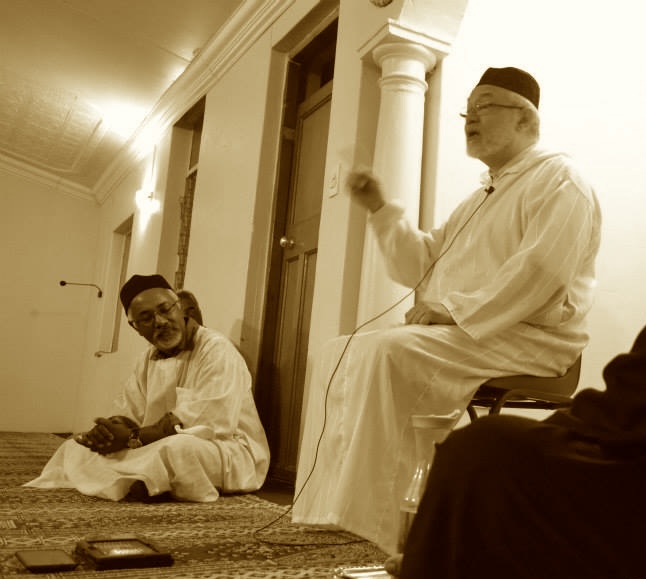
Sh. Seraj Hendricks speaking on Al-Fātiḥah at Janet St. Mosque in Florida, Johannesburg. 3 Nov. 2013 [Pic: Muavia Gallie]
Surah Al-Fātiḥah, the Opening Chapter of the Quran, holds profound significance in Islamic practice. It serves as a fundamental prayer for guidance and mercy, recited in every unit of Muslim ritual prayer (ṣalāh). Known as the Mother of the Book, Al-Fātiḥa is essential for the validity of prayers, underscoring its central role in worship and belief. This is why it is also referred to as the Seven Oft-Repeated Verses.
When I recite Al-Fātiḥah during my ritual prayers, I strive to focus meditatively on these seven verses. I recall an enlightening moment at a mosque in Johannesburg, Florida, where the late Shaykh Seraj Hendricks (may Allah’s mercy be upon him) shared a profound framework of the Quran. Drawing upon Al-Ghazali’s Mishkāt al-Anwār (The Niche of Lights), Sh. Seraj explained the duality of what is distant and what is near in the Quran.
In Al-Fātiḥah, the first four verses describe Allah in the third person:
In the Name of Allah, the Entirely Merciful, the Especially Compassionate;
Lord of all the worlds;
The Entirely Merciful, the Especially Compassionate;
Sovereign of the Day of Judgment.
These verses portray Allah The Sublime as transcendent and distant, beyond the cosmos. In contrast, the last three verses shift to a direct, intimate tone, addressing Allah in the first person:
You alone we worship, and You alone we ask for help;
Guide us on the Straight Path;
The path of those You have blessed, not of those who have incurred Your wrath or gone astray.
This shift emphasises Allah’s closeness, inviting a direct connection between the worshipper and the Divine.
This interplay of distance and nearness is a recurring theme in the Quran. Across 222 verses, references to the heavens and the earth metaphorically depict this duality. Heavens often symbolise the vast, cosmic, or intellectual realm, while earth signifies human, emotional, and spiritual proximity. In another sense, the heavens represent the mind—distant and analytical—while the earth represents the heart, intimately connected to spirituality.
Sh. Seraj also emphasised that these verses subtly address humanity’s role as vicegerents or stewards of God—khilāfatullah—and also as subordinated of God—ʿabdullah—in the universe and on earth. As Allah’s representatives, we are called to balance confidence with humility, leadership with servitude, and authority with submission in worship. This dual responsibility reminds us to rule with justice and compassion, always grounded in our devotion to and reliance on the Divine.
Focusing on Al-Fātiḥah: A Personal Practice
With this understanding, I now recite Al-Fātiḥah with a mindful dedication to different aspects of my being. Each verse resonates with a part of my body, mind, or soul:
Bismillāhir Raḥmānir Raḥīm (In the Name of Allah, the Entirely Merciful, the Especially Compassionate)—dedicated to the right hemisphere of my brain, the seat of creativity and emotion.
Al-Ḥamdu li-Llāhi Rabbi l-ʿĀlamīn (Praise be to Allah, Lord of all the worlds)—dedicated to my frontal lobe, responsible for reasoning and judgment.
Ar-Raḥmānir Raḥīm (The Entirely Merciful, the Especially Compassionate)—dedicated to the left hemisphere, where logic and analytical thinking reside.
Māliki Yawmid-Dīn (Sovereign of the Day of Judgment)—dedicated to the cerebellum, which governs balance and coordination.
For the remaining verses, I turn to my heart:
Iyyāka Naʿbudu wa-Iyyāka Nastaʿīn (You alone we worship, and You alone we ask for help)—dedicated to the heart’s ventricles.
Ihdinaṣ-Ṣirāṭal-Mustaqīm (Guide us on the Straight Path)—dedicated to the central core of the heart.
Ṣirāṭalladhīna Anʿamta ʿAlayhim Ghayri l-Maghḍūbi ʿAlayhim wa-Laḍ-Ḍāllīn (The path of those You have blessed, not those who incurred Your wrath or went astray)—dedicated to the atria of the heart.
As I complete the recitation, I feel that Al-Fātiḥah integrates into my being—mind, body, and soul—lifting me spiritually. Allah Most High affirms this closeness in the Quran, “Indeed, We created humanity and fully know what their souls whisper to them, and We are closer to them than their jugular vein.” (Surah Qaf, 50:16).
The Power of Words in Recitation and Reflection
The act of reciting sacred words, like those of Al-Fātiḥah, carries profound significance. When we call out these words, we are not merely speaking; we are engaging in an act of connection, both with the Divine and with our innermost selves. Recitation transforms the abstract into the tangible, turning thoughts into vibrations that resonate in the air and within our being. In this way, the spoken word becomes a bridge between the physical and the spiritual.
Equally important is the focus we bring to these words. In conversation, our attention to what we speak and how we speak reflects our intent and sincerity. This principle applies even more deeply in prayer, where concentration imbues our words with clarity and purpose. To recite mindlessly is to miss the essence of the act; to recite with focus is to align the body, mind, and soul in devotion.
Contemplating or meditating on certain words allows their meanings to unfold in layers. Words like ar–raḥmān (Entirely Merciful) or ṣirāṭal-mustaqīm (Straight Path) are not static; they expand and deepen with reflection. This process not only enhances our understanding but also transforms our recitation into an ongoing dialogue with the Divine. Contemplation invites us to live these words, allowing them to shape our actions and our being.
By calling out, focusing, and meditating on sacred words, we move beyond rote recitation into the realm of lived experience. This is where the power of Al-Fātiḥah truly lies—not just in its recitation, but in how it becomes a compass for our thoughts, a guide for our actions, and a sanctuary for our hearts.
Al-Fātiḥah is a map and a mirror — a guide that walks with us. Whether spoken aloud, whispered in prayer, or traced silently in our hearts, its light enters every cell that listens.
May our steps be straight. May our breath be mindful. May the One who is near, draw nearer still.
Ameen.
📚 You may also like…
🔸 Hy Lyk Soos ’n Wolf A spiritual meditation on instinct, loyalty, and the sound of the heart behind the howl. Some names we inherit. Others we grow into.
🔸 Tamat: A Sacred Completion, A Living Beginning A reflection on the weaving of remembrance and the sacred knot at the end of a Qur’an khatm — where endings become invocations for return.
To experience this reflection through voice, image, and sacred sound — watch the short video: 👉 Between Distance and Closeness (A meditative recitation of Al-Fātiḥah with visual symbolism and breath)
🌿 Final Note
Al-Fātiḥah is not only recited — it is walked, embodied, and remembered. May each verse carry you closer to the One who is closer than your jugular vein.
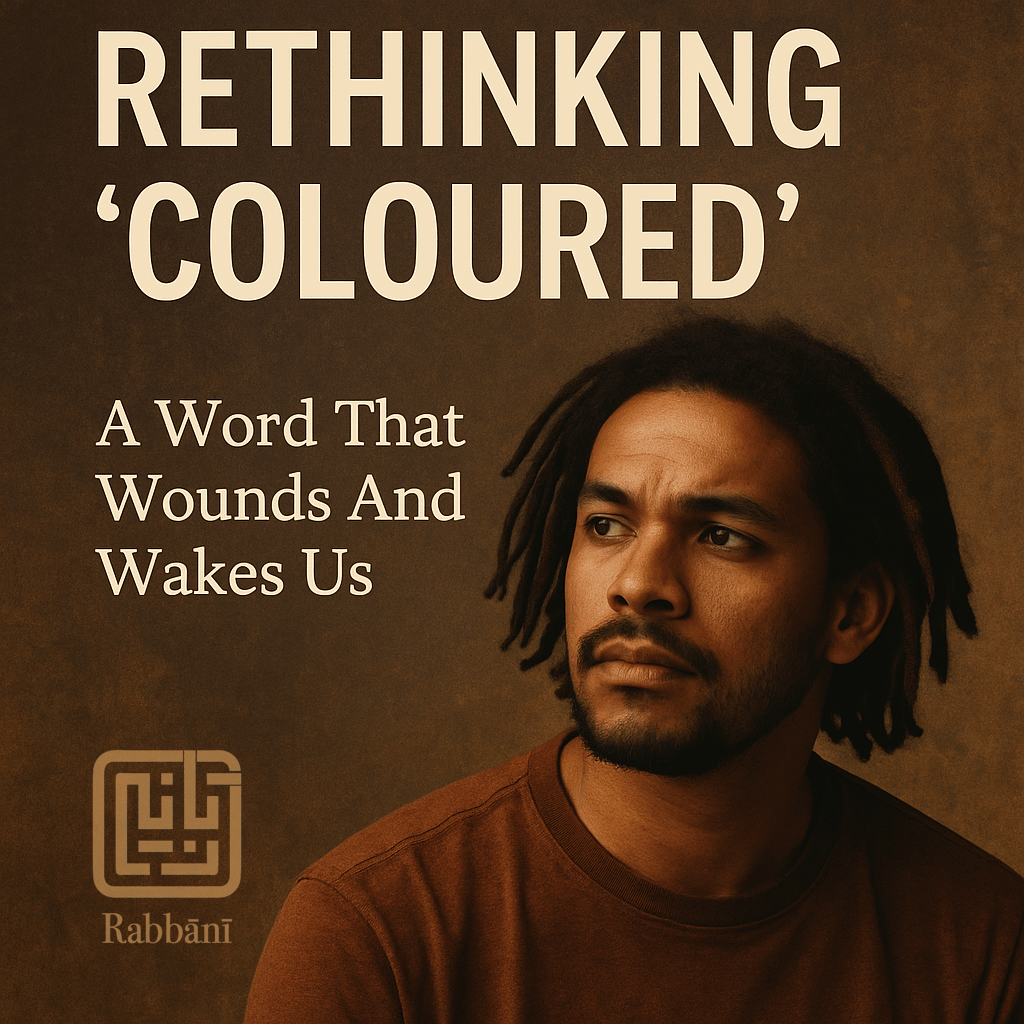
🟤 A Word That Wounds and Wakes Us: Rethinking “Coloured” in the Age of Memory
By Adli Yacubi
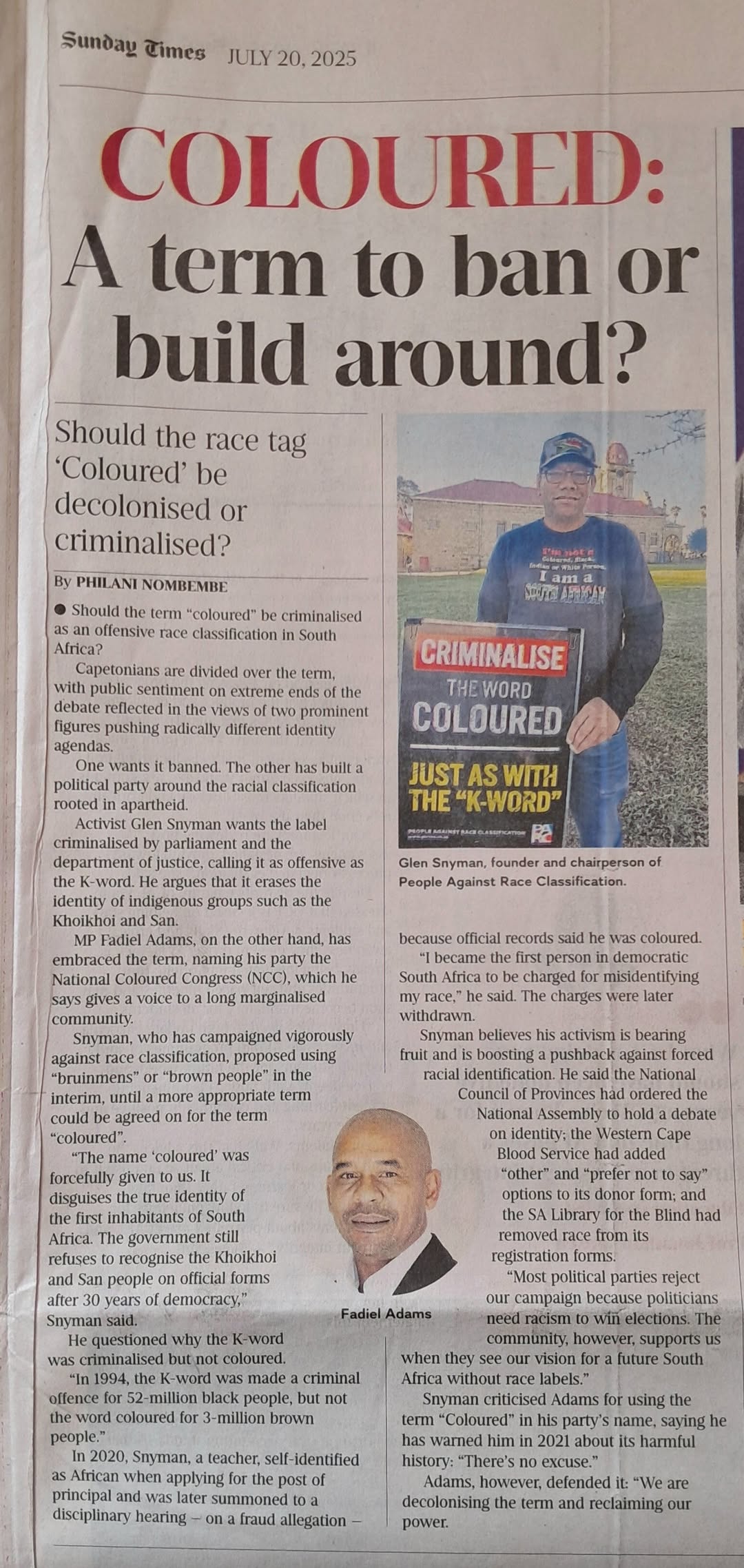
“The name ‘Coloured’ was forcefully given to us.” — Glen Snyman, Sunday Times, 20 July 2025
Last Sunday’s front page posed a question still burning through our national psyche: “Coloured: A term to ban or build around?”
In bold red and black, the Sunday Times article (20 July 2025) captured a moment of deep fracture — and opportunity. It spotlighted the voices of two public figures, Glen Snyman and Fadiel Adams, whose opposing stances on the term “Coloured” reflect long-simmering tensions within post-apartheid identity politics.
And yet, beyond the noise, a different current is rising. One that calls not for renaming or romanticising, but for remembering.
❌ Criminalise or 🔁 Reclaim?
Glen Snyman, founder of People Against Race Classification (PARC), argues that “Coloured” is not merely outdated — it is damaging, like the K-word:
“It disguises the true identity of the first inhabitants of South Africa. The government still refuses to recognise the Khoikhoi and San people on official forms after 30 years of democracy.”
Snyman’s activism led to national debates in parliament and institutions like the Western Cape Blood Service adding the “prefer not to say” option to racial forms. But his call for criminalising the term has stirred legal and ethical challenges — and provoked a backlash from those who feel erased by the erasure.
On the other end stands Fadiel Adams, leader of the National Coloured Congress, who says:
“We are decolonising the term and reclaiming our power.”
Adams believes in building around the identity — anchoring it in lived pain, community resilience, and political recognition. But critics say this collapses our histories into apartheid boxes, reinforcing labels that were never ours to begin with.
🪶 What’s In a Name?
Into this fire, Patric Tariq Mellet, historian and author of The Camissa Embrace, offers clarity beyond polemics:
“Goringhaicona was never a name people used for themselves. It was a derogatory Dutch term meaning outcast or scavenger. Autshumao’s people were known as the /Kamisons — water traders. They were a sub-group of the Cochoqua. The term Camissa remembers them not as fragments, but as a river of convergence.”
Mellet’s contribution is not merely semantic — it’s genealogical. It reveals that terms like “Coloured” and even “Brown” are colourist overlays that flatten our multiple ancestries: San, Khoe, Xhosa, enslaved African, Indian, Javanese, and European.
His critique of both Snyman and Adams is incisive:
“Both men reflect valid concerns — but both are caught in Apartheid’s trap. One criminalises. The other romanticises. Neither steps fully into the radical work of remembering, beyond state classification.”
🧬 Memory as Resistance
To stand in this in-between space — neither erasing the term nor enshrining it — is to do the work of memory. To say: we were misnamed, but we are not unnamed. We are more than what apartheid called us. And we are not only what the census categories offer us.
This blog, like others before it, is not a position paper. It is a growing reflection rooted in questions I’ve been asking for years: — What do we mean when we say “I am Coloured”? — Who gets to say so? — And what happens when our ancestors whisper different names?
We are not “non-white.” We are not “Other.” We are not “Coloured” in the way the law intended. And we are not simply “Brown,” either.
We are Camissa. We are from the river. We are still flowing.
📝 Postscript
We acknowledge the work of Patric Tariq Mellet, whose scholarship challenges colonial erasure. Through his writing, Camissa is no longer hidden — it is remembered as a place of sweet waters, of creolised identity, of sacred convergence.
His reminder to not confuse / reclaim / romanticise pejorative colonial terms (such as “Goringhaicona”) is especially important — and will be reflected in our future revisions.
We also draw from Stuart Hall, who wrote that nations are “narrated into being.” To say “I am from Camissa” is to resist imposed categories and to speak from the riverbed of relation — to narrate the nation otherwise.
The story of who we are is still being written. Let it not be in the language of our conquerors — but in the voice of our rivers, mountains, mothers and names.
💧 The Colour of God
صِبْغَةَ ٱللَّهِ ۖ وَمَنْ أَحْسَنُ مِنَ ٱللَّهِ صِبْغَةًۭ ۖ وَنَحْنُ لَهُۥ عَـٰبِدُونَ “This is the colour of Allah. And who is better than Allah in colouring? And we are His worshippers.” (Qur’an 2:138)
Not the colours of empire. Not the names imposed by maps or ministries. But the silver sap beneath the bark. The scent of rain on root. This is the ṣibghah of God. The sacred dye of those who remember.
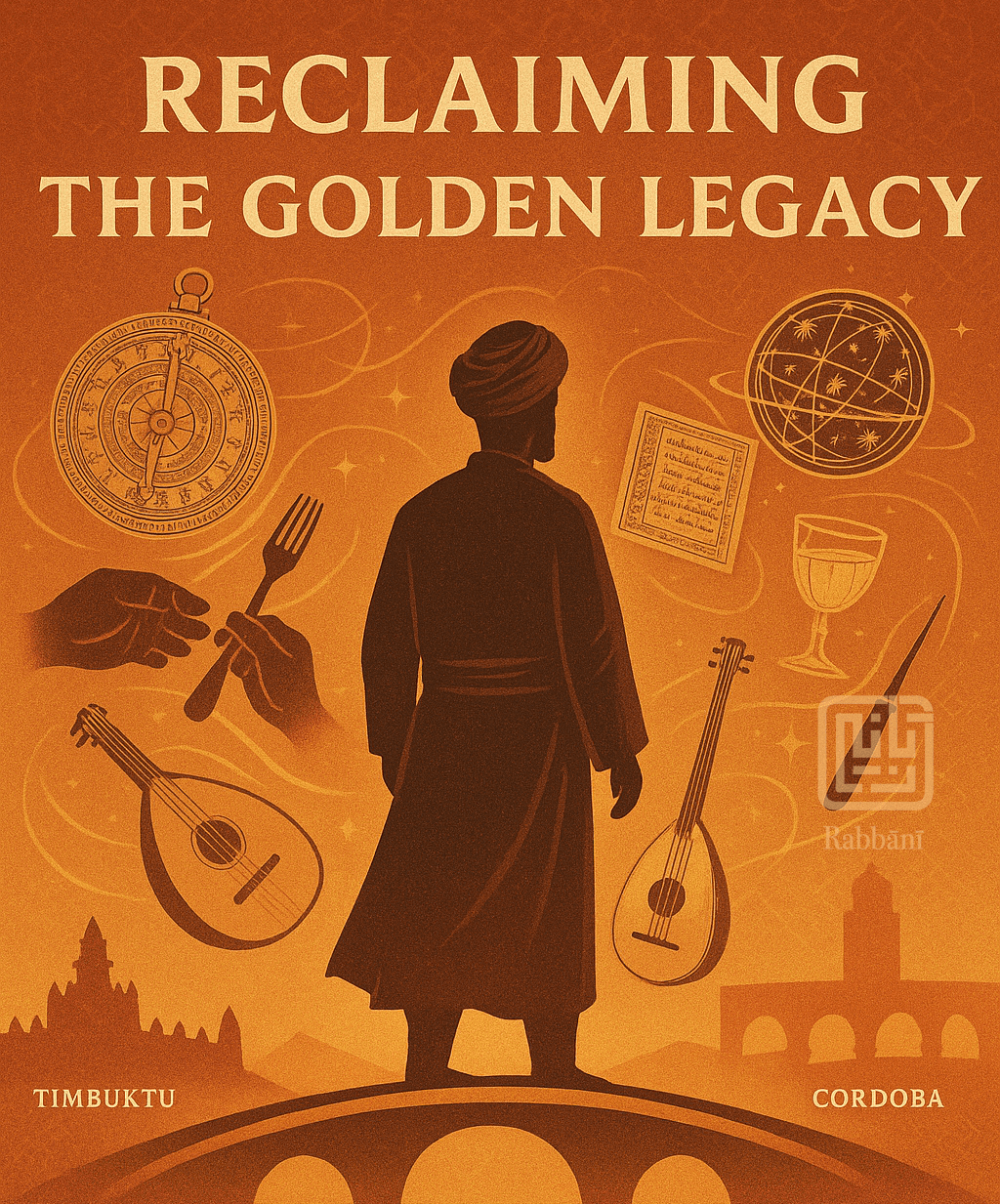
Our Inheritance: The African and Islamic Civilisations That Shaped the World
Our Inheritance: The African and Islamic Civilisations That Shaped the World
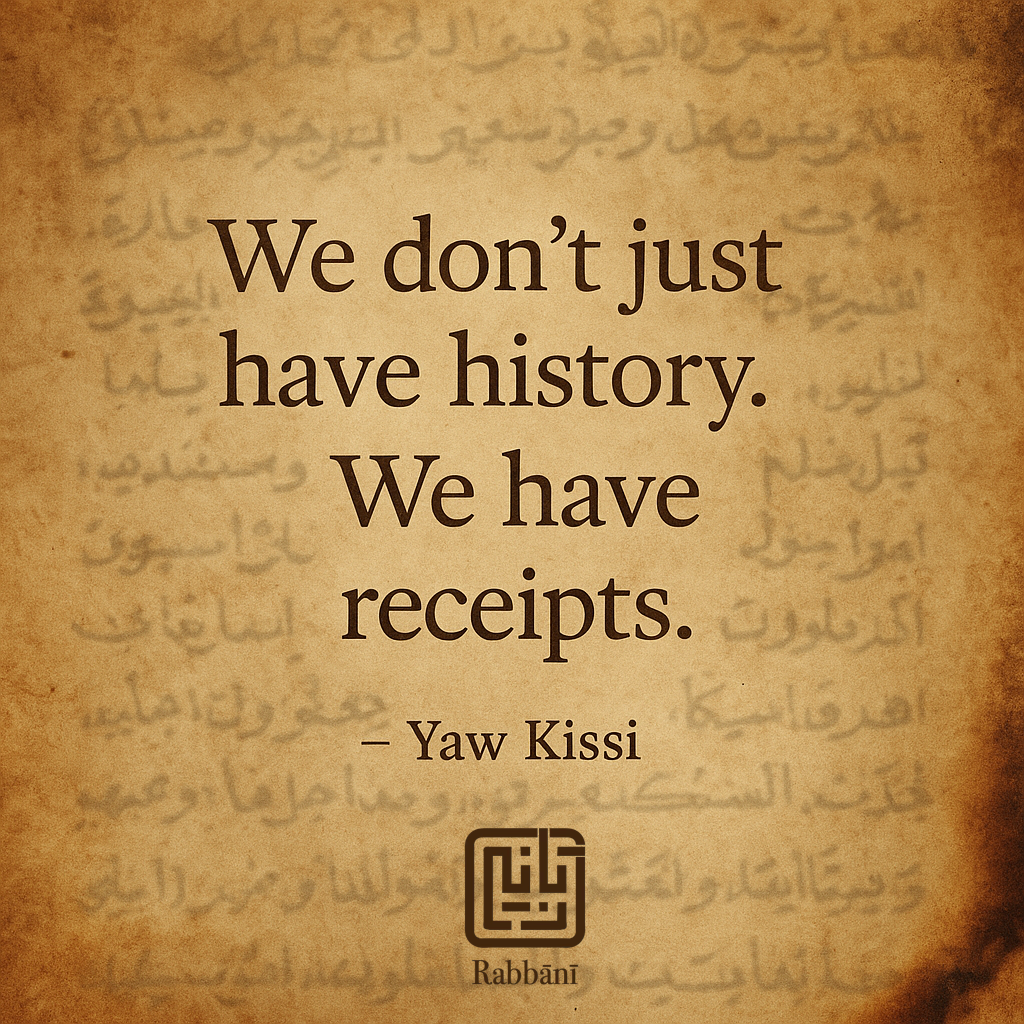
“We don’t just have history. We have receipts.” — Yaw Kissi
For generations, our textbooks — even in Islamic schools — handed down a version of history in which Europe alone was cast as the cradle of civilisation, and Africa into darkness. This colonial retelling stripped countless people of their confidence and belonging.
As Shaykh Allie Khalfe insightfully reminds us, even the academic traditions we take for granted — like graduation caps and gowns — trace back to the Islamic ijāzah system, where a teacher would bestow a turban and robe upon a student to mark their mastery.
Europe adopted these symbols while erasing their origins. But today, the veils are lifting. And as African memory resurfaces — in scrolls, dreams, and digitised manuscripts — we realise something essential:
We don’t just have history. We have receipts.
Mathematics and Science
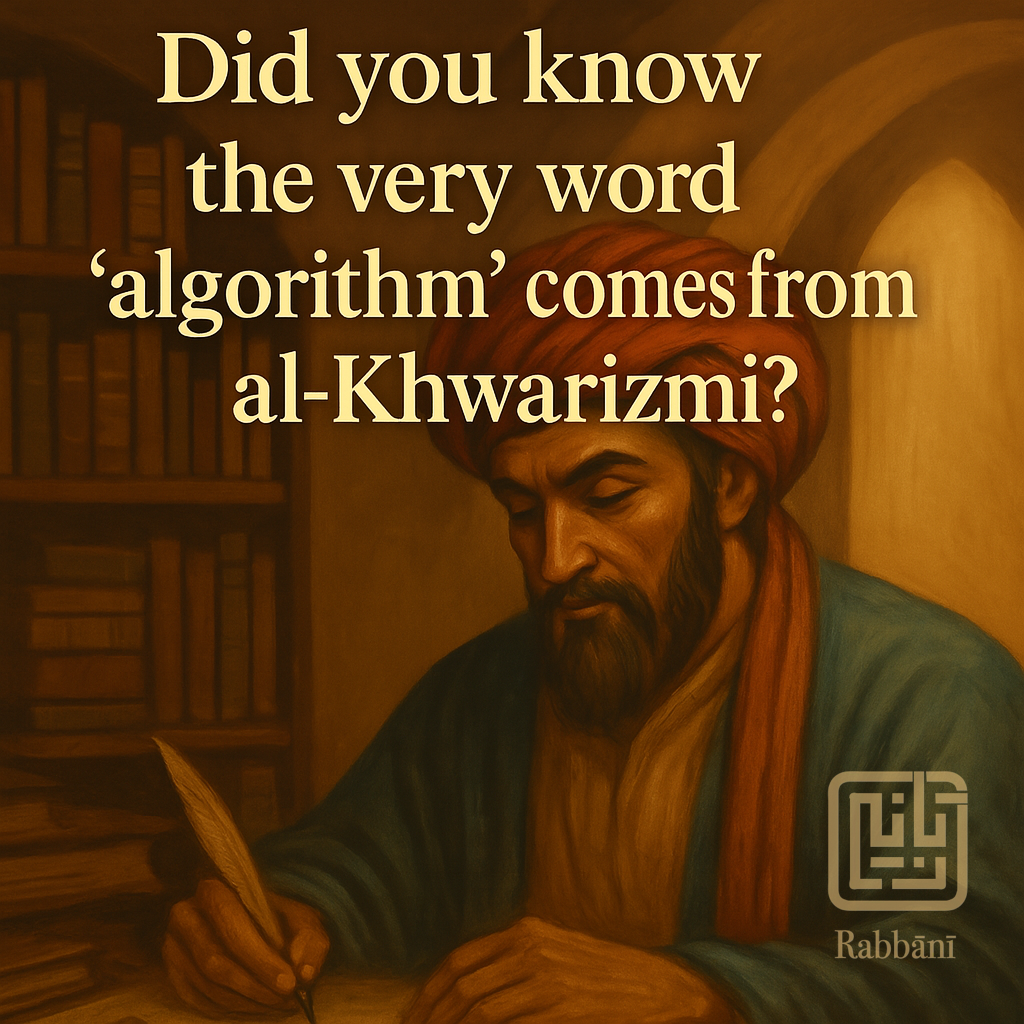
Consider al-jabr, or algebra — a foundational pillar of modern science, engineering, and finance. Muhammad ibn Musa al-Khwarizmi, working in 9th-century Baghdad, formalised its rules, giving his name to the word algorithm — the very basis of every modern computer. His systematic approach to equations transformed the world.
In medicine, Ibn Sina (Avicenna) produced the Canon of Medicine, a monumental text synthesising anatomy, treatments, and psychology, taught across Europe for over 600 years. Abu al-Qasim al-Zahrawi (Albucasis) in Andalusia created a 30-volume encyclopedia on surgical techniques, designing more than 200 surgical instruments that still influence modern practice.
Ibn al-Haytham (Alhazen), known as the “father of optics,” shattered ancient Greek theories by proving that light enters the eye to produce vision, and he introduced experimental methods that would inspire Europe’s later scientific revolutions. These figures were not footnotes in history — they were its authors.
Astronomy and Navigation
Muslim astronomers transformed the night sky into a navigational map, extending humanity’s reach across oceans and deserts. They refined Greek, Persian, and Indian observations and built on them with powerful new instruments and methods.
Al-Zarqali (Arzachel) of 11th-century Toledo developed the Toledo Tables — astronomical data so precise they became a cornerstone for European science, inspiring Copernicus and others. His universal astrolabe could be used at any latitude, freeing navigation from local constraints.
Mariam al-Asturlabi, a 10th-century woman scientist in Aleppo, constructed exquisitely precise astrolabes, allowing people to determine prayer times, measure the positions of stars, and navigate across continents. These tools formed the backbone of Muslim maritime routes linking East Africa, Arabia, and South Asia — centuries before Europe was ready to cross the Atlantic.
It is no exaggeration to say that the so-called Age of Discovery — Columbus, da Gama, Magellan — was made possible through navigational science and star charts inherited from the Muslim world. Yet most schoolbooks erase these global contributions.
Education and Intellectual Institutions
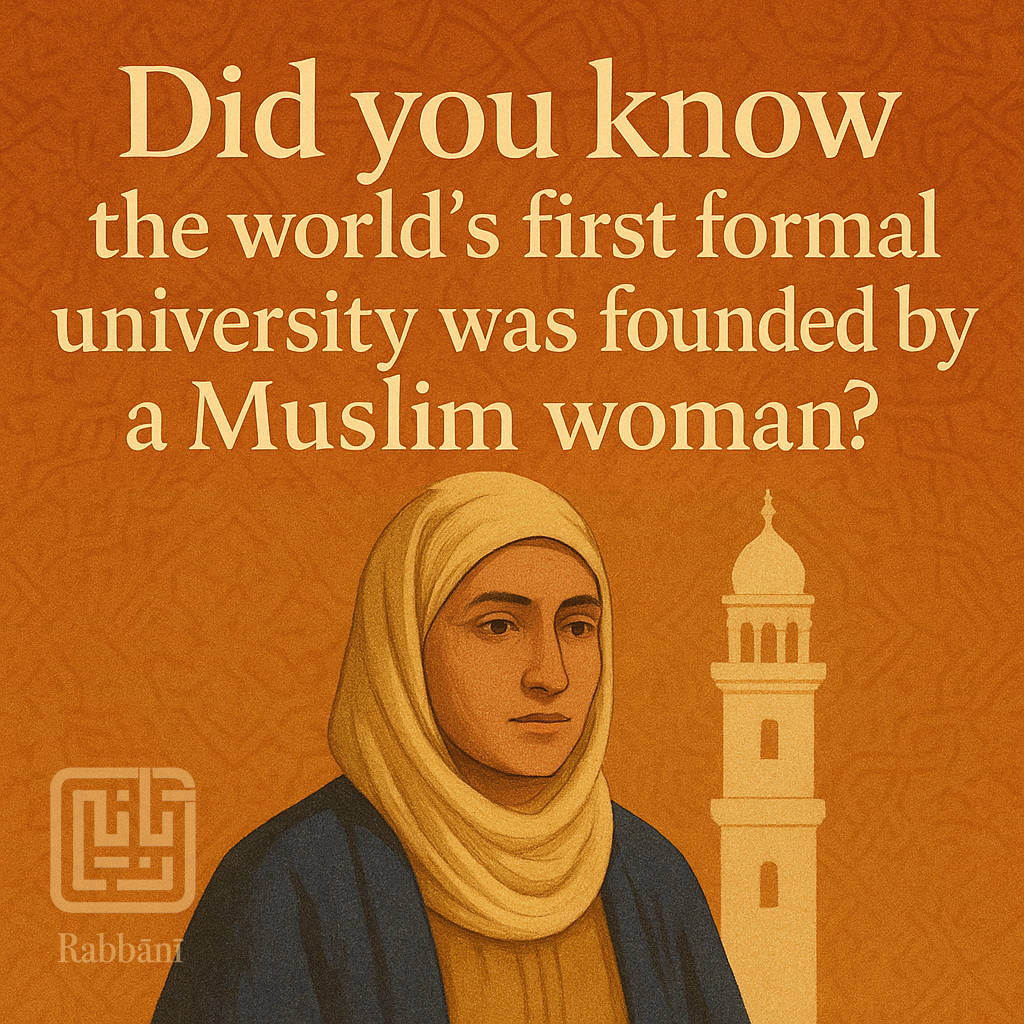
Muslim civilisation revolutionised education by designing institutions that united spiritual, legal, and scientific learning. Fatima al-Fihri, a Muslim woman in Morocco, founded the University of al-Qarawiyyin in 859 CE, the world’s oldest continually operating degree-granting institution. Her legacy shows how women helped sustain and fund educational excellence.
In West Africa, Ahmed Baba of Timbuktu, who authored more than 40 books on law, biography, and ethics, embodied the intellectual brilliance that made Timbuktu as respected as any European centre of learning. Even when Moroccan invaders exiled him to Marrakesh, his scholarship commanded respect, and he eventually returned to revive Timbuktu’s traditions.
Equally inspiring, Nana Asma’u of 19th-century Nigeria trained networks of female educators (yan-taru) and wrote poetry and theology in Arabic, Hausa, and Fulfulde, extending literacy and spiritual knowledge throughout the Sokoto Caliphate.
These institutions offered far more than theology: their curricula included medicine, astronomy, mathematics, grammar, and philosophy, attracting scholars from across Africa, the Middle East, and even Europe. They were open, cosmopolitan spaces that nurtured critical thinking and diversity, centuries before Europe’s universities caught up.
Art, Culture, and Daily Life
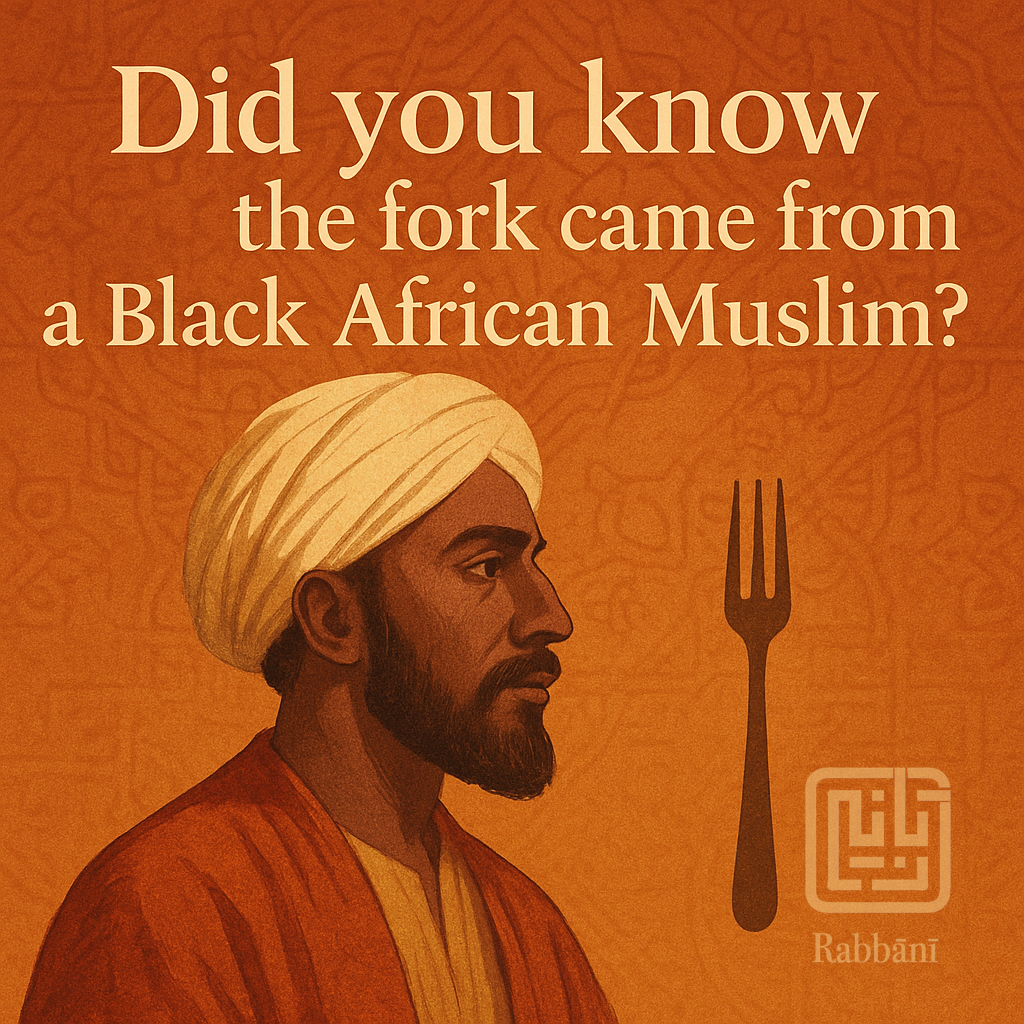
Perhaps nowhere was cultural brilliance more visible than in the story of Abu l-Hasan ʿAli Ibn Nafiʿ — known as Ziryab, the ‘Black Bird’. Born to a family who had been enslaved, most likely of Black African descent, Ziryab arrived in Cordoba in the 9th century and redefined taste itself. He expanded musical scales, added a fifth string to the oud, and established a structured method of teaching music that would echo through Europe for centuries.
“The fork, now held up as the badge of ‘civilisation,’ was popularised in Europe by a Black African Muslim.” — from the section on Ziryab
“They weren’t relics. They were receipts.” — on the Timbuktu manuscripts
He also transformed daily life by introducing crystal drinking vessels, organising meals into separate courses, encouraging regular hygiene, designing seasonal wardrobes, and even popularising the small two-pronged fork for delicate foods — centuries before Europe claimed it as its own. That fork would eventually spread across France and the continent, yet no one credited its origins.
In today’s world, where politicians shame people like Zohran Mamdani for eating with their hands, there is a profound irony: the fork, now held up as the badge of “civilisation,” was popularised in Europe by a Black African Muslim.
A Note on Eating With the Hand
The uproar over Zohran Mamdani’s video of eating rice with his hands shows how colonial thinking still lingers. Across Africa, India, and the Arab world, eating with the hand is rooted in ancient tradition, mindfulness, and even spiritual symbolism — linking the five fingers to the five elements of nature.
Western colonisers once labelled this practice “uncivilised,” forgetting that their prized utensil, the fork, came into European culture through Ziryab’s refined innovations. France and other parts of Europe embraced the fork over centuries, yet rarely acknowledged its roots.
As Shaykh Allie Khalfe wisely reminds us, the problem is not about etiquette, but about power, prejudice, and historical amnesia — a colonial hierarchy that still tries to shame non-European cultures while quietly living on their forgotten innovations.
Conclusion
The Golden Age of Africa and Islam was never lost — it was hidden, buried beneath centuries of colonial arrogance, racism, and cultural erasure. From the hospitals of Cairo to the libraries of Timbuktu, from the universities of Fez to the concert halls of Cordoba, from the Grand Library of Baghdad — Bayt al-Ḥikmah — to the scholars who charted the stars, our ancestors nurtured a world of knowledge, beauty, and moral excellence that still resonates today.
These contributions were not accidental: they were born of a civilisation that valued intellectual curiosity, hospitality, faith, and human dignity. In their pursuit of learning, these scholars and visionaries created bridges between continents and cultures, carrying forward a spirit of trust in God (tawakkul) and service to humanity.
Today, recovering these stories is not about boasting or chasing nostalgia — it is an act of healing, of reclaiming the confidence, pride, and resilience that colonial narratives tried to crush. Our children deserve to inherit a truthful memory of who we are: people who illuminated the world, built institutions of compassion and reason, and shaped the very frameworks of science, art, and law.
Let us honour this legacy not with empty slogans, but by living it — teaching it, protecting it, and carrying it forward as a sacred trust (amanah). For if our ancestors could rise from the chains of conquest and slavery to become authors of civilisation, then we too can rise, with God’s help, to build a world of justice, knowledge, and mercy once more.
We were never just subjects of someone else’s story. We wrote. We built. We mapped. We healed.
And the pages are still here.
We don’t just have history. We have receipts.
And now — we remember.
References
1001 Inventions: The Enduring Legacy of Muslim Civilisation, ed. Salim T.S. Al-Hassani
George Saliba, Islamic Science and the Making of the European Renaissance (2007)
John Hunwick, “Ahmed Baba: Intellectual of Timbuktu,” Sudanic Africa (1997)
Beverly Mack & Jean Boyd, One Woman’s Jihad: Nana Asma’u, Scholar and Scribe (2000)
Amira K. Bennison, The Great Caliphs: The Golden Age of the Abbasid Empire (2009)
Gülru Necipoğlu, The Age of Sinan (2005)
Toby Green, A Fistful of Shells: West Africa from the Rise of the Slave Trade to the Age of Revolution (2019)
The Mother Tongue of Tasbih: Afrikaans, Islam, and the Echoes of Resistance
An Interlude of Love, Argument, and Memory
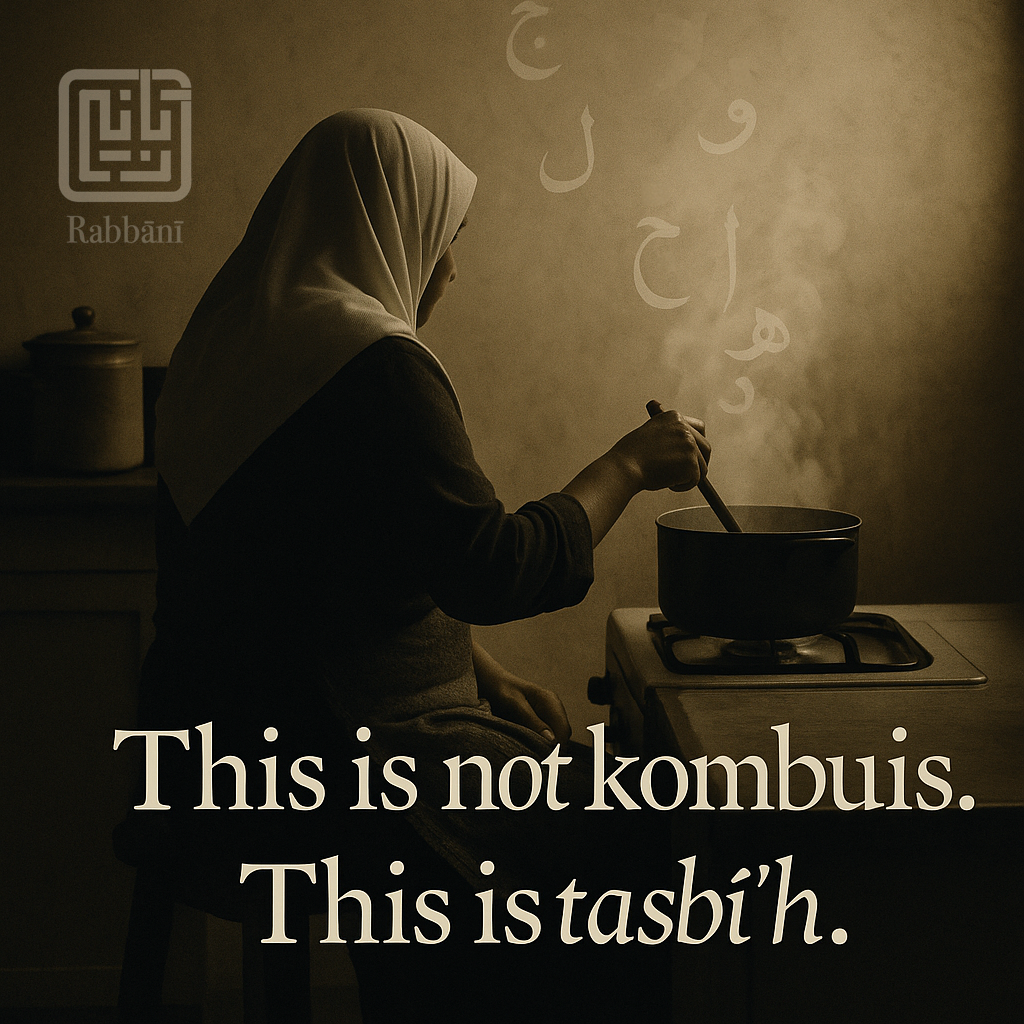
We were driving down a quiet stretch of road — just Sadia and I, the Karoo light pouring in through the windscreen, dust swirling around like old questions. She had grown up in Worcester, her Afrikaans carefully folded by teachers and ‘ustaads’, wrapped in the formal tones of schoolbooks and sermons — so different from the swing and slang I had grown up with in the Cape. I, on the other hand, had grown up with a different register: kombuis-Afrikaans, spoken in kitchens and mosques, spiced with Quranic rhythm and Kaapse mischief.
Somewhere between the mountains and memory, we argued.
“That’s not real Afrikaans,” she said, teasing. “You make up words.”
“And who decided what’s real?” I asked. “The Broederbond? The DRC? The state that tried to baptize us in its accent?”
She laughed — but the question lingered.
This is not just a story of a couple’s linguistic banter. It is the story of a language born in exile, nurtured in slavery, softened by Qur’an, and carried through generations of prayer, protest, and poetry. This is a story of Afrikaans — not as the language of the oppressor, but as the tasbih of the oppressed.
1. Afrikaans: Not a White Invention
Let’s begin here: Afrikaans was not born in Stellenbosch.
Its roots run through Cape Malay kitchens, slave quarters, mosque courtyards, and prayer gatherings beneath candlelight. It was whispered by Javanese mothers exiled from Batavia, recited by Wolof imams from Senegambia, taught by Hadrami scribes, and softened by the Khoena tongues of this land — long before colonial grammarians arrived to cage it in rules..
The historian Achmat Davids was among the first to challenge the myth that Afrikaans was solely a “white man’s language.” His pioneering research, later extended by Hein Willemse and others, traced Afrikaans’ earliest written form to the Muslim community of the Cape — not in Latin script, but in Arabic-Afrikaans, or what was sometimes called Ajami Afrikaans.
One of the oldest surviving texts in Afrikaans is a du’a (supplication) manual written in Arabic script by enslaved Muslims. Another is the 1869 Bayān al-Dīn, a complete Islamic catechism in Afrikaans, used for madrassah instruction. These works prove something scholars of empire often resist: that enslaved and colonised peoples were not passive recipients of a language. They reshaped it. They sanctified it. They infused it with rhythm, resistance, and remembrance.
Afrikaans was not merely a colonial bastard tongue. It was — and remains — a mother tongue for many, especially when that mother stood stirring boeber while reciting Qul Huwa Allahu Ahad under her breath.
2. Creole? Or Camissa?
I’ve always had difficulty with the word creole.
Not because I reject mixedness — quite the opposite. I honour our intertwined bloodlines, the sacred chaos of diaspora, the rivers that met and mingled here at the Cape. But because the term creole, as used by certain linguists, often carries a quiet violence: it frames our language as a compromise, a simplified system born of broken tongues. It reduces what is sacred into something stitched from scraps. As if kombuis-Afrikaans was the language of people who couldn’t speak properly — not of people who chose to pray differently.
And too often, creole becomes a coded term for “coloured.” A linguistic way of saying not-white, not-black, not-arabic, not-european — just other.
I prefer another term: Camissa. As Patric Tariq Mellet reminds us, Camissa was the name of the river that once flowed through the Cape Flats, long before the Dutch buried it under stone. It was also the name of the Goringhaicona clan who traded with the world before colonial maps erased them. To speak Camissa-Afrikaans is to remember we are not defined by brokenness — but by confluence.
So no, what we speak is not a creole. It is the tasbih of the kitchen, the dhikr of the dockyard, the language of longing. What they call kombuis, we call home.
3. The Language of Tasbih
In our home, Afrikaans was not the language of textbooks or term reports. It was the language of tasbīḥ — of remembrance, rhythm, and breath.
Thursday nights, just after maghrib, the living room would dim into stillness. A cloth was spread. The Rātib al-Ḥaddād would begin. First a whisper: Qul huwa Allāhu Aḥad… Then a swelling chorus — women’s voices, children’s murmurs, old men with trembling hands.
We called it the Gadat. It was recited in Arabic, but held together by Afrikaans: the instructions, the rhythm, the murmured cues. “Ouens, netjies!” “Hou die beat mooi!” “Moenie vinnig ry nie — luister na die kalmte.”
Sometimes, someone would break from the dhikr to hush a restless child. “Shhh, dis nou Allāh se tyd, my kind.” That now — that insistence that this moment of prayer was sacred and immediate — still echoes in my chest.
And when it was done, a sweetness returned: koesisters passed hand to hand, boeber ladled with care, stories resumed in Kaaps lilt. The tasbīḥ was complete — not just in recitation, but in the return to one another.
…
In his later years, my father told me how the elders taught Qur’an in Afrikaans before Arabic letters could be properly mastered. Children would chant: “Alif duwa detis, Alif duwa bowa, Alif duwa dappan, An In Oen.” It was a phonetic bridge — an echo of how Javanese, Malay, and Arab teachers preserved tajwīd in a tongue the children already knew.
This wasn’t a lack of Arabic. It was a path to it.
And it wasn’t unique.
In Senegal, Wolof Muslims chant dhikr in their own rhythms. In Indonesia, pegon script preserves the Qur’an in Javanese hearts. At the Cape, Afrikaans — even in its kitchen form — became the vessel through which the Names of God entered the ears of children.
Afrikaans was never just a tool of survival. It was a tool of transmission.
Of tawḥīd in a tongue our mothers understood.
4. Jawap: The Command to Recite
In the old madrassah, silence was not golden — it was a gap in the chain of transmission. A break in the rhythm. A forgetting.
And so, when your voice faltered or your memory stalled, the mu’allim would lean forward — not with cruelty, but with urgency — and say:
“Jawap, my kind!”
Not shout. Not plead. But command. Recite. Respond. Step back into the rhythm.
Because in the Cape, jawap was never just “answer.” It was a summons — to speak, to return, to carry what you’ve been given.
The word comes from the Arabic ج و ب — jawāb, meaning “reply,” and ijābah, the act of answering a call. But in Afrikaaps, jawap widened its reach. It meant:
Recite the ayah.
Step into the beat.
Don’t let the tasbīḥ fall silent.
You could hear it outside the masjid too — In a kitchen when someone moved too slow:
“Jawap nou! Die kos gaan brand!” In a playful quarrel between siblings: “Ek wag vir jou jawap, dan sal jy sien!”
But the root remained sacred.
To jawap was to not let the memory die. It was to pull the verse from the chest, even if the chest was tight. It was to let the breath carry the Names of God, even when the tongue stumbled.
…
Some nights, I’d sit with my father as he corrected a cousin’s recitation. He never raised his voice. Just waited for the right moment and said, gently but firmly:
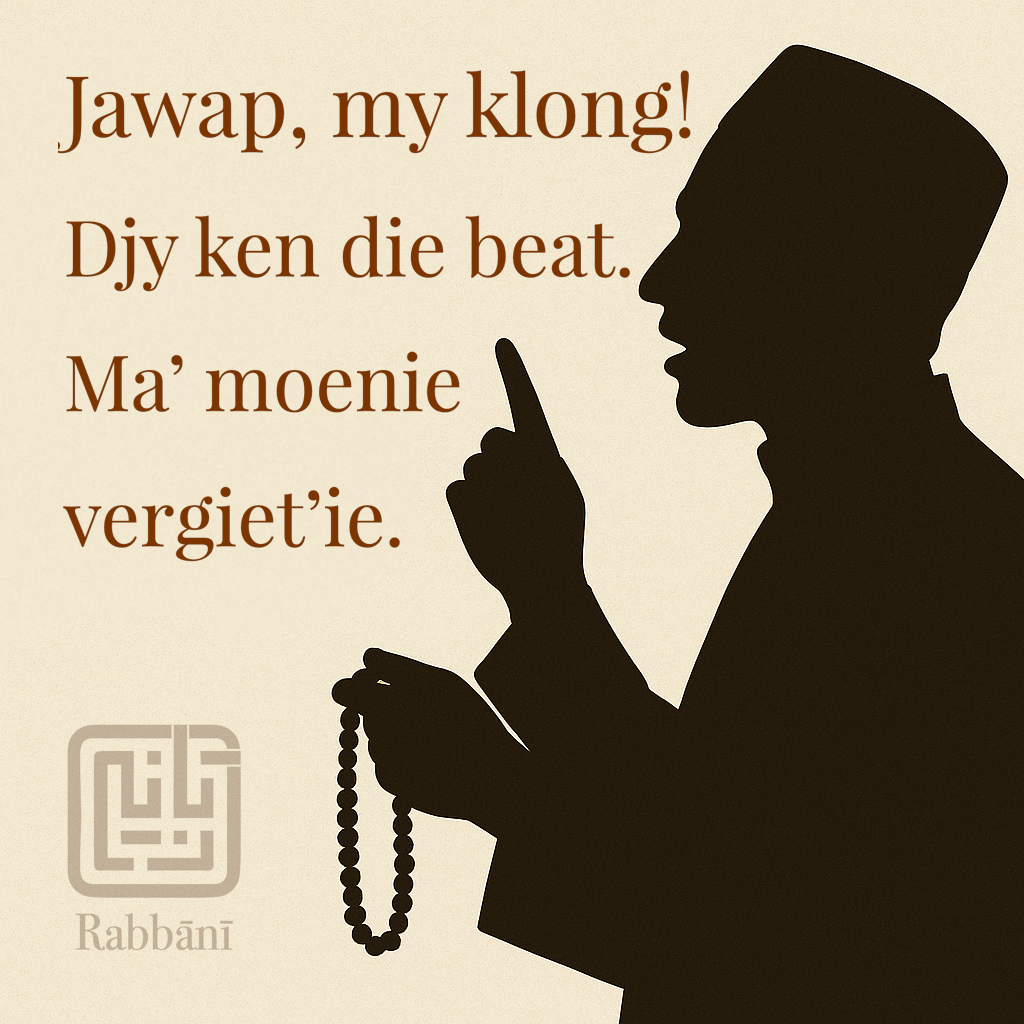
“Jawap, my klong! Djy ken die beat. Ma’ moenie vergiet’ie.”
That sentence lives in me.
And I wonder now if that’s what the Qur’an itself asks of us:
Fa-ijībū li… So respond to Me… (Qur’an 2:186)
Not just with belief, but with voice. Not only with intellect, but with breath.
To live is to jawap. To remember is to jawap. To teach, to protest, to praise — is to jawap.
And maybe that’s why the Gadat still echoes through the Cape — Not because we’ve mastered every rule of tajwīd, But because someone once told us:
“Don’t keep quiet. Jawap.”
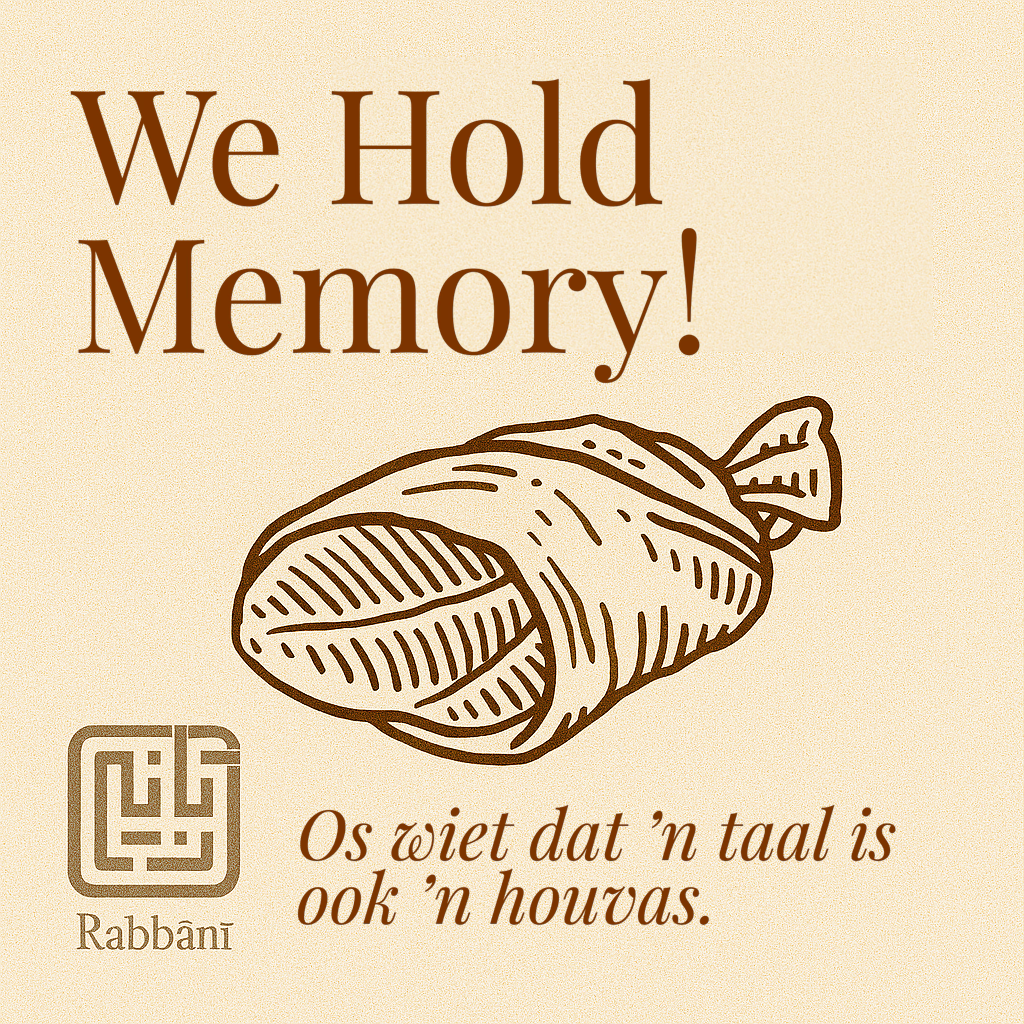
A salomie is how we hold history — wrapped in warmth, passed from hand to hand. To live is to jawap. To resist is to remember what we’re made of.
5. Echoes of Resistance: A Language That Refused to Die
To speak Afrikaaps was once considered vulgar. Uneducated. Low. The language of skollies, meidens, and kitchen girls. The official line was clear: proper speech belonged to white mouths and white pulpits.
But at the Cape — in Salt River, Bo-Kaap, Parkwood, Belhar, and Bonteheuwel — our people spoke tasbīḥ in their own tongue.
And that was resistance.
They recited Qur’an with Kaapse inflections. They sang dhikr in alleyways, under washing lines, between the Sunday curry and the Monday washing. They wrote duʿāʾ in Arabic script — with Afrikaans vowels — because the state’s education system wouldn’t teach them Arabic, and the imām couldn’t write Latin.
This wasn’t survival. It was sovereignty.
When the tongue of the oppressor tried to rename us, we jawapped back with remembrance. When they broke our schools, we turned kitchens into classrooms. When they mocked our accent, we sharpened it into poetry.
And in that echo, you can still hear the names of the early reciters: Tuan Guru teaching on Robben Island. Imam Saban writing Bayān al-Dīn for the children of slaves. Ouma Gatie sitting in her chair, reciting Yā Sīn in Afrikaans until her teeth ached — and her soul rose light.
Even Apartheid’s Bible — the 1933 Afrikaans translation — couldn’t erase the sound of tasbīḥ in our streets. Because we had our own Book, our own rhythm. Our mothers wrapped Qur’an verses in the same cloth they wrapped around your lunch tin: tight, warm, enough.
…
To remember in Afrikaans — to teach La ilāha illā Allāh with a Cape tongue — is not just a cultural artefact.
It is a form of sabr. Of jihād. Of wilfully remembering what empire tried to make us forget.
And so even now, when I hear a child reciting in Afrikaaps, I don’t correct the accent.
I listen for the memory in the melody. Because sometimes, the resistance is not in the grammar — It’s in the breath.
Theatre as Tasbīḥ: Walking Through 333 Years
In 1986, the Call of Islam commemorated 333 years of Islam in South Africa — not with a speech, but with a play.
“A Walk Through 333 Years” was a theatrical act of remembrance: combining Qur’anic recitation, storytelling, song, and dramatic re-enactment of Muslim life from enslavement to resistance.
Directed by a community professional, informed by the late Achmat Davids’ research, and carried by a cast of ordinary believers, the play jawapped our history with full breath. It wasn’t just performance — it was pedagogy.
The production travelled across the country and left audiences moved in ways no pamphlet or sermon could match.
Like tasbīḥ in the kitchen or dhikr in the alleyway, this was language at work — resisting, remembering, reclaiming.
Because sometimes, the resistance is not just in the grammar.
It’s in the gathering. It’s in the jawap. It’s in the walk through our own years — together.
6. Tongue, Tasbīḥ, and the Right to Return
So what is a language?
A dictionary will tell you it’s a system. A grammar. A structure of rules.
But we — the people of kombuise and kramats, of ratibs and roti — we know different.
We know that a language is also a holding. A way to wrap memory is like a salomie wrapped in a roti — not for perfection, but to preserve warmth.
We know that Afrikaans is not only the language of the jailer — it is also the jawap of the jailed. It is the rhythm of the Qur’an under colonial roofs. It is the sound of mothers whispering Bismillah while brushing a child’s hair. It is the beat of “Moenie vergiet’ie” — not as a threat, but as a prayer.
If they ask us who we are, we might say: We are the children of those who answered with breath when the world tried to silence them.
We are the ones who recited even when we could not read. Who made dhikr in a tongue they said was impure. Who kept the memory of revelation alive — in kitchens, classrooms, corners of mosques, and hearts that stammered but never surrendered.
…
And so, if anyone asks:
What kind of Afrikaans is this?
Tell them gently:
This is not the Afrikaans of the oppressor. This is the mother tongue of tasbīḥ. The language of jawap. The rhythm of remembrance. This is the tongue that taught us to speak back to the silence — and return to God with our own breath, in our own way.
Because what they called kombuis, we called home.
📚 Footnotes & References:
Achmat Davids, The Afrikaans of the Cape Muslims from 1815 to 1915: A Socio-Linguistic Study, UCT PhD Thesis, 1987. Foundational in establishing the role of Arabic-Afrikaans and Cape Muslim literacy practices.
Hein Willemse, editor and scholar of Afrikaans literary traditions, particularly around marginalised and non-standard variants. Relevant essays include: “Language, Race and Power in South Africa.”
Patric Tariq Mellet, The Lie of 1652: A Decolonised History of Land, and various writings on Camissa identity and language reclamation.
Adli Jacobs, Punching Above Its Weight: The Story of the Call of Islam, Function Books, 2024, p. 84. Documents the Call of Islam’s 1986 theatrical production “A Walk Through 333 Years”, co-developed with historian Achmat Davids. This performance combined Qur’anic recitation, song, and drama to embody the memory of Islam’s journey from slavery to resistance in South Africa.
Qur’anic verse cited: Qur’an 2:186 — “So respond to Me (fa-ijībū li) and believe in Me, that they may be rightly guided.”
Oral traditions and family sayings (e.g. “Jawap, my klong. Jy ken die beat.”) Attributed to the author’s father, part of Cape Muslim living heritage.
Arabic-Afrikaans manuscripts (e.g. Bayān al-Dīn, Ratib al-Ḥaddād in Arabic-Afrikaans): Refer to holdings in the National Library of South Africa, Clarke Estate Mosques, and private Cape Muslim collections.
Laagu vs Tajwīd debates and Thursday night Gadat gatherings: Drawn from oral sources and lived practice in Cape Town’s Muslim communities. May cite the influence of Shaykh Seraj Hendricks, Imam Taha Gamieldien, and Imam Abdullah Haron’s legacy of fusing dhikr with defiance.
🪶 Related Articles in This Series:
The Forgotten Tongue of Remembrance A reflection on Arabic-Afrikaans, the erased voices of dhikr, and the linguistic tenderness that survived colonial erasure.
Tamat: A Sacred Completion, A Living Beginning Explores the Cape Muslim tamat ceremony as both rite of passage and living echo of West African, Javanese, and Arab pedagogical traditions.


 Adli Yacubi