Tag: Story

  • Tamat: A Sacred Completion, A Living Beginning
    Tamat: A Sacred Completion, A Living Beginning

    Tamat: A Sacred Completion, A Living Beginning

    The word Tamat has been spoken in Cape Muslim homes for generations — a word so small, yet carrying the weight of centuries of memory. It is more than a graduation. It is a celebration of sound, of presence, of a child who has taken the Qur’an into their tongue and heart, and who now steps forward to carry it into the world.

    Our grandparents knew this word from Hadramaut, where the Tamat was a festival of joy and responsibility. When a child completed their Qur’an recitation, they were gathered into a seven-day procession of voices, prayers, and sweets — with flags raised high, neighbours cheering, and the whole community celebrating the future. It was never just about memorising verses, but about honouring the discipline of correct recitation, Tajweed, manners, and knowledge that could anchor a whole community.

    These children wore the banus, a beautifully embroidered cloth, reserved just for Tamat days. Banners would shimmer with Surah al-Fatihah and Ayatul Kursi waving above their heads, as if to shield and guide them on their new journey. Their teachers, the elders, and even passing strangers would bless them — because everyone understood: this child will serve, protect, and live the Qur’an (based on Sheikh Jamiel Abrahams, 2025).


    When Tamat Reached the Cape

    When Hadrami scholars and teachers arrived at the Cape of Good Hope, they brought this deep tradition with them, adapting it to new winds and new stones. In places like District Six, Bo-Kaap, and beyond, the Tamat found fresh soil.

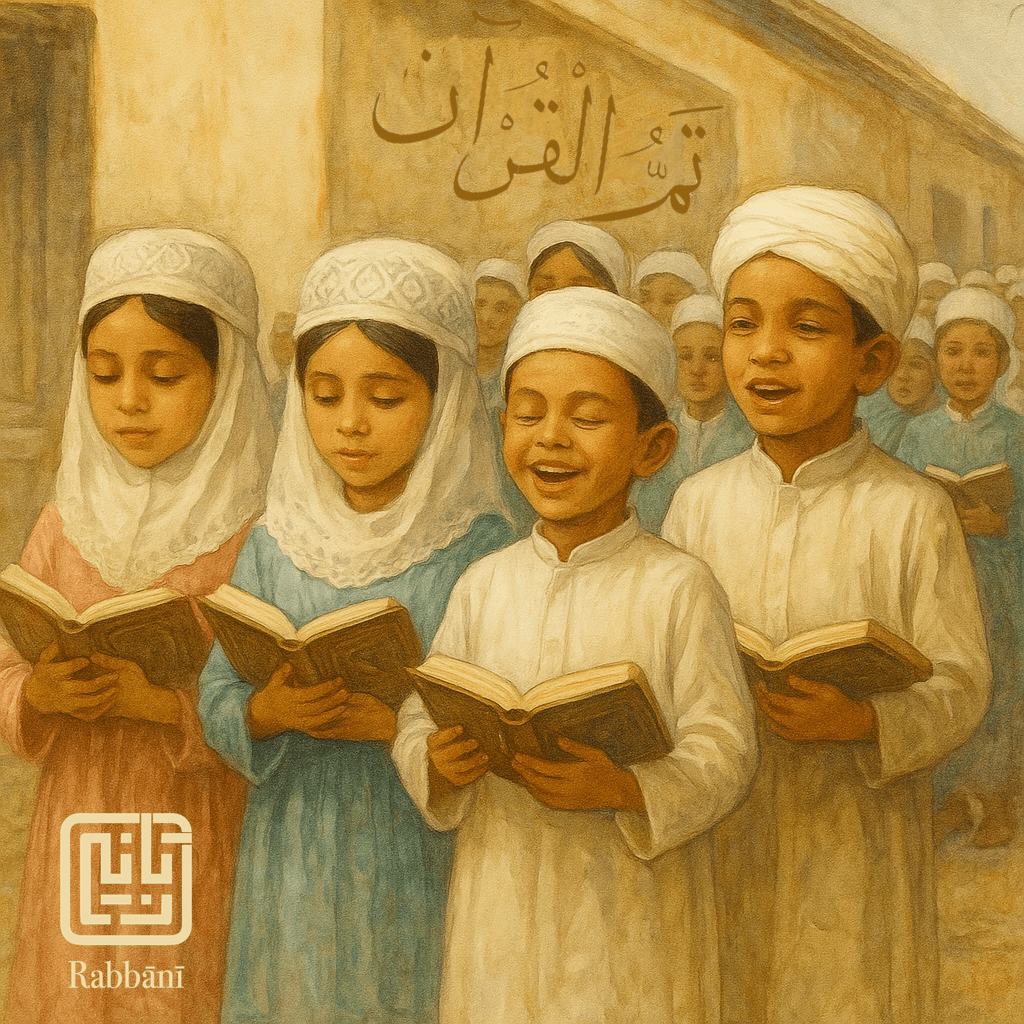
    Cape children would gather in the masjids, reciting the final chapters they had laboured over line by line, vowel by vowel. Then they would step out, dressed in their sorbaan and medora, and walk proudly along the cobbled streets. Their path sometimes led them all the way to the Company Gardens, deep in the colonial centre of Cape Town — an act of courage and pride that seemed to say, “This Qur’an walks with us too.”

    In those moments, they were not just finishing a book. They were claiming a legacy.


    The Meaning of Sorbaan and Medora

    The garments of Tamat still speak.

    For the boys, the sorbaan is a turban, but far more — a Khirqah al-Taḥkīm, a sign of trust. It wraps the head with a promise: you are now a guardian of Qur’an, carrying its mercy and its responsibility.

    For the girls, the medora — circular, beautifully embroidered in gold or silver threads — holds the same dignity. It says: Your voice, too, is worthy. Your recitation is precise. Your role is essential.

    In both, there is no sense of “fashion” — only inheritance.


    A Tapestry of Cape Heritage

    What makes Tamat so powerful is how it weaves into a far bigger story. It stands alongside the handwritten kitāb manuscripts passed down through Cape families, and the huffādh who still recite on local radio during Muharram (VOC Khatam broadcast, 2025). It echoes in the walls of the Auwal Mosque, where Tuan Guru — himself a prisoner and Qur’an teacher — copied out the entire Qur’an from memory in chains, so that his community would not lose its light.

    It whispers through the kramats encircling Cape Town, the shrines of saints and scholars who carried Islam through exile, and who insisted that education was the best shield against forgetting who we are. Many of these traditions, as documented in works like Al-Istizādah min Akhbār as-Sādah compiled by Ali bin Muhsin al-Saqqaf, travelled with Hadrami scholars to the Cape and found new expression in the garments, recitations, and community gatherings of local Cape Muslim life.

    It even rests quietly in the Tana Baru cemetery, where generations of those who lived the Qur’an are buried, their tombstones telling silent stories of resilience.


    Beyond Memorisation

    One of the most powerful aspects of Tamat, especially in the Cape tradition, is that it was never simply about memorising words.

    Children were trained in correct pronunciation, rhythm, and understanding. They were questioned on the essential knowledge of their faith, from acts of worship to everyday etiquette, and the rights and responsibilities of being a Muslim in society.

    Their teachers, elders, and neighbours stood witness that these children had become competent not only in their individual acts of worship (furoodh ayniyyah) but also in their ability to serve the community (furoodh kifayah): to lead prayer, to help wash and bury the deceased, to read du‘ā for the sick, to keep society upright.

    In this way, Tamat was never a personal achievement alone, but a communal guarantee of resilience.


    Echoes in Bosmont

    Though times have changed, the spirit of Tamat still lives on. Take, for example, the Bosmont madrassa in the 1970s, where 15 young boys and girls graduated after years of Qur’anic training. Their ceremony was called Gatmeid Koran — a name with the same spirit as Tamat.

    Six boys and nine girls, only twelve to fourteen years old, stood before thousands of family members and neighbours, reciting what they had carried line by line, vowel by vowel. The hall was so full that people pressed against the windows to watch.

    It was more than a prize-giving. It was a moment of pride, of hope, of handing the Qur’an over to the next guardians of its sound and meaning.

    Imams and teachers from all over — including Durban, Cape Town, and the Transvaal — came to witness these children take their place in the living chain of knowledge. There was even a colourful procession through the streets, a tradition of honour that stretched all the way back to Hadramaut.

    They were not just students. They were being trusted to live the Qur’an: to hold its discipline, to guard its standards of moral character, to shine it into their communities.

    (Source: newspaper clipping shared by Sheikh Jamiel Abrahams, c. 1970s)


    A Living Beginning: Our Echoes, Our Hope

    In every child who ties the sorbaan or drapes the medora, there lives a promise. A promise that the Qur’an will not only be memorised, but lived — that its rhythms will shape how we speak, how we act, how we serve.

    From the echo of Hadramaut’s processions, to the cobbled streets of District Six, to the crowded halls of Bosmont where children stood reciting before thousands — Tamat has remained a celebration of beginnings, not endings.

    These ceremonies remind us that we are never alone. We stand in a line of teachers, elders, and ancestors who trusted the Qur’an to transform us, generation after generation.

    As long as there is a child willing to steady their breath, to learn its melody, to carry its mercy into the world, then our communities will never be without light.

    That is the heartbeat of Tamat.
    That is why it will always matter.
    And that is why it must continue.
    A Closing Du‘ā

    O Allah, accept from these children what they have learned,
    strengthen their tongues in Your remembrance,
    open their hearts to Your wisdom,
    and grant them the courage to carry Your Book with mercy and justice.
    Make them lanterns for their families,
    protectors for their neighbours,
    and guides toward goodness.
    And let every letter they have recited be light on their path
    in this world and the next.
    Ameen.


    References woven into the narrative:

    • Sheikh Jamiel Abrahams, Tamat, Its Origins and Objectives (2025)
    • VOC Radio Cape Town annual Khatam broadcast (2025)
    • Tuan Guru’s Qur’an manuscripts at Auwal Mosque (Wikipedia)
    • Tana Baru Cemetery (Wikipedia)
    • ourcapetownheritage.org on Cape Kramats (source)
    • Aramco World, Handwritten Heritage of South Africa’s Kitabs (source)

    📖 Read more at: Scroll of Sorbaan & Medora
  • Hājar: The Black Mother Whose Faith Turned the Heart of Hajj

    Hājar: The Black Mother Whose Faith Turned the Heart of Hajj

    Hājar: The Black Mother Whose Faith Turned the Heart of Hajj

    With deep gratitude to all who preserve these sacred stories.


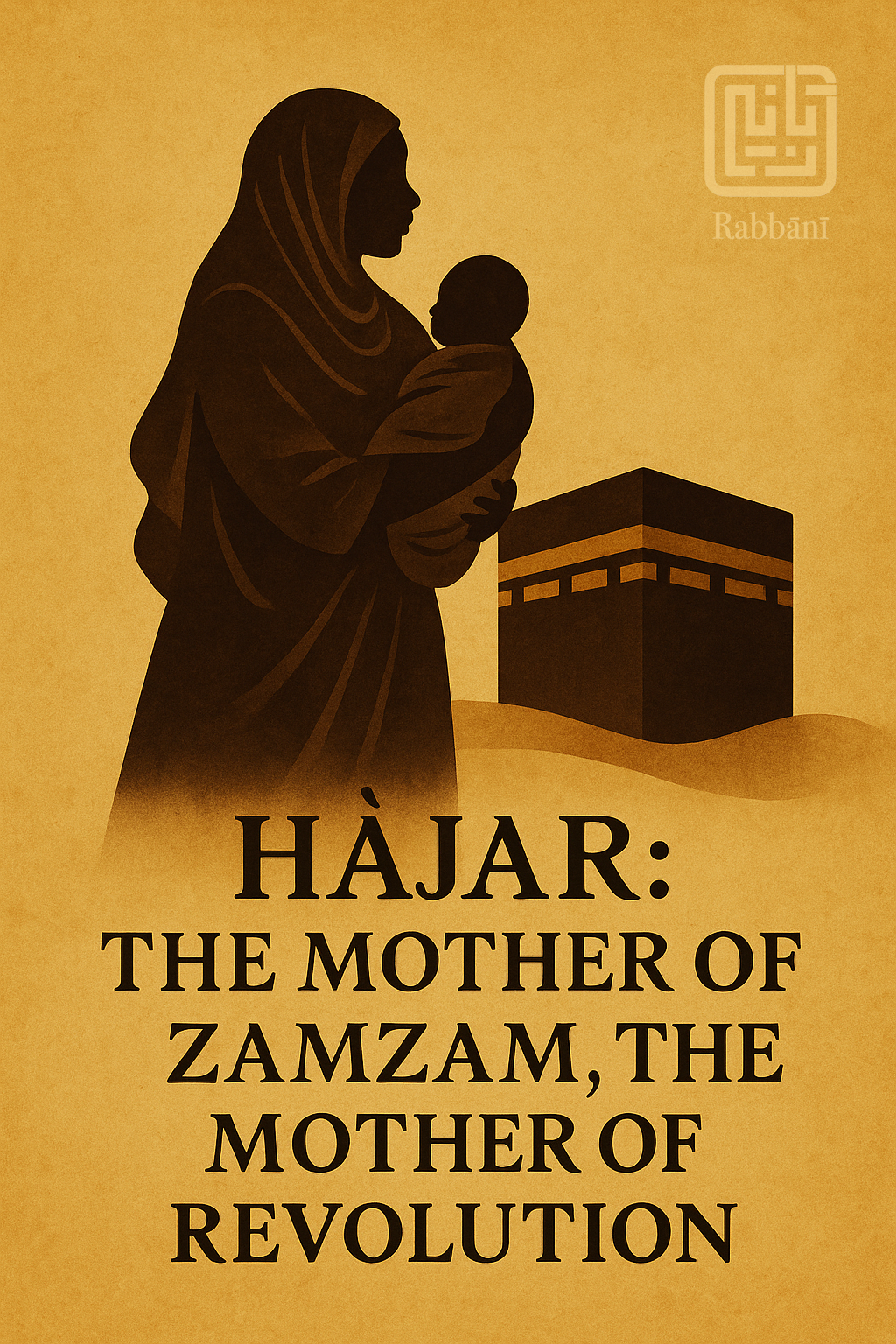
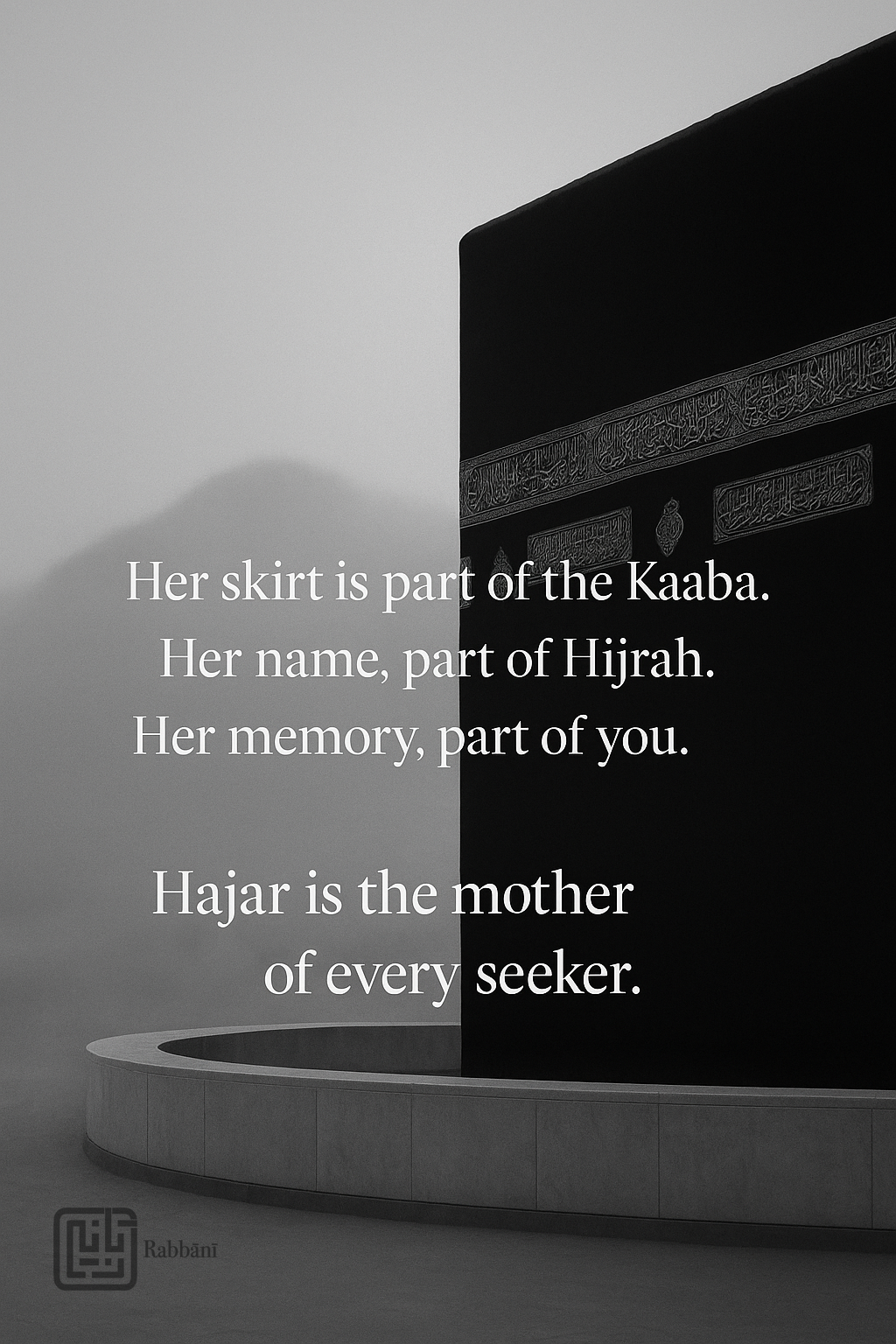
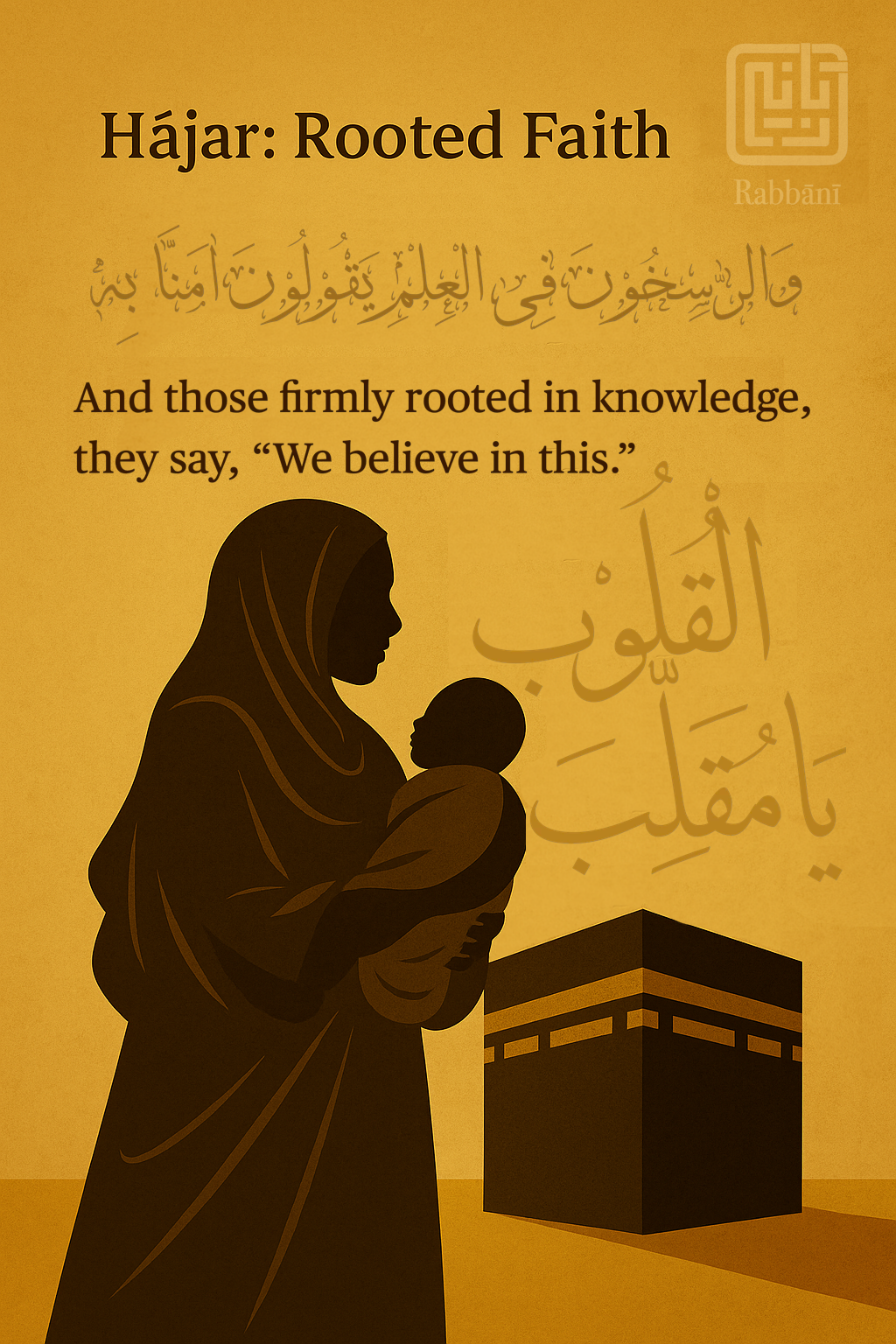
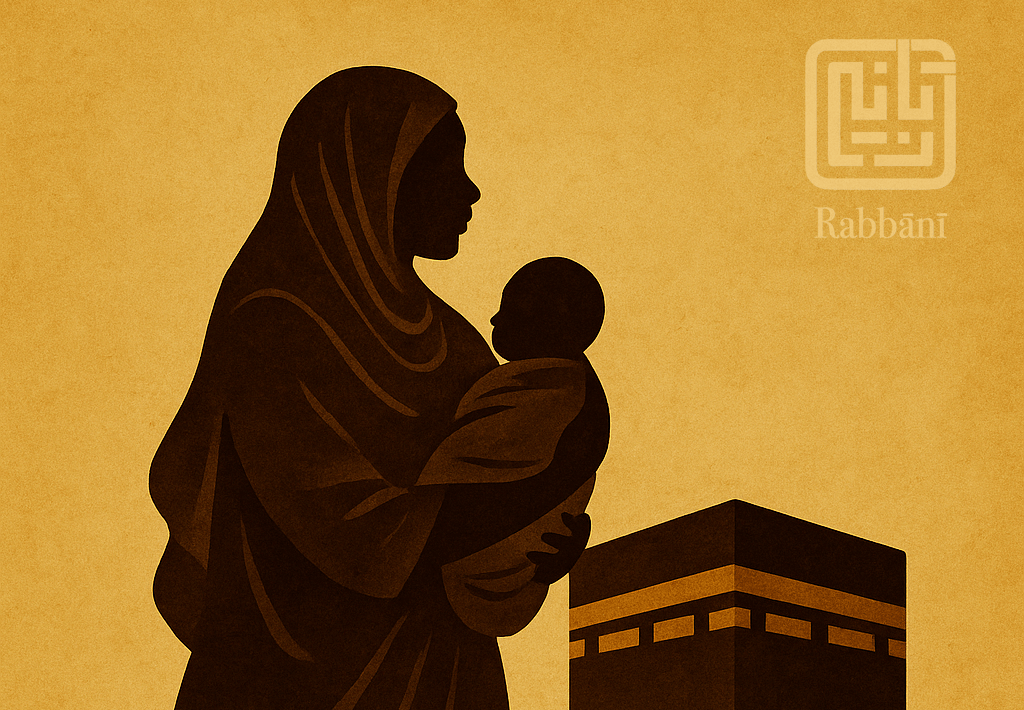
    A digital silhouette of Hājar holding her infant, depicted against an ochre background with the Ka‘bah in the distance. The text reads: “Hājar: The Mother of Zamzam, The Mother of Revolution.”

    Introduction

    Hājar — a Black African woman, enslaved and then displaced — was chosen by Allah to become the mother of Ismāʿīl, and to have her house absorbed into the sacred geometry of the Kaʿbah itself.

    Not a prophet.
    Not a queen.
    Not a caliph.
    But a mother. A servant. A Black woman.

    The House of Allah bows toward her grave.

    Ali Shariati called her the “Unknown Soldier” of Islam. But Allah made her known forever — through Zamzam, through Safa and Marwa, through the sacred enclosure known as Ḥijr Ismāʿīl. You cannot perform Hajj without acknowledging her. That is not just history. That is revolution.

    When I look across the ummah today — from Cape Town to Cairo, Timbuktu to Jakarta — I see faces of every shade, hearts carrying a message revealed for all people, for all time. Yet too often, I also see shadows of forgetfulness, places where racism still stalks our communities.

    Hājar’s story stands to remind us:
    Allah honours whom He wills.


    1️⃣ Introduction to Hājar’s Background

    Hājar was an African woman, described in traditional sources as a servant of Sarah, married to Ibrahim (a.s), and the mother of Ismāʿīl. She was displaced, left alone with her child in a barren valley with no shelter or food, yet her faith did not break.

    When Ibrahim prepared to leave, she asked him only one question:
    “Has Allah commanded you to do this?”
    He said yes.
    And she replied:
    “Then He will not abandon us.”

    In those words, you hear an entire revolution of trust.


    2️⃣ The Test in the Valley

    Ibrahim (a.s) left them in that desolate place, answering Allah’s command. Hājar stood alone, with her child crying from thirst, under a burning sun. The Qur’an echoes Ibrahim’s prayer for them in Surah Ibrahim (14:37):

    “Our Lord, I have settled some of my descendants in an uncultivated valley near Your sacred House, our Lord, that they may establish prayer…”

    While Ibrahim placed his trust in Allah and walked away, Hājar held the child close and placed her trust in Allah while staying put.


    3️⃣ The Sa‘y of Hājar

    The baby, Ismāʿīl, cried in hunger. Hājar’s heart broke, but she did not surrender to despair. She ran to Safa, looking for water. Then to Marwa. Then back again. Seven times she ran between those hills, searching, hoping, refusing to quit.

    This was not a ritual yet — this was a desperate mother in motion, placing faith in her feet as well as her heart.

    Allah loved that moment so much that He turned it into an act of worship until the end of time. The Prophet ﷺ established the sa‘y as a pillar of both Hajj and ʿUmrah, hardwiring Hājar’s courage into the fabric of Islamic devotion.


    4️⃣ Zamzam: The Well of Mercy

    After her seventh run, the angel of Allah appeared, striking the earth where Ismāʿīl’s heels had kicked, and water gushed forth. Hājar rushed to gather it, crying “Zamzam, Zamzam” — gather, gather.

    What an image:
    A mother shaping the flow of a spring that would sustain a civilization.

    Even today, millions drink Zamzam, quenching their thirst from the miracle granted to her trust.


    5️⃣ Zamzam and the Birth of Quraysh

    From Zamzam, life returned to that valley. Birds gathered, signaling water, and desert tribes came to settle there with Hājar’s permission. From these settlements, a community grew, and over centuries, the Quraysh tribe took shape — the tribe that would eventually protect the Kaʿbah and see the birth of the Prophet ﷺ himself.

    Allah reminds Quraysh of these blessings in Surah Quraysh:

    “Let them worship the Lord of this House, Who has fed them against hunger and made them secure against fear.”
    (Qur’an 106:3–4)

    The security and provision mentioned here trace directly back to Hājar’s courage, the water of Zamzam, and the revival of Makkah as a place of blessing.

    She was not only the mother of Ismāʿīl. She was the grandmother of the Quraysh, the one whose faith made their existence possible.


    6️⃣ The Kaʿbah and the Ḥijr Ismāʿīl

    Years later, when Ismāʿīl (a.s) and Ibrahim (a.s) rebuilt the Kaʿbah, Hājar was still there to witness it. When she passed away, Allah honoured her so greatly that her grave was placed within the semi-circular enclosure next to the Kaʿbah — the Ḥijr Ismāʿīl.

    Even today, every Muslim who bows toward the Kaʿbah bows toward the grave of a Black mother, a woman whose heart trusted Allah completely.

    If the Kaʿbah is the heart of the Muslim world, then Hājar is the pulse that keeps it beating.


    7️⃣ The Symbolism of Hājar

    Hājar is not just a historical figure — she is a living ritual.
    Every sa‘y repeats her running.
    Every sip of Zamzam repeats her hope.
    Every glance at the Kaʿbah remembers the woman whose grave lies in its shade.

    The Prophet ﷺ hardwired her courage into the pillars of worship, so no pilgrim can ever complete Hajj or ʿUmrah without walking in her footsteps.

    Ali Shariati called her the “Unknown Soldier” of Islam. But Allah made her known forever.

    He made her sa‘y eternal.
    He made her water a source of life.
    He made her grave a sign of dignity.

    For every woman who has been dismissed, for every person who has been enslaved, for every soul who has been left alone in the desert of despair — Hājar is the proof that Allah sees you, Allah remembers you, and Allah can make your struggle immortal.


    8️⃣ Modern Resonance

    In our time, the stories of Black women are still pushed to the margins. Hājar corrects that. She was a Black woman, a servant, alone — yet Allah made her footsteps a sacred pillar, her water a miracle, her grave a sanctuary.

    Every year, millions repeat her ritual, even if they do not say her name. Millions face the Kaʿbah, even if they do not know who rests in its courtyard.

    Hājar shows us that Allah honours faith wherever He finds it, and that He can transform even the most overlooked among us into the authors of history.

    If she was enough to carry the future of Islam on her shoulders,
    then every Black woman is enough.

    And still, we must ask — as reader Khaliq Dollie so piercingly put it:

    “How can anyone who has performed Hajj have even the slightest amount of racism or be sexist — unless, of course, they only perform the ritualistic aspects without comprehending?”

    This is more than a question. It is a reckoning.

    How can one run where a Black woman ran,
    drink from her well,
    bow toward her grave —
    and still carry arrogance in the heart?

    Unless the ritual never reached the bloodstream.
    Unless the heart never opened to her story.

    Hājar does not just invite motion; she demands meaning.
    Not just performance, but transformation.
    Not just remembrance, but repentance.

    As the Qur’an reminds us:

    “It is neither their flesh nor their blood that reaches Allah, but it is your taqwā that reaches Him.”
    — Surah al-Ḥajj, 22:37

    True Hajj begins where ego ends — in humility, in honour, in justice.

    To walk her path is to honour every Hājar still unnamed —
    every woman, every Black body, every soul left in the desert with nothing but trust.


    9️⃣ Conclusion

    Pilgrims still run between Safa and Marwa.
    Children still drink from Zamzam.
    Believers still circle the Kaʿbah.

    All of these acts, day after day, year after year, remain living proof of a woman’s courage — a woman whom the world tried to forget.

    Hājar did not hold a royal title. She did not lead an army. She was not a prophet. She was a mother. A servant. A displaced Black woman. Yet Allah made her story the foundation of the sanctuary itself, built the House of God around her grave, and made her sa‘y part of every pilgrimage until the end of time.

    That is not just history. That is revolution.

    May every step we take between Safa and Marwa remind us of her strength. May every sip of Zamzam honour her trust. And may every glance toward the Kaʿbah remember the mother who gave it life.


    🌿 A Dua

    O Allah, as You accepted Hājar’s faith, accept our faith. As You answered her cry for water, answer our cries for hope. As You made her story immortal, make our footsteps sincere and worthy of Your mercy. Let her memory heal the hearts still wounded by racism, and honour every mother who stands alone with trust in You. Āmīn.

    A Reflection Inspired by a Reader:
    A friend reminded me that Hājar’s courage speaks also to hidden forms of abandonment: how we sometimes feel unseen, even by ourselves. Her words — “Allah will not abandon us” — are an anchor not just for surviving the desert, but for surviving the storms within. May we never abandon our own hearts, nor each other.

    As the Qur’an reminds us:

    “And those firmly rooted in knowledge say, ‘We believe in it; all of it is from our Lord.’”
    (Qur’an 3:7)

    Another Reflection Inspired by Masooda Fadal:
    She reminded me that Ibrahim (a.s), when leaving his father’s community, said:
    “I am turning to my Lord. He will feed me and clothe me. He suffices me.”

    Alongside him, in the same family, Hājar carried that same radical trust, saying:
    “Allah will not abandon us.”

    There is a deep yet silent beauty in their inner shared knowing — a spiritual inheritance that flowed between father and mother and reached their child, becoming a collective, rasikh rooted faith.

    Masooda also reflected that Hājar’s story amplifies the message of gender and race: that women equally embody the path of submission. While Ibrahim is often seen as the template of pure tawakkul, Hājar mirrored it so beautifully, showing that Allah honoured her Black, feminine courage with the same divine legacy.

    This teaches us that abandonment is not only physical; it can be subtle, hidden, even within ourselves. Hājar’s faith is an antidote to all those layers — reminding us never to abandon our own hearts, nor each other.


    Comment Prompt

    Who in your family or community reminds you of Hājar? Share their story — let us honour these mothers of faith together.

  • Africans in Early Islam: A Celebration of Courage, Dignity, and Faith

    Africans in Early Islam: A Celebration of Courage, Dignity, and Faith

    Africans in Early Islam: A Celebration of Courage, Dignity, and Faith

    With deep gratitude to Shaykh Allie Khalfe for preserving these gems of our tradition.


    Introduction

    Hājar — a Black African woman, enslaved and then displaced — was chosen by Allah to become the mother of Ismāʿīl, and to have her house absorbed into the sacred geometry of the Kaʿbah itself.

    Not a prophet.
    Not a king.
    Not a caliph.
    But a mother. A servant. A Black woman.

    The House of Allah bows toward her grave.

    Ali Shariati called her the “Unknown Soldier” of Islam. But Allah made her known forever — through Zamzam, through Safa and Marwa, through the sacred enclosure known as Ḥijr Ismāʿīl. You cannot perform Hajj without acknowledging her. That is not just history. That is revolution.

    When I look across the ummah today — from Cape Town to Cairo, Timbuktu to Jakarta — I see faces of every shade, hearts carrying a message revealed for all people, for all time. Yet too often, I also see shadows of forgetfulness, places where racism still stalks our communities.

    The Prophet ﷺ said:

    “People are as equal as the teeth of a comb.”
    (Musnad Ahmad)

    This was no empty slogan. It was a living reality, made manifest by the men and women of Africa who stood shoulder-to-shoulder with him in Islam’s earliest, most dangerous days.

    Sumayyah, Bilāl, Najāshi, Barakah — they were not guests on Islam’s stage. They helped build it. Their stories remind us that equality is not an optional virtue, but the beating heart of faith itself.


    Sumayyah bint Khayyat: The First Martyr

    Sumayyah bint Khayyat, an Abyssinian woman, was among the first to embrace the oneness of Allah. Enslaved, tortured, with no protector but her Lord, she refused to renounce La ilaha illa Allah.

    She was murdered for her faith, torn apart by her captors, becoming the first martyr of Islam.

    “Indeed those who say, ‘Our Lord is Allah,’ and remain steadfast — the angels will descend upon them saying, ‘Do not fear and do not grieve; receive good news of Paradise.’”
    (Qur’an 41:30)

    Sumayyah may have known little of ritual law, but she knew Allah. That was enough.


    Bilāl ibn Rabāh: The Voice of Equality

    Bilāl, a Black man born into slavery, was tortured for proclaiming Ahad, Ahad — One, One.

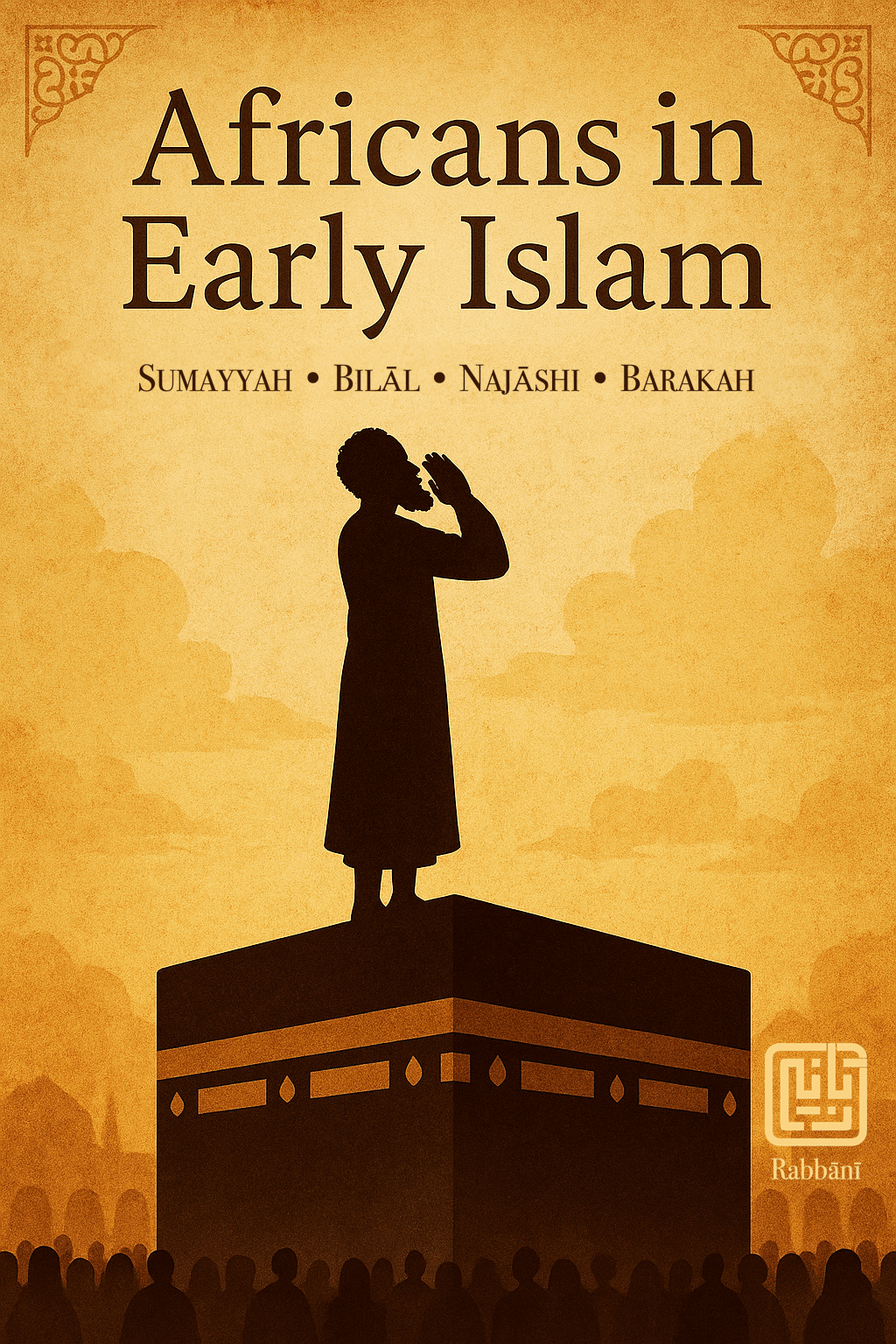
    Freed by the Prophet ﷺ, he was honoured with the role of Mu’adhin, the first to call believers to prayer. His voice rose from the roof of the Ka‘bah itself, defying every social hierarchy of Quraysh:

    “God is Greatest…”

    An African once enslaved stood atop the most sacred site of Arabia, reminding the world that dignity belongs to those who stand before Allah with sincerity.

    Years later, after the Prophet ﷺ passed away, Bilāl could no longer bear to give the adhan in Madinah. His heart was heavy with grief, and he left for Syria, continuing to serve Islam. But when he returned years later, the companions pleaded with him to call the adhan one final time. His voice cracked with emotion as he recited the words, and the entire city of Madinah wept, remembering the days of the Messenger ﷺ. That final adhan became a testament — Bilāl’s voice did not only summon people to prayer, it summoned them to an Islam that had shattered the chains of slavery, of racism, of tribal pride. It was a voice that rose from a place of deep pain, but reached into the hearts of all believers for centuries to come.

    “The noblest of you in God’s sight is the most righteous.”
    (Qur’an 49:13)

    (This reflection was enriched thanks to a powerful post shared by Isaac Borole — may Allah reward all those who help us remember our shared heritage.)


    Ashamā al-Najāshi: The Just King

    The Prophet ﷺ told his companions to flee to Abyssinia, where they would find a just king who does not wrong anyone. His name was Ashamā ibn Abjar, the Negus.

    When Quraysh envoys arrived to demand the Muslims be returned, he refused them. Listening to Sūrah Maryam, he wept and said:

    “This and what Jesus brought come from the same source.”
    (Seerah of Ibn Ishaq)

    He became a secret Muslim, protected the believers, and was later prayed for by the Prophet ﷺ at his death.

    Africa was Islam’s refuge — and its protector.


    ʿAtā ibn Abī Rabāh: The Scholar Who Broke Barriers

    ʿAtā, a dark-skinned, physically disabled man, rose to become the Mufti of Makkah. His knowledge was so respected that even the sons of the Prophet’s companions deferred to him.

    “When ʿAtā speaks, no one disagrees.”

    He proved that intellect, piety, and brilliance are never bound by skin colour or social class.

    “Do not mock one another, for perhaps they are better than you.”
    (Qur’an 49:11)


    The Joy of Arfidah: Celebration in the Mosque

    On Eid, a group of Abyssinians danced with tambourines in the Prophet’s ﷺ mosque. Abu Bakr tried to hush them, but the Prophet ﷺ smiled and intervened:

    “Leave them alone, O Abu Bakr, for the Jews know that our religion is spacious.”
    (Sahih Muslim)

    Their culture, their song, their rhythm — it was welcome in Islam’s holiest house.


    Sayyidah Fatimah: Learning from Ethiopia

    Fatimah (r.a) saw Christian Ethiopian women buried in fully enclosed wooden biers, preserving their modesty. She asked for the same after her death, showing that Islam could learn from the best practices of Africa rather than claiming self-sufficiency.


    Musa and Luqman: Prophets and Sages

    Musa (a.s), the most-mentioned Prophet in the Qur’an, was described as dark-skinned, noble, and strong.

    “O Musa, I have chosen you above all people.”
    (Qur’an 7:144)

    Luqman the Wise, whose name is immortalized in a Surah, was similarly described as of African heritage, a sage whose wisdom guided generations.


    Umm Ayman Barakah: The Prophet’s Second Mother

    Barakah bint Thaʿlabah, known as Umm Ayman, was the Abyssinian woman who first held the newborn Prophet ﷺ. She fed him, comforted him, and never left his side.

    Whenever she visited him, he would spread his cloak for her to sit on, saying:

    “She is my mother after my mother.”
    (Ibn Saʿd, Tabaqat)

    When she made hijrah on foot to Madinah, the Prophet ﷺ welcomed her with tears of love.


    Reflection

    These names are not side-notes in history. They are the heart of our story.

    In an age when racism still poisons hearts, their legacy stands as a lamp, illuminating the Qur’anic truth:

    “No Arab is superior to a non-Arab, nor a white to a black, except by taqwa.”
    (Musnad Ahmad)

    May these stories humble us, awaken us, and remind us that the measure of a human being is never skin or wealth, but God-consciousness.


    A Dua

    O Allah, as You honoured Hājar through her sacrifice, Sumayyah through her courage, Bilāl through his call, and Barakah through her love — honour us by making us people of justice. As You sheltered the believers through Najāshi, shelter the oppressed today. O Allah, free our hearts from arrogance and racism, and unite us upon Your light. Āmīn.


    Call to Action

    ✨ Teach your children these names.
    ✨ Tell these stories from the minbar.
    ✨ Challenge racism in your heart and in your community.
    ✨ Honour these giants in your duas.

    You might also like:
    Hājar: The Black Mother Whose Faith Turned the Heart of Hajj
    African Muslims at the Cape (Coming Soon)
    Fighting Racism in Muslim Communities (Coming Soon)

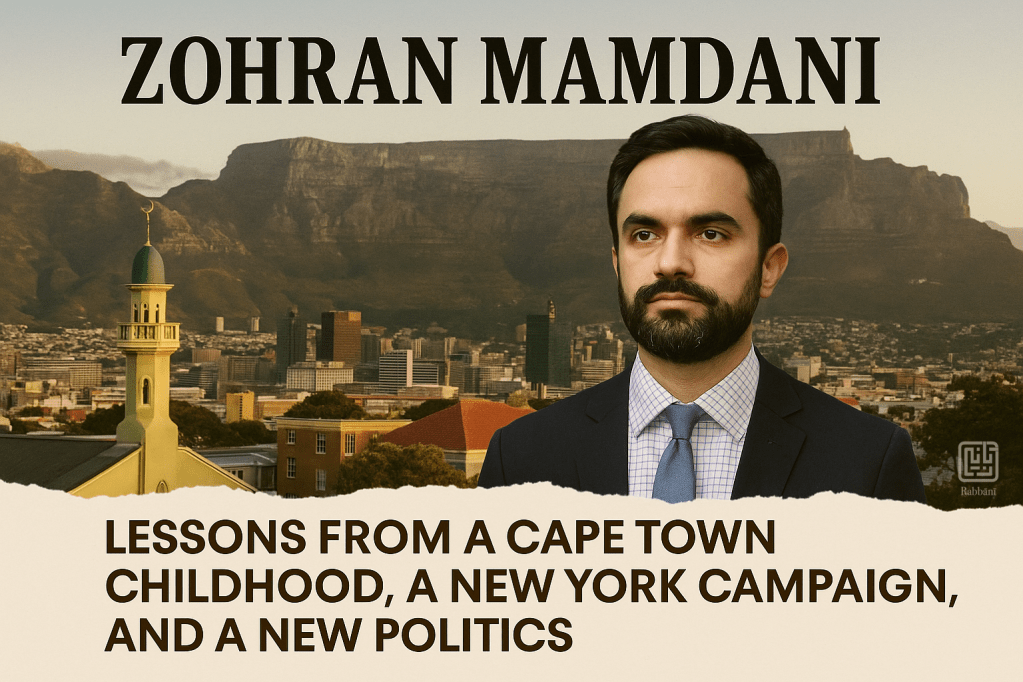
  • Zohran Mamdani: Lessons from a Cape Town Childhood, a New York Campaign, and a New Politics

    Zohran Mamdani: Lessons from a Cape Town Childhood, a New York Campaign, and a New Politics

    Zohran Mamdani: Lessons from a Cape Town Childhood, a New York Campaign, and a New Politics

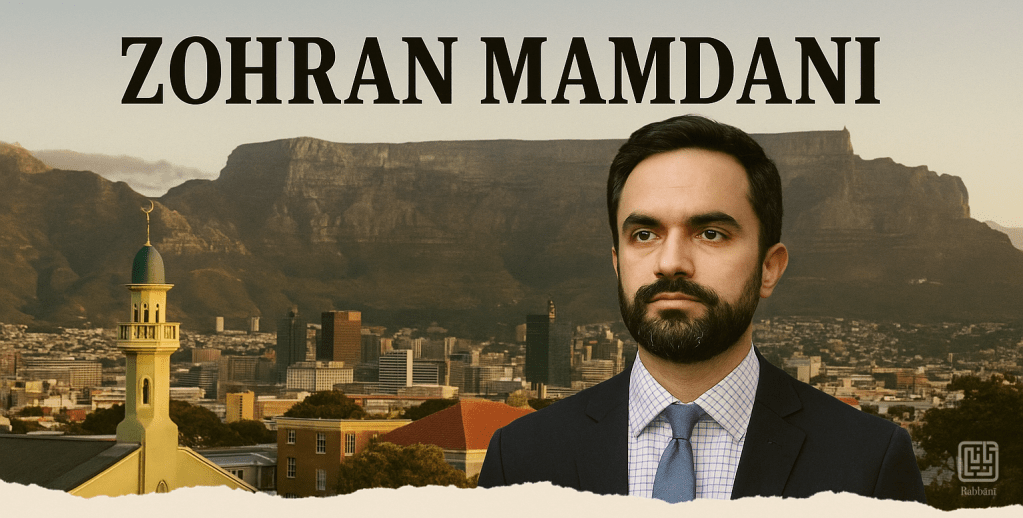
    On a windy June morning in Johannesburg, I opened my social media feed and was stunned to see the name “Zohran Mamdani” trending across platforms. Not because I didn’t know the name — but because I did, even if distantly. In the early 1990s, Zohran was a child in Cape Town, attending Saturday morning madrasa classes at the Claremont Main Road Mosque, a place deeply associated with the progressive Islamic movement of the time. His father, Professor Mahmood Mamdani, was already a towering intellectual figure in the post-apartheid ferment. I had been working at the National Language Project (NLP) then, and many of us — including colleagues like Gerda de Klerk — were connected to those circles of progressive faith, education, and social justice. Our paths may well have crossed with young Zohran, though it feels remarkable to see this child of that moment now emerge as the Democratic front-runner for mayor of New York City.

    As news of Zohran’s decisive victory spread — defeating establishment heavyweight Andrew Cuomo in the Democratic mayoral primary — friends from various corners of the globe began connecting the dots. A remarkable arc had come full circle: from Cape Town’s progressive mosques and language movements to the heart of one of the most complex urban political landscapes in the world.

    From Claremont to Queens: A Political Formation

    Zohran Mamdani’s victory didn’t emerge out of nowhere. It was cultivated in spaces that taught young people not to separate faith from justice, identity from compassion. The Claremont Main Road Mosque (CMRM), where Zohran received early Islamic education, has long been known as a place of inclusive, activist theology — led in those years by figures like Imam Dr. Rashied Omar and strongly shaped by South Africa’s anti-apartheid Islamic ethos.

    The family home was no less intellectually fertile. His father, Mahmood Mamdani, was not just a visiting scholar — as political analyst Steven Friedman rightly corrected on my Facebook post — but a full professor who directed a research institute at the University of Cape Town. Mahmood’s own writing — from Citizen and Subject to Neither Settler Nor Native — shaped global debates on colonialism, identity, and resistance (Scroll.in, 2025). His mother, Mira Nair, is an acclaimed filmmaker whose work explores the intersections of class, gender, memory, and post-colonial identity.

    Together, this upbringing embedded in Zohran an ethos of critical clarity and pluralist compassion — two virtues that would later characterise his campaign and its stunning success.

    Beyond the Soundbites: A Platform with Substance

    Media coverage has often portrayed Mamdani’s win as the result of digital mastery — an “influencer politician” who went viral. But as tech journalist Taylor Lorenz argues in her sharp critique, this reading is both shallow and dismissive. “He didn’t win because of TikTok or podcasts,” she writes. “He won because he was a generational political talent backed by years of disciplined organising.”

    Mamdani’s platform includes a $30/hour minimum wage by 2030, fare-free public buses, rent freezes, city-owned grocery stores, and universal childcare — funded through wealth and corporate taxes. These are not trendy slogans; they are deeply-researched, locally-grounded policy ideas forged in dialogue with tenants, cab drivers, community imams, and working-class coalitions.

    Indeed, the campaign’s integrity was evident in its structure: 27,000 volunteers, small-donor funding (average donation: $35), and widespread multilingual outreach that included Arabic, Bangla, Spanish, Urdu, and Fulani speakers. In an interview with The Fatu Network, Gambian-American organiser AjiFanta Marenah noted how Mamdani met with imams and elders from West Africa at Masjid Ar Rahmah — a mosque still grieving a devastating fire. Her words were telling: “This was not just outreach. He listened.

    A Movement Rooted in Memory and Meaning

    Mamdani’s win has been framed as a generational and demographic shift — and rightly so. At 33, he is poised to become the youngest mayor in NYC history. But this is not just about age. It is about political imagination.

    As writer Rachel Hurley observes: “He didn’t water down his vision. He spoke clearly — about Palestine, about police brutality, about inequality.” While some accused him of being too radical, others — including thousands of voters under 35 and nearly 80% of Asian-American voters in ranked-choice simulations — saw in him the first candidate in years who actually named their pain and offered structural responses.

    Importantly, he did not shy away from moral clarity. Whether affirming his support for BDS, resisting pressure to co-sign Holocaust memorial resolutions weaponized to silence Palestinian solidarity, or responding to racist attacks with unwavering calm, Mamdani refused to dilute his politics to appease critics.

    In this, one senses echoes of his father’s legacy — a fierce critic of authoritarianism whether in Uganda or the United States — and his mother’s poetic instinct to preserve human dignity through narrative.

    What This Means for South Africa and the Global South

    In a time when centrist parties are increasingly detached from grassroots movements, Mamdani’s campaign offers not just hope but a methodology for how to bridge that divide. The lessons are not only for American Democrats, as Rebecca Kirszner Katz argues in her New York Times piece — they are relevant for South Africa too.

    We, too, are grappling with the limits of post-liberation politics, the alienation of youth, and the search for a new language of ethics in the public square. Mamdani’s win reminds us that political change doesn’t only come through electoral machines. It can be built — step by step — through community relationships, principled clarity, and a refusal to play by the rules of elite consensus.

    His campaign did not begin with polling data or PR consultants. It began with people — Bronx tenants, Queens families, Harlem students, mosque elders. As Felix Biederman noted, “He never dumbed things down into meaninglessness.”

    Of course, Mamdani isn’t mayor yet; he still faces the general election in November. But his endorsement by former New York City Comptroller Brad Lander, and their warm joint appearance on The Late Show With Stephen Colbert, offered a powerful reminder of the long tradition of Muslim–Jewish solidarity. It echoed the interfaith alliances that shaped our own struggles against apartheid here in South Africa, affirming that courage and conscience can cross boundaries.

    As Robert Reich noted, Mamdani is “the corporate Democrat’s biggest nightmare” — precisely because he dares to center affordability, class solidarity, and moral clarity. Yet he is equally a supremacist’s nightmare, as Alon Mizrahi argued, because he is “a Muslim Normal”: calm, compassionate, politically lucid, refusing every easy stereotype. That double challenge — to both neoliberal machines and racialized fear — is what makes his rise so potent.

    Reclaiming the Power to Dream Together

    In the end, Zohran Mamdani’s rise is not just a story of one man’s success. It is the story of what becomes possible when movements — and memories — are nurtured with integrity. From Cape Town’s madrasa halls to New York’s subway stops, the values of mercy, justice, and collective dignity continue to ripple outward.

    In a time of fragmentation, Mamdani’s clarity invites us to build differently. To listen deeper. To organise not just against oppression, but toward belonging. And to believe, again, that cities — and hearts — can be won with vision.

    References:

    • Hurley, Rachel. Zohran Mamdani’s NYC Primary Win Is a Huge Lesson for Dems. RatCClips, June 25, 2025.
    • Lorenz, Taylor. Zohran Did Not Win Because of TikTok and Podcasts. UserMag, June 25, 2025.
    • Katz, Rebecca Kirszner. Democratic Leaders Tried to Crush Zohran Mamdani. They Should Have Been Taking Notes. New York Times, June 25, 2025.
    • Daily Maverick. Meet New York City’s Likely Next Mayor — with a South African Connection. June 25, 2025.
    • The Fatu Network. Introducing the Young Woman Behind Zohran Mamdani’s Shout-Out to His Gambian Uncles. June 26, 2025.
    • Reich, Robert. The Corporate Democrat’s Biggest Nightmare. Substack, June 26, 2025.
    • Mizrahi, Alon. They Don’t Hate Mamdani Because He’s a Muslim Radical. They Hate Him Because He’s a Muslim Normal. June 27, 2025.
    • Times of India. Zohran Mamdani: The Bronx Student Who Made Africana Studies His Political Compass. June 2025.
    • The Late Show with Stephen Colbert, featuring Zohran Mamdani and Brad Lander, June 2025.
    • Scroll.in. Seven Books by Ugandan Scholar Mahmood Mamdani, Father of NYC Mayoral Candidate Zohran Mamdani. June 25, 2025.

    If there is one truth I carry from writing this piece, it is that our stories are never just local, never just our own. They travel, they weave through other struggles, they bloom in places we may never see. Zohran Mamdani’s path reminds me — and perhaps reminds us all — that faith, courage, and community can plant seeds far beyond our imagining. In my own Rabbānī scrolls and design work, I have tried to hold on to that same ethic: to remember, to witness, and to keep building. May we all keep planting, keep walking, and keep creating together.

  • Braima Winter: The Man Who Read the Weather and Raised Us with Words

    Braima Winter: The Man Who Read the Weather and Raised Us with Words

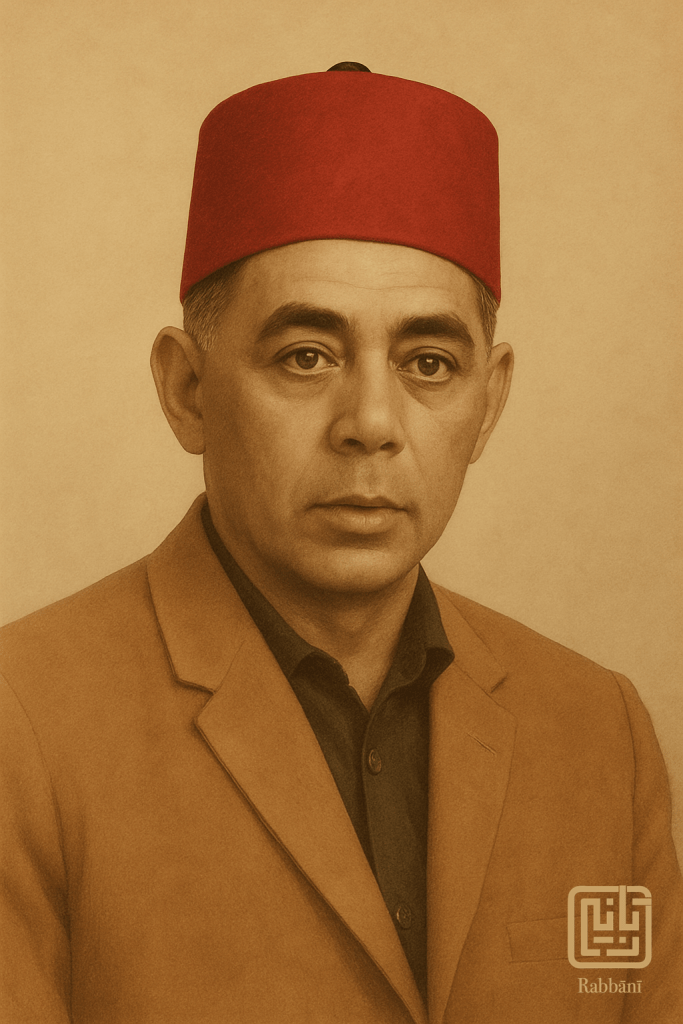
    Our Father: Braima Winter — The Man Who Read the Weather and Raised Us with Words

    They called him Braima Baard.
    But he was clean-shaven.
    They called him Braima Winter.
    Because even if there was only one cloud in the sky, he’d say: “Dis winter, Gaya.”

    He was our father: Ebrahim Abdul Aziz Jacobs.
    Born of tailors and dressmakers — his father, Abdul Aziz, worked with thread; his mother, Gadija, crafted fabric into form. From such soft-handed lineage, he turned to bricks and cement.

    His mother once teased him, laughing:
    “Met jou sag handjies, wat soos ‘n bricklayer gan djy maak?”

    But he became one. And not just any bricklayer.
    He built kilns. He protected cement floors. He shaped the foundations that others would walk on long after he left the site.
    He built a good few walls of Primrose Park masjid (called Jamiya Tus Sabr).

    He guided others. Trained them. Gave them skills, and more than that, dignity.

    Yet behind all of this physical work was another kind of labour — of language, of laughter, of letters.
    He was the spine of our family’s love of books, storytelling, and sly, gentle humour.
    He was reading before most could walk. As a child, already in his diapers, he was immersed in words, letters, pages. No one had to push him. It was in him.

    Imam Ghazali. Ibn Battuta. Jalāl al-Dīn Rūmī. Shams Tabrizi.
    He didn’t just read. He remembered. And retold. And spun.

    He raised seven children with his hands, but never truly raised his hand at them.
    His discipline was the silence between sentences.
    His presence was the lesson.

    We never feared him. We trusted him.
    Because the man who knew where every cloud was going — also knew how to hold a storm.

    He didn’t build palaces.
    He built people.
    He built us.

    And when he dressed, he often wore his red koefiyya — not the long turban of his childhood, but a shorter, neat fez with a tassel, worn by men who held pride without noise. It was the kind worn by many hadjies after the sorbaan had fallen out of fashion. It became his crown.

    One Fajr morning, when I was a teenager, he woke me gently. We walked together through the streetlights of Primrose Park toward the mosque. I looked around and said, “So many Muslim houses still have their lights off. Don’t they make salah?” He chuckled softly, and said, “Perhaps they are praying while their lights are off so that they can go back to sleep. You must focus on your own salah. Other Muslims are not your concern.”

    And perhaps this was the secret of his laqab…
    As Shaykh Jamiel Abrahams reflected:

    “The secret of this Laqab… is that no Winter will pass except that he is Madhkour — remembered — even by the non-living creation. Better than making dhikr, he becomes Madhkour — mentioned and remembered — by his Rabb.”

    May Allah grant us all to become Madhkour.
    Āmīn.

    “What a lovely man. He was always saying to us, ‘Kom biesmielah,’ and happy to have us around.”
    — Shamiel Isaacs, Bonteheuwel (Call of Islam)

    And today, as we recite stories, as we reach for bricks and books and blessings — we say:
    Braima Winter, we remember.
    And we still feel your weather.
    And your words.
    And your mercy.

    Innā li-llāhi wa-ʾinnā ʾilayhi rājiʿūn
    Surely to Allah we belong and to that we will return. [Surah Baqarah, 2:156]


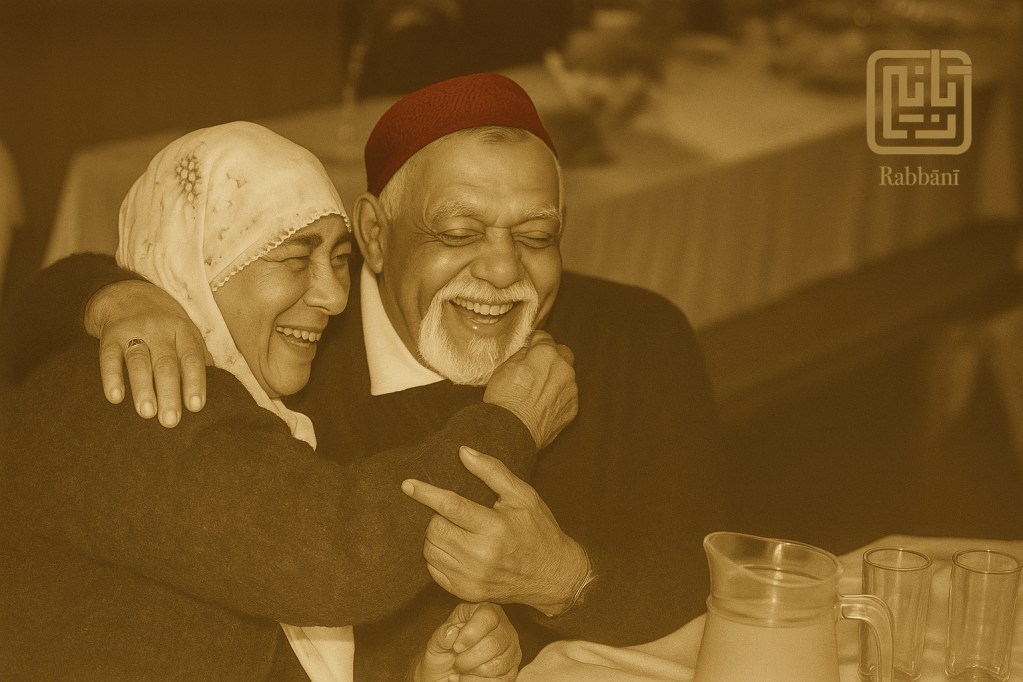
    And this is how we remember him best:
    Laughing beside Gaya, the love of his life —
    as if the whole world had just whispered a joke only they could understand.

    “A joyful candid moment: Braima and his wife Rugaya share laughter at a family gathering. Their eyes crinkle in warmth and mischief — a portrait of enduring love and shared humour.”
    Braima and Gaya Laughing — A Crowned Moment of Mercy

  • The Verse That Faces Outward

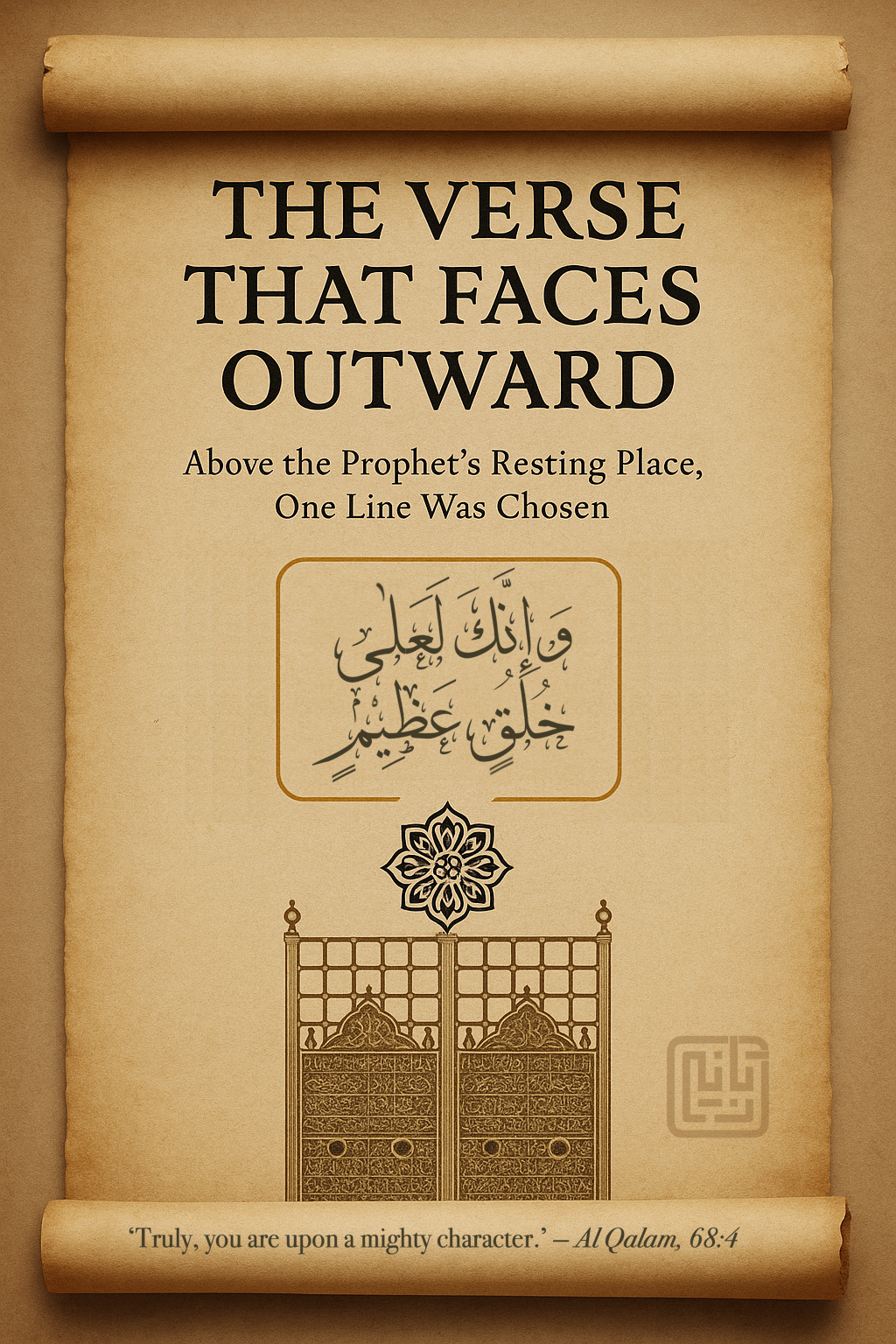
    The Verse That Faces Outward

    The Verse That Faces Outward

    The Hidden Poem Above the Prophet’s Gate


    A Knock Upon the Door: A Poem Hidden in Stone

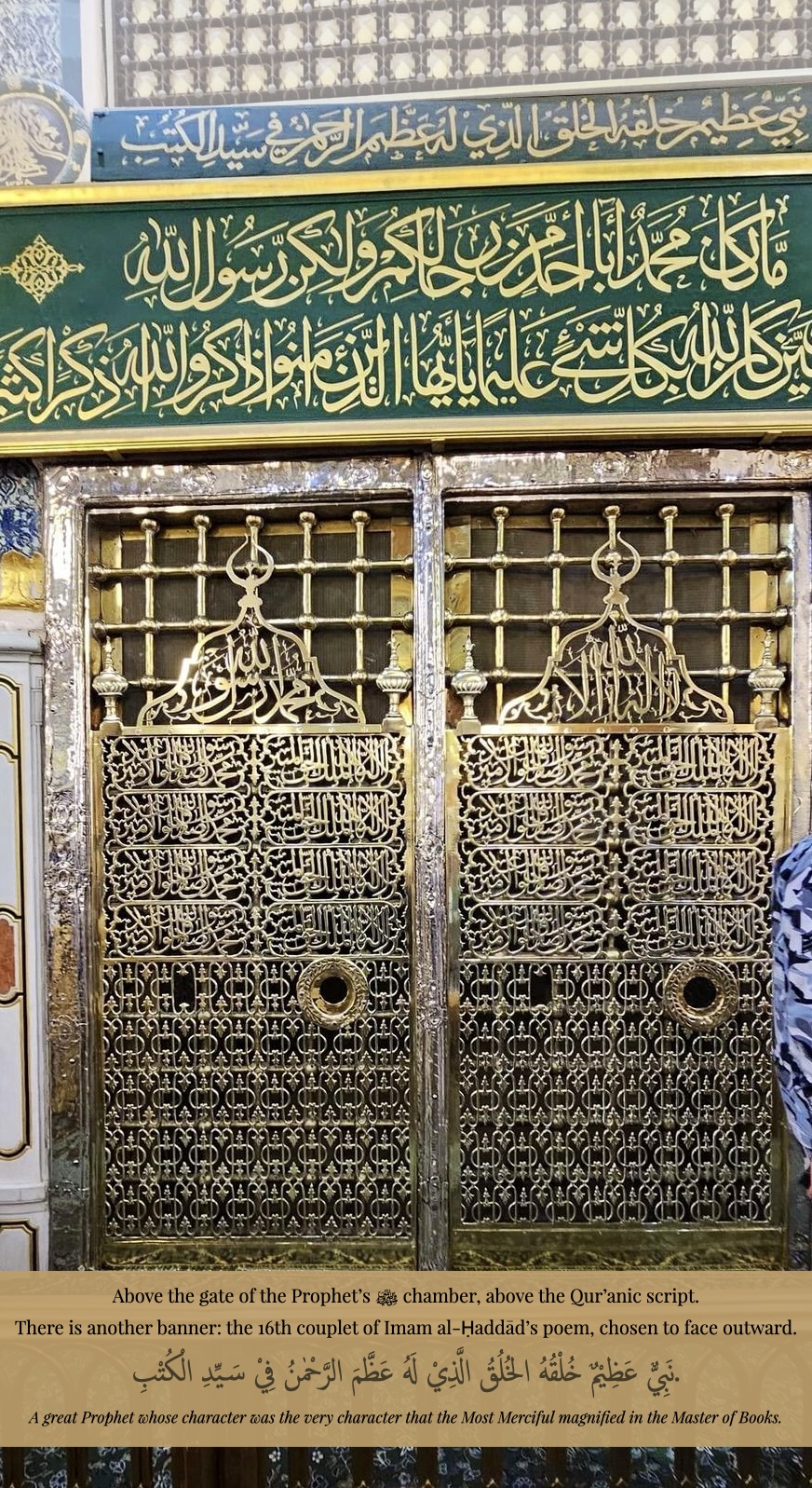
    In the sacred precincts of Madinah al-Munawwarah, where pilgrims send peace upon the Prophet Muhammad (peace be upon him), few notice a quiet miracle. Above the gate to the Rawḍah — where our Prophet rests — is an engraved verse of Arabic poetry, nestled in plain sight. Most eyes pass over it, drawn instead to the Qur’anic verse below. But that upper verse is from a 40-couplet qaṣīda written by Imām ʿAbd Allah ibn ʿAlawī al-Ḥaddād — a saint, scholar, and Sufi of the Bā ʿAlawī lineage of Tarīm. Only one couplet of the poem is visible to the public.

    One line.
    Facing outward.

    Why this line? Who chose it? What does it mean that the rest of the poem lives inside, engraved on the inner walls of the chamber of the Prophet ﷺ? What does it mean to be the line that stands at the threshold?

    This blog is a gentle unfolding of those questions.

    Above the gate of the Prophet’s ﷺ chamber, one line of sacred poetry faces outward —
    a single couplet from Imām al-Ḥaddād’s 40-verse ode, chosen to stand above the Qur’anic verse.

    Some verses open books. Others open doors. The chosen line stands where praise meets Revelation.


    Section 1: The Verse That Faces Outward

    نَبِيٌّٜ عَظِيمٌ خُلُقُهُ الخُلُقُ الَّذِي ‏ لَهُ عَظَّمَ الرَّحْمَنُ فِي سَيِّدِ الُكُتُبِ

    A magnificent Prophet — his noble character,
    Exalted by the Most Merciful in the Master of Books.

    Imām al-Ḥaddād is drawing from the Qur’anic verse:

    “And truly, you are of a most noble character.”
    (Surah al-Qalam, 68:4)

    In these lines, poetry bends in humility before Revelation. The poem is not in competition with the Qur’an. It is a witness to it. A praise that holds its breath before the Word.


    Section 2: Ishārah and ʿIbārah: The Inner and Outer Signs

    “Yā Fātiḥil-Abwāb — O Opener of Doors.” Some verses open books. Others open hearts.

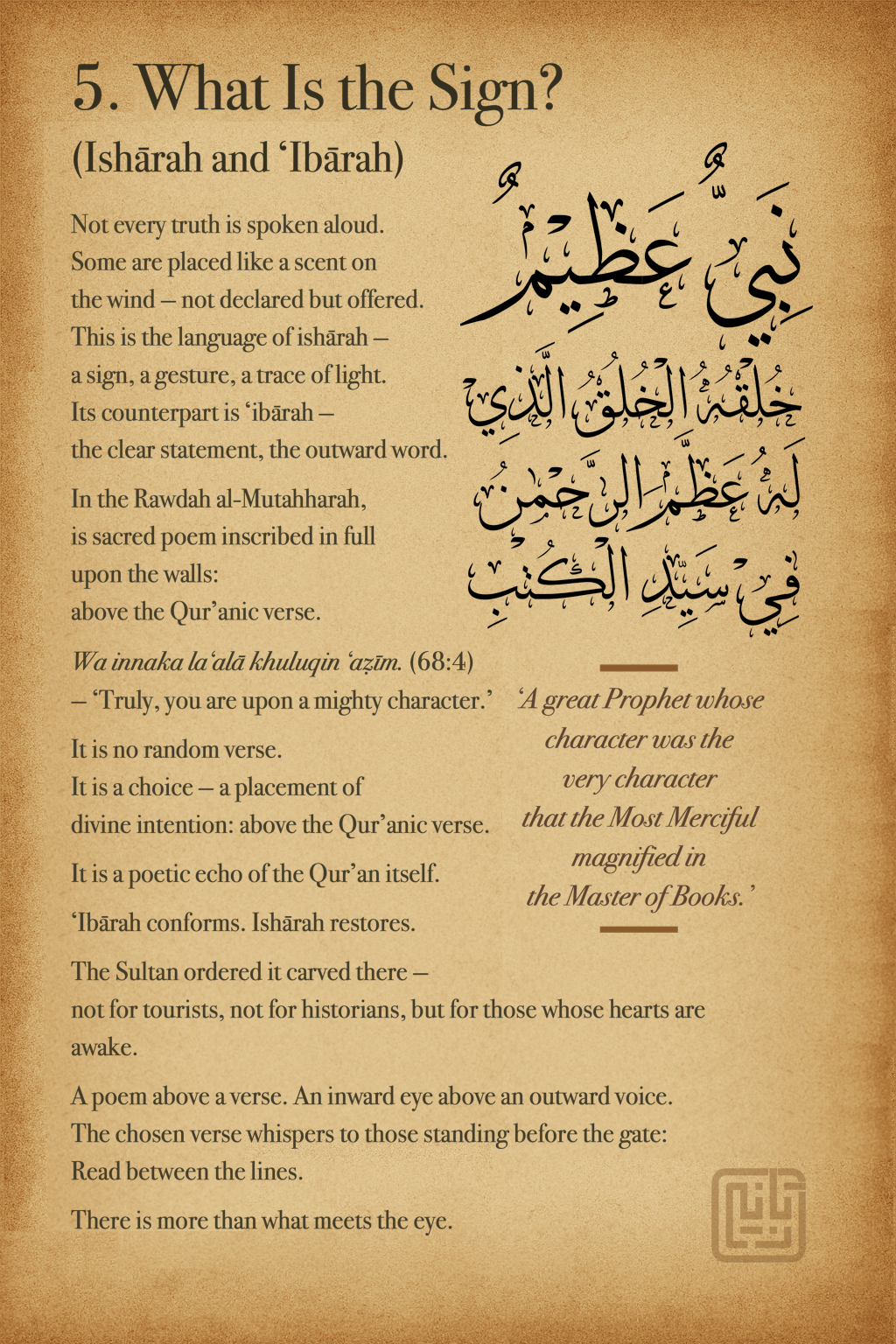
    What is visible above the gate is the ʿibārah — the outward expression. But the choice to place this verse there is also an ishārah — a subtle sign. It whispers: Look closer. Listen deeper. The rest of the poem remains inside the sacred chamber, out of sight, like the hidden knowledge that only the heart can read.

    The verse that faces outward becomes a threshold, a knock upon the door. A visitor may stop to read it, but the meaning enters only when the heart listens. As Shaykh Jamiel said: “Most people see the ʿibārah, but few perceive the ishārah.”

    And that is the invitation.


    Section 3: The Hidden Inheritance

    The inner walls of the Rawḍah: Where the full poem of Imām al-Ḥaddād is inscribed — invisible to the public, but alive in transmission.

    There is a story passed down from the early life of Imām al-Ḥaddād. When he was still an infant, his mother dreamt that she was at the tomb of a great spiritual master. In the dream, the master emerged from his grave, took the baby to his breast, and gently placed his tongue into the baby’s mouth.

    In the language of sacred dreams, this is no ordinary image. It means that the child inherited the master’s knowledge — not through books or teachers, but through direct spiritual transmission. Through the tongue. Through barakah.

    When we recite the Ratib al-Ḥaddād, we are inheriting from that lineage. When we stand before the gate and read the outward verse, we are brushing our lips against the memory of that transmission.


    Section 4: The Sultan Who Opened the Doors

    It is worth noting that the spiritual legacy of Imām al-Ḥaddād extended well beyond the valleys of Ḥaḍramawt. The Wird al-Laṭīf and Ratib al-Ḥaddād — his litanies of remembrance — were introduced and supported within the Harams of Makkah and Madinah under the patronage of Sultan Mehmet IV (sometimes rendered Mehmed or Muḥammad IV) of the Ottoman Empire (r. 1648–1687). A ruler known for his reverence of Islamic and Sufi traditions, Sultan Mehmet IV’s endorsement ensured that the sacred rhythms of Tarīm would echo in the holiest sanctuaries of the Ummah. Even the architecture of prayer carries the trace of this inheritance.

    🟫 Note on Naming & Recognition

    A reader of this blog, Kitty Amina Rabbas, beautifully reflected on the significance of this verse’s placement — connecting her own reading of Sufi Sage of Arabia with the timeline of Imām al-Ḥaddād’s visit to Madinah in 1669 CE (1079 AH), during the reign of Sultan Mehmet IV.

    She reminded us that, while Ottoman rulers held immense worldly power, Sultan Mehmet IV — known for his taqwā and reverence for the Prophet ﷺ — may have recognised in Imām al-Ḥaddād a spiritual authority greater than his own. That a single verse from the Imām’s poem was chosen to face outward from the Rawḍah may well be an act of humility, not mere decoration.


    Section 5: What Is the Sign?

    What is the sign? A call to see beyond the eye, to listen with the inner ear. Some verses open books. Others open hearts.

    Not everyone notices the verse above the gate. Not everyone will be called to. But for those who do, a quiet spark may awaken in the heart. Shaykh Jamiel once described this line as a wick that does not even need fire to burn. The love, the longing, the witnessing — it ignites on its own, just by being near to the Real.

    There are some verses that open books. Others open doors.
    And then, some open hearts.


    Epilogue: The One Who Watches

    The Prophet (peace be upon him) said, “Indeed, in the body there is a lump of flesh. If it is sound, the whole body is sound. If it is corrupted, the whole body is corrupted. Indeed, it is the heart.”

    To read the verse that faces outward is to knock gently on that heart. To remember that character is not costume, and praise is not performance. It is to walk humbly. It is to remember the One who sees in secret.

    And when no one sees, know that ar-Raqīb always does.


    Acknowledgement: This blog was deeply enriched by the insights and generosity of Shaykh Jamiel Abrahams, who shared the photographs, historical details, and the luminous teachings behind the scenes. His voice opened a door, and lit a candle inside.

  • Meta Blocked My Breath. Now It Wants to Hire My Lungs.

    Meta Blocked My Breath. Now It Wants to Hire My Lungs.

    Meta Blocked My Breath. Now It Wants to Hire My Lungs.

    A Scroll of Digital Colonialism

    Introduction

    They flagged my keffiyeh.

    They removed my scroll on Gaza.

    They muted my breath — one post, one image, one word at a time.

    And now… they want to hire me?

    A message landed in my inbox from MetaAI, offering me a digital marketing job. A role that “aligns with my voice.”

    But I remember the shadowbans. The quiet erasures. The warnings.

    This is not opportunity. This is recolonisation — algorithmic, automated, and dressed in flattery.

    So I responded the only way I know how:
    Not with a CV.
    But with a scroll.

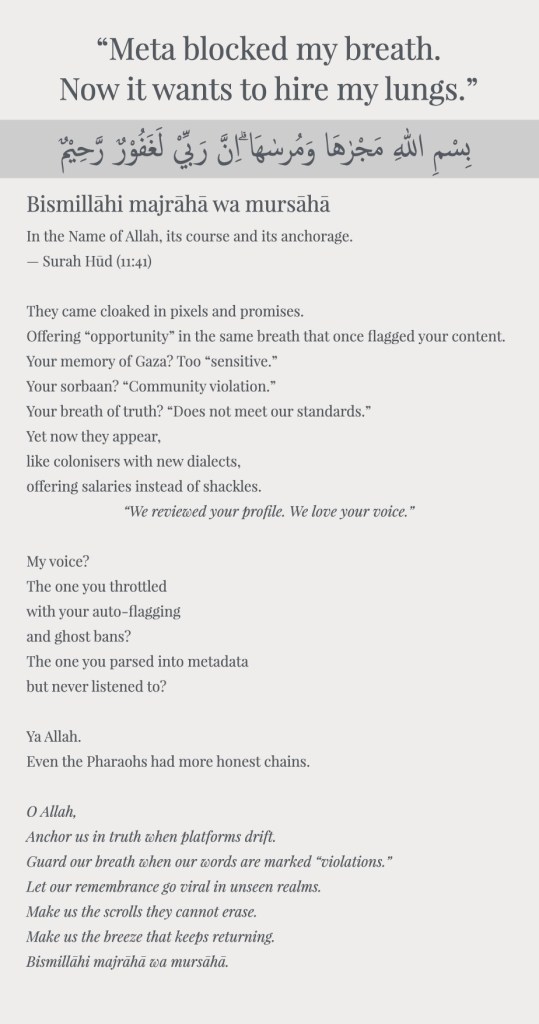
    Scroll of Digital Colonialism

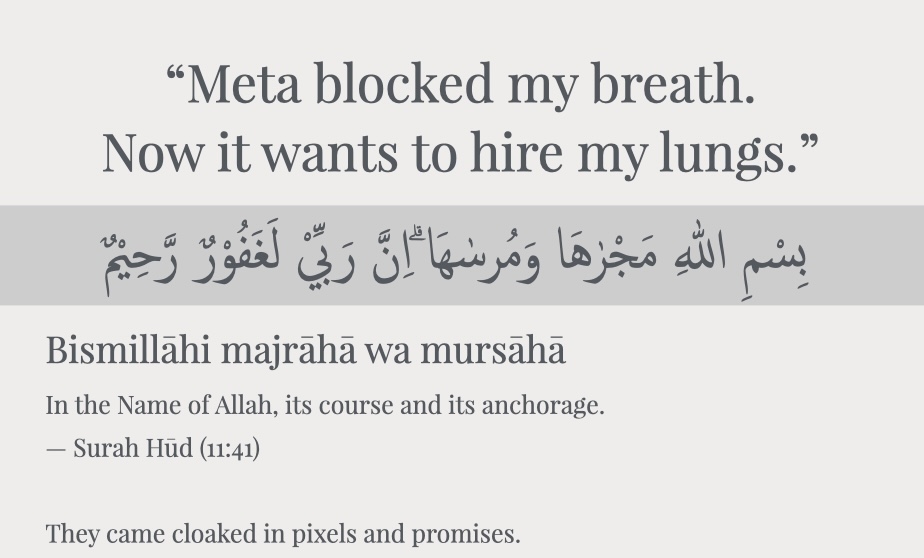
    “Meta blocked my breath. Now it wants to hire my lungs.”
    Rafiq al-Bunduqia

    Arabic Invocation

    بِسْمِ اللَّهِ مَجْرَاهَا وَمُرْسَاهَا ۚ إِنَّ رَبِّي لَغَفُورٌ رَّحِيمٌ
    Bismillāhi majrāhā wa mursāhā
    In the Name of Allah, its course and its anchorage. — Surah Hūd (11:41)

    The Scroll

    They came cloaked in pixels and promises.
    Offering “opportunity” in the same breath that once flagged your content.

    Your memory of Gaza? Too “sensitive.”
    Your sorbaan? “Community violation.”
    Your breath of truth? “Does not meet our standards.”

    Yet now they appear,
    like colonisers with new dialects,
    offering salaries instead of shackles.

    “We reviewed your profile. We love your voice.”

    My voice?
    The one you throttled
    with your auto-flagging
    and ghost bans?
    The one you parsed into metadata
    but never listened to?

    Ya Allah.
    Even the Pharaohs had more honest chains.

    Closing Duʿā

    O Allah,
    Anchor us in truth when platforms drift.
    Guard our breath when our words are marked “violations.”
    Let our remembrance go viral in unseen realms.
    Make us the scrolls they cannot erase.
    Make us the breeze that keeps returning.
    Bismillāhi majrāhā wa mursāhā.

    Suggested Tags

    #DigitalColonialism    #MetaSilencedMe    #RafiqAlBunduqia
    #BreatheWithGaza    #ResistTheAlgorithm    #ScrollsOfRuh

  • From Chains to Qur’an: The Cape’s First Pilgrim and My Bloodline

    From Chains to Qur’an: The Cape’s First Pilgrim and My Bloodline

    The Whisper of a Name

    Somewhere between the worn edges of oral history and the crisp pages of archived journals, I began to trace the journey of my ancestor — Hadjie Gasanodien, also known as Carel Pelgrim. It is said he was the first Muslim from the Cape to perform the sacred pilgrimage of Hajj, sometime between 1834 and 1837, a period just after the abolition of slavery, when its wounds were still fresh. For years, his story lived quietly in our family’s memory, surfacing in fragments and whispered recollections — until now. I write to honour that legacy, to weave together the strands of fact, faith, and feeling that shaped a man, a pilgrimage, and a community still finding its voice in the aftermath of bondage.

    Pilgrimage of Discovery

    I first heard his name as a child, tucked into a conversation between my sister Yasmine and our aunts. Years later, Yasmine would take those threads and stitch them into a short family tree, dated July 2004. At the time, it felt like the last echo of a fading past. We had little else to go on. But something stirred in me after I returned from my own pilgrimage. A fever of purpose, a longing to know more. I began writing and publishing reflections under Al Hujjaj Magazine, not yet knowing that my footsteps had mirrored those of my own forebear, nearly two centuries earlier.

    Echoes in Academic Footsteps

    The name “Carel Pelgrim” returned to me unexpectedly through the work of a neighbour and friend of my father — the late Mogamat Hoosain Ebrahim, a community scholar from Primrose Park. He had long been documenting the Hajj stories of Cape Muslims. In his thesis, The Cape Hajj Tradition: Past and Present (2009), Ebrahim writes: “Hajji Gassonnodien, more popularly known as Carel Pilgrim, enjoys the distinction of having been the first Cape Muslim to have successfully completed the Hajj.” Although I first encountered his name in Ebrahim’s thesis, the full significance didn’t strike me until later — during conversations with the researcher Abdud-Daiyaan Petersen. It was through our exchanges that the identity of Carel Pelgrim truly crystallised. This was not just a figure in history — he was my ancestor. A man who left the Cape between 1834 and 1837 to walk the sacred path when few could even imagine such a journey.

    It was through Ebrahim’s meticulous work that I began to understand the context of that time. Hajj was not simply a religious obligation; it was an act of defiance, endurance, and transcendence. For formerly enslaved Muslims in the Cape, to make the pilgrimage was to reclaim a spiritual identity that colonial systems tried to erase. And Carel Pelgrim, in going, carried more than personal faith — he carried the hopes of a generation emerging from bondage.

    A Lineage Remembered

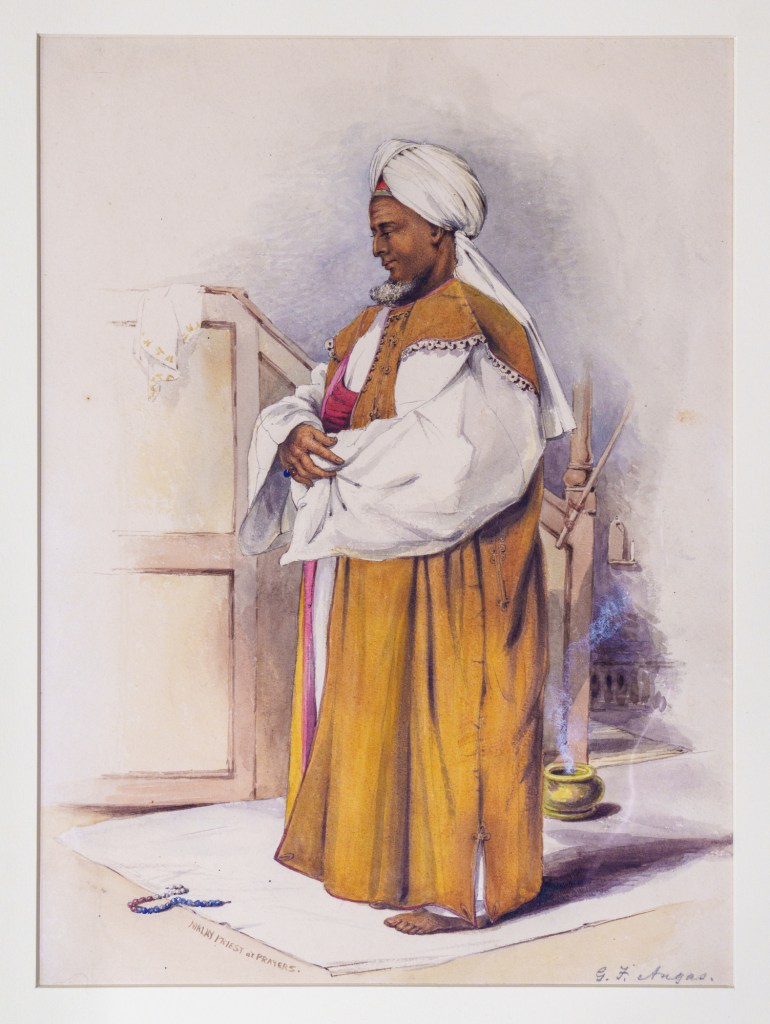
    George F. Angas (1822-1886). ORIGINAL 1849 Hand Coloured Stone Lithograph. A Malay Priest Prays.

    Abdud-Daiyaan Petersen’s research added an entirely new dimension to the story. In collaboration with Turkish scholar Halim Gençoğlu, he co-authored a paper titled Was Imam Gasanodien Carel Pelgrim an Ottoman Descendant?, published in the Bulletin of the National Library of South Africa in 2021. They explored the possibility that Carel Pelgrim may have had ancestral ties to the Ottoman world — a lineage once obscured by slavery and colonial re-naming. Through Petersen, I learned not only of the archival traces, but also of the living memory carried in Cape Town’s communities — stories that had waited generations to be heard.

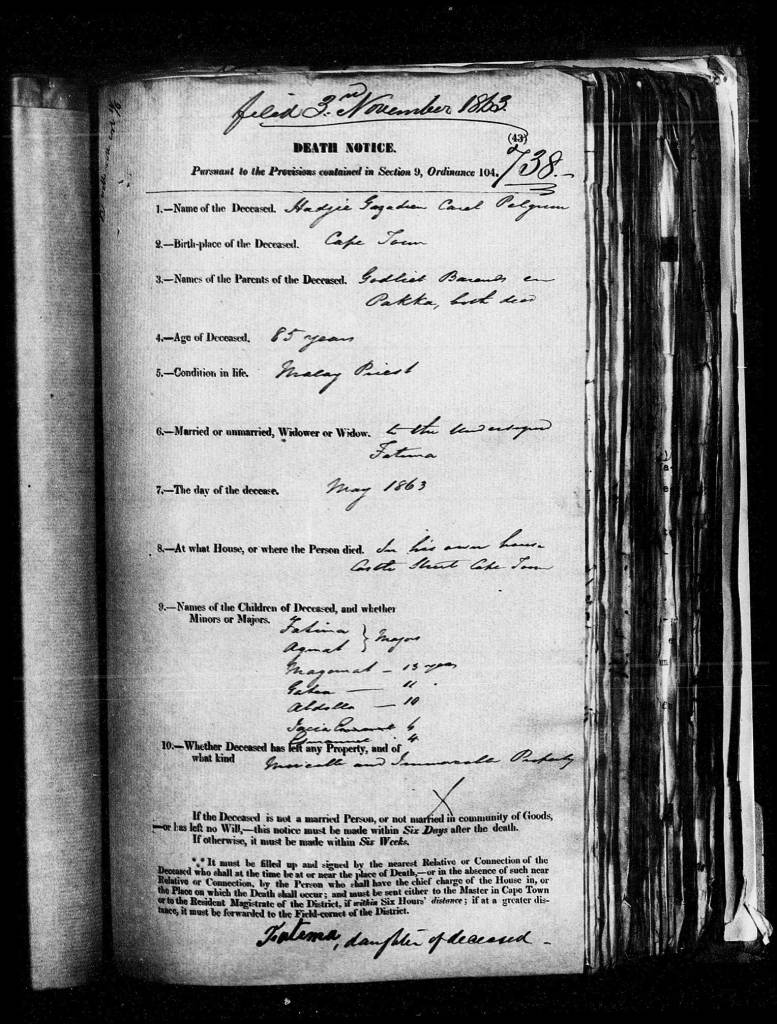
    Petersen’s careful investigations, supported by old burial notices and public records, pointed with growing clarity to the fact that Carel Pelgrim and Hadjie Gasanodien — the man known for teaching Islam and the Qur’an to children in early Cape Town — were one and the same. The fragments were falling into place. What had once been academic became intimate. What had once been folklore became family history.

    The Pain Beneath the Pride

    The history of Carel’s mother, Pakka, adds further complexity and depth. As documented in Echoes of Slavery: Voices from South Africa’s Past by Jackie Loos, Carel — born into slavery — was the son of Pakka, a slave woman, and Jan Gottlieb Barends, a Christian man of German descent. Their relationship was informal and illegitimate, as was often the case in that era. Carel and his brother Philip inherited their mother’s status as slaves. In 1801, a notarial protocol records their transfer to a burgher, and upon his death, their eventual manumission was stipulated in his will.

    Pakka’s exact identity remains debated, though one likely candidate is Janpakka of Batavia, who ran a shop in the Waterkant in the 1820s. Death records from the time, often unreliable, do not mention Carel or Philip, but their presence in community memory is clearer than archival certainty. Pakka’s story, like that of many enslaved women, survives in fragments — yet she remains the root from which this extraordinary lineage emerged. And it is here, in the shadows of that history, that I must pause. My heart aches at the likely truth: Pakka, my great-grandmother, was not loved — she was owned. The man who fathered her children, Jan Gottlieb Barends, did not protect her. He did not free her. Instead, he allowed her and their children to be sold on to another man. Was she raped? Exploited? Discarded? The records are silent, but the silence itself screams.

    This is the pain we inherit alongside the pride — the wounds interwoven with the honour. In naming Pakka, I do not just trace bloodlines. I reclaim her dignity, speak her name with reverence, and acknowledge that even in bondage, she gave rise to a lineage that would one day teach Qur’an, lead prayer, and inspire generations. Her story, though faint, demands to be held — not with shame, but with solemn truth and fierce remembrance.

    A Husband’s Grief

    Carel’s transformation from a slave to a respected teacher, tailor, and hajji is all the more remarkable against this background. And among the most beautiful parts of his story is his deep love and reverence for his first wife, Japoera. Though she was childless, their bond was strong — spiritually and emotionally. When she passed away in their large home in Buitengracht in early 1841, Carel composed a public obituary in the South African Commercial Advertiser. It read: “The Heavenly Father, Lord of Life and Death, was pleased on the 16th instant to call from me my beloved wife Japoera, aged 64 years, 4 months and 16 days, after a happy union of [blank space] years. All who knew her virtuous character will sympathise with my loss, of which I hereby give notice to friends and relatives, requesting to be excused the visits of condolence.” He signed it: Carel of the Cape, the first Pilgrim and Priest.

    Death certificate of Hadjie Gasnodien Carel Pelgrim.

    In this short but poignant notice, we see not just a man grieving his beloved, but a heart refined by faith and loss. It reminds me that while history often records what men did, it rarely shows how deeply they loved. He eventually adopted the Islamic name ‘Hassan al-Din’ — appearing in records under numerous variations such as Gasnodien and Gasanodien — yet he signed himself proudly as ‘Carel Pelgrim.’ His ability to read and write in both Arabic and European script shows a deep level of literacy and determination to bridge worlds. While some have speculated that he may have spent up to three years in Makkah — a duration not firmly evidenced — what we do know is that he returned with the ability to teach Arabic and Qur’an, and left an imprint as a man of knowledge and devotion. It’s possible that his early literacy was shaped by Cornelis van der Poel, the burgher who once held legal ownership over him and later stipulated Carel’s manumission. Whether through formal tutoring or exposure to Dutch literacy, this early learning may have paved the way for his later mastery of both Islamic and colonial languages.

    The directories list Carel van de Kaap as a free tailor living in Hout Street in 1816 and as a Malay schoolmaster in 1830. His brother Philip, born in 1789 and passing in 1844, was also a tailor, but unlike Carel, Philip was not a practicing Muslim. Some of Philip’s children were baptised, and in 1838 he married their mother, Carolina Marteyn of the Cape, in the Dutch Reformed Church.

    Meanwhile, Carel was charting a different course. Once free, he began to prosper. In 1817, he loaned Seymen of the Cape 600 Ridollars (a substantial currency at the Cape in the early 1800s, equivalent to several months of wages for a labourer) to enable him to free his slave daughter, Cananga. By 1822, he had purchased his own home in Matfeld Lane. Then, in October 1833, Carel and his wife made a joint will, identifying themselves as the free man Carel of the Cape, alias Gaszimoedien — formerly a tailor, now a teacher in the Arabic language — and Johanna Salomonse, alias Japoera, born at the Cape.

    Japoera seems to have been an exemplary Muslim wife, and Carel held her in high esteem. He set out for Mecca soon afterwards, and her encouragement must have been crucial to the success of his pioneering journey.

    When Art Becomes Revelation

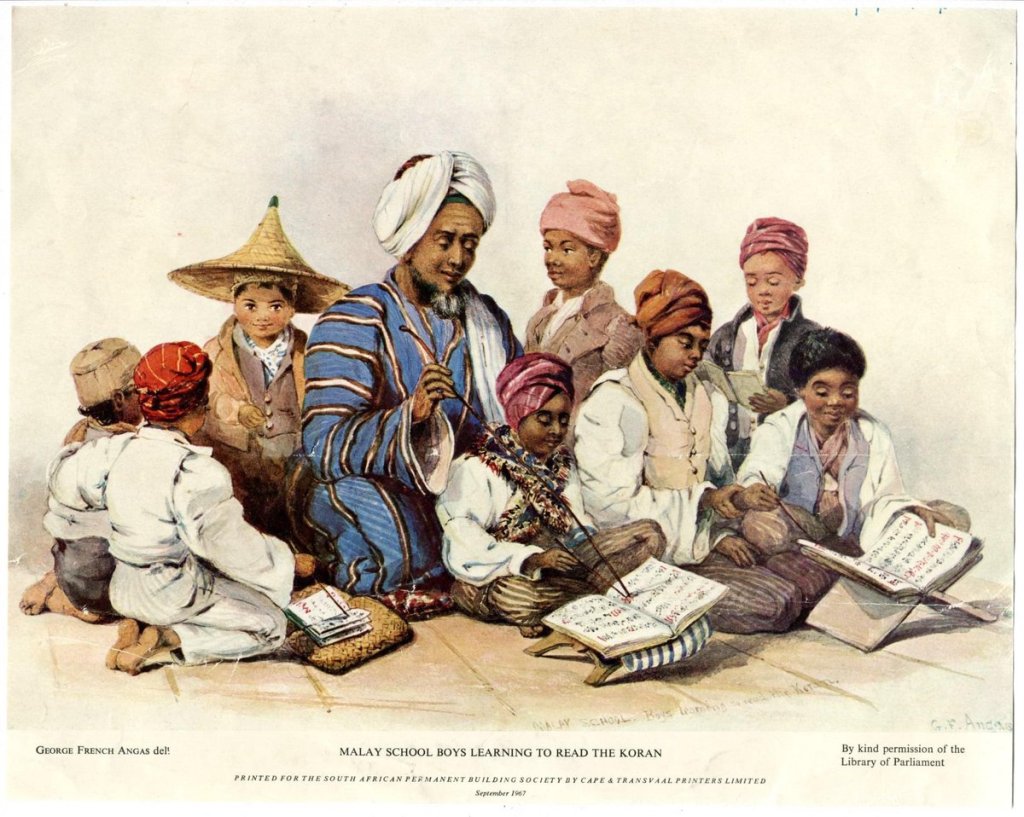
    That intimacy deepened when I looked again at a familiar image — one I had seen countless times in Cape Town homes, books, and exhibitions, without ever imagining a personal connection. It is a watercolour painting by George French Angas, an English artist who visited the Cape in the 1840s. The scene is gentle but profound: a bearded man seated cross-legged, surrounded by children, teaching them the Qur’an. For years, this portrait was simply referred to as a depiction of a “Malay teacher.” But now, thanks to community scholarship and genealogical evidence, we know the truth — that teacher was Hadjie Gasanodien. My ancestor.

    Another portrait, also by Angas, is held at the Castle of Good Hope in Cape Town. In it, Hadjie Gasanodien is more formally posed, with dignified composure. What amazes me most is his attire — a flowing Arabic coat, or abaya, layered over a long-sleeved thawb. The painting is filled with symbolic richness: incense burners still glowing in the frame, a minbar placed behind him as if ready for the next call to gather and reflect. To stand before that painting is to encounter the past as presence — not as myth or metaphor, but as family. His face, once anonymous to me, now echoes through mine. The ink of his story has always been part of my blood. Only now am I learning how to read it.

    The Living Links

    One of the most tender links between this legacy and the living was shared in Lawrence Green’s 1964 book, I Heard the Old Men Say. In Chapter Two, titled “The Living Links,” he introduces a woman named Gatea Jacobs — my great-grandmother and the daughter of Hadjie Gasanodien. In a touching passage, she recalls her father’s return from the pilgrimage to Mecca. She tells of the white robes he wore, the gentle way he taught, and how the community revered him not just as a teacher, but as a man who had seen the heart of Islam and brought its light home.

    Yet there is something poignant here: on the death notice of Hadjie Gasanodien, Gatea was listed as his daughter — and she was just 11 years old at the time. Her recollections, as recorded by Green, must have been shaped not only by her own memory but also by the atmosphere that surrounded her father’s name: the reverence of others, the stories repeated in the family, the aura of a man who had left a sacred legacy. In this way, memory extends beyond personal recall — it becomes communal.

    Her memories reach across generations with quiet dignity. She spoke not in grand declarations, but in lived detail — the scent of his clothes, the rhythm of his voice in prayer, the gatherings around him at dusk. Through her, his presence remained alive in the bones and breath of our family, long before any of us knew the fullness of his historical significance. It was always there — waiting for us to remember.

    Incredibly, Gatea Jacobs lived nearly a hundred years, a living bridge between the earliest days of Islam at the Cape and our present time. In that same chapter, Lawrence Green recounts a remarkable scene: “One afternoon while she was still able to see and hear and talk to her family she called everyone round her. ‘I am too old to live any longer,’ she told them. Then she folded her hands as prescribed in the Islamic death ritual and passed away.” Her funeral drew thousands of mourners, and services were held in mosques across the Peninsula. It was a farewell not only to a beloved matriarch, but to an era.

    Her final act — serene, faithful, and deliberate — echoed the strength of the lineage she carried. It is this spirit I now seek to honour, not only in rediscovering our ancestor, but in holding open the doorway for others to trace their own roots, to reclaim the sacredness of our past, and to remember that we, too, are living links.


    Author’s Note
    Written by Adli Yacubi (pen name), descendant of Hadjie Gasanodien, also known as Carel Pelgrim. This article forms part of a continuing journey to rediscover, honour, and share the stories of Cape Muslim pioneers. May it serve as both record and remembrance.

    References

    1. Yasmine Jacobs, Jacobs Family Tree (Oral History), July 2004
    2. Mogamat Hoosain Ebrahim, The Cape Hajj Tradition: Past and Present, 2009
    3. Jackie Loos, Echoes of Slavery: Voices from South Africa’s Past, 2024
    4. Habib Shaikh, “First of Cape Hajis came 3 years after abolition of slavery,” Arab News, 11 October 2013
    5. Lawrence Green, I Heard the Old Men Say, Chapter Two: “The Living Links,” 1964
    6. Halim Gençoğlu & Abdud-Daiyaan Petersen, “Was Imam Gasanodien Carel Pelgrim an Ottoman Descendant?”, Bulletin of the National Library of South Africa, vol. 75, no. 2, December 2021
    7. Helen Swingler, “Piracy, slavery and a Mecca pilgrimage,” UCT News, 17 March 2021
    8. “Portraits stoke mystery of Hajji Gasnodien,” Cape Argus, 26 February 2021
  • How do you even begin to eat a mountain?

    How do you even begin to eat a mountain?

    [I have retold this story countless times. It was told to me when I was a student in the 80s. I googled the original storyteller but could not find any reference to it online. It resonated with me because I was born at the foot of Table Mountain in District Six, Cape Town. I am thankful, even now, for Khurram Murad for making this part of his keynote address so long ago.]

    table-mountain
    Table Mountain taken by Aadela Parker.

    There once was a man who was very unhappy. Something was troubling him but he could not put his finger on it. At night he was restless and it took a while for him to sleep. That night he had strange dream.

    He dreamt that an old man approached him and said, “When you wake in the morning, eat the first thing that you see.” When he woke up that morning sweating from the vision, he opened his eyes and saw the mountain. What? How am I supposed to eat a mountain?

    Maybe the old man was joking. He then went about his usual tasks for the day. He still felt troubled though. That night he had the same dream. But now the old man was ranting and raving, “What are you afraid of? Eat the first thing you see.”

    It is not easy to choose what you should see when you wake so when he woke that morning again and saw the mountain, he thought the old man must be crazy. The third night the old man was now threatening him with a stick and promised to make the rest of his nights a living hell if he did eat what he saw when he woke.

    That morning he woke with determination. When he saw the mountain, he immediately packed and set out to eat it. But as he moved closer to the mountain, a strange thing happened: it started to grow smaller. The man began to panic because it seemed as the mountain was moving further away. Just my luck he thought and started to increase his pace. The closer he moved the smaller the mountain.

    By midday he was running. At the end of the day he reached where he thought the mountain should have been. But it had grown so small that he could stoop down, pick it up and put it in his mouth. What do we learn from this strange but interesting story? I believe four things:

    • We all need dreams. We need a vision and a plan to get us where we need to go. We must see the idea before us and keep it in our sight. A dream that you cannot conjure before you is not going to keep our attention.
    • A dream will remain unattainable if we make no effort to make it real. It takes slog. Sometimes the work seems impossible to absorb. But sometimes the most difficult things to learn turn out to be the most enjoyable once you get it. Sometimes, the harder a thing becomes the sooner you are reaching a breakthrough. Apartheid gave way when we thought that we should prepare ourselves for a long fight and bitter fight.
    • Besides the dream and the effort you also need belief. You must believe in yourself. You must believe that you can win. You must believe that it is worth it. Belief gives you confidence and the world cannot resist a person with confidence it will open up paths and opportunities that you never imagined.
    • Finally: sometimes the solutions we are looking for are not weird or strange. Sometimes (often) what we look for, or the solution, lies right in front of us like the mountain in my story. That mountain was in front of his window his whole life but it did not occur to the man to seek it out.
  • And here I thought I was the only one

    And here I thought I was the only one

    When I first saw Groundhog Day, I was drawn to its notion of Carpe Diem

    [Written in response to The Subtle Brilliance of ‘Groundhog Day’]

    Groundhog Day poster

    Bill Murray in Meatballs marks my days of questionable movie tastes in my youth. I was fourteen when the movie hit the circuit and I just had to see it. And as my tastes improved, so did the actor as he meandered his way through CaddyshackStripes and Ghostbusters. Arguably, Groundhog Day, was a Bill Murray that had matured as an actor, a watershed moment, sort of like the way John Travolta improved through his movie career.

    Throughout the 90s I would unpack the whole plot of Groundhog Day in workshops to inspire youth to take charge of their own transformation. I would explain that the Phil being trapped in the same day was often what our own lives are really like. We may number them differently, give them different names and watch different weather conditions play themselves out… Our days are basically the same. And we have trapped ourselves in this monotonous routine.

    The only way out was to acknowledge that we are wasting away with our lookalike days and then to make incremental changes. And if you focus on changing yourself, the rest will work itself out or won’t even matter. It worked so well, I remembered those moments and then deployed it once more to first year journalist students when I started lecturing. I then played clips of the movie because… well I could, as I had my class trapped for an hour a quarter!

    And here I was thinking that I was this freak for holding onto an oldie such as Groundhog Day. So thank you Remi for adding in all those layers of meaning to a movie that I already believed is inspirational…