Tag: Story

  • Introducing the Humans of Cameroon

    Introducing the Humans of Cameroon

    Changing the narrative of your country, one status update at a time

    A Cameroonian from the Facebook page of Humans of Cameroon
    A Cameroonian from the Facebook page of Humans of Cameroon

    Humans of New York, a website and Facebook page (now even an app) showcasing ordinary New Yorkers, is sitting at almost 11,5 million likes. It’s not difficult to see why. New York is perhaps the most famous city on earth. Google auto-completed the name when I typed in ‘how many songs about…’ It threw up a Wikipedia article listing songs, in alphabetical order, that reference the city, its landmarks and street names. There’s a gazillion of them!

    And Cameroon? Google started with ‘10 fun and interesting Cameroon facts’. And the first fact was: ‘Cameroon is the first African country to reach the quarter-final in soccer world cup.’ I bet you don’t even know what the capital of Cameroon is. I had to look it up and I’m from South Africa. Many Africans would roll their eyes and say, ‘Typical!’ Well, it’s Yaoundé.

    If you’ve been watching news recently, then you would know that Cameroon helped her neighbour Nigeria by launching airstrikes against the extremist group Boko Haram. Pretty feisty for a country that generally only gets into the news because of its football players making a name in European leagues.

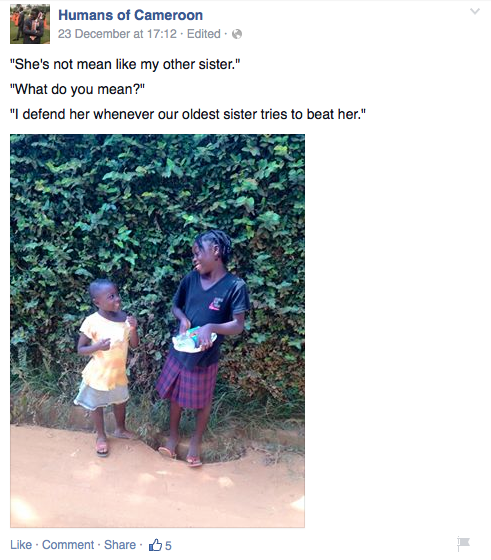
    Equally feisty is a Facebook page a friend asked me to like, called Humans of Cameroon. My first thought was that this must be a copycat of the massively popular Humans of New York. Then I clicked on the link and this jumps up at me:
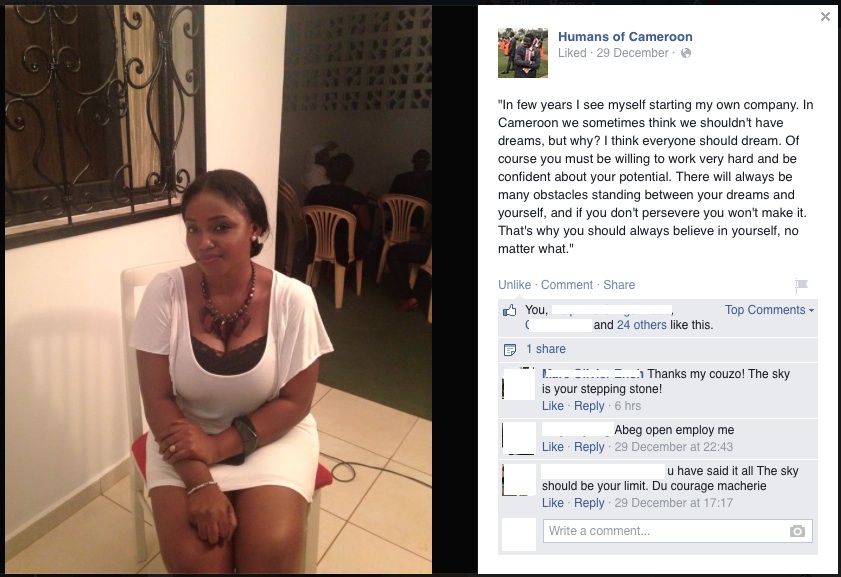
    The Entrepeneur

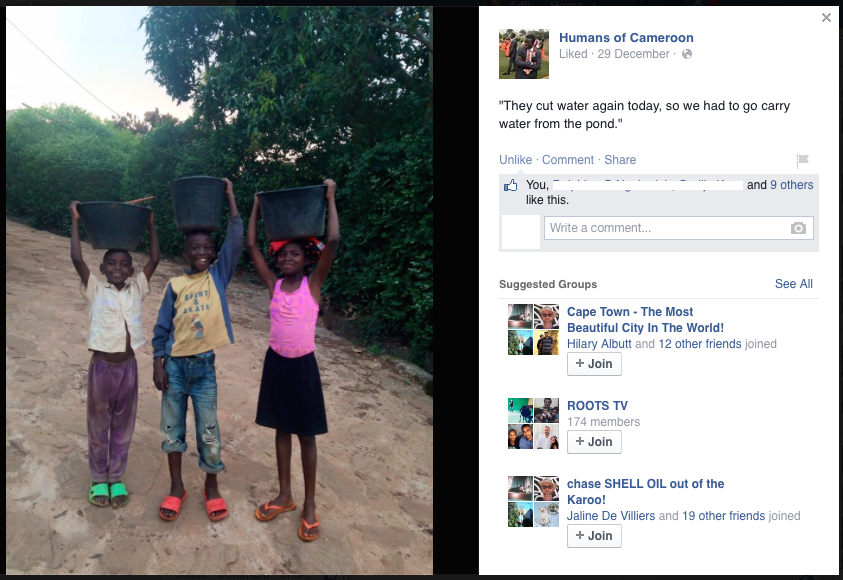
    And then this:

    Screen Shot 2014-12-31 at 21.16.04Water carriers

    I was taken by the sheer humanity of these stories. This was so far from the stereotypical depiction of Africans that either needed charity or came second to their wildlife and spectacular landscapes. Because of media priorities such as proximity (it is in our backyard), impact (it is massive and we are affected by it) and prominence (it involves celebrity), countries such as Cameroon hardly make it on the media radar. When they do make it into the news then, it is because of something negative.

    When I shared the page with my Facebook buddies, this is the response from one of them:

    “A gem of a FB find on this last day of 2014 (thanks to Adli Jacobs). Brilliant unmediated African voices — the kind we never get to access through mainstream media.”

    In a sense, the creators of Humans of Cameroon have applied the New York example as a genre. There have been other cities and countries that have done the same. In Cameroon’s case it acts to reposition (or repackage) the country by foregrounding its people and allowing their voices to contribute to how that nation is seen. And yet, in a sense, it also acts as a counter-balance to Humans of New York whose lives are evidently more affluent, residing in a city that is the darling of the world.

    There is no Statue of Liberty in Cameroon, no Empire State building, no Broadway or Time Square. There is no Madison Square Garden or famously numbered streets in Yaoundé, the capital. But there is in Cameroon, despite a past of two colonial masters (the British and French), despite a president who refuses to say goodbye, despite being beset by corruption, despite the threat of civil tension boiling over from neighbouring Nigeria, these amazing people…
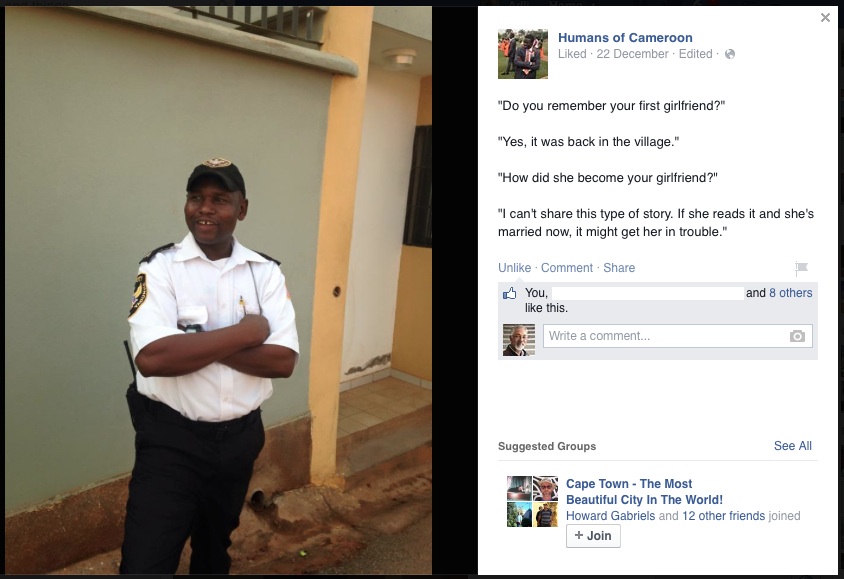
    Security guard

  • Making friends with my demons

    Making friends with my demons

    …when I’m not sleeping

    I love my sleep. I really do. It really does not matter whether I’m lying down comfortably or sitting in an awkward chair. If I need to sleep, I will. Which is why the alarm on my phone is such a godsend. 07h45. Snooze! 08h00. Snooze. 10h00. Bloody hell! It’s 12h00!

    The strange thing is that when I have an important morning meeting, or in a regular job that I need to hit the highway by 06h15, I am up by 05h30! I swear. By 06h00 I would’ve showered and shaved, made oats (my new thing!) and my mug of coffee. Coffee is crucial. And no decaf bullshit either. You don’t want to ruin a good day with a bad coffee.

    When I realise that I have to work tomorrow, I get so anxious that I check and prepare just about everything before I go to bed at night: printouts for my lectures, the keys to the office, the access key to the office parking, laptop cords, student registers… So I have no problem getting up, even before the alarm, when I know that I have to.

    But as soon as I know that tomorrow is Saturday or vacation or whatever, then boom! 12hoo. There is an old Jewish saying: If you have a reputation of an early-riser, then you can sleep until noon. This saying does not apply to me. I have the reputation of a noon-riser and so everyone is shocked when they see me up early in the morning. Go figure!

    Now with such a rigorous and methodical routine, what inspires me and where am I at my best? I am so glad you asked.

    In the last month I have written several pieces that I have posted on Medium. A few I have placed under the collection Warriors of the Light and three others that have found their way on Ummah Wide. In 2014 I published my first book on an anti-apartheid movement called Punching Above Its Weight—The Story of the Call of Islam. I am presently also writing several other pieces that I began last year. Two of them are novels.

    The truth is that I really love writing. Perhaps more than what I love the snooze button. But what has really sparked my new writing spurt is a combination of three things. I did a course in understanding the self and so began to meditate (more often) and became more self reflective. Then I acquired my new writing machine, my MacBook Pro. And just when I thought that I’ve reached my zen, a few storms hit my personal shoreline.

    Somehow, the combination of self reflection and personal crises brought out the creative in me. And the MacBook became the instrument through which I could create the word paintings. I don’t like personal crises. They make me anxious to say the least. But when I reflect upon them I see these exquisite colours, intense, dark, in these fascinating combinations. My empathy for pain in others deepens because of the resonance, the connection to my own.

    A friend of mine, Shabbir Banoobhai, unaware of my issues, sums it up so beautifully in a poem he shared on Facebook:

    sometimes our best gifts
    come dressed in wolf’s clothing
    carefully tailored
    designed, it seems
    to scare us into a lair
    from which there is no escape –
    until we decide to smile at one
    and the unthinkable happens

    it smiles at us
    its snarl curling up at our feet
    as if it was a puppy
    waiting for us –
    its only source of love –
    to draw it up, hold it close
    whisper sweet nothings in its ears
    nuzzle its o so soft hair
    as it licks our gooey face –
    at pains no doubt to say
    i love you, i love you

    then, noting our hesitation
    it wags its tail harder
    moaning plaintively –
    you did not really believe
    i meant to harm you, did you?

  • What’s your story, morning glory?

    What’s your story, morning glory?

    Everything is a story, including the person you believe you are

    Ryan McGuire of Bells Design on Gratisography
    Ryan McGuire of Bells Design on Gratisography

    It is Michel Foucault, the French philosopher, who says, “Do not ask who I am and do not ask me to remain the same.” The point he was making is that we are constantly changing as a result of a myriad of experiences that impact upon our personality in any given moment. As human beings, however, we are averse to change and freeze our identity to create a stable reference of who we are.

    If you were to ask me who I am, depending on the time, my mood and what I think you might know about me, I will tell you a story. It might be about what I doing right now, where I come from, what I might have accomplished… Whatever it is, it will be a story. I would not need to think too much about the story/stories because I have told it many times to different people. Even if I were to just simply say my name, the rest of the story will play itself out in my head because I have made enough repetitions in the past; I have repeated them over and over so many times. We make a mantra with the stories that we hold.

    Our entire lives, from when we are kids, we are surrounded by stories. You could say that stories pervade everything. Our very own lives, how we see others, how we see our communities, our nation, the world, are all constructed in story.

    Starting the South African story with Jan van Riebeek and the arrival of the first Dutch settlers in 1652 is a choice we make when we recount the history of our nation. But even if we were to choose to start further back than the arrival of colonialism, or decide to include areas previously excluded, we must realise that the narrative of the nation is a construction. We make choices in how we frame a country or a people.

    In a sense, we are also trapped within the stories we tell and retell. For example, I maybe a mess today because perhaps my father would beat me. Perhaps, he was a harsh man, he never acknowledged me, always called me a loser. And as a result I am a bad father to my kids, or a bad husband, or unreliable, or whatever… Through the stories we hold to our chests, we limit our own greatness or justify our own arrogance or our own racism. We say things like, “I am always a stickler for detail, I am fussy, I don’t suffer fools…” or “Women are always bad drivers”, “Blacks have no idea how to run a country which is why Africa is in a mess…” These are stories we invented partly based on limited experience of reality and partly based on very limited perception.

    Our entire lives, from when we are kids, we are surrounded by stories. You could say that stories pervade everything. Our very own lives, how we see others, how we see our communities, our nation, the world, are all constructed in story.

    It is like driving on the highway and a car swerves right in front of you. You honk your horn to vent your anger. You take a quick glance at the make of the car or maybe the number plate or the gender or race and we make up a story to explain the other driver’s lack of manners. We have no idea what the actual reason was for that driver’s behaviour and may never know. But we are going to go home and repeat that story to whoever cares to listen including our one-sided analysis.

    There is this story of a guy who could not control his gossiping tongue and went to see a sage for guidance. He was instructed to collect feathers and release it on windy day from the minaret overlooking the city. When he returned to declare success, the sage said to him, “Now go and collect those feathers once more.” “But this is impossible,” said the man, “they are now so widely spread!” “Precisely!” said the sage.

  • The Secret of the Rose

    The Secret of the Rose

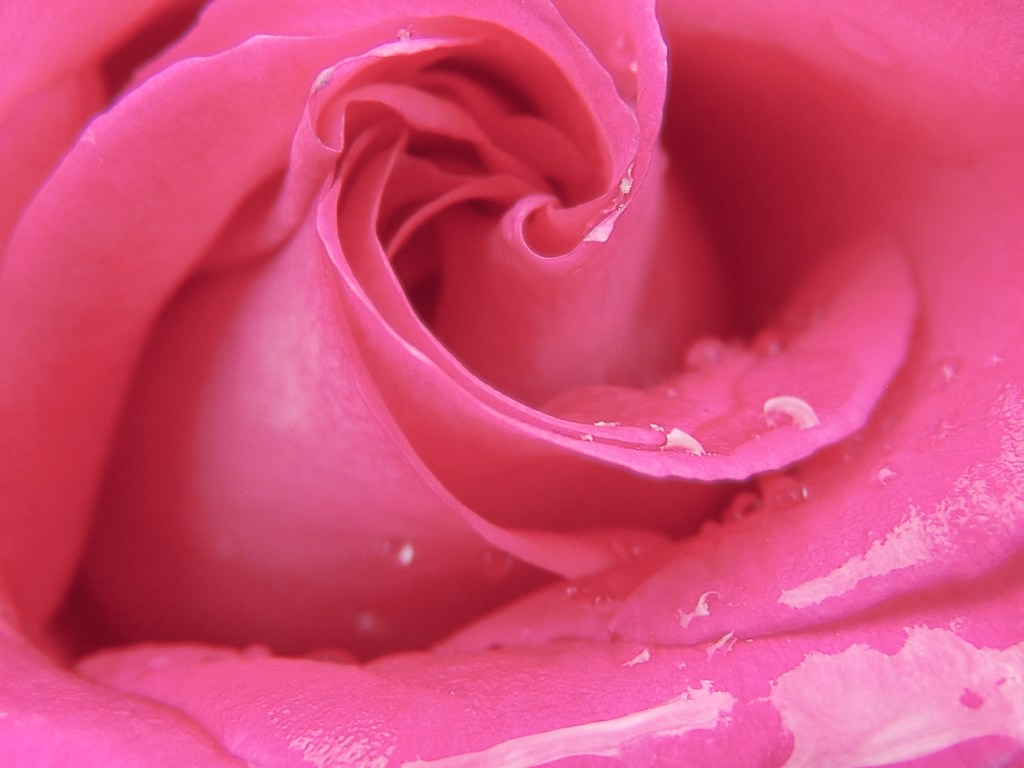
    It is said that the rose bush grew thorns to protect its flowers from fools. This is not so.

    Image by Ryan Mcguire of Bells Design
    Image by Ryan Mcguire of Bells Design

    The bush wished to be admired for its tenacity, its instinct for survival, its breeding and sharp intuition. And so it grew roses to draw an audience.

    Some say that it is the beauty in us that cannot resist its twin in the rose and, much like the feline species, the rose had tricked people into caring for them.

    Yet, what makes the rose hold our gaze?

    The beauty of the rose lies in the way that it enfolds its secret desires within layers of petals. Once you pry them open, the rose begins to die.

  • The Magical Garden of Words

    The Magical Garden of Words

    There was once a boy who loved words very much…

    Image by Wellington Sanipe in Unsplash
    Image by Wellington Sanipe in Unsplash

    Once, not far from here, there lived a boy. He was an ordinary boy except for one thing: he loved words. What type of words you ask? Oh, many kinds of different words. Words that made you see things differently, words that made you smile, words that made you sad, words that made you imagine amazing things… Many different words.

    These words he would pick up when others would use them in conversation. He discovered some when his father told stories. Others he found when his mother told him what to buy when she sent him to the corner shop. And yet others he uncovered in conversations he overheard when adults were speaking… Soon he had collected a large number of beautiful words.

    It was not that he really understood any of these words. Well, not at first. But as he took them to his room, he would look up their meanings in a dictionary and lay on his bed and pondered over them. Turning them round and round in his mind. Every new word he had would bring new ideas into his head.

    As he collected these words, he hid them in a box under the bed where no one could get to them. Soon he had so many that they could no longer fit in the box. Tried as he could, the lid of the box would not close any longer. The box was full. And so it was that as he grew older, he always had many boxes in his room each one filled to the brim with the new words he collected over the years.

    His mother was not too happy about this because it meant that his room was always untidy: boxes everywhere with words spilling out of them. Why could he not be like other boys and just forget words as soon as they are told to him, she would complain. Many of the words had found their way onto the the blankets of his bed, onto the floor and even onto the walls. His room was a mess of words.

    One day he took one of these words and planted them to see what would happen. He took a little pot with soil and put the word inside. He watered it and would you believe it? It grew. First a green stem with leaves and then later a flower: the word in colour with the most beautiful petals.

    So excited was he that he fetched his box of special words and began to plant them one by one. Soon he had a garden of words. Pot planted words were now everywhere in his colourful garden. Some words grew differently from others. Some had grown, like his first word, into word flowers. Others, grew into poems, into stories, into tales. Some even grew into books.

    On a sunny day a young woman walked by and admired his garden of words. “What a most amazing garden,” she said. “You should cut them and put them in vases.” He could see that the words had a great effect on her. As she cast her glance to different parts of the garden, the young man could see that the different word flowers changed the expression on her face.

    When she looked into the furthest corner of the garden where a tree of poems was in bloom, she became transfixed, the smile fading from her face and a tear forming in the corner of her eye. Then when she bent down to page through a book hanging from a branch, her eyebrows seemed to crease and there was a lost look in her eyes like someone who had stepped into a different world. Other stories made her smile so wide, the young man blushed.

    “Would you like one of them?” he asked because he could see that this word wonderland had touched her heart. He picked a poem with the most exquisite colours and gave it to her. When she looked him in the eye, he knew, in that moment, that she would always return to this magical garden of words.

  • The Legend of Sand and Sea

    The Legend of Sand and Sea

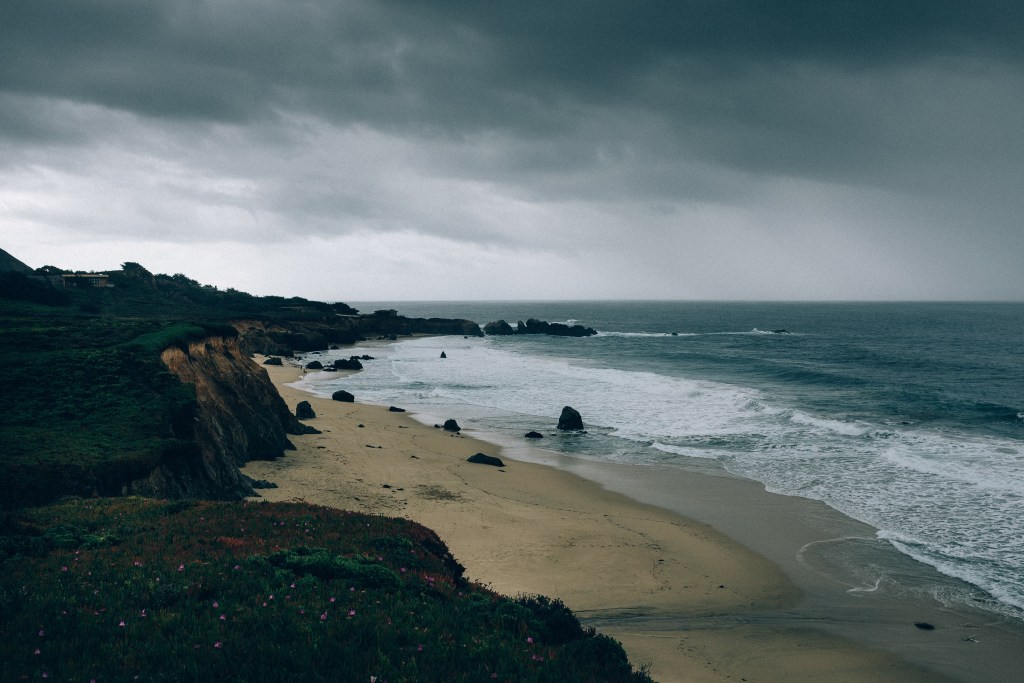
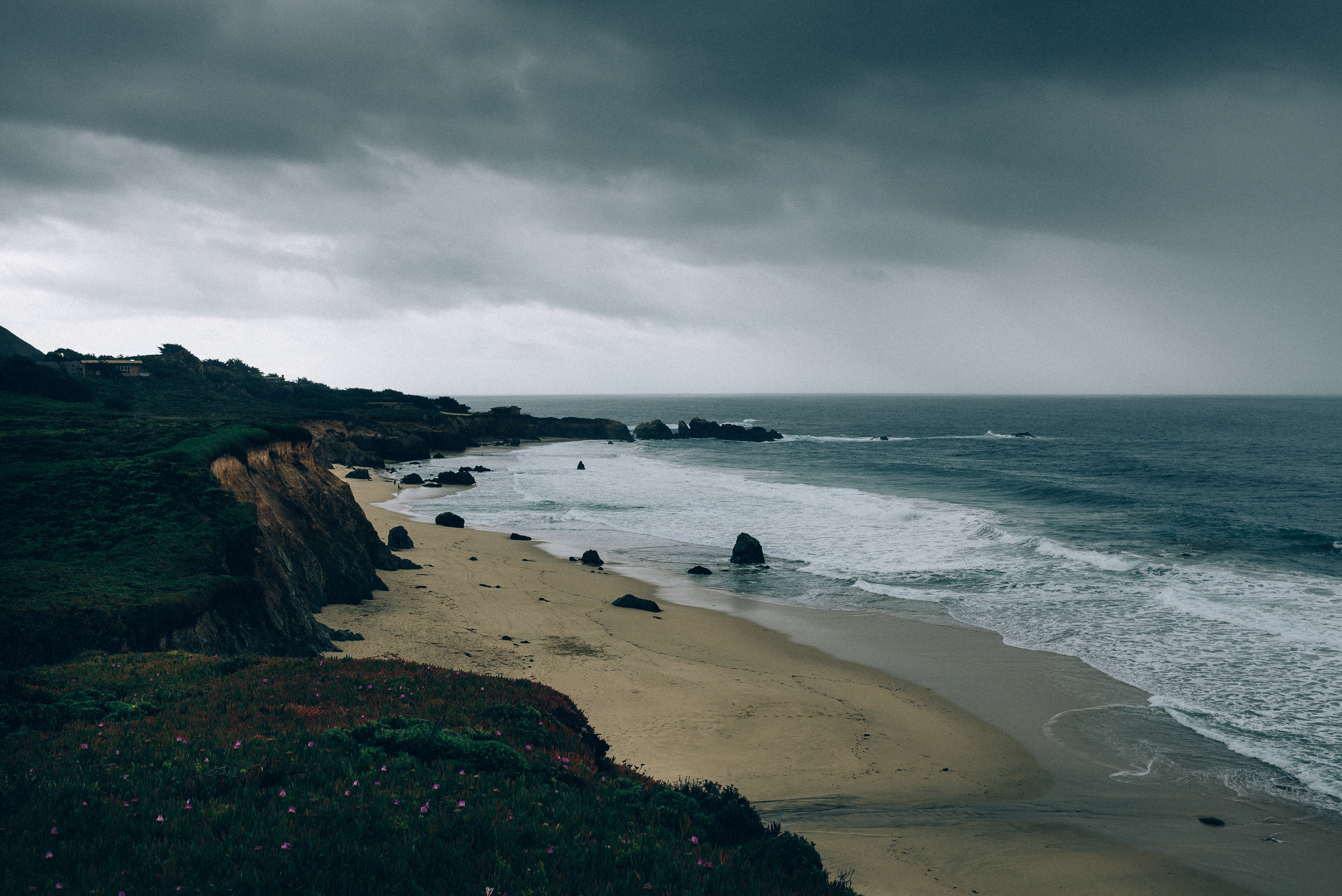
    The story of how earth and water met and why we love strolling on the beach…

    Image by Forrest Cavale on Unsplash
    Image by Forrest Cavale on Unsplash

    Sand, daughter of rock, and Sea, son of rain, finally met. Sea was shy and, for once, was unable to make waves. He hid behind a boulder. Sand was less bashful. She sought him out and cornered him on the waterfront. “I have been watching you for some time already and I like what I see,” said Sand, “You are just the cowboy for me. So why don’t you marry me?”

    Sea was taken aback. “I like you too,” said Sea, going back and forth, “but you don’t want to marry someone like me.”

    “But I do,” said Sand, “I think we make the perfect match.”

    “But I’m unreliable,” replied Sea, “everyone knows that I come and go like the tide.”

    “But every time you come in,” said Sand, “I will be refreshed.” She smiled widely.

    “Sometimes the weather angers me,” said Sea desperately, “then I blow up a storm.”

    “On my shore,” replied Sand, “have I been anything but the epitome of calm?”

    “I have depths you cannot imagine,” answered Sea, “A darkness you will never fathom.”

    “I lie in the sun all day,” said Sand, “and sometimes can be quite shallow, but I like a nice challenge.”

    “Yes,” searched Sea, “but I am known to drown many things.”

    “Whether I am under you or inside you,” replied Sand, “you can never swallow me.”

    Finally, when he could not think of anything else, Sea said: “Do I have a choice?”

    “I don’t think so,” replied Sand and smiled wider than any shoreline, “It is inevitable.”

    The sun set quickly behind the horizon.

    And so Sand and Sea were married. Under the watchful eyes of Moon, Sea regulated his tides. No matter how deep Sea was, you always found Sand holding him up. When he blew up in storm he found a place rest on the shores of Sand. There, with every incoming wave they renewed their love for each other and mingled in the breaking crest. They talked no more as there was no need for words any longer.

    After many years, and with the help of Sun, Sand and Sea gave birth to offspring that would symbolise their love for each other. These children were the first humans made of Sand and Sea. Human beings combined calm and storm, shallow and deep, travelling and staying — the one part never being able to swallow the other.

    People went all over the earth always keeping grandmother Sand under their feet to keep them firm and to build their homes. At first they only went where their uncles, the rivers were, and then later took water with them wherever they went. And till today, when lovers want to renew their love for each other they go walking on the shoreline with their feet mingling in the wet sand, their children building sandcastles that the tide will try to swallow… inevitably.

    Image by Ry Van
    Image by Ry Van