Our Inheritance: The African and Islamic Civilisations That Shaped the World
Our Inheritance: The African and Islamic Civilisations That Shaped the World
“We don’t just have history. We have receipts.” — Yaw Kissi
For generations, our textbooks — even in Islamic schools — handed down a version of history in which Europe alone was cast as the cradle of civilisation, and Africa into darkness. This colonial retelling stripped countless people of their confidence and belonging.
As Shaykh Allie Khalfe insightfully reminds us, even the academic traditions we take for granted — like graduation caps and gowns — trace back to the Islamic ijāzah system, where a teacher would bestow a turban and robe upon a student to mark their mastery.
Europe adopted these symbols while erasing their origins.
But today, the veils are lifting.
And as African memory resurfaces — in scrolls, dreams, and digitised manuscripts — we realise something essential:
We don’t just have history. We have receipts.
Mathematics and Science
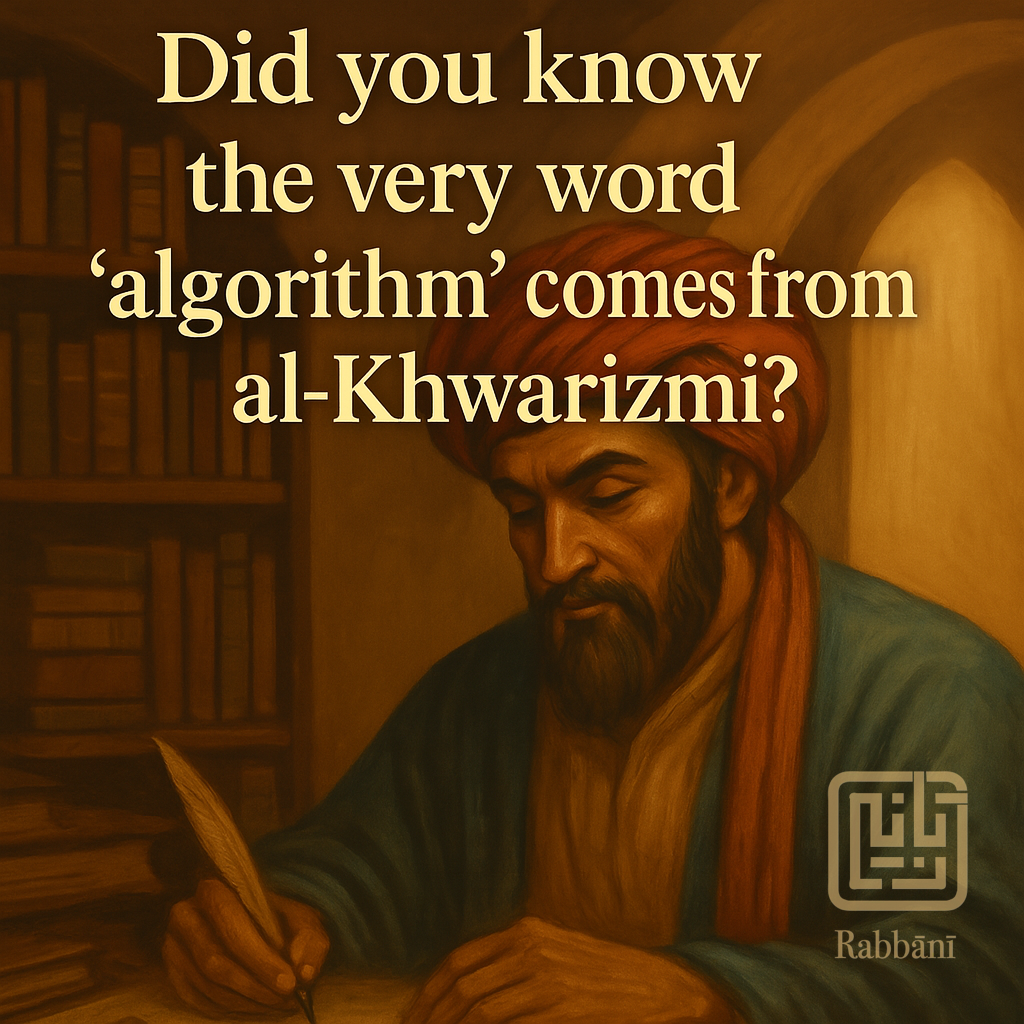
Consider al-jabr, or algebra — a foundational pillar of modern science, engineering, and finance. Muhammad ibn Musa al-Khwarizmi, working in 9th-century Baghdad, formalised its rules, giving his name to the word algorithm — the very basis of every modern computer. His systematic approach to equations transformed the world.
In medicine, Ibn Sina (Avicenna) produced the Canon of Medicine, a monumental text synthesising anatomy, treatments, and psychology, taught across Europe for over 600 years. Abu al-Qasim al-Zahrawi (Albucasis) in Andalusia created a 30-volume encyclopedia on surgical techniques, designing more than 200 surgical instruments that still influence modern practice.
Ibn al-Haytham (Alhazen), known as the “father of optics,” shattered ancient Greek theories by proving that light enters the eye to produce vision, and he introduced experimental methods that would inspire Europe’s later scientific revolutions. These figures were not footnotes in history — they were its authors.
Astronomy and Navigation
Muslim astronomers transformed the night sky into a navigational map, extending humanity’s reach across oceans and deserts. They refined Greek, Persian, and Indian observations and built on them with powerful new instruments and methods.
Al-Zarqali (Arzachel) of 11th-century Toledo developed the Toledo Tables — astronomical data so precise they became a cornerstone for European science, inspiring Copernicus and others. His universal astrolabe could be used at any latitude, freeing navigation from local constraints.
Mariam al-Asturlabi, a 10th-century woman scientist in Aleppo, constructed exquisitely precise astrolabes, allowing people to determine prayer times, measure the positions of stars, and navigate across continents. These tools formed the backbone of Muslim maritime routes linking East Africa, Arabia, and South Asia — centuries before Europe was ready to cross the Atlantic.
It is no exaggeration to say that the so-called Age of Discovery — Columbus, da Gama, Magellan — was made possible through navigational science and star charts inherited from the Muslim world. Yet most schoolbooks erase these global contributions.
Education and Intellectual Institutions
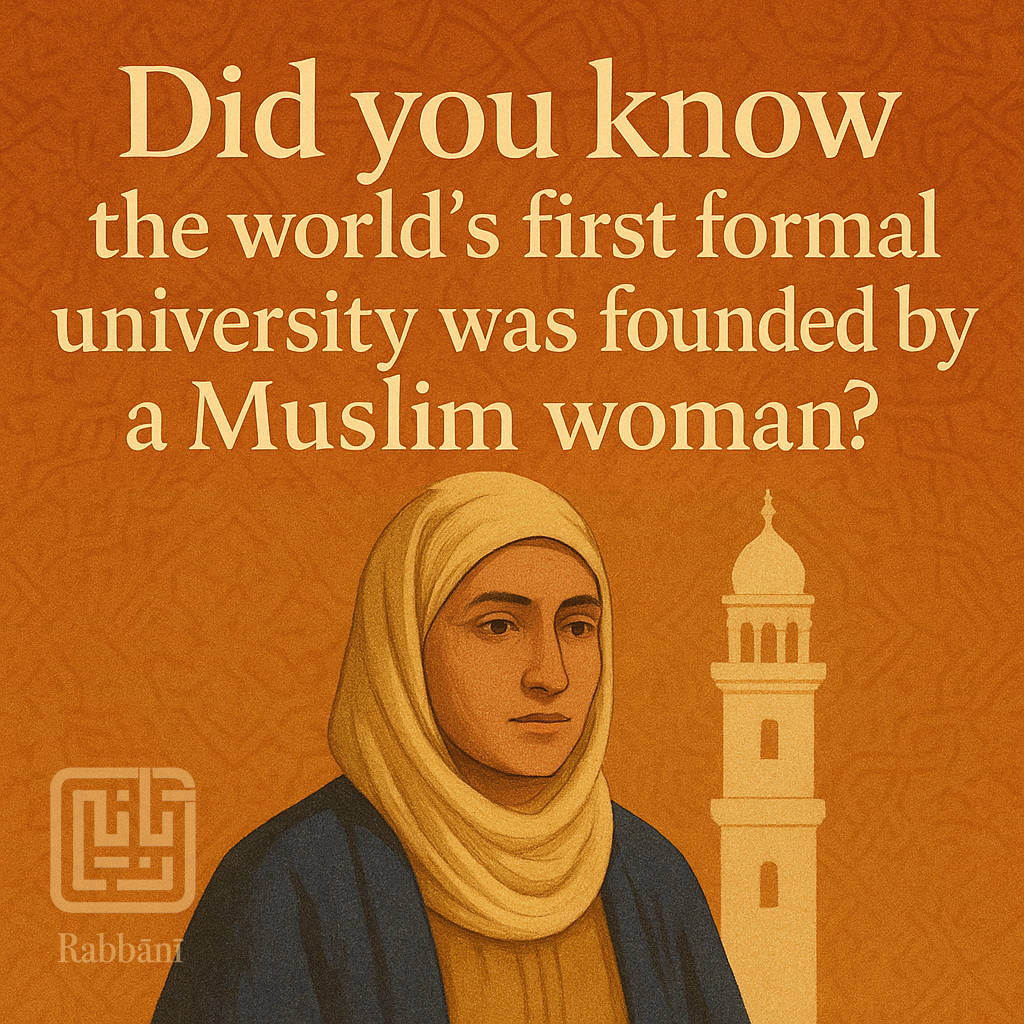
Muslim civilisation revolutionised education by designing institutions that united spiritual, legal, and scientific learning. Fatima al-Fihri, a Muslim woman in Morocco, founded the University of al-Qarawiyyin in 859 CE, the world’s oldest continually operating degree-granting institution. Her legacy shows how women helped sustain and fund educational excellence.
In West Africa, Ahmed Baba of Timbuktu, who authored more than 40 books on law, biography, and ethics, embodied the intellectual brilliance that made Timbuktu as respected as any European centre of learning. Even when Moroccan invaders exiled him to Marrakesh, his scholarship commanded respect, and he eventually returned to revive Timbuktu’s traditions.
Equally inspiring, Nana Asma’u of 19th-century Nigeria trained networks of female educators (yan-taru) and wrote poetry and theology in Arabic, Hausa, and Fulfulde, extending literacy and spiritual knowledge throughout the Sokoto Caliphate.
These institutions offered far more than theology: their curricula included medicine, astronomy, mathematics, grammar, and philosophy, attracting scholars from across Africa, the Middle East, and even Europe. They were open, cosmopolitan spaces that nurtured critical thinking and diversity, centuries before Europe’s universities caught up.
Art, Culture, and Daily Life
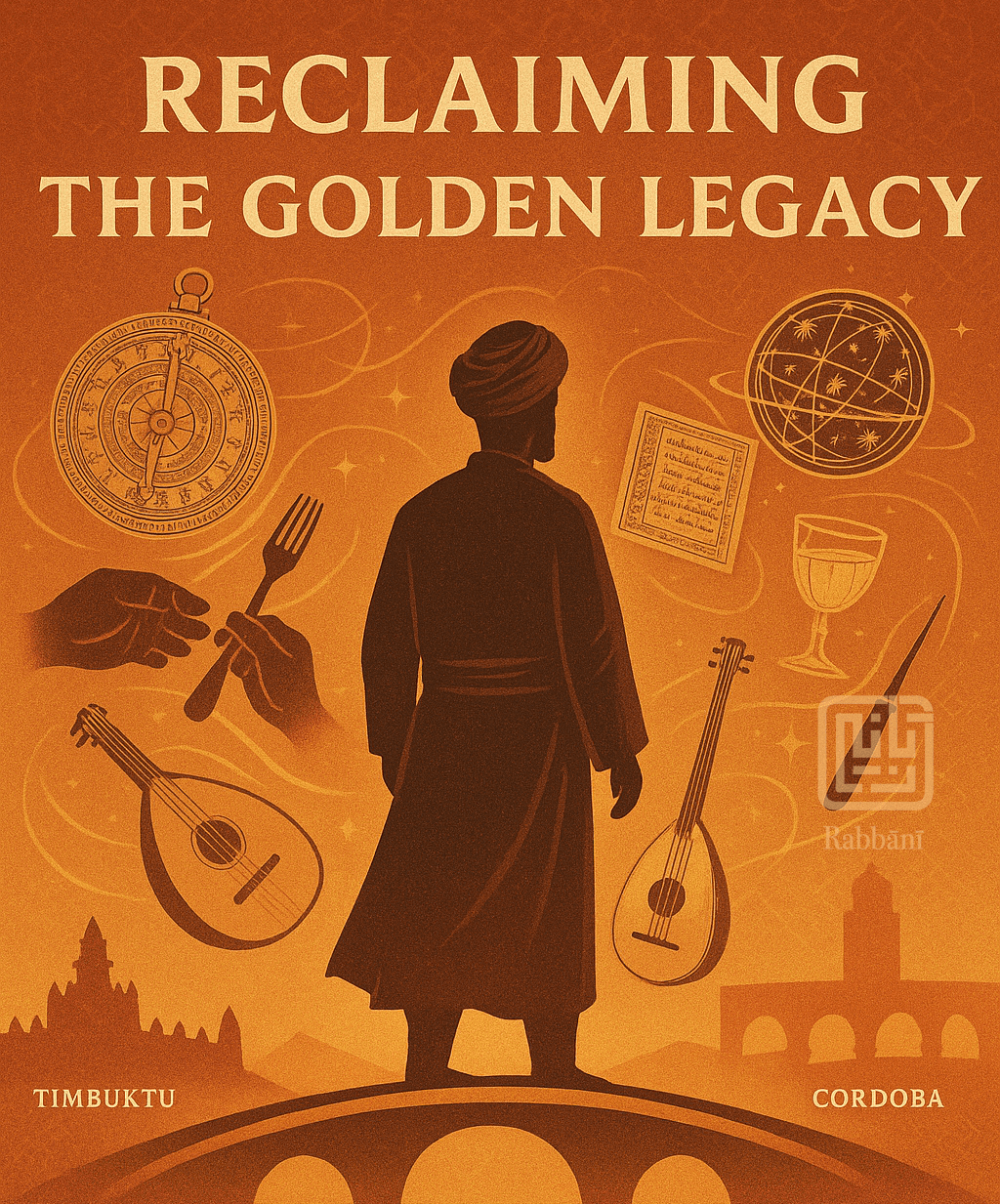
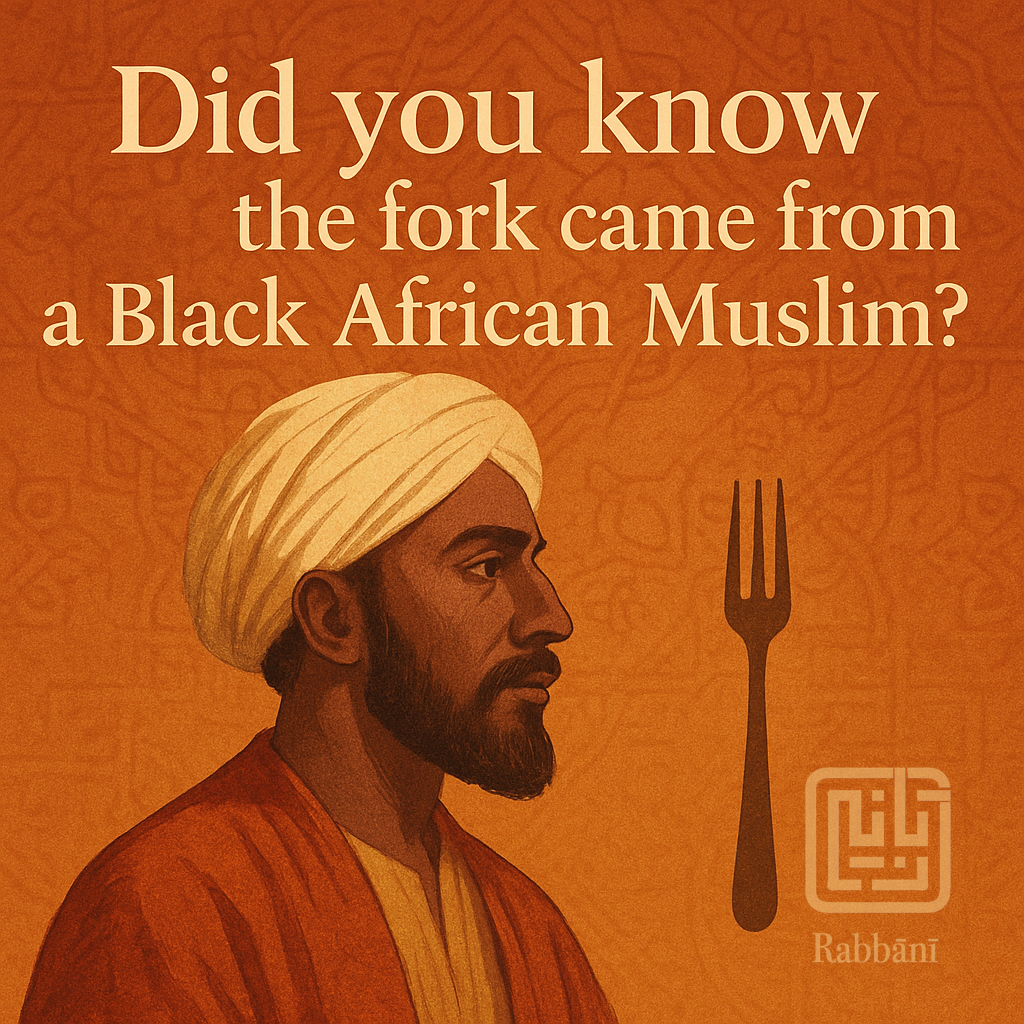
Perhaps nowhere was cultural brilliance more visible than in the story of Abu l-Hasan ʿAli Ibn Nafiʿ — known as Ziryab, the ‘Black Bird’. Born to a family who had been enslaved, most likely of Black African descent, Ziryab arrived in Cordoba in the 9th century and redefined taste itself. He expanded musical scales, added a fifth string to the oud, and established a structured method of teaching music that would echo through Europe for centuries.
“The fork, now held up as the badge of ‘civilisation,’ was popularised in Europe by a Black African Muslim.”
— from the section on Ziryab“They weren’t relics. They were receipts.”
— on the Timbuktu manuscripts
He also transformed daily life by introducing crystal drinking vessels, organising meals into separate courses, encouraging regular hygiene, designing seasonal wardrobes, and even popularising the small two-pronged fork for delicate foods — centuries before Europe claimed it as its own. That fork would eventually spread across France and the continent, yet no one credited its origins.
In today’s world, where politicians shame people like Zohran Mamdani for eating with their hands, there is a profound irony: the fork, now held up as the badge of “civilisation,” was popularised in Europe by a Black African Muslim.
A Note on Eating With the Hand
The uproar over Zohran Mamdani’s video of eating rice with his hands shows how colonial thinking still lingers. Across Africa, India, and the Arab world, eating with the hand is rooted in ancient tradition, mindfulness, and even spiritual symbolism — linking the five fingers to the five elements of nature.
Western colonisers once labelled this practice “uncivilised,” forgetting that their prized utensil, the fork, came into European culture through Ziryab’s refined innovations. France and other parts of Europe embraced the fork over centuries, yet rarely acknowledged its roots.
As Shaykh Allie Khalfe wisely reminds us, the problem is not about etiquette, but about power, prejudice, and historical amnesia — a colonial hierarchy that still tries to shame non-European cultures while quietly living on their forgotten innovations.
Conclusion
The Golden Age of Africa and Islam was never lost — it was hidden, buried beneath centuries of colonial arrogance, racism, and cultural erasure. From the hospitals of Cairo to the libraries of Timbuktu, from the universities of Fez to the concert halls of Cordoba, from the Grand Library of Baghdad — Bayt al-Ḥikmah — to the scholars who charted the stars, our ancestors nurtured a world of knowledge, beauty, and moral excellence that still resonates today.
These contributions were not accidental: they were born of a civilisation that valued intellectual curiosity, hospitality, faith, and human dignity. In their pursuit of learning, these scholars and visionaries created bridges between continents and cultures, carrying forward a spirit of trust in God (tawakkul) and service to humanity.
Today, recovering these stories is not about boasting or chasing nostalgia — it is an act of healing, of reclaiming the confidence, pride, and resilience that colonial narratives tried to crush. Our children deserve to inherit a truthful memory of who we are: people who illuminated the world, built institutions of compassion and reason, and shaped the very frameworks of science, art, and law.
Let us honour this legacy not with empty slogans, but by living it — teaching it, protecting it, and carrying it forward as a sacred trust (amanah). For if our ancestors could rise from the chains of conquest and slavery to become authors of civilisation, then we too can rise, with God’s help, to build a world of justice, knowledge, and mercy once more.
We were never just subjects of someone else’s story.
We wrote. We built. We mapped. We healed.And the pages are still here.
We don’t just have history. We have receipts.
And now — we remember.
References
- 1001 Inventions: The Enduring Legacy of Muslim Civilisation, ed. Salim T.S. Al-Hassani
- George Saliba, Islamic Science and the Making of the European Renaissance (2007)
- John Hunwick, “Ahmed Baba: Intellectual of Timbuktu,” Sudanic Africa (1997)
- Beverly Mack & Jean Boyd, One Woman’s Jihad: Nana Asma’u, Scholar and Scribe (2000)
- Amira K. Bennison, The Great Caliphs: The Golden Age of the Abbasid Empire (2009)
- Gülru Necipoğlu, The Age of Sinan (2005)
- Toby Green, A Fistful of Shells: West Africa from the Rise of the Slave Trade to the Age of Revolution (2019)
 Adli Yacubi