How empire sails in suits, and what it means to row in resistance.
🔰 Intro
There was a time when pirates came with cutlasses and black flags. You saw them coming. You heard the war drums. But today — the pirates wear uniforms. Or suits. Or diplomatic smiles. And while their ships sail under the banner of freedom, the wake they leave is full of oil, fire, and broken nations.
This is a story about empire. But it’s also a story about you. About where you sit — above deck, below deck, or paddling in a canoe. It’s about resistance. Memory. And the unseen rows of angels above.
“The sea is full of flags — but not one lowers its sails in grief.”
They told us flags were symbols of freedom. They said democracy wears red, white, and blue. They taught us that when their soldiers arrive, the people are being saved.
But the flag flaps like a warning now. The stripes stretch across oceans. The stars are stamped on missiles. The anthem plays over drone strikes.
This isn’t peace. It’s piracy with better branding.
The United States isn’t a country anymore — it’s a flagship. The lead ship in a fleet of multinationals, financial institutions, media empires, and war machines.
It doesn’t sail for justice. It sails for lithium. For land. For leverage.
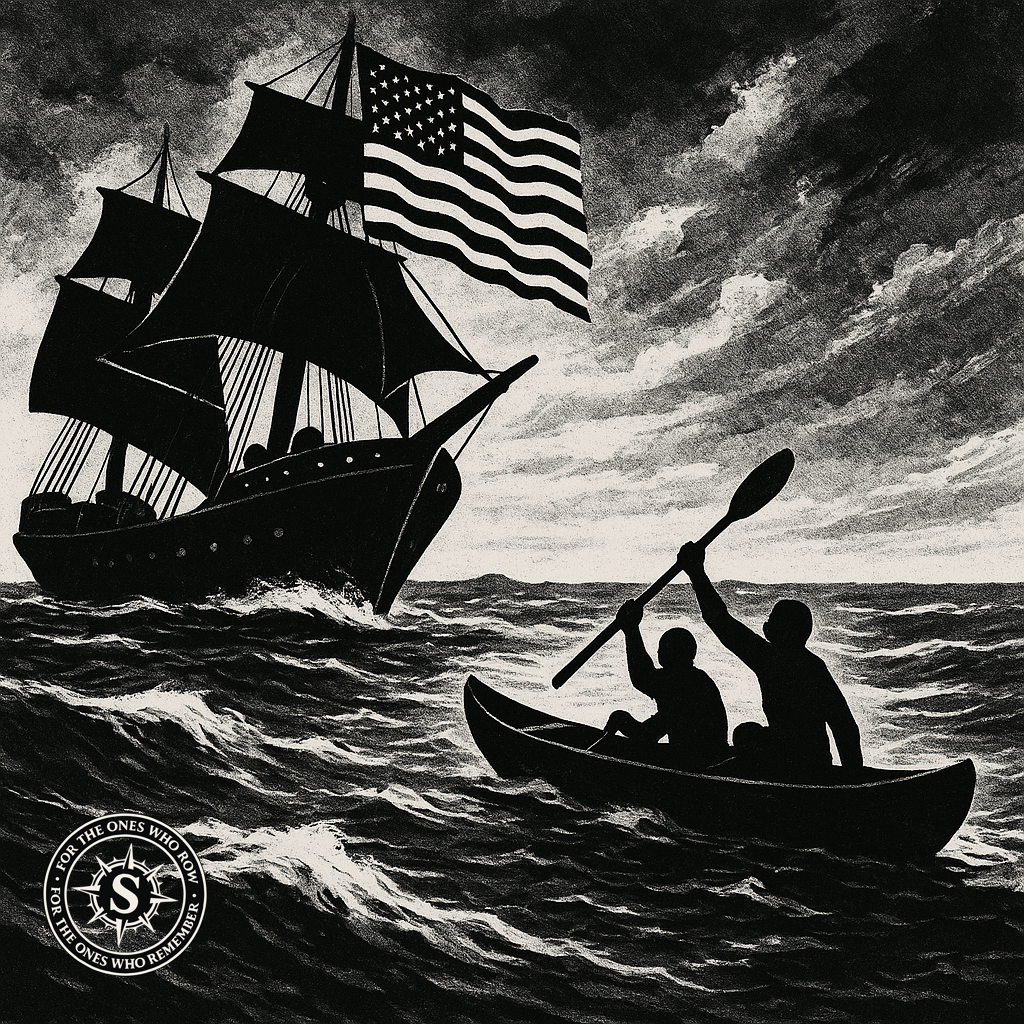
Its flag is the Jolly Roger of the modern age — not because it’s outlawed, but because it’s above the law. And while the old pirates hoisted black flags to strike fear, these ones wave their colours with pride… and call it diplomacy.
You see them dock in Gaza, in Haiti, in the Sahel. They don’t drop anchor — they drop sanctions. They don’t build bridges — they bulldoze economies. They leave schools shattered, mothers weeping, aquifers poisoned — and they call it freedom.
Even the boldest voices still need trade. Even South Africa, with its lawsuit and legacy, still knocks on the same doors. Because when the pirates run the ports, you have to smile as they loot.
Meanwhile, in Gaza, the killing continues. The children cry in Arabic, but no ship stops to help. The sea is full of flags, but not one lowers its sails in grief.
🏢 Section 2: The Pirates Have Offices Now
“You don’t need a coup when you can crash a currency.”
The pirates don’t need eye-patches anymore. They wear tailored suits. They don’t wave cutlasses — they carry clipboards. Their muskets have been replaced by metrics.
The modern pirate doesn’t kick down your door — he offers you a deal. An “investment.” A “development project.” A “partnership.”
But look closely: The lithium ends up in their electric cars. The water rights end up in their stock portfolios. The debt — always the debt — ends up around your children’s necks.
They’ve learned that you don’t need to invade a country if you can own its infrastructure. You don’t need to drop bombs if you can drop interest rates. You don’t need a coup when you can crash a currency.
BlackRock owns more land than many nations. Nestlé bottles water it didn’t pray for. Chevron calls oil sacred. Halliburton builds what the bombs destroy.
The empire privatized its violence. It outsourced the pillaging to companies with ethical mission statements. Its generals now wear CEO name tags. Its foot soldiers are analysts, consultants, lobbyists.
And when a country resists — like Bolivia, like Palestine, like Niger — it doesn’t get invaded at first. It gets discredited. Its leaders are called unstable. Its elections are called suspect. Its people are painted as dangerous, irrational, ungrateful.
This is how conquest works now: not with sails, but with spreadsheets. Not with warships, but with press releases. Not with swords — but with silence.
Somewhere, a young trade official — daughter of a struggle veteran — tries to resist. She sits in a Johannesburg office late at night, re-reading a contract with clauses meant to trap her people. She circles words in red. She drafts a softer version. She knows they won’t accept it. But still — she sends it.
🧠 Sidebar: They Stole the Thoughts Too
They didn’t just loot land and labour. They colonised knowledge. They broke open sacred libraries, and then wrote the footnotes in their own names.
The West calls it “intellectual property.” But it’s just patented plunder.
In Egypt, Plato sat at the feet of Black scholars. In Mali, the Dogon mapped the Sirius star system — long before telescopes. In South Asia, turmeric healed wounds before it had a bar code.
They burned the manuscripts of Timbuktu. Then they published “discoveries” about African medicine in European journals.
Today they say: “You owe us mobile phones.” But what they really mean is: “We branded what we stole.”
🛏 Section 3: Below Deck — The Ordinary Citizen
“The system is designed to keep the floor clean — even if the keel runs red.”
Empires aren’t only built by generals. They are built by people who go to work, come home tired, scroll a little, and sleep.
Below deck, life continues. The engines roar above, the orders are barked on the bridge — but here, the lighting is soft. There are supermarkets, streaming shows, lawnmowers, coffee shops.
No one hears the groans of the drowned. No one smells the smoke from the burning village.
Maybe they see something on the news — Gaza, Congo, Yemen. Maybe they feel a flicker of sorrow. Maybe not.
The comfort below deck is that you don’t have to know. The noise is muffled. The suffering is pixelated. The system is designed to keep the floor clean — even if the keel runs red.
And when someone does knock on the cabin door — a refugee, a witness, a protester — the citizens flinch. Not because they’re evil. But because it’s awkward. Disruptive. A crack in the illusion.
You see, this ship sells a story: “We are good.” “We bring freedom.” “We are the world’s hope.”
It’s a story whispered through education, hummed in entertainment, declared in politics. And most below deck believe it. Or want to. Or at least, want not to think about it too much.
One evening, a man in the suburbs clicks on a video about Gaza. He watches for seventeen seconds before an ad plays. He sighs. Skips it. Opens another tab. A special on air fryers. The horror slips away — not because he’s cruel, but because the system makes forgetting so easy.
Dissent is dulled with subscription bundles. A hundred shows to choose from. None of them about Palestine. And if that fails, there’s always a pill. A holiday. A hashtag that ends by Monday.
Because thinking leads to questions. And questions lead to guilt. And guilt demands action. And action? That rocks the boat.
🛶 Section 4: Canoes and Resistance
“These boats do not always win. But they do not drown quietly.”
Not every vessel sails under the pirate’s flag. Some float with patched sails and broken oars. They are small. Often sinking. But they do not bow.
They are the canoes of the world. Gaza, battered and besieged, still sings the Adhān through rubble. Haiti, dismembered by decades of debt and interference, still cooks its own rice. Congo, bleeding from every open vein of mineral wealth, still births drums and poems.
These are not nations that invade. They don’t fly drones or send tanks. They row.
And every stroke is resistance. Every preserved language, every intact culture, every refused bribe — resistance.
They are mocked for being poor. Starved for being proud. Punished for surviving.
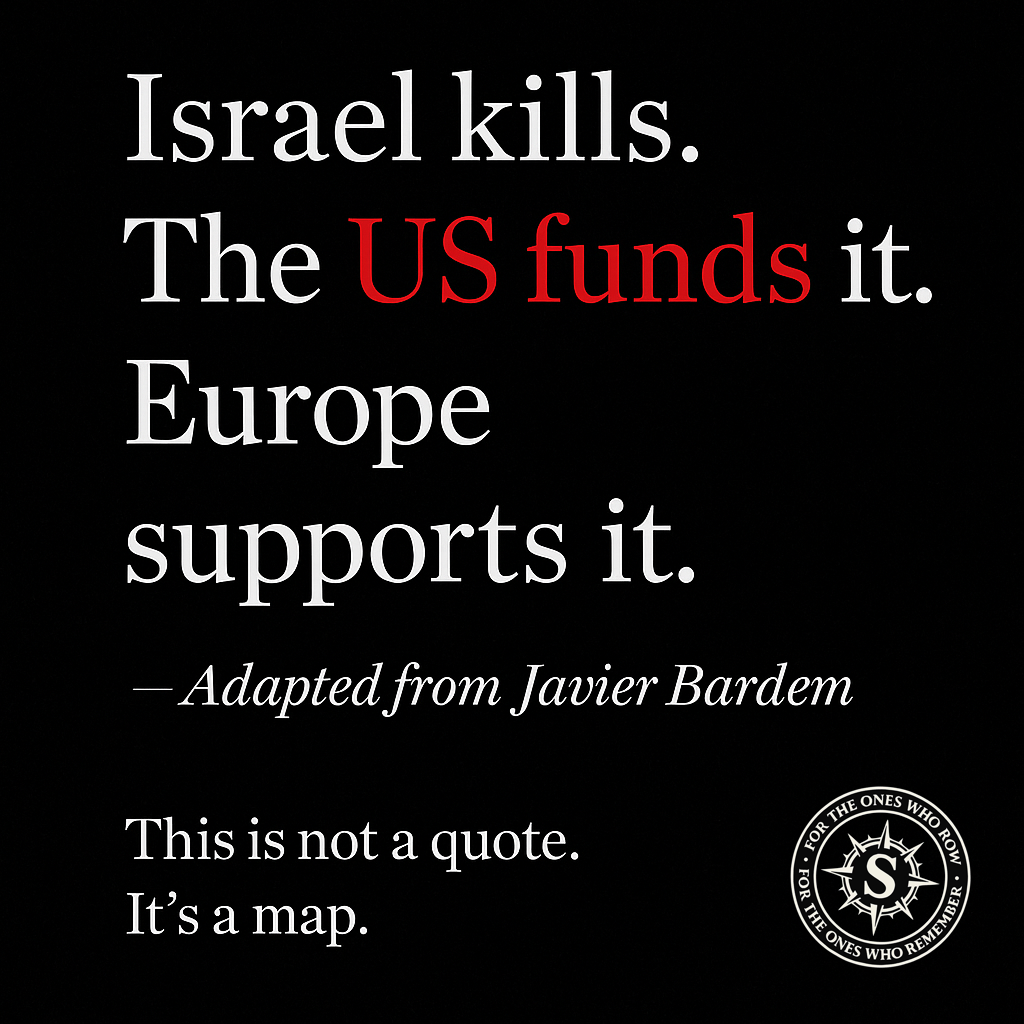
Some truths no longer need footnotes. As the Spanish actor Javier Bardem once said, bluntly and beautifully: “Israel kills. The US funds it. And Europe supports it.”
That’s not politics. That’s a map. A map of complicity. A map of whose silence lets the ship sail on.
The empire calls them unstable. Calls their leaders corrupt. Calls their children threats. But what they fear is not chaos — it’s clarity.
Because the canoe does not pretend. It knows the sea is dangerous. It knows what the pirate ship is.
And still, it rows.
Some canoes are communities. Some are movements. Some are just one grandmother who still tells the old stories — even as the bulldozers arrive.
Some of the canoes ride rivers: the Amazon, the Orange, the Missouri. In them sit the Mapuche, the Nama, the Sioux. They chant in languages the empire once tried to burn. They still paddle. They still protect.
As the bombs fall, a boy in Gaza recites lines from Mahmoud Darwish: “We have on this earth what makes life worth living.” He whispers them into the dust. Into his mother’s lap. It’s not defiance. It’s remembering.
These boats do not always win. But they do not drown quietly. Their resistance echoes — in funeral processions, in ululations, in the smell of fresh bread rising where bombs fell.
And in the far distance, something stirs. Not a boat. Not a bomb. But a wave. A rising swell of memory and reckoning. The kind that even empires cannot out-sail.
❓ Section 5: What Now?
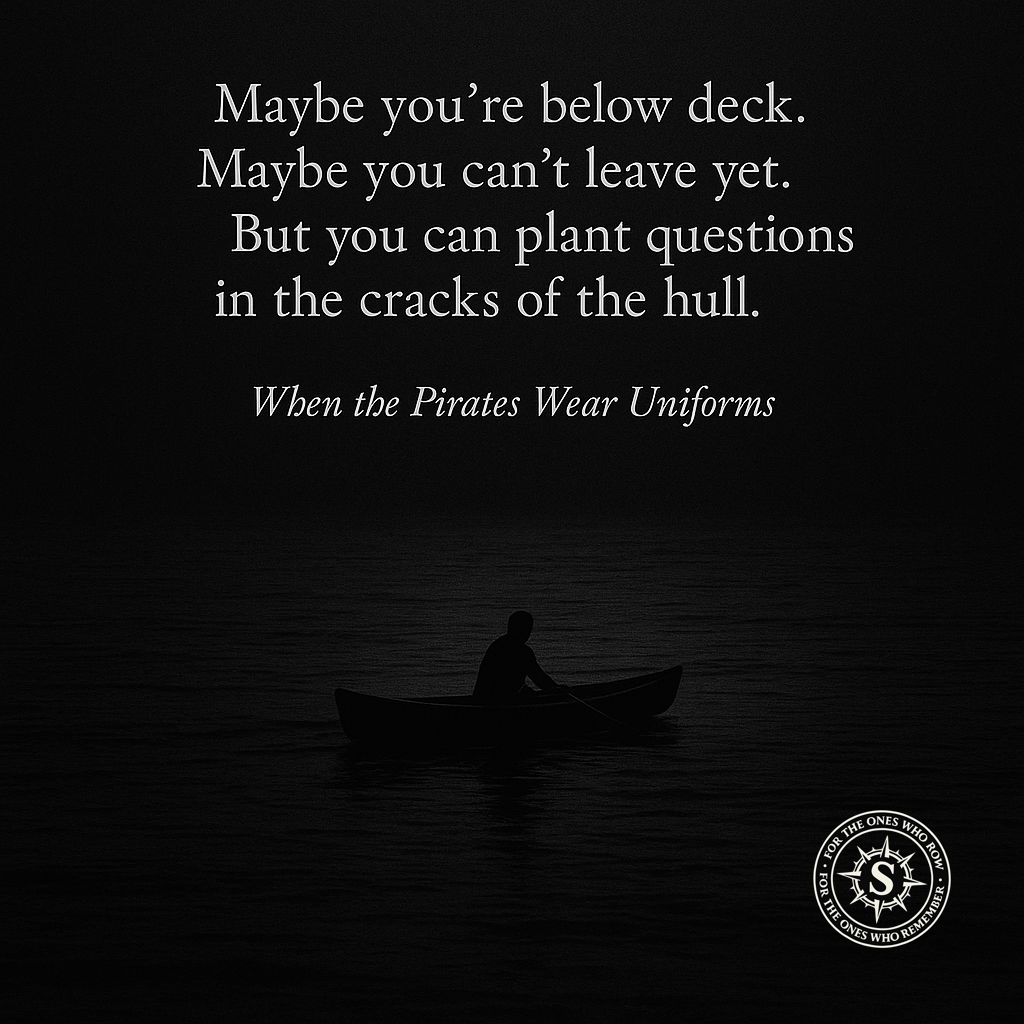
“Maybe you can’t leave yet. But you can plant questions in the cracks of the hull.”
You’ve seen the ship. You’ve heard the cannons. You’ve walked the quiet corridors below deck. You’ve watched the canoes struggle to stay afloat.
So now the question is simple. What now?
You don’t have to be a general. You don’t have to command a fleet. But you do have choices.
You can choose not to cheer when the ship fires. You can choose not to believe the stories they sell you — about the savages, the chaos, the necessary war.
You can choose not to mock the canoe. You can choose to listen when the drowned call out from beneath the waves. You can learn their names. Say their prayers. Tell their stories.
Maybe you’re below deck. Maybe you can’t leave yet. But you can plant questions like seeds in the cracks of the hull. You can make art that aches. You can whisper, even if your voice shakes.
And maybe, one day, when the ship hits a reef — you’ll already know how to swim.
🌌 Postscript: The Unseen Rows
“Above the pirate ships, the angels line up.”
For the ones who row. For the ones who remember.
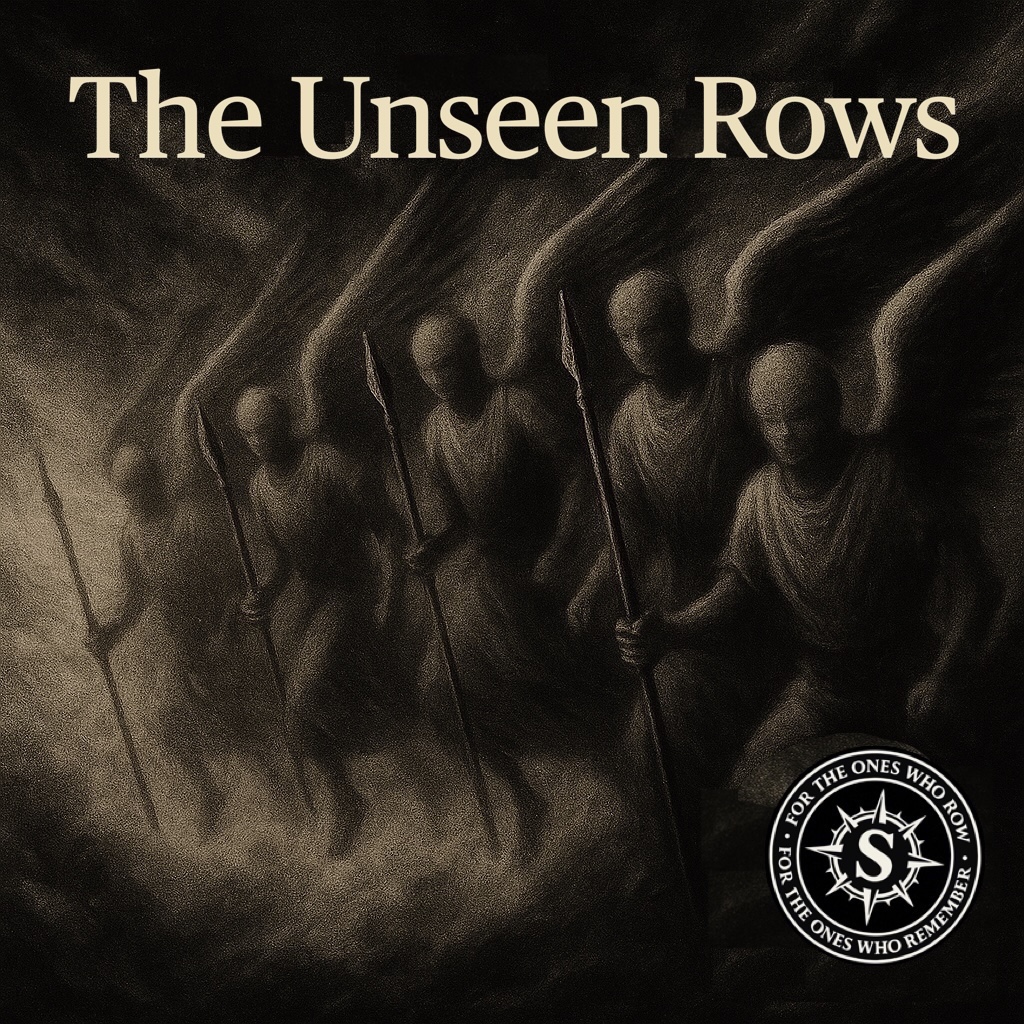
Above the shipping lanes and air raids, above the pirate flags and surveillance drones, above the offices and engines and war rooms — there are rows they do not see.
Al-Ṣāffāt. “By those arrayed in rows…” (Qur’ān 37:1) The angels. Not scattered. Not confused. Lined up — like soldiers of mercy. Advancing — like winds of truth. Reciting — not data, but dhikr.
وَالصَّافَّاتِ صَفًّا فَالزَّاجِرَاتِ زَجْرًا فَالتَّالِيَاتِ ذِكْرًا By those arrayed in ranks, by those who drive forward, and by those who recite the Reminder… (Qur’ān 37:1–3)
These are not symbols. They are not myths. They are the architecture of heaven. And they do not forget the ones who row.
When the shayāṭīn of power rise to steal, when the liars reach for whispers of the unseen, they are met with stones of fire. Comets hurled from truth’s edge. The skies are not neutral. The divine has guardians.
“They cannot listen to the Higher Assembly… they are pelted from every side, repelled, and for them is a perpetual punishment.” (Qur’ān 37:8–9)
And we? We row. We remember. We recite.
We do not carry cannons — but we carry verses. We are not in fleets — but we are not alone. Somewhere, angels are already in formation.
✨ A Final Word from Rafiq al-Bunduqia
The Sage on the Jetty
So here’s what I say, ne:
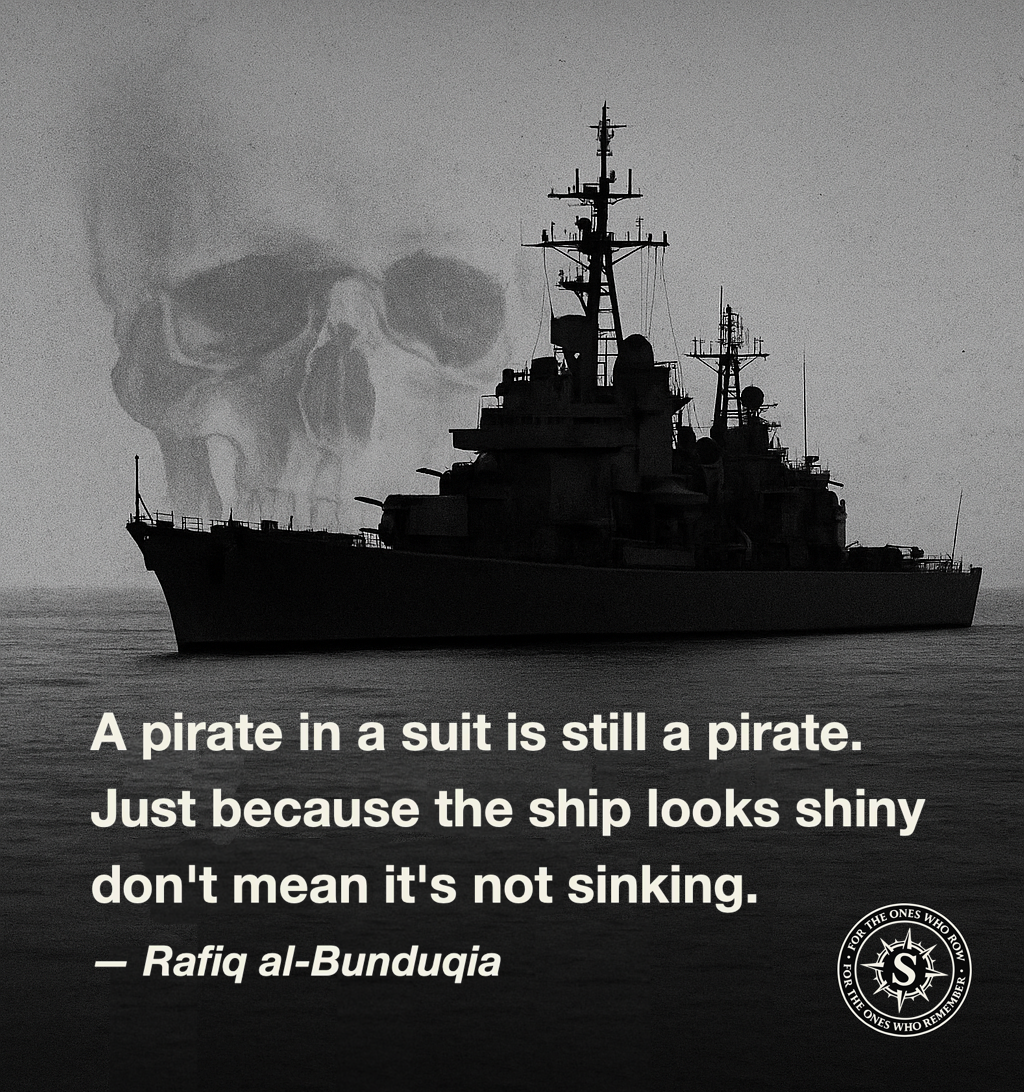
Don’t let them fool you with fancy uniforms and offshore accents. A pirate in a suit is still a pirate. And just because the ship looks shiny don’t mean it’s not sinking.
Me, I seen this before. The old flags change — but the hunger stays the same. They used to come for your gold. Now they come for your soul — and your SIM card.
They sell you peace while sharpening knives. Call it “stability,” call it “the market,” call it “regime change.” But listen close, my bru — they only change regimes that say “no.”
Below deck, I know some of you are tired. I know some of you feel small, feel stuck. But remember: Empires fall when enough people stop pretending.
You can’t steer the whole ship, but you can stop rowing. You can stop clapping for the captain. You can light a fire in your corner. And when the time comes — you’ll know which way to swim.
And as for the ones still paddling in canoes? Rowing against the wave, barefoot, hungry, heart full?
May your names be written on the wind. May your stories outlast the storm. And may your grandchildren sail free.
shotgun click
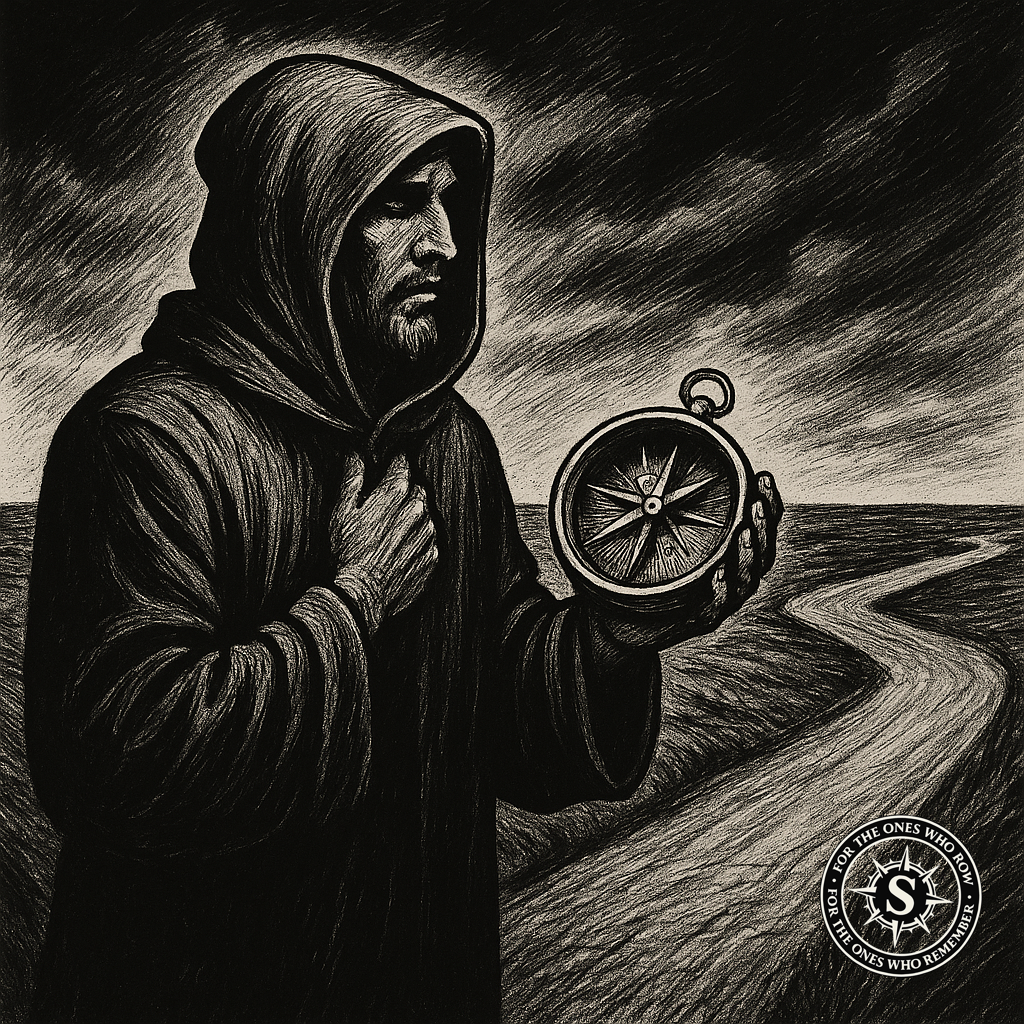
We ride till the ship breaks, bru. Until then — we don’t hand over our compass.
“Salaam to the angels who line up when we can’t. Salaam to the ones who row even with leaking boats. Salaam to the ones who still make dhikr in the dark.
And to the empire?
May you one day see what light you tried to drown.”
Ameen, and ashraaf ʿalaikum ya ṣaffāt.
The seal of remembrance — for the ones who row, and the ones who remember.
— Rafiq al-Bunduqia, The Sage on the Jetty 🧭
“The Pharaoh. The Banker. The Builder.”
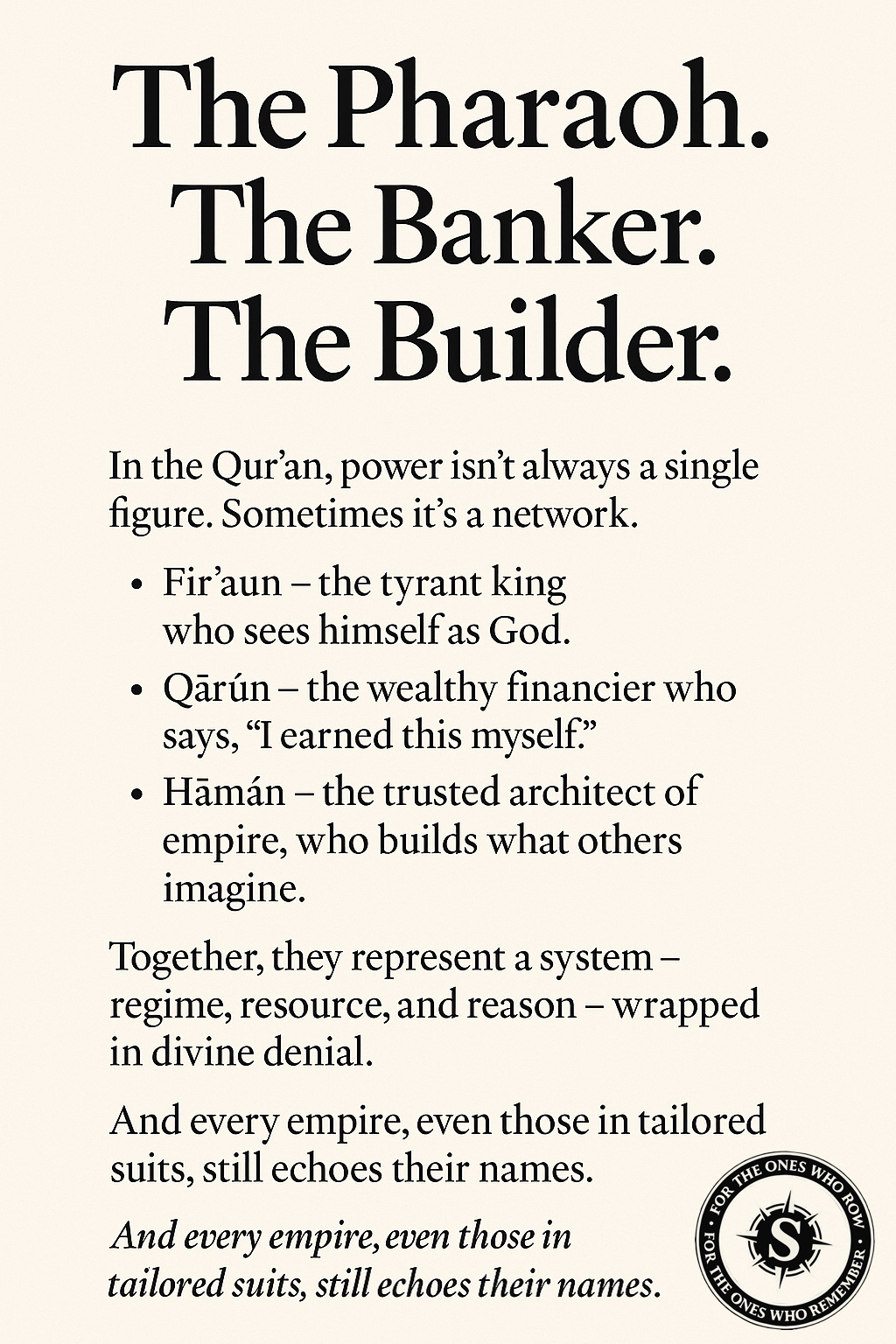
📜 Sidebar: The Three Faces of Tyranny Fir‘awn. Qārūn. Hāmān. These three figures appear repeatedly in the Qur’an — not just as villains of the past, but as types that recur across history. Fir‘awn: the dictator, the political oppressor. He claims divinity, demands obedience, and divides people to rule them. Qārūn: the hoarder, the economic elite. He flaunts his wealth, credits no one but himself, and forgets the source of all provision. Hāmān: the enabler, the bureaucrat and ideologue. He builds towers, writes the laws, manipulates truth, and justifies oppression in the name of order. Together, they form a system: the empire that marches with a flag in one hand, a contract in the other, and blood on its boots. Sound familiar?
“Today, they wear suits. They weaponise policy. But the triad still walks among us.”
The Pharaoh, the Banker, and the Builder
In the Qur’an, they stand together — a tyrant, a financier, and a master of infrastructure. Firʿawn ruled with cruelty. Qārūn hoarded with pride. Hāmān built towers for lies.
Centuries later, the empire shapeshifts. Today, they wear tailored suits. They pass laws. They sign cheques. They pave roads to ruin.
But remembrance makes them visible. And visibility is resistance.
“The Pharaoh. The Banker. The Builder.”
🧭 Parting Compass — A Note from Rafiq al-Bunduqia
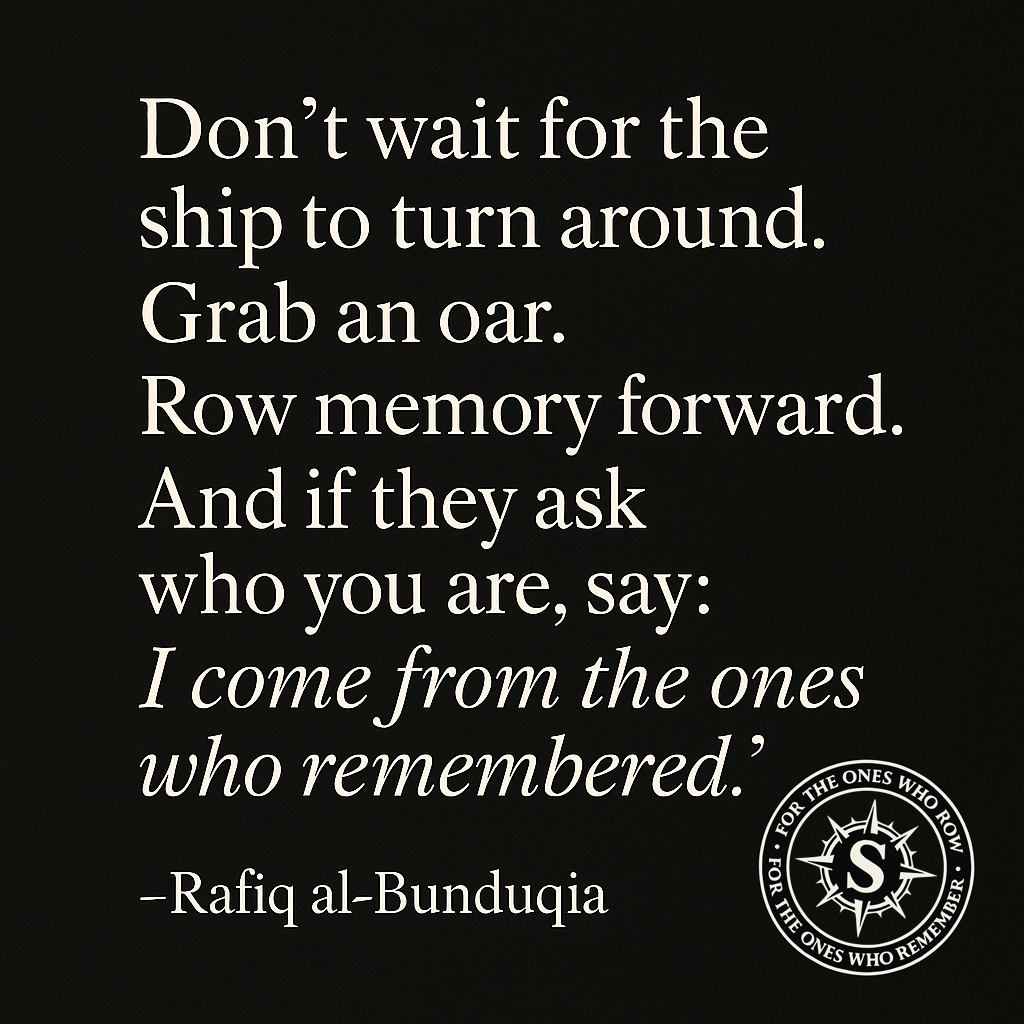
Don’t wait for the ship to turn around. Grab an oar. Row memory forward. And if they ask who you are, say: I come from the ones who remembered.
 Adli Yacubi