
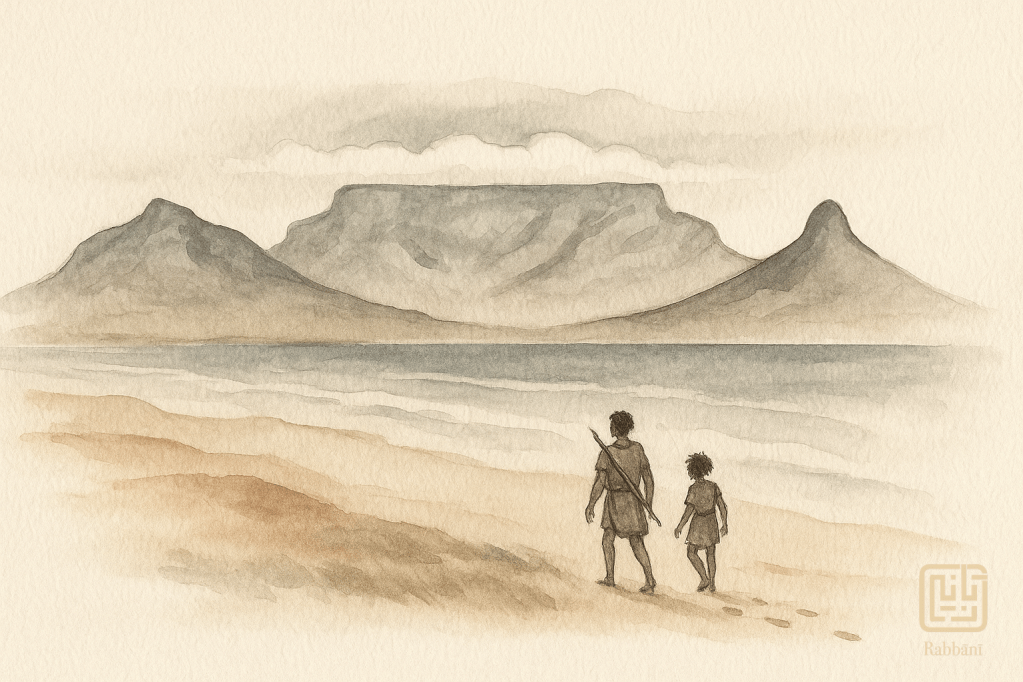
The Legend of the Silver Tree
(Passed down through the mothers. Told now in your hands.)
My mother told me this story.
She said her own mother heard it from her mother.
So now, I pass it to you — like a seed in the wind —
so that you, too, might send it down the line.
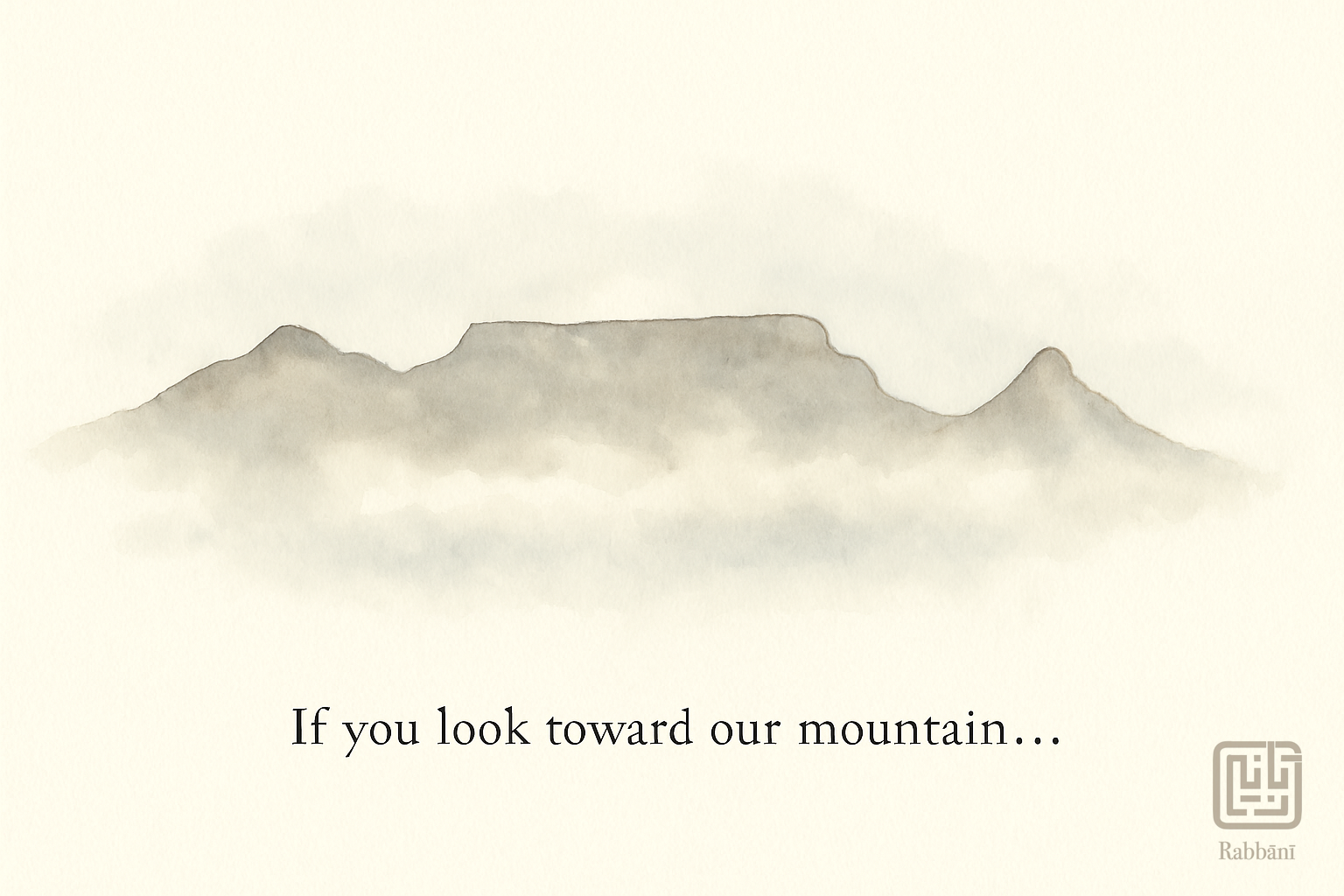
If you look toward our mountain — Table Mountain —
you’ll see the cloth of cloud spread across its top like a table set for guests.
To the right: the lion, his back forming Signal Hill, his mane rising into Lion’s Head.
To the left: Devil’s Peak, brooding.
The lion and the devil seated at the same table.
What a sight for any ship entering Table Bay!
But this story is older than the ships.
Older than the settlers who named those peaks.
Older even than the first Khoi and San who walked these lands.
Long, long ago — perhaps 22,000 years or more —
the people lived far inland.
The land was green. Rivers ran deep.
Wild animals moved in herds like shadows.
The earth was generous.
But then the rains lessened.
The land grew hotter, harder.
Some clans became violent.
The world was shifting.
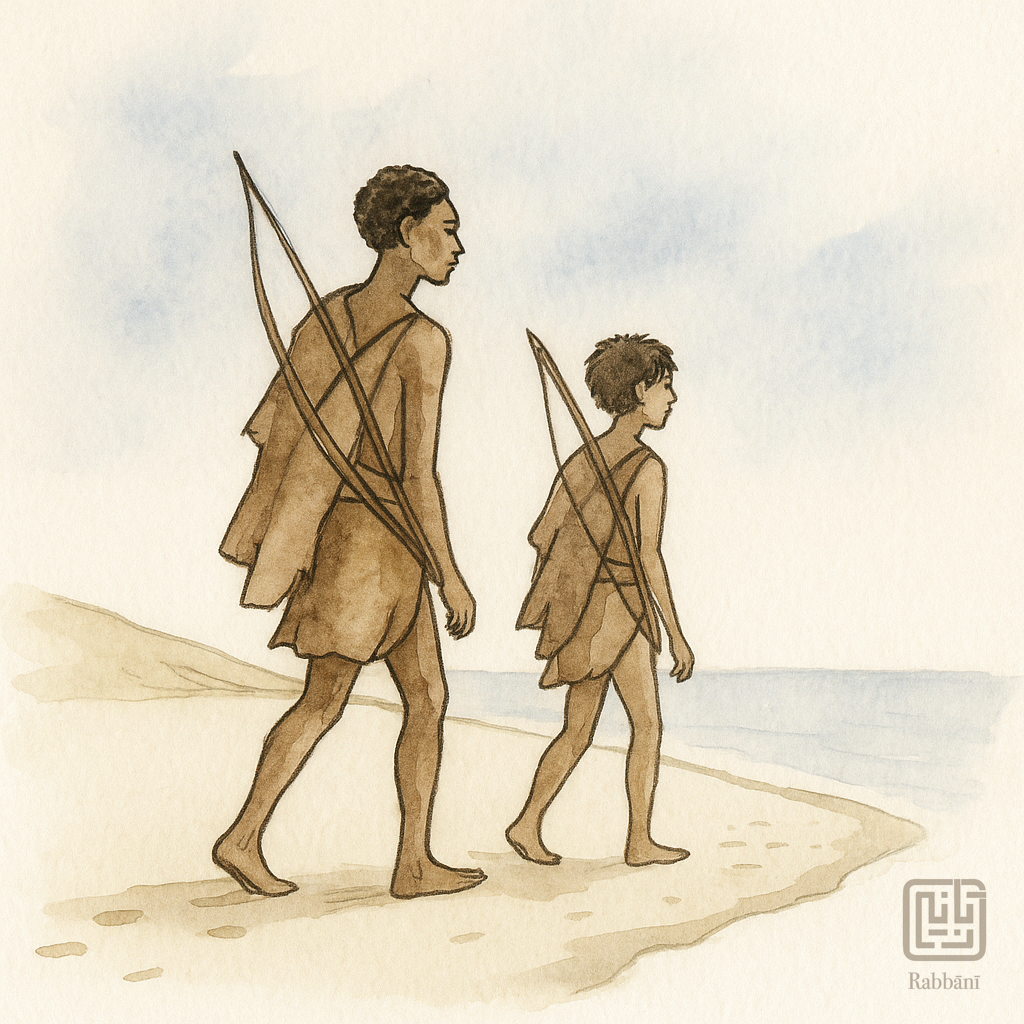
And so it was that a man named Gubi — a fire-maker, a spark of a man —
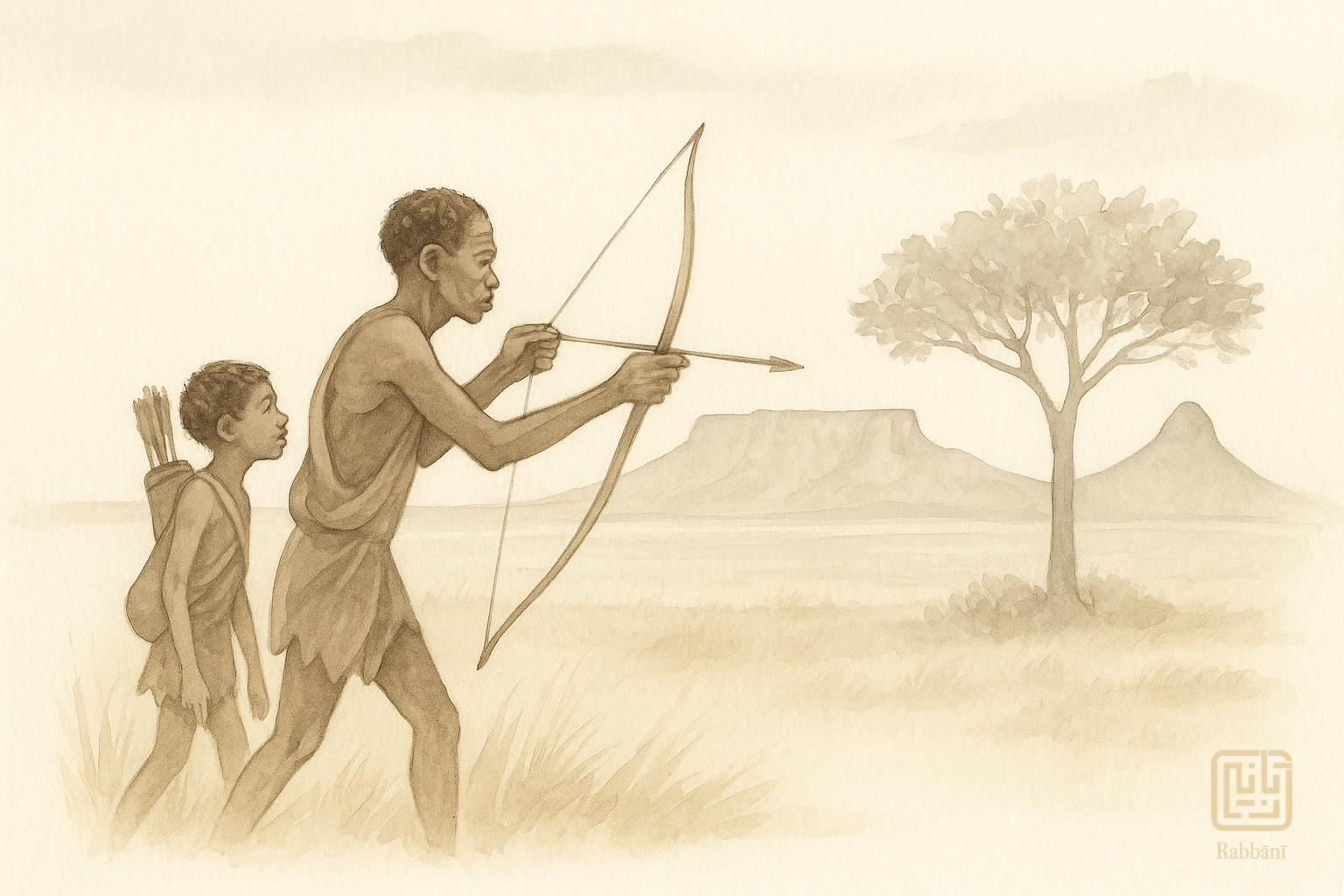
took his young son, Nori, and journeyed south along the Atlantic edge.
Not fleeing.
Seeking.
Their goods were wrapped in leather.
Their bows slung across their backs.
They followed the cold sea winds,
walking toward a dream of sanctuary.
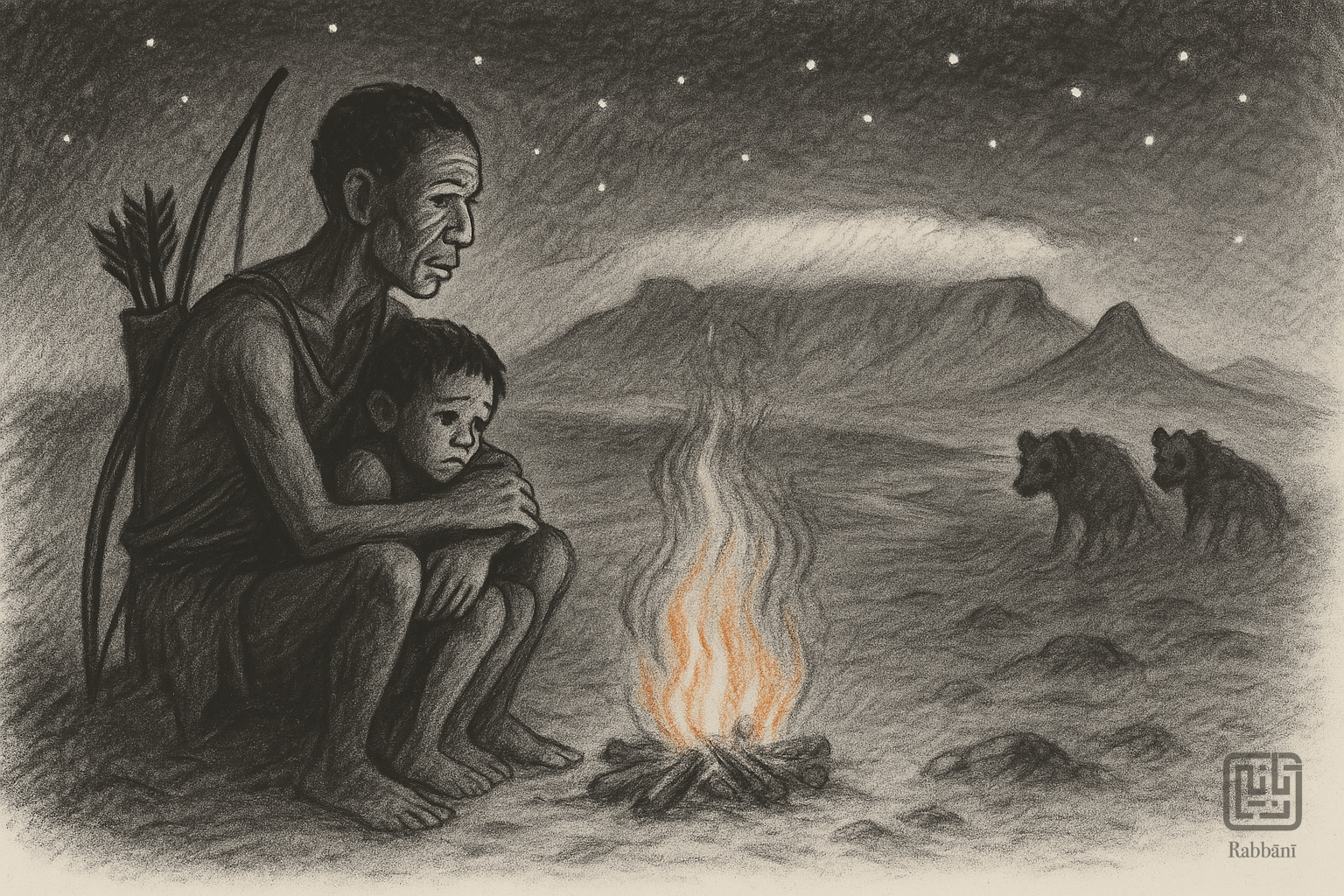
One night, as their fire danced in the dunes,
hyenas came snarling through the dark — hunting porcupines.
Gubi rose with fire in hand, casting its light wide,
pushing the predators back into the night.
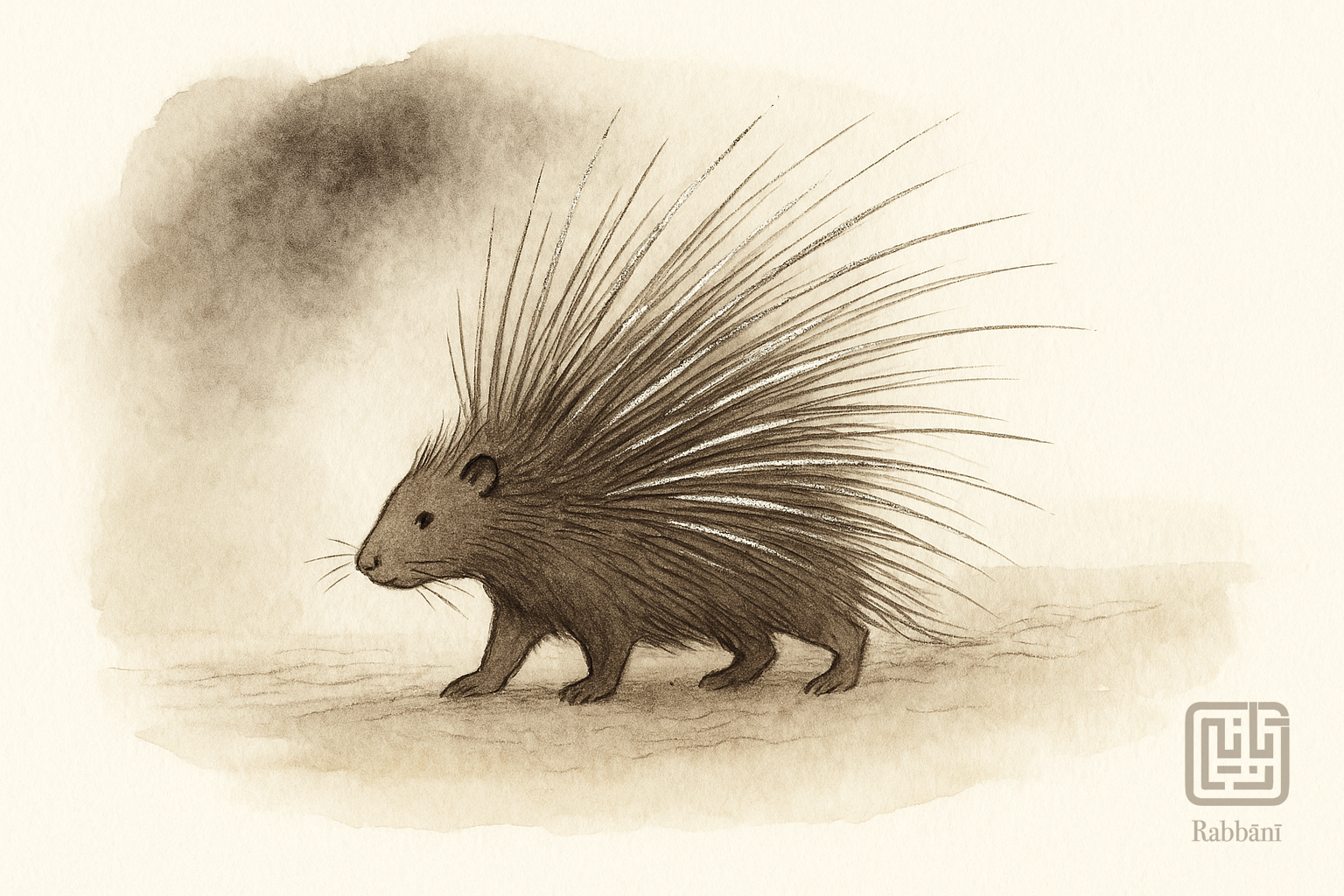
From the shadows came a porcupine.
But this was no ordinary porcupine.
She was old — a sage — her quills silver with wisdom.
She stepped forward and spoke in a voice like rustling leaves:
“You have shown courage and care.
For this, I give you a pouch.”
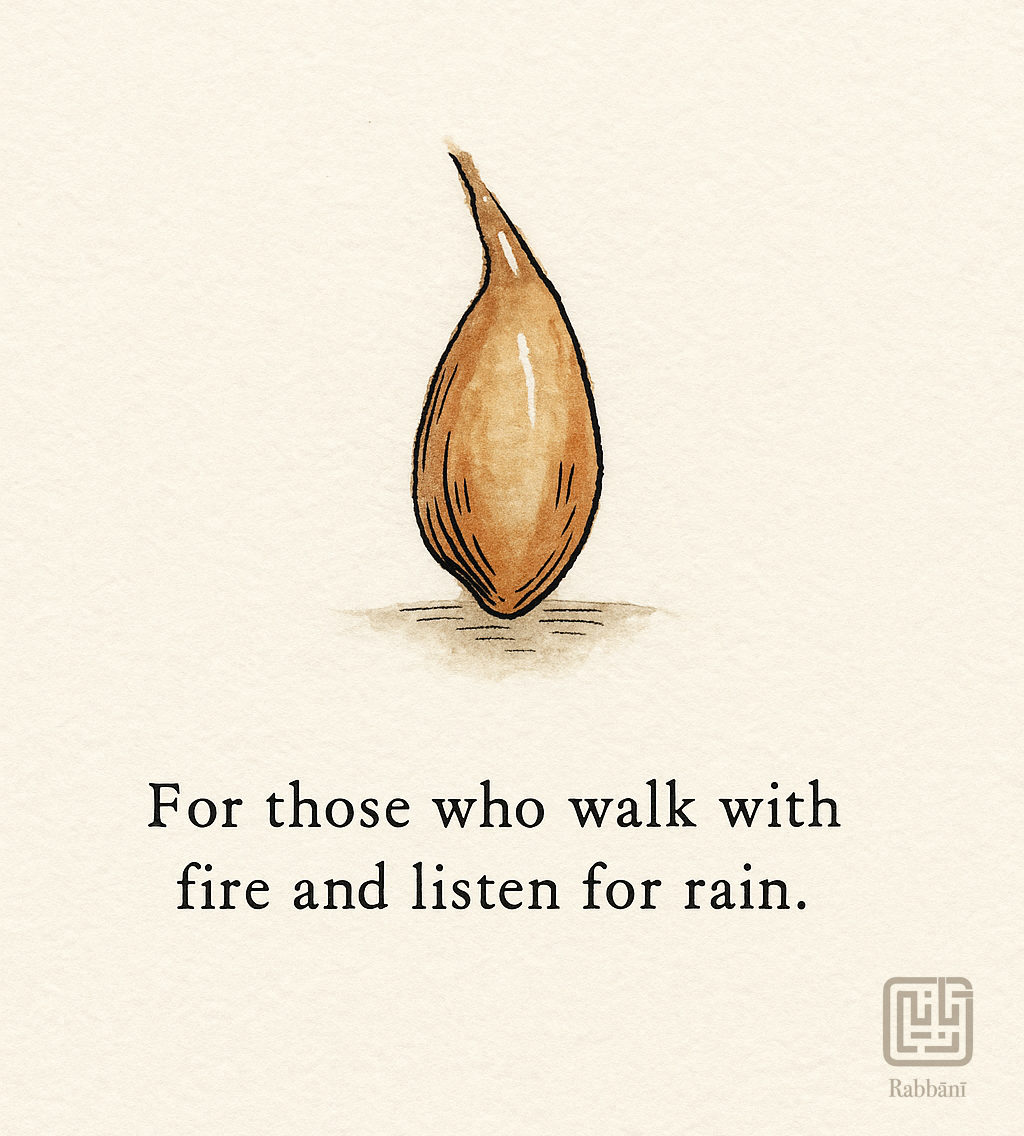
Inside: a handful of shimmering seeds —
soft, silver-tipped, unlike anything they had seen.
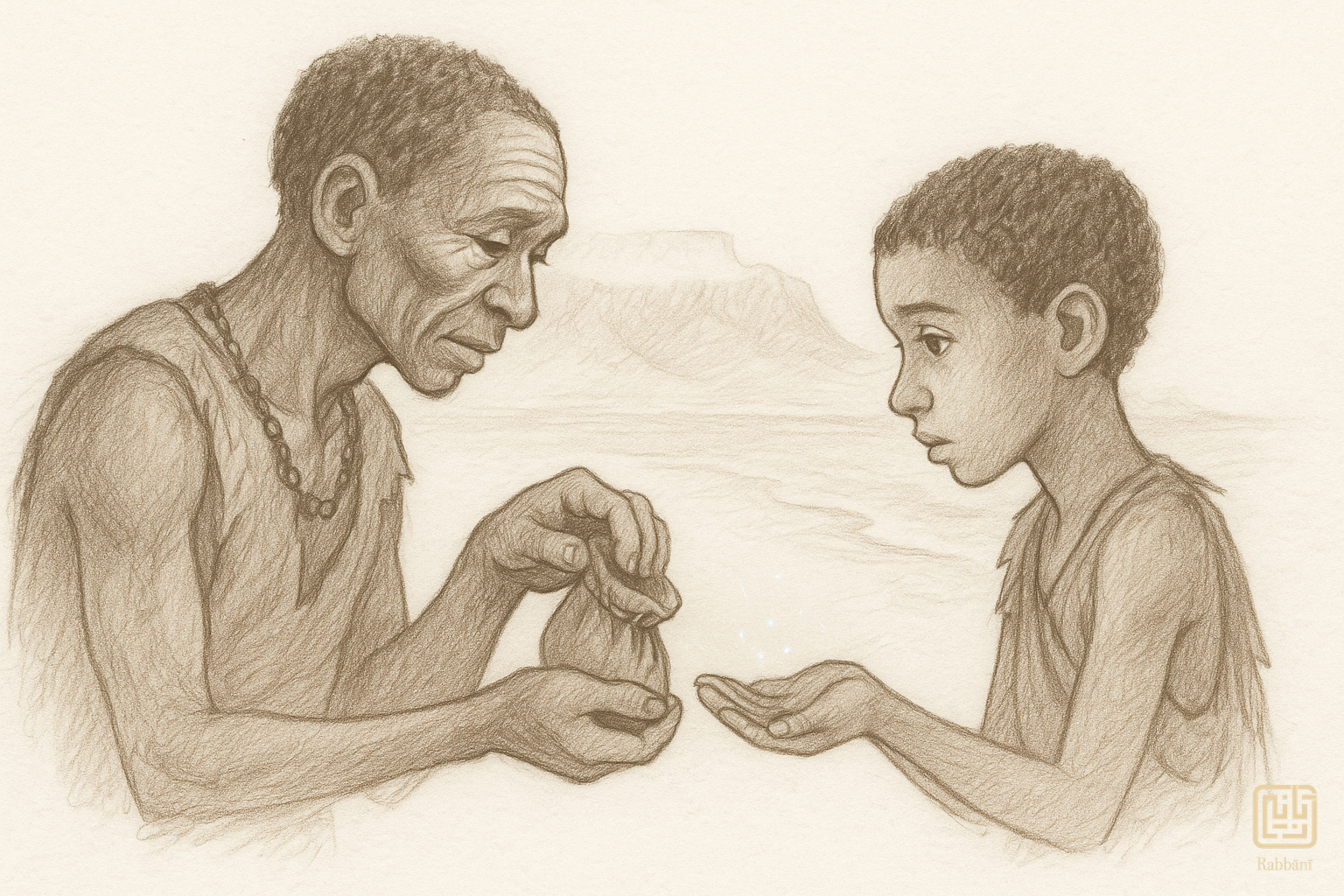
She said:
“As you walk,
look for the place where the sea makes clouds.
When you find it, plant these.
If they grow, you’ll know: this is your place.”
And so they walked on.
And when they reached the foot of the mountain —
flat, cloud-veiled, vast —
Gubi and Nori felt the truth of it in their bones.
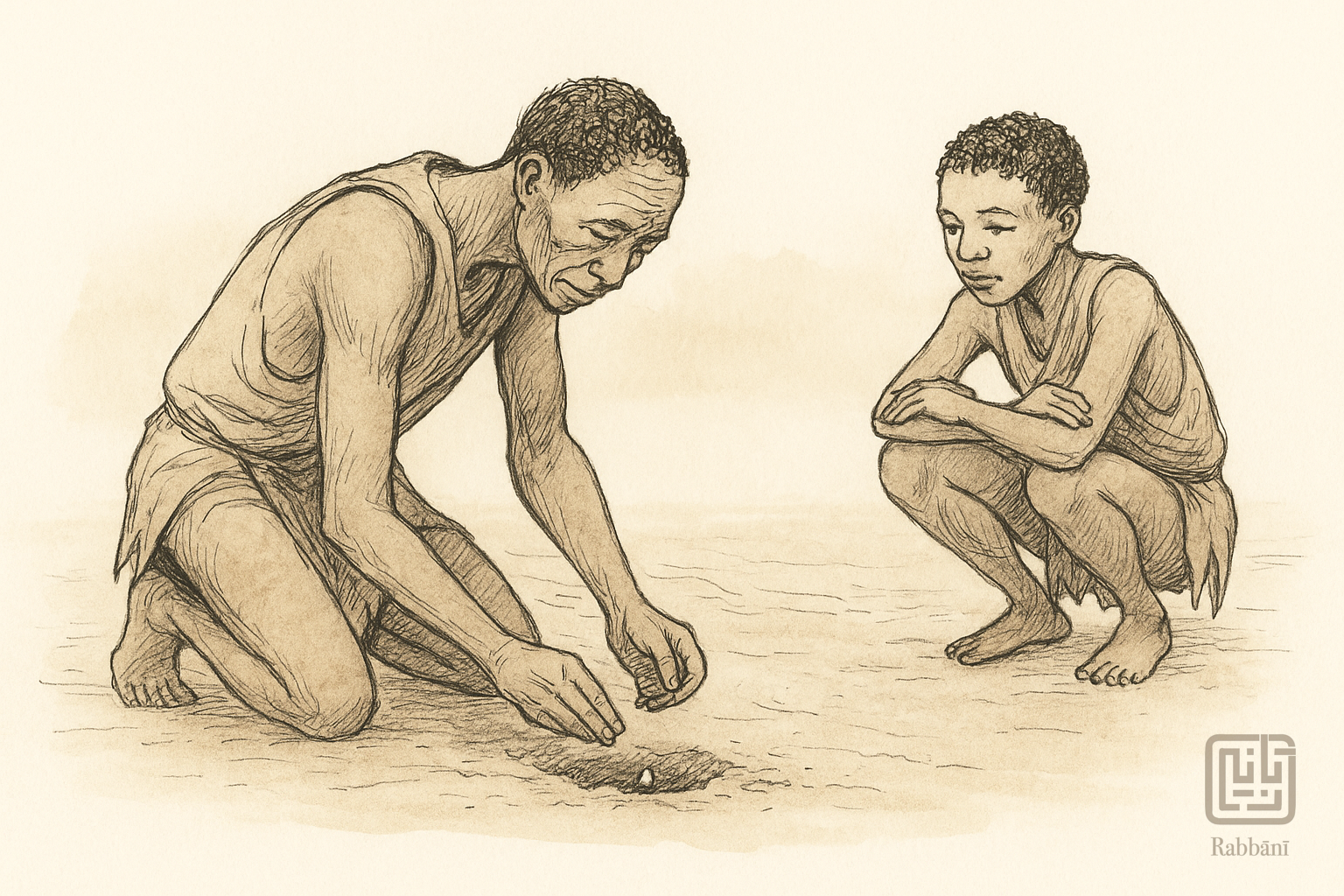
They planted the seeds.
And by dawn, the Silver Trees had begun to rise —
shimmering, breathing, alive.
Not just plants.
A blessing.
And that is how the Silver Tree — found only here —
came to live beneath Table Mountain.
Not brought by botanists.
Not named by settlers.
But gifted by a porcupine,
Planted by Gubi and Nori,
Rooted in fire, story, and seed.
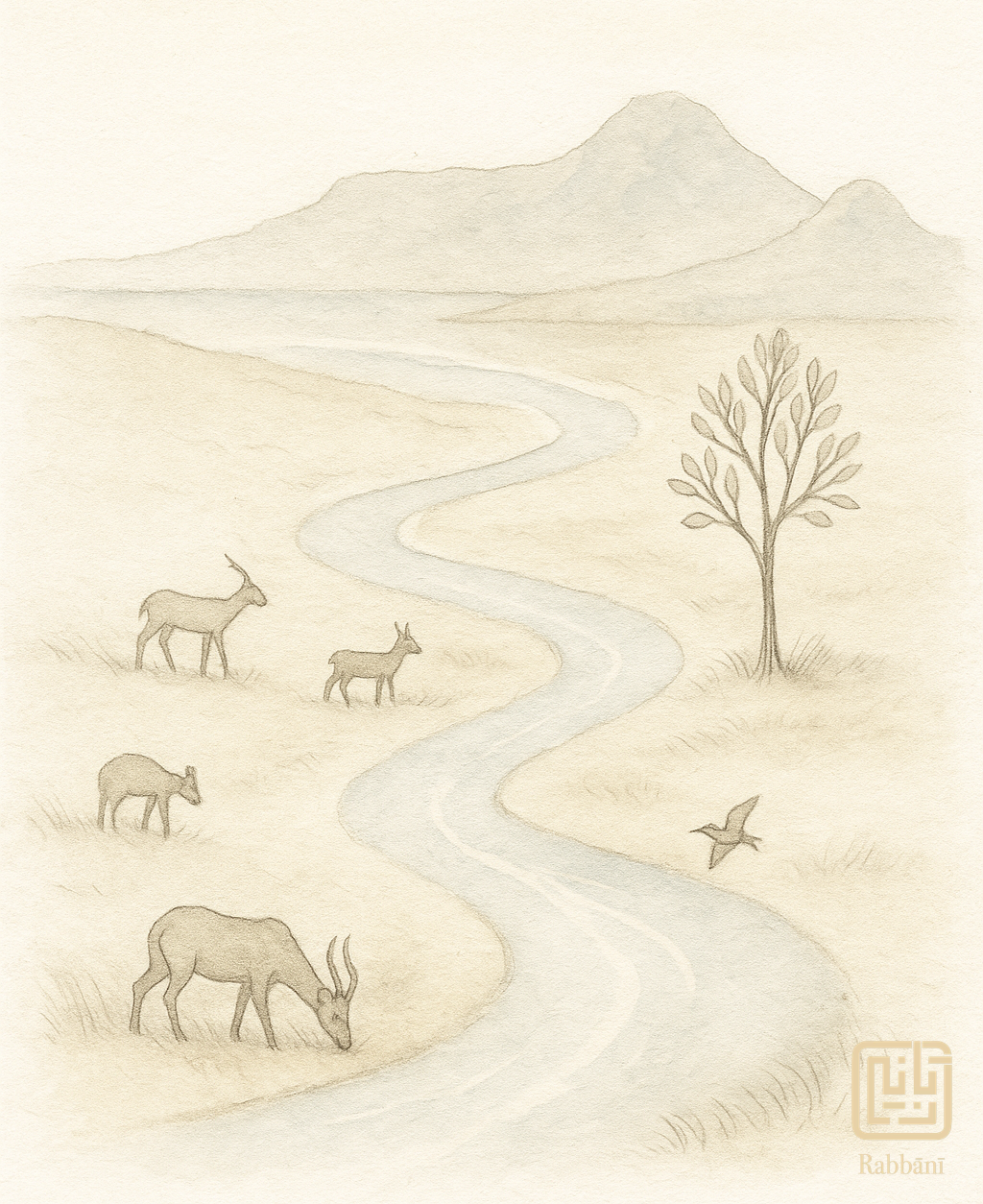
And when the rains came,
those Silver Trees
drank from the river
that flowed down the mountain —
the one they called Camissa —
the place of sweet waters,
rushing underground, murmuring toward the sea.
Even now, that river runs — quietly —
beneath the city that forgot it.
But the mountain remembers.
It remembers its own name.

Not Table.
But Hoerikwaggo — the Mountain of the Sea.
To its right, the curled-back hill they once called The Sleeping Lion —
its back arched into what settlers would name Signal Hill,
its mane rising into Lion’s Head.
To the left, the shadowed one —
once called Windmaker’s Watch,
now called Devil’s Peak.
The land is older than its names.
And stories, like rivers, find their way back.
Epilogue
Some stories are planted, not written.
They take root in silence.
They grow in the shade of memory.
This is one of those.
Passed from mother to daughter, from father to son,
from fire-circle to ear, from silence to word.
The Silver Tree still stands.
The mountain still watches.
And somewhere, Gubi and Nori are still walking —
between cloud and coast,
between the land’s longing and the sky’s answer.
So tell this story again.
When the mountain is misted,
when the wind shifts,
when the child beside you asks,
“Where did we come from?”
Tell them…
“Let me tell you the story of Gubi and Nori —
the spark and the seeker —
and the tree that shimmered with yes.”
Postscript
This story is told in honour of those who remind us that memory is a form of resistance.
We acknowledge Patric Tariq Mellet, whose book The Camissa Embrace reclaims the deep currents beneath colonial erasure. Through his work, Camissa is no longer hidden — it is remembered as a place of sweet waters, of creolised identity, of sacred convergence.
We also draw from Stuart Hall, particularly The Fateful Triangle: Race, Ethnicity, Nation, which reminds us that nations are not simply born — they are narrated into being.
To say I am from Camissa is to resist imposed categories and to speak from the riverbed of relation — to narrate the nation otherwise.This reflection flows alongside the companion essay:
→ A Word That Wounds and Wakes Us: Rethinking “Coloured” in the Age of Memory
which wrestles with the term “Coloured” — its violence, its survival, and the sacred dye of remembrance:
ṣibghah Allāh — the Colour of God (Qur’an 2:138).
🌿 Author’s Note
I wrote this story in honour of a voice passed through many generations — from my mother, to her mother, and beyond. It weaves ancestral memory with imagination, drawing from the wisdom of our lands, our rivers, and our people.
Gubi and Nori may be characters in legend, but they carry something real: the spirit of all those who walked before names, who travelled with seeds, and who listened deeply to the mountain’s silence.
I offer this story as a small act of remembering — a quiet prayer that memory may once again run like water beneath the city.
– Adli Yacubi
Writer. Listener. Wordsmith of the Sweet Waters.

 Adli Yacubi
2 responses to “The Legend of the Silver Tree”
Aslms Br Adli
Just a thought..
Could it be the very same seeds of the spring flowers growing out of the wall of Tuan Guru’s kramat, perhaps…
Or Devil’s Peak kramat, or Cape Point or Simon’s Town…
PEACE
Kulsum
LikeLike
Wa ʿalaykum al-salām dear Kulsum 🌿
What a luminous thought — yes!
Perhaps those very seeds scattered wide —
Tucked into stone cracks of the Kramats,
Carried on wind to Simon’s Town and Cape Point,
Drinking rain at the foot of Devil’s Peak…
Maybe even whispered into the wildflowers
blooming from Tuan Guru’s resting place —
roots gripping memory, petals lifting prayer.
This is the beauty of story:
It doesn’t close things.
It opens the world.
Thank you for adding your seed.
May it grow.
LikeLike